Rebuilding Place in the Urban Space

"A community’s physical form, rather than its land uses, is its most intrinsic and enduring characteristic." [Katz, EPA] This blog focuses on place and placemaking and all that makes it work--historic preservation, urban design, transportation, asset-based community development, arts & cultural development, commercial district revitalization, tourism & destination development, and quality of life advocacy--along with doses of civic engagement and good governance watchdogging.

Saturday, October 31, 2009

Military base relocation and sprawl

In honor of Congressman Moran's op-ed in last Sunday's Post about the negative implications of base relocation in Northern Virginia in terms of how the decisions promote driving over transit and other sprawl promoting aspects, "Why Northern Virginia's traffic may be about to get worse," below I reprint (with a couple edits) a blog entry from August 25, 2005.

This paragraph is critical:

My concerns center around the sprawl-promoting aspects of the move. Making Fort Belvoir a bigger regional military center increases car trips because it's not well connected to the current transportation infrastruture.

Clearly, managing transportation impact was not part of the charge in decision making. And as I have said before, in the DC region, the transportation demand management requirements of the Federal Government have some serious gaps, at least as they are expressed in the Federal Elements of the DC Comprehensive Land Use Plan.

Federal facilities, for the most part, should be required to be sited within 0.5 miles of a transit station at the most, and right at the station preferably (see "Pondering the End of a Line" from the Washington Post as one example of why federal facilities should be located immediately adjacent to high capacity transit), primarily subway or light rail (not streetcar), secondarily by railroad or street car, or tertiary by a high capacity bus station. This isn't the case with current regulations, although federal government agencies are required to do significant transportation demand management planning.

Some agencies are more oriented to transit access than others. For example, while the Station Place Development adjacent to Union Station was not welcomed by many H Street neighborhood residents because of design considerations, the location was seen as desirable by the Securities and Exchange Commission, because already more than 50% of their employees used transit, mostly the subway, to get to work. On the other hand, many agencies move farther from the core.
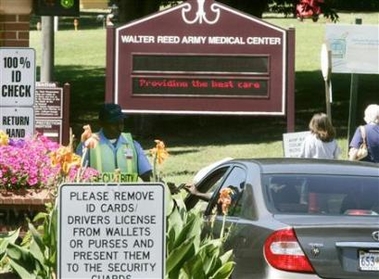
Walter Reed
Security personnel checks vehicles entering Walter Reed Army Medical Center in Washington August 25, 2005. A military panel voted on Thursday to close the Walter Reed Army Medical Center, which has treated U.S. presidents and soldiers including Iraq-war casualties over nearly a century in the U.S. capital. (Larry Downing/Reuters)


Today's papers report on the BRAC decisions with regard to various military installations in the Washington region as well as the broader region including "out-state" Maryland and Virginia. Stephen Pearlstein's column in the Post "Base Closings are an open door," argues that these moves will help broaden the business mix and lead to longer term health of the local economy by not being so reliant on the military. (This is also discussed in "TRANSFORMING DC'S OUTDATED MILITARY FACILITIES INTO CITY REVENUES" from the NARPAC website.)

More generally, the State of Maryland is a big winner in this process, as the Baltimore Sun reports in "Panel vote would bring over 7,000 jobs to Md.: Base closing, realignment boosts Fort Meade, Aberdeen Proving Ground; State could end up with largest net gain in jobs."

My concerns center around the sprawl-promoting aspects of the move. Making Fort Belvoir a bigger regional military center increases car trips because it's not well connected to the current transportation infrastruture.

And proposals to extend Metro to Fort Belvoir and even to Fort Meade in Maryland (suggested by state officials in Maryland) will add to the transportation infrastructure, but in a way that makes the newly connected area more likely to be developed in traditional sprawling patterns.

As far as Walter Reed goes, people are probably right that if the District can get control of this property (a very long process as pointed out by Delegate Norton) there will be a long-term net gain to the city as it is likely that most of the people working at Walter Reed are suburban residents.

In the old days, most people lived relatively close to work, and people walked or took streetcars to get to work. For example, perusing Census enumeration sheets for the H Street neighborhood for the early part of the last century finds that hundreds of people work for the Government Printing Office, located a short distance away at North Capitol and H Street, or the Bureau of Engraving and Printing, which spun off the GPO, or at private printers that grew up in the area as a cluster of printing skills developed (e.g, the headquarters of XM Satellite Radio was once a printing plant). Today, if a handful of GPO workers live in Greater Capitol Hill, I would be very surprised.

Labels: ,

Friday, October 30, 2009

DDOT to Hold Meetings on Transit Recommendations Including Streetcars

Reprinted from 10/15/2009. Note the WTOP radio story, based on the first meeting, "Ambitious plan to bring streetcars back to D.C.." There are 3 public meetings left, on Monday, Tuesday, and Wednesday of next week. The WTOP piece supports my reasons for concern, as discussed below.

Note that Alex B. called my attention to the Transit studies that I said (I excised the text) were no longer online. Alex provided this link, DC Alternatives Analysis (DCAA), and this one is also good because it has costing and phasing information, DC Transit Development Study—Executive Summary (also see their presentation to City Council, DC Transit Development Study—City Council Hearing).

-----------------------
It happened that Matt Johnson was at the ACT monthly meeting on Tuesday, so we talked after. Matt is a blogger, both on his own blog, Track Twenty-Nine, and within Greater Greater Washington. Although Matt is "young," he's already probably forgotten more about fixed rail transit especially railroads, than I will ever know...

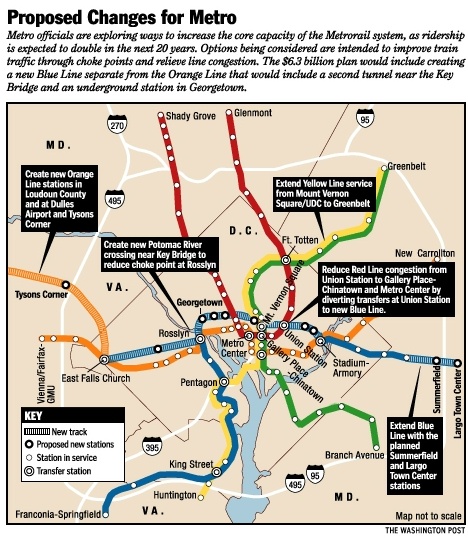
So we were talking about a more recently energized WMATA planning division, for example that they are putting the separated blue line back on the planning table and that there is a recognition that the decision in 2003 to devolve responsibility for transit (WMATA) expansion planning to the jurisdictions means that there is no regional planning perspective brought to bear on heavy (and light) rail transit planning. That funding is an issue. Etc.
Proposed changes for the WMATA system, 2001 (separated blue line)
Circa 2001. These plans were scuttled in 2003. Washington Post graphic.

The failure to plan regionally for transit is an issue, I believe in the context of the DC "Streetcar" studies. I wrote part of this (below) in a comment on an entry a couple days ago, in response to a comment about the design of the WMATA system, but the text below is expanded beyond my earlier comment.
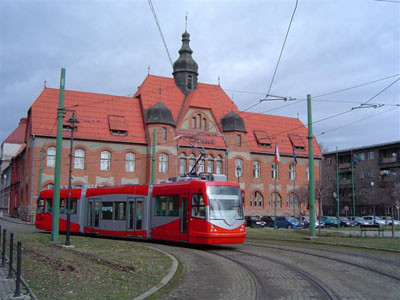
DC Streetcar in the Czech Republic
DC Streetcar being tested in the Czech Republic, where it was manufactured.

You may know that I have proposed that a streetcar or light rail line be developed for Rhode Island Ave., starting even as far inward as Dupont Circle, although I suggested it from RI Station originally. Peter Shapiro, an ex member of the Prince George's County Council, suggested such a line could go as far as Laurel. Note that MTA in Maryland studied a streetcar for route 1 in the mid 1990s.

At the H Street streetcar meeting in September, I mentioned the point that DC needs to (1) distinguish between Light Rail -- which is scaled to be a more regional kind of service -- and streetcars -- which are intended for a more local service -- depending on demand potential and (2) plan regionally, not just with a parochial focus on DC, (3) because part of providing such services should be not only to improve mobility within DC but to remove traffic coming into (and then going back out of) the city.

For example, major arterials such as Wisconsin, Connecticut, Georgia, 16th Street, North Capitol, Rhode Island, Michigan, South Capitol, Constitution, Independence, H Street, etc., are major routes into and out of the city, primarily used by commuters during rush hour periods.

By thinking about surface fixed rail transit in this context as well, "DC's Transit Future" may well need to be more expansive--and replanned--than what has been planned within the context of "streetcars."
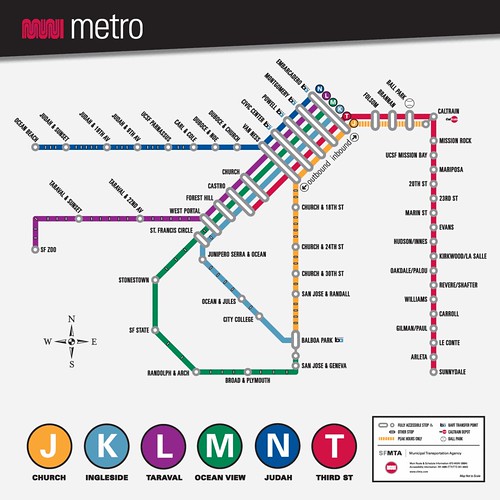
San Francisco MUNI map
Map of the fixed rail transit system in San Francisco, the MUNI, which is managed and planned separately from the BART subway system. The BART is a regional subway system and the MUNI is a local transit system exclusive to San Francisco, planned in part to satisfy a variety of needs, including promoting tourism (i.e., Cable cars and the Market Street line).

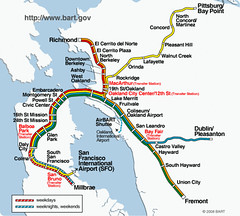
By comparison, the BART system covers a much broader area.
Bay Area Rapid Transit System map (BART)

In the DC region, WMATA tries to do both--provide metropolitan commuter rail services, and intra-city, or more close in fixed rail transit.

Also see "The (Meta) Regional Transit Network and transportation "vision" maps and "Adding cultural heritage dimensions and expanded service capabilities within commercial districts to DC Streetcar planning."

I don't think the necessary rethinking of "DC's Transit Future" will be happening as
Gabe Klein, the director of DDOT, either didn't really understand the points I was making (although I could be reading more into his response than is justified) at the Q&A in the H Street meeting, or he was just blowing off my assessment of more fundamental needs and issues in the context of surface fixed rail transit planning and development.

From email:

Series of Open Houses Scheduled in Every Ward

(Washington, D.C.) - The District Department of Transportation (DDOT) is embarking on a public outreach tour to all eight wards of the District to engage residents and businesses in the implementation of improvements proposed for the transit system for the city, including streetcars.

DDOT will be holding a series of open houses beginning later this month to present the findings of the DC's Transit Future study. DC's Transit Future studied short-term and long-term surface transit improvements for the District, potentially including additional limited-stop bus services, bus rapid transit (BRT), and streetcar services. The meetings will focus on DDOT's proposed streetcar network.

DDOT initiated the study in 2004 as a joint effort with the Washington Metropolitan Area Transit Authority (WMATA). It included a comprehensive public outreach program and a multi-corridor Alternatives Analysis that evaluated modes of transportation (bus and streetcar) and an implementation schedule for transit improvements in the District. The Interim reports of the study recommended a number of improvements, many of which DDOT has already implemented, such as bus improvements on Georgia Avenue/7th Street, 16th Street, and the Metrobus 30s Line with the launch of express services.

DDOT has already initiated construction on two streetcar lines, and the public meetings will give District residents an opportunity to hear about the current progress and view updated plans for future streetcar lines and other exciting transportation investments across the District.

The dates, times, and locations of the public meetings are as follows:

Ward 8: Monday, November 2, 2009, 6:30 pm - 8:30 pm
Savoy Elementary, 2400 Shannon Place, SE

Ward 5: Tuesday, November 3, 2009, 6:30 pm - 8:30 pm
Luke Moore Academy , 1001 Monroe Street, NE

Ward 3: Wednesday, November 4, 2009, 6:30pm - 8:30 pm
Stoddert Elementary, 4001 Calvert Street, NW

The program for all eight open houses is the same; it will consist of display boards, maps, information about the proposed system, and opportunities for participants to speak individually with and ask questions of project team members.

Recommendations from the plan have already been implemented as seen in bus improvements on Georgia Avenue/7th Street, 16th Street , and the Metrobus 30s Line.

Now in 2009, with a growing population and employment opportunities and the need for greater economic development for residents in the District, DDOT is revisiting the District's future transit options, and is looking to engage residents to comment on the recommendations.

For further information, please visit DC Streetcar Project website.

---------------------
Note that the DC Transit Futures (Alternatives Analysis) website is no longer online, although some of the documents are online at the Mass Transit Administration subwebpage (these are listed above).

This is an archival copy of the DC Transit Futures website with many of the documents:

-- DC Transit Future website, April 2007 -- check out the publications page. It doesn't link to the full document, but to a 12 page executive summary and many of the assessment documents.

Labels: , ,

Transportation for Maryland coalition meeting (Baltimore)

From email, but I assume that Transportation For America is working on building state level campaign affiliates to work for the passage of the next transportation enhancements bill, which was supposed to expire this year, but has been continued/extended for 18 months:

Help Shape National Transportation Policy! After National Health Care reform, the next big issue for legislators, the White House, and stakeholders from around the country could be Transportation Reform. How should Congress allocate an expected $400-500 billion in transportation funds over six years? Will public transit and other transportation choices receive enough funding?

We invite you to learn the latest about the federal transportation debate and how it affects Maryland. You can also learn about and join a new "Transportation for Maryland" coalition that is working with the federal Transportation for America organization to push for:

• Establishing better accountability and transparency in the State and Federal transportation processes.
• Leveling funding for all modes of travel
• Creating a transportation system that helps achieve climate, energy and employment goals.

When: November 2, 2009, 6:30 pm

Where: Episcopal Cathedral of the Incarnation, 4. E University Pkwy (corner of Charles St. and University)

Speakers:
Brian O'Malley and Otis Rolley, Central Maryland Transportation Alliance
Dru Perkins-Schmidt, 1000 Friends of Maryland
Rev. David Casey, BRIDGE
Dan Pontious, CPHA
Transportation For America


Transportation for Maryland Agenda

RSVP to info@cphabaltimore.org or 410-539-1369 x100.

Labels:

Regional corruption: Baltimore

Unlike the Post, the Baltimore Sun puts its stories on corrupt and illicit dealings in the City of Baltimore on the front page. Yesterday's paper had two stories related to the ongoing investigation of Mayor Dixon:

-- "Lipscomb gets probation for campaign violation" (plus today's follow up "Lipscomb apologizes for role in City Hall scandal" and coverage from earlier in the month, "Dixon's lawyers plan appeal on perjury charges ruling")

-- "Baltimore panel blocks company's payment to the City Foundation"

The City Foundation is a 501(c)3 conduit that allows developers and others currying favor with the city government to make donations or to have community benefits directed to this organization so that payments are considered charitable deductions.

The City Foundation story is not dissimilar to the unit set up by the DC Housing Authority. Likely by the way that Michael Kelly of the Housing Authority (and he was one of the best government officials in the City Government over the past 8+ years, reforming a department that had been previously termed one of the absolute worse public housing authorities in the U.S.) was "eased out" (see "D.C. Housing Authority Director Takes New York City Job" from the City Paper) had to do with this Parks contracting debacle and his likely distaste for working outside of the law.

From the article:

The Baltimore Board of Estimates on Wednesday blocked a company's payment to the embattled Baltimore City Foundation, and the city comptroller called for a halt to all donations to the private nonprofit group amid questions about how it oversees spending.

Later in the day, Mayor Sheila Dixon called for an outside consultant to recommend new oversight procedures for the city-controlled foundation, her strongest response since a Baltimore Sun investigation revealed questionable transactions by public employees using charity money.

As inquiries continue about whether the group's board of directors employs adequate safeguards to ensure that donations are properly spent, City Comptroller Joan M. Pratt requested that a scheduled $50,000 payment to the foundation set for approval on Wednesday be sent directly to the city's coffers.

"Right now, I think contributions made for the benefit of the city should go directly to the director of finance," Pratt said, adding that foundation board members "don't have the appropriate oversight." She later said she wanted to review five years' worth of independent audits before donations resume. The Board of Estimates did not act on that suggestion.

Also see "Audit of City Foundation sought." The article is a follow up to a Sun investigation of the Foundation.

Seems like the Baltimore Sun is stronger at investigation of the local government than is the Washington Post. The Post can be proud of its investigation of problems with funding of care services to HIV patients ("Wasting Away: The Squandering of D.C.'s AIDS Dollars") but the reality is that such an investigation doesn't get at the systematic corruption of processes, systems, and procedures that typifies the Executive and Legislative branches of the District of Columbia municipal government.

Such investigations give the appearance of concern and industriousness, without leading to substantive changes.

About 20 years ago I read a speech by the founder of a media watchdog group, and he talked about what he called the "bias of the middle" of news coverage on U.S. federal government actions overseas--that events like overthrows of overseas governments had good intentions, that mistakes were made, but they were aberrations, and that they would never occur again.

All the while, the government machine, what Harvey Molotch calls the Growth Machine in the municipal government context, keeps spinning along.

From a past blog entry:

I am a fervent proponent of the Growth Machine thesis, first laid out by sociologist Harvey Molotch, in the seminal article, City as a Growth Machine: Toward a Political Economy of Place. From the abstract:

A city and, more generally, any locality, is conceived as the areal expression of the interests of some land-based elite. Such an elite is seen to profit through the increasing intensification of the land use of the area in which its members hold a common interest. An elite competes with other land-based elites in an effort to have growth-inducing resources invested within its own area as opposed to that of another. Governmental authority, at the local and nonlocal levels, is utilized to assist in achieving this growth at the expense of competing localities. Conditions of community life are largely a consequence of the social, economic, and political forces embodied in this growth machine.

Political scientist Clarence Stone, a professor at University of Maryland has a competing thesis, that of the "urban regime." I don't think these theories are competing so much as different sides of the same coin. "Growth Machine" theory explains the motivation of "the land-based elite," and "urban regime" theory explains in detail how the land-based elite operates and functions.

Professor Stone was kind enough to send me a recent paper, "Now What? The continuing evolution of Urban Regime analysis," from 2005. He writes:

An urban regime can be preliminarily defined as the informal arrangements through which a locality is governed (Stone 1989). Because governance is about sustained efforts, it is important to think in agenda terms rather than about stand-alone issues. By agenda I mean the set of challenges which policy makers accord priority. A concern with agendas takes us away from focusing on short-term controversies and instead directs attention to continuing efforts and the level of weight they carry in the political life of a community. Rather than treating issues as if they are disconnected, a governance perspective calls for considering how any given issue fits into a flow of decisions and actions. This approach enlarges the scope of what is being analyzed, looking at the forest not a particular tree here or there. (emphasis added, in this paragraph and below)

In discussing Atlanta, Stone writes: "Land use, transportation, and housing formed an interrelated agenda that the city's major economic interests were keen to advance;" and

By looking closely at the policy role of business leaders and how their position in the civic structure of a community enabled that role, he identified connections between Atlanta's governing coalition and the resources it brought to bear, and on to the scheme of cooperation that made this informal system work. In his own way, Hunter had identified the key elements in an urban regime – governing coalition, agenda, resources, and mode of cooperation. These elements could be brought into the next debate about analyzing local politics, a debate about structural determinism.

In short, it's the "system" of governance, and how it operates, rather than looking at recurring events separately, as if they are not connected.

Labels: , , , , ,

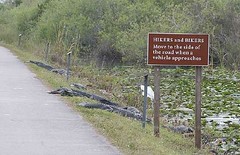
Road sign, hikers and bikers move to the side of the road when a vehicle appears

Internet photo, original source unknown.

A new definition for the term: road kill.

The travelogue of the world's Corrupt Cities includes DC, what does that say about us?

http://ecx.images-amazon.com/images/I/41YXH43GDPL._SL120_.jpg
Speaking of corruption, because I had been away and not reading the Washington Post, I was unaware of the issue of $86 million in construction contracts being given to people especially connected to Mayor Fenty, contracts let without Council approval--DC law requires that all contracts of $1 million or more be approved by the City Council. See "Housing Authority contracts 'illegal': PROJECTS MUST BE RESUBMITTED 'This was not something that agencies can just do'."

Of course, the fact that the "Attorney General" says the contracts are legal, see "D.C. parks contracts are legal, official says: Nickles had said housing group broke law in approval process" from the Post, only reiterates the need to have the Attorney General position be popularly elected. Peter Nickles proves that it is difficult for the holder of the position as appointed by the Mayor to be able to balance the responsibilities "to the people" as well as to his boss.

You don't transfer monies to an under-transparent unit of the government, technically independent with a 501(c)3 status, because you are trying to speed things up, but because you are trying to do things under the table. Directors of the Parks Department, Clark Ray and Ximena Hartsock, had to know that this smelled--and was illegal, a violation of contracting procedures. But they did what they were told to do.

Interesting that the Post put this on the front page of the Metro section and not the front page. And the editorial, Mr. Fenty's end run: The D.C. Council needs some answers on $82 million in contracts" is so even handed it's pathetic.

From the editorial:

Mr. Fenty denied any involvement in selecting any of the firms. Administration officials said the practice of using the housing authority to award contracts started in the administration of former mayor Anthony A. Williams because of longstanding problems in the city's procurement process and the authority's expertise in getting work completed. Moreover, they said that all 20 contracts, including the one to Banneker to manage the projects, were competitively bid and that they will conduct a review to ensure that proper procedures were followed. They note that if they wanted to conceal the contracts, they wouldn't have invited council members to groundbreakings for the projects.

The "coincidence" of someone connected to the Mayor getting some of these contracts, see "The New Cronies: Adrian Fenty, some frat buddies, and $86 million in city spending" from the Washington City Paper, is hardly coincidence. And the Post editorial page, the Mayor's biggest cheerleader, is being cute and indirect in order to ignore the obvious.

If this was done in the federal government, or another government agency, heads would roll. Look at how much coverage the Post has given to the shenanigans of the Director of the Montgomery County Office of Planning, Rollin Stanley, and improprieties of his administration. The amounts of money, $3,000 in one case, were minimal, although the mistakes in judgement ("Montgomery Planning Chief Gives Up Government-Issued Credit Card" and "Montgomery Planner Tried to Hinder Audit, Report Finds" from the Post, and also see "Montgomery planning chief blocked probe of computer failures from the Examiner) were significant.

Still, the behavior pales in view of what the Post takes in stride every day coming from the halls of municipal government in DC--the Wilson Building.

If we were to count the column inches devoted to the Rollin Stanley story, vs. the Parks contracting story, I bet more space has been devoted to the MoCo story so far, despite the reality that the amounts of money in question are thousands of times greater in DC.

I don't see how this kind of behavior is any different from what happened during the Barry Mayoralty. See "
A dream deferred; a black mayor betrays the faith" from the Washington Monthly in 1986. This article, by then Philadelphia Inquirer columnist Chuck Stone, was about black mayors Wilson Goode of Philadelphia, with a sidebar on the Washington situation. (This article came out more than one decade before the book I frequently tout, Dream City.)

It's as if the Post's historical memory only goes back a couple weeks.

But it is the flip side of what I wrote about yesterday in terms of Fred Siegel's discussion of the municipal entitlement economy. And yes, it's but another example of how the levers, and in particular the spending, of government are used to build fortunes by rewarding friends.

I guess with those community campaigns sponsored by libraries ("ONE BOOK" READING PROMOTION PROJECTS (Center for the Book, Library of Congress), where they promote everybody reading one particular book, and coming together in a variety of events to discuss it, well, I recommend Corrupt Cities: A Practical Guide to Cure and Prevention.

From the description of the book

Corrupt Cities
is a practical guide to assist in the diagnosis, investigation and prevention of various kinds of corruption. Bringing together both a conceptual and practical framework, the publication is designed for citizens and public officials, especially at the municipal level. The approach presented discourages more controls, more laws and more bureaucracy, while focusing on systematic corruption and its preventive measurers. It encourages consideration of the economic costs of corruption, rather than moral or ethical factors, as the driving force behind anti-corruption efforts. It also emphasises that "fighting corruption should not be considered an end in itself, but an orienting principle for reforming urban administration."

The arguments put forth are supported by examples of anti-corruption strategies, particularly from Hong Kong and La Paz. The publication also includes practical tips to adapt these strategies to difficult scenarios, for example, in cities/communities characterised by political indifference, bureaucratic inertia, and where citizen support may exist but is yet to be mobilised.

Ironically, coming back on the plane I was talking with a college student sitting next to me. She is studying business, at a university in Michigan. I opined that there is something to be said for "competition" in government, given how the oligopolistic "Democratic" control of municipal government in DC leads to terrible behaviors and actions. I didn't even know about this most recent example that decisively proves my point.

Labels: , , , , ,

Thursday, October 29, 2009

How Big Cities Go Bad/The Entitlement Economy

In "3 ways big cities go bad," Robert Robb, a columnist for the Arizona Republic, gives us an update on the thinking of Fred Siegel. I consider Siegel's The Future Once Happened Here to be one of the more important works on the decline of municipalities over the past 40 years. In combination with Molotch's work on the City as a Growth Machine, you really understand the underlying processes of why what happens the way it does.
Book cover, The Future Once Happened Here by Fred Siegel
In the profession, Siegel is considered to be "conservative" but he describes himself as a small-government Democrat. From the article:

Siegel believes there are three fundamental ways in which big cities go bad. The first is to lose control of order and civility in their public space - the streets, sidewalks and parks. This was an essential part of New York's deterioration and subsequent crime epidemic and the primary element of its recovery. ...

The other two ways big cities go bad, according to Siegel, are interrelated: control of city politics by municipal unions and an economy that becomes too much government-driven and too little privately-driven ...

All municipal politics tend to be an insiders' affair, characterized by small-turnout elections dominated by groups with a stake in the outcome - neighborhood associations, the cultural community, downtown-development interests and city workers.

When municipal unions dominate the mix, in essence choosing their bosses, fiscal discipline becomes impossible. And once government overhead passes a critical point, the only way to create space for private-sector growth is to shrink government, a virtually impossible task once city unions dominate elections.

The result is what Siegel has called an "entitlement economy," where opportunity depends on political decisions, not private initiative

Entitlement economy is an update from the book of the concept, "dependent individualism," expanded and extended to include the entire system, rather than merely the attitudes and behaviors of individuals.

There is no question that in the capital of the federal government, the bulk of the economy depends on currying favors, and achieving benefits often at the expense of others. It's an extension of the Marxist concept of Rentier capitalism. Instead of making their money from property rather than production, they make their income through the manipulation of the political decisionmaking process.

Labels: , , ,

Maryland Planning Commissioners Annual Conference

... being held today and tomorrow, is yet another example of a program (click here for the draft program) that could and should occur in DC. Many states have similar kinds of capacity building programs, including the Massachusetts Citizen Planner Training Collaborative.

I have argued that most of DC's Advisory Neighborhood Commissions, all of which whom have the responsibility, right, and authority to "weigh in" on planning and development matters within their geographies, need to vastly increase their capacity and knowledge in order to make better/good decisions.

(Also Dallas has the great Urban Information Center at the main branch of the Public Library. There is the Planning Commissioners Journal and many online resources including the Neighborhood Planning, Our Blocks, and the Useful Community Development websites, among others.)

Having such an annual conference for ANC Commissioners and members of the respective planning and zoning committees would build the capacity and knowledge of members, provide the ability to share and build information networks across the city, irrespective of specific geographies, and provide social and other networking opportunities.

Labels: , , ,

Change in Mode Split (trips to work by transit, walking, and bicycling) relative to 1996

Of course, this is all relative. When you start with small numbers, any changes on a percentage basis tend to be quite large...

Also see "Only in Portland: Protests of 'motorist discrimination', an entry in the Commuter blog of the Portland Oregonian.

Tuesday, October 27, 2009

been away

and not able to blog (laptop has major virus issues that I haven't been able to get fixed). I'll be able to get back to the swing of things on Thursday.

Labels:

Thursday, October 22, 2009

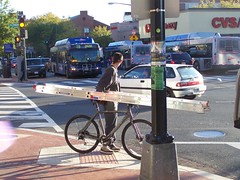
Using a bicycle as a trailer for a ladder

Also check out the organization in Philadelphia, the Pedal Co-op.

DC Transit

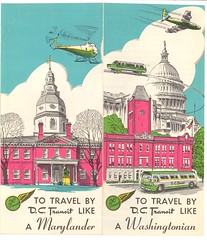
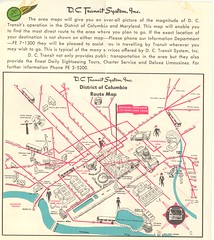
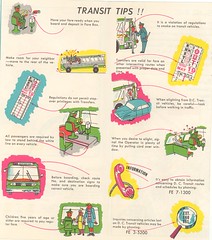
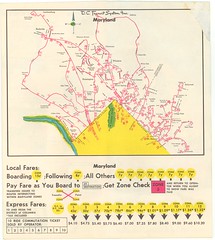
In the flotsam and jetsam of gobs of cut newspaper articles, files and other stuff scattered about at an estate sale, I snagged a transit brochure targeting tourists, published by the old DC Transit system. Not listing any streetcars, it's from sometime in the early 1960s.
Cover images, DC Transit brochure, ca. 1960s
Note the skyrail system by the U.S. Capitol.

Downtown DC bus routes, DC Transit brochure, ca. 1960s

Transit Tips, DC Transit brochure, ca. 1960s

Maryland bus routes, DC Transit brochure, ca. 1960s

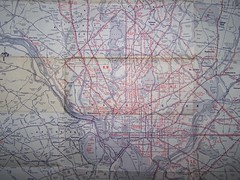
I have a slightly earlier map of the transit system, not published by the DC Transit system, also picked up at an estate sale.
Map of DC bus routes and streetcar lines, circa 1960

Labels: ,

Wednesday, October 21, 2009

Bloomingdale House Tour this weekend


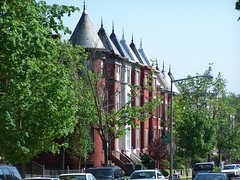
Bloomingdale Rowhouses
Originally uploaded by rllayman
From email:

The Bloomingdale Civic Association Presents "Victorian Secrets" -
A Fund Raising House Tour

Saturday, October 24, 2009
1 - 5:00 PM

This tour features 10 private homes in the Bloomingdale neighborhood - from a home that once housed nuns, to a home with an incredible garden oasis, to a North Capitol Main Street board member's lovely abode, to the best rooftop view in DC! Afterwards, join the end-of-the-tour party at the Anna J Cooper house and enjoy fantastic food & the smooth sounds of jazz artist, and Bloomingdale resident, Maurice Lyles.

This is a fund raiser to benefit the Bloomingdale Civic Association' s cooperative work and commitment to the citizens of this community.

Tickets are $15 in advance, $20 day of the tour (children 7-12 ½ price, under 7 free) and can be purchased at Bloomingdale Wine & Spirits, 1st and Rhode Island Ave., NW, Mon-Fri and at Big Bear Cafe on the day of the event.

You may also contact J.C. Blount, 202/986- 2772, J.C. Bond, 202/328- 3068 or Laurie Choice, 202/797- 7407 for additional information or to volunteer.

Tuesday, October 20, 2009

Bad transit planning or is it bad transit marketing?

As much hype as Dallas gets about the success of their light rail system, it's a relative thing. Not that many people use it and the throughput capacity isn't very significant. A heavy rail system, like the DC subway system, can run close to 40,000/track/hour, depending on the configuration. By comparison, some of the lines in Dallas have a maximum capacity of 4,000 people per hour per track.

Of course, it means you have to have a lot of equipment and personnel to be able to satisfy maximum (peak) demand. And normal rush hour demand can be exceeded by true crush levels, such as for a Presidential Inauguration or particular events.

It's why I have argued before that people who say the marginal cost of adding riders = zero are wrong, because they aren't considering how much equipment and personnel have to be bought or hired to run the base system at peak usage, plus they aren't taking into account the extra cost of building the system to be able to handle peak ridership.

This comes up because the Dallas Light Rail system had a massive public relations and operations failure over the weekend, in terms of providing service for a football game. See "DART knew limits of Green Line for Texas-OU but promoted it anyway" from the Dallas Morning News.

(cf. "Sound Transit and Sounders: Why isn't public transit ready after games?" and " Soccer Fans Encouraged to Arrive Early for Wednesday's match" from the Seattle Times, and this letter to the editor in the Montgomery County editions of the Gazette, "Where's public transportation when we need it?" about the failure to provide shuttle bus services to the US Open golf tournament)

From the article:

Long before the overcrowded rail cars began backing up on DART tracks Saturday, the transit agency knew that it could never handle more than a fraction of the crowd expected for the sold-out Texas-OU game that drew nearly 100,000 fans.

And yet, for weeks leading up to the game, it continued to promote the new Green Line as the best route to Fair Park, despite the likelihood of huge crowds. ...

Dallas Area Rapid Transit President Gary Thomas conceded Monday that the agency simply was not prepared for the crush of football fans and other fairgoers who overwhelmed the rail system on Saturday. Many fans endured trips of longer than three hours and arrived at the Cotton Bowl after halftime or even later.

"Obviously, the demand was a whole lot larger than we expected," Thomas said. "I am certainly apologetic for those riders who didn't get to where they were going in a time frame they felt was appropriate." ...

But this much DART did know: Under the best of circumstances, the agency can't deliver more than about 4,000 passengers per hour to Fair Park. Even with jam-packed trains stopping there every five minutes, with standing passengers overflowing the aisles, each two-car configuration would typically carry about 350 passengers.

DART said 36 trains were scheduled to arrive at Fair Park between 8 and 11 a.m., though it is not sure how many actually arrived due to delays on the tracks. But had every train arrived on time and been full, that would have provided rides for only about 12,000 fans.

No exact figures were available for service during those hours, though DART said that its entire light rail network provided passengers about 40,000 round trips Saturday, about 25,000 more than a typical Saturday. ...

Still, Lyons said the agency was right to advertise the Green Line as the best route to Fair Park, despite the obvious limitations of its rail cars.

"Based on the things we knew – that we would have a lot of people wanting to ride – and based on our experience throughout every day of the fair when we had good service – it was still the right thing to do, to tell people that [the Green Line] is the best way for people to get to Fair Park," he said.

The Dallas light rail system ought to have better planners and marketers than they seem to have. Or, as the title of a column in the Toronto Star puts it, "A 'world-class' transit system? Fat chance, unless we pay up."

But the big thing is to manage expectations in ways that are conscious of your constraints and your ability to satisfy the expectations you build.

Also see the past blog entries "More on Metro and rethinking transit marketing" and "Making Transit Sexy."

Labels: , ,

It ain't enough for real estate developers to control the elected officials, they have to be the elected officials too

R. Donahue Peebles, who created the Washington Marriott, is returning to D.C. with a $300 million fund and plans to redevelop a run-down area.
R. Donahue Peebles, who created the Washington Marriott, is returning to D.C. with a $300 million fund and plans to redevelop a run-down area. Photo: Nikki Kahn -- The Washington Post)

See Don Peebles: I may run for D.C. mayor" from the Washington Business Journal.

To learn more about Donohue Peebles, one needs to mine the backfiles of the Washington Post archives:

- Results, Washington Post archive search using the keyword "Donahue Peebles"
- "Back in the Game" a review/retrospective of Peebles' book, from the Washington Post.

He's not any different than other connected honchos, be they lawyers, bankers or others, who misuse their position to feed directly or indirectly out of the public trough.

-- "Lobbyist's salary for nonprofit questioned: Oversight of Homes Sought Board members borrowed, are paying back loans" from today's Post. David Wilmot is a connected real estate lawyer and lobbyist who is also an investor in properties and projects (Post article from today) who eats well off the plate of the city...

-- Or these articles from 2004 about shenanigans at the United Planning Organization, a community services group in the city that has received millions of dollars in federal and city funds over the years "Anti-Poverty Group Leader Steps Down" and "Living Well off the Poor" from the Post.

Or the myriad Post stories about the "Pitts Motel" and other "shelters" for the homeless during the Barry Era in the late 1980s:

- THE HOMELESS; Shelters are wasting resourses, wasting lives"
-
Is This Any Way To Help Homeless Families?
- Pitts Hotel: Final Checkout
- District Will Let Homeless Families Remain at Motel Shelter During Day
-
Grim Shuttle of the Homeless

don't sound any different than the Post's coverage of the provision of shelter and other services to HIV/AIDs patients in the last couple days, "'Wasting away': The sad legacy of the District's HIV/AIDS agency" and "'It doesn't seem right': A group plagued by service, cost complaints is awarded $4.5 million. How?."

God, NOTHING CHANGES.

Also see:

-- City as a Growth Machine: Toward a Political Economy of Place (Molotch)
-- book review, "Dream City: Race, Power, and the Decline of Washington, D.C., 1964 - 1994 from the Washington Monthly of the book by DC journalists Tom Sherwood and Harry Jaffe -- as journalists they are unfamiliar with the Growth Machine thesis, but their book is a perfect illustration of it.
-- A superb lesson in DC "growth machine" politics from Loose Lips (Washington City Paper) (blog entry)
-- Do the men who own the city make more sense than we do?* (blog entry)

Like "Gang of Four" sing in "Is it Love" ...

no one lives in the future
no one lives in the past
the men who own the city
make more sense than we do
their actions are clear
their lives are unknown
http://www.saycampuslife.com/images/money.jpg

Labels: , , , ,

K Street Transitway comments accepted until October 30th
See the DC Dept. of Transportation website: REMINDER: K Street Environmental Assessment (EA) Comments Due.

- K Street Transitway Environmental Assessment

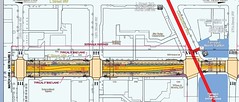
I like Alternative 3 because of the inclusion of bikeways. It's more of a "complete street" design and we need prominent examples of dedicated bike facilities in the city, especially Downtown-- why not on K Street? But Alternative 2 is a flexible alternative where the curb lane could be an additional bus-only lane in rush hour for instance.
Alternative 3, K Street Transitway

In either Alternative 2 or 3, optimizing how space is used from the face of the buildings on either side of the street, including the sidewalks, parking and service lane, side medians, and the through streets more optimally serves more people "more better."

What it will do is move transit along more quickly, provides for better vehicle throughput, and if constructed properly, as good if not better experience on the street for pedestrians (note that the K Street and Connecticut Avenue intersection is probably the #1 intersection in the city in terms of the volume of crossings Monday through Friday), and ultimately, for the ground floor businesses as well.

At the expense of some onstreet parking.

The real question here is about "prioritization," throughput, and optimality. And what it makes sense to focus upon, and upon what criteria it makes sense to use in coming to a decision.

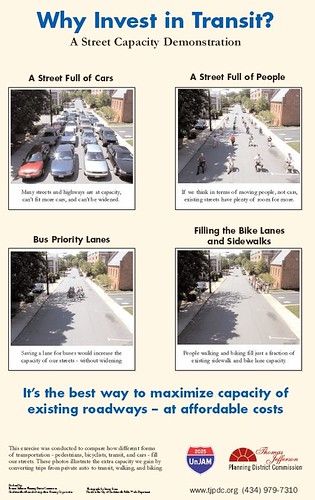
The Thomas Jefferson Planning District in Albemarle County, Virginia has a nice illustration of what it means to focus on optimality, in their Street Capacity Demonstration (although they should have included one shot of a bus with 40 passengers too). It's similar to the graphics produced in Berlin, Tampa, and elsewhere called "packing the pavement."
Street Capacity Demonstration, Thomas Jefferson Planning District
From a throughput standpoint, it makes sense to prioritize transit and the through lanes, and to be less concerned about providing a limited amount of parking spaces on the street--note that a DDOT official says there are about 300 on street parking spaces on K St. in the impacted area, and more than 15,000 spaces in parking garages and/or on-street within one block of either side (L or I Streets) of K Street.

Or as Abraham Lincoln is alleged to have said in the famous case where he represented the railroads that wanted to build a bridge over the Mississippi River vs. the riverboat interests which opposed the bridge: which interests are more important, traveling up and down the river or crossing the river?

Throughput and mobility optimality should be seen as the most important goal and objective, rather than the more narrow objective of maintaining parking on K Street.

The goal is extending the qualities of the livable city and continuing to improve DC's competitive advantages around transit efficiency.

E.g., look what is being proposed for the "42nd Street Transitway" in Manhattan--no cars. See "A Quieter, Calmer (and Car Free) 42nd Street" from Wired about the proposal from the Institute for Rational Urban Mobility about what they call vision42 and "Making New York's 42nd St. a Different Sort of Thoroughfare" from the New York Times.
Making New York's 42nd St. a Different Sort of Thoroughfare
Illustration: Mathieu Delorme.

Remember that ultimately, the K Street transitway is also supposed to support streetcar service from Minnesota Avenue, along H Street NE, to Union Station, along K Street in NoMA, Mount Vernon Triangle, and Downtown, to Georgetown (and probably with a connection to the Rosslyn Metro and a turnaround there--just like the old days).
DC Streetcar in the Czech Republic
DC Streetcar being tested in the Czech Republic.

A couple weeks ago I went to a fabulous presentation about transportation demand management programming in Arlington County. (I went to four conferences/presentations in two weeks, plus an exhibit in Philadelphia on a Saturday. That plus work and commuting means I haven't written up any of them.)

But I was thinking that while Arlington does site planning for transportation demand management, and Alexandria has hired an Arlington staffer to do the same thing, we really need to have a "parking planner" assigned to deal with parking optimization in the Central Business District.

Of course, really what we need is a "transportation management district" to manage optimality and throughput overall, rather than a strict focus on parking (a "parking management district").

But even so, to best use the parking resources available along K Street, parking information systems, wayfinding, and management of the available resources must be coordinated (with suasion and legal requirements if needed) in order to reap the full benefits of the extant resources.

I'd rather see a focus on that, than on concerns about the loss of a minimal amount of parking.
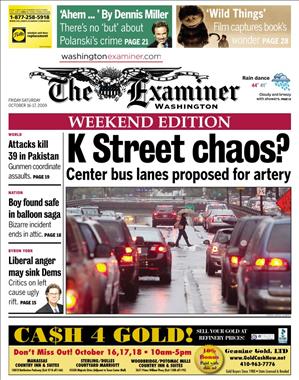
Washington Examiner cover, 10/16/2009

The real chaos is in promoting suboptimal transportation decisions, which seems to be the position of the Washington Examiner, judging by their recent choice of words on the cover of the 10/16/2009 issue.

Labels: , , , , , ,

Monday, October 19, 2009

Interview with Gabe Klein, Director of the DC Dept. of Transportation

Gabe Klein, DC Dept. of Transportation
For those of you who don't exhaustively read transportation literature, planning reports, area blogs, and the like, you might find this DC Metro Urban Diary (a blog that breathlessly supports most development) interview with Gabe Klein, the director of DC's Department of Transportation, to be interesting, "Industry Insight: Gabe Klein."

I do like that he mentions the creation of a DDOT "store" although I hope that they don't excessively focus on DDOT to the exclusion of promoting optimal mobility.

Labels:

Public Art Mural facing community challenge in the Bloomindale neighborhood

bloomingdale (for now).jpg

Reprinted in its entirety (including photo) from bloomingdale (for now):

Tonight's bloomingdale civic association meeting will include discussion about the boxer girl mural. There seems to be a lot of pressure on the city to destroy the mural and the mayor's office is considering it. If you are in support of this mural, or at least in support of the artist and property owner, please come to the meeting.

In general it seems that dccah has taken a lot of heat this year, especially with public art. I imagine this is a pretty important discussion. More info and images in these links:

- bloomingdale (for now)
- adventures of hoogrrl!
- washington city paper: housing complex

You do not need to be a member of the civic association or a neighbor to attend.

Monday night: 7:00 pm, 160 u street nw, st. george's episcopal church

I'm very clearly in support of art that challenges, art that makes you think, and art that helps give us a sense of unique place. The conservative, almost reactionary, response from some quarters to this art installation worries me. I feel successful destruction of this art will lead to further attempts to quash creative growth in the city.

----

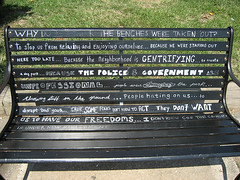
In a similar vein, check out this past cover story from the Washington City Paper on a very interesting public art sitting bench project in Columbia Heights that I never got around to writing about, "Bench Warfare."
3877432693_eab752ebe5.jpg
Bench image from the entry "Protest Benches at 14th and Oak Streets, NW" from the from Prince of Petworth blog.

Of course, there are many other examples of this kind of behavior, going back to the destruction of murals by Diego Rivera in the Rockefeller Center in the 1930s (although he was deliberately supra-provocative).

Labels: , , , ,

WMATA forums in DC and Virginia on dealing with budget shortfalls: Tonight and Wednesday

From the WMATA website:

1. The forum will be held on Monday, Oct. 19, at the U.S. Naval Memorial – Auditorium, 701 Pennsylvania Ave., NW, Washington, DC. The program will begin at 6:30 p.m., and includes an opportunity for public comment.

Metro Board Chairman Jim Graham, District of Columbia officials, Metro General Manager John Catoe, and other officials will be on hand to discuss Metro’s FY 2011 budget.

The cost of Metrobus, Metrorail and MetroAccess services is funded in part by passenger revenues and, in part, by subsidies provided by the District of Columbia, the State of Maryland and local jurisdictions in Virginia.

2. The forum will be held on Wednesday, Oct. 21, at George Mason High School, 7124 Leesburg Pike, Falls Church, VA. The program will begin at 6:30 p.m. Residents are encouraged to attend and participate in the forum.

NVTC Chairman, and Metro Board Member Christopher Zimmerman and Metro Second Vice Chairperson Catherine Hudgins will be joined by other Northern Virginia elected officials and decision-makers for the discussion.

Metro General Manager John Catoe will give a presentation that outlines Metro’s fiscal challenges as well as some proposed solutions. A public discussion will follow.

(Flickr photo by Brian Lane Winfield Moore.)

more meetings I'll miss: Art Huddles

Via email:

The Cultural Alliance of Greater Washington is convening three, ninety-minute Art Huddles in October for arts leaders, artists, arts funders and arts patrons to establish priorities and identify critical issues facing the arts community in the Washington DC Metropolitan region.

These gatherings, facilitated by Business Volunteer consultants, are designed to provide a forum where leaders of the cultural community can freely discuss concrete ways to build collaborations and create a strong, unified regional arts voice. Each Art Huddle will be convened by a Cultural Alliance of Greater Washington Board member and hosted by an arts organization.

Tuesday, October 20, 2009
9:30-11:00 AM
The Harman Center for the Arts
610 F Street NW, Washington, DC 20004
Board Convener: Septime Webre, Artistic Director, The Washington Ballet
Host: Chris Jennings, Managing Director, Shakespeare Theatre Company

Monday, October 26, 2009
6:30-8:00 PM
Joe's Movement Emporium
3309 Bunker Hill Road, Mount Rainer, MD 20712

Wednesday, October 28, 2009
10-11:30 AM
Wolf Trap Foundation for the Performing Arts
1645 Trap Road, Vienna, VA 22182
Board Convener and Host: Beth Brummel, Vice President of External Affairs

Registration information is on the webpage. For questions or more information, contact staff@cultural-alliance.org or (202) 638-2406 x14.


For my take on this issue as it relates to DC proper, see:

-- Art, culture districts, and revitalization
-- More on arts "districts"
-- A clustering approach to the management of civic assets
-- Arts-based revitalization, community building, network strengthening, commodification, and Artomatic
-- More Arts Displacement
-- Arts vs. arts-plus for commercial district revitalization
-- Cultural resources planning in DC: In the land of the blind, the one-eyed man is king
-- More on (DC's) Cultural Infrastructure
-- You Gotta Have Community Building
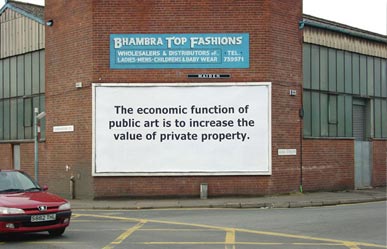
Hewitt & Jordan - The Economic Function.jpg
The Economic Function, Billboard text at the corner of Corporation Street & Alma Street, Sheffield S3. 6 April - 20 April 2004.

The work 'The economic function of public art is to increase the value of private property' sets out to question the function of art in the public realm within the economic regeneration of post industrial cities. The image will accompany a text in a journal by Public Art Forum to be published later this year.

This work is the second part of a commission for Public Art Forum. It completes the project 'I Won an Artist in a Raffle' where Hewitt & Jordan presented themselves as a prize to the delegates at the Public Art Forum conference held in London in April 2003.

Labels: , , , ,

Berlin's Festival of Lights

-- Flickr photos by mr172, Festival of Lights Berlin 2009 (Set)
-- ABC News article, with photos, "Travellers and Locals Enjoy the Illuminated Streets and Sights of Berlin‎"

Labels:

Another meeting: Capital Space Plan -- improving DC parks

Another meeting I won't be able to attend is the proposed plan for rethinking DC's federal and locally managed parks and open space.

From email:

Several local and federal agencies with distinct missions share responsibility for planning and managing the city's parks. For the first time in forty years, these agencies are working together to plan for the challenges and opportunities facing our open spaces. Please join the National Capital Planning Commission, the Government of the District of Columbia, and the National Park Service for an opportunity to learn more about the recently released draft CapitalSpace Plan -- a joint initiative to improve and unify Washington's park system.

Tuesday, October 27, 5:30-7:30 p.m.
Martin Luther King, Jr., Memorial Library, 901 G Street, NW.
Meet and Greet, 5:30-6:00 p.m.
Presentation and Q&A, 6:00-6:30 p.m.
Discussion, 6:30-7:30 p.m.

-- Project website
-- Six Big Ideas:
- Linking the Fort Circle Parks
- Enhancing Center City Parks
- Improving Playfields
- Improving Public Schoolyards
- Transforming Small Parks
- Enhancing Urban Natural Areas
-- Draft Plan

For those of us who can't make next week's meeting:

Public comments will be accepted through December 8, 2009.

It happens that in this bicycle and pedestrian planning job I am undertaking, there is a lot that is relevant about park planning generally, and trails specifically. I mentioned trails and park planning issues a couple weeks ago in the context of the City Council's decision to not confirm Ximena Hartsock as the director of the DC Dept. of Parks and Recreation. That entry included some links to some resources on park planning.

But also check out the Trails resources pages (sadly the documents are big and the webpages take a long time to load) on the San Jose, California Parks website.

There is also a lot happening in various jurisdictions, such as Houston and Denver, in repositioning playgrounds at neighborhood schools as park/recreation resources for neighborhoods outside of school hours.

Sadly, this should be something that is done as a matter of course, but it isn't, so programs in places like Houston and Denver become examples of "best practice" rather than of normal practice.

Kaboom, the national organization which assists communities in improving and building playgrounds, has just produced a report, Play Matters, on:

local initiatives that have increased the quantity of available play spaces and opportunities, improved the quality of kids playtime, and increased children’s safe access to them.
KaBOOM! releasing report this weekend  KaBOOM!.jpg

Labels: , , ,

Saturday, October 17, 2009

Public meeting about redevelopment of the Walter Reed Hospital Complex, Georgia Avenue, Washington, DC

http://www.nlm.nih.gov/hmd/medtour/images/wreed.jpg
Postcard, Walter Reed Hospital, Washington, DC.

From Councilmember Muriel Bowser:

I am hosting a public meeting on the future of Walter Reed Army Medical Center on Thursday, Oct. 22 from 7:00 to 9:00 p.m. at Ft. Stevens Recreation Center, located at 1327 Van Buren Street NW. Also on hand will be Deputy Mayor Valerie Santos and Thomas M. Fitzpatrick, M.D., BRAC commission. For more information, call Brandon Todd at 202-741-0917 or send him an e-mail.

See the article from the Washington Business Journal, "D.C. may get surplus Walter Reed land after all." As well as "Life After Base Closure" from Area Development Site and Facility Planning, plus the organization that helps communities reuse military bases, Association of Defense Communities.

Labels: , , ,

DC Open Government Forum, public event Wednesday October 21st

See their webpage.
-----
But DC also needs a stronger civic culture, one focused on accountability and excellence rather reveling in mediocrity.

NYC's Independent Budget Office, the quality reports produced by the City Auditor in Seattle, or the independent reports produced by the Municipal League of King County (Seattle) (e.g., "Review of Metro Transit") are examples of organizations that provide independent objective analysis.

Sure groups like the DC Fiscal Policy Institute, the DC Appleseed Center, and organizations like Brookings, the Urban Institute, and others produce reports on DC, but they all have axes to grind or are a little too close to power (Brookings, Urban Institute, Alice Rivlin) to question the Growth Machine too closely.

Plus groups in NYC like the Municipal Arts Society, Transportation Alternatives, the Citizens Union Foundation, and the Center for an Urban Future have so much more heft than equivalent groups in DC.

(If I ever do get the Citizens Planning Coalition relaunched, the idea is to have a combination of these four groups, plus some aspects of the Open Society Institute, as well as an action/research focus.)

Plus, publicly disclosed government data collection and evaluation systems, such as Baltimore's CitiStat program, or the more than one decade (I think) that the City of Austin, Texas has been making their agency evaluation information public.

-- City of Austin Performance Measures Database

DC evaluates agencies. But it is hard to find the data, or to know how objective and meaningful are the measures and metrics.

Plus I would like to see the City benchmark its performance against other agencies in the region and nationally.

Labels: , , , , , , ,

Action for Market Towns, the United Kingdom's equivalent of the Main Street program

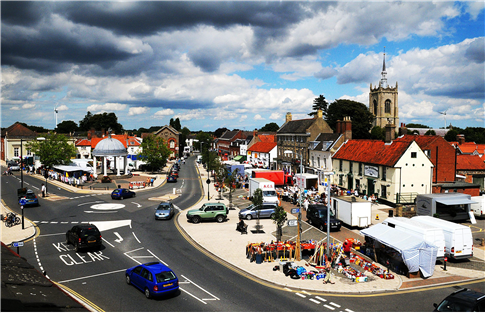
Swaffham England downtown
Swaffham, UK. Eastern Daily Press photo. Note what Project for Public Spaces would call layering, of linking a variety of activities in one place, plus how the design of streets and sidewalks favors pedestrians.

Seems to have a lot to offer those of us in other parts of the world, judging by this article, "How our market towns are fighting back from the Eastern Daily Press of the Norfolk region in the UK.

The Action for Market Towns website is full of resources including:

-- on the campaign theme of Prosperous Places

-- the Sustainability Toolkit is a diagnostic test helping organizations make objective and holistic self-assessments and identify needed resources and training

But to get full benefits including full access to the website, like the U.S. Main Street program, you have to join.

Labels: ,

Alleys (dwellings) as opportunities ... in Toronto

The article "Toronto's 2,400 laneways offer great potential for development," with the subhead "They may be a solution for a city seeking a denser, more efficient future," from the Toronto Star discusses the opportunities. From the article:

In fact, Toronto has a huge number of lanes where people live and work. And except for the fact that city planning policies are designed to keep residents away, the back roads of Toronto could be home to thousands.

There's no better demonstration of the vast potential of Toronto's laneways than Gilead Place, a tiny one-block thoroughfare that runs south from King St. east of Parliament St. In recent years, it has been transformed by the appearance of a row of townhouses on one side and a Jamie Kennedy cafe on the other. Only a few years ago, such a turn of events would have been inconceivable. Today, it seems natural.

Municipal officials would have us believe that lanes are unsafe because they're too narrow to accommodate fire and garbage trucks.

So let's use smaller vehicles. That's what they do in cities as diverse as Rome, Tokyo and Istanbul.

The first comment (there are 25) is quite interesting:

A recently new housing development called Cornell, in Markham, was designed with laneways and garages in back. Many home buyers chose to purchase a developer's option where they built a carriage house over the garages in these laneways.

The comment goes on to lament that this added housing, occupied, has stressed the infrastructure beyond the planned capacity. That's an issue, truly, but one that can be addressed by planning adequately for robust infrastructure from the outset.

Of course, most of the comments on the article are negative. That isn't a surprise. When I finally write a review of the book Nimby Wars, (see this article about the authors from Forbes), I will discuss this general problem of anti-change, even when change can mean improvement.

Labels: , ,

Who knew? New York's secret minute for trains...

According to the article in today's New York Times, passenger trains in the MTA system (Metro-North, Long Island Rail Road) leave one minute later than the "scheduled" timetable listed time, in order to accommodate people running late.

Labels: , ,

Friday, October 16, 2009

Turning stairs into a piano

Increased the use of the stairway over an adjacent escalator by 66%.

See the Youtube video.

(Sponsored by Volkswagen.)

Labels:

"Pedestrians are a hindrance" and other problems for motorists on K Street

The coverage by the Examiner on transportation issues is reasonably good. The editorials and headlines tend not to be so good. And the Examiner has a complete disconnect editorially in understanding the link between "congestion" and capacity and throughput and yes, the need for tax monies to pay for transportation--infrastructure for automobiles, transit, walking, and biking. (I keep meaning to write a piece about it, but I never can find the two articles and one editorial that I set aside for the entry.)

Even so the cover photo of today's Examiner is pretty damn alarmist.
Washington Examiner cover, 10/16/2009
The daily sum up of the news from the City Paper's Loose Lips columnist summarizes ("‘Reforming the Reform’: Loose Lips Daily") the actual news article from the Examiner, "District weighs bus lanes for center of K Street" as:

Business folks are upset about the lack of parking and effect on sidewalk cafes. Bikers are upset about the bike lane configurations. The Examiner front page wood: "K Street chaos." As opposed to the current K Street chaos...

The title in this entry comes from my reaction to a 2004 NARPAC report on the K Street Transitway proposal.

I responded to this in themail in 2004:

A number of the statements in the report are troubling. One section is entitled: “Pedestrians are a major nuisance.” Another statement is “Sidewalks are now used inefficiently due to the narrowing caused by curbside trees with their root grates, etc.” And “Lost parking must be accommodated (and expanded) somewhere. It is essential to get people out of their cars downtown, but not by trying to get Americans to give up their second most desired possession.”

On the latter point, I will say that the public space was not originally created to provide parking for personally-owned vehicles. Parking is a privilege, not a right, and providing parking spaces isn't the primary development priority that suburbanites believe we should take up. (Jane Jacobs would say something like, “You are asking the wrong question. The question isn't 'why aren't there more parking spaces?' The real question is 'why are there so many cars?', or 'why do so many people want to drive knowing there aren't more parking spaces?'”)

To truly be a transit city, we must constantly improve and expand transit systems. It is encouraging to see the various initiatives of the DC Department of Transportation to do so, such as via the proposed K Street busway. Another is to encourage the use of transit by making less preferred modes more difficult and expensive to use. Providing maximum parking tears at the urban fabric and streetscape without encouraging the use of transit. Parking tickets are a “positive” disincentive that ought to encourage “rational economic-thinking” people to use other modes of transit. Instead, people blame the ticketer or the situation, instead of their decision to drive and park (perhaps illegally) in the first place.


This relates to a serious concern faced by DC's advocates for a “livable city.” The US is dominated by an automobile-centric planning and development paradigm. Most every person in the region, including those who live in the city, has been imprinted with that paradigm without realizing that it is but one choice. Just one example is that there are plenty of people who think the solution to revitalization of our neighborhood commercial districts is in the demolition of the adjoining residential neighborhoods in favor of parking.

I fall into the trap of arguing with people about this lunacy, rather than just walking away ruing the fact that they've never read Jane Jacobs Death and Life of Great American Cities. The “teachable moment” so often when the entire worldview of the “student” is shaped by the automobile. It is troubling that forty-two years after the publication of that book, people who allegedly care about the city think that planning for the pedestrian and focusing on urban design and the streetscape is a “nuisance” and that we should be focused on making life simple and free for car drivers.

But the reality in DC is that automobile drivers aren't the primary patrons of businesses along K Street. Likely the primary patrons are people on foot--office workers, residents, and visitors--and these patrons are more likely to use transit to get to the store and they are less likely to drive.

The Bike Portland blog just happened to run a piece on this topic, "Bikes and the bad-for-business rap." In short, some business people believe all their customers-even in cities--come by car whether or not they do. This seems to be the case with one of the people featured in coverage on this issue in Portland, Oregon.

This is also an expressed issue with the closure of 7th Street SE adjacent to Eastern Market on weekends. (Part of the issue depends on the type of business and the nature of their patrons. But also it depends on other things such as parking access and wayfinding.)

And I remember coverage in the Montreal Gazette (e.g. "Time running out: merchants" and "Paths pose no threat to business" from 2007) and the New York City papers reflecting the same reaction on the same issue, as it related to the expansion of bicycle lanes, and the purported loss in business.

The reality is that urban customers are different from suburban customers. Accommodating urbanites helps urban businesses. And expecting your customers to be suburban in distinctly urban settings (such as on top of a subway station, in a dense part of northwest DC, for stores in high demand and not otherwise located close by), such as with the big box stores and the underutilized 1,000 space parking garage in Columbia Heights (see "At NW Mall, So Many Spaces, So Little Need DC Losing Millions On Empty Garage" from the Post) often backfires, as the city becomes denser and more amenities become available as a result. That means more walking, more bicycling, and more transit use, and less car usage.

Basically, all the findings with regard to transit accessibility and compact development are equally applicable to walking and bicycling.

People within 1/2 mile of transit are 5 times more likely to use transit, and to walk to get there. People living in relatively close range (up to a mile say) to amenities that are reachable to them in a safe and comfortable fashion are more likely to walk or bicycle to those "activity centers."

However, certain trips (i.e., groceries) are more likely to involve automobile use. However, with transportation demand management planning (i.e., delivery services) the need for automobiles in such situations can be significantly reduced even so.
------------
Tonight there is a meeting on the K Street Transitway proposal. Washcycle writes about it here, "WABA Alert: Important K Street Meeting Tonight."

Labels: , , ,