Rebuilding Place in the Urban Space

"A community’s physical form, rather than its land uses, is its most intrinsic and enduring characteristic." [Katz, EPA] This blog focuses on place and placemaking and all that makes it work--historic preservation, urban design, transportation, asset-based community development, arts & cultural development, commercial district revitalization, tourism & destination development, and quality of life advocacy--along with doses of civic engagement and good governance watchdogging.

Thursday, December 31, 2009

Woe is CSI: New York and the Law and Order franchise

... as "New York City crime rates at record low: police" from Reuters.

I joke that tv shows like CSI: Miami are hardly "advertisements" for tourism, even though they are pretty fake and disconnected from reality.

But with Law and Order, Law and Order Criminal Intent, Law and Order Special Victims Unit, plus CSI: New York, each year they produce more episodes than there are murders in Manhattan, I think the number for 2009 will be under 70 ... (although many of the shows seem to go outside of New York County into the other boroughs).

It's definitely an endorsement of the "broken windows" theory, and focusing resources in a comprehensive and data-driven manner, on interdicting and reducing crime.
http://truestorieslaworder.com/blog/wp-content/uploads/2009/tvguide2.jpg

Labels: , ,

Ten Common Sense Rules For TOD

I was looking in the archive for 10/2005 for something, and came across this. It emphasizes the point that TOD isn't about transit as much as it is about urban form, compact development, and mobility connected development.
------

Ten Common Sense Rules For TOD, from Bruce Liedstrand, an ex-government official and now consultant in California. To my way of thinking, these are the basic principles of "Old Urbanism" and ought to be the kinds of guiding principles applied to center city land use issues, but often aren't, because most residents are new to city life and unfamiliar with urban, rather than suburban, principles. I think this is a pretty good document. Check it out for more detail.

The principles are:

1. Urban Form
2. Urban Uses.
3. Urban Intensity.
4. Mixed-Use.
5. Retail Location.
6. Reverse the normal parking rules.
7. Walkability.
8. Transit Connectivity.
9. Neighborhood Connectivity.
10. Value Capture.

Labels: , , , ,

Wednesday, December 30, 2009

A green paradigm shift

While he sees these changes coming to the fore next year, and I think that it is more a matter of a serious paradigm shift that will take decades to play out, with possible acceleration due to increases in the price of gasoline as well as more restricted supplies, the entry "the Green Top 10 for 2010" list, by Steve Mouzon in his Original Green blog, is provocative:

(Note that I don't see HGTV switching to being green, sustainable, and focused on historic preservation any time soon.)

1. The New City
How things will have to change in how we locate and build places in order to have sustainable communities and a sustainable society
2. The Big Convergence
How the convergence of three trends, the Economic Meltdown, Peak Oil, and Climate Change, will bring about big changes (potentially).
3. The emergence of Live-Work
4. The Return of Durability
5. The Re-coding of the city
Tthis is about making urban zoning focused on achieving an urban place where the city supports and is based upon walking, transit, and bicycling. Most zoning codes, even for cities, are focused upon the automobile and automobile-accommodating and automobile-centric development practices. I think it's definitely a long process for reshaping this. It's not just the code and zoning that has to change. It's elected officials and the real estate development industry that have to change simultaneously. They are resistant.
6. The Return of the Garden
7. The Meltdown Vacuum
The "green lining" in the economic turndown, as unsustainable practices have a better chance at being righted given new economic circumstances.
8. Gizmo Green Gets Exposed
The belief that new technologies are the solution to any and all problems.
9. The Sustainability of Preservation
10. Offshoring Reversal

Labels: , , , ,

Tuesday, December 29, 2009

Report on exhibiting at the City Living Expo, 2003

This is from the email archives of the H Street Main Street organization, 10/27/2003. I mentioned that Expo recently, which was a center city promotion event sponsored by the Williams Administration. This is the "after-action" report, with the removal of the first paragraph thanking most of the volunteers. It's probably worth doing an event like this for the city every couple years. This ended up being a "one and done" event, but the city ought not to rest on its laurels. It must constantly tout (and extend) its advantages and benefits vis-a-vis other locations in the region.
-----------
Alan and Amira were especially great--they brought their "new" baby Amina, who probably was the best advertisement for the neighborhood that there could be. They came back again on Sunday and pitched in for 3 more hours each, in addition to the 2 on Saturday. THANK YOU EVERYONE. One of the reasons our booth was always so full was because our volunteers were so great.

Kevin pulled together some great display materials--a powerpoint presentation featuring highlights of the neighborhood and some "ads" that we will be using in our "Talk About H Street" campaign. The ads highlight the assets of the neighborhood. He also created a handout with more information and our website contact information. We supplemented the display with pages from the Strategic Development Plan, the DC Marketing Center piece, the July "Talk About H Street" ad, the pieces on cluster 25 and 23 from the Office of Planning, and some stuff from WMATA about buses and the subway.

We looked at our participation as "Talking about H Street" as well as "Talking about the greater H Street neighborhood." We said that there are four reasons to consider our neighborhood -- diversity, historic housing stock, close-in location, and great transportation assets. Along with a revitalizing commercial district and good opportunities to buy.

Our Main Street program matters to them, because a vibrant neighborhood needs a great commercial district with great amenities. Many of their questions were about living in the neighborhood. Many people had questions about the plans for H Street's commercial revitalization.

I am not sure what I expected. Some people were curious suburbanites without much commitment to the city. Many had lived in the city. Others were looking for affordable options. Many people, younger and older, were interested in condominiums -- low maintenance. Others wanted more rental options.

We distributed 1,000 or more of the general info sheet. More than 100 (and less than 200) asked for additional information about various topics. Some people want to volunteer.

Living. People wanted to know about available housing. (edited)

Because "good buys" are rare finds in the western part of the neighborhood we were encouraging people to consider the eastern part of the neighborhood. That's why we ended up adding information on the Trinidad area (Cluster 23 brochure) to our booth. [note that originally I used to say that the H Street neighborhood had five competitive advantages. The fifth was relatively inexpensive and well-located housing.]

THE QUESTIONS PEOPLE ASKED REALLY MADE ME CHANGE MY THINKING ABOUT TWO THINGS. I always write that "diversity of housing types" is important and necessary to the neighborhood, especially in terms of reducing displacement, but I didn't really know what that meant until we started getting questions on Saturday...

First, people kept asking about condominiums. I explained that this is coming but we are working on some zoning changes to make this happen. We need to work with the property owners on the 200 and 300 blocks of H Street to make sure this happens. It should also shape the development of the BP site. The land that we have available is too precious to waste. And as everyone knows we need more residents to strengthen the neighborhood ane more customers for the commercial district.

Second, it means that over the long term we (HSMS) really need to work on some of these broader housing issues as they relate to revitalization of the greater neighborhood and the strengthening of the H Street retail trade area.

We need to develop a position statement on housing issues in the broader neighborhood. We need to monitor developments that are in our trade area, developments that we might not ordinarily monitor, because they are in Wards 5 or 7. This should be linked to the encouragement of transit-oriented development associated with the proposed light rail developments along H Street/Benning Road and Florida Avenue.

(We probably need to develop a position statement about light rail as well. Personally I think it should be encouraged, and on an accelerated timetable. The paper on the www.apta.com website called "Bring Back the Streetcars" indicates that a 4-6 year timetable is not out of the question.

It makes sense to coordinate this with the streetscape improvement program. Fixed-rail transit investments generate great economic returns. It will vastly benefit the H Street commercial district. It should be no surprise that the H Street commercial district began declining once streetcars were removed from the corridor...)

It means that we need to weigh in on projects such as the Clark Realty development on Bladensburg on the old Sears site. Maybe they need more density. It means we need to advocate for housing above Hechinger Mall (like Kevin and I have been saying for years.) It means we need to look at the northern parking lots of RFK (problematic because they are owned by the federal government? which are wasted. Condominiums could be developed here, along with maintaining quality public space so that the Open Air Farmers Market would not be displaced. Etc.

We also need to work on inclusionary zoning and related incentives to ensure that affordable housing is required, as well as to ensure quality design. (WRT design, don't think it doesn't matter. The Pritzker condominums at 400 Mass Ave. NW are much more attractive than the condos at 5th and Massachusetts by Paradigm, and that is because the latter development used office building style window glass instead of the residential style windows of the former.

Similarly, the new apartment building on the 1000 block of New Jersey Avenue NW is pretty utilitarian. Incentives should have been provided to get them to include balconies and other design features that would have softwened the facade and made the building look more inviting.)

(Note that the newest housing in the greater neighborhood -- 800 block of 10th St., Wylie Court, and the development across from Hechinger Mall -- is all pretty utilitarian and cheap looking and really denigrates the overall aesthetic of the neighborhood's architectural style and sense of place.)

Also,
we need to make up a sheet about the residential living opportunities in the neighborhood, comparable to the sheets that the DC Marketing Center has developed for the H Street commercial district (as well as others throughout the city). Similarly, we need to add a "residential house photo tour" to the hstreetdc.com website.

Logistics.
When we exhibit next year I think we need to have 3 people in the booth at all times. Saturday was the busiest day. At times there were 15-20 or more people in the booth. We also need to take a map of the entire city, because many people need that in order to put the neighborhood in context. We should either wear tee-shirts or have nametags that identify us (oops). We should also sell our tee shirts and tote bags (this will be in the workplan for next year).

Adams-Morgan had a raffle and got a lot of names entered. But I don't think that is a good idea because you get mostly names of people who want a prize, not people that really care about your neighborhood.

Labels: , , ,

Traffic-mitigating public artwork - Oregon

From email:

Deadline to apply is January 13, 2010. Clackamas County and the Clackamas County Arts Alliance are seeking qualifications from artists / artist teams in the United States for a permanent traffic-mitigating public artwork that will signify entrance into the 172nd Avenue Roundabout and serve as a civic gateway to the City of Happy Valley. Main project goals are to improve traffic safety at the roundabout site and anchor the traffic circle to its place and surrounding neighborhoods. The full Request for Qualifications can be downloaded at http://www.wpcllc.info/ccaa/172nd-rfq.pdf. Total budget is $33,750.

Labels: ,

Monday, December 28, 2009

The real estate development sky is falling: 2009 edition

Today's Post has a front page story, "District's developers swagger no longer: With market's collapse, many find themselves in surprising new roles," on how real estate developers are seeing hard times. People with short memories do not remember the same passel of stories after the last real estate downturn hit DC and the region around 1989. That recession lasted about 10 years, and many companies, ranging from Oliver Carr and Van Metre, the rise and fall of Bill Regadie and Regardie's Magazine, and those well connected to the then Mayor, like Jeffrey Cohen--Children's Hospital site, Yale Laundry, a Cape Cod house jointly owned with Marion Barry--tanked for awhile ("Developer's Partnership Files for Bankruptcy" from 1990).

Just as the Abdo Company is taking on projects for other companies, Trammel Crow, a national company, did the same thing.

Jim Abdo put it best, how the excesses of the market were similar to the excesses of the dotcom boom (i.e., AOL merger with Time Warner, the rise and crash of PSI, of MCI-WorldCom, etc.). From the article:

Abdo said he saw the downturn coming when he noticed how many people "called themselves developers simply because they bought a piece of property. It reminded me of the dot-com craze. It wasn't hard to figure out there'd be a thinning of the herd."

The joke is that newspapers are the first draft of history. I guess one of the reasons that "those who don't know history are doomed to repeat it" is that the first draft of history only goes back a week or so...

Labels: ,

departments of public works vs. departments of transportation

There is a belief that "highway departments" focus on roads and road construction, because they are focused on providing mobility, especially speedy trips, for cars and trucks.

It's mostly true. Because most of the people who come to power in these agencies are civil engineers and traffic engineers, and they have spent their lives working on making the road network at the local, state, regional, and national levels--which face it, is an amazing accomplishment--complete and robust.

Although the funny thing is that the Federal Highway Administration, where the pro-car and pro-truck attitude starts out--provides an amazing number of high quality resources relevant to pedestrian and cycling concerns. Just two of these resources are:

- FHWA Road Safety Audit Guidelines, which focuses on ensuring pedestrian safety in the context of road design, and
- FHWA University Course on Bicycle and Pedestrian Transportation.

But as Ted Levitt wrote in The Marketing Imagination about how organizations have to figure out their real business (mission) and plan and implement and execute accordingly, the reality is that it's not about "highways." The real issue is mobility and maximizing mobility efficiently, balancing supply and demand to acheive the most mobility at the lowest cost.

Strategies that agencies are employing to accomplish this are:

1. De-merging the Department of Public Works, and creating a separate and new Department of transportation. Mostly this is happening in big cities like NYC or Baltimore or DC. (See NACTO National Association of City Transportation Officials.) But Montgomery County, Maryland has done this too.

2. Theoretically, the demerger is accompanied by a focus on balanced transportation planning, including streetscape and placemaking, pedestrian, bicycling, and transit issues, not just on roads and road building for cars and trucks. (Some departments also deal with freight and water-based transportation, and taxi service.)

Although Arlington County has proven that you don't need to demerge public works (there it's called the Department of Environmental Services) and transportation to get top notch transportation and mobility planning at the local level.

And see the SFMTA website for how it deals with multiple transportation modes, not just cars or even transit. Even though we think of that agency as the transit agency, responsible for the MUNI streetcar, light rail, and bus system, walking, bicycling, "livable streets", parking and curbside management, and taxi services are prominently listed on the website and are made easily accessible.

SF Municipal Transportation Agency website
3. Creating robust "transportation" plans focused on optimizing mobility and on all the issues that are involved in transportation, ranging from streetscape ("complete streets") to transit, rather than just focusing on roads, road building, and vehicle throughput.

Arlington County, Virginia has one of the best transpo plans of any county in the U.S., and cities like Portland, Seattle, Boulder, Tempe, and others have comparably great plans.

4. State level agencies are developing a smart transportation focus.

For a long time, in part because of federal requirements, states have been developing robust bicycle and pedestrian promotion programs, including walk to school programs. But just as there are a handful of great transportation plans out of thousands of very average plans, some states are much better than others. (I have found Maryland's Sate Highway Administration under Gov. O'Malley to be far more open to walking and bicycling issues than I expected, despite the agency's overwhelming focus on road construction.)

But now the more progressive state departments of transportation are extending what they are doing into more progressive directions. For example, Missouri has instituted a "practical design" approach, where they design and build the road to its function, rather than construct every road to be able to accommodate traffic capable of speeding along at 70 mph (see "How We Can Save Our Roads" from Parade Magazine), and Pennsylvania and New Jersey have jointly published the Smart Transportation Guidebook, which extends the concepts of complete mobility rather than a focus on automobility, as exemplified by the Arlington County or Seattle transportation plans, to the state level.

----
So, Action Committee for Transit has published an article in their latest newsletter about how the Montgomery County Department of Transportation, despite being calved off the DPW into its own agency, is still more of a road building and automobile-focused agency than it is a "transportation agency." (See the reprinted press release below.)

I do feel ACT's pain. In my work situation, a good deal of my creative-advocacy-mental energy is spent thinking about how to engage the local Department of Public Works so that we can make transportation--which includes walking, bicycling, and transit, not just vehicles--rather than road building and maintenance, the foundation of a broader perspective on the part of the agency, its agenda and activities, and better serve the county's residents. (And note that the agency has far more power and energy and presence compared to one puny bicycle and pedestrian planner...)

The only thing on our side is that for the most part, the County's road network is just about fully built out, so that the monies going to the agency that have traditionally been spent on road building... well now some can be reprogrammed towards pedestrian, bicycling, and transit facilities, because of the fact that the road network has been constructed.

But the Montgomery County experience has also taught me something, that just because you create a separate local transportation department, it doesn't naturally mean that the agency becomes "progressive" in terms of its agenda, mission, and vision about what it does.

Montgomery's Department of Transportation is old school, with old attitudes, and they have been sliding for more than 30 years on the very progressive decision in 1975 to build its own bus transit system, to complement the coming Metrorail system.

Arlington County has proven that one decision in and of itself doesn't make for a robust transportation plan. For example, first Arlington County decided to move the orange subway line from I-66 to Wilson Boulevard. Second they decided to intensify and broaden the land uses along the subway corridor--which can't really be done when a transit line is constructed in the middle of a highway. Third, they put into place various protocols to bring about the land use intensification and to focus mobility away from the automobile and towards the transit network. And then they continued to make other decisions, to create a local bus service to improve north-south connections in the county, creating the Arlington County Commuter Services operation to better focus transportation demand towards optimality. Etc. (And all of this they've done in a context where the State of Virginia doesn't allow the county to require transportation demand management planning as a matter of course.)

Many many many decisions must be made, programs developed, implemented, and evaluated, and the bar for service and quality must be continually raised, to achieve constant improvement in the transportation system.

The next issue that I think Action Committee for Transit needs to take up is the creation of a County Transportation Commission, comparable to the Planning Board, focused on ensuring that Montgomery County, its elected officials (see "Floreen, Andrews upset over ICC toll rates" from the Gazette) and agencies are fully focused upon achieve a robust transportation system focused on achieving optimal mobility, rather than maximizing vehicle throughput. This can help to begin the paradigm shift that clearly the MCDOT needs. (It's a strategy I am promoting in the context of where I am working as well.)
------------

ACT Slams Montgomery County DOT's Anti-Transit Policies

The Montgomery County Dept. of Transportation has become systematically hostile to transit riders and pedestrians, charges a front-page article in the January 2010 issue of the Action Committee for Transit's quarterly newsletter, Transit Times. "The county's traffic engineering philosophy," commented ACT president Ben Ross, "is to push pedestrians, bicycles, and buses out of the way so that there are more cars on the road.”

The 600-member advocacy group backed its charge with a five-point bill of particulars:

"That's not even the end of it," added ACT vice-president Hans Riemer. He pointed out that the county DOT has stalled completion of the Metropolitan Branch bicycle trail through Silver Spring and insists that local streets should be built with wide lanes that encourage cars to move at unsafe speeds.

Riemer observed that MCDOT's policies undermine the county's efforts to promote smart growth and non-automobile transportation. "Our Transportation Department is years behind the times," he said. "The kinds of places their policies create--like today's Rockville Pike--are often the most difficult and unpleasant places for people to live, to visit, to commute. These policies destroy community life, and they are less and less effective at promoting economic growth. The path we are on is unsustainable."

Labels: , , , ,

Sunday, December 27, 2009

Interesting cycling and walking promotion efforts in Toronto

- Toronto Pedestrian Charter and the webpage discussion.
Toronto Pedestrian Charter

- Toronto Walking Strategy

What is the Toronto Walking Strategy?
The aim of the Walking Strategy is to build a physical and cultural environment that supports and encourages walking, including vibrant streets, parks, public squares and neighbourhoods where people will choose to walk more often. By envisioning a city where high-quality walking environments are seamlessly integrated with public transit, cycling and other sustainable modes of travel, the Strategy sets out a plan that will produce tangible environmental, health and social benefits for residents and visitors to Toronto.

- Start a Bicycle User Group and join the BUG Network. There are currently 112 registered Bicycle User Groups in the City of Toronto.

- Bicycle Parking: A Guide for Business Owners & Cyclists in the City of Toronto

Labels: , ,

Oversupply of parking spaces in transit connected developments

Professor Robert Cervero of Berkeley, one of the world's leading transportation researchers, with his colleagues did a study on parking requirements for _suburban_ multiunit housing developments proximate to transit stations in the East Bay region of San Francisco and Metropolitan Portland. See Are TOD's Over-Parked? (summary) and the full report.

They found that more parking was required than used, as well as interesting findings about how demand for parking increases with the distance from the transit station. That may seem obvious (of course it is), but hopefully then the point should be understood that ideally more housing should be located more closely to the transit station, and that housing immediately located at the transit station shouldn't be required to provide large amounts of parking.

From the article:

Our research also showed that size and distance matter. In general, peak parking levels were highest for large-scale apartment projects with generous amounts of parking per unit and that were farthest from the nearest station. For every 1000 feet walking distance that a project lies from a station, we estimated, peak parking increased by 0.7 cars per dwelling unit. Case study work also showed that apartments served by retail shops, that enjoyed direct access to station platforms, and whose shortest walking path was not too circuitous tended to have lower peak parking levels.

Proximity, density, mixed use nature, and urban design all matter.

Labels: , , ,

Municipal management: Things could maybe be worse (San Francisco) compared to your municipality

As much as I write about DC, and clearly the problems in municipal government, the utilization of resources, the design of programs, and failures in service provision result from similar kinds of systems failure, this expose of failures in governance, management, and fiscal responsibility in San Francisco, "The Worst-Run Big City in the U.S." from the San Francisco Weekly, is pretty shocking.

Interestingly, if you have read Siegel's book The Future Once Happened Here, you can see what's happening is no different than what has happened elsewhere in cities like New York, Los Angeles, DC, and Philadelphia. To some extent, NYC has improved significantly although there are still problems. But the problems are worse in the other cities.

The problem is when the liberal ideal to help is coupled with lack of management controls, systems, and accountability. Eventually, it spirals out of control for a couple reasons. First, municipal workers become an interest group in and of themselves, and work to receive constantly rising incomes, pension benefits, and eased work rules.

Second, because problems are mostly seen as lack of enough money rather than how the funds are used, what the intended outcomes are, whether or not the outcomes are achieved, and why or why not.

Although the author of the SFW piece attributes the problems to "hyperdemocracy." Maybe that's an issue too. I think that the public's social concerns and desires to solve problems get used by the interest groups--workers, government agencies, nonprofit organizations--in order to maintain and strengthen these bodies in ways that become disconnected from the public good, because representing the public good, and the city overall, becomes disconnected from the work of the agency.

From the article:

There are ways San Francisco can maintain its rampant democracy while establishing a system that abhors waste and incompetence:

Return much of the day-to-day control of city operations to an unelected, long-term city manager — who would also be responsible for negotiating union contracts.

Institute detailed citywide planning to avoid waste and duplication of services, while ensuring essential city functions are provided for.

Emphasize best practices in each individual city department, and let go of workers who aren't needed because of productivity gains.

Eliminate all budget set-asides and mandatory staffing levels, and let the city develop budgets that meet the needs of today and tomorrow, not yesterday.

Fire people who are incompetent — and that includes those at the top-heavy management level.

Instead of telling us how much money has been spent on a problem, focus on whether the problems are getting solved.

Labels: , , , , , ,

Saturday, December 26, 2009

A ten year perspective: The future of healthy cities and infill and intensification

Over the past 10 years as revitalization energy has swept over Washington, DC as living in the center city became "trendy" again, seen as a logical choice, there has been a fast and furious debate about "new" housing, what's appropriate, and what current residents feel comfortable with.

(Note that today's definition of "urban" doesn't always mean the "center city" as places like Bethesda, Silver Spring, and the Wilson Boulevard corridor in Arlington County also thrive and have added copious amounts of multiunit housing.)

I remember exhibiting for the H Street NE neighborhood at the one and only "City Living Expo" in 2003 and being very conscious at both the excitement of people considering urban living as a logical choice, as well as the deep anger being expressed to me by some attendees, about the prospects of change, the influx of higher income residents, and how it might change their neighborhoods, their prospects, the city, and their sense of belonging within the city.

Much of the anger expressed over former Mayor Williams had to do with a perception that he was more focused on making the city attractive to new segments, rather than focused on making the city better for the people already here.

This is a tricky dynamic. Within the regional landscape, municipalities have to be competitive in order to continue to retain and/or recruit residents, investors, new projects, and amenities, in order to maintain revenue streams (income, property, sales taxes, other taxes and fees).

At the same time those "already resident" are clamoring for new programs and more spending on various priorities (especially the schools).

I was always struck by the desire people expressed at various community meetings about family housing vs. housing for nonfamilies--as one ANC commissioner put it "houses with room for two kids, a yard, and a dog" versus multiunit buildings, often more attractive to people without children--without a recognition of how the cost and availability of land as well as the cost of construction makes it virtually impossible to add single family detached or attached housing in the core of the city.

Not to mention that having a diversity of housing types (and mobility options) makes a locality more economically diverse and sustainable over the long term. Nor the fact that most households do not pay property and income taxes at the level that covers the cost of educating even one child (about $15,000/year/child) so that a housing development program focused on families (even though the number of households with children continues to shrink nationwide) is unsustainable financially.

Interestingly, in meetings in my new job, where I advocate for transit, walking, and bicycling, people who have fought those battles there for many more years and through many contentious public meetings sigh, and tell me stories of how residents are adamant that car-based living is the only choice for the county, of how they have been threatened etc.

But it's not a whole lot different here in DC. Arguments within neighborhoods over adding new housing, such as in Tenleytown, Brookland, Takoma, Fort Totten, etc., have been fierce. Many of these battles have been about infill housing on land owned by WMATA. But in large part these battles are about how people define their neighborhoods, on how they define themselves and residents that belong, vs. change and the kind of people they don't think they want to have in their neighborhoods.

And these kinds of arguments are prevalent across the region. A couple years ago I was struck by the arguments in Hyattsville over the EYA development "Arts District Hyattsville" and the inclusion of 14 feet wide townhomes in a section of the project that has not yet been developed. The argument was that people in such narrow homes weren't likely to be good neighbors and citizens committed to the city, because the houses would cost less. See "Hyattsville questions review process for EYA" from the Gazette. From the article:

The project in question, East Village — half of EYA’s Arts District Hyattsville — will include more than 500 row houses and condominiums, along with live⁄work units and retail space. But the width of the row houses — some are as narrow as 14 feet wide and as large as 24 feet wide — concerned Hyattsville city officials, who suggested narrower homes would appeal to a more transient population and lead to frequent ownership turnover.

And questions about redeveloping neighborhoods more intensively, such as in Silver Spring ("Two-thirds of Falkland Chase to be designated as historic" from the Gazette) or the way that Virginia Square neighborhood in Arlington was redeveloped from low density housing to high density multiunit and commercial, not to mention the Purple Line light rail proposal and opposition from the Town of Chevy Chase, are contentious, even if easier to do in the suburbs. (In DC, it's easier to do this on commercially zoned property, and almost impossible to do it anywhere else.)

The problem is that people's definitions of their neighborhoods tend to be static, while maintaining and extending the economic and social health of the center city in a variety of aspects (crime and public safety, quality of municipal institutions generally, schools, availability and quality of neighborhood retail, etc.) must be seen and interpreted as a dynamic process.

Another example--residents in the Georgia Avenue area around Missouri Avenue near the former Curtis Chevrolet site want more retail and amenities but don't want to allow the addition of multiunit housing (it's a moot question because current zoning allows such development)-- failing to recognize that the lack of quality retail is in large part due to the relative paucity of residents in the area which except for some apartment buildings here and there, is amongst the lowest residential density in the city.

The problem is that we don't identify the issues very carefully or directly, and when we aren't talking from a clear position and discussion framework, we don't discuss things very well.

Of course, even if we did, it would still be messy.

Christopher Hume, the great urban design columnist for the Toronto Star, raises similar kinds of issues in today's column, "Condo's future needs mature debate."

From the article:

Toronto's relationship with the condo might best be described as ambivalent. On one hand, we want growth; on the other, only as long as it's not in our back yard.

And then there's the sheer inconvenience of it all. Change, because it's new, is always inconvenient.

The irony, of course, is that there's nothing new about the condo. Toronto has emerged as the strongest condo market in North America, which says much about the growing desire for urban life.

The suburban dream may not be dead yet, but dark shadows are gathering on the horizon. Given the environmental crisis we face, sprawl can no longer be justified. It doesn't make sense.

Cities, dense and transit-based, are the future. As a result, so are condos. Indeed, Toronto has reached the point where it would unimaginable without condos. The idea of the single-family house is no longer economically or environmentally viable. Downtown land is simply too valuable, and resource too scarce. ...

Too often it seems there's a war being fought between citizens and developers. Many Torontonians feel that developers run roughshod over neighbourhood concerns, aided and abetted by the Ontario Municipal Board. So it's no surprise there's widespread anger at a process that's generally seen as favouring rich business interests. At the same time, neighbourhood issues can be petty and shamefully self-serving.

The fact is Toronto has yet to have a mature debate about the condo and its role in the 21st century city. Every decision seems to be made in a vacuum. ...

The new frontier will be family-sized units, apartments with three or more bedrooms. Developers complain that they're the last to sell, but according to downtown councillor Adam Vaughan, the number of highrise families living in condos has been constrained by the lack of suitable units.

Needless to say, all this will change; in the beginning, don't forget, condos were aimed at empty nesters. Now, it's more likely to be the mythical young professional.

Which demographic group is next remains to be seen. In the meantime, the only sure thing is that the condo is here to stay.

-----------
For many years, I have argued that those "One Book" reading campaigns, where everybody in the city is supposed to read the same book and discuss it, ought to be at least for one year, about the future of the city, and people should read Roberta Gratz' Cities: Back from the Edge.

While Jane Jacobs Death and Life of Great American Cities definitely and Steve Belmont's Cities in Full arguably are the most important books on urbanism of the last 50 years, Cities: Back from the Edge, based on JJ's work, is a more easily understood primer on what works and what doesn't, and is a good illustration of the concepts laid out by Jane Jacobs and then extended by Belmont (the first chapter of Cities in Full, 39 pages long, is entitled "Jane Jacobs Revisited" and puts numbers to many of JJ's concepts).

Face it, these concepts are nuanced and while simple and seemingly obvious, the details seem to elude most of us.

Over the past ten years, we haven't had the necessary discussion that we need to have about the future of the center city and the future of Washington, DC and its place and position within the regional context.

Not having that conversation has cost us a lot of time and anguish, and continues to make going forward as a city as whole, very difficult.

It's not enough that I have read these books and work to apply their concepts in my activities in DC (and elsewhere). A lot more people need to do so. Meanwhile we continue to run in place/around in circles.

-------
Also from Christopher Hume:

- Good design sets a city up for success

- Welcome to the age of region

- Love it or loathe it, change is a comin'

Labels: , , , , ,

Friday, December 25, 2009

Bike racks full...


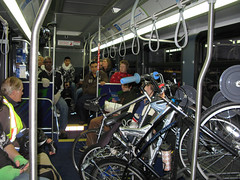
Bike racks full
Originally uploaded by Oran Viriyincy
On the Swift Bus Rapid Transit system run by Community Transit in Snohomish County, Washington. The bus has space for three bicycles _inside_ the bus. From the standpoint of maximum bus ridership, I may have opted for outside racks, although at the speed that BRT vehicles can go, > than 50mph, maybe that's an issue.

29 of the DC region's top transportation stories of the decade

I can't claim to be able to say what I think the top #10 transportation issues are in the DC region, but here are more than 20 (it's hard to limit myself to 10), not necessarily in order:

1. The crash of WMATA trains in June 2009 and the resulting deaths and injuries. Hands down this would be #1 for me. Including the resulting discovery that the systems problem with train controls has been an issue since 2005, and inadequately addressed.

2. Lack of quality leadership (board) for WMATA, turnover in leaders (Richard White, Dan Tangherlini, John Catoe).

3. Creation of the DC Department of Transportation, having been calved off the DC Dept. of Public Works.

4. Expanded transportation planning in DC's Department of Transportation, both as part of the "Transportation Policy and Planning Administration" and the Mass Transit Administration.

5. DDOT focus on streetscape improvements including in Georgetown, 8th Street SE (Barracks Row), Brookland, H Street NE, and other neighborhoods

6. Creation of the sustainable transportation oriented Arlington County Master Transportation Plan, and the general excellence and leadership on _regional_ transportation issues by Arlington County and its elected officials on transportation issues.

7. 2003 budget cutbacks at WMATA, leading to the devolvement of responsibility for expansion planning to the separate jurisdictions.

8. Silver Line subway extension to Dulles Airport.

9. Wilson Bridge reconstruction/Springfield freeway interchange construction.

10. Approval of the east-west Inter County Connector freeway from I-270 in Montgomery County to I-95 in Prince George's County.

11. High Occupancy Toll lanes for Virginia.

12. Creation of the DC Circulator bus system.

13. DC Bus shelter improvement contract (2005) including the creation of bicycle sharing (2008) and the funding of streetscape improvement projects.

14. Purple Line advances in Montgomery and Prince George's County, and the efforts of the citizen group Action Committee for Transit. As well as the oppositional efforts of the Town of Chevy Chase.

15. Efforts to make the Metropolitan Branch Trail off-road walking and bicycling trail from Silver Spring to Union Station in DC, first conceived of in 1988, reality.

16. All the cockamamie initiatives of DC City Council on transportation issues, ranging from earmarks for special bus services, proposals for tolls on the 14th Street bridge, the creation of "performance" parking initiatives while failing to increase the price of residential parking permits, Councilmember Harry Thomas' idea that gas stations should get tax incentives because he doesn't think the city has enough gas stations, etc.

17. That DC doesn't have a transportation plan, and certainly not one at the level of cities like New York City, Seattle, or Portland ... not to mention Arlington County.

18. The spending of $40+ million on a 1,000 space parking garage at DC/USA, immediately adjacent to the subway system, and its underutilization to the tune of 50% or more.

19. The publication of Trans-Formation: Recreating Transit-Oriented Neighborhood Centers in Washington, DC by the DC Office of Planning and the _failure_ to actually incorporate transit oriented development and urban design practices for city-involved projects adjacent to transit stations such as at Rhode Island Metro (the Rhode Island Place development) and Congress Heights in southeast DC (see "Giant Missed Opportunity" from East of the River).

20. Relatedly would be the transportation oriented development intensification efforts in the region that look to be more successful such as at Tyson's Corner in Fairfax County, Virginia, Columbia Pike in Arlington County, Potomac Yards in Alexandria and Arlington County, Virginia, and maybe at White Flint in Montgomery County.

21. Record ridership for WMATA in 2009, including during the Obama Inauguration as well as severe budget deficits and declines in ridership later in the year.

22. Planning for streetcars in DC and Northern Virginia.

23. BRAC and the stresses it is causing on regional mobility because base expansions are in places with limited transit service, while most of the locations that are being closed had high quality transit service.

24. Arlington County's opposition to widening I-66, to the tune of suing the State of Virginia.

25. Maryland's proposals, not yet funded, to expand the MARC train service to weekends. And the growth, decline, and regrowth of the Virginia Railway Express passenger railroad service.

26. Increased focus on pedestrian and bicycling matters in many of the region's jurisdictions.

27. The failure of the forthcoming Silver Spring Transit Station to include a dedicated bike station. (And the building of this station.)

28. A bikestation just opened in the past year at Union Station.

29. Bloggers, blogging and blogs on urban design and transportation issues.

30. "Dedicated" funding for WMATA from the Federal Government.

Labels:

Baltimore/Maryland's top 10 transportation stories of the decade

From Michael Dresser, the transportation columnist for the Baltimore Sun:

1. Derailment, fire close Howard Street Tunnel.
2. Intercounty Connector approved; construction begins.
3. New Woodrow Wilson Bridge opens.
4. Bay Bridge truck crash uncovers structural flaws.
5. Red Line, Purple Line advance.
6. Wheels fall off MTA buses.
7. Water taxi capsizes in Baltimore Harbor.
8. State struggles to fund transportation as gas tax stays put
9. Highway deaths continue to take toll.
10. Light rail double-tracking project completed.

See "Top 10 Md. transportation stories: 2000-2009" for the discussion.

Labels:

Wayfinding redux

Mike Licht directs our attention to the website Oddly Specific, which focuses on humorous specificity in signage.

Funny Signs - Stickman 4 way

Labels: ,

Thursday, December 24, 2009

Urban design vs. suburban design in DC

Especially since the approval of the DC Comprehensive Plan in 2006, I have become an ever stronger proponent for the necessity of defining urban design as one of two or three "leading" elements (in addition to the framework element) of the plan, to be treated as superior to all the other elements, and to guide how the other elements function, as well as the laws, regulations, and practices that follow.

When the city was designed, there weren't automobiles, and people didn't want to stable horses in their houses, so houses had "carriage houses," which were precursors to garages.
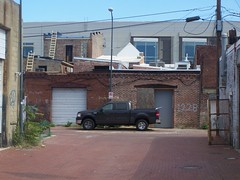
Blagden Alley
Old carriage buildings in Blagden Alley NW.

Capitol Hill Rowhouses
Rowhouses in Capitol Hill.

As the automobile became prominent and an easily functioning technology, garages become incorporated into the house.

But through the 1930s and 1940s, garages tended to be secondary buildings, usually at the rear of properties. Mostly, these structures were accessed via alleys (usually of an "S" type with an entrance on two sides of the block), and curb cuts to properties on the front side of a house were very rare, usually with the only exception being for properties on the corners of blocks, where because of the land configuration, did not have alley access.

In the 1950s, as cars become even more central to how households became organized, garages become central within house design, incorporated into the front elevation of the property, rather than being relegated to the rear.
Exurbanites in Virginia
Washington Post photo, new subdivision in Haymarket, Virginia.

You see this best in the suburbs, and where we have rowhouses in the city, none (with a couple of weird exceptions) have front yard accessible garages.

DCMUD discusses the imminent failure of the Stanton View housing development in the entry "Foreclosure Issued on Site of $4 Million District Investment ." If you're interested in that (I am but not enough to write about it, other than stating that DC should buy the project out of foreclosure to protect its investment) read the DCMUD piece.

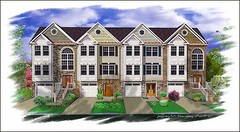
But the rendering for their project shows suburban-oriented rowhouse design, rather than a city empathetic design.

There are rowhouses in the Brightwood neighborhood built in the 1930s that have rear garages.
These rowhouses in Brightwood have rear entry basement garages
Front of a house on the 300 block of Gallatin Street NW.

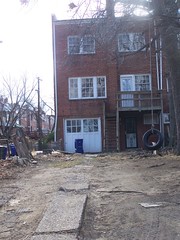
Rear entrance basement garages, rowhouses, Brightwood
Rear of the same house. (Yes, they need to update their backyard. But the garage is fully functional.)

An urban design element in the Comp Plan should stress urbanity, and regardless of where a property is located in the city, houses frontloaded with garages should not be allowed (except through variances, which should be very hard to get).

These rowhouses represent a continued suburbanization of the city that should be stopped, rather than encouraged.

Developments constructed with DC funds should never promote suburbanization of building design in the center city.

Wednesday, December 23, 2009

I like Dr. Gridlock, but

Robert Thomson is the commuting-mobility columnist for the Washington Post. Most of his writings are quite good, but he persists in neglecting to put much attention on the fact that driving is subsidized to the tune of many dollars per gallon--the reality is that taxes, tolls, and fees typically pay no more than 50% of the cost of roads, the rest comes from general funds.

------------
Recognize that we are hardest on those that we love. I am hard on Dr. Gridlock because I like what he does and I have high and ever increasing expectations for the quality of his work. I am hard on the Post generally, and of course, on DC and DC Government specifically. That's the role of a critic...
------------

His "colleague" Neal Peirce, who writes a column that is distributed by the Washington Post Writers Syndicate, but whose column is never published in the Post proper, wrote about this in 2003. See "GAS TAX HIKES: NEEDED BUT POLITICALLY PERILOUS" (5/11/03).

Dr. Gridlock persists in making the point that transit is subsidized, while neglecting in fairness to mention, ever, that roads are subsidized, for example, at the start of his column feature on the Metro budget, he writes:

Every ride we take on Metro is subsidized by many people who never use the transit system and many more who will never see it. Those people are sending Metro riders a holiday gift that should amount to $300 million for the next year. It will take the form of a federal subsidy with matching funds from the local jurisdictions that support Metro.

Where's the "fairness" and "balance" here?

Every gallon of gas gets a subsidy of close to $5 for road use and military protection of oil supplies, plus other spending on the health and environmental impacts.

Labels: , , , ,

WMATA ridership declines are in line with national statistics

Nationally, transit ridership has declined by 3.82%, according to the American Public Transportation Association, in the article, "APTA: Ridership drop reflects harsh economy," from Metro Magazine. From the article:

Trips on all of the major modes of public transportation — bus, light rail, heavy rail and commuter rail — were down; paratransit (demand response) and trolleybus were the only two modes that saw increases in ridership. “This downturn in public transportation ridership is a reflection of our economic times,” said APTA President William Millar. “Nearly 60 percent of riders take public transportation to commute to and from work, so it is to be expected that public transit ridership would be lower when unemployment is high.” ...

Heavy rail (subways) declined by three percent. Los Angeles Metro heavy rail continued its trend of increased ridership with an increase of six percent for the first nine months. Ridership on the Washington Metropolitan Transportation Authority (WMATA) increased by 0.6 percent for the same time period. ...

Bus ridership declined by five percent in the first nine months of 2009. In the largest bus ridership report, bus trips increased in San Francisco by 1.1 percent. Bus travel in the smallest population area (below 100,000) decreased by only one percent — the smallest percent decrease of all population groups.

WMATA reports that ridership is down below projections, and is one of the reasons that an unexpected budget deficit is leading to proposals for service cuts. See "Metro ridership still falling below budget projections" from the Examiner and "Pain ahead for Metro : The transit authority is looking at a combination of cuts and extra money to close a $175 million budget gap" from the Post.

From the Examiner article:

The problem is that fewer riders have been taking both Metrorail and Metrobus compared with last year. Part of the explanation may be the disruptions the deadly June 22 train crash caused throughout the system. Metro also ran fewer rail cars on the Red Line, where the crash occurred.

But agency officials have pointed to the region's high unemployment rates. Last year also brought in record ridership levels as commuters sought public transit when gas prices rose above $4 a gallon. It makes sense that some riders would return to their cars as fuel prices leveled off. However, Metro assumed ridership would continue to grow when it crafted the budget that began July 1.

In addition to the lower ridership numbers, the report also says riders are taking shorter train trips. Because fares range from $1.35 to $4.50, depending on distance and time of day, an increase in short trips is undercutting how much Metro expected to bring in through fares.

The ridership declines have been tempered, though. In July, rail ridership dropped 3.82 percent over the same time last year. In October, the report says, the average weekday ridership had dropped just 1.42 percent compared with the same month in 2008.

Matt Johnson, in the post "A new late-night map to soften the blow of Metrorail cuts" in Greater Greater Washington, offers an interesting suggestion on rightsizing service across the lines, to reduce the "need" to go to 30 minute headways late at night. By reducing service on lines that overlap, Matt's proposal means that 15 minute headways are achievable.

Labels: , ,

Walk this way ... to school (and transit)

Many school districts cancelled school in part because of walking conditions. From "Students get early jump on holidays" in the Baltimore Sun:

School officials said they decided to cancel classes not to extend the holiday break but because many sidewalks are still filled with snow and students would be forced to walk in the streets." Many of the sidewalks and paths that the walkers use have not been cleaned," said Patti Caplan, a spokeswoman for Howard County schools. "We have 10,000 walkers, so that is a pretty big deal."And piles of snow at bus stops would force students to stand in the street while waiting for buses.

2. The Prince Georges Gazette reports, in "Proposal to lessen walking distance to schools could become costly: Senator says students are required to walk too far," that any distance more than 1/4 of a mile is too far to walk to school, according to State Senator Anthony Muse, who has introduced legislation to change school bus transportation requirements in the county. From the article:

The bill, proposed by state Sen. Anthony Muse (D-Dist. 26) of Fort Washington, would require the school system to provide transportation to elementary students who live more than a quarter-mile from their school, and to middle and high school students who live more than one mile from their schools. ...

Currently, elementary students must live more than 1.5 miles from their school to receive transportation service, and middle and high school students must live more than 2 miles from school, Superintendent William Hite Jr. said. Changing the required walking distance, would force the school district to transport an additional 22,000 students, he said.

Currently 97,000 of the county's 130,000 students ride the school bus. With the average cost-per-student estimated at $419, an additional $9,218,000 would be required to fund transportation, Hite said. "This is not even factoring the new buses we would need," he said.

Public health statistics for Prince George's County:

Physical Activity and Obesity
Percent of adults age 18 and over who engage in regular moderate physical activity =45%
Percent of youth age 6-19 who engage in regular moderate physical activity = 56%
Percent of youth age 2-19 who are overweight = 31%
Percent of adults age 18 and over who are overweight, BMI 25-29.9 = 39%
Percent of adults age 18 and over who are obese, BMI > 30 = 23%


3. Note that I have blogged is that what Maryland needs to do to improve "walk to school" programs is to change state law to require that each school district provide balanced transportation planning, supporting walking and bicycling and transit, as well as school bus-based transportation.

See:

- New York State school district bans bicycling and thoughts on how to change the system...
- More on (Maryland) Walk to School

3. And on Greater Greater Washington, in "Large buildings have no excuse for not shoveling," some of the commenters suggest that cities be responsible for removing snow from sidewalks. While I think that is impractical for many reasons, not just because the DC Government has proven incapable of removing snow from sidewalks under its direct control and responsibility, such as those adjacent to parks and schools, at least in school zones and what we might call "transit sheds" there is a pretty simple solution.
100_0253.JPG
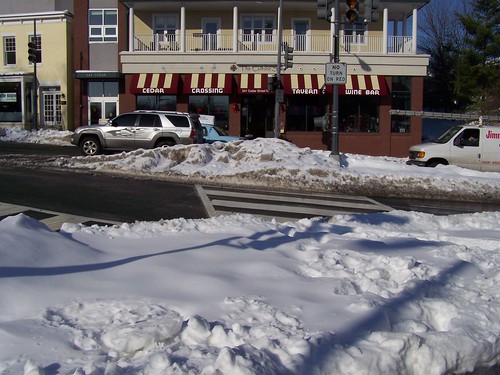
As of this morning, the pedestrian crosswalk at the intersection of Blair Road and Cedar Street, a few hundred feet from the Takoma Metro Station had not been cleared, looking pretty much like this still, even though this photo is from Monday afternoon.

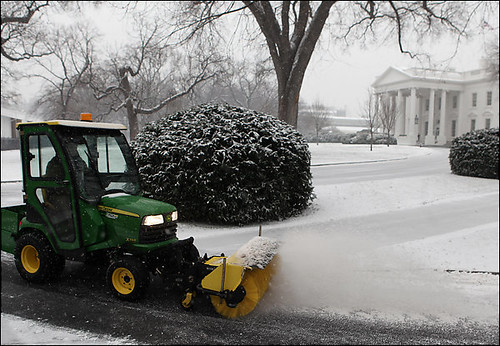
When I was 7 years old I lived in a nice neighborhood in Detroit called Rosedale Park, down the street lived our Congresswoman, and Roman Gribbs, who went on to become a sheriff, Mayor, and judge, was one of the leaders of my Cub Scout troop. So I don't know if the "snow brush" tractor that cleaned snow off our sidewalks in our neighborhood was paid for by a neighborhood association (my parents didn't consult me on such decisions) or the city, wanting to keep the VIPs happy.

But just as cities declare "snow emergency routes" for snow removal purposes, the same can be done for walk routes to schools, libraries, bus stops, and transit stations, and a system can be devised to make sure that snow is removed. Households need to be informed of their responsibilities, but still, just as with snow emergency routes, certain sidewalks can be designated "snow emergency routes" too, and cleared accordingly--that includes sidewalks and intersections.
Clearing snow at the White House
Clearing snow at the White House. Photo Credit: By Ron Edmonds -- Associated Press Photo

Labels: , , , , ,

What is the second act for retail in Columbia Heights?

I have been thinking about this for a bit, and then on the columbia_heights e-list there was a suggestion that the headquarters for the real estate analysis firm, Co-Star, be located there (see "DC Council backs controversial tax breaks to lure 2 firms" from the Post).

So I wrote (2 emails combined into one here):

Maybe it would, maybe it wouldn't. Sure, any incremental addition of people helps,especially during the day when retail districts often languish . But recognize that office workers support a very limited amount of commercial space.

The industry rule of thumb is 2 s.f. of retail and 5 s.f. of casual restaurant/take out space per worker, and the type of retail supported is very limited, usually convenience retail like CVS. Note as examples the relatively limited retail offerings in office districts such as M Street SE or Crystal City in Arlington.

So 1,000 workers support !!!!!!2,000 s.f. of retail space !!!!!!!!!!!!!!! and !!!!!!!!!!!! 5,000 s.f. !!!!!!!!!!!! of restaurant space.

So don't get too worked up about it. (And it's why chasing office development with big TIF exemptions can be a losing game, except for the property tax revenue, and some income tax revenue. BUT IT STILL PISSES ME OFF YEARS LATER, how immediately after the property tax exemption for Bureau of National Affairs expired, that they decamped for Arlington County. That's why _every_ property tax exemption of this nature should have massive clawback provisions, among other protections to ensure that there is acceptable civic and public finance ROI from such actions.)

One of the things I have been thinking about lately is that the Columbia Heights retail revitalization program has no second act.

While I was wrong, admittedly, in not favoring the creation of a chain retail center there (although I was right, in 2004-2005 to oppose the funding of a huge parking garage in the project since it is atop _the subway_), I think that DC/USA is a big success (at the very least I shop there, lugging items like Slow Cookers from Target on my bicycle), and is helpful in retaining consumer sales of DC residents thereby generating sales tax dollars, adding shopping options, and as repositioning Columbia Heights as a regional retail destination, even if the scale of "regional" in this instance is within DC only.

In and of itself, DC/USA doesn't provide enough retail to attract non residents. And given that what is offered is mostly convenience and/or discount goods, with the exception of Best Buy, it ends up being a limited offering.

The Reilly Law of Retail Gravitation is mathematical, but I summarize it thusly: with transportation costs being roughly equal, people choose to shop at the place with more and better stores.

For those of us in upper NW DC, comparing Columbia Heights to Silver Spring (has a Borders, movie theaters, more restaurants, Ulta [a cosmetics store that my wife frequents], great hardware store, some clothing shops, Whole Foods) or Bethesda (Bethesda Row has theaters, mostly restaurants, specialty shops, and Barnes & Noble), if we are "good little consumers" a la the Reilly Law, we will choose those Montgomery County locations, because foremost we are concerned about efficiency.

Another good comparison would be Columbia Heights to the DC side of Friendship Heights, with Mazza Gallery, admittedly an upscale mall, and the shopping center across the street, which includes not just Cheesecake Factory but stores like Pottery Barn, J. Crew, Borders, World Market, and Loehmann's. Plus there is other retail on the next couple blocks south, and the Lord & Taylor in back of Mazza Gallery. Plus then there is the additional retail on the Maryland side, ranging from high upscale (Saks) to the Gap and a Giant Supermarket and a Clyde's Restaurant.

Columbia Heights is pretty landlocked with limited opportunity for additional commercial redevelopment, and not able to add much in the way of additional chain retail with the space available at this time (with the current planning regime in place).

Clearly, if the Columbia Heights retail district is to extend its place within the regional retail landscape, it needs to add specialty goods stores, particularly in apparel, but other categories as well. Don't think about this comparison in terms of chain marques specifically, but about the breadth and type of the offering in the shopping district as a whole.

And then think about Columbia Heights and how to develop a retail plan and strategy along those lines.

I'd be focusing on that, and not on Co-Star.
--------
Disclosure: I was part of a bidding team (the RFP was not executed due to funding cutbacks) to do a next stage retail analysis of Columbia Heights. While the RFP excluded the 3100 block of 14th Street (where DC/USA is located), had we won the contract, we would have covered this and other points, basically, how to extend the retail energy that is present with DC/USA and the Giant Supermarket, and how to capitalize on the regional retail center aspects that these stores provide to strengthen the retail offerings north of the 3100 block as well as the secondary shopping district on 13th Street.

Labels: , , ,

Tuesday, December 22, 2009

Upping the expectations on snow removal

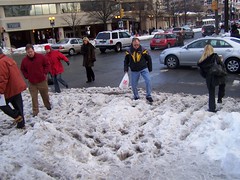
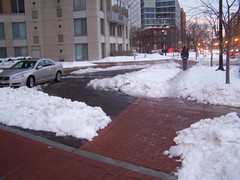
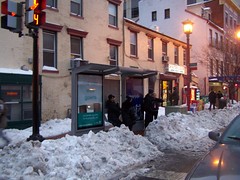
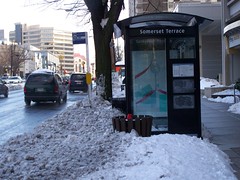
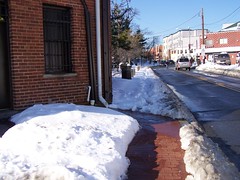
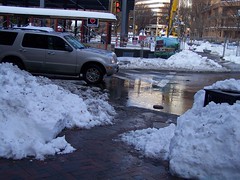
It's not enough to pat yourself on the back with regard to snow removal from streets (see "Busy rush hour as people head to work and shop" and this editorial, "D.C. area weathered the historic snowstorm with ease," from the Washington Post), how about being concerned about the removal of snow from sidewalks and bike lanes, clearing crosswalks and bus stops and shelters, from sidewalks on city government facilities, etc.?

Note that in my opinion, in my upper northwest but eastern side of DC neighborhood, through Saturday evening, I did not think that the snow removal practice on the collector and neighborhood streets was any great shakes...

By Sunday things improved. But it happened that we did a bunch of errands in Montgomery and Prince George's Counties on Sunday, and the roads we traveled on (Colesville, Georgia, US 1, Queens Chapel Road, etc.) were fine.

But neighborhood collector streets such as 3rd, 5th, and 7th weren't in good shape until Monday.

Maybe in the core of the city, things were much better.

Labels: , , ,

More on snow removal

100_0293.JPG
Mother carrying stroller w/baby because the uneven removal of snow made rolling the stroller impossible on Bradley Boulevard in Bethesda, Maryland.

1. Residents with corner lots have the "burden" of needing to shovel snow on two faces. It's a big responsibility. But it comes with the property. Too many people shirk this responsibility.
100_0244.JPG
The front walk of the house on Sheridan Street at 3rd Street NW.

100_0245.JPG
The sidewalk on the 3rd Street side of the house.

Yesterday, after business at my bank, because the weather was so nice, I decided to walk from Bethesda to Friendship Heights, along the west side of Wisconsin Avenue. There were many examples of people shoveling their front walk and shirking their responsibilities on the Wisconsin Avenue side of their properties. Of course, this is also a problem in Takoma DC and Manor Park, as I discovered walking to the subway station yesterday.

2. Similarly, residents with corner properties ought to shovel a path from the sidewalk to the street. (I used to do this when I lived on Capitol Hill.)
100_0242.JPG
Northeast corner of 3rd Street and North Dakota Avenue NW. (The corner building is an apartment building managed by the Barac Company.)

3. Or if they live next to a mid block alley they should shovel a path across the alley to the next house. (I used to do this when I lived in the H Street neighborhood.)
100_0370.JPG
400 block of Rittenhouse Street NW.

4. Commercial districts need to plan better for snow removal. Especially at intersections.
100_0344.JPG
6th and Massachusetts Avenue NW, northeast corner.

100_0317.JPG
Wisconsin Avenue, Friendship Heights, Maryland, adjacent to the M&T Bank.

5. And it occurs to me that it might be as part of "Transportation demand management planning" that businesses might be required to demonstrate that they have snow removal plans because when they don't, it can create traffic problems.

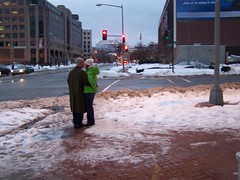
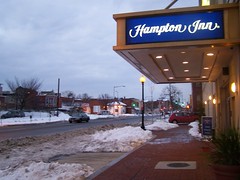
For example, I was "impressed" that the Hampton Inn at the corner of Massachusetts Avenue and 6th Street NW did not clear the snow in front of their entrance, where there is a lane for cars to load and unload. So instead of guests stopping in front of the hotel to drop off their luggage, they pulled into the entranceway for the garage to drop their luggage off on the sidewalk, blocking the sidewalk for pedestrians, and for other cars going into and out of the garage.
100_0347.JPG

And why wouldn't apartment-condominium buildings like 555 Massachusetts Avenue deem it important to clear the snow from their driveway for cars, but not from the sidewalk in front of their building?
100_0346.JPG
Unshoveled front sidewalk, 555 Massachusetts Avenue NW.

6. And just like there are Walk to School zones, there should be snow removal plans for "Walk to School" and "Walk to Transit" zones, including bus stops. Note that this seems to be a problem throughout the region, in Montgomery County, Baltimore City, and Baltimore County too, not just DC.
100_0339.JPG
Bus stop at 6th and H Streets NW, southwest corner.

100_0312.JPG
RideOn bus stop on Wisconsin Avenue in Friendship Heights, Maryland.

7. And instead of WMATA having to shut down bus service, I have wondered for quite some time why bus routes are not designated high priority for snow removal, in order to maintain service? See the Examiner story, "Metro pulled back in weekend storm, after 2003 mistakes." From the article:

Shortly before noon Saturday, the agency decided to halt buses and rail service to its aboveground stations by 1 p.m. "We could not wait any longer because we could see the weather was getting worse," Taubenkibel said. Buses are at the mercy of how well the roads are plowed. About 17 buses were stuck and 21 were in accidents as of 1:30 p.m., he said.

8. And in DC, the Department of Public Works, which sends out plenty of mail to DC households over the course of the year, ought to develop a brochure on the responsibilities of property owners and renters for snow removal, and send that out to households and other property owners in advance of the winter season.

As an example, check out this one page pdf from Douglas County, Colorado

9. Although responsibilities for snow removal for the DC Government ought not to stop at the roads. Many sidewalks along school and park properties tend not to be shoveled.
100_0251.JPG
Such as the corner park at Blair Road and 4th Street NW.

10. And we need to think about drainage issues (rain and snow related) as they relate to comfortable walking environments. Note the gutter downspout in this photograph. The water comes out of this spout and sprays out onto the sidewalk, creating the potential for dangerous, slippery conditions--such as this morning--when the water freezes and ices up the sidewalk.

I have been thinking about this for a bit, since seeing this article, "Sloppy Bloor St. corners tough on pedestrians," in the Toronto Star, and this intersection in Bethesda yesterday...
100_0273.JPG

These issues will be covered in the bicycle and pedestrian plan that I am working on at present, for a county in the Baltimore region.

Labels: , ,

What malls and convention centers have in common

They are enclosed spaces cut off from the world. They are single use places. And the people who go to them, convention goers especially, aren't interested in venturing elsewhere.

So generally, statements that X convention center or Y shopping mall will do all kinds of miraculous things for the adjacent areas and commercial districts are fatuous. Although, by working very diligently to make connections beyond the building, more positive impact can be garnered. But it's not easy.

The reality of shopping malls starting to change and add other functions isn't very interesting to me, even though it's interesting to a lot of other people, has engendered books such as Big Box Reuse, and many articles in the press.

All it is is a recognition that single use places lose their oomph and must be constantly refreshed in order to remain interesting and relevant. There's nothing new to that recognition, except to the people who didn't know any better.

As people get bored with shopping, and as the prevalence of "retail therapy" diminishes as the ability to spend money frivolously declines, places devoted exclusively to shopping lose their allure as well.

The Boston Globe has a number of recent articles that illustrate this point. "Legacy Place in Dedham puts a new spin on retail" discusses the triumph of lifestyles because they are mixed use destinations with more than retail stores. (And yes, lifestyle centers are modeled after traditional commercial districts, unlike traditional shopping centers, which focus exclusively on retail stores.) From the article:

Hours later, shoppers packed the open-air plaza off Route 1, streaming into Showcase Cinema de Lux to catch new releases such as “The Twilight Saga: New Moon,’’ tearing up the alleys at Kings bowling, gorging on sweets at Sugar Heaven, and hitting the sales at various merchants. While traffic dropped off at other retail outlets after Black Friday, Legacy Place was bustling for the rest of the post-Thanksgiving weekend.

This holiday, Legacy Place is changing the shopping landscape in Massachusetts by spurning such traditional gimmicks as door-buster deals at the break of dawn and photos with Santa. Instead, the Dedham complex is vying to attract customers with its unique combination of entertainment, upscale restaurants such as Met Bar & Grill, New England’s largest Whole Foods Market, and a range of retail options, including the first shopping venue in the state with all three Urban brands: Anthropologie, Free People, and Urban Outfitters.

Open-air shopping meccas such as Legacy Place have gained huge popularity across the country as consumers demand more from their shopping excursions. The number of lifestyle centers, which typically offer specialty merchants along with restaurants and entertainment with easy pedestrian access, has doubled to 434 since 2003. Meanwhile, no new enclosed mall has opened in the United States since 2006. In Massachusetts, about a half-dozen open-air shopping centers similar to Legacy Place have opened since 2003, including Derby Street Shoppes in Hingham and Patriot Place in Foxborough, according to Robert F. Sheehan, vice president of research for KeyPoint Partners LLC, a Burlington firm.

This comes at a cost when traditional commercial districts are unable, for many reasons, to be competitive. See "Dedham Square struggles to coexist with new Legacy Place mall." From the article:

In light of an ongoing metamorphosis in historic Dedham Square, hopes were high this fall that the downtown shopping area would hold its own once the massive Legacy Place lifestyle center sprang up on Route 1.

Town officials anticipated a spillover effect, figuring patrons of the 80 new stores and restaurants, and the 15-screen movie complex a mile down the road would also make a trip to the square to see, taste, and buy what the local shops had to offer.

But that has not happened. Foot traffic in the square is down, with some merchants reporting losses of 40 to 50 percent of their receipts, since the retail complex opened late this summer.

People are lazy, I mean, efficient. They prefer to go to one place and stay there. So unless the new and the old are well integrated, usually the new trumps the old, at least for a long while, and forever if the new continues to be able to be "refreshed" from time to time, while the old stays uncompetitive.

As for convention centers, as Robert Campbell writes in "Expanded convention center must do more than get bigger":

There are economic arguments for and against such an expansion. I’ll leave those up to the financial experts. I’m interested in the quality of city life for the people who live there and those who visit. Looked at that way, a convention center can be - and usually is - an unmitigated disaster. That’s the bad news.

The good news is that there are ways to make these Goliaths into better neighbors. That’s rarely achieved, but it’s possible.

First the bad news. Typical American convention centers are hideous, huge, blank-walled boxes. They’re surrounded by streets that are too wide, in order to accommodate all those trucks, buses, cabs and cars. Approaching such a center on foot, as a pedestrian, you feel alienated and unwelcome. The building divorces itself from its surroundings. It creates a dead zone all around itself, as if it were some kind of toxic infection in the city. There’s seldom much urban life in the vicinity of any convention center.

Often, these places are built far from the center of town, in locations where if you walk out the door there’s no place to go. In Chicago, for example, you feel like you must be in some other state. That’s true in Boston, too. The famous charm of our city is invisible and far away.

So what’s the solution? What makes these places work better? The answer is pretty simple, although hard to achieve. Everything depends on the edges, the periphery, the line of demarcation where the convention center meets the city around it. The center must reach out to shake hands with the city, not isolate itself behind a concrete wall or a moat of traffic.

He goes on to discuss two examples of better connected convention centers that illustrate his thesis, in Philadelphia and San Francisco.

In the meantime, economic development types sell us citizens a bill of goods.

Labels: , , , , ,