Rebuilding Place in the Urban Space

"A community’s physical form, rather than its land uses, is its most intrinsic and enduring characteristic." [Katz, EPA] This blog focuses on place and placemaking and all that makes it work--historic preservation, urban design, transportation, asset-based community development, arts & cultural development, commercial district revitalization, tourism & destination development, and quality of life advocacy--along with doses of civic engagement and good governance watchdogging.

Friday, March 31, 2006

I fear another blown opportunity to improve neighborhoods and to do neighborhood planning

004
Today's Post has this article, "12 Schools Open to Mergers, Janey Says," about DC's school closing discussion. The article is troubling for (at least) three reasons:

(1) There are plenty of opportunities for neighborhoods to improve;
(2) the city lacks true and comprehensive neighborhood-based land use and resource plans;
(3) ad-hoc planning of school closures and mergers by school principals is not likely to push forward overarching neighborhood improvement initiatives.

For example, the article mentions a Webb teacher saying that there school could be overwhelmed by 110 students (5 classrooms!) from Wheatley. Or someone else mentioned that the Ludlow-Taylor principal (236 students in a school capable of probably 600 or more) is negotiating with a special needs program serving 110 children.

Yet in the context of broader-based planning initiatives, letting 1,000 flowers bloom, cacophonious planning makes no sense.

1. In the 1950s through the 1970s, DC Public Schools built cheap ugly buildings, often tearing down what today would be considered historic residential building stock as well as school buildings to do so, and/or deaccessioning perfectly usable historic buildings.

2. Many neighborhoods lack other amenities such as park and green spaces.

3. Providing public services such as recreation, library, community education, and other services should be coordinated and ideally cross-use the same facilities in order to maximize return on investment.

If I were creating criteria to shape the school "rightsizing" process, I would be looking to (1) close buildings that are ugly and (2) that have opportunities for quality redevelopment and or providing other desirable community amenities.

For example, either Ludlow-Taylor or JO Wilson (two blocks apart) could close. L-T is from the 1970s, JO Wilson from the 1950s. North of H Street and south of Florida Avenue there are no public green spaces, other than the playground at JO Wilson, which could be more broadly used as a public greenspace.

Wheatley Elementary is a historic school building, and huge. Because of its historicity, redevelopment opportunities are restricted. Plus, its large size might suggest keeping the building as a public school to provide upside potential for being able to respond to possible student enrollment increases. Webb is an ugly "modern" school building located on Mt. Olivet Road at a location that has more redevelopment options. (Unless people are clamoring for Wheatley to be converted into condominiums...)
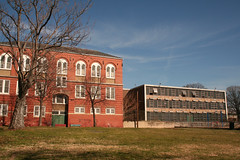
Old and new at Wheatley Elementary SchoolSee the difference... old and "new" construction at Wheatley Elementary School, Trinidad, Washington, DC. Photo by Inked78.

In neither case should these decisions be left up to the school board or to a few teachers or a couple school principals without a real neighborhood-based public process to wrestle through these issues.

This comes back to my criticism that DC doesn't have an Office of Planning, we have an Office of Land Use, and most of the planning initiatives of other DC Government agencies, in particular the DC Public Library System, the DC Parks and Recreation system, and the DC Public Schools "Master Education Plan" process as well as the School Facilities Closure process are separate processes, and certainly appear to be disconnected for the most part from overall "Comprehensive Planning" such as encapsulated by the ongoing Comprehensive Plan revision process.

We need a real Office of Planning that coordinates all of the city's government-based planning initiatives, and real neighborhood-based planning systems as well.

Getting back to schools planning for a minute, a friend of mine wrote me in response to the blog entry "Straight talk on "self-help" in neighborhood revitalization" and she said:

After I read your blog, I signed up as a volunteer to plant cherry trees at Adams Elementary School last Saturday! I had a GREAT time -- the principal of the school is a real visionary, too. You may want to interview him -- he is truly committed to blurring the boundaries between school and community, in very creative ways.

And I wrote in turn:

As far as schools go, I think that every school in the city should do the Project for Public Spaces "How to turn a place around" workshop at the school focusing on the community within a couple block radius of the campus, as a way to build a community-eyes on the street-engaging nearby neighbors into helping "secure" the perimeter in the hours that school's not open. Plus, these are park-like spaces that the community should be able to use, and assets that the community should be able to access in order to "build its capacity to learn and grow," and create a true "city of learning," school libraries should be sited within schools, so that they can be used off hours by residents, perhaps by having separate entrances that can be open when school isn't, etc.
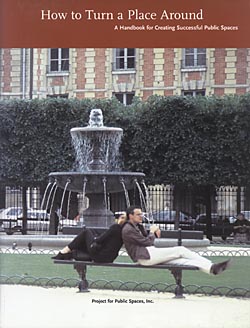
How to Turn A Place Around
I tried to get JO Wilson to do the HTTPA workshop but the community group is stuck in "charismatic leadership" from the 1980s (see Social Psychology of Organizations by Katz and Kahn)... Quite frustrating.
______
Also see "School closure picture sharpens," from today's Examiner. From the article (which doesn't list the complete list of 8 schools!!!!!!!!!!!!!!!!!!!!):

An analysis of D.C. Public Schools budget figures released this week gives some clue into which schools Superintendent Clifford Janey is considering closing or consolidating this fall. Eight elementary schools — all in Southeast and Northeast — which were listed separately in the budget figures released March 3 are now shown with consolidated budgets, according to figures released Wednesday. The enrollment figures for the schools are also combined in the most recent report...And some schools, including Van Ness Elementary in Southeast, no longer have budgets, according to the budget documents.

Index Keywords:

Housing or City Living is Uniformly Sexy, all the people are beautiful, etc.

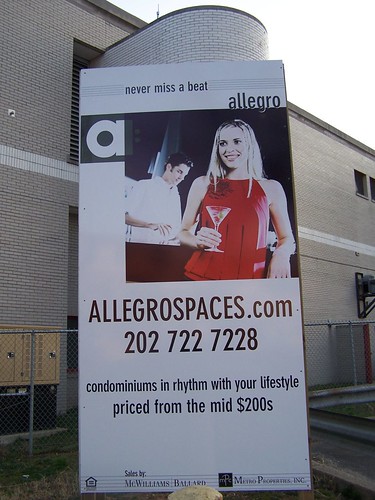
City living is uniformly hot... #2This building will be going up on the site of the old Giant Supermarket on 14th Street NW in Columbia Heights, about two blocks from Tivoli Square.

Today's Express (not online) has a special section on Condo Living, which includes a few pages focusing on Columbia Heights. The big question is whether or not there are way too many condominiums in the production pipeline, if there is enough demand. I was surprised to see that the development above has units from the $200,000s, since most prices I've seen range from $450-$600/square foot. Last week's Examiner real estate section feature an Adams-Morgan "loft" condominium (new construction) for which the asking price is $1.4 million.

Anyway, I'd try to pick up a copy of today's Express (which also has a page on Zach Schrag, author of the newly published book about the Washington subway system, Great Society Subway.)

Speaking of overhang, Wednesday's Washington Times had an article about the declining inventory of rentable apartments, "2BR, 2BA, 2MUCH." From the article:

Anthony Grossi rents a one-bedroom, one-bathroom apartment in Arlington and recently signed a six-month lease that raises his rent $75 per month. The increase, more than 4 percent, is typical in the Washington area, which continues to be one of the hottest apartment markets in the country, with average occupancy exceeding 96 percent, above-inflation rent growth, and demand far outpacing supply for affordable rental units, said Gleb Nechayev, vice president and senior economist at Torto Wheaton Research, a business unit of CB Richard Ellis...

More bad news for renters comes in the form of fewer options. About 9,800 rental units were converted into condominiums last year in the Washington area, but only 6,300 new rental units were built, Mr. Nechayev said. But Ms. Smith said no one knows how many of those conversions were bought and then turned back into rental properties. She acknowledged, however, that the smaller market definitely helps Bozzuto's bottom line, and said the company is seeing retention rates increase almost across the board.

Index Keywords:

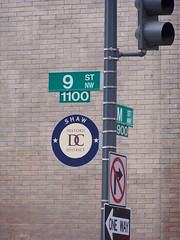
Historic District Sign


Historic District Sign
Originally uploaded by rllayman.
This is an example of the DC historic district sign marker that I think is disgustingly ugly. It makes me not want to work to create historic districts if this is how they are demarked.

Bus Stop -- Not the Hollies version, New Hampshire Avenue NW


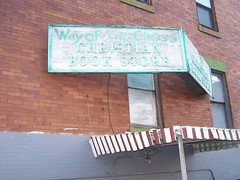
Way of the Cross Christian Book Store (Next door to the future condo building)

In Columbia Heights. I was looking at the old Giant Supermarket site, because it is being redeveloped into condos. I argue that they should be required to put ground-floor retail in as a way to extend walkability and to strengthen the commercial district by knitting together its various, somewhat disparate parts.

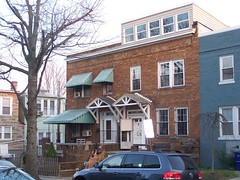
1010 Irving Street NW with discordant third floor addition

It is because of abominations such as this that I favor city-wide design guidelines whether or not a neighborhood is designated as a historic district.

This building stock would be considered contributing structures as part of a designated historic district, but creating historic districts is difficult in these times of the rising property rights movement, selfishness, and the disconnect in understanding about what makes livable neighborhoods in center cities (history + urban design + architecture), why these qualities need to be preserved, and how to do so.

In DC law, only historic districts possess additional design review "privileges" when infill construction and/or substantive changes to extant properties are proposed.

That's why design, historicity, and architectural integrity tends to be more apparent in historic districts.

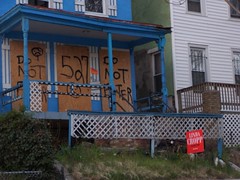
Why do candidate supporters put election signs in front of abandoned-vacant-nuisance properties?

This is something that I've always wondered about. What possesses people to have their candidates associated with disinvestment and abandonment, unless we are supposed to think that this particular candidate, if victorious, will change things?

(527 Irving Street NW)

Thursday, March 30, 2006

Saturday DC Board of Education hearing

hj319.jpgAnother Dick and Jane primer...

Thanks to Mark Borbely of Fix Our Schools for this information:

D.C. Board of Education
Announces a Public Hearing on
The Superintendent’s Recommended Criteria for
Consolidating and Rightsizing School Facilities
Saturday, April 1, 2006
11:00 a.m. – 2:00 p.m.

825 North Capitol Street NE
Washington, DC 20002
5th Floor Board Room

The District of Columbia Board of Education will hold a public hearing on the Superintendent’s recommended criteria for consolidating and rightsizing school facilities on April 1, 2006 at 11:00 am – 2:00 pm at 825 North Capitol Street, in the 5th Floor Board Room.

The hearing will be structured in a focus group format which will facilitate a more open dialogue among the participants, Board members and the Superintendent. This focus group format will allow for a more thorough discussion on what should be included in the proposed criteria that will be used to determine which school facilities will be recommended for consolidation or rightsizing. The
Criteria for the Consolidation and Rightsizing of DCPS Facilities are available on the Board of Education website.

The Board of Education invites the public to participate in the hearing. Those who wish to participate should contact Heather Reynolds at (202) 442-5193 by noon, March 31, 2006. If you are unable to participate in the focus groups, written statements can be submitted for the official record to: Russell A. Smith, D.C. Board of Education, 825 North Capitol Street, N.E., Washington, DC 20002.


Index Keywords:

DC K-12 Public Education issues

hj970.jpg"Sally, Dick and Jane" primer images from Julia's Collectibles.

There are two simultaneous processes, one to improve the schools and another to "rightsize" facilities and close schools deemed "not the right size." DC has lots of low enrollment schools, but having an arbitrary cutoff not taking into account success and size of school makes little sense.

According to the Common Denominator, this is the hearing schedule for the school closings, (one session was last night):

The first of the public forums is scheduled for March 29 at McKinley Technology High School, 151 T St. NE, and will focus on senior high schools. A second forum, on March 30, will be held at Kelly Miller Middle School, 301 49th St. NE, and will focus on the superintendent's plan to convert junior high schools to middle schools.

Four of the forums will focus on elementary schools. They will be held on April 3 at Noyes Elementary School, 2925 10th St. NE; April 4 at Patterson Elementary, 4399 South Capitol Terrace SW; April 5 at Thomas Elementary, 650 Anacostia Road NE; and April 6 at Janney Elementary, 4130 Albemarle St. NW.

All six forums are schedule to begin at 6 p.m.

According to one of the emails on the yahoogroup list that has a lot more up-to-date analysis of the various ins-and-outs of the issues, concerned4DCPS, the meetings have these geographic orientations:

April 3, Noyes ES, Areas E & H are roughly equivalent to Wards 4 and 5
April 4, Patterson ES, Areas A & D are roughly equivalent to Wards 8, southern section of Ward 2 & Ward 6
April 5, Thomas ES, Areas C & B is essentially equivalent to Ward 7
April 6, Janney ES, Areas G & F are roughly equivalent to Wards 1, the western section of Ward 2 and Ward 3

The Examiner reported the other day, in "Parents push for delay in school closing process," about a community email campaign asking the Board of Education to postpone a hearing scheduled for this Saturday, April 1st, but I can't find details about the hearing on the DCPS website or the School Board Calendar. And unlike most DC Government agencies under the separate DC.GOV web rubric, there isn't an easily found tab on the left for "News Room" or "Press Releases" that ostensibly would include such an announcement. 13774.jpg

Index Keywords:

Wednesday, March 29, 2006

Check out the website for Geography 378: Retail and Service Location

(a class at the University of Wisconsin - Stevens Point)

From the course website:

The text for this course is: Also a number of reading materials will be put on reserve. You will need the following material:

Main Text
Birkin, M., G. Clarke and M. Clarke 2005. Retail Geography & Intelligent Network Planning. Chichester, UK: Wiley.

Additional Material

The following books will be available on reserve.
Daniels, P. W. 1985 Service Industries: A Geographical Appraisal. London: Methuen.
Daniels, P. W. 1993 Service Industries In The World Economy. Oxford: Blackwell Publishers.
Fenker, R. M. 1996. The Site Book: A Field Guide to Commercial Real Estate Evaluation. Fort Worth, TX: Mesa House Publishing.
Ghosh, A and McLafferty, S. L. 1987 Location Strategies for Retail and Service Firms. Lexington: D. C. Heath and Company.
Jones, K and Simmons, J. 1990 The Retail Environment. London and New York: Routledge.
Riddle, D. I. 1986 Service-led Growth: The Role of Service Sector in World Development. New York: Praeger.
Salvaneschi, L 2002 Location, Location, Location: How to Select the Best Site For Your Business. Grants Pass, OR: Oasis Press.

There will also a lab manual containing Retail and Service Location exercises.

... cf. Bismarck -- "Fools say that they learn by experience. I prefer to profit from the experiences of others."

(I found this website by looking at "referral" results on how people clicked into the webpage for the blog. It can be quite fascinating.)

Index Keywords:

Higher Education/Special Libraries

A great thing about DC is the quality of the libraries here, in particular the special libraries. Many such libraries are closed to the public (such as those associated with trade associations). But many are not such as the Foundation Center (great for fundraising research) and the Higher Education Library at the "National Center for Higher Education" building on Dupont Circle. (Plus the Dept. of Education has a nice library by the Air and Space Museum, but it is a pain in the ass to access. It was much easier when it was located by Union Station.)

I spent a couple hours at the Higher Education Library yesterday (time I didn't really have). But they have such a nicely focused collection. Including journals on land use planning for colleges, and urban engagement (the journal for the Coalition of Urban & Metropolitan Universities) and other good stuff.

Note the mission of the Coalition:

Metropolitan Universities are institutions that strive to be responsive to the needs of our communities, to include teaching that is adaptable to the diverse needs of our metropolitan students, and to build close working relationships with elementary and secondary schools so as to improve the overall quality of education.

Metropolitan Universities combine research-based learning with practical application and are dedicated to creating interdisciplinary partnerships and forming alliances with outside public and private organizations to resolve complex metropolitan problems. Within the university environment, our colleges and universities seek to educate students to become informed and engaged citizens who will play a role in the betterment of society.

It's interesting that the University of Maryland College Park is a member, but there isn't even one member of this organization of any of the higher education institutions domiciled in DC.

The journal for the Society for College and University Planning is searchable online. And CUMU publishes Metropolitan Universities, which also has grist for the mill for neighborhoods abutting universities, not to mention the general town-gown interaction issues and opportunities.

Index Keywords:

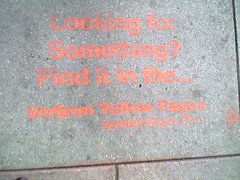
Commodification of Graffiti


Commodification of Graffiti
Originally uploaded by rllayman.
(This image is from DCist.)

In response to this, Denise Wiktor of the DC Department of Transportation Office of Public Space, writes:

There is a guerilla advertising group that is paid to place graffiti
advertising in Public Space. Another location was identified to me
yesterday that was orange containing a Verizon advertisement.

Now I understand there are two on Connecticut Ave sidewalks in Woodley Park near the Chipotle and Mr. Chen's. I would appreciate it if anyone
sees such advertisement to e-mail me so that we can ensure it is
removed and the parties properly sanctioned.

Now here's a DC Government employee that I've grown to be fond of, and we haven't yet met. (She was good about doing the right thing wrt the Giant Supermarket Tivoli Square seizure of public space issue.)

Visual evidence for why I say that Silver Spring is undergoing urban renewal, not revitalization

Urban renewal generally is a land assemblage and redevelopment strategy that creates new buildings without saving old buildings. Historic preservation, an asset-based revitalization strategy, is the heart of urban "revitalization" rather than big project planning type things (e.g., attracting large office buildings such as for the Discovery Channel).

Granted in Silver Spring there are a few exceptions, the old Hecht's Building, the revitalization of the Silver Theater, the attraction of arts based organizations to the area (another asset-based revitalization strategy).

But for the most part it's a bunch of new big buildings, brutal and cold, with little in the way of active engaging street life. (And as I mentioned before, the small independent businesses are being crowded out, according to this UMD student studio report as mentioned in this press release "Study Recommends Steps to Save Silver Spring Small Businesses" and subsequent articles.)

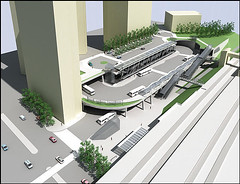
This rendering of a new multimodal transit center for Silver Spring illustrates my point.
PH2006032201177.jpgConstruction on the complex is scheduled to begin this fall and is expected to be complete in 2009. Photo Credit: Parsons, Brinckerhoff, Quade & Douglas Inc.-Zimmer, Gunsul, Frasca Partnership Photo via the Washington Post.

See the Post article, "Silver Spring's Plans For Transit Center Move to Final Stages: Hub Seen as Next Step in Revitalization," for more. Note to Post editors--there is a definitional difference between the words revitalization and redevelopment.

Index Keywords: ; ;

Baltimore and bicycling

crop4My bike wheel is in the left of this Baltimore photo from last July. Also see "Getting to Baltimore (and Artscape) with a bike."

I thought I was done with Baltimore today but somehow I missed a January article about a bicycling development plan for the City of Baltimore, which is discussed in this blog entry from WashCycle, "Baltimore Throws Down the Gauntlet." The original Sun article, "Bike lanes on path to approval ; First step in $175,000 plan would link Baltimore's college system" from January 23rd, 2006, is no longer available online, but the magic of databases allows retrieval:

Ambitious plans to create a bicycle network across Baltimore with a combination of designated lanes and shared roadways spanning more than 400 miles could begin in about a year, pending approval by the city's planning commission. The idea is to allow bicyclists to more easily navigate the often- congested streets by adding markings and signage, and, in some cases, resurfacing roadways to make them smoother. The paths would be integrated with public transportation stops.

Planning officials said at a meeting last week that the first phase would be the creation of the Collegetown Bike Route, which would link Johns Hopkins and Morgan State universities with St. Mary's Seminary and the Loyola-Notre Dame campus. Construction could start in about a year and cost $175,000.

The entire project could take up to 20 years to complete. It would include adding bicycle racks across the city and an education campaign for motorists and cyclists on how to safely share city streets. Promoters said they hope to get more people riding bicycles to work and when running daily errands.

"Baltimore has a lot of strong neighborhood shopping," said Robert S. Patten, a senior planner at Toole Design Group, which the city hired to develop the plan. "Biking's a great way to get access to all these things." Patten, who has spent a year on Baltimore's project, worked on plans for bike networks in other cities, including Washington. He is also a cyclist, and he listened to fellow enthusiasts at a public forum and spent time biking around the city and brainstorming with city officials to create a plan that would work best for Baltimore.

At last week's meeting, attended by about 100 people, city planners presented census statistics showing that less than one- half of 1 percent of Baltimore residents commute to work on bikes, compared with more than 1 percent in Washington.

"Baltimore is really struggling to become a world-class city, and this is really a forward-thinking idea, building a bike-friendly city," said Mike Counselman, a board member for One Less Car, a statewide biking advocacy group and a member of the mayor's Bicycle Advisory Committee.

"This is really about quality of life, revitalizing neighborhoods," he said. "When you think about why people want to live in the city, they want access to neighborhoods."

Ian Macdonald treks to work each day on a mountain bike from his Riverside Park home in South Baltimore to his downtown office, saving money in an era of high gasoline prices. He's commuted this way for years.

His route isn't always easy. The 30-year-old takes Key Highway, a wide and winding street that skirts an industrial zone and high- priced developments under construction, in which he constantly has to dodge potholes, sewer grates and impatient drivers.

Macdonald wears a helmet and has 15 years' experience biking in urban areas, yet Baltimore's lack of designated street lanes and what he describes as a culture of disdain for bicyclists make his trip decidedly stressful.

"One of the biggest problems I have is because it's not a designated bike trip, you find a lot of trucks in those lanes," Macdonald said. "And you have to jump out into four lanes of city traffic." But the climate seems to be improving. Macdonald, who three years ago successfully lobbied his employer, Constellation Energy, to install a bike rack outside his office building, said he now struggles to find a place on the rack to park his bike.

"It's about infrastructure - making sure you have connections to the light rail system and buses and MARC," Macdonald said. "I would love to be able to bike to the MARC station and go wherever I need to go."

MTA Bus,
No bike rack on this MTA bus. Photo from last July. Plus, you can't take bikes on MARC Trains.

Index Keywords:

The city wants to give $200 million to people killers? (HUH negligence)

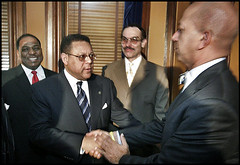
PH2006010502267.jpgPhotographer: Linda Davidson / The Washington Post. Mayor Tony Williams and Howard University President H. Patrick Swygert sign agreement for new National Capital Medical Center. Pictured: H. Patrick Swygert (left) signs the agreement at Mayor Williams looks on.

The very contentious attempt to create a "National Capital Medical Center" in NE DC continues. The fact that this process isn't looking at overall health and wellness objectives and how to achieve them is made pretty clear in this Washington Post editorial from today, "Mr. Rosenbaum at Howard," outlining how repeated failures by both the DC Fire and Emergency Medical Services Department and the Howard University Hospital doomed David E. Rosenbaum to death...

From the editorial:

"Once Mr. Rosenbaum was transported to the Emergency Dept., the triage nurse failed to properly assess, evaluate and manage his clinical presentation" as required by protocols and patient care standards. "The triage nurse also failed to perform a neurological assessment to determine Mr. Rosenbaum's level of consciousness and the possibility of a brain injury, based on the low GCS scorings [suggestive of a severe brain injury] obtained by the EMS unit while on the scene."

· "The evening charge nurse then failed to assess and evaluate Mr. Rosenbaum's condition prior to assigning him to the hallway. Furthermore, she failed to alert and specifically assign his care to one of the ED nurses overseeing patients in that hallway."

· "Mr. Rosenbaum was . . . left unattended in the hallway for approximately one hour and 20 minutes after his arrival to the ED . . . after which time he was discovered to have a life-threatening brain injury which required emergency neurosurgical intervention."

· "There was no documented evidence that Mr. Rosenbaum's initial evaluation by the physician included a comprehensive head-to-toe assessment . . . that would have revealed any trauma to his head. . . . Concurrently, there was no evidence that [his] initial level of consciousness (documented as lethargy), along with his limited response to painful stimuli, was investigated by the physician to determine a possible cause."

The Health Department has notified Howard of several deficiencies in its patient treatment and has demanded an "acceptable plan of corrective action," D.C. Health Director Gregg A. Pane said yesterday. The Health Department has also notified the federal Centers for Medicare and Medicaid Services of its findings and is weighing other options for holding the hospital accountable.

And to think: Howard University is asking that the city spend $200 million and that the federal government guarantee an additional $200 million so the university and the city can build a $400 million medical complex that Howard medical professionals will control and operate.

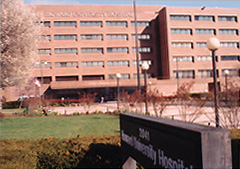
Howard University HospitalHoward University Hospital.

Index Keywords:

No sympathy

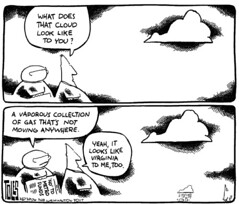
Opinions Tom Toles Cartoons - (washingtonpost.com).gifTom Toles editorial cartoon from the Washington Post.

The headline on the cover of the DC edition of The Examiner reads "Price of Metrorail to Dulles might land on Toll Road drivers: Commuters could end up paying for half of $4 billion extension."

And your point is?

Roads are subsidized by the tune of 50% from general funds of federal, state, and local governments. Gasoline excise taxes and fees cover the other 50%.

Why should road subsidies be sacrosanct? It's not like the toll road users aren't "driving" demand for transportation and more roads.

Granted in theory, their tolls cover the cost of the road that they are driving on. But they drive on plenty of other subsidized roads.

Who better to pay for an expansion of Metrorail in Virginia but Virginians? As Sam Smith and many others have pointed out, DC has subsidized the initial construction of the Metrorail system by directing all of its federal highway monies (part of that 50% subsidy...) to this. Virginia and Maryland did not take similar actions.

Live by the subsidy, die by the subsidy... see this previous blog entry: Virginia is for "free riders" (not lovers). Ideology such as "pay as you go" comes home to roost.

Index Keywords:

Class talk about transit (Baltimore, DC, Portland)

At first I was going to put this in the last entry, which was too long. I have been having an e-conversation with a Baltimore resident who came across the blog. Chris writes:

I came across your blog this evening and I was happy to read your Feb. 26 entry "Poorly designed transit doesn't market transit very well." I'm from Baltimore and I'm staunchly pro-transit, especially rail. I commuted to DC for a couple of years as well, so I'm familiar with transit issues in both cities.

Having discussed this issue with other Baltimoreans, the perceived value of the system (if you want to call it that, considering that the closest transfers between lines are no less than half a block apart) appears to be just one of the factors that has hampered transit support in Baltimore.

Case in point, when designs were being brought forward for rapid transit, one line was originally drawn into Anne Arundel County. If I'm not mistaken, the terminus was to be Marley Station. AA County said no way. And even since the construction of Light Rail, one of the main sentiments I hear coming from the area is that it's brought crime, mostly in the form of property crimes.

Consider the following:

"Citizens and political leaders in Anne Arundel County expressed fears about "undesirable elements" coming into their area via the subway, and many transit buffs cite this as the origin of the term "LOOT rail", a takeoff of "light rail" meaning that criminals without cars who live in the city would take the subway to the suburbs, commit burglaries and robberies, and then take the subway back to the city; and that by building a subway to the suburbs, that such crimes would be greatly facilitated."(Quote from the Roads to the Future website.)

In fact, from discussions I've had and read online, quite a few people in areas like Timonium and Hunt Valley, were not thrilled about the re-opening of Light Rail after the double tracking project. Apparently, crime was down during the time that th eline was closed and MTA was running bus bridges to those areas. Same line of thinking.

It certainly doesn't help that between the Cromwell/BWI Airport and Hunt Valley areas, the line traverses depressed areas that are home to lower class individuals, both white and black. These complaints that I've heard have been touched by both race and class. Apparently, some of the same can be heard from residents living near the northern end of theBaltimore Metro system. Those same arguments tend to be more along class lines.

So, that's what I've seen. I agree with the rest of your post concerning how the poor design has contributed to the lack of appreciation for transit in Baltimore, definitely is on the money.

Ironically, this is the flip side of anti-streetcar arguments in Anacostia, where predominately African-Americans of middle- and lower-incomes see "bringing back streetcars" as designed for whiteys working at Bolling Air Force Base.

I think it's crazy that people can argue against better transit and keep a straight face. But it really shocked me that this has happened, especially after people went on a site visit to Portland Oregon

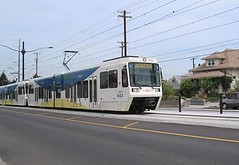
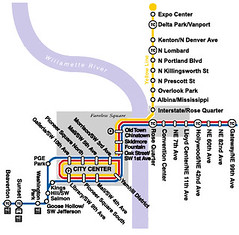
Although I think part of the problem is that Portland is so homogeneous--read white--that people probably had a difficult time looking past that. They needed to be taken on a tour of Tri-Met's Yellow Line, which had a very difficult gestation, and is a line designed in part to serve as an augur of revitalization for lower income and ethnic communities in northeast Portland.

ImagePortlandTriMetMAX.jpg - Wikipedia, the free encyclopedia.jpgInterstate-Yellow Line Tri-Met Light Rail in Portland.
portland9.jpgMap of the "poor" area in Portland...

One of the people who led the tour that I attended last fall is an African-American property owner in the area--he owns a building or two just up the block from the Widmer craft brewery and down the street from McMenamins White Eagle Rock n' Roll Hotel and a long block from the Albina-Mississippi station--who was originally against the system (because of the way it was funded, through the creation of an urban renewal district, after the failure of either two or three funding referendums).

Now he sees the value and utility of the system, and the positive impact it is having. I joke that he needs to become a transit ambassador for APTA.

My response to Chris:

The story you recount about AA county isn't unusual. The terminus for the main light rail line in Multnomah County (Portland, Oregon) went through the same battle and the local community didn't let the LR line go downtown. Instead, a new business center has developed around the LR terminus.

Note that there is some increase in crime that at the very least is station-related, but that kind of crime happens when a Walmart opens too... But as far as transit related crime goes it seems to go in cycles, as enterprising criminals say from SE DC go up to Rockville on the subway and steal cars. But it's not that frequent, most people who are criminals work close to home, it's the more apt criminals (and there aren't that many) that range farther afield.

Another problem is that the Baltimore region has a very urban renewal (rather than asset-based revitalization) approach to urban revitalization. I.e., Charles Center, Inner Harbor. I haven't read the book yet, but the "memoir" by David Wallace (of Wallace Roberts and Todd) goes into detail about his CC and IH experiences, as he and later his firm were the lead planners for both. I was reading the Baltimore Master Plan revision and while it's great that it has about a 40 page history of Baltimore, the contemporary part, especially that about the urban renewal phase, reads like it was written by pr flacks...

UR seemed to be antithetical to connections. And even though this "red line" is going forward (I've talked to a ZGL consultant who is highly involved in the effort) it will be (yet) another style of LR (more like Portland), different (although that's a good thing) from the current LR system.
The disconnected and "discoordinated" system (a quote from Steve Pinkus) in Baltimore, as you say "hampers" support.

And Chris' response:

On one message board that I frequent, that's been one of the points that anti-transit folks don't want to look at. I'm reminded of an anecdote I read on the same board, during a discussion of Light Rail reopening at Hunt Valley. One of the posters used to work at a department store at the old Golden Ring Mall. One day, he spotted somebody grab some merchandise, then make a break for the door. Outside, there was a car waiting, which the person jumped into, and sped away towards 695, never to be seen again. Not a single anti-transit person would take the anti-highway position, despite its possible use for shoplifting (I-83 isn't that far from Hunt Valley either).

And he quoted from the previously mentioned Sunday Sun article on traffic:

Though Pedersen is, by the nature of his job, an advocate of better roads, he said Marylanders can't expect the state to build its way out of its congestion problems. "We really need to take a multifaceted approach," he said. "You're not going to do it just with building additional highway capacity. We have to look at transit. We have to look at the demand side through programs like telecommuting, and we have to look at land use."

Dan Pontius, regional policy director of the nonprofit Citizens Planning and Housing Association, said Marylanders need more transportation choices. "People are realizing now that the benefit of adding a lane to a highway is pretty short-lived," he said. He said developers need to pay attention to these transportation problems as they design communities, and to try to incorporate walking areas and transit options into their plans.

Index Keywords:

Bub buh buh Baltimore...

There is so much I've been meaning to write about so here goes.

1. Paul Johnson points us to the current edition of The Urbanite free monthly, a very interesting architecture, design, and lifestyle magazine distributed throughout Baltimore. There are many interesting articles this month, including:

-- "Navigating Urban Space: Why isn’t walking part of Baltimore’s urban lifestyle?"
-- "The City Beautiful" Can a new and improved urban design and architecture review panel bring better buildings to Baltimore?
-- "Baltimore Observed: The Next Baby Boom" Are more middle-class parents deciding to raise their kids in the city?
-- "Pipe Dreams" What could happen if we treated infrastructure as an integral part of our city’s architecture?

2. ...Speaking of why Baltimoreans don't walk, from that article:

But back in Baltimore also means back in my car, and I did not miss the urban driving experience. I did not miss wasting time in traffic, the persistent gridlocking on President Street, the unsynchronized traffic lights, the close calls, the screaming at strangers, the being screamed at by strangers. I did not miss paying for gas and parking. I did not miss sacrificing my health and the health of the planet for a ride.

I decided to ask a few of my Baltimore City neighbors, Why don’t we walk? I heard concerns about streetlights and safety, but that doesn’t explain why we don’t walk during the day. Mostly I heard hollow attempts to describe an experience—walking in Baltimore—that no one thought was much fun. So I began to walk the streets in search of the reasons for our aversion.

How the hell is it possible that Baltimore ranks higher than Washington, DC in terms of being able to get around in a scenario of $100 per barrel oil and $5 or $6/gallon gasoline? According to this article from the Saturday Sun, "City could keep rolling if $100 oil parked cars," Baltimore is ranked 9th and DC 11th. From the article:

SustainLane, an online information provider about resource conservation, ranked Baltimore ninth, behind New York, Boston and Philadelphia in coping with $100-a-barrel oil.Baltimore even beat Washington, ranked No. 11, which has perhaps the nation's largest circular parking lot in the Capitol Beltway but also carried 190 million riders on its Metro subway system in fiscal 2004.

Considering that Baltimore had only 12.4 million subway riders and 92 million total public transit users, SustainLane's praise may seem suspect to some transit advocates. They also note that Baltimore recently built several parking garages to accommodate commuters by car.And Maryland listed a new highway in suburban Washington as its top transportation priority. Many local residents might not realize there is public transportation.

Given how "discoordinated" defines Baltimore's transit "system," (see this previous blog entry "Baltimore and Transit, a marriage made in hell?") this is but one more example of badly designed measurements and study methodology.

3. My comments on a listserv about this Sun article, "Hotel's flawed design will harm city" by architects writing about why the latest city-subsidized project, an additional "Convention Center Headquarters Hotel" won't contribute what it should, because of its disconnected from its context anti-urban design. From the article:
One of the most enchanting elements of the ballpark is that it participates in the street life of the city. It manages this through its remarkable permeability. A ground level arcade and an upper level promenade reduce its massiveness and invite pedestrians to become involved in both the surrounding urban energy and the spectacle of a ball game.

Eutaw Street continues through the site between the stadium proper and the historic warehouse, knitting the stadium grounds into the fabric of the neighborhood. The stadium complex faces directly onto the adjacent streets on its north, east and west sides, without the large parking lots that create a feeling of isolation at other ballparks.

This sense of connection is a critical aspect of the design that few other cities have managed to emulate and is more important to its success than the historical details that have been imitated across the country.

The interconnected exterior urban "living rooms" are a pleasure to walk through and provide a lively and attractive pedestrian environment. No one up to now has suggested eliminating or bridging over these spaces, as they are an integral part of the experience.

But in the design of the convention center hotel, the city seems to have been identified as the enemy. All open spaces are regarded as problems that must be overcome and, in most cases, bridged over rather than as assets. The extension of Eutaw Street has become a constricted passageway beneath the extensive overhanging connections between the base of the hotel proper and the ballroom wing.

Howard Street has a low-slung bridge across it between the ballrooms and the convention center that will almost entirely block this major view corridor and create a disagreeable pedestrian environment beneath it.

The space in front of Camden Station has an anomalous diagonal wall at the ballroom wing that forms an uncomfortable relationship with the historic station, focuses attention on the largely blank wall at this end of the convention center and has none of the intimate scale and detail of the station itself.

The base of the hotel is a closed box that seems impenetrable despite some areas of glass that have been inserted into the design; there are no arcades or walkways, even along Camden Street. The hotel turns its back on one of the finest urban ballparks in the country with a low, hermetically sealed utility wing.

The uses at the base of the building consist chiefly of service areas and meeting rooms, which add nothing to street activity in the area. There is little retail. The transit station proposed for the site in the block adjacent to Howard Street has been discarded, abandoning an opportunity to create a major new gateway to our city.

There are ways to avoid these urban design shortcomings and still have an efficient convention center hotel.

This by the way is an excellent article about urban design and context that I wish just about everybody concerned with urban land use and planning issues would read and think about in terms of their own situations...

4. Here's what I wrote about Baltimore's very urban renewal development orientation:

Stu must know this much better than I do, but it is so clear that the urban renewal orientation permeates the thinking of the growth machine types (politicos and high-level business and nonprofit muckety mucks) in Baltimore.

I have been reading the draft comp plan revision for Baltimore, and I am impressed e.g. that they include a 40 page history of the city. But the last few pages of this section, about the "modern" era are positively giddy about the benefits of urban renewal.

While I haven't read David Wallace's autobiography (Urban Planning/My Way) yet, thumbing through it indicates that it is probably one of the better sources for explaining how and why the Baltimore Growth Machine believes what it does. They see Charles Center as a great success in addition to the Inner Harbor, and there is a prevalent belief that there were no assets at all in the Inner Harbor area and that they did the right thing in tearing it all down and starting fresh.

As great as Camden Yards is, a "throwback" stadium, it did come at the cost of tearing down an extant great stadium also, Memorial Stadium, etc.

In any case, not trying to run down Nathan, but the prevalent beliefs about what comprises and shapes the "revitalization" or "redevelopment" paradigm are pretty persistent and difficult to change, especially because the ability of alternative viewpoints to access and permeate the muckety mucks is pretty limited.

As you all know from what I write, I claim, correctly I believe, that the same kind of urban renewal attitude is prevalent in DC. Despite the heritage assets of both cities, the cities share traditional clearance approaches, a focus on starchitecture and buildings as objects. It doesn't work too well on the ground. I think they got lucky with Camden Yards, judging by its lack of impact on subsequent projects such as the football stadium.

5. And this did lead to my learning of a "place-setter" website called Envision Baltimore and a companion e-list. It's a nice looking website that has a lot of potential.

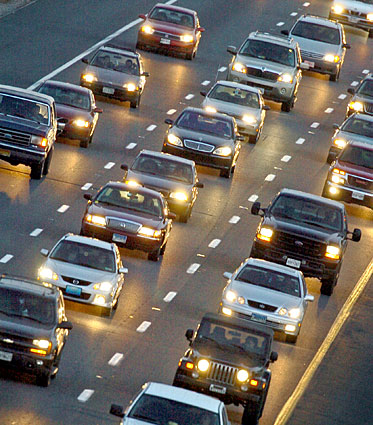
6. Ironically, despite Baltimore ranking 9th and DC 11th in terms of the ability to get around without a car, the Sunday Sun ran this article, "Rush-hour traffic is fast slowing to a crawl."

baltimoresun.com - Baltimore Beltway traffic.jpgTraffic crawls on the inner loop of the Baltimore Beltway between Baltimore National Pike and Security Boulevard on Friday. (Sun photo by Karl Merton Ferron) Mar 24, 2006

7. And tonite from 5-7:30 pm at Capitol Lounge (200 block of Pennsylvania Avenue SE), the Live Baltimore program will be trying to pick off DC-area residents to more to Baltimore. If you decide to move but still work in DC, I suggest urban pioneering in the area around Penn Station, where there is still block after block of virtually abandoned building stock.

LBHC-Logo-med

Check out the competition in any case. They have some attractive refrigerator magnets that you can probably get for free (normally they cost $1).

Index Keywords: ; ;

Now that's mixed use

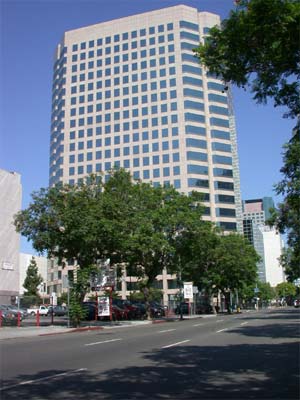
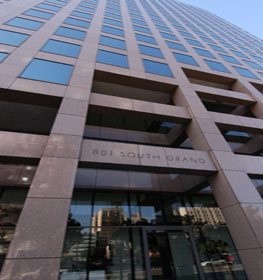
pg_la_801sgrand_003.jpg801 South Grand Street, Los Angeles. Photos from the project website.

The Wall Street Journal reports today on Sky at 801, a 22-story 1980s-era building in Los Angeles that is used as an office building, but where the top 11 floors are being converted to condominums, and ground floor retail is being enhanced. See the original press release from last year and the project website.

It helps to be able to have tall buildings. The maximum height of a DC building is 13-15 floors. This makes it almost impossible to do projects such as these in a city like DC. BUT, there are plenty of such opportunities in other traditional center cities that are defined by their tall buildings.

Welcome to Sky LoftsHome-The Building.jpg
Index Keywords:

Meet the Phoneys...business advocacy goes both ways

I wrote on an email list and then later in a blog entry (about local retail development) that businesses want to make the most money for the least investment, and with the fewest problems.

There's nothing wrong with that.

A problem with regulation is that the system is gamed through lobbying. Businesses, with much more money and benefit from shaping how they are regulated, expend a lot of money to ensure that they do well.

This is nothing new. The Abramoff Scandal at the Federal level is just one example. But this happens every day.

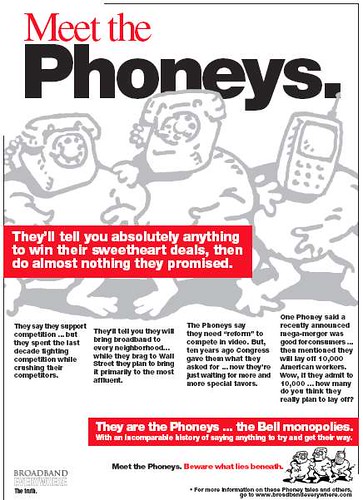
In logging onto the Washington Post website today, there was a political advocacy ad from the Broadband Everywhere "Coalition" which is but another industry lobbying group up against another industry/lobbying group, the traditional phone companies. I do want "broadband everywhere" but I recognize at the same time that it's not like the companies really care about us as much as they do about access and getting the opportunity to make more money.

Still and all, it's quite difficult for ground-up citizen groups to compete with the traditional business and business-backed forces. There are tremendous imbalances in terms of financial and paid-for staff resources, as well as technical competence, access to technological resources, etc.

This is why I suggest that the "Office of People's Counsel" model used to "represent the public interest" with regard to public utility matters, including rate increases, needs to be extended to land use and planning issues wrt matters before Zoning Commissions, Boards of Zoning Adjustment, Planning Commissions, and Alcoholic Beverage Licensing.

Making citizens pay, like the $500,000 being charged to Clarksburg, Maryland residents fighting the failure of Montgomery County to adequately regulate development in their area, is unreasonable, and again is an instance of protecting citizen rights being more of a privilege of income rather than an income-neutral right of all citizens.
The Broadband Everywhere website is hot...

meetthephoneys.jpg

(Remember the line from the book Essence of Decision -- where you stand depends on where you sit... or how much money gets stuffed in your back pocket... Speaking of which, see this AP story about sports stadium lobbying for the Yankees on the part of Reggie Jackson, "Jackson Testifies for New Yankee Stadium.")

Index Keywords:

Five Spaces left for ACHP's Section 106 class in DC

From Mary Rowse, Historic Washington Architecture:

Last call:

We are looking for five more people to join a group of nine, who will be paying a reduced fee of $300 to take the Advisory Council on Historic Preservation's popular two-day Section 106 Essentials Class in Washington DC on May 31 and June 1, from 8:30 - 4:30 each day. Individual registrants normally pay $450 for the class. Since there will be nine of us, we're getting a group discount that reduces the cost to $300 per person. If you'd like to participate in this class, please contact me by Friday, March 31, 2006.

The Advisory Council's two-day class explains the requirements of Section 106 of the National Historic Preservation Act, which applies any time a Federal, federally assisted, or federally approved activity might affect a property listed in or eligible for the National Register of Historic Places.

Since there are a number of pending Section 106 cases in the District, it would be a good idea for those concerned with any of them to be as familiar as possible with the law.

The course features:

* Information on the most recent changes to the ACHP's regulations, "Protection of Historic Properties" (36 CFR Part 800).
* New real-life case studies to illustrate each step in the Section 106 process.
* Practical advice on how to make Section 106 work smarter and more efficiently to resolve conflicts between development plans and historic preservation values.
* A revised curriculum and a course CD, featuring model documents, guidance materials, and a reference library.

The course is geared toward Federal, State, or local government officials, tribal representatives, or private consultants who encounter preservation-related law in their job, and members of the public with an interest in historic preservation.

There will be two classes taught in DC at the same time. Each one will have 50 participants. The first class has already sold out and the second one is expected to as well. ACHP is holding nine spaces for us to take the class for $300 each, reduced from $450 per person. Please let me know as soon as possible if you'd like to take advantage of this special opportunity.


Index Keywords:

Sports economists ask why do cities continue to subsidize teams... (Once again, DC bucks prevalent development trends)

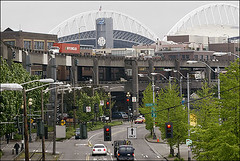
Qwest Field, SeattleIn 1997, Seattle Seahawks owner (and Microsoft cofounder) Paul Allen spent $6.2 million on a successful advertising campaign to persuade Washington voters to pay $327 million for a new stadium, now called Qwest Field. (AP Photo) Note: Paul Allen was one of the founders of Microsoft and he is one of the wealthiest people not just in the United States, but in the world. He needs a subsidy?

According to this article from the Opinion section of Sunday's Boston Globe, "Ballpark figures: Sports economists agree that cities--and taxpayers--get close to nothing from spending public money on sports teams. What they haven't figured out is why we're still doing it."

From the article:

FOR THE PAST FEW MONTHS, a dispute has been simmering between the Red Sox and Boston Mayor Thomas Menino. The Sox, along with some neighboring businesses and hospitals, have been lobbying for $55 million in state money for bus, subway, and road improvements near Fenway Park that would enhance the value of the property in the area, much of which the team owns and is developing. Repeatedly and firmly, the mayor has said he thinks the money would be better spent elsewhere.

Menino hasn't always been so frugal with the local baseball club. The last time the Red Sox asked for public funds, in a controversial and ultimately failed 2000 bid to build a new ballpark, Menino offered $212 million in city funds-on top of a state infrastructure package nearly twice the size of the one currently under consideration. City officials say the change is merely an adjustment to a new, straitened financial climate. But they also allow that the mayor is no longer sure it makes economic sense to grant the team's financial wishes.

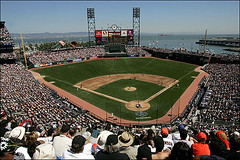
SBC Park, San FranciscoBuilt in 2000 and paid for almost entirely by the Giants, SBC Park has spurred a building boom along a formerly abandoned stretch of San Francisco's waterfront. (Getty Images Photo / Stephen Dunn)

cm_giants_2Photo by Mike Kepika of the San Francisco Chronicle. People leaving the streetcars to see a Giants game at PacBell Park. Note the leveraging of a pre-existing investment in transit.

For a decade and a half, the belief that sports teams were economic drivers helped persuade cities and states to shower billions of dollars on major league sports teams, most of it to build state-of-the-art stadiums like the Detroit Tigers' Comerica Park, the Seattle Seahawks' Qwest Field, and perhaps most famously the Baltimore Orioles' Camden Yards-the 1992 ballpark that set the standard not only for how ballparks would look, but how they would be built and paid for. ''Build the Stadium," went a 1997 slogan for a new San Francisco football stadium, ''Create the Jobs!"

But Menino isn't the only one to have had second thoughts in recent years about the wisdom of such largesse. Bitter public disputes have broken out in a few other sports cities over whether to give public funds to the local team. The most recent ballpark to be built, St. Louis's new Busch Stadium, was paid for almost entirely by the Cardinals after city and state officials refused to commit public funds. A proposed Manhattan stadium for the New York Jets died last year when the state government refused to chip in the asked-for $300 million. The political battle over the funding of Miller Park, in Milwaukee, was so vitriolic that former Wisconsin governor Tommy Thompson refused to set foot in it for years after it was built.

I find it incredibly interesting that these kinds of "big projects" get justified not on economics, but because it makes us "feel better about ourselves" or "makes our city 'big league.'"

I'd feel my city is "big league" if it possessed uniformly great schools, libraries, parks, and transit. That people are employed and healthy. That the city is safe for all people regardless of income status.

(I was thumbing through a introductory sociology textbook yesterday and in the section on "city life" lists Gans' five types of city residents: cosmopoles; singles; ethnic villagers; deprived; and trapped. How about working towards a city where through opportunity and support no one is deprived or trapped?)

That we had a city of citizens truly engaged in civic life, and the governmental, political, community, and neighborhood institutions and organizations were structured around this fact. That as a city we had "best-in-class" initiatives that were successfully innovative in small business development, community-based health initiatives, and civic engagement.

And somehow, that we worked in education about urban design, cultural heritage, and placemaking at all levels.

That's where I'd rather see our priorities, directing tax revenues towards these fundamental building blocks, the essential physical and social infrastructure necessary for the creation and maintenance of a truly livable city.

This undergirding philosophy colors how I look at and write about "Rebuilding Place."

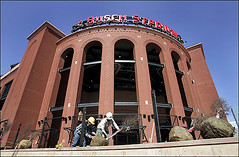
Busch Stadium, St. LouisThe St. Louis Cardinals had to pay for the new Busch Stadium, due to open this spring, though lawmakers did chip in a loan and some tax breaks. (Reuters Photo)

Index Keywords:

Tuesday, March 28, 2006

How many reports do you need to tell you that Rt. 1 in Prince George's County "needs to improve"?

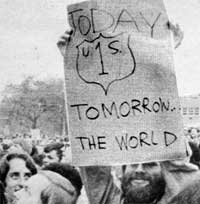
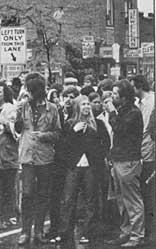
Student protest on Rte. 1, College Park, Maryland, during the Vietnam WarStudent protest on Rte. 1, College Park, Maryland, during the Vietnam War. Photos from University of Maryland Activists Re-Unite!.

I find it interesting that considering that the University of Maryland is in the top 20 public universities for research grant dollars (see this Baltimore Sun interview with the president of the University of Maryland, "His mission: move UM into top tier"), that if you do a websearch on "creative class" and "Prince George's County," you get 236 hits (although that is up from less than 90 as of January 2005).

Student protest on Rte. 1, College Park, Maryland, during the Vietnam War

Given that the University of Maryland has a decent planning school, I'm not sure why College Park, which already has a Rte. 1 corridor revitalization effort, and the Gateway Arts District from Mt. Rainer to Hyattsville, has indicated that Rte. 1 "needs work" or is a "diamond in the rough" feels the need to get a report from the EPA on why they should improve Rte. 1, but the UMD student newspaper informs us that this is so, in the article "Main Street feel may be closer for College Park: City to consider EPA’s guidelines for Rt. 1."

From the article:

University students may be another step closer to having the ultimate college town atmosphere in downtown College Park, complete with shops and restaurants on a tree-lined, pedestrian-friendly Route 1. In an attempt to quell mounting traffic concerns and create a more aesthetically pleasing city, the College Park City Council will hear recommendations from the Environmental Protection Agency tonight on ways to improve the blighted Route 1 area.

Representatives from the EPA’s Office of Policy, Economics and Innovation will present a report at tonight’s council meeting containing recommendations on how to streamline traffic along the busy road and also create a “Main Street” feel.

College Park and Hyattsville have an incredible opportunity along their sections of Rte. 1 to create the county's version of Takoma Park or Richmond's Carytown or Baltimore's Hampden Village, leverage the historic building stock still extant, and create a center for independently-owned and operated retail as a counter position to the County's efforts to attract gobs of chain retail to a community which is underserved I suppose in that department.

A piece of how Hyattsville could go about doing this was laid out in this study, Community Legacy Revitalization Plan, which reads pretty well. Although it doesn't go far enough to my way of thinking, e.g. it didn't recommend the Main Street Approach, but it's not bad all and all.

(Although I think Hyattsville needs to drop its slogan immediately--"Hyattsville: A good place to live"--and replace it with something like "Hyattsville--Prince George's [or Maryland's] Rising Star!" But that would require that Hyattsville believe in and execute such a tagline...)

Franklin's Brewpub, and the Nelson Gallery in Hyattsville, and Maryland Book Exchange (the college textbook store) and the row of restaurants in College Park offer possibilities... So does my idea of creating a streetcar line from Rhode Island Metro to Laurel, but that's not something that DC would work on as part of the DC Streetcar studies, it's an initiative that Prince George's County would have to move forward on its own.

Franklin's, HyattsvilleFranklin's inside, from Tacky Treasures.

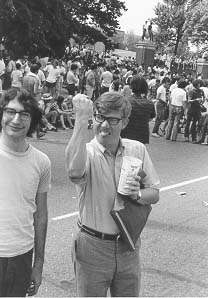
W. Lee Johnston, Professor of Political Science, UNC-Wilmington, during 1970 protest on Rte. 1W. Lee Johnston, before he became Professor of Political Science, UNC-Wilmington, during 1970 protest on Rte. 1. Photo from his website.

Index Keywords:

We the citizens of Catoctin County, in order to form a more perfect union...

ME/RUSHMark Baker, center, a planner with Bowman Consulting, waits with other developers, lawyers and county staff members in the halls outside the Planning Commission meeting for their cases to be called. (By Bill O'Leary -- The Washington Post). Go to the article for a larger version of this photo.

Someone passed along to me a link to Citizens for Catoctin County, the group that wants to split off the mostly rural western two-thirds of Loudoun County into a new county, in order to focus on preserving the rural landscape and to reduce the power of developers who have a majority of like-minded Supervisors on the Loudoun County Commission.

They need a bill to be entered into the Virginia Assembly, preferably from a Loudoun County legislator.

Can we say Growth Machine? In any case, I admire their efforts. According to the Post, outside of the towns in Western Loudoun County, there are only 9,000 homes in the 300 square miles of the mostly rural landscape.

See these Post articles to get a flavor of why the splinter group has formed:

-- Gatekeepers at the Gold Rush: Commissioners Labor at the Epicenter of Loudoun's Development Boom;
-- The Question of 46,000 vs. 14,000
-- Sanity, at Last, in Loudoun
-- Loudoun Reopens Door to Growth

Index Keywords: ; ;

Monday, March 27, 2006

Speaking of (making attending) DC baseball (games affordable)

One of the ways to have affordable baseball watching opportunities would be to create a minor league baseball team that would also play in the Washington Nationals stadium, obviously on different days.

Last year, the Brooklyn Cyclones (granted there isn't a professional baseball team there), but there are two in other boroughs, as well as other minor league teams in the city--Staten Island Yankees, games cost from $5 to $12 per ticket... (Check out the reviews of this book: The Brooklyn Cyclones: Hardball Dreams and the New Coney Island for more on this "idea".)

cyclonemag2003.jpg

Index Keywords:

Todos somos iguales (We are all equal)

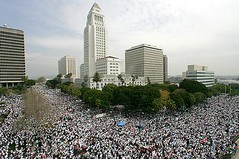
March for rights - latimes.com.jpgMany protesters wore white as a symbol of peace. (Gina Ferazzi / Los Angeles Times)

I find it incredibly fascinating that while the greatest number of protestors the weekend before last, on the third anniversary of the war in Iraq was about 1,000 people in NYC, one million or more people protested over the past few days about immigration law changes pending in Congress.

Millions! And not just in places like Los Angeles and Phoenix (or DC) but Columbus, Ohio (Fighting to live the American dream), and kids...
Making the circuit.jpgStudents march down State Street in South Gate after stopping at Southgate, Southeast and Jordan High Schools on their way back to Huntington Park High.(Brian Vander Brug / Los Angeles Times).

The times they are a changing...

Also see:

-- More Than 500,000 Rally in L.A. for Immigrants' Rights and High School Students Leave School to Protest Immigration Legislation: Hundreds take to the streets to call attention to a Republican House bill that activists contend is punitive and tinged with racism from the Los Angeles Times;
-- 20,000 in Phoenix rally for migrants: City's biggest demonstration ever part of national wave; marchers call for legalizing undocumented immigrants from the Arizona Republic, and
-- Area Soon to Be Mostly Minority from the Washington Post

March for rights - latimes.com.jpgThousands protest against House-passed HR 4437, an anti-immigration bill that opponents say will criminalize millions of immigrant families and anyone who comes into contact with them. (Bob Chamberlin / Los Angeles Times)
_________
According to other newspaper reports, student and other demonstrations continue, including two days in a row of student demonstrations at the Dallas City Hall. (Some amazing photos on the Dallas Morning News website--"Leaders: Time to end walkouts" and Photos.)

Index Keywords: ; ;

"Tourism" promotion vs. "destination" promotion

The trip to Grand Canyon involved a van, a tour guide, and 6 other riders. Because we were a couple hours from the Canyon, we spent a goodly amount of time talking amongst ourselves. One of the other people on the van is a high level State of Maryland Tourism Department employee, with the primary responsibility of attraction development. I would hire her to run such tourism efforts in DC in a heartbeat...

She made the point that tourism is defined as trips more than 50 miles away from your residence, so at times, a lot of what I think about in terms of DC tourism is really more about intra-regional "destination" promotion, trying to increase attractiveness to people already within the metropolitan area. (And she was also very clear about how her office is evaluated: are the initiatives bringing in more tourists, spending more money, and staying longer?)

So us visiting Baltimore (and vice versa) isn't tourism in the same way (because Baltimore is 45 miles away) as visiting further away destinations.

We need to do both, in any case, and we need to develop our local cultural heritage "offer" vis-a-vis the "National Experience" that defines the city.

One of the things she mentioned is that many years ago, local attractions in Baltimore organized the Baltimore Tourism Association to focus on the local experience, because they felt that the Baltimore Area Convention and Visitors Association was overly focused on downtown and the Inner Harbor. In DC, CulturalTourismDC is a similar response, although I don't think that we have been as successful as yet in terms of working to define the local cultural heritage message as well as to garner the funds to plan and develop and manage our local heritage assets in an organized and systematic fashion.

In addition, Baltimore is supported by the State of Maryland Office of Tourism and other state initiatives. For example, Baltimore is a state-designated heritage area and it has two or three state-designated arts districts, each designation affords a variety of focused tax and other benefits.

I don't know if you noticed last Wednesday that Baltimore had a special insert-set of articles in the Express newspaper? They are working it...

Another good example is the Jersey Shore Alliance, which has developed out of the Summit on the Shore tourism development initiative for the shore communities of the State of New Jersey. Also see this article from the Inquirer, "Shore tries a new way to lure you," and their "edgy website" promoting the Jersey Shore.

Index Keywords:

Now that's regionalism

Photo camerasD.C. police use photo radar cameras and red light cameras at such intersections as 16th Street and Colorado Avenue NW. (Bill O'leary -- The Washington Post)

The Washington Times reports, in "D.C. cameras hit Maryland drivers hardest," that Maryland drivers receive the bulk of the citations generated by DC's automated traffic control devices (running red lights and speeding).

According to the article, in February:

64% of the tickets were issued to those with Maryland drivers licenses;
20% of the tickets were issued to those with DC drivers licenses;
9% of the tickets were issued to those with Virginia drivers licenses;
and other states made up the difference.

Index Keywords:

Think police equines for nightlife crowd control

The Washington Times reports, in "Adams Morgan on watch" that local merchants in Adams-Morgan are seeking to hire security-"ambassador" personnel to augment street security presence during late night "datparts," in part because the DC police department can't provide as many officers as the area probably needs. (This is associated with the creation of the Adams-Morgan Business Improvement District.)

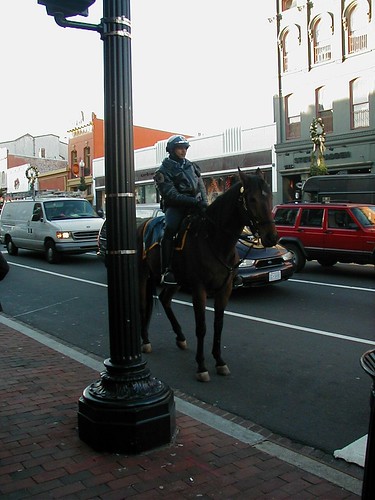
I think the solution might be to have mounted police patrols from say 11 p.m. to 3 a.m. Thursday, Friday, and Saturday, both in Adams-Morgan on 18th Street and Columbia Roads, and on U Street as well.

police20on20the20horse.jpgPoliceman on horseback in Georgetown. (Source: a GMU student weblog.)

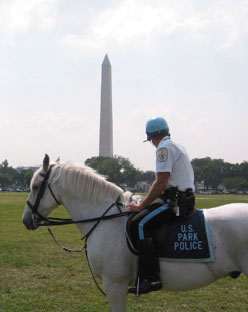
Police departments argue that horse patrols are effective in crowded areas and provide a more easy-going way to interact with people who might otherwise be unruly.

Google Image Result for http--www.usenta.org-images-ride-dc_police10.jpg.jpgU.S. Park Police officer near the Washington Monument. Photo from Usenta.

I think it's worth considering for these highly crowded inebriated late night "last call" situations.

adams-morgan-18th-street.jpg18th Street NW, Adams-Morgan at Night. Photo by Declan McCullagh.

Index Keywords:

Baseball, hotdogs, Congress, and misplaced priorities

paris-moneypile.gifThis is what it's all about...

I was so angry when I read this article in today's Post, "Nats TV Feud Might Be Bound For the Hill," about the pandering of Tom Davis (Virginia) in Congress and State of Maryland Representative Peter Franchot because big bad Comcast doesn't plan on broadcasting as many Washington Nationals baseball games as people might like.

It's all tied up in the b.s. deal that Major League Baseball made, giving the majority of the Washington Nationals baseball television rights to the Baltimore Orioles. It's not like I try to expend much energy defending rich people, but Comcast is angry because creating a Baltimore Orioles (dominated)-Washington Nationals television network will compete with their own Regional Sports Network. So they are playing "hardball" vis-a-vis the Baltimore Orioles and the Washington Nationals get caught in the middle.
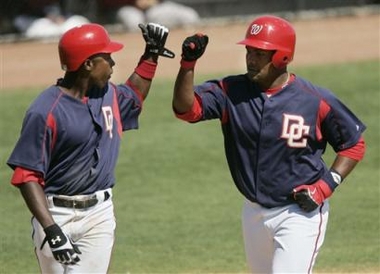
Baseball Spring Training on Yahoo! News Photos.jpgDo you really feel better about your community if a bunch of mercenaries win a game? Caption: Washington Nationals' Jose Guillen, right, is greeted at home by teammate Alfonso Soriano after hitting a two-run homer off Houston Astros' Brandon Backe in the fourth inning of a spring training baseball game at Space Coast Stadium, Sunday, March 26, 2006 in Viera, Fla. Washington won 13-6. (AP Photo/Pablo Martinez Monsivais)

Well, as people say in online MUDs, WTF? Who cares?

Congress can expend energy on something like this?

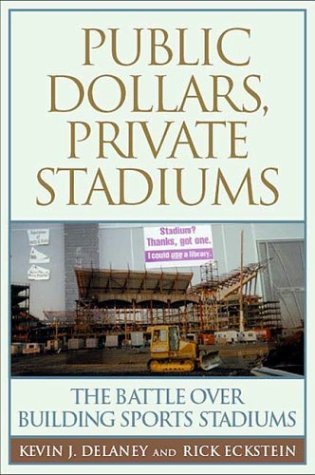
Meanwhile the real issue in professional sports leagues-community interaction is how cities let themselves get raped, pretty much, and give hundreds of millions of dollars to wealthy people and sports leagues to build stadiums and arenas with costs so high that increasingly the average person is priced out of attending anyway.
0813533430.01._SCLZZZZZZZ_.jpg
Of course, it's not like I haven't written about this before, such as in this blog entry, "Screw investigating steroids, Congress needs to look at how cities screw themselves over sports stadia," from last November.

But that might get in the way of Congresspeople getting free tickets to attend games, hanging with the people who own teams, etc.

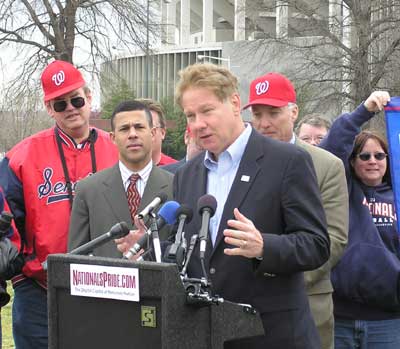
Politicians (and a few partisans) protest MASN-Comcast  District of Baseball.jpCongressman Tom Davis of Virginia speaking at a press event a couple days ago about the "travesty" of the under-scheduling of Nationals baseball games on Comcast cable systems. Photo from the District of Baseball blog (which I will be adding to the local link section). Also see the Nationals Pride website for more about this terrible injustice.

Speaking of injustice, check out this Tom Toles editorial cartoon. And note the demographics of the crowd (I cound one non-white person) and consider this event in the context of this article from the Washington Post, "Area Soon to Be Mostly Minority."

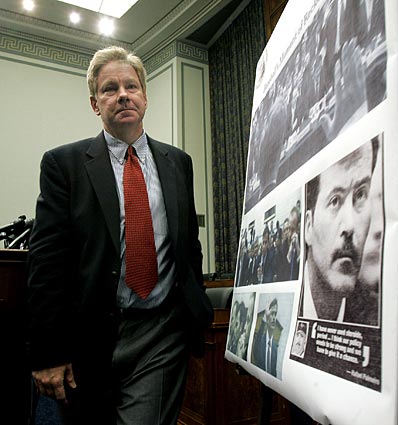
baltimoresun.com - House committee releases report on Palmeiro.jpgRep. Tom Davis, R-Va., walks past a poster of Rafael Palmeiro testifying before the House Government Reform Committee during the steroids hearings. Davis announced the committee would not recommend a perjury investigation of Palmeiro. (AP photo) Nov 10, 2005.

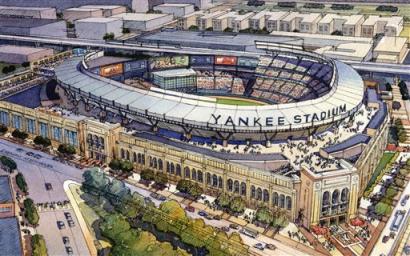
Speaking of subsidies of sports stadia and arenas, it's also an issue in NYC (see: the Yankee Stadium project; the failed NY Jets Westside Stadium proposal; or the big money dealing over the Brooklyn Nets), the Daily News has a great piece about Yankee Stadium, "Pols strike out in the Bronx." From the article:

A fast-growing coalition of Bronx residents and civic organizations is asking hard questions about plans by the New York Yankees to build a new stadium in the South Bronx on what was once public parkland. And the more these groups hear, the madder they get.

Just how angry will be clear Tuesday, when a City Council subcommittee holds a hearing on the Yankee plan. It's one of the last steps before a full Council votes on subsidies, zoning changes and city financing for the project. Civic groups plan to descend on City Hall en masse to raise questions that should have been addressed long ago.

The Yankees project, which has been breezing through state and city approvals, needs a complete overhaul. For starters, the plan calls for $70 million in state funds to build new parking garages in and around the stadium, although 61% of people living in the Bronx don't own a car.

According to the Tri-State Transportation Campaign (NY/NJ/CT), which advocates mass transit, a far smarter move would be to build a Metro-North station on the Hudson Line, which runs right past the stadium. For $80 million to $100 million, the city would have permanent public transportation instead of thousands of cars jamming local highways and streets...

Savvy civic groups smell a rat. Good Jobs New York, a subsidy watchdog group, is questioning the Yankees' financial estimates, pointing out that more than $400 million in public dollars would go to the wealthiest sports franchise in America - while the permanent in-stadium jobs created would pay, on average, a poverty wage of $17,500 a year.

yankeestadiumrenderingThis is an architecural rendering of the proposed Yankee Stadium in the Bronx borough of New York. The New York Yankees announced plans Wednesday, June 15, 2005 for a new $800 million ballpark, which would be built adjacent to the current Yankee Stadium and could be ready by the 2009 season. (AP Photo/New York Yankees)

Couldn't Congress be more concerned about these kinds of issues relating to professional sports rather than the meaningless kinds of things they do address?

Well?

Index Keywords: