Rebuilding Place in the Urban Space

"A community’s physical form, rather than its land uses, is its most intrinsic and enduring characteristic." [Katz, EPA] This blog focuses on place and placemaking and all that makes it work--historic preservation, urban design, transportation, asset-based community development, arts & cultural development, commercial district revitalization, tourism & destination development, and quality of life advocacy--along with doses of civic engagement and good governance watchdogging.

Saturday, December 21, 2019

USA Today series on the problems with reverse mortgages

Reverse mortgages are a loan product available to seniors when their house is paid off.  The mortgagee receives a monthly payment, which comes from tapping the equity value of the home.

But when the mortgagee dies, to get the house back, the survivors have to pay a fee equal to 95% of the value of the house.  Most families aren't able to pull this off.

One of the major discoveries in all the foreclosures that transpired in the aftermath of the 2007-2008 Great Financial Crisis was that there were major documentation, ownership and process issues when it came to handling mortgages.

Many people lost their homes because of process failures within the mortgage companies.

The USA Today investigation series shows that the reverse mortgage loan sector has the same kind of problems discovered in the main mortgage loan sector, and many families with the means to keep the home end up being screwed.

I just came across this, but the series ran in June.

-- "Seniors were sold a risk-free retirement with reverse mortgage"
-- "Should you get a reverse mortgage? The reasons you should or shouldn't"
-- "Reverse mortgages left many seniors in foreclosure. Here's what can be done to stop it"

Actor Tom Selleck shills reverse mortgages in tv commercials.

It's a very good discussion of the problem, irrespective of the specific focus on seniors.

Predatory practices.  The article also explores predatory practices, where mortgages are both heaviliy marketed and sold to households that may not have been in the best position to take on such a financial product.

Such practices contributed to the GFC ("Victimizing the Borrowers: Predatory Lending's Role in the Subprime Mortgage Crisis," Wharton School of Business) but were not the only cause.

Foreclosures in bulk devastate neighborhoods.  While the stories are about a mortgage product for seniors, because the mortgages can go into foreclosure, the primary article has an extensive section about foreclosures and how a preponderance of foreclosures in close proximity can have extraordinary negative impact on neighborhoods.

Labels: , ,

Thursday, October 18, 2018

Retail failure, leveraged buyouts/private equity, and "fraudulent conveyance"

There's lots of coverage in the media about business failure of retailers like Toys R Us ("Who Killed Toys 'R' Us? Hint: It Wasn't Only Amazon," Wall Street Journal), the Bon Ton Department Store chain, and now the bankruptcy of Sears as a product of private equity control of these businesses.

That's true.

Private equity loads onto the business tons of debt, usually alongside big and costly management fees to the owners, and high "salaries" for the people at the top of the corporation.

Often the real estate is separated from the operating business.  And they care zero about the effects on workers or communities.

From the standpoint of setting up a business for success, what these steps do is set up the business for failure, because only in the best of business conditions--growth, growth, growth--does the business have enough cash flow to operate the business. Even if operations are successful, the debt load makes it difficult to set aside any money for investment in capital improvements.

Recession; a shift of even a small amount of sales to e-commerce competitors, the need to invest in e-commerce and IT; etc. is enough to drive the company into failure, even if a number of the store locations remain profitable.

But this isn't new.

My best friend in college used to say that I read the business section of newspapers like most guys read the sports section.  So I remember the various failure of other retail chains over private equity type circumstances.
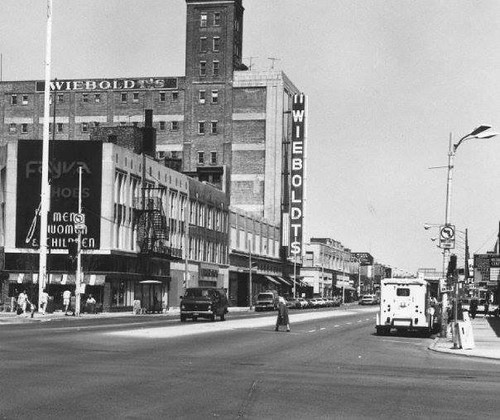
The Wieboldt's store in Lakeview ( Lincoln Ave and School street) the first two floors are commercial and the other floors have been remodeled into beautiful condos, "The Tower Lofts" -1601 w school st. Xsport's address and entry is at 3240 N Ashland AveThe Wieboldt's store in Lakeview ( Lincoln Ave and School Street). Today, the first two floors are commercial and the other floors have been remodeled into condos, "The Tower Lofts

The first that I can remember is the failure of the department store chain in Chicago, Wieboldts.

The company started in a neighborhood, expanded to other neighborhoods and outlying towns and eventually opened a downtown store.

They failed after a leveraged buyout.  A lawsuit with the argument of "fradulent conveyance" was mounted--fraudulent conveyance meant that the buyout set up the company on a path to failure that was foreordained.

-- WIEBOLDT STORES, INC., individually and on behalf of its Official Committee of Unsecured Creditors, Plaintiff, v. Jerome M. SCHOTTENSTEIN, et al., Defendants (1988)

From the suit:
Wieboldt's complaint against the defendants concerns the events and transactions surrounding a leveraged buyout ("LBO") of Wieboldt by WSI Acquisition Corporation ("WSI"). WSI, a corporation formed solely for the purpose of acquiring Wieboldt, borrowed funds from third-party lenders and delivered the proceeds to the shareholders in return for their shares. Wieboldt thereafter pledged certain of its assets to the LBO lenders to secure repayment of the loan.

The LBO reduced the assets available to Wieboldt's creditors. Wieboldt contends that, after the buyout was complete, Wieboldt's debt had increased by millions of dollars, and the proceeds made available by the LBO lenders were paid out to Wieboldt's then existing shareholders and did not accrue to the benefit of the corporation. Wieboldt's alleged insolvency after the LBO left Wieboldt with insufficient unencumbered assets to sustain its business and ensure payment to its unsecured creditors. Wieboldt therefore commenced this action on behalf of itself and its unsecured creditors, seeking to avoid the transactions constituting the LBO on the grounds that they are fraudulent under federal and state fraudulent conveyance laws.
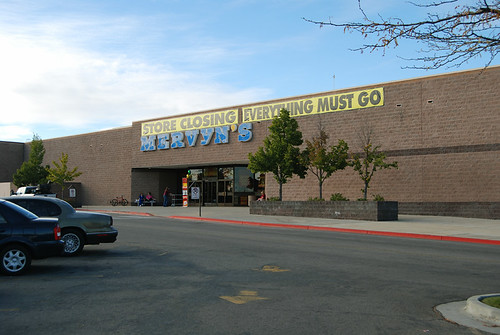
Mervyn'sSimilarly, the West Coast-based Mervyns chain had been owned by what is now called Target.

When they were sold in 2004 to private equity buyers, Sun Capital, the real estate assets were separated from the operating stores, and come a recession, the company failed, lasting for not quite five years under private equity ownership.

Real estate operators acquisition of department store companies.  But there were other examples too, of retail companies bought for their real estate assets, including the Taubman shopping mall company buying the DC based Woodward & Lothrop Company (1984) and Philadelphia's Wanamakers Department Stores (1986), and eventually selling the locations and shuttering the companies.

Canadian real estate developer Robert Campeau ended up starting the consolidation of many retail department store companies into the national Macy's chain, buying Allied Stores (1986) and Federated Stores (1988).  Those companies became bankrupt and Macy's ended up merging with them(1994), eventually repositioning what had been regional chains into one brand, Macy's, with a national footprint.

In short, when non-retailers buy retail companies, especially for financialization opportunities and/or to harvest the value of real estate, it usually doesn't bode well for the retailer nor for the employees.

Labels: , , , ,

Thursday, May 01, 2014

Multinational corporate tax management and "localness"

Recently there were Congressional hearings about how Caterpillar Corporation negotiated a special tax relationship with Switzerland, and created a paper company domiciled there for the purpose of managing transactions for the sale of replacement parts ("Caterpillar Escaped $2.4 Billion Tax With Swiss Maneuver ," Bloomberg).  While the transactions were mostly conducted in the US, for the purpose of taxes, they ran through Switzerland, at a tax rate less than one-fifth of the rate that would be in the US.

And a few weeks ago, it was suggested that Walgreen's, the nation's largest pharmacy chain, which a couple years ago merged with a British company, Boots, should relocate its corporate headquarters to Europe, to reduce its taxes.  See "Should Walgreen Move to Europe for Leaner  Taxes?" from Businessweek Magazine and "If  Walgreen Co. moves its HQ to Europe, blame Washington's tax failure" from the Chicago Tribune (Walgreen's is based in Greater Chicago). From the Tribune article:
A group of shareholders reportedly is pressuring the giant retail chain for a move to the land of cuckoo clocks. The reason: lower taxes. Much lower taxes:
If Walgreen changes its legal domicile to Switzerland, where it recently acquired a stake in European drugstore chain Alliance Boots, the company could save big bucks on its corporate income-tax bill. The effective U.S. income-tax rate for Walgreen, according to analysts at Swiss Bank UBS: 37 percent. For Alliance Boots: about 20 percent.

We hope Walgreen doesn't relocate. Would company executives be smart to do so in order to best serve their shareholders? Hmm. We'd rather not say. So we'll respond to that question with another, broader but similarly urgent question:

How many companies have to turn refugee before Congress and the White House stop their bipartisan talking — but only talking — about the need to reform the federal tax code in general, and the corporate income tax in particular?
This week, Pfizer, a pharmaceutical firm based in New Jersey, announced that it will merge with a British corporation and will move its domicile to the UK, to reduce its corporate taxes ("Pfizer's Move Poses Challenge. Here's a Solution," New York Times) while last week Starbucks announced it will move its European headquarters to the UK, because of new lower corporate tax rates ("Starbucks moves Europe HQ to London," Financial Times).

Apparently the effective US corporate tax rate is about 27% while in Europe it is 21% and the UK has just announced a tax cut so that the UK corporate tax rate will be about 20%.

The NYT article suggests shifting taxes from corporations to shareholders.  From the article:
It’s counterintuitive, but Congress could avoid this problem by abolishing the tax on corporations’ profits and much more aggressively taxing their American shareholders — who are unlikely to flee to London along with Pfizer’s incorporation documents.
I don't know what is a "fair" corporate tax rate, but as long as corporations can play one nation against another, the likely scenario is a race to the bottom.

It's a long way from the "good corporate citizen" discussed in the recent Urbanophile post ("Portrait of a Change Agent") about J. Irwin Miller, a banker and leader of Cummins Engine, which is still based in the comparatively small town of Columbus, Indiana and the various "corporate citizenship" initiatives he undertook which have made the city a great success or how SC Johnson in Racine, Wisconsin is restoring its old research center, designed by Frank Lloyd Wright, and how it has exhibit facilities and gives tours of its campus ("A Corporate Paean to Frank Lloyd Wright," New York Times).

Labels: , , ,

Wednesday, April 30, 2014

Real estate financing is the crucial element in enabling difficult projects

A couple months ago I wrote about ("Revitalization in impoverished neighborhoods can be very difficult because different "stakeholders" have different understandings of what's at stake") a situation in Portland, where an African-American enterprise promotion group had protested a particular development on a property owned by the Portland Development Commission, where the developer had lined up a Trader Joe's as lead tenant.

After frequent protests, TJ's walked, and the project fell apart.

This is important lesson because in projects that aren't a slam dunk, financing--especially since the 2008 real estate crash--can be extremely precarious, even for well respected and generally well financed companies.

Left:  Fort Totten Square, a mixed use development with a Walmart store on the ground floor and 350 apartments above, under construction on Riggs Road NE in Washington, DC.

This comes up in DC with regard to the financing of a mixed use project called Fort Totten Square--retail on the first floor, residential above--project a couple blocks from the Fort Totten Metro Station.

Most people think that any project at a Metro station would be rated an "A," but it isn't that simple.

I rate Fort Totten a C or D, because there isn't any center to the community generally or at the station.  It's not a walkable area.  By contrast locations in the Central Business District and neighborhoods around it are rated A, and neighborhoods in the next ring further out are B (Columbia Heights, Petworth, Brookland) or C (Rhode Island Avenue), the next ring would be rated C or D, unless there are town centers, and the furthest out stations D or E--there's a reason that after decades most of the furthest out stations haven't experienced much in the way of ancillary development.

The financing for the Fort Totten Square project was recognized by Washington Business Journal as exemplary for 2013 ("Best Real Estate Deals of 2013: Financing").  The lead developer on the project is JBG, which since the crash, has been one of the most active and best financed of companies focused on the local real estate market exclusively and has been able to take advantage of "pricing opportunities" presented by the failures of other firms.

According to the article, without the Walmart lease and "progress payments" by Walmart, JBG wouldn't have received a construction loan for the Fort Totten Square project. The progress payments are key, because typically a big chain retailer doesn't begin paying "rent" until the store opens, or even sometime afterward, depending on the inducement package they receive--this case was unusual also because instead of getting a free ride, they agreed to pay for part of the construction cost for their space.

From the article:
Wal-Mart signed a lease for nearly 120,000 square feet with JBG in August 2012 to anchor the 345-unit residential-and-retail development, kick-starting a project that had been in the works since 2008 but stalled due to the recession. Still, even with a lease in hand, getting lenders on board wasn’t a slam dunk. There was the uncertainty of whether a mixed-use project with Class A apartments in the Fort Totten neighborhood would be successful. There was also the challenge of getting any one bank to back a construction loan for $73.6 million.

Wal-Mart helped answer both of those problems, as it turned out. The retailer agreed as part of its lease to reimburse construction costs up to a certain point and to make monthly progress payments during the construction. Bank of America and SunTrust agreed to credit JBG with those monthly payments toward its equity requirement, which was enough to structure a financing deal with a loan-to-cost ratio of just less than 60 percent.
This is relevant to the debacle of the Walmart store on Georgia Avenue (ANC4B Large Tract Review Report on Walmart, 5/2011; "Walmart opens two DC stores tomorrow"), which is a single use project at a prominent intersection on the Georgia Avenue corridor.

Given the desire of Walmart to open stores in DC, it is not unlikely that had Foulger-Pratt presented a similar kind of deal to the company, they probably could have received the financing necessary to build a similar kind of mixed use project.

Labels: , ,

Wednesday, July 18, 2012

Wall Street vs. Main Street (communities) literally: conspiracy to manipulate bond pricing

EE calls our attention to this Rolling Stone article, "The Scam Wall Street Learned From the Mafia: How America's biggest banks took part in a nationwide bid-rigging conspiracy - until they were caught on tape," by Matt Taibbi.

It's about bid rigging, which lowered the return to municipalities and other local government entities from the sales of municipal bonds.

Of course, local governments have been getting nailed by similar kinds of financial shenanigans by Wall Street financiers for a long time, from San Diego's bankruptcy because of pension fund investment problems, to the bankruptcies of Harrisburg, Pennsylvania and Jefferson County, Alabama, because of funding fraud abetted by either contract fraud (Jefferson County) or product failure (Harrisburg) which triggered increasing costs and not enough money to rectify the problems.

Labels: , , , ,