Quote of the day: new city residents as consumers rather than producers of the city zeitgeist
New York Magazine has an article about the tv show "Portlandia" and the idea that the show facilitated the eradication of "Old Portland" ("The Portlandia Effect: How Did the Show Change the City It Satirized?").
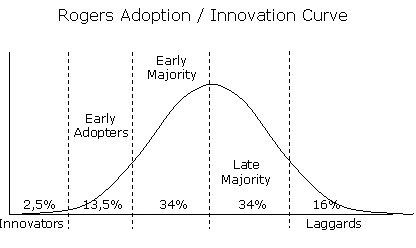
While it is typical for people in a community to see their place and situation as unique, I think what they are hitting on is a difference in attitude about living in (and consuming) a city, on the part of what Everett Rogers would call the "early majority" segment on the adoption diffusion curve.
People coming to the city later, when the city was doing better, didn't see a need to "pioneer" and contribute time and energy to improve their community.
Quote:
“Portlandia was the moment something shifted and a new kind of person started showing up in Portland, who wasn’t the same kind of hearty doer, but more of a spectator who wants to be entertained by a city,” said Carye Bye, a former Portland-based artist who donated her hand-printed cards to Portlandia.I do think that Ms. Bye has identified the "problem," that people who now are attracted to living in the city, because now national trends favor urban living as opposed to suburban living ('Americans Increasingly Want to Live in Cities, Not Suburbs," Time Magazine, 2014; "The suburban shift: why families are choosing to live in cities," Child in the City blog), are much more interested in consuming what the city has to offer rather than contributing their efforts to making the city a better place to live, as well as recognizing history and other "legacy" place elements as an important element of what makes a particular city "unique."
The article quotes a professor who wrote an article on "site-specific" tv shows as a force for gentrification specifically about "Portlandia," but I tend to agree with Carrie Brownstein:
... the show had become an easy target and a focal point for Portland’s change, but said the city’s growth was bound to happen regardless, as it has around much of the country.Note that this difference in attitude about what the city means as a place to live and consume may differ by household type. For example, the Child in the City article suggests more families are attracted to urban living because it saves time, is more sustainable, etc. From the article:
- More Family Time
- Access to Urban Amenities: The City is our Backyard
- The Value of Experiences
- Reduced Energy Consumption
- Reduced Goods’ Consumption
- More Exercise and Time Outdoors
- More exposure to people/building connections
- Better Family Connections
Labels: car culture and automobility, urban design/placemaking, urban living, urban vs. suburban vs. rural
posted by Richard Layman @ 1:36 PM&Permanent Link
Follow this blog
0 comments







