Rebuilding Place in the Urban Space

"A community’s physical form, rather than its land uses, is its most intrinsic and enduring characteristic." [Katz, EPA] This blog focuses on place and placemaking and all that makes it work--historic preservation, urban design, transportation, asset-based community development, arts & cultural development, commercial district revitalization, tourism & destination development, and quality of life advocacy--along with doses of civic engagement and good governance watchdogging.

Friday, October 17, 2025

Exercise bikes or real bikes: which is a better tactic for marketing a residential community? | Utah City in Vineyard, Utah

(Photo: Francisco Kjolseth | The Salt Lake Tribune) Vineyard apparently plans to create an inland port project industrial zone, along with its massive Utah City development, on the old Geneva Steel site, seen here as vacant land to the north and east on Wednesday, Oct. 18, 2023.

KSL-TV reports that the "Utah City" development in Vineyard, near Utah Lake in Utah County, is providing Peloton exercise equipment in residential buildings for exercise and wellness support ("Utah City integrates wellness with residential living through new Peloton partnership").  From the article:

A newly formed partnership with Peloton adds another phase amid the development of the 700-acre mixed-use community located on the eastern shore of Utah Lake, a press release from Utah City announced.

The development eventually plans to become a walkable, transit-oriented, mixed-use destination in the heart of Vineyard.

Jacklyn Briggs, director of marketing for Utah City, said in efforts to align with the development's goal of providing convenient access for people who want to live an active lifestyle, it's partnered with the global at-home fitness brand to outfit Peloton equipment in each multifamily building in Utah City. "Utah City is a wellness and well-being focused community," she said.

Briggs added that Utah City aims to provide the infrastructure and opportunities — whether indoors or outdoors — to make it more accessible for people prioritizing health and fitness as part of their everyday routine

Why not real bikes, so people can ride trails, ride to do errands, ride to school, etc., and get health benefits while performing acts they'd be doing by car most likely?

In the blog entry "Revisiting assistance programs to get people biking: 26 programs," I suggest bike bundling for public housing.  That is, providing in a lease a bike, helmet, lock and training, and secure bike parking in the complex.  (It'd #16 but fully described in this predecessor entry.)

Interesting, because the Vineyard City government organized a number of activities for National Bike Month in May.   

And the small town even has a Bicycle Commission.

No reason that for profit apartment buildings couldn't do bike bundling?  

I did suggest it to Bozzuto Development for a project they did in Brookland, DC, but by then they had already sold the building (but kept the management contract) and the property owner couldn't put their head around the concept.  

But Monroe Street Market is part of the bikeable Brookland neighborhood, and adjacent to the Metropolitan Branch Trail, allowing for scads of destinations in a 5 mile radius.

That concept included a bicycle retail store which would provide service to the apartment dwellers with bicyclists 

The same goes for the Utah City development in Vineyard.  It has the opportunity to make biking a true mode of transportation, not just recreational.

I've already dinged this development in writing, because they're positioning as a new urban walkable community ("Vineyard’s new 700-acre development to be called Utah City," Ogden Daily Herald, "Vineyard could welcome the next inland port. Here’s where other projects have been approved across Utah," Salt Lake Tribune).   

It's almost 40 miles from Salt Lake City, so in terms of the city proper, in terms of distance it's exurban. 

More than 50% farther from the core than the Gaithersburg Kentlands new urbanist development is from DC.  Unless they shift their "center city" reference point from Salt Lake to Provo.

For a single line the Frontrunner rail passenger service is pretty good, although it doesn't run on Sunday, and it doesn't run late.

From the 2023 Building Salt Lake article, "Vineyard’s new urbanist downtown to use new TIF tool for housing near transit":

Last week I traveled south to Vineyard to attend an event sponsored by the Utah Chapter of the Urban Land Institute (ULI) on transit-oriented development. Having not owned a car for the past 6.5 years, I rode FrontRunner with my ebike.

Taking my ebike was critical, because it would allow me to traverse the 1.5 miles between Vineyard’s FrontRunner station and the Topgolf that hosted the ULI Utah event in a mere six minutes instead of a half hour on foot. The temperature also happened to be in the high 90s that day and that 1.5-mile route is treeless and devoid of shade.

As icing on the proverbial cake, the irony was not lost on me that I was perhaps the only attendee to use transit to arrive at an event extolling the values of transit-oriented development.

That may be, but it's a speck in a few hundred miles of sprawl.  It's not changing the development paradigm towards compact development and non-automobile dependence in any significant manner.

Urban Land Institute report promotes active transportation.  It's now almost 10 years old, but the Urban Land Institute published a report on the real estate development opportunities incorporating bicycling, Active Transportation and Real Estate: The Next Frontier.

While there are pathbreaking developers doing interesting things, especially out west, I think that most still aren't seriously considering active transportation, especially biking, as a part of the development in a structured way.

Soon to open dvanced bicycle parking facility in Brooklyn.  New York City is taking a quantum step forward in the coming of a Dutch style high capacity bicycle parking hub in the One Sunset development in Brooklyn ("New York City is Getting a Dutch-Style Bicycle Hub and it’s a Game Changer," Momentum Magazine).  The contractor providing the service is called Oonee.

Although it's pathbreaking, the One Sunset webpage on amenities doesn't call much attention to it.  It won't be a huge facility.  From the article:

Housed in a 1,300-square-foot, ground-floor space, the facility will feature “a bright, welcoming environment furnished with modern amenities that make riding easier and far more convenient.” With around-the-clock access and 95 free secure parking spaces for bikes, including accommodations for large-format bicycles and battery-free e-bikes, the Hub is poised to become a vital link in Brooklyn’s micromobility ecosystem.

Charging facilities for those battery-free e-bikes will be placed just outside, while indoor battery swapping stations and secure charging options for e-scooters and e-bikes will be available 24/7. According to Oonee, “these facilities will also provide a safe charging alternative to residents in the area,” addressing growing concerns about unsafe e-bike battery charging in residential buildings.

That's about one parking space for every two units ("JV Plans 187-Unit Mixed-Use Property in Brooklyn," Multi-Housing News, "Introducing: New York’s First Oonee Hub:  A Dutch-inspired parking & service center for Sunset Park riders," Medium) which I think is on the low side.  

But it's still a step forward, especially since it will have a ground floor entry, rather than require a trip through the bowels of a parking garage.

Obviously, from a bicycling promotion standpoint, we hope that the demand will be greater than the supply, and that other developers will create similar but bigger facilities.

Lend Lease Barangaroo South development, Australia.  Note that some developments, more commercial than residential, in Australia have "platinum" bicycle facilities, with secure parking, lockers, showers, etc., such as the Lend Lease Barangaroo South development ("anonymous-breach-pixelregistered-breach-pixelsUnderground: Tour Barangaroo’s bustling basement beneath city," Daily Telegraph).

To meet the needs of the end of trip users, we have 1,460 lockers and 132 showers in 24 purpose built change rooms. All users have free use of towels, body wash, ironing boards and hair dryers. We also have two bike maintenance stations with bike stands, tools and tyre pumps. Users can also arrange for a mobile mechanic to maintain their bike.

Less use than planned for leads to a reduction in parking spaces.  Although in renovations they are reducing the amount of parking provided based on use and providing other amenities ("Lendlease Loses Bike Parking in $30m End-of-Trip Revamp," Urban Developer).

“Ongoing travel surveys and data collection completed have identified that there is a significant underutilisation of the bicycle parking facilities in the basement,” Ethos Urban wrote.

Data showed cycling to work accounted for about 3 per cent of the modes by which tower tenants travelled to work. Only about 200 of the 1157 bicycle parking spaces offered under the three buildings were used each day. Under the plans, Lendlease will cut bicycle storage to 660 spaces.

At least they are basing their decision making on data, and I would argue more energies could be directed to programming to significantly increase uptake, using some of the concepts in the "Revisiting assistance programs to get people biking: 26 programs" entry.  But this is Sydney, not Melbourne, and Victoria State is known for global best practice bicycle transportation promotion.

Labels: , , , ,

Sunday, June 26, 2011

Speaking of schools #2: pupil transportation

The Henrico County Public Schools district (outside Richmond, VA) has been running ads in The Express for a director of pupil transportation. The job description posted mentions nothing about walking and biking to school as a task area and responsibility within the position. It's a pretty good job, paying $100,000+ year to manage pupil transportation for the 48,000 student system.

Do an advanced google search of the National Association of Pupil Transportation website and you will get zero hits of the term "safe routes to school." Although that is partly a function of how b adly the website is designed. The 2010 conference did have one session on the topic.

When I worked in Baltimore County on a walking and biking planning project last fiscal year, I realized after looking at the "safe routes to school" issue for only a couple of weeks that the major issue is that most states do not require school districts to do what we might call "balanced transportation planning" for pupil transportation.

Most regulations focus on transportation by bus.

It happens that Baltimore County has a national best practice example of a walk to school program at Stoneleigh Elementary School, and I spent a few hours there on International Walk to School Day in 2009 (and had further interactions with the involved parents who created the program and the principal).

I realized after that experience, and after learning that the State of Maryland Dept. of Transportation was doing a review of walk to school initiatives at the school district level, that the most fundamental issue was changing the requirements at the state level by requiring school districts to do balanced transportation planning, incorporating walking and biking into the planning regimen.

Obviously, by doing that, where practical and appropriate, more children would be walking and biking to school. Yet that idea wasn't even in the scope of work of the Maryland study (and final report)!!!!!!!!! (I pointed that out in Oct. or November 2009, but the study scope was never changed.)

Given that as much as 25% of local traffic in neighborhoods during school opening and closing hours is due to taking kinds to and from school by car, this is an important issue.

The State of Washington has some balanced transportation requirements for school districts, requiring that all elementary schools be provided with walk to school maps, providing money to school districts for transportation improvements that affect the walking and biking environment, and recommending that school districts have a school traffic safety committee to consider transportation issues more broadly.

The City of Minneapolis has a city-wide walk to school plan. And the Boulder Valley School District covering the City of Boulder in Colorado does balanced transportation planning, providing support to schools for walking and biking, through the school district's central administration structure--it's not left up to the schools on an ad-hoc and individual basis.

Labels: , , ,

Monday, December 13, 2010

Two interesting reports on benchmarking active transportation and cycling on arterials

From the Toronto Coalition for Active Transportation:

TCAT Releases Two New Research Reports
With support from the Toronto Community Foundation, TCAT is pleased to announce two new research reports today examining the state of active transportation in Toronto.

The first report titled
Benchmarking Active Transportation in Canadian Cities compared the performance of active transportation in Toronto against other cities in Canada, the United States and Europe using key indicators as benchmarks. Among the study’s findings:

•Cities with more kilometres of bicycle facilities have a higher active transportation mode share
•In cities with high mode shares, the percentage of cyclists and pedestrians injured and killed is lower than in cities with low mode shares, thus confirming the “safety in numbers” theory
•The cities with the lowest active transportation mode shares also have the highest private automobile shares
•Cities in jurisdictions with low gas taxes tend to have low active transportation levels and higher private automobile mode shares

The second report
Building Better Cycling in Cities: Lessons for Toronto examined how to accommodate cyclists on arterial roads. Since these streets carry a high volume of high-speed motor vehicles, providing safe passage for cyclists is especially critical.

Case studies from Toronto, Vancouver, Montreal, Portland, New York City and Berlin demonstrated how policies and practices improve cycling arteries. Suitable bicycle facilities and sufficient bikeway networks along with policies that support cycling are important in creating safe and convenient cycling arteries in cities.

Researcher and lead author Ada Chan summarizes the report: “As one of the world’s major cities, Toronto should be in the forefront of cycling innovations. The new mayor and city councilors in the upcoming term have lots of opportunities to transform the city into a leading urban cycling centre to increase cycling mode share and cycling safety for Toronto residents.”


The first report is interesting in that it begins to lay out measurable criteria for evaluating communities on whether or not the built environment and policies and programs support active transportation. The second report is important because it pulls together in one document most of the best practices on "cycling arteries."

The cycling "superhighways" in London demonstrate that calling a bike lane a "superhighway" even if it is painted blue implies a level of dedicated infrastructure, that if not present, doesn't serve bicyclists very well.

Note that the hullaballoo over cycletracks on Pennsylvania Avenue, and the initial contraflow cycletrack on 15th Street, that has been since converted to a bi-directional cycletrack, and is now being extended (see "15th Street Cycletrack parking berms" and "Headed south along 15th St. at G St. NW" from Washcycle) shows that DC can do best practice.

Labels: , , ,

Wednesday, December 23, 2009

Walk this way ... to school (and transit)

Many school districts cancelled school in part because of walking conditions. From "Students get early jump on holidays" in the Baltimore Sun:

School officials said they decided to cancel classes not to extend the holiday break but because many sidewalks are still filled with snow and students would be forced to walk in the streets." Many of the sidewalks and paths that the walkers use have not been cleaned," said Patti Caplan, a spokeswoman for Howard County schools. "We have 10,000 walkers, so that is a pretty big deal."And piles of snow at bus stops would force students to stand in the street while waiting for buses.

2. The Prince Georges Gazette reports, in "Proposal to lessen walking distance to schools could become costly: Senator says students are required to walk too far," that any distance more than 1/4 of a mile is too far to walk to school, according to State Senator Anthony Muse, who has introduced legislation to change school bus transportation requirements in the county. From the article:

The bill, proposed by state Sen. Anthony Muse (D-Dist. 26) of Fort Washington, would require the school system to provide transportation to elementary students who live more than a quarter-mile from their school, and to middle and high school students who live more than one mile from their schools. ...

Currently, elementary students must live more than 1.5 miles from their school to receive transportation service, and middle and high school students must live more than 2 miles from school, Superintendent William Hite Jr. said. Changing the required walking distance, would force the school district to transport an additional 22,000 students, he said.

Currently 97,000 of the county's 130,000 students ride the school bus. With the average cost-per-student estimated at $419, an additional $9,218,000 would be required to fund transportation, Hite said. "This is not even factoring the new buses we would need," he said.

Public health statistics for Prince George's County:

Physical Activity and Obesity
Percent of adults age 18 and over who engage in regular moderate physical activity =45%
Percent of youth age 6-19 who engage in regular moderate physical activity = 56%
Percent of youth age 2-19 who are overweight = 31%
Percent of adults age 18 and over who are overweight, BMI 25-29.9 = 39%
Percent of adults age 18 and over who are obese, BMI > 30 = 23%


3. Note that I have blogged is that what Maryland needs to do to improve "walk to school" programs is to change state law to require that each school district provide balanced transportation planning, supporting walking and bicycling and transit, as well as school bus-based transportation.

See:

- New York State school district bans bicycling and thoughts on how to change the system...
- More on (Maryland) Walk to School

3. And on Greater Greater Washington, in "Large buildings have no excuse for not shoveling," some of the commenters suggest that cities be responsible for removing snow from sidewalks. While I think that is impractical for many reasons, not just because the DC Government has proven incapable of removing snow from sidewalks under its direct control and responsibility, such as those adjacent to parks and schools, at least in school zones and what we might call "transit sheds" there is a pretty simple solution.
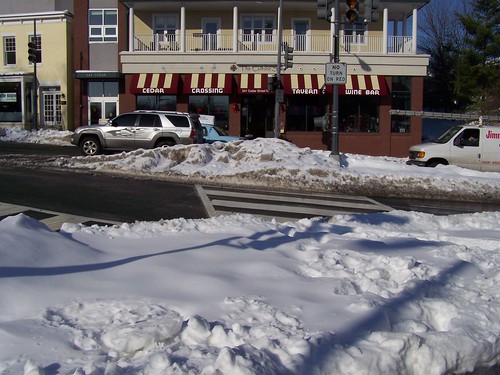
100_0253.JPG
As of this morning, the pedestrian crosswalk at the intersection of Blair Road and Cedar Street, a few hundred feet from the Takoma Metro Station had not been cleared, looking pretty much like this still, even though this photo is from Monday afternoon.

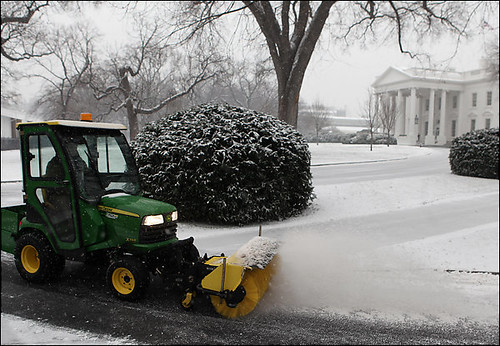
When I was 7 years old I lived in a nice neighborhood in Detroit called Rosedale Park, down the street lived our Congresswoman, and Roman Gribbs, who went on to become a sheriff, Mayor, and judge, was one of the leaders of my Cub Scout troop. So I don't know if the "snow brush" tractor that cleaned snow off our sidewalks in our neighborhood was paid for by a neighborhood association (my parents didn't consult me on such decisions) or the city, wanting to keep the VIPs happy.

But just as cities declare "snow emergency routes" for snow removal purposes, the same can be done for walk routes to schools, libraries, bus stops, and transit stations, and a system can be devised to make sure that snow is removed. Households need to be informed of their responsibilities, but still, just as with snow emergency routes, certain sidewalks can be designated "snow emergency routes" too, and cleared accordingly--that includes sidewalks and intersections.
Clearing snow at the White House
Clearing snow at the White House. Photo Credit: By Ron Edmonds -- Associated Press Photo

Labels: , , , , ,

Friday, June 06, 2008

Explore the Anacostia River for fun and in terms of thinking about the connection of the city to the water

---------------
The post below is from August 2006, but is worth repeating in the context of this item from today's Washington Post Weekend Section, in the "In Town" feature on page W3:

Row, row, row your boat gently down the Anacostia. Don't know how? Here's your chance to learn.

The Anacostia Community Boathouse Association and the
Capital Rowing Club host National Learn to Row Day[, on the Anacostia River in Washington, DC] a clinic to introduce residents to rowing, including technique, equipment and on-the-water instruction. Saturday from 10 to 4 at the Anacostia Community Boathouse, 1115 O St. SE. FREE

This sounds like a lot of fun, but I am spending all weekend dealing with new house issues.

-----------------


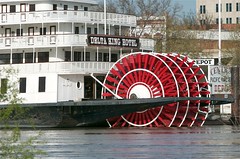
Delta King Hotel
Originally uploaded by MousseFromSacto.

For Stren Series, Anglers Hit the Potomac.jpgChris Baumgardner of Gastonia, N.C., finished in second place on the third day of the tournament. (Photos By Dayna Smith -- The Washington Post)

The Sacramento riverboat hotel, Delta King, image by MousseFromSacto via Flickr.

1. A couple weeks ago, Charles County sponsored an fishing contest. How's the fishing in DC? Enough for competitive fishing on the Outdoor Life channel? See "For Stren Series, Anglers Hit the Potomac," from the Post.

2. DCist has a pretty good idea about the two finalists competing for the contract from the Anacostia Waterfront Corporation to rebuild the Southwest DC Waterfront--in the blog entry "A New Anacostia Waterfront Imagined," they put the two proposals online:

The presentations by the two can be viewed here and here, though beware -- they're large .pdf files.

I haven't reviewed both proposals yet, but I was pleasantly surprised by the one I did page through, the PN Hoffman-SBER proposal, which includes a variety of participants including the Project for Public Spaces, and a number of educational and cultural offerings.

3. Speaking of educational and cultural offerings, and thinking more than just about a riverboat hotel or hostel, and maybe even a warship. (I know these are pretty typical.)

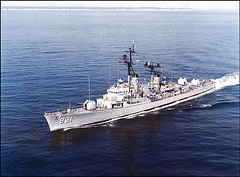
Sacramento has such a hotel (see "Sacramento digest: Riverboat's new manager") apparently there are hostel houseboats in Europe, and Calvert County Maryland is working to land a battleship as a tourist attraction. See "Some See Future for Destroyer in Solomons" subtitled "Backers Want to Turn Ship Into Museum That Allows Students to Stay Overnight."
PH2006071900037.jpgCalvert County commissioners are considering a proposal to dock the USS Forrest Sherman in Solomons. (USS Forrest Sherman Foundation)

(Also see "Naval Warship Museums Problems And Potentials.")

4. Maybe a way to get around the gaming thing would be to do what they did in Mississippi (until Hurricane Katrina), allow gaming on boats in the Gulf of Mexico. How about a gaming cruise on the Potomac? (I am not likely in favor of such.)

5. And speaking of the waterfront, one of the Commissioners of the DC Commission on the Arts and Humanities, Carl Cole, makes the point that DC doesn't have a "port authority" to deal with such issues, such as promoting river-based business.
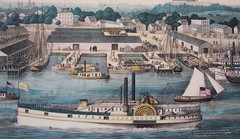
Maritime Heritage of Southwest DCThis image of Maritime Heritage in Southwest DC is cropped from a history trails sign.

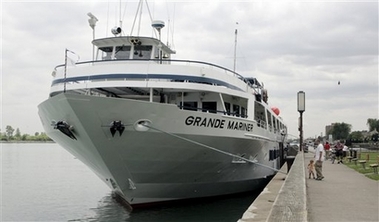
See "Cruising the Midwest," an AP story that appeared in today's Express. Note that there used to be a big trade in boat-ship based travel out of DC. One of DC's first African-American millionaires, made his money in the steamboat trade. In the midwest, the Great Lake Cruising Coalition works to make river- and lake-based boat tourism a reality.

Great Lakes Cruises on Yahoo! News Photos.jpgThe Grande Mariner cruise ship is shown docked in Wyandotte, Mich., on June 13, 2006. By the time the Grande Mariner and its 65 passengers reach Chicago four days after seeing Detroit, they will have traveled through the Erie Canal and four of the five Great Lakes. (AP Photo/Carlos Osorio)

6. And of course, we need to link up with Prince George's County Maryland's Anacostia Trails Heritage Area, and work together jointly to promote tourism and improvement of the area. Among the many things they do (in association with the Parks Dept. of the County) are river tours of the Anacostia, starting at the Waterfront Park in Bladensburg, and going south into DC.

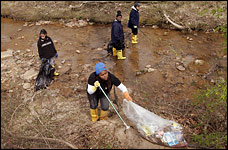
7. Speaking of DC, I keep meaning to mention the great efforts of Washington Parks and People and their restoration of the Watts Branch Park, now called the Marvin Gaye Park. Also see "Reviving the Roots Of an R& B Legend," subtitled "Park Could Be Homage to Marvin Gaye," and "Getting Its Groove Back," subtitled "A Park Under Restoration Will Be Renamed Today for Marvin Gaye," both from the Washington Post.
Getting Its Groove Back.jpgWatts Branch Park is officially rededicated as Marvin Gaye Park on what would have been the singer's 67th birthday. There is much yet to be done, but the 1.6-mile-long park is well on its way to being turned into what one activist calls the "east-of-the-river equivalent of Rock Creek Park." Washington Post photo.

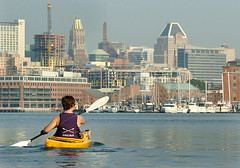
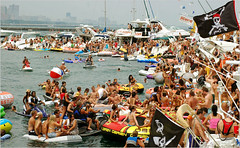
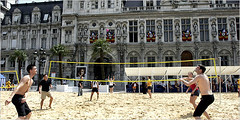
8. And how about kayaking, faux-beaches, volleyball, and more fun stuff?
baltimoresun.com - Canton Kayak Club member.jpgA Canton Kayak Club member takes in the sunrise at the Inner Harbor. (Sun photo by Elizabeth Malby)Jul 13, 2006

Boat rave, waterfront, ChicagoBoat rave, waterfront, Chicago. New York Times photo.

Water ballWater balls...

Paris Plage, Urban BeachParis Plage, an August urban beach tradition. Bernard Bisson, Getty Images.

Labels: , , ,

Wednesday, June 13, 2007

Free bike "rental" program in Tulsa

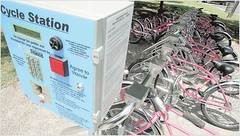
The "Bikes for health: Free to ride" article in the Tulsa World discusses a free bike rental system being created by a local health foundation to help promote exercise and active, healthy living.
Free bikes as part of a program to encourage healthy lifestyles.
ROBERT S. CROSS / Tulsa World. Pink bicycles on way. River Parks visitors will soon be able to use free bikes located at several sites as part of a program funded by the Warren Medical Research Foundation to encourage healthy lifestyles.

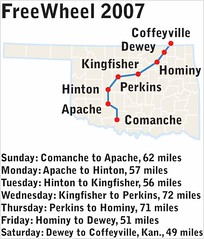
The Tulsa World also reported on a state-wide annual bicycle jaunt called Oklahoma FreeRide. It's similar, but on a much wider scale, to Arlington and Alexandria's recent bike ride covering 20+ miles on June 3rd. See "
FreeWheel starts today."

Again, we need to do something like this in DC, at the neighborhood level, and city-wide, and maybe like the Oklahoma riders, we need to go into and touch various points in Maryland and Virginia while doing so.
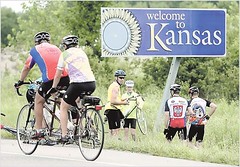
Oklahoma FreeWheel 2006 riders at rides end on the border with Kansas
Tulsa World file. Oklahoma FreeWheel 2006 riders take photos and ride past the “Welcome to Kansas” sign on the final day of FreeWheel in June 2006.
Route for the Oklahoma FreeWheel 2006
Tulsa World graphic.

Labels: , , , ,