I suggested that advocacy groups join together and produce a state and county-level campaign agenda for sustainable transportation to use during the election cycle. No one has taken me up on the idea.
I wrote this in email as a start:
1. With regard to Action Committee for Transit (Montgomery County's leading transit advocacy group, which is starting to stake more positions on other sustainable transportation issues), while they have a position on MARC two way service through MoCo, there isn't a MARC tab in the left sidebar of their website.
Historically, train service to Martinsburg WV wasn't two-way during the daytime, because back then few people from DC had any reason to "reverse commute" to Montgomery County. With the development of office complexes in the Wisconsin Avenue and I-270 corridors, taking the train from DC or Silver Spring to White Flint, Rockville, Gaithersburg, or Frederick may make sense and would be a lot faster, albeit more expensive, than current public transit alternatives.
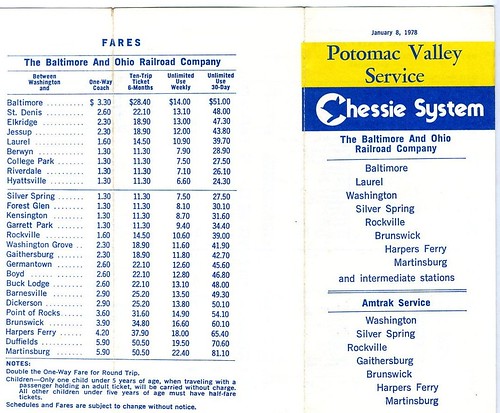
Flickr image of the timetable by David Wilson.
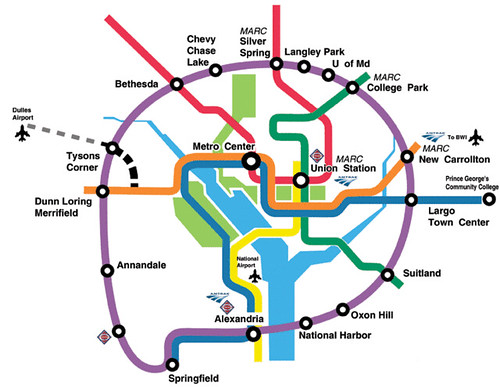
2. ACT is also in favor of an extension to the western leg of the red line (as am I and something I've been meaning to write about).
3. Lately I have been mentioning a separate Metro line emanating from Fort Totten up New Hampshire Ave. to White Oak, although this is something Ben Ross and I talked about briefly once before.
Andrew Bossi's conceptual map of metrorail expansion shows a separated yellow line, but with a routing different from what I am thinking about. DC's objectives for a separated yellow line are different from Montgomery County's, so having two different extensions probably makes sense.

4. Which would be different from a separated yellow line primarily serving DC up Georgia Ave. and going to Silver Spring, but beyond that would be up to MoCo
5. I just don't know MD and MoCo issues well enough to say what a MoCo transportation agenda should be but here are some things:
- Allowing a local add-on gasoline excise tax
- extending complete streets requirements at the state level to local jurisdictions
- Building the Purple Line obviously
- Two way MARC service to/from Frederick, adding a third track to accommodate this
- Extending the western leg of the Red Line
- Making Wisconsin Ave.-Rockville Pike a "Signature Street" (see my writings about this concept--below) from the DC line to (and past) Rockville for Montgomery County and SHA/MDOT/State of Maryland as a pilot project + the White Flint MARC Station
- Beginning planning for a New Hampshire Avenue Yellow Line Metrorail expansion to White Oak, emanating from Fort Totten Metrorail station
- Montgomery County's BRT initiative
- Planning with the State of Virginia to extend the Purple Line west to Tysons
6. For Prince George's I don't have much other than:
- Building the Purple Line obviously
- But as importantly beginning the planning for the segment between New Carrollton and Alexandria Virginia, with priority emphasis from the Suitland station to Alexandria for service to National Harbor
- Making University Boulevard a "Signature Street"
- Building the Red Line
- Reconfiguring the current light rail line with modern light rail vehicles
- Building a fixed rail transit network for Greater Baltimore ("From the files: transit planning in Baltimore County" from this blog, and "THE PORTAL TO A RED LINE THAT WOULD ACTUALLY WORK EFFECTIVELY" and "THE FULLY INTEGRATED METRO/LIGHT RAIL/STREETCAR PLAN" from Baltimore Innerspace).
- Allowing a local add-on gasoline excise tax
- Approaching Virginia to begin the discussions about merging MARC and VRE and beginning to create one integrated passenger rail system for the region, ultimately serving DC, MD, VA, and parts of WV, PA, and DE ("Regional transportation planning and fixed rail service")
- Expanding planning for Purple Line extensions to Virginia from Bethesda and from New Carrollton
-----Signature Streets------------------------
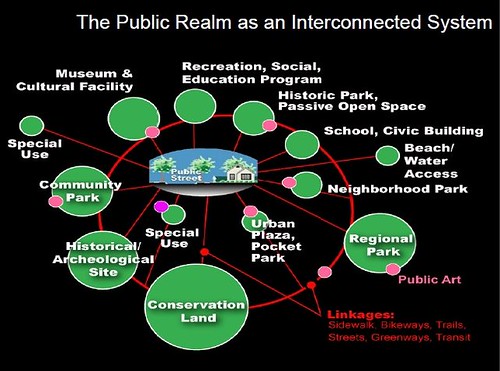
Public Realm as an Interconnected
system, Slide from presentation, "Leadership and the Role of Parks and
Recreation in the New Economy," David Barth and Carlos Perez, AECOM.
* At the very end of the planning process for the Western County
Pedestrian and Bicycle Access Plan, I came up with a concept that I
called "Signature Streets" but I just didn't have the time to develop it
more thoroughly or "sell" it adequately to the advisory committee.
The basic ideas were:
(1) combine complete streets principles
(2) with smart growth ideas (the County has a policy prioritizing investment in extant places)
(3) along with the integrated public realm concepts of David Barth
(4) by designating a subset of the county's road network as foundational or "signature"
(5) and upgrading these streets with systematic special and complete
treatment so that sustainable transportation modes (walking, biking, and
transit) are integrated into the mobility system (also related is
Barth's concept that streets should be treated as linear parks), along
with streetscape improvements (the County already has an excellent
streetscape improvement program, just not a focus on sustainable
transportation) and placemaking elements
(6) and justifying using bond funding to pay for the development of the
upgraded mobility network and acquisition of the necessary right of
way.
See, in counties, to expand the right of way, you have to buy the land.
That's expensive. The government doesn't want to do it. But by laying
it out in terms of developing a road-based complete mobility network
that extends quality of life and how the county "deserves" a
road-mobility system that meets its needs in the 21st Century and as the
third largest jurisdiction in the State of Maryland makes this kind of
re-thinking achievable.
With regard to bond funding, even in bad times, parks-related bond
initiatives pass overwhelming in Baltimore County. And this idea is
kind of an extension of parks. The model that I suggested was Seattle's Bridging the Gap initiative. [Add-on,
at the time I didn't know about the MAPS3 program in Oklahoma City,
which is another example, of course the
sales tax funded light rail construction acceleration program in Greater Los Angeles is another
example]
I suggested denoting signature streets with special street signs, not
unlike how the City of Toronto has special "sign topper" designations
for all sorts of areas in the city.
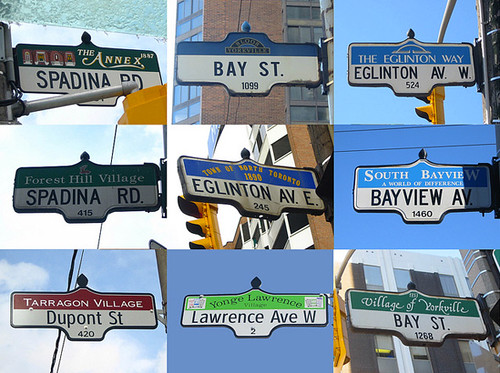
From "Toronto street signs typology" in BlogTO.
I would love to see that metro map come to life some day
ReplyDelete