Neighborhood commercial district revitalization in DC
Originally, the city had 12 Main Street commercial district revitalization programs. Now only 4 of the original programs exist (Mt. Pleasant has an unofficial program still, but they dropped out of the city program). The city "created" some Main Street programs in Wards 4, 5, and 7 at the behest of elected officials, but I doubt any of those programs are really functioning anymore.
Last year I wrote a piece, "Commercial district revitalization: H Street and an assessment of the Main Street program in DC," in response to it being the 10th anniversary of the Main Street program in DC. That piece focuses on internal organization of the organizing group being key to the ultimate success of the program.
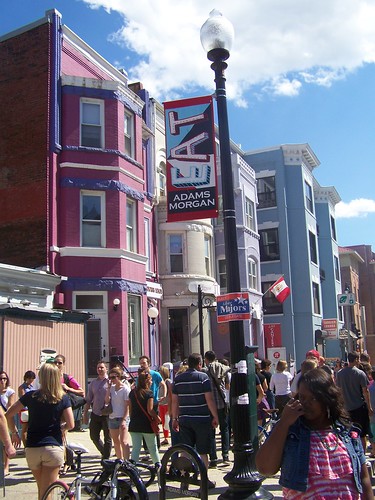 I was talking with a Main Street program director a few weeks ago, and I was told that the Adams-Morgan Main Street program is basically defunct. I know that internal organization was an issue in Adams-Morgan.
Something not adequately discussed in last year's piece was funding. Sure I mentioned it, but I should have discussed it a bit more deeply, especially as it is an issue in Adams-Morgan.
Typically, across the nation, Business Improvement Districts function in large city commercial districts, especially "Downtown." Some of the most prominent BIDs in the US are in New York City and Philadelphia, along with DC's Downtown DC BID. The main actors in BIDs are the property owners.
Note that I have made the point that as BID districts become mixed use with a heavy residential component, organizational and representational structures need to be opened up to resident involvement. See "NoMA revisited: business planning to develop community."
Main Street groups typically are present in smaller towns and in neighborhood commercial districts that don't have a lot of office buildings.
The Main Street approach is different from the BID approach in that residents and other stakeholders who don't necessarily own businesses in the commercial district are drawn into the organization, to broaden the range of skills and volunteers able to work on issues. (In my experience, Main Street volunteers tend to be 10-15 years younger than typical historic preservation group members, and live within a couple blocks of the main commercial street.)
Originally in DC, you had neighborhood merchant groups, funded with a wee bit of money from the DC Department of Housing and Community Development, but for the most part, these groups didn't do much.
In the late 1990s, DC authorized the creation of "business improvement districts," which originally focused on districts with large property owners, like Downtown and Georgetown and to some extent Capitol Hill. Since then BIDs have been created on the Capitol Riverfront and in NoMA, and a variant form was created for Mount Vernon Triangle.
Over time, the BID framework was expanded so that it could be applied to districts with small properties and landholdings, in particular Adams-Morgan.
In 2002, DC launched the Main Street program as an alternative and focused method (the program started in the late 1970s and is active in more than 1,000 communities across North America) for commercial district revitalization that is more appropriately sized for the small commercial districts that typify many of DC's neighborhoods.
A hybrid of the BID and Main Street approach is the "Community Improvement District," a special service district (that's what BIDs are) that covers both commercial and residential areas. Baltimore has a couple, and one in particular, Charles Village, has been very contentious with a group of residential property owners who resent paying towards the SSD. California has a lot more types of these districts, especially in San Francisco.
But I have also written about the BIDs in San Diego, which are somewhat unique, in that they use the BID funding mechanism--a fee per $100/property value--but tend to use the more ground up "Main Street Approach" to shape the programming and orientation of the organization.
So the commercial district revitalization organizations in San Diego have the advantage of steady funding from a property tax assessment like a BID, but the broader organizational, programming, and volunteer structure of a Main Street program. See "Let's Assess the Assessments" from the San Diego Reader.
That's a form that we're missing in DC, and ultimately the lack of steady funding has been the biggest problem for neighborhood commercial district revitalization organizations in the city.
The Adams Morgan Main Street program had a strong president, but at the same time, there were "my way or the highway" issues with the organization's leadership. Instead of developing as a Main Street program/BID, the merchants created their own BID, with the support of the Main Street program.
But ultimately, there wasn't enough money and civic capacity for both organizations to exist separately. So the Main Street program in Adams Morgan, after 11 years, is no more.
--------
Note that things are changing too as neighborhoods are adding more residents because of the insertion of multiunit residential buildings. See "Burying the lead: economic value of each new household added to a commercial district-neighborhood-city."
Labels: building a local economy, commercial district revitalization planning, Main Street, urban design/placemaking
posted by Richard Layman @ 2:00 PM&Permanent Link
Follow this blog
14 comments