One of the speakers at yesterday's introduction of the new Brookings Metropolitan Center report on "Innovation Districts," was the
Mayor of Chattanooga, Andy Berke.
The Mayor came to the attention of Bruce Katz at Brookings because when the Center published the book
Metropolitan Revolutions (see
my book review), Mayor Berke took it as a challenge in terms of framing how smaller cities could forge a similar innovation path comparable to large cities like Boston and San Francisco. ... that by definition, the innovation century isn't the unique province of large cities.
I think that's very interesting.
Chattanooga. It happens that in 2010 I was part of a bidding team for the bike share system there (we placed highly but didn't win) and so as is my want, I learned tons about the state of the city at that time, including the landing of a new VW manufacturing plant, expansion of Alstom's power plant manufacturing operation there, that it is a big regional headquarters for the TVA, a big insurance company is based there, the decent coverage of the city by the local newspaper, the
Chattanooga Times-Free Press, etc. (And Sugar's BBQ has great barbecued jalapeno poppers.)
(Note that the city is very much car oriented, many blocks downtown are parking lots, wide streets have as many as four lanes of parking (one on each side of the street and one on each side of the median) and there is a lot of vacant space and buildings in need of spiffing up.)
The City of Chattanooga owns the local electricity distribution company. In Tennessee, electricity is generated by the Tennessee Valley Authority, a New Deal era initiative that started with hydroelectricity generation. Distribution is coordinated through various public firms across the state. In Chattanooga, the Electric Power Board is the local electricity utility and it is an agency of the local government.
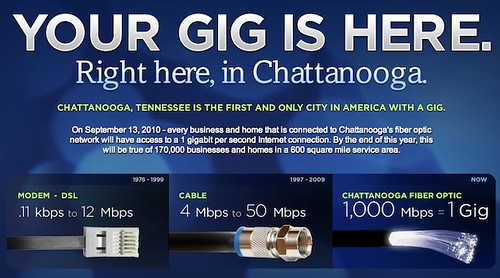
Chattanooga's Smart Grid and 1 Gigabit Internet. Being able to link with an electric car charging infrastructure was an element of the bike share element of the RFP, so I had to learn a fair amount about the city's initiative around the creation of a "Smart Grid" electricity infrastructure nettwork, including the creation of a 1 Gigabit Internet network that includes every building or structure that is wired for electricity.
All of those things happened before the current Mayor was elected in 2013, and he had been in the State House, not local government, previously... and he wasn't accurate in the brief presentation in describing how "The Gig" network came about. It pre-dated Obama Administration initiatives, although the EPB ended up paying for 1/3 of the project with funds from the federal government, which accelerated build out of the system significantly--it had been planned for full build out by 2020, instead they finished last year.
The EPB in Chattanooga figured out in 2007 that while implementing a smart grid to manage their network ("
How Chattanooga beat Google Fiber by half a decade,"
Washington Post) they could also integrate high speed internet services simultaneously, so they did. From the article:
There, the effort to bring cheap broadband to the masses began as a simple engineering problem: The city's electric company, EPB, needed a way for its systems to monitor and communicate with new digital equipment being installed on the grid. Meanwhile, city hall was learning that the country's biggest phone and cable companies wouldn't be starting service there for a decade or more. So EPB became an ISP. Now it operates some 8,000 miles of fiber for 56,000 commercial and residential Internet customers. With today's rollout, gigabit service will cost $70 a month ...
Chattanooga spent $330 million on its new network, raising $220 million in bond money and winning $111.5 million in federal stimulus dollars. (The money from Washington was like icing on the cake; by the time EPB applied, it had already reached its initial targets and with the additional funds cut a 10-year construction plan down to three years.) Along the way, EPB fought several court battles with Comcast and the state cable association. Even before all this, Chattanooga had to lobby the state government for permission to let EPB participate in the telecom market.
It is an interesting example of a public-civic initiative by a publicly owned electricity that "investor-owned" "public" utility companies have not matched.
... and I think about Chattanooga often when I hear opposition expressed to smart meters (part of Takoma DC is a hotbed of opposition to smart meters) because their world hasn't crashed and burned as a result of having the technology, in fact it's saving money and reducing outages ("
Smart Grid Saves EPB Chattanooga $1.4M in One Storm," Greentech).
The Gigabit network isn't enough: Chattanooga as the city government has a big opportunity to up its game. While the Mayor is very active in promoting "The Gig" as an element of the city's economic development program and as a key element not only in business recruitment but as an opportunity for existing businesses and organizations to transform how they operate, it occurred to me while he was talking that Chattanooga hasn't taken "The Gig" to the next level in terms of what are called "Smart City" initiatives.
It's not enough to be ahead of other US cities, when at the world city-global city scale, world class cities are aiming to achieve much more from "Smart City" initiatives.
Note that I haven't been there lately, so I am not up with the latest developments, and clearly they are moving in the direction of what I am about to suggest already, as evidenced by various
Gig City projects underway, including
GigTank, a startup accelerator project focused on the smart grid and how to leverage it.
Living labs. Specifically I am thinking of Helsinki, where a digital community was created in the Arabianranta district starting in 1998, as part of the process of building and creating that area and is called "Helsinki Virtual Village"--built on what at the time, a 10 megabit network, was a big deal.
It turns out that there is a
European Network of Open Living Labs that links similar initiatives in other countries. Yes, MIT does this kind of stuff in various labs, but in Helsinki and other cities such efforts play out in actual communities. For example, Hamburg has similar digital neighborhood initiatives comparable to Arabianranta in its HafenCity project.
--
Helsinki Living Lab
--
Innovation Communities, Forum Virium Helsinki
City "Smart City" Initiatives. The Helsinki Virtual Village program informed the creation by the municipality of an initiative to develop new applications and integrate "information and communications technologies" (we call it IT or information technology while in Europe they mostly refer to this as ICT) at a wide variety of scales and projects, which they have organized through a city agency called
Forum Virium Helsinki, which is designated as the city's "innovation unit." From the website:
[FVH] develops new digital services and urban innovations in cooperation with companies, the City of Helsinki, other public sector organizations, and Helsinki residents. The aim is to create better services and new business, plus to open up contacts for international markets.
Right: an implement of Transit Screen for San Francisco.
While focused on mobility exclusively, Arlington County Government's
Mobility Lab is another kind of example of such a unit. The
Transit Screen information system is a start up business that grew out of a Mobility Lab initiative.
Street lights as sensor networks. I've started seeing articles about street lights as information points ("
Will Streetlamps Become Information Hubs for Cities?,"
Government Technology), because as the lights are replaced with LED systems, the capacities and capabilities for how the lights can be used and the poles networked becomes much greater.
The
Smart City sensor networks in Amsterdam, Barcelona, and Manchester measure different elements of the urban environment: Carbon Monoxide; Nitrogen Oxide; Temperature; Humidity; Light; and Sound.
Intelligent transportation systems. There is a lot written about this and many cities are developing smarter traffic signal systems that "learn" and are integrated--motor vehicle operators clamor for coordination to reduce wait time at traffic signals. But few US cities are at the point of integrating multiple mobility information and tolling networks,
although El Paso is exploring it, as an element of simplifying cross-border crossings between Mexico and the US, which creates massive traffic tie-ups. Interestingly, the initiative is a local one, rather than one involving national governments.
Plus the
Mobility Lab example, etc. (European cities are farther ahead on such ITS installations more generally.)
Minneapolis 311 mobile application on a Smartphone.
Smarter citizens. There has been a lot written about "apps for democracy" and various cities have created mobile applications of various sorts. Much of this discussion frustrates me because the fundamental issue is more than just sending in an e-complaint, but whether or not cities are open to innovation and the democratic impulse. I wrote about that here, "
All the talk of e-government, digital government, and open source government is really about employing the design method."
The Manchester UK-based
Future Everything, a digital lab and annual festival, has a publication,
Smart Citizens, which is on the broad topic of "how cities can create the policies, structures and tools to engender a more innovative and participatory society." That's what we need to discuss and a city like Chattanooga could be a "living lab" for such a process.
Also see "
The New Socialism: Global Collectivist Society Is Coming Online" from
Wired Magazine, the
Digital Communities magazine and website, which is published by
Government Technology, "
Digital socialism and the 'non-planners'," etc.
Digital City Festival. For 19 years, Manchester's Future Everything has been delivering an
annual festival on the digital city. Chattanooga could start a similar event.
Conclusion: reaping the advantages in smallness. Still, Mayor Berke is on to something.
While big cities have the advantage of bigness and all the agglomeration economies that size enables, it can be hard to marshal the resources and leadership necessary to bring about transformational change in bigger cities. Too many people and organizations are empowered to say no, and they do, often.
By contrast, a city like Chattanooga has a potential advantage in being small, because it can be easier for the local political and economic leadership of the city to come together with citizens to move innovation forward.
Plus sometimes, smaller places believe that they need to "try harder" in order to be able to compete with larger places, making the community a bit more willing to think out of the box.
By contrast, too many people in big cities are content to rest on their laurels, because they don't look outward enough, past the immediate community and more towards the network of cities, especially the network of globally-relevant cities, where innovation is happening all the time.
Of course, not just any small city can do this. Chattanooga has a lot of assets, including
a state university based downtown and a community college with strong technical education programs based on the river just outside of the core. The city still has major manufacturing companies actively producing goods, including big operations for VW and Alstom Power Generation. There is a committed philanthropic community. And they are well-placed for freeway and railroad transportation and they aren't too far--118 miles--from Atlanta, perhaps the South's most important city.
Even so it can be hard, because oftentimes, their initiatives have to be approved by the Tennessee State Government--"The Gig" network project was challenged in the courts by the private sector and other entities and the city needed enabling legislation from the State Legislature.
Chattanooga Stand community survey materials were designed by Casey Yoshida.
When I was there, I was impressed with the variety of initiatives in the city, including the Enterprise Center, which supports small business development, the super impressive community visioning citizen initiative,
Chattanooga Stand, which is a ground up citizen initiative promoting community engagement and improvement, and the city arts unit, among others, the strong philanthropic community (one of the main foundations is funded from original investments in the Coca Cola Company), the creative output by various local design and advertising firms, and the marketing efforts of the tourism organizations and the chamber of commerce, etc.
So I think that the city definitely has the potential to move forward and become one of the country's "smartest cities," moving beyond "The Gig" to "US Smart City 2.0".
--
URENIO Intelligent Cities - Smart Cities - Innovation Ecosystems research program, Europe/Greece
Labels: agglomeration economies, digital/Internet, information technology and systems integration, participatory democracy and empowered participation, Smart City, utility infrastructure







