Rebuilding Place in the Urban Space

"A community’s physical form, rather than its land uses, is its most intrinsic and enduring characteristic." [Katz, EPA] This blog focuses on place and placemaking and all that makes it work--historic preservation, urban design, transportation, asset-based community development, arts & cultural development, commercial district revitalization, tourism & destination development, and quality of life advocacy--along with doses of civic engagement and good governance watchdogging.

Friday, July 07, 2023

Digital ad screens in NYC Subway stations display weekend service closure maps

Reddit photo from r/nycrail.

In 2018, I had a meeting and walking tour of part of London with Ivan Bennett, who had been product design manager for the London bus system--it was a fabulous experience, about 6 hours.  

-- "Thinking systematically about bus transit service improvements: spurred by Columbia SC, Edmonton AB, and Baltimore," 2017
-- "Branding's (NOT) All You Need for Transit," 2018

One of the points he made along the way was about digital screens being able to display different kinds of maps much more easily.  

For example, at night, the display of a digital bus system map could be limited to the night time bus route network.  

This is another example of the positive opportunities offered by digital display screens for transit system maps.  

Previously, NYC Subway used posters to present this information, which had to be printed and put up.

Labels: , , , , , ,

Friday, September 23, 2022

Prince George's County Film Festival: developing an ecosystem supporting digital media production

Compared to Sundance, Cannes, or the Toronto International Film Festival among others, hearing that Prince George's County, Maryland has launched an annual film festival might sound like a joke ("With film festival, Prince George’s makes a bid for the silver screen," Washington Post).  

I think it's a great idea.

From the article:

Prince George’s County didn’t feel like a place to make movies when actress Kike Ayodeji grew up. She loved film festivals, but she had to drive to D.C. and Philadelphia or fly to Los Angeles to reach them. The first film to represent Prince George’s that came to mind for her was a 2020 documentary about the county’s long list of accomplished basketball players.

By the time it debuted, a once-modest local community of directors and performers had grown considerably, backed by the county’s film office, which opened in 2013. The documentary film dubbed Prince George’s a “Basketball County.” Now, these artists think Prince George’s can be a county for filmmakers, too.

They will make that pitch at the Prince George’s Film Festival, the first county-sponsored film festival running this week from Thursday to Sunday. To the county’s filmmakers, it’s an underdog story fit for Hollywood. Next to the iconic scenes of the District, Prince George’s traditionally attracted little attention from large film and TV productions.

Creating a media production community.  In "Revisiting stories: cultural planning and the need for arts-based community development corporations as real estate operators" (2018, original piece 2009) I distinguish between between arts as consumption (going to museums to see art produced by dead people) and arts as production (people producing art and design products), and quote from a paper by John Montgomery on the development of multifaceted arts districts (Montgomery [2003], "Cultural Quarters as Mechanisms for Urban Regeneration. Part 1: Conceptualising Cultural Quarters," Planning, Practice & Research, 18:4).

As pointed out in the Post article, if you want to develop a functioning if not thriving film community, you need to support its development, and a film festival is an element that does.  

Another way to think about this is in terms of what the book Strategic Marketing for Not For Profit Organizations calls publics. The author says all organizations have three publics:

the input public that gives you resources; the throughput public that does that work; and the output public to whom your efforts are addressed.

In terms of media production (film, television, digital), the throughput public is the group of people: writers; producters; directors; production staff; actors; etc., that do the work.  

It's also a way to promote local theaters and spaces within the county ("Mount Rainier aims to recapture the Kaywood Theater as a cultural anchor," 2018) and even open air community film events ("Utah Film Society Summer Film series a deep dive of documentaries on public lands issues") that don't have to exclusively focus on fun entertainment type films.
 
Although that's not what the festival is doing, at least initially. It's only showing films at National Harbor and Bowie State University. National Harbor provides some glitz whereas the Publik Playhouse does not...

Montpellier France trams, livery design by Christian Lacroix 

Creating a community that is design forward.  In my series of articles on how to leverage the Purple Line light rail program, I suggest that the Purple Line can be utilized to "to rebrand Montgomery and Prince George's Counties as Design Forward."

This film festival can be an element of such a strategy.

Leveraging community cable and other public facilities to support digital media production.  In "What would be a "Transformational Projects Action Plan" for DC's cultural ecosystem" one of the points is that DC could way better leverage its community cable networks, the way that New York City does.  No reason why PGC can't do it, even if DC won't.  From that piece:

29.  Reposition and relaunch city operated cable channels as a network comparable to what NYC does with "NYC Life" which has great programming, and a locally produced equivalent of CSPAN's BookTV and "American History TV" programming on weekends.

There are tons of great presentations all the time in DC.  By capturing them on film they can reach broader and bigger audiences.

Boston Central Library broadcast studio.  Image from Boston Magazine.

30.  Create broadcast studios for tv and radio at the Central Library.  WGBH-TV does this in Boston ("WGBH studio and cafe to open at Boston Public Library," Boston Globe).

Separately, I've argued that public radio stations like WPFW-FM could be co-located at the Central Library, comparable to  KCPW-FM in Salt Lake City.

31.  Add broadcast capabilities to cultural facilities around the city including library branches and university auditoriums.  This would support programming on a "DC Life" channel comparable to NYC Life and CSPAN.

BRIC has created a studio at the Coney Island branch of the Brooklyn Library system.  A radio station and recording studio is located in the Montreal North cultural and community center library facility. 
 
From "Neighborhood libraries as nodes in a neighborhood and city-wide network of cultural assets":
 
The Chicago Public Library has a teen recording studio called YOUmedia.  The renovation plans for the South Shore Branch include a YouMedia studio and recording facility ("South Shore Library Set To Get $2.5 Million Upgrade With New Recording Studio And More," Block Club Chicago).
 
The Helsinki (Finland) Library System has two especially innovative programs. Library 10, a special library focused on music and culture, started as a program located in the city's multi-functional  CableFactory arts center, but has since been relocated to a different site. In addition to its book and media collection, the library provides space and equipment for the production and presentation of independently-produced work.

Meetingpoint is an experimental library without books, which provides technical assistance and guidance for digital communications and living in a digitally-connected society. Meetingpoint also develops digital communications platforms for organizations, with a focus on civic participation. 

Both programs have extended hours, open as early as 8am and close as late as 10pm. Both programs are seen as models for helping to develop new ways of developing programs, organizing space, and serving patrons for the new Central Library.

Another media specific but non-library program that should be reviewed for ideas includes the Podcast Garage in Boston ("The Podcast Garage celebrates a year," Boston Globe)

Labels: , , , ,

Tuesday, April 28, 2020

(Someday) Going back to online school

It's not clear if young children are carriers for the coronavirus.  Many experts say no.

Regardless, schools have been closed on account of the possibility, and depending on the place, the possibility remains that it might not be til 2021 for most schools to be back in session.

Dealing with online learning and access then should be a major priority for schools.

Here in Salt Lake, one schoolteacher we know said that most of the kids in her class had access to computers, and the school had enough laptops to provide to the kids that didn't.

But many schools are not so well provisioned ("As Classes Move Online, What Happens To Students Without Internet Or Computers?," NPR).

Even then, some households, with multiple children, and parents working from home, probably need more computers than they have.

And then there is the issue of access to the Internet.  Many households lack such service although there are programs that aim to provide Internet access to low income households through cable systems ("Internet Options for Low and Fixed Income households").

Some school districts have outfitted school buses to serve as mobile wi-fi hotspots ("School Bus Wi-Fi Hotspots Aide Student Learning During COVID-19 Closures," School Transportation News, "Virginia School System Turns Buses into Wi-Fi Hot Spots," Charlottesville Progress-Index. But it's not like they can put school buses by every house that needs access.

From the STN article:
As the program [for schools in South Bend, Indiana] was being developed, Sanchez said the district made two considerations. First, the district determined the hours that each school requires for distance learning. He added that he wanted the buses parked during the same hours that eLearning is taking place, which is Monday through Thursday from 8 a.m. to 4 p.m.

The other consideration was where to park the buses.

“We looked at two different heat maps that we have. The first one that we looked at was where we have a lot of students [in] poverty … we identified parks, we identified apartment complexes, we identified other areas that students can congregate, based on where they live in those areas,” Sanchez explained.

The district also conducted a survey to determine which households have internet access and which do not.

“We went to those areas where students said we don’t have high quality or broadband. So that way, we not only went to impoverished areas, but we also went to areas where we knew there was limited Wi-Fi,” he added.
Many library systems have wi-fi hot spot check out programs (Check Out a Library Hotspot," Public Libraries). But schools mostly don't (Starting a Mobile Hotspot Lending Program, Maine).

And this lends more support to the concept of public wi-fi networks using streetlights as networks, etc.

But it seems that one thing this summer that schools should be doing is ensuring they have computers to provide to the students that need them, along with wi-fi hotspots/Internet access.

Labels: ,

Thursday, February 21, 2019

An illustration that it is possible to integrate public service advertising into digital transit ad programs.

In "PL #5: Creating a Silver Spring "Sustainable Mobility District" | Part 3: Program items 10-18" I wrote:

10.  Create a digital community and transit information network for Silver Spring, employing kiosks and mobile applications.  For at least 15 years, I've been thinking about how to create and deliver a city- (county-) wide digital nonprofit and cultural communications feed, with sub-feeds for neighborhoods/districts.

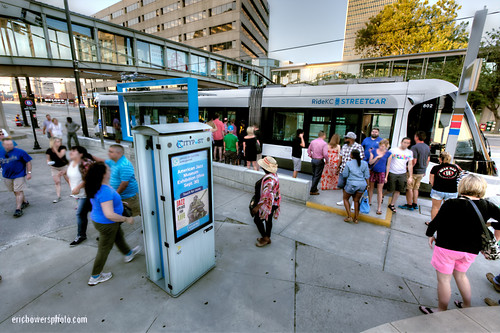
Now, with real-time transit information feeds like TransitScreen, you can use them as the engine but add other feeds to the engine.  That's how the digital information kiosks work (called CityPost, produced by Smart City Media) alongside the Kansas City Streetcar.

From the Digital Signage Today article "Meridian deploys outdoor interactive kiosks in Kansas City" :
The interactive kiosks, located at Kansas City Streetcar platforms and throughout downtown, enable travelers to check the arrival time of the next streetcar, offer Kansas City locals and tourists access to city services, and display information about local restaurants, activities and events...

Kiosk users can sync their smartphones to the kiosk with a mobile app to save and share information. For example, Kansas City Streetcar travelers might see an ad for dinner at a local restaurant. They are then able to pull that information onto their mobile device to access again at their convenience.
There is also the LinkNYC program, delivered by Civiq Smartscapes, but these systems tend to be more focused on delivering advertising rather than useful community-specific information.  I have similar concerns about a program done separately by the New York MTA transit agencies.

The feed would be multi-stream instead of a single advertising feed or a single transit information feed. 

Take (1) the digital ad feed presented in bus shelters and transit stations; (2) add transit and mobility information like the TransitScreen application; and (3) create and deliver a separate "community information feed" promoting  nonprofit and public sector organization, events, public meeting notices, etc.  (Note that Outfront Media is doing (1) and (2) on screens in Metrorail stations.)

There is great need for systematically delivering community information in public and visible ways in many places, because community media outlets are going out of business because of how the Internet has changed the business of media and advertising.

In fact, Montgomery County does a form of delivering community information digitally at the Silver Spring Civic Center, where they have two digital screens side-by-side behind the information desk.  One presents the TransitScreen info, and the other cycles through "ads" for Montgomery County Government agencies and services, and community events.   

The idea is to create content in a way that works at two scales: (1) a city or county; and (2) at the sub-city/county scale, by neighborhood/ transit district.

The stream would be device independent, so that it could be displayed on screens and kiosks as well as received on a digital feed.  Besides delivering this digital network in kiosks at transit stations and key "crossroads," in bus shelters, and civic buildings and sites, ideally, places like coffee shops, office and apartment buildings, etc., would put up screens and "subscribe" to the feed as a service to their customers/tenants--many do this with transit information already.

As another example, recently I came across the Pitt Smart Living Project, but it seems to focus only on delivering area-specific transit information.

-- Pitt Smart Living Project TransitScreen for Sennott Square

To create and deliver the community ads and event content, I'd set up an "advertising and design curriculum" as part of the School of Art and Design at Montgomery College, perhaps with the involvement of the journalism program of Montgomery-Blair High School, which very actively markets its Silver Chips student newspaper to the community beyond the school. 

A way to extend the community and educational value of the program would be to create an equivalent of the teen graphic design program of Boston's Artists for HumanityArts on the Block, based in Kensington, could participate too.    The firm handling advertising in Montgomery County's bus shelters would be another partner.

Currently the MC Media Arts & Technology program is located at the Rockville campus, but in keeping with the presence of Discovery Channel in Silver Spring, perhaps this academic program could shift to the Silver Spring campus.

-- Smart City Media video showing the program in Kansas City

An issue is whether or not to include "for profit" ads.  I would in part to defray costs, but outside of bus shelters, perhaps ads should be limited to businesses based in Silver Spring, potentially the Silver Spring retail trade area (which includes parts of DC and arguably, part of Prince George's County), and Montgomery County outside of Silver Spring.


========
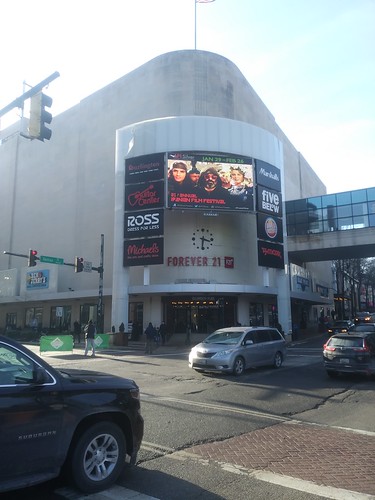
Note that this section above failed to acknowledge that the large digital advertising screen at the intersection of Fenton and Ellsworth Avenue features ads for community events.
Digital advertising screen, at intersection of Fenton and Ellsworth Avenues, Silver Spring, Maryland

When I was talking about this last summer with Ivan Bennett, former chief product design manager for Transport for London's bus system, he said that it is difficult to mix for profit and nonprofit ad programs.

(And that most good ideas have been figured out already, it's just funding that's the hindrance.)

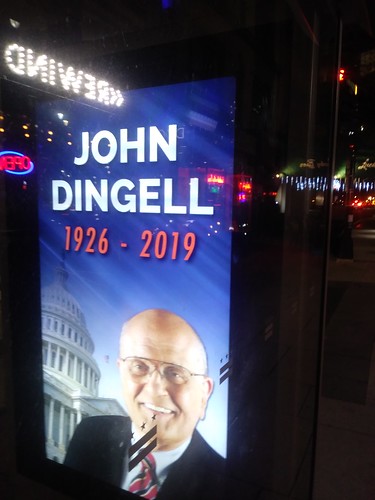
But then I saw this "ad" in a bus shelter on Connecticut Avenue NW last week.  John Dingell was a Congressman for Michigan who served many decades and he died a couple weeks ago.
John Dingell appreciation ad on his death, bus shelter, Connecticut Avenue NW, Washington, DC

Labels: , , ,

Monday, July 10, 2017

Bicycling information systems for bikeways

I've written about ideas to create community information networks--digital (see item #10, here, "PL #5: Creating a Silver Spring "Sustainable Mobility District" | Part 3: Program items 10-18 ) and analog--at the city and sub-city scale.

And I've suggested that bicycle route signage use branding and identity systems (see also the Better Bikeways signage project by Joseph Prichard and "Greater Knoxville Greenway signage project"), including map signage and signs with URLs/contact information for bikeway planning.

Dealing currently with the creation of cycletrack infrastructure in the Greater Takoma area because I sit on the neighborhood "Public Works and Infrastructure" Committee, I have been thinking about incorporating (1) community information boards; (2) murals; and (3) underpass lighting as part of the planning and construction process. 

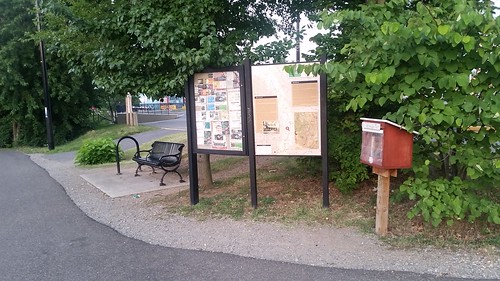
There is a community information board (and a Little Free Library) at the Rhode Island Metrorail Station "trailhead" on the Metropolitan Branch Trail, and a neighborhood association occasionally posts yard sign meeting notices at the R Street "trailhead," but these are exceptions.
Map sign, bulletin board and Little Free Library at the Rhode Island Avenue pedestrian bridge trailhead, Metropolitan Branch Trail
I think this is the only bulletin board placed on a DC bike trail.

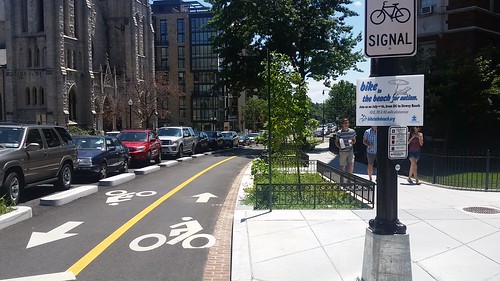
This weekend I noticed that the "Bike to the Beach" fundraising event posted signs promoting the event on various trails and cycletracks throughout the city.  I thought that was pretty smart, a well-targeted way to reach potential participants.

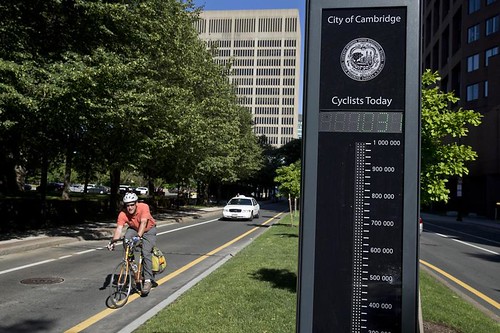
It reinforced the idea of the need for more systematic delivery of cycling-related information along bikeways, besides counters, and maybe digital information systems can be integrated into bike counter kiosks as one method.

A feed could be created as part of local and metropolitan bicycle planning, besides government agencies, it could include info from bicycle organizations and publications like the regional Spokes Magazine for the bicycling community, even ads (to help fund it).

15th Street Cycletrack between V and W Streets
15th Street Cycletrack between V and W Streets NW

Kansas City Streetcar Stop with Smart City Post Kiosks
Kansas City Streetcar Stop with Smart City Post Kiosks.  Flickr photo by Eric Bowers.

Bicycle counter, Cambridge, Massachusetts
Bicycle counter, Broadway Street, Cambridge, Massachusetts.  Photo by Michael Lee, Boston Globe.  Why not make this a kiosk incorporating biking related notices and information?

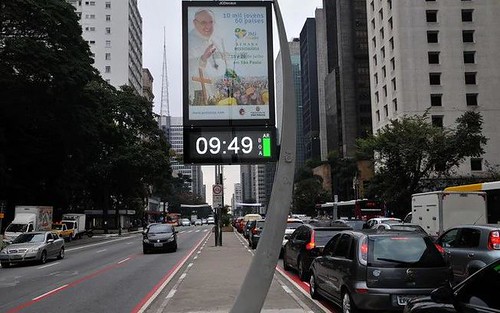
I noticed from images that on a cycletrack in Sao Paulo they have digital advertising kiosks.
Digital ad signage on Avenida Paulist ciclovia/cycletrack, Sao Paulo
Digital ad signage on Avenida Paulist ciclovia/cycletrack, Sao Paulo.

Labels: , , , ,

Tuesday, June 10, 2014

Chattanooga as a "smart city": next steps

One of the speakers at yesterday's introduction of the new Brookings Metropolitan Center report on "Innovation Districts," was the Mayor of Chattanooga, Andy Berke.

The Mayor came to the attention of Bruce Katz at Brookings because when the Center published the book Metropolitan Revolutions (see my book review), Mayor Berke took it as a challenge in terms of framing how smaller cities could forge a similar innovation path comparable to large cities like Boston and San Francisco.  ... that by definition, the innovation century isn't the unique province of large cities.

I think that's very interesting.

Chattanooga.  It happens that in 2010 I was part of a bidding team for the bike share system there (we placed highly but didn't win) and so as is my want, I learned tons about the state of the city at that time, including the landing of a new VW manufacturing plant, expansion of Alstom's power plant manufacturing operation there, that it is a big regional headquarters for the TVA, a big insurance company is based there, the decent coverage of the city by the local newspaper, the Chattanooga Times-Free Press, etc.  (And Sugar's BBQ has great barbecued jalapeno poppers.)

(Note that the city is very much car oriented, many blocks downtown are parking lots, wide streets have as many as four lanes of parking (one on each side of the street and one on each side of the median) and there is a lot of vacant space and buildings in need of spiffing up.)

The City of Chattanooga owns the local electricity distribution company.  In Tennessee, electricity is generated by the Tennessee Valley Authority, a New Deal era initiative that started with hydroelectricity generation.  Distribution is coordinated through various public firms across the state.  In Chattanooga, the Electric Power Board is the local electricity utility and it is an agency of the local government.
chattanooga-gig
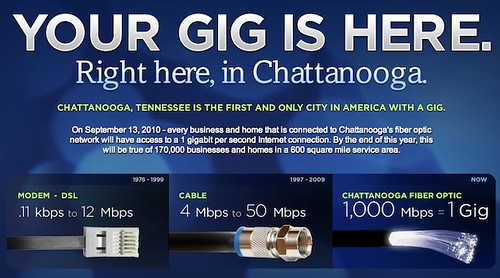
Chattanooga's Smart Grid and 1 Gigabit Internet.  Being able to link with an electric car charging infrastructure was an element of the bike share element of the RFP, so I had to learn a fair amount about the city's initiative around the creation of a "Smart Grid" electricity infrastructure nettwork, including the creation of a 1 Gigabit Internet network that includes every building or structure that is wired for electricity.

All of those things happened before the current Mayor was elected in 2013, and he had been in the State House, not local government, previously... and he wasn't accurate in the brief presentation in describing how "The Gig" network came about.  It pre-dated Obama Administration initiatives, although the EPB ended up paying for 1/3 of the project with funds from the federal government, which accelerated build out of the system significantly--it had been planned for full build out by 2020, instead they finished last year.

The EPB in Chattanooga figured out in 2007 that while implementing a smart grid to manage their network ("How Chattanooga beat Google Fiber by half a decade," Washington Post) they could also integrate high speed internet services simultaneously, so they did. From the article:
There, the effort to bring cheap broadband to the masses began as a simple engineering problem: The city's electric company, EPB, needed a way for its systems to monitor and communicate with new digital equipment being installed on the grid. Meanwhile, city hall was learning that the country's biggest phone and cable companies wouldn't be starting service there for a decade or more. So EPB became an ISP. Now it operates some 8,000 miles of fiber for 56,000 commercial and residential Internet customers. With today's rollout, gigabit service will cost $70 a month ...

Chattanooga spent $330 million on its new network, raising $220 million in bond money and winning $111.5 million in federal stimulus dollars. (The money from Washington was like icing on the cake; by the time EPB applied, it had already reached its initial targets and with the additional funds cut a 10-year construction plan down to three years.) Along the way, EPB fought several court battles with Comcast and the state cable association. Even before all this, Chattanooga had to lobby the state government for permission to let EPB participate in the telecom market.
It is an interesting example of a public-civic initiative by a publicly owned electricity  that "investor-owned" "public" utility companies have not matched.

... and I think about Chattanooga often when I hear opposition expressed to smart meters (part of Takoma DC is a hotbed of opposition to smart meters) because their world hasn't crashed and burned as a result of having the technology, in fact it's saving money and reducing outages ("Smart Grid Saves EPB Chattanooga $1.4M in One Storm," Greentech).

The Gigabit network isn't enough:  Chattanooga as the city government has a big opportunity to up its game.  While the Mayor is very active in promoting "The Gig" as an element of the city's economic development program and as a key element not only in business recruitment but as an opportunity for existing businesses and organizations to transform how they operate, it occurred to me while he was talking that Chattanooga hasn't taken "The Gig" to the next level in terms of what are called "Smart City" initiatives.

It's not enough to be ahead of other US cities, when at the world city-global city scale, world class cities are aiming to achieve much more from "Smart City" initiatives.

Note that I haven't been there lately, so I am not up with the latest developments, and clearly they are moving in the direction of what I am about to suggest already, as evidenced by various Gig City projects underway, including GigTank, a startup accelerator project focused on the smart grid and how to leverage it.

Living labs.  Specifically I am thinking of Helsinki, where a digital community was created in the Arabianranta district starting in 1998, as part of the process of building and creating that area and is called "Helsinki Virtual Village"--built on what at the time, a 10 megabit network, was a big deal.

It turns out that there is a European Network of Open Living Labs that links similar initiatives in other countries.  Yes, MIT does this kind of stuff in various labs, but in Helsinki and other cities such efforts play out in actual communities.  For example, Hamburg has similar digital neighborhood initiatives comparable to Arabianranta in its HafenCity project.

-- Helsinki Living Lab
-- Innovation Communities, Forum Virium Helsinki

City "Smart City" Initiatives.  The Helsinki Virtual Village program informed the creation by the municipality of an initiative to develop new applications and integrate "information and communications technologies" (we call it IT or information technology while in Europe they mostly refer to this as ICT) at a wide variety of scales and projects, which they have organized through a city agency called Forum Virium Helsinki, which is designated as the city's "innovation unit."   From the website:
[FVH] develops new digital services and urban innovations in cooperation with companies, the City of Helsinki, other public sector organizations, and Helsinki residents. The aim is to create better services and new business, plus to open up contacts for international markets.
Right: an implement of Transit Screen for San Francisco.

While focused on mobility exclusively, Arlington County Government's Mobility Lab is another kind of example of such a unit.  The Transit Screen information system is a start up business that grew out of a Mobility Lab initiative.

Street lights as sensor networks.  I've started seeing articles about street lights as information points ("Will Streetlamps Become Information Hubs for Cities?," Government Technology), because as the lights are replaced with LED systems, the capacities and capabilities for how the lights can be used and the poles networked becomes much greater.

The Smart City sensor networks in Amsterdam, Barcelona, and Manchester measure different elements of the urban environment: Carbon Monoxide; Nitrogen Oxide; Temperature; Humidity; Light; and Sound.

Intelligent transportation systems.  There is a lot written about this and many cities are developing smarter traffic signal systems that "learn" and are integrated--motor vehicle operators clamor for coordination to reduce wait time at traffic signals.  But few US cities are at the point of integrating multiple mobility information and tolling networks, although El Paso is exploring it, as an element of simplifying cross-border crossings between Mexico and the US, which creates massive traffic tie-ups.  Interestingly, the initiative is a local one, rather than one involving national governments.

Plus the Mobility Lab example, etc.  (European cities are farther ahead on such ITS installations more generally.)

Minneapolis 311 mobile application on a Smartphone.

Smarter citizens.  There has been a lot written about "apps for democracy" and various cities have created mobile applications of various sorts.  Much of this discussion frustrates me because the fundamental issue is more than just sending in an e-complaint, but whether or not cities are open to innovation and the democratic impulse.  I wrote about that here, "All the talk of e-government, digital government, and open source government is really about employing the design method."

The Manchester UK-based Future Everything, a digital lab and annual festival, has a publication, Smart Citizens, which is on the broad topic of "how cities can create the policies, structures and tools to engender a more innovative and participatory society."  That's what we need to discuss and a city like Chattanooga could be a "living lab" for such a process.

Also see "The New Socialism: Global Collectivist Society Is Coming Online" from Wired Magazine, the Digital Communities magazine and website, which is published by Government Technology, "Digital socialism and the 'non-planners'," etc.


Digital City Festival.  For 19 years, Manchester's Future Everything has been delivering an annual festival on the digital city.  Chattanooga could start a similar event.

Conclusion: reaping the advantages in smallness.  Still, Mayor Berke is on to something.

While big cities have the advantage of bigness and all the agglomeration economies that size enables, it can be hard to marshal the resources and leadership necessary to bring about transformational change in bigger cities. Too many people and organizations are empowered to say no, and they do, often.

By contrast, a city like Chattanooga has a potential advantage in being small, because it can be easier for the local political and economic leadership of the city to come together with citizens to move innovation forward.

Plus sometimes, smaller places believe that they need to "try harder" in order to be able to compete with larger places, making the community a bit more willing to think out of the box.

By contrast, too many people in big cities are content to rest on their laurels, because they don't look outward enough, past the immediate community and more towards the network of cities, especially the network of globally-relevant cities, where innovation is happening all the time.

Of course, not just any small city can do this.  Chattanooga has a lot of assets, including a state university based downtown and a community college with strong technical education programs based on the river just outside of the core.  The city still has major manufacturing companies actively producing goods, including big operations for VW and Alstom Power Generation. There is a committed philanthropic community.  And they are well-placed for freeway and railroad transportation and they aren't too far--118 miles--from Atlanta, perhaps the South's most important city.

Even so it can be hard, because oftentimes, their initiatives have to be approved by the Tennessee State Government--"The Gig" network project was challenged in the courts by the private sector and other entities and the city needed enabling legislation from the State Legislature.

Chattanooga Stand community survey materials were designed by Casey Yoshida.

When I was there, I was impressed with the variety of initiatives in the city, including the Enterprise Center, which supports small business development, the super impressive community visioning citizen initiative, Chattanooga Stand, which is a ground up citizen initiative promoting community engagement and improvement, and the city arts unit, among others, the strong philanthropic community (one of the main foundations is funded from original investments in the Coca Cola Company), the creative output by various local design and advertising firms, and the marketing efforts of the tourism organizations and the chamber of commerce, etc.

So I think that the city definitely has the potential to move forward and become one of the country's "smartest cities," moving beyond "The Gig" to "US Smart City 2.0".

-- URENIO Intelligent Cities - Smart Cities - Innovation Ecosystems research program, Europe/Greece

Labels: , , , , ,

Wednesday, November 13, 2013

Conference in Los Angeles: The Politics of Parametricism Digital Technologies and the Future(s) of Sociality

With reports that an "anti-snitching" endeavor in Philadelphia was using Instagram as a platform ("Police probe website targeting crime witnesses" and "Source: Police eye teen as author of anti-snitching site," Philadelphia Inquirer) and that the Sacramento Police Department tracked down and arrested robbers who used a stolen credit to purchase $120 in food from Carls Jr. via a photo they posted to Instagram ("Instagram photo of $120 Carl's Jr. order leads to 4 burglary arrests," Sacramento Bee), this Friday's conference, "The Politics of Parametricism" at REDCAT (the Roy and Edna Disney CalArts Theater) in Los Angeles is definitely trenchant.

According to the conference description:
Parametric models enable digital designers to create complex structures and environments, as well as new understandings of space, both real and virtual. Whether as tools for democratic action or tyrannical spectacle; self- and community-building capabilities; a post-humanistic subject; or the mediatized politics of our desired futurisms—all these themes are figured and being assembled within the Parametricist discourse.
Two of the sessions on Saturday, "Parametricism, the commons and social representation," featuring
Peggy Deamer, Teddy Cruz and Laura Kurgan" and "Designing subjectivities, curating new models of sociality" featuring Benjamin Bratton and Andrés Jaque, look at intersection of the virtual and real worlds on architecture and society.

-- Guardian interview with Benjamin Bratton, Center for Design and Geopolitics, University of California, San Diego

I wonder if I would be cut out for the Master’s Program in Aesthetics & Politics at the California Institute of Arts.

Labels: , ,

Saturday, October 29, 2011

New media workshops next week

1. What's Next in the Social Media Revolution?
Seventh Annual William G. McGowan Forum on Communications
Friday, November 4, at 7 p.m.
William G. McGowan Theater
National Archives

What's on the cutting edge of digital communications and social media, and what's the big picture? A panel will explore new opportunities and ideas for social media affecting the private, government, and public sectors and the average citizen.

Moderated by Alex Howard, the Government 2.0 Correspondent for O'Reilly Media, panelists include Sarah Bernard, Deputy Director, White House Office of Digital Strategy, Pamela S. Wright, Chief Digital Access Strategist at the National Archives, and David Weinberger, senior researcher, Harvard Berkman Center for Internet & Society.

A Social Media Fair and Reception will take place in the theater lobbies prior to the program from 5:30 to 6:30 p.m.

This program is generously supported by the William G. McGowan Charitable Fund, Inc.

For all Public Programs, (unless otherwise noted) please use the Special Events Entrance on the corner of 7th Street and Constitution Avenue, NW. Doors to the building open 30 minutes prior to the start of the program. All events listed in the calendar are free unless otherwise noted. Seating is on a first-come, first-served basis.


2. Discovering Technology fair
November 5th, noon to 5 pm
Bread for the city Northwest
1525 7th Street NW
Workshops, film, presentations, training consultations, discussions

Labels: , , ,

Thursday, September 15, 2011

Getting seniors online

It happened that a post I did on "Rethinking community planning around maintaining neighborhood civic assets and anchors" sparked a comment from a colleague who is working on digital divide type issues related to senior citizens.

I really love the graphic they use to explain how they are trying to create a digitally networked senior community, further leveraging the network to other community organizations and institutions.
Concept for a Senior Internet Training Network, Don Samuelson
A key issue for the program is connecting to Senior housing buildings and Section 8 housing with appropriate programming. Their initial project is creating Internet access and training operations for 2,900 building residents in 23 building scattered across 10 communities in northern Illinois from Chicago to Rock Island.

-- Get Seniors Online website

The website has extensive resources including a literature review of various best practice programs.

Interestingly, with regard to the previously mentioned Comcast program, Internet Essentials, in Boston the program is income-tested, but not limited to households with children, so seniors, among other low income households are eligible to participate in the program. See "Boston and Comcast Strike Deal for Cheap Internet Services" from Government Technology.

But for some reason the Federal Trade Commission, in negotiating the anti-trust agreement, did not see the need to extend that provision on a national basis, for some reason it's Boston-specific, and therefore is a wasted opportunity.

Labels: , , , ,

Information production vs. consumption and digital access


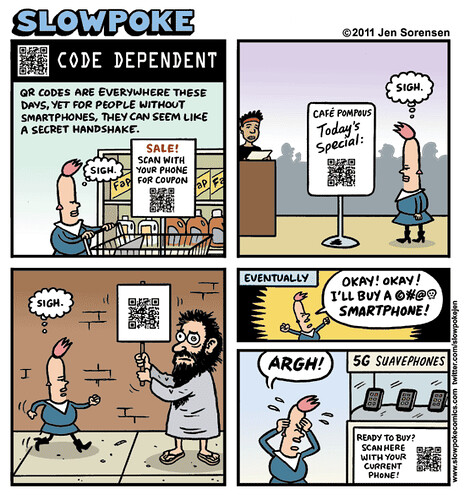
Slowpoke comic, Jan Sorenson.

My home office computer has some software flaw at the moment, so I can't reply to comments in the comments on entries. In the previous entry, Spookiness writes:

This is good PR I suppose, but most trends I have seen seem to point to the decline of home PC's connected to fixed wireline broadband connections. More and more, it's simply not the way that most people are connecting to the internet nowadays. Even poor people have cell phones with smart phone capability and internet access that way. This seems about 10 or 15 years too late, and frankly like the "food desert" issue, I think the digital divide is overstated.

I am not absolutely opposed to your argument about the digital divide. Research from many years ago by Milton Mueller (now at Syracuse) found that lower income households spent plenty of money on telecommunications services such as cable and cell phones, just not computer-related services. (Mueller M. and Schement, J. R. "Universal Service from the Bottom Up: A Profile of Telecommunications Access in Camden, New Jersey." The Information Society 12:3 (August 1996).

However, I don't necessarily agree with your argument in terms of what we might call digital access devices and Internet connection.

There are three separate issues. One is having a computer, or based on what spookiness says, a digital access device, which could also be a phone or a gamebox. The second is access to the Internet.. The third is whether or not the device is capable of supporting the ability to work substantively.

Maybe you can write a paper or produce a digital media production on a phone, but I think it would be almost impossible.

E.g., someone like myself, who writes, finds micro-devices like smartphones extremely frustrating, because they aren't designed for serious writing or research. Maybe an Ipad can get you there as opposed to a phone, I haven't used one in depth. I won't write a blog entry on a phone. It takes too damn long.

So the issue becomes one of production versus consumption of digital content.

This data is from an article in Municipal World (the Canadian public administration monthly magazine) from a few years ago, the basic point is that more than half the people "on the Internet" consume content but don't produce it. The numbers total more than 100%.

info seekers 51%
spectators 33%
joiners 19%
info sharers 15%
critics 19%
creators 13%

Creators are screwed by limitations on the ability to create. That's why people like me need computers, be they hardwired or not, because we write or otherwise develop and produce "content." I can't write on an smartphone, even if I can use it to consume content.

I think students in particular probably need more traditional "digital access devices," in other words, "computers" (laptops/Ipads qualify) first, and internet connections second. A computer matters. Whether or not the connection is landline or wireless matters less.

But it's not just about using google for limited search. It's about reading and using documents. It's about creating documents. Creating videos. Manipulating images, etc.

Ultimately, you need a better computer. And if you do a lot of your work at home. You need access to the Internet at home.

So the Comcast program does matter I think, although it would be interesting to do some systematic study of the program to see what the results end up being.

Labels: , , , ,

Comcast initiative: "Lifeline" Internet access, $10/month for low income residents with schoolchildren

Regarding the so called "digital divide," where lower income people have limited access to fee-based services such as Internet service, Comcast, the nation's largest cable television company (with interests both in providing cable services to customers as well as in programming, including NBC), is providing a $10/month Internet service to households with children qualifying for free lunch at their local school. See "Comcast to offer $10 Internet access" from the Los Angeles Times Technology blog. This is one of the conditions imposed on Comcast as a result of their merger with NBC/Universal.

-- Section from the case study on the DC Municipal Broadband Network (which is also made available to community organizations), New America Foundation

From the article:

The media and communications giant's Internet Essentials plan provides Internet access at speeds of 1.5 Mbps (megabits per second) and also offers other qualifying customers a netbook computer for $149.99 when signing up for the service.

To qualify, families must live in an area covered by Comcast and have at least one child who receives free school lunches through the National School Lunch Program.

The $10 Internet plan comes after the Federal Communications Commission ordered Comcast to offer affordable Internet access for low-income families following its purchase of NBC Universal in January. ...

Along with the $9.95 low monthly rate and the $149.99 netbook, the plan also offers qualifying families access to free Internet training and promises "No price increases, no activation fees and no equipment rental fees," according to a Comcast Web page.

Labels: , ,