Rebuilding Place in the Urban Space

"A community’s physical form, rather than its land uses, is its most intrinsic and enduring characteristic." [Katz, EPA] This blog focuses on place and placemaking and all that makes it work--historic preservation, urban design, transportation, asset-based community development, arts & cultural development, commercial district revitalization, tourism & destination development, and quality of life advocacy--along with doses of civic engagement and good governance watchdogging.

Thursday, March 05, 2026

Posters as an element of marketing transit stations and neighborhoods

I can't say I've thought about this much.  I do think about it terms of parks, and using National Park Service style posters with a design language created in the 1930s.

Original poster design, 1938.

Modern version.  Poster not produced by the National Park Service.


Now that I think about it, they are reminiscent of the transit marketing posters produced by railroads, and for transit specifically, the London Underground ("Birth of the London Underground Posters," Art Institute of Chicago, "Frank Pick: the forgotten genius of the London Underground," GalleryTelegraph, "The Hidden Women Behind London’s Beloved Modernist Transit Posters," Bloomberg), and Chicago Transit.

London Underground Poster.

Modern CTA poster promoting rehabilitation of Wilson Station.  
Making these kinds of posters could be a way to engender goodwill for transit infrastructure projects.

Non CTA poster, done in the 1930s National Park style.
Promoting the Lincoln Square neighborhood.
This series of posters by the Chicago Neighborhoods Project
 is comparable to those by u/Coup-de-Cous for Los Angeles.

Art deco style railroad poster.

Labels: , , ,

Friday, August 01, 2025

Christopher Taylor Edwards, Rest in Peace | A grassroots leader in design thinking

Later he grew a huge beard but this is how I remember him.


Open-casket visitation Sunday, August 3, 3pm (service begins 4pm) at Colvin House, 5940 N. Sheridan Rd., Chicago, IL 60660. Reception 5-7pm. Parking is limited. Guests are encouraged to take public transportation or rideshare.
(I like the nod to public transportation.)

He moved around a lot and since I am not a big Facebook user we lost touch, but my partner kept following him, from his getting another design degree in NYC and being the first design fellow in a Knight Foundation program at Parsons, to Chicago.  Before that he lived in Oakland and DC among other places. 

In the early 2000s when blogs were the supreme social media (having long since been superseded by other media like Twitter/X, Instagram, TikTok, etc.), there was a small blogging community in DC devoted to the city and its urban issues and that's how I met him.

-- Christopher's old blog

As part of my activism then I used to lead walking tours of "Florida" Market (now renamed Union Market, which was the original name, also see "Revitalization of the wholesale food Union Market in DC to a consumer focus," [2025]) to increase awareness and to ford off the attempt at urban renewal-ing a cool food business district, mostly oriented to wholesale customers, but a number of businesses also sold to the consumer.

I was also interested in the visitor/tourist/guest experience, these days the profession is often oriented to computers using the shorthand of UX--user experience.  But the principles last.

In the tours besides going to businesses that sold to retail customers, we talked about missing amenities,  like directories, trash cans, etc., which were used as reasons for urban renewal.  My response was, yes it's dirty, why doesn't the city have trash cans?  Yes, it's hard to find things, why isn't there a directory?  Etc.

I knew Christopher as a "graphic" designer, but he was also into museum exhibiting and urban design, and he offered to help develop a "proof of concept" in wayfinding signage for the market.  

The city already had a wayfinding system, but I discerned gaps, and the concept of a district area directory map was one.  I also thought the "Discover DC" headers were more oriented to tourists, rather than both residents and tourists, so we developed a "Discover DC" concept as well.

The city sign.  Maybe it's merely a quibble, but I liked the idea of "exploring" being open to all, not the implication of "discover" being you had to be an outsider to find something, ignoring the fact that these are existing places known to many.

I had been aware of the concept of "design thinking" before this project, but he and I talked about it and related issues to design.  These blog anniversary pieces draw a lot on design thinking, business process redesign, design method, and systems thinking. This was in 2008.

(I started blogging in 2005, and these anniversary pieces draw a lot on design thinking, business process redesign, design method, and systems thinking.

--  "20th anniversary of the blog| Urban revitalization systems thinking's greatest hits: Part one -- (in)FAQ and my influences," 
-- "20th anniversary of the blog| Urban revitalization systems thinking's greatest hits: Part two -- not transportation
-- "20th anniversary of the blog| Urban revitalization systems thinking's greatest hits: Part three -- transportation"

In my writings, I prefer the application of design thinking to the typical urban planning process of constrained scopes, because that allows for an iterative process that can explore and incorporate new ideas, rather than be limited to the client's defined and usually constrained scope.

-- "Florida Market proof of concept wayfinding signage and the need for a wayfinding conference," 2009
-- Explore Florida Market (history)
-- Florida Market Map and Directory


In the project I had a idea leap using design thinking on the Florida Market Map, and how to represent necessary items like transit.  

I came up with the idea of using the local transit system's iconography rather than weak lines and or the weird looking industry-standard rail transit icon.  We extended this to mapping bus routes using the WMATA graphic design as well, although it's not as pathbreaking.

FWIW, I still haven't come across a similar use of integrating local transit map graphic design into other map products. 

 There is tons of writing and display of great transit map design, but not about incorporating some of that design into different kinds of maps.

WMATA Metrorail map.

Extract from an old WMATA bus system map 
(WMATA has since changed all of its bus-related routes, naming conventions, and map designs.)

The design method, graphic design, and design thinking offer a lot to making better government services like parks, libraries, schools, forms, etc.

-- "City branding versus identity | Branding versus Urban Strategy," 2019
-- "All the talk of e-government, digital government, and open source government is really about employing the design method," 2012
-- "PL #7: Using the Purple Line to rebrand Montgomery and Prince George's Counties as Design Forward," 2017
-- "World Usability Day, Thursday November 9th and urban planning," 2017
-- "Branding's (NOT) all you need for transit," 2018
-- "Illustration of government and design thinking: Boston City Hall to Go truck," 2013<
"Best practice bicycle planning for suburban settings using the "action planning" method," 2013,

Thank you Christopher.

============

Over the past week, I came across some design thinking publications, downloadable, from the UK Design Council.

-- The Design Economy: Environmental and Social Value of Design 
-- Design Economy: People, Places and Economic Value
-- Design for Neighbourhoods: A design agenda for the new government
-- Future of Motorway Service Areas (interesting speculation about electric cars)
-- Public Design Beyond Central Government Key Insights and Recommendations

-- "Five components of social design: A unified framework to support research and practice," Design Journal

Labels: , , , ,

Friday, April 25, 2025

Impact of proposed transit cuts at SEPTA/Philadelphia presented in graphically compelling ways

With WFH and the ending of special grant programs from the Biden Administration ("Public transit agencies eye service cuts as pandemic aid runs out," Marketplace/NPR), coupled with the Trump Administration's pro-car bias, virtually every transit agency is facing financial exigency in future  budget cycles ("Metra, CTA and Pace warn of possible 40% service cuts starting in 2027," NBC Chicago, "What to know about possible PRT cuts and how to make your voice heard," Pittsburgh Post-Gazette) , often with pleas like in Philadelphia ("No more excuses — Harrisburg Republicans must find a way to fully fund SEPTA," Philadelphia Inquirer) and the SF Bay, for state bailouts.

Process for considering transit service cuts in Pittsburgh

WFH has totally messed up transit agency budgets, shifting the most use from morning and evening commute to primary business districts, to use spread out during the day, across the system, further increasing costs alongside revenue decreases.  DC for example has lost about 250,000 train riders from pre-covid highs.

The Reddit Philadelphia has included entries on what budget cuts would to do to SEPTA's, the regional transit agency for Philadelphia, service network, and I thought they've had some good graphics to illustrate the changes.

-- SEPTA budget cut fact sheet

  Proposed cuts to the current rail system ("SEPTA prepares for major service cuts," Trains Magazine).

Current ail transit system

The Delaware Valley Regional Planning Commission ("Regional planners calculated the impact on traffic if SEPTA cuts happen. It’s really bad," Inquirer) did a study of the impact the proposed cuts will have on motor vehicle traffic congestion.


From the article:
SEPTA is facing a $213 million annual structural deficit due in part to pandemic-related ridership reductions and inflationary pressure on labor and materials costs. (Fare evasion doesn’t help matters, costing from $30 million to $68 million yearly, according to SEPTA projections.)

The transit agency released a $1.65 million operating budget on April 10 that included a doomsday scenario of service cuts, along with an average fare increase of 21.5% across the board. In all, up to 55 bus routes would be eliminated, five Regional Rail lines shut down, and 66 stations closed. Other routes and lines would see reduced frequency of buses and trains.
At least one of the SEPTA trolley routes serve the suburbs.  This is in Media, Pennsylvania. 
Those cuts would occur in two phases, this fall and on Jan. 1, without new state subsidies, the transit agency says. If the full menu were enacted, all rail services would stop at 9 p.m. across the SEPTA network early next year.
From the standpoint of "those who don't know history are doomed to repeat it, some Pennsylvania Republicans are recommending privatization ("Idea to privatize SEPTA floats around the State House amid funding crisis," Fox29).  The proposal focuses on bus services, not the entire system.

There's a reason that with few exceptions, privately run transit systems were acquired by local and state governments to maintain service.  They were unprofitable from a fare standpoint, especially in that many of the "spillover benefits" of transit aren't captured by the transit operator.

Note that plenty of public transit agencies outsource operations of some or all of their transit services to the private sector.  Sometimes it works, sometimes it doesn't.  Since the operator isn't responsible for investments in transit infrastructure, that's often skipped over.  Privatization is no panacea.

Impact on property values.  Another report ("SEPTA cuts could lead to drop in property values around Regional Rail lines," WHYY/NPR, Economic Impact Analysis: SEPTA Service Cut Proposal Due to Lack of Funding) points out that property values will drop in areas that get less service at a cost of .  This is another example of a "spillover benefit," improved property values, just one of multiple positive economic development impacts not being captured by a transit agency.


Impact on special event population.  SEPTA promotes transit service to sports events like Eagle football games and concerts ("Taylor Swift's Eras Tour helps boost Philadelphia's economy," ABC6).  Philadelphia will host ceremonies commemorating the 250th anniversary of the signing of the Declaration of Independence, and World Cup soccer.  

Severe cuts to transit will significantly impact the ability of visitors to move around the city ("Philly mostly ready for 2026 … except for that little SEPTA problem," WHYY/NPR).

Streetcar service to ATT Park in San Francisco. SF Chronicle photo.

Impact of graphic design in government communications.  Note that the presentation of these issues with great graphics is an illustration of the power of good graphic design and the use of the design method by government agencies.

-- "All the talk of e-government, digital government, and open source government is really about employing the design method," (2012)
-- "PL #7: Using the Purple Line to rebrand Montgomery and Prince George's Counties as Design Forward," (2017)
-- "Design as city branding: transit edition," (2012)
-- "City (and university) branding: brand deposits; brand withdrawals; brand destruction," (2012)
-- "Georgetown: A subtle but important difference between branding and identity-positioning," (2010)
-- "Identity ≠ branding or Authenticity is the basis of identity," (2007)
-- "The taxi livery debacle as a lead in to a broader discussion of the importance of "design" to DC's "brand promise," (2012)
-- "Illustration of government and design thinking: Boston's City Hall to Go truck," (2013)
-- "(DC) Neighborhoods and commercial districts as brands," (2012)

Labels: , , , , , , ,

Tuesday, February 04, 2025

Houston Light Rail fountains: Railroad Beautiful for the 21st Century

20ish years ago, I came across the term "railroad beautiful" which referred to the architecture (H. H. Richardson) and landscape of stations (Olmsted) for the Boston & Albany Railroad ("A Railroad Beautiful," Journal of Education, 1904).

It was a precursor to the City Beautiful movement, and is what I call "transportation infrastructure as civic architecture."  Which I argue should be a key planning element for transportation projects.  Out here in Utah there is a lot of this for freeways--bridges and walls--not so much for transit.

I have an old post:

-- "Transit, stations, and placemaking: stations as entrypoints into neighborhoods" (2013)

that discusses this more in terms of neighborhoods if you look at the title, but in fact treats the entire system as a design product 

-- "Branding's (NOT) all you need for transit" (2018).  

Some systems do this in a systematic way, most don't, focusing on transit as a conveyance.  But if you want people to ride transit, perhaps for many it needs to be more design forward.

-- "Design forward trains and streetcars: Haga-Utsunomiya Light Rail and Brightline" (2023)

I haven't been to Houston in decades, so I didn't know that the Houston Light Rail terminal station on Main Street called Main Street Square, has a water feature--a fountain--and plantings, marking a recapturing of the concept of railroad beautiful for the 21st Century.


Labels: , , , , , , ,

Monday, December 04, 2023

Super design forward buses in Mexico: Irizar ie tram

Merida city in Mexico is creating a new bus rapid transit system ("IE tram system brings to Merida a whole different means of transportation," Yucatan Times, "Yucatan's Electrifying IE-TRAM Project," Mexico Business News), and as part of it, they're using Irizar ie tram bus vehicles, produced by the Irizar company in Turkey, which look more like fixed rail transit vehicles than buses.

While the specifications on the website only show a 40 foot long bus, images also show an extended version in the articulated bus form.


In "Making bus service sexy and more equitable," as a way to position bus service as a high quality servivce, I suggest that cities like Washington should switch to double deck buses, made famous by London, but used in many cities in Europe especially, but also Las Vegas and Ottawa, Ontario.  The Vegas and Ottawa buses are pretty dowdy looking, while Luxembourg puts them to shame.


The Irizar ie tram is a worthy option as a way to reposition the image of bus transit.

Also see:

Labels: , , , , , , , ,

Wednesday, November 22, 2023

Learning what not to do from the New England Patriots football team

Before I came up with the Transformational Projects Action Planning approach ("Why can't the "Bilbao Effect" be reproduced? | Bilbao as an example of Transformational Projects Action Planning," 2017), earlier I came up with a method I called Action Planning, which incorporates design thinking and social marketing into the planning process, based on best practices I observed in Arlington County and the Tower Hamlets borough of London ("Social Marketing the Arlington (and Tower Hamlets and Baltimore) way," 2008, "All the talk of e-government, digital government, and open source government is really about employing the design method," 2012).  

From "Design Thinking," American Libraries, 2008

I used action planning concepts when I did a pedestrian and bicycle plan for Baltimore County ("Best practice bicycle planning for suburban settings using the "action planning" method," 2010).

Basically, I'm interested in continuous process improvement and iterative learning ("Incrementalism as a concept of iterative improvement in government project development no longer a legitimate public administration theory," 2023) applied to government and social program improvement.

I have a bunch of posts on this for government:

-- "Big data/Machine Learning/AI as a policy savior," 2022
-- "I get tired of all the talk about rewarding "failure" because it shows people are trying, and won't be penalized for it," 2017
-- "Creating the right program vs. the hype of big data," 2013
-- "Does the focus on big data mean we miss the opportunity for better use of "little data"," 2015
-- "For a lot of "urban problems" the issue isn't knowledge about what to do, but willingness to engage that knowledge," 2017
-- "Helping Government Learn," 2009
-- "Positive Deviance and DC Public Schools," 2007
-- "Positive Deviance in New York City (public schools)," 2009
-- "3 R's of Transforming the school system," 2007

Digging deeper to learn the right lesson.  Sometimes I tell the story of the first project I did at the Center for Science in the Public Interest, a report on the presence of a potential carcinogen in alcoholic beverages.  We sold a fair number of copies through press mentions.  It happened that the chief author, editor of the newsletter, and I were eating lunch together in the basement lunchroom (it had a stove, a luxury for an office), and we ended up doing an after action analysis.

I was certain the report sold because of the policy comparisons between the US and Canada.  The newsletter editor said no, it was because of the list of test results included, and people wanted to check if what they drank was potentially tainted.  In short, it wasn't about policy it was about self-help.

It was an important lesson to me about not learning the wrong lesson from success.  But to dig deeper for the right lesson.

Learning from sports teams.  There are tons of "leadership books" and seminars and articles about leadership lessons from sports team coaches.  Then again, there's a lot written about abuse by coaches ("Beneath NCAA gymnastics’ glow, a familiar ‘toxic’ culture," Washington Post).

Because I went to the University of Michigan, a big sports school, I got turned off by large team sports. I don't watch sports on television for the most part.  I don't go to games.

It seemed futile to witness people getting in fights when Michigan lost.  I used to say "whether or not they win or lose, I still have to take my finals."  That being said, I hope they win, but I haven't watched four full quarters of football equivalent of the team over the past 40 years.

However, I find the business, politics, and societal aspects of professional sports interesting, and of course relevant to urban revitalization and policy.  And I have been reading sports stories a lot more in the past 12-18 months because the rest of the news--the US's slow but steady march to authoritarianism pushed forward by Trump ("Trump and allies plot revenge, Justice Department control in a second term," Washington Post, "Trump and Allies Forge Plans to Increase Presidential Power in 2025," New York Times)--is so depressing.

(Rory Smith of the New York Times/The Athletic, who writes about European soccer, writes many interesting stories along these lines.)

Learning from the New England Patriots: it's easy to learn the wrong lessons.  In the same vein of my lesson from CSPI, there is a great column about the decline of the New England Patriots football team ("The fall of the Patriots: An obsession with ‘value’ has led to the lowest point in 30 years," Boston Globe).

Under the coach, Bill Bellichick, the team became famed for finding "value" players, e.g., a fifth round selection for half the cost of a name player, who performed just as well or better.  The coaches all thought their success was them, not fully acknowledging the role Tom Brady, the quarterback and a diamond in the rough late draft selection, played in pulling it all together.  Since Brady left, the team has languished, really badly.  From the article:

“To be good in the business of football today — and good to me is not being good one year, but try to sustain it year in and year out — you have to understand economics and you have to understand value,” Kraft said near the end of his team’s almost-magical 2007 season. “I think every discussion I had with Bill, he understood value.”

The concept of value helped the Patriots win six championships and dominate the NFL for 20 years. On the field and on the salary-cap ledger, the Patriots were better than any team at working the margins, identifying undervalued assets, and exploiting loopholes.

It worked brilliantly when Tom Brady was leading the franchise to unprecedented heights. But “value” has since become a negative in Foxborough. The Patriots’ obsession with finding value — constantly looking for ways to spend 50 cents on the dollar — is why they are 2-8 and at their lowest point since Kraft bought the franchise 30 seasons ago. That obsession has seeped into every crevice of Gillette Stadium, weakening the core of a once-dominant franchise.

The coaches and owner learned the wrong lesson.  Value mattered and matters, but it works in a certain set of circumstances, and to keep working, a great amount of flexibility and serendipity is required.  

“If you gave us any of the top 15 [quarterbacks], we could do it. I don’t think the coaches view Tom as special as everyone else in football does.”

They thought it was them, but they were just a piece of a whole that they didn't truly understand.

Failures in Design Thinking.  The Stanford Social Innovation Review has published articles over the years about application of design thinking to social enterprises and social issues.  The current issue has an article, "Design Thinking Misses the Mark," about the failures of the applications of design thinking.  That's what I've been writing about for years, obviously, as indicated by the text above.  From the article:

However, design thinking has not lived up to such promises. In a 2023 MIT Technology Review article, writer and designer Rebecca Ackerman argued that while “design thinking was supposed to fix the world,” organizations rarely implement the ideas generated during the design-thinking process. The failure to implement these ideas resulted from either an inadequate understanding of the problem and/or of the complexities of the institutional and cultural contexts. One of Ackerman’s examples is the San Francisco Unified School District (SFUSD), which hired IDEO in 2013 to redesign the school district’s cafeterias. The five-month design-thinking process resulted in 10 recommendations, including creating a communal kitchen and using technology to reduce cafeteria lines. However, Angela McKee Brown, the consultant SFUSD hired to implement the recommendations, told Ackerman that IDEO failed to account for the operational and regulatory arrangements required for their implementation.

We reject design thinking as a singular tool kit prescribed to solve social problems. In what follows, we explain why design thinking as typically practiced has not been able to create impactful and sustainable solutions to complex social issues. Instead, we call for a critical stance on design, where critical means both discerning and important. We invite designers to adopt a continuously reflexive and questioning stance akin to what scholar and activist Angela Davis called “a way of thinking, a way of inhabiting the world, that asks us to be constantly critical, constantly conscious.”

... The social sector is inherently complex because it consists of a multitude of actors across different contexts, timelines, and political realities. Any approach that purports to easily solve for such complexity is more likely than not to be reductive and therefore ineffective. Design thinking tends toward oversimplification in at least three ways. 

  • Design thinking is formulaic
  • Design thinking is decontextualized
  • Design thinking is short-termist. 
The article goes on to provide recommendations on how to improve the approach.

Conclusion.  My form of design thinking, effectuated through the concepts of wider scopes for planning, action planning, and transformational projects action planning (also see "A wrinkle in thinking about the Transformational Projects Action Planning approach: Great public buildings aren't just about design, but what they do," 2022), aims to avoid those faults.

Labels: , , , , , , ,

Tuesday, November 21, 2023

Design forward trains and streetcars: Haga-Utsunomiya Light Rail and Brightline (plus bonus)

When I first was into the idea of reintroducing streetcars into American cities, I favored re-adopting the heritage streetcar vehicle ("A National Mall-focused heritage (replica) streetcar service to serve visitors is a way bigger idea," 2013).  

But maybe 15+ years ago, I had a conversation with Dan Malouff (Beyond DC), and he made the point that for a lot of people that might mean that streetcars are dowdy and old fashioned.

His point was provocative.  And I'm sure I disagreed at the time.  But he's right.  

Today, too many people scoff at streetcars as "19th century technology."  Although cars are 19th century too.  The thing is both have improved since.  But really they are knocking mass transit for being transit while favoring individualized personal mobility.  

Design should be a key element in repatterning how people think about transit.

A lot of train design is clunky, or at least given that the trainsets are used (unless terribly faulty) for at least 40 years, it's important to try to get the design right and to be forward, recognizing it will be around for a long time.  

While I think Baltimore's light rail cars have a kind of industrial charm, they have been in service for 31 years, and likely many more.  They don't communicate "design forward."  (Note that in my writings on the Purple Line, I suggested that they replace the Baltimore light rail vehicles at the same time.  But that's expensive when the cars have years of useful life yet.)

Most governments aren't so great at this, but there are exceptions.

There's an article in the Financial Times, "Kenneth Grange: ‘The government once had ideas about how to use design’," about a famous designer in the UK, and he commented about how the UK government was once truly focused on the value of design as an element of the built environment:

He also says the Design Council, founded in 1944, was a cornerstone of his career, a government body which “approved” the right kinds of designs. “It was an incredible thing,” he says. “The government had ideas about how to use design, for how to recover from the war and for society. And it promoted industry too; everything then was made here, now absolutely everything is made in China.” 

... One thing Grange points out is that so many of his designs were the result of central or local government commissions, from the Festival of Britain to parking meters and trains, something almost unthinkable today. “Wouldn’t it be great if [Keir] Starmer, or whoever ends up trying to govern this country, embraced the idea of believing in design in the creation of real stuff that makes real lives better?”

And you have the great example of Frank Pick who incorporated design into the communications and stations and trains of what we now call the London Underground.

I do have a piece about this, "Using the Purple Line to rebrand Montgomery and Prince George's Counties as Design Forward," which includes links to scads of entries as design as an element of urban revitalization.

I watch "Japan Railway Journal" on NHK as a way to keep in touch with best practice in Japanese rail matters.  While it's a sub-channel for many PBS stations, it's also available on demand.

For the most part they cover trains and stations, but sometimes but not nearly enough local transit systems operating in Japan.

The latest episode is "Haga Utsunomiya LRT: Shaping Communities," on Japan's first new from the ground up streetcar/tram/what they call light rail in 75 years.  

HU 300 light rail car.

The line was built mostly for Utsunomiya City, capital of Tochigi Prefecture, but during the planning phases it was slightly extended to the manufacturing district of Haga, which is a major job center ("Utsunomiya in Japan: The new light rail opened today!," Urban Transport Magazine).  

Just like in the US, it took a long time to realize, about 30 years from idea to working line--about 10 miles.  And its primary purpose is urban revitalization and centralizing new development along the transit line, with the aim of promoting trips on transit instead of by the car.

There's talk about extending it to the Utsunomiya City Hall, but I think they should also extend it to Haga's center, as the manufacturing district is on the edge of Utsunomiya, and the light rail barely extends into Haga.

But related to Dan's point, the streetcars are absolutely design forward, with a great design, low floors, huge swathes of glass for the windows, and a decent livery.  

The cars are called HU 300 and are manufactured by Niigata Transys, although Alstom is a partner as they provided the bogie/wheel sets.

Similarly, Brightline ("Florida's Brightline passenger rail as an opportunity to rearticulate and extend transit service in cities like Orlando"), the "new" private passenger rail service operating from Miami to Orlando (an extension to Tampa is planned) also has well designed trains and liveries.

In "Branding's (NOT) all you need for transit," I discuss how London Underground is treated as a "design product":

The London Underground as a design product. The London Underground is an outlier for transit systems in that it has been a consistent innovator in design and usability for 100+ years.

Key to this development was Frank Pick, who started at the agency being responsible for communications ("PR") and who laid the groundwork for corporate branding by coordinating all elements of the program into an integrated and extensive transit system -- advertising, branding, station architecture, vehicle design, and mapping -- with the highest standards for "design."

That legacy had been maintained through the creation of "product design managers" for the various transportation modes managed by the successor agency, Transport for London. But more recently, because the agency has been crushed by needing to find money to pay for Crossrail, in part because the national government cut back its contribution, they've cut these positions (and many other programs across the system).
-- Product design guidelines, Transport for London

Although in our IT centric world these days maybe people think about this more in terms of what is now called UX or User Experience.  

Brightline also does that, better than Amtrak, more like how it was done "back in the day" with railroad passenger service as being a premier service by railroads.

And the ads ("American Streamlined Trains. Striking Ads of the 1940s," Ikonographia). This page classifies ads, and the elements of premier train service as:

  • the equipment
  • power and speed
  • comfort and service
  • ability to serve leisure and vacation (and commuting)
  • designing trains for the future.


Brightline's focus on first mile/last mile transportation integration with train service is unparalleled.  They even sponsor bike share in some places ("Brightline kick starts bike share rental program," Florida Weekly).  

(Deutsche Bahn was an early pioneer in bike sharing, but not in other elements of first mile/last mile.  In Los Angeles, the local transit agency is the deliverer of bike share.  This is an outlier in the US.)

Multiplicity bus system Luxembourg.  I've mentioned these buses.


And I just came across the livery for the Class 222 trains of East Midland Trains in the UK.

Labels: , , , , , , , ,

Tuesday, July 25, 2023

Bus stops as neighborhood focal points and opportunities for placemaking

1.  Boston is promoting digital library access at 20 bus stops ("Borrowing books on the bus? It’s happening in Boston," Boston Globe).

It's not particularly pathbreaking.  Libraries in places like Orange County, California and Calgary have put in book lending stations at transit stations in their communities for more than a decade.

2.  But once again, it raises the issue of how to make bus stops more than perfunctory places within a neighborhood and community.  See past blog entries:

-- "Pathetic not revelatory: Quality of bus stop study in San Francisco," 2021
-- "Bus shelters as social spaces, as potential vectors for virus: Seoul's new anti-covid bus shelter," 2020

Project for Public Spaces has a report on the topic, Destination Station: Transforming Bus Stops through Community Outreach.

3.  Utah has invested in bus stops, but given the heat and sun in the summer months, the fact that a majority of stops have zero provision for shade is a problem.  And not providing a shelter doesn't work out so great in the winter either.

There are three bus stops--no shelters--alongside Sugar House Park for which I am on the board, and I hope that we can work with the Utah Transit Authority to put shelters in, and at at least two of the locations, to incorporate greenery.

Transit shelter next to a fence/golf course, E. Spring Street, Long Beach, California, 
with bougainvillea growing on top of the shelter

A few years ago, there was a public art project with one bus shelter in Everett, Massachusetts that did something similar ("Everett tried to make a bus stop pretty," Boston Globe).  But only for three days.

Rendering of “Felipe Baeza: Unruly Forms,” which will be presented by Public Art Fund next month on more than 400 JCDecaux bus shelters and street furniture throughout New York, Chicago, Boston in the United States, and Mexico City, León, Querétaro in Mexico.  Image: Public Art Fund, NY

4.  The New York Times has an article on a bus shelter public art project, "Watching for the Bus Stop Gallery."  From the article:
Starting Aug. 9, the artist, whose home base is Brooklyn, will be giving people something to think about during their own public transportation journey, or purgatory as the case may be. As part of a Public Art Fund program designed to reach people where they live or commute, Baeza will have eight of his mixed-media, collagelike paintings reproduced on some 400 JCDecaux bus shelters in New York, Boston and Chicago as well as Querétaro and Léon in Mexico. They will also appear on digital kiosks and newsstands in Mexico City.... 

And his paintings for the project — fantastic, ritualistic images of human bodies in different stages of transformation or regeneration — touch on the power of mobility. Speaking from a small office-like studio at the Getty, where he had a nine-month residency ending in June, Baeza called his subjects “unruly forms” or “fugitive bodies” who don’t conform to norms or abide by laws. Some seem to be morphing into sea creatures or mythic birds; others are on the cusp of flight.

I especially like the leveraging of digital ad networks across cities.  

I proposed something like that, although within communities, as point #10, "Create a digital community and transit information network for Silver Spring, employing kiosks and mobile applications" in "PL #5: Creating a Silver Spring "Sustainable Mobility District" | Part 3: Program items 10-18" (2018).

Labels: , , , , , , ,

Wednesday, April 26, 2023

Post columnist Colbert King says the DC Council needs to do more oversight

In "An example of oversight from the D.C. Council? More of that, please."  Duh.  He makes the point that the Council probably needs more staff to be able to do so.  One of the comments on the article made a point about a local "Government Accountability Office" function.

The article mentions Councilmember Robert White questioning at a hearing, Brenda Donald, director of the DC Housing Authority, asking about her $40,000+ bonus for the year, after the agency was ripped to shreds by a HUD inspection report ("D.C. Housing Authority’s leadership is failing, HUD report says," Post).  After the Executive branch restructured the board in ways that didn't necessarily improve functioning and oversight--the Council pretty much rolled over on that.

Speaking of oversight, how is that the DCHA, which was revitalized during the administration of Anthony Williams, has in 15 years, deteriorated to one of the worse in the country?  Doesn't say much for executive branch competence.

I've written about how to improve the legislative branch and oversight over the years, "Continued musing on restructuring DC's City Council (mostly)" (2013), is probably the most complete summation of recommended changes.

In "Outline for a proposed Ward-focused (DC) Councilmember campaign platform and agenda" (2015), I suggest more tools for ward-specific oversight.

But I realize it's yetanother post, where I reference organizations like the Municipal Research and Services Center of Washington State or the Independent Budget Office of New York City, and I never mentioned the Congressional Research Service, which besides the GAO and the Congressional Budget Office, provides such resources to Congress, along with Committee staffs.

Organizations like the MRSC or IBO provide a lot of deep research which is almost uniformly lacking when it comes to DC policy development and program practice.  Although to be fair, the same goes for plenty of other cities.

-- "For a lot of "urban problems" the issue isn't knowledge about what to do, but willingness to engage that knowledge" (2017)

DC has Inspector Generals and an Auditor who reports to Council.  The auditor, former Councilmember Kathy Patterson, has done a lot of good reporting.  But again, the Executive Branch doesn't seem to want to engage with it, and the Council doesn't push.

In some cities, more independent offices, like the New York City Comptroller--currently Brad Lander--who is elected, do this kind of work as well, and bring more attention to the ins and outs of better governance.

=====

Note that separatelly I argue for training, assistance, and capacity development systems for the city's Advisory Neighborhood Commissions and citizens groups more generally.

-- "Framingham Massachusetts creates Citizen Participation Officer position," 2018
-- "Building civic engagement systematically: Seattle's Department of Neighborhoods," 2022

And in general across the board in other cities too.

Labels: , , , , , , , ,

Monday, March 20, 2023

Great article on urban design qualities of Kimmel Center in Philadelphia | extendable to civic assets more generally

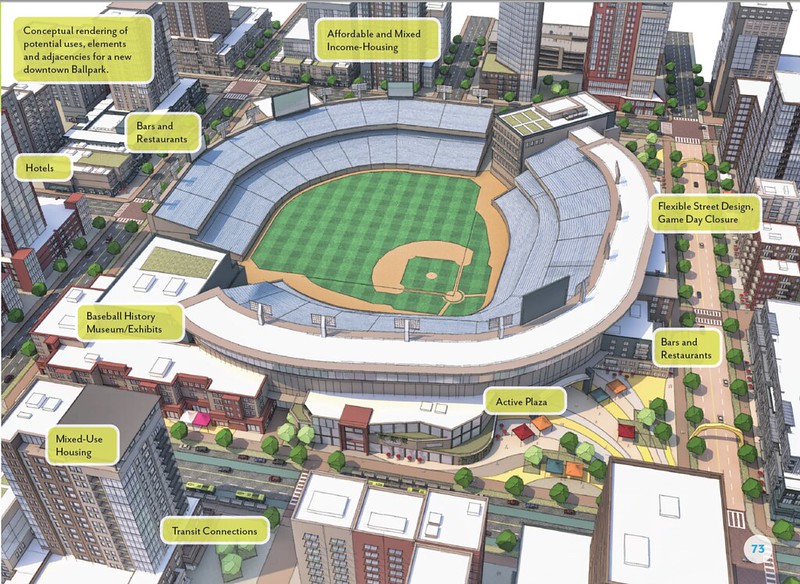
Proposal for a new Downtown baseball stadium in Kansas City that is tightly integrated into the urban fabric.

My writings on stadiums and arenas have a framework of elements to consider when dealing with a project.  It was developed out of the sense that activists oppose such projects, especially public funding, but most of the time they happen regardless, so why not expend our energies on mitigating the problems and yielding the most benefits.

-- "Framework of characteristics that support successful community development in association with the development of professional sports facilities ," 2021

The current stadium complex in Kansas City is surrounded by parking lots, disconnecting it from the city.

It hasn't focused so much on interior design as much as broader place characteristics and exterior features, but the comments include a number of articles such as on Milwaukee's Fiserv Arena ("Fiserv Forum's architecture wonderful inside, flawed outside," "The Killers, Violent Femmes rock first Fiserv Forum show, cover 'Laverne & Shirley' song," Milwaukee Journal-Sentinel) with more discussion of the interior architecture, which needs to be included in an update to the framework.

The writings on "transformational projects action planning" discuss both interior and exterior elements.  From "A wrinkle in thinking about the Transformational Projects Action Planning approach: Great public buildings aren't just about design, but what they do" (2022):

TPAPs should be implemented at multiple scales:

(1) neighborhood/district/city/county wide as part of a master plan;
(2) within functional elements of a master plan such as transportation, housing, or economic development; and
(3) within a specific project (e.g., how do we make this particular library or transit station or park or neighborhood "great"?); in terms of both
(4) architecture and design; and
(5) program/plan for what the functions within the building accomplish.

Lately, I have been mulling the issue of civic buildings as elements of the creation of neighborhood centers and community centers because of some examples in Salt Lake City and County where the final results are paltry compared to the investment, because a good framework wasn't employed (along with a failure to have a focused plan for the creation of neighborhood centers).

That's why a Philadelphia Inquirer article, "A new cafe at Kimmel is the first step to a better arts center," by Peter Dobrin, the paper's classical music critic is so great.  

Writing about the Kimmel Center for Performing Arts, which styles itself as an arts campus, the review addresses the power or failure of civic assets to push urban design, placemaking, and revitalization forward as part of the program for the building and site.

Note that the Inquirer is one of the only newspapers in North America that has an urban design writer, Inga Saffron, who is fabulous.  Like the Milwaukee Journal-Sentinel's music critic's review of the Arena, Dobrin is particularly insightful.  From the article:

The Kimmel Center was trumpeted as Philadelphia’s fifth public square — an 18-hour-per-day, seven-day-a-week arts center where you could show up anytime and find a concert or see a film.

But since it opened in 2001, the Kimmel has sent mixed signals about just how welcoming it really wants to be. Some of this has to do with the architecture — fortresslike from the outside, visually chilly on the inside — but also with the way the Kimmel has policed its spaces, which has sometimes been heavy-handed. On balance, though, this ostensibly public space has never lived up to its promise.

With the recent opening of a cafe in its lobby, Philadelphia’s major arts center is taking another run at inviting the city in.

Yes, I know: In one sense, a few dozen seats and a place to have a macchiato and a country-ham-on-baguette is a modest gesture. But quietly and convincingly, the cafe is already easing one of the arts center’s long-standing deficits. It has made the institution less opaque — metaphorically and physically.

 One of the missed opportunities of the original design was failing to recognize the arts center’s most prominent spot, the corner of the structure at Broad and Spruce Streets, as an invitation for transparency. One part of the structure, the enormous pile of masonry at Broad and Spruce, was extended west with a ticketing booth that blocked the view into the plaza. At its front door, the Kimmel had little to signal what goes on inside.

 ... It’s no accident that arts centers everywhere are becoming more sensitive to atmosphere and user experience. Competition for leisure time is stiff, and getting people to leave their houses, a challenge. The New York Philharmonic has renovated and renamed its home in Lincoln Center, and now the lobby of David Geffen Hall features a 50-foot-long digital screen showing video art during the day and streamed performances of Philharmonic concerts live.

The New York auditorium’s acoustics also got a makeover. The sound was crisper and more present than before in two concerts I heard there in January, and aficionados seem generally impressed.

But then there are those patrons who want to experience music more passively, sitting in the lobby sipping and chatting or scrolling social media as Beethoven streams digitally in the background.

... It’s worth noting that New York has a great deal more public space than Philadelphia — in Lincoln Center plaza, for starters. The Kimmel, with its huge glass dome, functions as a kind of roomy indoor-outdoor gathering space that’s rare here, heightening the importance of making it succeed.

... The symbolic value of the cafe as a space of access to all is important, especially now. The arts are still perceived by some as elitist, and arts attendance took a hit during the pandemic [.]

... The Kimmel has pursued a series of renovations to both its public and private spaces on a rolling basis since opening, both as part of routine maintenance and in response to financial pressures and other factors.

... The tale of the rooftop garden is a good metaphor for the push and pull of operating an arts center. It is a public space, but the institution is also expected to produce enough revenue to offset rental costs for its resident companies (a subject for another day).

The open-air garden atop the Perelman Theater once offered anyone who wanted it a great city view, an escape from the busy city. But the Kimmel, strapped for income, took down the trees and renovated the rooftop perch years ago so it could reap revenue from weddings and other events.  Gone was one of the city’s truly fun and surprising public spaces.

The Kimmel needs to evolve further to become the social hub the arts community urgently needs to reintroduce pandemic-weary patrons to the value of live, in-person performances. The New York Philharmonic renovation introduced fun to the place through the architecture, fabrics, and amenities.

Some lessons.

  • the building should be permeable (I am a big fan not just of large windows, but garage doors tht open up
  • the space should be active, open and "fun"
  • there should be connection between the interior and exterior of the building(s)
  • there should be connection between the exterior and the area beyond the site
  • arts buildings should promote art, not look like just another office building
  • outside public spaces should be open and active, not grim and closed off.

Labels: , , , , , ,