Rebuilding Place in the Urban Space

"A community’s physical form, rather than its land uses, is its most intrinsic and enduring characteristic." [Katz, EPA] This blog focuses on place and placemaking and all that makes it work--historic preservation, urban design, transportation, asset-based community development, arts & cultural development, commercial district revitalization, tourism & destination development, and quality of life advocacy--along with doses of civic engagement and good governance watchdogging.

Tuesday, February 06, 2024

Difficultly of fomenting institutional change not just a problem for minorities

I joke that half the entries I write are about best practice, the other half about worse practice and poor decision making.  Plus to be fair to elected officials even in the best circumstances change takes a long time.

I joke that I didn't start understanding patience within community organizing until my 40s, when I realized a "fast tracked" transportation project takes 10 years.

Lately too I've been thinking about how "ur academic literature" that is really important for interpretation is kind of lost to history and not referenced by current pundits.

The three big examples for me are Exit, Voice and Loyalty, about how people stay or leave organizations in the face of conflict, Diffusion of Innovations about exactly that (and the spinoff work by Geoffrey Moore, which Rogers disavowed), and Alexander Gerschenkron's papers on "The Economic Advantages of Backwardness in Historical Perspective."

The latter writings are particularly relevant to the take up of electric vehicles, and how China is overtaking the US in terms of having the preeminent position in electric car productions.  (This will be the subject of a later blog piece, along with some issues.)  In the case of China, they don't have the same investment in legacy technologies, so they can leapfrog the countries that do.

Washington Post columnist Perry Bacon has a piece, "We are facing limits from diversity," about the difficulties minorities face in trying to "change" organizations.  As someone who has worked on such issues for 30+ years, it's hardly an issue exclusive to minorities.  From the article:

... I once assumed that greater inclusion would inevitably lead to equitable policies, because people from groups that had been unfairly diminished would see injustice more clearly than others and be more motivated to address it. I don’t think that anymore. 

 ... It’s rarely directly stated that, “If we add more people of color or women to institution X, that will move it leftward.” But that assumption is embedded in a lot of discourse. Democratic politicians who are White women or people of color often emphasize their connections to those groups, hinting they will be particularly strong advocates for those who share their identities. For example, in his 2008 campaign, Barack Obama argued his candidacy was an extension of the 20th-century Black freedom movement. 

... Here’s the problem: Individuals, whatever their identity, usually don’t change powerful, established institutions, for several reasons. First of all, the minorities and women tapped to join such institutions are often chosen because they have signaled that they won’t disrupt the status quo too much. Many Black Democratic mayors and Black police chiefs have blocked efforts to increase scrutiny of officers or meaningfully reform police practices; they wouldn’t have gotten those jobs if they were going to push for major changes. 

... Second, even minorities and women who favor more progressive change are caught in a bind: Challenging the values of the institutions they are a part of would likely reduce their ability to advance, or even remain in their current roles. 

 ... The third and biggest problem is that minorities and women often simply don’t have enough internal power to change these institutions, even when they try. 

 ...Progressives should push institutions to fundamentally change, not just put more people of color in high-profile roles. The path to a consistently progressive Democratic Party is for the left to win primaries, particularly the presidential contest, and take over the party from within. A more diverse administration run by a centrist figure such as Biden isn’t enough. And when change is impossible, progressives should look to create or revitalize alternative institutions.

WRT institutional change, welcome to the club.

I did figure out some fundamentals when I did a bike and pedestrian plan for Baltimore County.  

(1) my job wasn't to be a bomb thrower but to figure out how to wend my way through the existing system and build support (at the first multi-agency meeting, a guy doing streetscape work did just that, criticizing all the other agencies--it was a good lesson) 

(2) build on existing best practice, reference it, building support across agencies.  

(3) work with advocates disappointed about not seeing progressive action from previous efforts, acknowledging that work, and how it led to the work that we're doing today.  Build on it.

(4) focus on preferred outcomes and look backwards at the system processes producing non-desirable outcomes as routine, and work on rebuilding the processes (process innovation) to generate preferred outcomes as a matter of course.

(5) make recommendations on elements like a Pedestrian and Bicycle Committee and sub-committees for political districts that were practical, and "opportunities for appointments" by elected officials.  

I was super proud of #5 and the sub-committees.  Because it would bring the executive and legislative branches together, with citizens, and a foundational agenda (from the plan).  The council districts did this have had way more progress on bike and pedestrian improvements than the council districts that haven't.

But one thing I didn't figure on... the County Executive gets to appoint the chair.  And he appointed a flunky, someone who worked for the Executive Branch, and therefore the Executive overly shaped the agenda and reduced the independence/objectivity/advocacy capacity of the group.

====
That being said, systems aren't about improvement, but about maintenance of the system.  See Planning in the Public Domain and to some extent Social Psychology of Organizations.

Labels: , , , , , , , ,

Friday, February 02, 2024

Another way to think about gap analysis/planning

 I joke that I might not be a good planner, but I'm great at gap analysis.  I meant to read this Financial Times column last week, "The secret to finding the best idea ever? First think about the absolute worst  When looking for a business breakthrough, a design innovation, or a flash of artistic insight, it’s smart to think in reverse," but I forgot.

The title puts gap analysis in perspective.  There are so many bad ideas and implementation, how can I not excel at gap analysis?  

But it's also about brainstorming.  People make important, interesting points, or share ideas.  I build on them.  And it's two-way.  People improve and extend ideas I put out there too.

From the article:

Creativity gurus have termed this approach looking for the “worst possible idea”. When looking for a business breakthrough, a design innovation or a flash of artistic insight, it can be hard to think of much when challenged to dream up a good idea. Far easier, less intimidating and more fun to write down a list of terrible ideas, then see what those terrible ideas suggest once you turn them on their heads. 

Sometimes the worst-idea exercise is little more than a warm-up, getting the imaginative sparks flying before the real creative work begins. Sometimes, however, focusing on what makes an idea bad shines the spotlight on what might make an idea good. If the bad idea is to make a product look clumsy and ugly, that suggests it’s worth paying more attention to the product’s elegance and beauty. If the bad idea is to ship the product with bewildering instructions, the good idea is to hire an editor to hone the instructions. 

... So let’s hear it for wilful contrarianism in the search for inspiration. Sometimes looking for a bad idea gets the creative juices flowing. Sometimes a bad idea perfectly highlights what would make an idea good. And sometimes, the bad idea is actually the best idea of all.

Labels: , , , , , ,

Sunday, January 07, 2024

Expert articulators of problems | a derisive term from new Philadelphia Mayor Cherelle Parker

When I was in college, a lot of people criticized activists over "not having solutions" when they articulated problems. 

For decades, I've believed that identifying problems is a worthy skill, even if you don't have "the" answer--especially because many people who think they have "the answer" don't, they have an answer to one eensy element of the whole problem. 

Of course, having a good solution as well as an articulation of the problem is even better. That's what I aim to do in my blogwriting. Although I argue that half of what I write about is systems failure and bad decision making; the other half best practice ("solutions") although not every best practice is universally applicable.

Philadelphia Inquirer columnist Helen Ubiñas is somewhat derisive of the new mayor's declaration of a state of emergency giving the designees for action 100 days to come up with a plan to deal with the city's crime problems, including the massive set of drug markets and decay in the Kensington neighborhood ("Business and Bloodshed").
 
She figures they should focus on doing, that there are already plenty of plans in the bookshelves and computers in city offices ("We’ve finally declared a public safety emergency in Philadelphia. But why do we have to wait to act on it?").

Her column mentions how the Mayor has a term that is derisive of the activists and others who call on the city to constantly do better.  From the PI:
 “Expert articulators of problems,” also know[n] as “AOPs”: These are people who like to point out, for example, that Philly has the highest poverty rate among the 10 largest U.S. cities, but are “very, very, very short on delivering solutions,” as Parker said Tuesday. She is not a fan of AOPs.
Parker is no different from the professors who tried to denigrate our arguments 40 years ago, "because we didn't offer solutions simultaneously with identifying problems."  Note that's an illogical argument.

The failure to not avail oneself of the knowledge and insights of AOPs is close to criminal.  Although granted I joke that there is a fine line between "critical analysis" (me) and "whining" (Greater Greater Washington blog).

Every once in awhile I get "despondent" about DC Government, and all the job interviews I had to no avail (I did get a job offer once, but they then reneged with no explanation--I figure it was because of my "outspokenness").  But all I wanted to do was help to make the city better.

And my all too brief* planning job in Baltimore County proved I was fully capable of working "within the system" without being a super huge PITA, but a PITA nonetheless because I wasn't satisfied with the status quo.  (* Bad timing there too.  I was on a grant.  The director wanted to hire me back, but then wasn't retained after the next election, so I lost my chance.)

Anyway, I am proud to be an AOP.

Labels: , , , ,

Wednesday, November 22, 2023

Learning what not to do from the New England Patriots football team

Before I came up with the Transformational Projects Action Planning approach ("Why can't the "Bilbao Effect" be reproduced? | Bilbao as an example of Transformational Projects Action Planning," 2017), earlier I came up with a method I called Action Planning, which incorporates design thinking and social marketing into the planning process, based on best practices I observed in Arlington County and the Tower Hamlets borough of London ("Social Marketing the Arlington (and Tower Hamlets and Baltimore) way," 2008, "All the talk of e-government, digital government, and open source government is really about employing the design method," 2012).  

From "Design Thinking," American Libraries, 2008

I used action planning concepts when I did a pedestrian and bicycle plan for Baltimore County ("Best practice bicycle planning for suburban settings using the "action planning" method," 2010).

Basically, I'm interested in continuous process improvement and iterative learning ("Incrementalism as a concept of iterative improvement in government project development no longer a legitimate public administration theory," 2023) applied to government and social program improvement.

I have a bunch of posts on this for government:

-- "Big data/Machine Learning/AI as a policy savior," 2022
-- "I get tired of all the talk about rewarding "failure" because it shows people are trying, and won't be penalized for it," 2017
-- "Creating the right program vs. the hype of big data," 2013
-- "Does the focus on big data mean we miss the opportunity for better use of "little data"," 2015
-- "For a lot of "urban problems" the issue isn't knowledge about what to do, but willingness to engage that knowledge," 2017
-- "Helping Government Learn," 2009
-- "Positive Deviance and DC Public Schools," 2007
-- "Positive Deviance in New York City (public schools)," 2009
-- "3 R's of Transforming the school system," 2007

Digging deeper to learn the right lesson.  Sometimes I tell the story of the first project I did at the Center for Science in the Public Interest, a report on the presence of a potential carcinogen in alcoholic beverages.  We sold a fair number of copies through press mentions.  It happened that the chief author, editor of the newsletter, and I were eating lunch together in the basement lunchroom (it had a stove, a luxury for an office), and we ended up doing an after action analysis.

I was certain the report sold because of the policy comparisons between the US and Canada.  The newsletter editor said no, it was because of the list of test results included, and people wanted to check if what they drank was potentially tainted.  In short, it wasn't about policy it was about self-help.

It was an important lesson to me about not learning the wrong lesson from success.  But to dig deeper for the right lesson.

Learning from sports teams.  There are tons of "leadership books" and seminars and articles about leadership lessons from sports team coaches.  Then again, there's a lot written about abuse by coaches ("Beneath NCAA gymnastics’ glow, a familiar ‘toxic’ culture," Washington Post).

Because I went to the University of Michigan, a big sports school, I got turned off by large team sports. I don't watch sports on television for the most part.  I don't go to games.

It seemed futile to witness people getting in fights when Michigan lost.  I used to say "whether or not they win or lose, I still have to take my finals."  That being said, I hope they win, but I haven't watched four full quarters of football equivalent of the team over the past 40 years.

However, I find the business, politics, and societal aspects of professional sports interesting, and of course relevant to urban revitalization and policy.  And I have been reading sports stories a lot more in the past 12-18 months because the rest of the news--the US's slow but steady march to authoritarianism pushed forward by Trump ("Trump and allies plot revenge, Justice Department control in a second term," Washington Post, "Trump and Allies Forge Plans to Increase Presidential Power in 2025," New York Times)--is so depressing.

(Rory Smith of the New York Times/The Athletic, who writes about European soccer, writes many interesting stories along these lines.)

Learning from the New England Patriots: it's easy to learn the wrong lessons.  In the same vein of my lesson from CSPI, there is a great column about the decline of the New England Patriots football team ("The fall of the Patriots: An obsession with ‘value’ has led to the lowest point in 30 years," Boston Globe).

Under the coach, Bill Bellichick, the team became famed for finding "value" players, e.g., a fifth round selection for half the cost of a name player, who performed just as well or better.  The coaches all thought their success was them, not fully acknowledging the role Tom Brady, the quarterback and a diamond in the rough late draft selection, played in pulling it all together.  Since Brady left, the team has languished, really badly.  From the article:

“To be good in the business of football today — and good to me is not being good one year, but try to sustain it year in and year out — you have to understand economics and you have to understand value,” Kraft said near the end of his team’s almost-magical 2007 season. “I think every discussion I had with Bill, he understood value.”

The concept of value helped the Patriots win six championships and dominate the NFL for 20 years. On the field and on the salary-cap ledger, the Patriots were better than any team at working the margins, identifying undervalued assets, and exploiting loopholes.

It worked brilliantly when Tom Brady was leading the franchise to unprecedented heights. But “value” has since become a negative in Foxborough. The Patriots’ obsession with finding value — constantly looking for ways to spend 50 cents on the dollar — is why they are 2-8 and at their lowest point since Kraft bought the franchise 30 seasons ago. That obsession has seeped into every crevice of Gillette Stadium, weakening the core of a once-dominant franchise.

The coaches and owner learned the wrong lesson.  Value mattered and matters, but it works in a certain set of circumstances, and to keep working, a great amount of flexibility and serendipity is required.  

“If you gave us any of the top 15 [quarterbacks], we could do it. I don’t think the coaches view Tom as special as everyone else in football does.”

They thought it was them, but they were just a piece of a whole that they didn't truly understand.

Failures in Design Thinking.  The Stanford Social Innovation Review has published articles over the years about application of design thinking to social enterprises and social issues.  The current issue has an article, "Design Thinking Misses the Mark," about the failures of the applications of design thinking.  That's what I've been writing about for years, obviously, as indicated by the text above.  From the article:

However, design thinking has not lived up to such promises. In a 2023 MIT Technology Review article, writer and designer Rebecca Ackerman argued that while “design thinking was supposed to fix the world,” organizations rarely implement the ideas generated during the design-thinking process. The failure to implement these ideas resulted from either an inadequate understanding of the problem and/or of the complexities of the institutional and cultural contexts. One of Ackerman’s examples is the San Francisco Unified School District (SFUSD), which hired IDEO in 2013 to redesign the school district’s cafeterias. The five-month design-thinking process resulted in 10 recommendations, including creating a communal kitchen and using technology to reduce cafeteria lines. However, Angela McKee Brown, the consultant SFUSD hired to implement the recommendations, told Ackerman that IDEO failed to account for the operational and regulatory arrangements required for their implementation.

We reject design thinking as a singular tool kit prescribed to solve social problems. In what follows, we explain why design thinking as typically practiced has not been able to create impactful and sustainable solutions to complex social issues. Instead, we call for a critical stance on design, where critical means both discerning and important. We invite designers to adopt a continuously reflexive and questioning stance akin to what scholar and activist Angela Davis called “a way of thinking, a way of inhabiting the world, that asks us to be constantly critical, constantly conscious.”

... The social sector is inherently complex because it consists of a multitude of actors across different contexts, timelines, and political realities. Any approach that purports to easily solve for such complexity is more likely than not to be reductive and therefore ineffective. Design thinking tends toward oversimplification in at least three ways. 

  • Design thinking is formulaic
  • Design thinking is decontextualized
  • Design thinking is short-termist. 
The article goes on to provide recommendations on how to improve the approach.

Conclusion.  My form of design thinking, effectuated through the concepts of wider scopes for planning, action planning, and transformational projects action planning (also see "A wrinkle in thinking about the Transformational Projects Action Planning approach: Great public buildings aren't just about design, but what they do," 2022), aims to avoid those faults.

Labels: , , , , , , ,

Wednesday, April 26, 2023

Post columnist Colbert King says the DC Council needs to do more oversight

In "An example of oversight from the D.C. Council? More of that, please."  Duh.  He makes the point that the Council probably needs more staff to be able to do so.  One of the comments on the article made a point about a local "Government Accountability Office" function.

The article mentions Councilmember Robert White questioning at a hearing, Brenda Donald, director of the DC Housing Authority, asking about her $40,000+ bonus for the year, after the agency was ripped to shreds by a HUD inspection report ("D.C. Housing Authority’s leadership is failing, HUD report says," Post).  After the Executive branch restructured the board in ways that didn't necessarily improve functioning and oversight--the Council pretty much rolled over on that.

Speaking of oversight, how is that the DCHA, which was revitalized during the administration of Anthony Williams, has in 15 years, deteriorated to one of the worse in the country?  Doesn't say much for executive branch competence.

I've written about how to improve the legislative branch and oversight over the years, "Continued musing on restructuring DC's City Council (mostly)" (2013), is probably the most complete summation of recommended changes.

In "Outline for a proposed Ward-focused (DC) Councilmember campaign platform and agenda" (2015), I suggest more tools for ward-specific oversight.

But I realize it's yetanother post, where I reference organizations like the Municipal Research and Services Center of Washington State or the Independent Budget Office of New York City, and I never mentioned the Congressional Research Service, which besides the GAO and the Congressional Budget Office, provides such resources to Congress, along with Committee staffs.

Organizations like the MRSC or IBO provide a lot of deep research which is almost uniformly lacking when it comes to DC policy development and program practice.  Although to be fair, the same goes for plenty of other cities.

-- "For a lot of "urban problems" the issue isn't knowledge about what to do, but willingness to engage that knowledge" (2017)

DC has Inspector Generals and an Auditor who reports to Council.  The auditor, former Councilmember Kathy Patterson, has done a lot of good reporting.  But again, the Executive Branch doesn't seem to want to engage with it, and the Council doesn't push.

In some cities, more independent offices, like the New York City Comptroller--currently Brad Lander--who is elected, do this kind of work as well, and bring more attention to the ins and outs of better governance.

=====

Note that separatelly I argue for training, assistance, and capacity development systems for the city's Advisory Neighborhood Commissions and citizens groups more generally.

-- "Framingham Massachusetts creates Citizen Participation Officer position," 2018
-- "Building civic engagement systematically: Seattle's Department of Neighborhoods," 2022

And in general across the board in other cities too.

Labels: , , , , , , , ,

Thursday, January 26, 2023

Las Vegas Mayor's Symposium on Urban Design (poorly marketed) | Missing Middle Housing

Suzanne saw this on Instagram (#mayorssymposium).  There's nothing on the regular Internet.  The focus this year is on infill housing, featuring presenters from other cities in the west.  The Instragram hashtag has links to slides on the individual sessions.

FWIW, these kinds of activities may help to assuage the opposition to such initiatives elsewhere, such as in Arlington County, Virginia ("Arlington lawmakers to consider a missing middle plan with no eightplexes," Washington Post).  

A sign opposing a zoning deregulation proposal known as “missing middle” on Jan. 8 in the Lyon Village neighborhood in Arlington. (Craig Hudson for The Washington Post) 

In community organizing/planned change, it's best to spend a goodly amount of time upfront to build the base of support for substantive changes to the status quo.

Dealing with this since the fall ("As housing prices soar, a wealthy county rethinks the idea of suburbia," Post) isn't enough time.

Salt Lake City has passed a similar change, up to four units.  

Corner duplex, with entrances to each unit on different streets, Salt Lake City.

And interestingly, infill housing could be done in a sensitive way, with restrictions on certain types of historic housing that isn't easily modifiable, because most neighborhoods have examples of existing small multiunit buildings (duplex, triplex, quads, quints, and small apartment buildings) that were sensitively done at the time the neighborhoods were constructed initially.

Many of the houses in Salt Lake are one story, so adding a story or two wouldn't be outlandish.  But the problem is if developers would be focused on creating four 2,000 s.f. units on one lot, which wouldn't work.

-- Missing Middle Housing website

Labels: , , , ,

Sunday, July 24, 2022

Who to contact tags on poles and other utility infrastructure in the public space


Asset tag with information on who to contact on a Verizon Wireless pole, 2700 South, Salt Lake City.

A few months ago I got into a comment thread argument on a Washington Post article, about a situation in Silver Spring in addressing a problem with equipment hanging off dangerously from a pole ("When it comes to utility wires and boxes, companies pass the buck").

Generally, poles are owned by the local electric utility or maybe the phone company, and they rent space on them to other providers to install equipment.  

Usually there isn't information on the pole generally, or on the specific pieces of equipment for who to contact if there is a problem.

I made the point that the pole and all the equipment on it should have contact information (asset tags), so any problems could be addressed, and that the article did us a disservice by not addressing the overarching problem of lack of such identification.

People commented that wasn't the point, etc., that the issue was these specific people and their problem with this particular pole.

One of my lines is that there is a fine line between whining and critical analysis.  For example, entries at Greater Greater Washington are more often about whining--why doesn't this work?--without offering deeper analysis.

While I think it's fine to be good at identifying a problem without necessarily being good at identifying solutions, websites and newspaper columnists I hold to a higher standard. I stopped reading GGW years ago, because I just felt for the time spent, I could get more value reading other sources.

Public Service Commissions should be petitioned to make this a requirement.

=====

Ironically, this is an issue in the park for which I am on the board.  There are no signs posted on who to contact if there is a problem.  Anywhere.  For lost and found, for anything.  This creates a fair amount of problems in my opinion, including giving a sense that there aren't "eyes on the street," which helps to foster vandalism in the restrooms.

Labels: , , ,

Tuesday, May 03, 2022

DCPS middle schools in black wards, "positive deviance" and the pull of the attractiveness of schools in the upper income wards west

For a longer term project and blog entry*, I have two books that I am trying to read, Marketing Schools, Marketing Cities and How to Walk to School: Blueprint for a Neighborhood School Renaissance.  

The first book is critical of efforts to create urban schools that are especially attractive to high income (read "white") households who are attracted to urban living, but repelled by poor quality schools.  It's a study of a school created with the support of the University of Pennsylvania and the Center City Business Improvement District.

The second describes the efforts of parents and principal to revive and make more attractive a Chicago elementary school located in a neighborhood that was attracting in-migration of high income households.

I happened to write a couple entries in the past couple months about middle schools: 

-- "A positive deviance failure in Boston: Timilty Middle School"
-- "DC schools capital planning: a legacy of waste"

The piece about the decline, rise, fall and dissolution of Timilty School in Boston made me realize that despite how attractive I find "positive deviance theory" ("Your Company's Secret Change Agents," Harvard Business Review, Positive Deviance Collaborative) the forces favoring inertia are supra powerful.  

Timilty could have been used as a fulcrum for transforming the city's schools, which today are facing state takeover ("Boston community members voice concern over possible state takeover of schools," Boston Globe).  Instead it was shunned, ignored, and avoided.

Cass Tech vacant and before demolition.

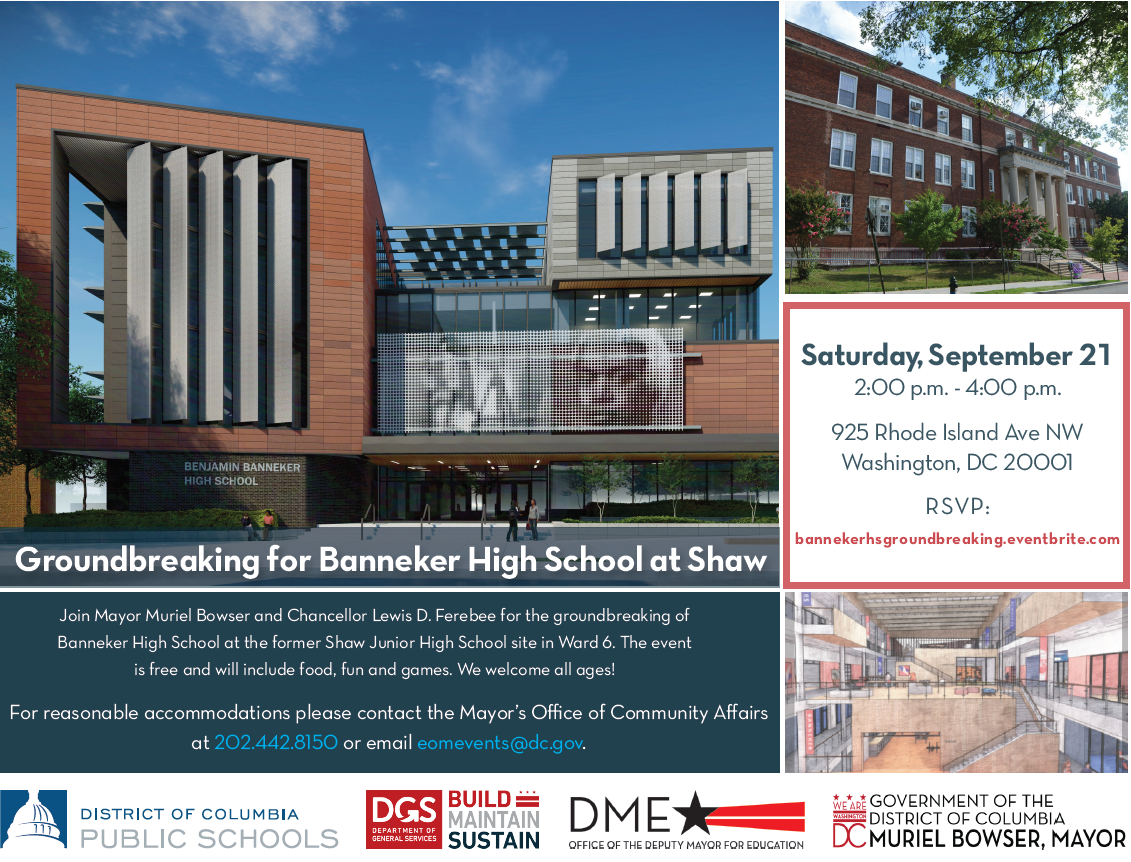
In the piece on capital planning, in the comments I realized that while charlie is right that the decision to expand Banneker High School by moving it to the former Shaw Junior High site was the right move, they could have built a taller, bigger building, with the middle school on the bottom, and Banneker on top.

After all, the original and renowned Cass Technical High School in Detroit was seven stories!

And made it a supra duper magnet school combination.  "Stronger together."  

But without robust planning processes, and the schools master planning hasn't been particularly exemplary, the likelihood of creative ideas bubbling to the surface and leading to visionary outcomes is pretty remote.

After I wrote those pieces, the Post ran another story, "Bowser’s vow of better middle schools falls short in poorest D.C. wards," about how despite the push to have middle schools in lower income areas of the city, comparable to the push to add middle schools in Ward 4, and to continue to invest in other middle schools, those schools suffer from minimal enrollment, and instead families prefer to have their children go to schools in what we might call "white wards."

That's very interesting.  

Is it out of the idea that "white schools" are better as a matter of course, that they get more resources despite claims of equity and the areas are safer, or that because of the under-enrollment, the local middle schools have limited offerings, combined with crime and other problems in the neighborhoods around the schools and sometimes within the school itself?

I was also thinking about positive deviance within the DC Public School system, which I've written about a lot, but I was wondering if other than demographics and donations by wealthier parents, is there something that can be learned from the operation of schools in the areas "west of Rock Creek Park" that can be codified and replicated and transferred to the operation of schools east of Rock Creek Park? 

=====

* When we first moved to Salt Lake, I came across an article that said that demographic projections were such that the school system would be losing enrollment.  It turns out this is because households with large numbers of children (Mormons...) are leaving the city, and that the people attracted to urban living have fewer or no children.

Now, especially as a result of covid, the system is looking at closing schools ("Here are the 14 Salt Lake City schools proposed for possible boundary changes or closures," Salt Lake Tribune).  

I am not super familiar with where all the schools are located, but basically the schools under the greatest threat of closure are in the center and western parts of the city. 

I'm a bit surprised so many west side schools are under threat of closure because that is higher minority population demographically with a tendency to larger families. 

The southeastern part of the city is the highest income and no schools are proposed to be closed there.  (Two schools are under threat in the high end Avenues neighborhood, which is northeast.)

The center city is more dense, but tends to have households with few or no children. (In an odd instance, where we live there are 18 kids within a few houses of us, but that is atypical, although we are on the east side.)

I find it interesting that the center city areas are children-light, but it isn't surprising.  Although as I have written before ("Rethinking community planning around maintaining neighborhood civic assets and anchors"), for neighborhood revitalization purposes, I argue that it can be important to keep some neighborhood schools open, despite low enrollments for reasons of place and community values.

Anyway, while the various schools will have to fight to stay open, either by repositioning their curriculum and offerings to attract more students (albeit at the expense of other schools) or by being chosen to stay open at the expense of other schools, it turns out that the school system invests very little in developing the capacity of schools to market and develop their program and "brand."  If they think about it at all, they expect the schools to do it on their own.

A friend teaches at one of the schools under threat and asked me to talk with them about repositioning, marketing, etc.

When I lived in the H Street NE neighborhood, by Wilson Elementary School, I argued that all schools should do the equivalent of the Project for Public Spaces "How to Turn A Place Around" workshop as a way to build stronger connections with the neighborhood around the school, which is increasingly important as fewer households have children.

When we first moved to Manor Park in Ward 4, a charter school had recently opened a couple blocks away, and for the first couple years, they were very outreach focused, inviting community members to events and presentations, building a playground in the front of the school open to the neighborhood, etc.

But over time, they stopped reaching out.  And frankly, maybe most people rebuffed their efforts.

In any case, like I wrote in this piece in 2006 ("Main Street and getting schooled in politics, constituency building, and building support for your program"), organizations have to be constantly outwardly focused and engaged in order to remain relevant and supported. 

Labels: , , , , , ,

Sunday, April 17, 2022

A positive deviance failure in Boston: Timilty Middle School

An article in the Boston Globe, "Once a crown jewel of BPS, Roxbury’s Timilty Middle School will close in June. Will its history of transformation be remembered?," discusses how Timilty Middle School is closing, as a result of the current approach to have K-8 schools, based on the research conclusion that with each transition in K-12 (from elementary to middle, from middle to high school) there are increased problems, so reduce the number of transitions.

Positive deviance theory.  The story is a good illustration of "positive deviance theory," but in how PD was created, rather than preexisting.  But the school system was resistant to applying and replicating the lessons to other schools.  Instead, the majority of the unexceptional were able to crush the outlier of exceptional quality. 

The idea behind positive deviance is that even in poor performing places and organizations there are pockets of excellence, and these practices can't be rejected because they were "not invented here."

I was first introduced to the concept in a Harvard Business Review article, "Your Company's Secret Change Agents."  It's a subtle and challenging approach.  I had to read the article a couple times to really understand.  

One of the examples was from Brazil, and a high performing cluster of schools in one state, that otherwise shared all the same operational characteristics of the underperforming schools.  The example is fully relevant to low income school settings in the US.

Past blog entries:

-- "Positive deviance in New York City schools goes unrecognized," 2009
-- "No wonder (DC) school systems are underperforming," 2016  
-- "Schools #2: Successful school programs in low income communities and the failure of DC to respond similarly," 2019  [the innovation discussed in entry #2 was reversed as discussed in entry #3]

Timilty had been an underperforming school, but a new superintendent created a program, "Project Promise," adding two hours to the school day and a half day on Saturdays, based on the Japanese model, along with a focus on reading, writing, and mathematics across the curriculum, a collaborative model for school administrators, teachers and staff, room for experimentation and flexibility, and a rich set of extracurricular activities.

The school became regionally and nationally, even internationally, acclaimed.  But the superintendent was pushed out, and while the school continued its success afterwards, over time, rather than transfer the best practices from Timilty to other schools, the school was targeted because "it cost more," and there wasn't a belief that the school had much to teach others.  And eventually, the resources and programs were eliminated and the school's outcomes declined to the mean.  

It's definitely an illustration of the need for strong leadership at the administrative and board levels of a school system, to retain and support the commitment to success (there is a more recent similar problem in Seattle with Rainer High School and the school system's unwillingness to pay the extra costs of IB practice, despite the transformation of the school, see "International Baccalaureate program at an impoverished high school in Seattle as a way to improve academic outcomes").

K-8 schools: one less transition, but at the loss of quality outcomes for older students?  Another problem that the article doesn't address is the concept of K-8 schools.  DC is mentioned as one of the places that has developed such schools, out of the idea of reducing transitions, but also "that parents liked their elementary school but not the middle/junior high school" so keep the students at the elementary school.

From the Globe article:

Boston’s decision to eliminate its middle schools dates back to 2018, when then-Superintendent Tommy Chang made the case that students and families needed fewer transitions to new schools. Since then, declining city enrollments and deteriorating facilities have given the district more reasons to close aging buildings and consolidate students at fewer campuses. ...

Amy Ellen Schwartz is among the researchers who see a real cost to school transitions, one that may outweigh the benefits of separate middle schools. “Kids in a new school are dislocated, with new rules and peers and different levels of preparation,” said Schwartz, economics chair at the Maxwell School of Citizenship and Public Affairs at Syracuse University. “There’s robust research showing that transition has a cost in academics. … I like the K-8 model, and I do think moving kids around can be a problem.”

 Many urban districts, including those in Newark, N.J., Baltimore, and Philadelphia, have dismantled middle schools in the last two decades. In Cambridge, though, administrators went the other way, consolidating middle grades to address an enrollment drop-off in sixth grade. The change allowed more sports and clubs for grades 6-8 than otherwise would have been viable, at a time in their development when such pursuits take on new importance. 

 Educators agree that what matters most, for students and for school success, is meeting the needs of students in the middle grades, regardless of which buildings they are placed in. It’s clear that was the strength of the Timilty, which sparkled well into the 1990s in a structure built before World War II began, fueled by an ingenious blend of daring and compassion, uncompromising expectations and high-octane school spirit.

But for the upper grades in a K-8 school, there are no economies of scale such as at a junior high, where there are sports programs and other extracurricular activities offered that are age appropriate.  In the K-8 schools, the critical mass of students and programs is for the lower grades, and the upper grades are stinted.

DC reversing K-8: creating middle schools.  Ironically, the Globe article doesn't mention that the DC Public School system, partly because of the competition between charter schools and traditional schools for students, has been re-creating middle and junior high schools for the past ten years.

DCPS found that "speaking of transitions," after the elementary grades, because DCPS didn't have middle schools, students were leaving for charter schools, and then at the "transition" from 8th grade to high school, DCPS was not getting those students back, because the students who left after 6th grade remained ensconced in the charter school network.

-- "D.C. to add middle school, shake up Ward 5 education," Washington Post, 2012
-- "Can gentrifying Ward 4 support two new middle schools? D.C. will soon find out.," 2017
-- "Bowser proposes money for stand-alone middle school for Shaw students," 2022

This may be more of an issue when school systems have to compete with students with charter schools.  

But as the article discussed, I believe that the issue of "transition" between elementary and middle school is less about "the transition" and more about whether or not the middle school is organized to address the issues that come with transition, let alone excellence across the curriculum, the provision of an array of extracurriculars, etc.

There is a "happy medium" between the ideas of James Conant in The Comprehensive High School and Roger Barker and Paul Gump in Big School, Small School. ("“Big School, Small School” Revisited," Handbook of Japan-United States Environment-Behavior Research).

The former argued for large high schools able to offer a wide range of curricular options.  Gump argued that larger schools have costs in terms of student participation in class and extracurriculars, that in larger schools fewer students participate, but in more activities, while the majority of students do not participate.

OTOH, not having middle schools means for the most part, the K-8 schools are likely to inadequately serve the upper grades.

Labels: , , , ,

Sunday, February 13, 2022

Killing people is seen as a routine outcome, not as an indicator of the need for change: Orange County Sheriff's Department versus Fullerton Police Department

Fullerton Police Department.  Fullerton's police department completely revamped its use of force, training, and other practices after police officers beat Kelly Thomas, a homeless man, to death in July 2011

While the city paid out a big judgement to his family, rather than accept what happened as "an accident," the City of Fullerton evaluated various police processes and changed them, to reduce the likelihood of injury and death in interactions between the police and the public ("Here's how Fullerton police have improved since Kelly Thomas' death." Orange County Register).

The changes in practice were not limited to dealing with homeless people or people in mental distress, but in how all of the city's police officers interact with the public and how they are trained.

The police department has set a goal of being one of the best police departments in the country for its size, and measures its success through annual independent reviews.  From the article:

The study offers a half-dozen recommendations – compared with 59 in its first review – that range from striving to use the least force necessary to more cautious foot pursuits. 

... Four years ago, OIR Group recommended that officers – when safely possible – employ less force by increasing time and distance, using cover and concealment, creating barriers, and calling and waiting for backup.

“The department,” the document says, “has substantially addressed many of the shortcomings we noted in our 2012 report.” 

First, a new training room was built for officers to practice lesser-force techniques. Then, a video-based interactive training system was installed. It offers more than 200 bad-guy scenarios, and each one can be altered with the touch of a screen. 

“These upgrades in training facilities,” the report concludes, “allow trainers to emphasize the importance of tactical alternatives to force, particularly deadly force.” 

The training may be paying off. Citizen complaints have dropped from a high of 36 in 2014 to a low of 24 last year. 

Still, the new report offers new suggestions. They include requiring incident reports to check off threat perception, least-use-of-force efforts, and adherence to reporting policies. 

The process in Fullerton is appears to be a national model, unlike the whitewashes that seem to be happening in most other cities when it comes to evaluating police departments and officers in terms of excessive force and deaths at the hands of police officers.

--  Fullerton Police Department: Audit of Force Reviews and Internal Investigations, August 2016, OIR Group

Orange County Sheriff's Department deputies kill a homeless man in San Clemente, September 2020 ("DA clears deputy who shot and killed homeless Black man in San Clemente," Orange County Register). 

Officers from the homeless liaison unit !!!!!!! confronted a homeless man who was jaywalking.  In the struggle that resulted, they determined he reached for one of the officer's gun, so they shot and killed him.

The DA cleared the officers, saying he was reaching for the gun, but that is disputed.  Amazingly, the DA said that the man wasn't jaywalking (although they said he was crossing against a green light giving them still the reason to stop him).

Process redesign.  It's so obvious the officers in San Clemente mishandled this, and is just as egregious as the actions of the West Valley Utah Police Department in their apprehension and subsequent killing of a man in mental distress, which was documented by the Salt Lake Tribune ("A West Valley City police officer killed a man inside the police department. It was his third shooting") and later featured in a Frontline documentary, "Shots Fired."

It happens over and over and over again because police departments, their "overseers" -- the fact is that true oversight is minimal -- elected officials and the public see such killings as routine, maybe unfortunate, but not as an indicator of process failure.

For example, I argue that the high rate of settlements for police misconduct ought to be seen as an indicator of system failure ("Where is the risk management approach to police misconduct and regularized killings of citizens?," 2020).

Instead, rather than get fired, the West Valley police officer serial killer got a commendation.  And the family just got a settlement "West Valley City settles lawsuit with mother of man shot, killed while handcuffed in police station").

Why is Fullerton's police department such an outlier?  This is something I need to track down.

Labels: , , , , , , ,

Monday, December 06, 2021

Firefighter vaccine refusal as a reorganization opportunity

In the past I've written about how fire departments these days mostly respond to medical calls, but most departments haven't reorganized to reflect this fact, in part a result of labor contracts which mandate stasis.

-- "Rationalizing fire and emergency services," 2011
-- "Fire department issues in municipalities," 2014
-- "DC's fire department is in the same situation as WMATA in terms of the necessity of a redesign of culture and behavior through a human factors approach," 2015

A column in the Los Angeles Times, "To anti-vax firefighters, bye-bye. Now let's build back better at the LAFD," suggests that the Los Angeles Fire Department has an opportunity to do some reorganization in view of the likelihood that 300-400 firefighters will be put on permanent leave for refusal to get vaccinated.  From the article:

That’s why Andrew Glazier, a former member of the Board of Fire Commissioners, sees a potential mass departure as an opportunity rather than a problem. 

“If you lose several hundred people, and you refuse to change your operating model, then, yeah, you’ll have a big problem,” said Glazier. “But … if they were willing to add single-function paramedics to the department, you can hire them up and have them in the field in six weeks or less, and you can continuously hire them as needed.”

About 85% of the calls for the fire department are medical.  The Firefighters Union represents firefighters not paramedics, and firefighters get paid more.  So the union continues to advocate for firefighters being cross-trained as paramedics, rather than hiring paramedics specifically and reorganizing services to focus on paramedics.  

Although cross-training makes sense too, the reality is that fewer firefighters and related equipment are required to serve the average city today than in the past.

And as it is, comparable to crime analysis approaches in police departments, if fire departments put some resources into "fire suppression" by providing assistance to communities and households where buildings have characteristics indicating the potential for catastrophe, house fires especially would be less of a problem.

As I wrote in 2017, in "I get tired of all the talk about rewarding "failure" because it shows people are trying, and won't be penalized for it":

... [the] article ("Cities Are Having a Data and Analytics-Driven Moment, and It's Likely to Stay") in Government Technology [describes] an initiative in  New Orleans, where the firefighters decided to be proactive in distributing smoke alarms in neighborhoods with a higher rate/risk of fires. From the article:

In New Orleans, the city has been saving lives by using data to predict which of the city’s buildings need to be equipped with fire alarms. Using data collected by the Census and New Orleans Fire Department, the city identified building age, building inhabitant income, and building inhabitant occupation length as strong predictors for determining if a structure may not have a smoke alarm installed. It then mapped this information along with fire risk calculated from resident age data and fire data over the previous five years. The program’s results now inform NOFD’s door-to-door program to install free smoke alarms.

To me the issue isn't big data, but first, the decision (1) to be proactive in distributing smoke alarms, (2) not willy-nilly, but in those neighborhoods with a higher risk for fires.

I find it hard to believe that the Fire Department doesn't analyze runs and fires already to know what types of properties and situations are high risk.

====

I do note that DC Fire Department has recently undertaken such an initiative ("Neighbors offer support for family of 7-year-old who died in D.C. rowhouse fire," Washington Post).  But likely such efforts could be more systematic.  From the article:

As the investigation continued into what caused the blaze, D.C. fire officials and firefighters returned to the neighborhood Wednesday morning in hopes of preventing future fires. They arrived with free smoke alarms in hand and printed sheets of fire safety tips, and were welcomed by neighbors, who said they are making efforts to help the family moving forward. 

 “Any time something happens to any of the neighbors, it affects all of us,” said Geoffrey Tate Sr., 65, who has lived in the community for nearly 50 years.... 

Visiting nearly 200 homes Wednesday, groups of fire officials talked to residents on Quebec Place, Rock Creek Church Road, Princeton Place and Warder Street NW. Fire Inspector Celina C. Primus went door-to-door on a block of homes, making sure residents checked for working smoke detectors and had a fire escape plan. 

“When a tragedy like this happens, they want to know someone outside of immediate family cares for them,” Primus said. “We care.”

Labels: , , , , , , ,

Tuesday, November 02, 2021

Reprint: Fawning coverage of DC school "reform" doesn't push better practice forward (2017)

These days I have been thinking a lot about organizational failure (I have a partially written entry about WMATA and its wheels issue) and what I am calling a "bias for inaction." The Post has an editorial ("D.C. schools improved under mayoral control. Why do some council members want to undermine that success?") about how the DC City Council shouldn't get over-involved in DC Public Schools matters, since mayoral control has resulted in great gains.

That's a crock.  

Two wrongs -- the wrong kind of City Council involvement and the sub-optimal involvement of mayoral control -- don't equal a better system.

The school system continues to lag for students of color and the Post has been the primary enabler of the sub-optimal "reform" efforts in DC Public Schools, ever since the onset of Mayor Adrian Fenty and Michelle Rhee.  Rather than address the issue of resources and quality programs, mostly they've focused on high-stakes testing and demonizing bad teaching.

The article led me to re-read this piece from 2017, which is still completely relevant, and well written to boot.

==============

Fawning coverage of DC school "reform" doesn't push better practice forward

DC's Schools Chancellor, Kaya Henderson, left her position at the end of September.  The Post, in articles and an editorial hailed her great accomplishments, although they are arguable, and never came close to fulfilling the measurable promises first made by Michelle Rhee to her foundation overlords -- Guy Brandenburg's series of articles evaluating Rhee's promises found a pass rate of 1.5 on 62 items ("Did Michelle Rhee Actually Close Those Achievement Gaps").

The Washington City Paper has a particularly blistering article, "Left Behind: How Kaya Henderson Failed At-Risk DCPS Students," assessing the Henderson era, as Kaya Henderson missed most of her goals on improving educational outcomes for children from low-income households.

... A 40/40 school is among the 40 lowest performing schools in the District. When she announced her plan, Henderson said her second-highest priority—“invest in struggling schools”—was to increase proficiency rates in those schools by 40 percentage points by the end of the current school year. Initially, DCPS defined “proficiency” according to the D.C. Comprehensive Assessment System (DC-CAS), designed to test mastery of English, math, and science according to local “content standards,” but it abandoned that metric after the 2013-2014 school year.

Schools designated as 40/40 schools have certain traits in common: They mostly reside in parts of the city plagued by high crime, high unemployment, high rates of disease and mortality, and high numbers of single-mother households. More than half are elementary schools, which experts agree is the educational stage that is most critical to any future prospects for success in academics—or life. ...

As Kaya Henderson departs DCPS, the schools are nowhere close to the goal she set, with marginal or inconsistent gains in some schools, stagnation in some, and losses in others, according to a City Paper review of DCPS performance data. DCPS, after four years, still lists 10 of the 40/40 elementary schools as “priority” schools, meaning they still need “intense support to address low performance of all students” and require “special quality monitoring and professional development.” Six are labeled “focus” schools, meaning they need “targeted support to address large achievement gaps,” according to the DCPS website. Just five are considered to be either “rising” or “developing.”

Which is not surprising, given that investment in 40/40 schools has ranged from non-existent to inequitable to compromised, according to DCPS funding data, proficiency scores, budget experts, and education watchdogs.

Meanwhile, the charter schools continue to grow their enrollment, and probably only the existence of Pre-K education for 3 to 5 year olds helps to keep DCPS enrollment figures up ("Report: Charter Enrollment Outpacing Traditional Public School System," Washington City Paper; "DC Public Schools See Seventh Consecutive Year of Increased Enrollment," Georgetown Hoya).

The resignation of Kaya Henderson offered the city and its media an opportunity to take stock, to compare DC's "reform" efforts to other cities, to gauge the impact of the charter schools on the traditional school system, to look in-depth at specific initiatives, and even to compare DC to other best practice K-12 efforts in the area (Arlington County, Montgomery County).

Outside of the City Paper article and some e-list discussion, such a review did not occur, even to how the Mayor inadequately followed the law on selecting a chancellor that was passed as part of shifting authority of the school system over to the Mayor from an elected school board ("Antwan Wilson confirmed as chancellor of DC Public Schools," Post).

Review: Lots of Pain, Minimal Gain. Perhaps the biggest problem in "reforming" K-12 education has to do with asking and answering the wrong questions ("Missing the most fundamental point about urban educational reform).

And ideology in terms of an anti-government or neoliberalism agenda that promotes charter schools, private schools and vouchers, or home schooling ("Mitt Romney: Trump has made a smart choice for education secretary," Washington Post) over what anti-government types are now calling, pejoratively,"government schools"

Although we must concede that school systems become bureaucratic and lose focus on what matters. Teacher's unions often end up focusing on maximizing pay. And too often personnel decisions can be particularly arbitrary--I know plenty of good teachers who got screwed by vindictive principals or other school administrators.

A failure to focus on the need for different types of resources.  But comparably to how I argue that the problem with a disinvested property is lack of investment and the solution to disinvestment is not demolition but investment, the problems around teaching low income children aren't solved by forcing students to spend lots of time studying for and taking tests or to fire the teachers, but are solved by providing additional, focused and the "right" resources necessary to address economic and other gaps that make it much harder for children from such households to succeed.

I used to get furious in how Michelle Rhee was allowed to shift the argument from resources to teacher blaming, when just about any successful charter school is successful because they have more resources in terms of special programs, more instruction time, etc. For example, the Harlem Children's Zone model ("The Harlem Project," New York Times).

But rather than argue for more targeted resources and innovative programs for children and schools in need along the lines discussed in various past blog entries ("Powerful story of how Bristol Virginia elementary school deals with extremely impoverished students," "Creating cultures of excellence in schooling," "International Baccalaureate program at an impoverished high school in Seattle as a way to improve academic outcomes," "Back to school as a reason to consider schools issues comprehensively"), the focus in DC was on tests and demonizing "bad teaching" (and failing to acknowledge that "bad teachers" were produced by the system, and that therefore, the system has some responsibility for dealing with that, rather than tossing people out.

Community Schools model as an alternative. A model for delivering an actual program for the "40/40" schools is the Community Schools concept, which is not new and pre-dates programs like the Harlem Children's Zone. It's about bringing to impoverished schools a wide variety of additional types of resources. 

Austin, Texas is one place where the Community Schools model has been shown to be particularly successful ("Years Into Austin’s Community Schools Experiment, National Policy Catches Up," Texas Observer).

The initiative came at the instigation of the advocacy group, Austin Voices for Education and Youth.

According to the report, Community Schools: Transforming Struggling Schools into Thriving Schools, two previously failing schools, Webb Middle School and Reagan High School are succeeding.

From 2010 to 2015, Webb went from the lowest-performing middle school in Austin ISD, based on its test scores, to one of its best. Its enrollment has grown 55 percent, and fewer students are leaving the school mid-year. Reagan’s enrollment has more than doubled and its graduation rate has improved from 48 percent to 85 percent.

The Observer says the report:

lauds Webb and Reagan’s discipline policies built on restorative justice, early college partnerships, daycare programs and mobile clinics for student mothers, new mental health and trauma support programs, on-campus English classes for parents, and new band, orchestra and dance troupes.

It's not that DCPS hasn't implemented bits and pieces of these kinds of programs here and there across the system.  But they haven't developed and implemented a comprehensive program.

And the Webb and Reagan schools are demographically comparable to the many school buildings that DCPS closed in Wards 7 and 8 ("Rethinking community planning around maintaining neighborhood civic assets and anchors").

What has prevented development of comparable stories of success in DC is a complete failure to develop, fund, and implement a real plan for improvement--asking and answering the right questions instead of the wrong ones.

And it's not apparent that anything will change with the new regime.

Labels: , , , , , ,

Wednesday, October 24, 2018

10 Principles of Strategic Leadership from Strategy+Business

"10 Principles of Strategic Leadership," Strategy+Business.

According to the article, only 7% of managers are "strategic leaders."

1. Distribute responsibility.
2. Be honest and open about information.
3. Create multiple paths for raising and testing ideas.
4. Make it safe to fail.
5. Provide access to other strategists.
6. Develop opportunities for experience-based learning.
7. Hire for transformation.
8. Bring your whole self to work.
9. Find time to reflect.
10. Recognize leadership development as an ongoing practice.

The article discusses each of these elements with examples.

Governments, like DC with its Capital Fellows Program, often have "management development programs," primarily for newer hires. Although I haven't always been impressed with the projects they work on or the "insights" that are generated. Deeper focus on strategic leadership development is required.

Labels: , , , ,

Saturday, May 12, 2018

Leadership etc.

1. An article by Lord Bilimoria ("Why the Lords are right to apply the brakes on a train-crash Brexit," Guardian) in discussing why the House of Lords wants more say in the "executive branch's" decision-making on Brexit, discusses the difference between managers and leaders with this quote:
Managers do things right; leaders do the right thing.
I like it. Not that it's unlike discussion by Max Weber about "bureaucracy" or Friedmann's Planning in the Public Domain, but it is succinct.

Although I seem to write more about managers doing things wrong and leaders doing the wrong thing too, than about managers doing things right and leaders leading.

2. There is an interview with University of Chicago Professor Richard Thaler in McKinsey Quarterly. Thaler is one of the co-founders of "nudge theory" and a leader in the field of behavioral economics. One of the points in the piece is distinguishing between bad decisions and bad outcomes.

-- "Debiasing the corporation: An interview with Nobel laureate Richard Thaler"
I think strong leaders, who are self-confident and secure, who are comfortable in their skin and their place, will welcome alternative points of view. The insecure ones won’t, and it’s a recipe for disaster. You want to be in an organization where somebody will tell the boss before the boss is about to do something stupid.

Figure out ways to give people feedback, write it down, and don’t let the boss think that he or she knows it all. Figure out a way of debiasing the boss. That’s everybody’s job. You’d like it to be the boss’s job, but some bosses are not very good at it.
Although I would argue that a lot of what I write about is about "bad decision making" which leads to bad outcomes, or at least satisficed outcomes, and much less in the way of optimal returns.

The other point that is at the foundation of how I look at the world is about is processes.  When processes such as how zoning approvals work,  yield as a matter of routine, mostly undesirable outcomes, than there is something wrong with the process. 

In a form of business process redesign (Thomas Davenport's Process Innovation has been a big influence on my thinking, excerpts), when I get to do plans, it's something I try to do, looking backwards at the process with recommendations "for fixing" so that the routine outcomes become desirable rather than products that aren't all that great.

3. You wouldn't think a magazine and website on Pizza stores would have a great article about leadership, but Pizza Marketplace does, "The key quality of great pizza brand leadership: It's probably not what you think." It makes the point that great leaders hire people better than them, rather than mediocre people which protects fearful "leaders" who can always outshine the less skilled.

Labels: , , , ,

Saturday, March 24, 2018

"Innovations gap" as a concept both for the economy and for understanding adoption of or not adopting best practice

Simon Wren-Lewis is an economist at Oxford and among his activities, he writes the blog Mainly Macro. A current entry,"The Output Gap is no longer a sufficient statistic for inflationary pressure," discusses what he calls the "innovations gap."
what I call the innovations gap: the difference between actual output and the level of output that firms could achieve if they started using the best technology available to them. Because there is currently a large innovations gap, firms are likely to meet additional demand not be raising prices but by investing in these more efficient techniques. ...

Why have most firms not been investing in the most productive equipment and techniques since the GFC [Global Financial Crisis]? I think the simple answer is fixed costs and demand. Investment projects almost always involve a large fixed cost element (disruption, retraining), and with static demand those fixed costs may exceed any efficiency gain. But in a normal recovery from a recession, where demand is growing rapidly, firms are happy to incur that fixed cost because they need to expand capacity anyway to meet growing demand. In a weak recovery, on the other hand, many firms may not need to expand capacity, with any modest increases in demand going to leading firms, firms that do invest in the latest technology. Hence the divergence noted above.
It's a great term, very succinct, which usefully describes the difference between adopting best or leading practice, adopting better than what you're doing but still laggard practice, or changing nothing, when it comes to government operations.

It's the flip side of what Alexander Gerschenkron called "the economic advantages of backwardness," which Wren-Lewis calls the "fixed costs" of current operations--the investments in the technology and practice you have versus the cost to adopt new practices and technology and the retraining that is required.

Labels: , , , , , ,

Wednesday, March 14, 2018

Another aspect of revitalization planning: it takes a long time

I mentioned the other day ("Revitalization planning vs. positive thinking as planning") that one of the things that defines revitalization planning is a focus on facts, current conditions and that life isn't rosy and that changing things in the face of unfavorable market conditions can be very hard.

I laugh to myself a lot at community meetings when people complain about a project not being underway after only a few months.  I finally figured out patience some when I was 47, and I realized that "fast tracked" transportation projects like a street reconstruction, can take 10 years.

Similarly, there were some construction projects that I was involved with that have taken 12-15 years to come to fruition, that's a long time.

I connected with people from the Strip District in Pittsburgh around 2005, because the International Public Markets and Public Spaces conference was in DC, and I led a tour. 

The Pennsylvania Railroad Fruit Auction & Sales Building is located between the 1600 and 2100 blocks of Smallman Street in the Strip District in an area that’s ripe for expanded downtown development. FILE PHOTO BY JOE WOJCIK: Pittsburgh Business Times, "Report: City in deal to redevelop produce terminal."


In 2008, I attended the National Trust for Historic Preservation national conference in Pittsburgh, and I did went on some tours of the Strip District and reconnected with the group Neighbors in the Strip (now called Strip District Neighbors, and sadly, the people I knew are no longer involved, "Staff of Strip District group resigns," Pittsburgh Post-Gazette).

One of their white elephant projects is trying to adaptively reuse the old Pennsylvania Railroad Produce Terminal.  Various proposals had been made in the years before 2008.  And for a time they ran a small market in part of the building.

But instead of signing an agreement with NIST, the city signed a contract with a major real estate development firm, McCaffrey Interests.  NIST felt dissed. 

OTOH, you can concede that a well financed real estate firm is more likely to be able to pull off such a difficult project.

That doesn't mean it's necessarily any faster.

They are still working out details of the contract ("Pittsburgh URA approves deal on Produce Terminal redevelopment," Pittsburgh Tribune-Review).

That's a project that's been underway for 20 years or more and likely many years to come.

And as the resignation of my colleagues shows, it's often contentious and community organizers may run into the buzzsaw of local government, the Growth Machine, and politics.

Labels: , , , , ,

Monday, March 12, 2018

Revitalization planning vs. positive thinking* as planning

* "Positive thinking: Reduce stress by eliminating negative self-talk," Mayo Clinic

Note that I believe that critical self-reflection is a positive thing. But others may not agree.

-- "The Weakness of Positive Thinking," Strategy+Business
========

Suzanne and I have a running argument about the problems of today's organizations is that everything is supposed to be positive, you can't be critical or particularly evaluative, because that isn't being part of the team and is perceived as being unhelpful.

(I got in an argument with someone about this on a historic preservation list, when she criticized my comments as unhelpful.  I replied that insanity is doing the same thing over and over again and expecting a different result, that in DC to prevent demolition of buildings, they have to be designated, and doing a MoveOn petition isn't the way you go about doing it.  I suppose you could counter that petitions help build support.  Maybe they do, but for what purpose, when a petition doesn't produce a finished nomination and landmark application, and the number of signatures is immaterial to whether or not a landmark nomination has merit, meets the standards laid out in the law and regulations, etc.)

Recently, I answered a question on a job application for a listing of your planning area specializations--my response was too long for the 100 character limit.  But my first item was neighborhood and commercial district revitalization planning.

And later, thinking about it, I realized that's why I feel out of sorts so much with thematic planning  such as for "sustainability" or "culture," even neighborhood and livability planning because those types of planning processes tend to be aspirational and very positive and don't provide a realistic survey of current conditions or the process to get from A to B, especially if B is a stretch goal.

Another line I read that resonated was:
"Mistaking a fad for innovation."
That's the first thing that goes through my mind when I read the word "incubator" in an economic development or cultural plan.  ("Dockless bikes," "scooters," "big data," too.)

With incubators, plans focus more on the temporariness and less on the elements for which incubees need help: space; short term and permanent; technical assistance; capacity building; and financing ("The Sad Story of How a DC Tech Incubator Fell Apart," Washingtonian,; for an different perspective see "What to consider before you put your startup in an incubator," Medium).

Kicking out tenants after an arbitrary period of time fails to acknowledge how important it is to have long term access to cheap space and how long it can take for a business/initiative to succeed and ("Think Before You Incubate: How Incubators Can Hurt Your Startup," Techli).

That being said I think most business districts need to encourage the provision of WeWork type spaces, to provide support to developing businesses that aren't at the point where they need or can afford a traditional space.

On the other hand, revitalization planning starts with the acknowledgement that things aren't so great, but that there are opportunities, and through the planning process you come up with a plan and program to realize them. Depending on a variety of preconditions, it can take a long time or a short time to succeed. And generally, the more money required from the public sector is an indicator of the difficulty of the prospects.

Even sustainable mobility planning has to start out with data about mode split for sustainable modes (biking, walking, transit, car pooling, car sharing) and in most cities that data demonstrates the "opportunity" present in increasing mode share but also how difficult it is likely to be to achieve high rates, especially for biking.

... the draft of the next cycle of the DC historic preservation plan mentions the importance of the cultural plan.  But the reality is that the Cultural Plan barely even acknowledges the importance of the city's built environment as an element of culture, and mostly highlights historic preservation in terms of financial support for telling community stories. 

Hey, that's important, but to ignore the built environment is pretty damning.  But focusing on people's stories is positive, the eating away of the city's architectural character and coming up with ways to address it is less fun and harder.

=====
Also see "Helping Government Learn," 2009, which includes my approach to developing better practice, and which I have since modified. The idea is that you start with one site, and then scale up in the duplicate and replicate phases, and then further refine in the accelerate phase.

Original list

1. Indicate -- identity the particulars of processes and structures of success and failure
2. Duplicate -- figure out how to duplicate (repeat) success.
3. Replicate -- develop the systems, structures, frameworks to apply programs to different situations and communicate them throughout innovation networks.
4. Accelerate -- figure out how to speed up successful innovation and programs.

New List

1. Indicate -- identity the particulars of processes and structures of success and failure
2. Duplicate -- figure out how to duplicate (repeat) success.
3. Replicate -- develop the systems, structures, frameworks to apply programs to different situations and communicate them throughout innovation networks.
4. Accelerate -- figure out how to speed up successful innovation and programs.
5. Communicate -- push out the final product to communities of practice for more widespread adoption,recognizing that other places will bring new elements to the model.

Positive deviance.  And "I get tired of all the talk about rewarding "failure" because it shows people are trying, and won't be penalized for it," 2007, about "positive deviance."

What I call "action planning,"Social Marketing the Arlington (and Tower Hamlets and Baltimore) way," 2008 and "Best practice bicycle planning for suburban settings using the "action planning" method," 2010.

Design method/design thinking. "All the talk of e-government, digital government, and open source government is really about employing the design method," 2012, "Illustration of government and design thinking: Boston's City Hall to Go truck," 2013, and "PL #7: Using the Purple Line to rebrand Montgomery and Prince George's Counties as Design Forward," 2017.

Labels: , , , , ,