Rebuilding Place in the Urban Space

"A community’s physical form, rather than its land uses, is its most intrinsic and enduring characteristic." [Katz, EPA] This blog focuses on place and placemaking and all that makes it work--historic preservation, urban design, transportation, asset-based community development, arts & cultural development, commercial district revitalization, tourism & destination development, and quality of life advocacy--along with doses of civic engagement and good governance watchdogging.

Tuesday, February 06, 2024

Difficultly of fomenting institutional change not just a problem for minorities

I joke that half the entries I write are about best practice, the other half about worse practice and poor decision making.  Plus to be fair to elected officials even in the best circumstances change takes a long time.

I joke that I didn't start understanding patience within community organizing until my 40s, when I realized a "fast tracked" transportation project takes 10 years.

Lately too I've been thinking about how "ur academic literature" that is really important for interpretation is kind of lost to history and not referenced by current pundits.

The three big examples for me are Exit, Voice and Loyalty, about how people stay or leave organizations in the face of conflict, Diffusion of Innovations about exactly that (and the spinoff work by Geoffrey Moore, which Rogers disavowed), and Alexander Gerschenkron's papers on "The Economic Advantages of Backwardness in Historical Perspective."

The latter writings are particularly relevant to the take up of electric vehicles, and how China is overtaking the US in terms of having the preeminent position in electric car productions.  (This will be the subject of a later blog piece, along with some issues.)  In the case of China, they don't have the same investment in legacy technologies, so they can leapfrog the countries that do.

Washington Post columnist Perry Bacon has a piece, "We are facing limits from diversity," about the difficulties minorities face in trying to "change" organizations.  As someone who has worked on such issues for 30+ years, it's hardly an issue exclusive to minorities.  From the article:

... I once assumed that greater inclusion would inevitably lead to equitable policies, because people from groups that had been unfairly diminished would see injustice more clearly than others and be more motivated to address it. I don’t think that anymore. 

 ... It’s rarely directly stated that, “If we add more people of color or women to institution X, that will move it leftward.” But that assumption is embedded in a lot of discourse. Democratic politicians who are White women or people of color often emphasize their connections to those groups, hinting they will be particularly strong advocates for those who share their identities. For example, in his 2008 campaign, Barack Obama argued his candidacy was an extension of the 20th-century Black freedom movement. 

... Here’s the problem: Individuals, whatever their identity, usually don’t change powerful, established institutions, for several reasons. First of all, the minorities and women tapped to join such institutions are often chosen because they have signaled that they won’t disrupt the status quo too much. Many Black Democratic mayors and Black police chiefs have blocked efforts to increase scrutiny of officers or meaningfully reform police practices; they wouldn’t have gotten those jobs if they were going to push for major changes. 

... Second, even minorities and women who favor more progressive change are caught in a bind: Challenging the values of the institutions they are a part of would likely reduce their ability to advance, or even remain in their current roles. 

 ... The third and biggest problem is that minorities and women often simply don’t have enough internal power to change these institutions, even when they try. 

 ...Progressives should push institutions to fundamentally change, not just put more people of color in high-profile roles. The path to a consistently progressive Democratic Party is for the left to win primaries, particularly the presidential contest, and take over the party from within. A more diverse administration run by a centrist figure such as Biden isn’t enough. And when change is impossible, progressives should look to create or revitalize alternative institutions.

WRT institutional change, welcome to the club.

I did figure out some fundamentals when I did a bike and pedestrian plan for Baltimore County.  

(1) my job wasn't to be a bomb thrower but to figure out how to wend my way through the existing system and build support (at the first multi-agency meeting, a guy doing streetscape work did just that, criticizing all the other agencies--it was a good lesson) 

(2) build on existing best practice, reference it, building support across agencies.  

(3) work with advocates disappointed about not seeing progressive action from previous efforts, acknowledging that work, and how it led to the work that we're doing today.  Build on it.

(4) focus on preferred outcomes and look backwards at the system processes producing non-desirable outcomes as routine, and work on rebuilding the processes (process innovation) to generate preferred outcomes as a matter of course.

(5) make recommendations on elements like a Pedestrian and Bicycle Committee and sub-committees for political districts that were practical, and "opportunities for appointments" by elected officials.  

I was super proud of #5 and the sub-committees.  Because it would bring the executive and legislative branches together, with citizens, and a foundational agenda (from the plan).  The council districts did this have had way more progress on bike and pedestrian improvements than the council districts that haven't.

But one thing I didn't figure on... the County Executive gets to appoint the chair.  And he appointed a flunky, someone who worked for the Executive Branch, and therefore the Executive overly shaped the agenda and reduced the independence/objectivity/advocacy capacity of the group.

====
That being said, systems aren't about improvement, but about maintenance of the system.  See Planning in the Public Domain and to some extent Social Psychology of Organizations.

Labels: , , , , , , , ,

Wednesday, January 18, 2023

Revisiting yet again the Capital Crescent Trail underground tunnel debacle: Bethesda/Purple Line light rail

I haven't been writing so much lately because I am in a depressed phase where it seems to me that the capacity of government to be innovative is minimal.  

I was talking about my writing the other day and I said, half the pieces are about innovation, the other half are about poor decision making.

Last year I wrote about the ongoing cost issues wrt keeping the underground tunnel for the Capital Crescent Trail, which goes under Wisconsin Avenue in Downtown Bethesda.  

 -- "Revisiting the Purple Line light rail project in Suburban Maryland | the tunnel in Bethesda for the Capital Crescent Trail" (2022)

For various reasons, a tunnel is expensive and presents some serious negatives in terms of opportunity costs and reductions in the benefits and possibilities for the light rail connection at the Bethesda Metrorail Station (on the Red Line).

For those reasons, 10 years ago, I said it was better to shift to an at-grade crossing, done extranormally well such as how the Indianapolis Cultural Trail is configured but with a traffic signal, and put the money not spent into other bicycle support infrastructure.

-- "Purple line and the bicycle trail conflict" (2012) 

After all, the point should be to create a stronger bikeways network overall, a system!

Bicycle Traffic as a system, diagram, German National Bicycle Plan, 2002-2012

It comes up again because according to the Washington Post ("New Capital Crescent Trail tunnel could be delayed as costs grow"), now the cost of a tunnel is over $80 million.  From the article:

Montgomery County Executive Marc Elrich (D) proposed Tuesday to delay building a tunnel to continue carrying the Capital Crescent Trail beneath downtown Bethesda, saying its growing cost, now estimated at up to $82.5 million, is too expensive.

Under Elrich’s proposal, an expected 2½ years of tunnel construction would start sometime after mid-2028, beyond the county’s six-year capital spending plan. That would delay its opening until at least late 2030, four years after the adjacent light-rail Purple Line is scheduled to begin carrying passengers in late 2026.

Elrich’s timeline, trail advocates say, would violate the county’s long-held promise to reopen an underground trail crossing in tandem with the state’s Purple Line. Montgomery leaders publicly assured the trail would continue to carry cyclists and runners beneath busy Wisconsin Avenue after the state sought to use the original trail tunnel for the Purple Line’s Bethesda station.

It's pretty obvious why this stuff depresses me.  

It takes years and years to build infrastructure as it is.  And so much time in so many instances is further wasted, and costs escalate, because of poor consideration of options, lack of understanding about constraints and cost benefit analysis, and the resulting bad decision making.

Especially because in this case, an underground tunnel makes it even more difficult to extend the Purple Line west (over the American Legion Bridge), which should be a priority, which should be being planned for now, and it isn't ("As the American Legion Bridge turns 60, its traffic woes draw scrutiny," Post).

The American Legion Bridge, seen during an evening rush hour in early December, has some of the worst traffic congestion in the Washington region. (Jahi Chikwendiu/The Washington Post)

This isn't difficult stuff.

Labels: , , , , , ,

Monday, July 18, 2022

‘Systemic failures’ in Uvalde school massacre, report finds

I don't know what to think about this.  

The report by the Texas State House of Representatives ("Uvalde report: 376 officers but 'egregiously poor' decisions," Associated Press) says that a state or federal law enforcement agency could have taken control of the response to the mass shooting event at Robb Elementary School in Uvalde, Texas, where 19 children and 2 teachers were killed and it took more than an hour for the police to engage with the shooter.

Like all government agencies, law enforcement agencies are very conscious of jurisdiction, and definitely a federal agency wouldn't step in unilaterally.  The report says that the Texas Department of Public Safety is tasked with the responsibility for dealing with mass shootings and could have taken control. Or that they or the US Border Patrol could have asked for control.

But that takes time, negotiations between the local department and the state agency etc., unless they already have a memorandum of understanding in place.

Why the chief of the school district police department, Pete Arredondo, or the acting chief of the city police department, Lt. Mariano Pargas, didn't step up and declare they were incident commander and act accordingly is beyond me.

It's definitely a great example of my belief that most people and organizations are bad at decision making, and even worse in crisis conditions.

It's accentuated by lots of different agencies in small places. While I understand the value of subsidiarity and having agencies organized and focused on smaller units, there is a lot to be said for scale.

Also see "America is resigned to mass shootings — but not to cops who fail to act," Washington Post. From the article:

An infuriating new report on the shameful police response to the Uvalde, Tex., school shooting “absolves no one,” according to The Post’s print headline. A better way to put it would have been that the report “implicates everyone” for delaying more than an hour while 19 children and two teachers were dying or lying dead.

But the question here is not whether the existing system could have been made to perform better. It’s whether we need a whole new system to confront the mass shootings that have become a tragic fact of American life. ...

But because we have effectively decided to tolerate school shootings and other mass killings of innocents, we need a system in which schools and other vulnerable institutions, such as churches and even shopping malls, are more effectively locked down. We need a system in which it is clear who is taking charge of the police response and in which incidents are considered “active shooter” until proved otherwise.

The reports on Uvalde make clear just how poorly every single tripwire that might have prevented the shooting functioned.

===

-- "Not that I want to defend management failure and unnecessary death, but that was an outcome determined by a corrupt system ," 2020

Labels: , , , , , ,

Wednesday, April 06, 2022

Necessity as the mother of invention: Housing at once single use shopping malls

Here and there across the country, there have been over the years the addition of housing to shopping centers, not usually directly connected, but perhaps on out parcels.

Shopping malls initiated the concept of single use land use development.  Whereas downtown and secondary commercial districts had been mixed use including civic and nonprofit uses as well as housing (on the outskirts), shopping malls were devoted only to retail.

Just before the 2008 crash, Melvin Simon Associates, a leading shopping mall company, promoted the concept of "Alls," adding housing and other functions to shopping mall campuses, but the program sputtered as a result of the recession.

-- "LIVE.WORK. PLAY.STAY.SHOP. | Building the Shopping Destinations of the Future"

Since then, as retailers have gone out of business, many shopping centers are redeveloping mall space for all kinds of uses, from fitness centers to medical clinics to offices.  These efforts do succeed as real estate ventures, but at the expense of the success of the remaining retailers, because the new uses aren't great at generating retail customers.  OTOH, these ventures make the properties more resilient, and may generate more tax revenue for localities.

-- "Adding other uses turns retail centers into communities," Shopping Centers Today

Housing proposed at Plymouth Meeting Mall.

The Philadelphia Inquirer reports ("Philly’s biggest mall owner wants to build thousands of apartments on its properties to help pay its debts") that one of that area's large regional real estate players wants to add housing to its sites to generate more revenue, which it needs to pay off its debts.

I remember the decades of struggles, working on urban revitalization in DC, to try to get property owners and/or large retailers (like supermarkets) to be innovative, to consider alternatives to their standard business models.

Mostly, it was a failure, because the businesses had little reason to accept challenges to how they did things, they were satisfied with how they were operating.

A couple exceptions, although they did it on their own, were Federal Realty, which developed Bethesda Row (ULI Case Study, "Why are people so damn good about asking the wrong question?," 2006) in Montgomery County Maryland, and Edens, a shopping center owner based in the Southeast that bought a goodly amount of the Union Market district, and then began changing their approach to retail and property development, adopting a mixed use, urban-centric business model.

Federal Realty waxes and wanes.  They've developed similar and much bigger projects in places like Boston and San Jose, but at the same time mixed use projects cost more to develop and are more risky, so they sometimes refocus on traditional suburban strip centers, anchored by grocery stores.  While Edens has projects all over the country now that are "urban," such as Denver ("The Future of Retail is Coming to RiNo," Denver Business Journal) when before they were only into suburban single use malls.

It's interesting to see that at times, financial exigency can spark innovation.

It's rare though, because in general people and organizations aren't good at making decisions, and trying times make it even more difficult to be innovative.

It's even rarer in government.

Labels: , , , , ,

Saturday, February 13, 2021

Quote of the week about Andrew Cuomo | Arwa Mahdawi, The Guardian

Arwa Mahdawi is a columnist focusing on "women's issues" for The Guardian.  Her Saturday column is titled "This week in patriarchy."  She's definitely hardcore and well worth reading.  

This week's column discusses Andrew Cuomo and how his failures in addressing the pandemic had been ignored in favor of his great television presentations in March and April, when by contrast President Trump was so bad.

Governor Cuomo is in the news because it turns out the state deliberately mis-stated downwards the number of covid-related nursing home deaths ("New Allegations of Cover-Up by Cuomo Over Nursing Home Virus Toll," New York Times).  Mahdawi isn't surprised given Cuomo's authoritarian tendencies and tendency to act in ways that are personality-driven.  

Relatedly, last week the New York Times reported on Cuomo's discounting of public health expertise during the pandemic, preferring political responses ("9 Top N.Y. Health Officials Have Quit as Cuomo Scorns Expertise").  

FWIW, Cuomo acts similarly on other issues, such as transit wrt the Metropolitan Transit Authority ("How a Clash of Egos Became Bigger Than Fixing the Subway," NYT) where he treated Andy Byford the then chair of the NYC Subway system the same way he treats Mayor De Blasio*, and to some extent with infrastructure like the replacement for the Tappan Zee Bridge, which could have accommodated rail transit but doesn't.)

The quote from Arwa Mahdawi:

The undeserved hype around Cuomo reflects the dangerous way in which style has triumphed over substance in politics. It also reflects the way in which, when it comes to leadership, we reward charisma and confidence over competence.

Increasingly, I am losing my sense of hope that it is possible for government to be "wildly successful."  

When expertise is discounted and short term political goals are prioritized, "doing the wrong thing" is much more likely to become the routine outcome rather than "doing the right thing."

*  Interestingly, Andrew Cuomo to Andy Byford and Mayor De Blasio is the same as Mayor Giuliani to William Bratton, the police commissioner.  

Bratton was the successful implementer of "broken windows" policing, which led to significant drops in the city's crime rate.  

But Giuliani resented that Bratton got publicity independently of him, that the mayor wasn't credited for the success ("Bratton, bidding adieu, says he regrets falling out with Giuliani," Crain's New York Business).

Labels: , , , ,

Monday, January 04, 2021

New Year's 2021 Post #1: The pandemic

======

Re-dated from Saturday January 2nd to Monday January 4th, because of the addition of a new online New Yorker article, "What the San Francisco Bay Area Can Teach Us About Fighting a Pandemic," focused on the response of the San Francisco Bay area, and how long term commitment to funding public health, engagement of the UCSF medical campus in ongoing public health efforts, and experience that grew out of the response to the AIDs epidemic, in dealing with at risk segments of the population, were drawn on to make for a relatively exemplary response.

SF has 900,000 residents and 189 deaths from covid.  The 8+ million eight county Bay Area metropolitan area has fewer than 3,000 deaths from covid, which is about one-third of the overall US death rate from covid.

Additional comments interspersed below.

======

Over the past decade, on many New Year's Days, I've written one or more posts, looking back with hope going forward.  For example:

-- 2016
-- "New Year's Post #3: More thinking on "return on investment" from different types of sports facilities and DC, and an Olympics in DC," 2015
-- "New Year's Post #1: Defining mediocrity up and the 2014 elections in DC," 2014

This year, it'll be more a set of pieces over the course of the next week.

Magazine long form writing on important issues.  When I was in England in 2018, during that time the London Review of Books published a full issue "article," The Tower," on 2017's Grenfell Tower disaster, where a fire killed 70 people and injured many more, and illustrated organizational and regulatory failures which contributed to the catastrophe.  

I picked up a copy but it was so overwhelming I never got through the article.

New Yorker's "The Plague Year".  In the US, the New Yorker has been known for its support of similar long form writing.  Pieces by John McPhee or the first publishing of John Hershey's Hiroshima, on the impact of the atomic bomb's dropping on that city.  And others.

Coronavirus Christmas ornament.

The current issue has a 40 page article on the pandemic, "The Plague Year: the mistakes and struggles behind America's coronavirus tragedy" by Lawrence Wright.  

We got the issue yesterday, I picked it up today, and spent the last couple hours reading it.  

I've touched on the pandemic in occasional writings since March:

-- "Rush Medical Center (Chicago) clues us into a gap in state and regional health care planning: planning for disaster and epidemic response"
--"More communities need to integrate health care and public health programming: Prince George's County, DC, etc."
-- "Blaming the victim vs. blaming the system: Federal officials blame pandemic deaths on poor health practices of individuals"
-- "How far has Brand America fallen? The US as a failed state"
-- "Memorial Day musing | Repositioning failure as success: pandemic; urban revitalization; voter suppression"
-- "Planning for winter outdoors in the wake of coronavirus"
-- "No we're not in this together: it should be obvious that people and places with more resources fare better,"
--"Coronavirus series in the Financial Times and the failures and successes of governance"

My primary interest is in systems and the quality of decision making, and what pandemic response communicates about needed changes to the health care "system."  WRT decision making, it's about how the quality of decision making has declined, that even in noncrisis situations a lot of people make bad decisions, and in crisis, few people are good at rising to the occasion.

This has definitely been proven the case as it relates to the pandemic.

The New Yorker article doesn't necessarily break anything new, but it's amazing that the author, was able to provide that kind of overarching coverage, reminding us of so many elements that are easily forgotten in the tsunami of news and reporting about the pandemic over the course of the year.  Like I'd forgotten about the soldier's home in Holyoke, Massachusetts, and the 75 deaths there.  And I had even written about it.

-- "Not that I want to defend management failure and unnecessary death, but that was an outcome determined by a corrupt system"

A different New Yorker article, "What the San Francisco Bay Area Can Teach Us About Fighting a Pandemic" discusses how SF's largest "old age home" is owned by the city and run by the public health department.  By contrast to the Holyoke operation, SF neither stints on funding nor staff (who are well paid) and the facility is run by the city public health department.  They managed the covid response excellent, and extended this approach to other nursing homes in the city (and area), resulting in relatively few nursing home related covid deaths, whereas nationally nursing home deaths comprise 40% of the total.

My thoughts about the pandemic and what the response should be have mostly been covered in earlier pieces.  And given the virulent disagreement between progressives and conservatives about health care, the idea of "Medicare for All" ("Medicare for All: What Is It and How Will It Work?," healthline), and the role of government more generally, I don't see much changing, despite the catastrophic failure of the federal government in addressing the pandemic.

The New Yorker article closes discussing the two elements that differentiated countries in their response to the coronavirus.  First, experience with pandemics and therefore a willingness to not think the coronavirus was just a bad flu, but something novel and deathly serious.

The second was the quality of decision making and management of the response.  For example, Wright contrasts successful nations like Taiwan to the US, but also within the US, states like South Dakota and Vermont.  Both have Republican governors.  But while SD is known for its laissez faire approach and rapidly rising infection and death rates, Vermont was an early actor applying best practice public health measures.  If all the US had the same death rate as Vermont, there would be fewer than 90,000 deaths, instead of 350,000 and climbing.

But at the very least, this should happen.  

1.  Change health insurance to health and wellness care.  Like I outlined in "More communities need to integrate health care and public health programming: Prince George's County, DC, etc.," which is an extension of the series on what DC should do when rebuilding the United Medical Center East of the River.  While they'll be doing one or two out of the many dozens of innovative ideas I suggested, mostly it's a missed opportunity at the cost of hundreds of millions of dollars.

2.  Relatedly, when building new hospitals, ensure there are pandemic preparedness facilities incorporated into the facility. ("Rush Medical Center (Chicago) clues us into a gap in state and regional health care planning: planning for disaster and epidemic response")

3.  Integrate public health measures, including the repositioning of the US public health system along the lines of how the US Agriculture Extension program is set up, linking federal agencies and research units with colleges of agriculture in every state, and "county extension units" providing technical assistance ("More communities need to integrate health care and public health programming: Prince George's County, DC, etc.").

The New Yorker article, "What the San Francisco Bay Area Can Teach Us About Fighting a Pandemic" discusses at length the public health response in San Francisco and the Bay Area, and how long term investment in public health systems there were leveraged to address covid.  The area's death rate is 1/3 that of the US as a whole.  NYC's death rate is 134x greater than SF.

The way that SF has continued to invest in public health, do great outreach, and engage the local university into the process is a model that should be adopted nationally.

4.  Address failures in urban and rural hospital economics, by taking over failing hospitals and keeping them in operation/Medical deserts I mentioned this in "What should a domestic Marshall Plan/21st Century New Deal look like?".  A model would be in the UK's railroad franchising system, where the state has the ability to take over franchises when run poorly or there is no bidder.

This is a problem in cities like Chicago and Philadelphia, and also many rural areas ("States with the most rural hospitals at risk of closing," North Platte Telegraph).  It's continued through the pandemic, when we need more health care options, not fewer.

There have been lots of problems with the Veterans Administration hospital network, because it's been underfunded and negatively impacted by neoliberalist approaches to government, and special interests trying to carve off part of the business of medical care ("The VA Is Privatizing Veterans’ Health Care While Launching a Campaign to Deny It," American Prospect).  

But in the 1990s and into the early 2000s it had been fixed and was considered a national best practice example of the potential for government provided care ("The Veterans Health Administration: An American Success Story?," Millbank Quarterly: A Journal of Population Health and Health Policy, 2007).

The first VA hospital I was ever conscious of was the one in Allen Park, Michigan.

The model of a successful, nonprivatized VA could be a model, and extended to operate hospitals that would otherwise go out of business in rural and urban areas.

5.  A public health and wellness approach would help us better address social determinants of health, disparities in outcomes and equity ("Covid-19 has shown us that good health is not just down to biology," Guardian; "Social Inequities Explain Racial Gaps in Pandemic, Studies Find," New York Times). 

I mentioned this in the Marshall Plan piece and it permeates the entries on the UMC, community health ("Community Health Improvement Planning"), on equity planning, and those cited above.

The New Yorker article, "What the San Francisco Bay Area Can Teach Us About Fighting a Pandemic" is particularly relevant to this discussion.  The SF Bay experience is that by far the people with the greatest risk for covid were "special populations," workers in food service and health care, primarily Latino and black, living in crowded conditions, without the means to take off work if sick, and not able to adequately quarantine if required.  The public health response addressed all those elements in creative, systematic ways.

6.  Creating a federal equity planning initiative.  Earlier this year, the Federal Office of Management and Budget banned training programs related to equity ("OMB calls critical race theory ‘divisive, un-American,’ orders agencies to cease training," Federal News Network).  The New Yorker article discusses Dr. Ebony Hilton, an anesthesiologist at the University of Virginia.  Last year, she and two colleagues wrote to the Biden Administration calling for the creation of a "Department of Equity" to address such matters.

While I don't think such a cabinet level agency would ever be approved as long as the Republicans control at least one branch of Congress, creating a formal equity initiative within the President's Office, the way that the Obama Administration created an Office of Urban Affairs to provide an Executive Office focus on urban issues.

At the city level, more places, like Toronto, are adding an "equity lens" to their policy, programming, and budgeting.  A similar approach applies a "women's lens" ("Gender Lens on the Budget," NFAW) or "children's lens" ("Assessing the Impact of economic trends on children," UNICEF) to policy and budgeting.

7.  We're going to have to figure out senior/nursing care and add it to a health care for all program.  Seniors have been disproportionately impacted by the pandemic.  People older than 70 are particularly at risk and have much higher death rates ("The plight of nursing home residents in a pandemic," Harvard Health Letter).

Various reports ("How government incentives shaped the nursing home business — and left it vulnerable to a pandemic," Washington Post; "Long-Term Care Policy after Covid-19 — Solving the Nursing Home Crisis," New England Journal of Medicine; "This Is Why Nursing Homes Failed So Badly," New York Times, not that they are really news, demonstrate that the nursing care industry stints on health care to increase profits.  This is true for for profit firms, and can be true even for nonprofits.  For example, a rural Utah hospital has purchased nursing homes throughout the state and uses the profits from them to subsidize losses at the main hospital.

By contrast, San Francisco's city run "old age home" is a model example of what happens when care is not stinted.  From the New Yorker article, "What the San Francisco Bay Area Can Teach Us About Fighting a Pandemic": 

Laguna Honda is by most measures the biggest skilled-nursing facility, or S.N.F., in the United States. It usually houses seven hundred and twenty residents, who are cared for by seventeen hundred staff members—as many people as one might find in all the S.N.F.s in a midsize American city. In January, therefore, when San Francisco began preparing for the coronavirus, it did so with one remarkable advantage: an unusually large proportion of its nursing-home residents lived in a facility owned and operated by the San Francisco Department of Public Health. 
Nursing homes vary widely in quality, and studies have found that a few factors combined can predict the level of care they provide. Size is important: facilities larger than a hundred beds tend to be harder to oversee and more prone to outbreaks. The percentage of patients on Medicaid is another indicator: because Medicaid reimburses care providers at lower rates than Medicare does, facilities that rely on it seek to cut costs. More than half of American nursing homes are owned by chains, and these tend to be worse than nonprofit, smaller for-profit, and government-run facilities. (Having been purchased by private-equity firms, many are under intense pressure to slash budgets.) But the most crucial determinant of quality is probably nurse staffing. Higher staffing levels, especially of registered nurses, or R.N.s, are consistently associated with significant improvements in care, while for lower levels the reverse is true.

Ironically, people live longer because of declines in tobacco use and other health care improvements such as cardiac care.  But before, smoking would kill off people before they got old enough to exhibit dementia and related ailments.  And taking care of people with dementia is hard and costly.

Labels: , , , , ,

Monday, October 26, 2020

Coronavirus series in the Financial Times and the failures and successes of governance

 The Financial Times has a multi-part series on the pandemic, "Coronavirus: Could the world have been spared?"

You can argue it's related to the discussion about what Alon Levy calls "state capacity" or what we might call "state competence."  Levy writes about transit and the increasingly inability of local and regional governments to be successful at expanding it.  

In "One thing that Portland doesn't get accolades for: Getting S***/Stuff Done when it comes to sustainable mobility infrastructure," I discuss how Portland is an outlier (and Oklahoma City too, but for different kinds of projects) in its 50 year history of taking on transportation projects successfully, including adding and integrating multiple transit modes into one network.

There are some gaps in the FT series.  For example, I'd have included a piece on Asian countries other than China, specifically Taiwan, South Korea, Hong Kong, and Singapore, and their success mostly and failures (a couple) at responding to the coronavirus, which would have furthered the lessons.  

Another important article to include would have been on the massive failures by the CDC and the FDA, not just because of control by the President's office and the HHS higher ups, but because of execution failures and ossification and an unwillingness to act outside of traditional regulatory processes in terms of speed.  As well as control of the data ("Why Can’t We See All of the Government’s Virus Data?," New York Times) etc.


Note that the Wall Street Journal has also been running an ongoing series on response to the coronavirus which is excellent as well: "The Covid Storm;" and they've focused more on the US and have some of the articles that I wished would have also been in the FT series, such as on the failure of the FDA to authorize tests and expanded testing by various types of laboratories ("What Derailed America’s Covid Testing: Three Lost Weeks").

The pieces address China, Europe, New York ("How New York’s missteps let Covid-19 overwhelm the US") and Africa, as well as reader responses. 

I'd summarize the lessons as:

1.  Many countries, not just authoritarian countries like China, at the outset were more concerned about controlling information and the narrative, than responding.

2.  China's authoritarian focus on control and top-down decision making impeded their response.

3.  But once they hammered out a position on what to do, because they are an authoritarian country, they could respond decisively with great control focused on stamping out the virus.

4.  Most Western countries, because they have limited direct experience with pandemics, but with "run of the mill" flu epidemics, didn't take the threat of the potential of a highly infectious disease seriously. Hundreds of thousands of people have died as a result.

5.  Asian countries had experience with SARS and therefore developed the systems to respond.  They understand the asymmetric position they are in vis a vis China and monitor disease-related events there closely.

6.  Africa, despite its lack of resources, is highly experienced with epidemics and takes them seriously.  It responded more quickly than most Western countries, even though at the time it had almost no cases.

Interesting too is image over substance.  

7.  While people like New York State Governor Andrew Cuomo got lots of accolades for high quality communication and action on the coronavirus, the reality is that his failure to respond with alacrity cost up to 20,000 lives.

From the article on the response in New York:

Mr Cuomo has been hailed for how he fought the ensuing fire, calmly informing the public and marshalling resources. His new book contrasts his crisis management skills with an incompetent national response. But a closer examination of those crucial early weeks tells a less flattering story, of divisions between New York and Washington; the governor and the mayor; the mayor and his health department; and the city’s richest and poorest hospitals. 
Many of those divisions persist, raising questions about how many lessons have been learnt from New York’s fraught spring as it enters the winter with cases climbing once more. ...  
Our understanding of coronavirus has improved since March, but interviews with dozens of the people at the centre of New York’s response show that its leaders were warned of the threat and could have acted faster. 
 ... New York’s leaders were trying to quell fears, not rouse them. ... 
Scares over previous epidemics hitting New York had proved unfounded, and the mayor and governor were treating the disease like Ebola — preparing for isolated cases, not a rampant outbreak. But Michael Osterholm, a University of Minnesota epidemiology professor, believes the public health community “lost six weeks” because they saw coronavirus as less of a threat than a flu pandemic. It was “more than a fog”, he says. “It was like Jell-O.”

This particular piece of mine is good on linking more closely public health and health care systems, albeit not just for pandemics but for chronic health conditions:

-- "More communities need to integrate health care and public health programming: Prince George's County, DC, etc."

In the comments thread on that entry, I add links to new relevant information and concepts as I come across them.

American exceptionalism.  While yes, there is the trope of American exceptionalism, the pandemic shows that plenty of countries, not just the United States, have a form of exceptionalistic thinking which means that much of the time they aren't particularly interested in scanning other places for examples of better practice.

(One counter to this, although it's a trend in academia and the information gathered and knowledge created probably tends to stay within academia despite the attempts at dissemination are the think tanks created that have "Observatory" in their name, such as the Observatory on Latin America at the New School.)

Fareed Zakaria had a column on this topic a couple months ago ("What sets apart countries that successfully handled the pandemic? Failure," Washington Post).  I disagree with his conclusion--that previous failures better prepared the countries that best responded to the coronavirus, but then, I've always been oriented to gathering best practice ideas from "elsewhere," be it another university, a journal, different academic disciplines, other states, and later, different countries.

I'd say not failure, but having to respond because they had no other choice, was the "secret" to their success.

When I first got involved in urban revitalization, I paid a lot of attention to best practice in other cities, especially cities more economically challenged than Washington, DC, like Pittsburgh--at the time, or Baltimore.

My line about them was that they had "a desperate willingness to be innovative, because they had no other choice."

Economic success too often breeds complacency.  And complacency is the biggest problem in governance in the US, at all levels.

It's why many cities and states are doing a bad job expanding transit and taking care of infrastructure.  It's why the federal government is failing at responding to disasters like Hurricane Katrina or Hurricane Maria, which devastated Puerto Rico.  

The WMATA train crash at Fort Totten in Washington, DC, in 2009 killed 9 and is a perfect of complacency and governance and operational failure.  The problem with signal communication had come up previously, but train crashes had been avoided.  Rather than accepting that these incidents were indicators of deeper, systemic problems, the managers of the subway operations focused on system uptime. Photo: US Transport Society.

Complacency is built upon disinvestment in government--people, capacity, material, etc.  The US has been able to muddle through for a long time since Reagan ushered in neoliberalism and a continued disinvestment in government capacity and tax receipts, because of the high level of investment in government and infrastructure before then.

Photo:  Emergency crews work at the scene after the Interstate 35W bridge over the Mississippi River in Minneapolis collapsed on Aug. 1, 2007.  Photo: Scott Takushi / St. Paul Pioneer Press, "The day a bridge collapsed in Minneapolis and lives changed forever."

The bridge collapsed because of faulty maintenance and inspection.  Thirteen people died and 145 were injured.

But finally, that previous level of "over" investment has been exhausted, tapped out, and failure is now much more frequent. As long as the Republicans control significant swathes of government, disinvestment will intensify ("Stunning' Executive Order Would Politicize Civil Service," Government Executive; "Trump’s historic assault on the civil service was four years in the making," Washington Post).

Labels: , , , ,

Friday, July 10, 2020

Money talks, b.s. walks: Washington Redskins, Goya food products and business decision making

I read a column recently that made the point that even with "Woke Capitalism," capital comes first, before woke-ness.

And I have written a lot about how cities need to protect their interests when it comes to funding sports stadiums and arenas.  If you have a team owner who is lousy, such as Daniel Snyder, Jeffrey Loria, or the Dolans, separate from the team losing (the Ford Family and the Detroit Lions), the local jurisdiction has zero recourse. Teams are part of oligopolies where the localities have no say.

-- "Been to Largo lately? Sports teams often aren't very good partners...," 2018
-- "Stadiums and arenas redux: Mayor Bowser still wants the area NFL team to relocate to DC," 2019

I have an old post about Walmart, making the point that they make business decisions based on the impact, positive or negative, on their revenue, and they prefer to maximize decisions that make more money.

As a result it's possible for them, simultaneously, to be anti-union, discriminate in terms of employee promotions, make scheduling decisions in the favor of the company, do nutrition and health positive programming in association with Michelle Obama, and focus on sustainable business practices like recycling and solar energy, all from the same line of thinking.

The NFL has become woke in the face of the George Floyd killing and the subsequent protests, to the point where the Commissioner stated he was wrong about Colin Kaepernick's kneeling protests ("NFL commissioner Roger Goodell: I 'encourage' a team to sign Colin Kaepernick," ESPN).

As part of this newfound wokeness the NFL is now pressuring the Washington Redskins to change their name which is seen as derogatory to Native Americans ("Washington Redskins name change: Team plans to scrap Native American imagery but keep color scheme, per report," CBS Sports).

If the team had been successful under owner Daniel Snyder ("Dan’s Disaster: How the Washington Redskins Plummeted to Rock Bottom," The Ringer) maybe they wouldn't be so quick to pile on.

But the team isn't successful, which puts Snyder in the position of having to kow tow to the NFL owners and minority owners of the team.

FedEx paid the Washington Redskins $205 million in 1999 for the naming rights to FedEx Field in Landover, Md.MARK TENALLY/ASSOCIATED PRESS. But now that the stadium has plenty of empty seats because of consistent business failures on and off the field, are naming rights worth it?


FedEx, founded by Fred Smith, who is also a minority owner of the team, and the "proud" sponsor of naming rights for the stadium ("Absolutely, positively, it's now FedEx Field," Washington Post, 1999) where the Redskins play, has informed them that they will end their naming rights deal at the end of the upcoming season, unless the team changes its name ("In private letter to Redskins, FedEx said it will remove signage if name isn’t changed," Post).

Separately, Smith and the other two owners have announced they are interested in selling their interest ("Redskins’ minority owners look to sell stakes in team amid ongoing turmoil," Post) and it is reported that the minority owners have asked the team to change the name. But again, if the team weren't so badly managed, would the minority owners be so "woke"?

I just hope that the name change won't provide further impetus for DC to try to recruit the team back to the city.  We could do much better redeveloping the RFK site to achieve other goals that are more economically and socially beneficial ("Stadiums and arenas redux: Mayor Bowser still wants the area NFL team to relocate to DC," 2019 and "Wanted: A comprehensive plan for the "Anacostia River East" corridor," 2012).

Similarly, the Goya Foods CEO was at some to do at the White House and he said very positive things about President Trump, even though Trump is pretty anti-Latino in immigration and other policies, and Latinos make up a large proportion of the primary customer base for Goya products.

Many people from Chef Jose Andres to Alexandria Ocasio-Cortez and Julian Castro have called for a boycott ("Goya Foods Boycott Takes Off After Its President Praises Trump," New York Times).

FedEx is a leader in brand management. They know what the trends are, brand-wise, for the Redskins as a team name and they'd rather be on the right side of the trends.

Obviously, Robert Unanue, CEO of Goya, isn't as well attuned to brand management.   Despite a recent effort to refresh the brand.

Unanue is complaining about the calls for a boycott as a restriction of his "freedom of speech."

But there's no restriction on his speech.  He's free to say whatever he wants.  Just as people have the right to not buy your products and tell you why.

Although Goya Foods is probably strong enough to withstand a big loss in sales.  Taylor Gourmet sandwich shops wasn't and went out of business ("Sandwich Chain Closes Because Customers Can’t Stomach That Owner Met Donald Trump," Fortune Magazine).


Regarding cities and brand management:

-- "Managing the brand promise of cities in the face of corruption," 2019
-- "PL #7: Using the Purple Line to rebrand Montgomery and Prince George's Counties as Design Forward," 2017
-- "Branding's (NOT) all you need for transit," 2018

Labels: , , , , , , ,

Wednesday, October 16, 2019

Author talk, After the Projects: Public Housing Redevelopment and the Governance of the Poorest Americans: Saturday October 19th

From the Metropolitan Studies Center at American University in Washington, DC:

Saturday, October 19, 2019
2:00 PM – 4:00 PM
Mt. Pleasant Neighborhood Library
3160 16th Street Northwest
Washington, DC 20010


Professor Lawrence Vale will talk about his new book After the Projects: Public Housing Redevelopment and the Governance of the Poorest Americans this Saturday. The manuscript examines the deeply-rooted spatial politics of public housing development and redevelopment at a time when lower-income Americans face a desperate struggle to find affordable rental housing in many cities.

This event is part of a series of author talks in connection with the Anacostia Community Museum's exhibition, A Right To The City. It was developed in partnership with American University's Metropolitan Policy Center and the D.C. Public Library.

Book Abstract:
At a time when lower-income Americans face a desperate struggle to find affordable rental housing in many cities, After the Projects investigates the contested spatial politics of public housing development and redevelopment. Public housing practices differ markedly from city to city and, collectively, reveal deeply held American attitudes about poverty and how the poorest should be governed. The book exposes the range of outcomes from the US federal government’s HOPE VI program for public housing transformation, focused on nuanced accounts of four very different ways of implementing this same national initiative—in Boston, New Orleans, Tucson, and San Francisco. It draws upon more than two hundred interviews, analysis of internal documents about each project, and nearly fifteen years of visits to these neighborhoods. The central aim is to understand how and why some cities, when redeveloping public housing, have attempted to minimize the presence of the poorest residents in their new mixed-income communities, while other cities have instead tried to serve the maximum number of extremely low-income households. The book shows that these socially and politically revealing decisions are rooted in distinctly different kinds of governance constellations—each yielding quite different sorts of community pressures. These have been forged over many decades in response to each city’s own struggle with previous efforts at urban renewal. In contrast to other books that have focused on housing in a single city, this volume offers comparative analysis and a national picture, while also discussing four emblematic communities with an unprecedented level of detail.

Labels: , , ,

Saturday, May 12, 2018

Leadership etc.

1. An article by Lord Bilimoria ("Why the Lords are right to apply the brakes on a train-crash Brexit," Guardian) in discussing why the House of Lords wants more say in the "executive branch's" decision-making on Brexit, discusses the difference between managers and leaders with this quote:
Managers do things right; leaders do the right thing.
I like it. Not that it's unlike discussion by Max Weber about "bureaucracy" or Friedmann's Planning in the Public Domain, but it is succinct.

Although I seem to write more about managers doing things wrong and leaders doing the wrong thing too, than about managers doing things right and leaders leading.

2. There is an interview with University of Chicago Professor Richard Thaler in McKinsey Quarterly. Thaler is one of the co-founders of "nudge theory" and a leader in the field of behavioral economics. One of the points in the piece is distinguishing between bad decisions and bad outcomes.

-- "Debiasing the corporation: An interview with Nobel laureate Richard Thaler"
I think strong leaders, who are self-confident and secure, who are comfortable in their skin and their place, will welcome alternative points of view. The insecure ones won’t, and it’s a recipe for disaster. You want to be in an organization where somebody will tell the boss before the boss is about to do something stupid.

Figure out ways to give people feedback, write it down, and don’t let the boss think that he or she knows it all. Figure out a way of debiasing the boss. That’s everybody’s job. You’d like it to be the boss’s job, but some bosses are not very good at it.
Although I would argue that a lot of what I write about is about "bad decision making" which leads to bad outcomes, or at least satisficed outcomes, and much less in the way of optimal returns.

The other point that is at the foundation of how I look at the world is about is processes.  When processes such as how zoning approvals work,  yield as a matter of routine, mostly undesirable outcomes, than there is something wrong with the process. 

In a form of business process redesign (Thomas Davenport's Process Innovation has been a big influence on my thinking, excerpts), when I get to do plans, it's something I try to do, looking backwards at the process with recommendations "for fixing" so that the routine outcomes become desirable rather than products that aren't all that great.

3. You wouldn't think a magazine and website on Pizza stores would have a great article about leadership, but Pizza Marketplace does, "The key quality of great pizza brand leadership: It's probably not what you think." It makes the point that great leaders hire people better than them, rather than mediocre people which protects fearful "leaders" who can always outshine the less skilled.

Labels: , , , ,

Saturday, August 04, 2012

The routine discarding of expertise in policymaking

So I was reading a review of a book on General Westmoreland, one of the generals in charge of the Vietnam War, in the New York Review of Books, and there was an extended quoting of material by one James C. Thomson, a now deceased State Department staffer, about why knowledge experts on Vietnam-Asia weren't involved very much in policymaking as it related to the conduct of the War/presence of the US in Southeast Asia.

It turns out the quotes are from an Atlantic Magazine article by Mr. Thomson, from April 1968 (it's pretty amazing that the Atlantic Magazine has put most of its archives online), "How Could Vietnam Happen? An Autopsy." 

And the article is quite insightful, ironically I came across it just after I had just written a lamentory email on a schools listserv about how knowledge about organizations and systems and subject specific expertise for the most part doesn't seem to be too important to elected officials at the Council-Mayoral-School Board level in many jurisdictions.

From the article:

Any new Administration inherits both complicated problems and simplistic views of the world. But surely among the policy-makers of the Kennedy and Johnson Administrations there were men who would warn of the dangers of an open-ended commitment to the Vietnam quagmire?

This raises a central question, at the heart of the policy process: Where were the experts, the doubters, and the dissenters? Were they there at all, and if so, what happened to them?

The answer is complex but instructive. 


In the first place, the American government was sorely lacking in real Vietnam or Indochina expertise. ...

In addition, the shadow of the "loss of China" distorted Vietnam reporting. Career officers in the Department, and especially those in the field, had not forgotten the fate of their World War II colleagues who wrote in frankness from China and were later pilloried by Senate committees for critical comments on the Chinese Nationalists. Candid reporting on the strengths of the Viet Cong and the weaknesses of the Diem government was inhibited by the memory. ...

But a recurrent and increasingly important factor in the decisionmaking process was the banishment of real expertise. Here the underlying cause was the "closed politics" of policy-making as issues become hot: the more sensitive the issue, and the higher it rises in the bureaucracy, the more completely the experts are excluded while the harassed senior generalists take over (that is, the Secretaries, Undersecretaries, and Presidential Assistants). The frantic skimming of briefing papers in the back seats of limousines is no substitute for the presence of specialists; furthermore, in times of crisis such papers are deemed "too sensitive" even for review by the specialists. Another underlying cause of this banishment, as Vietnam became more critical, was the replacement of the experts, who were generally and increasingly pessimistic, by men described as "can-do guys," loyal and energetic fixers unsoured by expertise. In early 1965, when I confided my growing policy doubts to an older colleague on the NSC staff, he assured me that the smartest thing both of us could do was to "steer clear of the whole Vietnam mess"; the gentleman in question had the misfortune to be a "can-do guy," however, and is now highly placed in Vietnam, under orders to solve the mess.

Despite the banishment of the experts, internal doubters and dissenters did indeed appear and persist. Yet as I watched the process, such men were effectively neutralized by a subtle dynamic: the domestication of dissenters....

A related point—and crucial, I suppose, to government at all times—was the "effectiveness" trap, the trap that keeps men from speaking out, as clearly or often as they might, within the government. And it is the trap that keeps men from resigning in protest and airing their dissent outside the government.  
--------------
Read the full article.  It's very good.  Completely relevant to all levels of government.

Labels: , , , , , ,

Monday, January 19, 2009

Another lesson in where you stand depends on where you sit (transit)

----------
Update: Action Committee for Transit has a press release out, responding to the WRI report. See "BUS BACKERS CAN'T DENT PURPLE LINE NUMBERS."
----------

has to do with the recent World Resources Institute study weighing in on the Purple Line, and coming out in favor of bus "rapid" transit. See "Study: Bus transit better than light rail for Md.," from the Washington Business Journal.

I wrote this in a response to an entry on The Overhead Wire, "Leave Something Out?," which also links to the study (In the comment thread a couple people made good points, one that WRI doesn't favor light rail, and that a grant from Shell helped create the WRI transportation research program.)
----
The thing you have to remember is that WRI is an active proponent of BRT as a transportation solution overseas, and they work on many projects there.

There is no question that BRT works great overseas, where far more people don't own cars compared to the U.S., and where people are willing to endure crush loads double what people are willing to endure in North America. In other words, they fit about 160 people on a 60 foot bus.

And payroll is much cheaper in other countries than it is in the U.S.

WRI wants more BRT in the U.S. to help justify their case for their work in foreign countries.
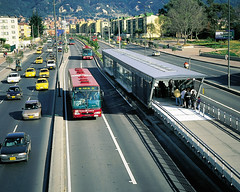
TransMilenio Bus Rapid Transit, Bogota
BRT in Bogota. Photo from the World Resources Institute. But where are you going to get the space to put 5 lanes for BRT on University Boulevard? (Click through to the full sized photo, it's great.)

But this fails to take into account three realities: (1) most people in the U.S., especially in the suburbs, have cars, access to cars, or could buy them; (2) to get people with the option of automobility to use transit you have to provide a high quality alternative; (3) research has proven time and time again that choice riders will ride fixed rail and except in rare instances, they won't ride bus.

The other thing it fails to take into account is the transit reality in Metropolitan Washington where people are familiar with transit, particularly heavy rail, a/k/a Metro or the subway. I just can't see people being willing to ride the bus eagerly when they know about rail options. I ride buses and I know that except in a few situations, for the most part riders are lower income, mostly people of color. The apparent demographics do not match those of higher income populations in the region.

That being said, Montgomery County has one of the most successful suburban bus systems in the U.S., although for the most part it is designed to move people from home to subway station (although not all of the system is configured that way) and back.

Also in our region, because policymakers know that full funding of rail-based transit (heavy, light, streetcar, railroad expansion) in all forms is not achievable, they are selling BRT too.

But we don't have, for the most part, the ability to deliver BRT in the fashion it is provided in places like Curitiba and Bogota--on dedicated, exclusive separated busways. Fortunately, many of the 1960s freeway plans in the region were halted by community opposition.

But lack of highways, from the BRT perspective, it means the region lacks the type of usable freeway lane capacity that can be directed to fast BRT service. (Of course, this doesn't get into the issue of the fact that most freeway based transit systems don't work too well in terms of getting high usage.)

Instead, mostly what is being provided is limited stop but not really "express" service. I call it bus rapider transit.

We should just be direct and say we want to improve the transit system for people who have few choices, and make it work so great that people with mobility choices will ride it as well.

It's a shame that some of the Montgomery County politicos, people I had favored, are coming out in favor of BRT because they believe they can get more transit service for the same money (also fund another BRT system in upper Montgomery County).

Who cares if you fund 2 "great" systems if they aren't used, or don't accomplish the same objectives in terms of true mode shift and land use improvements.

I am in Pittsburgh at the moment. If people don't know, it is one of the only places in the U.S. with true BRT services. It's fast (at least the routes I've ridden), using old trolley right of way, and on routes separated from any other traffic.

See this piece from Light Rail Now for some photos on one of the segments: Pittsburgh West Busway - Bus Rapid Transit

But in the great scheme of things, in the mobility network in Greater Pittsburgh, the bus rapid transit services are hardly used. Regardless of the "success" of BRT in Los Angeles (again a case where BRT was used because of lack of money for fixed rail) I think that communicates the reality of BRT in the U.S. It meets most of the definitions of what FTA says should be quality BRT. And it doesn't get used.

And the DC region has successful fixed rail transit... making lack of use by choice riders almost certain.

(Perhaps BRT could work, especially initially, with the upper MontCo "Corridor Cities Transit" proposal but only because within the proposed service area of that transit line there are extremely limited fixed rail transit options currently.)

---------
"where you stand depends on where you sit" is a point made by Graham Allison in the book Essence of Decision. The book is an analysis of how the U.S. policymakers handled the Cuban Missile Crisis, and the line refers to how to explain the policy positions of different government agencies.

Everyone has their "bias" or issue orientation, and it is important for that orientation to be named and identified, rather than to allow the organization to lay out its position as seemingly objective. (i.e., how the Downtown DC BID, which is mostly an organization run by the largest property owners within its geographic service area, says that property taxes are too high, in a current policy paper, "DC's Response to the Global Finacial and Economic Crisis").

Labels: , ,

Monday, October 22, 2007

Groupthink and bad decisionmaking

From "U turn if you want to on the road to a bad decision," in the Financial Times:

This botched invasion of Cuba is often held up as the definitive example of "groupthink", that process by which, the psychologist Irving Janis said, "the (group) members' strivings for unanimity override their motivation to realistically appraise alternative courses of action".

Close-knit teams are particularly susceptible to the pull of groupthink. The late Prof Janis suggested several ways in which teams can avoid it. Two key steps are to invite experts from outside into meetings, and to appoint at least one person to the role of "devil's advocate" - a role that should be played by different people in successive meetings.

Why do clever people make bad decisions? No doubt groupthink explains why some boards end up committing to an idiotic course of action. Cowardice may stop people who know better from speaking up. But what if everybody is acting in good faith, is drawing on good data and apparently relevant experience? What explains the bad decisions that do undeniably get made even in these propitious circumstances?

See Essence of Decision by Allison, Groupthink and Decision Making by Janis and Mann and even The Andromeda Strain by Crichton...

Labels: