Rebuilding Place in the Urban Space

"A community’s physical form, rather than its land uses, is its most intrinsic and enduring characteristic." [Katz, EPA] This blog focuses on place and placemaking and all that makes it work--historic preservation, urban design, transportation, asset-based community development, arts & cultural development, commercial district revitalization, tourism & destination development, and quality of life advocacy--along with doses of civic engagement and good governance watchdogging.

Tuesday, January 13, 2026

Trump's F****** with Culture and Civil Society Harms the Nation and Washington DC

Normally government moves pretty slow. The pace at which President Trump is destroying institutions and enriching his family, while spending much of his time playing golf, staying up late, and tweeting, is unprecedented. It's almost impossible to keep track.

Good thing he had the Heritage Foundation's Project 2025 blueprint to destroy progressive leaning government! ("The year Trump broke the federal government," Washington Post).

Including attacking nonprofit, progressive leaning organizations ("Trump's Secret War Against Vital Nonprofits," Alliance for Justice, "What is Trump doing to US nonprofits and philanthropies?," Devex. "Progressive Nonprofits Condemn Trump’s Targeting of George Soros and His Foundations," Chronicle of Philanthropy, "Senate GOP Ramps Up Attacks on Left-Wing Nonprofits," NonProfit Quarterly).

MAGA-fying civic education ("Trump Administration Announces New Civics Effort With MAGA-Aligned Groups," NYT) plus prayer in schools ("Trump wants prayer back in schools. Boston has a cautionary tale," Boston Globe).

And specific attacks on "blue" states although not limited to culture ("Trump is waging war on Democrat-led states," Globe).

Banner at the Kennedy Center calling it the "Nation's Cultural Center."  Photo by Bonnie Cash/UPI.

Because the arts and education are seen as dominated "by the left" the Trump Administration has been militant about defunding organizations that support or practice these disciplines.

The same goes for nonprofit organizations involved in human services, agriculture and other fields.


Work continues on the construction of the ballroom at the White House on 9 December in Washington DC, where the East Wing once stood. Photograph: Pablo Martínez Monsiváis/AP

Here's a line up of some of the destruction.

And building grandiose monuments to his ego

President Donald Trump addresses a dinner for donors who have contributed to build the new ballroom at the White House, Wednesday, Oct. 15, 2025, in Washington. | John McDonnell/AP Photo
Photo: Nathan Howard, Reuters.

Massive banners with Trump’s face are adorning some federal buildings in DC. 
Democrats are crying foul.  CNN photo.
Armored vehicles drive during the Army's 250th anniversary parade in Washington, D.C. 
Alex Wroblewski/AFP via Getty Images
  • And he wants his face on coins even though the law says living people can't be so honored.
The U.S. Mint released three prototype designs for a $1 coin featuring President Donald Trump 
to celebrate the country’s 250th anniversary this year. 

====

In DC, he also wants to take over the public golf courses ("Trump’s self-serving takeover of D.C. public golf is bad news for all," The Athletic/NYT).

Labels: , , , , ,

Tuesday, October 14, 2025

Minneapolis television news anchor creates documentary saying that Minneapolis is a shithole

According to the Minneapolis Star-Tribune, "What to make of ‘A Precarious State,’ the new film that sees Minneapolis through a dark lens." Rick Kupchela produced it, paid for it to be broadcast on local television--it's on YouTube too--in advance of Minneapolis' mayor election.

Billed as a public education campaign, the film, “A Precarious State,” has drawn some 300,000 views on YouTube and aired statewide on ABC affiliates last week as a paid advertisement.

Asked if it was released to influence city elections, Kupchella, in an interview with the Minnesota Star Tribune, said it wasn’t, but he also said it was necessary to release the film while it was still relevant.

The film doesn’t interview or mention Mayor Jacob Frey, who’s battling several challengers for a third term, but a woman who appeared in the documentary told the Star Tribune she agreed to be in it after she was told it would portray Frey in a positive light.

Kupchella won’t say who paid for the film, though he did tell the Forum of Fargo-Moorhead that it was produced with the help of “business and community leaders.” He said donors weren’t eager to come forward publicly in today’s supercharged political climate. “I think it’s a very important story that we uncovered here,” he said in an interview.

He says state school results are poor, city crime is out of control, that the city is socialist--like Seattle some Democrat Socialist of America members sit elected to City Council and this year the mayoral campaign features another ("Minneapolis mayoral candidate Omar Fateh is a democratic socialist. Here’s what that means," MST).  DSA representatives are in the State Legislature and on St. Paul's City Council as well.

=====

Interestingly, American Prospect has an article, "The ad campaign for capitalism," about the national business community's campaign in the 1970s to save capitalism.

And Rolling Stone on billionaires wanting to control politics, "The Right’s Secret Plan to Help Billionaires Buy Elections."

And it turns out Trump's proposed university compact ("Trump Offers All Colleges Preferential Funding Plan Rejected by MIT," Bloomberg, "Inside the Trump Administration’s Assault on Higher Education," New Yorker) was provided in draft form by a trustee of the Wharton Business School at Penn ("The Billionaire Behind Trump’s Deal for Universities," New York Times).  Note that even if a college president is against signing, a conservative board might force the university to agree ("‘One-sided deal’: College presidents see Trump offer rife with peril," Politico).

Speaking of socialists ("America's Socialist Experiment," TwinCities PBS), Professor Joshua Freeman argues that the ostensibly Fiorello LaGuardia, NYC's mayor during the Depression, had a socialist agenda ("How Mayor Fiorello La Guardia Transformed New York City," Jacobin).

Labels: , , , ,

Tuesday, April 15, 2025

70th anniversary of the DC Capitol Hill Restoration Society

In 2000, I first got involved in urban revitalization through the prism of historic preservation, when a preservationist reached out to me about the H Street neighborhood north of the Capitol Hill Historic District (from F Street NE to Florida Avenue NE).

I remain an ardent preservationist today, mostly because the architecture and urban design is so much more humanist and aesthetically pleasing than that of today.  Good books on the subject include Changing Places (out of print) and Cities: Back from the Edge.

It was also a great strategy for neighborhood stabilization during the many decades that center city living was disfavored and populations shrunk.  

Preservation was cheap for cities because the property owners bore the bulk of the cost of compliance--although some argue that put undue hardship on lower income households.  For the most part, cities merely paid for the regulatory function, and brick sidewalks and historically appropriate streetlighting.

It is difficult to separate out the effects of preservation and stabilization versus "gentrification."  I'd argue that gentrification results from architectural attractiveness (mostly, there are plenty examples of tear downs and McMansionization of designate-able properties) and that preservation shouldn't be criticized for its success.  "Inward investment" by preservationists shouldn't be criticized as gentrification but as reinvesting in a city where capital for housing was often unavailable.

Another criticism is that it has focused on building preservation over intangible heritage ("New York City’s Historic Preservation Movement Is Having a Midlife Crisis," Bloomberg). That by selecting certain areas to preserve, it says others aren't worth preserving, part of the argument of the book History of Urban Places.

In any case, with the rise of property rights sentiments, now at least pre-covid, the trend of city revival and the need for "more housing" amidst constrained land resources, preservation has come into attack by prominent economists and the like ("Idiocracy concerning historic preservation from both Yglesias and Glaeser," 2011), and Binyamin Applebaum in the New York Times ("Historic Preservation Is Hurting Cities," letters, "Preserving Historic Buildings," and "I Want a City, Not a Museum," letters, "Should Historic Buildings Give Way to New Housing?").

Rowhouse neighborhoods have a lot of density as this aerial photo of Capitol Hill by Al Drago shows.

I hope to write more about this in May, which is National Historic Preservation Month.  (There are some books I need to read first...)

I do argue that preservation hasn't come up with a great narrative for how to deal with growing cities.  I hope it would include design review and a focus on the "architecture of the ensemble" (Stephen Semes).  Although Patrice Frey, formerly president of Main Street America, the organization focused on preservation of town and neighborhood business districts, provides a pretty good list ("Why Historic Preservation Needs a New Approach," Bloomberg from 2019).

=======

CHRS celebrated their anniversary last night, and these are the themes (an approach from historic preservation at the scale of the cultural landscape) they identified as key to each decade.  I hope they provide more detail later.

  1. Birth Pangs and Growth  
  2. Creation of the Historic District 
  3. Safeguarding a Police Station
  4. Eastern Market;
  5. Moving a Freeway
  6. Public Education
  7. Continued Outreach, and more.

Even though Capitol Hill is economically more successful than the neighborhoods it touches I thought they had a reasonable forward focus on those areas as "of interest" to preservation, CHRS, and the community.  

After all, the building stock is the same. 

Labels: ,

Last week was National Library Week

 I usually put together an omnibus piece about various items I've come across over the past year, from new libraries to interesting programs.

-- "National Library Week, 4/7 - 4/13," 2024.  Note that it is in the comments section where I try to include mentions/links to the stuff I include the next year.

-- "Neighborhood libraries as nodes in a neighborhood and city-wide network of cultural assets," 2019

I didn't get around to it this year.

The Trump Administration intends to shutter the Institute of Museum and Library Services.  It's sad that the way the Trump Administration, in another anti-education and learning move, around the time of NLW announced it wants to eliminate the Institute of Museum and Library Services, and halted all its grants ("Federal museum and library grants abruptly terminated," USA Today).

IMLS was effectively shuttered in early April when nearly all employees were placed on administrative leave, and all work on approving federal grants for state, local and academic libraries and museums was immediately halted.

This reflects MAGA "thinking more generally."  See "In the Land of Self-Defeat, New York Times.

It's a joke that this is about budget savings, IMLS's budget is $304 million, much of which goes to grants to state-based organizations.

This is about destroying three different things, which I intend to write more about, (1) destruction of civil society, especially one that is focused on knowledge and critical thinking (S," New York Times); (2) federal government generally; and (3) education/higher education.

2.  Book banning still marches apace (:US public schools banned over 10K books during 2023-2024 academic year, report says," USA Today, "Rightwing groups across US push new bans to limit ‘obscene’ books in libraries," Guardian).  Book Riot reports that US-based right wing groups are taking book banning overseas ("Book Banning Attempts Rise in UK as US Groups Reach Overseas").

Also reinforcing Trump anti-education efforts has led to book banning at the US Naval Academy ("Book ban at military service academies draws flak from Congress,").

I realize that the Trump Administration is basically following the playbook of the hard right political parties in Hungary, Fidesz, currently, and the Law and Justice Party in Poland before they were turned out of office {"Enacting the “Illiberal Playbook” in Hungary and Poland," Perspective on Politics).

3.  Philadelphia Inquirer columnist Will Bunch ("Young people won’t, or can’t, read a book. Now democracy is dying. Coincidence?") writes about a significant drop off in book reading overall, but especially amongst college aged youth.

A viral essay with an anodyne headline — “The Average College Student Today” — from a self-proclaimed professor at a U.S. regional public university, under the pseudonym Hilarius Bookbinder, has rocked online academia with its claim that the typical modern undergraduate student is functionally illiterate. They essentially argue that smartphone-addled young people — echoing their president — might read passages or ideas, but can’t finish an adult book from cover to cover.

“I’m not saying our students just prefer genre books or graphic novels or whatever,” Bookbinder, citing 30 years of classroom teaching experience, wrote. “No, our average graduate literally could not read a serious adult novel cover-to-cover and understand what they read. They just couldn’t do it. They don’t have the desire to try, the vocabulary to grasp what they read, and most certainly not the attention span to finish.”

I'll admit that with 30 years of the Internet including 10+ of smartphone, consumption of information moves to the article rather than the book.  My attention span has certainly diminished, and I don't necessarily read a book a week.... although journal articles should count for more than regular articles. 

Labels: , , , , , , ,

Thursday, March 13, 2025

Federal government cuts target civil society

While the other day I wrote about the alleged "Nonprofit industrial complex" ("The "nonprofit industrial complex," city government and service delivery"), at the same time, nonprofit organizations are a key element of American civil society, as President George H.W. Bush said, "1,000 points of light." 

Many nonprofits are top down, with few opportunities for volunteers, while volunteers and efforts focused on delivering outputs helping communities are the mission of many others.

I haven't read Project 2025 : Building for conservative victory through policy, personnel, and training, but given that it is a handbook targeting "progressive action," we shouldn't be surprised.

Nonprofits are the foundation of civil society and civic engagement.

Grant cuts are likely to affect cities and counties as well, and in turn nonprofits that get grants this way ("Federal judge temporarily blocks Trump administration freeze on federal grants and loans," AP).  According to the Los Angeles Times:

... a Jan. 27 memo from the White House budget chief. The memo ordered a wide-ranging spending freeze, specifically calling out “the use of Federal resources to advance Marxist equity, transgenderism, and green new deal social engineering.”


Image from "Community Gardens: What Are They and How To Find Them," Nourishing Neighbors.  Also see "8 Great Tips to Start a Community Garden," Sunset Magazine.

Cuts at the Agency for International Development ("Secretary of State Rubio says purge of USAID programs complete, with 83% of agency’s programs gone," AP) diminish civil society development in foreign countries, and reduce the effectiveness of "soft power" and public diplomacy efforts of the US.

At USDA ("USDA’s $1B in cuts leaves farmers and schools bracing for impact," Washington Post, "Trump's USDA secretary defends $1 billion cuts to funding for food banks, schools," NBC, "A message from the Board of Directors," Green Urban Lunchbox, Salt Lake City), from GLUB:

We are reaching out to share an important update regarding The Green Urban Lunch Box’s programs. After thoughtful deliberation, we have made the difficult decision to pause all our current programs for this year - including the Small Farm Initiative (SFI), CSA, FruitShare, and Back-Farms - while we evaluate the best path forward.

... This decision was not made lightly. We are deeply committed to exploring sustainable ways to continue serving our community and advancing our mission. We are actively engaging in discussions with like-minded organizations and partners to ensure that the impact of our collective efforts endures. However, we do not anticipate resuming our programs this year.

EPA (E.P.A. Plans to Close All Environmental Justice Offices," New York Times, "A West Philly nonprofit lost a multiyear grant worth $700K to DOGE cuts," Philadelphia Inquirer, "The protectors of Santa Monica Bay are caving to Trump’s dangerous demands," Los Angeles Times),  From the PI:

The Overbrook Environmental Education Center is now without up to $700,000 promised to the group for its work to support other organizations working on community gardens, waste reduction, sustainable agriculture, and other environmental projects in disadvantaged local communities, said Jerome Shabazz, executive director of the center.

From the LAT:

A page on the Bay Foundation’s website that previously explained how climate change is affecting the watershed — as seen on the Jan. 21, 2025, version of the page, available via the Internet Archive — was rewritten to delete all references to climate. The group also removed its Justice, Equity, Diversity & Inclusion page, which had previously pledged its commitment to “equity and inclusion across race, gender, age, religion, identity, and experience.”

Also alarming: a draft work plan presented last month to the Santa Monica Bay Restoration Commission. Before the Environmental Protection Agency doles out federal funding for Santa Monica Bay restoration, it must approve a work plan written annually by the commission and the Bay Foundation, then submitted to the EPA.

HUD ("Trump DEI Purge Hits Affordable Housing Groups," Bloomberg), from Bloomberg:

The canceled awards include ongoing projects in more than 1,000 communities to address homelessness, disaster recovery, persistent poverty and other housing issues, according to a list seen by Bloomberg CityLab.

... At least eight national organizations saw their technical assistance contracts with HUD terminated following the DOGE review of their public-facing sites. Technical assistance refers to grants for consulting on tools, coordination, systems and other solutions.

DOGE further eliminated awards for least two of the three groups that administer grants for a program known as Section 4. Federal law requires these awards to be managed and distributed by national intermediaries; HUD’s own guidance for these awards, which are meant to provide support for capacity-building and community development, requires recipients to “advance housing justice” and “support underserved communities.”

(Interestingly, while LISC and the Enterprise Foundation have lost their grants, Habitat for Humanity, which is religious affiliated, did not.)

parks ("Trump administration eyes 30 percent payroll reduction at National Park Service," The Hill, "Workforce cuts raise concerns over national park upkeep," Roll Call).  The National Park Service was one of the first agencies to face massive cuts, cuts so deep professionals are afraid the parks can't be managed and operated in the face of high usage ("National Parks cutting hours, limiting services as Trump layoffs reduce staffing," USA Today).  

NPS is a big utilizer of volunteers and the likelihood is that such programs will barely function this year.  It's one of the largest "citizen-facing" agencies.  And for many it begins to engender greater understanding of the environment and wilderness.  .

 It reminds me of my old joke, that the guiding principle of property management at DC Government was demolition by neglect.  The Trump Administration aims to wreck the Park Service ("DOGE cuts National Park staff as visitation rate peaks," Washington Examiner).  The Park Service was ordered not to share statistics on use ("National Parks Had a Record Year. Trump Officials Appear to Want It Kept Quiet.," New York Times).

To further diminish the quality of visits, the government is cancelling leases of land that hold visitor centers and museums ("Trump property purge to include national park visitor centers, museums," Washington Post).

transportation ("Sec. Duffy Moves to Rescind Billions for ‘Woke’ Transportation on Feb. 18 — So Advocates Must Speak Up Now," Streetsblog): cuts will target sustainable mobility programs and affect biking, walking and biking programs, among others

the arts ("'Chilling effect': Arts organizations react to end of DEI initiatives from fed agency," NPR), etc., public radio and television ("Trump's FCC chief opens investigation into NPR and PBS," NPR). are attacks on civil society.  From the PI:

====

Note: for Sugar House Park, I intended to apply for a grant to create a senior nutrition community garden in association with the Utah State University Extension Service--the grant proposal is due around now.  

But that call for proposals was issued by the Biden Administration, and with all the changes with grants in the Trump Administration, it seemed like a waste to put in the energy to apply, since it's not likely such grants will be proffered.

Labels: , , ,

Wednesday, October 16, 2019

Author talk, After the Projects: Public Housing Redevelopment and the Governance of the Poorest Americans: Saturday October 19th

From the Metropolitan Studies Center at American University in Washington, DC:

Saturday, October 19, 2019
2:00 PM – 4:00 PM
Mt. Pleasant Neighborhood Library
3160 16th Street Northwest
Washington, DC 20010


Professor Lawrence Vale will talk about his new book After the Projects: Public Housing Redevelopment and the Governance of the Poorest Americans this Saturday. The manuscript examines the deeply-rooted spatial politics of public housing development and redevelopment at a time when lower-income Americans face a desperate struggle to find affordable rental housing in many cities.

This event is part of a series of author talks in connection with the Anacostia Community Museum's exhibition, A Right To The City. It was developed in partnership with American University's Metropolitan Policy Center and the D.C. Public Library.

Book Abstract:
At a time when lower-income Americans face a desperate struggle to find affordable rental housing in many cities, After the Projects investigates the contested spatial politics of public housing development and redevelopment. Public housing practices differ markedly from city to city and, collectively, reveal deeply held American attitudes about poverty and how the poorest should be governed. The book exposes the range of outcomes from the US federal government’s HOPE VI program for public housing transformation, focused on nuanced accounts of four very different ways of implementing this same national initiative—in Boston, New Orleans, Tucson, and San Francisco. It draws upon more than two hundred interviews, analysis of internal documents about each project, and nearly fifteen years of visits to these neighborhoods. The central aim is to understand how and why some cities, when redeveloping public housing, have attempted to minimize the presence of the poorest residents in their new mixed-income communities, while other cities have instead tried to serve the maximum number of extremely low-income households. The book shows that these socially and politically revealing decisions are rooted in distinctly different kinds of governance constellations—each yielding quite different sorts of community pressures. These have been forged over many decades in response to each city’s own struggle with previous efforts at urban renewal. In contrast to other books that have focused on housing in a single city, this volume offers comparative analysis and a national picture, while also discussing four emblematic communities with an unprecedented level of detail.

Labels: , , ,

Tuesday, October 01, 2019

Revisiting Pittsburgh

For a couple years at the end of the 2000s I was in Pittsburgh a bunch of times, partly to work on a commercial district revitalization plan in the Lawrenceville District and I knew people running the Strip District organization (but the consultant I was working with ended up being a problem and the people running the commercial district revitalization group left, so we had no client, etc.).

Pittsburgh

As is my way, I spent a lot of time figuring out the city in terms of its revitalization trajectory.  Then, despite decades of incredible work, it still languished.

After I responded to something Richard Florida wrote about Pittsburgh, in "Urban economic development strategies: do you invest in people or places? ... yes," he re-tweeted it, saying it showed great understanding of the city's conditions.  (The items are appended at the end of this entry.)


And note later, I termed Pittsburgh an example of best practice revitalization, along with other cities  like Bilbao and Liverpool.  See "Economic restructuring success and failure: Detroit compared to Bilbao, Liverpool, and Pittsburgh," 2014.

Nigel, our e-correspondent from New Zealand, shares with us the new City Journal article on Pittsburgh, "A Renaissance Runs Through It: What Pittsburgh’s latest comeback tells us about urban revitalization," and just reading the first couple paragraphs makes me realize it's a perfect example of my argument about the long time needed to reach critical mass in population and business activity to the point where revitalization not only is evident but has a sustainable momentum.

Despite the fall of the steel industry (and failure/consolidation of other businesses like Westinghouse, Gulf Oil, eventually Heinz, etc.), it still had a core of leading businesses (Alcoa, Mellon Bank, etc.) including finance, universities, and medical care..

Decent neighborhoods. Attractive building stock. A strong history of innovation.  Foundations (Heinz and shockingly the Sarah Mellon Scaife Foundation which was controlled by the otherwise conservative Richard Scaife--"Richard Mellon Scaife dies: funded conservative groups ... and historic preservation in Pittsburgh," 2014") committed to investing in the city.

Some really awesome community organizations doing really great stuff.  For example, both the Pittsburgh History and Landmarks Foundation and the Pittsburgh Cultural Trust are not just national best practice, but world class in their work on historic preservation and the development and maintenance of cultural facilities specifically.

Some of the foundational ideas in Richard Florida's books are based on his experience in Pittsburgh, because when he was there, large numbers of people didn't stay after college, but some did, creating businesses, but the ecosystem wasn't there enough to keep the businesses or the people once the businesses moved into different phases where they needed different types of access to capital and talent.

But now, Pittsburgh is a center of research and practice for automated vehicles and robotics, and the start up business ecosystem is much more healthy than it was 15 years ago when Richard Florida taught at Carnegie-Mellon University.

4000 block of Butler Avenue, Lawrenceville, PittsburghNice neighborhoods got better, neighborhoods that languished are now significantly improved ("One hidden element of the revitalization of Pittsburgh's East Liberty neighborhood) and housing prices in neighborhoods I looked at in the late 2000s have more than doubled in the ten years since.

I think it was more a function of time and the fact that time is necessary to rebuild both the ecosystem and the masses of people able to bend the curve towards city improvement. 

Because all the while, sprawl and the growth and development of the suburbs continues apace, which is why urban retail
and the Downtown still languishes on that score.

-- "Has DC reached revitalization critical mass, so that local government missteps don't matter?," 2011

Despite the cold weather, and the difficulties, Pittsburgh had the right conditions to rebuild after the loss of the steel industry.  It just took 30+ years.

And yes, the city was an early poster child for urban renewal dating to the 1950s, and for urban renewal, some of it, at least Downtown, was decent.  Efforts in the Hill District and East Liberty were flawed.  In Allegheny, a toss up.  Etc.

(This isn't an image from DC, but illustrates the point.)

DC as an example.  Similarly, using DC as an example, it took 20+ years after the introduction of Metrorail to DC before you started to see a critical mass improvement of the city -- because while not absolutely intention, Metrorail also served DC neighborhoods which were close to the core and comprised of attractive historic building stock and an urban form that favors walking, biking and transit

After 25 years or so, as the core stabilized, this revitalization pushed out beyond the core, to neighborhoods like Columbia Heights, H Street NE, and Petworth.

But with DC and economic studies of the value of transit, I know for the first 20+ years, studies didn't find much effect.  I think that's because the time frame you need to look at is much longer than people realize.

Aerial view of Dupont CircleAnd is hard to discern in any case, when you look at data at the metropolitan scale.

For DC proper, or Arlington County, you need to look at the core part of the system in those communities and measure the impact before and after, at the "submarket" scale even, not the entire city.

Note that studies by the Center for Transportation Studies at the University of Minnesota found that the greatest economic impact from transit are at the core of the system.

-- "Transit oriented development can take decades to realize, so two years is too short of a time to be expecting it (Austin Texas)," 2012
-- The Hiawatha Line: Impacts on Land Use and Residential Housing Value (Feb 2010, CTS 10-09)
-- Transportation as Catalyst for Community Economic Development(Dec 2007, CTS 07-07)

That makes sense.  It's where you have the most critical mass. Or what others call "the network effect."
======================
From the 2010 piece, "Urban economic development strategies: do you invest in people or places? ... yes":

... the point is that you need to have people-focused institutions that are place-committed. Capital can move anytime. But locally focused and locally committed institutions won't move. And if these institutions can develop a focus on improvement that is based on best practice, innovation, and quality then they become the levers and fulcrums of a new kind of industry.

If they don't, revitalization efforts are muddled and don't ever amount to very much.

The elements.
,

1. A number of quality universities that continue to attract talent, and at least two of the universities have strong engineering education programs which

2. These universities help develop new technologies and generate spin off businesses which build the region's economy and provide higher paying jobs.

3. It doesn't hurt that the University of Pittsburgh Hospital System is world class, especially in organ transplantation. This anchors medical care as a key "local" industry.

4. The city still has a handful of large national and global companies, a mix of manufacturing-research based companies like PPG and the U.S. headquarters for Bayer AG, software companies, and service industries (such as Mellon Bank). This means that there are still job and idea-producing industries there, even though these businesses are subject to the same concentration and downsizing trends affecting such companies.

5. Pittsburgh has a couple of incredibly strong foundations still present locally, focused on funding organizations and initiatives that improve the city both socially and economically.

6. Innovation, The region has a legacy and history of innovation that is embodied in organizations, including civic organizations and civil society so that groups are problem and self-help focused.

7. The arts organizations there have some heft. The Pittsburgh Cultural Trust has focused on re-establishing arts uses downtown and maintaining and extending the arts infrastructure there. The Carnegie Institutions set a standard of excellence as well. Etc.

Labels: , , , ,

Tuesday, November 07, 2017

Today's elections

As some commentators put it, it's an "off-off election," not associated with the national elections at all, so turnout tends to be significantly reduced.  This type of election separated from elections for national offices which normally increases turnout, derives from some of the political "reforms" of the Progressive Movement, which aimed to shift the primacy of voting from the "unwashed" (immigrants) to the educated.

But it comes at the expense of majority participation and tends to support elite and conservative interests.

In this election, only in Virginia and New Jersey do you have Governor's races.  But many localities have their elections during this cycle, including New York City and various counties in New York State, communities in Maryland, Boston, and Minneapolis, where a Socialist Alternative candidate is vying for a seat ("A Minneapolis socialist thanks the local paper for not endorsing her," The Nation; "Editorial endorsements: Reich and Bildsoe for Mpls. City Council," Minneapolis Star-Tribune).

Also various measures (referenda) are on the ballot, such as a transportation funding vote in Maine and a proposal to call for a Constitutional Convention in New York State.

2017-10-02_01-03-48
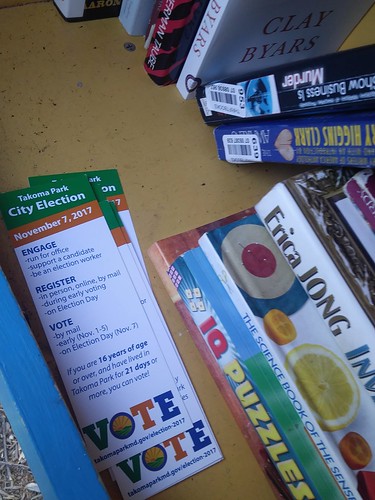
In Takoma Park, people tend to put literature on local activities, including the election, in the various Little Free Libraries that have been constructed around the city.

In College Park, Maryland, the election has been roiled by a proposal to allow non-citizens to vote in local elections ("Debate over noncitizen voting has upended College Park elections," Washington Post).

The City of Takoma Park, which borders DC, has its elections--a couple years ago they voted to lower the voting age to 16 years of age, but it hasn't had much impact on turnout--and at October's Street Festival most of the candidates had booths and were politicking. Annapolis and Frederick also have elections.

Campaign mailer sponsored by the New York Republican State Committee supporting Jack Martins, Republican candidate for Nassau County executive. Photo Credit: New York Republican State Committee. Also see "Martins defends MS-13 mailer against Curran; others cry foul," Newsday.

Interestingly, elections for Governor in Virginia, the Mayor's race in New York City ("Malliotakis Ad Hammers de Blasio on Quality of Life in New York," New York Times), and even for New York's Nassau County Executive race ("In New York Suburbs, Campaigns Are Anything but Genteel," NYT) have sought to paint Democratic nominees as soft on crime and abetting immigrant-fueled crime--the specter of the Salvadoran crime gang MS-13 has been raised in ads--even though national statistics find that crime is dropping, both in New York City--the murder rate is on track to be the lowest ever in the modern age of easy access to guns--and in the State of Virginia.

... Not that MS-13 isn't a problem, but it's not a scourge threatening society in the US (unlike in El Salvador where the flow of gang members from and to the US has led to a surge of crime and death in the home country), so the fear mongering is comparable to Newt Gingrich railing against the imposition of Sharia Law in the US as a way to stir people up over something that can't happen ("Newt Gingrich clarifies comments on Sharia law," USA Today).

I am not an ad guy, but I wonder how you would paint conservatives against gun control laws as soft on death.  Because there are plenty of people with grievances, who when armed, end up killing a lot of people.  Without guns, especially access to guns specifically designed to kill lots of people, they wouldn't be able to be so successful at murder.

Still, people will be looking at the election results to gauge what might happen with next year's mid-term national elections and various state elections in the Time of Trump. It appears that in New Jersey the Democratic candidate will win, after two terms of Republican Chris Christie, and Bill De Blasio appears to be sailing towards a decisive win, despite some grumblings about his governance and associations with corruption around access.

The Virginia election is likely to be close. The state is pretty evenly divided between parties and urban and rural interests, and the statewide elections for the US Senate, Governor, Lt. Governor, and Attorney General tend to be close always, although shifting to Democrats over time.

Because the off-off year election depresses turnout, conservatives have an advantage in a Virginia, and if Ed Gillespie wins it will be seen as support for a Trump presidency, especially as Gillespie has employed Trump-like campaign tactics.

Malliotakis ad against Bill De Blasio, New York City


Ed Gillespie MS-13 ad, Virginia

Labels: , , ,

Friday, October 13, 2017

One more blow against community media: Washington Post drops Thursday "county" news special sections

"In the old days," metropolitan newspapers were known for publishing special zoned community news sections one or two days per week. 

The idea was that more locally focused news of less interest to the entire metropolitan area would be featured as well as provide an opportunity for smaller, local businesses to advertise.

With the precipitous decline of the newspaper industry co-terminate with the rise of the Internet over the past 20+ years -- most major newspapers have less than half the circulation they had back then, for example the Washington Post distributed close to 800,000 papers daily, now it's about 350,000 -- newspapers have been cutting back.

And that includes special zoned community news sections.  The Louisville Courier-Journal and the Detroit News eliminated their special weekly community news sections more than ten years ago, the New York Times about five years ago, the Boston Globe consolidated their five zoned editions to three, eliminating the special Boston city section as part of the changes.

The Washington Post kept its sections but in those areas where it published twice/week it reduced frequency, and a couple years ago, stopped including locally relevant "copy" specific to the edition, although each section retained its local community calendar, which was still an important service and one of the only "mass media" ways to communicate local events to a wider audience. 

It became more of a "Home Life" section, but with the local calendar.

From the Post description of the purpose and value of the section to students:
Every Thursday LOCAL LIVING combines Home and community news with local entertainment, family and health features that readers want. The result? A convenient weekly resource covering Washington life from family room to community room.

LOCAL LIVING provides news and features about the community, profiles of neighbors and neighborhood organizations, coverage of local government agendas, zoning and school board actions. 
LOCAL LIVING offers a wide range of educational opportunities and strategies. A few simple examples will help to introduce students to LOCAL LIVING.

Articles and advertisements provide illustrations, headlines and vocabulary that lead to concept development, so necessary to reading a story with success. In articles, features and photographs, a particular area of the Washington metropolitan region is covered. Students can learn much about the locations in and geography of their area and surrounding areas through LOCAL LIVING.
Now the Post has dropped this section, called "Local Living," and the county-specific calendar-events feature.  (The New York Times dropped its Thursday Home section about two years ago.)

Suburban weekly networks.  Some newspapers, among them the Chicago Sun-Times (although later they sold out those newspapers to the Chicago Tribune), the St. Louis Post-Dispatch, the Baltimore Sun, and the Los Angeles Times, constructed networks of suburban-focused weeklies distributed separately from the main newspaper but with the same idea of providing locally relevant news and advertising.

The Washington Post didn't do that in quite the same integrated fashion, but had such weeklies in Frederick, Montgomery, Prince George's Counties in Maryland and in Fairfax County, Virginia.  A couple years ago they shut down the Maryland weeklies and sold the Fairfax edition ("The ongoing tragedy of dying print media, the latest being community newspapers in Montgomery and Prince George's Counties, Maryland").

It's been a blow for nonprofits and cultural organizations in Suburban Maryland ever since, in terms of being able to communicate to a wider audience.

Now that blow has been extended to the entire circulation area of the Washington Post newspaper.

If in the Internet era one of the true distinctions and reasons for reading a "local" paper is locally relevant news and features, then sadly the Post is becoming less relevant.

The negative effect on civil society. Most research on citizen involvement in local civic affairs finds a strong positive association between reading the local newspaper and the level of engagement. Research on newspaper closures finds that there is a negative impact on civic engagement and involvement as newspapers close or shrink.

From the journal article, "Dead Newspapers and Citizens’ Civic Engagement," published in Political Communication:
Using data from the 2008 and 2009 Current Population Survey (CPS) conducted by the United States Census Bureau, this article assesses the year-over-year change in the civic engagement of citizens in America’s largest metropolitan areas. Of special interest are Denver and Seattle, where the Rocky Mountain News and Seattle Post-Intelligencer closed during the intervening year. The data from the CPS indicate that civic engagement in Seattle and Denver dropped significantly from 2008 to 2009—a decline that is not consistently replicated over the same time period in other major American cities that did not lose a newspaper. The analysis suggests that this decline may plausibly be attributed to the ewspaper closures in Seattle and Denver. This short-term negative effect is concerning, and whether it lasts warrants future attention.
As mass print media ceases to be a mass medium, the quality of participation as well as the amount of participation declines.

Also see the discussion on media within the past entry, "Voting vs. civic participation | elections vs. governance."

Existing community media networks in DC and Northern Virginia.  In Northwest DC, the Current Newspapers still publish, although the shutting down of the Gazette Newspapers fatally damaged a once extent newspaper supplement distribution network, cutting the revenues of the Current group.  The Capital Hill Community News group publishes monthlies for Capitol Hill, center city DC, and East of the River.

Virginia has a couple large community weekly networks, the primary being the Connection Newspapers.

Calendar features.  It happens that the calendar-event section of the Current Newspapers is probably the premier such section in the metropolitan area, but it lacks the reach and positioning possessed by the Post.  The calendars in the Capital Hill Community News publications are quite good as well.  And the Washington City Paper, the city's alternative weekly, publishes a calendar as does the Post Weekend section, although the Weekend section focuses on events and showings, not lectures and such.

In Cincinnati, the arts organizations have banded together to create a digital calendar called ArtsWave with an associated ArtsWavePass that provides discounted access to events.

The Post could still publish a community calendar page in the regular paper.  Ideally, the Post could continue the community calendar function by dedicating one page, perhaps in the Thursday Style section.  There could be a DC/Maryland page for DC and Maryland and a Virginia page for the Virginia editions of the paper.

Opportunities to create digital community information networks.  In various writings, I've described how community-district information systems could be distributed at the sub-city/sub-county level, by "district."  Working with "calendar engines" like the Current Newspapers, it is possible to create such networks, perhaps in conjunction with the distribution of district-specific transit information.

I describe such a network, focused on Silver Spring, in an article series on Silver Spring. as item #10.  The basic outline is relevant regardless of specific place.

Reprinted

Create a digital community and transit information network for Silver Spring, employing kiosks and mobile applications.  For at least 15 years, I've been thinking about how to create and deliver a city- (county-) wide digital nonprofit and cultural communications feed, with sub-feeds for neighborhoods/districts.


Now, with real-time transit information feeds like TransitScreen, you can use transit information applications as a foundation/the engine but add other information feeds to the engine.  That's how the digital information kiosks work (called CityPost, produced by Smart City Media) alongside the Kansas City Streetcar.

From the Digital Signage Today article "Meridian deploys outdoor interactive kiosks in Kansas City" :
The interactive kiosks, located at Kansas City Streetcar platforms and throughout downtown, enable travelers to check the arrival time of the next streetcar, offer Kansas City locals and tourists access to city services, and display information about local restaurants, activities and events...
Kiosk users can sync their smartphones to the kiosk with a mobile app to save and share information. For example, Kansas City Streetcar travelers might see an ad for dinner at a local restaurant. They are then able to pull that information onto their mobile device to access again at their convenience.

There is also the LinkNYC program, delivered by Civiq Smartscapes, but these systems tend to be more focused on delivering advertising rather than useful community-specific information.  I have similar concerns about a program done separately by the New York MTA transit agencies.The feed would be multi-stream instead of a single advertising feed or a single transit information feed.

Take (1) the digital ad feed presented in bus shelters and transit stations; (2) add transit and mobility information like the TransitScreen application; and (3) create and deliver a separate "community information feed" promoting  nonprofit and public sector organization, events, public meeting notices, etc.  (Note that Outfront Media is doing (1) and (2) on screens in Metrorail stations.)

There is great need for systematically delivering community information in public and visible ways in many places, because community media outlets are going out of business because of how the Internet has changed the business of media and advertising.

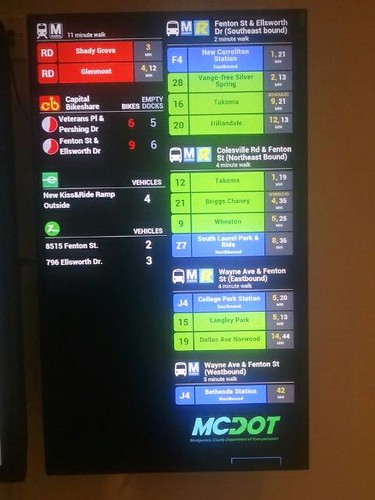
TransitScreen mobility information display, Silver Spring Civic CenterIn fact, Montgomery County does a form of delivering community information digitally at the Silver Spring Civic Center, where they have two digital screens side-by-side behind the information desk. 

One presents the TransitScreen info (pictured at right), and the other cycles through "ads" for Montgomery County Government agencies and services, and community events.    (Libraries frequently have community bulletin board-like digital screens presenting such information also.)

The idea is to create content in a way that works at two scales: (1) a city or county; and (2) at the sub-city/county scale, by neighborhood/ transit district.

The stream would be device independent, so that it could be displayed on screens and kiosks as well as received on a digital feed. 

Besides delivering this digital network in kiosks at transit stations and key "crossroads," in bus shelters, and civic buildings and sites, ideally, places like coffee shops, office and apartment buildings, etc., would put up screens and "subscribe" to the feed as a service to their customers/tenants--many do this with transit information already.

As another example, recently I came across the Pitt Smart Living Project, but it seems to focus only on delivering area-specific transit information.

-- Pitt Smart Living Project TransitScreen for Sennott Square

To create and deliver the community ads and event content, I'd set up an "advertising and design curriculum" as part of the School of Art and Design at Montgomery College, perhaps with the involvement of the journalism program of Montgomery-Blair High School, which very actively markets its Silver Chips student newspaper to the community beyond the school. 

A way to extend the community and educational value of the program would be to create an equivalent of the teen graphic design program of Boston's Artists for Humanity.  Arts on the Block, based in Kensington, could participate too.    The firm handling advertising in Montgomery County's bus shelters would be another partner.

Currently the MC Media Arts & Technology program is located at the Rockville campus, but in keeping with the presence of Discovery Channel in Silver Spring, perhaps this academic program could shift to the Silver Spring campus.

-- Smart City Media video showing the program in Kansas City

An issue is whether or not to include "for profit" ads.  I would in part to defray costs, but outside of bus shelters, perhaps ads should be limited to businesses based in Silver Spring, potentially the Silver Spring retail trade area (which includes parts of DC and arguably, part of Prince George's County), and Montgomery County outside of Silver Spring.

Labels: , , ,

Tuesday, August 16, 2016

Civil rights, public accommodations laws, and religious belief exceptions

When I was more heavily involved in historic preservation matters, I led a campaign to landmark an "old" arena/coliseum building in the H Street neighborhood of Washington, DC (now the building is about to become a high profile REI outdoor store, "We're Opening a New Flagship in Historic Uline Arena in Washington, DC").

One of the things I learned while doing the research to justify landmarking was the place of the building in the timeline of civil rights history specific to local Washington, DC.  Technically, the city did not legalize segregation but in the late 1800s, laws banning segregation were hidden, and public accommodations--but not the city's transit system--but most everything else, stores, restaurants, hotels, housing, and hiring became segregated.

Later, while supposed to be segregated, the practice at baseball games at Griffith Stadium was integration.

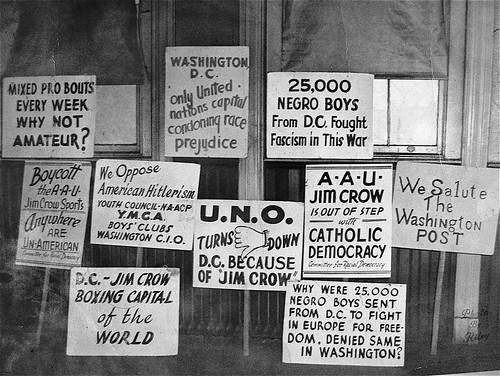
After World War II, E.B. Henderson, a professor, director of sports for DC Schools, and a leading activist within the NAACP, led a campaign where people protested every event held at the Uline Arena, in order to get the owner--who claimed that integration of events was at the discretion of the sub-tenants renting use of the building--to make integrated events that standard practice.  In 1949, the owner capitulated.  (This was reported in the black press at the time.)
Protest Signs, Campaign to integrate Uline Arena, (1948-49)
Protest Signs, Campaign to integrate Uline Arena, (1948-49).

I believe this influenced the holding in the Thompson Restaurant case four years later, where  segregation in public accommodations in the city was prohibited, and this case in turn had to have influenced the Brown v. Board of Education case in 1954, which included a DC case, Bolling v. Sharpe.

The fight did not end with integrated schools, much more advocacy and legal action was required over the next 15 years to affirm civil rights protections in DC and US laws, as we know.

And as Black Lives Matters and related movements demonstrate now, it takes many decades to counter the legacy of hundreds of years of structural racism and economic segregation.

Public accommodations and personal practices.  This comes up with regard to various laws concerning discrimination concerning sexual orientation or other matters, such as filling a prescription for birth control.

I don't see how it can be legal to provide a "religious exception' to what need to be considered civil rights public accommodations and equal protection laws.  (Obviously, I don't agree with the "Scalia" Court holding in the Hobby Lobby case with regard to health insurance and coverage for abortion.  The company's policy was upheld because of the beliefs of the leaders of the corporation.)

If you're a licensed pharmacist, I think it's fine to choose to not fill a prescription, provided your license to be a pharmacist is revoked, because you shouldn't have a choice whether or not to fill a legally prescribed prescription.  In short, as a matter of business and licensure, pharmacists have a duty to fulfill all of their responsibilities.

Similarly, as an elected official, Kim Davis, the county clerk in Kentucky who refused to grant marriage licenses for gay couples, should be removed from office as being unfit to perform the duties of the position ("Kim Davis stands ground, but same-sex couple get marriage license," CNN).  The same for the Chief Justice of the Alabama Supreme Court ("Alabama chief justice orders halt to same-sex marriage licenses." Reuters).  The law is the law.

If you're licensed/incorporated as a business selling to the public, you should have no right to pick and choose your customers on the basis of race, creed, gender, sexual orientation, ethnicity, etc. (although I am fine with "firing customers" in certain situations, see "When, Why, and How to Fire That Customer," Bloomberg, but for strict business reasons only).


Arlene's Flowers in Richland, Wash., refused to provide flowers for a same-sex wedding. Above, the store in 2013. (Bob Brawdy / Tri-City Herald)


Christian Science Monitor has a story, "A florist caught between faith and discrimination," about a florist in Washington State who refused to provide flowers for a gay wedding ceremony, even though the request came from a long time customer.  She is now facing a lawsuit brought by the ACLU which she is likely to lose.  (Also see "Florist who rejected same-sex wedding job broke Washington law, judge rules," LA Times.)

Choosing to serve someone or not because of their race is illegal.  Equal protection should be afforded to people generally, including on the basis of sexual preference, use of contraceptives, etc.

I have no empathy or sympathy for the position of the owner of Arlene's Flowers, Baronelle Stutzman.  As a retail business, she should serve all her customers, not pick and choose.  Otherwise she shouldn't be in the business of serving the public.

Labels: , , , , ,