Rebuilding Place in the Urban Space

"A community’s physical form, rather than its land uses, is its most intrinsic and enduring characteristic." [Katz, EPA] This blog focuses on place and placemaking and all that makes it work--historic preservation, urban design, transportation, asset-based community development, arts & cultural development, commercial district revitalization, tourism & destination development, and quality of life advocacy--along with doses of civic engagement and good governance watchdogging.

Thursday, February 06, 2025

Church and social spaces: grant opportunity

Holy Trinity Roman Catholic Church in Duquesne, Pennsylvania. Photo: Matthew Christopher, Abandoned America.  From "Why Are There So Many Abandoned Churches?," Atlas Obscura.

My writings on churches have been somewhat negative, shaped by my agnosticism-atheism, and my experience in DC, where many churches built large property portfolios that they didn't take care of, bought buildings to tear them down for parking, and the phenomenon of urban church closure, abetted by the high cost of maintenance and repair, alongside neighborhood change and suburban outmigration, etc.  

-- "Churches, community, religion and change," 2012/2015

Note that Washington Post columnist Perry Bacon Jr. lamented not wanting the religious part of church but still wanting the connection ("I left the church — and now long for a ‘church for the nones’" and letters to the editor, "Perry Bacon is not alone in his search for connection without church").

I am not religious, but I definitely respect the social justice strain of Christianity.  In DC, there is the Sojourners group, and also Luther Place Memorial Church (Evangelical Lutheran), which in the 1980s started leveraging their property portfolio on Thomas Circle to house people in need. There are probably more positive examples than I realize, and that's the case in many cities across the country.

Sign on what is mutual aid at the Steinbruck Center for Social Justicer at Luther Place.

I've written about third spaces ("Third Place Issues," 2024), including how church social halls helped the nascent DC punk music scene develop in the 1970s and 1980s, where social halls were the venue for all ages concerts.

Last year, Eerdman's published Gone for Good: Negotiating the Coming Wave of Church Property Transition. It asks the very good question about what do you do with church spaces, especially those serving community purposes, when a church closes?  Who picks up the slack, if anyone? (Interview)

Note that there is the phenomenon of the "non church" ex-religious building still used for community events, like the 6th and I Synagogue in DC ("Born Again," Washingtonian).  This, the Atlanta Freethought Society ("Smyrna Atheist Helps Revive 140-Year-Old Primitive Baptist Church," Patch), and the Washington Ethical Society, an offshoot of the Unitarian-Universalist Church, is probably what Perry Bacon is looking for.

That's a provocative question, making me more aware of my previous bias.  

I realized that my thinking about "the church in the city" was too narrow, and at the same time, how to translate the idea or concept of social infrastructure as laid out by Eric Klinenberg in Palaces for the People: How Social Infrastructure Can Help Fight Inequality, Polarization, and the Decline of Civic Life could use examples of religious facilities as part of the exploration into facilities and programming that could make social infrastructure real.  This is a long term writing project.

The idea of facilities and programming isn't different from my writings on how to support the development and maintenance of a local arts ecosystem.

-- "Reprinting with a slight update, 'Arts, culture districts and revitalization'," 2009/2019

Church Brew Works, Pittsburgh.

Note that one trend in church recapture in the face of abandonment has been conversion to housing ("These old Maine churches are being transformed into homes," Bangor Daily News, although DC has had instances of this since the 1980s) or other types of for profit development ("As Hundreds of Churches Sit Empty, Some Become Hotels and Restaurants," New York Times).

Like the Church Brew Works in Pittsburgh (which is pretty cool--but its creation led the Cardinal of the Milwaukee diocese to put strict restrictions on what could go into sold off church property, "What to do with a closed church? Why, you sell it, of course," AP); and we stayed in an airbnb in a converted church in Savannah once, as well).  Also see "What should we do with all of those empty churches?," BigThink.

=============

Because time is of the essence, I thought it would be worth bringing this up even though I'm nowhere near the stage of a review because the National Fund for Sacred Places has a small grant fund:

Apply by Mar 15, 2025 

to provid[e] technical and financial support for congregations to repair or improve the functionality of their community spaces. To apply for the grant, the space must have been originally built to be a house of worship and owned by a faith community; the congregation must be at least three years old; the property must possess historical, cultural, or architectural significance; and the congregation must be community-minded and serve nonmembers, among a few other considerations.

Labels: , , , , , , , ,

Friday, July 09, 2021

Maps showing Covid deaths associated with the failure to vaccinate and the decline of the Christian Right


CDC, July 2, 2021


I don't have much empathy for people who don't want the vaccine (cf., "Heidi Larson, Vaccine Anthropologist," New Yorker).  Given that greater than 95% of the deaths and hospitalizations from covid now are amongst the unvaccinated, I can't think of a stronger message or indicator of the "self help" benefits of vaccination.

Although I do have a newer appreciation for people saying they won't get vaccinated because it was developed so fast.  I am participating in a Phase 3 vaccine trial for another disease, and the Phase 3 period for the study is three years.  That being said, the technology and science of the successful covid vaccines have been in development for many years, so it's not as simple as "you need a lot of time."

I wasn't really understanding the hoax stuff either (e.g., "South Dakota nurse says some patients deny COVID-19 is real, even as they die from it," Nexstar, and "Their neighbors called covid-19 a hoax. Can these ICU nurses forgive them?," Washington Post), but a piece by NYT columnist Michelle Goldberg, "The Christian Right Is in Decline, and It’s Taking America With It," has given me a lot of insight into this.

I was reading a different article ("A horn-wearing ‘shaman.’ A cowboy evangelist. For some, the Capitol attack was a kind of Christian revolt," Post) which equated the right wing religious fervor around Trump, Qanon, etc. as an indicator of a time of religious fervence, not unlike the period where "new" religions like Mormonism were created in the 1830s.   From the article:

Many forces contributed to the attack on the Capitol, including Trump’s false claims of electoral victory and American anger with institutions. But part of the mix, say experts on American religion, is the fact that the country is in a period when institutional religion is breaking apart, becoming more individualized and more disconnected from denominations, theological credentials and oversight. 

That has created room for what Yale University sociologist Phil Gorski calls a religious “melee, a free for all.” 

“There have been these periods of breakdowns and ferment and reinvention in the past, and every indication is we’re in the middle of one of those now,” he said. “Such moments are periods of opportunity and creativity but also of danger and violence.” 

Some scholars see this era as a spiritually fertile period, like the ones that produced Pentecostalism or Mormonism. Others worry about religious illiteracy and the lack of supervision over everything from theological pronouncements to financial practices.

The Goldberg piece extends this thinking and it reminded me of a pretty insightful paper I wrote as a sophomore in college, comparing the rise of hasidism in Poland in the 1600s in response to pogroms with how the Islam religion remained the one area that opponents to the Shah of Iran could organize within in.  The only major social or cultural institution that the Shah had not challenged was religion, making it a vehicle for change and challenge against the state.  Like how hasidism was more fantastical, Islam in Iran became more forceful, angry, and zealotric.

Evangelical Christianity is on the decline according to research cited by Goldberg.  She contrasts that to the relatively recent time, during the Bush Administration, when it was at its height, and the reaction to social and cultural changes challenging traditional forms of religion has been deep.

At the same time, plenty of people are maintaining their religiosity but disconnecting from more traditional church institutions, removing "guardrails" and peer pressure that can influence their behavior.  From the Post:

Pauline Bauer, Stephen Baker and Jenna Ryan were among the thousands who descended on the Capitol in protest of what they falsely called a stolen election, including some who saw themselves engaged in a spiritual war. For many, their religious beliefs were not tied to any specific church or denomination — leaders of major denominations and megachurches, and even President Donald Trump’s faith advisers, were absent that day. For such people, their faith is individualistic, largely free of structures, rules or the approval of clergy.

Vaccination is just one more element caught up in the decline of the Christian right.

Labels: , , ,

Tuesday, October 13, 2020

The reality is that "religious freedom" in the Constitution's Bill of Rights probably doesn't mean what religionists think, from the perspective of "originalism"

I do write about the "establishment clause" and the separation of church and state as outlined in the First Amendment to the Constitution of the United States from time to time, but it's hardly a focus of a blog on urbanism.

I have written about churches in the context of urbanism ("Churches, community, religion and change," original piece, 2012).  And I am a fan of religious architecture and design, especially stained glass.  

Now here in Salt Lake, I am fascinated about how the LDS Church builds churches to anchor neighborhoods, and they are sited to encourage walking to church (I'm not sure many people do), so there is an abundance of churches within neighborhoods.  But like urban churches elsewhere, they are running into having "too many churches" as the city becomes more religiously diverse.

An article in the Salt Lake Deseret News, "What does ‘a wall of separation between Church and State’ mean exactly?," made me think about it anew, based on my experiences in DC, and learning about the early history of the region.  

Pro-religionists focus on the clause "or prohibiting the free exercise thereof," rather than the first clause of the sentence, "Congress shall make no law respecting an establishment of religion."

My interpretation of this section of the First Amendment is that it concerned the forced payment by American households to financially support the Church of England, the "official religion" of Maryland and other Southern colonies and Congregationalism in New England.  Some colonies required payment to the Protestant denomination of their choice.  Only Delaware, New Jersey, Pennsylvania and Rhode Island did not require religious payments.

Although I'm really only familiar with Maryland, because DC was originally part of Maryland, and what is now St. Paul's Episcopal Church on "Rock Creek Church Road," was the official church for that part of what is now DC.

Maryland was originally founded with a doctrine of religious freedom, and the earliest Lords Calvert were Catholic.  Because the Calverts continued to practice the Catholic faith, eventually the Royal Charter was withdrawn from them, in 1689, and the Church of England became the state religion in Maryland.

All householders had to pay a tax to support the operations of the church in their region.  Later the Calverts converted, and in 1699, the Royal Charter was restored.  

Queens Chapel Road in DC and Prince George's County, Maryland is named after the Queen Family (who owned about three square miles of land in what are now the Brookland, Edgewood, and Woodridge neighborhoods), which maintained a hidden chapel to practice their Catholic faith, despite the forced adoption of Anglicanism for the Maryland Colony.  

(We don't know where the chapel was located but it was probably close to origin point of Queens Chapel Road, which is near the intersection of 18th and Irving Streets NE, on the Woodridge side of 18th Street.)

For some time, I've let myself believe that the example of the Queens and Maryland was one of the influences on what became the final wording of the First Amendment.   

Based on my interpretation of those events, I figured that resentment over having to pay to the church, even if you chose not to practice that faith, was a key impetus behind this clause of the First Amendment.  

Not so much the ability to practice religion free of the state, but the ability to not practice religion or a particular religion.  And definitely to not be forced to pay for its maintenance ("Public Funding of Religious Activity in 18th-Century America," Pew Research Center).

OTOH, because the Calverts started out Catholic and understood the problems their practice of an unapproved religion created for them politically and financially vis a vis the King of England, they were more tolerant of other faiths, and in 1649, they facilitated the passage of the Maryland Toleration Act, one of the earliest laws mandating religious tolerance for the practice of other religions.

So you can make the argument that the First Amendment clause about religion is equally about the freedom to practice religion, as much as it is to not practice it.

Donald Trump holds up a Bible during a photo opportunity in front of St John’s Episcopal church on Monday. Photograph: Tom Brenner/Reuters.

Be that as it may, the rise in religionism on the part of conservatives and the frequent involvement of religion-related interpretations in federal lawmaking and interpretation is about religious perspectives superseding the independence of government from religion and vice versa ("Religion and Right-Wing Politics: How Evangelicals Reshaped Elections," New York Times).

The SLDN article makes the point that originally the Constitution ordered the relationship between the federal government and states, and citizens, but that states were not subject to all of its provision.  

Therefore, official religions persisted in some states for some time after the creation of the United States. So the tension of church and state, and yielding authority to either the state or to religion remains.

Labels: , , ,

Wednesday, September 25, 2019

An indicator that shopping malls are becoming marginal real estate: churches are going into them

In declining community commercial districts, one indicator of decline was the leasing up of buildings by (mostly independent) churches.

"Church"? at 514 H Street NEIn the 32 years I lived in Washington, I can count on one hand the number of times I saw people go in or out of this building.  And for half that time, I lived about one block away.

Not only did they not use the building for most of the week, but rules that may exist about proximity of restaurant liquor sales can get triggered, plus the building shifts off the tax rolls because churches don't pay property taxes.

Retail Dive reports ("Lease of faith: Why churches are going into malls") that churches are leasing up old department stores and other spaces in still operating shopping malls, granted in malls that are on the spiral of decline.

Also see:

-- "Reprint: Churches, community, religion and change," 2012, revised 2015

Labels: , , ,

Sunday, June 25, 2017

As "out" groups become mainstream, place-based institutions and affinities are at risk

The Toronto Star has an article, "As the queer community spreads out, can the gay village remain vital?," about the potential decline of the city's Gay Village, as the LGBTQ community becomes more accepted and people feel less need to live in gay-specific neighborhoods to be safe and accepted. (This has been an issue in DC and other cities for a long time.)

Although the article also mentions cohort-specific issues, that the older Gay community may be less conscious of difference when it comes to transgender identifications. From the article:
Like many young LGBT Torontonians, Rosenberg-Lee lives and works in the west end, and he travels to the gay village very rarely, either to attend social events during Pride month in June, or to access transgender specific resources at the 519 community centre or the Sherbourne Health Centre. If these opportunities ceased to exist, he’s fairly certain he wouldn’t visit the village at all.

This is the dissonant truth about Toronto’s gay village. For at least a decade, a lot of young queer life in Toronto has coalesced outside the village proper, in smaller bars along Queen St. W. and Dundas St. W., or in Kensington Market, Parkdale, and Leslieville.

Even though Church St. between Wellesley and Carlton — a colourful strip of bars and clubs offering drag performances and trivia nights — still remains the heart of the city’s gay village and a popular address of LGBT tourism in Canada, it is not necessarily the heart of LGBT activity in the city.
Similarly, I commented on a neighborhood e-list awhile back about the discussion of issues around the "black" Douglas Memorial United Methodist Church on H Street NE as the neighborhood whitens ("Pastors Part Ways After Partnership Between Black and White Congregations Dissolves," Washington City Paper).

The irony of that case is that when the neighborhood became majority black in the 1950s, the then white church had to change its focus to remain relevant in a changing neighborhood.  Now the black church faces change as the neighborhood changes again.

... I was at a conference yesterday where one of the presenters does research on the impact of changing communities ("gentrification") on black churches.

Yes there is impact.  No the impact is not particularly new, even if it remains wrenching to the people and institutions facing change.

But to me these issues are no different from how "mainline" churches have declined in cities as ethnic groups--e.g., Polish Catholics, Lithuanian Catholics, German Catholics, Irish Catholics in Pittsburgh all had their own specific churches, which were place-based, and as people assimilated and moved to de-ethnicized communities those churches declined (see "Churches, community, religion and change").

Most churches follow their congregation as the members move outward (e.g., synagogues especially--first they moved further out into the city's outskirts, and oftentimes later out of the city entirely, as members moved further outward and no longer had residential connections within the city).

These are issues of what the "Chicago School of Sociology" called "ecological succession" as it related to neighborhood, community, and urban change, although then they argued that as people became better off they moved farther away from the center categorically, and as they left, they were replaced by new immigrants who then re-started the same kind of process.

From the Encyclopedia of Chicago article, "Chicago Studied: Social Scientists and Their City":

A second subtheme concerned the changes such succession implied in community institutions. In the 1930s, Samuel C. Kincheloe studied church succession, and Everett Hughes studied the real-estate board. In the 1950s, Morris Janowitz published his study of the community press. Later students were to study hospitals, jails, and cultural institutions. Again and again, the theme was underscored. Community institutions were both stakes and actors in the continuous ebb and flow of ethnic groups.

Labels: , , , , ,

Friday, February 24, 2017

Tricky issues: the zoning case of the mosque in Sterling Heights, Michigan

The City of Sterling Heights, Michigan is in the news ("Sterling Heights mosque deal cheered as 'win for religious liberty'," Detroit Free Press) because it just settled a case where a mosque had been denied an application to create a church on a lot zoned residential.

I can't claim to know the ins and outs of their zoning classifications, but I do know that in many cities, like DC, a church usually is a standard "matter of right" exception within zoning in that churches are allowed to be built across residential zones with few limitations.

Debbie Rosi, center, leads a protest of the construction of a mosque on 15 Mile Road in Sterling Heights, Michigan. They said they were concerned about traffic congestion and lowered property values.  Photo: John M. Galloway, Detroit News.

So it's hard to say if community opposition is because it was a mosque--feeding narratives about anti-Islam sentiments, and which has come up in other zoning matters elsewhere across the country, even in Northern Virginia ("In battle over proposed Prince William, some see Islamophobia" and "A smokescreen for bigotry: Disguising anti-Muslim bias with land use objections," Washington Post)--or because it is a residentially-zoned lot, in a community where religious uses aren't "matter of right."

The only way to answer the question is whether or not the community would have opposed a similar application by a religious institution practicing a Judeo-Christian faith (cf. "Zoning and religion," 2010).  According to the DFP article, the area is home to a Chaldean Christian community, which has expressed some opposition.

Photo: Niraj Warikoo, Detroit Free Press.

I will say that I do believe that there should be restrictions on churches in terms of eliminating "blanket" matter of right use within residential zones.

Instead of blanket approval, I think that church uses should be zoned in a manner where they are placed on arterials and collector streets, rather than neighborhood streets, so that traffic impacts can be mitigated.

On that basis, the Mosque is proposed for 15 Mile Road, a major arterial that should have few problems in terms of accommodating additional traffic.

Basically, the point is that this would be a matter of right use, but with conditions.

Another condition would be a requirement to practice transportation demand management planning, and to discourage "mothballing" of properties ("Losing my religion: Shiloh Baptist Church and Neighborhood Destabilization," 2005) and to discourage the conversion of other residential properties to parking.

Traffic congestion is one of the points raised by opponents to the mosque.

=======
Yesterday, the Post had an article, "A new crop of DC churches has discovered the secret of appealing to millennials," about trends in urban church practice, although I would say that my 2012 piece, "Sunday morning: Churches, religion, community and change," is far superior.

Labels: , , , , , , ,

Wednesday, January 25, 2017

Tough public policy issue with mosques: Wahhabism

As someone who believes strongly in the US Bill of Rights and the First Amendment clause that "Congress shall make no law respecting an establishment of religion, or prohibiting the free exercise thereof," I don't believe that governments should get in the way of churches opening or operating as churches. That being said there can be plenty of urban policy issues that then become complex:

- building regulation including historic preservation requirements
- parking accommodations when church congregations become disconnected from the neighborhood in which the church is located
- acquisition of adjoining properties by churches and warehousing/mothballing  practices contributing to neglect/nuisance properties (Shiloh Baptist Church in DC)
- advocacy for voucher programs to fund attendance at church schools
- funding improvements and maintenance of buildings as congregation membership declines
- reuse of properties
- property tax exemptions
- religious symbols (creches etc.) placed in the public space

etc.

I do have a problem when religious organizations seek special treatment, claiming special treatment is in fact "normal treatment," such as through the federal Religious Land Use And Institutionalized Persons Act, which comes up a lot when it comes to land use and building regulation.

Many churches argue that because of the First Amendment, they should be exempt from all laws, or because of RLUIPA that somehow a building regulation is a stricture against practicing religion.  (At the national level this comes up with laws concerning the provision of health care services including abortion, or with pharmacists who refuse to dispense legal drugs associated with abortion, etc.)

In DC this has come up with historic preservation laws and the eventual decision to demolish a landmarked church building ("The Third Church of Christ, Scientist challenge to the DC historic preservation laws" and "The slippery slope of economic hardship arguments to obviate historic preservation protections") as well as with a conservative sect that doesn't believe in graven images, in this case "stained glass windows," and attempted to remove the windows from an existing church building they purchased which is located in the Capitol Hill Historic District (Hepworth Church Decision, Mayor's Agent, DC)

Some Councilmembers--I don't agree--have suggested passing a law giving churches an exemption from the historic preservation laws.

With regard to providing "support" to churches, in the UK, because of how the Anglican religion was the official religion of state, there still exist today on some properties a legal responsibility to fund repairs to church buildings.

Obviously we don't have such requirements in the US.  But there needs to be some mechanism to assist congregations that need help maintaining their properties, when such deterioration has a negative impact on the adjacent neighborhood.

-- Partners for Sacred Spaces is a "non-denominational nonprofit organization focused on caring for and making good use of older and historic religious properties"

And churches, focused on parking and other issues, can become vociferous opponents of neighborhood and urban change.  See the preamble discussion from this reprinted blog entry, "Churches, community, religion and change," on the biking/parking issue, and the rest of the entry for a more general discussion about the changing roles of urban churches.

Other jurisdictions have cases where new churches haven't been approved, denied water connections, etc. And some jurisdictions don't favor new churches because it takes property off the tax rolls, and localities are dependent on property tax revenue for the bulk of their budget.

Islamic facilities have come under increasing scrutiny since 9/11, with opposition in many places, with people fearing the religion's more recent association with terrorism amidst the unending escalating nightmare in the Middle East, sparked by the US invasion of Iraq in 2003.

Still, as religious institutions, they have the right to open, whether or not people practice other faiths.

2. Negative public policy ramifications from the Wahhabi brand of Islam.  But an article in the Washington Post ("A mosque is at the center of a raw debate in the South of France"), about opposition to the creation of a particular mosque in France, outside of Nice, where a brutal terrorist act last summer killed 86 people, raises an interesting point.

The opposition to this mosque comes about because of its association with the Wahhabi version of Islam, which treats non-adherents to that particular sect as apostates and enemies ("Wahhabism: Saudi Time Bomb?," PBS "Frontline").

There is a connection between Wahhabism and many of the people who have committed terrorist acts in Europe especially, but I think also in the US. And the Saudi Arabian government has actively supported the creation of Wahhabism-practicing mosques across Europe.

Leaders of Mosque En-Nour say they don't practice Wahhabism, but opposition centers around how the property was purchased by the Minister of Islamic Affairs of Saudi Arabia, and Saudi Arabia exports Wahhabism.

In the US, the First Amendment is absolute. A church regardless of its teachings can't be restricted. 

But you can see why promotion of the Wahhabi religion would be considered counter to public safety and governments are supposed to protect the safety of the public.

What should be the policy when  a particular religion espouses or supports violence against non-adherents?

Should such practice justify an exception to the First Amendment?

Labels: , , , , ,

Tuesday, August 16, 2016

Civil rights, public accommodations laws, and religious belief exceptions

When I was more heavily involved in historic preservation matters, I led a campaign to landmark an "old" arena/coliseum building in the H Street neighborhood of Washington, DC (now the building is about to become a high profile REI outdoor store, "We're Opening a New Flagship in Historic Uline Arena in Washington, DC").

One of the things I learned while doing the research to justify landmarking was the place of the building in the timeline of civil rights history specific to local Washington, DC.  Technically, the city did not legalize segregation but in the late 1800s, laws banning segregation were hidden, and public accommodations--but not the city's transit system--but most everything else, stores, restaurants, hotels, housing, and hiring became segregated.

Later, while supposed to be segregated, the practice at baseball games at Griffith Stadium was integration.

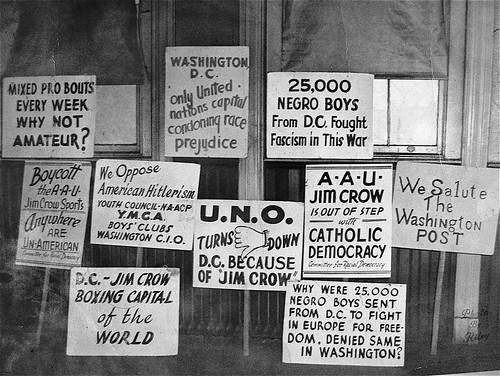
After World War II, E.B. Henderson, a professor, director of sports for DC Schools, and a leading activist within the NAACP, led a campaign where people protested every event held at the Uline Arena, in order to get the owner--who claimed that integration of events was at the discretion of the sub-tenants renting use of the building--to make integrated events that standard practice.  In 1949, the owner capitulated.  (This was reported in the black press at the time.)
Protest Signs, Campaign to integrate Uline Arena, (1948-49)
Protest Signs, Campaign to integrate Uline Arena, (1948-49).

I believe this influenced the holding in the Thompson Restaurant case four years later, where  segregation in public accommodations in the city was prohibited, and this case in turn had to have influenced the Brown v. Board of Education case in 1954, which included a DC case, Bolling v. Sharpe.

The fight did not end with integrated schools, much more advocacy and legal action was required over the next 15 years to affirm civil rights protections in DC and US laws, as we know.

And as Black Lives Matters and related movements demonstrate now, it takes many decades to counter the legacy of hundreds of years of structural racism and economic segregation.

Public accommodations and personal practices.  This comes up with regard to various laws concerning discrimination concerning sexual orientation or other matters, such as filling a prescription for birth control.

I don't see how it can be legal to provide a "religious exception' to what need to be considered civil rights public accommodations and equal protection laws.  (Obviously, I don't agree with the "Scalia" Court holding in the Hobby Lobby case with regard to health insurance and coverage for abortion.  The company's policy was upheld because of the beliefs of the leaders of the corporation.)

If you're a licensed pharmacist, I think it's fine to choose to not fill a prescription, provided your license to be a pharmacist is revoked, because you shouldn't have a choice whether or not to fill a legally prescribed prescription.  In short, as a matter of business and licensure, pharmacists have a duty to fulfill all of their responsibilities.

Similarly, as an elected official, Kim Davis, the county clerk in Kentucky who refused to grant marriage licenses for gay couples, should be removed from office as being unfit to perform the duties of the position ("Kim Davis stands ground, but same-sex couple get marriage license," CNN).  The same for the Chief Justice of the Alabama Supreme Court ("Alabama chief justice orders halt to same-sex marriage licenses." Reuters).  The law is the law.

If you're licensed/incorporated as a business selling to the public, you should have no right to pick and choose your customers on the basis of race, creed, gender, sexual orientation, ethnicity, etc. (although I am fine with "firing customers" in certain situations, see "When, Why, and How to Fire That Customer," Bloomberg, but for strict business reasons only).


Arlene's Flowers in Richland, Wash., refused to provide flowers for a same-sex wedding. Above, the store in 2013. (Bob Brawdy / Tri-City Herald)


Christian Science Monitor has a story, "A florist caught between faith and discrimination," about a florist in Washington State who refused to provide flowers for a gay wedding ceremony, even though the request came from a long time customer.  She is now facing a lawsuit brought by the ACLU which she is likely to lose.  (Also see "Florist who rejected same-sex wedding job broke Washington law, judge rules," LA Times.)

Choosing to serve someone or not because of their race is illegal.  Equal protection should be afforded to people generally, including on the basis of sexual preference, use of contraceptives, etc.

I have no empathy or sympathy for the position of the owner of Arlene's Flowers, Baronelle Stutzman.  As a retail business, she should serve all her customers, not pick and choose.  Otherwise she shouldn't be in the business of serving the public.

Labels: , , , , ,

Friday, October 23, 2015

Reprint: Churches, community, religion and change

This piece originally ran on October 14th, 2012.

Churches and bike lanes.  It's being reprinted in honor of how some DC churches are claiming religious freedom violations because of plans to put bike lanes in front of their churches ("Pastors: 6th Street Bike Lanes A ‘Cancer’ That Will Destroy Church," Washington City Paper; "Can some big D.C. churches fight off a bike lane?," Washington Post.

Note in the past DDOT didn't put a bike lane on the 1500 block of M Street NW because of complaints by the Metropolitan African Methodist Episcopal Church on that block ("How a downtown bike lane has become a political headache," Washington Post, 2013).

The reality is that there are plenty of churches in the city located next to bike lanes and plenty of churches in other cities located along streetcar and light rail lines.

Only by believing that your place in the city is completely unique and exceptional and incomparable to any other place in the city or the world can these anti-change positions be sustained.

I am not happy when I ride by New Southern Rock Baptist Church on Kansas Avenue NW and they have cars parked in the bike lane on a Sunday or during a funeral. But it's a lot better to divert around the parked cars than to not have access to it the other 160 or so hours in a week, when the church building is mostly empty.

Churches and homeless services/property warehousing.  The comment thread on the original post has some interesting points.  Charlie wrote:
What I found interesting about the Atlantic article, and a lot of DC talk about black churches, is how much it replicates how settlers in the west talked about the Indians and the need for removal. The existence of the churches is a real threat for the search for authenticity.

One thing you left out is the tendency of churches to offer homeless services in the city, and how that really manages to shit on the local neighborhood. That needs to be regulated and banned.

As I see it, the real problem is the warehousing aspect. Churches want to expand, and use their tax exempt status to do so. (Others are using it as a way to turn themselves into real estate developers). This isn't an isolated issue: The Cleveland Clinic ran down its local neighborhood in order to have cheap real estate to expand.
Churches and historic preservation: graven images and RLUIPA.  And in the intervening years there was an interesting holding by the Mayor's Agent concerning a church that bought an existing church in the Capitol Hill Historic District, but because their brand of religion doesn't hold for graven images, they wanted to remove the stained glass windows.

I figured they'd win based on the RLUIPA law, but in another example of the fact that I don't have legal training, the holding stated that the purchasers knew going in that the building was in a historic district and therefore that the changes they proposed were likely not to be approved.  That out of the doctrine "all citizens are presumed to know the law," that they had no reasonable expectation that their religious position in and of itself would otherwise trump existing law.

Inekon-built streetcar in Portland, Oregon, USA, on the Portland Streetcar system.  Train is stopped at SW 11th and Clay with The Old Church on the right.

Churches and streetcars.  And speaking of churches and anti-urban attitudes toward transportation, not that long ago a church at 11th and K Streets NW claimed that building a streetcar line next to the church would impinge on their religious practice also.

I wrote about that in December 2014, "The co-existence of streetcars and churches elsewhere ought to counter anti-streetcar arguments by churches in DC today."

Like with churches and bike lanes, there are probably thousands of examples of churches around the world located next to streetcar or light rail lines.

Valorizing property value in new church-mixed use construction projects.  In Dupont Circle, residents have been fighting a church's proposal to rebuild their church and pay for it partly by having part of the site developed for market rate housing ("New Design Released for Dupont Circle Church Development," UrbanTurf).

While I don't think the new building as proposed is particularly attractive, I can't criticize the church for being focused on how to remain relevant in the 21st century and how to pay for their operations going forward, given the fact that many urban denominations find that their membership is shrinking, members are increasingly not located within the neighborhood, social and community service demands are increasing, revenues are decreasing, and costs are rising.

On the 900 block of F Street NW and at the intersection of Wayne Avenue and Fenton Street in Silver Spring ("First Baptist Church Demolition Underway in Silver Spring," Bethesda Magazine), church sites have been or are being redeveloped as mixed use office or residential buildings, but in each case the church function has been or will be maintained on the site, as a part of the new building.

I will say it can be a shame to lose the distinctive architecture style and aesthetic qualities of church buildings that were constructed long ago which are replaced by the homogeneous building designs of today.

============
Churches, community, religion and change

I do love church architecture and stained glass windows (not exclusively religious of course), but because I am somewhere between agnostic and atheist, perhaps too often I discount the role of religion in society generally as well as locally.

Of course, religious communities and their churches and related institutions (charities, monasteries, convents, colleges, etc.) are involved in many aspects of communities, urban and suburban and rural, which make them worth paying attention to, including such issues as:

• their roles in community and building community;

• their participation, directly or indirectly, in ocal politics (ministers and churches can be the backbone of support for particular politicians);

• the issue of the church and society, the First Amendment, separation of church and state, and the pernicious rise of  the application of religion to all sorts of public activities (e.g., "Putnam courthouse could display 'In God We Trust'" from the Nashville Tennessean);

• their participation in community stabilization and redevelopment--some churches such as Abyssinian Baptist Church in Harlem and Bethel New Life in Chicago, and the Catholic Church affiliated Famicos Foundation housing development organization in Cleveland, among others, have very well respected community development arms (although some once well-respected church community development arms have also degraded, see "Floyd Flake ripped over condition of buildings run by his church" from the New York Post);

• and in community destabilization, by warehousing urban properties (Shiloh Baptist Church in Shaw is well known for amassing properties and letting them moulder but they are hardly the only church that does so, see ""Losing my religion: Shiloh Baptist Church and Neighborhood Destabilization" from 2005)--I argue that churches may believe that improving a neighborhood is a bad thing, because by improving property values, it becomes more difficult to continue to acquire nearby properties;

• the parking issue--because as church membership becomes disconnected from the neighborhood where the church is located, people drive in to worship and need somewhere to leave their cars--actually I am fine with Sunday double-parking as opposed to demolishing buildings and converting the land to parking lots used a handful of hours/week and believe that churches should have to create transportation demand management plans (see the blog entries, "Even a church can do transportation demand management planning" and "Megachurch parking ministries set standard for church transportation demand management");

• church-related historic preservation and land use issues and the RLUIPA Act (see "Building regulations (including historic preservation), religious freedom, and local and federal laws" and "Be careful what you wish for/religious freedom/RLUIPA"), which many churches use in an attempt to privilege the way they wish to use property and avoid local regulations--in DC, there are frequent calls to give churches an exception from historic preservation laws, which is ironic because it was a church's demolition of houses for parking in Capitol Hill that spurred the creation of local historic preservation law;

• including the opposition by people with more traditional beliefs to the establishment of new faith communities, especially in the post-9/11 environment, to Islamic churches (e.g., "Planned Mosque Inches Along, but Critics Remain" from the New York Times);

• and vice versa, the belief by some faith traditions, usually the most orthodox, that freedom of speech provisions should not be applicable to the interpretation of their religion by others;

• church closure, relocation, and the counter-response of the creation of new types of religious communities that are a-denominational (although for a First World country, the US has the highest rates in the world of people who declare a religious faith).

Church closure and relocation in the face of demographic change

It is the latter to which the rest of this blog entry is directed, in response to an article in The Atlantic blog, "In Changing Neighborhoods, Black Churches Face an Identity Crisis," in part about the H Street neighborhood.

The article is interesting only because it employs an incredibly limited, a-historical time frame that ignores the last 100+ years of urban history.

Church location used to be tightly linked to ethnic/racial communities living in particular neighborhoods

Historically, particular churches and faiths were tightly associated with particular ethnic and racial groups, and people of the same ethnicity and/or race tended to live in the same places and neighborhoods, for various reasons including income, immigration patterns, segregation, or other forms of discrimination.

As a result, churches were very tightly linked to particular communities, and a "Little Italy" was likely to be dominated by the Catholic Church, Jewish neighborhoods by synagogues, German communities had Lutheran churches, etc.
 
Today's black churches in changing inner city neighborhoods are not the first churches to be buffeted by demographic change.

And in DC at least, "black" churches have been responding, for better or worse, to black middle class outmigration from the center city for decades anyway (for example, the Nineteenth Baptist Church is located on 16th Street NW, as it moved to follow and better serve its relocating members, as Ward 4 became home to the city's largest concentration of middle-class African Americans), and many of the city's black churches have relocated to the suburbs, generally Prince George's County, following their parishioners, not unlike how at one time, retailers left the city for the suburbs, in pursuit of their relocating customers.

Relocation to where members live makes sense too, if you want to play a prominent role in civic affairs and local elections.

Chromolithograph of the St. Stanislaus Kostka (Polish Catholic) Church, 1891.  

Yet, these kinds of issues cross racial, ethnic, neighborhood, and denominational boundaries, and have for decades.

For example, declining membership has led Catholic dioceses to close churches (and their associated schools), in the face of significant opposition ("Church and School Cuts Anger Catholics in Philadelphia" from the New York Times), in cities across the country including DC, Baltimore, Philadelphia, Pittsburgh, Detroit, and Milwaukee.

For example, when Pittsburgh's steel mills were booming and immigration was high, the Strip District had four very large Catholic churches, each serving different ethnicities and languages, such as Polish or Czech.  Today, one of these churches, St. Stanislaus Kostka Church, once supported by over 7,000 families, now has fewer than 500 families as members, and has merged in part with St. Patrick's, sharing a priest and other functions, while other churches have closed.

Urban demographic change has often meant change to the buildings where people prayed


As neighborhoods changed in the cities--and the first form of "outmigration" from cities was from the core of the city to neighborhoods still in the city but outside of the core, typically neighborhoods developed and served by streetcar companies--their churches and temples followed them into new buildings in their new neighborhoods, and the old churches were sold to different religious faiths.

For example the church at 8th and I Streets NW in Downtown DC was once a synagogue--and before it was a synagogue, the building was a Methodist Church, although eventually the Washington Hebrew Congregation demolished it and built the religious building that still stands today.  To make the former Methodist church more "Jewish" they "add[ed] a depiction of the Ten Commandments and Stars of David to the apex."

This process continues.  Recently a church in Orange County, California converted to a mosque.  See "Catholic church converts to Islamic mosque" from the Orange County Register.  And the once closed synagogue at 6th and I Streets NW was converted into a church of another faith, and a few years ago was reopened as a facility to serve the community and people of the Jewish faith both, but not as a traditional temple ("Sixth & I Historic Synagogue" from Washington Jewish Week), and a conservative church bought a church on Capitol Hill and wants to rip out its stained glass windows because the church doesn't believe in "graven images" ("Broken Windows Theory" from the Washington City Paper), etc.

Suburban out-migration and center city population loss significantly impacted traditional churches

As long as cities maintained population and as long as religion was important to people in the way they organized their lives, there was enough demand so that old church buildings could be sold to different religious faiths more in tune with new populations.

 As population dropped in center cities, churches lost membership, some to the point where they had to close, leaving buildings empty without demand for purchase from other church organizations. (Of course, this is now a problem in rural communities as well.  See the webpage "Educating Ourselves About Rural Church Preservation" from Sacred Places.)

This church building at 9th and D Streets SE on Capitol Hill was converted into 18 condominium units in 1989.

It wasn't until after World War II when housing choice (and incomes) expanded greatly and in forming new, mostly suburban, neighborhoods and choosing where to live, people bought houses without considering ethnic and religious ties (although there is no question that in certain faiths, such as Judaism in both Baltimore and Detroit, there is a religiously influenced geographic pattern to the migration outward from the center city that is clearly discernible).

And of course the parking issue is related to the fact that churches no longer primarily serve members in the neighborhood who walk to services.  (Orthodox Jews are an exception of course.  Religious laws restrict the use of mechanical equipment, including cars, on the Sabbath, so adherents tend to cluster in particular neighborhoods close to their temples, within walking distance.) 

 
Image of Pittsburgh's former St. John the Baptist Catholic Church, now the Church Brew Works, from the Pittsburgh Eats blog.

But as population shrunk, incomes dropped, and even as religious practices changed (the rise of Pentecostalism and storefront churches), the demand for large, grand (and expensive to maintain) church buildings declined. 

Besides reuse of the buildings for other types of institutions and agency, or as housing, churches have been converted into night clubs or brew pubs (the creation of the Church Brew Works in Pittsburgh led the Archdiocese of Milwaukee to put a clause in its sales agreements for church buildings to forbid certain uses).

Changing communities: some churches reposition and maintain their position, space, and place

Sojourners Magazine serves the Christian social justice movement.

Churches changing in response to changing communities is not new, especially in relationship to the increased prominence of social justice concerns as more people turned their spiritual focus outwards.

One example (and hardly the only one) is how in Washington, DC, Luther Place Memorial Church on Thomas Circle at 14th Street NW refocused their programs on inner city, poverty and other social justice concerns, in turn attracting new members who supported the church in its efforts to refocus its mission outwards toward active, engaged community service (the Church now has multiple programs, including housing, that are probably amongst the best in the city).

As immigrant populations change urban neighborhoods, other churches have changed as well, adding services in different languages, such as Spanish, and adapting outreach and community service programs to be responsive to new demands. Certainly this has been the case in the Columbia Heights neighborhood, which is the center of DC's Latino population.

And the increase in the number of Unitarian-Universalist Churches in urban locations in the 1960s and 1970s was another response to people looking to join with others in worship, community service, and fellowship, without necessarily being bound in the same way with ethnicities and neighborhoods.  For example, DC's Washington Ethical Society, Unitarian-Universalist affiliated:

is a humanistic religious community, without formal creed or dogma, united in the belief that the greatest moral and spiritual values are to be found through raising the quality of human relationships.

Certainly, rise of progressive and social justice practices in the Catholic Church (liberation theology, Nuns on the Bus, etc.) and the Episcopal Church (such as the appointment of women and gays as priests and bishops) continues to spark tensions between conservative and liberal factions, even to the point where some churches are breaking off and leaving the mother church.

Another response by churches has been to organize across religions through the creation of ecumenical organizations that link churches and their missions towards working together on a variety of social justice goals.

DC's Downtown Cluster of Congregations and the Capitol Hill Group Ministries are local examples.  (Although I will argue that these kinds of organizations can also devolve into typical special interest groups focused on their own needs to the exclusion of others, at least when it comes to church parking matters...)

The rise of the new church: non-denominational churches as a new response to serve diverse communities

While we can't ignore the reality that churches and organizations espousing traditional religious interpretations continue to open in the city to serve audiences new to the city, often using non-church buildings (storefronts, other buildings), in part because such buildings are much less expensive than a large traditional church building, social and community changes concomitant with the continued development of the post-industrial society, mean that traditional definitions of ethnicity are no longer the dominant way many people to choose to define themselves, leading to weak religious ties with traditional forms of religious practices.

In response, religious practice and organization has been changing and adapting to serve these new communities.  And, there are many organizations and a growing body of literature that addresses the issue of how churches and religious denominations need to change to serve new and different populations.

Plus, considering how much I write about civil society, community building, civic engagement, etc., it would be a mistake to ignore church community building as an element of this and community organizing more generally, especially in terms of the success of the megachurch and other forms of non-denominational churches in creating racially and economically diverse congregations that connect people over broad geographies.

New age spirituality.   New age spiritualism and offshoots of traditional religion (kabbalah) and older practices (Wiccan) has been one response, but typically that hasn't been associated with in-city practices.  Instead it is more likely to be associated with the out-of-doors, communes, and in natural landscapes ("The New Age in Sedona, Arizona" from the New York Times travel section).

Megachurches.  While we think of megachurches as "suburban," it's probably more accurate to think of them as churches that operate on a metropolitan scale where their membership base isn't circumscribed by or limited to a particular neighborhood or geography.

Left: Houston's 16,800-seat Lakewood Church Central Campus, home to four English language services and two Spanish language services per week, is located at the former Compaq Center.  Wikipedia image.

The car allows the megachurch to create spiritual communities in places where people otherwise feel disconnected and where traditional religious denominations may not be adequately serving their needs, by drawing upon the automobile-enabled across an entire metropolitan area rather than limiting themselves to a particular neighborhood or district or single jurisdiction. 

See "Megachurches As Minitowns" and "Megachurches Add Local Economy to Their Mission" from the New York Times.   Megachurches serve metropolitan communities connected by the car.

Televangelism.  While we may think of megachurches as a recent phenomenon, I think it's more accurate to think of it as the second generation of this phenomenon, which started first with the rise of the televised ministry ("televangelism") in the 1960s and 1970s and the teleministry's associated church and related facilities (Jim and Tammie Lee Baker, Pat Robertson and the 700 Club, Oral Roberts, Robert Schuller in Orange County).

(Then again, you had the radio ministers in the 1930s and 1940s, people like Father Coughlin of the Shrine of the Little Flower Parish in suburban Detroit's Royal Oak--Father Coughlin was the scourge of FDR and was only suppressed through a deal that FDR made with the Vatican to recognize the Church as a city-state and appoint an ambassador to the Vatican.)

MCC serving the LGBT community.  The Metropolitan Community Church formed in the late 1960s to serve lesbians and gays in response to the rejection of homosexuality by most traditional religious denominations.

LGBT status by definition transcends race or ethnicity and so MCC churches, like Unitarian churches, tend to have more diverse memberships compared to ethnically- and race-bound traditional churches.  Because MCC adherents came out of traditional faiths, the Church tends to be more formal in their religious traditions, while being more expansive and unbiased in terms of membership and to whom services and rites are provided.

Non-denominational churches.  Like megachurches, but not nearly as large as the arena-sized congregations that exist in Dallas and Atlanta, non-denominational churches have been created in center cities to serve populations that are younger and newer to the community, connecting diverse peoples looking for spiritual connection, and who are less interested in worshiping within more traditional ethnic and/or racial boundaries or their neighborhoods, instead creating racially and/or ethnically diverse faith communities that cross neighborhood and sector boundaries, drawing its membership from across an entire city (and beyond).

DC's National Community Church as a multi-site urban-sized megachurch.  DC has a good example in the "Theater Church," now called the National Community Church, which first started by holding worship services on Sunday mornings when the theaters at Union Station weren't showing movies.
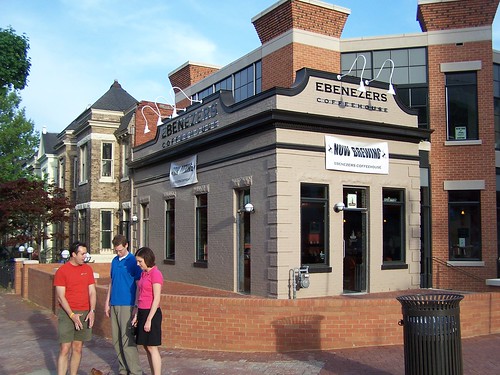
Ebenezer's Coffee Shop, 2nd & F 
Streets NE, DCI have long thought this church was interesting, because they didn't have a building.  (See "Building a churchless megachurch" from the Washington Post).

And you could argue that it was a form of "mixed primary use," by using a "hall," in this case a cinema, in a nontraditional and time- and space-efficient manner.

But I just wasn't looking at their operations as closely as I could have, because likely, physical manifest destiny was always part of the plan.

Just like how food trucks can be a way to "build up" to a bricks and mortar location, the same kind of path was forged by the National Community Church--they are not a "megachurch" in one location but a "multi-site" church serving multiple communities with favorable economic demographics.

First, they expanded services from Union Station in DC to other theater locations in the metropolitan area, not limiting their operation or "service area" to DC proper.
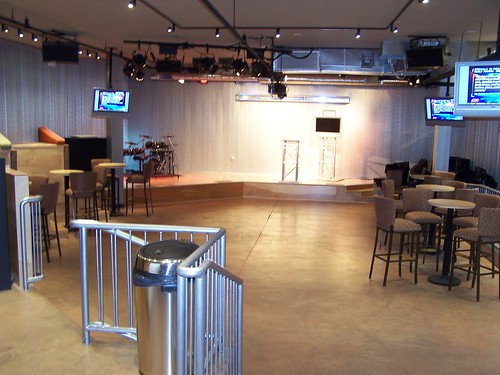
Ebenezer's Coffee Shop, 2nd & F Streets NE, DCSecond, they created the Ebenezer's Coffee House on 2nd Street NE near Union Station--with a hall suitable for religious services in the basement and offices on the second floor above the coffee house, although with a bit of puffery (see the past blog entry "Ebenezer's Coffee Shop and a bit of truth stretching") as they claimed the building they had rehabilitated had been a drug house, which was not the case.

Right: the basement hall at Ebenezers Coffee House.

This gave them offices, space that they controlled, and a way to have physical presence outside of the Sunday morning hours. 

And currently they have expanded into a building, (I don't want to call it "third" because I imagine that they will continue to expand into physical buildings, most likely not typical church buildings), through the acquisition of the old People's Church on 8th Street SE in the Barracks Row neighborhood of Capitol Hill ("National Community Church Pouring Serious Money into Barracks Row" from the Washington City Paper  and "Century-old movie theater in Capitol Hill to reopen as the Miracle" from the Washington Post).

They are restoring the theater function of the building, and will show movies and such outside of church hours.

Interestingly, the restoration of these buildings does illustrate an interesting element of nonprofit business activity.  I don't know if the buildings are exempt from local property taxes, because they are owned by a church.

In any case, the income from the cafe or operations as a movie theater would be taxable (it's unrelated business income from the standpoint of a church.  But not having to operate the businesses strictly on a for profit revenue basis allows them to spend more money and create "grander" facilities than is likely for a tax paying business.

Conclusion

There is a lot more going on in the city with regard to religion, religious practices, and community and spiritual development than you would ever imagine if all you do is limit your consideration of religion and the city to the last couple of years of demographic change.

Labels: , , , , , , , ,

Sunday, December 29, 2013

Continued failure to understand separation of church and state

While Christmas is practically a secular holiday, more about shopping than anything else, the reality is that it is a religious event.  And in the US, the Constitution, specifically the First Amendment states that there should be no establishment of a state-sanctioned religion.  This is commonly referred to as separation of church and state.

And while plenty of the electorate and elected officials want to deny this and make the US a more officially religious country, the law is the law.

Since Kennedy Performing Arts Center, located in Washington, DC, is a facility owned and operated by the federal government, it is subject to the clause in the Constitution concerning separation of church and state.

Image from 2012:  Metro Latino USA.

Although the courts have been inconsistent on their rulings concerning displays of Christmas-related symbols on government property, we have a National Christmas Tree at the White House and another by the US Capitol, etc.

That doesn't sit well with Darryl Summers, according to this letter, "Where's the Christmas spirit at the Kennedy Center?," in the Washington Post:
The security office at the Kennedy Center should be alerted that the Grinch is on the prowl there. While attending a performance of “Elf the Musical,” I realized that the center had little sign that much of the United States was celebrating a festive season: There was not a single holiday decoration or reminder in any public area that I visited. Even last year’s small, lonely Christmas tree in the Grand Foyer was nowhere to be seen this time.

Though the Kennedy Center entices patrons with such cheerful holiday offerings as “Elf the Musical” and last year’s “Irving Berlin’s White Christmas,” I emerged joyfully from the Opera House only to discover that I had been transported to the home of Ebenezer Scrooge. If not for the cheerful nutcrackers for sale in the gift shop (thank you, at least, Mr. Tchaikovsky), there was nary a sign of holiday-ness.

Maybe next year the Kennedy Center board of directors could at least buy a few white beards for ushers (who all wear bright red jackets anyway) to stand in for Santa, who is very busy this time of year. Or maybe we should put the Kennedy Center on Santa’s Naughty List.
I do wish that like the letter commentary in publications like The Nation, there could be a response when people write stuff like this.

Although the Post did run a semi-related piece on the Phil Robertson "controversy".  See "The First Amendment doesn't hold all the answers."

Labels: , ,

Wednesday, June 19, 2013

Holding on DC historic preservation matter concerning a church schools us on both RLUIPA and "economic hardship" claims

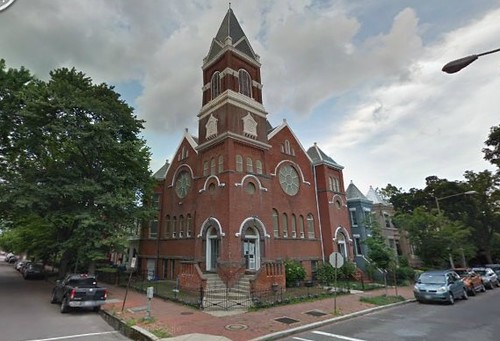
church, 700 A Street NE, DCA church denomination, World Mission Society, bought a "used" church present in the Capitol Hill Historic District, located at 700 A Street NE, in Washington, DC (building pictured above, from Google Street View), to start a congregation in the DC metropolitan area.

The church building has "graven images," that is to say, stained glass windows depicting religious figures and stories, and so the church wanted to remove the windows.  No said the DC Historic Preservation Review Board.

The church appealed, on two grounds.  First, that not allowing the windows to be removed is an unreasonable restriction on their First Amendment rights to practice religion and the separation of church and state clause. The RLUIPA--Religious Land Use and Institutionalized Persons Act--is a federal law designed to provide "equal treatment" to religious institutions with regard to local building regulations, and this act was referenced in the appeal.  Second, they made the claim that the restriction created an "economic hardship."

The opinion by the Mayor's Agent (in effect a "Court of Appeals" vis-a-vis the Historic Preservation Review Board, although the plaintiff could still appeal the decision to local or federal courts) is a very careful application of the relevant laws and regulations.

The foundation of the ruling has to do with the fact that the Capitol Hill Historic District is what we might call a "pre-existing condition," and it is then incumbent on any property purchaser to do due diligence concerning how the historic preservation regulations may impact on the plans a purchaser might have for a property.

So, while many jurisdictions end up interpreting RLUIPA to mean that churches get to pierce local building regulations for just about anything they say that has to do with practicing religion, the opinion takes an opposite stance.  Since the preservation regulations regulate facades present to the street and windows for all properties within a historic district, the holding argues that a church is not treated any different from any other property, when such regulations are applied.

And with regard to claims of economic hardship with regard to historic preservation regulations, the denial of the claim was based on the fact that applying the building regulations equally to a church, regardless of the  intent of the owner, does not create a hardship.  Therefore, there is no justification for not applying historic preservation/other building regulations to a building, regardless of the use, even if that use is religious.

As a non-lawyer, the opinion is an important read as well, because it makes very clear on how such narrow grounds and interpretations legal arguments are made.

Note that if the historic district designation hadn't been a pre-existing condition, the findings may have been different, although it would have been impossible to have the same fact pattern.  (Meaning that the church would have already removed the windows.  I don't see how an action would have been brought against the church to put them back in, upon the creation of a historic district.)

Labels: , , , , ,

Sunday, October 14, 2012

Sunday morning: Churches, religion, community and change

I do love church architecture and stained glass windows (not exclusively religious of course), but because I am somewhere between agnostic and atheist, perhaps too often I discount the role of religion in society generally as well as locally.

Of course, religious communities and their churches and related institutions (charities, monasteries, convents, colleges, etc.) are involved in many aspects of communities, urban and suburban and rural, which make them worth paying attention to, including such issues as:

• their roles in community and building community;

• their participation, directly or indirectly, in ocal politics (ministers and churches can be the backbone of support for particular politicians);

• the issue of the church and society, the First Amendment, separation of church and state, and the pernicious rise of  the application of religion to all sorts of public activities (e.g., "Putnam courthouse could display 'In God We Trust'" from the Nashville Tennessean);

• their participation in community stabilization and redevelopment--some churches such as Abyssinian Baptist Church in Harlem and Bethel New Life in Chicago, and the Catholic Church affiliated Famicos Foundation housing development organization in Cleveland, among others, have very well respected community development arms (although some once well-respected church community development arms have also degraded, see "Floyd Flake ripped over condition of buildings run by his church" from the New York Post);

• and in community destabilization, by warehousing urban properties (Shiloh Baptist Church in Shaw is well known for amassing properties and letting them moulder but they are hardly the only church that does so, see ""Losing my religion: Shiloh Baptist Church and Neighborhood Destabilization" from 2005)--I argue that churches may believe that improving a neighborhood is a bad thing, because by improving property values, it becomes more difficult to continue to acquire nearby properties;

• the parking issue--because as church membership becomes disconnected from the neighborhood where the church is located, people drive in to worship and need somewhere to leave their cars--actually I am fine with Sunday double-parking as opposed to demolishing buildings and converting the land to parking lots used a handful of hours/week and believe that churches should have to create transportation demand management plans (see the blog entries, "Even a church can do transportation demand management planning" and "Megachurch parking ministries set standard for church transportation demand management");

• church-related historic preservation and land use issues and the RLUIPA Act (see "Building regulations (including historic preservation), religious freedom, and local and federal laws" and "Be careful what you wish for/religious freedom/RLUIPA"), which many churches use in an attempt to privilege the way they wish to use property and avoid local regulations--in DC, there are frequent calls to give churches an exception from historic preservation laws, which is ironic because it was a church's demolition of houses for parking in Capitol Hill that spurred the creation of local historic preservation law;

• including the opposition by people with more traditional beliefs to the establishment of new faith communities, especially in the post-9/11 environment, to Islamic churches (e.g., "Planned Mosque Inches Along, but Critics Remain" from the New York Times);

• and vice versa, the belief by some faith traditions, usually the most orthodox, that freedom of speech provisions should not be applicable to the interpretation of their religion by others;

• church closure, relocation, and the counter-response of the creation of new types of religious communities that are a-denominational (although for a First World country, the US has the highest rates in the world of people who declare a religious faith).

Church closure and relocation in the face of demographic change

It is the latter to which the rest of this blog entry is directed, in response to an article in The Atlantic blog, "In Changing Neighborhoods, Black Churches Face an Identity Crisis," in part about the H Street neighborhood.

The article is interesting only because it employs an incredibly limited, a-historical time frame that ignores the last 100+ years of urban history.

Church location used to be tightly linked to ethnic/racial communities living in particular neighborhoods

Historically, particular churches and faiths were tightly associated with particular ethnic and racial groups, and people of the same ethnicity and/or race tended to live in the same places and neighborhoods, for various reasons including income, immigration patterns, segregation, or other forms of discrimination. 

As a result, churches were very tightly linked to particular communities, and a "Little Italy" was likely to be dominated by the Catholic Church, Jewish neighborhoods by synagogues, German communities had Lutheran churches, etc.
 
Today's black churches in changing inner city neighborhoods are not the first churches to be buffeted by demographic change.

And in DC at least, "black" churches have been responding, for better or worse, to black middle class outmigration from the center city for decades anyway (for example, the Nineteenth Baptist Church is located on 16th Street NW, as it moved to follow and better serve its relocating members, as Ward 4 became home to the city's largest concentration of middle-class African Americans), and many of the city's black churches have relocated to the suburbs, generally Prince George's County, following their parishioners, not unlike how at one time, retailers left the city for the suburbs, in pursuit of their relocating customers.

Relocation to where members live makes sense too, if you want to play a prominent role in civic affairs and local elections.

Chromolithograph of the St. Stanislaus Kostka (Polish Catholic) Church, 1891.  

Yet, these kinds of issues cross racial, ethnic, neighborhood, and denominational boundaries, and have for decades.

For example, declining membership has led Catholic dioceses to close churches (and their associated schools), in the face of significant opposition ("Church and School Cuts Anger Catholics in Philadelphia" from the New York Times), in cities across the country including DC, Baltimore, Philadelphia, Pittsburgh, Detroit, and Milwaukee.

For example, when Pittsburgh's steel mills were booming and immigration was high, the Strip District had four very large Catholic churches, each serving different ethnicities and languages, such as Polish or Czech.  Today, one of these churches, St. Stanislaus Kostka Church, once supported by over 7,000 families, now has fewer than 500 families as members, and has merged in part with St. Patrick's, sharing a priest and other functions, while other churches have closed.

Urban demographic change has often meant change to the buildings where people prayed

As neighborhoods changed in the cities--and the first form of "outmigration" from cities was from the core of the city to neighborhoods still in the city but outside of the core, typically neighborhoods developed and served by streetcar companies--their churches and temples followed them into new buildings in their new neighborhoods, and the old churches were sold to different religious faiths.

For example the church at 8th and I Streets NW in Downtown DC was once a synagogue--and before it was a synagogue, the building was a Methodist Church, although eventually the Washington Hebrew Congregation demolished it and built the religious building that still stands today.  To make the former Methodist church more "Jewish" they "add[ed] a depiction of the Ten Commandments and Stars of David to the apex."

This process continues.  Recently a church in Orange County, California converted to a mosque.  See "Catholic church converts to Islamic mosque" from the Orange County Register.  And the once closed synagogue at 6th and I Streets NW was converted into a church of another faith, and a few years ago was reopened as a facility to serve the community and people of the Jewish faith both, but not as a traditional temple ("Sixth & I Historic Synagogue" from Washington Jewish Week), and a conservative church bought a church on Capitol Hill and wants to rip out its stained glass windows because the church doesn't believe in "graven images" ("Broken Windows Theory" from the Washington City Paper), etc.

Suburban out-migration and center city population loss significantly impacted traditional churches

As long as cities maintained population and as long as religion was important to people in the way they organized their lives, there was enough demand so that old church buildings could be sold to different religious faiths more in tune with new populations.

 As population dropped in center cities, churches lost membership, some to the point where they had to close, leaving buildings empty without demand for purchase from other church organizations. (Of course, this is now a problem in rural communities as well.  See the webpage "Educating Ourselves About Rural Church Preservation" from Sacred Places.)

This church building at 9th and D Streets SE on Capitol Hill was converted into 18 condominium units in 1989.

It wasn't until after World War II when housing choice (and incomes) expanded greatly and in forming new, mostly suburban, neighborhoods and choosing where to live, people bought houses without considering ethnic and religious ties (although there is no question that in certain faiths, such as Judaism in both Baltimore and Detroit, there is a religiously influenced geographic pattern to the migration outward from the center city that is clearly discernible).

And of course the parking issue is related to the fact that churches no longer primarily serve members in the neighborhood who walk to services.  (Orthodox Jews are an exception of course.  Religious laws restrict the use of mechanical equipment, including cars, on the Sabbath, so adherents tend to cluster in particular neighborhoods close to their temples, within walking distance.) 

 
Image of Pittsburgh's former St. John the Baptist Catholic Church, now the Church Brew Works, from the Pittsburgh Eats blog.

But as population shrunk, incomes dropped, and even as religious practices changed (the rise of Pentecostalism and storefront churches), the demand for large, grand (and expensive to maintain) church buildings declined. 

Besides reuse of the buildings for other types of institutions and agency, or as housing, churches have been converted into night clubs or brew pubs (the creation of the Church Brew Works in Pittsburgh led the Archdiocese of Milwaukee to put a clause in its sales agreements for church buildings to forbid certain uses).

Changing communities: some churches reposition and maintain their position, space, and place

Sojourners Magazine serves the Christian social justice movement.

Churches changing in response to changing communities is not new, especially in relationship to the increased prominence of social justice concerns as more people turned their spiritual focus outwards.

One example (and hardly the only one) is how in Washington, DC, Luther Place Memorial Church on Thomas Circle at 14th Street NW refocused their programs on inner city, poverty and other social justice concerns, in turn attracting new members who supported the church in its efforts to refocus its mission outwards toward active, engaged community service (the Church now has multiple programs, including housing, that are probably amongst the best in the city).

As immigrant populations change urban neighborhoods, other churches have changed as well, adding services in different languages, such as Spanish, and adapting outreach and community service programs to be responsive to new demands. Certainly this has been the case in the Columbia Heights neighborhood, which is the center of DC's Latino population.

And the increase in the number of Unitarian-Universalist Churches in urban locations in the 1960s and 1970s was another response to people looking to join with others in worship, community service, and fellowship, without necessarily being bound in the same way with ethnicities and neighborhoods.  For example, DC's Washington Ethical Society, Unitarian-Universalist affiliated:

is a humanistic religious community, without formal creed or dogma, united in the belief that the greatest moral and spiritual values are to be found through raising the quality of human relationships.

Certainly, rise of progressive and social justice practices in the Catholic Church (liberation theology, Nuns on the Bus, etc.) and the Episcopal Church (such as the appointment of women and gays as priests and bishops) continues to spark tensions between conservative and liberal factions, even to the point where some churches are breaking off and leaving the mother church.

Another response by churches has been to organize across religions through the creation of ecumenical organizations that link churches and their missions towards working together on a variety of social justice goals.

DC's Downtown Cluster of Congregations and the Capitol Hill Group Ministries are local examples.  (Although I will argue that these kinds of organizations can also devolve into typical special interest groups focused on their own needs to the exclusion of others, at least when it comes to church parking matters...)

The rise of the new church: non-denominational churches as a new response to serve diverse communities

While we can't ignore the reality that churches and organizations espousing traditional religious interpretations continue to open in the city to serve audiences new to the city, often using non-church buildings (storefronts, other buildings), in part because such buildings are much less expensive than a large traditional church building, social and community changes concomitant with the continued development of the post-industrial society, mean that traditional definitions of ethnicity are no longer the dominant way many people to choose to define themselves, leading to weak religious ties with traditional forms of religious practices.

In response, religious practice and organization has been changing and adapting to serve these new communities.  And, there are many organizations and a growing body of literature that addresses the issue of how churches and religious denominations need to change to serve new and different populations.

Plus, considering how much I write about civil society, community building, civic engagement, etc., it would be a mistake to ignore church community building as an element of this and community organizing more generally, especially in terms of the success of the megachurch and other forms of non-denominational churches in creating racially and economically diverse congregations that connect people over broad geographies.

New age spirituality.   New age spiritualism and offshoots of traditional religion (kabbalah) and older practices (Wiccan) has been one response, but typically that hasn't been associated with in-city practices.  Instead it is more likely to be associated with the out-of-doors, communes, and in natural landscapes ("The New Age in Sedona, Arizona" from the New York Times travel section).

Megachurches.  While we think of megachurches as "suburban," it's probably more accurate to think of them as churches that operate on a metropolitan scale.

Left: Houston's 16,800-seat Lakewood Church Central Campus, home to four English language services and two Spanish language services per week, is located at the former Compaq Center.  Wikipedia image.

The car allows the megachurch to create spiritual communities in places where people otherwise feel disconnected and where traditional religious denominations may not be adequately serving their needs, by drawing upon the automobile-enabled across an entire metropolitan area rather than limiting themselves to a particular neighborhood or district or single jurisdiction. 

See "Megachurches As Minitowns" and "Megachurches Add Local Economy to Their Mission" from the New York Times.   Megachurches serve metropolitan communities connected by the car.

Televangelism.  While we may think of megachurches as a recent phenomenon, I think it's more accurate to think of it as the second generation of this phenomenon, which started first with the rise of the televised ministry ("televangelism") in the 1960s and 1970s and the teleministry's associated church and related facilities (Jim and Tammie Lee Baker, Pat Robertson and the 700 Club, Oral Roberts, Robert Schuller in Orange County). 

(Then again, you had the radio ministers in the 1930s and 1940s, people like Father Coughlin of the Shrine of the Little Flower Parish in suburban Detroit's Royal Oak--Father Coughlin was the scourge of FDR and was only suppressed through a deal that FDR made with the Vatican to recognize the Church as a city-state and appoint an ambassador to the Vatican.)

MCC serving the LGBT community.  The Metropolitan Community Church formed in the late 1960s to serve lesbians and gays in response to the rejection of homosexuality by most traditional religious denominations.

LGBT status by definition transcends race or ethnicity and so MCC churches, like Unitarian churches, tend to have more diverse memberships compared to ethnically- and race-bound traditional churches.  Because MCC adherents came out of traditional faiths, the Church tends to be more formal in their religious traditions, while being more expansive and unbiased in terms of membership and to whom services and rites are provided.

Non-denominational churches.  Like megachurches, but not nearly as large as the arena-sized congregations that exist in Dallas and Atlanta, non-denominational churches have been created in center cities to serve populations that are younger and newer to the community, connecting diverse peoples looking for spiritual connection, and who are less interested in worshiping within more traditional ethnic and/or racial boundaries or their neighborhoods, instead creating racially and/or ethnically diverse faith communities that cross neighborhood and sector boundaries, drawing its membership from across an entire city (and beyond).

DC's National Community Church as a multi-site urban-sized megachurch.  DC has a good example in the "Theater Church," now called the National Community Church, which first started by holding worship services on Sunday mornings when the theaters at Union Station weren't showing movies.

Ebenezer's Coffee Shop, 2nd & F 
Streets NE, DCI have long thought this church was interesting, because they didn't have a building.  (See "Building a churchless megachurch" from the Washington Post).

And you could argue that it was a form of "mixed primary use," by using a "hall," in this case a cinema, in a nontraditional and time- and space-efficient manner.

But I just wasn't looking at their operations as closely as I could have, because likely, physical manifest destiny was always part of the plan.

Just like how food trucks can be a way to "build up" to a bricks and mortar location, the same kind of path was forged by the National Community Church--they are not a "megachurch" in one location but a "multi-site" church serving multiple communities with favorable economic demographics.

First, they expanded services from Union Station in DC to other theater locations in the metropolitan area, not limiting their operation or "service area" to DC proper.

Ebenezer's Coffee Shop, 2nd & F Streets NE, DCSecond, they created the Ebenezer's Coffee House on 2nd Street NE near Union Station--with a hall suitable for religious services in the basement and offices on the second floor above the coffee house, although with a bit of puffery (see the past blog entry "Ebenezer's Coffee Shop and a bit of truth stretching") as they claimed the building they had rehabilitated had been a drug house, which was not the case.

Right: the basement hall at Ebenezers Coffee House.

This gave them offices, space that they controlled, and a way to have physical presence outside of the Sunday morning hours. 

And currently they have expanded into a building, (I don't want to call it "third" because I imagine that they will continue to expand into physical buildings, most likely not typical church buildings), through the acquisition of the old People's Church on 8th Street SE in the Barracks Row neighborhood of Capitol Hill ("National Community Church Pouring Serious Money into Barracks Row" from the Washington City Paper  and "Century-old movie theater in Capitol Hill to reopen as the Miracle" from the Washington Post).

They are restoring the theater function of the building, and will show movies and such outside of church hours.

Interestingly, the restoration of these buildings does illustrate an interesting element of nonprofit business activity.  I don't know if the buildings are exempt from local property taxes, because they are owned by a church.

In any case, the income from the cafe or operations as a movie theater would be taxable (it's unrelated business income from the standpoint of a church.  But not having to operate the businesses strictly on a for profit revenue basis allows them to spend more money and create "grander" facilities than is likely for a tax paying business.

Conclusion

There is a lot more going on in the city with regard to religion, religious practices, and community and spiritual development than you would ever imagine if all you do is limit your consideration of religion and the city to the last couple of years of demographic change.

Labels: , , , , , ,