Rebuilding Place in the Urban Space

"A community’s physical form, rather than its land uses, is its most intrinsic and enduring characteristic." [Katz, EPA] This blog focuses on place and placemaking and all that makes it work--historic preservation, urban design, transportation, asset-based community development, arts & cultural development, commercial district revitalization, tourism & destination development, and quality of life advocacy--along with doses of civic engagement and good governance watchdogging.

Monday, October 27, 2025

National Community Planning Month | Civic Involvement continued, Orange County Register's Be the Change

A special section in the paper pays attention to various volunteer efforts in the county.  

One, the LibroMobile, I've actually been to one of the earlier iterations and talked with its nonprofit leader, Sarah Rafael Garcia (on another visit I talked with her husband who was filling in at the store; he wrote his masters thesis about Barrio Logan and the National Landmark Chicano Park in San Diego)

=====
Interesting CNN article, "A White Evangelical Christian man tried to save my soul. It didn’t go as planned – for either of us," about evangelicalism and its turn towards Christian National.  At the end of it, he discusses church as "third place," and the decline of third places or other types of places where people come together as a group and have a common experience.

Volunteering is a form of third place.

Labels: , ,

Wednesday, July 16, 2025

National Ice Cream Day is Sunday/ice cream shops as attractors for neighborhood commercial districts

 Reprinted from August 2018 -- "Ice cream shops as commercial district activation devices"

Check out stores and news coverage in your community for possible promotions ("Free ice cream, discounts and more for National Ice Cream Day," Good Morning America).

In car-oriented places, drive ins still have their appeal, like Neilsen's Frozen Custard in the Salt Lake area.

There's also a rise in the number of independently owned ice cream shops and chainlets ("Artisanal Ice Cream Segment Leads Growth in the Global Ice Cream Parlor Market, Offering Unique Flavors and Premium Experiences," PR Newswire, "Once an NYC summer staple, Mister Softee ice cream trucks are slowly disappearing from the streets," ABC7, "From Mexico To Chicago, The Story Behind “La Michoacana” Ice Cream Shops," WBEZ/NPR).

================

Nancy's Ice Cream in Colonial Beach, Virginia.

The previous entry mentions how in Everett, Massachusetts, planners are thinking about trying to get a ice cream shop to take space in their downtown, as a way to attract patrons.

For a few years, Dolci Gelato had a well-placed corner shop in Takoma Park, Maryland, which was jammed on summer evenings and during the Sunday Farmers Market, and likely was a great attractor and activator.

But this year, the organization converted the space to a bar as part of their adjoining Trattoria restaurant.  Old Town Takoma no longer has that very visible attractor as they've moved the gelato operation around the corner to an old no longer used bank teller drive up window.

More recently, on the Upshur commercial strip in Petworth, Lulabelle's has opened.  It's not on a corner but serves very popular ice cream and during the day--coffee beverages--helping to draw people to the district, especially kids attracted by the parallel display of candy including home-made marshmallows and other treats.

Mason's Creamery, Bridge Avenue and 44th Street, Cleveland, Ohio.

Of course, there are tons of places like this, such as Dolcetti Gelati in the 9th and 9th district in Salt Lake City or the Mason Creamery ice cream shop in Cleveland, which has been featured recently in newspaper ads by Google.

Mason's started as a food truck and selling ice cream at farmers markets, according to this article on the Cleveland Rocks, Cleveland Eats blog.

There is the down-side of the winter months however.

There are limited "solutions" to revenues dropping significantly during that time.  Lulabelle's has food, the aforementioned coffee drinks and candy, along with some gifts, to stoke sales during the months when ice cream is a slow seller.

Google video about Mason's Creamery and the use of various Google analytics and small business support services.


Planning by daypart and season.  The way to think about this, from the standpoint of commercial district revitalization planning, is planning the retail and entertainment (and programming/activation mix) by day of the week, month, season, and "daypart" ("breakfast/lunch/dinner/late-night," morning/afternoon/early evening/late evening," etc.).

Stoking the patronage of the district, at all times is a worthy endeavor.  Ice cream, frozen yogurt, and gelato shops are a way to do this starting in the spring and in the evenings.

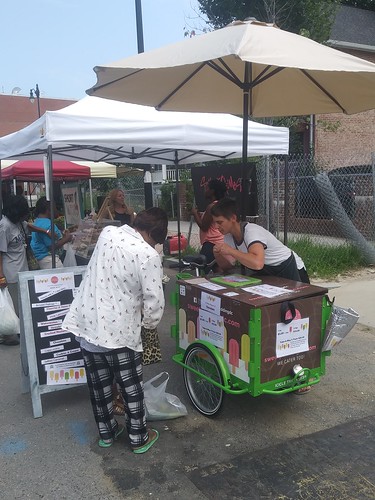
A locally made popsicle vendor at the Petworth Farmers MarketArtisan popsicles being sold at the Petworth Farmers Market.

Where availability of space is an issue, even ice cream food trucks and vending carts may be worth considering as an alternative to no such provision at all.

Labels: , , , ,

Thursday, February 06, 2025

Church and social spaces: grant opportunity

Holy Trinity Roman Catholic Church in Duquesne, Pennsylvania. Photo: Matthew Christopher, Abandoned America.  From "Why Are There So Many Abandoned Churches?," Atlas Obscura.

My writings on churches have been somewhat negative, shaped by my agnosticism-atheism, and my experience in DC, where many churches built large property portfolios that they didn't take care of, bought buildings to tear them down for parking, and the phenomenon of urban church closure, abetted by the high cost of maintenance and repair, alongside neighborhood change and suburban outmigration, etc.  

-- "Churches, community, religion and change," 2012/2015

Note that Washington Post columnist Perry Bacon Jr. lamented not wanting the religious part of church but still wanting the connection ("I left the church — and now long for a ‘church for the nones’" and letters to the editor, "Perry Bacon is not alone in his search for connection without church").

I am not religious, but I definitely respect the social justice strain of Christianity.  In DC, there is the Sojourners group, and also Luther Place Memorial Church (Evangelical Lutheran), which in the 1980s started leveraging their property portfolio on Thomas Circle to house people in need. There are probably more positive examples than I realize, and that's the case in many cities across the country.

Sign on what is mutual aid at the Steinbruck Center for Social Justicer at Luther Place.

I've written about third spaces ("Third Place Issues," 2024), including how church social halls helped the nascent DC punk music scene develop in the 1970s and 1980s, where social halls were the venue for all ages concerts.

Last year, Eerdman's published Gone for Good: Negotiating the Coming Wave of Church Property Transition. It asks the very good question about what do you do with church spaces, especially those serving community purposes, when a church closes?  Who picks up the slack, if anyone? (Interview)

Note that there is the phenomenon of the "non church" ex-religious building still used for community events, like the 6th and I Synagogue in DC ("Born Again," Washingtonian).  This, the Atlanta Freethought Society ("Smyrna Atheist Helps Revive 140-Year-Old Primitive Baptist Church," Patch), and the Washington Ethical Society, an offshoot of the Unitarian-Universalist Church, is probably what Perry Bacon is looking for.

That's a provocative question, making me more aware of my previous bias.  

I realized that my thinking about "the church in the city" was too narrow, and at the same time, how to translate the idea or concept of social infrastructure as laid out by Eric Klinenberg in Palaces for the People: How Social Infrastructure Can Help Fight Inequality, Polarization, and the Decline of Civic Life could use examples of religious facilities as part of the exploration into facilities and programming that could make social infrastructure real.  This is a long term writing project.

The idea of facilities and programming isn't different from my writings on how to support the development and maintenance of a local arts ecosystem.

-- "Reprinting with a slight update, 'Arts, culture districts and revitalization'," 2009/2019

Church Brew Works, Pittsburgh.

Note that one trend in church recapture in the face of abandonment has been conversion to housing ("These old Maine churches are being transformed into homes," Bangor Daily News, although DC has had instances of this since the 1980s) or other types of for profit development ("As Hundreds of Churches Sit Empty, Some Become Hotels and Restaurants," New York Times).

Like the Church Brew Works in Pittsburgh (which is pretty cool--but its creation led the Cardinal of the Milwaukee diocese to put strict restrictions on what could go into sold off church property, "What to do with a closed church? Why, you sell it, of course," AP); and we stayed in an airbnb in a converted church in Savannah once, as well).  Also see "What should we do with all of those empty churches?," BigThink.

=============

Because time is of the essence, I thought it would be worth bringing this up even though I'm nowhere near the stage of a review because the National Fund for Sacred Places has a small grant fund:

Apply by Mar 15, 2025 

to provid[e] technical and financial support for congregations to repair or improve the functionality of their community spaces. To apply for the grant, the space must have been originally built to be a house of worship and owned by a faith community; the congregation must be at least three years old; the property must possess historical, cultural, or architectural significance; and the congregation must be community-minded and serve nonmembers, among a few other considerations.

Labels: , , , , , , , ,

Wednesday, February 28, 2024

Third place issues

Third places are what we might call community hubs. It's a term popularized by Ray Oldenburg in a book of the same title.

-- Third places” as community builders, Brookings
-- "Third places, true citizen spaces," UNESCO

Robert Putnam, Bowling Alone.  There is a documentary out, "Join or Die," featuring Robert Putnam, who has been writing about this for decades ("A Forthcoming Documentary Examines How Civic Life in America Is a Matter of ‘Join or Die’," Colossal).

A lot of the time they are commodified spaces, places where you have to spend money to participate.  Notably examples are England's pubs ("Community pubs campaign," Plunkett Foundation, "U.K. pubs struggle to survive as work, leisure habits shift," Los Angeles Times), Viennese coffee shops, and neighborhood cafes in France especially Paris.  
“There’s a true sense of community that falls away when pubs disappear,” she says. “You lose a sense of history.” Given the crucial role that pubs have played in local neighborhoods, it’s perhaps no surprise that some communities have stepped in themselves to keep the lights on. 

When the Step pub in north London closed in 2020, there was an outcry as property developers tried to take it over, leading Dan Jones, a resident of four years, to consider a different solution: “Why don’t we try and buy it as a community?” 

He began handing out fliers and, in a matter of weeks, “very quickly realized there was a large appetite” to enact his plan. Hundreds of people pledged to invest in a fundraising campaign, and within four weeks, the effort raised $357,000 — far in excess of the $319,000 goal — which was topped up by a government grant of $382,000. “It took us by surprise, the speed at which we were able to raise the money and the fact that we got over target,” Jones says.
... Keeping prices low — a pint of beer costs from $6, compared with $9 at many London pubs — and offering the space for free to community groups and activities including kids’ clubs, Italian classes and local folk musicians has eased concerns about gentrification and fostered new connections, Gadsby Peet says.

And corner stores, which in the cities like New York, continue on as bodegas ("What Makes A New York City Convenience Store A Bodega," Tasting Table).

Social halls.  In the US, there were/are some uncommodified spaces like churches, church social halls (where the DC punk movement got its start), old political precincts and ward halls, and ethnic based associations and meeting halls, like German American groups, or the "Chinese associations" in US Chinatowns ("How COVID and anti-Asian hate conspired to gut family associations in Chinatown," San Francisco Chronicle).  

I have written about how many Salt Lake neighborhoods have what I call "neighborliness," with community events like movies in the park, pot lucks, and 4th of July parades, which I think comes from the Mormons and their organizing around their church.

Music places (""Ground up (guerrilla) art #2: community halls and music (among other things)."," 2011).

Community/recreation centers can do it too.  But not usually.  Programming is key.  Jewish Community Centers are another form.  Like the 92nd Street Y in New York City.

Photo from "The Pennsylvania Horticultural Society Announces the Seasonal Re-Opening of PHS Pop Up Gardens in Manayunk and South Street ," Philadelphia RowHome Magazine.

Beer Gardens.  The Philadelphia Horticultural Society, followed by the city parks system, has been a leader in creating pop up beer gardens as community revitalization levers.

The Wall Street Journal had a good article on parks, "Cities' Message to Young Families: Play and Stay--New Features Include Parks, Playgrounds and Beer Gardens," (also) and I was struck by the description of what we might call a blending of business and park, specifically food and beverage service, and that "beer gardens" are the most in-demand feature of new parks ("Commerce as the engine of urbanism and parks," 2014).

I guess it makes sense, given the historical connection to beer production, that Milwaukee County in Wisconsin has beer gardens in some of their parks, and a traveling beer garden park promotion program.

This reminds me of the comment by Professor Alex Wall, who wrote a book about Victor Gruen, one of the leaders in the development of shopping malls, which is:

"Commerce is the engine of urbanism."

Union halls and fraternal organizations too (like the Masons).  Also see "Back to school #2: education unions should create multifaceted public education "meeting halls" comparable to AIA chapter "architecture centers"" (2016).  Plus veterans and the American Legion and VFW halls ("Social organizations and aging: The benefits of VFW membership," KU thesis).

These kinds of institutions have waned as society has become more individualized and nuclear family focused, but also as the organization of business activity has changed.  For example, in once industrial cities like  Baltimore or Pittsburgh you had lots of neighborhood bars, not unlike England's pubs, catering to people who did shift work, as plants often operated 24 hours/day.  Same with breakfast places/diners.

Membership libraries.  Before public institutions like libraries, a number of communities had membership libraries like the Free Library of Philadelphia, and multi-faceted cultural organizations called an Athenaeum in cities like Boston, Hartford, and Alexandria, Virginia--all are still going strong.

There was a membership library in DC called Provisions that attempted this model. They have since affiliated with George Mason University in the suburbs.


Increasingly, regular libraries too are that third place, although few have coffee shops, and there aren't many opportunities for interaction along the line of"social bridge" concepts ("Outdoor library book sale as an opportunity for "social bridging"/triangulation").  You're with people, but alone.

William H. Whyte and "triangulation."  Whyte, who had been editor of Fortune Magazine, became interested in cities and public space, and pioneered methods of urban observation, including filming people and how they used public space.  He wrote a couple of very important books on cities and activation, The Social Life of Small Urban Places and The City: Rediscovering the Center.

One of his concepts is what he called "triangulation," where people who didn't know each other talk to each other.  Triangulation is the process: 
in which a stimulus provides a social bond between people. Strangers are more likely to talk to one another in the presence of such a stimulus. The stimulus might be musicians, or street entertainers, or apiece of outdoor sculpture. Museum professionals will note the relation of these stimuli to landmark exhibits which have a similar effect.

Anne Lusk, in her dissertation on greenways, calls this a social bridge. and I like that term better, it sounds less "social science-y." 

Book clubs.... Some of the libraries in Salt Lake County have cookbook clubs, where people cook a recipe from a chosen book and share the results in a pot luck.

Mixed use civic assets.  This article outlines a fair number of mixed use examples of civic assets promoting third place type community building.

-- "Update: Neighborhood libraries as nodes in a neighborhood and city-wide network of cultural assets," 2019

College student unions.  Are great models for community spaces ("Building community in student unions," KSU thesis, " STUDENT UNIONS ARE CHANGING LIVES BY DESIGN!," LPA Design Studios). 

Goucher College in Baltimore County calls its an athenaeum too.  

The building combines the college’s main library and student activities center. Besides the campus library, the building has spaces for performances, lectures, and other events, an art gallery, the campus center for community service and multicultural affairs, fitness facilities, meeting and study spaces, and a café..

Art Gallery memberships.  Same goes for museums.  Membership has privileges, people can hang in galleries, etc., like at the Phillips Collection in DC.

Social property.  Our market system isn't set up well for nonprofit properties, the BTMFBA writings, not withstanding.

There aren't really institutions around to keep such facilities going although many people do it on a more individualized cooperative type structure, like BloomBars in Columbia Heights, and in Takoma, Electric Maid Community Exchange ("'Third places' strengthen community. Here's how we can rebuild them," WBUR/NPR), snd the Rhizome art space.

In Salt Lake there is the example of the Mestizo Institute of Culture and the Arts, but I think it's slimmed down a lot of those functions.  It's still cool conceptually ("Artists create ‘love letters’ to Salt Lake City’s west side," Salt Lake Tribune).  

El Libro Mobile in Santa Ana/Orange County is cool too, with both physical popups and other activities.

Settlement houses.  Another type of social property are the old "settlement houses" that were common to the big cities in the late 1800s into the 1900s.  Neighborhood House is a remnant of this movement still active in Salt Lake City.

Alone together: Today's coffee shop is the primary third place, and to a lesser extent the bookstore/cafe.  Now, probably the most prominent third place in the US is the coffee shop--over the last 30+ years "coffee culture" has developed, with a big push by Starbucks, in the US in the place of bars.   

But lots of commodification, and a very specific aesthetic, called the Global Village Coffeehouse.  Still, while there are a lot of chains, and some failed chains, there has been room for independents to make their place within this ecosystem.  Most bigger cities have an array of cool places.

But there's a lot of bad coffee out there too.  We're looking at you Starbucks!  But they provide the third space.

Note they have a more bar-ry night-time concept too, ("'Evenings' at Starbucks: Coffee shop to sell wine, craft beer, small plates," USA Today).  

Xando's 19th Street, photo: Keith Stanley.

That's what Xando/Cozi did, at least in DC in the 90s.  It was cool, they had stores at each end of Dupont Circle, and we made friends with some of the staff, etc. ("Coffee, with a twist," Washington Post, 1997, "New battle brews in coffee war," Washington Business Journal).   

For a long time they had excellent bagels that were square and baked in a wood oven in house.  Maybe 10 years ago, they went to regular and the magic was over.  But the company never figured out how to manage.

They had food throughout the day that was better than a regular coffee shop, plus alcohol at night.

Bookstores are great for hanging and attending events.  Not sure about making "social bridges."  Bur a lot of Barnes & Nobles have cafes (and books and periodicals!).  Fortunately most cities of at least a medium size have some decent independent bookstores that sponsor events, etc.

Inside The Cloud Room, a co-working space in Seattle’s Capitol Hill neighborhood that is thriving as workers seek a space that is not home and not the office. (GeekWire Photo / Kurt Schlosser)

WeWork/Shared Spaces/Co-working. The WeWork "hot desk" phenomenon too is an element of creating third spaces, although definitely for a profit. 

People don't always want to be isolated and alone ("Even as WeWork goes bankrupt, co-working is poised to survive and thrive in other spaces," GeekWire, "sIkea is betting you'll come to its coworking space in a mall, then shop at one of its stores," Business Insider).

Project for Public Spaces: The Power of 10.  PPS addresses placemaking at multiple scales.  One concept is the "power of 10," where places need multiple elements to not only attract people, but to keep them there, and keep them coming back.


Third Place issues around the country

Salt Lake backyard concerts.  In Salt Lake, some residents have organized backyard concerts, with small ticket charges to pay the artists.  After complaints ("A 23-year musical neighborhood tradition goes quiet on Kensington," Building Salt Lake) in one neighborhood ("Thinking about the opportunities for success with neighborhood commercial districts: comparing Manor Park in DC to 15th and 15th in Salt Lake," ) the city said it was illegal.  

Instead, the city should have figured out how to make it legal, with mitigation.

Washington State corner stores and cafes ("WA bill to build community through neighborhood cafes faces roadblock," Seattle Times).  There is an initiative to make zoning at the state level more amenable to corner store legalization to deal with third place issues.  But there's pushback.

FWIW, I learned a lot from a coffee shop in a strip center in West Seattle.  That you can have a cool space, even if the exterior is dull.  Buildings are envelopes.

-- "More thoughts on suburban hipness (it's really about commercial hipness generally, not urban vs. suburban)," 2013
-- "BTMFBA Chronicles: Seattle coffee shop raises money to buy its building," 2018

This came up in DC many years ago.  There are two problems.  You need a few thousand people to make the business work, and most neighborhoods don't have that kind of density.  Cost of property is expensive.  But there are some in DC still, more remnants of the previous era not new initiatives like Broad Branch Market and Mott's Market in Capitol Hill ("Revisiting Mott's Market corner store in Capitol Hill DC: residents buy the building after all," 2022).

Photo: "D.C.’s As You Are bar issues fundraising appeal to prevent closure," Washington Blade.

Gay bars as safe spaces.  I am really embarrassed that a few years ago I wrote about the decline of LGBTQ+ third places in terms of assimilation. 

 Obviously, Republican states are proving that it can be very difficult out there for people who seemingly are against "the norm"  ("House Republicans are adding dozens of anti-LGBTQ+ measures to must-pass bills," the 19th, "Republicans Are Winning Their War on LGBTQ Rights," The New Republic, "Don't take gay marriage for granted," Boston Globe, "Greg Abbott tells U.N. to 'go pound sand' over concerns about LGBTQ+ rights in Texas," San Antonio Current, "Voters ban Pride flags on city property in California beach town. ‘It sets a tone’ " Sacramento Bee).

 Safe spaces are needed ("The number of gay bars has dwindled. A new generation plans to bring them back," Washington Post).

The Post reports, "D.C.’s ‘queer living room’ was struggling. Then came $150K in donations," how one such bar facing closure on Capitol Hill raised over $150,000 to stay open.  From the article:

As You Are, a combination cafe and bar, has played a unique role for the queer community since it opened on a corner of Barracks Row in March 2022. Unlike many LGBTQ+ entertainment spaces, it focuses on more than just nightlife and emphasizes consent in all interactions. A downstairs area is set up as a coffee shop, with stacks of board games in a corner, while a bar and dance floor upstairs are used for events such as disco nights and karaoke. Some have described the establishment as a “queer living room” where everyone is not only welcome, but actively embraced. 

But the business has faced numerous financial challenges since its opening, including a delayed launch and a slow period last summer. Nearly two years in, Pike and their co-owner and spouse, Jo McDaniel, found themselves with roughly $150,000 of debt. They realized on Feb. 5 that they had to catch up on their tax payments to be eligible for D.C.-administered grants.

National Christian Church, Thomas Circle, Washington, DC.

... Pike and McDaniel said they asked their landlord to renegotiate their $27,000-per-month rent to be based on sales, but were denied. At one point, they said, their real estate company sent them the wrong account number for a wire transfer. They still have not gotten back $18,000 of the payment they made to that incorrect account, they said. 

Rueben Bajaj, their landlord, declined to discuss the details of his interactions with Pike and McDaniel but said his company has had “ongoing conversations” with them and “provided solutions.” Bajaj contributed $500 to the fundraiser because, he said, “I personally want to see As You Are succeed.”

The Washington Blade reports another bar will be opening in a couple months on 14th Street ("New gay bar on 14th Street to open in April").  From the article:

“This new venue, catering especially to the LGBTQ+ community, offers a cozy, inclusive space that reminisces about the times of record stores and basement hangouts with friends,” the statement says. “In its past life as a music store and radio supply shop, Crush transforms its legacy into a modern-day haven,” the statement continues. “It features top-notch DJ booths, a dance floor and a summer garden, alongside a premium sound system to ensure every night is memorable.”

Rutstein told the Washington Blade the new bar will have a capacity of accommodating 300 people on its two floors. He notes that the name ‘Crush” stems from the romantic crush that people often have for one another and his and Rutgers’ new bar is aimed at providing a friendly space for people to meet and socialize. 

“We’re looking to be inclusive to everyone,” Rutstein said. “It’s certainly going to be heavy on the LGBT community” because he and Rutgers have been part of that community for many years. But he added, “We want to be inclusive to gays and lesbians being able to bring their friends and allies in along with them and not feel weird about it.”

Photo: Under the Umbrella

Which reminds me that an LGBTQ+ book store opened in Salt Lake.  

Again, it's not about assimilation as much as it is that people need supports on that continuum of their journey/age cohort, etc. ("Why we love Under the Umbrella, Salt Lake City’s little queer bookstore," USA Today). From the article:

What’s your store’s story? 

Under the Umbrella Bookstore is your local queer bookstore. No other bookstore in the area specifically caters to the queer community, providing a safe space for queer folks of all ages to congregate and celebrate their stories. Under the Umbrella is meant to help bridge the gap between what Salt Lake City currently has and what the city needs by providing a safe, accessible, and inclusive space for everyone. Utah is predominantly white, which means there are even fewer places where the safety and comfort of queer people of color are prioritized.

And a sports bar ("The Locker Room: Salt Lake City's first gay sports bar," Salt Lake Tribune). 

The McDonald's inside Scarborough's Cedarbrae Mall will be closing at the end of February after 18 years. Andrew Francis Wallace Toronto Star.

Toronto: Closing of McDonalds stores in neighborhood shopping centers.  The Toronto Star writes, "When a neighbourhood mall McDonald's closes, more than food disappears,," about how the closure of McDonald's restaurants in area malls inadvertently reduces options for seniors  Some letter writers weigh in as well, "We need more community spaces geared to seniors."  From the article:

On the surface, it’s not sad news when a multibillion-dollar fast-food conglomerate closes a handful of locations (Scarborough is a culinary paradise, after all). But consider the role these spots located inside neighbourhood malls play in areas lacking places for people to gather, chat and evade freezing temperatures or the blazing sun. 

While I wait for my breakfast, two older men behind me shove coins into each other’s hands, refusing to let the other pay for their coffee. The cashier looks on in amusement, clearly having witnessed this routine before. 

That’s the charm of these neighbourhood malls, characterized by one or two anchor tenants – usually a department store, gym, supermarket or standalone fast-food joint – and non-chain retailers, as well as doctors’ and government offices. These malls aren’t destinations for luxury shopping, Instagram-friendly backdrops and ticketed “immersive experiences,” but rather they’re where local residents run errands and are able to hang out with friends for hours for the price of a $2 cup of coffee, a relatively low barrier in an increasingly unaffordable city.

... “(There were a lot of) seniors with their coffees sitting for hours,” he recalls, describing the scene at the now-defunct Eglinton Square McDonald’s. “It brings communities together like a coffee shop. It’s a reason to go out and come together when you didn’t have a lot of money. ... Whether you’re in high school or a senior, it’s the place to be. ... With Cedarbrae (Mall), Cedarbrae Collegiate (Institute) is right behind it, so thousands of kids over the years have been to that McDonald’s.”

New York City Puerto Rican neighborhood social club.   Last year in the food section, the New York Times ran a story on the perseverance of a Puerto Rican social club in the face of a changing neighborhood ("Her Social Club Isn’t Going Anywhere. Toñita Has No Plans to Quit.").

In a part of Williamsburg, Brooklyn, that has been transformed in recent years by modern apartment buildings and fast-casual restaurants, a nondescript door on Grand Street is the entrance to Toñita’s, one of the last Puerto Rican outposts of its kind in New York City. 

Here, the customers drink $3 beers and play dominoes, or sit around and chat over free plates of food like arroz con gandules. The walls are crowded with Puerto Rican flags and portraits of the bar’s owner and matriarchal figure, 

Social clubs like Toñita’s are popular in Puerto Rico and Cuba. Photo: José A. Alvarado Jr. for The New York Times.

Maria Antonia Cay, who is more commonly known as Toñita. She opened the place in the 1970s as the Caribbean Social Club, a members-only hangout for the neighborhood baseball team. In 2000, she obtained a liquor license and opened the spot to everyone for cheap drinks and pots of Puerto Rican dishes that she makes in her apartment kitchen upstairs. (She bought the building decades ago.) “It reminds me of home,” said Djali Brown-Cepeda, an archivist and filmmaker who runs the Nuevayorkinos Instagram account. 

As neighborhoods like Williamsburg gentrify and businesses owned and frequented by people of color close, many of the people who grew up there fear they’ll lose the community outposts where they can speak Spanish, dance and play games. Ms. Cay said she has been offered millions of dollars for the building but will not sell.

Reading at the Astin Beer Company.

Silent book clubs.  Is a thing ("Silent Book Club gains traction in the Pittsburgh region," Pittsburgh Tribune).  From the article:

The rules of Silent Book Club are simple: No assigned reading, no homework and no small talk required. Members are expected to show up at a designated meeting place with whatever title they’re enjoying, sit and read. 

They can share thoughts if they want, but they don’t have to. The concept has revitalized the idea of joining a book club. It’s paradise for introverted readers and book vigilantes who don’t like the rules of traditional book clubs.

Civic assets as public facing opportunities for civic engagement and promotion of democracy.  Am working on this wrt the Park I'm on the board of in Salt Lake in terms of volunteerism and meeting opportunities, as well as a proposal to the City Library to create a combination Dallas Public Library Urban Information Center and technical assistance center, with training opportunities, showing webinars from publications like Chronicle of Philanthropy, etc.

-- "Community cleanups and other activities as community building and civic engagement activities," which is somewhat misnamed as it discusses various types of spaces," 2011
-- "The layering effect: how the building blocks of an integrated public realm set the stage for community building and Silver Spring, Maryland as an example," 2012

David Barth, AECOM

Creating places for social interaction/social bridges/triangulation.  There's an article, "‘Sticky’ places are urban planning lifelines Shared spaces build community and are key to alleviating America’s loneliness epidemic. Here’s how to create them.," in the Boston Globe about the design of spaces like parks in ways that foster interaction and connection.  From the article:
Connelly leaned on a newly purchased volleyball net, a ball, and a powerful resource: the public park. Public spaces, which served as a lifeline for people during the pandemic, can be more thoughtfully designed to better foster human connection and combat loneliness. 

After corralling friends for a casual volleyball game, Connelly headed to a grassy spot in Lincoln Park, across the street from her apartment in Somerville. Several passersby, observing the group’s overhand serves and obvious camaraderie, asked to join the game. As Connelly, her friends, and their soon-to-be friends cleaned up the net after playing, they started a group chat to coordinate play times, resulting in what is now a group of more than 500 community members, and growing, who get together almost daily to socialize and play volleyball. 

... As an urban designer advocating for more sustainable, livable, and equitable cities, I hear communities express the need for sticky public spaces daily. To create them, I work with people across Greater Boston to transform unused storefronts into temporary vibrant social infrastructure, like community pop-ups that host regular events and serve as communal living rooms. 

These spaces make people feel welcome, represented, and connected to their neighborhoods, and this, in turn, builds social connections between visitors. Though the Lincoln Park volleyball group formed organically, it was no accident. The park was designed to spur the interactions that allowed the spontaneous group to grow. In 2018, the City of Somerville renovated the park, turning it from baseball fields into a lively space with a skate park, parkour area, basketball court, multiple playgrounds, hammock poles, a community garden, and much more. 

In the park’s redesign, these areas flow into one another — for example, the central path cuts through the skate park — creating connections between uses and users. 

 ... The park is also well integrated into the dense neighborhood of multifamily homes that surrounds it. On streets that dead-end at the park, the sidewalks continue without gates or other barriers. This confluence of environmental and programmatic design creates a park that is sticky. 

 ... Social infrastructure, like physical infrastructure, requires upkeep, investment, and adaptation. All communities deserve to have local public spaces that are designed to be sticky. Just as cities determine which roads and bridges need repair, so should they assess where their social infrastructure is lacking. 

City leaders can start by asking community members to finish the sentence “I wish I had a place to . . . " They can then take what they hear and use whatever space is available — an extra room in a library, a disused municipal building, even a parking lot — to create that place.

-- CultureHouse,  

Labels: , , , , , , ,