Rebuilding Place in the Urban Space

"A community’s physical form, rather than its land uses, is its most intrinsic and enduring characteristic." [Katz, EPA] This blog focuses on place and placemaking and all that makes it work--historic preservation, urban design, transportation, asset-based community development, arts & cultural development, commercial district revitalization, tourism & destination development, and quality of life advocacy--along with doses of civic engagement and good governance watchdogging.

Tuesday, March 03, 2026

School closures and neighborhood effects

Given the decline in the number of school aged children, and outmigration from cities, school districts such as in Washington, DC, Chicago, and Philadelphia have been closing schools for decades.

The rational planning part of me is in favor because of the need to spend money efficiently, have enough students to be able to offer a wider range of programs, etc.

But the other side of my rational planning part also acknowledges that school closures have negative impact on neighborhoods, that elementary schools in particular are building blocks for neighborhoods (along with libraries).  

And that sports programs at the high school level can engender community pride, etc.

I pointed out this contradiction starting in 2011:

-- "One way in which community planning is completely backwards," 2011
-- "Missing the most important point about Clifton School closure in Fairfax County," 2011
-- "Rethinking community planning around maintaining neighborhood civic assets and anchors," 2011
-- "The bilingual Key Elementary School in Arlington County as another example of the "upsidedownness" of community planning," 2019
-- "National Community Planning Month: Schools as neighborhood anchors," 2022
-- "School closure and consolidation planning needs to focus on integration planning at the outset as a separate process," 2023

I suggested that cities ought to consider subsidizing continued school operation in some communities as a stabilization and revitalization measure.

Philadelphia is going through another round of school closure ("City Council members grill school district officials on plan to close 20 schools — and superintendent says he could have closed 40." Philadelphia Inquirer) and an op-ed about this "It’s not just about schools. It’s about neighborhoods," makes the same point as I did, but she describes better the effects of a school within a neighborhood beyond the curriculum.  From the article:

The conflict playing out in Philadelphia isn’t only about schools. It’s about the fact that the school district and City Council have different responsibilities for the same places, and the new facilities plan brings that conflict into sharp focus./p>

The facilities plan is doing exactly what it was designed to do. The trouble is that everything it was not designed to do.

A Philadelphia neighborhood school isn’t just one institution. It’s four, sharing an address. There’s the instructional platform: courses, teachers, schedules, the district’s domain. There’s the civic anchor: the building that signals to a neighborhood that its children count, and they belong. There’s the distribution node: where meals are served, where social workers operate, and where there is, most days, someone watching. And there’s the pathway to the future: where a counselor knows a family by name, where a student learns there’s a college or a trade or a life beyond the block.

... When that school building closes, all of those other things close with it. Some of those functions were formal educational programs. Others accumulated because families had nowhere else to go for them. The school became the place where paperwork was explained, problems were addressed and solved, and someone always knew which door to knock on next.

City Council doesn’t get to vote on the facilities plan, but it funds roughly 40% of the district’s $2 billion budget.

... What closes with a school building is not limited to instruction. Council’s budget is the instrument for the functions the facilities plan does not govern: housing investment, community infrastructure, colocated services, and neighborhood anchors that exist independent of school enrollment.

The conclusion to the article is succinct.

The district’s plan answers an educational question. What replaces the neighborhood functions housed in those buildings is a civic one.

That answer does not sit with the school district.

Recommendation.  School systems need to work more closely with city planning departments, to ensure decisions are made in a manner that promotes neighborhood stabilization and improvement.  If necessary, could funds be identified that could be provided to keep certain schools open, and to improve enrollments to make it more financially efficacious for doing so.

Labels: , , , , , ,

Thursday, May 01, 2025

63 things to do during National Historic Preservation Month

Over the years, originally inspired by a "what you can do" list by Preservation Action Council of San Jose, I've developed a four-part series on what people can do to "celebrate" National Preservation Month.  There are 60 items across the posts, ranging from visiting a historic district to watching a film in a historic theater.

Rather than reprint them in full--recognize that some of the links in previous pieces may be out of date--here are the entries.

-- "May is Historic Preservation Month: 60 ways to celebrate | Part 1: Cultural Heritage Tourism (1-19)," (2019)

1.  Resources for Cultural Heritage Tourism Travel. Magazines like Southern Living, Yankee and Sunset.  Bookstores.  Visitor Centers.  Historic preservation organizations.  Local chapters of the American Institute of Architects, and sometimes the American Society of Landscape Architects.  When traveling, library special collections.

2. Stay at a historic hotel in the city or a bed and breakfast located in a historic district. For example, the Tabard Inn in the Dupont Circle Historic District is one of the most romantic places in the city to have weekend brunch--out on the patio, during the spring, summer, and fall.

3.  When you visit other places, check out how they deal with historic preservation matters, and share that learning when you come back. For example, every fall, Pasadena Heritage sponsors Craftsman Weekend, in honor of its bungalow heritage.

4. Don't forget to check out traditional commercial districts, antique shops, other stores, cinemas, theaters, concert halls, restaurants, historic cemeteries, etc. as a regular part of your travel itinerary.

5. Check out a historic library building/Central Library.  Another great place to learn about a community when you're traveling is the main library.  Some of the buildings are historic, others more recently are majestic new construction buildings very much worth visiting.  .

6. Visit historic sites.  Many people visit historic sites when traveling.  Across the United States, ("The shortest route to America's 49603 historic sites," Washington Post) there are almost 90,000 places listed on the National Register of Historic Places.

7. Go see a museum exhibit relevant to urban history, even if it's on a seemingly broader topic. When people travel, and "consume" locally available museums, usually people's trips start and end with the local arts museum.

8.  Walking and building tours.  Many communities have organized walking tours for historic areas. Some print booklets for self-guided tours, many places have smartphone tour apps, and cities often have historic marker and trails programs.

9. Bicycle touring.  Bikes are a great way to cover a lot of ground more quickly.  And it's less tiring to bike than it is to walk.  Many cities have bike rental operations (there is a loosely affiliated group called "Bike and Roll" operating in many cities).  And some hotels and B&Bs make bicycles available to their guests.  (There are even apps for renting bikes directly from individuals, like Spinlister, which can be cheaper than the bike rental places.)

10.  Transit as a way to get around.  While not many cities in the US do this, many European cities set up or promote specific transit services as a way to tour parts of the city, usually a set of tourist-oriented attractions in the core ("Travel around the city by tram," Visit Helsinki).

If you're already familiar with how to use transit, it usually isn't hard to figure out how to use another transit system.  If you don't regularly ride transit, likely people will be happy to help you.

11.  When we travel, we like to visit house museums.  For example, the Woodford Mansion in Philadelphia is really cool, and Savannah has many different house museums that you can visit, the most notorious being the Mercer-Williams House.  Most cities have at least one.  Los Angeles has just reopened the Hollyhock House.

12. Arguably, "antiquing" which for me includes ephemera, can be a form of historical/historic preservation-related research and is deserving of a separate entry.

While traveling, you may wish to check out reclaimed building materials stores too.  You'll probably have to do some digging to find such organizations, but offhand I know there are such places in New York City, DC (Suburban Maryland), Baltimore, Pittsburgh, Minneapolis, Detroit, York and Scranton, Pennsylvania, etc., plus the various Re:stores run by local affiliates of Habitat for Humanity.

13.  Visit a historic railroad station, bus terminal and/or a transportation museum.   There are many fabulous extant railroad stations, many no longer in use, in so many cities.2013 was the 100th anniversary of Grand Central Station in New York City, and in Chicago, Denver, and Los Angeles new master planning and/or construction improvement projects for stations in those cities are underway.

14. Visit a streetcar museum.   Many communities have streetcar/transit museums such as the Baltimore Streetcar Museum and the National Capital Trolley Museum  in Montgomery County, Maryland in this area.  So try to ride a historic streetcar as well.

15.  Ride a streetcar system in active service. Some places run heritage streetcars in active service.  Everyone knows about the streetcars in New Orleans (and that system continues to expand in bits and pieces).

16. Tour a historic trail, road, railroad, canal, park network, or parkway/greenway.

17.  Garden Tourism. Garden tourism has two different strands.

18. Ride a passenger rail train.  Ride a passenger railroad (commuter) train.  In the DC region, that means MARC or VRE.  In Greater New York, New Jersey, Philadelphia (SEPTA), Chicago, and Boston (as well as Toronto and Montreal), Southern California, Northern California and elsewhere commuter railroads provide passenger rail services once provided by private railroad companies.

19. Visit a national or state park. DC, for obvious reasons, has many nationally owned parks, the system of Fort Circle Parks works to preserve the forts built during the Civil War to protect the city from Confederate invasion. Fort Stevens, hidden behind a church on Georgia Avenue, around Quackenbos Street NW, was attacked by Confederate forces, and President Lincoln was up there and watched. Up Georgia Avenue a bit, close to Walter Reed Hospital, is a somewhat forlorn and neglected battlefield cemetery and monument honoring soldiers who died at the battle at Fort Stevens.

20. Take a boat trip on a local river.  Many cities have water-based tours or smaller scale water taxi systems.  Boston, Seattle, New York City, and San Francisco have working passenger ferry systems. The Staten Island Ferry is working transit that's free.

-- "May is Historic Preservation Month: 60 ways to celebrate | Part 2: Explore your community (20-36)," (2019)

21. Explore an older area of your community that you don't know. Go on a neighborhood or building tour. Check out a talk (not all of them cost money) at the National Building Museum.

Or just walk around a neighborhood with housing built before 1930.  Walking here and there around the core of Takoma Park, Maryland, we always come across attractive and unique houses.

22.  Many preservation groups sponsor neighborhood house tours.  On the first Sunday of May, Historic Takoma Park (DC and Maryland) has their annual house tour.

23.  Follow the path of a Heritage Trail such as one of the many "produced" by CulturalTourismDC in DC.

24. Shop at stores in commercial districts that are historically designated: i.e., Cleveland Park; Georgetown; Capitol Hill; Dupont Circle in DC, but there are so many across the country.
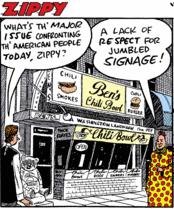
Frame, Zippy the Pinhead by Bill Griffith, Ben's Chili Bowl25. Eat in a restaurant in a historic building/historic district. Now 60+ years old, Ben's Chili Bowl is one of the few remaining restaurants in the city that is many decades old.  .. Readers have pointed out that Martin's Tavern in Georgetown and Cafe Mozart, a German restaurant downtown, are much older.

26. See a movie in a historic cinema building. There aren't many historic cinemas in DC proper any more, but the Uptown Theater in Cleveland Park is one.

27.  See a production in a "legitimate" historic theatre or concert hall.  You have many choices in the DC area such as the Warner, the National, the Studio Theatre, the Lincoln Theatre, the Shakespeare Theatre at the Landsburgh, the Atlas Performing Arts Center (which utilized federal historic preservation tax credits to pay for a portion of the building's rehabilitation), or the DAR Concert Hall.

28.  Even if you're an atheist, it can be fun to visit a historic church building, including checking out their stained glass windows (I am a big fan of stained glass).

29. Shop at a historic public food market. Eastern Market is DC's last remaining public food market building, built in 1873.  (Union Market is privately owned, and was constructed in the 1970s.)

30. Visit a historic cemetery. In DC, we have the Congressional Cemetery or the Rock Creek Church Cemetery at St. Paul's Episcopal Church, among others.  Brooklyn's Greenwood Cemetery is a standout.  Some cemeteries offer tours.

31. Check out an exhibit at a local history museum or historic site, such as at the Anacostia Community Museum or the Historical Society of Washington or one of the other house museums and historic sites in the city and region.

32. Walk the historic grounds of a local college or university.  In DC, Catholic University, Trinity, Georgetown, Howard, and Gallaudet have beautiful grounds and buildings.  Kendall Green at Gallaudet was designed by Frederick Law Olmsted.

33. Check out a monument or memorial in your community and learn more about it. We can't preserve what we don't understand or appreciate.

34. Visit a historic railroad or bus station, such as DC's Union Station. Designed by Daniel Burnham, it's an incredible example of the City Beautiful architectural movement. Check out chapters from Bill Wright's dissertation on Union Station. He's a great writer!

Railroad stations tend to be grand while older bus stations tend to be gnarly, which is an interesting commentary on the place of these respective modes in transportation history and practice.

35. Check out a historic library building.  Many cities have great library buildings that now qualify as historic.  A number of DC's libraries were built with support from the Carnegie Foundation (Northeast, Southeast, the old Carnegie Library downtown, Takoma, and Mount Pleasant, which is particularly gorgeous) as were more than 2,000 other libraries elsewhere in the US.

36. Take a boat trip on a local river.  The pontoon boat tours of the Anacostia River leaving from the Bladensburg Waterfront Park (in Prince George's County) dip into DC.  Many cities have water-based tours or smaller scale water taxi systems as well.

37. Explore historic preservation matters in your region, beyond the borders of your community.

-- "May is Historic Preservation Month: 60 ways to celebrate | Part 3: Learn and Get Involved (37-52)," (2019)

38. Learn about the history of your community. For example, for DC, read Dream City: Race, Power, and the Decline of Washington, D.C., 1964 -1994 and Between Justice and Beauty, and more.

39. Become a member of your citywide/countywide/regional preservation organizations such as the DC Preservation League, the Municipal Arts Society in New York City, Baltimore Preservation, Historic Districts Council in New York City, Cleveland Restoration Society, Preservation Resource Center of New Orleans, Landmark Society of Western New York (which serves Rochester, among other places), etc.  I am a big fan of the Chicago Bungalow Association.

40.  Before you get too involved, you might want to take the time to read your city, county, or state historic preservation plan.  This will educate you about preservation issues in your area.  (Although generally such plans are pretty positive, and don't go into enough detail about the "threats" nor do they outline ways to address "opportunities" in a process design approach.)

41. Learn about why historic preservation is important, in and of itself, as well as a urban revitalization strategy. The reason I am a strong supporter of preservation is that I have come to believe that it is the only approach to economically sustainable neighborhood and commercial district revitalization that works for the long haul.


42. Join a neighborhood/local preservation group, such as in DC the Capitol Hill Restoration Society, Historic Takoma, or Historic Mount Pleasant).

43.  Nationally, you can join the National Trust for Historic Preservation while you're at it. If you join, you can visit NT owned sites and affiliate organization museums at a discount/free, get discounts at Historic Hotels, and discounts on products you purchase.

44.  Preservation Action is a 501(c)4 advocacy group that advocates for specific legislation and is also a membership group.  Their "Preservation Advocacy Week" is held in March, where members lobby Members of Congress for legislation favorable to preservation.

45.  At the state level, most states have statewide preservation organizations.  In the DC-VA-MD area, that means Preservation Maryland and Preservation Virginia/Association for the Preservation of Virginia Antiquities, as well as the DC Preservation League.  Many sponsor annual or bi-annual conferences, journals, and other provide other resources.

46. Volunteer/1. Get involved in a preservation issue in your neighborhood or the city-county at large, which could include attending meetings of your local historic district/preservation commission, which in DC is the Historic Preservation Review Board, or working on a particular project affecting your neighborhood or city.

47. Volunteer/2, in a traditional commercial district revitalization initiative, at a history museum, or for a historic site.  A "division of the preservation movement" is the Main Street commercial district revitalization program, which links economic development with historic preservation focused on the revival of local commercial districts and downtowns in smaller communities.

48.  Volunteer/3, at a history museum, a historic park or at a historic site.  Museums and historic sites are always looking for volunteers, as our most park systems, including the National Park Service.  Many docents at sites and museums are volunteers.

-- Volunteer in Parks program, National Park Service

49. Work to preserve historic schools as schools.  The DC Public School system has an archives and museum that is also a meeting center, Sumner School, at 17th and M Streets NW.

50. Another way to learn a lot but very quickly is to attend a preservation conference such as the annual meeting of the National Trust for Historic Preservation (this year it's in Denver starting October 10th) and the National Main Street conference, which was held in Seattle in March, some sessions materials are available).

51. Check out the history resources at your local library or a specialized collection such as in DC at the Washingtoniana Collection at the Martin Luther King Central Library or the Peabody collection at the Georgetown Branch, the Kiplinger Library at the Historical Society of Washington, the Jewish Historical Society, or the Moorland-Spingarn Collection at Howard University.  Many city libraries have history collections.

52. Read a historic district brochure (or historic building or district nomination form).  In DC, they are available online or in hard copy at the Historic Preservation Office.  Many communities produce and publish these kinds of publications.  Two of the best I've ever read is one on Jefferson County Indiana including Madison (One of the first Main Street communities) and Hanover, and the other on the Kansas City public market, called City Market.  Both lay out their respective histories chronologically but thematically.

53.  I am a big fan of reading the design guidelines publications produced for cities or neighborhood historic districts, which describe local historic districts, such as those from Montgomery County Maryland, Richmond, Virginia, Roanoke, Virginia, and the Philadelphia Rowhouse Manual.  The Roanoke Virginia Residential Pattern Book is a stand out!

54.  Listen to a preservation focused podcast.  Podcasts--"radio shows" are a new addition to preservation-based media.  Preservation Maryland produces a great series, PreserveCast, which is worth checking out.

-- "May is Historic Preservation Month: 60 ways to celebrate | Part 4: Preservation At Home (53-60)," (2019)

55. If you own "an old house," and want to learn more about historically sympathetic renovation, why not subscribe to relevant magazines such as Old House Journal, Old House Interiors, American Bungalow, This Old House, Fine Homebuilding, etc.

56.  Publications on maintenance of historic houses.  

57.  Books to guide renovation.  

58.  Parts and appliance resources.  There are companies that specialize in "historic" parts.  For example, DEA Bathroom Machineries specialize in bathrooms, especially historic sinks.

59.  Most big cities have architectural salvage stores, for example in the DC area, it's Community Forklift.  In Baltimore, Loading Dock is a non-profit while Second Chance is a for profit.

60.  Workshops and expos.  It would be logical to have "Preservation Expos" during Preservation Month but it doesn't seem to be the case.  Historic Chicago Bungalow Association holds workshops most months, and has building expos too, from time to time.

61.  Activities for and with children.  If you have children in your life, how about doing an activity with them that is architecture-preservation related?

62. Television programming.  There are some HGTV/DIY network shows that are sympathetic to historic preservation, although the bulk of the shows are not.  Even the heralded "Fixer Upper," even if they renovate vacant houses, tends to homogenize the interior of a house into a gargantuan "open concept" house with a massive kitchen. 

But shows like "Rehab Attic," to some extent "Stone House Revival," and "American Rehab: Charleston" generally are pretty empathetic on historic preservation and can be a great source of ideas.  Lately I've been enamored by "Restored," featuring Brett Waterman working on houses in Riverside County, California.

Obviously, "This Old House," on PBS is the grand-daddy of all shows.  In my opinion, it's great for historic architecture and detailing, but the program tends to be more about supersizing houses, but doing a great job while you're doing so.  And they seem to let it slide when homeowners make decisions that somewhat cavalierly rip out historic elements in favor of modernization.

63.  Researching the history of your house.  There are people who will research this for you, but many city libraries have usable information and even may offer seminars on how to go about this.  Census records are one place, but more current records aren't accessible.

-- How to Research the History of Your House | This Old House
-- Internet Public Library: Research the History of Your House
-- Houses - The National Archives

Labels: , , , , , ,

Wednesday, March 12, 2025

Why Europe is going car free?

 Early in my days of pro center city advocacy, I was somewhat troubled about how advocates jumped on the ideas of Hans Monderman and the woonerf or shared street, streets designed to mix motor vehicles, pedestrians and cyclists, as a way to slow traffic and better balance mobility between the car and non motorized forms.

It wasn't because I don't believe in making pedestrian and bike trips better, but because the US physical environment is so dominated by the car and much of the nation's urban form, outside of the cities built up to the streetcar era ("Transportation and Urban Form: Stages in the Spatial Evolution of the American Metropolis") is shaped for the car.  In short, a woonerf, at least in the US, will still be dominated by the car, and worse, by mixing different types of traffic, it will create new conflicts.  

One place you see this in DC is at the Wharf, both on the boardwalk where there can be vehicles, and in the outer perimeter where there is a separate bicycle path, but it is crossed frequently by pedestrians getting to the sidewalk.  

For the boardwalk, they probably should have made all the service access underground.  WRT the cycletrack, it probably should have been further out into the street right of way.

There is an article in the Washington Post, "Why Europe is going ‘car free’," about congestion zones and low emissions zones for cars, (but not so much discussion of pedestrian districts in most major cities, which is a distinguishing condition between US cities and European ones).  That Europe is going car free while the US is not.

In one way, it's another example in the US of what I call "next generation asphalt nation," that instead of aiming to shift more traffic to sustainable modes, we are focusing on electric cars and maybe hydrogen powered heavy trucks, to be more environmentally conscious, when not driving is the best choice for the environment--note this is happening some as people switch from cars to electric bikes.

The amazing thing about so much of Europe is that it retains the "streetcar era" and "walking city era" urban form.  So you can go "car free" because your life is not harnessed to the car the way it is in the US--92% of all trips involve a car.

In short the author is making the same mistake as woonerf opponents.  Promote better policies where they can work.  Don't try to adopt other treatments without consideration and adaptation.

For example, people in DC talk about a congestion zone pricing scheme.  But DC, especially with the Trump Administration's destruction of government, has so many commercial district competitors in  the metropolitan area: Montgomery, Fairfax, Arlington, and Loudoun Counties, and Alexandria City, that businesses could easily pick up and leave.  That's much harder to do in NYC or London.

====

This came up today in the Park in SLC for which I am on the board.  A graduate student doing a design study of the park suggested grade separation of the walking and bicycle paths--the park is a one way loop road with smaller lanes for walking and biking, a motor vehicle lane, and a parking lane.  It works pretty well.


Parc La Fontaine, Montreal

I am embarrassed to say this didn't occur to me. It will probably take at least 5 years to try to pull off.  But it's worth trying.

Labels: , , , , ,

Thursday, February 06, 2025

Church and social spaces: grant opportunity

Holy Trinity Roman Catholic Church in Duquesne, Pennsylvania. Photo: Matthew Christopher, Abandoned America.  From "Why Are There So Many Abandoned Churches?," Atlas Obscura.

My writings on churches have been somewhat negative, shaped by my agnosticism-atheism, and my experience in DC, where many churches built large property portfolios that they didn't take care of, bought buildings to tear them down for parking, and the phenomenon of urban church closure, abetted by the high cost of maintenance and repair, alongside neighborhood change and suburban outmigration, etc.  

-- "Churches, community, religion and change," 2012/2015

Note that Washington Post columnist Perry Bacon Jr. lamented not wanting the religious part of church but still wanting the connection ("I left the church — and now long for a ‘church for the nones’" and letters to the editor, "Perry Bacon is not alone in his search for connection without church").

I am not religious, but I definitely respect the social justice strain of Christianity.  In DC, there is the Sojourners group, and also Luther Place Memorial Church (Evangelical Lutheran), which in the 1980s started leveraging their property portfolio on Thomas Circle to house people in need. There are probably more positive examples than I realize, and that's the case in many cities across the country.

Sign on what is mutual aid at the Steinbruck Center for Social Justicer at Luther Place.

I've written about third spaces ("Third Place Issues," 2024), including how church social halls helped the nascent DC punk music scene develop in the 1970s and 1980s, where social halls were the venue for all ages concerts.

Last year, Eerdman's published Gone for Good: Negotiating the Coming Wave of Church Property Transition. It asks the very good question about what do you do with church spaces, especially those serving community purposes, when a church closes?  Who picks up the slack, if anyone? (Interview)

Note that there is the phenomenon of the "non church" ex-religious building still used for community events, like the 6th and I Synagogue in DC ("Born Again," Washingtonian).  This, the Atlanta Freethought Society ("Smyrna Atheist Helps Revive 140-Year-Old Primitive Baptist Church," Patch), and the Washington Ethical Society, an offshoot of the Unitarian-Universalist Church, is probably what Perry Bacon is looking for.

That's a provocative question, making me more aware of my previous bias.  

I realized that my thinking about "the church in the city" was too narrow, and at the same time, how to translate the idea or concept of social infrastructure as laid out by Eric Klinenberg in Palaces for the People: How Social Infrastructure Can Help Fight Inequality, Polarization, and the Decline of Civic Life could use examples of religious facilities as part of the exploration into facilities and programming that could make social infrastructure real.  This is a long term writing project.

The idea of facilities and programming isn't different from my writings on how to support the development and maintenance of a local arts ecosystem.

-- "Reprinting with a slight update, 'Arts, culture districts and revitalization'," 2009/2019

Church Brew Works, Pittsburgh.

Note that one trend in church recapture in the face of abandonment has been conversion to housing ("These old Maine churches are being transformed into homes," Bangor Daily News, although DC has had instances of this since the 1980s) or other types of for profit development ("As Hundreds of Churches Sit Empty, Some Become Hotels and Restaurants," New York Times).

Like the Church Brew Works in Pittsburgh (which is pretty cool--but its creation led the Cardinal of the Milwaukee diocese to put strict restrictions on what could go into sold off church property, "What to do with a closed church? Why, you sell it, of course," AP); and we stayed in an airbnb in a converted church in Savannah once, as well).  Also see "What should we do with all of those empty churches?," BigThink.

=============

Because time is of the essence, I thought it would be worth bringing this up even though I'm nowhere near the stage of a review because the National Fund for Sacred Places has a small grant fund:

Apply by Mar 15, 2025 

to provid[e] technical and financial support for congregations to repair or improve the functionality of their community spaces. To apply for the grant, the space must have been originally built to be a house of worship and owned by a faith community; the congregation must be at least three years old; the property must possess historical, cultural, or architectural significance; and the congregation must be community-minded and serve nonmembers, among a few other considerations.

Labels: , , , , , , , ,

Wednesday, January 22, 2025

Urban planning when things are going well: DC, 2014 (The Office of Planning under Harriet Tregoning)

Oops.  When I do searches for articles within the blog, I come across articles that remain in draft form, as I never got around to finishing them.  This one is from February 2014.  Most of these drafts I delete, but this reads well and is worth publishing, even if it is 11 years late.

===============
Harriet Tregoning, the director of the DC office of planning, is leaving to take a position with the Obama Administration.  So there is a current article in the Post ("Departing DC planner Harriet Tregoning hailed as 'forward-thinking public servant") and a previous article in the City Paper ("Urbanista!: Inside Harriet Tregoning's Push to Reshape D.C.") which discuss how great she is.

Note that I like Harriet Tregoning a lot, and I love to talk about planning with her, but at the same time I try to be objective and analytical.

Planning as boundary spanning and serving multiple masters.  In textbooks on organizational psychology, behavior and development, there is an extended discussion of boundary spanning, where people have conflicting responsibilities to different groups with different priorities.  Planners are the classic example of boundary spanners.

Planners are beholden to their bosses, who are ultimately part of and beholden to the Growth Machine.  At the same time planners (and elected officials) are supposed to be helping the citizens. 

... it's a kind of contradiction as discussed in Planning the Capitalist City, where planners have to mediate between capital and the democratic impulse.  Property owners need assistance from the state in various ways to reduce risk and increase income, but it comes at the expense of public input into what they want.

Planning is about dealing with the future while residents mostly want things to stay the same.  At the same time, there is a different cleavage.  Planners are tasked with considering the future and dealing with it, not trying to prevent change necessarily, but instead working to manage it and mitigate and limit negative effects, in ways that are good for the city in general and neighborhoods specifically, simultaneously.

Growth and change is going to happen regardless, and so you need plans to deal with it.

Planners have dual responsibilities to satisfy simultaneously both city-wide and neighborhood goals and objectives.  Relatedly, in planning engagements, planners have two responsibilities, simultaneously dealing with "citywide" concerns as laid out in a master or comprehensive land use plan for the community, as well as neighborhood concerns, while residents typically only take responsibility for the latter.

Left: Central Perk coffee shop set from the Friends television show.  TV shows in the late 1990s and early part of the last decade showed urban living in a more favorable light than the suburban oriented shows from the 1970s and 1980s, shows like Brady Bunch.

This isn't helped by the fact that this dual and sometimes conflicting role isn't "named" and identified and  discussed.  It isn't out in the open.  

So at the end of a typical planning process, usually there is acrimony, because the residents feel screwed, believing that change was ramrodded on them.  The Brookland Small Area Plan is a good example.

I don't like acrimony.  And I have this "enlightenment-age" idea that we are capable of learning, of having discourse.

Growth vs. shrinking | young vs. old  | urban vs. suburban  | historic preservation vs. limited building regulation.  I argue that the dis-ease about what is happening in the city that seemingly pits younger and newer residents vs. older and long-time residents, that is mostly expressed by the young "smart growth" types and the older residents who are members of old line civic and neighborhood groups, is a function of looking at and dealing with the city from two fundamentally different perspectives. 

Fighting to save the shrinking city.  The old--and remember they started out as young--urban pioneer types no less starry eyed than the readers of Greater Greater Washington but they moved to the city in the 1960s, 1970s, and 1980s when it wasn't cool at all--came to the fore during the many decade period when the city was shrinking, the municipal government was failing to execute its most basic responsibilities, the ascendance of Black Power,  and prevailing trends which did not favor urban living and urban investment.  Involved residents saw their primary task as stabilization of neighborhoods (and the city) in a time of limited resources.

Note that the historic preservation movement was the foundation for saving many DC neighborhoods, by stabilizing them as the city's population shrank, and repositioning their value in a market that dis-valued urban location and amenities.

This building is part of a set of new buildings that will bring retail, art space, and almost 900 new apartments to land on the west side of the Brookland Metrorail station, adjacent to Catholic University.

City revival.  Since 2003 the city has been growing--even with the recent hiccup of the recession + a slowing and braking on urban growth because of some shrinkage of the activity of federal government, especially in terms of leased office space and personnel.

Broader trends changed in favor of urban living, multi-unit housing has been/is being constructed in great quantities, areas of the city that had languished (east and northern sections of the "central business district" and in southeast and on the waterfront) are being revitalized, people are living and walking in places where it would have been unimaginable to see them even 10 years ago.

U Street NW.  

Revival spreads beyond the city core.  Development of new housing and retail is happening even outside of the city core, albeit mostly centered around subway stations (Columbia Heights, Petworth, Fort Totten, Takoma, U Street), but even in a couple areas (14th Street, H Street) where subway access is tangential.   

But it took until 2011 to begin to see a significant uptick in population.

And we have to acknowledge that this growth has yet to impact and benefit other more impoverished parts of the city, such as far northeast or east of the river.

Cycletrack on 15th Street NW.

Enjoying the benefits of the growing city.  This new growth has been embraced by the young, who see the city as an attractive, exciting place to live.

Newer residents see the city not from the vantage point of when it was shrinking, but during its  growth and rebirth.  They don't understand the people who see issues from the perspective of failure and shrinkage.

It doesn't help that the long-time residents haven't figured out that the skill set they developed fighting for neighborhood stabilization isn't necessarily the same skill set required to deal with opportunities for growth.

(Talk to someone who lived in a "blighted neighborhood" starting in the 1980s or earlier, a neighborhood that has changed over the past five years in ways that are visible to everyone.  We are astounded, shocked, and still somewhat dumbfounded by the change, changes we never thought possible...) 

DC's core is comprised of rowhouses and apartment buildings, while the outer city is a mix of attached and detached single family housing  and clusters of apartments, especially on arterials.

To me, the difference between our respective experiences being shaped by the city's state as shrinking versus growing is the most fundamental difference in outlook and viewpoint about where the city should be, both now and in the future.

This fundamental difference in outlook--abetted by the fact that neither "side" acknowledges that they are shaped at all--leads to much of the failure to achieve consensus about how to move forward. 

This is a real problem, because change will happen regardless of whether we embrace it or try to ward it off.

Our house is detached, and five miles from Downtown (but 3/4 mile from a Metrorail station).  The pattern and form of residential housing in the outer city can be very different from the core--especially because it was built during the automobile era, and the center city was not.

Time marches on.

Suburban mentality, urban expectations.   Most of us who come to the city from other places have been imprinted with a suburban planning paradigm outlook even if we don't recognize it.

Plus, how we think about the city is also complicated by the fact that DC is more of a urban-suburban city than it is an urban-urban city--not quite the difference between Manhattan and Staten Island, but close enough.

DC has eight wards.  Wards 6 and 2 comprise the bulk of the original L'Enfant City, which was designed for walking and to be densely populated.  Ward 1 has some L'Enfant City in it, and is designed with L'Enfant City principles.  In fact, it's the most dense of all of the city's wards.

So at best three wards of eight are urban, and even the residents of the urban core are not fully committed to all of urbanism's precepts.

The other wards are a mix of "real city" and semi-suburb, and tend to be car reliant (the poorer parts of the city have less car use even though they are mostly located in the outer wards).  They are dominated by a suburban approach to what should be urban issues.

Shouldn't an Office of Planning work to identify and address these kinds of differences in perspective and understanding?  I think it is the job of an office of planning to name-identify these kinds of issues, for citizens and elected officials, and to help us work through them and come to as much of a consensus understanding as is possible.

I believe that Harriet Tregoning, instead of helping to calm the waters, accentuated the differences.

She played to the young and smart growth crowd and helped to stoke the differences between groups, instead of trying to help the different "interest groups" (young and old, shrinking vs. growth, urban vs. suburban) work through their differences and come to, if not a common understanding, at least a better understanding of where we are and how we can move forward.

We needed to show the connections between perspectives and groups more than the differences, how current conditions are built on the efforts of the previous generations of people committed to urban living and how their contributions should not be unacknowledged and unappreciated, and how these efforts are "consumed" by new residents at minimal cost.

The Zoning Rewrite as one example.  The strife over the zoning rewrite is a perfect example. To me, a lot of the opposition is expressed by people who still see the city as having to be stabilized but at the same time, not needing to grow (a whole other issue). And for the most part, the most vociferous opponents to "change" are from more suburbanized sections of the city.

The office of planning should have provided a much better approach to the process. It happens I recommended a particular course which they investigated but ultimately they chose not to move that approach forward figuring it was too radical.

So what we have, in my opinion, are changes, but without a good framework for explaining them, or dealing with, and more importantly, for targeting the changes.  It's chaos.

For example, except for the issue of accessory dwelling units (and excepting issues concerning Georgia Avenue and the industrially zoned land along the railroad tracks), I imagine out of more than 150* blocks (*an estimate, not an exact count) in my greater neighborhood, change is only targeted/needs to be managed for 6-8 blocks, located immediately at the Metro and in the abutting commercial district.

That's 6 to 8 blocks out of more than 150 blocks.  But:

(1) "opponents" are applying what planners would call "neighborhood conservation goals" of keeping things the same to how they approach what should happen on blocks that are in fact targeted for change;

(2) even though the material conditions of those blocks--commercial, transit station adjacent, multi-unit, denser--are fundamentally different from traditional residential blocks;

(3) change and intensity are the goals for these 6-8 blocks in what we might call the "town center" of our neighborhood, while conservation-preservation-limited change are the goals for the other 144 decidedly residential blocks in the neighborhood which are a mix of one- and two-story houses with some three- and four-story apartment buildings mixed in a couple of places (mostly adjacent to the commercial district);

(4) Plus "opponents" keep pointing to the Takoma Central Plan, which was approved in 2002 and is based on planning and land use conditions from the late 1990s, so it is seriously out-of-date because in the last 15 years there has been massive change and material changes in those conditions, both in the neighborhood and in the city, so that the plan is somewhat irrelevant to how those 6-8 blocks should be addressed (and it's a shock that WMATA actually agrees, something I testified about almost 8 years ago).

The method I recommended would have allowed for a different approach, based on the Nashville Community Character Manual.  It would have defined conditions much more carefully, block by block, in terms of land use context, at the neighborhood and block scale, based on the character intent or goals for each  block.  
The CCM focuses on preserving, creating, or enhancing existing or envisioned community character and form, rather than focusing on purely density and land use as its predecessor LUPA did. The result is policy and planning principles that will inform development, creating design that fits the character of the community. ...

The CCM contains detailed design standards that are written to fit the character and form of the Transect Category and Community Element. The design standards are all pertinent elements of site design and development which residents may use to have an open dialogue with developers on proposals that affect their community. The design principles include: Access, Block Length, Building Form, Connectivity (Pedestrian, Bicycle, and Vehicular) Density / Intensity, Landscaping, Lighting, Parking, Service Area, and Signage. 
It would have provided a common framework for dealing with change, identifying where it would or could happen, and why it should happen in some places and not others, and how it should happen where it is going to happen, while acknowledging that outside of ADUs and maybe corner stores (which economically, won't happen anyway, with some exceptions, because of the cost of land) most blocks of the city will remain unchanged.

In the Takoma case it would have made very clear that mostly, the residential blocks of the neighborhood will remain the same, and that some change, a limited amount, would occur in a handful of blocks in the transit station and commercial district catchment areas, based on planning principles appropriate for those blocks, recognizing the need to fit in with the overall neighborhood context, even though the density and height will be different.

(Brookland's a similar case.  Change will happen to about 8-10 blocks around the Metro station, but also to some of the industrial land along the railroad tracks, and to some of the commercial district on 12th Street, but the bulk of the residential blocks in the greater neighborhood will remain unchanged.  There, maybe 20 blocks will change out of 200+, and those blocks aren't residential now anyway.)

Instead the whole process is incredibly acrimonious at all scales, with neighborhood plans, and with proposed changes to the general zoning code, and still, despite the seven years and counting all the work that's gone into it, the proposed new code lacks a robust framework and foundation.  I chalk that up to a failure of leadership and approach.

The Height Limit discussions.  Another area that I would chalk up to a failure of planning leadership is the discussion of proposed changes to the height limit law.  I won't go into it, because it has been discussed elsewhere.  But I would argue that the city has never provided a good economic argument for why changes are needed, other than "we are getting to a point where there will be no more land left to develop."

I think the more compelling arguments in favor would have focused on what benefits the residents get from allowing taller buildings, how population density allows for the provision of more and new types of retail, provides more income tax money to fund municipal services, would help the central business district preserve its place as a prominent site of commerce and exchange vis-a-vis the region, which constantly markets against DC, and is now competing harder by adding transit to once distant locations like Tysons Corner, Reston, and Loudoun County, in order to compete for federal office space, and how on very long time frames (50 years), a change in the height limit will almost certainly lead to a positive change in affordability for both multiunit housing and commercial space, etc.

But most important to me is that an increase in commercial property values would lead to increased commercial property taxes, and this could fund Metrorail transit expansion in the city, to a level and scale far beyond what is proposed by WMATA.

Without that increase in revenue, Metrorail expansion won't happen in our lifetimes...

Even though the Office of Planning made a reasonable proposal which would only increase height by 25% (I think it could have been higher), the City Council did not vote in favor of considering a change.

Recognizing that the process of getting change enacted is incredibly difficult, involving the Executive and Legislative branches of the Federal Government, and the local government, plus winning support of a majority of citizens, the fact that the City Council didn't vote in favor again strikes me as an indicator of a failure of planning leadership.

Other gaps in the planning process.  I could write just as much about the evident gaps in how DC does land use planning and how there has been no fundamental attempt to improve the process.

Gaps include:

-- a failure to plan adequately at the three scales of the city: city-wide; sub-districts (areas, districts, or sectors); and neighborhoods ("small area plans" are not comprehensive neighborhood plans, but "build out opportunity analysis and management plans);

-- no open and transparent public process for capital improvements planning and budgeting (most jurisdictions do this on a six-year running plan);

-- many of the city agencies that should have master plans do not, this includes libraries, public schools, fire and emergency services, health and wellness/health care, transportation, and parks (both transportation and parks are doing master planning currently).

Shouldn't an office of "planning" be advocating for the city to do integrated, comprehensive planning at all levels and working to improve how the city and the agency approaches and carries out its work?

Conclusion.  Such failures are not worthy of acclamation and commendation.

Labels: , , , , , ,

Wednesday, October 18, 2023

Equity/"Equity" versus efficiency and the school closure debate

I've mentioned that Salt Lake City is in the process of closing schools ("School closure and consolidation planning needs to focus on integration planning at the outset as a separate process").  

Enrollment of elementary school aged kids has dropped by 6,000 over the past 10 years, and the State Legislature has ordered the district to right size the number of elementary schools in response.

The way the city grew pre-1960s, there are a lot of schools concentrated in what is termed central city.  Even though the area is dense, and the city is growing in population, the number of households with children is declining, decreasing demand for classrooms.  Whereas when schools were built, they ended up being concentrated, because at the time there were lots of families with children.

On the other hand, on the east side of the city, schools are less concentrated so if a school is closed the distance a student will have to travel to another school is significantly increased or otherwise difficult.  

There is an op-ed in the Salt Lake Tribune, "Salt Lake school closures feels reminiscent of ‘The Hunger Games’," making the argument that equity demands that schools on the east side should be closed too, not just schools in the core.

I have made an equity argument before, although I didn't use that word, in arguing that strong neighborhoods are built around quality neighborhood schools ("National Community Planning Month: Schools as neighborhood anchors") and sometimes, when enrollment drops, it might be worth keeping a school open regardless because of its community impact.

But in the Salt Lake Schools case, the issue is efficiency--closing schools in an area where there is a preponderance of them, where there are other schools nearby that the students can attend--versus equity--closing schools across the city even if it isn't efficient and more costly, because it's unfair to make one particular area suffer most of the change.

I am on the efficiency side.

But it's interesting that equity is used as an argument generally, without acknowledging that sometimes it's just about cost, not unfairness.  

Note too in this case, it is about geographical and income equity, and much less about racial and demographic equity--although schools on Salt Lake's west side will also be "disproportionately" closed too, again because of demographics, not out of targeting.

The author uses low income students (Title I) as a proxy.  From the article:

The 25% schools with the lowest percent of low-income students are: Ensign (1.28%), Bonneville (8.24%), Uintah (9.18%), Indian Hills (13.25%), Highland Park (17.04%), Beacon Heights (18.21%) and Dilworth (20.22%). Combined, these schools served 376 Free Lunch students, which is 7.5% of the total Free Lunch students served in the SLCSD in 2022. 

Instead, the short-listed schools were selected west from the great divide in the central east and central west areas of SLCSD. Our tributes — Emerson, Hawthorne, Bennion, Riley, Jackson, Newman and Wasatch Elementaries — were reportedly identified through evaluation of all 27 SLCSD elementary schools, yet they are remarkably all geographically located west of the 25% most affluent neighborhoods and in two distinct lines that transect SLCSD, almost stacked like dominos, disproportionately impacting central east and central west neighborhoods.

It's an interesting argument, pitting middle class income whites against higher income whites (the area to the east is the highest income zip code in Salt Lake City).

Is it inequitable that a white household making $160,000 or more per year faces school closure and that a white household making $200,000 or more per year does not?

Labels: , , , , , ,

Tuesday, March 14, 2023

Downtown retail doesn't work the way people think

Given the prevalence of the development of shopping malls over the past 70 years, central business districts (downtowns) have long since been supplanted as major retail centers, with the exception of a few major cities like Manhattan (New York City), Chicago, and San Francisco (Union Square), where the retail stores remained high profile destinations, especially for visitors--not residents.

Very early in my involvement in such matters, I saw a presentation by a person from an urban economics consulting firm, where he said that the average office worker supported 1.5 s.f. of (convenience retail) and 5.5 s.f. of (quick service) restaurant.

In short you needed many thousands of workers to support a small amount of retail, and what the office workers were interested in was pretty limited, pharmacy, dry cleaners, shoe repair, etc.

Similarly, with restaurants, the support was for quick service places like Quiznos, Corner Bakery, Potbelly, Au Bon Pain, etc., not high quality sit down restaurants.  Although again, larger commercial districts were capable of supporting some.

Then there was a study of Southwest DC's business district, which found that 65% of the time, government workers brought their lunch, making it that much harder to support retail and food in districts dominated by federal buildings.

And that was before the impact of e-commerce.

And it turns out office workers aren't particularly intrepid.  They just aren't that interested in exploring the area around where they work.  And shopping in the area where they work, or coming home from work in the work city, as opposed to the residential city, doesn't seem to be of interest either.

And that was before covid, which has accelerated work from home.  Most commercial districts have half the number of employees coming to work that they did before.

So it's difficult for other retail categories like apparel, home furnishings, etc., to survive in downtown centers.  Frankly, they do better in areas with residential-supported commercial districts.

So to me, that Target is closing a downtown Philadelphia store after seven is years no suprise ("Target to Close Center City Store. Here's Why," ).  Fewer office workers.  Office workers aren't that interested.  E-commerce.  Not enough residents nearby to act as frequent customers.

Similar to the announcement of Walmart closing a store on the outskirts of Downtown DC, my reaction was it just wasn't located close to lots of potential and frequent customers ("Walmart to close one of its three DC stores").

Labels: , ,

Wednesday, March 01, 2023

Walmart to close one of its three DC stores

During the period of the (post) 2008 recession, Walmart, recognizing that it achieved about as much growth as it could in the suburbs and exurbs, decided to focus on cities.  DC, not being particularly sophisticated politically, was ripe for the picking, and local elected officials welcomed them with open arms.

I and many other residents were opposed on business grounds, although yes they would hire people and make available goods often not available in various neighborhoods.  Another big issue was urban appropriate building form.  It turned out that Walmart didn't care very much.  They would be fine with mixed use buildings (two of the three in DC were such), which they didn't seem okay with before.  But at the same time, they were fine with single use buildings too, so long as that was a location they wanted.

Sadly, many prominent urbanists thought that this was a breakthrough decision by Walmart when it wasn't.

I was involved in opposing the Walmart that ended up being built up the street from my house -- and ironically a second Walmart was built 1.25 miles from our house, in the other direction in Fort Totten, making our area likely the most densely served by Walmart of any other area in the US.

But the elected officials wanted it to happen -- JOBS! JOBS! JOBS! -- and for the most part it was a matter of right use so it couldn't really be opposed successfully.  And an area of DC law that offered a way to oppose the entry -- the environmental impact law -- was underdeveloped, and those lawyers who were willing to oppose except for JOBS! JOBS! JOBS! weren't sophisticated enough to follow that line of reasoning.

I ended up writing many entries on the issue:

-- "Walmart: in the city, vs. of the city," 2011
-- "Lessons from Walmart's foray into DC," 2011
-- "Wal-mart plays hardball with DC," 2013
-- "What community benefits are supposed to be versus what people think they are about," 2013
-- "More Walmart in DC," 2013
-- "6Ps, Walmart in DC and "I hate to say I told you so"," 2014
-- "Lessons from Walmart's foray into Washington, DC," 2011
-- "Piling on City Council for Walmart," 2013
-- "I hope for Aspen Hills' sake that Montgomery County is smart enough to learn from DC's planning errors with regard to Walmart's entry," 2012
-- op-ed piece, Washington Business Journal, "Temper Walmart glee with planning"

Anyway, Walmart first proposed five stores, then a sixth in response to calls for equity in the area East of the River.  They built three ("First Walmart Stores In D.C. To Open Dec. 4, Will Employ 600 People," WAMU/NPR, 2013):

  • Georgia Avenue NW
  • Fort Totten NE
  • 50 New Jersey Avenue NW

The store on New York Avenue never came to be.  Nor did a store on East Capitol.  And the store site that they agreed to later to appease elected officials and opponents, in the Skyland Center, ended up being dropped as well ("Walmart will pay DC $1.3 million over canceled plans for SE store," WTOP radio).

Now they've announced an upcoming closure of the store in Lower NW DC ("Northwest DC Walmart location closing March 31," WTOP radio).  

"Sadly," of the three it has the best building, a traditional design mixed use style that fits in with nearby buildings including the Government Printing Office. 

I argued that they chose this location because their lobbying/government affairs national offices were located there as well.


 And it had one of the best transportation demand management signs I've ever seen in a retail store.


But it wasn't particularly close to teeming amounts of residential population, so I'd say it was a bad location, and I'm not surprised.  It probably had issues with personnel and "shrink" as well.

Walmart Fort Totten, photo by Beyond DC

Walmart Georgia Avenue NW

The store has underground parking but refuses to allow it to be shared with local businesses. 

The site was originally approved for a mixed use development with 400+ apartments above, which would have generated more income, sales, and property tax revenues for the city. But with the recession, the developer wanted quick and easy money and sold the development rights to Walmart--a 75 year lease, with renewables. Walmart paid for everything including constructing the building. 

FWIW, this is the building that many urbanists said heralded a new day for Walmart's urban design and city appropriate design.

====

Mea culpa.  Here in Salt Lake we do shop at Walmart, just for a couple items.  The store is a bit farther from us than the two in DC. In DC, I did buy a bunch of shipping supplies there while preparing to move.

Labels: , , ,

Wednesday, November 02, 2022

National Community Planning Month: Schools as neighborhood anchors

This post is a little late, National Community Planning Month ended yesterday, the end of October.

I had a bunch of ideas to write a bunch of pieces over the course of the month, like on citizen participation and civic engagement through participation in planning engagements, and on best practice engagement programs involving community groups and planning agencies ("Framingham Massachusetts creates Citizen Participation Officer position," 2018).

Next year...

Students, parents, and teachers participating in a clean up of the school grounds, Wasatch Elementary School, Salt Lake.

Schools as fundamental neighborhood anchors.  One of the ideas for a piece was built on my pieces around the idea that the way we do "neighborhood planning" and schools planning is upside down in that elementary schools are key community-civic assets embedded in neighborhoods, and the neighborhoods with successful elementary schools usually function better than neighborhoods with less successful schools--for a variety of reasons.

So we should re-prioritize planning around this point, making neighborhoods better by making schools better and vice versa.  

-- "One way in which community planning is completely backwards," 2011
-- "Missing the most important point about Clifton School closure in Fairfax County," 2011
-- "Rethinking community planning around maintaining neighborhood civic assets and anchors," 2011
-- "The bilingual Key Elementary School in Arlington County as another example of the "upsidedownness" of community planning," 2019

Yes, I know some of this is about demographics.  Schools with high income demographics tend to do much better than those with low income demographics.

But Dallas and their Transformation Schools initiative has proven that with the addition of focused resources and initiatives, that doesn't have to be the case.  

-- "Dallas parents flocking to schools that pull students from both rich and poor parts of town," Hechinger Report

Well not exactly, what they do is in a very purposeful way, they bring high and low income demographics together, in ways where both groups are well served. 

2.  Special Funding.  What this should mean is that schools should get additional funding, from the local government separate from the school system, or the school system's budget should include support, for these functions.  

Another element could be treating schools as "neighborhood cultural centers" too, the way I describe how neighborhood libraries should be positioned ("Neighborhood libraries as nodes in a neighborhood and city-wide network of cultural assets," 2019).

An activist arrives at the entrance of Parker Elementary School in Oakland, where parents and community organizers occupied the building after it was closed by the school district. (Melina Mara/The Washington Post)

3.  Recognition of the need for school support = neighborhood support.  There are stories about school closure planning in Oakland, California ("In Oakland, closing schools opens questions about a city’s soul," Washington Post).  

What amazed me about the situation is that the city has lots of charter schools ("How Charter Schools Became Such a Big Player in California's Education System," KQED/NPR), and they drew off enrollment from the traditional schools, so those schools started failing, in turn having negative impact on the neighborhood.  

One way to think of this is as mitigation.  If new schools are allowed to draw off students, and schools in neighborhoods are key neighborhood assets, this policy needs to be further considered.

Open enrollment is a problem in a way.  While it expands choice, opportunity, and equity, at the same time it disconnects students from neighborhood schools.  It's also complicated because some people in low income neighborhoods believe that local schools are always inferior to schools in high income areas ("DCPS middle schools in black wards, "positive deviance" and the pull of the attractiveness of schools in the upper income wards west," 2022).

4.  Individual schools need a program to systematically build relationships with their neighborhood.  (Note that sometime in the next few months, I plan to write a dedicated blog entry on this topic.)

A big problem, at least in cities, is that households have a lot fewer children.  In the average city, fewer than 25% of households have children, so that means 75% of the households in the average neighborhood have limited interest or connection to the local schools.

That means that schools need to invest resources in engaging with the neighborhood beyond the school grounds.  But school districts don't invest in this, don't create assistance programs for schools.  Most figure that PTAs suffice, but again, PTAs are mostly comprised of parents of schoolchildren, not interested parties without children.

I found this bookmark, promoting volunteering in the schools, in a book at a Library book sale.  It dates to the 1980s.

Arts Festival and fundraiser, Uintah Elementary School, Salt Lake City.

In Salt Lake, many of the city's schools, even in the West Side low income area, are threatened with closure as long term demographics expect the city's population of school aged children will decline, even as the city's population rises, because most of the new residents will have no children or fewer children, and family sizes are declining (even though Utah, because of the Mormon Church, tends to have way more children per household on average compared to other states).

But in the higher income east side of the city, only one school, just one, out of more than a dozen, is threatened with closure.  That's because that school, on the edge of an exclusive neighborhood, is in an area where the demographics don't favor households with children.

The school district doesn't understand at all the link between neighborhoods and school success, school success and neighborhoods, and the need to invest in outreach and building relationships beyond the school grounds.

Although many of the schools do art festivals in the Spring, doing great projects as fundraisers.  I don't know if that happens at the poorer schools too.

My neighborhood school, Bonneville Elementary, has introduced its first fall festival.

But assistance to schools for marketing, for creating successful differentiated programs, is wanting.  

There is a big arts initiative, and some STEM efforts, but language programs and other innovative programs like Montessori, present elsewhere, aren't part of the discussion here.

Turn a place around workshop, Project for Public Spaces.  Ironically, when I first got involved in urban revitalization in my Northeast DC neighborhood 20+ years ago, because of the disconnection from the neighborhood problem, I suggested that the local school do a form of the PPS "How to Turn A Place Around" workshop, focused on building connections between the neighborhood and the school, if only to reduce vandalism.

The school had a special program in French, and for a long time had higher enrollments, because resident grandparents were illegally enrolling their suburban resident grandchildren in the local school.  This was a childcare measure among others.  

Capital City Public Charter School, DC.  This school is located a couple blocks from our DC house, and for the first few years after it opened, they made a big effort to do outreach to the neighborhood, to invite residents to school events, etc., but it fell off.   I think this is an element of their "expeditionary learning" approach.

But they did place the school playground in the front yard of the school so it could also serve the neighborhood.  And they've created a food forest on their grounds too ("For D.C. students, lessons in growth, of the garden variety," Washington Post).

5.  Community schools.  One type of program, although more focused on schools in low income neighborhoods, is called "community schools" ("Schools #2: Successful school programs in low income communities and the failure of DC to respond similarly," 2019). 

There are a number of great examples ("Community Schools Offer More Than Just Teaching," New York Times).  From the article:

Community schools, which, among other things, integrate nonprofits, businesses and colleges on the school site to offer services to students and their families, have existed for more than a century. There are now an estimated 5,000 such schools nationwide, according to the national Coalition for Community Schools. ...

The trend is bolstered by research demonstrating that community schools help increase students’ attendance and graduation rates. By addressing an array of student and family issues — from hunger and homelessness to health care — schools are lifting barriers that prevent students from fully participating in and benefiting from their education. The approach also helps to build trust that allows families to embrace the schools and their child’s learning. ...

A full-service community school includes four elements: various integrated support services through nonprofits, businesses and higher-education institutions; active family and community engagement; expanded and enriched learning, which can include after-school, weekends and summers; and collaborative partnerships among parents, students, school administrators and community leaders.

And not mentioned in the NYT article is the "Family Learning Center" model being expanded in Vancouver, Washington ("As need soars, schools rally behind families in Vancouver, Wash. — and other cities take notice," Seattle Times).

6.  Related is the concept of co-location, "joint use" and "shared services" between agencies to further support schools.  For example, why couldn't the local library system be involved in running school media centers?  I read somewhere that Helsinki does this.

In Baltimore County, the Department of Recreation and Parks invests in recreation and community serving facilities in schools, so that these facilities can serve the community beyond the school day, and at the level required, which might be more than what the school would normally provide to serve only its school population.  They've done this for 70+ years.  It's sad that it's so atypical.

An obvious example are playgrounds.

-- "Joint Use Agreements," Planning for Whole Communities Toolkit, Puget Sound Regional Council
-- Shared Use webpage, Change Lab Solutions

7.  Walk and Bike to School initiatives as a way to do urban design improvements in a neighborhood.  While I argue that transportation agencies should be planning for "walkable communities" not pedestrians ("Planning for place/urban design/neighborhoods versus planning for transportation modes: new 17th Street NW bike lanes | Walkable community planning versus "pedestrian" planning," ), the improvements that come from developing safe routes to schools also serve neighborhoods.

-- "Wednesday is National Walk and Roll to School Day," 2022 
-- "Why isn't walking/biking to school programming an option in Suburban Omaha? | Inadequacies in school transportation planning," 2022

Note that such programs should also address night time activities ("Night-time safety: rethinking lighting in the context of a walking community," 2014).

- School Walk and Bike Routes: A Guide for Planning and Improving Walk and Bike to School Options for Students, Washington State Department of Transportation
-- Safe Routes to School program, Washington State Department of Transportation
-- City of Tacoma SRTS program, including SRTS Action Plan.  

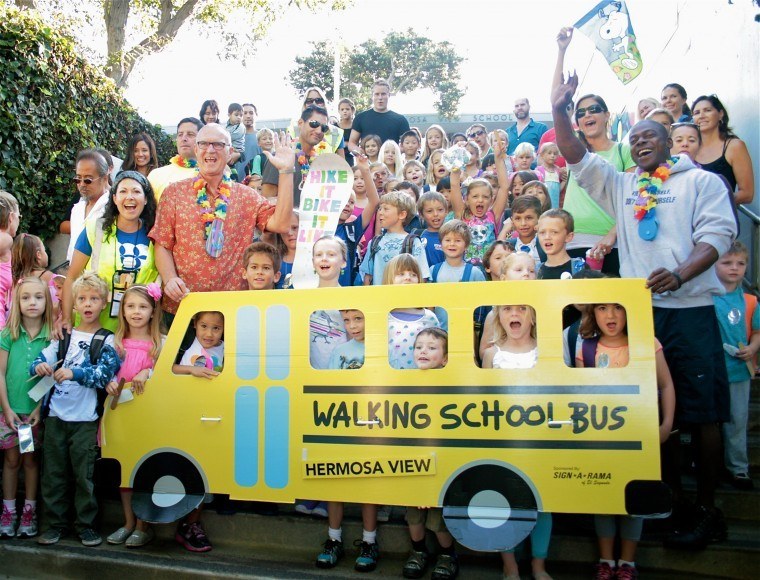
Walk and bike to school activities can also be a way to engage residents who don't have children, in supporting "bike buses" and "walking school buses."

But if kids aren't neighborhood residents, they aren't going to be walking or biking.

Labels: , , , , , ,