Rebuilding Place in the Urban Space

"A community’s physical form, rather than its land uses, is its most intrinsic and enduring characteristic." [Katz, EPA] This blog focuses on place and placemaking and all that makes it work--historic preservation, urban design, transportation, asset-based community development, arts & cultural development, commercial district revitalization, tourism & destination development, and quality of life advocacy--along with doses of civic engagement and good governance watchdogging.

Wednesday, March 01, 2023

Walmart to close one of its three DC stores

During the period of the (post) 2008 recession, Walmart, recognizing that it achieved about as much growth as it could in the suburbs and exurbs, decided to focus on cities.  DC, not being particularly sophisticated politically, was ripe for the picking, and local elected officials welcomed them with open arms.

I and many other residents were opposed on business grounds, although yes they would hire people and make available goods often not available in various neighborhoods.  Another big issue was urban appropriate building form.  It turned out that Walmart didn't care very much.  They would be fine with mixed use buildings (two of the three in DC were such), which they didn't seem okay with before.  But at the same time, they were fine with single use buildings too, so long as that was a location they wanted.

Sadly, many prominent urbanists thought that this was a breakthrough decision by Walmart when it wasn't.

I was involved in opposing the Walmart that ended up being built up the street from my house -- and ironically a second Walmart was built 1.25 miles from our house, in the other direction in Fort Totten, making our area likely the most densely served by Walmart of any other area in the US.

But the elected officials wanted it to happen -- JOBS! JOBS! JOBS! -- and for the most part it was a matter of right use so it couldn't really be opposed successfully.  And an area of DC law that offered a way to oppose the entry -- the environmental impact law -- was underdeveloped, and those lawyers who were willing to oppose except for JOBS! JOBS! JOBS! weren't sophisticated enough to follow that line of reasoning.

I ended up writing many entries on the issue:

-- "Walmart: in the city, vs. of the city," 2011
-- "Lessons from Walmart's foray into DC," 2011
-- "Wal-mart plays hardball with DC," 2013
-- "What community benefits are supposed to be versus what people think they are about," 2013
-- "More Walmart in DC," 2013
-- "6Ps, Walmart in DC and "I hate to say I told you so"," 2014
-- "Lessons from Walmart's foray into Washington, DC," 2011
-- "Piling on City Council for Walmart," 2013
-- "I hope for Aspen Hills' sake that Montgomery County is smart enough to learn from DC's planning errors with regard to Walmart's entry," 2012
-- op-ed piece, Washington Business Journal, "Temper Walmart glee with planning"

Anyway, Walmart first proposed five stores, then a sixth in response to calls for equity in the area East of the River.  They built three ("First Walmart Stores In D.C. To Open Dec. 4, Will Employ 600 People," WAMU/NPR, 2013):

  • Georgia Avenue NW
  • Fort Totten NE
  • 50 New Jersey Avenue NW

The store on New York Avenue never came to be.  Nor did a store on East Capitol.  And the store site that they agreed to later to appease elected officials and opponents, in the Skyland Center, ended up being dropped as well ("Walmart will pay DC $1.3 million over canceled plans for SE store," WTOP radio).

Now they've announced an upcoming closure of the store in Lower NW DC ("Northwest DC Walmart location closing March 31," WTOP radio).  

"Sadly," of the three it has the best building, a traditional design mixed use style that fits in with nearby buildings including the Government Printing Office. 

I argued that they chose this location because their lobbying/government affairs national offices were located there as well.


 And it had one of the best transportation demand management signs I've ever seen in a retail store.


But it wasn't particularly close to teeming amounts of residential population, so I'd say it was a bad location, and I'm not surprised.  It probably had issues with personnel and "shrink" as well.

Walmart Fort Totten, photo by Beyond DC

Walmart Georgia Avenue NW

The store has underground parking but refuses to allow it to be shared with local businesses. 

The site was originally approved for a mixed use development with 400+ apartments above, which would have generated more income, sales, and property tax revenues for the city. But with the recession, the developer wanted quick and easy money and sold the development rights to Walmart--a 75 year lease, with renewables. Walmart paid for everything including constructing the building. 

FWIW, this is the building that many urbanists said heralded a new day for Walmart's urban design and city appropriate design.

====

Mea culpa.  Here in Salt Lake we do shop at Walmart, just for a couple items.  The store is a bit farther from us than the two in DC. In DC, I did buy a bunch of shipping supplies there while preparing to move.

Labels: , , ,

Wednesday, May 11, 2016

Tampa Bay Times investigation on the cost of emergency services associated with Walmart stores

Years ago, when I first started working on urban revitalization issues I remember coming across an article from some newspaper out west about the large numbers of police calls to a local Walmart and the high costs this imposed on the locality, to the point where it exceeded the sales tax revenue generated by the store. This type of economic impact is rarely touted when local officials chortle about the entry of Walmart into their communities.
Walmart
The Tampa Bay Times noticed a similar pattern with Walmart stores in the Tampa Bay area and chose to investigate it further. See "Walmart: thousands of police calls, you paid the bill." From the article:
Law enforcement logged nearly 16,800 calls in one year to Walmarts in Pinellas, Hillsborough, Pasco and Hernando counties

Law enforcement logged nearly 16,800 calls in one year to Walmarts in Pinellas, Hillsborough, Pasco and Hernando counties, according to a Tampa Bay Times analysis. That’s two calls an hour, every hour, every day.

Local Walmarts, on average, generated four times as many calls as nearby Targets, the Times found. Many individual supercenters attracted more calls than the much larger WestShore Plaza mall.

When it comes to calling the cops, Walmart is such an outlier compared with its competitors that experts criticized the corporate giant for shifting too much of its security burden onto taxpayers. Several local law enforcement officers also emphasized that all the hours spent at Walmart cut into how often they can patrol other neighborhoods and prevent other crimes.

“They’re a huge problem in terms of the amount of time that’s spent there,” said Tampa police Officer James Smith, who specializes in retail crime. “We are, as a department, at the mercy of what they want to do.”, according to a Tampa Bay Times analysis. That’s two calls an hour, every hour, every day.

Local Walmarts, on average, generated four times as many calls as nearby Targets, the Times found. Many individual supercenters attracted more calls than the much larger WestShore Plaza mall.

When it comes to calling the cops, Walmart is such an outlier compared with its competitors that experts criticized the corporate giant for shifting too much of its security burden onto taxpayers. Several local law enforcement officers also emphasized that all the hours spent at Walmart cut into how often they can patrol other neighborhoods and prevent other crimes.

“They’re a huge problem in terms of the amount of time that’s spent there,” said Tampa police Officer James Smith, who specializes in retail crime. “We are, as a department, at the mercy of what they want to do.” ...

Many businesses paid a lot more in property taxes than the local Walmart but were much less of a burden on police. The Tyrone Square Mall in St. Petersburg, for instance, paid nearly four times as much in taxes as three nearby supercenters combined. Still, the mall attracted fewer police calls.
The story discusses how because Walmart's margins are so low, the shoplifting of an item costing only a few dollars takes away the profit from $100 of sales, so they take any theft seriously.

But not seriously enough to hire their own security personnel, which would also cut into their margins.

In developing special zoning review protocols for big box stores, dealing with security and crime issues should be an element.  A security plan should be required, and a commitment made by the company on investing in its own security infrastructure should be a must, rather than offloading it on local police departments.

Note that other retail businesses with high incidents of crime include convenience stores ("Hartford, Houston enact rules to reduce late night crime at stores, 2008 and "Disproportionate link between Circle K convenience stores and crime in Phoenix suburbs," 2011) and gas stations, and of course night life establishments.

In those business categories, zoning and business licensing protocols should require similar types of security planning in advance of the business' opening, and ongoing.

Labels: , , , ,

Sunday, July 05, 2015

Economic impact of locally owned hardware stores vs. big box stores

The National Hardware Retailing Association, with Independent We Stand, an organization supporting independently owned retail businesses, commissioned Civic Economics, an economic consulting firm specializing in commercial district revitalization work, to do a study (Home Sweet Home) of the hardware sector, analyzing the differentiated economic impact on local communities of consumer expenditures for the same type of project at independently owned hardware and building materials stores versus the so-called "big box" home improvement stores such as Home Depot or Lowes.

The results of the study are presented in the cover story of the July issue of Hardware Retailing Magazine.

The study focuses on what is called the multiplier effect of consumer expenditures, when money spent in a transaction is used by the seller to purchase goods and services, pay employees, etc.  Chain stores spend a lot less money locally than do locally owned businesses, plus the profits are repatriated to the chain headquarters and to distant stockholders.  By contrast, local businesses spend locally.

From the HR article:
Methodology.  Since a typical home improvement project involves a variety of goods and services, a hypothetical project approach was used to account for all home improvement categories. The budget for the hypothetical project was $10,000 and was divided among hardware, power equipment, lumber and building materials and professional installation services, as seen below. This budget provided opportunities to analyze various hardware and power tool segments from both independents and chains. 
Civic Economics studied both independent and big-box businesses, examining the services and products that can be purchased at either. To determine a retailer’s “local economic impact,” the firm analyzed the different merchants’ labor costs, profits, procurement and charitable giving. 
Labor: A larger share of operating costs for local home improvement stores goes to labor since local stores’ administrative functions are either carried out in-house or outsourced to local providers. National chains consolidate these functions at their national headquarters. 
Profits: A larger portion of independent stores’ profits remain in a community. National chains redistribute profits to their shareholders or invest in global operations. 
Procurement: A local business will pay for local accounting and legal services. National chains provide these professional services in-house from their headquarters. 
Charitable Giving: Hometown businesses generally give back to their own communities. National chains are more likely to donate to national charities or groups located near their headquarters, not near their stores.
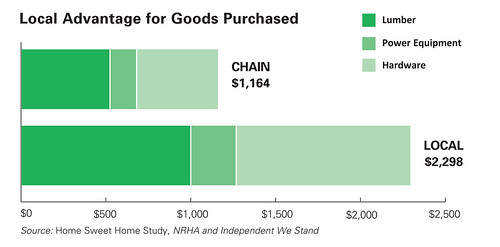
The study found that spending at locally owned stores had almost double the impact--the multiplier effect--compared to chain stores, on the example used in the study, of an expenditure of $10,000, spending at the local store would generate an additional $2,298 of spending, while at the chain store, the impact was about half, totaling $1,164.
Local economic impact of expenditures at a locally owned hardware store vs. a chain retailer
NRHA has created a website with a variety of support materials, including a widget that can be added to a retailer's website, enabling people to calculate the local impact--by zip code--of their spending on home improvements.

"Economic development" versus "building a local economy."  This is a great illustration of the point I make about there being a difference between "economic development" versus "building a local economy."  The former is focused on "getting business," while the latter approach looks more deeply at the type of business, how it functions and its multiplier effect.

One example would be the supermarket industry.  While the DC area no longer has a significant number of independently owned retail chains, other places do.

In other places, there is a big difference in the local economy from buying from local stores versus chain stores, especially groceries from Walmart, which sends most of its revenue Bentonville, Arkansas, compared to locally headequartered companies.

But economic development policies by local governments don't usually reflect this, providing incentives and funding to chain stores, while providing little "help" to smaller, locally owned stores.

Another example: liquor stores in Minnesota and a level playing field between big and small stores.  The Minneapolis Star-Tribune has an interesting article related to this broad topic, "Total Wine uncorks booze battles in Minnesota: Rivals of the big-box retailer are returning fire in an unfolding price war,"about the impact of a chain seller of alcoholic beverages, Total Wine, on locally owned stores.  Minnesota has a wrinkle I didn't know about,  as many smaller towns and cities own liquor stores (not unlike how Montgomery County, Maryland is involved in the industry, which generates about 10% of the county's revenue).

But Minnesota alcoholic beverage sales regulations requires that all retailers have access to pricing and wholesale information and to all brands and product types--that no one retailer can be an exclusive seller of a brand or product type.  This extends, surprisingly, to private label items (so if Trader Joe's has "Two Buck Chuck" for sale in Minnesota, other liquor stores are able to buy the item).

From the article:
Minnesota’s existing liquor sellers have been able to gain unusual insight into Total Wine’s business because of a state law prohibiting liquor retailers from making deals to exclusively sell any alcoholic product. Instead, liquor must be sold through a distributor that every retailer can access.

That means all of Total Wine’s products, including its private-label Winery Direct and Spirit Direct items, can be ordered and sold by any Minnesota liquor store. Any Minnesota liquor dealer can also see Total Wine’s wholesale prices.

The law is part of a broader regulatory structure that was built over decades to ensure that smaller sellers of alcohol products won’t fall prey to larger competitors and to carve out room for both municipal and private dealers.
The "store brands" that Total Beer & Wine sells have to be made available to any retailer that wants to sell it, which provides a level playing for stores big and small.

At the same time, those kinds of provisions in the law, if extended to other retail categories, would make it easier for smaller retailers to compete with bigger companies.

Another way, as evidenced by the Home Sweet Home study, is the example of business cooperatives in hardware.  Where the organizations True Value, Ace Hardware, and Do It Best support individually owned businesses, by providing a structure that provides high quality services and technical assistance, branding and marketing support, product development, and pooling of buying to get better prices.

The average independent retailer doesn't have access to similar services, maybe other than reading trade magazines, which makes it difficult for them to compete with chains.

Labels: , , , , , ,

Wednesday, June 03, 2015

Urban retail reflections

A group of us are having a debate in e-mail about the upscale retail CityCenter development, spurred by a recent Washington Post article ("Luxury shopping arrives downtown, and Friendship Heights braces for departures").  One person sees it as a great (re)development, while I am somewhat skeptical--not because I don't think people like Kate Spade, but because there is only so much demand.

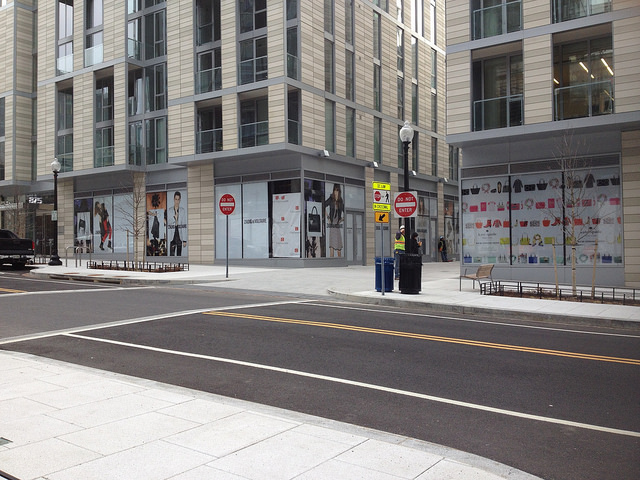
Image of CityCenter from Popville.

As far as the development goes, it's quite impressive.

From an urban design standpoint, they've broken down what would be two full blocks each with a single large superbuilding, by creating smaller buildings with "alleys"/walkways in between to create more viable and active ground floor spaces.

But DC doesn't have a huge population, suburbanites don't come into the city to shop, and the tourists and business visitors to the city don't tend to do the kind of high end shopping common to visitors to NYC, London and Paris--especially by foreign tourists.

-- Global Report on Shopping Tourism, UN World Tourism Organization

Georgetown DC.

So I suspect there isn't enough demand to support higher end retail in four different submarkets within DC as well as two more in Virginia and Maryland: CityCenter; a few blocks away on Connecticut Avenue (Burberry moved from this district to CityCenter) in the Golden Triangle Business District, and in Friendship Heights--the commercial district that straddles DC and Montgomery County, with Bloomingdales, Neiman-Marcus, Saks Fifth Avenue and Lord and Taylor (no longer an upscale anchor, but still a functioning department store chain) as anchors, let alone competitive centers in Tysons (Virginia) and Montgomery Mall, or Georgetown--which is not an upscale shopping district.

2.  I have been reflecting on what I've learned from the past 15 years of my involvement in commercial district revitalization in DC because of a conference being held by LOCUS, an organization of developers committed to the creation and strengthening of "Walkable Urban Places," created by pro urban developer and researcher Chris Leinberger and sponsored by Smart Growth America.

One of the walking tours yesterday was of H Street NE.  I didn't go, because I get tired of listening to the people who talk about it now, people who weren't involved at all during the initial and most difficult years--it's easy to participate in revitalization when it's already happening.

Image from HillNow.

Although I did have a good conversation with one of the (re)developers of a complex of buildings on H Street--he estimates it will be worth about $200 million and he is definitely doing it because of "the streetcar" -- the project that so many call a failure even though it has triggered more than $500 million in development on a few blocks of the corridor before it has even started service.

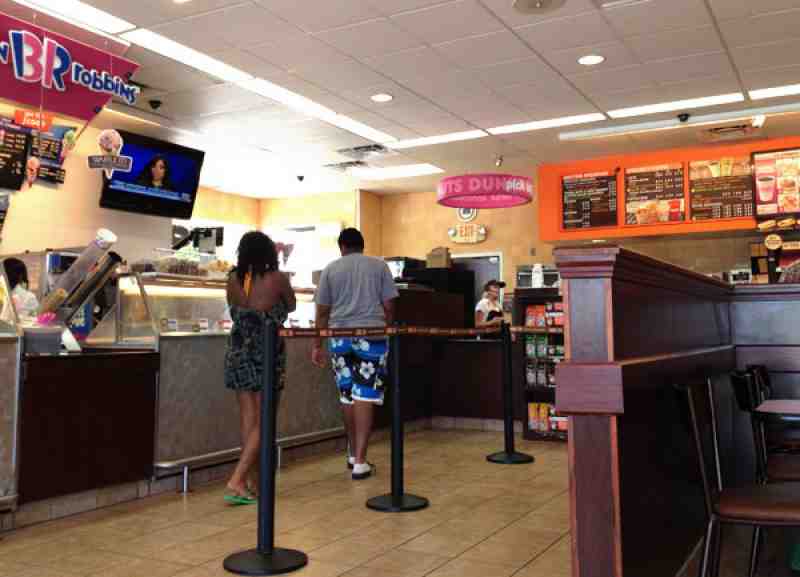
Interior of a Dunkin Donuts-Baskin Robbins combination store from Inside Fort Lauderdale.

3.  Dunkin Donuts vs. Starbucks as an illustration of issues in urban retail recruitment.  What also brings this to mind is an "argument" I had about 13 years ago with the consultant assigned by the city to assist our nascent H Street Main Street commercial district revitalization program.

-- NOTE that according to Time Magazine, this Friday is "National Donut Day" and Dunkin Donuts will give you a free donut with the purchase of a beverage.  (I do get coffee at the Dunkin at 8th and Pennsylvania Avenue SE sometimes before Eastern Market meetings.)

The interior of a typical Starbucks.

He was telling me that rather than aim for "a Starbucks," what is wrong with a Dunkin Donuts?

Obviously we all know the difference in perceptions, even if Dunkin coffee is probably better--less burnt, and no longer cheaper than Starbucks.  One has a subdued interior while the other is garish, etc., and in trying to "improve" a commercial district, Starbucks sends one signal while Dunkin Donuts sends another.

... then again, the first retail entrant into H Street after all the new plans was Family Dollar.

The Post ("Map: How coffee splits the United States in half"), Boston Globe ("Split country: Dunkin' vs. Starbucks") and Brandchannel ("Coffee Grind: Data Maps Show America Runs on Dunkarbucks") have articles on the competition between Starbucks and Dunkin Donuts with some insights into the meaning of the differences in the footprints of the respective chains.

And recently I wrote about Zillow's take on Starbucks as an initiator of neighborhood change--I disagree, arguing that Starbucks is a follower, not a leader of change.  See "(Not) Understanding how retail chains make property decisions: Baltimore, Starbucks, andSalon Magazine" where I wrote:
* Starbucks follows, it doesn't lead. I make the joke about Starbucks "as the one thing a commercial district" because when you work in the field, that's what residents come up to you and say, repeatedly. It's not that simple. Similarly, Zillow is wrong that Starbucks knows the next hot neighborhood. They are followers, not leaders, and their locations are co-incident with what we might call high-value "amenity districts." 
For example, Starbucks considers the location at 8th and D Streets SE on Eastern Market Square in Capitol Hill a distressed location, even though the number is full of houses costing $800,000 or more. There aren't many examples of Starbucks stores leading neighborhood and commercial district revitalization efforts. In DC, Starbucks followed Xando (which later rebranded as Cosi) which was the first "new coffee shop" in the city by many years.
Brandchannel points out that outside of urban centers, specialty coffee chains like Peets don't do well, but the Starbucks and Dunkin brands work well in all markets.

In any case, these blog entries, now ten years old, reflect insights I had about these issues quite awhile ago, but obviously, based on some of the discussions at the conference yesterday, these are still "new" ideas.

-- "Store siting decisions"
-- "Why the future of urban retail isn't chains"

From the first piece:

[I]n my experience there are four key decision points faced by a business proprietor involved in investing in and opening a store in the center city:

1. Whether to invest-open a store--or not
2. Where to invest--city or suburbs (most retailers are focused on the suburbs)
3. If investing in the city, where to invest within the city--the northwest quadrant which has the most population and the best demographics, or within the other three quadrants of the city
4. Investing in your particular commercial district.

Even in the District of Columbia, many business proprietors only have eyes for the northwest part of the city, which has the city's best overall demographics and density. Getting people to invest in other parts of the city is still a struggle, and the people most likely to do so are those with the least experience, and therefore have a greater likelihood of failure, without the provision of some help--even they are even open to help.

The point I am making is that you need to know where in the decision chain the business proprietor is, and the process can take much longer or much shorter if you have to make a "sale" for each one of these stages.

A business proprietor who has already decided to open a store, and to invest in the District of Columbia is half sold already...

4. FWIW, I am somewhat wrong about "the future of urban retail isn't chains."  Although it's not often what we prefer.  See the 2012 piece "It ain't true: chain retailers are entering the city, but not necessarily on the city's terms."

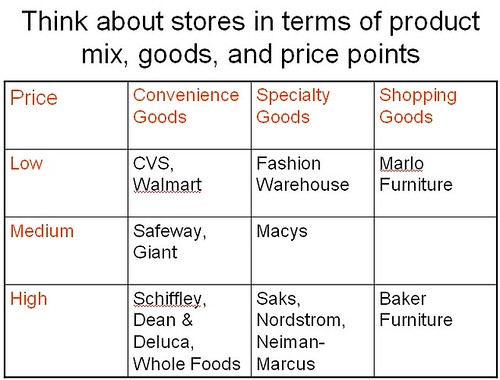
We have to differentiate between the types of goods sold: convenience, specialty and shopping goods, and price points.

For common goods at lower price points like apparel (think H&M) or electronics (Best Buy, etc.), chains will continue their reign because there aren't practical alternatives.
Rating stores in terms of product mix, goods, and price points
But other than the supermarket category, where some large independently owned regionally-based firms (e.g., Giant-Eagle, HEB, Publix, Wegman's) remain successful and dominant, most retail categories are dominated by national and international companies.

For specialty artisanal goods and restaurants, independent stores will still be able to break through. But outside of restaurants, the portion of the specialty goods sector held by independents is likely to be small, if not infinitesimal, even if particularly important to and prominent within traditional commercial districts.

But the consolidation of companies within retail categories, for example, Macy's in department stores; Walmart and Target in general discount, Kohls in apparel and housewares; Best Buy and hhgregg in electronics and appliances; Bed, Bath and Beyond in housewares, etc,; makes it very difficult to populate all the various legacy commercial districts and neighborhood centers that people want to activate.

For example, in the department store category, DC once had six mainline stores that were locally owned (Garfinckels, Hechts, Jelleffs, Kanns, Landsburghs, Woodward & Lothrop)--and they each served the city from one Downtown store, although Garfinckels had an outpost in Spring Valley, and Woodies a store just over the city line in Friendship Heights.  Plus, Sears had three stores in DC, and the African-American focused Morton's chain had stores across the city, mostly in neighborhood commercial districts but a downtown store also.  Of all of those stores, only the Downtown Hecht's (now Macy's) is left.

There isn't enough demand, let alone enough different store companies able to fill all the space that currently exists.

5.  One newer development is how in some of the biggest or highest income cities, certain chains are opening a select set of experience-retail focused outposts different from their typical offerings. For example, how REI is opening a signature store in the old Uline Arena (a building I helped save from demolition) or how Urban Outfitters has opened a signature almost "department store" like experience in Manhattan.

This is the next stage of higher end chain retail in urban centers that I discussed some in this piece from 2012, "Another point about urban retail: Whole Foods, Design within Reach, and American Apparel," and this piece from 2010, "Speaking of the Room & Board store and not knowing how the retail industry works."

In any cases, the strong markets will still be able to attract and develop retail while the weak markets will continue to find recruiting and developing retail a slog.

Room & Board, before, 14th and T Streets NWThe Room and Board building on 14th Street NW, before renovation.

6.  14th Street NW has arrived.  In 2010, I said it would take awhile before the retail offer on 14th Street between T and Rhode Island Avenue improves.  If we extend that to U, to include the Trader Joes, I think it's fair to say that the improvement has arrived.

See "14th Street NW as a retail district."

The same building after renovation.

Although the district is dominated by restaurants, with only a smattering of retail, it works well enough for residents, because the convenience retail (Whole Foods, Trader Joes) meets real needs, and the specialty retail lends an upscale feel and appeals to a wider trade area, bringing people to the commercial district from across the metropolitan area, rather than just the neighborhood or city.

Labels: , , , , , ,

Friday, May 08, 2015

DC resident retail preferences, will they shape the DC agenda at ICSC?

The International Council of Shopping Centers is the major trade organization for shopping center developers, property managers, chain retailers and restaurants, and support organizations.

Each May, the group holds a massive convention in Las Vegas, complemented by regional events throughout the year.

-- Mid-Atlantic ICSC meeting, February 2015

Since the Mayoral administration of Anthony Williams, DC Government has exhibited at the event, to highlight the economic advantages of the city and to recruit retailers, such as Target, to the city and specific developments.

When the city first started exhibiting, it was still a major stretch for national chains to consider center cities as a preferred location for expansion.

The city has come a long way since then, even if I do believe that retailers for the most part still aren't thinking urbanistically, but are more about bringing their stores to the city without much in the way of changes from suburban formats. See:

- It ain't true: chain retailers are entering the city, but not necessarily on the city's terms
- Another point about urban retail: Whole Foods, Design within Reach, and American Apparel

In preparation for this year's exhibiting and recruiting at ICSC, the Washington DC Economic Partnership is seeking resident input for their "preferences."

Washington DC Economic Partnership Marks 15 Years at ICSC RECon in Vegas, press release

From email:
Poll: Residents Retail Wish List - What Would You Like The District To Have

Next week, the Washington, DC Economic Partnership (WDCEP) plans to attend the annual global real estate convention – the International Council of Shopping Centers Conference (RECon), taking place May 17 to 20 at the Las Vegas Convention Center. RECon is the global convention for the shopping center industry and provides networking, deal making and educational opportunities for over 35,000 retail real estate professionals from around the world.

This year marks 15 years WDCEP has had a presence at the global convention representing Washington, DC for retail attraction. The District government and WDCEP’s presence at ICSC RECon, have led to deals that landed many popular retailers and restaurants into the District of Columbia. Some key retail successes due to WDCEP’s ICSC RECon efforts include Apple, Costco, H&M, Harris Teeter, Nike, and Nordstrom Rack.

This year, WDCEP and the District government will focus their efforts on promoting retail opportunities throughout the District with meetings scheduled with nearly 80 retailers including restaurants, grocery stores, clothiers, specialty stores, and national retailers.

Sound Off! Tell Us What's On Your Retail Wish List? WDCEP would like to hear from DC residents regarding what retail brands they would like to see place an "open for business" footprint into the District. What's missing? What's necessity? What's a want? Tweet @WDCEP #WeDC your thoughts!

Labels: , , ,

Wednesday, February 04, 2015

A paper on Walmart that I wished I'd been aware of back when DC was happily recruiting the company to the city

The US Department of Agriculture supports "regional rural development centers" across the US to support the agricultural extension system and its mission of promoting successful rural development in all aspects--social, community, economic, agricultural.

We can argue that the community development movement for sure and even planning as a profession has antecedents in the agricultural extension system, which developed beginning in Civil War times, with the creation of the federally-supported land grant (agricultural college) university system across the states.  Parallel with the development of each university was the creation of a state-wide agricultural extension system to advance the application of knowledge towards the improvement of agricultural yields.

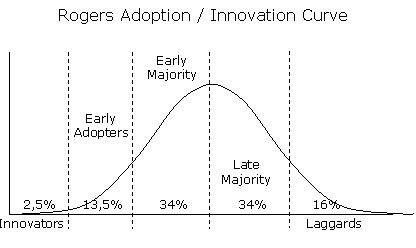
In fact I frequently mention the work of Everett Rogers on the diffusion of innovation (graph at left).  His training and research came out of the rural development field.

The Northeast Regional Rural Development Center is based at Penn State University and is set up to support rural development and improvement efforts in the Northeast and Mid-Atlantic states.  I was looking at some of their recent publications and out pops "Wal-Mart and Social Capital." published in the American Journal of Agricultural Economics.

From the article:
Advances in the consistent measurement of county-level social capital (Rupasingha, Goetz and Freshwater 2006*) now make it possible to examine rigorously the impact of bigbox chains on the civic capacity of all rural and urban US counties. Previous studies have implemented the concept using trust, social norms or networks, following Putnam’s (2000) seminal work, Bowling Alone. These studies use cross-country comparisons based on individual-level data (the World Value Surveys, Knack and Keefer 1997), state-level data in the U.S., (the General Social Survey, Glaeser, Laibson and Sacerdote 2002) or data collected in individual-level surveys in specific contexts (Narayan and Prichett 1999).

In this article, we identify for the first time the independent effect of Wal-Mart stores on social capital at the U.S. county-level during the 1990s. We propose a conceptual model of the processes leading to changes in social capital and hypothesize that big-box corporations, in which innovative business processes and management functions are handled out of centralized headquarters, or outsourced to Asia, depress social capital stocks in local communities. 
This compounds the adverse effects of losing local philanthropic capacity, reinvestment of surpluses (rents) and community-specific knowledge or capital.
* "The production of social capital in US counties," Journal of Socio-Economics

The papers related to social capital at the county level (DC functions as a county from the this standpoint) look to be quite interesting.

During the process of shepherding the process that produced the report, ANC4B Large Tract Review Report on Walmart, 5/2011, for ANC4B, concerning the proposal for the now opened Walmart on Georgia Avenue NW in my neighborhood--the report was praised, but systematically ignored, by the DC Office of Planning--it happens that while talking with one of the professors who co-authored a paper on the impact of a Walmart store in Chicago, I specifically mentioned this element as a likely impact from the change in how the retail sector is organized at the local level.

The chaining up process is accelerated as other chains come to the area to be proximate to the Walmart big box store so they can also share the customer base, which further accelerates the loss of social capital that had existed within the local retail sector in general and within the neighborhood commercial district specifically.

Of course, during the pre-entry period, Walmart steps up local philanthropic efforts to build support (see for example the op-ed by one such funded organization, "Walmart: A force for good in D.C.," published in the Washington Business Journal--although to its credit the WBJ also published my critical piece, "Temper Walmart Glee with Planning").

As the company successfully opens stores, local philanthropic activity is likely to decline significantly, as it did in Prince George's County, after the within Beltway store on had been open for a couple years ("Wal-Mart has donated $2.2M to D.C. causes since proposing District stores" WBJ).

Also see the past blog entry "Lessons from Walmart's foray into Washington, DC."

=================
A little update on the Georgia Avenue NW Wal-mart and the long term possibility for site redevelopment.

The site has been sold to a company that is committed to mixed use development according to the Washington Business Journal ("The second Wal-Mart to open in D.C. gets new out-of-town landlord").  The property was an outlier in the portfolio of the original developer and they weren't interested in fully monetizing the value of the property because obviously, they had no long term commitment to owning the property.

So in 10-20 years, we're likely to see this site get redeveloped into the kind of mixed use development that should have been built from the outset.

Labels: , , , , , ,

Friday, October 31, 2014

6Ps, Walmart in DC and "I hate to say I told you so"

DCist has a piece, Business Owners Near Georgia Avenue Walmart Seek City's Help," in response to a report by Ward 4 Thrives about how businesses in the vicinity of the Walmart on Georgia Avenue NW in Washington, DC are seeking extra-normal assistance from the City Government, because since the Walmart opened 11 months ago, they are experiencing business difficulties.

The 6Ps = prior planning prevents piss poor performance.

FWIW, I co-chaired a committee convened by ANC4B to study the proposal for a Walmart at that site and to provide guidance about the matter which the ANC would consider and submit to relevant DC Government agencies. It was a great committee, and while I wrote the bulk of the report and recommendations, by no means are all the recommendations and analysis mine.

We prepared both a full report and analysis as well as a summary list of the 37(!) recommendations. We did not address "yes or no" on Walmart because it was a legal use for that site.

About 25% of the recommendations specifically discussed the need to provide technical and other assistance to the businesses and buildings near the "Walmart site" to address the likely negative impacts that would ensue, to decrease the likelihood of business failure and building vacancy--8 of the 37 recommendations addressed economic impact mitigation, 1 recommended that Walmart share parking with adjoining businesses, and 2 suggested that the Office of Planning more significantly address economic impacts in the Large Tract Review process going forward.

The Office of Planning ruled that "economic impacts" were not "neighborhood impacts" as defined by the Large Tract Review regulations. Not having the economic means to challenge this determination, which is counter to how most other jurisdictions interpret such regulations and "environmental assessment" processes, the project sailed through.

But then again, at the time, the Office of Planning and DDOT were ordered to "make Walmart happen," not to ensure the best possible results for all impacted parties.

FWIW/2, "I hate to say I told you so" is the title of a song by the Hives. But that report is 3.5 years old, and these negative impacts were predicted. And I wrote a bunch of pieces about the process, learning from it, and the need to change various DC planning review processes, regulations, and practices:

-- Lessons from Walmart's foray into Washington, DC
-- Piling on City Council for Walmart
-- I hope for Aspen Hills' sake that Montgomery County is smart enough to learn from DC's planning errors with regard to Walmart's entry"
-- op-ed piece, Washington Business Journal, "Temper Walmart glee with planning"

The recommendations...

Transportation Demand Management

11. Walmart should agree to explore with the DC Department of Transportation setting up a shared parking situation with the on-site customer parking spaces, perhaps through the creation of a “transportation management district” to manage this and other transportation demand management initiatives in both this and the Walter Reed commercial nodes on Georgia Avenue.

Neighborhood economic impact recommendations

27. Based on this preliminary review, it is recommended that the Office of Planning conduct a more detailed and complete analysis of the neighborhood economic impact of a Walmart
general merchandise/supermarket combination store in Ward 4, as a legitimate (but novel) interpretation of the provisions of the Large Tract Review process concerning minimization of adverse neighborhood impacts. If potentially negative impacts cannot be expected to be reasonably mitigated, denial of the application in whole or in part could potentially be justified.

28. A mitigation program, funded by the developer and/or Walmart, should be created for Ward 4 businesses (a separate program could be created for Ward 1, but such a recommendation is not within the purview of this committee) to limit potentially negative impacts on extant retailers, as well as to leverage to as great an extent as possible, in a proactive manner through various commercial district revitalization activities, the entry of Walmart into the Georgia Avenue corridor generally, and into the Missouri Avenue-Piney Branch commercial district node specifically.

29. Funds should be made available for technical assistance to merchants, façade improvement projects, marketing, and other initiatives, in advance of (and after) the opening of the Walmart store, to better prepare retailers to face and address competition. (The Main Street commercial district revitalization program, such as the program in Old Takoma, serving both DC and Maryland, is one such model for this type of program.)

30. A revitalization coordinator should be hired, paid for by Walmart/Foulger-Pratt, for at least a three year period, to develop and manage this program, in association with merchants, residents, and other stakeholders. This person could be assigned to work as part of the Deputy Mayor’s Office for Planning and Economic Development, the Office of Planning, or in the Ward 4 Councilmember’s Office.

31. A master database of all commercial properties should be created, with data on lease terms, property size, building condition, revenue potential/s.f. and other items, for use in the execution of this program.

32. A recruitment and development program to attract new businesses and new development should be executed simultaneously with development and implementation of the technical
assistance and support program for extant businesses and properties.

33. Note that while the Washington DC Economic Partnership is tasked with the development of marketing materials for various DC commercial districts, they have not created promotional materials for the Missouri Avenue to Piney Branch Road commercial node on Georgia Avenue. They should be directed to create such materials forthwith. ** {Actually this has since been rectified.]

Recommendations for rectifying gaps in Planning and Zoning regulations

34. The Large Tract Review process does not adequately address potentially negative economic impact of projects generally. The LTR process is also deficiently because it is essentially advisory, without the ability to directly mandate action or deny approval. These defects in the Large Tract Review process should be addressed and the process made more robust.

35. DC should create a new mandatory review process (“Large Retail Impact Review”) to address the various economic and other impacts of large scale retail projects in excess of 75,000 square feet.

Labels: , , ,

Tuesday, September 17, 2013

The Living Wage Bill and the 2014 DC elections

It's been reported locally and nationally--especially in the business press---that Mayor Gray vetoed the Large Retailer Accountability Act legislation.  The major provision in the bill was to impose a "minimum wage (including benefits) of $12.50 per hour on stores that have at least $1 billion of sales in the US, and are 75,000 s.f. or larger.

This was seen as a bill specifically directed at Walmart, because the bill has an exclusion for unionized employees, which would end up exempting chain supermarkets like Safeway or Giant.

I wasn't in favor of the bill, not because I think that retailers should be able to pay their employees poorly, but because I think that DC needs to have a much better set of regulations in place for the land use review of big box store projects, to ensure that the projects are well integrated into the urban fabric and to mitigate possible negative effects.  See "Lessons from Walmart's foray," "Walmart: in the city, vs. of the city" and "DC's proposed legislation on large retailers is misguided."

But that wasn't the bill that the Council passed.

I probably am in support of the bill, as a recognition that minimum wages should be higher, and that with the hollowing out of the middle ground in available jobs, "Walmart" or "McDonald's" jobs (fast food workers have been "striking"--they don't have unions--for better pay over the summer, see "Fast-food workers strike for higher pay" from USA Today) are no longer entry jobs, a rung in the ladder of "moving on up" job-wise, they are permanent, especially for less well educated employees.

Just as cities and corporations are going bankrupt because of material changes in how local economies work as a result of the US being connected within a global economy, the world of work is in the process of changing as well.

Living Wage bills are on the agenda of more and more cities.  It's an issue in the Seattle election right now as well ("Seattle mayor wants to block Whole Foods because of its low wages" from Grist Magazine and "Can city stop Whole Foods over pay? Lawyers differ" from KOMO News) and it's even on the ballot in the Puget Sound community of SeaTac ("Appeals court says SeaTac voters can decide on $15 minimum wage" from the Seattle Times).

When travelling abroad, compared to the US, I am always struck by how much more expensive food costs in supermarkets and at restaurants.

It's because employees are paid a living wage (+ taxes are higher on businesses, which pays for national health programs).  In the US, our low food prices come at the expense of labor.

Going forward that may be changing.

The impact on the DC elections.  Mayor Gray will make the case that he vetoed the bill to prevent Walmart from leaving the city, and two of the stores that they propose to build are in lesser served areas of the city (plans for a sixth store fell through more recently, see "For what it's worth"), and they will be large employers.

004Call out quote from the Black Commentator article "Cover Story: A 'Movement' Against Wal-Mart."
 
I have written before that Walmart, typically, treats employees pretty badly ("Piling on City Council") and so it is an issue of "is any job better than nothing?"

As a city, as a community, we should be concerned about the businesses we attract and actively recruit to the city and in turn, the kind of environment and opportunities that these businesses provide to their employees.

Regardless, I think this will be a big election issue in the Mayoral campaign.  I think Gray's veto means that he has already decided that he won't run for re-election.

But, I could be wrong.  Maybe he will run again.  But it's going to be hard for him to not be implicated in election fraud around his successful primary win in 2010.  So maybe that is an influence too.

And he thinks that Walmart is the right choice to define his Mayoralty, for his legacy.

Labels: , , , , , , ,

Wednesday, October 24, 2012

More research on the economic impact of Walmart

From the Economic Development Quarterly:

New WalMart stores put large retailers out of business, mom-and-pop stores less affected: Focus issue of economic development quarterly reveals economic and social impact of WalMart stores

Los Angeles, CA (October 23, 2012) Ranked as one of America's largest corporations and the largest private employer in the United States, some say that WalMart stores are catalysts for economic growth in U.S. communities, while others claim that they can have damaging effects on local shops. However, a new study finds that it is the larger retailers such as Ames Department Stores, Sears, and Kmart that lose business with the arrival of a new WalMart store, while smaller retailers are not affected to the same extent. This study is published today in a new Focus Issue of Economic Development Quarterly (a SAGE journal) that describes the economic development impact of Wal-Mart stores. 

"Wal-Mart predominantly might be replacing stores already characterized by nonlocal management," wrote the authors. "This seems to contradict a widely held belief that Wal-Mart hurts locally owned subsidiary business establishments." 

Using Indiana as a case study, researchers Michael Hicks, Stanley Keil, and Lee Spector studied the financial impact of new WalMart stores on establishments nearby. They found that competing stores with 49 or fewer employees were affected very little after a Wal-Mart was opened in the county and competing stores with 50 to 99 employees received a very small negative impact, while stores with 100 to 249 workers closed at a rate of about .5 stores per year, and competing stores with over 250 workers closed at a rate of 1.5 stores per year. 

This Focus Issue of Economic Development Quarterly, out today, includes four articles that detail the economic impact of WalMart stores across the nation. These articles include: 

• "Walmart and Local Economic Development: A Survey," by Alessandro Bonanno and Stephan J. Goetz 
"The Impact of an Urban WalMart Store on Area Businesses: The Chicago Case," by David Merriman, Joseph Persky, Julie Davis, and Ron Baiman 
"Revisiting WalMart's Impact on Iowa Small-Town Retail: 25 Years Later," by Georfeanne M. Artz and Kenneth E. Stone 
"Mom-and Pops or Big-Box Stores: Some Evidence of WalMart's Impact on Retail Trade," by Michael Hicks, Stanley Keil, and Lee Spector  

"Where an auto plant or a high-tech research park brings a range of economic development benefits to a community, the economic development benefits generated by a new big-box retailer are far less obvious," wrote the issue editors. "While these articles do not focus on policy implications, the research results reported here suggest great caution in subsidizing WalMart retail locations."


----

One of my hypotheses relating to the economic impact of Walmart, in talking with the professor (David Merriam) at Loyola who has done studies of the impact of the first Walmart store in chicago--and they have access to sales tax data by zip code--is that some of the job loss impacts of locally owned stores that close are "mitigated" by the opening of other chains (banks, autoparts stores, etc.) attracted to locating stores in proximity to Walmart, and some aren't retailers (like banks). 

And that a significant (negative) impact in part the coming of Walmart to communities concerns the   reshaping of "local" commercial districts away from being comprised of "local" businesses.  In short local businesses close, chains open. 

But that wasn't something the Loyola study really looked into (and presumably the others did not either).  But you can suss that out kind of impact from the competing positive study that Walmart commissioned from Mari Gallagher Associates.

And because the positives from the economic multiplier effect are less for monies spent at chain stores as opposed to locally-owned stores, this ends up having a significant negative economic impact.  (See "Independent Businesses Deliver Bigger Economic Benefit, Study Finds" from the Institute for Local Self-Reliance.)

I haven't read any of the papers yet, and I do wonder if any of the EDQ studies considered any changes to the composition of the type of retail present in local commercial districts and communities after the entry of Walmart.

Probably more independent stores selling "useful" goods--selling stuff people use (food, hardware, pharmacy, etc.) close and the independents that remain open sell stuff people don't really need--beads, gifts, etc.--or used goods like clothing.

Also see the past blog entry "Lessons from Walmart's foray into Washington, DC."

Labels: , , , , , ,

Tuesday, July 31, 2012

Urban retail #3: Ace Hardware Express and Unleashed by Petco

A truer illustration of urban retailers entering cities on the city's terms (as claimed in the New York Times article "Retailers' Idea: Think Smaller in Urban Push") concern the new Ace Hardware Express store initiative and the smaller footprint pet supplies store division, Unleashed by Petco, by the big box Petco pet store chain.

Ace Hardware/Express
Ace Hardware technically is a business cooperative owned by its members. Members are store owners, running their local store under the Ace Hardware banner (True Value is also a business cooperative), but setting up and operating their store independently, with various levels of support that can be provided by the cooperative, but chosen by the store owner.

Ace Hardware has had an initiative for a number of years that supports the creation of new stores, not just in urban areas, like the stores in various DC and Baltimore neighborhoods owned by Gina Schaffer and Marc Friedman ("Hardware Made a Little Easier" from the Washington Post), but also in the suburbs.  They have counterparts in cities like Chicago (Jeremy Melnick) and Indianapolis (Steve Fusek) opening urban stores also.

New stores get an inventory credit worth more than $200,000, but they still have to spend plenty of money to open a store. 


There have been problems with this initiative, and the company is being sued by some of the people whose initiatives have failed, which includes a Springfield, Virginia couple ("Springfield’s Fischer Hardware hanging tough; Rep. Connolly calls for Ace Hardware probe" from the Washington Post).

Still, the cooperative keeps up the innovation.  The Ace Hardware Express is a new initiative, modeled in part after food convenience stores, with a smaller selection of products in a significantly smaller footprint, targeting urban neighborhoods.

Gina and Marc are opening one of these stores in DC's Woodley Park neighborhood ("Ace Hardware to open Woodley Park store from the Washington Business Journal.

According to the WBJ article:

The 3,800-square-foot store uses Ace’s new "express" model for locations less than 4,000 square feet. ... Despite the smaller size, the new Ace will offer more than 20,000 products, including basic hardware, plumbing, pet supplies and other items.

The cooperative plans 400 or more stores in this format.  See "Ace Hardware adding smaller 'Express' stores" from the Chicago Tribune.

Unleashed by Pepco
Takoma | Big Bad Woof
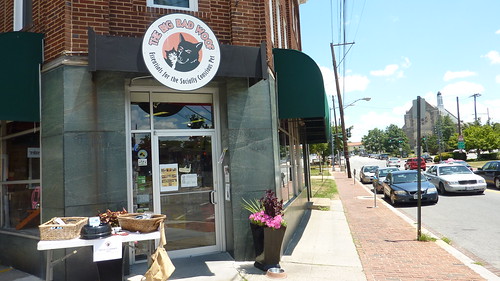
The Big Bad Woof independently owned and operated pet supplies store in the Takoma DC commercial district.  Photo from Washington DC Economic Partnership.

I remember a presentation at a Main Street conference in 2007 maybe, about trends in retail, and how the presenter specifically mentioned locally owned pet shops and other pet related concepts (like Doggy wash and pet day care). DC has a few examples of long time small pet shops, such as Chateau Animaux (which started by vending at Eastern Market) in Capitol Hill and Big Bad Woof in Takoma DC.

Clearly, Unleashed by Petco is the company's response to this trend, the rise of dog parks in urban areas, etc., and a realization that their large format store won't work in most center city locations--although the Unleashed chain has stores in suburban locations as well.

The company has 50 stores, including one in DC now, with a new one about to open in the NoMA district on the 1200 block of 1st Street NE.

They aren't quite entering the city on the city's terms as their stores are being located in strip shopping centers and new buildings, such as the new Safeway on Wisconsin Avenue in Georgetown, rather than extant buildings.  But they are locating in small store locations in "neighborhood" commercial districts, so they are halfway there maybe.

(Photo of the Unleashed by Petco store from Georgetown Metropolitan.)  According to the GM blog entry, the company has had some teething difficulties in figuring out how to properly merchandise store windows in the urban setting.

Labels: , , , , , ,

Friday, July 27, 2012

Another point about urban retail: Whole Foods, Design within Reach, and American Apparel

The general line in retail store location decisions is that "retail follows rooftops."

In short, it means that typically, chain retailers don't lead, anchor, and stoke and speed positive change by opening stores in neighborhoods that have the potential for improvement (e.g., despite all the talk of H Street's revival, Family Dollar was the first and only chain retailer of "significance" to open on the corridor in the last 10 years, although a Giant Supermarket will open next year).

They come in once it is very much evident that improvement is happening.

Now for those of us in neighborhoods where we know the potential is there, we find this process very frustrating.  I've written about it in the past in the entries "Why the future of urban retail isn't chains" and "Store siting decisions."

We know the possibilities are there but the companies won't come, and it's hard to get independent retailers of heft to open similar kinds of stores.  So nothing is the result.

But there are a couple key exceptions to this general rule, and they are so exceptional that they deserve to be mentioned.  Whole Foods Market, Design Within Reach, and American Apparel are nationally known companies that will locate retail stores in emerging districts--provided of course, that the right demographics are present.  (Note that I think H Street NE in DC has the opportunity to develop a similar kind of retail vibe by attracting stores such as these, even if not quite at the scale of the companies mentioned in this entry).

For what it's worth, it's an illustration of the diffusion of innovations curve as developed by Everett Rogers.  Whole Foods, Design Within Reach, and American Apparel are early adopters (the second stage), while companies coming in now, like Walmart, are late adopters.  But the City Target example is interesting because it represents a more careful targeting and development of a more appropriate store model for the center city.  (Just as supermarkets like Harris Teeter have bigger prepared food departments in their urban stores, the City Target is less oriented to providing "family sized" packaged products typically sold in suburban locations.)
Rogers' Adoption-Innovation Curve

Whole Foods Market and center city locations
So one of the commenters in the previous entry on urban retail from yesterday mentioned the Whole Foods Market on P Street NW in the Logan Circle/Dupont Circle area.  It was a cryptic comment so I don't know exactly what was implied.

I'm going to take the mention as a counter to my general points, that retailers aren't focused on meeting the city on the city's terms.

It's a reasonable point, not as an illustration of how all the chains are operating, but as an illustration of how Whole Foods Market is an outlier in the context of leading supermarket chains, and upscale ones at that, being willing to open in center city locations.

I've written about that store before (and similar events in the East Liberty district in Pittsburgh, where a Whole Foods, Trader Joes, and other leading chains opened in an emerging district, but one adjacent to two of Pittsburgh's most successful neighborhoods/neighborhood commercial districts--places they wanted to be but had no available retail space in which to locate--that fact is not being adequately captured by reporting on the issue, such as in this New York Times article, "Slumbering Pittsburgh Neighborhood Awakens").

I think the lesson is twofold.  First, clearly Whole Foods is very much driven by demographics and market analysis, not perceptions of an area.  If their analysis shows a store will be successful, they'll open.

That being said, traditionally their stores have been in outlying urban locations, say like Tenleytown in DC, and not so much in the core of center cities.  Although there is the store on P Street NW in DC, and the company is opening a store in Detroit!!!!!!!!!!!!!!!!!!!!!!!!!!!!!!!!!!!!!!!!  And it will be downtown.

Granted, the core of the city is attracting new residents, has a number of cultural assets as anchors, and the store will be less than 25,000 s.f. in size, so it won't be a huge risk.

Second, I think the willingness to open new stores in center city locations is partly related to the fact that as a company, Whole Foods Market has grown through the acquisition of multiple regional chains (Fresh Fields in the DC area, Mrs. Gooch, Bread & Circus, etc.) and those predecessor companies, based in their communities, were originally more open to putting stores in center city locations, provided they had the right demographics, and those attitudes and openness were incorporated into the "DNA" of the successor company's real estate strategy-making.

It's fair to say that this makes the company exceptionally different from almost all other chain retailers in the United States.

Design Within Reach
Sells edgy, modern furniture.  So it makes sense that they are willing to open stores in edgy, modern, design oriented urban districts, such as in the Pike Place Market area of Seattle or
Adams Morgan in Washington DC
(oops, I guess I am out of the loop, commenter IMGoph reports to me that they closed this location) or the Pearl District in Portland, Oregon.

American Apparel
This company has a lot of negative issues.  But they definitely have an edgy vibe and they communicate this sense of self in part by willing to locate in emerging, rather than already established, commercial districts.  Maybe Silver Spring Maryland isn't the edgiest place to locate a store, but it is atypical nonetheless.  Then again, they've had a store on Hawthorne Avenue in SW Portland Oregon for years and years, and this is typical of the kinds of emerging districts that they like to locate in.
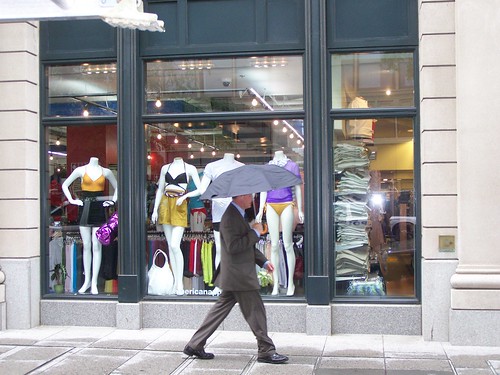
American Apparel store window, Downtown DC

American Apparel store window, Downtown DC.

Labels: , , , , , ,

Thursday, July 26, 2012

It ain't true: chain retailers are entering the city, but not necessarily on the city's terms

The New York Times has a story today, "Retailers' Idea: Think Smaller in Urban Push," about how because center cities--after experiencing decline for decades are now (re)experiencing population growth, most importantly, population growth generated by higher income and younger demographics--find that chain retailers, after focusing on the suburbs for decades, are now re-entering the city.

From the article:

Retailers are now willing to come into cities on the cities’ terms — with all the zoning headaches, high rents and odd architecture — because that is where the growth is. Most large American cities are growing faster than their suburbs for the first time in almost a century, according to a Brookings Institution analysis of census results released last month, largely because young adults are choosing urban apartment life. That population shift, along with Internet competition, have made the car-focused, big-box model less relevant.

I just don't know if I believe this.

Chains are coming into the city and dealing with zoning and rents.

But for the most part, they are still focused on fitting their standard formats, developed for suburban locations, into the city, with minimal substantive changes.

There are exceptions. But there aren't enough exceptions to see a pattern that supports the assertion that "retailers are now coming into cities on the cities' terms."

The urban push by retailers makes even more apparent the need for special big box review ordinances/zoning procedures/zoning regulations

Plus, the New York Times story doesn't discuss some of the hardcore "rolling up" of elected officials to ease the entry of chains, in particular Walmart, in many urban markets.  The ability to better shape Walmart's entry into DC was absolutely constrained by Walmart's strategic lining up of the support of key elected officials, from the mayor on down, before their public announcements.

DC lacks a big box retail review ordinance and because elected officials jumped on the Walmart bandwagon fast and furious (see "The Selling of Walmart: How the world's biggest retailer won over D.C. without a fight" from the Washington City Paper) it became almost impossible to develop any forward momentum to deal with Walmart from a position of oppositional strength, in the situations where the developers needed that kind of push in order to do better projects. (There was a movement to create "a community benefits agreement" with the company, but nothing in the zoning laws requires such agreements generally, although for two of the sites, such agreements will be triggered, but for those sites only.)

No ability to push back on the developer and/or the company means the projects for the most part won't improve (a/k/a "suck").

And I would argue it's a dereliction of the responsibilities of elected officials to act solely as cheerleaders and not as "organizers" focused on achieving the best possible outcome to the city and its constituent neighborhoods.

Although even when there are zoning procedures in place that the companies don't like, companies may work very hard to overturn them or to win special exceptions from the laws being applied. 

San Diego passed a very strong big box review ordinance.  I haven't been able to find the exact legislation ("Ordinance to Protect Small and Neighborhood Businesses"), but this report on the bill by the San Diego Office of Planning has a good overview of the provisions.

But massive organized opposition by Walmart led to the City Council caving, and repealing the ordinance. See "City Council Votes To Repeal Big-Box Ordinance" from San Diego Channel 10 News.

But from the standpoint of a well planned and prepared city, the San Diego ordinance is exactly the kind of retail review ordinance that center cities need to have in place in order to deal with these kinds of projects, if you want to be able to have leverage for negotiation.  

Home Depot
For example, you have a very suburban style big box Home Depot in DC.
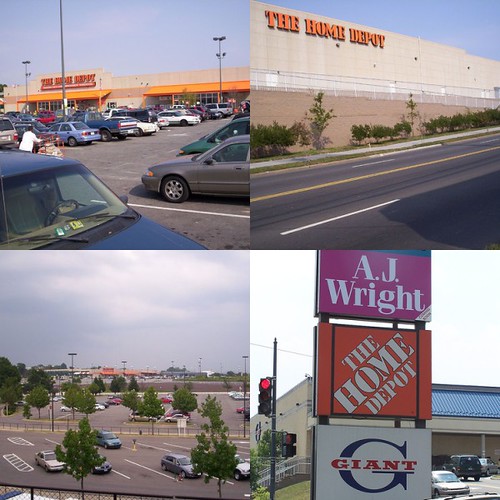
Home Depot mosaic

Yet you have a Home Depot in Manhattan located in a historic building that was once a department store, and the store does home delivery.
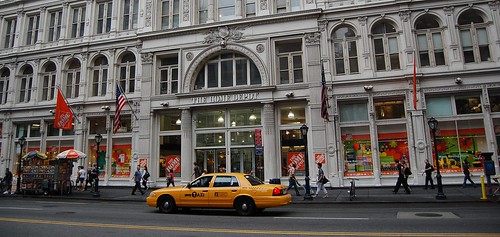
Stern Brothers
Flickr photo by Mattron.  Caption:  Stern Brothers was New York's largest department store of the 19th century. This magnificent cast-iron building was their flagship location from 1892.  Now a rather convenient Home Depot.

And you have a Home Depot in Chicago integrated into a neighborhood commercial district.
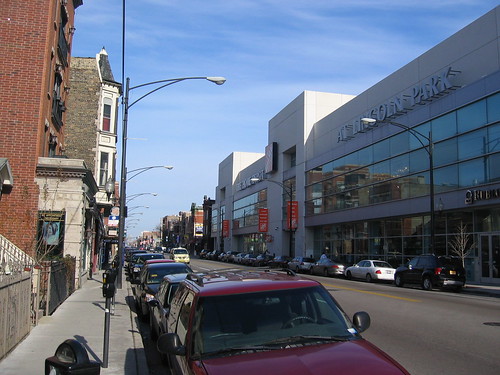
Home Depot, Halsted Street, Lincoln Park, Chicago
Home Depot on South Halsted Street in the Lincoln Park neighborhood of Chicago.  Photo by Steve Pinkus.

But you don't see a pattern yet of Home Depot integrating their stores into urban settings and offering delivery in a systematic way in a manner that we would consider decidedly urban.

Walmart
Similarly, with Walmart's foray into DC, 2 of the 6 stores -- that's 33% -- will be components of mixed use multistory buildings. The other 4 stores will be part of projects that are either single site/no mixed use or more suburban styled shopping centers.

Although in other cities, Walmart is experimenting with a variety of formats, smaller supercenters, stores styled more like convenience stores, but larger, modeled on the so far unsuccessful Fresh&Easy West Coast initiative by Tesco, and supermarket only stores called Neighborhood Markets.

While a typical Walmart store's sales are 55% food, with a population of slightly more than 600,000, and with limited reasons for nonresidents to come to DC to shop, 6 stores seems to be 2 too many for this market.

In fact, two of stores will be within 2 miles of each other, which is likely the only such example of Walmart supercenters being located so close together out of the entire US store portfolio.  (Although two of the stores will likely get some business from Prince George's County residents, as the city-county line is less than one half mile away from each of the proposed locations.)
Walmart Neighborhood Market, 555 W. Monroe Street, Chicago
Note that this Walmart Neighborhood Market store in Chicago is not part of a vertical mixed use project (and the same goes for the new City Target in Seattle).

Target
Target as of yesterday opened their first "City Target" in Seattle, which I wrote about earlier this week. It will be interesting to see if this store format--about 1/3 smaller than a typical suburban Target, with a smaller selection of products, including fewer larger sizes, and maybe no lawn mowers--influences the company and their store organization and format in other ways in other locations.  (The Times story says that Target also opened City Targets yesterday in Los Angeles and Chicago.)

There is no question that the City Target model is shaped by the company's experience with their foray into DC's Columbia Heights neighborhood, as the main anchor of the DC/USA project on 14th Street NW.  It's an all retail building (no theaters, unlike the Harlem/USA project in NYC on which the project was modeled), with a lot of parking--half of it unused, at a great expense to the city--and a store size comparable to the company's suburban stores.
New City Target, Seattle, note the windows
New City Target in Seattle, note the open windows.  Over the past few decades, large format retailers have shifted away from stores with windows, to focus customer attention on the products inside the store.  This store is an exception.  Seattle PI photo by Sofia Jaramillo.

Supermarkets
In Canada, the Sobey's chain has a variety of formats including some stores specifically designed for the center city market. I've written about them but this Toronto Globe & Mail piece, "How Sobey's is taking on Loblaws" is more definitive.  (This blog entry "Revisiting Sobeys Urban Fresh," from Only Here for the Food describes a Sobeys store in Downtown Edmonton.)

In the US, while supermarkets are locating in the city, they are still internally focused, even if the companies are doing different things. I've written about this issue in the blog for years ("Urban supermarkets and urban design") but also in an op-ed in the Washington Business Journal, "Urban Safeway Design Misses Mark."

In the DC market, Harris Teeter and Safeway are opening up stores as part of vertical mixed use projects, with structured parking, in both the city and the suburbs. Harris Teeter has a big focus on prepared foods, while Safeway does not. Giant, a lagging chain in DC proper, although still strong but under pressure in the suburbs will be opening three stores (one is new, the others are redevelopments) in vertical mixed use projects.


Whole Foods is the only store that does merchandise the front of the building somewhat more towards the ways I've suggested in past writings.

The Whole Foods Market in the Foggy Bottom neighborhood (pictured above) has a separate entrance and set up for prepared foods, which takes the sale and eat-in/on premises of prepared foods to a new level for a typical urban located supermarket, more towards the ways I've suggested in the past, to a level beyond Harris-Teeter (or the former Ukrops chain in Richmond) or Wegmans, which has extensive inside eat-in options (Whole Foods does at some of its newer suburban locations), but not outdoor patios and the like.

Pharmacies
Walgreens purchase of New York City's Duane-Reade chain has significantly influenced changes in store formats, which I have written about in the past, ranging from a super-duper store on Wall Street that includes a shoe salon, sushi, self-serve yogurt, a high end selection of business periodicals, and other services.  to selling draft beer at a location in Brooklyn.  And this has begun to influence store formats outside of New York City--at least in Chicago--but not anywhere else in the Walgreens chain as of yet.
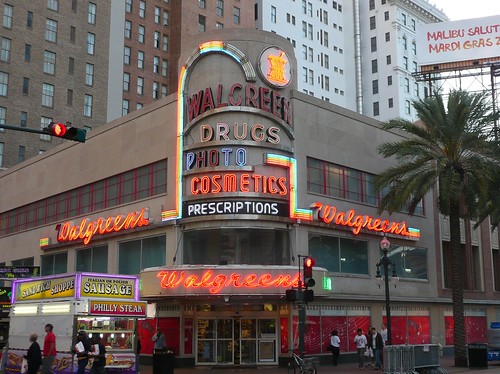
New Orleans, LA Walgreen Drugs
Walgreen Drug Store on Canal Street in New Orleans. Note that the windows are covered up, although the store remains in a historic building.  I don't know if the upper stories of the building are in active use. Flickr photo by army.arch.

For the most part, even in the cities the big drug store chains, including Walgreens, prefer to build their standard format store, originally designed for suburban locations, with drive throughs and big parking lots, as a single story, non-mixed use building, except in downtowns, where they lease ground floor locations that are part of office or apartment buildings.

Office supplies
The Times story mentions Office Depot opening smaller stores in central business districts.  Staples is doing the same thing.  But for the most part, this is a logical and easy thing for the companies to do, because compared to the other formats, their stores are smaller anyway.

The smaller format makes sense because central business districts are where office supplies are consumed the most anyway, and while the array of products offered compared to a typical suburban location may be constrained, business customers are accustomed to ordering products like desks from catalogs anyway.

Conclusion: Temper the glee
Also in the Washington Business Journal, I wrote an op-ed about the Walmart foray into DC, "Temper Walmart Glee with Planning," that made the point that we shouldn't be cheerleaders, but act towards the entry into the city by big box retailers with both open eyes and open minds, and with the right regulatory review protocols already in place.

Dealing with large format stores isn't unique.

Very large department stores once ruled the cities.
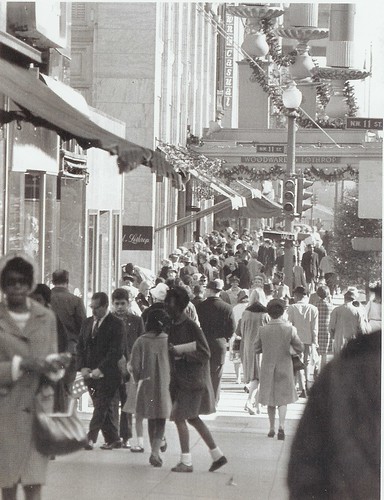
 11th and F Streets NW, Washington, DC, December 1968
11th and F Streets NW, Washington, DC, December 1968.  Photo source unknown.

The issue is to reshape the suburban-oriented formats of today's large retailers into ways that are more in concert with urban needs--the desire to promote vitality on city streets instead of dead zones and the desire to integrate retail into already extant places and reviving them, rather than building new retail on greenfield or grayfield locations that still requires an automobile trip to the store and back.

Without acknowledging these issues, the New York Times article misses at least half the story.

Labels: , , , , , ,