Rebuilding Place in the Urban Space

"A community’s physical form, rather than its land uses, is its most intrinsic and enduring characteristic." [Katz, EPA] This blog focuses on place and placemaking and all that makes it work--historic preservation, urban design, transportation, asset-based community development, arts & cultural development, commercial district revitalization, tourism & destination development, and quality of life advocacy--along with doses of civic engagement and good governance watchdogging.

Tuesday, April 16, 2024

Follow up: arenas and stadiums as "performing arts centers" attractions for cities: experience versus retail

A couple weeks ago I wrote "Good quote on arenas and stadiums as "performing arts centers" attractions for cities," quoting Ron Kirk then Dallas mayor, on the decision to go forward in building a basketball arena in the late 1990s for the Dallas Mavericks.  

He was very clear about the point of the arena being developing the area around the arena, which has resulted in over $3 billion in new development over about 25 years.  That's pretty amazing.

This relates to my lesson about such facilities.  That if you want spillover benefits, you have to plan for them, what I call "transformational projects action planning."

-- "Framework of characteristics that support successful community development in association with the development of professional sports facilities, 2021

-- "Updating the best practice elements of revitalization to include elements 7 and 8 | Transformational Projects Action Planning at a large scale," 2024

2.  I also wrote recently in "Suburban stadium/arena interest a function of new, younger generations of ownership or a better real estate play?," about the desire for team owners to control more land around the stadium or arena, which they can develop for greater profit.

My problem with this is that it gives them a monopoly on earnings, rather than opening up the potential for other firms to benefit from the likely investment of public monies in such sites.

Battery District.

3.  There is a great article in the Philadelphia Inquirer, "Stadium entertainment districts — such as the one proposed in South Philly — are changing the game for fans around the country," about this phenomenon and reading it, it's great for teams--for example, the Atlanta Braves make $59 million per year in lease and other income from the Battery development next to their stadium.

It's also another lesson about planning and development.  As commercial districts shift to what I sometimes call "eater-tainment" ("Successful retail today often includes food, experiences, social elements, and isn't rote," 2016), the reality is that when going to a sports event, consumers aren't interested in shopping at retailers--unless they sell team merchandise exclusively--they want experiences.  From the article:

These mixed-use developments help provide a hedge at a moment when the dominance of American sports programming faces new competition, from such entertainment as video games and on-demand TV, and when fan behavior can be unpredictable. Last year’s World Series between the Texas Rangers and Arizona Diamondbacks was the least-watched on record. .

.. Of course, that’s not why most people go to the Battery. They go to ride the mechanical bull at PBR Atlanta, the bar brand of the Professional Bull Riders league, billed as the toughest sport on dirt.  They play in the Sandbox virtual-reality center and browse through the unique designs at Baseballism, a fan shop. 

"PBR Atlanta opens near Suntrust Park: 7 things to know about Battery Atlanta’s “cowboy bar”," Atlanta Journal-Constitution

“It’s more than just a baseball day experience,” said Winston Parrish, a Braves fan who with his father, Dwight, came from Asheville, N.C., to the Phillies’ opening day game. “You’re able to get a hotel right there in the Battery, and walk from your hotel to the game.” 

When Dwight Parrish attended baseball games as a boy in the 1960s and 1970s, the focus was on seeing star players and snacking on Cracker Jack. “Today, it’s a different thing,” he said. “It’s all about the kids. It’s all about the family experience. It’s awesome.”

Note that support of other businesses making money of patrons is a primary justification for public investment.

4. Retail consumerism now is more purposive, special directed trips.  It's not the kind of "mixed primary use" attraction that Jane Jacobs wrote about where people will shop, eat, then go see a movie.  Plus the effect of online commerce, which significantly reduces in person shopping.

In short, if you are a businessperson wanting to open a business by a stadium or arena or a development like the Navy Yard or Wharf districts in DC, focus on eating, drinking (tough because a lot of the time events are scheduled at times that discourage patrons from eating outside of the facility) and experience.

======

P.S.  Looks like the Phoenix Coyotes are coming to Salt Lake ("Did Ryan Smith just confirm the NHL is coming to Utah?," Deseret News).  

I've written about why does the NHL continue to support the Coyotes when they are unsuccessful ("Revisiting "Framework of characteristics that support successful community development in association with the development of professional sports facilities" and the Tampa Bay Rays baseball team + Phoenix Coyotes hockey," 2022).

OTOH, while the "Good quote" article argues that Salt Lake doesn't really have the market size to justify more teams, I guess when a billionaire wants a team and there is a super-weak one out there, it presents opportunity.

Labels: , , , , , , ,

Saturday, December 11, 2021

Revisiting older writings on the success of independent retail and neighborhood commercial districts

Sitting in the car at 15th and 15th earlier today ("Thinking about the opportunities for success with neighborhood commercial districts: comparing Manor Park in DC to 15th and 15th in Salt Lake"), I was thinking about my experiences around 2006-2008, when serving as a Main Street program manager in the Brookland neighborhood of DC (near Catholic University, with 12th Street NE as the spine of the commercial district) and in 2008, doing commercial district revitalization studies in Pittsburgh and the small town of Brunswick, Georgia.

The failure of some businesses in Brookland--seized by "opponents" to the Main Street program as proof of failure--as well as reviewing conditions in the Strip District, Lawrenceville, Penn Avenue Arts District, East Liberty, and Shadyside commercial districts in Pittsburgh led me to write three blog entries which still read quite well.

-- "The "soft side" of commercial district competition" (2006) jumps off from the concept of the Reilly Law of Retail Gravitation which I summarize as "people choose to shop at places with more and better stores."  

Retailers, especially independent businesses, need to think more broadly about both their business and their place as part of a commercial district, and they need to focus on those elements of the commercial district that influence perceptions of potential patrons.  From the article:

As long as a particular urban commercial district is deficient compared to nearby shopping alternatives, it won't be able to attract new customers, until it starts providing some decent options. You can put any kind of sugar coating on it that you want, but it's these factors that must be addressed: 

  1. the quality and condition of the buildings
  2. the cleanliness of the street and sidewalks
  3. the condition of the street furniture, treeboxes and other aspects of the physical environment
  4. the signage and windows of the businesses 
  5. the quality and organization of the store interiors.

Points 4 and 5 aren't about the broader commercial district, but factors directly under the purview of the business owners, and I expanded on those elements in later entries.

-- "Why ask why? Because" (2007) was a response to criticism of the Main Street program when some businesses failed on the Brookland commercial corridor.  The point I made was that business failure needs to be understood not merely a declarative statement, and that a business support program can only do so much.  

The article outlines what a journal article called "retail mixes" but what I prefer to call retail store subsystems (using the concept of organizational subsystems as discussed in Social Psychology of Organizations by Katz and Kahn).    To the three mixes outlined in the article:

  • goods and services
  • communications
  • physical distribution
I added:
  • store operations
with the aim of helping retailers create more robust and successful business concepts and models.  The reason that the stores failed in Brookland had to do with weak systems and business models mostly, but also some certain stores needing a larger customer base (a/k/a "retail trade areas") than was proximate in the neighborhood.   From the entry:
The Rosenbloom article discusses the Trade Area Mix, linking broad market demand to the possibility of store (and commercial district) success: 
  1. Trade Area Geography: the geographical extent of the trade area
  2. Trade Area Demand: the level of consumer demand within the geographically delineated trade area
  3. Trade Area Heterogeneity: the mix of consumer market segments within the trade area and the diversity of consumer demand for products and services. The greater the demand, the higher degree of heterogeneity, characterized by more offerings.
When someone says "That store closed, the X commercial district is a terrible place to do business," the reality is a lot more complicated. Was it the owner [and management]? The concept? The commercial district? The property? Access to capital? 

And it's not either/or, it can be and/and/and... For example, the Brookland commercial district has some significant spatial and access issues. Just like I write about "intra city sprawl," commercial districts need to ensure intensity and critical mass.

-- "Indepependent retail businesses can succeed and thrive" (2008) outlines elements of robust retail business concepts and identity systems, extending concepts laid out in Designing Brand Identity.  (Although this table is updated, from the 2009 blog entry, "Retail and Restaurant Check Up Surveys.")

----------------------------------------------------------------------------------------------

Principles for creating complete concepts/identity systems for retail businesses*
--------------------------------------------------------------------------------------------- 
Overall
• Understand the needs, preferences, habits, and aspirations of the target audience. 
• Experience and study the competition and learn from their successes and failures. 
• Understand traffic flow, the volume of business, and economic considerations of your location. 
• Create an experience and environment that makes it easy for customers to buy, and that inspires them to come back again and again. 
• Good design sells. It is a competitive advantage. Design is systems and processes, not just graphics. 
• A disciplined, coherent approach leads to a unified and powerful brand presence. 
• Create a distinct position and complete identity for your store/concept. 

Facade/Exterior
• The storefront is a mass communications medium that works 24/7 and can attract new customers, influence purchasing decisions, and increase sales. 
• Logo and signage expresses the brand and builds on understanding the needs and habits of users in the environment. 
• Exterior signage must consider both vehicular and pedestrian traffic. 

Interior
• Design an interior space that is sustainable, durable, easy to maintain and clean, and is energy efficient.
• Consider the dimensions of space: visual, auditory, olfactory, tactile, and thermal. 
• Understand the psychological effect of light and lighting sources. 
• Align merchandising strategies with displays, advertising, and sales strategies. 
• The shelf is the most competitive marketing environment that exists. 
• Consider the needs of handicapped customers and those of different ages. 

Service/Business operations
• Consider all operational needs so that the store delivers on the brand promise. 
• Create an environment that helps the sales force sell and makes it easy to complete a transaction. 
• Align the quality and speed of service with the experience of the environment. 
• Benchmark the quality and speed of service against the competition. 

Plan for the future
• Anticipate future growth. 
• Measure, evaluate, change. 
• Constantly ask: is the message clear?; is the content accessible?; is the experience positive? 

Labels: , , , ,

Thursday, November 11, 2021

Pharmacy deserts

=====

This could be an initiative in keeping with the November 2020 post, "What should a domestic Marshall Plan/21st Century New Deal look like?."

=====

The Washington Post has a story, "The last drugstore: Rural America is losing its pharmacies," about the dearth of pharmacies in rural areas in particular, because of market consolidation--nationally there are really only three primary firms, CVS and Walgreen's, which have many many thousands of stores, and Rite Aid, which is about 1/4 of the size of either of the other two.  

Note that the Post covered this story in 2018, "The Health 202: Here's why rural independent pharmacies are closing their doors."

And a few months ago, I remember reading this Kaiser Health News story, "How One Rural Town Without a Pharmacy Is Crowdsourcing to Get Meds."

A couple of "general merchandise store chains," Shopko and Fred's, which served smaller communities, included pharmacies or thought that was a point of differentiation (Fred's).

But now both companies are out of business, further reducing the presence of pharmacies in rural areas.

Supermarkets can be a major force in pharmacy, including Walmart, although the stores with pharmacies tend to be in larger communities.  This is much less the case for the much smaller stores that are more likely to serve rural communities.

And some supermarkets are getting out of the business too ("Wakefern to shut 62 ShopRite pharmacies," Supermarket News).

Unfortunately, today's pharmaceutical reimbursement programs penalize independent pharmacies, which is why there has been such consolidation.

Pilcher-McBryde Drug Store in Selma Alabama.  Photo by Michael Harding.

There are independent pharmacies supported by national pharmaceutical and medical supply distributors, run as franchises, like Good Neighbor, Health Mart, and Medicine Shoppes.  

Somehow, Rexall still exists in Canada, but I don't think in the US, although there are still remnant stores, maybe they still have signage up but are otherwise independent.

Here and there hospital groups may operate community pharmacies, but increasingly they are less interested in doing this because of cost and liability, especially the need for higher security.  For example, the Intermountain Hospital Group based in Utah recently closed all its 25 pharmacies ("Intermountain Healthcare to close 25 retail pharmacies across Utah," KUTV-TV).

Five-ish solutions.  Working with the National Community Pharmacists Association, the National Grocers Association, and other organizations...

Supporting the creation of independent pharmacies.  When I first got involved in commercial district revitalization, I remember a story recounted by the Hometown Advantage initiative of the Institute for Local Self Reliance.  A community that lost its pharmacy sent a letter to every registered pharmacist in the state, offering incentives for them to open a store in their city, that they would own.  They got a taker.  ILSR wrote about this a couple years ago as well ("How a Rebirth of Independent Pharmacies Could Cure Rural Ills").

A group like the National Association of Counties could work with the franchise groups and communities to offer an incentive program to address this.

Small supermarkets.  The same thing can be done with small supermarkets.  Just like Ace Hardware has a program to open hardware stores in association with supermarkets especially in small communities, the franchise groups could do this too, in association with a group like the National Association of Counties.

Or independent pharmacies could co-locate with supermarkets, operated independently, but each supporting the other and sharing customers.

State incentive programs.  Pennsylvania has a program to support the opening of supermarkets in underserved communities, called the Fresh Food Financing Initiative, which involves the state and community development and food advocacy organizations ("Success story," Reinvestment Fund; eligibilityapplication, Food Trust).  

A similar program can be created by states to support the opening of pharmacies in underserved areas, working with independent pharmacies and small supermarkets, backstopped by independent franchise systems

Federal and state insurance supports.  Just as teaching hospitals get a premium payment from federal insurance programs to recognize the greater costs and benefits from their teaching role, state and federal health insurance support programs could provide greater reimbursements for stores located in pharmacy deserts, just as teaching hospitals get a premium for the extra costs of teaching. The National Community Pharmacists Association is suing the federal government over this issue

Doctors offices.  Doctors could do this too ("Should physicians dispense drugs to their patients?," Quartz), although it creates a significant cost and security issue.  Most doctors offices aren't constructed to the security level required for dispensing pharmaceuticals.

Labels: , , , , ,

Friday, November 29, 2019

Shopping local during the holidays: Small Business Saturday and beyond


-- "Mass consumerism is destroying our planet. This Black Friday, let’s take a stand," Guardian
From the article:
Today, in austerity Britain (and, yes, for all the talk of spending promises, austerity is still here), the idea of excessive consumerism seems to have lost much of its resonance. Memories of consumerism and easy credit seem to have become tainted by the recession. Academics have observed how Britons felt ashamed of their pre-crash consumerism and (wrongly) felt personally accountable for the austerity that followed, identifying particular consumer objects – such as expensive tracksuits and conservatories – as symptomatic of a flaw in the national character.

For many consumers, shopping has become mixed with guilt and a sense of responsibility as it increasingly depends on credit card debt and the labour of poorly paid and precarious workers – and it has a heavy environmental toll. Buying something today is also an experience drained of fun: it often entails making sure you are in when the package arrives, unpacking it and realising that it isn’t what you wanted.
Not in the U.S. But it should. And more people are cutting back. If you are going to buy stuff, why not make choices on what and where you buy in order to have more economic impact locally?

-- "Before you jump on the sales train, ask yourself: do you need this?," Guardian


The holiday shopping season is touched off by so called "Black Friday," the day after Thanksgiving.

Although plenty of stores open on Thanksgiving, although some companies remain holdouts.  And many others are starting their holiday promotions earlier and earlier ("What Does ‘Black Friday’ Even Mean Anymore?," New York Times.; "‘Everything is always marked down’: Black Friday has become just another day of sales," Washington Post).

The big chains offer lots of deal busters to get shoppers in stores, and over the past few years stores have been opening earlier and earlier, including no longer waiting til Friday and opening on Thanksgiving.

Promotion of independent commercial districts and stores can be a hit or miss phenomenon.  Some retailers are good marketers, many are not.

The "Main Street commercial district revitalization approach" was developed to bring new resources to commercial districts, beyond that which are normally possessed by the typical business owner.

An example of a national program designed to promote small business, but that is realized only if local businesses and commercial districts organize to leverage it is Small Business Saturday.

The event was created a few years ago by the American Independent Business Alliance, the group that actively promotes the "Shop Local" movement,.to promote holiday shopping at local and independently owned businesses, as opposed to how most holiday shopping is focused on big box stores and national chains,

Museum Store Sunday/Cyber Monday/Giving Tuesday.  Other "interest groups" have jumped on the bandwagon and have developed companion days riffing off Black Friday.

E-commerce retail aims to make the Monday after Thanksgiving their biggest shopping day of the season and year, calling it Cyber Monday, which now has greater sales volume than Black Friday.

Nonprofit organizations promote receiving fundraising donations on the Tuesday after Thanksgiving, Giving Tuesday.

A few years ago, the Museum Store Association created Museum Store Sunday.  Definitely there are exemplary museum stores such as the MoMA Design Store, the National Building Museum's gift shop, the book sections at museums like the National Gallery.  Since people don't think of museum gift shops outside of visiting a museum's galleries, it makes sense to do a promotional event ("Museum Store Sunday fills shopping gap no one knew they had" and ""Museum Store Sunday: Shop small businesses off the beaten holilday path," USA Today).

Small Business Saturday.  For the past few years, the event has been sponsored by American Express, which originally offered inducements to card members as an incentive to shop local on that day.

They continue to put a lot of money into marketing, advertising, and promotional support.

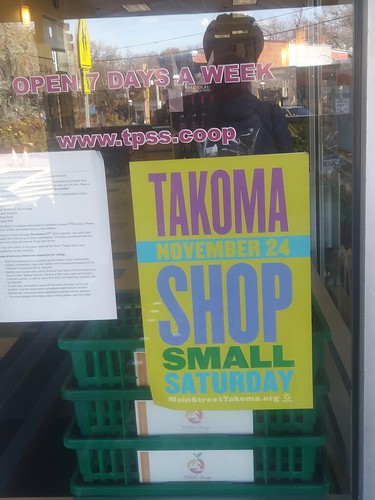
That affiliation with American Express was too corporate for Takoma Park's Old Takoma Business Association, which created its own parallel event but without signing on to the American Express effort.

Takoma Park Maryland Shop Small Saturday
The economic value of shopping locally.  Research results are piling up demonstrating the thesis that spending money in stores based locally has greater economic benefit than shopping in chain stores, which buy few services locally (excepting labor) and don't spend profits locally.

See "Economic impact of locally owned hardware stores vs. big box stores," which discusses an economic impact study done by the North American Retail Hardware Association, which also produced "shop local" holiday promotional materials for this holiday season.

Reminders to shop local are necessary.  A big campaign promoting shopping at independently owned stores and in traditional, usually town-city based shopping districts as opposed to shopping malls, reminds people that spending money at locally-owned stores is important.

The reality is, with so many other marketing messages, people need to be educated and reminded.

Hopefully, the kind of inducement previously offered by American Express to their cardholders isn't required.

I think this is likely to be the case, because so many other retailers and independent shopping districts are now participating in the program, and marketing to consumer bases that goes beyond the segment comprised of American Express credit card holders.

Still, as traditional commercial districts begin skewing their mix of businesses and attractions to food and drink, it becomes harder to "shop locally" at the neighborhood scale, but more possible for "regionally serving small business districts."

By that I mean places with a strong representation of quality independent shops selling goods, like Manayunk or South Street in Philadelphia, Carytown in Richmond, Hampden in Baltimore, to some extent Alexandria, Virginia in the DC area, although many commercial districts have some retail outlets that people can still visit--it might be reconditioned or resale of goods stores though.

The North Park commercial district in San Diego has a great gateway sign.  San Diego funds business improvement efforts with the equivalent of a BID assessment, but many of the programs are organized as "Main Street" programs, which are more volunteer-based groups compared to staff-driven "downtown" associations driven by property owners.

One example of how a county business promotion division is using "Small Business Saturday" as a way to promote its businesses and business districts is Macomb County, Michigan.  See "Macomb County Shops Make Big Deal of Small Business Saturday," C&G Newspapers.

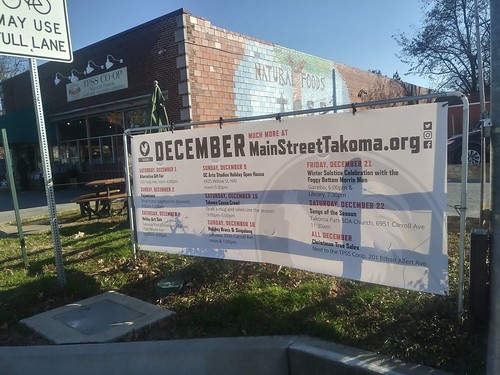
Signboard listing holiday events in Takoma Park's Old Town Takoma commercial district.  

Holiday marketing beyond Small Business Saturday. Many community business districts have figured out the holiday season, providing a large number of events and activities in a coordinated fashion.  And they market these events as part of a comprehensive calendar.
Line up of Holiday Events, 12/2018, Main Street Takoma Park, Maryland

In the DC region, Fredericksburg, Virginia, Frederick, Maryland, and Takoma Park, Maryland do a particularly good job.

In the Petworth neighborhood of DC, this year marks the 14th edition of the Upshur Street Crafts Fair on  Saturday December 1st.  (Last year they did it two weekends in a row, I guess that didn't work out.)

Artisans sell items from booths on the street, and retail stores and restaurants participate as well. 

For the few years, the Friends of the Petworth Library have held a book sale at the library in conjunction with the event too.  That's a particular smart example of leveraging existing events for other purposes, "latching on" and extending the value of the event by adding complementary activities.

Holiday Markets.  More cities are sponsoring holiday markets, modeled after the famous Christmas markets in Germany.  DC has its Downtown Holiday Market, on F Street between 7th and 9th Streets NW, next to the Smithsonian Museums there.  Baltimore has created a similar event.  Although I will say that a city needs to have a reasonably large population to make such an event work.

Hanukah.  The Jewish holiday of Hanukah isn't a gift-oriented holiday, although gift giving has become an element of it because of how the event and religion exists alongside other traditions.

More communities are recognizing that religious traditions other than Christian need to be better acknowledged when planning such activities.

NYC lights a menorah each year in Manhattan, billed as the "World's Largest Menorah," during the week long "Festival of Lights" in early December.

(Because of DC being the National Capital there are National Christmas Tree Lighting and Menorah Lighting events, but they don't have ramifications for stoking retail buying in traditional commercial districts.)

Labels: , , , ,

Wednesday, October 30, 2019

New York Times listing of "Top 10" DC restaurants as an opportunity to briefly revisit Richard's Rules for Restaurant-Based Revitalization

Bad Saint restaurant, DC.

"10 Reasons Why Washington Is A Great Restaurant City"

Back when blogs were ascendant, I got a lot of play for "Richard's Rules for Restaurant-Based Revitalization," which listed a set of "rules" for how restaurants can spur revitalization of neighborhood commercial districts, and by extension cities.

I would get interviewed by journalists here and in other cities, to comment about restaurant and community development issues.

The original piece was partly a response to an article in the Philadelphia Inquirer, which discussed the success of neighborhood restaurants.  At that time, 2005, mostly the kind of chef-driven restaurants discussed in the article had zero chance of success in DC.

This restaurant, at 1330 Pennsylvania Avenue SE, has been successful for more than 30 years, although it was an outlier in that it isn't part of bigger commercial district.

At best, "neighborhood-focused" restaurants not too expensive, with decent service, and an accessible menu could succeed, at least in DC, but not chef-driven restaurants, which were more likely to be successful Downtown and in Georgetown.

But even then, not that many people were willing to venture to Downtown, fearing crime.

Chef Jose Andres' Jaleo has been a great exception, going strong since it first opened in 1993, and spawning other branches in Maryland and Virginia, and elsewhere such as Disney World and Las Vegas, commensurate with his growing fame.

I countered that restaurants to be successful needed to focus on developing neighborhood residents as frequent customers eating out at their establishment multiple times per week.

-- "Richard's Rules for Restaurant-Driven Revitalization (updated)," 2005, is the basic piece, with five rules and a list of elements denoting quality restaurants
-- "Revisiting Richard's Rules for Restaurant-Based Revitalization," 2010, discusses a couple restaurants which repositioned away from upscale to more "comfort" food, to better meet the desires of neighborhood consumers
-- "Updating Richard's Rules for Restaurant-Driven Revitalization," 2013, continues to discuss this in the context of commercial retail district development
-- "DC restaurants: location and equilibrium," 2014, ditto.
-- "A note on food halls," 2017
-- "Successful retail today often includes food, experiences, social elements, and isn't rote," 2016
-- "Destination restaurants as a call for revisiting "Richard's Rules for Restaurant-Based Revitalization"," updated this discussion some in line with the city pushing 700,000 residents making it possible to support the outward spread of restaurant creativity beyond regionally-serving restaurant clusters like Downtown and Georgetown.

"Restaurant tourists":  local eater-tourism as an analogue of architourism.  After the success of the Guggenheim Museum Bilbao, there has been a renewed focus on "architourism" as a way to draw visitors to cities ("The museum that changed a whole city: Guggenheim Museum Bilbao turns 20," Die Welt; "Why can't the "Bilbao Effect" be reproduced? | Bilbao as an example of Transformational Projects Action Planning").

Architourism is a phenomenon that dates back centuries, but it's new to cities thinking in more rigorous ways about how to attract tourists in the face of a multitude of competitive destinations.  (Cultural heritage tourism, which I tout often, is a variant.)

While of course, traditional tourists (people who don't live in your area coming to visit and staying/paying for at least a one night stay) are often a source of business for restaurants, we could say that an element of restaurant patronage is "eater-tourism," comprised of in-region residents going out to eat at places in their home metropolitan area, places that are acclaimed by the national media, from Bon Appetit and Food & Wine Magazines, to reviews in the New York Times or features on television shows such as Diners, Drive-ins and Dives or cooking shows featuring name chefs.

-- "The Guy Fieri Effect," Restaurant Hospitality
-- "The Diners, Drive-Ins And Dives Effect," Twin Cities Business Magazine

This is comparable to movies and television shows that feature particular areas or topics, like the movie "Sideways" and its effect on wine tourism ("'Sideways': 10 years later, hit film still makes waves in Santa Ynez Valley economy," KPCC-FM/NPR), or Frances Mayes book Under the Tuscan Sun later made into a movie, which still draws visitors to Italy, Peter Mayle's book, A Year in Provence, etc.

Chef Roy Choi hosts an interesting series on PBS SoCal, "Broken Bread." 

Island Press just released a book I plan to read and review, titled Food Town USA: Seven Unlikely Cities That Are Changing the Way We Eat.

Chef-driven restaurants primarily rely on non-neighborhood residents for patronage.  It's different today, somewhat, but what today's Times article states as a truth, that
"many new restaurants ... are also bringing fresh life to residential neighborhoods, where relatively low overhead enables creative risks".
has a number of caveats. It's not an absolute.

While some neighborhoods are capable of supporting one or two expensive destination restaurants, recognizing that the customer base for these restaurants is mostly derived from non-residents, the demand isn't unlimited, and some concepts probably work better in restaurant districts that are more central and have a larger customer base with positioning that isn't reliant on an individual restaurant "having to do all the marketing themselves."

(In DC, Metrorail access is a key element of the ability of some neighborhoods to draw patrons from outside the immediate area.)

Overspecialization is still risky.  Last year's "An update to Richard's Rules for Restaurant-Based Revitalization on the failure of wine bar restaurants in DC and Baltimore" discusses restaurant location as being one of five types, and the more local the district, the more risky chef-driven and/or specialized concepts.

This piece discusses this problem in terms of wine bars and the reality that during the week, the average person isn't likely to consume a lot of alcohol, so that wine bars etc. become special occasion destinations, which may not be enough to keep a business open.

What happens when the chef is too ambitious? The CityLab  2019 confab of international mayors just held in DC from Sunday to Tuesday featured a session with Chef Kwame Onwuachi, author of Notes from a Young Black Chef: A Memoir and operator of Kith & Kin on The Wharf, which is one of the restaurants highlighted in the Times article.

While I don't think the talk at CityLab 2019 covered restaurant issues in a manner that could provide insight to mayors, e.g.
  • they could have discussed in a focused way the process of financing restaurants
  • the difficulties faced by people of color in owning, launching and maintaining restaurants
  • providing special financing programs for restaurants (and groceries) in under-served neighborhoods
  • restaurants as social enterprise 
  • workforce training programs, e.g., DC's Food Policy Council is preparing reports on the DC Food Economy and a Food Workforce Workforce Development Strategy, etc.
it was an interesting presentation and Chef Onwuachi made me interested enough to want to read his book.

But because I entered the session late, I don't know if they discussed the spectacular failure of his first attempt at a restaurant in the Shaw neighborhood.

Besides setting up unreasonable expectations for what it would achieve, the cost of the meals, etc., Shaw Bijou had a business model that likely was unachievable in a neighborhood setting:

Really high prices and requiring a large amount of customers, likely not from the neighborhood, to fill the seats.

-- "What Happened at the Shaw Bijou?" Eater DC
-- "Chef Kwame Onwuachi Opens Up About the Shaw Bijou and Restaurant Racism in His New Memoir," Washingtonian Magazine
-- "Shaw Bijou, one of D.C.'s most expensive restaurants, has closed after less than three months," Washington Post

A few restaurants in DC manage to pull this off, like Rose's Luxury on 8th Street SE in Capitol Hill. But there isn't enough demand to support a large number of such restaurants across the city.

What happens when the name chef moves on from an acclaimed but neighborhood-based restaurant?  Restaurants featured in the Times piece, like Komi in Dupont Circle and Bad Saint on 11th Street in Columbia Heights, still are run by either the original chef-owners or original owners.

But Himitsu, one of the shining lights in Petworth, has changed its name ("D.C. Favorite Himitsu Will Change Its Name When Its New Chef Debuts," Eater DC) and chef because co-founder Kevin Tien not only moved on, he took his recipes with him ("Himitsu’s Founding Chef Is Leaving the National Standout That Helped Petworth Pop," Easter DC).

Will the new restaurant be able to succeed without a name chef?  If so, one element of repositioning might be to shift more towards serving neighborhood restaurants, rather than "food tourists."  But that means big changes to the menu, price points, and business model.

Practioners often aren't good at generating meta-theory.  One thing I've learned through observation is that practitioners tend to not be good at generating "meta-theory", the lessons and learning they need to be able to duplicate and replicate their success elsewhere and in places with different conditions.

Systematizing the "reproduction" of restaurants.  For restaurants this may matter less, because there is a differentiation between the financing side and the food side.

Able financiers ("Who Is Hilda Staples?," Washingtonian), although they sometimes bet on the wrong horse ("From 'Top Chef' stardom to bankruptcy: The rise and fall of Mike Isabella," Washingtonian) and restaurant groups ("Longtime D.C. restaurant group shifts focus to food halls as it expands beyond region," Washington Business Journal) develop the expertise to replicate success with different concepts and chefs.

Labels: , , , , ,

Friday, November 23, 2018

Shopping local during the holidays: Small Business Saturday and beyond


The holiday shopping season is touched off by so called "Black Friday," the day after Thanksgiving.

The big chains offer lots of deal busters to get shoppers in stores, and over the past few years stores have been opening earlier and earlier, including no longer waiting til Friday and opening on Thanksgiving.

Promotion of independent commercial districts and stores can be a hit or miss phenomenon.  Some retailers are good marketers, many are not.

The "Main Street commercial district revitalization approach" was developed to bring new resources to commercial districts, beyond that which are normally possessed by the typical business owner.

An example of a national program designed to promote small business, but that is realized only if local businesses and commercial districts organize to leverage it is Small Business Saturday.

The event was created a few years ago by the American Independent Business Alliance, the group that actively promotes the "Shop Local" movement,.to promote holiday shopping at local and independently owned businesses, as opposed to how most holiday shopping is focused on big box stores and national chains,

Cyber Monday/Giving Tuesday.  Other "interest groups" have jumped on the bandwagon and have developed companion days riffing off Black Friday.  E-commerce retail aims to make the Monday after Thanksgiving their biggest shopping day of the season and year, calling it Cyber Monday, while nonprofit organizations promote receiving fundraising donations on the Tuesday after Thanksgiving, Giving Tuesday.

For the past few years, the event has been sponsored by American Express, which originally offered inducements to card members as an incentive to shop local on that day.

They continue to put a lot of money into marketing, advertising, and promotional support.

That affiliation with American Express was too corporate for Takoma Park's Old Takoma Business Association, which created its own parallel event but without signing on to the American Express effort.

Takoma Park Maryland Shop Small Saturday

The economic value of shopping locally.  Research results are piling up demonstrating the thesis that spending money in stores based locally has greater economic benefit than shopping in chain stores, which buy few services locally (excepting labor) and don't spend profits locally.

See "Economic impact of locally owned hardware stores vs. big box stores," which discusses an economic impact study done by the North American Retail Hardware Association, which also produced "shop local" holiday promotional materials for this holiday season.

Reminders to shop local are necessary.  A big campaign promoting shopping at independently owned stores and in traditional, usually town-city based shopping districts as opposed to shopping malls, reminds people that spending money at locally-owned stores is important.

The reality is, with so many other marketing messages, people need to be educated and reminded.

Hopefully, the kind of inducement previously offered by American Express to their cardholders isn't required.

I think this is likely to be the case, because so many other retailers and independent shopping districts are now participating in the program, and marketing to consumer bases that goes beyond the segment comprised of American Express credit card holders.

Still, as traditional commercial districts begin skewing their mix of businesses and attractions to food and drink, it becomes harder to "shop locally" at the neighborhood scale, but more possible for "regionally serving small business districts."

By that I mean places with a strong representation of quality independent shops selling goods, like Manayunk or South Street in Philadelphia, Carytown in Richmond, Hampden in Baltimore, to some extent Alexandria, Virginia in the DC area, although many commercial districts have some retail outlets that people can still visit--it might be reconditioned or resale of goods stores though.

The North Park commercial district in San Diego has a great gateway sign.  San Diego funds business improvement efforts with the equivalent of a BID assessment, but many of the programs are organized as "Main Street" programs, which are more volunteer-based groups compared to staff-driven "downtown" associations driven by property owners.

One example of how a county business promotion division is using "Small Business Saturday" as a way to promote its businesses and business districts is Macomb County, Michigan.  See "Macomb County Shops Make Big Deal of Small Business Saturday," C&G Newspapers.

Signboard listing holiday events in Takoma Park's Old Town Takoma commercial district.  

Holiday marketing beyond Small Business Saturday. Many community business districts have figured out the holiday season, providing a large number of events and activities in a coordinated fashion.  And they market these events as part of a comprehensive calendar.
Line up of Holiday Events, 12/2018, Main Street Takoma Park, Maryland

In the DC region, Fredericksburg, Virginia, Frederick, Maryland, and Takoma Park, Maryland do a particularly good job.

In the Petworth neighborhood of DC, this year marks the 13th edition of the Upshur Street Arts & Crafts Fair on  Saturday December 1st.  (Last year they did it two weekends in a row, I guess that didn't work out.)

Artisans sell items from booths on the street, and retail stores and restaurants participate as well. 

For the few years, the Friends of the Petworth Library have held a book sale at the library in conjunction with the event too.  That's a particular smart example of leveraging existing events for other purposes, "latching on" and extending the value of the event by adding complementary activities.

Holiday Markets.  More cities are sponsoring holiday markets, modeled after the famous Christmas markets in Germany.  DC has its Downtown Holiday Market, on F Street between 7th and 9th Streets NW, next to the Smithsonian Museums there.  Baltimore has created a similar event.  Although I will say that a city needs to have a reasonably large population to make such an event work.

Hanukah.  The Jewish holiday of Hanukah isn't a gift-oriented holiday, although gift giving has become an element of it because of how the event and religion exists alongside other traditions.

More communities are recognizing that religious traditions other than Christian need to be better acknowledged when planning such activities.

NYC lights a menorah each year in Manhattan, billed as the "World's Largest Menorah," during the week long "Festival of Lights" in early December.

(Because of DC being the National Capital there are National Christmas Tree Lighting and Menorah Lighting events, but they don't have ramifications for stoking retail buying in traditional commercial districts.)

=======
Had the Macy's Thanksgiving Parade on tv a bit yesterday, while cooking.  Eventually changed from NBC to CBS because the latter focused more on the parade than all their various special sponsor promotions.

I can't remember which channel it was, but they featured a short story on how Ebay is a great option for holiday shopping.  Considering they were showing the "Macy's" Parade and that Macy's is primarily a "brick and mortar" store and that the department store category is declining in response to changes in shopper behavior along with e-commerce, I thought that was pretty ironic.

Of course, when NBC's feed did an interview with the CEO of Macy's, I helped offered the tv some suggested questions, such as "how many stores might you be closing next year?"

-- "A reckoning on 34th Street," video, CNBC-TV
-- "As Macy's shrinks its stores, CEO Jeff Gennette says this is what he will do with the extra space," CNBC-TV

Labels: , , , ,

Wednesday, November 14, 2018

An update to Richard's Rules for Restaurant-Based Revitalization on the failure of wine bar restaurants in DC and Baltimore

The original "Richard's Rules" post dates to 2005, and was a response to an article about "destination restaurants" as key to neighborhood revitalization in Philadelphia.  I countered that restaurants to be successful needed to focus on developing neighborhood residents as frequent customers eating out at their establishment multiple times per week.

-- "Richard's Rules for Restaurant-Driven Revitalization (updated)," 2005, is the basic piece, with five rules (below) and a list of elements denoting quality restaurants
-- "Revisiting Richard's Rules for Restaurant-Based Revitalization," 2010, discusses a couple restaurants which repositioned away from upscale to more "comfort" food, to better meet the desires of neighborhood consumers
-- "Updating Richard's Rules for Restaurant-Driven Revitalization," 2013, continues to discuss this in the context of commercial retail district development
-- "DC restaurants: location and equilibrium," 2014, ditto.
-- "A note on food halls," 2017
-- "Successful retail today often includes food, experiences, social elements, and isn't rote," 2016

Last year's piece "Destination restaurants as a call for revisiting "Richard's Rules for Restaurant-Based Revitalization"," updated this discussion some in line with the city pushing 700,000 residents making it possible to support the outward spread of restaurant creativity beyond regionally-serving restaurant clusters like Downtown and Georgetown.

Ruta del Vino.

But the failure of a wine bar, Ruta del Vino, a Latin American wine and food concept, on Upshur Street NW ("Ruta del Vino Wine Bar Closes After 2-Year Run in Petworth, Eater DC) and Baltimore's Wine Market Bistro/Ludlow Market ("Ludlow Market Closes in Locust Point" and "Ludlow Market opens as more casual replacement of Wine Market Bistro,"  SBmore.com) provides an opportunity to further refine the discussion.

Categorizing restaurant districts.  While neighborhoods are supporting expensive destination restaurants, recognizing that the customer base for these restaurants is mostly derived from non-residents, the demand isn't unlimited, and some concepts probably work better in restaurant districts that are more central and have a larger customer base with positioning that isn't reliant on an individual restaurant "having to do all the advertising and marketing themselves."

There are at least five primary categories of urban restaurant districts:

(1) regional and touristy-serving, like Downtown and Georgetown, but also Alexandria and now The Wharf district in SW DC, probably the Ballpark District/Navy Yard

(2) center city/metropolitan serving, like 14th Street NW, Adams-Morgan, U Street NW, and H Street NE in DC, or Bethesda and Silver Spring in Montgomery County, Maryland

(3) day-time office district serving (which can be a "daypart" distinction for regional and center city districts that serve different market segments at night)

(4) larger neighborhood serving districts like Dupont Circle, Capitol Hill, Columbia Heights

(5) smaller neighborhood serving districts like Old Takoma in Takoma Park Maryland, abutting DC.

The "Rules" call for food and by extension, drinking, concepts that aren't super specialized, a more common denominator, like "Mexican" food, not Indian, with the suggestion that Thai food is now a more universal cuisine, etc.

Granted places like Bad Saint (Filipino) in Columbia Heights, Himitsu (Japanese) in Petworth, Rose's Luxury in Capitol Hill are super specialized and/or expensive and they do fine in "neighborhood" locations.

But maybe there is a limit to how much specialization can work in neighborhood restaurant districts.

Are "neighborhood" wine bars too specialized for today's food and beverage preferences?  I wonder about "wine bars."  I'm thinking that these business failures mean that at a minimum wine bars as a sub-category of restaurants need to be more carefully located, probably in "metropolitan-serving" districts that have much larger customer bases and are more convenient to get to than neighborhoods that may be more out of the way and harder to reach by transit

Both establishments were reasonably well-regarded.  Wine Market Bistro had been in business for almost 14 years, but Ruta del Vino only 2 years.  Both found that the customer base for "heavy" wine consumption was declining.

I can't speak of Wine Market Bistro because I never went there but I did go to Ruta del Vino.

First, Suzanne's the wine drinker not me, I prefer craft beer (and porters at that).  But second, the food while good was overpriced vis a vis the quality and the value (the ceviche was great, the parillada needed more meat, but was cool as a dish served for two).

Third, others complained that the service wasn't that great, although in comments, the owner "complained" that it was difficult to find good help, but also that business was spotty.

Inside the space was a knock out, although outside there were issues (the way a garbage dumpster for an adjoining building is out front, a bus shelter right next to the patio, unkempt treeboxes, etc.).  They didn't invest much in maintaining the public space outside the restaurant.

But to go there a lot you have to want to drink a lot of wine.  Most people aren't doing that when they go out to eat.  A special occasion restaurant needs to draw on a larger "retail trade area" beyond that of a neighborhood to keep seats filled.

And they have to be able to execute the quality-value-price-service equation.

Wine bars/in-city wineries as destinations/experiences.  Note that District Winery in the Navy Yard and City Winery in Ivy City ("City Winery Is Opening in Ivy City DC for Music and Wine Fans Alike," Washingtonian Magazine) are destinations, hold events, and are owned by well-funded restaurant groups with multiple interests. 

These establishments operate on a much different scale than Ruta del Vino or Ludlow Market and they are located in "metropolitan" serving districts.

I think Ruta del Vino, had it been able to execute, would have done much better on 14th Street NW in Logan Circle/P Street, or Wine Market Bistro/Ludlow Market on Charles Street or in Federal Hill, or possibly in the private Belvedere Square Market, which functions like a public market.


Grand Cata wine shop.

Selling bottles for off-premise consumption + food and drink on-premise as a way to make the restaurant work?  Possibly, Ruta del Vino could have been more successful had it been paired with a sales shop, like Grand Cata on 7th Street NW in Shaw, but that didn't work for Ludlow Market.

On the other hand, a Ruta del Vino type restaurant next to Grand Cata, if well executed, would probably do just fine.

So how much of this comes down to operators?  Although again, with Ludlow Market, that was a concept run by a highly experienced operator and it had worked for a long time, until it didn't.

Cideries.  Another drink concept that seems to me to be over-expanding a bit is cider ("Two Consultants Quit Their Jobs to Open a Cidery in DC Later This Fall," Washingtonian).

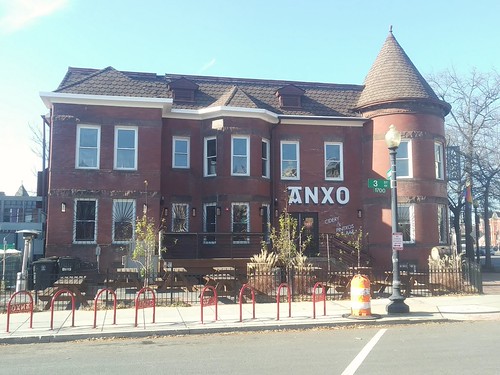
The Anxo cidery has installed custom bicycle racksDC has Anxo, on Florida Avenue NW (left) and with an outpost on Kennedy Street NW, and the new Capitol Cider House on Georgia Avenue in Petworth.

These are destinations.  I think over the long term, firms need to carefully consider where they locate their concepts.

Anxo on Florida Avenue and Capitol Cider House on Georgia Avenue ("Capitol Cider House Opens in Petworth with a Local-Only Bar," Washingtonian) are very visible and likely have staying power.

Locations in neighborhood-serving districts, like Ruta del Vino, Ludlow Market, and Anxo on Kennedy Street NW may have more difficulty being sustainable.

... people are likely to be less inclined to drink cider than wine.

Labels: , , , ,

Monday, December 18, 2017

Retail consultant Bob Phibbs: Holiday Shopping: 9 Tips To Get Last Minute Shoppers To Spend More In Your Brick And Mortar Store

Years ago I remember reading advice from a retail consultant to department stores like Sears, that if they wanted to sell more, why not provide shopping carts, like grocery stores and discount merchandise stores.

And of course, the six most important words that McDonalds uses to spur add-on sales (although I notice that at the McDonalds I frequent maybe three times/year--I have this "myth" about eating high fat McDonalds food when I have a cold -- they've forgotten to say it):

-- Do you want fries with that?

Retail consultant Bob Phibbs offers retailers some very practical advice to sell more.

From his blog entry, read the entry for the details:

1. Give a shopping basket. If you don’t already have shopping baskets, get them – now. Paco Underhill first reported 75% of people who take a basket actually buy something versus 34% who don’t.

2. Empty their arms. If you are a clothing store, sporting goods, or other retailer where baskets aren’t practical, your crew should still be walking up and offering to take the clothes or items from the shopper so they can be more relaxed while looking around. Yes, some will refuse, some will think about it, and some will accept.

Make this your mantra: full hands equal fewer sales.

3. Keep ‘em in the aisles. Keep your best associates out on the selling floor and away from ringing up sales or wrapping gifts. Their goal is to increase add-ons. As they finish helping someone, make sure they simply ask, “Who else is on your list?” It works wonders.

4. Spotlight A No-brainer Gift. Put one product under 15 bucks, - even better under 10 - by the register, ideally pre-wrapped with a sign that says, “A gift for the person you’re bound to forget.” The key is to have one product that doesn’t require any thinking. The shopper has to get it like a USB charger for $9.95 rather than a tiny book of pithy quotes by Margaret Thatcher.

5. Ship it. While UPS and the rest will be challenged, there’s still time to sign up for a local delivery service like Deliv in the US or Shutl if you’re from the UK. Millennials hate to carry too much – they’d rather have it shipped. Notice I didn’t say free – it’s a value add.

6. Cut the line. If you offer gift wrapping, make sure you have a separate line for pickup away from the queue to pay. Make sure to get their cell phone number so you can text them when it’s ready, and add their name and number to your CRM so you can market to them in January.

7. Heads up. Always instruct your managers to have their heads up and looking around the store to see who has been waiting a long time, who has a question, and which cashier is not up to it. They need to be able to step in as appropriate to keep your store moving along.

8. Keep it clean. Make sure your store is clean and organized by your part-timers or even a young relative.

9. Work the line.

Labels: , , ,

Friday, November 24, 2017

Holiday Shopping, Small Business Saturday, etc.

Cover, Golden Book Publishing, 1958.

Black Friday, the biggest day for retail sales.  I saw something on the news today that I don't believe.  They said that $682 billion in sales are made on Black Friday, today, the day after Thanksgiving, and the traditional start of the holiday shopping season.

That is $2,000 for every person in the U.S.

Small Business Saturday is a promotion created by the American Independent Business Alliance and now spearheaded by American Express ("Small Business Saturday gives local retailers chance to take on Amazon" and "Downtown merchants group pushing people to shop 'small'" Baltimore Business Journal).

-- Small Business Saturday website

The idea is that independent businesses can't compete  "head-to-head" against traditional chain retailers in terms of offering the best prices on mass market goods, especially on Black Friday, but they can differentiate their businesses in terms of artisan goods, customer service, and experiences.

Bene hat shop, 6200 block of 3rd Street NWMany stores run promotions throughout the day. 

In DC, as part of SBS, at 4:30 pm, Mayor Bowser will be visiting Bene' Millinery & Bridal Supplies at 6217 3rd Street NW in the Manor Park neighborhood of DC (it's a throwback retail block, one block, embedded within the neighborhood).

Bene' adjoins two other boutiques, Lovely Lady, which sells new clothes, and Kasia's Collection, a consignment type store.

All three of the stores do great windows but their hard work often goes unrewarded because few people walk by and look, and cars go too fast to be able to see the artistry.

Indies First 2017Indie Bound, an alliance of independent bookstores, holds its annual promotional event, Indies First, co-incident with Small Business Saturday, the first Saturday after Thanksgiving.

Artisan retail on the rise.  Traditional retail has been on the decline for some time.  Every week there are new reports on store closings, retail firm bankruptcies, and sales declines.  While some of this has to do with the rise of online retail, another perhaps more significant element concerns how people are using their time, specifically time using digital devices ("It's Not Just Retail That's Changing. It's Us," Bloomberg).

Separately, Bloomberg reports a rise in sale for independent stores and continued difficulty on the part of traditional shopping malls ("Mom-and-Pop Shops Are Threatening the Mall This Holiday Season").  From the article:
Spending growth at mom-and-pop businesses has outpaced that of the big chains in the past two years, according to Sarah Quinlan, senior vice president at credit-card giant Mastercard Inc., which tracks purchasing patterns. When they’re not shopping online, Americans are seeking more personal connections and advice -- something they can find lacking at national retailers.

“The consumer is shopping small,” she said.

Big chain stores still account for the majority of shoppers’ purchases, according to Mastercard. But many of the most affluent consumers are now clustered in walkable neighborhoods, letting them skip the mall in favor of neighborhood hardware stores, bookshops and grocers. And they’re willing to pay the higher prices, Quinlan said.
Relatedly, there are reports of the creation of more independent bookstores, including the opening of a new bookstore, Solid State Supply, on H Street NE last weekend.

Last week, I went to the opening of the new location of Willow, an apparel and gift store, in the Navy Yard district of the Capitol Riverfront.  Willow's first store is on Upshur Street NW in the Petworth neighborhood, and it's an exception that "proves the rule" about the difficulty of success for one-off apparel retail in neighborhood shopping districts. 

The proprietors aren't going to become wealthy, or a national chain, but they have figured out how to fill a niche in providing affordable apparel, complemented by gifts, cards, housewares, and items for children in neighborhoods with certain kinds of demographics.

I had been skeptical that such a store could work in the Navy Yard, which tends to have fewer in-neighborhood residents as regular customers, but the store, by reaching out further into a retail trade area that encompasses Capitol Hill, can be successful.

Another fascinating store in the Navy Yard district is Steadfast Supply, an independent which specializes in selling items created by locally-based artists and craftspeople,  It's an interesting contrast to Willow, because of the price points.  By featuring items produced "by hand," items definitely cost more money at Steadfast Supply, which might make it more difficult for them to build a base of repeat customers.

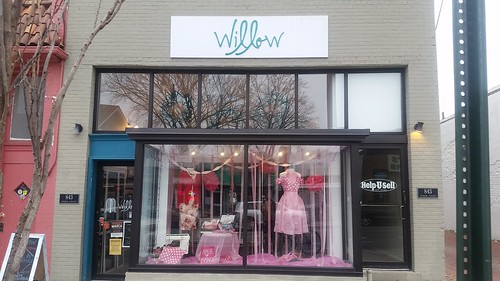
Storefront window, Willow retail store
The Willow apparel and gift store on Upshur Street NW, Petworth, Washington, DC.

Willow, Steadfast Supply, Solid State Books and others (e.g., Upshur Street Books, the Big Bad Woof pet supply store in Takoma, etc.) are examples of the new small scale retail resurgence, which admittedly is a localized phenomenon. 

The development of this kind of retail can only happen in those areas with the right population and demographics.  But stores like Willow prove that there are more places that can support independent retail than was previously thought.

A couple of initiatives in DC.  From Mayor Muriel Bowser's weekly e-letter:
When Washingtonians share their talents and creativity with our city, we want to do all we can to support them. Last month, we celebrated the opening of Shop Made in DC, a new brick and mortar store and café stocked exclusively with DC brands and concepts. Tomorrow, I will celebrate Small Business Saturday on Minnesota Avenue, DC's newest Main Streets designee. And next week, the Council and I will host a variety of District-based entrepreneurs at the Wilson Building for a pop-up Made in DC: Holiday Bazaar.
Handwringing about the future of retail in New York CityCrain's New York Business reports ("Local pols shop for solutions to retail's crisis") on legislation proposed by various City Councilmembers to provide support to independent retailers and restaurants, which have been caught between chain businesses and ever escalating rents.

Rents have been escalating in part over non-sales related objectives, or by property values being set in a fashion that is disconnected from the revenue potential of the space.

Proposals include tax cuts for retailers and rent control.  One program provides some discounted rent in a new development for four stores.

I still believe the best option is for New York City to create a commercial retail space community development corporation comparable to the SEMAEST group in Paris.  The Vital Quartier program has by this time supported 400 independent businesses and controls more than 500,000 s.f. of retail space.

From the Guardian article "Paris's new planning strategy: bookshops in, textile wholesalers out":
Devoted to "economic development and commercial diversity" in the eastern districts of the city, Vital'Quartier works in 11 parts of the city deemed stagnant or dominated by a single commercial activity.

In those areas, the Semaest targets premises, buys them, renovates them and then advertises for tenants who will be able to pay rent at affordable rates as long as their plans for the space concur with the authorities' vision. De Nuñez, who believed there was an "urgent" need for a Spanish-language bookshop, pays around €1,700 per month for his 60 sq metres in one of the priciest parts of the city.

"Normally you would have to pay a big sum of money up front, maybe €50,000 or €60,000," he said. 
The holiday window at 1z2z3z, a store featuring items for young children.

VCU Brandcenter students decorate store windows at Richmond's Westhampton shopping district.  VCU Brandcenter is the advertising program, and this year, students working on Project Holiday decorated the storefront windows of 28 stores on Libbie, Grove and Patterson Avenues ("VCU Brandcenter students create holiday window magic at shops," Richmond Times-Dispatch). From the article:
Their efforts are part of Project Holiday, a friendly competition for the students to come up with the most wonder-inspiring window display with a budget of just $100 per window and lots of creativity. The public will get the chance to vote on the windows they think are the most creative.

The project is a collaboration between the Westhampton Merchants Association and graduate students in the Experience Design track at the VCU Brandcenter. The participating businesses provided the $100 budget per window.
That's a great way for students to get practical experience in retail merchandising and builds on the idea of artisanal retail experiences.

Labels: , , , ,