Because they can charge higher income people more money.
The
Post food section yesterday has a focus on farms and farmers market, and one of the articles is entitled "
Farmers market prices tend to be higher in the city: Why?." The thrust of the articles is that the prices are higher because expenses are higher. That's true to some extent, but it isn't the primary reason.
In high income areas, like DC, people are accustomed to paying more money for items, including food. Market vendors take advantage of this and charge more money, and make more money than they would if they sold the items closer to home.
By contrast, food at farmers markets in Baltimore _City_ tend to be much more competitively priced, especially at the big Baltimore Farmers Market located Downtown and open on Sundays.
A peck of peaches at the Baltimore Farmers Market is sold for $15 in 2014. According to a USDA conversion chart, a peck of peaches weighs more than 40 pounds. Photo: Algerina Perna, Baltimore Sun. $15 will get you 4-5 pounds of peaches at a farmers market in the DC area.
The market in Towson, the main conurbation in Baltimore County, also sells foods at competitive prices.
Note that Baltimore's Waverly/32nd Street Market has been increasing prices over time as the market has become more popular with higher income consumers, especially from Charles Village and other nearby neighborhoods. It too used to sell goods for much less compared to farmers markets in DC. No more.
When I see farmers, bakeries, etc. coming to DC farmers markets from as far as Pennsylvania and West Virginia, it's pretty clear they are motivated to do so because they can charge a lot more than they could in markets local to them.
Farmer direct marketing sales are on the decline. A front page story, allied to the special section, is also interesting, "
For some growers, farmers markets just aren't what they used to be," as it discusses how market vendors are experiencing a significant drop in sales of produce and other products that have to be further prepared by the purchaser in order to eat, with some vendors reporting sales declines of 30% to 50%.
Part of this is because of a switch on the part of high income consumers and younger consumers to greater purchase of prepared foods.
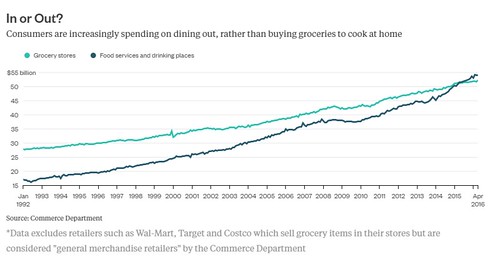
(This paragraph reprinted from a piece from a couple weeks ago.) More food spending now takes place out of home. While I've mentioned this here I think (definitely at Eastern Market public market board meetings) a different Bloomberg piece ("
Blue Apron IPO could be waylaid by buyer like Kroger") includes this graphic:
In response, companies are shifting their strategies, such as focusing on providing experiences and using e-commerce technologies, to improve the retail experience and social media marketing specifically to remain relevant, and stoke awareness and sales.
HOWEVER, I've since learned that part of the problem with this graph is that the data inadequately captures sale of non-cooked food that have switched from being purchased at traditional supermarkets to "non-traditional" locations ranging from warehouse stores like Costco to drug stores (which function more like convenience stores), and discount department stores like Target and Walmart. Likely this means that noncooked food sales are still greater than food sales "out-of-home."
Still, higher income demographics are more likely to cook less and eat out more. As the income mix of DC's population changes, this has repercussions on the type of food that is sold. Similarly, DC has experienced an explosion of new grocery stores, and these stores tend to feature produce and organic items especially. This likely has an impact on farmers and public markets too.
More competition also means sales declines. But while the article mentions part of this is also likely to an increased proliferation of farmers markets, it doesn't develop the point. I think, at least with decline in sales at markets in DC, farmers market proliferation is a huge element.
For example, why go to the Dupont Circle Farmers Market on Sunday when you can go to a very good farmers market at 14th and U Streets NW on Saturday.
Why go to the Takoma Park Farmers Market on Sunday when you can go to the Silver Spring Farmers Market on Saturday?
Why go to the Petworth Community Market on Saturday if you live a bit west when you can go to another market held at the same time at 14th Street and Colorado Avenue NW? (And why go at all to the Takoma market on Sunday if you live in Petworth?) Etc.
And, since I am on the community advisory committee for Eastern Market, the city's public market building, why go buy food from farmers at Eastern Market on Saturdays and Sundays when you can more conveniently purchase similar goods at a myriad of markets across the city, much more conveniently located?
And why go to Eastern Market or Dupont Circle Farmers Market on the weekend when you can go to a super well marketed and curated Union Market ("
Union Market: every DC foodie trend in one building,"
Washington City Paper), which is often programmed with exciting special events?
Or if you live in the H Street neighborhood, you don't need to go to Eastern Market because of a Saturday farmers market there, as well as the more conveniently located Union Market. Etc.
Last week, the Post Weekend section picked crabcakes from Dragon Creek Seafood as an item not be missed from at the USDA Farmers Market to be ("10 great things to eat and drink at DC-area farmers markets"). The company is located in Virginia's Northern Neck, about a two-hour drive from DC.
Not to mention that many school PTAs are supporting truck farmer food sales on the grounds of public schools (in many higher income areas, as it happens) to raise money for projects. That's one more element of competition that isn't likely to be registered when considering this issue.
For many years I've been arguing that DC's population can't support the plethora of farmers markets across the city. DC has far more farmers markets than makes sense for demand. The farmer vendors are the ones paying the price.
Markets as activation devices not as places to buy food. This piece discusses the various reasons to open a farmers market ("
The reason(s) why a farmers market is created shapes the type and mix of vendors allowed to sell").
The front page article discusses how for many people, a farmers market has become an event to go to to experience, not a place to buy food.
Many of the reasons have to do with activation, not promoting access to food or income generation for rural areas. And property owners especially are motivated by bringing in people, not as much about the nature of what they buy. But for example, with Union Market, most of the vendors sell prepared items, not food that needs to be prepared and cooked by the purchaser.
Labels: consumer behavior, experience economy, food-agriculture-markets, neighborhood revitalization, urban design/placemaking


.webp)







