Rebuilding Place in the Urban Space

"A community’s physical form, rather than its land uses, is its most intrinsic and enduring characteristic." [Katz, EPA] This blog focuses on place and placemaking and all that makes it work--historic preservation, urban design, transportation, asset-based community development, arts & cultural development, commercial district revitalization, tourism & destination development, and quality of life advocacy--along with doses of civic engagement and good governance watchdogging.

Wednesday, May 27, 2026

The "new" Washington Post editorial page blows a chance to be innovative | Nudging versus "nannyism" and senior health care

I was gonna end my online subscription to the Washington Post, but some of the articles from years ago I cited in the recently submitted grant application for a playground at Sugar House Park in Salt Lake ("Forget rest stops. Plan your road trip around playgrounds," "Kids getting burned on swings and slides? Here’s how to fix it"), made me realize that despite the destruction of the Metro and Sports sections, the devastation of the Editorial Page and how the range of op ed writings went from lean progressive to "personal freedom and markets," I still get value from a subscription, both for new articles and old (and often better) articles too.

But not from the editorial page.  And the national and international coverage is still holding up, despite many gaps resulting from staff firings.

Nudging is the behavioral economic theory that people who should change their behavior but won't because it requires a change in their routine or to act, will make the right choice given a nudge.

Nudge theory is a behavioral science concept proposing that subtle changes to the environment—known as "choice architecture"—can guide people to make better decisions without restricting their freedom of choice or altering financial incentives
Nannyism is a term popularized by the English Tories who believe that encouraging people to make positive behavioral changes with "nudges" is an overinvolvement by government in people's lives, that they should be allowed the freedom to f* up and impose the costs from doing so onto the State.

According to Wikipedia:
The term was coined by MP Iain Macleod in (1965) to describe a government that over-regulates personal lifestyle choices. 

In the Nanny State Index, the UK consistently ranks among the most heavy-handed countries in Europe for dictating health and consumer regulations.

The concept manifests across several specific areas of public policy:
  • Tobacco & Vaping: The UK has pushed heavily toward a "smoke-free generation," alongside severe restrictions and proposed taxes on disposable vapes.
  • Diet & Food: Following the implementation of a national sugar tax, England has enforced strict rules including calorie labels on restaurant menus and bans on junk food advertising near checkouts and on TV.
  • Alcohol: Measures like minimum unit pricing aim to curb consumption by hiking the cost of cheaper alcohol.
Instead, the Tories would rather pay the high costs resulting from chronic health conditions resulting from poor behaviors and choices.  After all, higher than necessary costs from health care and a static tax base means government has to shrink to pay for people's bad choices, and that's in the Tory interest because they believe government ("we the people") is unnecessary.  

I call it anarcholibertarianism.

A great example of "nudge theory" decades before the theory was coined was how the now famed criminology professor, Ronald V. Clarke, was the creation of a theory called "preventing crime in situations":
Their theory of situational crime prevention used locks, access control and vigilance. Yet the most impressive demonstration of the theory examined the relationship between the lethality of household gas usage and suicide rates in England and Wales. Their research led to decades of innovations in the design of crime prevention measures, largely following their clear theoretical framework.

Prime example: Less lethal oven gas reduced suicides Between 1963 and 1975, there was an unexpected decline in the number of suicides in England and Wales. Clarke and Mayhew then reviewed the evidence to look for any change in the opportunity structure to prevent suicide. In 1988 they published a report showing that the decline was clearly due, at least in part, to a reduction of lethality in the chemical composition of household gas. It simply became more difficult to commit suicide by just turning on the gas and lying down – then waking up alive with a headache. They concluded that the practical feasibility of carrying out a particular act has a major impact on whether or not the act will be committed – and at what rate of occurrence.

Situational crime prevention theory is but a form of "choice architecture."

The Post is all in on being against "nannyism" even with clear economic/cost-benefits.  The editorial, "Seniors are adults: They don’t need the federal government to buy them bath mats.," criticizes Senator Angus King who wants to send everyone on Medicare (that includes me) a bathmat to help reduce the likelihood of falls, because bathroom falls by the aged cost the health care system a lot of money.

Older adults with assistive devices walking on a trail in the Sawtooth National Forest, Ketchum, Idaho.

Medicare doesn't pay for prevention measures like bath mats, grab bars, and shower chairs.  

According to a pre-Trump Administration report which is scrubbed from the HUD website, Overcoming Obstacles to Policies for Preventing Falls by the Elderly Final Report,  by the Department of Housing and Urban Development, the annual cost of health care from elderly falls is at least $80 billion per year.

To put that number in perspective, if Jeff Bezos who is one of the globe's wealthiest and owns the Washington Post, was responsible for covering that cost year after year, his fortune would be wiped out in 3 years and 2 months.

Although note that Senior Housing Services programs, which used to be funded by HUD, will make these kinds of fixes, as part of broader renovation assistance aimed at keeping seniors in their homes despite infirmities--keeping people at home as long as feasible costs a lot less than nursing homes, another major health care cost, but for Medicaid.

Housing renovation data by age and economic and physical circumstances.  Years ago I saw a presentation from the Joint Center for Housing Studies.  

Right: house in the Trinidad neighborhood of DC showing severely deteriorated roof conditions.

It contrasted overall housing remodeling statistics with statistics for lower income households.

Most households do one major remodeling project annually, targeting one key element of the house, either repair, maintenance, or the creation of a new feature.  Annually, the average household spends $2,400 on improvements and $700 on repairs.

Their research finds that a disabled household spends 10% less than the average, senior households 20% less, minority households 30% less, households with houses under $100,000 in value 50% less, and households with under $20,000 annual income spend 50% less.

Households with all of these characteristics spend an average of $500 year on repairs and improvements, less than one-sixth of the national average, and a majority of these households spend no money at all.

Nursing homes/social care.  The US is running into a fiscal cliff as society ages and Medicare doesn't provide nursing home care ("New Study Explores the Need for Expanded Long-Term Care Services to Support Aging-in-Place," JHU).  

And what about social security?  Plus the fiscal cliff of Social Security benefits having to be cut because Republicans won't take proactive steps, they'd rather "defund" part of the government by letting it fail naturally ("Waiting To Rescue Social Security Has Weakened Our Options," CRFB)

In England, local government is responsible for providing what they call "social care" for the disabled and aged, and it's driving cities into bankruptcy ("Social care is bankrupting councils. Why aren't we angry?," New Statesman).  Families are sending their relatives needing care to Thailand because it is cheaper ("Families sending relatives with dementia to Thailand for care," Guardian).  Anti-nannyism has real and escalating costs.

Waiting for a ride.

These costs demonsrate the value of changing the policy on assistive devices.

In my comment on the Post editorial, I said that Medicare could make bath mats a "joining premium" like how PBS and NPR give you premiums (gifts) in return for donations.

It's an intellectual and policy failure of great proportions for the Post to not acknowledge the reality of the severe economic cost of falls.

The other thing, while the term "ableist" is in decline these days by Trump mandates against inclusion, you really get insight into the need for universal design--in the old days, the Post published articles about it, such as:

-- "Adapting Your Home To Maximize Mobility," 2006
-- "A Safe Home, Step by Step," 2010
-- "Making the case for cottage homes," 2019
-- "A major renovation yields a multigenerational home on Capitol Hill," 2021

to better deal with the changes in psychomotor prowess that come from illness, disability, and or age.  Instead, the Post's worldview is shaped by its writers being able, not infirm.

At one time too, the Post had an award winning Health section focusing on wellness and behavior change.

Last year they did one of their "Washington Post Live" events on the "Future of health policy in the United States."  Times sure have changed.

My circumstances changed in a flash.

I went from biking to work for 30 years to being a hospital "frequent flyer," but for good reason.

I had colon cancer, presented heart failure in post-op after surgery, and the biopsy found I also had an aggressive rare Lymphoma, so I started chemotherapy within a month of the colon surgery.  Without treatment for the Lymphoma the oncologist said I'd be dead within a year.

Chemotherapy f*s you up.  

I was so weak, but I didn't vomit.  Though once it did take me 3-4 hours to have a bowel movement.  Suzanne said the prednisone made me mean.  It did help my appetite.

I did use chairs in the shower some because my FIL had dementia before he died, and we kept the equipment.  I even used a transporter because for a time I couldn't handle the "long walk" from the entrance of the hospital to my heart doctors or to the radiology/lab testing section. For more than two years, I was pretty damn weak, especially because even more medical things happened:

  • I was hospitalized for covid, 
  • probably could have died thank god for remdesivir, but it did worsen my heart
  • got a heart pacemaker
  • then an additional lead
  • then a stent, even though less than a year before my angiogram found limited plaques, and 
  • serious reduction in appetite as a complication from chemotherapy and the medicine, 
  • which led me to a few months of enteral nutrition feeding + regular eating--enteral really sucks, the tubes can clog easily, and emergency rooms aren't set up to deal with feeding tube clogs.

Plus, one of the medicines I took made me cough constantly--it turned out it was from a medicine I didn't really need, fortunately, and once I got off it, and other medication changes my appetite improved.  Although I still only weigh 20ish more pounds than my low of 110.  From a high of about 175.

Today's shower.  

And that was after I went through chemotherapy swimmingly.  I had three treatments, then covid, so treatment stopped.  In preparation for resumption 14 weeks later, testing found I no longer had the Lymphoma (thank you to mRNA maybe).

But it took me until about the past two months when everything finally came together "at once" and I am super better.  (I'm still susceptible to illnesses like norovirus which can wipe me out.)

Yet only two years ago I thought I was a candidate for a heart transplant.  My ejection fraction could be better, but I haven't been tested since my recovery kicked in.

Our shower has a "natural grab bar" the soap dish, and is a pretty tight squeeze so I could lean against the walls.  But I was damn tired, had balance problems etc.  I think I might have had assistance once or twice...

Now I don't.  It helps that last summer I joined the JCC Wagner in Salt Lake first for the pool, and weight lifting really started only this year (not much so far 30-60 pounds depending on the machine or free weights), cycling (I've just started being able to bike a bit "in the wild," after not having done so since September 2023), spa, and pool walking.  The JCC has indoor and outdoor pools, that + the spa have been incredible for me.

Another premium that should be part of Medicare: fitness memberships/a MAHA agenda for aging.  I'm not part of Medicare Advantage, so I pay from my limited social security income the monthly cost of JCC membership.  The local rec center is cheaper especially with a senior discount, but there is no pool.  The County rec centers with pools happen to be much less convenient for me to get to, triple the time.

But Medicare should consider paying for fitness memberships for all enrollees, regardless of the type of plan, because lifting weights and other fitness activities have so many positive benefits (Physical Activity Benefits for Adults 65 or Older, CDC, "Resisting decline: the neuroprotective role of resistance exercise in supporting cerebrovascular function and brain health in aging," Frontiers in Physiology, "How can strength training build healthier bodies as we age?," National Institutes on Aging).

Or a deduction program funding the purchase of bicycles like in England or Ireland ("The Benefits of Biking for Seniors, Including the Mental and Physical Payoffs," Bicycling), but instead of deducting from your payroll check, from your Social Security check.

They could do this in conjunction with County and City Recreation Centers, Senior Centers, and yes, for profits.  Better that fitness centers make money off of Medicare than prescription mills and other fraudulent activity.

If we were really about MAHA, "Make America Healthy Again," ("Dr Oz at the Center for Medicare and Medicaid Services: a chance to improve food service in hospitals") those are the kind of preventative care measures we should be instituting.  

A FitLot exercise station at the Columbus Center in the City of South Salt Lake.

While RFK has done stupid PR stunts with unhealthy people like Kid Rock ("RFK Jr.'s erotic workout video with Kid Rock sure is weird," USA Today), imagine if the FitLot exercise equipment station piloted by AARP on its 50th anniversary--they funded one, but just one, in every state--were rolled out to playgrounds and parks across the country.  

(I am working to install one at Sugar House Park.)  Especially because it turns out they aren't just used by the elderly, but by people wanting to maintain and improve their fitness.

My energy level has rebounded significantly.  The past week, although I developed a cold as a result, I worked 10 hour days for about 9 days on the grant application, doing some 8-15 discrete tasks each day.  Before the last  two months, I maybe could have done 3-4, took naps many days of the week, etc.  Now I am waking up before 7am which is what I used to do naturally, before I was sick.  I'm not taking naps.

(Oh, and I am drinking alcohol some again, and coffee.)

What about the people who are in a permanent state of debilitation?  But most people who are debilitated remain debilitated, no Lazarus Effect for them.  They need compassion and assistance.  The Post really fell down by not considering this issue more broadly than the opportunity that they saw to shoot an arrow at "government waste" and overinvolvement of government in our lives rather than "personal freedom" to be really sick and unhealthy.

Fuck you Washington Post editorial page, until your writers have similar kinds of experiences and develop some empathy.

Just based on my response, the Post clearly missed an opportunity to move better policy choices forward.

========

These are articles I wrote suggesting DC could develop a wellness oriented program in association with building a new hospital in Southeast DC, where suffering from chronic conditions is high.  Of course, DC took the least innovative path.

-- "Health equity devolves to cities and states as the federal government cuts taxes for the wealthy," (2025)

Labels: , , , , , , , , ,

Thursday, June 23, 2016

Farmers markets and why food costs more at farmers markets in cities

Because they can charge higher income people more money.

The Post food section yesterday has a focus on farms and farmers market, and one of the articles is entitled "Farmers market prices tend to be higher in the city: Why?."  The thrust of the articles is that the prices are higher because expenses are higher.  That's true to some extent, but it isn't the primary reason.

In high income areas, like DC, people are accustomed to paying more money for items, including food.  Market vendors take advantage of this and charge more money, and make more money than they would if they sold the items closer to home.

By contrast, food at farmers markets in Baltimore _City_ tend to be much more competitively priced, especially at the big Baltimore Farmers Market located Downtown and open on Sundays.

A peck of peaches at the Baltimore Farmers Market is sold for $15 in 2014.  According to a USDA conversion chart, a peck of peaches weighs more than 40 pounds.  Photo: Algerina Perna, Baltimore Sun.  $15 will get you 4-5 pounds of peaches at a farmers market in the DC area.

The market in Towson, the main conurbation in Baltimore County, also sells foods at competitive prices.

Note that Baltimore's Waverly/32nd Street Market has been increasing prices over time as the market has become more popular with higher income consumers, especially from Charles Village and other nearby neighborhoods.  It too used to sell goods for much less compared to farmers markets in DC. No more.

When I see farmers, bakeries, etc. coming to DC farmers markets from as far as Pennsylvania and West Virginia, it's pretty clear they are motivated to do so because they can charge a lot more than they could in markets local to them.

Farmer direct marketing sales are on the decline. A front page story, allied to the special section, is also interesting, "For some growers, farmers markets just aren't what they used to be," as it discusses how market vendors are experiencing a significant drop in sales of produce and other products that have to be further prepared by the purchaser in order to eat, with some vendors reporting sales declines of 30% to 50%.

Part of this is because of a switch on the part of high income consumers and younger consumers to greater purchase of prepared foods.

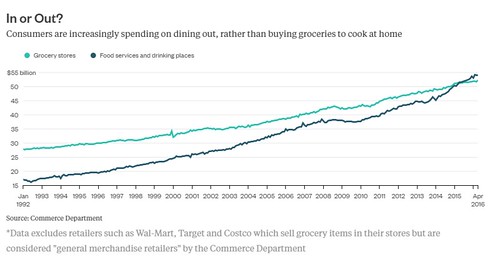
(This paragraph reprinted from a piece from a couple weeks ago.)  More food spending now takes place out of home. While I've mentioned this here I think (definitely at Eastern Market public market board meetings) a different Bloomberg piece ("Blue Apron IPO could be waylaid by buyer like Kroger") includes this graphic:
Spending on food: supermarkets vs. prepared foods

In response, companies are shifting their strategies, such as focusing on providing experiences and using e-commerce technologies, to improve the retail experience and social media marketing specifically to remain relevant, and stoke awareness and sales.

HOWEVER, I've since learned that part of the problem with this graph is that the data inadequately captures sale of non-cooked food that have switched from being purchased at traditional supermarkets to "non-traditional" locations ranging from warehouse stores like Costco to drug stores (which function more like convenience stores), and discount department stores like Target and Walmart.  Likely this means that noncooked food sales are still greater than food sales "out-of-home."

Still, higher income demographics are more likely to cook less and eat out more.  As the income mix of DC's population changes, this has repercussions on the type of food that is sold.  Similarly, DC has experienced an explosion of new grocery stores, and these stores tend to feature produce and organic items especially.  This likely has an impact on farmers and public markets too.

More competition also means sales declines. But while the article mentions part of this is also likely to an increased proliferation of farmers markets, it doesn't develop the point.  I think, at least with decline in sales at markets in DC, farmers market proliferation is a huge element.

For example, why go to the Dupont Circle Farmers Market on Sunday when you can go to a very good farmers market at 14th and U Streets NW on Saturday.

Why go to the Takoma Park Farmers Market on Sunday when you can go to the Silver Spring Farmers Market on Saturday?

Why go to the Petworth Community Market on Saturday if you live a bit west when you can go to another market held at the same time at 14th Street and Colorado Avenue NW?  (And why go at all to the Takoma market on Sunday if you live in Petworth?)  Etc.

And, since I am on the community advisory committee for Eastern Market, the city's public market building, why go buy food from farmers at Eastern Market on Saturdays and Sundays when you can more conveniently purchase similar goods at a myriad of markets across the city, much more conveniently located?

And why go to Eastern Market or Dupont Circle Farmers Market on the weekend when you can go to a super well marketed and curated Union Market ("Union Market: every DC foodie trend in one building," Washington City Paper), which is often programmed with exciting special events?

Or if you live in the H Street neighborhood, you don't need to go to Eastern Market because of a Saturday farmers market there, as well as the more conveniently located Union Market.  Etc.

Last week, the Post Weekend section picked crabcakes from Dragon Creek Seafood as an item not be missed from at the USDA Farmers Market to be ("10 great things to eat and drink at DC-area farmers markets").  The company is located in Virginia's Northern Neck, about a two-hour drive from DC.

Not to mention that many school PTAs are supporting truck farmer food sales on the grounds of public schools (in many higher income areas, as it happens) to raise money for projects.  That's one more element of competition that isn't likely to be registered when considering this issue.

For many years I've been arguing that DC's population can't support the plethora of farmers markets across the city.  DC has far more farmers markets than makes sense for demand.  The farmer vendors are the ones paying the price.

Markets as activation devices not as places to buy food.  This piece discusses the various reasons to open a farmers market ("The reason(s) why a farmers market is created shapes the type and mix of vendors allowed to sell").

The front page article discusses how for many people, a farmers market has become an event to go to to experience, not a place to buy food.

Many of the reasons have to do with activation, not promoting access to food or income generation for rural areas.  And property owners especially are motivated by bringing in people, not as much about the nature of what they buy.  But for example, with Union Market, most of the vendors sell prepared items, not food that needs to be prepared and cooked by the purchaser.

Labels: , , , ,

Sunday, March 22, 2015

Is that all there is?: 7-11 vs. upscale convenience

The Washington Post reports ("7-Eleven is taking over Washington, one hot wing at a time") that 7-11 is on a tear in the Washington DC-area with plans to open more than 40 new stores.  The article states that increasingly, the company is selling ready-to-eat food.

That makes sense, given that the "food" that the store sells otherwise is paltry--a few feet of shelving devoted to overpriced canned goods, complemented by aisles of shelving devoted to snack foods and soda and other beverages, coffee, and usually one refrigerator with milk and other dairy products (I used to buy milk at our local 7-11, but after a few ownership changes, the price increased by more than 25% and I stopped).

There are examples of convenience stores doing a great deal more in terms of providing a wider variety and quality of food options, even 7-11, but not in the DC region.  I've written about this from time to time.

-- New high quality urban format Walgreens "pharmacy" in Chicago
-- Finally, the urban model for a healthy convenience store

Giant Eagle Supermarkets of Pittsburgh has a convenience store division called GetGo where they sell Giant-Eagle branded products as well, but like the various Kroger convenience store divisions, are more like traditional convenience stores.

Sheetz, WaWa, and Royal Farms (based in Baltimore) are well known for quick service food prepared to order, based on orders placed at touch screens.

Steve Bisson/Savannah Morning News. Greg Parker at Parker’s Market on Drayton Street.

Best practice models for urban grocery-convenience stores.  Probably the best upscale "convenience store" I've even seen is the Parker's in the Savannah Historic District.

It's more like an urban market that happens to sell gas ("Ambitious, innovative leadership fuels Parker's success," Savannah Morning News).  But what's interesting about the store is that it is the only such upscale store within the chain of 36 stores.  They have the ability to differentiate and innovate, unlike a lot of companies.

Note that the second piece of mine cited above discusses a couple of concepts, Green Zebra of Portland, and Yummy Neighborhood Markets located in five communities in Greater Los Angeles--stores focused on home delivery--that are equally innovative.

Green Zebra is doing well enough to open a second store ("Green Zebra Grocery finds footing, plans to open second store," Portland Oregonian) after earlier plans to expand in the Woodstock neighborhood were nixed in response to regional health foods supermarket New Seasons announcing plans to open a store there. The first Green Zebra store, in the Kenton neighborhood, is now profitable.

According to the Portland Business Journal ("Strategies: Green Zebra Grocery shows its stripes"), the company plans to have 20 stores by 2020, including west coast cities beyond Portland.  The company sees their customers as buying "meals" as opposed to food.  From the article:
Sedlar launched Green Zebra to take advantage of two trends — demand for healthy and organic food and demand for convenience. ... 
Green Zebra strikes a balance. It isn't a conventional convenience store though Sedlar says customers treat it that way. Unlike New Seasons, where customers shop for groceries, Green Zebra customers shop for meals. In fact, they shop by the meal. It's common to see the same person come in several times a day. They're friends," she said.

Not surprising, deli items are the top two sellers, followed by bananas. Beer and wine are big drivers too, patterns that have driven changes to the company's product mix. The store strives to sell natural and organic items, with a goal of being GMO-free. Its shelves are stocked with products from 60 Northwest vendors, including Eugene-based Ninkasi Brewing Co.
Although some potential customers express concern about high prices.

Gas stations as places for innovative restaurant operations.  In any case, we don't see much of that kind of innovation around here, with the exception that high quality food service operations such as Fast Gourmet on 14th St. NW in DC or Seoul Food on University Boulevard in Wheaton are opening up in gas stations ("Gas station restaurants are becoming the next big thing in cuisine," Washington Post).

Ironically, 7-11 is owned by a Japanese company known for innovation in its stores in its home market.

Upscale independent groceries.  I have written about Glen's Garden Market in Dupont Circle.  I don't think it's really all that, but is impressive in how it ups margins by having a bar and a counter selling fresh foods. The counter is comparable to what Broad Branch Market offers in Chevy Chase DC--and is a model for what small neighborhood "grocery-convenience stores" could do.

Photo from Yelp.

In fact, I happened onto an independent grocery on 14th Street NW, Streets Market and Cafe, that I didn't know about, even though they opened in March 2014.

They also have a store in Arlington in the Lyon Park neighborhood across from Ft. Myer.

It's small, on the ground floor of a late model apartment building, with an attractive layout, with a prepared food area and some tables, plus upscale departments for cheeses and beer and wine, rounded out with produce, dairy, and nonperishables. The produce is competitively priced and seems of decent quality, while the other items are a bit pricey, albeit convenient.

According to the firm's website, they are looking to expand.

United Brothers Fruit Market, Astoria, QueensUnited Brothers Fruit Market in Astoria, Queens is open to the street, and markets its wares on the sidewalk.  

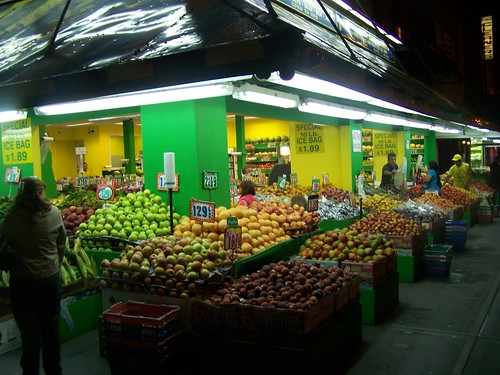
I argue that urban supermarkets could place their produce, flower, cafe and other food service operations in a similar manner and better connect to the street ("Urban Safeway Design Misses Mark," Washington Business Journal)

While Streets Market and Cafe doesn't fully meet my idealized design of how an urban grocery could reset vis a vis its place on the street and in a neighborhood (see the past blog entry, "Urban) Grocery Shopping") they are a big step forward.

Were I to win a big lottery payout, I'd gladly invest in both Green Zebra and Streets Market and Cafe.

Labels: , , , ,