Rebuilding Place in the Urban Space

"A community’s physical form, rather than its land uses, is its most intrinsic and enduring characteristic." [Katz, EPA] This blog focuses on place and placemaking and all that makes it work--historic preservation, urban design, transportation, asset-based community development, arts & cultural development, commercial district revitalization, tourism & destination development, and quality of life advocacy--along with doses of civic engagement and good governance watchdogging.

Sunday, November 01, 2020

NEW HARVARD/AARP REPORT FINDS MOST OLDER ADULTS DO NOT RESIDE IN LIVABLE COMMUNITIES

 From a press release from the Joint Center for Housing Studies at Harvard University about a newly released report, Which Older Adults Have Access to America’s Most Livable Neighborhoods? An Analysis of A ARP’s Livability Index commissioned by the AARP Public Policy Institute:

“While livability is ultimately subjective, the AARP Livability Index identifies key aspects of the built, economic, and social environments that contribute to community and individual well-being, and measures the degree to which those aspects are present in communities. Using data from the Index and the American Community Survey, the new report finds that renters and Asian older adults are more likely to live in high livability neighborhoods while homeowners, middle-income households, older adults with disabilities, and white older adults are more common in places of low livability. Shares of Black and Hispanic older adults hold steady across neighborhoods of all levels of livability.” ... 


 “This report illustrates the challenges that many communities face in supporting people as they age,” says Rodney Harrell, VP of Family Home and Community at AARP. “We need to ensure equitable access to the benefits that livable communities can offer, including for those living in higher-scoring neighborhoods. Every neighborhood has tradeoffs and every community can improve. Our findings support policy solutions to address barriers and improve livability for people of all ages and older adults more specifically.”

My reaction:

Probably it's true that most older adults don't reside in livable communities.  Fortunately, I do.  And I am in a situation of two households in one, including two people 83 years old, one with dementia.

In terms of communities using the index to make improvements, or for households using the index as a way to choose a place to live, I still see some problems with the way that the AARP Livability Index measurement is set up.

I can't claim I've drilled down deeply into every element of the Index, of which there are seven:

  • housing
  • neighborhood
  • transportation
  • environment
  • health
  • engagement
  • opportunity

but overall, the index is pretty impressive, with many factors captured within each category. It's pretty thorough. 

Although arbitrary at times. E.g., only counting a library if it's within a half mile. The metrics communities use for providing library "levels of service" aren't set up to provide that level of service. It'd need to be weighted to be more accurate and useful. Like a library within a half mile gets a stellar weight, but a library still within a mile still gets a positive, but lower rating. 

(Salt Lake City is 80 square miles and has a main library and seven branches.  Residents also have access to the County Library system, which doesn't have any libraries within the city limits.  DC is 60 square miles and has a main library and 25 branches.  In terms of personal experience, I'd say that both cities are reasonably served.  But DC might have too many libraries, although it'd rate more highly on the AARP Livability Index, arguably the more branch libraries, the less well stocked they are with materials.  For example, Salt Lake City's branch libraries have much better periodical collections than any of DC's branches, even in the wealthiest areas. )

Weighting for mobility and age and physical ability.  To be most useful, the index needs to be weighted mode, age and physical (cap)ability to make it truly applicable for individual households. E.g., I'd say it needs to be in tranches by age, mode, and assistance needs.   

Photo: Capitol Hill, DC.  The man used to bike by himself but eventually realized he was excluding his wife.  So they got a tandem bike.

AARP starts asking people to join at their 50th birthday. There's a big difference between a 50 year old with full faculties and physical capabilities, and an 83 year old with dementia or someone who needs an assistive device and or an "attendant" to get around.

Similarly, I understand the focus on walkability as a a primary metric, but at a certain age, it's not practical in terms of speed and carrying capacity for an 83 year old to walk a half mile to the grocery store and back.  Especially if you are impaired or need assistive devices to move around, etc.

But being able to move around your neighborhood, for exercise, is important. But even in the last year, having experienced a couple illnesses, our familial range in walking on daily exercise walks has been cut in half in terms of capability. 

We were talking with a friend about a park 1.2 miles away. She asked if we walked there. It would take at least an hour just to get there, with two 83 year olds, and then we'd have to get back. 

As much as I push sustainable mobility, it's not practical for many of the aged. Especially with transit. 

Even before the dementia became pronounced, I used to ruminate about the impossibility of wrangling two people then in their late 70s on the subway during rush hour. 

Although outside of the major city transit systems, transit isn't as rushed and crowded so it is probably less of a deal in Salt Lake as it would be in DC or NYC or Chicago or Boston. 

I write about the sustainable mobility platform as being comprised of a network of modes = walking + biking and micromobility + transit + car sharing (including access to one way and two way and a variety of vehicles to meet different needs) + delivery + taxi/ride hailing, 

In DC, with biking complemented by car share and transit and walking we didn't need to own a car. But if Suzanne's parents had joined us in DC, definitely we would have needed to get a car.

Flickr photo by Ed Yourdon, New York City.

Salt Lake's car sharing options are minimal and while the bus service is pretty extensive and we're in a good area for service, it's pretty time consuming to get somewhere.  

The light rail and commuter rail are polycentric systems, not really useful for getting around "within a place," more about traveling long distances.

I was doing an itinerant job this week, fortunately a few blocks away, while some other people working there took more than an hour to get there on transit, from a distance of 5-6 miles. For me it was a five minute bike ride.  (And it'd have been a 30 minute bike ride had I lived in the other place.)

The same goes for mobility and the aged. For our two households in one: me at 60, my partner, 53 and her two parents at 83, one with dementia, when we travel together we mostly drive, except for exercise-based local walking. 

Baltimore.

Even 7 months ago, we could manage a half mile walk with them to the grocery (we'd carry the groceries), but not now, as health conditions have changed. 

 But that doesn't prevent me from cycling on trips on my own, be it to the grocery or work or a library or whatever. (Suzanne doesn't bike.) 

Basing the index on type of mobility (mode).  Were I creating this kind of livability index, I'd make it work with a number of options, not unlike Google Maps, which gives you the option to choose four different modes to get somewhere: driving; walking; transit; and biking.  Exclusively on foot; on bicycle; with a car; need for assistance; etc. 

And the half mile thing just makes no sense in terms of how levels of service are provided. E.g., doctors or hospitals aren't built with a half mile radius. (Not that the index uses a half mile as the measure for access to health facilities). 

With Suzanne's parents, most of our life is captured in a three mile radius in terms of walking + car, albeit mostly car.

That includes access to amazing health and hospital care, a senior-rec center with a library provided by the county, another library provided by the city, an impressive array of retail, parks and walking opportunities. Even a major research university and additional recreation facilities (because of their age, they get free access to the county recreation facilities). 

The area and city is a grid but the road network is punctuated with dendrils and discontinuities in terms of the residential streets, which can break off for a block or two or more in various seemingly random ways--but the streets stay pretty straight and keep the same name.

Maybe even take into consideration topography and e-bike vs. regular bike.  E.g., as I age I may get to the point where I switch to an e-bike, especially because SLC has intense hills.  Even without age as a factor, many people here get e-bikes because of the hills.

Labels: , , , , ,

Sunday, September 27, 2020

Not that I want to defend management failure and unnecessary death, but that was an outcome determined by a corrupt system

Getty Images photo.

On Friday, former leaders of the Holyoke Soldiers' Home in Massachusetts were charged with criminal abuse and neglect, over the coronavirus-related deaths of 76 people ("Two Charged in Coronavirus Outbreak at Veterans’ Home That Left 76 Dead," New York Times).

But the fact that the Superintendent: (1) was a political appointee, (2) unqualified, (3) made bad decisions (4) especially in times of extreme circumstances, (5) amid inadequate resources, especially staff, contributed to and produced the "failures." 

From the Boston Globe story "At Holyoke Soldiers’ Home, moral accountability lingers for Charlie Baker":

It’s the story of how easily we forget about old people, especially those who live 90 miles away in Western Massachusetts. It’s the story of how politicians pay tribute to veterans on holidays but somehow never make those vets a year-round priority. 
It’s also the story of how political connections pave the way for employment, even for the difficult and specialized job of running a facility that promises veterans “care with honor and dignity.” According to the report prepared by former federal prosecutor Mark W. Pearlstein, Walsh, a decorated Marine Corps veteran with no experience in health care or long-term care, was encouraged by a state lawmaker to apply for the superintendent’s job.
... During the June 24 press conference, Baker also said, “The first time I ever met him [Walsh], or talked to him was when we swore him in.” But according to Walsh’s attorney, William Bennett, on April 27, 2016, Walsh was interviewed, separately, for 20 to 30 minutes each, by Baker, Lieutenant Governor Karyn Polito, and then-Baker chief of staff Steve Kadish.

Nursing homes in general are under-funded, staff are poorly paid, there aren't enough staff, etc.

This is likely doubly true of "veterans" nursing homes run by states.

The "system" produced the conditions that led to these deaths. 

But there aren't criminal charges in store for the people who created those conditions.

======

Four years ago, in the run up to the local elections, I was talking with my neighbor about voting and she said that she made her choice on whether or not the person was qualified to be mayor. I said why, "they're running for council." 

She made the point that the more capable and qualified the candidate the better we would be served. She's right of course. 

Putting people into positions when they are barely or un- qualified is catastrophic when circumstances require extraordinary response. (This by the way is why the line "never let a crisis go to waste" is mostly a story of unrealized opportunities. Most people aren't capable of rising to the occasion.)

Corrupt systems.  I don't like to bandy about the word "corruption" when it comes to government.  Corruption has a specific meaning and the word is too often misused when people excoriate politics and politicians.  

But there is no question that putting "politics" over "governance" and quality outcomes has subverted and degraded what government does and can do, in ways that dis-serve the public.

Years ago, blogreader EE shared with us a book published by the World Bank, Corrupt Cities: A Practical Guide to Cure and Prevention and I wrote about it in this 2011 piece, "DC ethics legislation misses the point: focus on what produces corruption as a regular outcome, not monitoring." 

While the book focuses on "developing nations," the reality is that corruption in government works the same way everywhere it occurs. 

As the authors write: 

Corruption = monopoly + discretion of public officials - accountability.

My piece listed 9 particular issues (although there are more) with the way things work in DC.  

Even though legislation was passed to reduce conflicts, most of the areas I identified as rife with the potential for conflict weren't addressed.

IACA is the International Anti-Corruption Academy, which was formerly known as the International Association of Crime Analysts, and they provide technical assistance and training world-wide.. This particular issue of their alumni magazine  focuses on local government and features an interview with one of the authors of the book Corrupt Cities and his work as the Mayor of La Paz, Bolivia. 

One quote: 

"The problem is not corrupt individuals.  It's corrupt systems." 

"Islands of Integrity and Effectiveness," discusses the five point system to limit corruption that was derived from the work that led to the book: 
  • Breaking monopolies by increasing competition in activities and service delivery
  • Decreasing discretion in decision making by establishing and enforcing clear rules and procedures
  • Strengthening accountability and transparency mechanisms of activities/service delivery by effective management of information and data
  • Increasing the probability of being caught and punished by establishing effective control mechanisms
  • Decreasing the relative value of the gain versus the loss, by creating incentives and motivation for honest performance and behaviour.
I realize that the kinds of recommendations I've made over the years wrt DC governance and politics in various entries absolutely reflect those points, especially the first three, but also the last two.

Labels: , , , , , ,

Thursday, September 06, 2018

It seems like "How To Design for Senior Citizens" is how we should be doing urban design generally

ArchDaily has a piece by Brazilian architects on "How To Design for Senior Citizens."

From the article:
Our old age is the result of our environment and the choices we have made. According to the WHO (World Health Organization), six items influence how we will age. These determinants are social, economic, behavioral, personal, the available social and health services, and the physical environment. We can reach old age as active individuals or as having an advanced level of frailty that compromises our functional abilities. To keep the elderly population healthy and active is a necessity and not a luxury.

But how do we keep the elderly population active? There are four pillars that are currently considered: health, continued learning and education, social participation and security, and protection.
This has been a thread in US urban design too for a few decades, in terms of providing accommodations in the built environment and transportation through legal means such as the Americans with Disabilities Act and requirements that transit agencies provide paratransit and medical transportation.

-- RespectAbilityUSA is an advocacy group addressing some of these issues.

More recently, it has moved away from a more strict legalistic approach, to concepts around "visitability" in terms of accommodation as we get older, and in housing redesign to support "aging in place."

There is discussion about what are called "naturally occurring retirement communities" and there has been a rise in the development of grassroots organizations to provide supports for aging in place. The DC area probably has a couple dozen of these organizations, such as Capitol Hill Village or East Rock Creek Village.

The American Association of Retired Persons (AARP) has older adult urban design initiatives, and like many other cities, DC has created an Age Friendly DC Strategic Plan.

-- AARP Network of Age-Friendly States and Communities
-- Moving an Age-Friendly DC, Coalition for Smart Growth

But I think the point is that because much of the modern US planning paradigm was developed after WWII when the US experienced explosive growth especially among younger household demographics, that the land use and transportation paradigm ended up presupposing that everyone would be and stay "young and healthy."

Simultaneously, as we moved from more of an extended family, multi-generational household paradigm to the "nuclear family," somewhat isolated and contained, these "social, economic, behavioral, personal, the available social and health services, and the physical environment" elements within our lives because less flexible and less resilient as our capabilities and capacities changed.

This becomes very much pronounced as we age.  After a certain point, that automobile dependent isolated lifestyle doesn't work very well.

In any case, creating a built environment that isn't dependent on the automobile and prioritizes "health, continued learning and education, social participation and security, and protection" ought to be the priority, regardless of age.

Places that work simultaneously for children and families and young adults and older adults should be the priority.

That doesn't mean that every building needs to accommodate every possible group, but that neighborhoods more generally need to provide spaces and housing that do so overall.

The 8-80 Cities initiative brings a "universal" approach to planning and placemaking.

The work by Eric Klinenberg years ago, published as Heat Wave: A Social Autopsy of Disaster in Chicago which attributed a high death rate during a heat wave in Chicago among seniors to social isolation was quite damning in terms of identifying the problems of social isolation.

The problem hasn't gone away ("Estimated 70 Deaths Linked To Canada's Heat Wave," NPR; "Heat wave deaths will increase dramatically by 2080, study suggests," USA Today).

But you don't all of sudden become isolated.  It's a situation that develops over years and then may become catastrophic when faced with one or more changed circumstances.

Heat wave related deaths are merely an indicator of a deeper design problem.

Labels: ,

Friday, March 06, 2015

Senior housing needs vs. "the market" and government involvement: Part 1 - assisted living facilities in Montgomery County

The Gazette ("Assisted living centers in Silver Spring, Bethesda to close by June") and other media have reported that two senior care living facilities located located in the Bethesda and Silver Spring conurbations in Montgomery County, Maryland will be closing because the properties are owned by a health care related real estate investment trust, HCP (Health Care Properties) and they have been put up for sale.

Both of these facilities are centrally located and the amenities of the respective commercial districts are close at hand, which is a plus.

From the Springhouse of Silver Spring website:
Location, location, location. Springhouse is located near downtown Silver Spring minutes away from Washington, D.C. Our community is located near several neighborhood restaurants, banks, churches, synagogues, health and medical offices. Everything you want in an apartment building plus the knowledge that a licensed nursing staff is there for you 24-hours-a-day.
The operator is independent of the property owner, and so they have notified residents and the State of Maryland that they will be closing their facilities.

Note that it would be possible for the operator, Springhouse, to remain in the facilities.  They are choosing not to do so by taking advantage of the future sale of the real estate to shut down the two facilities.  Normally, the sale of the properties could be facilitated by having a long term tenant.

Financial engineering, real estate investment trusts and business vulnerability.  Note that this is but another example of how the disconnection of property ownership from business operations can have negative impact on business operations, although mostly we have seen this effect in the retail sector.

Real Estate Investment Trusts (REITs) are a preferred vehicle for owning real estate because they enjoy advantageous tax treatments not available to companies that integrate business operations with real estate ownership.

At one time the company called Manor Care, based in Silver Spring, owned and operated nursing home and other senior care facilities.  After (1) a merger and consolidation with another similar firm they became NCR Manor Care, (2) relocated to Toledo Ohio, (3) and were bought out by Carlyle Group--based in DC--about 8 years ago, (4) later, Carlyle sold the underlying real estate holdings of HCR Manor Care to an independent real estate investment trust, HCP, based in California, (5) while still operating senior care facilities in those locations, (6) but leaving the senior care company HCR Manor Care exposed and vulnerable to any changes in the real estate markets where its businesses operate.

Carlyle sold the real estate to HCP for more money than it spent buying all the stock of NCR Manor Care.

NCR Manor Care financial and legal issues.  Nursing home and other senior care facilities are being buffeted by changes in the health care industry, including payment rates for what is called post-acute care--when people are released from hospitals but still need ongoing care.

According to the investment website Seeking Alpha, there are 50 HCP properties operated by NCR Manor Care that have been deemed underperforming financially and/or operationally, and so it may be that these particular properties in Montgomery County are not generating the financial returns the company prefers.  Plus the firm is being investigated by the government, although this may come to naught.

It appears as if these two properties in Montgomery County are the first of the 50 properties to be readied for sale.

Alternatives.  I'd argue that public ownership of the land/buildings of senior living facilities could be in the public interest as a way to maintain the provision of such services without necessarily requiring the facilities to also be publicly owned.

Were there a wide ranging senior care/health and wellness plan for the area which provided guidance and recommendations concerning the provision of various types of care facilities, it would be possible for the state/county to step in, even use eminent domain authority to buy the properties to ensure the continued operation of the care facilities operated there.

Labels: , ,

Monday, October 21, 2013

Yes, the suburbs are still screwed: aging edition

Joel Kotkin has a piece in Forbes Magazine, "Where Are The Boomers Headed? Not Back To The City," stating that it's urban legend that older boomers are flocking to the center city, and that suburbs will have to take care of their aging population.

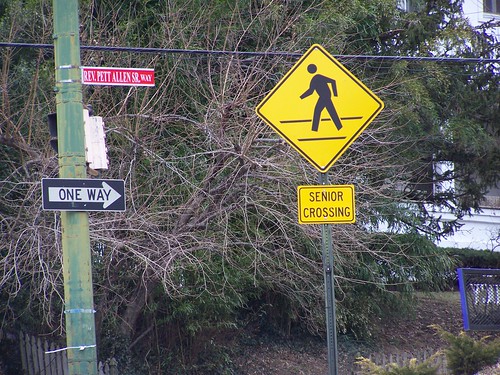
Senior crossing pedestrian signI think he mis-states what pro-city people are saying about the trend and the velocity of people moving back to the city.

People of all ages, including the aged, are moving back to the city. But it's about percentages and trends.

See the past blog entry ".Get Urban 2.0: DC continues to add population" which discussed this point in 2012.

In short, the millions of people who moved to the suburbs from the 1950s to the 1970s who are now 40 to 60 years older, are not moving back to the city at the same rate they left the city--which is a good thing for those of us in the city.

But enough people are moving to the city so that it's noticeable--and undeniable--and this has been going on for more than 10 years--I remember being first exposed to the concept at a conference in 2003, and that person (the director of the Responsible Hospitality Institute) had been on the circuit making the same point for a few years at that time.

And yes, suburbs are screwed because they have to build an infrastructure to support people who can no longer be independent, whereas in the city that kind of infrastructure already exists or can be adapted for such use in a relatively economically efficient manner.  It's a form of what Jane Jacobs called "mixed primary use."

That being said the creation of "aging in place support and assistance organizations" is on the rise in center cities, especially in Washington, DC. See "A Village For the Elders" (2007) and "It takes a village to keep some seniors at home" and "AARP studies D.C. seniors who join aging-in place networks" (2010) from the Washington Post.

The Village to Village Network is a national technical assistance organization for such organizations.

Some issues with dealing with aging residents

1.  Village organizations are sprouting up all over the city (albeit in upper income neighborhoods) to support what in the trade are called "naturally occurring retirement communities."  I am pretty sure I remember reading this 2002 article on the topic, "Haven for Workers in Bronx Evolves for Their Retirement," in the New York Times.

I do think such groups should consider organizing on a geographic scale broader than a particular neighborhood, and there should be shared services amongst the various groups to aid efficiency.

2.  And I have complained that the aging centers infrastructure in DC ought to be co-located with other public facilities, and maybe shared across wards rather than every ward having its own senior center, in order to better utilize scarce resources. See "Provision of public services and recreational centers."  But since a lot of the funding is federal, this might not be possible.

3.  Kotkin points out that an AARP study (Aging in Place: A State Survey of Livability Policies and Practices) states that 3 of 4 seniors want to age in place.  That's very difficult for communities, because it makes it harder to keep neighborhoods, especially commercial districts, thriving, as they require a certain level of activity and patronage.

4.  So called "senior" or "retirement" communities find that residents don't want to move there til they are in their mid-70s, even though the communities are advertised as 55+ years of age communities.  (AARP membership eligibility kicks in at 50 years of age.)

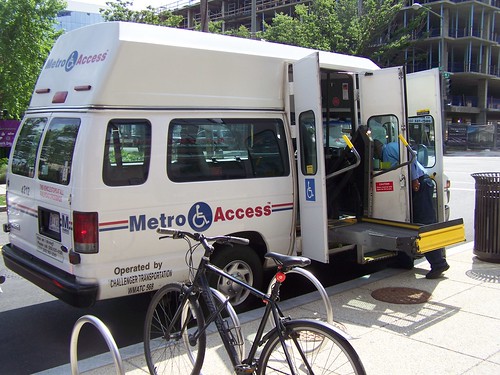
Metro Access paratransit vehicle5.  Transportation for seniors is a big issue.  In the first place, over the past 60 years, the US has developed a mobility paradigm that requires an automobile for accessibility.

-- International Conference on Aging, Mobility, and Quality of Life (2012)

As people age and they lose their ability to drive, they become disconnected from their world outside of their home.  That is why the "village" network is a good thing, as it provides low-cost assistance.

-- Older Drivers | National Institute on Aging

-- Driving Safely While Aging Gracefully - National Highway Traffic Safety Administration

I don't have good advice for how to deal with people in your family who are aging and should stop driving or limit their driving.  We have to face that issue ourselves and it hasn't gone so well so far.

Relatedly, the rising demand for paratransit and senior transit services is crushing the budgets of transit authorities, which are required to provide such services as part of the various laws governing federal funds and transit.

-- "Transit agencies struggling to meet needs of disabled ridership," Chicago Tribune
--  Creative Ways to Manage Paratransit Costs - National Center for Transportation Research
--  PUBLIC TRANSPORTATION AND ADA PARATRANSIT - AARP

On the other hand, the subway and bus system can be so congested that it can be difficult for people who have physical mobility issues to make sense of the system and get around.  It can be bad on a subway platform during rush hour regardless of your age!  So it can be that much worse for people who need more time.

6.  And one of the ways to deal with mobility issues in the city is to ensure that we extend walkability, bikeability (including three-wheel bikes and electric bikes) and transit services, and even automobile usage by seniors--because one form of prioritizing mobility uses is focusing resources on who needs them most.

7. Perhaps the most significant issue as we age is vulnerability to crime.  As we age we are easier targets.  And there are plenty of people who may see this and take advantage of the opportunity that this can provide.

Labels: , , ,

Thursday, April 04, 2013

Making cities work better for the aged

In the comment thread on this post, "Understanding why Upper Northwest DC residents don't buy into the sustainability mobility paradigm," there was some good discussion about how to provide non-car dependent mobility options as people get older.

Some people in Chevy Chase--younger than I it turns out--said the paradigm I outlined was something appropriate only for the young, whereas I expect to be getting around that way into my 70s (20 more years...).

100_0700.JPGBelow, I am running the press release from Community AGEnda, an initiative of Grantmakers In Aging (GIA) supported by the Pfizer Foundation, which is focused on providing tools and supporting pilot projects to support aging populations in terms of urban design, mobility, and programs.

Here are some comments, which are probably best read after reading the release.

1. One of the problems of all the various village programs is that they duplicate organization, at least in DC. We probably have 10 different programs. All want to have their own directors, etc. I wonder if it would be better to organize these programs across a larger scale, not necessarily a whole city, but larger, so that administration requirements are not unnecessarily duplicated?

2. how come no demonstration programs for transit and aging populations? Interacting with my wife's parents when we travel together, this is an issue... But it's an issue in cities generally, problems with paratransit service economics, etc. (There is a  Community AGEnda initiative on mobility in Kansas City, where they have bus transit, but not light rail and/or subways.)

3. one issue people don't talk about with aging in place programs is that they are designed to reduce housing turnover, but at the same time, lack of housing turnover within neighborhoods can lead to economic stagnation in local retail districts, because older households buy less, don't go out to eat, etc. This is especially going to be a problem in suburban counties, but I also think it is one of the reasons that DC neighborhood commercial districts stagnated in the 1980s and 1990s.

100_0664.JPG4. In DC, there is a similar program to your Miami initiative, Connecticut Avenue Pedestrian Action. One of the leading groups involved is a senior services organization, Iona. There are lots of apartment buildings, with older residents, some are defined senior housing programs, others aren't.

5. In inner cities, there is the crime issue. Older residents out and about, can be targets, because they move slower, etc.

6.  See "" from the Philadelphia Inquirer and "" from the Baltimore Sun.
----------------
From the press release:

... today released a set of important tools and resources to inform and inspire planners, philanthropies, and others seeking to build a more age-friendly future. These materials are available free online.

The tools include Age-friendly America, a searchable online database with contact information and background on more than 200 age-friendly projects; Age-Friendly Communities: The movement to create great places to grow up and grow old in America: An introduction for private and public funders, an overview of the goals and accomplishments in the field to date; and Aging Power Tools: A curated selection of resources to promote stronger, age-friendly communities, a robust collection of tools from top practitioners.

Age-friendly communities: the value proposition

“We think that every community in America could benefit from this forward-looking approach,” said John Feather, PhD, CEO of Grantmakers In Aging. “For foundations and other funders looking for maximum long-term impact, it’s hard to beat age-friendly community development, which is highly collaborative, adaptable to diverse communities, and offers benefits for residents of all ages.”

“The aging of America represents a profound societal change that we’re living through right now,” said Caroline Roan, president of the Pfizer Foundation. “We believe it can present a great opportunity if we work together, take steps to become more age-friendly, and re-imagine how our communities can help us grow old with dignity, in the places we care about.”
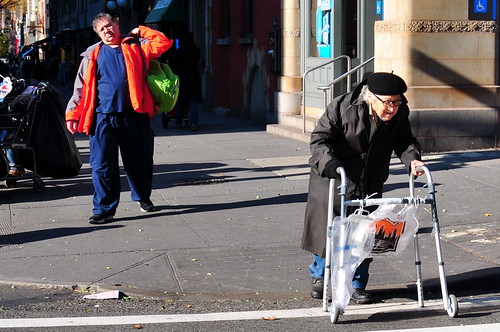
Crossing the street
What makes a community age-friendly?

Age-friendly initiatives take various forms but all share the goal of creating better options for people to age in place and continue contributing to their communities. This may involve improvements to the built environment, from planning and building safe outdoor spaces to creating affordable, accessible housing; or improving infrastructure, such as more walkable town centers or more accessible public transportation. Other age-friendly initiatives tackle social needs, creating engaging cultural and outdoor activities, services, and volunteering options.

Photo above by Ed Yourdon via Flickr.

With Americans living longer and 10,000 Boomers turning 65 every day, those over age 65 will make up 20 percent of the American population by the year 2030, making age-friendly innovation more needed than ever.

Community AGEnda sites and activities

In its first year, Community AGEnda supported five programs with grants of $150,000, requiring each grantee to raise matching funds of one-third or more of the value of the grant. Their age-friendly activities include:

•         In Miami-Dade County, Florida: collaborating with the county parks to serve older adults better, conducting a walkability study in East Little Havana, preparing the area’s employers to hire and retain more older adults, and working with Miami-Dade County to review and modify planning policies related to transportation, housing, land use, and community design;

 In four communities and two counties in the Atlanta metropolitan area: supporting community gardens, establishing a health and wellness promotion plan, conducting a walkability assessment, and hosting workshops about the need to create age-friendly communities;

 In Maricopa County, Arizona: planning and implementing pilot programs using the Village model of membership-driven services and volunteerism to promote aging in community, producing a video on aging in place, and creating a new website to help “younger” older adults (ages 55-70) find the resources to age in place comfortably, safely, and affordably;

 In Bloomington, Indiana: discussing development incentives to create an age- and ability-friendly Lifetime Community District; in Indianapolis, creating a conceptual illustration for the Martindale-Brightwood neighborhood to highlight potential development opportunities; and in Huntington, Indiana, engaging stakeholders to focus on housing, transportation, and accessibility issues; and

 In the greater Kansas City area: working to improve transportation and mobility options for older people in urban and surrounding suburban areas, raising awareness of caregiving issues and the need to tap into the expertise of older adults as community resources, and working with the First Suburbs Coalition to produce a toolkit to assist elected officials and planners in developing the capacity to assess and plan for an increased older adult population.

Labels: , , , , ,