Rebuilding Place in the Urban Space

"A community’s physical form, rather than its land uses, is its most intrinsic and enduring characteristic." [Katz, EPA] This blog focuses on place and placemaking and all that makes it work--historic preservation, urban design, transportation, asset-based community development, arts & cultural development, commercial district revitalization, tourism & destination development, and quality of life advocacy--along with doses of civic engagement and good governance watchdogging.

Saturday, June 27, 2026

In a weak housing market, will Cleveland's Housing Innovation District move the needle?

Cleveland's biggest problem is that the city is shrinking.  The population in 1990 was 505,000 and 372,000 in 2020. 

Now that's a store.

For example the famed Heinin supermarkets local chain announced they're closing their landmark downtown store, located in a historic bank--after downsizing and rebuilding after George Floyd riots closed the store ("Heinen’s closure in downtown Cleveland raises questions about sustaining development").

 And so is the metropolitan area.  The 2020 population was about 2.1 million.  The estimate for 2026 is 1.72 million.  

1836 E. 79th Street, Cleveland, Ohio.

In that context, there's a lot of vacant buildings and lots ("Finding the Potential in Vacant Lots," New York Times) not just in the city proper, but in the suburbs too.  

I know that years ago, Cleveland's inner ring suburbs were leaders in trying to do suburban revitalization (The Northeast Ohio First Suburbs Consortium), but not quite how Arlington County, Virginia was able to because the DC metropolitan area was growing, and they could leverage the addition of Metrorail ("How DC [really Arlington County] densified," Works in Progress).

Still, Cleveland has incredibly social, community and organizational capital. In the 1990s, Cleveland  foundations worked together to force accountability and consolidation on community development corporations.  There are many foundations doing great housing work like the Catholic social justice based Famikos Foundation.  When I was there in 2002, the city had a great facade improvement program and manual.

The Cleveland Restoration Society was a leader in leveraging city monies in bank accounts to fund housing renovation.  They have a revolving fund to invest in property development.  

There are a number of firms specializing in historic preservation financing and rehabilitation of big projects like Sandvik Architects.  And the state has a historic preservation tax credit too.

And they have a program to help churches light their steeples, which I think is really cool.

The Metroparks system is fabulous, with many on the Lake Erie waterfront.  

There are great civic assets like the West Side Market and business improvement districts and community development initiatives all over.  The Rock and Roll Hall of Fame.  Terminal Tower is a fabulous train station.  (But all the old department store buildings, massive 1 million s.f. or more are all defunct.)

I always tout there "Business Revitalization Overlay District" as a way to coordinate investment with the public and private sectors.  They have strong design review requirements.  And the State has a strong receivership statute that allows nonprofits to take over properties, cure the title, fix them, and sell them, to bring houses back into use.

They are an example of a line I have, that cities like Cleveland 

"have a desperate willingness to experiment because they have no other choice."

More alternative weeklies need to publish "worst of" articles. Page 1, Page 2.

They still have legacy heavy rail service although it's not well used.  A great system for evaluating bus stops for amenities.  The transit system provides decent coverage, and it was the first one to connect heavy rail service to the local airport in the late 1970s.  A big Midwestern bank is still based there, and there are some other corporations.  In nearby Akron, LeBron James has invested a lot, so has the Knight Foundation.  

The Cleveland Scene alternative weekly still publishes once a month print issues, although the Cleveland Plain Dealer only prints a couple of editions each week. But their urban design writer who was great, Steven Litt, has retired.

Both the Akron and Cleveland areas have great regional bikeway plans and systems.  Plus the universities and the Cleveland Clinic constantly grow.  There are investments in public spaces, the (in my opinion) over touted Health Line BRT, etc.

Creating Cleveland heavy rail is a fascinating story.  The Van Sweringen brothers were developing Shaker Square and Cleveland Heights and they wanted transit service.  To get it, they bought the Nickel Plate Railroad system, to get the necessary right of way.  They also built Terminal Tower.  But they were ruined by the Depression.


Forest City, a regional hardware store chain, was based in Cleveland, and is long since shut down, but the firm shifted to large scale revitalization oriented real estate development in many cities, including DC.  Value City, a regional department store chain specializing in low income markets, was based their too.  It's last iteration in furniture, finally closed this year.  But the founding family, the Schottensteins, when on to be big in vulture investing.

And Playhouse Square is a national best practice example of historic preservation and arts focused development.  They've since created a CDC to build and hold property around the theaters.  

The Gordon Square Arts District is a best practice neighborhood focused arts district revitalization initiative ("A Cleveland Arts District Hustles and Rebounds," NYT).  A number of new developments complement the Capitol Theatre and two buildings converted into smaller community theaters.  Reasonably well designed new buildings too.

To me, Cleveland has a lot going on, and if I could have found gainful employment there, I would have liked to live in the city, despite its cold winters.

I think the Housing Innovation District is interesting, it aligns a wide variety of programs and systems so that both small and larger developers can participate and work with small parcels, not just big ones.  From "'Amazing neighborhoods' that deserve investment. Cleveland proposes East Side improvement district" (Ideastream/NPR)

Cleveland is proposing sweeping development efforts in the historically redlined East Side neighborhoods of Hough, Central and St. Clair-Superior.

Using a suite of economic development tools, including waived permit fees for new construction, modernized zoning codes and a new tax increment financing district, the city plans to put millions toward spurring new housing, businesses and walkable communities in neighborhoods that have been challenged by decades of disinvestment. Cleveland officials are referring to the area as a Housing Innovation District.

"When we think about the Housing Innovation District, it's 'How can we create an area that really incentivizes people to bring new housing,' but [also] really builds wealth block by block in the neighborhood for the existing residents that are here," Tom McNair, the city's Chief of Integrated Development, told reporters in St. Clair-Superior on Wednesday morning. "Because St. Clair Superior, Hough, Central: these are amazing neighborhoods that for far too long haven't gotten the type of investment they deserve."

Lake Erie beach, Cleveland Metroparks.

BUT, at the end of the day, you need households to live in the buildings.  It's not about what the neighborhoods deserve, it's about what the market will support.  

I read a couple of articles on small developers in Chicago and Pittsburgh ("Six new townhomes. Zero buyers. And one developer on the brink," Pittsburgh Post-Gazette) who built market rate housing in emerging neighborhoods (so weak not strong) and they couldn't sell them.  Or the houses wouldn't appraise for a mortgage, because of the prevailing housing prices.

I am constantly amazed to see community revitalization programs in specific areas that have spent many hundreds of millions, and it's hard to see improvements, even though they are and usually key civic assets, plus housing--although my line from decades ago, that building better housing for poor people doesn't rebuild broken micro economies all that much, which was my lesson from H Street DC ("Ah, the H Street Community Development Corporation"). 

An awesome house for $325,000 in the Ohio City neighborhood across the river.

OTOH, even marginal additions of population make a difference ("Community revitalization initiatives for smaller communities | marginal attraction of people and commerce even in small amounts makes a difference").

And to be fair, they've really pulled together a lot of policy changes, financing, land etc. to make things happen.  It will be interesting to watch even though I think that it's really tough to move the needle in weak markets.

Labels: , , , , ,

Saturday, May 09, 2026

Triplex, 472 East Granite Avenue, City of South Salt Lake, with a painting propped up against the house

When I took the photo I didn't notice the painting propped against the facade.

I've been collecting photos of small multunit "single family" properties that are embedded within Salt Lake City, but also neighboring communities and other cities in the Salt Lake Valley.

Often a duplex will be on a corner, with entrances on each side of the street.  Or on an arterial.  Or a few next to each other.

There may be triplexes or even larger properties.

First I started trying to photograph these buildings because to me, compared to "everywhere else" this kind of property sensitively located within a neighborhood extends the range of housing types available to people representing a wider range of needs and incomes.  Not every house in a neighborhood should be a big single family detached house, especially as more households nationally are as small as one person.

Arlington County Board Chair Katie Cristol hears from citizens holding signs demanding more affordable housing at a county board meeting in Arlington, Virginia, on Nov. 12, 2022. (Bill O'Leary/The Washington Post)

Second, I think it's a better way to visually express how a change in the zoning of traditionally single family residences to up to fourplexes can be done without wrecking community character.  

My photo album, Duplexes, Triplexes, Quads etc., demonstrates this.  Plenty of the buildings date to the 1930s and before, while others are more contemporary--to me less attractive but still illustrative.

Duplex, English Tudor style, 1601-1605 700 East, Salt Lake City.

I love the great variety of brick used in the Prairie style era of homebuilding in Salt Lake.  Unlike DC, which is dominated by red brick, red brick is rare here but there are so many other colors.  This isn't Prairie style but it's around the same time.

I plan on putting together a few pages of a brick color pattern book, partly as a way to guide architectural style decision making in the Sugar House area.

This is important because of the trend nationally to do this kind of rezoning in places like Minneapolis, Arlington County, Virginia, etc. ("Single-family Zoning: Can History be Reversed?," Joint Center for Housing Studies).

And the opposition to it, not just in Arlington County.  Although Brookings says that's because of bad messaging, "‘End single-family zoning’ is bad political messaging."

The funny thing is Salt Lake City is "considering" changing single family zoning, and many people are against, while there are all kinds of positive examples within the city already.  It's just that it's so subtle people may not realize it.

Labels: , , , ,

Monday, July 21, 2025

Building housing ahead of the market in "transitioning" markets

At a real estate conference I was at many years ago, a developer made the point that building affordable housing was unprofitable in Prince George's County, Maryland (the area's least economically vibrant community but comparatively still quite successful) because it was underpriced by existing Class B, C, and D housing.

I've mentioned the HUD typology of neighborhood type, ranging from distressed to healthy, with various types of emerging and transforming points in between.

Photo: Justin Guido, PPG.

An example in Pittsburgh about new construction in urban neighborhoods with relatively weak microeconomies, illustrates both points.

A developer built some new (ugly to me) rowhouses in Pittsburgh's Hill District, believing that the "neighborhood deserves" new construction housing and greater choice, just like more thriving parts of the city ("Six new townhomes. Zero buyers. And one developer on the brink," Pittsburgh Post-Gazette.

The houses were priced at about double the area's mean housing price of $227,000.  None have sold even after price reductions.  From the article:

The six modern townhomes on a quiet stretch of Rose Street were built by developer Steffan Johnson — who saw them as a personal response to the difficulty he experienced while shopping for urban housing desirable to upwardly mobile Black professionals when he and his family moved here in 2009 from Minneapolis.

“I wanted to show what’s possible for this side of the city by bringing modern architecture and high-end finishes — almost custom homes — to a part of the Hill that is long overdue,” he said. But five months after listing the homes — for $480,000 — Mr. Johnson has yet to find a single buyer.

This is a lesson for revitalizing cities and neighborhoods that you can't be too far ahead of the market.  Especially when it is still emerging.

East of the River neighborhoods in DC have a similar problem with new construction not always being able to appraise at the right price to support a mortgage, because existing housing costs less, and it's hard to find higher price comp(arison)s.

It's interesting to think about this in terms of his target market.  Does it exist in Pittsburgh, or are people content to live in non-Black majority neighborhoods.

Another is the idea of the "one over neighborhood" ("When the one over neighborhood is in the county next door, and housing prices have been in the tank: Mount Rainer, Maryland," blog entry 2016) by Live Baltimore.  The Hill District hasn't developed positive dynamics at the scale of the metropolitan residential housing landscape the same way that South Pittsburgh or Lawrenceville have.

Labels: , , , , ,

Wednesday, January 08, 2025

Different smaller housing types other than large apartments

Micro-apartments.   The Boston Globe ("Micro-apartments will become a cost-effective solution for renters — eventually"), reports on the provision of small apartments in the city, 450 s.f. or less, with kitchens and community amenities.  They are a form of what used to be called SRO, or Single Room Occupancy housing, but flashier.  (Also see this BG article from 2015, "Developers, city hope tiny apartments will keep families in Boston").

From the current article:

The idea of living in a micro-unit, or an apartment roughly less than 400 square feet, might send some renters heading for the wide-open spaces of the suburbs. But for others, a small, manageable, and ideally affordable living space would make living closer to downtown feel more approachable. Perhaps unsurprisingly, it’s the affordability piece that Bostonians are still seeking.


In 2016, the city’s Housing Innovation Lab rolled out a traveling model apartment called the Urban Housing Unit, or UHU. At 385 square feet, this micro-apartment traveled to eight neighborhoods across the city, showing Bostonians what life in such a small space could look like. During its tour, the Housing iLab gathered feedback from roughly 2,000 residents to help draft guidelines for a compact living program.

... “We worked with the city of Boston to create these compact-living regulations that changed the [square footage] downward and basically made it so that it was more like an open-ended thing,” Roy said. “You had to just show it to the Boston Planning Department, go through the design, and make sure that you fulfilled certain requirements — there’s some storage, there’s a decent kitchen, there’s a place to put your bed, and there’s a certain amount of light and air.”

... Six years later, micro-units have proliferated throughout Boston — like the ones for rent at Micropolis in Beacon Hill and the studios at Troy Boston in the South End — but they aren’t quite nailing the goal of UHU yet. That’s because many of the micro-apartments for rent today aren’t exactly affordable. A 250-square-foot unit at Micropolis, for example, fetches more than $2,000 per month.


 ... Smaller homes can present advantages, too. Though there’s a shortage of space, there’s also less cleaning and maintenance to be done, Salpoglou said. Utility bills will be smaller, and you’ll likely be buying less “stuff,” like furniture, accessories, and things that might constitute clutter. “There’s no question there’s an added benefit to them,” he said.

... It’s the kind of project Roy thinks could benefit Boston, along with more cohousing models. Both would serve demographics like workforce singles and couples, graduate students, single parents, divorcées, the elderly, artists, and recent immigrants, which make up many of the groups currently priced out of Boston’s housing stock. 

“There has to be a way for the city and the state to subsidize nonprofit development to do this,” Roy said. “It’s necessary for the workforce — for people who don’t make $100,000 a year and just need a place to live.”

What I think's interesting about the initiative is the prototyping they did.  There definitely is a need to extend the range of housing choices available to people, especially singles.  Cost of new housing is an issue, so subsidy might be required.   And it is a way to add "gentle density" to a community, especially if such buildings are built in areas with good transit and other amenities.

Two adjacent rowhouses on Chapin Street NW were combined and renovated to form the first Cohabs building in D.C. There is no signage to suggest that the building is different from the other houses on the block. (Aaron Wiener/The Washington Post)

Co-living.  In "Can 35 roommates cure loneliness? This co-living housing firm thinks so," the Washington Post discusses a firm opening a more expensive of group housing that they call co-housing.  From the article:

Brussels-based Cohabs is buying up properties in D.C. with the aim of converting them into “co-living” spaces, where as many as 36 housemates will share common areas, events and — according to the firm’s marketing — a cure for urban loneliness.

The company opened its first D.C. house last month. The property, formerly two adjacent rowhouses in Columbia Heights, has been turned into a warren of 36 bedrooms, 15 bathrooms, two full kitchens, six kitchenettes and two roof decks.

Cohabs has purchased five other properties in D.C. and is aiming for more. In 2025, the company plans to buy a building a month, according to U.S. managing director Daniel Clark. “We could go pretty quickly to 500 beds, and I think 1,000 beds is possible,” Clark said.

... Those rents include cleaning services, utilities, periodic group breakfasts and events, a full-size bed and other furnishings, and basic communal supplies such as toilet paper, soap and olive oil. 

According to the article, other firms offer a similar kind of experiential housing elsewhere in the city, while the WeLive spin off from WeWork failed. 

It does seem like a good way to add housing density without new construction or teardowns of existing historic building stock.  It extends the range of housing types available--not everyone wants their own apartment.  The programming is a nice touch for people more interested in experiences.

The New York Times article refers to co-living as "dorms for adults," ("As Housing Costs Soar, Co-Living Makes a Comeback").

Co-housing.  I was confused at first, thinking they were calling it co-housing.  I've visited the co-housing development in Takoma DC.  The building is U shaped, with separate attached buildings, like rowhouses, with a commonspace in the middle including kitchen, dining, and other facilities.  But each housing unit has its own facilities: kitchen, washer and dryer ("There’s Community and Consensus. But It’s No Commune," New York Times).  

But the intent, like the Cohabs version, is to promote interaction, which isn't necessarily the case with group housing, unless people already know each other.  From the NYT article, "Modern Housing With Village Virtues":

Louise Dunlap, 78, has rented a studio apartment in a nine-unit cohousing community for the last six years. “Interdependence,” she says, “goes beyond turning the compost and fixing the washing machine. I get a chance to share meals and deep conversations. There’s a kind of love that grows out of these connections — not romantic love, not family love, but something about our common humanity. I wish everyone could experience this.”

The problem with co-housing is that the first wave of residents are fully committed, while tenants are replaced individually as units go up for sale, and new residents don't necessarily have the same commitment.  Another problem is financing the building in the first place ("They Took a Chance on Collaborative Living. They Lost Everything," NYT).

Co-operatives.  There are two types of co-operative housing.  One is more communal, the other has separate apartments or buildings, with zero focus on co-living.   For example, in Ann Arbor, there are a large number of communal co-ops serving as a form of student housing.  They prepare common meals, at least for dinner, using an in-building commercial kitchen, and have joint spaces for living, with individual small rooms and shared bathrooms.  Rather than jobbing out cleaning etc. like the co-living spaces, the residents do this collectively.

Single Room Occupancy ("Single-room rentals in America's housing ecosystem," Niskanen Center, Single Room Occupancy Task Force Report, Hennepin County).  Units were significantly smaller than co-living options, with a size of 80 to 140 s.f. on average, with shared restrooms and a living room.  Rooms often had a small kitchenette with a hot plate, not a full stove.  

Many cities have seen a small rebirth of the SRO type as a way to address homelessness.

Boarding houses.  A variant of SROs was boarding houses, which included dinner for sure and maybe breakfast.

Labels: , , , ,

Friday, October 07, 2022

REVISED: The unintended consequences of converting office buildings to housing: the need for public safety; schools; amenities

More stuff to be concerned about listed in the elements and issues sections.

==========

I haven't written about this being discussed in a number of places like DC ("D.C. mayor unveils plans to incentivize office-to-residential conversions as downtown struggles to recover," Washington Post) because there is nothing really special about the phenomenon.  

 Screenshot, Downtown Pittsburgh Partnership marketing campaign, 2009.

It had been happening for decades ("Having a Longer View on Downtown Living," Eugenie Birch, University of Pennsylvania, 2002; Get Urban!: The Complete Guide to City Living, 2004, Retire Downtown: The Lifestyle Destination for Active Retirees and Empty Nesters, 2006, both by Kyle Ezell), but mostly in weak market cities where the office districts were depopulated by business.

Now, as even successful central business districts are being hollowed out by the pandemic infused "work from home," it's taking on a renewed velocity.

In " Municipal finances face a shaky future " charlie makes some points about this, that the kinds of things people are looking for in housing aren't available for a reasonable price:

... given that the biggest drivers of urban RE right now are 1) private access, 2) outdoor space and 3) yard for pet/children I don't see converted office space as being that popular. You could do a tradeoff in space (like Tribeca in the 1970s); I'd think about downtown if you can get me around 3000 SF in space.

Key elements.  To riff off this, there are eleven elements at a minimum that matter a lot, that cities aren't budgeting or planning for, for their central business districts to become meccas for housing:

  • demographics.  The items below in part presume that all household segments will be interested in urban living, including families.  That may not be the case.  And that shapes what the necessary responses are.
     
  • public safety in general.  While there's no question that Republicans are hyping crime beyond reality ("The real story about crime Republicans won’t tell you," Washington Post), it is a problem--it rose during the pandemic and is still higher than pre-pandemic levels in many major cities, which is why I've been writing about the rise in disorder rather frequently over the past 18 months.  People don't want to live in fear.
  • homelessness and camping in specific.  It's not a good look and definitely a concern for parents.  And it can be dangerous especially in its randomness ("University of Maryland graduate student is fatally stabbed in Chicago," Washington Post). 


 Flickr photo by Rex Block.  Homeless tents on the overpass of Connecticut Avenue at Dupont Circle.

  • cleanliness/public space management.  Unkempt areas aren't places where people want to live ("Updating the post The "soft side" of commercial district revitalization," 2006/2016).  Center cities can be pretty dirty.  This puts further pressure on business improvement districts.
  • schools (and daycare).  Outside of New York City and Vancouver ("In the City" Vancouver Courier, 2006), apartment living with families are uncommon.  People do travel far for school choice, but schools may need to be added.  In general, people don't want schools to be bad.  WRT "daycare" one reason for the rise in provision of PreK education for 3 to 5 year olds in cities like DC and NYC is to address the dearth of quality daycare and the expense.
  • sustainable mobility.  Transit, walking, biking, car share need to be viable options.
  • quality and breadth of available retail.  You need way more people than will live Downtown to support the breadth of retail that people want.  People will have to travel out of their home area for most specialty shopping. Grocery stores are always an issue ("Urban Grocery Shopping," 2006) although some companies like Giant Heirloom Market in Philadelphia and the independent Streets group in the DC area are now focusing on center city locations.  
  • civic assets need to be available.  Parks, recreation centers, libraries.  Usually cities have parks and libraries in the core.  Not usually recreation and community centers.
  • programming.  It's not enough to have civic assets to go to, there need to be things to do.  This puts pressure on libraries (which can be quite good at programming) and parks and recreation centers (which vary in their capacity) to respond.
  • communications/neighborhood organizations.  Business improvement districts generally represent business.  There are "community improvement district" variants ("NoMA revisited: business planning to develop community," 2011) but they aren't resident as citizens oriented.  Developing neighborhood residential organizations will need some assistance.  Plus media, how do people get informed?
  • equity/social housing/diversity of housing types.  Will central business district living be limited to the well off?  What arrangements will be made for social inclusion?

In a more micro sense, it's about refocusing on business districts as places for residence, and the factors that matter to that, as opposed to the previous focus on outlying neighborhoods as places for families.

-- "Keeping families in cities: safety; schools; space + money ," 2015

Or true mixed use.  Not mixed commercial use.  Or some housing on top of retail.

This reminds me that when Toronto did an urban grayfield development project in the 1970s, creating the St. Lawrence neighborhood, schools and other public assets (children's theater space, medical clinic, health club) were incorporated into the apartment buildings ("Directions for New Urban Neighbourhoods: Learning from St. Lawrence," case study).

Rec-reating Downtown.  Interestingly, years ago I wrote about the DC Zoning Commission allowing developers to opt out of providing recreation space.  

But I said what should happen is that they have to pay into a fund to create civic park and recreation amenities in the central business district, developed by the city.

David Barth, Carlos Perez.

For example, in my writings on Silver Spring, I mention that having a playground or two downtown still makes sense, even if most of the area is dedicated to business. And creating a rec center-arena with a rooftop field.

And that DC should have intervened when the Downtown YWCA--which had an Olympic sized pool--and the Dupont Circle YMCA were allowed to be sold off and converted to other uses ("When BTMFBA isn't enough: keeping civic assets public through cy pres review, " 2016).

Rooftop gardens, cinema, tennis courts, basketball courts, football fields, cultural trails, bikeways, etc. are topics I've blogged about over the years.  (And high grade amenities in upscale apartment buildings.)

Indianapolis Cultural Trail.

This also gets at my point about "parks and recreation planning" incorporating non jurisdictionally controlled assets, like private gym facilities, yoga ("Breathing New Rhythm Into Tired Streets Yoga Studios Signal D.C. Gentrification,"  Post, 2006), YM and YW-CAs, school recreation facilities (Baltimore County over-invests in "school" recreation facilities so that they can also serve the broader community), public assets controlled by other agencies, etc.

And activation more generally.

-- "The layering effect: how the building blocks of an integrated public realm set the stage for community building and Silver Spring, Maryland as an example," 2012
-- "Better practices in parks planning: Montgomery County Energized Places initiative," 2017 
-- "From more space to socially distance to a systematic program for pedestrian districts (Park City (Utah) Main Street Car Free on Sundays) ," 2020

Reiterating the point that neighborhoods need urban design plans and that planning should focus on great places more than "walking" or "biking."

-- "Planning for place/urban design/neighborhoods versus planning for transportation modes: new 17th Street NW bike lanes | Walkable community planning versus "pedestrian" planning," 2021

Issues

Schools.  The University of Pennsylvania funded a school in the Center City, in order to stabilize the neighborhoods around the campus, to attract as new residents people with choice.  More recently, they have agreed to fund a second school ("Building off years of success, Penn and Lea School formalize partnership").  

But these kinds of efforts are often criticized as inequitable (Marketing Schools, Marketing Cities: Who Wins and Who Loses When Schools Become Urban Amenities, Maia Bloomfield Cucchiara, 2013).

Toronto is building a school as part of a condominium project ("In a first for Ontario, a school in a condo is coming to Toronto’s waterfront," Toronto Star).  From the article:

In a first for the province — and believed to be unique in Canada — a “vertical school” will be built into the third floor of the project on Lake Shore Blvd. E., just east of Yonge St., the Star has learned.

The Ontario government is set to announce its $44 million contribution for the new school on Friday morning, a partnership between the province, Toronto District School Board (TDSB) and Menkes Developments.

Unlike its other schools, the board will not own the land, but rather the space it occupies in the building.

A child-care centre is in the works for the second floor, beneath the school, and both will have vestibule space on the main floor to help get the kids upstairs.

Women and public safety: The presence of women as an indicator of safety in the public space. For years I have been strongly influenced by points made in writings about safety in public spaces and how the number of women out and about can be seen as an indicator of success or failure. 

John King, urban design writer for the San Francisco Chronicle wrote about this ("Great architecture, clean streets, culture -- it must be Minneapolis") in discussing Minneapolis as an example of his ten principles about how to make cities great:

Women know best. The first night in Minneapolis, I dined at Cafe Brenda on walleye and wild rice, which, with blueberry muffins, constitute the trifecta of local cuisine. A stroll past sleepy blocks of warehouses evolving from red-light district to residential neighborhood led me to the banks of the Mississippi. Walking along grassy parkland toward the Falls of St. Anthony, I had the place to myself -- except for one woman jogging casually past me toward the horizon.

When a city feels safe enough that a woman jogs along, alone, at dusk ... somebody is doing something right."

The presence of women as an indicator of what works and what doesn't in managing public spaces ha been discussed over the years in various writings on New York City's Bryant Park. 

Keith Bedford for The New York Times. A man and a woman: Minding the gender gap in Bryant Park.

From the 2005 New York Times article "Splendor in the Grass""

It was lunchtime at Bryant Park, and thousands of office workers were gathered beneath the emerald veil of trees. Ever since the park was renovated 13 years ago, it has been a remarkable space, and one of its most remarkable aspects is that the number of men and women is about equal, a balance that is carefully monitored as a barometer of the park's health. In 1980, when the space was rife with drug dealers and other scurrilous sorts, the ratio of men to women was about 9 to 1, said Dan Biederman, president of the Bryant Park Restoration Corporation.

But when the park reopened in 1992, the comfort level of women was seen as key to its resurgence, which is why the park's designers paid special attention to accouterments that appeal to women, like bathrooms with full-length mirrors, kiosk food and flowerbeds.

These days, the male-to-female ratio is just about even. And with this balance comes the possibility of triangulation, which Mr. Biederman defines with scientific precision as the tendency of an external stimulus to prompt strangers to interact. "If there's enough triangulation from things in the park," he said, "then people who don't know each other will break down and talk to each other."

Aging out versus aging in place.  In Cleveland in 2002, I went on a tour of the Warehouse and Gateway districts.  The guide mentioned "aging out," how once people hit 35, lifestyle changes lead them to be less interested in nightlife, drinking, and urban living, and they move ("Daypart and age-group planning in mixed use (commercial) districts," 2009).  

Will downtowns be attractive to all housing segments, so that people will stay as the nature of their household changes?  Or will it be the young without children and the older without children?

Community organizing and community media needs.  The HafenCity development in Hamburg has supported the creation of a digital news operation serving the community's information needs.  

I suggested at least 15 years ago that the Downtown DC BID should set up a communications network for office buildings (lobbies, elevators, restrooms, concierges) to get the word out on events, opportunities etc., because for the most part, non residents aren't interested and don't seek out information about the area in which they work.  It's still necessary, and doubly so for residents.

In DC, there is the Downtowner community newspaper, but office workers don't go out of their way to pick it up and read it.  Residents might. 

BIDs turning into CIDs may need to develop organizations similar to those of HafenCity and resident affinity groups.

The city as an entertainment machine. And of course, this brings up the issue of the city shifting away from production, be it industrial or knowledge, and to consumption and leisure ("What is the competitive advantage for the post-covid city? Doubling down on place values," 2022).

Retail.  A couple noteworthy urban retail development initiatives were the Historic Downtown LA Retail Project, no longer in existence, and the Second Street development in Austin, which specifically was charged to attract independent retail (""To get independent businesses you need to rebuild the supporting infrastructure," 2005, "Austin Second St. district thriving," Austin Business Journal, 2010).

Lots of cities pay to recruit chain retail, but it's tough because, as said above, the population numbers aren't supportive--try telling that to your residents though.

Social housing, equity and diversity of housing types.  Inclusionary zoning where 10% to 20% of units are required to be affordable can be difficult because of the cost of conversion.  It may be reasonable to allow "buyouts" where developers pay into a fund.  It could pay for 100% social housing buildings in the central area.  It could be thought of as "horizontal" inclusion versus "vertical" inclusion.

In building, affordable housing shouldn't be allowed to be treated differentially ("‘Poor door’ tenants of luxury tower," NY Post,  "Poor doors: the segregation of London's inner-city flat dwellers," Guardian).

In terms of a diversity of housing types, build a bunch of small housing too, including single room occupancy buildings as social housing.

Labels: , , , , , ,

Sunday, July 12, 2020

Riots lead to gentrification, according to the New York Times

===========
Updated: On the pro-urb list, a commenter shares with us a Harvard study from 2014 ("A new view of gentrification," "Divergent Pathways of Gentrification: Racial Inequality and the Social Order of Renewal in Chicago Neighborhoods," American Sociological Review, 79:4) which makes the point that gentrification is more dependent on prime location, and in the case of Chicago, percentage of population that is African-American, not whether or not an area is riot-scarred.


Tom Toles editorial cartoon, Buffalo News, 1998, presages tomorrow's NYT article by 22 years.

In "Riots long ago, luxury living today," the point is made that districts rended and wrecked by riots in the 1960s are now being gentrified.

While that's a significant overstatement as many such areas in districts like Watts, or Detroit or Baltimore haven't experienced that kind of change in the way that neighborhoods in Washington, DC have, I think it's a facile argument.

(1) Starting after WWII, cities were abandoned by outmigration to the suburbs, wrecking urban residential real estate markets.  Outmigration was fueled by a sense of relief and new hope, spurred in part by the fact that cities had experienced 15 years of disinvestment during the Depression and the war effort.

Ecological succession model, Chicago sociology(2) Outmigration was in keeping with the theory of "ecological succession" by University of Chicago urban sociologists, who saw constant out-migration from the innermost areas of cities by the better off.  Unlike in Europe, they didn't see people valuing in-city location as their economic circumstances improved, especially at the core.

(3) Riots in the 60s were response to racialized social control (Michelle Alexander's term, from The New Jim Crow) and a deep sense of abandonment and loss of hope after the assassination of Martin Luther King.

(4) But even after school desegregation spurred outmigration beginning in the mid-1950s, many people still saw value in city location (what we call, wrongly "urban pioneers" as people already lived there, better to term them "urban migrants" or "in-migrants", but different from what the Chicago sociologists described, as this is an in-migration of people with money, or if not money, commitment and skills).

(5) Taking a few decades, year by year in-migration finally hit critical mass about 2000, becoming visible and with a self-replicating momentum in terms of housing demand and neighborhood business district improvement.

In the early 1990s, there was a journal article, I thought in Urban Studies Review that discussed how people started wanting to live "downtown" as opposed to the suburbs. I don't have the cite anymore.  This article is similar, but not the one I am thinking of, "Having a Longer View on Downtown Living," by Professor Eugenie Birch, dating to 2002.

And yes, people less well off (like me) bought in areas that were well located but had been devalued by previous trends. (We first bought in 1989.  Too bad I didn't stay, now the house is four doors down from a Whole Foods Supermarket.)

I love city life license plate, Live Baltimore, State of MarylandThe Live Baltimore residential recruitment program has a term they call "one over neighborhood."

People want to live say in Dupont Circle, but they can't afford to buy, so they choose to live in the next closest place with similar characteristics, in this case Logan Circle. People who can't afford to live in either choose Shaw, etc.

For me, H Street NE was "one over" from Capitol Hill, close to Union Station and close to Downtown.

Note that it was also a neighborhood scarred by riots in 1968.  21 years later when we bought it was still gnarly, and set to become even worse as a result of the crack epidemic.  (Around 2000, I decided if I didn't get involved the neighborhood commercial district would remain crappy, and helped to start a commercial district revitalization initiative.  Our timing happened to be very good, coincident with other trends favoring urban living.)

(6)  Around 2000, trends developed favoring or "revalorize" city living amongst bigger swathes of the market (cf. Rogers' diffusion of innovation curve and think about it in terms of desire to live in the city).

Many observers attribute part of this to tv shows like "Seinfeld" and "Friends" which were set in NYC, as opposed to shows in the past, like "Brady Bunch," set in the suburbs.

This is described by Christopher Leinberger, in The Option of Urbanism.   He argues that during the  postwar period through the 1990s, 70% of people preferred suburban living, but that sometime in the late 1990s, trends changed.

So that while the 30% of people preferring urban living remained constant (this was the source of year-by-year in-migration), now 30% of people seeking housing were indifferent, interested and willing to live in either cities or suburbs, which stoked demand for urban living, leading to the significant changes in demographics and ownership, and the "reproduction of space" (LeFebvre) in many urban neighborhoods.

So to me, there isn't much new to what the NYT article discusses.  But it's incorrect or at least not very nuanced to draw a direct connection between riots and gentrification.

The neighborhoods were already abandoned through outmigration, riots just made them cheaper and less livable.  As housing demand changed, so did the neighborhoods that were well located.


Other elements contributed to a willingness to live in the city, especially improvements in public safety, and I hate to say, the rise of charter schools, which gave people the sense that they could have some control over the potential for quality K-12 education in urban settings.


Cars travel south on Virginia's Interstate 395 during rush hour near the King Street exit in Arlington. The state plans to add more than 3,000 Park & Ride spaces along I-95/395 by 2012. 2006 Photo By Leslie E. Kossoff -- Associated Press Photo.

Cities with high frequency transit have another advantage.

As commute times become longer, living in the city, closer to work, reduces commuting times and hassles, further increasing demand for center city living.

Labels: , , , ,

Wednesday, January 21, 2015

Canadians are different than "Americans" when it comes to weighing choices about where to live

Well, at least residents of Greater Toronto are different.  The Toronto Star reports in "Buying a cheaper home outside Toronto may not pay off: Homebuyers should consider the high cost of commuting in the GTA when deciding where to live, says a study by Pembina-RBC," on a study published by the Pembina Institute, 2014 Home Location Preference Survey: Understanding where GTA residents prefer to live and commute, which looks at neighborhood preferences in terms of the cost of housing and cost of transportation.

From the article:
In the study, the likely selling price and carrying costs of each of those potential homes is calculated along with the lifestyle and financial implications of the different locations. The case studies showed that the most lifestyle friendly home choices in terms of walkable neighbourhood, amenities and shorter commute times aren’t always in downtown Toronto. They are also found in 905-area hubs such as Oakville, Port Credit and Markham Village.

Sometimes the difference in price, once commuting costs are factored in, is eye-popping. In one case, the report found that a house in Mississauga’s walkable Port Credit neighbourhood would have cost $1,000 a month less than a Milton house priced at $180,000 less.

But that difference depended on giving up one of the family cars in favour of a transit — a radical notion for many homebuyers.
Compared to the US, the results are startling because 81% of respondents prefer "location efficient living" that isn't automobile-centric and dependent, and this preference is true across all age groups.

The report is worth reading page-by-page because they drill down deeper into people's preferences, which is good in terms of dealing with the often "yes, but..." discussions that people have when discussing urban-town-city vs. "suburban" housing choices.

Separately the study provides four interactive case studies showing the economic costs of various housing and transportation combinations.

Key Findings:

1. GTA homebuyers prefer walkable, transit-friendly neighbourhoods to car-dependent locations

- When housing costs are not a factor, 81% of respondents would choose to live in an urban or suburban neighbourhood where they can walk to stores, restaurants and other amenities, and where they can access frequent rapid transit. They would choose these neighbourhoods even if it meant trading a large house and yard for a modest house, townhouse or condo.

2. Most homebuyers choose a location based on price rather than preferences

- Affordability is a primary consideration; over 80% of respondents choose a neighbourhood because that is where they can afford a home.

3. Walkable, transit-friendly suburbs are becoming more popular

- When the cost of housing is not a factor, only 19% of respondents would choose a suburban location with a large home and yard, but where a car is required and commuting takes more than 30 minutes.

- By contrast, 42% of respondents would choose a modest house, townhouse or condo in an urban or
suburban location that is walkable, and where it is possible to commute by rapid transit.

4. All age groups and family types prefer location-efficient living

- If cost were not an issue, all age groups would prefer to live in a location-efficient city or suburb, with 82% of respondents over 60 and 84% under 35 exhibiting that preference.

5. Understanding transportation costs makes homebuyers more likely to choose a walkable,
transit-friendly neighbourhood

- Homebuyer preferences shift when they are told that they can save a minimum of $200,000 over
a 25-year period by giving up one household car and walking, biking or taking transit.

- When informed of these savings, 60% of respondents would choose to live in an area with easy access to rapid transit, even if they could only afford a smaller home.

- Only 36% of respondents would choose a larger home in an area without access to rapid transit

Island Press - Option of Urbanism Investing in a New American Dream - Christopher LeinbergerThese results are in line, but more pronounced, compared to the findings by Christopher Leinberger as discussed in the book Options of Urbanism, where he writes that 30% of people prefer city-town living, 40% prefer traditional suburbs, and 30% are happy to choose either, depending on what is available at the time.

Similarly, they remind me of Kyle Ezell's thesis in the out-of-print book Get Urban, where he argues that you don't have to live in Manhattan to be able to live an urban experience.  And note that increased demand to live  in the center of cities is being experienced across the US, in cities like Nashville, Memphis, Detroit, etc., even if other parts of center cities languish.

And as the study makes clear, in Greater Toronto anyway, people don't have a hard time figuring out that walkable urban places, what Leinberger calls "WalkUPs" in other writings, aren't exclusive to center cities.

Note that in the US, while recommended housing costs tends to be around 30% of household income, transportation costs are 20% of household income.   According to the Housing + Transportation Affordability Index from the Center for Neighborhood Technology:
The traditional measure of affordability recommends that housing cost no more than 30% of income. Under this view, three out of four (76%) US neighborhoods are considered “affordable” to the typical household. However, that benchmark ignores transportation costs, which are typically a household’s second largest expenditure. The H+T Index offers an expanded view of affordability, one that combines housing and transportation costs and sets the benchmark at no more than 45% of household income.
And while it doesn't seem to have gathered a lot of traction, the Location Efficient Mortgage concept, developed by the Center for Neighborhood Technology at least 10 years before they developed the Housing + Transportation Affordability Index is designed to allow households to buy "more expensive houses" because it takes into account a lowered cost of transportation.

Labels: , , , ,

Tuesday, September 23, 2014

Arlington County and community-city-neighborhood-urban soul


"Heart Full of Soul" by The Yardbirds

Arlington is a suburb and a county, across the Potomac River from Washington, DC.  It's about 26 square miles--pretty small--and has about 220,000 residents and a bunch of conurbations, some somewhat "soulless" like Crystal City and Rosslyn, the national heralded smart growth  example of the"Wilson Boulevard corridor" anchored by four Metrorail stations over a two mile length, many interesting neighborhoods, a well-run innovative government, and an engaged and active population.

Map of the District of Columbia, 1835, showing the original 100 square mile geography of the District.  Arlington County makes up the majority of the secction listed as "Alexandria County" on the map.

Arlington and the City of Alexandria that abuts it were once part of the original 100 square mile "District of Columbia," but were retroceded back to Virginia in 1846 (too bad, if they hadn't , DC would have 1 million residents and we would be a lot less concerned about commercial and residential leakage to the suburbs).

Arlington is home to National Airport, the Pentagon and a lot of government agencies, centered around two major office districts--Crystal City and Rosslyn--convenient to DC and marketed that way against DC.

The Wilson Boulevard corridor is memorable because of how the county decided to locate the Metrorail there, underground, rather than within the media of I-66, and the decision to intensify development in the corridor to complement and leverage the subway service, while simultaneously preserving the residential districts just outside, and north and south of the corridor.

More recently, the County intends to construct streetcar service on Columbia Pike, a revitalization corridor in the county which has engendered vociferous opposition in some quarters, and is intensifying development in the Potomac Yards district west of Crystal City (most of this district is in Alexandria).

Arlington called "soulless."  A couple weeks ago, Senator Kristin Gillabrand caused some controversy when she wrote in her memoir that she moved from Arlington County, Virginia to DC because it lacks soul. Ben Adler  piled on ("Kirsten Gillibrand shouldn’t apologize. Arlington really is ‘soulless’," Post; "How to give a community a soul," Grist Magazine), agreeing that by comparison to DC neighborhoods like Georgetown, it's true, DC has ineffable qualities of "soul" and "character" while Arlington doesn't.

I think that's an ill-considered argument on a number of dimensions.

1.  There is no question that places like the Rosslyn and Crystal City office districts are uncongenial, but Arlington as a place to live and a place to engage is much more than the bad architecture and superblocks of those districts.

2.  Yes, many DC neighborhoods are older and have "better architecture" and aren't focused on automobility, although architectural superiority is a matter of opinion for people who prefer the Colonial Revival style that typifies much of Arlington.
Bloomingdale Rowhouses
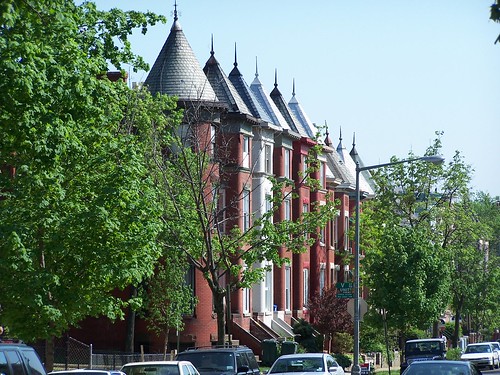
DC's Bloomingdale neighborhood, 1st St. NW.

There is no question that DC has many more distinct and older neighborhoods than Arlington, and great swathes of historic rowhouse architecture that Arlington, unlike Alexandria, doesn't realliy have.

3.  Community is the sum of architecture, people and connections and organizations.   There is no question that DC's rowhouse building stock gives the city a very particular visual identity, but if "community" or "soul" is the nexus of the built environment and the people who inhabit it, Arlington is more than the content of its architecture and arguably, DC may add up to less than the content of its architecture and people.

Architectural character isn't enough to build "soul" and DC is losing a great deal of its soul or community as the city de-emphasizes the importance of neighborhood elementary schools--which are the basic building block of neighborhood identity and cause neighbors to meet--and as new residents move into the city in large part out of the attraction to historic architecture but with limited commitment to participation in neighborhood and civic affairs and community building activities.

Civic society and participation can be pretty weak in DC, although neighborhoods like Capitol Hill, Georgetown, and Takoma (although more the Maryland side) stick out for the variety of neighborhood-serving organizations, activities, and sense of community.  Neighborhood elementary schools are an essential building block in most of these places.

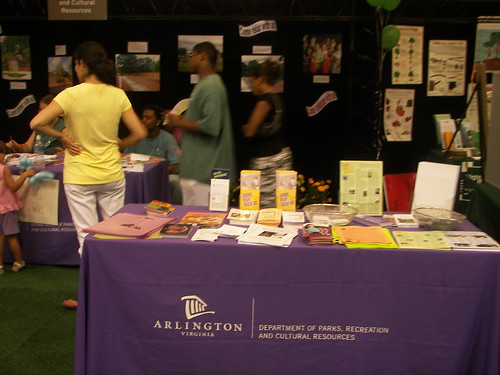
Dept. of Parks, Recreation & Cultural Resources Booth, Arlington County FairBy contrast, the Arlington County Fair is also a place where most of the county's government agencies exhibit, and even the County Manager spends some time in County Manager booth, talking with residents and answering their questions.

4.  Both Arlington and DC have some cool commercial districts and night-time destinations, and while the scale of places might be different between the two communities, Arlington holds its own with establishments like Clarendon Ballroom, Iota Cafe, Whitlows, Continental Pool Lounge and the Lost Dog Cafe.

Frankly, I'd rather have a branch of Lost Dog Cafe in Takoma than Republic, the ostensibly seafood restaurant from Jeff Black.

There is incredible vitality and street energy in the Wilson Boulevard corridor, and many great neighborhoods across the count

5.  Not only does Arlington have some awesome neighborhoods, it is also small enough so that many residents get involved in civic activities and pushing forward innovative practices, such as the County's focus on sustainability and energy planning, and a great deal of civic engagement.

For example, I have always been struck by how Arlington County Board members do things like lead community walks, and how the Arlingtonians for a Clean Environment community group leads environmental initiatives and helps push the county forward towards enacting and achieving a more progressive environmental agenda than surrounding jurisdictions.

Conclusion.  There's plenty of reasons to consider living in Arlington--other than the fact that the State of Virginia has some wacked politics and that the political structure is set up to advantage the rural areas over urban areas like Northern Virginia.

Labels: , , , , ,

Thursday, September 18, 2014

Social equity is more than housing and mobility

One of my big reservations in response to the "Walkable Urban Places" conference mounted by   the GWU Center for Real Estate and Urban Analysis and the Urban Land Institute was the trumpeting by Chris Leinberger of "a new measure of social equity."

His measurement of social equity is the percentage of income spent on both housing and transportation.  The problem is that anyone outside of the real estate development community would recognize that this definition of "social equity" is a constrained or truncated definition that is inadquate to the task.

Showing this relationship graphically is not new and has been spearheaded by the Center for Neighborhood Technology (The H+T Affordability Index) and is the basis of the concept of the "Location Efficient Mortgage," which has been around for about 12 years, but hasn't been made widely available.

The point is that traditional measurements of housing affordability and underwriting guidelines for mortgage financing (that housing costs should be no more than 30% of household income) fail to take into account transportation costs.  Generally, there is an inverse relationship between housing cost and transportation, places where people may pay "significantly more" for housing tend to be locations where residents pay "significantly less" for transportation, and vice versa.

Using LEM concepts, housing costs could be up to 39% of a household's income, depending on the proximity to and utilization of sustainable mobility infrastructure.

Social access vs. social equity.  I would call the combination of (1) "how much money" people spend on housing and transportation as well as (2) the locational connectedness of where people live as two of the three elements of "social access."  The third element of social access is locational connectedness in terms of access to civic assets like schools, libraries, cultural centers, and parks as well as commercial amenties like retail and restaurants and services.

Social access is a fundamental element of social equity, but it doesn't come close to providing a complete definition or measurement of it.

The European concept of social exclusion.  Poking around in various University of Michigan libraries back in my college days, I came across work out of the UK about "social exclusion"/social inclusion.  (Also about the concept of "social audits" being applied to for profit corporations.)

Achieving social equity has the same meaning as social inclusion.

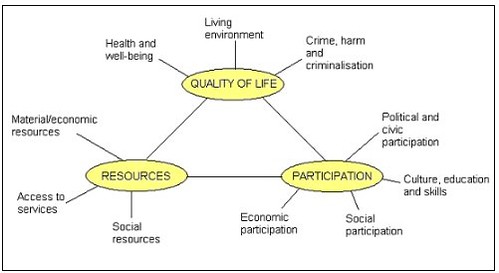
The Bristol Social Exclusion Matrix (pictured below) developed as part of the The Multi-dimensional Analysis of Social Exclusion, contains three primary elements for measuring social exclusion with ten sub-elements. Interestingly, they don't seem to separate out transportation access although "Access to public and private services" is one of the sub-elements. I'd separate out transportation/mobility as a separate sub-element.
Bristol Social Exclusion Matrix

Labels: , , , , ,