Amazon has set off a massive flurry of local and state government responses to their issuance of a
Request for Proposals (RFP) for the development of a "second" headquarters with a planned for headcount of 50,000 employees.
The company stated it would like to develop a second headquarters away from Washington State and will chose a location based on the following criteria:
- Metropolitan areas with more than one million people
- A stable and business-friendly environment
- Urban or suburban locations with the potential to attract and retain strong technical talent
- Communities that think big and creatively when considering locations and real estate options
+ incentives in cash, land, and other considerations.
Responses are due October 19th and a decision will be made next year.
The print media across the country has been covering various local responses. I can't keep up.
Is it worth preparing a bid? Mostly, I think it's a losing proposition, because a lot of time and effort has to be expended to prepare a credible proposal, and ultimately, you have to handicap your chances based on what your community has to offer and its place values versus the likely motivations of the company, rather than strictly being cheerleaders for your particular region.
Henry Grabar at Slate wrote early ("
Your city will lose the contest for Amazon's new HQ") after the announcement handicapping communities based on their existing base of talent, size, cost to acquire and build office space, and more residences, location, and whether or not the firm would be accommodated in new (greenfield) or existing (infill) places
Personally, I think Amazon wants to have a headquarters in an area with a decent quality of life, but are likely to seek favor with conservatives/Republicans as columnist Jon Talton argues, "
Amazon's second headquarters: Expect the unexpected," in the
Seattle Times, by putting it in a Republican state that isn't totally mossback politically, WHILE KEEPING ITS WAGES DOWN. From the column:
Bezos and his lieutenants may be reacting to our extreme political, social and cultural polarization by seeking a second base in a red state such as Texas. This would potentially give Amazon more political protection from Republican lawmakers — remember, President Donald Trump has threatened antitrust action against Bezos. Or they might be assessing America’s reactionary turn on immigration, trade and world leadership, and all the risks involved. In this case, a Canadian second headquarters would make sense.
Where? If Bezos stays to form, he wants a city, not only because of his commitment to sustainability but also to attract top talent. A suburban area with good transit might also make the cut. I suspect traditional incentives will play less of a role. The company will certainly take them and play localities off against each other. But talent, education (especially with a strong research university), a cool vibe, good air-travel connections and transit will be the big factors for the finalists. This is not going to be like the 20th-century moves from downtowns to far-flung, car-dependent office “parks.”
Talton's analysis is interesting because it means that the company is making business and political calculations that are just as important as an incentive package.
General Electric as an analogue. Relatedly, I found very interesting the process General Electric went through in deciding to return to the city from a now traditional suburban campus. They ended up picking Boston.
During the search process they did make clear to some states that they weren't interested, because of how political decisions made by their elected officials, such as opposition to the Export-Import Bank, had negative impact on their business ("
GE rules out relocation to Dallas because of Texas politicians' views,"
Dallas Morning News).
If competition for employees is a priority. I think this matters because while Amazon says wages will average $100,000 per employee, competition for highly trained employees would push wages up further, such as in Silicon Valley and Seattle, because of the competition between the big companies, and startups, for the best talent.
That means most big cities: Chicago; Denver (the
New York Times suggests that Denver would be the optimal choice, "
Dear Amazon, We Picked Your New Headquarters for you"); Greater Los Angeles; New York City; Washington, DC; among them, are out of consideration, as well as those existing digital economy clusters already experiencing a great competition for technically qualified workers (Austin, TX; Boston; San Francisco; Silicon Valley).
Not sure about Pittsburgh, it has Carnegie-Mellon, which has drawn an increasing number of digital commerce firms, but a major corporate headquarters for Amazon could push wage competition to undesirable levels.
Baltimore's probably too close to DC from a wage standpoint, and Johns Hopkins is more known for medical technology than computer engineering. Similarly, Philadelphia may be languishing in terms of attracting and keeping corporate headquarters, but it's embedded in the Mid-Atlantic economy and wages wouldn't be cheap.
Is red state--conservative Republican--presence a priority? But maybe wages aren't the biggest priority for Amazon, currying more favor with conservative politicians is, as Jon Talton suggests.
If you want to locate in a Republican state but without terrible politics that means North Carolina is out, despite the presence of the Research Triangle and even Greensboro. Probably Texas is out for politics--Governor Greg Abbott and Senators Ted Cruz and John Cornyn are hard right, and the large cities (Austin, Dallas, Houston) have too high a prevailing wage, while San Antonio has a limited presence in digital technology business and no rail transit system.
Wisconsin, nope, even though it has the University of Wisconsin Madison with strong engineering and business programs and proximity to Chicago--Wisconsin may have shot its bolt with Foxconn and the promise of up to $3 billion in incentives ("
$3 billion incentive package,"
Milwaukee Journal Sentinel).
Now that Sam Brownback is no longer governor, maybe Kansas has a chance. They definitely need an economic boost after the radical tax cut policies of the former Governor have wrecked the state's finances. Oklahoma City has strong leadership, great quality of life and is creating a streetcar system, but doesn't have premier technical engineering programs.
Maybe the
Silicon Prairie initiative linking Nebraska, Iowa, Missouri and Kansas makes that region, strongly Republican, attractive.
If this is a priority, then I think Indianapolis would be a consideration. It's reasonable politically, conservative, flipping between Democrats and Republicans, with the presence of Eli Lilly. Purdue University isn't that far, with its strong engineering programs and the university's desire to develop a major online presence ("
Purdue-Kaplan online university is one step closer to becoming reality,"
Lafayette Journal & Courier). Purdue and Indiana University have a joint campus in the city. While there is no real transit system, the city is compact.
Canada? Even though the RFP says "North America" and is not limited to the US, because not drawing attacks on the company from politicians is likely an important priority--separately company founder Jeff Bezos is frequently attacked by President Trump over his ownership of the
Washington Post--I don't think it's very likely that Amazon would pick a city in Canada, like Toronto ("
Allan Sloan: Trump might be driving Amazon HQ2 to Canada") for its second headquarters, as a way to send a signal that parts of Corporate America are unhappy with President Trump over immigration, foreign trade policy, and other matters even if they are happy to get tax cuts.
As a retailer--although the company makes a great deal of money selling computer services to other firms--Amazon is far more focused on the domestic market than other digital commerce firms that sell software and platforms, although Amazon is plenty active in various international markets.
Where? Jon Talton suggests Dallas; Denver; and Toronto; as well as Austin, although it lacks an international airport, and Atlanta, but it lacks a walkable center. He also suggests Calgary; Cincinnati; Guadalajara; Minneapolis; Monterrey; and Pittsburgh. He suggests Phoenix would be a possibility except for the state's politics, but doesn't ding North Carolina's Research Triangle for the same reason, instead handicapping it because of sprawl.
I would consider Baltimore--Amazon could be the 21st century anchor the city needs to reposition ("
Opinion: What Baltimore and D.C. can do to start working better together as a region (Baltimore Business Journal op-ed),"); Indianapolis; Minneapolis; Philadelphia--in the thick of things, but more in need of such a boost despite what the Green Party of Philadelphia says ("
Green Party to Amazon: Stay Away from Philly," press release).
Pittsburgh; maybe Chicago but the state government is completely dysfunctional and its choice wouldn't curry favor with Republicans, but it is so centrally located, possibly Kansas City, especially given its bioscience and Smart City initiatives ("
Kansas City To Become The Largest 'Smart City' In North America," KCUR/NPR) and how smart city initiatives could be a new area of growth for Amazon (Pittsburgh has the same potential).
It will be interesting to see what Amazon does.
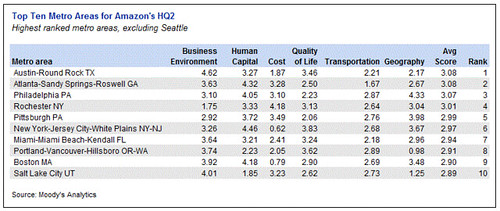
Moody's Analytics ("
Where Amazon's Next Headquarters Should Go: We offer a data driven approach to selecting the best metro area for HQ2") doesn't seem to believe that wages are the foremost consideration, and lists various places that offer intriguing possibilities. Except for global warming, Miami would be a good choice, offering multilingual business opportunities and Florida is a Republican state. Portland and Salt Lake too, except both are probably too close to Seattle to offer the kind of geographic diversity the firm wants.
If Moody's is right, and they have better insights into business decision-making than I do, it looks like a big city truly has a shot, although based on recent wins such as Mercedes Benz, maybe it's Atlanta and not traditional cities like Boston, Philadelphia or Pittsburgh.
Atlanta
-- "
Regional Transit A Strike Against Atlanta To Get Amazon's 2nd Headquarters," WABE/NPR. From the article:
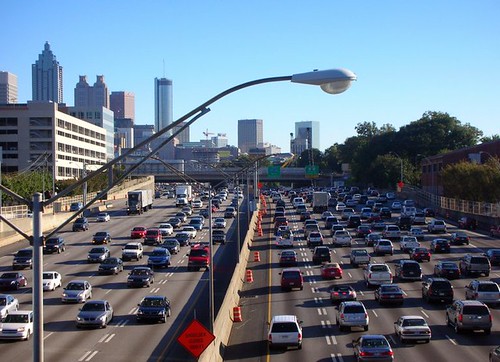
It's no secret Atlanta doesn't have a regional transit system. But with the city pegged as one of the top contenders for Amazon's second headquarters, metro Atlanta's lack of transit might cost the city the deal.
"The ability to get workers to work is a major consideration,” said Robert Puentes, president of the Eno Center for Transportation, a nonprofit think tank in Washington, D.C. “And in cities, states and metros across the country, the emergence and the reliability in public transit is a key consideration."
Despite the lack of transit, Moody's Analytics ranks Atlanta quite highly. Plus, the MARTA system seems on the verge of substantive expansion, although the current general manager credited for steadying the agency is leaving ("
Keith Parker explains decision to leave MARTA,"
Atlanta Business Chronicle.
Austin
-- "
Austin is top candidate for Amazon HQ2, Moody's Analytics says,"
Austin Business Journal
Baltimore
-- "
Hogan plugs Baltimore as his preferred site for Amazon headquarters,"
Washington Post
-- "
Opinion: Why Baltimore should be at the top of Amazon's list for HQ2,"
Baltimore Business Journal
-- "
How Johns Hopkins is playing a role in bringing Amazon's HQ2 to Baltimore
Boston
Some of the commentary in the
Boston Globe has been particularly interesting and will be discussed in the Part 2 piece.
-- "
Boston's pros and cons surround the Amazon bid,"
Boston Globe
-- "
Amazon Weighs Boston in Search for Second Headquarters," Bloomberg
Brooklyn
-- "
Brooklyn May Be NYC's Best Bet to Win New Amazon Headquarters," Bloomberg
Chula Vista (Greater San Diego)
-- "
This city is offering Amazon a $400 million incentive package, chance to develop university (and ocean views),"
Phoenix Business Journal
Columbus, Ohio
-- "
Few experts see Columbus getting new Amazon headquarters,"
Columbus Dispatch
Actually, Columbus could be a good choice. Ohio is a Republican state, and the city has a top notch university, is the state capital, and has a significant investment program refocusing development on downtown. The core has the potential to be walkable. They have a decent bus system, and good enough air connections.
New York City
-- "
Hey Amazon: this report says NYC is a tech dynamo,"
Crain's New York Business
--
New York City Tech Ecosystem Study webpage,
report, HR&A for the Association for a Better New York
Northern Virginia
-- "
Tysons Corner bypassed as Northern Va. vies for Amazon,"
Richmond Times-Dispatch
In the 1990s, Virginia created the
Center for Innovative Technology in Loudoun County, and it has become the centerpiece of the state's technology development and innovation agenda.
Providing transit connections to that anchor was one of the justifications for the creation of the Silver Line heavy rail line through Fairfax and Loudoun counties. Amazon there could also provide the energy to reposition Dulles International Airport. The State chose that district rather than Tysons, for its bid.
Interestingly, had the State implemented its many years plan to "extend" the Northeast Corridor Amtrak service to Richmond, maybe Richmond could have been a contender, although it's a small metro. Virginia Commonwealth University is an up and comer, and focuses on engineering, medical, and business studies.
Pomona
-- "
Pomona wants to be home to the new Amazon headquarters,"
Los Angeles Times
Prince George's County, Maryland
-- "
Pr. George's Co. gives Amazon 3 reasons to build new HQ here," WTOP-radio
Just think what PG's chances would be if the Purple Line had already been constructed and was in operation and it had been used to already reposition the County ("
Another lesson that Prince George's County has a three to five year window to reposition based on visionary transportation planning," "
Part 4 | Making over New Carrollton as a transit-centric urban center and Prince George's County's "New Downtown"," and "
PL #7: Using the Purple Line to rebrand Montgomery and Prince George's Counties as Design Forward") and College Park was truly a college town ("
More Prince George's County: College Park's militant refusal to become a college town makes it impossible for the city(and maybe the County) to become a great place," 2015). It has University of Maryland, with a decent engineering school, has a Republican governor, sort of has transit, etc.
Toronto
-- "
Toronto’s tech talent being used to woo Amazon,"
Toronto Star
Washington, DC
-- "
DC pitches 4 sites for Amazon headquarters," WTOP-radio
WRT DC's proposals, none of the area's suggested have enough build out potential to accommodate Amazon's plans, although NoMA and the Capitol Riverfront are nice places. The suggestion of Shaw is odd as it has almost no build out capacity of significance.
A truly path-breaking proposal could have been offered. On the other hand, it would have been very interesting for DC to offer an expanded "Capitol Hill East" site with the addition of the RFK Stadium site immediately north, and the former Pepco generating site north of RFK, all on the west bank of the Anacostia River but immediately accessible to the so called "East of the River" district of the city, which is the least economically well off section.
It's near the H Street entertainment district, pretty close to Union Station, one of the busiest train stations in the US, is served by a Metrorail station, and could be the hub of expanded streetcar service, which is currently provided on the H Street side of the RFK site, and the undergrounding of the Orange Line between the Armory and Minnesota Avenue Stations, adding more development capacity to the RFK parking lots.
The site offers reasonably convenient access to National Airport and isn't too far from BWI Airport, south of Baltimore.
It would have provided the means for a major transformation of this part of the city ("
Wanted: a comprehensive plan for the Anacostia River East corridor," 2012), and far more economically impactful than the current plans to attract the Washington Redskins ("
Half billion-dollar plans for RFK Stadium site include sports center,"
Washington Post).
The transformation could extend environmentally, as the city could leverage Amazon's choice of the city as a way to accelerate plans to restore the Anacostia River and watershed. Although it would have set up an interesting dynamic with the National Park Service, because there is an easement limiting use of the RFK site for recreation.
The city could start with the Reservation 13 site and grow out from their as they negotiate changes with the NPS and integrate Pepco into the project. To assuage the NPS, the city could integrate some recreational uses into the sites as well as invest in improvements to other park spaces along the river which are currently controlled by the federal government.
It could have also leveraged a long since forgotten revitalization proposal for the Spingarn High School campus that dates to 2003 ("
The City Of Learning‚: School Design and Planning as Urban Revitalization in New Jersey, Berkeley, and Washington, D.C.," Roy Strickland, University of Michigan), current desires to spiff up the Langston Golf Course (The Langston Initiative, Federal City Council), and proposals for the old Hechinger Mall ("
H Street Group Pitches Major Hechinger Mall Development As Activity Moves Down the Corridor," Bisnow)--the Mall is owned by a major national developer and could be brought into the mix.
It could even be used to push forward the plans to develop over the Union Station railyard,
the Burnham Place development, including an extension of the project beyond its current boundary of K Street. Plus push extension of the streetcar both east and west--Amazon has invested in Seattle's streetcar ("
Amazon to Buy 4th Streetcar, Fund 10-Minute Headways," Seattle Transit blog). And the undergrounding of the Orange Line across the RFK campus could also be used to build another station on Benning Road, serving the site's northern section.
But it would send the city's residential real estate market into overdrive and definitely people East of the River would fear displacement in the pace of significantly increased real estate demand.
And the city wasn't capable of pulling such a vision together in the first place.
Labels: building a local economy, business recruitment and retention, change-innovation-transformation, economic development planning, real estate development, tax incentives and abatements, urban vs. suburban