Rebuilding Place in the Urban Space

"A community’s physical form, rather than its land uses, is its most intrinsic and enduring characteristic." [Katz, EPA] This blog focuses on place and placemaking and all that makes it work--historic preservation, urban design, transportation, asset-based community development, arts & cultural development, commercial district revitalization, tourism & destination development, and quality of life advocacy--along with doses of civic engagement and good governance watchdogging.

Sunday, November 26, 2023

Revisiting Pittsburgh and Allegheny County as an opportunity for city-county consolidation: The "RiversCity" proposal

Partly what got me thinking about city-county consolidation--places like Indianapolis (1970), Knoxville, Macon-Bibb County, Georgia (2012), and what SF and Philadelphia did in the 1800s--was seeing mention of a Brookings Institution report about Pennsylvania c. 2003 (Back to Prosperity: A Competitive Agenda for Renewing Pennsylvania), and it mentioning how so many of the micro jurisdictions across the state including in Allegheny County, where Pittsburgh is, lacked the financial capacity to serve their residents.

Plus I attended a conference in Louisville Kentucky in 2004, just as they were beginning to consolidate the city and county after a successful vote to do so (A 10-Year Perspective of the Merger of Louisville and Jefferson County, KY, Abell Foundation, "How merger reshaped Louisville, Jefferson County and metro development," Louisville Public Media/NPR).

It was probably easier for Louisville because Knoxville city and Knox County had merged some functions--but not the city and county--years before.

Later I suggested this for Baltimore City and County ("Opinion: What Baltimore and D.C. can do to start working better together as a region (Baltimore Business Journal op-ed," 2016), and I support efforts to do this for St. Louis City and County ("St. Louis: what would I recommend for a comprehensive revitalization program? | Part 1: Overview and Theoretical Foundations," 2021).  I also think Detroit should do it, but ideally with Oakland County!, not Wayne.

It turns out that ten years before Brookings, Professor David Miller (now deceased) of the University of Pittsburgh suggested a proto version of this, a concept called "Rivers City," not for the entire county and not for Pittsburgh but for the various small communities in what is called the Lower Mon(ongahela) Valley ("Small Western Pennsylvania towns weigh merits of merging some public services," Pittsburgh Post-Gazette).

The economic circumstances they face are issues common to that of municipal finance for communities and metro areas across the country, which I wrote about in "The real lesson from Flint Michigan is about municipal finance" (2016).

Basically our local government finance systems were set up when the country was growing.  They don't work well in changed circumstances.

In the Lower Mon Valley, communities are resistant, believing rightly that they are unique.  Although really, they are not exceptional, and economically at least, they should merge to have greater taxing and funding capacity.  

Those communities haven't merged, but over the years, because of their minimal financial capacity, they have merged services, like police and fire departments.  This phenomenon has been happening across the country for the past couple decades in places like New Jersey, Suburban Detroit, and Salt Lake County.

According to the article, 39 communities make up "Rivers City," ranging in population from 232 to 23,000. The communities total 209,000 in population, while Pittsburgh is about 306,000 and the total county population is 1.238 million.

From the article:

“A lot of these really small towns have now been in a position for about 30 years where they just don't have the tax base necessary to support the full slate of services that they had been used to previously,” Mr. Dougherty said. “And I'll be honest: our response to them has largely been, heal thyself, mostly through service cuts.” 

If it isn’t service cuts, then it’s consolidation — many fire and police departments are either decertifying their operations or merging with nearby departments, Mr. Dougherty said. And it’s likely that sort of functional consolidation, rather than municipal consolidation, will occur in the coming months and years, he said.

Labels: , , , , , ,

Wednesday, March 01, 2023

Buckhead District of Atlanta looks to secede from Atlanta

Predominately white district ("Richest Atlanta District Inches Closer to Seceding From City," Bloomberg).  A kind of edge city, but within the city, not on the outskirts of the metropolitan area.  It's competitive with Downtown for commercial property location and development. It accounts for 38% of the city's tax revenue.  So its leaving would cripple the city economically.

Definitely counter to my call for cities and counties to merge, to create bigger, more viable polities.

It's being pushed by the State Legislature, especially the Senate.  The House may oppose, but unlikely.  The city would be forced to divvy up civic assets at a price favoring Buckhead.

It seems pretty ugly.

Labels: , , , ,

Wednesday, January 05, 2022

Pontiac Michigan: a lagging African American city in one of the nation's wealthiest counties

I've written about Oakland County, Michigan vis a vis Detroit, and how the multi-decade County Executive, L. Brooks Patterson, spent a lot of time working to keep the county ascendant at the expense of the majority black center city.

-- "The rise of Oakland County is built on Detroit's fall," 2014
-- "One more idea about Detroit: merging not with Wayne County but Oakland County," 2019
-- "Revisiting stories: the death of L. Brooks Patterson, County Executive, Oakland County, Michigan," 2019
-- "Michigan politics as an illustration of the impact of the decline of industry on social capital," 2020

Oakland County has not quite 1.3 million residents and the population is roughly 75% white and 14% black.  Located immediately north of Detroit, later waves of black outmigration from the city led to significant demographic changes in communities like Southfield and Oak Park, which are now majority black.

Built on the earlier success of the auto industry, as of the 2010 Census, Oakland was the seventh wealthiest county in the US--and the second wealthiest, after Fairfax County, Virginia, of places with at least one million residents.

The county has lots of office parks, Oakland University, and an industrial promotion initiative called Automation Alley, aimed at keeping its industrial base competitive.  While definitely a suburban community, it has a number of traditional town centers predating suburbanization, like Royal Oak, Ferndale, and Birmingham, and Pontiac, the county seat.

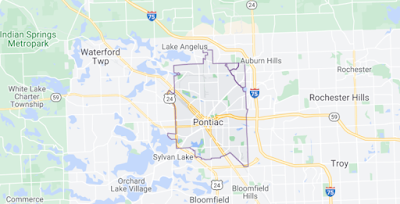
Pontiac, about 20 miles north of Detroit, is the Oakland County seat, but in the 1970s, the county government began relocating most of its facilities to a new automobile-centric headquarters campus in adjacent Waterford Township, with criminal justice facilities (courthouse, jail) remaining in the city.  This removed the valuable energy government office districts can provide to city economic health.

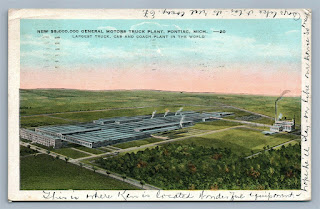
When I lived in Michigan, Pontiac was known for its industry--home to GM's Pontiac Motors division when that brand still had verve, but also GM's extensive medium truck and bus manufacturing operations, and for being a majority black community in a predominately white community.

It was one of the first cities in Michigan to employ busing to achieve school integration, and it was challenged violently, with bombings of buses in 1971.

Pontiac is about 20 square miles, while Oakland County is 907 square miles.  Today the city has about 60,000 residents, down from a peak of 85,000 in 1970.  The population is about 52% black, with over 20% of the population below the poverty line. By contrast, the overall poverty rate in Oakland County is 7.8%.

Deindustrialization.  At its peak, GM had 30,000 employees working at various plants in Pontiac, and was the largest property holder and paid the most in property taxes ("Pontiac, Michigan feels brunt of GM's pain," Reuters).  

But GM's dissolution of the Pontiac brand, the sale of its bus manufacturing operations, and the cessation of the manufacturing of large trucks led all but one of GM's facilities to close there by 2010. 

Now there are a few hundred employees, at a single facility.

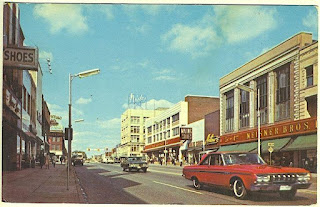
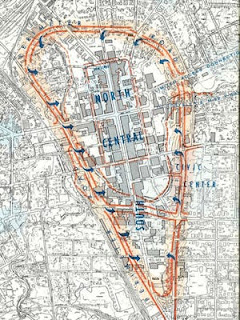
The city also suffered population outmigration and went through some iterations of urban renewal, including the construction of a ring road around the city, to facilitate car-based commuting traffic, at the expense of walkability and the economic health of the Downtown.

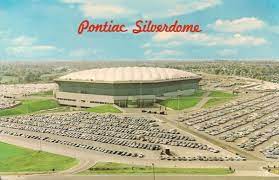
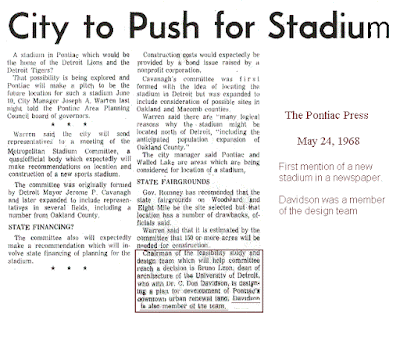
Football stadium. As part of an earlier period of outmigration from the center city, for a time, the Detroit Lions football team relocated to a covered stadium built in Pontiac, called the Silverdome, although the team returned to Detroit in 2002.  

(For a time, the Detroit Pistons basketball team played at a suburban arena in nearby Auburn Hills/Auburn Township.  Chrysler moved from inner city Highland Park to Auburn Township as well.)

Being located on the edge of the city, by freeways, the stadium provided zero energy to Pontiac's core.  

Although Pontiac was hardly an exception, as other suburban stadium and arena projects across the county also had minimal positive impact ("Framework of characteristics that support successful community development in association with the development of professional sports facilities").

Deindustrialization was a problem across the state and the state failed to step up.  Like Detroit and Flint ("The real lesson from Flint is about municipal finance," 2016), Pontiac was one of a set of legacy cities in Michigan that because of the drop in property and income tax revenue from population shrinkage and deindustrialization went into bankruptcy, being the first to do so in 2011.  Plus, the economic multiplier effect.  Each auto job supports 3-4 other jobs.  Not all are local (e.g. parts plants from afar) but many are, furthering job losses and economic decline.

Even when plants stayed open, automation often reduced employment by as much as 75%.  It occurs to me that in multiple cities across Michigan, facing similar problems, not limited to GM or Chrysler or Ford:

  • Battle Creek (Case Equipment moved to Kentucky), Bay City (GM), Benton Harbor, Detroit, Flint (GM, Buick), Jackson, Kalamazoo (Upjohn and GM, see "Former GM plant in Kalamazoo finds second life as successful business park," Kalamazoo Gazette--while successful the industrial park replacing the GM plant has 1/8 of the workforce), Lansing (Oldsmobile), Pontiac (Pontiac, GM Truck), Saginaw (GM)  
that like the Massachusetts Gateway Cities Initiative, the State of Michigan should have developed a state-wide initiative addressing deindustrialization and its impact on center cities across the state ("Growth Ideology in a Period of Decline: Deindustrialization and Restructuring, Flint Style," Social Problems, 1992, "Understanding Resilience Through Regional Responses to Economic Restructuring," dissertation, 2010).

Instead, later Republican administrations focused on cities declaring bankruptcy, fitting their narrative of incapable cities run by Democrats, rather than developing a broader economic revitalization initiative.

Pontiac looks to do Downtown street calming.  A recent article in the Detroit Free Press, "State agrees to unwind Pontiac's Woodward 'Loop' that leaders say strangles their downtown," says that the city is going to get rid of the ring road, in an attempt to reapply more city-centric urban design principles. From the article:

When it opened in 1964, the design of Pontiac’s Woodward Avenue Loop — formerly called Wide Track Drive — was hailed as a triumph.  (Wide Track was named after a Pontiac Motors marketing campaign for its cars.)

Its swaths of one-way pavement unsnarled bottlenecks and shunted GM workers as well as parts-laden tractor-trailers through Pontiac’s downtown and to half a dozen bustling factories. The high-capacity roadway played into the dreams of midcentury designers, on a binge they called urban renewal.

The road re-routing created a set of five one way streets, each five lanes wide.  It was decidedly anti-urban, facilitating car movement over people and a thriving downtown.  

Moving the government center and the creation of Pontiac Mall, on the border of the city and Waterford Township, were other actions that redirected economic activity away from Pontiac's Downtown to other parts of Oakland County. 

Why does Pontiac lag in the midst of great wealth?

And I hate to admit, reading that article, that I hadn't ever really thought about the reality that while Oakland County is wealthy and white, could that wealth have been harnessed to spur the economic revitalization of Pontiac, to reverse the steady drumbeat of decline?

Deindustrialization and outmigration?  It's not just deindustrialization, although that's a factor.  Pontiac was on the decline long before GM shut down its plants, just like many other cities across the state, the Midwest, and the nation.

Lack of political longevity?  The now deceased County Executive L. Brooks Patterson was in office for 27 years.  Certainly, unlike Mayors who are in office for usually no more than 2 terms, he had the opportunity to address Pontiac's poverty over the long term.  (Community revitalization is a multi-decade process, see "Main Street Niches in a Mass Sales World," 2004.)

Lack of attention to revitalization needs in legacy communities?  It's not like Patterson wasn't paying attention to the needs of inner ring suburbs, as Oakland County is the first and only county in the US to have created a county-wide Main Street commercial district revitalization program, which it did in 2000.  Pontiac participates, and has had a Downtown Development Authority for decades.

Tax harmonization.  Could the county have applied various tax harmonization strategies, like what has been done in Greater Minneapolis, or how various counties share sales taxes with legacy communities. (This likely would have required approval by the state legislature.)

Best practice county revitalization initiatives.  To be fair, plenty of counties have areas of persistent poverty.  But should this be the case?   

Are we taking poverty for granted, especially when it is co-terminate with race?

Recently I made this point about Montgomery County, Maryland and how its East County section remains a laggard ("East County, Montgomery County, Maryland: Council redistricting spurs ideas for revitalization | Part 1 -- Overview").  

Fairfax County, Virginia has been working on the revitalization of the Route 1 Corridor for decades ("Fairfax County’s Richmond Highway area ripe for development during next decade," Virginia Business).  And both counties are comparable to Oakland in terms of wealth.

The most typical initiatives focus on inner ring suburbs. But Pontiac is different as it was never a suburb in the traditional sense, but a stand-alone city, secondary to the center city, but significant and unitary, with its own economy, newspaper, civic institutions, etc.

Previous entries call attention to Hennepin County, Minnesota ("A County and Its Cities: the Impact of Hennepin Community Works"Journal of Urban Affairs) and Oklahoma City--not a county exactly, but the city is larger than other city-counties like Philadelphia or San Francisco ("Change isn't usually that simple: The repatterning of Oklahoma City's Downtown Streetscape"). 

Maryland had/has a couple of smart growth related initiatives.  The "Community Legacy Revitalization Program," is a state program funding revitalization planning and projects in existing places, and there was a similar initiative at the county scale in Baltimore County under former County Executive Jim Smith ("Community renaissance set down in writing," Baltimore Sun; "Baltimore County Confronts Suburban Decline").  

Is it racism or the "soft bigotry of low expectations"?

Pontiac is a little place, 60,000 residents and 20 square miles.  In the midst of great wealth. 

From the standpoint of money, political administrative longevity, and political capacity, there's no reason that Pontiac should have continued on its negative trajectory.  Just like the way that cities like Bilbao have been renewed, using an approach that I call "transformational projects action planning." 

-- "Why can't the "Bilbao Effect" be reproduced? | Bilbao as an example of Transformational Projects Action Planning," 2017
-- "Economic restructuring success and failure: Detroit compared to Bilbao, Liverpool, and Pittsburgh," 2014
-- "Minneapolis Super Bowl: Urban Revitalization and Transformational Projects Action Planning," 2018
-- "Downtown Edmonton cultural facilities development as an example of "Transformational Projects Action Planning"," 2018

there's no reason that Pontiac couldn't have been improved similarly.

It seems like economic revitalization there ought to be a straightforward process although granted they went through a bunch of flawed urban renewal iterations and severe deindustrialization

10 Pontiac School District buses were destroyed in an attack by the Ku Klux Klan.  Detroit News photo.

On the other hand, L. Brooks Patterson did start his political career defending opponents to busing and school integration.  In Pontiac! ("RIP, L. Brooks Patterson, Racist," Detroit Metro Times, "Busing set off Democratic debate flare-up, but does it still matter in Detroit?," Detroit News).

While Patterson's campaign "against" Detroit and Wayne County could be termed to be more a kind of "economic county-ism," racism was an issue.

But wrt Pontiac, perhaps it was more about benign neglect in the context of institutionalized and/or structural racism, and the failure of the state to think systematically about deindustrialization and its impact across the state.

The default is to see Pontiac/blacks as perennially poor, as a condition not particularly amenable to change.

While it's rare for counties to develop revitalization programs the way that Hennepin County did--which it did out of desperation, facing severe property tax revenue losses in the face of economic and population decline in Minneapolis--we can raise the bar for counties like Oakland, where overall they are fine economically, but possessing severe pockets of poverty and decline.


Some recommendations.

1.  The State of Michigan should develop a program addressing deindustrialization more systematically, using the Massachusetts Gateway Cities Initiative and "Hennepin County Works" program as models.

2.  Oakland County should make "leveling up" Pontiac its number one economic development priority.

3.  Building on the nascent road dieting effort and examples of successful communities nearby like Royal Oak ("Downtown Royal Oak social district opens this weekend -- Here's what to know," Fox2 Detroit, "Baker College to Build Flagship Metro-Detroit Campus in Downtown Royal Oak," "Royal Oak and Rochester Downtowns Win National Awards," OC Times) and Birmingham, focus on redeveloping the residential and retail possibilities Downtown.

-- Reinventing Suburban Business Districts (ULI)
-- Reinventing America's Suburban Strips
-- Revitalizing Distressed Older Suburbs
-- Putting the Urban in Suburban: Art and Business of Placemaking
-- "The secret to a successful suburb: Lakewood, Cleveland Heights and the Inner-ring Divide," Cleveland Plain Dealer

4.  Develop a revitalization plan using the Transformational Projects Action Plan approach, with Oklahoma City's Metropolitan Area Projects program and the downtown streetscape program as best practice models..

5.  Why not merge Pontiac into Oakland County?  This would make County prioritization of Pontiac revitalization unavoidable.

6.  Baring that, why not consolidate Pontiac and Waterford Township (Michigan makes it almost impossible now for cities to annex townships.  Waterford is 92% white and has 72,000 residents). But combining the two would make it tied as the state's third largest city, and would add the stronger residential tax base of Waterford.

7.  Consider merging the Pontiac School District with adjoining school districts, like Waterford. This is difficult, as communities like local control of schools.  

OTOH, a majority of Oakland County school districts are shrinking and consolidation could be advantageous, especially if combined with a MAP 4 Kids program of construction and other improvements like the second phase MAP program in Oklahoma City ("MAPS for Kids wraps up," Daily Oklahoman).

Labels: , , , , , , ,

Wednesday, March 25, 2020

If DC hadn't lost Alexandria and Arlington, it would be over 1 million population

It's been awhile since I've thought about this, but an email discussion reminded me.  When the District of Columbia was first created, it was a 100 square mile diamond shaped district, incorporating land from Maryland and Virginia.

Map showing the original District of Columbia as a 100 square mile diamond shaped district

The Maryland side was mostly underdeveloped, with the exception of the Town of Georgetown.  The Virginia side had the City of Alexandria and its growing port.

In 1847, the Virginia side was retroceded back to Virginia, because of rising anti-slavery sentiment and the existence of a large and successful trade in selling slaves in Alexandria.  Retrocession protected that business from potential changes in its legality.

That cut DC in size from about 100 square miles, to 61 square miles.

These days, DC is the fourth largest "county" in the area.

Jurisdiction Population
Fairfax County, Virginia 1,146,883
Montgomery County, Maryland 1,048,244
Prince George's County, Maryland 908,801
District of Columbia 711,517
Arlington County, Virginia 235,121
Alexandria City, Virginia 160,530 

But if it were combined with Arlington and Alexandira, the population would be 1,107,168, just a little behind Fairfax County.  And DC would be about 1/4 the size in square miles compared to either Fairfax or Montgomery Counties.

Nationally, DC would be vying with San Jose, as the tenth largest city in the US. (Although if Baltimore City and Baltimore County took my recommendation for merger, than DC/San Jose would be vying for 11th place.)

Labels: ,

Wednesday, September 25, 2019

Arlington and Alexandria: Maybe they should just merge

Welcome to Virginia, Interstate 95, Alexandria, VirginiaThe Washington Post reports ("Arlington and Alexandria split in the 1870s. Could Amazon bring them together?") that Arlington and Alexandria are looking to work more closely together on affordable housing and other matters, possibly through the creation of what in California they call "joint powers authorities" or community development corporations to address joint concerns in a substantive way.

While I recommended Montgomery and Prince George's County needed to create a joint community development corporation operating in the Purple Line light rail transit line catchment area, to buy, hold, maintain, fund, and develop affordable housing, along with other urban design and economic development issues ("Creating a transportation development authority in Montgomery and Prince George's County to effectuate placemaking, retail development, and housing programs in association with the Purple Line"), probably Arlington and Alexandria should just merge.

Arlington County has 235,000 residents; Alexandria, 145,000 . Technically Arlington is a county but run as a city.

I've recommended that Baltimore City and County merge ("Opinion: What Baltimore and D.C. can do to start working better together as a region (Baltimore Business Journal op-ed)," 2016).

I think Detroit should merge with a county, but ideally Oakland County but it's located within Wayne County ("One more idea about Detroit: merging not with Wayne County but Oakland County").

I am familiar with city-county mergers in places like Indianapolis, Kansas City, Kansas, Lexington, Louisville, and Macon. In the mid-1800s Philadelphia and San Francisco merged their city and county functions. In the Boston area, counties as political subdivisions don't really exist.

The advocacy group Better Together calls for a merger of the City and County of St. Louis, and other jurisdictional mergers within the county as well.

Whereas these kinds of mergers can be problematic politically, because more conservative outer areas with more population can dominate the core areas which tend to be more politically progressive, Alexandria and Arlington are pretty much the same on the political spectrum, strong Democrat/progressive politics.

But opposition to the idea in St. Louis ("Better Together pulls St. Louis city-county merger proposal," St. Louis Post-Dispatch; Better Together to pull petition on city-county merger," St. Louis Business Journal)  has led the group to pull back its quest to have a statewide vote on the matter in November 2020 and makes clear a lot of time is necessary to build support for such a change, which always requires a vote.

(One of the problems of such initiatives is if they require statewide votes, when the matter only concerns people in the affected jurisdictions.)

So it probably makes sense to start working more closely together, to build the foundations for consideration of a merger later.

Labels: , , , ,

Sunday, August 11, 2019

One more idea about Detroit: merging not with Wayne County but Oakland County

Vacant houses in Detroit
Rebecca Cook, Reuters.

In the 2014 piece, "The rise of Oakland County is built on Detroit's failure," I did discuss city-county merger as one way to change the trajectory for the City of Detroit, which while revitalizing at its core, faces real long term issues concerning lack of market demand for residential living.

I favor city-county merger for legacy cities like Pittsburgh, St. Louis (it will be on the ballot but I haven't written about it yet), Baltimore ("Opinion: What Baltimore and D.C. can do to start working better together as a region (Baltimore Business Journal op-ed)," 2016), and Detroit, as a way to deal with difficult financing and governance issues ("The real lesson from Flint Michigan is about municipal finance," 2016).

But Detroit's decline has significantly impacted Wayne County too, and the County has other issues besides Detroit, aging infrastructure

Since the tri-counties haven't grown much, there isn't much chance of Detroit's recapturing the lost 1.2 million residents...

That's why after I wrote the 2014 piece, I realized that instead of merging with Wayne County, Detroit should merge with Oakland County, which is the most economically successful county in the Detroit Metropolitan Area.

That would be an unprecedented kind of merger.

But outside of creating more rigorous metropolitan government structures, along the lines in Greater Portland Oregon and Minneapolis-St. Paul, that's maybe the only kind of quantum scale change that could truly change Detroit's trajectory.

All the great media discussion notwithstanding:

-- "12 big developments set to transform Detroit," Curbed Detroit
-- "Detroit's Revival Is in Full Swing, But Some Question Its Future," Barron's
-- "Commentary: How Detroit Became a Model for Urban Renewal," Fortune
-- "Detroit's Big Comeback: Out Of Bankruptcy, A Rebirth," NPR
-- "Is Detroit Really Experiencing a Full Recovery?" CityLab

When I did a tour of New Orleans in 2006, after Katrina when the city was devastated, the native tour guide was outraged, and wanted us to be outraged too. I said, "how is this any different from what happened to Detroit?"

Detroit suffers from racism sure (see the writings of Thomas Sugrue) but it was also the auto industry's plan to break the UAW, which mostly has worked, but at the expense of cities in Michigan, especially Detroit and Flint (Pontiac, Lansing, Bay City, and Saginaw too).

In the 1950s, Detroit had something like 15 auto assembly plants, each of which employed thousands of people, and scads of supplier plants, each of which employed hundreds or thousands of people.  Now Detroit has two assembly plants.

Similarly, Flint at its peak had over 80,000 people employed by GM.  Now it is fewer than 8,000.

So that is why Michigan shifted Republican over the past few decades as auto workers, who tended to vote Democratic (cf. George Wallace, and Reagan Democrats), lost their jobs and left the state.

It's also why I get f*ing tired of reading comments on articles about how Democrats who run cities drive them into the ground.  The issue is far more complicated.

Look at all those robots!  Photo from "10 Auto Industry Jobs that Will Die Due to Automation," MoneyInc.

At the end of the day, locally elected officials have little control over what corporations do and mega economic trends like capital investment, globalization, the replacement of workers with machines, industrial consolidation, etc.

The systems that fund local government were created when the nation was growing rapidly.  We are past that phase now, and in many cases, especially for legacy communities with aging infrastructure and growing pension liabilities, local government funding systems won't generate enough revenue

Labels: , , , , , ,

Revisiting stories: the death of L. Brooks Patterson, County Executive, Oakland County, Michigan

======
Note: I lived in Oakland County roughly from 1971/1972-1978 and the summers of 1979 and 1980.
======

L. Brooks Patterson won 7 terms as County Executive in Oakland County, Michigan, which lies north of Detroit.  Before that he was the tough on crime County Prosecutor for 4 terms.

He was strongly pro-County and pretty much anti-Detroit, as I wrote in this piece from 2014, "The rise of Oakland County is built upon Detroit's fall."

From the Crain's Detroit Business article, "What will happen to Brooks' deputies?":
Patterson was first elected county executive in 1992 after serving four terms as Oakland County prosecutor.

His tenure as Oakland County executive was marked with myriad successes, but also controversy. The county's AAA bond rating has been reaffirmed time and time again under his leadership, and the county has a lauded three-year rolling budget. He instituted the Automation Alley high-tech cluster and the Emerging Sectors program for knowledge-based jobs. Medical Main Street and Main Street Oakland also came into being under his watch. He was honored by Governing magazine in 2013. The University of Detroit graduate and U.S. Army veteran was generally viewed as a business community champion.

While his leadership of Oakland County itself has drawn wide praise, his comments about Detroit and other issues have drawn criticism.

His career had been marked by bitter feuds with Detroit and neighboring counties over a host of issues ranging from transit to the Detroit Water and Sewerage Department. Some viewed him as an obstacle to more robust regional cooperation.
Like Trump's very parochial bilateral "Make America Great Again" push, Patterson was a block to creating more regional approaches to the area's issues.

In e-talking with Nigel, our correspondent from New Zealand, I looked up the demographic data comparing Wayne, Oakland, and Macomb Counties population from 1960 to today.

Overall, there are only about 120,000 more residents in 2018 compared to 1960--although it must be acknowledged that the metropolitan area has grown beyond these three counties.

The difference is that 1.2 million residents from Detroit have been redistributed and Wayne County's population dropped by 900,000, while Oakland and Macomb Counties roughly doubled in population.

Patterson died not quite two weeks ago, and because in the 2016 election, the County shifted from a Republican dominated electorate to a more progressive and Democratic there is jockeying between Democrats as the Party aims to capture the County Executive position.

It's not clear if there will be a special election, which if one is held will be in the 2020 election cycle, for a two-year partial term, as the normal cycle for the office is in the "off year election" from Presidential elections.

Also see:

-- "Commentary: Patterson leaves enduring legacy, but time for region to move on," Crain's Detroit Business
-- "R.I.P. L. Brooks Patterson, A racist," Detroit Metro Times
-- "McGraw: Friends Say Brooks Patterson 'Loved' Detroit, But His Record Shows Otherwise," Deadline Detroit

A couple weeks ago in a post about segregation, I mentioned that I went to school for a time in the Pontiac School District, while the school system was desegregating and where school buses were bombed in protest. It turns out L. Brooks Patterson represented one of the incendiary anti-busing activists, Irene McCabe...

Labels: , , , , , ,

Friday, January 24, 2014

The rise of Oakland County is built upon Detroit's fall

The other morning the tv was on a channel showing a repeat of a Dateline NBC show on a cable channel.  It featured a crime spree in the Detroit suburbs that started with a car jacking.  The driver of the car was killed and his body was found in a burned out, vacant bungalow on Detroit's east side.

These abandoned houses, some touched by fire, are actually in Highland Park, an incorporated community separate from Detroit, but completely enclosed by it.  Photo: Patricia Beck, Detroit Free Press.   Note that this block looks way better than the area where Matt Landry's body was discovered.

Television footage of the mother of the dead man, Matt Landry, was featured in the story, plaintively calling on the mayor of Detroit "to clean up your city and tear down all those vacant houses."

Understanding her pain, I was still pissed, because she saw no connection between the exodus of 1.2 million Detroit residents out of the city to the suburbs, and how this exodus has produced the city's cycle of abandonment and failure.  Outmigration has been a plague that has been brought down on the city.  People like she and her husband have some responsibility, even if minute, for Detroit's decline.

-- "GOODBYE DETROIT: The Bulldozing And Burning of Detroit," Radiant Writing blog

2.  The connection between Detroit's abandonment and the rise of Suburban Detroit is made even more directly in the story "Drop Dead, Detroit!:  The suburban kingpin who is thriving off the city's decline," featured in the current issue of New Yorker Magazine.   (I too was part of the suburban outmigration, having finally left Detroit by 1972, for Oakland County, with interim stops in Wayne County towns along the way.)

The story is a profile of L. Brooks Patterson, Executive of Oakland County Michigan.  He has been County Executive for 20 years and for 20 years before that he was the elected County Prosecutor.

Media in Detroit have picked up on the story ("New Yorker article quotes L. Brooks Patterson with choice words about Detroit," Detroit Free Press; "'Drop Dead Detroit' remarks," Oakland Press).

The article is chilling in describing how L. Brooks Patterson-Oakland County has been systematic in taking every advantage possible from Detroit's decline--of course, the City of Detroit's leaders have made it easy for him.  Oakland County is still one of the wealthiest counties in the US, and one of the best managed.  Its economy is thriving.

But success is built in large part by Patterson taking every opportunity he can to benefit the county at the expense of Detroit, including opposition to mass transit, which if constructed, would begin to rebalance Detroit's economic opportunities at the metropolitan scale, and opposition to creating a regional water system which would offload some infrastructure costs from the city to the counties.  Rightly, he sees these kinds of steps as better balancing costs amongst the jurisdictions, whereas he would rather that Oakland County continues to benefit at Detroit's expense, in this case by actively disadvantaging Detroit.

To strengthen Oakland County's positioning, he doesn't miss an opportunity to criticize Detroit as crime-ridden and a basket case, with such jokes as:
... when asked what advice he would offer embattled Wayne County Executive Robert Ficano. He said: “Go in the garage, pull the door down, leave the engine running.”

From the article:
... From memory, she cited Patterson's governing philosophy: "If it's good for Detroit and good for Oakland County, I'm for it.; if it's good for Detroit and neutral for Oakland County, I'm for it; if it's good for Detroit and bad for Oakland County, I'm against it."

Tellingly, Patterson leaves "good for Oakland County and bad for Detroit" out of his formulation.  It is possible to see the county's success as largely dependent on the city's decline, as white flight dispersed some of Detroit's strongest resources into suburbia.  McGraw, of Deadline Detroit, said, "Patterson had a platform and he used it to denigrate Detroit and Detroiters, and to give voice to people who moved out of the city and resent what the city has become--even though their departures contributed to it.  Instead of being a leader who says, 'We're gonna work with Detroit,' he's been perceived as an enemy of Detroit, because he's acted like an enemy.  For so many years, he's been a drumbeat: 'Detroit is bad.  Detroiters are out to rip us off.  They want tax breaks, but look how well we're managing our county.'  He did manage the county well.  But it's so much easier to manage growth than it is to manage loss or blight."
Interestingly, it turns out that Patterson grew up in the same Detroit neighborhood, Rosedale Park, that I once lived in,  where our Congresswoman lived a block or two down my street (I think that's why snow was cleared from our sidewalks, but we'll never know now, 45 years later), home to public officials, business leaders, a future Mayor, etc.  It was a solid middle class neighborhood.

3.  The article points out that things are changing a bit for Oakland County, as some businesses like Quicken Loans, attracted by historic building stock and urban opportunity, have relocated to Detroit out from the suburbs.

Woodward Avenue, Detroit, 1942.  Wikipedia image.  The manufacturing prowess of the US auto industry was one of the key elements of the success of the US military effort in World War II.

Still, it will be a long time before Detroit can stabilize, in large part because of the city-suburban divide and the advantages of greater suburban population which also means more legislators in the State House and Senate to represent suburban interests.

A solution would be reorganizing how government is structured in the tri-county area (Wayne, Oakland, and Macomb Counties--Macomb County, located mostly east of Detroit, is where Matt Landry was carjacked).

There should be a hard "metropolitan-scaled" government created (1) to take responsibility for certain infrastructure and civic assets like the Detroit Institute of Arts, the Zoo, and other cultural assets that are used by the entire region, but paid for by the city (recently, a regional tax of a 10-year duration was instituted to support the museum) and (2) to re-integrate transit back into the city and suburbs, (3) if only to staunch and reduce the costs to government of sprawl and exurbanism--the Detroit metropolitan area is the most spread out of any US metro--and (4) to reposition the region for the 21st century economy (not unlike what is happening in Fairfax and Loudoun County with the opening of the Silver Line Metrorail extension there).

And I think about a merger of Detroit and Wayne County, but as the article points out, the real wealth in the region is in Oakland County.  How do you restructure the way the local municipalities and the counties are structured to correct the clear economic and political imbalances that currently exist?

4.  But it won't happen.  While the Michigan State Government could probably force a reorganization of Metro Government in Greater Detroit, comparable to how Toronto and Montreal were reorganized by their provincial governments, it would require legislation and agreement, including agreement by "out-state" legislators, legislators from outside of Southeastern Michigan.

And not unlike how the rest of New York State derides New York City, the State of Michigan has spent 40+ years deriding Detroit and the Detroit Metropolitan area, while sucking money from it--for example, one of the reasons that Michigan still has a constellation of great public universities is because they were built on auto industry money.

This is proven by the bankruptcy process foisted on the city by the Governor.

Location, location, location.  Image of abandoned bungalows on Moran Street from Detroit Unreal Estate Agency blog.  Houses like these in my neighborhood in Washington, DC are worth close to $400,000.  In Detroit, similar houses are worthless.

Not that that bankruptcy isn't necessary if only to rightsize financial obligations to the city's current ability to pay--but it wasn't the only choice and it mostly was political, another example of politicians using Detroit as a scapegoat and whipping boy, blaming the city's condition as the result of personal failures of its leaders and residents--not that they haven't contributed--rather than on the structural conditions and processes that produced the desolation that now has come to a head (see "Six decades in Detroit: How abandonment, racial tensions and financial missteps bankrupted the city," Detroit News).

5.  Parenthetically, note that L. Brooks Patterson operates similarly to Gov. Chris Christie.  Oakland County has one of the strongest County-based Main Street commercial district revitalization programs in the US.  In 2005, When the City of Ferndale opposed the widening of the nearby I-75 Freeway as not beneficial to the city (not unlike how Arlington County Virginia opposes HOT Lanes in their county as oppositional to their transportation priorities as set forth in their planning documents), they were dropped from the Main Street program, because the County Executive supported the freeway widening.

But the projects have moved forward.  See "SEMCOG approves $1 billion I-75 widening project for Oakland" from the Oakland Press and "$2.6 billion I-94, I-75 widening projects in Detroit and suburbs move forward" from MLive.

That massive highway widening projects are still being pursued in Greater Detroit (I-94 is also to be widened) demonstrates how automobility--once Detroit's biggest strength, is now its bane.
6.  Note that this process is not atypical, it's how it works in other regions across the country.  Baltimore suffers from almost exactly the same process, but it lucks out in that the County Executives from the suburban jurisdictions mostly aren't as skilled as L. Brooks Patterson, so Baltimore City still manages to compete for residents and jobs, although it still mostly loses out.

DC has been saved from a similar fate by (1) the federal government's presence in the core--a certain percentage of federal government activity is required by law to remain in DC, although suburban and West Virginia legislators do everything they can to move federal agencies to their communities--which helps to fill up Downtown office space with organizations that benefit from being located close to the government; (2) attractive neighborhoods filled with historic building stock; (3) that once subway service was added to the city, made living in these neighborhoods worth it even in the 1970s, 1980s, and 1990s, as the city became less safe and municipal services declined, because it was more "efficient" to get to work than it was living in the suburbs.

But it's still a struggle.

------
Note that I do intend to write a piece comparing the response by Pittsburgh, Bilbao, Detroit, and Liverpool to similar circumstances.  Both Pittsburgh and Bilbao lost their steel and chemical industries (Bilbao also suffered from the decline of its role as a port), while Detroit lost its role as a center of production for the auto industry--and the gas crisis in 1973 should have been a wake-up call to the city of a change in material conditions.

Pittsburgh and Bilbao responded with wide ranging revitalization plans--it helped that both cities didn't have to deal with racism and segregation--and Detroit didn't, although it was a place where a number of successful one-shot projects (Renaissance Center, casinos, People Mover, new convention center, new baseball and football stadiums, etc.) that didn't contribute well enough to an overall program for reversing decline.

In that sense, Detroit's elected leaders did fail, and do bear some responsibility for the current failures, because they didn't act to manage the city's decline in a manner that would reduce the negative impact.

Labels: , , , , , ,

Wednesday, January 15, 2014

States, economic development, and sub-state/metropolitan area political restructuring

Taxation capacity as a way to assess likely success of political jurisdictions.  My first political science class in college was with A.F.K. Organski.  His claim to fame was figuring out how "taxing capacity" and "tax collection effectiveness" were useful ways to evaluate the likely success of revolutionary states like (North) Vietnam vis-a-vis its struggle for dominance with the US-supported (South) Republic of Vietnam.  It turned out that the North Vietnamese had a stronger sense of nationhood and commitment based on the relative effectiveness of the respective governments and taxation.

2.  Scranton as an example of a failure to meet financial obligations due to lack of taxing capacity.  Last week an article, "For Scranton residents, bankruptcy is an inviting option," in the Los Angeles Times about Scranton, Pennsylvania discussed its economic travails--its population is half what it was when the city was at its peak and it is constantly raising taxes to meet financial needs. 

The city is on the precipice of bankruptcy and people quoted in the article see bankruptcy as a solution.  But even with the ability to discharge certain debts, it appears to me that there is no real long term solution for the city, because given its population and place within the greater economy, the city will never have enough population and property tax revenue to meet its financial needs--even if reduced.  The city's taxing capacity is sub-optimal. 

Scranton makes up about 1/3 of the population of Lackawanna County.  To counter outmigration trends, why not just merge the city and county?  (That's what Louisville, Kentucky and Jefferson County did around 2005, although Louisville was not in financial straits in the same way as Scranton.)

3.  City-county mergers as a financial tactic.  Although I have many reservations about suggesting center city-county mergers, because of how inner city progressivism can be overwhelmed by relative suburban conservativism and anti-cityism, from an economic standpoint, more metropolitan areas need to go through this kind of political and financial restructuring to bring revenues in line with costs and to get savings from economies of scale.

The Brookings Institution has suggested this for Pittsburgh and Allegheny County for many years.  I think about it from time to time with regard to Baltimore City and Baltimore County--they were separated back in the 1850s. 

And in small cities where I've written revitalization plans, Brunswick, Georgia and Cambridge, Maryland, it seems to make sense also.  And Detroit and Wayne County, Michigan.  Etc.

4.  States need to reorient their economic development policies towards cities and metropolitan areas.  Relatedly, Aaron Renn, in his blog, "Why State Economic Development Strategies Should Be Metro-Centric," and in Governing Magazine, "How Globalization Isolates Struggling Cities," writes about how states need to change their approach to economic development, by focusing on strengthening center cities and planning at the metropolitan level, rather than by somewhat disconnected and arbitrary districts.

These pieces provide a useful and necessary follow up and extension to the discussion in the Brookings Institution book Metropolitan Revolution (see my review and "Resurging cities, resurging metros, the impoverished and the Metropolitan Revolution (continued)").

5.  But states aren't likely to change.  While Aaron's right, I thing that the urban-rural dichotomy in most states, accentuated and strengthened by gerrymandered political districts, makes states agreeing to:

(1) shift their economic development approach from disconnected districts to instead focus on cities and metropolitan areas as integrated units

(2) forge-push-require more consolidation of cities and counties in order to get their revenue and cost structure in better balance given today's scenarios of either lower growth or decline

almost impossible.

6.  So in many places, especially center cities between the coasts, things will be getting worse, not better.  Without extra-normal and somewhat selfless political leadership, taking such steps is almost impossible because these kinds of restructuring programs involve significant dislocation and difficult choices, especially because the number of areas needed to be helped exceeds the available political will, money, and toolbox of solutions.

That being said, without putting such ideas out there and the random place acting upon them, the only alternative is continued severe decline.

Labels: , , , ,

Saturday, November 02, 2013

Changing the structure of local government revenue generation

The Wall Street Journal has been running a series of articles on city finances, and the latest article, "Cuts in State Aid Leave Cities Reeling," focuses on the impact of cuts in state aid to cities, using Providence, Rhode Island as an example.

A WSJ interactive feature on the economic status of the largest cities in the US provides comparative data on population, number of days of cash on hand, financial reserves, taxable real estate per capita, net direct debt per capita, pension costs and state aid.
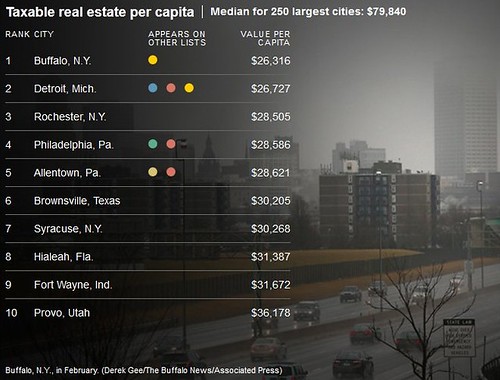
Ten lowest per capita taxable real estate, out of 250 largest US cities
Not quite 17% of Providence's budget came from state aid in 2007, and last year it was about half of that figure.  This is one of the highest percentage drops experienced amongst the nation's 250 largest cities, and has been devastating to the city's budget.

In response the city has cut expenses, raised residential and commercial property taxes, especially commercial property taxes, imposed a personal property tax on motor vehicles, and has been much more aggressive in pushing the city's nonprofits--which hold 39% of the city's land--to provide "Payments in Lieu of Taxes."  The nonprofits have been resistant, but are coughing up some money.

What is the best way forward to "solve" the financial problem of hard pressed cities and towns?

Obviously, financing local government is a problem for most cities as the result of a quintuple whammy of outmigration of residents and businesses; deindustrialization; the recession, which battered tax revenues; and poor financial decisionmaking in the past (such as unfunded pension liabilities or a variety of bond-funded initiatives that were poorly executed, such as in Harrisburg, PA or in Jefferson County, AL).

Losing state and/or federal funds pushes local governments, but particularly cities, to the brink.  How local governments are funded needs to change.

Changing the framework

In "Detroit and the New York Times" I wrote that there are four primary approaches that react to  material changes in financial and economic conditions faced by local governments, by reorganizing the structure and scale of local government and how it is financed.  But really there are three approaches:

  • one has to do with the scale of government, adding to the volume of taxable properties as a taxation method by combining jurisdictions;
  • the second has to do with the organization of government, and merging services across jurisdictions, while not necessarily merging over-arching governmental bodies;
  • the third has to do with taxation and what is allowed to be taxed.
In the March piece, I outlined these four categories:

- merging of the center city and the county (e.g., Indianapolis, Nashville, Lexington, Louisville, New York City in 1898, Toronto, Montreal, etc.)
- not merging the center city and county but having strong metropolitan scale planning and governance institutions, especially for transit (Minneapolis; Portland, Oregon)
- tax revenue sharing across a metropolitan area (Minneapolis)
- special tax-service districts that operate across a city-county-region (Regional Asset District, Allegheny County, PA; Huron-Clinton Metropolitan Parks Authority, Southeastern Michigan). 

These three writer-academics are probably the biggest proponents of the harmonization of taxing, funding, and certain elements of planning and governance on the metropolitan scale:

-- Gerald Frug, Harvard University
-- Myron Orfield, Institute for Metropolitan Opportunity, University of Minnesota Law School
-- David Rusk, Inside Game/Outside Game: Winning Strategies for Urban America

Government mergers at a smaller scale

Another element that I didn't include in the March list is a fifth, various mergers of government-provided services across jurisdictions, at a level smaller than center city and county, such as library systems, small police departments getting absorbed by county police departments, mergers of smaller special services districts into larger, more consolidated districts, etc.  Most recently this has been pushed by Gov. Christie in New Jersey ("NJ voters support merging school districts, local governments," from the Newark Star-Ledger and "Princeton Merger Vote Tests Christie's Attempt to Shrink Towns" from Bloomberg ) and is happening in the Midwest especially between hard pressed local governments for the last 10 years or so, but it isn't a phenomenon limited to the Midwest (e.g., "Santa Ana disbands Fire Department in bid to rescue budget" from the Los Angeles Times, or this blog entry "Cook County and City of Chicago partner on certain operations: Save $20 million").

De-annexation

A variant of merger is annexation, which is a long time phenomenon.  Usually annexation of unincorporated township or county land by an adjoining city occurs in order to increase tax base, provide access to "city water" and other services, etc.  But now some communities are doing de-annexation, giving up land to another jurisdiction, to cut costs.  See the blog entry "Annexation as a strategy for saving counties money: Cook County, Illinois."

Tax base sharing

According to a paper by the New York State Commission on Local Government Efficiency and Competitiveness:
In a tax-base sharing approach, each municipality shares in the increase in property value that occurs in a specific area after a certain date. Tax-base sharing is intended to:

• Reduce competition among communities for commercial and industrial properties to add to their tax bases.
• Create a fairer distribution of tax benefits from properties that impact on and are supported by surrounding communities.
• Reduce disparities in tax bases.
• Promote orderly urban development, regional planning, and smart growth by reducing the impact of fiscal considerations on the location of business and residential growth; of highways, transit facilities, and airports.
But sharing tax revenues across jurisdictions occurs only in two places in the United States, Greater Minneapolis and the Meadowlands area of New Jersey.  And in metropolitan regions that cross state boundaries such as Philadelphia, Washington, DC, Chicago, Wilmington, and New York City, it would be impossible.

So while I am intellectually attracted to this approach, and in our area we see the necessity of it in Virginia especially as cities and counties are legally separate, and therefore there isn't the opportunity to share sales taxes across jurisdictions, something that can happen with a more typical county organization of the taxation process at the sub-state level, the likelihood of pulling this off in most places is nil.

Other approaches are needed.

(Note that the federal government did do revenue sharing from 1972-1986.   See the 1980 GAO report, Changes in Revenue Sharing Formula Would Eliminate Payment Inequities; Improve Targeting Among Local Governments and "END OF FEDERAL REVENUE SHARING CREATING FINANCIAL CRISES IN MANY CITIES," New York Times.)

Local income taxes

Most cities are reliant on property and sales taxes for the bulk of their revenues.  The vagaries of these sources--lack of stability and their declining nature, except in the most economically robust communities--ought to push states to reconsider how local government funding occurs.

Some cities, usually the largest in the country, like New York City, have imposed income taxes for a long time.  The primary purpose is to tax income earned in the city by nonresidents.  But most cities do not have income taxes or are not able to levy such taxes based on state law.

In March I wrote about this, "Economic restructuring of cities: Detroit etc. (with a comment on local income taxes)," suggesting that states should include a local income tax as part of the state income tax filing process.

Local income taxes are controversial, and business organizations usually are against such taxes, and jurisdictions that don't impose such taxes recruit and market against the cities that do.  If "everybody does it" a level playing field is created.

In that blog entry, I mention how Maryland has a local income tax, but it is collected by the State as part of the annual income tax filing process.  The rate does vary by jurisdiction.  It doesn't insulate local jurisdictions from having to be careful stewards of the public monies, but it does help to stabilize funding of local government.

The Maryland method works pretty well as a model.

(Back when Chrysler Corporation was based in the City of Highland Park, Michigan, a local income tax assessed mostly on professional workers at Chrysler generated the bulk of the city's revenue, along with commercial property taxes on the Corporation's property.  When Chrysler moved to the suburbs--Highland Park is a community surrounded by the City of Detroit--Highland Park became destitute.  See the past blog entry "Urban decay and sprawl: one community's gain at the expense of another's.")

Service payments instead of property taxes from nonprofits

While I think it's reasonable to give nonprofits a tax exemption, I think it's also reasonable for nonprofits to pay for the services portion of what property taxes normally cover.  For example, for emergency services, schools (in Ann Arbor, Michigan, University of Michigan student families may send their children to the local schools, but the school district gets no money from the University to defray the cost), infrastructure provision, etc.

That's the point of PILOTs, to collect some tax equivalent money from nonprofits to help cover the cost of government/provision of public services.  This is especially important to cities, where as much as 50% of the land in some places may be tax exempt.

When I was a child, I seem to recall that the federal government recognized this impact on local jurisdictions and did provide some monies to jurisdictions based on the presence of federal installations in their communities.  This was separate from the federal revenue sharing program.

-- Payments in Lieu of Taxes: Balancing Municipal and Nonprofit Interests, Lincoln Land Institute
-- Taxes, Fees, and PILOTs, National Council of Nonprofits
-- PILOTS Taking Off, University Business Magazine

Separately, Providence proposed that nonprofit entities with more than $20 million in property should have to pay the equivalent of 1/4 of the property tax that would be assessed on commercial property.  This was at the height of the current recession. See "City wants new tax on colleges, hospitals" from Providence Business News.

Taxing unrelated business income/possessory interests

Although there is another issue for which I don't know the details, such as whether or not nonprofit property that is used for unrelated revenue generating purposes is also taxed.  For federal tax purposes this is covered by a tax on unrelated business income.

This is an issue in DC for example, because George Washington University owns a great deal of property that is commercial used for functions not related to the university.  Typically, a food operation that mostly serves students and faculty would be exempt from tax.  But what about a building leased to an unrelated organization like the World Bank or the local utility company?

In DC in terms of federally owned property used for profitmaking purposes, such as Union Station, the city assesses property tax payment equivalents. This type of property tax is called a "possessory interest tax."

Union Station challenged this for awhile, but has since capitulated (see "D.C., Union Station Redevelopment Corp. settle tax dispute," from the Washington Business Journal).

Note also that when government agencies lease space in privately owned buildings, the property owner ends up paying property and income taxes as a result, whereas this wouldn't happen if the agency were located in an agency-owned building.

Fees assessed on students enrolled in local universities and colleges

Another way to raise money from nonprofit institutions of higher education is to somehow impose a fee on each student that is paid to the locality.

Pittsburgh proposed a tax on student tuition ("Pittsburgh Pushes Tax on College Students," Wall Street Journal, "Pittsburgh's mayor drops tuition tax," Pittsburgh Post-Gazette) and Providence proposed a fee per student ("Mayor Proposes a College Attendance Head Tax In Rhode Island," Tax Foundation; "Student Fee Would Break Bond of Trust," an op-ed by the President of Providence College).

The Providence proposal was criticized in part because it was aimed at private institutions only, although this was a convenience, because local governments can't impose taxes on higher governmental authorities (state or federal) without their consent.

Neither proposal was approved, but in both instances pressure was created on the colleges to make PILOT payments.

Conclusion

I would recommend three policy changes at the state level and one at the federal level, to assist local governments in attaining funding stability and economic sustainability through taxation practices.  (Mergers are a different issue and should be pursued as well.)

First would be for states to set up a local income tax percentage as part of the state income tax collection system such as how Maryland does it.  (I don't know what to recommend for those states, like Alaska or Washington or Florida without a state income tax.)

Second would be to set a state policy that structures the imposition of PILOTs, rather than expecting each locality to figure it out on its own. That way cities don't have to try to do student capitation taxes either.

Third would be to clarify taxation policies on property owned by nonprofits but generating income unrelated to their primary function.  Procedures should be put into place at the state level enabling localities to assess "possessory interest" and/or "unrelated business" taxes.  And the legality of this practice with regard to federal property should also be clarified by the federal government as well.

Fourth would be a PILOT equivalent for federal lands and installations.  I remember there being such a program in the 1960s, but I could be wrong.  It bears further research.  I might just be thinking of the federal formula for revenue sharing.

Such payments could help to reduce rural resistance to federal land ownership, a problem that is particularly pronounced out west, where a great deal of property is federally owned, especially in Utah.  See this op-ed, "Black Diamond CEO: Shutdown exposed folly of Utah's federal-land grabbers," from the Salt Lake Tribune.

And in those situations where the federal land portfolio doesn't really need a particular property (see the book Who Is Minding the Federal Estate?: Political Management of America's Public Lands, "GSA completes sale of West Heating Plant for $19.5 million" and "GSA to auction off Bethesda building" from the Washington Business Journal) maybe having to make such payments would include faster right-sizing of the federal land portfolio as another benefit.

Labels: , , , , , ,

Thursday, May 30, 2013

Could the debacle of Mayor Rob Ford in Toronto lead to Toronto's de-amalgamation?

The planner in me likes "efficiency" so I am attracted to the idea of city-county amalgamation for a variety of reasons like cheaper services, better harmonization of tax revenues so that as people and business leave "the city" the city isn't crushed by the loss of revenue, etc.

But the downside of such amalgamations is that cities tend to be more "progressive" politically than suburbs, even if by comparison to exurban and rural areas, suburban residents are still more "liberal" than they are conservative.  For example, in Virginia, Richmond, the Hampton Roads area (which is dominated by military bases), and Northern Virginia all vote pretty Democratic, which is why the State has Democratic senators and voted for President Obama.  But it's all relative.  They are less progressive than DC residents, say.

2010 Election Results, Toronto Mayoral raceImage of the 2010 election results in Toronto from Torontoist.

So this means that in amalgamated city-counties, suburban more conservative voters demographically overwhelm city voters, and the likely result is a more conservative mayor from the suburban regions.  This happens in Toronto and it happens in London in the UK.

The core of the city votes progressive, the outskirts conservative, and the conservatives win because more people live in the outer city.  See the past blog entry, "City-county/County-city" for more discussion on thsi.

This article, "How Rob Ford's Meltdown Could Save Toronto: Mayor's latest outrageous behavior may be catalyst city needs to open de-amalgamation debate," from The Tyee, posits that the reason that Ontario's Premier forced the amalgamation of Toronto in the late 1990s was deliberate, designed to ensure that the suburban voters would dominate the inner city, and elect conservative mayors.

But because the current mayor, Rob Ford, is such a wacko, the author posits that maybe, just maybe, Toronto could get de-amalgamated.  This would cut costs and help the transit system, which is being forced to serve less dense suburban areas, which is much more costly than serving Toronto's dense core.

So much for my theoretical desires for efficiency.

Labels: , , , , , , ,

Tuesday, May 01, 2012

Annexation as a strategy for saving counties money: Cook County, Illinois

I write a bunch about how economic circumstances are encouraging communities to consolidate services, such as fire and emergency services, policing, library services, etc.  You see a lot of this in Michigan and New Jersey, and California.

Traditionally, counties control land and provide services to areas that are "unincorporated" or not otherwise part of "incorporated" cities and towns within the county.

Cook County is pushing the idea that the 62 square miles of the 945 square mile county that are unincorporated be annexed (consolidated) into the abutting city or town, and thereby shifting the cost of providing services to that land off the county and onto the city or town.  See "Residents torn over Preckwinkle's push to end Cook County's unincorporated areas: Some fear taxes, regulations will rise after annexation; others hope for better policing and services" from the Chicago Tribune.

Separately, for years Pittsburgh and Allegheny County have kicked around the idea of merging, spurred in part by a Brookings Institution study back in 2004 ("Pittsburgh: The Road to Reform).

I used to be pretty favorable towards this idea, because it broadens the tax base available to cities.  I happened to be in Louisville in 2004, around when consolidation with Jefferson County was occurring, and the planning function of Nashville-Davidson County in Tennessee is amazing.  And the City of Memphis just did an amazing push back onto Shelby County, not of the city functions, but of the school district.  They voted to disband the school district, forcing a merger with the separate county school district.

A middle road is that originated by Tom Murphy, later Mayor of Pittsburgh, but then a state legislator.  He created the legislation that enabled the creation of the "Regional Asset District," that regionalized the financing of some assets, particularly cultural assets like zoos and museums, that historically had been created and funded and managed by the City of Pittsburgh but used by the entire region.

In other jurisdictions there are similar efforts to fund hospital services.

But now I am more sanguine about it, even though at the time that I produced commercial district revitalization framework plans for Brunswick Georgia (part of Glynn County) and Cambridge Maryland (part of Dorchester County) I thought that the city and county should merge (in Brunswick they did merge the sanitation service around the time I was there).

Given voting results in Toronto and London, where conservative "suburban" voters outvoted the inner-city "progressive" voters in the most recent mayoral elections, I worry about these mergers being a force for conservatism in terms of pro-city policies, where instead the urban agenda becomes subordinate to the suburban majority, e.g., in Toronto Mayor Ford is primarily concerned with aiding commuters in getting quickly to and from their jobs in the city core, not improving the quality of life and competitive advantage of "the city."

Labels: , , , , ,