Rebuilding Place in the Urban Space

"A community’s physical form, rather than its land uses, is its most intrinsic and enduring characteristic." [Katz, EPA] This blog focuses on place and placemaking and all that makes it work--historic preservation, urban design, transportation, asset-based community development, arts & cultural development, commercial district revitalization, tourism & destination development, and quality of life advocacy--along with doses of civic engagement and good governance watchdogging.

Thursday, July 23, 2026

Boston to get pretty big PILOT payments from Boston University

 Big cities have lots of civic institutions, including universities and hospitals.  Tax exempt, they don't pay property taxes, and since property taxes are the primary way cities earn revenue, that makes it harder to fund operations.

In Canada, nonprofits mostly still have to pay property tax, unless they get an exemption, which is pretty hard.  The municipality has to believe it gets big benefits in return.

Over the years, many cities including Providence Rhode Island, Pittsburgh, New Haven Hartford--50% of the city's property is tax exempt, Philadelphia and Boston have tried to get decent sized "payments in lieu of taxes" from major nonprofits and they've been unsuccessful.  (In Connecticut, the state reimburses jurisdictions for a percentage of lost property tax issues due to tax exemptions.  Decades ago under Nixon, the federal government had a similar program for cities and federal undertakings.)

In Philadelphia, rather than submit to any kind of tax, the University of Pennsylvania, its hospital system, Drexel University and Amtrak's 30th Street Station joined together to fund the University City District business improvement district through annual contributions.

So the fact that Boston has managed to get a 5 year agreement, and about $20 million per year from Boston University is a big deal ("BU to pay city of Boston more than $104 million over five years in record deal," Boston Globe).  It's a mix of money and in-kind services, but the cash part is still pretty hefty.

Now for Harvard, MIT, the big hospitals, other universities....

Labels: , , , , ,

Thursday, February 26, 2026

Proposed ballot measure in San Diego would tax second "empty" homes

 "Proposed ballot measure that would heavily tax thousands of second homes in San Diego clears critical hurdle," San Diego Union Tribune.

A proposed ballot measure that would impose a hefty tax of as much as $15,000 a year on thousands of empty second homes in San Diego cleared a major hurdle Wednesday when elected leaders agreed to advance it to the full City Council next week.

The proposal, which initially calls for an annual $8,000 tax on more than 5,000 largely unoccupied homes — plus a $4,000 surcharge for corporate-owned dwellings — is being pushed by Councilmember Sean Elo-Rivera, who just a month ago failed to win support from his colleagues for a far broader measure that would have also taxed whole-home short-term rentals.

An empty second home is defined as one that is left unoccupied for more than 182 days out of the year and is not an owner’s primary residence. Elo-Rivera argues that by keeping such homes off the rental or for-sale market, owners are depriving San Diegans of much needed housing.

A lengthy analysis prepared by the Office of the Independent Budget Analysis offered a more conservative estimate of anywhere from 1,790 to 2,812 empty homes that would be affected by the proposal. However, that estimate takes into consideration properties that would fall under a number of exemptions proposed by Elo-Rivera, as well as those instances where owners opt to sell their properties or convert them to short- and long-term rentals.

The Independent Budget Analyst’s office also concluded that the measure, if passed by voters, could generate from $12.1 million to $23.8 million in new revenue to the city during the first year of implementation. That could increase to $15.3 million to $30 million in the second year, which is still considerably less than the $51 million calculated by Elo-Rivera’s office.

Ideally, laws like this are less about revenue generation, and more about pushing properties back into the home ownership market.

Labels: , ,

Saturday, March 30, 2024

Wizards and Capitals teams staying in DC after all and the failure of the mansion tax referendum in Chicago have one thing in common: failure to take the time to build consensus

 Change is hard.  My experience in the civic arena is that it takes "a couple rounds" of putting the idea out there before there is consensus to go forward.

I wrote a bunch about failures of transit referenda in Tampa Bay and the State of Georgia in the 2010s.  Georgia introduced a new way to create transportation districts, then expected people to vote up or down in less than a year ("Failure of the transit-roads sales tax measure in Metro Atlanta," 2012).  

In Tampa, the two counties can't figure out how to work together on transit, nor can they build support within their counties (Voters reject Greenlight Pinellas," Tampa Bay Times, "My Ride/My Road: Polk County Voters Reject 1-Cent Sales Tax Increase," Lakeland Ledger, 2014).

There are plenty of other examples.

My point was that to do breakthrough initiatives, you have to build the support for it, people are conservative, and that takes time.  The other way I put it is that the more time you spend on the front end, with civic engagement and a slew of meetings and other activities, the faster it goes on the back end.  Finally, I hate losing. So I'd rather set myself up for success by taking the necessary time to build support.

1.  Sports Arena in Alexandria.  Virginia has a Republican Governor and a Democratic State Legislature.  Announced in December ("Lawmakers vote in favor of plan to bring Capitals, Wizards to Virginia," Washington Post), he wanted to move the Capitals hockey team and Wizards basketball team to an arena in Alexandria, claiming billions of dollars of benefits and many thousands of jobs("$730 rooms, $75 parking: Youngkin’s own report calls arena forecasts rosy").

Note while Downtown DC benefits from CapitolOne Arena, it's not like it drives the economy.

To stoke development in that area, a process that has been going on for about 20 years--giving the rights to develop to the team owner, which is the trend in stadium and arena development.  Team owners say they need the extra money to spend on the team, especially with the decline in broadcast revenues and minimal revenues from streaming.

-- "Capital One Arena, Wizards and Capitals may move to Alexandria | Why not the RFK campus?," 2024
-- "Framework of characteristics that support successful community development in association with the development of professional sports facilities," 2021

The deal called for at least $1.35 billion in tax incentives ("Caps, Wizards complex in Virginia could get largest arena subsidy ever").  

It was a shocking move.  And not all the state, especially State Senator Caroline Lucas, was on board ("Leonsis finally met arena nemesis Lucas, but maybe too late to save it").

Other issues also brought more opposition ("Plan to move Capitals, Wizards to Virginia draws transportation worries," "Plan for new Caps, Wizards arena in Va. stirs up its would-be neighbors") including a casino proposal ("JBG Smith blames Tysons casino conspiracy for derailing Potomac Yard deal," Alexandria Now).

Governor Youngkin just sprung this on everybody.  And "everybody" needed more than 3 1/2 months to get on board.  Let alone vote on it.

An article about the aftermath in the Post , "Va. Gov. Youngkin arrived like a GOP star, but arena failure clouds legacy," made the point about Youngkin, on most new initiatives he proposes, doesn't attempt to build support for them in advance, therefore fails.  (Also see "After Va. arena plan collapses, politicians and dealmakers trade blame" and " Proclamation: Governor Glenn Youngkin Statement On Monumental Sports & Entertainment Project.")

But Holsworth, the political analyst, said he saw a significant difference in the way Youngkin approaches big initiatives compared with previous governors. When Republican George Allen wanted to impose new education standards in the 1990s and had a Democratic legislature, he said, the governor appointed prominent Virginia educators to key administration roles and mounted a campaign around the state to build support from lawmakers and local officials — all before any votes were taken. 

Similarly, in the 2000s, Democrat Mark R. Warner logged miles around the state and made endless PowerPoint presentations to persuade business groups and a GOP legislature that Virginia had to raise taxes to preserve its high bond rating. 

Youngkin made no such broad effort to pave the way for the arena ... “It’s just not a very keen understanding of the political dynamics of Virginia,” Holsworth said.

So it failed and the teams are staying in DC ("Caps, Wizards will stay in D.C. under deal announced by Bowser, Leonsis," Washington Post) getting $500+ million from the city to do so, and getting the rights to redevelop the adjacent Gallery Place development to add some revenue streams ("MRP Realty to buy Gallery Place, make room for Monumental Sports & Entertainment," Washington Business Journal).

Under the terms of the deal signed Wednesday, pending expected D.C. Council approval next week, the District will send $515 million over three years to finance Capital One Arena’s modernization. In addition, the agreement provides for 200,000 square feet “of newly programmed space throughout Capital One Arena and in the Gallery Place building next door.” The terms also call for a new downtown practice facility for the Wizards, with “options including top floors of Gallery Place,” per Monumental’s release.

Campaign flyers for the Bring Chicago Home referendum at a march to the polls event March 9, 2024, in Chicago. (Vincent Alban/Chicago Tribune)

2.  Real estate transfer tax in Chicago.  In Chicago, new mayor Brandon Johnson proposed a higher transfer tax rate on properties selling for more than $1 million, to pay for affordable housing.  

Called "Bring Chicago Home," he proposed it in September ("Chicago mayor introduces real estate transfer tax plan to combat homelessness," Axios) for a vote this March.   That's 6 months!

It was estimated the tax could raise $100 million per year.

Naturally, the business community especially the real estate development community was against and could spend a lot of money fighting it.  Plus a lot of citizens were indifferent.

A number of cities, including DC, have such a tax, so it's not novel (Local Mansion Taxes: Building Stronger Communities with Progressive Taxes on High-Value Real Estate, report, Institute for Taxes and Economic Policy), the issue is getting it passed.

  • As of early 2024, 17 cities and counties have progressive taxes on high-price real estate sales, also known as “mansion taxes.” Several others are currently considering adopting these policies.
  • Together these taxes raise nearly $3 billion in annual revenue, equipping communities with resources to make progress on critical priorities of local and national concern including housing, education, and infrastructure. 
  • Local mansion taxes have been around since 1982, but the momentum for them has built in recent years. 
  • Nearly all of today’s mansion taxes were enacted or expanded between 2018 and 2023. 
  • Local mansion taxes play an important role in rebalancing upside-down tax codes, advancing racial and economic equity, and raising new revenue to build more resilient and inclusive communities. 
  • Mansion taxes have proven popular with voters: When put on the ballot, measures to enact or expand mansion taxes have succeeded 86 percent of the time.

Which they didn't.  It was also challenged in court by real estate interests, who didn't even want the votes to be counted ("Real estate group appeals Bring Chicago Home to state Supreme Court," Chicago Tribune).  The court said no, count the votes.  

But it didn't pass anyway, losing roughly 54% to 46%, a 21,000 vote difference in a low turnout election ("Chicago Voters Reject Mansion Tax in Blow to Mayor Johnson," Bloomberg).

Some electeds are chastened ("City Council’s Progressive Caucus responds to ‘Bring Chicago Home’ defeat with ‘we heard you’ humility," Chicago Sun Times). Not the mayor ("Johnson, defiant after 'Bring Chicago Home' loss, vows agenda push will 'get stronger'," Crain's Chicago Business).

But they shouldn't be so chastened, just recognize that they mishandled the initiative, by trying too soon for a vote without building the consensus for the need.  From the Axios article, "Why the Bring Chicago Home ballot measure failed"

  1. People not affected by homelessness don't understand it
  2. Voters fear rising residential taxes if the measure further hurts commercial real estate
  3. People worry that the tax could stifle future development
  4. Citizens have little faith in city leaders
  5. Voters were confused by the measure's changing legal status and swayed by opponents' commercials
  6. The measure lacked spending specifics
Conclusion.  My point is pretty clear.  Losing sucks.  So take the time necessary to build the consensus and coalition so you can win.  I don't understand why elected officials can't figure this out.

Especially in Chicago when you know from the outset that monied interests, in this case the commercial real estate industry, will fight you hard.  Or in Virginia, where the governor was asking to subsidize a billionaire with $1.35 billion, based on dubious claims about the economic value of doing so.

When I used to work in restaurants, there was a woman who was really fast but made mistakes and I would say "speed kills."

In this case, "Speed kills good ideas."

Labels: , , , , , , ,

Monday, March 04, 2024

Tax incentive programs underfund schools

One of the biggest sources of funds for urban revitalization is tax increment financing.  Governments impute a likely increase in property value and tax revenue from a new development, but direct that increase to the developer as a source of finance, inducement, etc.

But that is all the taxes--city, county, schools, special districts, etc.

The argument can be made that the tax abatement shouldn't be total, that it should be more measured, especially when it comes to funding local schools ("Students lose out as cities and states give billions in property tax breaks to businesses — draining school budgets and especially hurting the poorest students," The Conversation).  From the article:

At James Elementary in Kansas City, Mo., principal Marjorie Mayes escorts a visitor to a classroom with exposed brick walls and pipes. Bubbling paint mars some walls, evidence of leaks spreading inside the aging building. 

The district would like to tackle the $400 million in deferred maintenance needed for its 35 schools, but it doesn’t have the money. The lack of funds is a result of tax breaks Kansas City lavishes on companies that do business there. The program is supposed to bring new jobs but instead has starved schools. Between 2017 and 2023, those schools lost $237.3 million through tax abatements, according to the Kansas City Public Schools. 

That city is hardly an anomaly. An estimated 95% of cities provide incentives to woo corporations. A 2021 review of 2,498 financial statements from schools across 27 states revealed that in 2019 at least $2.4 billion was redirected for tax incentives, according to the academic research that appeared in Community Development. 

Yet that downplays the magnitude: Three-quarters of the 10,370 districts did not provide any information on tax abatement agreements. Abatements have long been controversial, pitting communities against one another in beggar-thy-neighbor contests. Yet their value is unclear: Studies show most companies would have made the same location decision without subsidies. 

... In Kansas City, for example, nearly $1,700 per student was redirected in 2022 from poorer public schools, while between $500 and $900 was taken from wealthier schools. Other studies found similar demographic trends elsewhere, including New York state, South Carolina, Texas, and Columbus, Ohio. The funding gaps often force schools to delay needed maintenance, increase class sizes, lay off teachers, or close. 

All told, tax abatements can harm a community’s value, with funding shortfalls creating a cycle of decline. Researchers agree that a lack of adequate funding undermines educational outcomes, especially for poor children.

Aerial view from the west of a stadium-anchored redevelopment master plan proposed by the Chicago Bears. (Courtesy Hart Howerton/Chicago Bears)

In Chicago, the Bears football team wants to move to the suburbs, to the site of an old race track.  But there is contention with the local governments and school districts about how much the property is worth, and how much tax incentive would be provided ("Bears, suburban school districts $100M apart in valuations of Arlington Heights site," "The Chicago Bears' Battle Over Arlington Heights Property Taxes, Explained," NBC Chicago).  The team says the property is worth much less than the local government. 

-- Arlington Park project, Chicago Bears
-- "Chicago Bears reveal tentative plans for mixed-use development in Arlington Heights anchored by domed stadium," Architect's Newspaper
-- "The new Chicago Bears Arlington Heights stadium will benefit Chicagoland," Evanstonian

From the Chicago Tribune, "Bears stadium development could hinge on TIF money":

For decades, TIFs have been used in Chicago and across the suburbs to help develop real estate. They have been criticized by some as a “slush fund” for municipalities to use as they wish, while diverting money from schools and other taxing bodies. 

 And they have been praised by officials of towns large and small as economic engines that bring jobs, development and an improved tax base. TIFs work by using any increase or “increment” in property tax revenues in the TIF district for the municipality to redevelop that site, typically by building infrastructure such as roads and utilities. 

Other taxing bodies, such as schools, parks and libraries, typically get only the same amount of property taxes as when the TIF took effect, with no increased revenue during the 23-year duration of the TIF. 

The Bears’ say they will pay to build a new stadium, but would only proceed with their planned $5 billion mixed-use development if they get tax “certainty” and public funding for infrastructure such as roads, utilities and stormwater management. Apartments, condominiums and other development planned for the site would be built by private developers — and could mean the added expense of more students for local schools.

I argue that TIFs should be more targeted, and school tax revenue streams not be included.

Labels: , , ,

Wednesday, February 15, 2023

Brookfield Properties defaults on two properties in Los Angeles

Brookfield Properties is one of the largest US commercial property owners, with large holdings in major cities including NYC and Washington.  

With the impact of covid on working in central business districts--most cities have at best 50% of employees back in the office--the value of commercial property is taking a big hit.  Most companies are reducing their office footprint in favor of work from home, and this is devaluing property.

Cities haven't really started reducing property tax assessment values in response ("Real Estate Values in the Time of COVID," NBER).

Another way to see the impact is whether or not there is an increase in loan defaults, because the revenue from leasing isn't enough to cover the loan, especially as mortgage rates rise.  

That's why this loan default is big news ("One of the biggest landlords in Los Angeles just defaulted on $755 million in loans for two sky scrapers as remote work keeps offices vacant," Fortune).  From the article:

The two properties in default, part of a portfolio called Brookfield DTLA Fund Office Trust Investor, are the Gas Company Tower, with $465 million in loans, and the 777 Tower, with about $290 million in debt, according to a filing. The fund manager had warned in November that it may face foreclosure on properties. 

The company had the option to extend the maturity on the loans tied to the Gas Company Tower, but elected not to, according to its latest filing. It also elected not to get interest-rate protection that was required for loans for the 777 Tower property, which amounts to an event of default, the filing said. 

“We believe DTLA’s decision to default on these two assets increases the risk for the remaining loans in their portfolio,” Barclays Plc research analysts Lea Overby and Anuj Jain wrote in a note Tuesday.  Brookfield declined to comment. 

The values of comparable office buildings have broadly dropped, according to the Barclays analysts. Office vacancies have increased across the country since the pandemic made working remotely more routine. The vacancy rate in the Los Angeles central business district vacancy rate was 22.7% in the fourth quarter of 2022, according to a Jones Lang LaSalle Inc. report.

Labels: , , , , ,

Monday, October 24, 2022

Two words: vacancy tax | NYC: More than 60,000 Rent-Stabilized Apartments Are Now Vacant

The City news website in NYC reports that "More than 60,000 Rent-Stabilized Apartments Are Now Vacant — and Tenant Advocates Say Landlords Are Holding Them for ‘Ransom’."  From the article:

During a worsening housing affordability crisis, New York City landlords are keeping tens of thousands of rent-stabilized units off the market — a phenomenon tenant activists call “warehousing.” 

An internal state housing agency memo obtained by THE CITY shows that the number of rent-stabilized homes reported vacant on annual apartment registrations rose to over 61,000 in 2021 — nearly doubling from less than 34,000 in just a year as the city emerged from COVID lockdown.  ...

The Coalition to End Apartment Warehousing, a collective of tenants and 15 community organizations, has been calling attention to the trend, claiming that landlords are fabricating housing scarcity to manipulate legislative changes in Albany. “Creating fake scarcity to raise prices is not a fair way to run the housing market, and it deprives New Yorkers of needed housing,” coalition members wrote in a recent op-ed.  ...

The Housing Stability and Tenant Protection Act of 2019 (HSTPA) repealed both vacancy bonuses and vacancy decontrol. It also sharply limited how much landlords could pass along the costs of renovations to tenants through rent increases, practices that housing advocates and lawmakers criticized for spiking rents and fueling displacement. 

Prior to 2019, landlords could make a lot of money by emptying out rent-stabilized apartments. HSTPA essentially revoked any financial incentive to do so. ...

But landlords are still legally permitted to keep their rent-stabilized apartments empty indefinitely.

It still has loopholes ("D.C.’s problems with vacant, blighted properties haven’t gone away, residents and officials say," Washington Post), but DC's vacant residential property tax is 5x the regular rate.  It does move properties back into the market. 

And they aren't a universal solution ("Cities Now Use Taxes to Fight Blight. Is It Working?," Governing).  They work better in strong markets, where the demand to develop and the demand to rent are both high.  

In weak markets, vacancy taxes encourage demolition, because of low demand, and demolition generally isn't the best way to move revitalization forward ("Demolition isn't always a solution").

=======

-- "Rents are rising everywhere: with continued supply-demand mismatch, shouldn't renter protections be universal?," 2022

Labels: , , , , , ,

Tuesday, March 15, 2022

Project Rehab, University City District, Philadelphia: Best Practice Neighborhood Stabilization Program

In 2020/2021, I wrote a five part series on creating a model framework for systematic neighborhood stabilization, suggesting the creation of a national program comparable to the Main Street commercial district revitalization program, but for neighborhoods/residential property, modeled after a program created in Pennsylvania, called Elm Street.

-- "The need for a "national" neighborhood stabilization program comparable to the Main Street program for commercial districts: Part I (Overall)"
-- "To be successful, local neighborhood stabilization programs need a packaged set of robust remedies: Part 2"
-- "Creating 'community safety partnership neighborhood management programs as a management and mitigation strategy for public nuisance programs: Part 3 (like homeless shelters)"
-- "A case in Gloucester, Massachusetts as an illustration of the need for systematic neighborhood monitoring and stabilization initiatives: Part 4 (the Curcuru Family)"
-- "Local neighborhood stabilization programs: Part 5 | Adding energy conservation programs, with the PUSH Buffalo Green Development Zone as a model," 2021 

The major point is the framework and ability to implement, but that programs need complementary remedies to be able to act, and organized initiative so that they are able to implement and effect change.

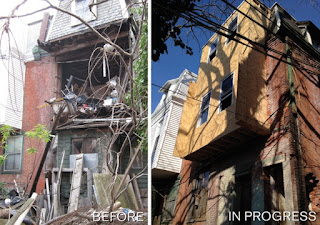
Photo from the first Project Rehab project, in 2012.

The Philadelphia Inquirer has an article, "A ‘Mr. Fixit’ helps West Philly residents and businesses cut through red tape," about the Project Rehab initiative of the University City District business improvement district.  It focuses on addressing problem properties--distressed, vacant, etc.--as a way to "cure nuisances" by assisting the property owner, rather than seizing or demolishing buildings.

It's not a huge program, they've addressed about 5 properties per year since the program's creation in 2011.  That demonstrates not failure, but how time consuming the process can be.

From the website:

While Project Rehab responds to the unique needs of each property owner, the core steps of every project are the same. 

 1. Property Monitoring and Identification UCD uses a variety of methods to monitor problem properties in the district. Staff conduct physical surveys to identify distressed real estate, and seek input from community and civic associations as well as concerned community members. Staff also work closely with the City, making use of information and investigations gathered by the Department of Licenses and Inspections. 

2. Owner Identification Project Rehab then uses a variety of resources to clarify property ownership, which can be challenging to unravel. Staff conducts online research and interviews community organizations, neighbors, and owners’ family members. Project Rehab also partners with government offices such as the Philadelphia Revenue Department, the Records and Deeds Office, the Register of Wills, and Licenses and Inspections to obtain information on owners and their properties. 

3. Defining the Course of Action Once we establish contact with an owner, Project Rehab and the owner develop a course of action for the property, which often entails renovation for eventual personal use, sale, or rental/leasing. Whatever the desired outcome, UCD provides a range of free supports and services to help the owner achieve their goals: 

Financing: Working in partnership with local banking institutions, UCD drafts and develops financing packages for owners who want to finance the rehabilitation of the property. 

Rehabilitation: UCD has developed a list of licensed contractors who are experienced with the rehabilitation of distressed properties. Staff provide support and knowledge to owners throughout the process, helping to obtain all required permits, licenses and inspections. '

Sale: UCD has built a network of realtors who support those owners who decide to sell their property. Zoning: UCD connects owners with local attorneys and community organizations to work through the zoning process. 

Conservatorship: Project Rehab works with 501-4C not-for-profits to utilize Pennsylvania legislation known as the Act 135 Conservatorship Act to redevelop distressed properties with no known owners. 

Along the way, the Project Rehab team is able to deploy outside the box strategies to help each owner achieve their rehabilitation goals, regardless of the issue surrounding the real estate. From helping a family open an estate to untangling title issues to ensuring that owners are well represented while seeking equity development partners, Project Rehab is a guide and support for property owners.

======

The UCD is an association so to speak, not a typical business improvement district where property owners in the district are taxed a small amount on the assessed value of the property. Instead property owners in the district pay voluntary amounts.

-- "In University City, a model for a [neighborhood improvement district]," Philadelphia Daily News, 2012

It was pointed out to me that this wasn't altruistic, but a strategy by the nonprofit property owners--University of Philadelphia, Drexel University, Amtrak, etc.--to ward off the idea of taxing nonprofit property owners as a way to generate tax revenues for cities.  Some institutions pay what are called PILOTs, or payments in lieu of taxes.  

--"Proposal to eliminate nonprofit property tax exclusion in Maine," 2015

But some cities, which have significant swathes of property off the tax rolls because of the concentration of nonprofit institutions within their borders, look to tax nonprofits too.  (Note that Ontario doesn't have the kind of tax exemption system we do in the US.  Even the provincial government and nonprofits pay property taxes.)

Separately, Pittsburgh is looking for PILOTs as a way to fund infrastructure improvements ("Pittsburgh City Council proposal would turn to nonprofits for infrastructure funding," Pittsburgh Tribune-Review).  

PILOTs are an alternative to an earlier proposal to impose a 1% tax on tuition and medical bills--the city has two major hospital systems and at least two large universities, Carnegie-Mellon and the University of Pittsburgh ("Pittsburgh Councilman Ricky Burgess proposes 1% tax on higher-ed students, medical patients," PTR).

That built on similar proposals, at least for a capitation tax on students, in Providence, Rhode Island.  Providence College was disfavorable ("Student Fee Would Break Bond of Trust").

Labels: , , , , , , ,

Wednesday, November 17, 2021

Property tax exemptions and local hospitals: the Tower Health example

Photo: Ben Hasty, Reading Eagle.

Reading, Pennsylvania-based Tower Health, which started with Reading Hospital but like most hospitals grew into a larger network, including a misguided attempt to expand into Philadelphia and its suburbs by buying a set of community hospitals from a for profit hospital firm, which has been a financial disaster ("Tower Health records massive loss on St. Chris and other hospitals it bought in Philadelphia region," "Tower is selling Chestnut Hill Hospital, closing Jennersville, as it digs out from massive losses," Philadelphia Inquirer), is also dealing with a series of property tax cases.

When the hospitals were owned by a for profit firm, they weren't eligible for a tax exemption.  That changed when Tower Health, ostensibly a nonprofit, purchased them, costing localities including school districts a significant amount of tax revenue.

Chester County challenged the tax exemption for three hospitals which Tower Health is now selling or closing, while Montgomery County challenged the tax exemption for Pottstown Hospital, which is still operating ("Tower Health fights for its tax-exempt status, and local governments are watching," Reading Eagle).

The Chester County court ruled that Tower's exemptions were unjustified, although Tower is challenging the ruling, while Montgomery County's ruling was the opposite.

One of the points made in the Chester County case was that the hospital system doesn't really function much differently from a for profit hospital chain in that funds are redirected to the parent, and that the hospitals don't provide all that much free care for charity patients, merely provide care to people who have Medicaid or Medicare coverage anyway.  The judge relied on these points in making the decision.

The Montgomery case was based on compensation and incentives being based on for profit hospital metrics and were significantly out of line for nonprofits.

Separately I came across an article ("Sanford reports $65 million in payouts to former executives," Sioux Falls Business) about the "tie off" compensation being provided to the former CEO of South Dakota based Sanford Health which has multiple facilities in South Dakota and surrounding states, but as far afield as California.  

It's $46 million!!!!!!!!!!!!!!

Sanford Health is a nonprofit.

This definitely reiterates the point made by Montgomery County, Pennsylvania in its challenge of the property tax exemption for Pottstown Hospital.

2.  Payments in lieu of taxes/PILOTs.  Cities tend to have a preponderance of nonprofit institutions with property tax exemptions, which has a serious impact on municipal finance.  Some nonprofit institutions make an annual payment to cities to cover some of the costs that they impose.  

-- Payments in Lieu of Taxes: Balancing Municipal and Nonprofit Interests, Lincoln Land Institute
-- "PAYMENTS IN LIEU OF TROUBLE: NONPROFIT PILOTS AS EXTORTION OR EFFICIENT PUBLIC FINANCE?," NYU Environmental Law Journal

But most officials complain that the payments generally come nowhere near compensating communities for costs incurred.

3.  Not all nonprofits may be tax exempt when it comes to property.  Generally, state law dictates whether or not nonprofits are entitled to property tax exemptions.  In most states it's categorical and an exemption is provided automatically.

By contrast, in DC, to receive a property tax exemption, the organization has to provide a high degree of service within the city, to the city.  For example, national trade associations or think tanks (Heritage Foundation, etc.) generally are deemed to not provide services to DC residents proper, so they aren't entitled to a property tax exemption.

It would be reasonable to create a "table of authorities" on the criteria for which nonprofits are entitled or not entitled to property tax exemptions, by use category/type of organization, for example hospitals, universities, etc.

The analogy would be how nonprofits can be taxed on "unrelated business income" which is generated by activities not related to the nonprofit purpose.

Labels: , , , , , , ,

Monday, May 03, 2021

Speaking of urban economics and comprehensive/master plans: a move to remote work could crush center city tax revenues

Even before the pandemic, the cratering of retail was going to have a big impact on the valuation of commercial property.  And commercial property is a major revenue stream for center cities.  Although before the pandemic, the valuation decline hadn't really started flowing much to city budgets ("The next economic crisis: Empty retail space," POLITICO).

With the pandemic's emptying of commercial office buildings in favor of remote work, and since then many companies have stated they will be shifting to more flexible working conditions, including remote work ("Salesforce rolls out permanent remote work plans,"Working from home: The future of business is remote," ZDnet), there will be a significant drop in demand for office space.

And fewer workers downtown also means fewer customers for adjacent retail and food service businesses and fewer riders on transit ("COVID-19 Has Been 'Apocalyptic' for Public Transit. Will Congress Offer More Help?," TIME Magazine. "'Do I Really Need This Much Office Space?' Pandemic Emptied Buildings, But How Long?," NPR).  

It means reduced transportation demand some, but it also spreads it out in a deconcentrated manner, rather than concentrating it, as activity centers do.

There have been articles about how reduced demand for office buildings in center cities  creates opportunities for housing development as adaptive reuse ("Following pandemic, converting office buildings into housing may become new ‘normal’," Washington Post).

But those articles tend not to mention that there are serious economic implications from conversion of these properties, specifically a decline in commercial property tax revenues ("Coronavirus Has Caused Sharp Decline in Commercial Property Values," Facilties.net, "Empty Office Buildings Squeeze City Budgets as Property Values Fall," New York Times).

Separately there is the issue of the drop in tourism as a result of the pandemic, which affects retail and hospitality industries.

Similarly, the impact on the entertainment business (concerts, sports events, etc.) and cultural institutions, like museums.

These declines also impact commercial property valuation ("Commercial Real Estate’s Pandemic Pain Is Only Just Beginning," Bloomberg).

I've mentioned before that DC needs to more actively manage the attractiveness, centrality, and importance of its central business district:

-- "Could bringing premier regionally headquartered business enterprises to the Pennsylvania Avenue Corridor be key to its renewal and revitalization?," 2014
-- "Why Mayor Bowser is right to be leery of systematic lowering of taxes," 2015
-- "DC, Transformational Projects Action Planning, and the Baltimore-Washington Maglev project," 2021

I doubt that's much discussed in the Comprehensive Land Use Plan revision.

And some believe things won't change much ("Workers are slowly returning to offices: Dallas takes the lead, while San Francisco and NY trail behind," USA Today).

San Francisco faces first property tax revenue drop in decades.  Bloomberg reports on San Francisco, "San Francisco Feels a Tax-Base Chill With First Drop in 25 Years," and how it projects a significant decline in commercial property tax revenues as a result of changes to how people work as a result of the pandemic as well as the decline in tourism.  From the article:

... the virus that drove out residents and kept tourists away will likely make this downturn different. The city controller’s office estimates that San Francisco’s commercial and residential property tax base fell 0.46% over 2020, a decline that would translate to a $7.8 million drop in revenue for the fiscal year beginning in July.

That’s not so big as to threaten the creditworthiness of San Francisco, which sold bonds Tuesday. But the mere possibility of a decline in that tax base is a big switch for a city that benefited from a years-long tech boom that seemed to mint new millionaires every day. 

It’s those techies -- from companies such as Uber and Salesforce and Twitter -- that may make San Francisco more vulnerable to a prolonged pandemic downturn than perhaps every other major city in the country. Given the option to work remotely, many of them have decamped to cheaper spots like Lake Tahoe and suburban Sacramento, and some are showing little desire to return to their Bay Area offices soon. If this shift drives down demand for office space and homes enough, it’ll sink property values so much that the city’s bottom line gets hit even more. 

 “San Francisco’s almost got a state of emergency in its economics,” said Ken Rosen, professor emeritus at the Haas School of Business at the University of California at Berkeley who focuses on real estate. With an expected fall in commercial property values, “there’s no question that’s going to make the city have very tight budgets the next few years.”

Conclusion.  Recovery from the pandemic will be complicated and there will have to be a constant watch on changes in the commercial property market and how this will impact local budgets.  Especially because stressed property owners will be active in challenging property assessments, and could even seek additional inducements and tax incentives to improve their buildings in the face of exogenous changes to the market.

Labels: , ,

Saturday, March 13, 2021

Homes in poor neighborhoods are taxed at roughly twice the rate of those in rich areas

The Washington Post calls our attention to a study, "Reassessing the Property Tax," by Christopher Berry of the University of Chicago.  From the abstract:

Using data from millions of residential real estate transactions, this paper shows that assessments are typically regressive, with low-priced properties being assessed at a higher value, relative to their actual sale price, than are high-priced properties. Within a jurisdiction, homes in the bottom decile of sale price face an assessment level, as a proportion of price, that is twice as high as that faced by homes in the top decile, on average. As a result, the property tax disproportionately burdens owners of less valuable homes. Such regressivity is evident throughout the US. This result cannot be explained by measurement error in sale prices, or by explicit policy choices, such as assessment limits. Rather, regressivity appears to result from limitations in the data and methods used in assessment.

The author believes this isn't deliberate, but that probably isn't fully true.  There are policy decisions that impact relative assessments, at least in some cities.

For example, New York City has a residential property tax assessment methodology that pools condominiums and cooperative apartments with multiunit rental buildings, thereby undervaluing owner occupied properties, while traditional single family housing and small apartment buildings are valued in line with current property value ("Make New York City Property Taxes Fair," Regional Plan Association).

Wealthy property owners and real estate interests don't want to change the system ("De Blasio Delay Plus Pandemic Means Property Tax Reform Appears Off the Table This Year," Gotham Gazette).

In other cities like Philadelphia and Baltimore, new and converted housing is taxed at a much lower rate, usually for the first ten years of ownership, creating a similar dynamic to that of New York City, where higher income residents pay lower taxes compared to legacy residents.

Labels: , , ,

Friday, February 14, 2020

Be afraid, be very afraid about the US's real estate centric economy

The latest post, "The Commercial Real Estate Future: Bankruptcy, Foreclosure, Workout, Value Added Reinvention and Redevelopment," in Larry Littlefield's Saying the Unsaid in New York blog is very disturbing (and the kinds of things that charlie has been saying for awhile about financialization of the economy).

Since local governments rely on property taxes for the bulk of their revenues ("The real lesson from Flint Michigan is about municipal finance" and "A correction (and update) to a March post on municipal finance: addition of land transfer tax to the list") this is "worrisome."

Labels: , , , ,

Thursday, February 13, 2020

Slumlording in Akron, Ohio

Lower quality units rent at higher prices when supply is constrained.  Commenter Charlie has pointed out in the past that one problem with demand being greater than supply in housing is that non-premier and substandard units rent for higher prices than they should warrant, because people have little choice.

Lower quality units in weak markets are often rented to desperate tenants, who then are bullied to not complain for fear of eviction.  There is a kind of opposite problem too.  Desperate people will live in terrible quality housing because avaricious landlords will rent it to people below market prices, because they can't afford better housing.

But then tenants are in a bad position, because if they complain about the quality of the unit, even if not up to code, they face the threat of eviction.

OTOH, I do have a wee bit of sympathy for the property owner, because unless they are long time owners, they've bought dilapidated properties, which are expensive to fix, especially when rent revenue is low, and property taxes are comparatively high given the value of the property.  (Weak market cities tend to have high property taxes in a desperate attempt to raise the revenues necessary to pay for municipal services and operations.  E.g., we just spent a lot !! of money to get our house "up to code" to be able to rent it out, and it was in decent condition.)

Renter Anthony Williams gently lifts the hood over the stove as he talks about how it fell while his son was cooking in the dilapidated home he rents on Tuesday Jan. 28, 2020 in Akron.  MIKE CARDEW / AKRON BEACON JOURNAL

An Akron Beacon-Journal article ("Tenant hits 'slumlord' in the pocketbook") goes into great detail on such a slumlord, who also games his property taxes, figuring he can make more money by not paying taxes, although now the County is on to him, and is targeting his properties for code and tax enforcement.

It's worth a read.

One tenant has one upped the landlord through a housing court action, so his rent is being escrowed because the landlord hasn't cured building code violations. 

Interestingly, when the Summit County Land Bank has taken over properties with tenants, as a result of property tax foreclosure actions, they take great pains to sell the property to the tenant.

Receivership.  Ohio has a strong housing receivership statute, which allows nonprofits to take over properties and "cure" notorious nuisances.  When a property is fixed, the housing court can extinguish liens and debts on the property, and award ownership to the nonprofit, which then sells the property.

I wonder why Summit County and/or Akron aren't using this tool.

Labels: , , , , ,

Thursday, November 07, 2019

Why does change take so long?: retail business rents

WAMU/NPR reports ("Small Business Owners Press D.C. Lawmakers For Financial Relief") on a City Council hearing on a spate of bills introduced to address the issue, although some of the proposed legislation is still way more focused on "legacy businesses" rather than the problem in general.

But considering I have been bringing this up for more than 15 years, it's very hard to be excited about it.

I used to testify about this issue a lot from 2004 to maybe 2007, before I got the message that the DC City Council was not interested in addressing the problem in a systematic way.

- "Avoiding the real problem with DC's property tax assessment methodologies," 2007
- "Testimony -- Historic Neighborhood Retail Business Property Tax Relief Act," 2006
- "Forcing Displacement by the disconnection of tax assessment models from public policy goals," 2005
- "Displacement of retail businesses through increasing property tax assessments," 2005

The basic problem is that because DC is an international real estate market, property prices are bid up on various criteria, many of which push up rents beyond the value of the property based on the revenue capacity of the space.

- "Commercial retail rents #2," 2009
- "Cleveland Park Retail: My off-hand evaluation, the rents are too high," 2009

I had a letter to the editor in the Post about it in 2007.
Tax Policy Hurts D.C.'s Local Businesses, Richard Layman

A July 20 Metro Article ["Feeling the Pinch of D.C.'s Prosperity: Small Businesses Cry Out for Relief From Rapid Rise in Property Taxes"] inadequately explained why tax assessments are rising for small commercial property owners in the District.

Regardless of buildings' locations and use, the D.C. Office of Tax and Revenue values commercial buildings as if they could be converted into downtown office buildings. If the purpose is to turn the entire city over to office buildings and retail chains, then this property tax assessment methodology is working.

The market for downtown property is not local; it involves national and international developers, lenders, and portfolio investors. The market for small-footprint buildings in neighborhood commercial districts is local--in terms of property owners, investors, tenants, sales potential and rents. The solution is simple: differentiated tax assessment methods.

The legislative focus on property tax abatements or tax caps fails to address this fact.

As a result, locally owned businesses will continue to close or relocate to the suburbs, while more and more of the retail identity and uniqueness of the District is lost and the city's retail landscape becomes reshaped into yet another mall, albeit outdoors, featuring national brands.
One of the things that bugs me about politicians is that they focus on individual, somewhat idiosyncratic examples -- Ben's Chili Bowl -- and not structural conditions. That's why I was disappointed in 2013, when then Councilmember Wells testified about this issue to a tax revision commission, but about individual businesses, not the structural problem.

-- "Revisiting the issue of neighborhood commercial district property tax methodologies"

A big "new" problem: the need for more coordinated planning in small commercial districts.  While it's not a new problem, the velocity of real estate intensification has increased significantly and therefore, because commercial district zoning allows for housing and up to 5 story buildings, retail is being displaced in small districts like Upshur Street NW, in favor of condominiums.

There's no attention being paid for that, and the need for "thumbnail" development plans for small commercial districts, to coordinate change.

Since 2002, I've suggested Cleveland's Business Revitalization District Overlay zoning as a model for what DC ought to be doing... It requires an extra level of coordination and review for new projects.

A newer problem: people go out to eat, not to buy goods.  A related problem that is even newer is that people when they go out, tend to be interested in eating and experiences, not in buying goods. 

So asking prices for rent are probably too high for retailers based on their ability to sell goods, even beyond the revenue capacity of a store based on more traditional metrics.

Labels: , ,

Monday, October 21, 2019

Should poorly run properties win tax assessment reductions when, if run by other parties, they wouldn't be losing money and property value?: Trump Doral Resort

The Trump Doral Resort in Miami is in the news because President Trump, who still maintains his ownership interest in various properties in North America and overseas, planned to have the G-7 conference there, which would have provided great financial benefit to him, even though such self-dealing is specifically precluded by the US Constitution.

He backed off because of the criticism ("Trump’s plan for the G-7 was blatant corruption. He was right to drop it," Washington Post).

Relatedly, the Post reports ("Trump’s prized Doral resort is in steep decline, according to company documents, showing his business problems are mounting") that since Trump has become President, the fortunes of the Trump Doral Resort have declined significantly, and the company is seeking a reduction in its tax assessment as a result. From the article:
At Doral, which Trump has listed in federal disclosures as his biggest moneymaker hotel, room rates, banquets, golf and overall revenue were all down since 2015. In two years, the resort’s net operating income — a key figure, representing the amount left over after expenses are paid — had fallen by 69 percent. ...

“They are severely underperforming” other resorts in the area, tax consultant Jessica Vachiratevanurak told a Miami-Dade County official in a bid to lower the property’s tax bill. The reason, she said: “There is some negative connotation that is associated with the brand.” ...

the statistics provided by the company’s consultants to Miami-Dade County — which are legally required to be accurate — showed competing resorts in the same region of Florida still outperformed the Trump resort in the key metrics of room occupancy and average room rate.
JW Marriott Miami Turnberry Resort & Spa in Aventura is one of the many hotels in South Florida outperforming the Doral National Resort.  

Penalize poor management don't reward it. But should poor or toxic management be a justification for property tax reductions when if the building/property had been better managed, revenues and property values wouldn't have dropped?

I say no.

This is no different from valuing upward properties that have been rezoned.  Granted, that can be a displacement strategy too, to shift properties generating limited revenues to higher, more profitable uses. 

But that is how zoning and property tax assessments work, and poor performance in the face of better performance elsewhere ought to be penalized, not reward.

Labels: , ,

Wednesday, June 19, 2019

Umm, maybe the reason Calfiornia cities are unable to solve worsening problems has to do with the residential property tax cap

Trash in Skid Row.  LA Times photo by Mel Melcon.

A few weeks ago, LA Times columnist Steve Lopez had some disturbing columns about rampant dumping, rats, and other problems in the city ("There’s a trash and rodent nightmare in downtown L.A., with plenty of blame to go around."

It reminded me of a similar series in the St. Louis Post-Dispatch about systematic problem dumping there, albeit mostly by suburban residents, and how the city has implemented security cameras in persistently problematic areas.

-- "Focused ways to deal with illegal dumping: camera-based enforcement," 2018

Granted this is partly a management and enforcement issue.

Conservative columnist Victor Davis Hanson jumped on the opportunity to criticize "far left" California as a cesspool in an article in the National Review, "California: America's First Third-World State."

California is the world's fifth largest economy. It's hardly a basket case. 

But its ability to deal with its problems are in large part of function of its ability to generate revenue, which for the state, is from income tax, from individuals and corporations, and with the decline of industry and the increased economic costs of climate change, the state is economically stressed.

Dealing with dumping, rats, homelessness, etc. are local issues and primarily issues of funding. Cities and counties rely on property taxes for the bulk of their revenue

-- "The real lesson from Flint Michigan is about municipal finance," 2016
-- "A correction (and update) to a March post on municipal finance: addition of land transfer tax to the list)," 2016
-- "A brief comment on local government finance: Fairfax County, Virginia," 2017
-- "Tax exempt property rolls threaten center city financial solvency: solution--make PILOTs mandatory?," 2017

In California, residential property taxes are capped at rates set in the 1970s, because of the Proposition 13 tax cap passed in 1978. Property tax can be raised up to 2% per year, but all properties are assessed at 1% of their value.

The property tax bill for a typical California residential property ends up being about 1/7 of the property tax paid in a city like Washington, DC.--and in the DC area, DC's residential property taxes are mostly lower than the surrounding jurisdictions, sometimes significantly so.

… a letter to the editor in the Wall Street Journal derided the LA Unified School District for trying to raise the school tax ("A political disaster: How Measure EE, L.A. schools tax hike, failed so badly," Los Angeles Times).

The letter too failed to acknowledge how the state's property tax caps impact the funding of school systems.  And that California is one of the world's most economically successful states.

Even though Proposition 13 has forced many local governments to seriously cut back, because of the overall growth of the state economy, many communities have been able to weather some of the financial restrictions.

But now many of the problems are reaching supra-critical states, and localities lack the financial capacity and flexibility to address them.

But because the self-interest in maintaining low property taxes is so high, it's unlikely that the property tax regime will change, as the LA Schools found out with the failure of their tax referendum. (Although counties throughout California have been successful with added sales taxes to fund transportation/transit initiatives).

It's too bad that people like Victor Davis Hanson can't be honest about the impact of extranormally low property taxes on the ability of local governments to address evident problems.

Labels: ,

Saturday, September 08, 2018

New York Times special section: "The Empty Storefronts of New York"

Last Sunday, the New York Times published a special section on "The Empty Storefronts of New York." Besides the print section, it's also online.

It's powerful.

But it's a complicated issue.

Canal and Lafayette Streets, Chinatown, Manhattan, NYT photo.

Problems

1. NYC has the same issue that we have in DC in that as the real estate market has been reproduced in terms of being reorganized on an national and international basis, so that properties (and concomitant commercial taxes) have escalated in price beyond what normal retail businesses can reasonably pay.

I used to testify about this a lot, until I finally realized that the DC City Council didn't care, and I was wasting my time.

-- "Revisiting the issue of neighborhood commercial district property tax methodologies," 2013
-- "Avoiding the real problem with DC's property tax assessment methodologies," 2007
-- "Tax Policy Hurts D.C.'s Local Businesses," letter to the editor of the Washington Post, 2007
-- "Testimony -- Historic Neighborhood Retail Business Property Tax Relief Act," 2006
-- "Forcing Displacement by the disconnection of tax assessment models from public policy goals," 2005
-- "Displacement of retail businesses through increasing property tax assessments," 2005

2.  What has happened is that in hyper strong markets, buildings are valued as assets, not merely as "envelopes" for business activity "today."

As a result valuations for the buildings are much higher than they would be if buildings were valued only in terms of their ability to generate rents.  With higher valuations, rents for retail spaces have gone beyond what would be justified in terms of the ability of the business to generate revenues from sales (based solely on sales per square foot). 

-- "Cleveland Park Retail: My off-hand evaluation, the rents are too high," 2009
-- "Commercial retail rents #2," 2009

3. For a long time, national and international firms, seeing "advertising value" from marquee stores in high rent districts were willing to pay higher rents that for those stores was uneconomic, but was justified for its contribution to "brand value."

4. In turn, that led commercial property owners to believe that higher rents were justified not just for high profiles spaces, but in general.

5. This is true even in "neighborhood districts" that mostly have local business proprietors not chains.

6. Separately, the other thing that is happening is a more discrete definition between neighborhood serving retail, mostly convenience (food, pharmacy) and services (dry cleaners, etc.), and sub-city but regionally serving districts, with larger stores and wider range of offerings--think how Union Square in Manhattan functions as a regional shopping district for Lower Manhattan.

That means more vacancies too as once locally offered retail included furniture, office supplies, apparel, electronics, etc., as well as categories that aren't normally around at all post-Internet such as travel agencies.

7.  Plus ongoing consolidation in retail, partly in response to the impact of e-commerce on traditional brick and mortar retail, but also financialization and other aspedts.

Solutions?

1. I do think that there needs to be an overt and separate valuation process for retail property.  Especially for neighborhood districts with local business proprietors and property owners--such districts shouldn't be valued and evaluated as if national and international property owners and retailers are active in that market.

2. Which should reduce taxes.

3. And lead to rent reductions.

4. I do think if necessary, a form of commercial rent control is reasonable.  Since high pricing is a function of forces external to the market for renting commercial real estate.

5. However, perhaps the most important response is to create a retail focused community development corporation to buy, hold, and rent retail space, modeled after the Paris Vital Quartier program implemented and managed by the SEMAEST CDC.

The program operates on a break even basis, and in some of the targeted neighborhoods, vacancies have declined by up to 40% ("Paris City Hall wants to revive Semaest," Les Echos).

The program has assisted more than 650 individual businesses and controls 730,000 s.f. of retail space.

-- Presentation
-- Paris SEMAEST Integrated Action Plan, (English), Urbact
-- "Emmanuelle Hoss, new managing director of the Semaest, a real estate company in the city of Paris," LSA Commerce & Transportation
-- "Social media to strengthen local commerce: The case of the Semaest in Paris," Urbact

=======
Blog commenter charlie has made the point for some time that as the retail sector consolidates, and even successful companies close stores, the value of retail space should decline and this will result in lower prices for buildings and therefore, lower commercial property tax assessments, impacting local government budgets.

-- "NYC's retail rents keep sliding with Fifth Avenue taking a beating," Bloomberg Businessweek

It's hard to say though in hyper strong markets where the property market is inter/national because of how buildings are valued as assets independent of their present value in terms of generating rents.

Labels: , , , ,

Tuesday, March 20, 2018

The concept of overhousing explains the stagnation of neighborhoods and neighborhood commercial districts as they age

As neighborhoods age and housing turnover declines, neighborhoods tend to stagnate.  A few years ago, I was against the idea of giving DC seniors a bye from property taxes ("Councilmember Anita Bonds Proposes No Property Taxes for Senior Citizens," Washington Afro-American)) because of my observation that a lot of a neighborhood's lagging properties are owned by families that have paid off the property and are likely waiting for the property to move into an estate situation before doing anything.  Eliminating property taxes merely extends the period for which houses can moulder.

(That being said, the fact that property taxes are based on current values, which is divorced from the ability to pay, is a problem for senior households and needs to addressed, as needed.)

And it's obvious why many commercial areas in the city stagnated in the 1980s and 1990s, it was because there was little housing turnover and as households age they buy and "go out" less, providing an ever smaller customer base.

Housing turnover and additions to housing supply energize neighborhoods.  A neighborhood and neighborhood commercial districts need to draw on a mix of demographic segments to remain economically healthy and resilient. 

This has been confirmed by how the increase in population in many neighborhoods--from both housing turnover and the addition of housing--in the 2000s was followed by a revival of local commercial districts in places like Capitol Hill, H Street, Petworth, Columbia Heights, and others, although granted the mix tends to favor restaurants over retail ("Obsolete and underperforming buildings: is it the building or the micro-economy of the retail trade area?").

Because many of the low-density neighbourhoods losing population are predominantly single-family dwellings, an urban planner says the City of Toronto’s official plan’s definition is essentially a one-way ratchet that will rule out new multiunit dwellings in any area where they don’t already ‘prevail.’ Photo: Deborah Baic/The Globe and Mail.

Overhousing as an element of stagnation.  The Toronto Globe and Mail has an article which discusses this phenomenon, "Toronto’s low-rise neighbourhoods losing density as ‘overhousing’ spreads," about "overhousing" in some neighborhoods in Toronto. From the article:
The extra bedrooms Mr. Smetanin has identified aren't about to be rented out. Most are owned by seniors living in empty-nest neighbourhoods (70 per cent of the overhoused population is 65 years old and up). But they illustrate the strange predicament of a city booming in population but where many neighbourhoods are actually losing density. "If you could return those areas back to 2001 density levels, you'd create about 80,000 homes straight-away," he says.

The rate of depopulation that created the spare bedrooms in Toronto's low-rise neighbourhoods is stark: "Since 2001, about 52 per cent of the land mass of Toronto has reduced in density of population by about 201,000 people," Mr. Smetanin says. "Other parts of Toronto have grown by 492,000."
This is a description of what happens as "neighborhoods age out" and before housing starts to turn over.

But it's also complicated by a mismatch in the size of properties constructed back when households were much larger, and the average size of households today.

Declining household size.  For example, in DC today, the average household size is 2.24. While I don't have access at the moment to the exact data for 1930, nationally, average household size was 4.11.

Of course, looking at old Census enumeration sheets finds that even small rowhouses had triple the number of residents compared to today's average.
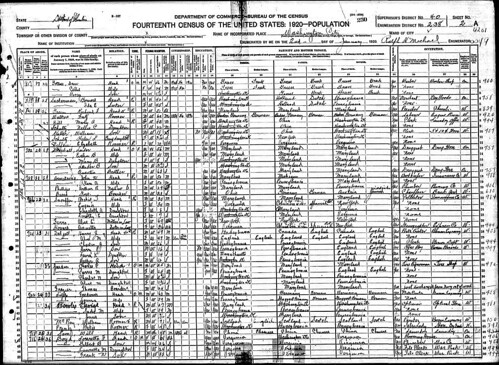
1920 Census data, H and 9th Streets NE, Washington, DC
1920 Census data, H and 9th Streets NE, Washington, DC.


How to address the mismatch between house size and household size: smaller housing units.  With new construction, a greater variety of unit sizes allows a wider range of household sizes to be accommodated.

One way to address the mismatch between the size of properties built early in the 20th century to the household sizes of today is to break up larger houses into smaller units.  From the TGM article:
... [Cheryl Case] argues the city has not adopted zoning that reflects the smaller family sizes prevelant in the city today, but acknowledges the solution is tougher and more political: "The city needs to develop policies that would develop more housing in neighbourhoods."

The existing zoning rules make that difficult, she says. About two-thirds of the city's residential land permits only one household per structure, and the city's official plan specifies that it hopes to maintain "stable" neighbourhoods by paying attention to "character."
2018-03-18_01-05-18
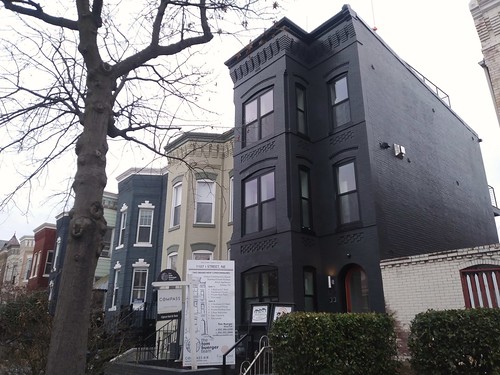
This rowhouse on I Street NE is being converted into two units, a ground floor single story apartment, and a two story upper apartment. The asking price for the two units is about $1.2 million. 
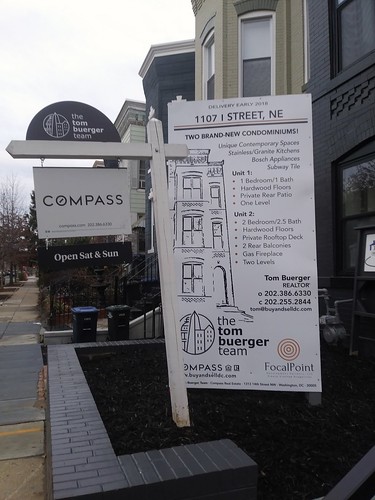
Three story rowhouse broken up into two condominiums, I Street NE
While it might not be happening in Toronto, and not in traditional single family neighborhoods in DC, it is happening in DC's rowhouse neighborhoods, where larger rowhouses are being converted from single family houses to multiple, smaller units, and medium sized rowhouses are being expanded somewhat to yield two units instead of one.

Note too that in those rare instances where new rowhouses are being constructed on an infill basis, almost as a matter of course each building is two to three units, including a separate basement apartment.

Making over houses as smaller units isn't driven not so much by a conscious application of 21st century housing policy but more as an expression of 21st century real estate economics, demand, and demographics.

It's the result of a kind of real estate arbitrage of building and lot sizes that enables property redevelopers maximize income while responding to a significantly increased demand for urban living and a relative inability to produce more single family type housing, because most of those sites have already been developed.
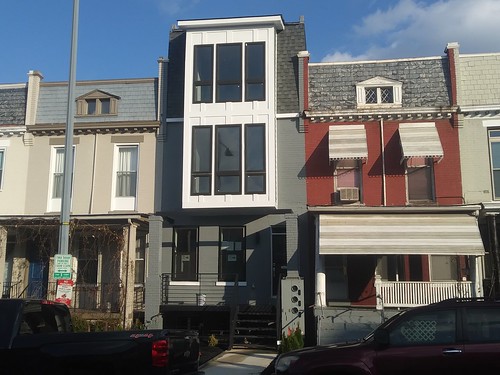
Weird pop up rowhouse, 13th Street NW, Columbia HeightsThis house is on 13th Street in Columbia Heights.  Note that the electric box indicates the building will have two households.  (One meter for each household, plus a separate meter for common areas.)

A great many neighborhood activists protest these changes as an unreasonable change in neighborhood character.

There is some truth to their claims, because often the additions and popups are aesthetically challenged.

Also see the Toronto Star article, "Toronto has too much housing despite overall population growth: report."  Note that a report referenced in both articles, "Promoting Vibrancy in Residential Neighbourhoods," from the Ryerson University City Building Institute, does not appear to be online.

Does the creation of more units on the same number of lots challenge infrastructure?  Some people raise a concern that making houses over into smaller units increases demand for utilities and other infrastructure beyod what we might call neighborhood carrying capacity.

The reality is that given the typically much larger household sizes back when these houses were originally constructed, with one exception, likely the present infrastructure is capacious enough.

The exception is parking capacity and road capacity.  For the most part, DC's street network and street parking capacity is fixed.  So as more households are added, if the new households maintain more suburban-oriented automobile dominated mobility behaviors, this creates problems in terms of demand for parking and more road congestion.

The proper response is to significantly increase the cost to register cars, the cost of residential parking permits (now$35/year), to encourage wider use of car sharing, to invest in transit quality and frequency and a broader array of transit options, and in transportation demand management programming to assist people in transitioning to other modes.

Labels: , , , ,