Rebuilding Place in the Urban Space

"A community’s physical form, rather than its land uses, is its most intrinsic and enduring characteristic." [Katz, EPA] This blog focuses on place and placemaking and all that makes it work--historic preservation, urban design, transportation, asset-based community development, arts & cultural development, commercial district revitalization, tourism & destination development, and quality of life advocacy--along with doses of civic engagement and good governance watchdogging.

Friday, May 08, 2026

Maybe we should create volunteer Garden Corps or Yard Corps efforts to help overwhelmed people care for their yards

A house with an unruly front yard on 200 South in Salt Lake City.

Salt Lake has so many homeowners who go out of their way to do attractive plantings.  

I don't know what their backyards look like, but some front yards are just stunning.  While others are just "merely" very nice.

I do know it's a ton of work.  At our DC house, for DC the backyard was big, not quite 50 feet wide and 90 feet long, with a garage.

It was pretty big for us.  When we bought, the defining element were two huge trees with such a great canopy that between them was a "living room" that was so thick that while not quite impervious to rain, provided a lot of protection.

OTOH, there was so much shade, we couldn't grow vegetables in the back, so we did in our front yard, which being smaller, was easier to maintain.  

We took up the Square Foot Gardening method, where you build your own growing medium, 1/3 peat, 1/3 vermiculite/perlite, 1/3 five different types of compost.

The first year we bought all the different kinds locally.  And it was expensive. 

Another year we found mushroom compost being sold at a farmers market in Richmond which was pretty cool.  We would call Veteran Compost for a load, but they never called back.  

Did you know that from yard waste, Montgomery County, technically the Maryland Environmental Service, makes a compost called LeafGro, like how Milwaukee's sewer socialists created Milorganite?

We liked to travel to places in Pennsylvania like Lancaster and rented a car to do so.  

I realized if we stopped at a farm store out there and bought our year's worth of compost, the savings would pay for most of trip!  

There are farm stores in the DC region, but I always liked the ones in Lancaster County.

The first year I pulled all kinds of "weeds" from the beds.  At a tour of the Winterthur House and Gardens, as we were being shuttled up to the house, the driver said "And you might think that the lawn is full of weeds.  No, those are native plants, flowering."

I realized what I had been doing was pulling up natives.  

Fortunately, the plant seeds were hardy and they came back.  The beds looked a bit unruly, but were beautiful.

Over the years we added more native plants, based on the US Fish and Wildlife publication Native Plants for Wildlife Habitat and Conservation Landscaping in the Chesapeake Bay Watershed.  

My biggest lesson was to sit back, observe and learn from the yard, from what previous owners had done.  I still had the problem of buying stuff that I wouldn't get around to planting, like dahlias, but we planted a bunch of stuff.

Another lesson.  Apparently the realtor in prepping the house for sale before we bought, planted 3 azaleas on each side of the entry to the front door.  One one side, two kept dying off.  I replanted them twice.  They died.  I finally figured out I should plant something else...

Blue mistflower.

We'd go to area plant sales to shop for them.  Not just to sales elsewhere as the local Ace Hardware stores in Old Town Takoma Park and Petworth were also a good source.

We added a bird bath to the back yard (we bought an older home appropriate style from the catalog at a store in Alexandria; I can't remember the name.  We found it by going to a nearby French restaurant, which closed many years ago).

I learned that more than birds needed water.  I failed to get the photo, but once there was an inchworm walking around the rim, bees drinking water, and if I remember correctly, a grasshopper or butterfly.

It made a huge difference for birds.

Sadly, the two trees, one a Willow Oak, the other a Maple, reached the end of their useful lives and died. But I let a bunch of Willow Oak seedlings grow.  Because of a variety of circumstances it's been 7 years since I've been back and I want to see their progression.  Even by the time we moved out west a number of saplings were taller than me.

Back when the Willow Oak was still alive, but the Maple had died.  An easter egg hunt.

We used to hold a brunch-y thing and an Easter egg hunt for the neighbor kids and friends we met through them.  It was always a good time.

Another thing we discovered the second year is wild blackberries along the back fence.  We got some yield, but after awhile, the birds and squirrels won out. 

I realized it was our responsibility to  recognize that fauna have a right to the food too.

We planted some blueberries but they never really took, and birds got most.  We did have mint growing pretty profusely.  Rosemary was off and on.  The bay leaf tree was so so.  We grew lemongrass one year, garlic another--it's planted in the fall, but I thought the work required was greater than the cost of buying, although if you planted exotic varieties it'd be different.  We learned the best way to grow basil was in a container on the front porch, so it got some shade and didn't bolt early.

In parts of Ward 4, DC has planted serviceberry bushes in the planting strips on some streets.  With the little girls next door we would pick them and make pie.

It took a year or so of my talking about it, but the impetus was Suzanne and we finally built a compost bin, of pallets that we scavenged from the industrial road behind the Metropolitan Branch Trail in Takoma.  (Now used pallets cost a lot.)  We used plans from Montgomery County.  DC didn't offer an equivalent resource.

Before we composted formally, I collected leaves with a leaf machine (electric, like our mower).  We had so many, even though the recommendations today are to leave them be.  The leaf sucker makes them into little bits.  I just piled them against the bad soil by our garage and they made beautiful leaf mold and improved the soil.

(For the bin, I also learned to stock up on leaves in the fall, to be able to use them the rest of the year.  We didn't "clean up" grass clippings, just left them. And sometimes I would snag a neighbor's bag of grass clippings to speed up the heat in the compost bin--but only later I realized they might use fertilizer, put junk in the bags too, etc.)

Our bins after I pulled out some reserved leaves.

As the wood degraded over the years, we replaced it with plastic bins.  

Regardless of address, the County sanitation and recycling booth at the Montgomery County Agriculture Fair gives them out for free, and that's where we got them.  Going to the Ag Fair is fun regardless--sometimes we'd take the neighbor kids who loved the circus rides.  

Arlington has one too, but it's fun in a different way.  We never managed to go to the Maryland State Fair.

Separately, we had a pile for twigs and such.  We had tons but I never wanted to pay to compost them at the place in Montgomery County that will take them.  We just let them degrade, and they did.

I always meant to get a chipper but we wanted an electric one and at the time they weren't robust enough.  One of my recommendations years ago on the DC Sustainability Plan was for the creation of a community chipper (and log splitting) program.  But they'd degrade.

Our house has a walkout basement, which is a super cool feature.  While this is big for DC, as you go west, those houses and yards are even bigger.  But I do know of a house within easy walking distance of Takoma Metrorail Station that is one acre!

We had butternut squash grow out of the compost pile one year (I wasn't too religious about turning) and tomatoes another.  

When we lost our front tree due to waterlogged roots and it came down, after weeks of heavy rain, I took out all the compost and put it in there.  More than 30 tomato and cilantro plants took root.

I still regret not getting off my ass and planting asparagus.  Once it takes it grows for decades.

The worst thing of all was dealing with plants that were out of control.  We never could get out all the ivy that had been planted years ago, and Virginia creeper.  We had a Rose of Sharon tree that probably grew from seed, and Suzanne realized it was enveloped by vines, and I had to go in and delicately take them all out.

We also solved an interesting mystery.  One bluestone paver at the bottom of the stairs to the back from the front.  And another by the rear patio entry.  She figured out that the other stones must have been buried by subsequent growth.  They were.  I had a terrible backache that day, but we started digging out and raising the stones, some of which were quite heavy.  And later I realized my back pain was gone, from the work of digging and stretching.

Oops, the Takoma Park House Tour was last weekend.  They are fun to go on, also to volunteer, and then you get to go see the houses for free.

I called our yard rustic.  

But the amazing thing was how important that rusticity was to attracting fauna.  We had birds of various types, insects including butterflies and fireflies.  And yes, raccoons from time to time.  

Once a champagne colored (beige) skunk walked through the back yard.  Other neighbors experienced deer which fortunately never happened to us.  (Over the years I rescued raccoons from our garage and a neighbor's waste bin.)

My final lesson was rustic versus manicured made a huge difference.  

When we would go on the Takoma Historic House Tour the super manicured yards were always barren of birds and insects (fauna).  I'd take rustic over manicured any day.

==============

Sharon Schueler (left), Leif Dormsjo and Al Foxx clear weeds, dirt and grass in a courtyard at Calverton Middle School in Baltimore. (Baltime Sun photo by Kim Hairston).  This photo is from 2005.  Ironically, a decade later, Mr. Dormsjo served as the director of the DC Department of Transportation.

Volunteerism. So how does all this relate to the Garden Corps idea?  Also see with out of date links, "National Volunteer Week: April 16th-22nd," from 2023.

I saw that yard while taking photos yesterday, and it made me realize that like programs that help seniors and others with housing maintenance and repair ("A case in Gloucester, Massachusetts as an illustration of the need for systematic neighborhood monitoring and stabilization initiatives: Part 4 (the Curcuru Family)"), sometimes people just need help with their yards.

Photo from AthensNow, "My Neighbor’s Yard Is Overgrown/Unkempt/Has Junk Piled Up. What Can I Do?."

There are some programs where people will let others garden in their yards.  Or glean fruit from trees.  There is the Master Gardener training program sponsored by the Agricultural Extension Service in every state.  Some counties have urban oriented MG programs.   

Montgomery County's program often has people tabling at libraries and other places for advice and workshops. Some places offer a Master Composter training program.  Arlington County, Virginia has EcoAmbassadors focused on climate change issues.

Many parks agencies sponsor weed pulling of invasives and planting natives in their place. 

Technically illegal, I would do guerilla tree branch trimming on the route to and from the bus stop closest to our house.  

What about extending these kinds of program to yard help?

The Brookland neighborhood has the Greater Brookland Garden Club, and has for many years.  Members have monthly "parties" at houses and often are called upon to give advice.  

The group sponsors a Welcome to Brookland gateway sign with a planting bed.  

Decades ago, Savannah had a small block grants program that people could use for neighborhood projects like greenspace ("Enabling Productive Neighborhoods: The Role of a New Kind of Leader").

Asset-Based Community Development Manuals:

-- Leading by Stepping Back: A Guide for City Officials on Building Neighborhood Capacity
-- City-Sponsored Community Building: Savannah’s Grants for Blocks Story

H&R Block sponsors a similar program available nationwide.

San Francisco has created a variation of a neighborhood service district--they have those too, but unlike a business improvement district, it includes residential property as payers into the district--called a Green Benefits District (something that I will write a separate entry about).  

====

But it's an idea.  I don't have the capacity or physicality to create it myself.  However, it could be a program of a revitalized Garden Center at Sugar House Park.

Labels: , , , , , ,

Thursday, February 16, 2023

Volunteer Expo, Asheville, North Carolina

With the decline in public media--newspapers and alternative weeklies especially, it's increasingly difficult for organizations to get the word out about volunteer opportunities.  

In Asheville ("Volunteer expo seeks to recruit help for over 65 local nonprofit organizations," WLOS-TV) the Junior League of Asheville just sponsored the fifth edition of its Annual Volunteer Expo.

The Hill Center on Capitol Hill in DC sponsors something similar, focused on the Capitol Hill neighborhood, but the room they hold it in is too small.  I suggested they move it to Eastern Market's North Hall, but they evinced zero interest.

In "Outline for a proposed Ward-focused (DC) Councilmember campaign platform and agenda" (2015), I suggested each city political district should sponsor a volunteer expo, based on the Hill Center effort, but of course, a city-wide event can be just as good.

More opportunities need to be provided to seed community involvement.

Labels: , , , , , , ,

Tuesday, March 15, 2022

Project Rehab, University City District, Philadelphia: Best Practice Neighborhood Stabilization Program

In 2020/2021, I wrote a five part series on creating a model framework for systematic neighborhood stabilization, suggesting the creation of a national program comparable to the Main Street commercial district revitalization program, but for neighborhoods/residential property, modeled after a program created in Pennsylvania, called Elm Street.

-- "The need for a "national" neighborhood stabilization program comparable to the Main Street program for commercial districts: Part I (Overall)"
-- "To be successful, local neighborhood stabilization programs need a packaged set of robust remedies: Part 2"
-- "Creating 'community safety partnership neighborhood management programs as a management and mitigation strategy for public nuisance programs: Part 3 (like homeless shelters)"
-- "A case in Gloucester, Massachusetts as an illustration of the need for systematic neighborhood monitoring and stabilization initiatives: Part 4 (the Curcuru Family)"
-- "Local neighborhood stabilization programs: Part 5 | Adding energy conservation programs, with the PUSH Buffalo Green Development Zone as a model," 2021 

The major point is the framework and ability to implement, but that programs need complementary remedies to be able to act, and organized initiative so that they are able to implement and effect change.

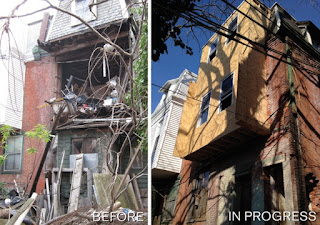
Photo from the first Project Rehab project, in 2012.

The Philadelphia Inquirer has an article, "A ‘Mr. Fixit’ helps West Philly residents and businesses cut through red tape," about the Project Rehab initiative of the University City District business improvement district.  It focuses on addressing problem properties--distressed, vacant, etc.--as a way to "cure nuisances" by assisting the property owner, rather than seizing or demolishing buildings.

It's not a huge program, they've addressed about 5 properties per year since the program's creation in 2011.  That demonstrates not failure, but how time consuming the process can be.

From the website:

While Project Rehab responds to the unique needs of each property owner, the core steps of every project are the same. 

 1. Property Monitoring and Identification UCD uses a variety of methods to monitor problem properties in the district. Staff conduct physical surveys to identify distressed real estate, and seek input from community and civic associations as well as concerned community members. Staff also work closely with the City, making use of information and investigations gathered by the Department of Licenses and Inspections. 

2. Owner Identification Project Rehab then uses a variety of resources to clarify property ownership, which can be challenging to unravel. Staff conducts online research and interviews community organizations, neighbors, and owners’ family members. Project Rehab also partners with government offices such as the Philadelphia Revenue Department, the Records and Deeds Office, the Register of Wills, and Licenses and Inspections to obtain information on owners and their properties. 

3. Defining the Course of Action Once we establish contact with an owner, Project Rehab and the owner develop a course of action for the property, which often entails renovation for eventual personal use, sale, or rental/leasing. Whatever the desired outcome, UCD provides a range of free supports and services to help the owner achieve their goals: 

Financing: Working in partnership with local banking institutions, UCD drafts and develops financing packages for owners who want to finance the rehabilitation of the property. 

Rehabilitation: UCD has developed a list of licensed contractors who are experienced with the rehabilitation of distressed properties. Staff provide support and knowledge to owners throughout the process, helping to obtain all required permits, licenses and inspections. '

Sale: UCD has built a network of realtors who support those owners who decide to sell their property. Zoning: UCD connects owners with local attorneys and community organizations to work through the zoning process. 

Conservatorship: Project Rehab works with 501-4C not-for-profits to utilize Pennsylvania legislation known as the Act 135 Conservatorship Act to redevelop distressed properties with no known owners. 

Along the way, the Project Rehab team is able to deploy outside the box strategies to help each owner achieve their rehabilitation goals, regardless of the issue surrounding the real estate. From helping a family open an estate to untangling title issues to ensuring that owners are well represented while seeking equity development partners, Project Rehab is a guide and support for property owners.

======

The UCD is an association so to speak, not a typical business improvement district where property owners in the district are taxed a small amount on the assessed value of the property. Instead property owners in the district pay voluntary amounts.

-- "In University City, a model for a [neighborhood improvement district]," Philadelphia Daily News, 2012

It was pointed out to me that this wasn't altruistic, but a strategy by the nonprofit property owners--University of Philadelphia, Drexel University, Amtrak, etc.--to ward off the idea of taxing nonprofit property owners as a way to generate tax revenues for cities.  Some institutions pay what are called PILOTs, or payments in lieu of taxes.  

--"Proposal to eliminate nonprofit property tax exclusion in Maine," 2015

But some cities, which have significant swathes of property off the tax rolls because of the concentration of nonprofit institutions within their borders, look to tax nonprofits too.  (Note that Ontario doesn't have the kind of tax exemption system we do in the US.  Even the provincial government and nonprofits pay property taxes.)

Separately, Pittsburgh is looking for PILOTs as a way to fund infrastructure improvements ("Pittsburgh City Council proposal would turn to nonprofits for infrastructure funding," Pittsburgh Tribune-Review).  

PILOTs are an alternative to an earlier proposal to impose a 1% tax on tuition and medical bills--the city has two major hospital systems and at least two large universities, Carnegie-Mellon and the University of Pittsburgh ("Pittsburgh Councilman Ricky Burgess proposes 1% tax on higher-ed students, medical patients," PTR).

That built on similar proposals, at least for a capitation tax on students, in Providence, Rhode Island.  Providence College was disfavorable ("Student Fee Would Break Bond of Trust").

Labels: , , , , , , ,

Friday, August 28, 2020

A case in Gloucester, Massachusetts as an illustration of the need for systematic neighborhood monitoring and stabilization initiatives: Part 4 (the Curcuru Family)

-- "The need for a "national" neighborhood stabilization program comparable to the Main Street program for commercial districts: Part I (Overall)"
-- "To be successful, local neighborhood stabilization programs need a packaged set of robust remedies: Part 2"
-- "Creating 'community safety partnership neighborhood management programs as a management and mitigation strategy for public nuisance programs: Part 3 (like homeless shelters)"
-- "A case in Gloucester, Massachusetts as an illustration of the need for systematic neighborhood monitoring and stabilization initiatives: Part 4 (the Curcuru Family)"
-- "Local neighborhood stabilization programs: Part 5 | Adding energy conservation programs, with the PUSH Buffalo Green Development Zone as a model," 2021 

Part 1 of this series discusses the need for focused neighborhood stabilization and improvement programs, particularly in weak market neighborhoods. With a proposed model being a reworking of the Main Street commercial district revitalization approach, but for neighborhoods, which the State of Pennsylvania has already done, calling it "Elm Street."

-- Elm Street program, Pennsylvania Downtown Center
-- Elm Street Managers Handbook
-- Chambersburg Elm Street Neighborhood Plan

Part 2 discusses packaging a set of remedies, so the programs can act expeditiously. 

To do that programs need to collect data and information and create maps showing the condition and state of properties, and identify potential solutions, including organizing community volunteer and self help/DIY initiatives such as the "Paint Ypsilanti" initiative that helped residents in the Depot Town neighborhood, when their houses were in need of a new paint job.

Rebuilding Together.  The piece mentioned the Rebuilding Together organization, which has local chapters that assist people without the means to do so to make necessary repairs on their houses.

 I attended their national conference in 2013 ("One element typically ignored in housing policy: helping low income families stay in their homes via repair assistance").

The organization terms April as "National Rebuilding Month" (the organization used to be called "Christmas in April"), and encourages affiliates to focus their service efforts then, culminating in "National Rebuilding Day," held on the last Saturday in April.

A project underway by Rebuilding Together Manchester in Connecticut.  Photo: Bob Kiefer.

Local affiliates may or may not have full time staff, but the bulk of the work is done by volunteers, both amateur and professional.

Funds tend to be a mix of government grants and locally raised donations, depending on the group.
Affiliates with paid staff tend to undertake more projects and do projects throughout the year, rather than just in April.

One focus is the installation of ramps for the disabled, which chapters tend to do all year, not just in April.

Manchester, Connecticut.  

More recently, rather than focusing on one-off projects, some RT chapters have started focusing each year's activity on particular neighborhoods, repairing dozens of houses at the same time, having a multiplicative impact on neighborhoods, going beyond that of a focus on individual houses.

Each year, collectively the chapters repair over 10,000 houses with the involvement of as many as 100,000 volunteers, with an equivalent value of around $100 million.

Neighborhood Housing Services.  In some respects you can argue that RT is a "self-help/DIY" version of the public program Neighborhood Housing Services, a program created by Congress in the 1960s, that many cities adopted to do similar kinds of work.

Through hundreds of programs across the nation, public and/or nonprofit agencies provide grants and other repair and housing rehabilitation services to people in need, mostly using public funds from HUD community block grants.

-- Maryland NHS webpage
-- "Neighborhood Housing Services: A Program with Promise," Vanderbilt Law Review, 1976
-- "Redlining Practices, Racial Resegregation, and Urban Decay: Neighborhood Housing Services as A Viable Alternative," The Urban Lawyer, 1975
-- "Building a Better Neighborhood Housing Partnership," Housing and Society, 2007

The programs may target households in terms of income eligibility as well as specific neighborhoods.  Some programs have energy-related initiatives and/or offer technical assistance workshops on topics such as foreclosure or home buying.

Also, many cities and counties, often in conjunction with senior aging programs, have created focused programs to provide such services to older-aged households.

The note that the Curcuru family received July 20 telling them their house is an “eyesore.” (Photo here and below: Michelle Baran)

The difference between Neighborhood Housing Services and initiatives like Elm Street and Rebuilding Together.  To make clear, while NHS type programs are important, what this series recommends is the support of initiatives that are more directly intertwined with civil society supportive elements.

The difference between the Main Street model and the community development corporation model is that non-professional citizens/residents are incorporated into the organization as members, volunteers, and leaders.

Gloucester, Massachusetts and the Curcuru family.  The Washington Post has an article, "A couple was shamed for their aging house. Hundreds of people stepped in to help spruce it up," about the Curcuru Family in Gloucester, Massachusetts, and how the health and income challenged family hasn't been able to keep up their house in good condition.

The house, long in need of painting, was called out as an eyesore in an anonymous missive.  Once this was disclosed in a Facebook post, the family received many offers of help and the house will be repainted.

Obviously, the house needs to be painted. Anyone can see that's the case.

But the state of disrepair should have been seen as an indicator of the need for help, rather than as an opportunity for anonymous shaming.

A long time ago, a colleague made the comment that the reason that there are so many lawyers is because people are unwilling or not very good at engaging with other people to deal with problems and differences, so they need third party intermediaries.

Another way to think of organized stabilization initiatives is as a friendly third party intermediary.

By collecting data, making assessments, and organizing a system of help, it's possible to deal with this kind of issue as a conversation rather than as through anonymous accusations and shaming.

Note that Gloucester has a housing rehab support program, but it's got a long waiting list.  And judging by the Post article, it's probably not particularly proactive in identifying houses of particular need.

The advantage of creating initiatives like an Elm Street neighborhood stabilization program or Rebuilding Together is that they draw on a wider variety of resources, including volunteers, than is typically possible through a staff-driven city agency.

Columbus Ohio and the Old Towne East neighborhood.  In Part 1, I mentioned the 2003 documentary "Flag Wars," about the demographic change--"gentrification"--of a neighborhood close to the Downtown of Columbus, Ohio.

The footage was mostly shot in the late 1990s.

-- Discussion Guide

The neighborhood is marked by huge houses, and had a preponderance of older black families, mostly low income.

Like the state of the Curcuru house in Gloucester, many of the houses were in disrepair, which of course is why some people were motivated to buy there--houses were cheap, big, and well located, and sweat equity could generate a great financial return.

Vacant houses in Olde Town East.  Wikipedia photo by Zhao 737.

So many of the houses are so large, that keeping them up would be a challenge for all but higher income households (e.g., in the last year, repairs and appliance replacement at our small bungalow in DC have already totaled over $4,000, and I wish we'd put some more money into landscaping).

Instead of looking to creating "mutual assistance programs" to help economically challenged households, many new residents profiled in "Flag Wars" called on the city's Code Enforcement inspectors to ticket and fine the homeowners.

Needless to say, this created animus ("‘Flag Wars’ Helped Me See Systems Of Racism In Housing And Its Effects On My Own Family," Columbus Navigator).

While it's taken a couple decades, apparently, these days, the neighborhood has "arrived," at least pre-pandemic, judging by last summer's historic house tour ("Olde Towne East home tour to feature the old, new, grand and sleek," Columbus Dispatch).

The Olde Towne East historic home tour features condominiums currently under construction at 1369 Fair Avenue. Pictured are owner Misty Linn (L) and her partner Katie Kikta (R). Tour organizers say the event illustrates the variety and health of the area's housing. Photographed on Tuesday, July 2, 2019. [Barbara J. Perenic/Dispatch]

Manor Park DC and the Albright Memorial Methodist Church.  An ongoing theme in writing about cities is the decline of churches as older church-going residents move to the suburbs.

As church congregations shrink, the ability to maintain buildings diminishes, especially as buildings age, and that is the case with the Albright Methodist Church on Rittenhouse Street NW in the Manor Park neighborhood (between Takoma and Brightwood).

Comparable to the letter received by the Curcurus, a resident living across the street from the church complained about their failure to maintain the roof, that tarps continued to cover part of the roof for many years, that it is an eyesore etc.

It's not that the church didn't know about the problem, but they spent many years raising the necessary funds to fix it.

He could have talked to them, and he could have even volunteered some of his time and energy to helping them facilitate and speed up the repair.  I guess the saving grace was that he didn't do it anonymously.  But in any case, most of the discussion on the list was more about defending the church.

That was a few years ago, and I seem to recall that the roof has finally been fixed.

While churches typically aren't eligible for government funds for repair (see the First Amendment), some historic preservation organizations do provide assistance to churches in these situations, sometimes with the support of the national organization Partners for Sacred Places.


Columbus, Ohio community identity billboard


Labels: , , , , , ,