This blog entry is being reprinted with some additions, in response to the op-ed in
Crain's Chicago Business, "
For arts to survive the leaner funding environment, more of us must act together." I didn't think it said anything of substance.
I sent the author an email saying so, linking to this entry from 2019, "A comprehensive list of funding sources for arts and culture" and suggesting that Cook County and Chicago could create a fractional sales tax to support the arts.
The arts funding entry was a companion to "What would be a "Transformational Projects Action Plan" for DC's cultural ecosystem." That one is deserving of an update too.
According to this Crain's article, "Chicago’s arts and culture is essential infrastructure. Here’s why," Chicago already spends millions supporting the arts. While this article, "How Chicago arts and culture orgs plan to stay strong despite federal cuts," states that arts grants from the federal government to Chicago-based cultural institutions have been cut by almost 50%. From the article on Chicago arts funding:
It turns out that Chicago already has a hotel tax, "Special Events and Municipal Hotel Operators' Occupation Tax Fund" that supports arts and special events.
Chicago, Cook County, and Illinois all have big budget problems, the city has a budget deficit of more than $1 billion, and billions more debt in unfunded pension liabilities. The last thing residents want is another tax.
However parks ("How We Win: A Look at How TPL Secures Public Funding for Parks and Open Space," Trust for Public Land) and arts tax initiatives tend to be voted upon highly favorably and people could be convinced of the value.
A sales tax like the one suggested, modeled after the Zoo, Arts and Parks sales tax in Salt Lake County, would increase the amount of money available to the arts, and if extended to Cook County, could support a wider variety of institutions and programs than are supported currently.
I forgot something in the original post, the 1% for the arts--public art, sculptures, other physical works--that tend to be associated with federal and municipal building projects, and a couple other examples from Arlington County, Virginia. And doing some research for this introduction, I found that Portland passed a small capitation income tax ($35) in 2012 ("Portland: How to Pass an Arts Tax," Creative West)--although about 70% supports school arts education programs, leaving just a little for cultural organizations.
When I wrote the original piece, I didn't do a search of academic papers, I just wrote from what I came across over the years. There are a bunch of good papers on the subject.
Otherwise, I was shocked at how well the piece read almost 7 years later.
Here goes:
===========
Someone asked me if I'd written a comprehensive piece about funding arts and culture and I replied that I've written about it, but in bits and pieces across various entries. So I decided to take a crack at a comprehensive piece. I'm sure there are comparable lists published in manuals, articles, and textbooks.
The framework below doesn't count revenue generated by normal program activities such as ticket sales to events, fees from services, product sales, etc.
Note that there are four types of funds/donations/benefits provided:
- capital funds for facilities, which I tend to think about the most;
- ownership and access to facilities;
- general operating monies not earmarked for specific projects; and
- program-specific grants and sponsorships, which are usually time-limited.
Certain categories can support only capital projects, others include both grants for programs and operations as well as capital projects. The framework is organized as follows:
- Government sources
- Individuals
- Foundations
- Corporations
- Real estate related revenue generation by nonprofit organizations
- Colleges and Universities
- Earned income
========
Government sources
Funding from Government
capital, facility access, grants
Cities, townships and other forms of local government including counties, other government agencies, states, and the federal government. Ideally, there is a transparent and open process for access to such funding. That isn't always the case. New York City has a good process for grants and capital projects. Most cities have decent processes for projects, but DC doesn't at least for capital projects.
- operating and other grants from general funds
- capital planning and budgeting for facilities from capital funding sources
- owner, operator, and sometimes lessor/rental agent of cultural facilities, libraries, etc.
- seller/lessor of buildings and land
- co-location projects
- 1% for the arts building projects
- municipal utility funding
- other
One example, the City of Richmond owns the Altria Theater by the VCU campus, but they outsource the management of the facility. DC owns the land under Yards and Canal Parks but they are managed by nonprofit entities.
The Salt Lake Central Library includes a public auditorium and gallery and exhibit spaces. DC owns Eastern Market a public market, Cleveland the West Side Market and the Municipal Auditorium, the Salt Lake County Library System owns an events space called the Viridian Center, etc.
In the past, DC hasn't been good about deed and other contract restrictions to get back control of properties that they sell when they are converted to other uses. ("DC's Source Theater sold: cause for a cy pres review?").
Other governments have more public and transparent processes for grants, especially for capital projects.
Co-location projects. I know of a few, two in Arlington County, Virginia. The first is the incorporation of community center functions into Thomas Jefferson Junior High School. Part of this was the construction of an auditorium big enough to serve the community at large, much larger than a normal school project. Encore Stage and Studio, focused on youth programming, is the resident theater company based in that space.
Signature Theatre is seen in the Shirlington neighborhood in Arlington. (Lance Rosenfield/Prime)The second has been less successful. When Arlington built a new library in the Shirlington community, they also built a connected theater facility for the Signature Theatre Company.
Signature was supposed to pay back a good portion of the cost of the theater but they were unable to do so, and the deal went through with an initial major restructuring with debt being forgiven ("Signature Theatre saved, but Artisphere faces shutdown," Washington Post). From the article:
County board members grilled Signature’s managing director, Maggie Boland, for two hours Wednesday before approving the loan, asking why the theater couldn’t simply raise its ticket prices, whether its vision was overly ambitious and what would happen if the loan payments were not made.
Boland answered that ticket prices “are set at the top of the market” and raising prices further would push a segment of the audience away. She cited a consultant’s study that concluded that neither price increases, fundraising nor budget cuts would be enough to offset the theater’s heavy debt burden and overhead.
Since then there has been further rounds debt forgiveness ("Signature Theatre may get $415K in loans forgiven as it plots future renovations," ARLNow).
Part of the problem may be that the location is not served by Metrorail, making it harder to compete against better located facilities. It's still a cool project and gets more than 100,000 patrons each year, who in turn buy food and drink and local restaurants, adding value to the commercial district. And apparently, post covid, it's doing decently well, setting attendance records ("Amid Kennedy Center turmoil, two Arlington theater companies broke sales records in 2025," ARLNow).
First floor, Millcreek City Hall.It's different than creating a separately controlled space for an arts group, but Millcreek, Utah developed its City Hall with shared spaces. Millcreek as a city is only about ten years old, and it didn't have a center or downtown.
The City Hall and Millcreek Common project is designed to create a destination and gathering place for the community.
The ground and second floors are set up for markets and exhibits, and there's some food service too. The markets are kind of flea markets and kind of junky. To me, it's a bit garish compared to the government function.
Millcreek Common ice rink.The fifth floor meeting room is for City Council and open to other groups. The building also incorporates a rock climbing wall.
Outside, Millcreek Common is a plaza, ice/roller rink, with a building for meetings (and theoretically exhibits) and another building for food. Because they are focused on "making money" from the spaces, they aren't doing much in the way of curation. They have a lot of festival type events throughout the year in the plaza ("Millcreek breaks ground on second phase of its Common city center hub on Highland Drive," Salt Lake City Weekly).
Switchwall covers three faces of the Denny substation with an array of thousands of light “switches” that are flipped by the wind.1% for the arts. As part of capital projects, some jurisdictions have requirements that public projects direct 1% of total project costs to the arts, usually for public art.
Sometimes the buildings may incorporate spaces for other arts functions, either back of the house or public facing. Seattle does this through its municipally-owned electric utility, Seattle City Light, and other agencies.
Depending on the jurisdiction, private initiatives may have to devote a similar funding stream to public art as part of the finished project. The federal government does this through the "Art in Architecture," program for federal buildings, although the allocation is 0.5% of project cost.
Transit projects. Prior to 2013, transit projects could use federal funds for art-related elements of public transportation projects. This was one of several types of projects termed “transit enhancements” for which transit agencies were required to spend a certain amount of their FTA formula grant funds. That is no longer allowed.
A lot of great public artworks come about through such programs, including some very moving and controversial public art projects at the Expo Center and Delta/Vanport stations on the Tri-Met MAX Yellow Line in Portland.
Expo Gates, Valerie Otani, Expo Center, Portland, Oregon.
Valerie Otani addresses the theme of Japanese relocation during World War II at the site of the 1942 Portland Assembly Center. Traditional Japanese timber gates strung with metal "internee ID tags" mark station entrances. Vintage news articles are etched in steel and wrapped around the gate legs. (The artist spoke to us on our tour. And the headlines of the newspapers included in the work were vicious and racist. )
Despite losing access to federal funds, most transit agencies still incorporate public art into facilities using local funds.
Cable cars and escalators now carry tens of thousands of people a day between Medellín’s comunas and the city centre. Photograph: imagebroker/AlamyMunicipal utility funding stream. For capital investments, the only place I am familiar with this is Medellín, Colombia. Empresas Públicas de Medellín (EPM) operates electricity, water and telecommunications services in the city.
The city receives a 30% annual dividend which is used in part to fund "social urbanism" program making transportation and cultural investments in distressed and/or poorly connected areas ("'Social urbanism' experiment breathes new life into Colombia's Medellín, Toronto Globe & Mail, "Medellín's 'social urbanism' a model for city transformation," Mail & Guardian, "Medellín slum gets giant outdoor escalator," Telegraph, "Medellín, Colombia offers an unlikely model for urban renaissance," Toronto Star, "Medellín escapes grip of drug lord to embrace radical urbanism," Guardian). EPM also does projects on its own.
In the US, Seattle Public Utilities does something similar, although not in cultural or transportation investments. They do fund environmental sustainability projects wrt stormwater. Separately, the electricity utility, Seattle City Light also funds energy efficiency initiatives.
General property tax "districts"
capital and operating
In many jurisdictions, schools, libraries, parks, even health, police, fire, EMS services, transit and various capital projects are funded by separate property tax related initiatives, which often require require special referendums/levies approved in a public voting process. (DC doesn't have this kind of process.) Illinois even has forest districts.
Usually these initiatives are limited to a city or county geography specifically, but can span communities when multiple jurisdictions are served by the entity.
Separately from regular funding sources, Seattle residents have passed additional levies to provide specific funding streams for programming, not capital projects, for libraries, transit, which is mostly provided by King County, and school and family programs.
For example, the school levy provides additional funding to ensure all schools have librarians, a nurse, and other structural support staff, the transit levy pays for additional bus service for Seattle specifically including new rapid bus lines, the library levy expanded hours and staff, etc.
Culture-related property tax districts that cover multiple jurisdictions
Capital, grants
Explainer, "Perspectives on Cultural Tax Districts"
Examples include the Regional Asset District in Allegheny County, PA; Scientific and Cultural District, Denver; Huron Clinton Metropolitan Parks Authority, Detroit area which dates to the 1930s I think; parks districts for an entire county, more recently multi-county tax support for the Detroit Zoo and the Detroit Institute of Arts each separately driven by Detroit's bankruptcy (unfortunately, I think they messed up in the Detroit area where I am from, the Regional Asset District is better, whereas in the Detroit area they are focusing on one institution at a time), library districts, etc.
The idea is that in the old days cities tended to own and operate these kinds of cultural assets, but with suburban out-migration there became many free riders and the cities no longer had the economic capacity to support these institutions by themselves.
For DC, along these lines I argue that we should change the property tax somewhat into tranches:
- general
- transportation
- parks and culture
- neighborhood investment
but it would need to be complemented with a public capital budgeting process generally and for cultural facilities specifically, which we don't do.
Yes in DC the Executive branch and Chief Financial Officer have capital budgeting units, but it's wrong that like the federal government, the public part of the process is merely just a part of the annual budget, unlike the much more rigorous review and public capital budgeting planning processes typical of most jurisdictions nationally and in the region.
Special purpose property tax districts
operating funding primarily, but can support capital projects
The equivalent of business/community improvement districts but for culture/parks.
A proposal to pay for the operations of the High Line linear park through such a district didn't succeed. A Business Improvement District pays towards the operation of Bryant Park.
Texas has lots of special purpose districts that fund the equivalent of BIDs/CIDs. Klyde Warren Park in Dallas was originally its own district, but later merged with the Dallas Arts District funding district ("Klyde Warren Park, Dallas Arts District reach accord on tax plan to fund operating costs," Dallas Morning News).
SF has what are called Green Benefits Districts at the neighborhood scale to support local green/open space activities.
Tax increment financing
capital projects
TIFs are districts/projects where it is expected that planned new development will generate new tax revenues. They sell bonds against the future revenue stream, which is usually made up of property and school tax revenue. They can be controversial because some entities like schools argue that their costs go up with more housing, but by not getting more revenue they lose out.
The revenues are used to fund infrastructure, sometimes to provide subsidies to specific developments, to fund other projects, and sometimes cultural facilities, public art, etc.
Allentown, Pennsylvania has a special type of district that also includes anticipated future state income tax revenues as part of the revenue stream. It's called the "Municipal Improvement Zone." That required special legislation from the state.
Bond support for capital projects
capital projects
Bonds issued by a government entity typically have lower interest costs and other better terms than a cultural organization can receive from traditional financial institutions.
They are a type of loan. So an organization needs a strong revenue stream to be able to pay them off.
DC already does this. Maryland has a program. Etc.
New forms of bonds include "social impact bonds" and "green bonds." Social impact bonds are marketed as a way to fund social innovation, with the aim of sharing cost savings resulting from new programs which the governments couldn't otherwise fund. The problem with SIBs is that benefits are usually "earned" across programs and can be almost impossible to monetize, and one of the only ways to monetize benefits is by reducing agency budgets.
Green bonds don't have the same kind of constraints as SIBs. They are bonds, but targeting sustainability and environmentally-related projects.
Sales tax percentage add on dedicated to arts/culture
capital, grants
Prominent examples are ZAP (Zoo, Arts, Parks) in Salt Lake County Utah; the cigarette tax in Cleveland/Cuyahoga County Ohio. Great Parks of Hamilton County, Ohio; and Metropolitan Area Projects, Oklahoma City. Also see "Sales Taxes for the Arts," Americans for the Arts.
Note that speaking of equity, even though I hate smoking, I think the cigarette tax for the arts is wrong. The beneficiaries mostly don't pay the tax.
The MAPS program is called Metropolitan but the tax is only paid by Oklahoma City residents, but then the projects are only within OKC too. It has to be re-approved every few years. Each "new" tranche focuses on a specific set of projects.
It's in the fourth cycle I believe, so it's called MAPS4 ("Change isn't usually that simple: The repatterning of Oklahoma City's Downtown Streetscape"). They've had a couple of other cycles but not called MAPS, but using the same process and funding.
MAPS is an example of what I now call "Transformational Projects Action Planning." I need to read the former mayor's book that came out last year, although he didn't originate the program.
Even if they have to be renewed, the programs listed above are relatively permanent. A variant is a "temporary" sales tax add-on for a specific project. For example, the rehabilitation of the former train station in Cincinnati, Union Terminal, was funded through a small increase in sales taxes lasting for five years, for the entirety of Hamilton County, Ohio, not just the city ("Cincinnati's Union Terminal Now Saved for Future Generations," National Trust for Historic Preservation).
Most of these programs (including the ones mentioned above in Seattle) are very good about public marketing about the program, what is funded, and how it comes about because of citizen support.
Ensuring operational stability. Interestingly, this cycle of MAPS is putting aside monies for long term operating support for the community organizations that got new facilities as part of the program ("Investment for OKC MAPS 4 program operating funds begins," Daily Oklahoman).
Along the same lines, while the ZAP tax in Salt Lake County does not fund new capital projects, separately the County fundd new projects through a bond, which is paired with ZAP in that the new facilities can be assured of ongoing operating support in part from ZAP.
Geographically specific sales tax districts/local option sales taxes
for capital projects primarily, program support can be possible in some situations
States that stick out are Colorado and Georgia (Special Purpose Local Option Sales Tax: A Guide For Local Officials). But the Georgia districts I've come across haven't been related to arts/culture but revitalization and transportation. And in Colorado, unusually, these districts are usually smaller than a city.
E.g., there is a 1% add on sales tax in the Larimer Square district in Denver, called a historic preservation and restoration fee (rather than a "tax") just for the blocks around the square. Alto there is a historic preservation tax for sales of items in Union Station, paying toward that facility's rehabilitation.
There are other special tax districts like this across Colorado, usually for revitalization projects functioning as a variant of TIF/tax increment financing (you sell bonds against anticipated future revenues) but using sales taxes, not property taxes, to pay off bonds and loans.
Tourism tax revenue stream
grants, capital projects
Sources include taxes on hotel stays, car rentals, restaurant meals, taxi trips (this can be diverted to transportation), sometimes parking (transportation/tourism). Airbnb type stays not paying such taxes crimps this revenue stream.
Travel industry organizations try to discourage such fees, which tend to be high, because they argue it discourages travel ("Tax burden on US travel and tourism," World Tourism and Travel Council.
For 15+ years I've argued that in DC some of this revenue stream needs to be captured in a more regularized fashion to support sub-city visitor marketing and cultural asset development and programming, out of the sense that if we make places great "for us residents" they are also attractive to others. Note that Events DC/Destination DC do a wee bit of this, e.g., providing some funding to Cultural Tourism DC, etc. But not enough.
Some jurisdictions do use this revenue stream for cultural development projects, not to just build and operate convention centers and run "convention and visitors bureaus" for tourism marketing.
Note that this should include funding in a systematic way for marketing of sub-districts of the city, like Anacostia or Georgetown, and DC doesn't really do that.
Income Tax/Capitation Tax. As mentioned above, Portland, Oregon may be the only jurisdiction with an income tax for the arts. But only a small portion goes to cultural organizations. Most pays for arts education in elementary schools.

Admissions taxes (on tickets)
source of funds for grants mostly, but could go towards capital projects
It bugs me that nonprofit arts groups argue for exemptions while at the same time asking for money. Or that sports teams ask for exemptions while getting millions in other funding ("Admissions tax would be a win-win for downtown Spurs arena," San Antonio Express-News). Etc. The only way that Prince George's County makes any money off the Redskins football stadium is because there is an admissions tax.
Advocates in the Hill District in Pittsburgh proposed a tax on arena parking to be used for community projects, but they weren't successful ("A dollar a car for the Hill," Hill District Consensus Group). I think it's a great idea.
Columbus, Ohio has a variety of ticket taxes, some specific to a particular venue to support that venue ("Columbus City Council's 2% ticket tax for proposed women's soccer team faces concerns ahead of vote," WOSU/NPR) and a general tax on venues with more than 400 seats to fund the arts ("Columbus Ticket Fee Study" Greater Columbus Arts Council).
Unfortunately, Ohio Townships can tax cultural institutions, but use the money to fund emergency services not arts and culture ("Ticket tax? Liberty Township wants surcharge on Columbus Zoo entry to pay for fire and EMS," Columbus Dispatch). Also, the city added a 2% tax to the 5% tax on Nationwide Arena, to fund improvements there ("Columbus OK's fee hike at Nationwide Arena, sending it more casino tax," Columbus Dispatch). In Ohio, casinos are taxed at 33% and 5% goes to the locality.
There are tons of examples across the country. Arvada, Colorado's tax extends to movies, lectures, and events with cover charges or admissions fees like a firing range, indoor play facility, a golfing range, etc.
Funding from individuals
Individual organizational fundraising/ongoing campaignsgrants/donations, capital projects
This is the kind of fundraising we're used to and how the average citizen participates in arts funding.
We join groups as members, such as a museum, give additional donations, etc., to local and national groups, public radio and television, schools we graduated from, etc.
This category includes special fundraising events--dinners, galas, etc.
"United Way" for the artsgrants primarily, some capital projects
United Way is a workplace fundraising program, usually through large workplaces, where people make donations, sometimes matched by the workplace.
Mostly the monies go to social programs that donors either earmark to specific projects or provide a general donation, which the United Way then subsequent donates. United Black Fund in DC is a variant. There is the Combined Federal Campaign that isn't run by United Way and others.
In Cincinnati, ArtsWave is the equivalent of United Way for the arts. The original organization was created in 1949. These days it raises more than $12 million annually, which helps to fund 125 different organizations and projects, along with general arts marketing.
Capital/endowment campaignscapital projects, endowed programs (e.g., a professorship, scholarship programs, etc.)
Heavy duty campaigns to raise millions and billions such as university fundraising campaigns, hospitals, etc. Or in the DC area, to fund expansion to Arena Stage, build a new Children's Museum, etc.
Note this is a hybrid category because foundations also may provide support to such campaigns.
High dollar funders ("rich people") who often have their own foundations as wellgrants, capital projects, naming rights
Large donations are often associated with naming rights of some sort.
I'm thinking of people like Eli Broad in Los Angeles. He provided major funding of LACMA and the Museum of Contemporary Art, but also created his own museum, The Broad art museum. But his museum is free and well located and easily accessible downtown.
Mitchell Rales (Danaher Group), created the Glenstone Foundation art museum in Montgomery County, Maryland but unlike Broad, the museum is not in a highly accessible location.
Then again, it does have a cultural landscape/outdoor art element that could not be realized in many urban locations ("
“Probably the Best Private Art Museum on Earth”,"
Airmail, "
An Oasis of Art,"
Washington Post).
David Rubenstein (Carlyle Group) makes high profile donations to Washington Monument and Washington Cathedral repair, Library of Congress, National Archives, etc. ("
David Rubenstein sure funds a lot of DC stuff,"
Washingtonian Magazine).
Catherine Reynolds and her husband, mostly donations to national/nationally positioned organizations (Smithsonian, National Museum of Women and the Arts).
Betsy Casey (provided large grants to the Washington Opera and what is now called Casey Trees, dedicated to management and expansion of the city's urban forest).
The problem for DC is that most of the super rich want to give to the national institutions, not locally focused organizations and projects. By contrast, local business people who become rich but stay local usually focus their philanthropy locally (e.g., "
The Future Is Now: Behind the Surge In Los Angeles Arts Philanthropy,"
Inside Philanthropy), plus to their alma maters.
Betsy Casey was an exception in funding decidedly local institutions. This could change if there were the creation of a local fine arts museum and other high profile signature but local institutions.
There can be ethical and other issues associated with such donations ("
Big Gifts, Big Problems: Takeaways From Capital,"
Inside Philanthropy). This is called "reputational risk" ("
Defining Reputational Risk," Risk Management Monitor).
FoundationsFoundationsGrants for programs and facilities (capital) which don't have to be paid back. Nationally, the Kresge Foundation is known for providing very large grants to organizations for new facilities. Called a
Challenge grant, typically, they are a 1-to-1 match, so the organization has to raise other monies to receive the grant. A lot of their funding is directed to Michigan-based organizations, since that's where the original Kresge business started.
Including directed fund accounts for the arts organized by Community Foundations
And large donations for capital projects.
In DC, the Cafritz Foundation is a kind of real estate operating foundation that uses revenues from commercial property it owns to fund culture related projects. Otherwise, the DC area is weak on foundations compared to other cities, because it didn't have much of an industrial or business base, which is the source of wealth for many foundations (Ford--cars; Pew--oil; Abell--newspaper; Knight--newspapers; Kresge--retail; W.T. Grant--retail; Mellon--banking and other; Carnegie--steel; etc.).
This can blow up, i.e., "reputational risk," if a foundation has problematic affiliations ("
Institutions Distance Themselves From Sackler Family Donations," NPR).
Program related investment (loans from foundations)
capital projects, social enterprises
Explainer from LK Felicitas Foundation,
Resources from the Venn Foundation
Like revenue bonds issued by cities, program related investment by foundations is the equivalent of a loan. Because it's meant to be paid back, I don't think this can be seen as a solution for cash-starved arts organizations. Projects need to be successful for them to be able to pay back a loan. Many such projects, funded by either local governments or foundations, have failed in their ability to pay back such loans.
I've noted my reservation about PRI wrt DC's cultural plan already. But if it's put in the context of a long term, lower or no interest loan, options for full or partial forgiveness, and as a counterparty that is more willing to negotiate terms in tough times, etc., then I can live with it, as long as it's made very clear that it is a loan not a grant, but the nonprofit does receive an advantage in terms of lower interest and a willingness to renegotiate terms if it becomes necessary.
For example, had DC's City Museum been funded through loans ("PRI") from foundations instead of traditional loans, it might have survived.
Working capital loan programs by foundationsfunds to address cash flow and other problems
This is a kind of support intended to help organizations deal with funding timing issues, prevent organizations from "going out of business,"etc. The intent is that the loans are paid back. Such loans from private sector sources would have exorbitant interest rates.
--
Arts & Culture Loan Fund, McArthur Foundation
--
Arts Loan Fund, Northern California Grantmakers
--
Financing, Nonprofit Finance Fund
CorporationsCorporate donations, grants and sponsorshipsgrants and capital projects
This works at a couple different scales, big corporations with a national or international footprint versus more locally based organizations. National corporations tend to fund national organizations (
The Art of Winning Corporate Grants, Americans for the Arts). National organizations especially are doing it for them, not for you/out of civic interest, usually ("
Corporate giving tied to branding, image,"
Arizona Republic).
They may fund specific programs, exhibits, donate to capital campaigns, etc.
Sponsorships are employed for events such as museum exhibits, free attendance days at museums, etc., and festivals, and if amounts received are greater than costs, the organization has some revenue left over that it can use for other activities.
Local arts groups in a city tend to get small grants from small firms, while big museums and cultural institutions get big dollar grants from large corporations doing brand development.
For example, national corporations like General Motors gave money to national museums like the Smithsonian National Museum of African American History and Culture. JPMorganChase supports arts organizations.
Bank of America has an arrangement where its cardholders get one free admission each month admission to various museums because of
its arts and culture philanthropic program.
Locally headquartered national corporations support institutions in their home community, like like FedEx in Memphis or Whirlpool in Benton Harbor, Michigan. A trust based on stock in the Hershey Foods Corporation funds the Milton Hershey Home boarding school for low income children in Hershey, Pennsylvania.
In fact as corporations consolidate or move this becomes a problem for local communities. For example, CSX move to Atlanta from Norfolk hurt the nonprofit sector there ("
Real damage from Norfolk Southern's departure may be to Hampton Roads Image,"
Norfolk Virginian-Pilot), and likely will hurt Atlanta as Norfolk Southern gets merged into Union Pacific.
Bank and department store consolidation has reduced philanthropy in many cities. One of the issues of the merger of Constellation Energy into Exelon was continued corporate giving in Baltimore ("
Exelon donations in Maryland made as agreed,"
Baltimore Sun). Newspapers too. Some family foundations continue despite having sold their newspaper, like the Abell Foundation in Baltimore.
Just like with foundations, there can be reputational risk issues when it comes to corporate funding ("
Handling the Ethical Dilemmas that Corporate Partners Can Bring to a Charity,"
Chronicle of Philanthropy; "
The Koch brothers open their wallets for the arts. But should arts groups take Koch money?," Studio360, Public Radio International).
Decades ago when I worked for the Center for Science in the Public Interest, one of the initiatives was pointing out how alcohol, tobacco, and unhealthy food purveyors were big supporters of organizations in the Black and Hispanic communities.
Proffers associated with for profit real estate developmentgrants, space access, capital projects
In return for density bonuses and other "relief" from zoning and building regulations, property developers are required to provide benefits to the community in return, which can be monetary or in-kind, and either for operating funds or short term or long term access to space. Some communities use this as a way to fund space for cultural organizations.
In the DC area, Arlington County, Virginia is one of the best at this. Some projects include public art, or theater space, exhibit spaces, etc.
There was an article ("
Mixed-Use Bethesda Development Plan Includes Movie Theater") in
Bethesda Magazine about a project in Bethesda asking for a height bonus in return for a 4000 s.f. theater, although there were no details about specifics (rent: free or not; who would run it; etc.). E.g., my understanding about the arts retail at Monroe Street Market in the Brookland neighborhood of DC is that they were guaranteed low rent ($15/s.f.) for only 5 years. What happens after?
In DC, I don't think the agreements are negotiated strongly enough to make the benefits clear and with the greatest possible return. My preference is for structural/permanent benefits with clear management systems, etc. (E.g., Howard Theatre getting poorly renovated was really bad.) I don't think getting 1,500 s.f. at the Atlantic Plumbing Building for Washington Project for the Arts is a huge thing, even it is 1.5x the size of the ground floor of my house.
 The Economic Function, Billboard text at the corner of Corporation Street & Alma Street, Sheffield S3. 6 April - 20 April 2004, By Hewitt and Jordan. The work 'The economic function of public art is to increase the value of private property' sets out to question the function of art in the public realm within the economic regeneration of post industrial cities.
These projects may end up being serious constrained and subsumed in relationship to the bigger real estate developments of which they are a part ("
The $500m Shed: inside New York's quilted handbag on wheels;" "
Studio 144: why has Southampton hidden its £30m culture palace behind a Nando's?,"
Guardian). From the article on the Hudson Yards project:
It seems fitting that the cultural centre of New York’s latest luxury private development should look like a quilted Chanel handbag. Rearing up at the northern end of the High Line on Manhattan’s reborn West Side, the Shed presents a 10-storey wrapping of puffed-up diamond cushions to passersby, standing as the gaudy gateway to Hudson Yards – the most expensive real estate project in US history. ...
All hope has been vested in the Shed as the one redeeming feature of Hudson Yards, a project roundly condemned as the ultimate fruition of disaster capitalism. Floating on a 28-acre magic carpet over the train tracks, it is a place where glistening towers of $30m apartments rise above a vast shopping mall of luxury brands – a millionaire’s playground that, by some estimates, has benefited from almost $6bn in public funding and tax breaks.
Within this bloated commercial citadel, the Shed has been billed as the one truly public element, standing on a slice of city-owned land and mostly funded by private philanthropy. Its director, Alex Poots, formerly of the Manchester international festival, said its publicness was the very thing that attracted him to move there. ...
The problem was it had to be squeezed into the profit-led plans of Related Companies and Oxford Properties Group, the developers of Hudson Yards, who deemed that a big moving shed would get in the way of people seeing their mall. So the site was shrunk, flipped 90 degrees into the back corner of the site, and plugged into the base of one of their luxury apartment towers, while the four shells were reduced to one. “It’s our deal with the devil,” Diller told me in 2017. “It allows us to get extra back-of-house space.”

Flickr photo by Lenny Spiro.Community Reinvestment Funding from Bankscapital projects although separately banks often make financial contributions to arts and culture projects from other revenues
Federally chartered banks are required to invest in the communities in which they operate and this can include support for culture related capital projects among other programs such as affordable housing and community improvement. These loans and contributions have different terms and arrangements compared to traditional loan products.
--
The Community Reinvestment Act and the Creative Economy: Investing in Creative Places and Businesses as Part of Comprehensive Community Development, Federal Reserve Bank of San Francisco
-- "
With bank support arts organizations help build better communities," Minneapolis Federal Reserve Bank
Federal (and State/Local) Historic Preservation Tax Credits/New Markets Tax Credits/Conservation Easementscapital projects
These programs (and Opportunity Zones in the next category) are enabled by government legislation that creates tax credit and other programs that can generate funding streams for culture-related and other projects ("
Historic tax credits critical to revitalization,"
Richmond Times-Dispatch). Of course, the building(s) has to be designated as historic, either individually or as part of a historic district.
They are tricky to categorize because they are enabled by the government, funded by the private sector, and benefit nonprofits. They have to have a revenue stream (like ticket sales for performances) but they don't have to be profitable.
Theater and cinema buildings across the country have been notable participants in tax credit programs.
In DC, the Atlas Performing Arts Center used historic preservation tax credits to help pay about 1/5 of the $20+ million renovation.
Some states and on occasion local governments, have parallel funding historic preservation tax credit programs that can be stacked with the federal program. Playhouse Square in Cleveland has used both federal and state preservation credits to push many projects forward ("
Playhouse Square: 60-Acre Theater District Revitalization," DLR Group).
However, the recent changes in federal tax law make these programs harder to use and reduce demand for participation by corporations since their taxes are so much lower, they aren't motivated to seek further tax reductions.
Loans in Opportunity Zonescapital projects, or projects with a revenue stream of some sort
It's a tax credit program for investors seeking to reduce their taxes. It can be a source of funding for projects in lower income geographic areas that qualify. But these are loans, not grants.
Traditional loans from traditional financial institutionscapital projects mostly but not exclusively
Still looks like the Carnegie Library that it once was, but inside it's a retail space.Didn't work out for DC's City Museum... ("
DC's Past is Prologue,"
Washington Post). That building ended up being taken over by the city and eventually rented out to the Apple Store, with a space for the Historical Society upstairs.
The interest rates are usually at market rates. They have to be paid back. Lenders can take control of properties, etc. This is what happened to the failed attempt to create an Armenian Holocaust Museum. The "donor" to the project wasn't so much a donor as lender to the project to buy the buildings. When the project failed to proceed, the lender called the loans and got control of the buildings.
Real Estate Activation benefitsgrants, dedicated space for culture programs, public art
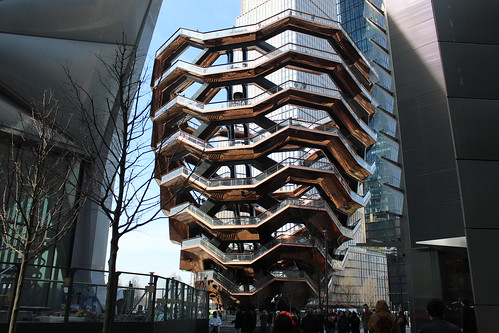 The Vessel by Thomas Heatherwick Studios, Hudson Yards/The Shed, New York City. Photo by Elvert Barnes.
Arts and cultural spaces can be provided by property developers driven by the desire to increase marginal economic returns for the project overall. The principals might have an interest in arts and culture but they are doing this to make their developments more successful, worth more money, have more customers, charge higher rents, have lower vacancy rates etc.
The Vessel sculpture-stairway by Thomas Heathewick in Hudson Yards, New York City has attracted criticism as this photoshopped reinterpretation indicates. (Artist unknown.)The culture program of The Shed at the just launched Hudson Yards development in New York City is an example. It's partly proffer, partly to make the project more successful.
Daniels Corporation in Toronto. They want the activation but as a corporation they seem to be committed to providing valuable cultural benefits ("
Vibrant New Arts and Cultural Center Announced at Regent Park," ArtDaily).
Monroe Street Market in DC has a pedestrian street lined mostly by small studios/sales spaces for artists and craftspeople. In presentations Jim Abdo talked about how great this was, but he didn't acknowledge that filling out that space with traditional retail would have been really difficult.
THEARC (Town Hall Education and Recreation Center) in DC's Ward 7 was built in part to help revitalize an adjacent community, but also to help push the adjacent real estate development forward in an area that was hard to invest in on a strict profit basis ("
On Mississippi Ave. SE, a place of light and learning,"
Washington Post). It's still a great community asset regardless of its genesis.
Real estate development and operation by nonprofit organizations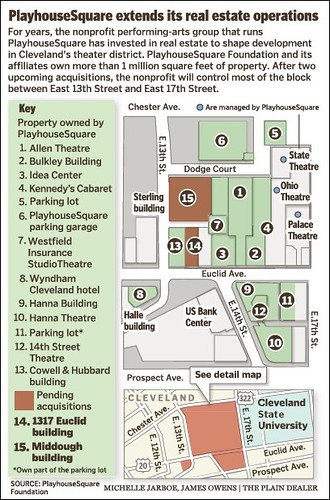 Cleveland Plain Dealer graphic.
Cultural districts that are systems integrators in terms of funding sourcesPittsburgh Cultural Trust; Playhouse Square Development Corporation, Cleveland; BAM (Brooklyn Academy of Music) Culture District; Upper Manhattan Empowerment Zone (they did a presentation c. 2003-2005 as part of the planning process for the U Street DUKE Plan -- back in the day OP did some great capacity building programming. On that panel were representatives from the KC district that has the Negro Leagues Baseball Museum, Greater Philadelphia Tourism Corporation, and Kathy Smith/Cultural Tourism DC).
In real estate finance they talk about the stack, which is comprised of multiple layers each representing a different type (or tranche) of funding.
Multifaceted cultural districts pull together all sorts of funding streams to fund capital projects and operations. It's not really a separate category because all the funding sources are listed, but they are masters at putting it together.
Property related revenue generation by cultural organizationsfunds can be used for any purpose
By this I don't mean income from renting facilities or a bit of unused office space to other organizations, which is a normal income stream. I mean "big money."
It might mean one-time revenues from the sale of developable land or ongoing revenue from owned projects which the group may or may not manage.
E.g., Playhouse Square generates rental income from projects, including housing ("
PlayhouseSquare stars in its own real estate revival,"
Cleveland Plain Dealer). From the article:
The nonprofit corporation also manages office buildings, industrial facilities, bank buildings and retail strips across the region and expects to grow through property acquisitions, a major theater redevelopment and an expansion into leasing and tenant representation.
Today, roughly 30 percent of the foundation's revenue is tied to real estate. ... The nonprofit's model -- part performing-arts presenter, part economic-development engine -- has been mimicked by arts groups from New Jersey to London. ...
Real estate has provided the foundation with a way to subsidize arts and education programs and to create what Art Falco, the chief executive, refers to as a "working endowment" to ensure the nonprofit's survival.
"We're not aware of any other organization, particularly in the performing arts, that has taken this approach," Falco said. "It's just been an evolving strategy, as we have moved from renovations of the theaters to operations of the theaters to being a catalyst for neighborhood development."
BAM too I think.
While they don't devote the money to culture, George Washington University generates a significant amount of income from real estate development, office buildings proximate to their campus. So does Harvard, MIT, and Yale, among others. Although Ohio State University and University of Pennsylvania got into real estate development to help improve the area around their campus, to improve security, etc.
The site for a tall building overlooking Central Park is worth a lot more than the typical property that a cultural organization may be able to sell. 53W53, Manhattan.The biggest examples that come to mind for me besides Cleveland and BAM are housing developments as part of later stage museum campus developments, such as the apartments at the Newseum in DC (sadly, the Newseum went bankrupt and sold the exhibit building to Johns Hopkins University), the Museum Tower next to MoMA in NYC ("
Museum Tower's $70 million duplex the newest addition to NYC skyline,"
Bloomberg Businessweek).
There are projects with museums in Denver and Dallas, but they may or may not result in ongoing revenue streams for the arts institution. I think like with the MoMA project, they are one time revenue gains. MoMA got a $126 million payment from the developer.
DC does have the capacity for supra best practice: Sumner School redevelopment. One best practice one-off variant was done by DC Public Schools in the 1980s. A playground for an unused school in the Farragut North area--Sumner School--was leased for 99 years to a developer, who built an office building on the site, as well as incorporating part of an additional school, Magruder, into the office building. But as part of the lease, the developer agreed to renovate the Sumner School, and maintain it for the life of the lease, and that building is now used as the school system's museum and archives and for events.
So not only does the school system get lease payments on the office building, it got a renovated cultural facility that they don't have to pay to maintain.
But generally, this is tough to do and the typical nonprofit doesn't have expertise in real estate development.
Colleges and Universitiesfacilities access, capital projects, program operation
This is a special category. They don't provide funds to non-affiliated arts organizations. But many colleges and universities own and operate cultural facilities also open to the public, sometimes in unique ways. Many times, these initiatives are related to academic departments and programs. Mostly the facilities are on campus, but some are off campus, often the result of the acquisition of cultural assets that had "been on the skids."
GWU and cultural events at its Lisner Auditorium is the most prominent example in DC. UMD and George Mason U have arts centers programmed for public audiences. Many universities have art museums or other types of museums. In DC, GWU has a history museum now and houses the Textile Museum as well. The Katzen Arts Center at AU is the closest thing DC has to a local arts museum. Boston University owns a number of theater buildings
Examples include public radio and television affiliates. In DC that includes WAMU-FM at American University and WHUT-TV, a public television station at Howard University. UDC used to have a radio station but when the city was broke, it sold off the station to CSPAN for the revenue. (Other agencies in other cities have sometimes done something similar.)
But WBUR, the NPR station owned by Boston University just opened a big facility with public functions, meeting rooms etc. WXPN/World Cafe in Philadelphia. Not sure on the business aspects of the music hall, but the radio station is affiliated with Penn.
Some universities have galleries off campus in the community, like the Massachusetts College of Liberal Arts Gallery 51 on Main Street in North Adams. Emerson College in Boston owns a number of theaters.
Gettysburg College owns a theater that is publicly programmed, located in the downtown of the city, which is decidedly "off campus."
MICA (Maryland Institute College of Arts) and John Hopkins University renovated the Parkway Theatre in Baltimore. It includes certain of their academic programs, space for the Maryland Film Festival and maybe other organizations, and the theatre space. The Peabody Conservatory unit of JHU offers concerts, etc.
 Photo from the Right to the City exhibit at the Anacostia Community Museum.
At one time Catholic University (CUA) owned the Newton Theater on 12th Street in the adjacent Brookland neighborhood, but they sold it off and now it's a CVS.
Some colleges have moved their bookstores to adjacent areas off campus, including in DC, CUA.
Earned incomeAdmissions, gift shops, food service, "room" rental and special event space, rental income
I didn't include this section originally because I thought it was obvious, but there are a couple wrinkles to it. If it fits in with the cultural organization, gift shop, online merchandise sales, and quality food service adds both revenue and value to an institution.
Gift shops. Over the years, museums especially but also parks have been very successful developing income streams from gift shops. Some museums may also sell more expensive art works as part of their shop operations ("
Museums don’t just want gift shops to make money — they want them to shape our understanding of art," Vox, "
Your Museum Store for the 250th: Profit, Purpose, Powerhouse," Museum Store Association, "
Museum Gift Shops: Unpacking the Art, Commerce, and Impact on Cultural Institutions," Wonderful Museums).
MoMA Design Store, Kyoto.
Leveraging the purpose of the museum, Museum of Modern Art in New York City is known for its line of design related merchandise, and they have shops in locations outside of the city including Kyoto.
National Park gift shops, usually run by an affiliated nonprofit organization separate from the federal government, provide upwards of 25% of on-site generated revenues.
Bar Luce, designed by Wes Anderson Fondazione Prada Milano 2015. Photo by Attilio Maranzano. Courtesy Fondazione Prada “The old idea was that ‘we need to have food here because people need to eat something — so we can actually get away with the lowest common denominator, and charge whatever we want.’”
… Beyond an improved experience for museumgoers and the cachet that fine food can bring, upgraded dining can also increase [...] visits.
Lox five ways at the Jewish Museum.
In an example of mission related menu planning, the Jewish Museum in NYC features a kosher restaurant called Lox.
(I always thought that DC's City Museum should have tried to work with Marriott Corporation to create a revived Hot Shoppes Restaurant as the museum's food offering--the corporation started with food sales at a hot dog stand on 14th Street in Washington, DC.)
In DC, the National Museum of the American Indian cafe features dishes from native cuisines while Sweet Home Cafe at the National African American Museum of History and Culture is all about Southern cooking ("
The 5 best museum cafes in D.C,,"
Washington Post).
Central Park, given its size, has a wide range of restaurants, concessions, and food carts, at price points from quite high (Tavern on the Green), to more medium priced food. A number of museums in NYC have added restaurants from name firms and restauranteurs. Often they operate hours outside of the museum's normal operating hours, offer a discount to employees and members, and return from 5% to 10% of profits to the museum.
Wedding at the Marina Park Pavilion, Lake Dillon, Colorado.
"Room" rentals and special event space. Some organizations derive significant income from rental of space for business meetings or special events like weddings, which may or may include catering sales from on-premise establishments.
Or theater and cinema operators may rent their facilities for performances, business meetings, etc. like the community dance performance I saw once, that was shown in the Howard University Theatre, which the group rented.
Usually it's smaller spaces, like the meeting house at This is the Place Park in Salt Lake, a gallery in a museum, a space set aside for meetings, etc.
Red Butte Gardens in Salt Lake has set up an amphitheater on part of its grounds and sponsors a summer concert series which generates. Tickets range up to $105, it fits up to 3,000 people per show, and also allows for the sales of sponsorships separate from the general operation of the overall facility. A case study in Public Gardens Management (I can't find my copy of the book at the moment) stated a high percentage of RBG's revenue came from this, as much as 45%. Because it's set off from the Gardens, it doesn't affect other operations of the arboretum.
Depending on the venue, providing alcohol to guests likely requires special permitting or service from a licensed facility on site. Marketing is also an issue. Unless the spaces are well known, marketing is required, which might not be a skill existing within the organization, etc.
Tents in Bryant Park display festive colors during Fashion Week in New York, 2006. (AP Photo/Stuart Ramson, file)
Scale: whole institution events versus rental of smaller spaces. This can become "too much of a good thing," and a bastardization of an organizational mission.
Workers clean up Grant Park the day after the 4-day Lollapalooza music festival on Aug. 5, 2024, in Chicago. (Stacey Wescott/Chicago Tribune)
It's important to balance park closures, revenues, and negative impacts to the park and to the public who lose out on access in the interim.
Rental income. From spaces in the facility or on the grounds, not involving public facing functions. As mentioned above, GWU but also Yale University among others ("
City Planning 101: Why universities became big-time real estate developers," Slate), have large real estate portfolios on which they earn income. The facilities may have some relation to the school, like Yale owning a neighborhood shopping center which serves the campus, or not, like GWU renting buildings to the World Bank. Cooper Union, an arts, architecture and engineering college, owns the land where the Chrysler Building was built, and it's a significant source of revenue.
Typically this only happens with large institutions, mostly universities. But Playhouse Square in Cleveland acts as a developer, usually to manage the area around its "campus," and for revitalization, but it has the benefit of generating income for use by the organization on other priorities.
The dispute leaves Cornell without rental income from a marquee property that was supposed to generate revenue for decades and highlights the risks universities face when they lease campus land to private operators. With 57 years remaining on the sublease, the lost rental income could total hundreds of millions of dollars — a gap Cornell is now racing to close by finding a replacement operator for the shuttered hotel.
Labels: arts-culture, capital planning and budgeting, municipal finance and budgeting, nonprofit funding, nonprofit management, public finance and spending, tax credit programs


.jpg)
.jpg)