Rebuilding Place in the Urban Space

"A community’s physical form, rather than its land uses, is its most intrinsic and enduring characteristic." [Katz, EPA] This blog focuses on place and placemaking and all that makes it work--historic preservation, urban design, transportation, asset-based community development, arts & cultural development, commercial district revitalization, tourism & destination development, and quality of life advocacy--along with doses of civic engagement and good governance watchdogging.

Monday, July 25, 2022

University of Utah University Neighborhood Partners program and community revitalization in West side Salt Lake City/County

(charlie a long time ago said it would be interesting if I would write more about what I learn about Salt Lake.  Now, with things moving back to a kind of endemic covid normal, I am learning more about programs and initiatives in the area and from time to time I will write about them.)

Ever since I was in college and an involved student, I have been interested in "town-gown" relations between schools and communities, and programs that help the latter.  This has been the case partly because many universities, like Yale in New Haven, Penn in Philadelphia, University of Chicago on the South Side, etc. are (or were) in economically languishing communities.  

But that's not categorical.  In "Back to School #3: College " (2016) I mention a number of elements (slightly edited):

-- In most communities, colleges and universities are major property owners, and even developers ("Project Rehab, University City District, Philadelphia: Best Practice Neighborhood Stabilization Program," "What do universities owe abutting communities? | Penn to invest in Lea Elementary School in West Philadelphia")

-- Business development initiatives ("How the closure of a Pfizer research center in Ann Arbor, Michigan led to the development of a biotech sector there," "Naturally occurring innovation districts | Technology districts and the tech sector")

-- Coordination and collaboration among universities within cities ("The other George Miller idea: creating multi-college innovation centers in (cities) Philadelphia | Creating public library-college education centers as revitalization initiatives," "Better leveraging higher education institutions in cities and counties: Greensboro; Spokane; Mesa; Phoenix; Montgomery County, Maryland; Washington, DC")

-- Economic and community impact ("University President Freeman Hrabowski and an agenda for urban universities," "President of Washington State University dies: fostered development of the "University District" adjacent to Downtown Spokane," "Universities as elements of urban/downtown revitalization: the Portland State story and more")

-- Economic impact of college sports, public funding of sports facilities ("Tourism economic impact of University of Michigan football")

-- Property tax exemptions and local municipal revenue

-- Sustainable Mobility

-- Interaction/exploration programs introducing students to the city     

I have been pretty critical of DC's universities for not being particularly engaged with the city, although there is probably more interaction than I know about it.  Still, for decades, not one DC-based university was a member of the Coalition of Metropolitan and Urban Universities, and none really have a stellar urban studies program.

One of the Monroe and Market mixed use buildings, Brookland neighborhood.

Catholic University is about the only university doing a major campus adjacent development program.  Interestingly I got in an e-mail discussion with the author of a recent encomium about CUA's retiring president ("John Garvey improved Catholic University — and Washington," Washington Post).  

The author attributes Brookland's revitalization to President Garvey's efforts while I pointed out that the real estate development project he was inferring started at least 6 years before the president took office in 2011--the project starting delivering as he became president.

And at the University of Maryland, community programs serving area communities seem to wax and wane depending on the university's economic circumstances.  After the 2008 recession, they dropped their primary outreach program.

That's why I find the University of Utah University Neighborhood Partners program to be pretty interesting.

The University is based in the east part of Salt Lake City, which is the city's wealthier section, at the foot of the Wasatch Front mountain range.  

Partnerships target university and community outcomes, all feeding into the long-term goal of decreasing barriers to higher education, but also focused on place-based community improvements.

The UNP program provides directed access to university resources to the west side of Salt Lake City and increasingly to westside Salt Lake County, which is less well off economically, with a much greater range of ethnic diversity.

And it's about 21 years old, with much more staying power and commitment than I remember from university initiatives in the DC area ("How University Neighborhood Partners helps west side leaders," Salt Lake Tribune). 

Partners in the Park event in Poplar Grove Park.

Besides various action research initiatives, UNP also sponsors events around the community, like the Partners in the Park resource fair, where various partners in the UNP program have exhibits and community members can talk to people conveniently in their neighborhoods, without making special trips.

Impact.  The real question is how much economic and social impact.  That I don't know and need to look into more deeply.  

There's definitely a lot of personal impact, with more west side youth going to the University of Utah and other higher education institutions for college.  

The areas don't seem "revitalized" but on the other hand, they don't look so poor either.  Sure, somewhat disinvested compared to the east side.

Westside Salt Lake has no center.  I think the biggest issue is that there aren't really strong "town centers" on the west side the way that there are on the east side ("Thinking about the opportunities for success with neighborhood commercial districts: comparing Manor Park in DC to 15th and 15th in Salt Lake").  Plus so much of the land is zoned industrial that from the residential perspective, it's going to lag.

I do know with a regular Main Street commercial district revitalization program ("Basic planning building blocks for urban commercial district revitalization programs that most cities haven't packaged: Part 1 | The first six") that it takes a couple decades and ongoing efforts beyond to see real improvement.  So from that perspective, 21 years is just getting started.

Therefore, the university's commitment to the University Neighborhood Partners program is impressive (cf "Drexel’s John Fry talks about nurturing biotech, building University City, and why the school wants to mint more engineers," Philadelphia Inquirer).  From the Salt Lake Tribune article:

It was in 2001 that University of Utah President Bernie Machen (1998-2004) recognized and took ownership for the fact that, as an institution, the U was little involved on the west side. Determined to change that, he turned to Irene Fisher, then-director of the Bennion Center, to change the University’s role from absentee to west side community partner.

Fisher spent a year - yes, an entire year - just interviewing west side community leaders and organizations about what they wanted from the University. And the finding from all that listening?

“They wanted to be listened to more,” said Mayer-Glenn. West side leaders also said they were, “tired of being studied and then the U would just disappear - doing research with no real impact or usefulness to the community.”

In short, west side residents didn’t want to be rescued, they wanted a partner who would seek to understand them. That meant listening, and staying to listen. So, second, listening is about an ongoing conversation.

Mayer-Glenn explains that, out of conversations, key issues emerged. “We don’t bring solutions, we find leaders and then we help them develop their own capacity to realize the change they want to see in their community.”

That usually starts with a leadership “pipeline” where a cohort of community members take a low-cost, team-based leadership course. “Sometimes sparks happen,” said Mayer-Glenn, “and an idea and a plan emerges.”

As a project takes on shape and substance, the next step in the pipeline is UNP’s startup incubator that provides additional capacity-building support. From the incubator a number of (primarily) nonprofit startups have emerged that serve the west side community.

“It is because of organizations like UNP that we have been able to grow and increase the connections and opportunities and access we need,” said Javier Alegre, executive director of Latino Behavioral Health Services, one of the first organizations to emerge through UNP’s leader pipeline.

Although maybe the next step is to do something like the "George Miller" idea for Philadelphia's Navy Yard ("The other George Miller idea: creating multi-college innovation centers in (cities) Philadelphia | Creating public library-college education centers as revitalization initiatives"), or what the University of Michigan is doing in Detroit ("Detroit Center for Innovation to be built in The District Detroit," University Record), on the west side.

It could also help create a more defined downtown of west side.

The University's health system is going to be doing something not dissimilar in West Valley City ("A big hospital complex is coming to West Valley City. See what it will have," Salt Lake Tribune), providing better service to an underserved area, but also expanding the University of Utah Health system, which has tended to be focused on its medical campus, while other hospital systems in the state are extending their networks across the state.

Labels: , , , ,

Tuesday, May 31, 2022

John Fry, president of Drexel University, and universities and cities

John A. Fry, president of Drexel University, talks about the challenge of managing a university through the coronavirus. Photo: Michael Bryant, Philadephia Inquirer.

The Philadelphia Inquirer published an interesting interview with John Fry, the president of Drexel University, on his being awarded the William Penn Prize honoring civic leaders, by the city chamber of commerce ("Drexel’s John Fry talks about nurturing biotech, building University City, and why the school wants to mint more engineers"). 

He worked on urban initiatives for University of Pennsylvania, then went to Franklin & Marshall in Lancaster, Pennsylvania, as president for 10 years ("College President as urban planner," PI, 2016), then became president of Drexel in 2010. 

Rather than build on the previous president's initiatives to build a campus in Sacramento, he doubled down on Philadelphia, including such initiatives as:

  • investing in the area around the campus, including in the University City District business improvement district (which does a lot of great work) and the 30th Street Station owned by Amtrak
  • student retention programs--initially he called for expanding enrollment by 10,000 students, but realized they could have more effect by retaining more of the students they already had
  • bought vacant property in the area, stabilizing and improving it, providing space for start ups and university expansion
  • expanding the College of Computing and Informatics, not unlike then Mayor Bloomberg's initiative to create an IT school with Cornell and Technion--Philadelphia lost out on the Amazon HQ2 initiative in part because of a dearth of potential tech employees
  • created a second medical campus in suburban Philadelphia
  • built dorms (through a private firm) to add housing for 3,000 students
  • took over the Academy of Natural Sciences and the local history museum, Atwater-Kent, so that they will still exist.

Other recent entries relevant to higher education institutions and cities are:

Labels: , , , , , ,

Monday, October 11, 2021

College towns and sustainable mobility promotion

School's back in session for many universities.

There is an article in the Detroit News, "Why Wayne State is offering free public transportation to students, staff," about how Wayne State University is shifting money it had spent on poorly used shuttle buses to instead pay for transit passes good on the area bus services (the city and the suburbs have separate systems), the city bike sharing system, and the QLine streetcar on Woodward Avenue.  

This program is open to students and staff.  (Article access requires subscription, but you can access it from a typical public library system's articles database.)

-- Wayne State press release describing the program

The SF Muni program is providing college students with free transit access too, this and next year, paid for by Covid stimulus monies.

It makes me think of the conversation I had with a planner at Towson University, who said "we should think about 'safe routes to campus' and all the ways--transit, biking, etc.--we can facilitate it."

A bunch of best practices.  Many universities have agreements with local transit services for student access.  For a time (until the 2008 recession), Central Washington University in Ellensburg made its transit system open to residents.  University of Maryland has an extensive shuttle bus system, and College Park residents could pay for a pass, and the University bus service also operated the special Route 1 bus service in that corridor.  Baltimore's Collegetown program has a shuttle bus operating between university campuses.

About 20 years ago, this was an area of interest for UCLA planning professor Donald Shoup  ("Unlimited Access: Prepaid Transit at Universities,").

Some transit systems, like LA Metro and the Baltimore-area MTA, offer reduced cost transit passes to college students independent of university financial support.

Photo: Ktransit.

Portland State University funded a stop for the campus on the streetcar line, and provided right of way through the campus. Oregon Health Sciences University operates the Portland Aerial Tram.  

But sadly, some universities like University of Southern California and Norfolk State University have been resistant to facilitating access to local transit systems.  Some don't plan for it at all.

Harvard University has paid for a number of bike sharing stations serving its campuses.  UC Davis when it first built its campus, made it walking and biking centric, banning cars from the central section of the campus.  Other campuses have bike rental/use programs, have bike repair shops on campus, and extensive intra-campus bike lane systems, etc.

UC Santa Barbara bike shop brochure

University of Utah has provided subsidies to faculty and staff for e-bike purchases. Some universities have bike master plans and the League of American Bicyclists "Bike Friendly" program includes universities, who vie for designation.  Baltimore's Collegetown program has a system of bike routes between campuses as well.  (I argued that Baltimore County should have tried to extend such routes to Towson University and UMBC.)

University of Utah has an arrangement with the transit authority so that tickets for sports events (football, baseball, gymnastics, basketball) also provide transit access for no additional charge ("Hate Stadium Parking and Game-Day Traffic? An Idea," CityLab). 

Sustainable mobility programming and college campuses.  I have three pieces that are particularly relevant:

-- "Innovative University Transportation Demand Management Programs," 2014
-- "College towns of a certain size as an opportunity for sustainable mobility nirvana," 2018
-- "This week is Bike Week at the University of Utah," 2018

The basic point is that college can be a good time to "imprint" students with best practice paradigms about sustainable mobility that they can adopt going forward, beyond college (fingers crossed, but I'm not totally convinced).

Certainly, living in Ann Arbor, mostly walking, but biking some and occasionally using either the University shuttle service between campuses (one year I lived on the route, but I still didn't use it much) or the city bus service, primed me for adopting sustainable mobility practices once I moved to Washington.  But plenty of college students are anti-transit and remain so after they graduate.

Intra-campus bike path at UCSB.

Promotion must be constant.  But that if you're going to promote sustainable mobility practice, it needs to be constantly emphasized and promoted, and multiple initiatives need to be adopted--especially because every year there are new students, AND YOU NEED TO START IN THE FALL TERM because that's when students come back to school.

For example, University of Maryland does its "bike week" in April, when school is almost over, while University of Utah does their "bike week" at the start of the fall term. (But Utah doesn't participate in the city bike sharing system.)

Ideal program elements.  A "sustainable mobility expo" needs to be held every fall at the bare minimum.

And more than just providing access to bike sharing--which many universities don't do at all, universities should have bike purchase programs for students and staff, bike maps (posted), repair facilities, etc.

States should require as part of campus planning requirements, that colleges be required to do sustainable mobility planning (biking, walking, transit).  For example, in Maryland there are no such requirements.  Some universities care and do it, others don't, even in the same county.

Similarly, cities should include transportation demand management planning requirements on colleges and universities, including for sustainable mobility (biking, walking, transit).

Secure bike parking should be a minimum requirement, as bike theft on campus is a perennial problem.

Labels: , , , , , , , ,

Wednesday, November 27, 2019

(WTF?) University of Michigan faculty raise objections to UM investment in creation of Detroit Center for Innovation

A c. 1940s post-war ad by a company then based in Detroit. In the 1950s, Detroit had something like 15 auto assembly plants, now it has two.

The University of Michigan announced the creation of a new Detroit Center for Innovation, in association with Dan Gilbert, principal of Quicken Loans and a big investor in the physical revitalization of Detroit albeit focused on the core and private equity honcho Stephen Ross (who has his own issues, "Who is Stephen Ross, the billionaire criticized for his high-end Trump fundraiser?," Washington Post) in an Opportunity Zone which have issues ("I figured out why Opportunity Zones won't amount to much") on a site that had originally been slated for a jail.

The College of Literature, Science and the Arts has a Detroit-based program, the Semester in Detroit, where students live in the city, take classes and do projects, and faculty of the program have criticized the DCI proposal ("UM Semester in Detroit faculty express concerns about new Detroit Center for Innovation," MLive).

From the letter:
UM would offer masters degrees and “stackable certificates” for professionals who would serve the emerging high-tech economic system, building capacities in areas such as artificial intelligence and cyber-security, emerging fields in what some have called the rise of “surveillance capitalism.” As reported by Detroit Free Press business columnist John Gallagher, the planning for this project occurred almost exclusively behind private, closed doors with no input from long-time Detroit residents, community institutions or city council. ...

The city of Detroit is important - both historically and contemporarily - for understanding the complex and inextricable conflicts created by capitalism’s dependency on racial and economic oppression and inequity. While such conflicts have been present since colonization of the original Anishinaabe lands that became “Detroit,” we need only look back a few years, or even weeks, to see how white billionaires continue to “re-imagine” majority-black Detroit in their own image and for their own economic benefit. Given this history, and considering the private interests involved in this partnership, we believe the “Detroit Center for Innovation” is an inappropriate and irresponsible deployment of the University’s social, economic and intellectual capital. ...

So many companies once based in Detroit and with manufacturing facilities in Detroit and the surrounding area no longer exist. 
Many recent major development projects in Detroit have skirted, abused or manipulated the spirit and legal requirements of Detroit’s community-benefits ordinance. ...

The land for this project encompasses the boundary between the historic black neighborhoods of Black Bottom and Paradise Valley, which were strategically destroyed by the city of Detroit, in conjunction with the federal government, in the mid-20th century. How will these community histories and legacies be honored and empowered without tokenism and cultural cooptation? And, who will decide?
Yes, I think universities need to be careful about the relationships they make with funders and programs.

Given his recent controversies, I'd probably back away a bit from Stephen Ross.  OTOH, he is a UM graduate and gave enough money to the business school to have them rename it in his honor--first after a donation of $100 million, which he followed up with a second $100 million 9 years later..

But UM and Dan Gilbert, even Stephen Ross, aren't responsible for all the faults of capitalism and to possibly scuttle this investment/program as a result would do a lot more harm to Detroit.

I do think such criticisms can and should be used to make the program better, and more focused on generating more direct benefits for the city.

The Sun Still ShinesBut Detroit's biggest problem is disinvestment.  The solution/response to disinvestment is investment.

The city has is a loss of two-thirds of its population over the past 60 years and much of its industry.  It needs to reboot the business ecosystem in order to be able to generate growth in the face of abandonment.

When I first heard of the proposal, I thought about an article I had read about Walter Chrysler, and why he was able to create a car company without a lot of internal capacity.  It was because he was able to rely on a rich ecosystem of suppliers.

-- "Markets, Networks, and the Rise of Chrysler in Old Detroit, 1920—1940," Michael Schwartz, Enterprise & Society, 1:1 (2000)

In the 80+ years since, the business ecosystem of auto production has changed significantly, bulked up, so that such an ecosystem no longer exists.

But that's true of many different industries.  And many other cities have been equally crushed by the changes from consolidation and relocation of manufacturing outside of the US.

Could a UM DCI help to rebuild such an ecosystem across multiple business sectors, thereby helping to rebuild not only Detroit, Michigan and US manufacturing (cf. "Innovation Should Be Made in the U.S.A.," Wall Street Journal) but the city's economy and attractiveness as a place to conduct business and reside?

(My problem is that I have to forget my memories of what Detroit was before 1970--many of us did not recognize that the city was in serious decline at the time--and take such proposals from where they are, where the city is today.)

Labels: , , , , ,

Thursday, February 07, 2019

DC, Universities and "making versus taking" or universities that add to a community's capital and those that don't

Earlier in the week, the Washington Post ran an article, "How many colleges and universities operate in DC?," about the rise of universities from elsewhere in the US opening programs in DC and how this benefits the city.

Featured examples include the University of California Washington Center (pictured at left) and the proposal by Johns Hopkins University of Baltimore (which already has a center offering a variety of degree programs in Dupont Circle; plus their health system owns a hospital in the city) to buy the Newseum, a grand building on Pennsylvania Avenue close to the Capitol and the National Mall, for the relocation and unification of their programs into one facility.

I've written in the past about how DC has lots of universities but doesn't really get the maximum economic benefit from them, at least in terms of their sparking new business development and economic activity.

-- "Better leveraging higher education institutions in cities and counties: Greensboro; Spokane; Mesa; Phoenix; Montgomery County, Maryland; Washington, DC," 2016
-- "Naturally occurring innovation districts | Technology districts and the tech sector," 2014

And about universities, urban revitalization, and urban planning more generally:

-- "Should community culture master plans include elements on higher education arts programs?," 2016
-- "AJC series on Historically Black Colleges and Universities," 2018
-- "Speaking of planning for higher education: more on the University of the District of Columbia," 2012

including a couple pieces on College Park, Maryland, home of the University of Maryland College Park:

-- "College town follow up: alumni as residents and contributions to community capital," 2015
-- "More Prince George's County: College Park's militant refusal to become a college town makes it impossible for the city(and maybe the County) to become a great place," 2015
-- "Revisiting past blog entries: College Park as a college town and economic development | PG County and Amazon," 2018

That's because the schools and programs that tend to generate the most economic activity--business, engineering, computing--aren't necessarily that great.

And the health programs--Georgetown, George Washington, and Howard all have medical schools--aren't major research and health science technology development powerhouses compared to counterparts elsewhere.

For years, I wrote that not one DC based university was a member of the Coalition of Urban and Metropolitan Universities (Georgetown joined a few years ago and I guess that must have spurred the University of the District of Columbia to join too) and none really have great urban studies programs.  For awhile only UDC had an urban planning program.  Now it doesn't, but GWU, Georgetown and CUA have programs.

By contrast, other cities smaller, less well located, and "less prestigious" than DC have recognized the value in focusing on higher education as a revitalization and economic development tool and they're doing a better job of it.

JHU's major university center in DC is based at 1740 Massachusetts Avenue NW.

My argument about the "Washington semester" and degree programs, and centers (mostly about politics) being set up in DC by non-DC universities isn't about adding to the city as much as it is about benefiting or taking from it.

It's along the lines of my cultural planning writings which differentiate between arts organizations promoting "arts production" by which they add to, extend, and build the arts ecosystem and focus on producing art created by living artists versus promoting "arts consumption" or the presentation of arts and culture to audiences of works usually produced elsewhere, often by people no longer living.

Or as can be extrapolated from the piece "College town follow up: alumni as residents and contributions to community capital," universities based elsewhere but with programs in the city aren't likely to contribute much to community capital UNLESS they specifically create programs and initiatives to do so.

One example is how Kent State University's architecture school has an urban design studio in Cleveland, where the students are engaged in a variety of community-serving projects the the school's Cleveland Urban Design Collaborative.

(For a long time, HUD had a program to foster the development of such programs by universities, although no university in DC seems to have availed themselves of the program.  CUA's architecture school does a fair amount of urban design studio work by students on projects in the city.  To its credit, University of Maryland's planning and architecture school does a fair amount of projects in DC too.)

Labels: , , , , ,

Tuesday, September 11, 2018

This week is Bike Week at the University of Utah

In the draft plan I did for Baltimore County, I did discuss specific measures to work with large organizations such as college campuses, to develop in systematic ways programs to support bike commuting, but discussion about programming and promoting cycling in specific ways was for the most part deleted from the plan.

During my time there I made a couple presentations at Towson University, and a few years ago, I served as a special lecturer for an online segment on bicycle and pedestrian planning for a course at the New School.  So I have some presentations on focused planning for bicycling at universities.

And while I have written from time to time about the need for focused transportation demand management planning at universities, one of the best ways to increase bike use at universities is to promote it.

In my assessment of where we are with bike planning ("Bike to Work Day as an opportunity to assess the state of bicycle planning: Part 1," 2017), recommendation #3 is:
In the DC area specifically, there needs to be greater focus on the opportunities to work with large employers, especially the federal government, and college campuses.
I did have a section on biking for transportation in the 2016 post, "Back to School #3: College."

The advantage of promoting biking to college students is that they are "impressionable" and it's a good time to develop sustainable behaviors as routine ("College towns of a certain size as an opportunity for sustainable mobility nirvana," 2018).

This leverages the interest that many universities and their students have in sustainability more generally.

-- Association for the Advancement of Sustainability in Higher Education

The university in Davis, California was a leader in promoting biking when it opened in the early 1960s ("Davis, California – the American city which fell in love with the bicycle," Guardian) and most University of California campuses are national leaders in transportation demand management.

The League of American Bicyclists has the "Bicycle Friendly University" program. Among exemplary best practice examples, Ripon College provides free bikes to students who commit to not bringing a car to campus ("Ripon College gives freshmen free bikes for no-car pledges," Milwaukee Journal-Sentinel).

A basic set of steps related to promoting biking on campus include:
  • an intra-campus bike route system, with links to the community bike lane network
  • lots of bike parking
  • including high quality secure parking, especially in dorms
  • programming to facilitate bicycling for transportation
  • an on-campus bike shop including repair activities
  • support for community bike sharing systems (paying for stations serving campus and discount membership programs)
  • creation of "bike provision" programs to rent bikes to students for low or no cost, for the term or year, including helmet and lock [At UCLA they call it the Bike Library, "Bikes all rented out at UCLA Bike Library," Daily Bruin) while at North Central College in Illinois, use of a "rental" Cardinal Red Bike is free, but they have a small number of bikes.]
  • discounts for bike purchasing, especially for staff (could adapt the British program of payroll deduction programs to buy bikes), but students too
  • including e-bike purchase discount programs for staff
  • anti-theft programs.
Schedule of events, Bike Week 2018 at the University of Maryland College Park (poster).

I think it was 2011, when I went to a Bike Day promotion at the University of Maryland College Park but it was in April, pretty much at the end of the school year.

To its credit, the UMCP has kept up and significantly expanded what they're doing to a full-fledged Bike Week.  But it's still in April, at the end of the school year, rather than in September.

That's incredibly poor timing.

Instead, cities should get universities to hold "Bike Week" or "Bike Expo" programs during the first month of school in the fall.

That's what the University of Utah does, where this week is Bike WeekThe campus is located uphill in Salt Lake City.  One of the events will be a bike expo this Thursday, which is something that should be part of a Bike Week promotional calendar at all college campuses.

Earlier in the year the University had a special promotion to provide discounts on purchases of electric bikes.  I'd argue that's a program that should be offered to staff especially on a year-round basis.


Interestingly, the SLC bicycle sharing program doesn't seem to be a sponsor of the University Bike Week.  Students are eligible for a discount of about 1/3.  Then again, there aren't any bike share stations at or near the University.  That's something that should be addressed as part of a wider range of bike planning there.

One cool thing about the B-cycle programs is that many of them offer cross-usage privileges without an additional fee.  That ought to be a member benefit attractive to college students, especially those visiting Denver and Boulder.

============
Davis, California as an important lesson for other college towns.  Davis was pathbreaking in that when the university campus was created, it didn't allow cars, and specifically promoted biking.  It led to the City of Davis becoming an equally committed proponent of bicycling("Davis, California - the American city which fell in love with the bicycle," Guardian)..
Bicycle racks at the University of California, Davis, 1963, by Ansel Adams


But this was in the period of widespread biking use, before automobility superseded other forms of mobility in the US.  Plus, because new student cohorts need to be educated and trained each year as other cohorts graduate, transportation demand management programming needs to be constant and rigorous rather than trickle down.

Over time, biking for transportation has significantly declined, both on the campus and in the city, and other cities, which developed more advanced practices, have leapfrogged Davis ("Fifty years of bicycle policy in Davis, CA," Ted Buehler).

The lesson is that promoting sustainable mobility practice needs to be constant.

And timed properly.

Labels: , , , ,

Monday, July 09, 2018

College towns of a certain size as an opportunity for sustainable mobility nirvana

There is an article, "Study seeks ways to improve public transit in Newark," in the Newark (Delaware) Post about the MPO there doing a study on improving transit in that city, which is home to the University of Delaware, and has various transit services, including a rail connection to Wilmington and Philadelphia through SEPTA.

Interestingly, that MPO is responsible for part of Maryland, including Perryville, and planning is going on to extend the MARC commuter rail system to Newark, or the SEPTA connection to Perryville ("Maryland trains to Newark inch closer," Wilmington News-Journal).

I was there once, in 2010, when I gave a presentation on "Metropolitan Mass Transit Planning" and urban revitalization blogging at the School of Public Policy and Administration, although it hardly makes me an expert on the town.

When reading the article and the comments, many negative, I couldn't help but think:

1.  Outside of big cities it's hard for people to consider transit as a realistic and preferred mode, since the rest of the nation is designed--by land use and transportation policy and practice--to preference and require automobility.  So I do understand the negativity.

2.  Because college towns have a large number of students, most who don't have cars, live on or close to campus, and walk mostly, there is the ability to develop a system and culture supportive of transit in these communities, which are outliers compared to most American communities.  For example, this is why some of the only successful "pedestrian malls" in the U.S. are in college towns like Boulder, Burlington, Vermont, and Charlottesville, Virginia.

-- "Sustainable transportation planning on college campuses," CJL Balsas, Transport Policy, 2003

3. So why not build upon the potential for transit in college towns, by going beyond, and creating "sustainable mobility districts," and the construction of a multi-faceted "sustainable mobility platform" not just for the campus but for the entire community.

Best practice campus mobility initiatives.  A 2014 piece, "Innovative University Transportation Demand Management Programs," lists a number of best practice programs as a kind of toolkit that can be drawn upon for the development of such a vision:

That entry responded to the release of a report, A New Course: How University Programs are Reducing Driving on Campus and Creating New Models for Transportation by the US PIRG Education Fund and the Frontier Group

It has a set of recommendations and a bunch of examples of best and better practice at universities across the country.  Its most important points are that:
  • TDM helps strengthen town-gown relations
  • saves money for the college
  • helps the environment
  • patterns the behavior of young adults in ways that support sustainable transportation choices throughout their lifetime (using the campus bus and the city bus system on occasion in Ann Arbor probably primed me for using transit in the "big city" later),
  • and provides best practice examples that can be used to improve sustainable transportation practice in other settings.
There are plenty of college towns like Ann Arbor ("Meanwhile, 35 miles west of Detroit, a transit funding measure faces certain victory," MetroTimes), Chapel Hill, Boulder, Ellensburg, Washington, and others that are best practice examples for transit provision.

Usually what is offered is a mix of city-based and university-based services, although Chapel Hill Transit is the sole provider in that city, is free to ride (except for express commuter bus services), and the University of North Carolina provides 38% of the funding for the system, while in Ellensburg, Central Washington University's transit system is piggybacked on by the town.

In College Park, Maryland, there is a MOU between the city and ShuttleUM/U of Maryland so that residents are eligible to ride the system, provided they apply for a bus pass and prove they are residents.  Otherwise, the city is served by separate county and metropolitan transit services.  The college bus system runs a separate branded service on Rte. 1, funded by local communities and the county.

The university in Davis, California was a leader in promoting biking when it opened in the early 1960s ("Davis, California – the American city which fell in love with the bicycle," Guardian) and most University of California campuses are national leaders in transportation demand management.  The League of American Bicyclists has the "Bicycle Friendly University" program. Among exemplary best practice examples, Ripon College provides free bikes to students who commit to not bringing a car to campus ("Ripon College gives freshmen free bikes for no-car pledges," Milwaukee Journal-Sentinel).

In the UK, the Cyclepoint bike parking facility at the train station in Cambridge provides spaces for almost 3,000 bikes ("3,000 Cycle Parking Spaces for the UK’s Largest Cycle Hub at Cambridge StationK," Falco). Like many university towns, Cambridge has a strong bike advocacy group, Cambridge Cycling Campaign.

In Baltimore, the Collegetown Network includes a system of bike connections between universities across the city.  (When I worked in Baltimore County, I recommended it be extended beyond the city limits to connect to universities and colleges in Greater Towson and Catonsville.)

Columbia, Missouri, home to the University of Missouri, is a small town leader in sustainable mobility ("A Free-Wheeling City," Parade Magazine).  Park on the Hill is a Chapel Hill initiative providing information on parking of all types, focused on the Downtown.

Tempe, home to Arizona State University, is a leader in community transportation ("The Shaping of a '20-Minute City'," Governing Magazine).  Starkville Mississippi, home to Mississippi State University, has an exemplary local advocacy group, Starkville in Motion, dedicated to achieving pedestrian, biking, and safe routes to school improvements.


Preparing underground piping for Holland Michigan's downtown sidewalks.  Holland DPW photo.

The sidewalks in Downtown Holland, Michigan are heated, using the waste heat from a local power plant, which is then pumped through miles of pipes placed under the sidewalks.  Holland is home to Hope College.

It's not new though, they did it in 1988, when they were reconstructing the streetscape.

It's noteworthy for four reasons: (1) being in Western Michigan, Holland gets an inordinate amount of snow in what is called "the Lake effect" because of weather conditions in association with Lake Michigan; (2) it covers a lot of ground, over 10 acres; (3) it was constructed in association with a planned road and sidewalk replacement project, cutting the cost of the project compared to it being a one-off job; and (4) it is accomplished using waste heated water produced as a byproduct of electricity production.  (Waste water, which is generally at a constant temperature, can be a source of energy for heating and cooling systems, something Arlington County has pointed out in its energy planning.)

But it was easier for the city to do this because they have a municipally-owned and operated electricity production and distribution system and water and sewer system, the Holland Board of Public Works.


Portland State University sponsors streetcar stops and the streetcar is routed through part of the campus (picture, right).  (Although because of increased costs, the student id no longer includes free access to the streetcar.)

Oregon Health Sciences University operates the Portland Aerial Tram. (OHSU staff and patients ride free.)

The University of Colorado paid for naming rights for one of Denver's transit lines ("University of Colorado pays $5 million to name RTD's Denver airport line," Denver Post).

Tickets for sports events at the University of Utah include use of the local transit system.

Harvard University will be paying a significant amount of the cost for a new railroad station in the Allston district of Boston. Many universities work with local transit systems for discounted pass programs for students and staff.

Main Street, Newark, Delaware.  Photo: Jennifer Corbett, WNJ.

Newark, Delaware: parking in the core is also a problem.  One of the negative comments on the NP article referenced a previous study in the city, on parking ("Newark parking garage debate heats up," Wilmington News-Journal), that as the person recounted "led to nothing happening."

Another comment mentioned that the University does have a parking garage close by that could be used to support parking in the Downtown.

Concept of Silver Spring, Maryland as a sustainable mobility district.  That made me think of my series of articles on Silver Spring, Maryland as a "sustainable mobility district" as being relevant to this discussion, about moving the discussion beyond "transit" or "parking" towards a broader consideration of "sustainable mobility."

-- PL #5: Creating a Silver Spring "Sustainable Mobility District"
---- "Part 1: Setting the stage"
---- "Part 2: Program items 1- 9"
---- "Part 3: Program items 10-18"
---- "Part 4: Conclusion"
---- "Map for the Silver Spring Sustainable Mobility District"
---- "(Big Hairy) Projects Action Plan(s) as an element of Comprehensive/Master Plans"
---- "Creating the Silver Spring/Montgomery County Arena and Recreation Center"

Syracuse Connective Corridor.  One of the examples shaping the Silver Spring concept is the "Connective Corridor" in Syracuse, New York.

The Syracuse Connective Corridor is a wide-ranging approach on improving the connections between the campus of Syracuse University and the city, while simultaneously emphasizing sub-districts within the city center ("Is Syracuse's Connective Corridor work transforming downtown?" and "Syracuse's Connective Corridor: 2 miles long, $47 million better," Syracuse Post-Standard; "The Connective Corridor – a message from our Publisher," Syracuse New Times).
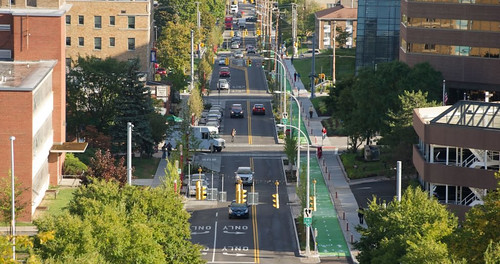
Syracuse Connective Corridor with cycle track
One of the facilities in the Connective Corridor program is a high profile separated cycle track for bicyclists.

Although there is some criticism that the project is shaped more to benefit the university, which is the primary funder.
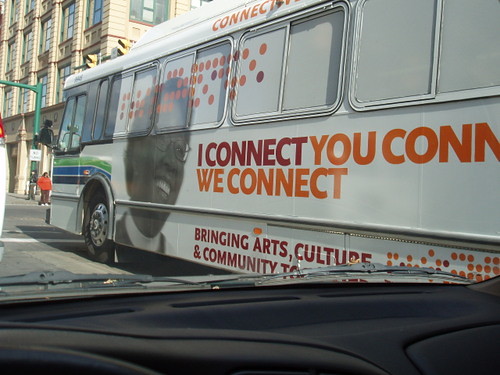
Connective Corridor decorated bus, Syracuse, NY

The description of the Connective Corridor in promotional materials sums up the elements that comprise a "Signature Street" or sustainable mobility district:
The Connective Corridor is a collaboration between Syracuse University, the City of Syracuse and Onondaga County to connect University Hill with downtown Syracuse.  The project includes new streetscapes to make the city more pedestrian and bike-friendly, a free public transportation system with smart bus technology, a network of green infrastructure, public art, wayfinding systems, façade improvements and innovative illumination projects that highlight Syracuse’s beautiful historic buildings and public spaces. The Corridor also connects the city’s vibrant arts and cultural district, as well as downtown dining and the great local food scene. Take the bus, walk or ride your bike...
Besides being a best practice example of a university taking initiative to create better connections and placemaking conditions within the city that is its home, it's an example of a university and a city joining together its resources--this latter point is important because many cities are like Newark, in running separate transit and parking systems from the university, when they would be better served by working together.

Integrating parking services.  Item #5 in the proposed program for Silver Spring is a re-articulation of parking services, including the provision of parking wayfinding systems and district-wide valet parking.  That seems like an area that needs to be explored in Newark too.

Downtown Milwaukee's street-based real-time parking wayfinding signage is a good model for the real-time signage side, because more than apps are needed to change people's perceptions and behaviors ("Downtown Milwaukee signs offer parking guidance," WUWM/NPR).

Another good example for university towns is the aforementioned Park on the Hill program in Chapel Hill.

Other elements of a sustainable mobility district.  Then add other elements from the Silver Spring framework, including improvements to the biking and pedestrian environment, including a city-wide secure bike parking system, and other placemaking improvements.

Compared to Silver Spring, some other elements would need to be added for the average college town, because they already exist in Silver Spring, such as bike sharing and car sharing, but they may not be present in smaller communities like college towns outside of major metropolitan areas.  Many universities have bike programs and special car sharing arrangements that can be leveraged to achieve broader sustainable mobility initiatives.

Sustainability planning.  Plus, universities tend to be leaders in sustainability planning and it's a good way to engage students and faculty, who are simultaneously local residents, in directing some of these energies towards community improvement..

-- "Sustainability Plans Popular on College Campuses," Environmental and Energy Study Institute

Indianapolis Cultural Trail
The Indianapolis Cultural Trail is another model of high profile pedestrian and bicycle facilities that can be drawn upon by college towns.

IBJ photo.

In a smaller, more self-contained place like a college town, e.g., Newark or Chapel Hill, etc., it would probably be easier to create a one-off car sharing organization, maybe even electric based, like Blue Indy ("BlueIndy car-sharing program striving to be in black by 2020," Indianapolis Business Journal), as a way to seed the necessary infrastructure for electric car usage beyond car share.

Portland's Electric Avenue (FAQ) would be another example that college towns could draw upon in broadening their focus from "transit" to "sustainable mobility."  (College towns are smaller and a better place to try to introduce e-based car services, whereas these types of programs are being implemented in larger cities where they are much harder to make successful.)

Davis, California as an important lesson for other college towns.  Davis was pathbreaking in that when the university campus was created, it didn't allow cars, and specifically promoted biking.  It led to the City of Davis becoming an equally committed proponent of bicycling("Davis, California - the American city which fell in love with the bicycle," Guardian)..
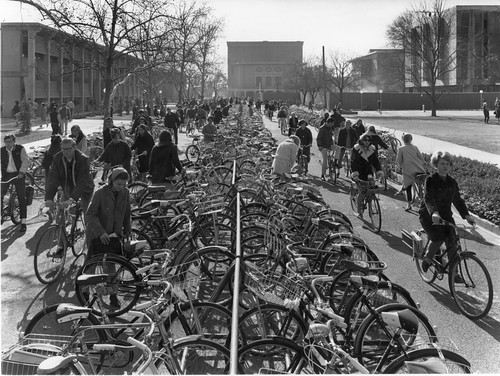
Bicycle racks at the University of California, Davis, 1963, by Ansel Adams


But this was in the period of widespread biking use, before automobility superseded other forms of mobility in the US.  Plus, because new student cohorts need to be educated and trained each year as other cohorts graduate, transportation demand management programming needs to be constant and rigorous rather than trickle down.

Over time, biking for transportation has significantly declined, both on the campus and in the city, and other cities, which developed more advanced practices, have leapfrogged Davis ("Fifty years of bicycle policy in Davis, CA," Ted Buehler).

The lesson is that promoting sustainable mobility practice needs to be constant.

Sustainable Mobility Platform elements for a college town
(recognizing that many of these elements are likely to be present, but are probably not well integrated)

1.   Integrating city and university transit into a single, unified system.
2.   Ideally riding the transit system would be free, through local and university funding sources (possibly through the creation of a transportation management district and use of parking revenues).
3.   Creating an integrated parking system between the city and university as appropriate, including wayfinding and valet services.
4.    Transportation Demand Management programming of a very serious nature, including trip travel programs for residents and large employers aimed to getting them using other modes (e.g., the Smart Trips program of Whatcom County, Washington) and the provision of TDM information at all types of locations--schools, libraries, retail businesses, large employers, bicycle shops, etc.
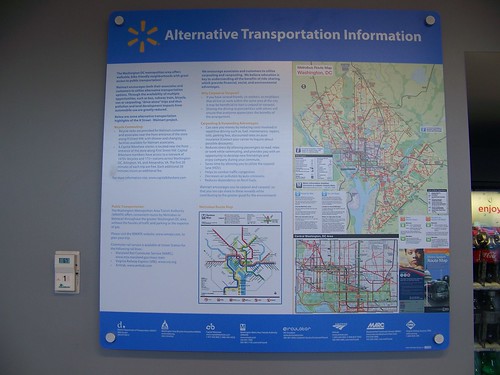
Alternative information sign, Walmart store, H Street NW, Washington, DC
TDM wayfinding signage at a Walmart supercenter in Washington, DC.

5.    Creating an infrastructure for electric car charging.
6.    Creating a car share system open to students under the age of 25, that supports both one-way and two-way usage.  Possibly the car share system could be comprised of electric cars.
7.    Set high mode split goals for biking, walking, and transit.
8.    Creating a city-university biking program, including a network of secure bike parking along the lines of the Melbourne Parkiteer system, some form of access to bikes (bike sharing), bike co-ops and an integrated network of high quality bicycle lanes, cycle tracks, and trails.*
9.    Use bike provision models such as those of Ripon College, North Central College, and UCLA to provide long-term access to bikes for students and for residents, bike commuting assistance programs such as of those in UK communities like the Hackney and Hounslow boroughs in London ("Eight "mutual assistance programs" that can build support for biking as transportation") which will loan people bicycles, locks, and helmets so they can try out biking
10.   The train station should be an anchor hub for bike parking and other bike services in the city, complemented by a campus-based "bike station."*
11.  Connect with metropolitan-regional transit systems for a low cost transit pass for use outside of the city/campus.
12.  Various pedestrian and placemaking improvements.
13.  Safe routes to school programming.
14.  Create zoning requirements for new construction that support high quality sustainable modes, especially biking in apartments, office buildings, schools, etc., plus electric car charging capacity, and spaces for car sharing, etc. College campuses tend to provide sub-standard bicycle parking, especially in dormitories.

The Urban Land Institute report, Active Transportation and Real Estate: The Next Frontier, describes 10 different apartment developments with extraordinary bicycle accommodations.  Other examples include Plant51 in San Jose ("Commuting has never been easier when you live at Plant 51 in San Jose," San Jose Mercury News) and Via6 in Seattle ("A look inside Via6's bicycle-friendly living and cycle club in downtown," Cascade Bicycle Club).
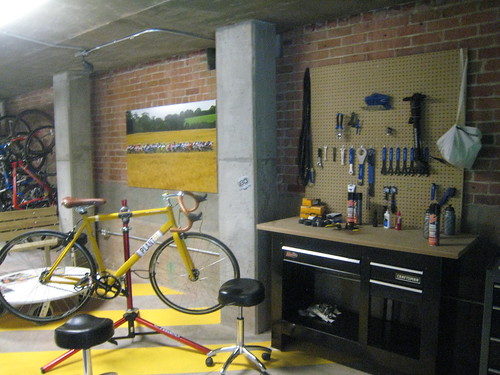
Plant 51 · Bicycle Kitchen
In-house bicycle repair station at the Plant51 condominium in San Jose.

In San Francisco, the 100 California building owned by Pembroke Real Estate doesn't have car parking, but after a renovation the building now has a bike parking room with space for more than 100 bikes, a bike repair station, lockers, showers and towel service.
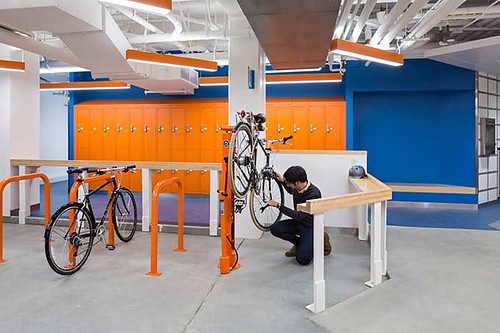
Bicycle room, 100 California Building, San Francisco
Bike Room, 100 California Building. Photo: Design Blitz SF.

Specific items for Newark
* Ideally the Wilmington MPO could work with SEPTA and the Philadelphia MPO to develop a "Cyclepoint" type program for bike parking at main train stations across the SEPTA network (in Newark, Wilmington, and Philadelphia especially), and a Parkiteer type secure bike parking program across the service areas of both planning organizations.

For Newark specifically, they should work to increase SEPTA train service between Wilmington and Newark, and to eliminate the "missing link" between the MARC and SEPTA systems.

Labels: , , , , , ,

Friday, September 09, 2016

Back to School #3: College

1.  In Boston, there were complaints that people moving in for college too often parked in bike lanes ("As students return, cyclists compete with moving trucks in bike lanes," Boston Globe, photo also).

2.  In most communities, colleges and universities are major property owners, and even developers. Colleges and universities tend to grow and develop large real estate portfolios that can engulf neighborhoods and small towns.

Oppositionally, in DC, over the past year, American University, George Washington University, and Howard University have sold/leased off-site properties that are going to be redeveloped for market rate housing.

A couple years ago, the Monroe Street Market development opened in Brookland, on land owned by Catholic University therefore generating revenue for the school, and it is reshaping the neighborhood's commercial heart.

This doesn't always work for the best, it can lead to a homogenization of retail, as pointed out in an old Yale Herald story, "The mall next door."

Elsewhere, including the University of Maryland College Park and the University of Connecticut, universities aim to create ancillary real estate developments to strengthen the place character of the college town (also see the past blog entries "More Prince George's County: College Park's militant refusal to become a college town makes it impossible for the city(and maybe the County) to become a great place," "To be a great city, College Park Maryland needs some "there", it needs a center," and "College town follow up: alumni as residents and contributions to community capital").

University of Pennsylvania is the most prominent example of long term reinvestment in the neighborhood outside of the campus for revitalization and public safety issues, but many other universities have similar initiatives, such as John Hopkins University in Baltimore.

The book The University and Urban Revival: Out of the Ivory Tower and Into the Streets by Judith Rodin, former president of the University of Pennsylvania, chronicles the revitalization story there.

Working with Historic Macon, Mercer University has invested in historic preservation-based improvement programs in the neighborhoods abutting the campus.  

As discussed in "Institutional financial support for employees to buy houses in weak real estate markets," many universities have programs assisting faculty and staff in buying houses in the community, in part as a stabilization measure

The Lincoln Land Institute has an initiative on universities as real estate developers.

3.  Business development initiatives.  There are so many science, biotechnology, business and other development initiatives going on in  and around universities these days they are too numerous to discuss, but they are important and worth paying attention to in local communities.

For example, the College Park area isn't known for ancillary business development, while it is a different story in places like Cambridge, Massachusetts ("A real estate empire grows in Kendall Square," Boston Globe,"), Ann Arbor, or the Silicon Valley ("The secretive billionaire who built Silicon Valley," Fortune Magazine) where the association with Stanford University is very clear.

4.  Coordination and collaboration among universities within cities.  This interests me a lot.  I think there is a lot of fallow opportunity for this in DC.  Cities like Spokane, Washington and Greensboro, North Carolina ("Better leveraging higher education institutions in cities and counties: Greensboro; Spokane; Mesa; Phoenix; Montgomery County, Maryland; Washington, DC") are leaders.

5.  Economic impact studies. There are economic impact studies of universities ("The rights and wrongs of economic impact analysis for colleges and universities).  Results need to be evaluated carefully.

6.  Economic impact of college sports, public funding of sports facilities. Rarer are economic studies of the tourism impact of college sports on the local community ("Tourism economic impact of University of Michigan football").  With the latter, that could influence local community interest in football conference realignment and willingness to subsidize sports facilities ("Funding Sources Differ For Baylor and A&M Stadiums," KBTX-TV).

7.  Property tax issues.  There is more talk about how universities consume a fair amount of community services and create opportunity costs in economic value because of property tax exemptions, which for most communities generate the bulk of local government revenues.  This has even come up in DC lately ("Universities in D.C. avoided $111 million in local property taxes" and "Universities shouldn't be exempt from DC property tax," Washington Post), although it's been an issue in cities like Boston and Providence for some time.  Providence has even proposed a "per capita tax" on college students ("Mayor Proposes a College Attendance Head Tax In Rhode Island," Tax Foundation).

Interestingly, Ontario and maybe all of Canada doesn't have a property tax exemption for nonprofits or other government authorities, meaning that even the Province of Ontario pays property tax to Toronto on the Parliament building. I haven't looked into it in depth, it might be that the property tax structure builds in a pricing scheme based on the consumption of public services for particular properties, so that there is a kind of break for nonprofits compared to straight up commercial use.

8. Biking as transportation.  University of Louisville got big play ("UofL forges path to change how students commute") in its local paper, the Louisville Courier-Journal, for winning a sustainability award for its Earn-A-Bike Program, which provides a $400 credit to buy a bike, presumably used for transportation not recreation.  The article made it out to be a first of its kind program, but it isn't.  Ripon College launched a similar kind of program about 8 years ago ("Ripon College gives freshmen free bikes for no-car pledges," Milwaukee Journal-Sentinel).
The goals of U of L's Earn-Bike Program include:

►Reducing the vehicle miles traveled to campus (and associated pollution)
► Reducing the number of vehicles that must be parked on and around campus
► Increasing health and activity levels within the U of L community
► Saving money you would otherwise spend on gas, parking and other automobile expenses
► Reducing traffic congestion
► Rewarding individuals for not driving to campus
Separately from the ever expanding bike sharing idea (some universities, like Harvard and MIT, pay for bike share stations rather than expecting a local government to do so), other schools have comparable programs where students can get bikes to use for an entire term for free or a low price, again, as a transportation demand management measure.

Nevertheless, a lot more attention should be paid to college campuses in terms of transportation demand management more generally, but also for the opportunity to develop the routinization of pro-sustainable mobility behaviors.

Last year's Big Walk in New York City

9.  Interaction/exploration programs introducing students to the city.  But I am particularly interested in focused college initiatives that introduce students to the broader community in a focused way, noting that plenty of universities have experiential learning programs doing field work and service in community settings.  These stick out:

The Urban Democracy Lab at New York University holds what they call, "The Big Walk," a walking tour-event in New York City.  This year it will cover about six miles, starting in Manhattan and ending in Brooklyn, starting in Washington Square at the University and ending in Red Hook.

What distinguishes this from Professor Ken Jackson's bike tour of New York City ("Taking a Spin Through New York City's History," New York Times is that "The Big Walk" is held within the first couple weeks of starting school.

DePaul University's Chicago Quarter.  I don't think any university has an offering quite like DePaul's.  The Chicago Quarter is a set of over 100 courses for freshmen, designed to:
acquaint first-year students at DePaul with the metropolitan community, its neighborhoods, cultures, people, institutions, organizations and issues. It is through these classes that students make first contact with both the university's urban identity and its Vincentian mission. Students also learn about university life, resources, and how to be a successful student. This learning is accomplished through a variety of means, but particularly through first-hand observation, participation, personal discovery, reflection, discussion, and guest lectures.
A bunch of universities have university-community volunteer days, some at the outset of the academic year, others during it.  From "“A great kind of bonding experience:” Carroll University hosts annual Freshman Day of Service":
The annual Freshman Day of Service is in its eighth year. It offers a chance for first-year students to get out and give back to the area they’ll call home for the next four years.

“It's kind of like an icebreaker," said another freshman, Mireya Ramos. "To do something as a group as well, but also help the community.”

About 700 Carroll freshmen on Tuesday, September 6th split up between 30 different non-profits and businesses in Waukesha and Milwaukee.
UCSD's end of the school year public policy presentations. Typically, urban planning students have major studio projects to finish out their studies. Usually these are field projects in local communities, and result in public presentations and the production of reports.

Besides whatever project-based presentations they make, at the University of California San Diego, the urban planning department also holds a symposium where students present on all of the year's projects. See "Smart growth, preservation goals missed in practice: UCSD urban studies students report results from senior research work," San Diego Union-Tribune.

I've often thought that all the student research that occurs in a typical academic year could be harvested, instead of lost to papers randomly distributed and retained.

Labels: , , , , ,




