Rebuilding Place in the Urban Space

"A community’s physical form, rather than its land uses, is its most intrinsic and enduring characteristic." [Katz, EPA] This blog focuses on place and placemaking and all that makes it work--historic preservation, urban design, transportation, asset-based community development, arts & cultural development, commercial district revitalization, tourism & destination development, and quality of life advocacy--along with doses of civic engagement and good governance watchdogging.

Monday, July 25, 2022

University of Utah University Neighborhood Partners program and community revitalization in West side Salt Lake City/County

(charlie a long time ago said it would be interesting if I would write more about what I learn about Salt Lake.  Now, with things moving back to a kind of endemic covid normal, I am learning more about programs and initiatives in the area and from time to time I will write about them.)

Ever since I was in college and an involved student, I have been interested in "town-gown" relations between schools and communities, and programs that help the latter.  This has been the case partly because many universities, like Yale in New Haven, Penn in Philadelphia, University of Chicago on the South Side, etc. are (or were) in economically languishing communities.  

But that's not categorical.  In "Back to School #3: College " (2016) I mention a number of elements (slightly edited):

-- In most communities, colleges and universities are major property owners, and even developers ("Project Rehab, University City District, Philadelphia: Best Practice Neighborhood Stabilization Program," "What do universities owe abutting communities? | Penn to invest in Lea Elementary School in West Philadelphia")

-- Business development initiatives ("How the closure of a Pfizer research center in Ann Arbor, Michigan led to the development of a biotech sector there," "Naturally occurring innovation districts | Technology districts and the tech sector")

-- Coordination and collaboration among universities within cities ("The other George Miller idea: creating multi-college innovation centers in (cities) Philadelphia | Creating public library-college education centers as revitalization initiatives," "Better leveraging higher education institutions in cities and counties: Greensboro; Spokane; Mesa; Phoenix; Montgomery County, Maryland; Washington, DC")

-- Economic and community impact ("University President Freeman Hrabowski and an agenda for urban universities," "President of Washington State University dies: fostered development of the "University District" adjacent to Downtown Spokane," "Universities as elements of urban/downtown revitalization: the Portland State story and more")

-- Economic impact of college sports, public funding of sports facilities ("Tourism economic impact of University of Michigan football")

-- Property tax exemptions and local municipal revenue

-- Sustainable Mobility

-- Interaction/exploration programs introducing students to the city     

I have been pretty critical of DC's universities for not being particularly engaged with the city, although there is probably more interaction than I know about it.  Still, for decades, not one DC-based university was a member of the Coalition of Metropolitan and Urban Universities, and none really have a stellar urban studies program.

One of the Monroe and Market mixed use buildings, Brookland neighborhood.

Catholic University is about the only university doing a major campus adjacent development program.  Interestingly I got in an e-mail discussion with the author of a recent encomium about CUA's retiring president ("John Garvey improved Catholic University — and Washington," Washington Post).  

The author attributes Brookland's revitalization to President Garvey's efforts while I pointed out that the real estate development project he was inferring started at least 6 years before the president took office in 2011--the project starting delivering as he became president.

And at the University of Maryland, community programs serving area communities seem to wax and wane depending on the university's economic circumstances.  After the 2008 recession, they dropped their primary outreach program.

That's why I find the University of Utah University Neighborhood Partners program to be pretty interesting.

The University is based in the east part of Salt Lake City, which is the city's wealthier section, at the foot of the Wasatch Front mountain range.  

Partnerships target university and community outcomes, all feeding into the long-term goal of decreasing barriers to higher education, but also focused on place-based community improvements.

The UNP program provides directed access to university resources to the west side of Salt Lake City and increasingly to westside Salt Lake County, which is less well off economically, with a much greater range of ethnic diversity.

And it's about 21 years old, with much more staying power and commitment than I remember from university initiatives in the DC area ("How University Neighborhood Partners helps west side leaders," Salt Lake Tribune). 

Partners in the Park event in Poplar Grove Park.

Besides various action research initiatives, UNP also sponsors events around the community, like the Partners in the Park resource fair, where various partners in the UNP program have exhibits and community members can talk to people conveniently in their neighborhoods, without making special trips.

Impact.  The real question is how much economic and social impact.  That I don't know and need to look into more deeply.  

There's definitely a lot of personal impact, with more west side youth going to the University of Utah and other higher education institutions for college.  

The areas don't seem "revitalized" but on the other hand, they don't look so poor either.  Sure, somewhat disinvested compared to the east side.

Westside Salt Lake has no center.  I think the biggest issue is that there aren't really strong "town centers" on the west side the way that there are on the east side ("Thinking about the opportunities for success with neighborhood commercial districts: comparing Manor Park in DC to 15th and 15th in Salt Lake").  Plus so much of the land is zoned industrial that from the residential perspective, it's going to lag.

I do know with a regular Main Street commercial district revitalization program ("Basic planning building blocks for urban commercial district revitalization programs that most cities haven't packaged: Part 1 | The first six") that it takes a couple decades and ongoing efforts beyond to see real improvement.  So from that perspective, 21 years is just getting started.

Therefore, the university's commitment to the University Neighborhood Partners program is impressive (cf "Drexel’s John Fry talks about nurturing biotech, building University City, and why the school wants to mint more engineers," Philadelphia Inquirer).  From the Salt Lake Tribune article:

It was in 2001 that University of Utah President Bernie Machen (1998-2004) recognized and took ownership for the fact that, as an institution, the U was little involved on the west side. Determined to change that, he turned to Irene Fisher, then-director of the Bennion Center, to change the University’s role from absentee to west side community partner.

Fisher spent a year - yes, an entire year - just interviewing west side community leaders and organizations about what they wanted from the University. And the finding from all that listening?

“They wanted to be listened to more,” said Mayer-Glenn. West side leaders also said they were, “tired of being studied and then the U would just disappear - doing research with no real impact or usefulness to the community.”

In short, west side residents didn’t want to be rescued, they wanted a partner who would seek to understand them. That meant listening, and staying to listen. So, second, listening is about an ongoing conversation.

Mayer-Glenn explains that, out of conversations, key issues emerged. “We don’t bring solutions, we find leaders and then we help them develop their own capacity to realize the change they want to see in their community.”

That usually starts with a leadership “pipeline” where a cohort of community members take a low-cost, team-based leadership course. “Sometimes sparks happen,” said Mayer-Glenn, “and an idea and a plan emerges.”

As a project takes on shape and substance, the next step in the pipeline is UNP’s startup incubator that provides additional capacity-building support. From the incubator a number of (primarily) nonprofit startups have emerged that serve the west side community.

“It is because of organizations like UNP that we have been able to grow and increase the connections and opportunities and access we need,” said Javier Alegre, executive director of Latino Behavioral Health Services, one of the first organizations to emerge through UNP’s leader pipeline.

Although maybe the next step is to do something like the "George Miller" idea for Philadelphia's Navy Yard ("The other George Miller idea: creating multi-college innovation centers in (cities) Philadelphia | Creating public library-college education centers as revitalization initiatives"), or what the University of Michigan is doing in Detroit ("Detroit Center for Innovation to be built in The District Detroit," University Record), on the west side.

It could also help create a more defined downtown of west side.

The University's health system is going to be doing something not dissimilar in West Valley City ("A big hospital complex is coming to West Valley City. See what it will have," Salt Lake Tribune), providing better service to an underserved area, but also expanding the University of Utah Health system, which has tended to be focused on its medical campus, while other hospital systems in the state are extending their networks across the state.

Labels: , , , ,

Tuesday, May 31, 2022

John Fry, president of Drexel University, and universities and cities

John A. Fry, president of Drexel University, talks about the challenge of managing a university through the coronavirus. Photo: Michael Bryant, Philadephia Inquirer.

The Philadelphia Inquirer published an interesting interview with John Fry, the president of Drexel University, on his being awarded the William Penn Prize honoring civic leaders, by the city chamber of commerce ("Drexel’s John Fry talks about nurturing biotech, building University City, and why the school wants to mint more engineers"). 

He worked on urban initiatives for University of Pennsylvania, then went to Franklin & Marshall in Lancaster, Pennsylvania, as president for 10 years ("College President as urban planner," PI, 2016), then became president of Drexel in 2010. 

Rather than build on the previous president's initiatives to build a campus in Sacramento, he doubled down on Philadelphia, including such initiatives as:

  • investing in the area around the campus, including in the University City District business improvement district (which does a lot of great work) and the 30th Street Station owned by Amtrak
  • student retention programs--initially he called for expanding enrollment by 10,000 students, but realized they could have more effect by retaining more of the students they already had
  • bought vacant property in the area, stabilizing and improving it, providing space for start ups and university expansion
  • expanding the College of Computing and Informatics, not unlike then Mayor Bloomberg's initiative to create an IT school with Cornell and Technion--Philadelphia lost out on the Amazon HQ2 initiative in part because of a dearth of potential tech employees
  • created a second medical campus in suburban Philadelphia
  • built dorms (through a private firm) to add housing for 3,000 students
  • took over the Academy of Natural Sciences and the local history museum, Atwater-Kent, so that they will still exist.

Other recent entries relevant to higher education institutions and cities are:

Labels: , , , , , ,

Thursday, March 24, 2022

Howard University announces wide ranging building program

Not unironically after a multi-week campus sit in protesting the lack of quality in dorm accommodations ("Rats, mold, roaches: Howard students stage sit-in over housing conditions," Guardian), Howard University has just announced a major building program ("Howard University announces historic $785 million investment in new buildings, renovations," Washington Post).

Photo: Jacquelyn Martin, Associated Press.

I think it's great.  I hope that one element will be addressing the problem with the dormitories, which in part is fallout from outsourcing and should be a lesson that outsourcing can create more problems than it solves.

Over the years I've written about related issues:

-- University-driven revitalization

-- "Naturally occurring technology districts" with Georgia Avenue and nearby universities as an example

-- Howard University's hospital issues (they created a management contract with Washington Adventist Hospital system, offloading the associated costs and risks, with the aim of eventually selling to them the hospital)

-- ideas by Temple University journalism professor George Miller about how HBCUs can better serve center cities ("The other George Miller idea: creating multi-college innovation centers in (cities) Philadelphia | Creating public library-college education centers as revitalization initiatives" and "HBCUs and the city: Relocating Cheyney University to Philadelphia" -- be sure to read the comments for additional resources).

Connecting better to the community.  The building expansion program also provides an opportunity for the university to connect better to the city outside of the campus.


As someone (yes a white guy) who lived in DC for 32 years, I thought it was unfortunate that the campus is hidden behind Georgia Avenue. Granted, colleges are cloisters and designed to be separate.

When I would bike to Downtown via 4th Street, I always appreciated the backside of the campus and wished that the city would have redesigned the street in asphalt block to make it connect better to the campus and tame the traffic.

But wow, the college core campus is gorgeous and it's a shame more people don't know about it, aren't aware of it.

(I only used the HU college library once or twice in my 32 years, and never, to my chagrin, went to see the Moorland-Spingarn archives). 

I do think the university should think about how to increase connections to the area around the campus, through wayfinding and cultural interpretation signage programs, including directional signage to and from Georgia Avenue, campus architectural tours, marketing the culture better to the wider community (e.g., I love the Cramton Auditorium that is a somewhat art deco building), etc.  

-- Wayfinding and Signage at UCSD, Selbert Perkins Design


Outdoor public art at Newcastle University.

For example, a couple years ago I came across an old article "New 'Discover' guide highlights the cultural gems which are part and parcel of Newcastle University," ) about how Newcastle University produced a guidebook to the cultural resources on its campus, including public art, architecture, events, facilities, books/libraries, and objects.

Unfortunately, the guide is not available online, but it's a great example of how universities can better promote such resources beyond the strict population of the campus.

Table of contents from Newcastle University Discover Guide

Similarly, Waseda University in Tokyo is repositioning its campus cultural resources as available to all, that the university is a steward and promoter of such resources.  

One example at Waseda is its new library and cultural center devoted to the work of author Haruki Murakami ("Peek inside Waseda University’s brand new Haruki Murakami library," Lithub).

Labels: , , , , , ,

Tuesday, January 18, 2022

What do universities owe abutting communities? | Penn to invest in Lea Elementary School in West Philadelphia

Not unlike how so many state capitals don't foster urban revitalization and a thriving local community, when you would think otherwise, plenty of urban universities are cloisters with limited positive impact on the areas outside their campuses--Yale and New Haven, Providence and Brown, Columbia University and Manhattan are prime examples.

The New York Times recently published an article, "Have Urban Universities Done Enough for the Neighborhoods Around Them?," about this wrt Columbia University, recent tragedies of students killed just off campus, and the general unwillingness of the university to invest in community safety and revitalization around the campus.  

Separately, Columbia has agreed to many millions in community benefits in association with expansion, but for years has provided only $5,000 per year to the Friends of Morningside Heights Park, the place where Tessa Majors was murdered ("NYC teen who murdered Barnard student Tessa Majors gets 14-years-to-life in prison," New York Daily News).

Universities and colleges (unless overtly for profit) are exempt from local property taxes, making their presence not always economically positive, even though generally universities have positive local economic impact, although that's usually at a scale greater than the immediate neighborhoods around a campus ("The economic impact of universities: Evidence from across the globe," Economics  of Education Review).

Some cities try to get universities to contribute money to local government, called PILOTs -- payment in lieu of taxes -- and a mayor in Providence, Rhode Island even suggests an annual per capita payment per student ("Mayor Proposes a College Attendance Head Tax In Rhode Island," Tax Foundation).

Former president of Penn, Judith Rodin, wrote a book, The University and Urban Revival: Out of the Ivory Tower and Into the Streets, about her experience reorienting Penn to West Philadelphia.

One school that has invested a lot in community and revitalization is the University of Pennsylvania (and of course there are others, see "Better leveraging higher education institutions in cities and counties: Greensboro; Spokane; Mesa; Phoenix; Montgomery County, Maryland; Washington, DC," "The other George Miller idea: creating multi-college innovation centers in (cities) Philadelphia | Creating public library-college education centers as revitalization initiatives," "University President Freeman Hrabowski and an agenda for urban universities," "President of Washington State University dies: fostered development of the "University District" adjacent to Downtown Spokane," and "Universities as elements of urban/downtown revitalization: the Portland State story and more"). 

A bunch of colleges also have mortgage programs to subsidize loans to faculty and staff for living in neighborhoods near campus ("DC giving money to universities to give to their employees to live in the city," 2011).  Mercer University in Macon, Georgia initiated a neighborhood revitalization program for lagging neighborhoods around its campus in the late 1990s ("Beall’s Hill Neighborhood Revitalization Project," MU, Neighborhood Revitalization Guide, Historic Macon Foundation, "Historic Macon Foundation will expand revitalization efforts in Macon’s Beall’s Hill neighborhood with $3 million from Knight Foundation," Knight Foundation).

After considering relocating to Philadelphia's suburbs in the 1960s, Penn instead re-committed to Philadelphia, and began investing in West Philadelphia off campus.

A key initiative is the creation of a business improvement district, the University City District, which also includes Drexel University, Amtrak, and other institutions.  

Memorial Gate at Penn.

While it was pointed out to me that these organizations created the initiative as a way to ward off PILOTs and other property tax attempts, the group does a lot to improve the area, has workforce development initiatives, clean and safe services, etc.

Another was the creation of a new elementary school, Penn Alexander, partly as a lab for university initiatives, but primarily as a way to make the neighborhood more attractive to faculty and staff affiliated with the school, as well as higher income segments of the market not necessarily affiliated with the school, but who would be attracted by its proximity to Center City Philadelphia.

Penn is now extending their support of local elementary education to an additional school, Henry Lea ("Penn to invest nearly $5M over 5 years in another West Philly school," Philadelphia Inquirer). Lea is close to Penn Alexander, but significantly under-enrolled.  From the article:

It would be the second such transformational, recurring commitment Penn would make to a Philadelphia School District school. The university already partners with Penn Alexander, providing it with $1,300 a student - money used to pay for extra staff and other supports. ... 

The reason? Penn, the district, and the Philadelphia Federation of Teachers “wish to emulate the success of the Penn Alexander School and desire to collaborate to support the Henry C. Lea School,” according to the board resolution. The money “will further support the provision of the highest-quality educational opportunities for children in West Philadelphia and Penn’s desire to collaboratively support Lea.” ...

Penn Alexander was not a preexisting district school, but arose from a 1990s Penn idea: Build a strong public school as a way to revitalize the neighborhood surrounding the university, in part to make it an attractive place for Penn faculty to live. The university helped design Penn Alexander, which opened in 2001 with extra staff and opportunities not available in most other district schools. 

Despite being just a few blocks away from each another, Penn Alexander and Lea have significantly different student makeups. Most Penn Alexander students live inside the catchment area; 45% are white, 26% Asian, 14% Black, and 4% Hispanic. Just 46% are economically disadvantaged, far less than district average, and 7% receive special education services. The school scores a 90 out of 100 on the district’s School Performance Report, placing it among the top performers in the city; it won the coveted National Blue Ribbon School of Excellence distinction from the U.S. Department of Education in September. 

Penn Alexander often has a waiting list for kindergarten; for years, parents camped outside the school for days to secure a spot for their children. (The students who did not win a seat at Penn Alexander were most often sent to Lea, which typically is not full.) ... 

Lea is more representative of the school system as a whole: 43% of its students live in the catchment area; 65% are Black, 13% white, 12% Asian, and 5% Hispanic. Three-quarters of its students come from economically disadvantaged families and 15% receive special education services. It scored a 53 out of 100 on the district’s internal metric, landing it in the second-highest performing group of schools.

It will be interesting to see the impact on Lea compared to Penn Alexander, and if more resources and attention is enough to improve student outcomes in significant ways for students of color.

A more systematic approach to center city public school improvement.  Like other center cities, Philadelphia's schools lag ("‘Stubborn inequity’: 6 in 10 Philly kids still attend low-performing schools, report says," Philadelphia Inquirer).

Recently I wrote a couple pieces in response to an op-ed by Temple University professor George Miller, about expanding higher education opportunities for Philadelphia residents ("HBCUs and the city: Relocating Cheyney University to Philadelphia?" and "The other George Miller idea: creating multi-college innovation centers in (cities) Philadelphia | Creating public library-college education centers as revitalization initiatives").

(Also see "A MILLION MILES AWAY: Temple, Philadelphia’s ‘diversity university,’ has seen a plummeting share of Black students over the last 25 years, even as it rapidly expanded enrollment," Philadelphia Inquirer, "Capital One announces partnership with Delaware State University," Capital One Foundation.)

At the same there should be a similar visionary approach applied to the city's public school system, involving as many of Philadelphia's universities as possible.  

While there have been many failures in urban school reform, there are positive examples ("Surprising gains in 5 school districts you’ve never heard of, plus Chicago," Washington Post), usually involving the use of AP and International Baccalaureate programs for high schools, and magnet and other programs for elementary and middle schools.  

Additional resources for Title I Schools, Co-operative High School (one of my ideas), Summer School, Year Round School, Pre-K 3-5, etc., should also be included in achieving transformational programmatic improvement in large public school districts ("Successful school programs in low income communities").  From the Washington Post article "America’s most accelerated math program blasts through pandemic":

The Pasadena public schools, where most students are from low-income families, have had a mediocre reputation for decades. But in recent years its administrators have created strong AP and International Baccalaureate programs with high levels of participation. It has established magnet schools and dual-language immersion classes.

The "Schools as Community Center" approach should also be used, whereby schools are expanded through the co-location of other civic assets such as libraries ("Update: Neighborhood libraries as nodes in a neighborhood and city-wide network of cultural assets"), public health clinics, etc.  (In DC, Briya Charter Schools have a co-location agreement with Mary's Center clinics, a couple elementary schools in Salt Lake City have public health clinics.)

-- Cincinnati Public Schools Community Learning Centers approach

There are many other examples, including Arlington County, Virginia, Montgomery County, Maryland's approach to Title I schools, etc.

Fixing buildings initiative.  Separately, Penn has agreed to a $100 million investment in the school system, over ten years ("Penn’s $100 million pledge has a backstory," WHYY/NPR), but I don't think that is enough.  

It's for buildings, not unlike MAPS4Kids in Oklahoma City, and while schools and neighborhoods around them were improved, a failure to invest in programs apart from buildings meant that the buildings improved but outcomes for students from diverse backgrounds remained unchanged ("Maps for Kids wraps up," Daily Oklahoman).

By contrast, Oklahoma City spent almost $500 million on the core school district.

Leighton Harris, 4, in pink, and her classmates learned about shapes in the prekindergarten class at the James Rushton Early Learning Center in Birmingham, Ala. The Alabama program is free and meets more quality benchmarks than Massachusetts' pre-K system, according to national experts. Photo: JONATHAN WIGGS/GLOBE STAFF

Pre-K initiative in Alabama as a model.  A city-wide pre-K program could be a great initiative.  The Boston Globe has an article, "Families in Alabama have free, full-day prekindergarten while many Mass. families can only dream of it," about a statewide initiative that appears to have significant positive outcomes. From the article:
Massachusetts prides itself on having its schools top some national rankings on test scores, but that glow can obscure the gaps. Large swaths of low-income students and students of color are left behind from a young age due to the state’s uneven access to early education, which enriches children when their developing brains are spongiest, say experts, making it a critical tool in closing achievement gaps. 
Studies have found that children who attend high-quality pre-K grow up to have better high school graduation and college attendance rates, less criminal activity, and higher salaries. 

Alabama’s program is still young, but research already shows promising results: Students who attended the state’s pre-K were less likely than their peers to later be chronically absent, need special education services, or be held back a grade — and as middle-schoolers, they were more likely to read and perform math at grade level. ...

In Alabama, the state increased its funding for pre-K by 26 percent last year, and by 16 to 20 percent in previous years. Enrollment has grown from 1 percent of Alabama’s 4-year-olds in 2002 to 44 percent this year, officials said, and is on track to reach at least 70 percent by 2026.

And DC.  A similar initiative has also worked well for DC, with positive impacts on children, mother employment and income, and in retaining as residents families with residential choice (The Effects of Universal Preschool in Washington, D.C., Center for American Progress, "What Can D.C.’s Universal Pre-K Program Teach Us?," The Century Foundation).

Britain Sure Start.  Under Labour Government, the Sure Start program was created to provide extra support to low income families ("Sure Start worked. So why is Theresa May out to kill it?," Guardian). But the program has mostly been eliminated by succeeding Conservative governments. From the article:

The reality is that Sure Start was a groundbreaking success. A commitment to supporting families in the early years of their children’s development shouldn’t have been revolutionary, but it was. When the Labour government announced Sure Start in 1998, the programme was targeted at the poorest 20% of wards in England. From there it grew into a network of 4,000 children’s centres across the country, each dedicated to improving the life chances of young children and the wellbeing of families.

Children’s centres offered employment support, health advice, childcare, parenting help – unified service delivery designed to prevent isolation and, ultimately, to reduce the gaps between rich and poor children which, as a growing body of evidence shows, often go on to define lives. ...

A study by Oxford University revealed by the DfE just before Christmas was the most detailed ever conducted on the impact of children’s centres – and it found the centres benefited parents and families who regularly attended classes in poorer areas, contributing to less disruptive home lives, better maternal mental health, and improved social skills among children and adults.

From a university standpoint, it's opportunity to involve programs in health, medicine, public health, etc. 

Community broadband network with schools as key nodesAn op-ed in the Inquirer, "The Black community needs better internet access now," makes the point that limited access to high speed Internet is an access and economic development issue in poor communities ("The Digital Divide Is a Human Rights Issue: Advancing Social Inclusion Through Social Work Advocacy," Journal of Human Rights and Social Work).

The article isn't particularly visionary, pointing out that the Biden infrastructure bill provides a $30/month discount on broadband for low income families, and that there should be hard core advocacy and outreach to get people to sign up.

By contrast, the Murray School District in Utah created a high speed community broadband wireless network, through an antenna-based system, where high speed cables deliver broadband to schools, and through antennas on the roofs of schools, a wifi network has been created, so that students can access it from home and other places ("This Utah school district has built its own internet service so students can log on from home," Salt Lake Tribune).  From the article:

In the school district that covers this small suburb of Salt Lake County — a nearly perfect 3-mile by 3-mile square that includes some of the poorest neighborhoods in the state — every student will soon be connected to high-speed internet at home. 

It will be delivered through a network dreamed up and built entirely by Murray School District, an extraordinary undertaking that no other district in the nation has ever pulled off. And the service will be free for the kids there at a crucial time, when the pandemic has made access to broadband as essential to education as books. 

“We’re pioneering it,” said Jason Eyre, the technology supervisor for Murray schools, who has been called “the godfather of Utah’s new educational broadband plan” after working on the project for more than two years. ... 

There are 44 towers total, including six at the district’s one high school. The structures look like metal trees with an antenna on top and are placed largely on roofs to create the LTE network. The acronym for “Long-term Evolution” refers to an upgrade of wireless data networks that dates back about 10 years, and included switching to new radio spectrum. 

Before now, the radios at Murray schools have mostly provided Wi-Fi inside the buildings. But Murray has used federal funding for COVID-19 to purchase and engineer higher quality towers that can send an internet signal much farther — between 900 feet and a mile, to the houses and apartments of all of its 6,000 students. 

The district will now be distributing hotspots and other receivers to its kids to place in a window of their home. That will pick up the signal from the towers, and when a student opens a Chromebook from the district, it will automatically connect online.

By using other civic sites: parks; libraries; recreation centers; and other government buildings; a network with greater depth and breadth can be created.  And of course, universities, as their IT departments typically have a lot of experiencing in dealing with high speed Internet connections, heavy use of the system, providing wifi over long distances, etc.

Granted Comcast is based in Philadelphia, and provides local cable, but creating this kind of community broadband network could be a great repositioning move for the local school system and the city at large, just as the Gig network is doing for Chattanooga ("Chattanooga as a "smart city": next steps").

The trick is to make it available to community members as well.  But how to do that without degrading the quality?  OTOH, the school system could take extra steps for student access--providing computers etc. as well as hotspots and receivers.

In any case "Maps4Kids"-like building rehabilitation and reconstruction efforts should include the construction of a community-wide wifi network.

Conclusion.  Maybe all of this is already being done, but I doubt it.  The next step for addressing "what Philadelphia universities owe Philadelphia" should be a focus on getting involved in significantly improving the public school system.

Labels: , , , , ,

Wednesday, November 17, 2021

HBCUs and the city: Relocating Cheyney University to Philadelphia?

A follow up entry to this piece is "The other George Miller idea: creating multi-college innovation centers in (cities) Philadelphia | Creating public library-college education centers as revitalization initiatives."  

=========

HBCUs = historically black colleges and universities

Will Bunch, the awesome opinion columnist for the Philadelphia Inquirer, calls our attention to a proposal by George Miller ("Move Cheyney University to the Navy Yard") suggesting that Cheyney University of Pennsylvania--the nation's first HBCU, located in suburban Delaware County, 24 miles from Philadelphia--relocate to Philadelphia's Navy Yard and focus on educating the city's people of color from a far more convenient location.  From the article:

Cheyney, located about 30 miles from the city, is the oldest historically Black college or university in the country (though nearby Lincoln University was the first HBCU to offer degrees). 

Forty-three percent of the 1.5 million people in Philadelphia are Black or African American, and the vast majority of them do not hold college degrees. That limits their employment opportunities. Black students can attend any college, of course, but HBCUs tend to offer a greater sense of community and more support than students might find at predominantly white institutions. 

Only about 13% of Temple University’s undergraduates are African American and about 8% of the University of Pennsylvania’s students identify as Black or African American. Both schools have long-standing Black communities adjacent to their campuses, but the relationships with those communities are often tense. Those areas are among the poorest in the city. ...

Having a historic HBCU in Philadelphia would create affordable and appealing opportunities for people who might not otherwise seek higher education. That would be good for Cheyney, too.

I was thinking that was an incredibly great idea, and ruing how former mayor of Washington Anthony Williams' idea of relocating the University of District of Columbia to the St. Elizabeths campus east of the river was shot down 20 years ago ("UDC is focused on the wrong students," Forest Hills Connection). 

If you relocate it does it matter?  But then I thought, well, Baltimore has two HBCUs located within the city, albeit on the outskirts, Coppin State and Morgan State ("Morgan State University should move their architecture and planning school to Downtown/Station North Arts District"), and they aren't particularly central to the city and its ability to stoke educational attainment amongst the city's youth.  

Chicago State University was buffeted by funding issues sparked by a fight between the state's former Republican governor and the Democratic state legislature, which severely crippled the school's ability to function.

Just because you locate Cheyney in Philadelphia, if it's not capable of repositioning and becoming more innovative, and maybe with free tuition (like CUNY), would the relocation have all that much impact?  

Columbus, Ohio has just announced a program that will provide free tuition to the local community college for city school graduates ("New program offers Columbus City Schools graduates free tuition at Columbus State," Columbus Dispatch).  From the article:

The next three classes of Columbus City Schools graduates will be able to attend Columbus State Community College for free under a new initiative announced Wednesday morning. 

 "We are hoping to make Columbus the best city to learn, earn and achieve your dreams,” said Columbus City Council President Shannon Hardin. “For too many folks, they don’t see a pathway past high school. We are making a promise that we will support you in going after your dreams.” 

The program, called the Columbus Promise, is set to start with the district's current senior class and is being funded by the city of Columbus, Columbus schools, Columbus State and other local groups interested in seeing students succeed and go onto college.

In fact, the great 2018 series in the Atlanta Journal-Constitution on HBCUs had a story on Cheyney's problems, "Cheyney University: The oldest HBCU faces an uphill struggle."

I'm not sure the University of the District of Columbia is particularly noteworthy on this dimension either ("Speaking of planning for higher education: more on the University of the District of Columbia," 2012). 

And Howard University -- "The Mecca" -- is located in DC too, but doesn't necessarily have all that much impact on the city's minority student population and college attainment.  Not unlike Morgan State, it's a cloistered place separate from the rest of the city.  Plus, it has serious management issues ("‘We won’: Howard protesters reach deal with university and end month-long occupation," Washington Post).

Although cloister and location is central to Miller's recommendation that Cheyney be relocated to a central location within Philadelphia, at the Navy Yard, and as part of a broader initiative creating a special campus for multiple colleges to offer programs.

Urban universities and colleges and first generation college students.  How many city-based HBCUs and Predominately Minority Institutions (PMIs) have performed the way that City College did and does in New York City ("American Dream Machine: The City University of New York aggressively moves poor kids into the middle class.," City Journal) in educating first generation college students, contributing to the local economy (CUNY's Contribution to NYC, NYC Comptroller's Office), and boosting graduates into the nation's middle class?

There are other urban universities that had a similar place in their communities historically, although perhaps less so today, including the University of Baltimore, what is now Wayne State University in Detroit, City College of San Francisco, and Metropolitan State University in Denver, although for some cities community colleges have taken on this role, or state universities have created city units, like the University of Illinois Chicago, Cal State Los Angeles and the University of Colorado.

Not exactly the same, but some colleges like Dartmouth offer access to college classes to area high school students.  And some colleges have developed special integrated high school/college programs like the Bard College High School, which has multiple campuses.

-- Center for First-Generation Student Success
-- Degrees of Difficulty: Boosting College Student Success in New York City, Center for an Urban Future
-- "Why free community college is necessary but insufficient for true student success," University Business

HBCUs/Predominately Minority Institutions that are particularly successful.  Recently I wrote about the University of Maryland Baltimore County upon the announcement by its President that he will be retiring ("Freeman Hrabowski and "urban universities"").  UMBC has become the number one college in the country in educating minority students for entrance into graduate and professional schools.

And some of the HBCUs in Atlanta, like Spelman College ("A Culture of Success: Black Alumnae Discussions of the Assets-Based Approach at Spelman College," Journal of Higher Education), Morehouse College ("A prescription for more black doctors," New York Times), and Clark Atlanta University ("Applying IRSS Theory: The Clark Atlanta University Exemplar," Decision Sciences) have a similar kind of impact and could be models for similar initiatives elsewhere.

The AJC series reports on how Greensboro, North Carolina-based North Carolina Agriculture and Technical State University has set the stretch goal of being the best academic HBCU in the country ("A&T: An HBCU powerhouse rises in Greensboro").

Greensboro's economic development agenda is predicated in part on a focus of leveraging its multiple higher education institutions and NCA&T is a key element of the strategy ("Better leveraging higher education institutions in cities and counties: Greensboro; Spokane; Mesa; Phoenix; Montgomery County, Maryland; Washington, DC").

The University of Texas El Paso is widely known as being particularly successful for graduating first generation Hispanic students ("UTEP encouraging first-generation student success," KFOX14).  From the article:

UTEP's current initiatives are geared toward boosting retention rates by working closely with students. They include: 

  • A first-generation course — UNIV 1301 — designed to prepare students for internships, employment, undergraduate research, and community-engaged learning experiences. 
  • Summer bridge programs offered to entering students, freshmen, and sophomores targeted to help students continue their momentum between those years. 
  • Wraparound services including tutoring, advising, coaching, and mentoring to help students successfully complete their courses. 
  • First-generation peer leaders, instructors, mentors, advisors, and alumni will be accessible to students as part of the mentorship program. 
  • The program will prepare first-generation students for college by helping them develop writing, communication, and critical thinking skills through a variety of methods.

The first-generation program aims to work with students through their first 45 semester credit hours and improve student retention. The program focuses on celebrating student success by fostering students’ diverse backgrounds, strengths, and skillsets.

Conclusion.  While the idea is great, it needs a lot more than simply relocating Cheyney University and plopping it down in Philadelphia to have the kind of impact that Mr. Miller believes could result.  

1.  Relocating Cheyney University to Philadelphia would only be a first step.

2.  The second and most important step is rebuilding Cheyney University from the ground up, using schools like Spelman, Morehouse, UMBC, and NC A&T as models of HBCU/PMI best practices, along with other examples of premier education attainment for first generation college students.

3.  The third step is integrating the relocated and repositioned school into the community so that it can have the same kind of effect on the minority college student population within Philadelphia specifically, the way that colleges like UMBC do, but in a less place specific manner.

4.  Ideally with free tuition for residents of Philadelphia and adjoining counties, not unlike New York State's free tuition program for the State University as well as CUNY.

Labels: , , , , , , ,

Wednesday, November 27, 2019

(WTF?) University of Michigan faculty raise objections to UM investment in creation of Detroit Center for Innovation

A c. 1940s post-war ad by a company then based in Detroit. In the 1950s, Detroit had something like 15 auto assembly plants, now it has two.

The University of Michigan announced the creation of a new Detroit Center for Innovation, in association with Dan Gilbert, principal of Quicken Loans and a big investor in the physical revitalization of Detroit albeit focused on the core and private equity honcho Stephen Ross (who has his own issues, "Who is Stephen Ross, the billionaire criticized for his high-end Trump fundraiser?," Washington Post) in an Opportunity Zone which have issues ("I figured out why Opportunity Zones won't amount to much") on a site that had originally been slated for a jail.

The College of Literature, Science and the Arts has a Detroit-based program, the Semester in Detroit, where students live in the city, take classes and do projects, and faculty of the program have criticized the DCI proposal ("UM Semester in Detroit faculty express concerns about new Detroit Center for Innovation," MLive).

From the letter:
UM would offer masters degrees and “stackable certificates” for professionals who would serve the emerging high-tech economic system, building capacities in areas such as artificial intelligence and cyber-security, emerging fields in what some have called the rise of “surveillance capitalism.” As reported by Detroit Free Press business columnist John Gallagher, the planning for this project occurred almost exclusively behind private, closed doors with no input from long-time Detroit residents, community institutions or city council. ...

The city of Detroit is important - both historically and contemporarily - for understanding the complex and inextricable conflicts created by capitalism’s dependency on racial and economic oppression and inequity. While such conflicts have been present since colonization of the original Anishinaabe lands that became “Detroit,” we need only look back a few years, or even weeks, to see how white billionaires continue to “re-imagine” majority-black Detroit in their own image and for their own economic benefit. Given this history, and considering the private interests involved in this partnership, we believe the “Detroit Center for Innovation” is an inappropriate and irresponsible deployment of the University’s social, economic and intellectual capital. ...

So many companies once based in Detroit and with manufacturing facilities in Detroit and the surrounding area no longer exist. 
Many recent major development projects in Detroit have skirted, abused or manipulated the spirit and legal requirements of Detroit’s community-benefits ordinance. ...

The land for this project encompasses the boundary between the historic black neighborhoods of Black Bottom and Paradise Valley, which were strategically destroyed by the city of Detroit, in conjunction with the federal government, in the mid-20th century. How will these community histories and legacies be honored and empowered without tokenism and cultural cooptation? And, who will decide?
Yes, I think universities need to be careful about the relationships they make with funders and programs.

Given his recent controversies, I'd probably back away a bit from Stephen Ross.  OTOH, he is a UM graduate and gave enough money to the business school to have them rename it in his honor--first after a donation of $100 million, which he followed up with a second $100 million 9 years later..

But UM and Dan Gilbert, even Stephen Ross, aren't responsible for all the faults of capitalism and to possibly scuttle this investment/program as a result would do a lot more harm to Detroit.

I do think such criticisms can and should be used to make the program better, and more focused on generating more direct benefits for the city.

The Sun Still ShinesBut Detroit's biggest problem is disinvestment.  The solution/response to disinvestment is investment.

The city has is a loss of two-thirds of its population over the past 60 years and much of its industry.  It needs to reboot the business ecosystem in order to be able to generate growth in the face of abandonment.

When I first heard of the proposal, I thought about an article I had read about Walter Chrysler, and why he was able to create a car company without a lot of internal capacity.  It was because he was able to rely on a rich ecosystem of suppliers.

-- "Markets, Networks, and the Rise of Chrysler in Old Detroit, 1920—1940," Michael Schwartz, Enterprise & Society, 1:1 (2000)

In the 80+ years since, the business ecosystem of auto production has changed significantly, bulked up, so that such an ecosystem no longer exists.

But that's true of many different industries.  And many other cities have been equally crushed by the changes from consolidation and relocation of manufacturing outside of the US.

Could a UM DCI help to rebuild such an ecosystem across multiple business sectors, thereby helping to rebuild not only Detroit, Michigan and US manufacturing (cf. "Innovation Should Be Made in the U.S.A.," Wall Street Journal) but the city's economy and attractiveness as a place to conduct business and reside?

(My problem is that I have to forget my memories of what Detroit was before 1970--many of us did not recognize that the city was in serious decline at the time--and take such proposals from where they are, where the city is today.)

Labels: , , , , ,

Tuesday, September 11, 2018

This week is Bike Week at the University of Utah

In the draft plan I did for Baltimore County, I did discuss specific measures to work with large organizations such as college campuses, to develop in systematic ways programs to support bike commuting, but discussion about programming and promoting cycling in specific ways was for the most part deleted from the plan.

During my time there I made a couple presentations at Towson University, and a few years ago, I served as a special lecturer for an online segment on bicycle and pedestrian planning for a course at the New School.  So I have some presentations on focused planning for bicycling at universities.

And while I have written from time to time about the need for focused transportation demand management planning at universities, one of the best ways to increase bike use at universities is to promote it.

In my assessment of where we are with bike planning ("Bike to Work Day as an opportunity to assess the state of bicycle planning: Part 1," 2017), recommendation #3 is:
In the DC area specifically, there needs to be greater focus on the opportunities to work with large employers, especially the federal government, and college campuses.
I did have a section on biking for transportation in the 2016 post, "Back to School #3: College."

The advantage of promoting biking to college students is that they are "impressionable" and it's a good time to develop sustainable behaviors as routine ("College towns of a certain size as an opportunity for sustainable mobility nirvana," 2018).

This leverages the interest that many universities and their students have in sustainability more generally.

-- Association for the Advancement of Sustainability in Higher Education

The university in Davis, California was a leader in promoting biking when it opened in the early 1960s ("Davis, California – the American city which fell in love with the bicycle," Guardian) and most University of California campuses are national leaders in transportation demand management.

The League of American Bicyclists has the "Bicycle Friendly University" program. Among exemplary best practice examples, Ripon College provides free bikes to students who commit to not bringing a car to campus ("Ripon College gives freshmen free bikes for no-car pledges," Milwaukee Journal-Sentinel).

A basic set of steps related to promoting biking on campus include:
  • an intra-campus bike route system, with links to the community bike lane network
  • lots of bike parking
  • including high quality secure parking, especially in dorms
  • programming to facilitate bicycling for transportation
  • an on-campus bike shop including repair activities
  • support for community bike sharing systems (paying for stations serving campus and discount membership programs)
  • creation of "bike provision" programs to rent bikes to students for low or no cost, for the term or year, including helmet and lock [At UCLA they call it the Bike Library, "Bikes all rented out at UCLA Bike Library," Daily Bruin) while at North Central College in Illinois, use of a "rental" Cardinal Red Bike is free, but they have a small number of bikes.]
  • discounts for bike purchasing, especially for staff (could adapt the British program of payroll deduction programs to buy bikes), but students too
  • including e-bike purchase discount programs for staff
  • anti-theft programs.
Schedule of events, Bike Week 2018 at the University of Maryland College Park (poster).

I think it was 2011, when I went to a Bike Day promotion at the University of Maryland College Park but it was in April, pretty much at the end of the school year.

To its credit, the UMCP has kept up and significantly expanded what they're doing to a full-fledged Bike Week.  But it's still in April, at the end of the school year, rather than in September.

That's incredibly poor timing.

Instead, cities should get universities to hold "Bike Week" or "Bike Expo" programs during the first month of school in the fall.

That's what the University of Utah does, where this week is Bike WeekThe campus is located uphill in Salt Lake City.  One of the events will be a bike expo this Thursday, which is something that should be part of a Bike Week promotional calendar at all college campuses.

Earlier in the year the University had a special promotion to provide discounts on purchases of electric bikes.  I'd argue that's a program that should be offered to staff especially on a year-round basis.


Interestingly, the SLC bicycle sharing program doesn't seem to be a sponsor of the University Bike Week.  Students are eligible for a discount of about 1/3.  Then again, there aren't any bike share stations at or near the University.  That's something that should be addressed as part of a wider range of bike planning there.

One cool thing about the B-cycle programs is that many of them offer cross-usage privileges without an additional fee.  That ought to be a member benefit attractive to college students, especially those visiting Denver and Boulder.

============
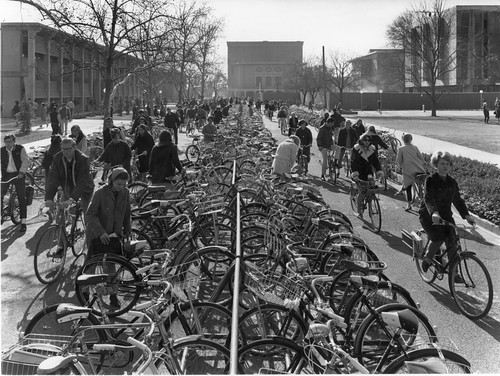
Davis, California as an important lesson for other college towns.  Davis was pathbreaking in that when the university campus was created, it didn't allow cars, and specifically promoted biking.  It led to the City of Davis becoming an equally committed proponent of bicycling("Davis, California - the American city which fell in love with the bicycle," Guardian)..
Bicycle racks at the University of California, Davis, 1963, by Ansel Adams


But this was in the period of widespread biking use, before automobility superseded other forms of mobility in the US.  Plus, because new student cohorts need to be educated and trained each year as other cohorts graduate, transportation demand management programming needs to be constant and rigorous rather than trickle down.

Over time, biking for transportation has significantly declined, both on the campus and in the city, and other cities, which developed more advanced practices, have leapfrogged Davis ("Fifty years of bicycle policy in Davis, CA," Ted Buehler).

The lesson is that promoting sustainable mobility practice needs to be constant.

And timed properly.

Labels: , , , ,

Tuesday, May 01, 2018

Ordinary versus Extraordinary Planning around the rebuilding of the United Medical Center in Southeast Washington DC | Part three: the potential for donations around an expanded program

Another reason to take more time and plan the development of a wider range program of health sciences and biotechnology research and industry, anchored around the construction of a new hospital in Southeast Washington, DC is the ability to line up donations to pay towards the estimated $250 million cost of a new hospital as currently planned.

Of course, while way more fundable, the program as outlined in the two entries on "Ordinary versus Extraordinary Planning around the rebuilding of the United Medical Center in Southeast Washington DC"

-- Part One: Rearticulating the system of health and wellness care East of the River
-- Part Two: Creating a graduate health education and biotechnology research initiative on the St. Elizabeths campus
-- Part three: the potential for donations around an expanded program

will be much higher in cost than the current estimate of $248 million to build a 104-bed hospital.

Still there is great opportunity in "naming donations" ("What's in a naming? A lot of money," Crain's Detroit Business), receiving large donations for the construction and other costs of creating a new hospital and new health science schools and research buildings, in return for naming the buildings/schools after the donors.

For example, the Jacobs Family in Buffalo (owner of the Delaware North Companies) donated $30 million to the University of Buffalo for the naming of its medical school.

The Samueli Family gave the University of California Irvine $200 million for the renaming of the College of Health Sciences, incorporating the medical and nursing schools and the planned development of schools pharmacy and public health. Henry Samueli was a founder of the chip technology firm Broadcom and owns the Anaheim Ducks hockey team.  (Earlier they donated $40 million to UCLA for the renaming of the engineering school.)

Sidney and Lois Eskenazi gave $40 million to the Health and Hospital Corporation of Marion County towards the construction of a new hospital in Indianapolis. The hospital and hospital system has been renamed for the family in recognition of the gift.

Western Michigan University received a $100 million donation toward the creation of its new medical school, which was subsequently renamed the Homer Stryker MD Medical School.

Ferris State University alumnus Phil Hagerman and his wife donated $5 million to the university's College of Pharmacy, which will be renamed to acknowledge the donation.

In 1998, Joan and Sanford I. Weill and the Weill Family Foundation gave $100 million to Cornell's Medical School in NYC, which was renamed. Subsequently, they have donated $500 million in additional gifts for various programs.

In 2009, Patrick Soon-Shiong, founder and chief executive of Los Angeles-based Abraxis BioScience Inc., and his wife, Michele Chan, gave $100 million to St. John's Health Center in Santa Monica for the repositioning of the hospital as an active research facility--$35 million went towards expanding and renovating the hospital; $10 million for attracting doctors and scientists; and $55 million was allocated for the creation of science research centers and funding future projects.

Over the past 25 years, the Huntsman Family has given more than $350 million to the University of Utah for cancer research, through the now named Huntsman Cancer Institute.

Etc.

I am not saying it would be easy to do this. As I have written in the past, in DC and the DC region, federal institutions tend to scoop up the donations of major benefactors, or people fund very particular projects here ("At 37 feet tall, Jeff Koons's flower-draped 'Split-Rocker' demands a whole lotta love," Washington Post) or elsewhere where they can get more publicity, and have much greater control over the final project.

But if you start now and begin asking, the likelihood of raising money is much greater than if you don't ask at all.

And while some people would be satisfied with getting their name on an ordinary hospital building, many more potential donors will see the proposed community health programs, creation of medical and other health and science education schools, the development of a biotechnology research initiative, and bioscience high school education and workforce programs as far more interesting and worthy of funding.

Labels: , , , , ,

Saturday, June 20, 2015

President of Washington State University dies: fostered development of the "University District" adjacent to Downtown Spokane

I haven't gotten around to writing about the creation of Union Square in Greensboro, North Carolina ("Union Square Campus groundbreaking kicks off," Triangle Business Journal), which is spurring revitalization and development through the leveraging and co-locating of area college and university programs, specifically nursing.

One of the models for Greensboro is the University District in Spokane ("Campus evolution: WSU kicks Spokane development into high gear," Spokane Spokesman-Review), where five universities--three, University of Washington, Washington State University, and Eastern Washington University with branch campuses, while Gonzaga and Whitworth are based in Spokane, and the local community college system are collaborating on the redevelopment of the old waterfront district, a 50-acre parcel adjacent to Downtown.

Elson Floyd was president of Washington State University for eight years. (Alan Berner/The Seattle Times)

While the creation of the U District in Spokane has been underway for more than a decade, approval from the Washington State Legislature for WSU to create a medical campus in Spokane just a few months ago was a crowning achievement of WSU President Elson Floyd, who died earlier today while undergoing treatment for cancer, according to the Seattle Times ("Elson Floyd, WSU president, dies at 59").

Jensen-Byrd Building photo from the Washington Trust for Historic Preservation.

The medical school will anchor a massive building program about to be undertaken mostly by WSU for the Spokane branch (list from the SR article) totaling more than $300 million of construction in the University District:
  • U-District Health Clinic: Two-story, 42,600-square-foot family practice clinic staffed by resident physicians; operated in partnership with Empire Health Foundation and Providence Health Care. Also will provide training for nursing, pharmacy and other health sciences students. Estimated cost: $15.6 million (not state-funded).
  • Jensen-Byrd renovation: Convert six-story, century-old warehouse into multiuse facility with gathering areas and student amenities. WSU is seeking a private-sector partner. Estimated cost: $55.5 million to $61.3 million (not state-funded).
  • Multilevel parking garage: Ground-floor office space for campus support services to be sited near Jensen-Byrd; 600 parking stalls. Estimated cost: $30.5 million to $33.7 million (not state-funded).
  • Research facility: 150,000- to 160,000-square-foot research building, four to five stories, east of existing Pharmacy and Biomedical Science Building and connected at basement level. Estimated cost: $99.9 million to $110.4 million (will seek state funding).
  • Education/clinical research facility: 140,000-square-foot facility along Spokane Falls Boulevard; classrooms, auditoriums, research labs; shared with EWU. Estimated cost: $84.6 million to $93.5 million (WSU and EWU to jointly seek state funds).
In researching about Greensboro about their project and looking more closely at their higher education efforts--one is the Joint School of Nanoscience and Nanoengineering where the Dean reports to both the North Carolina A&T State University and The University of North Carolina Greensboro, I was struck by the fact that DC has many many universities, but they don't work together very much.

The kind of motivations in Greensboro--shrinking state appropriations are "encouraging" the colleges and universities there to work together in order to be able to do new and innovative programming--don't appear to be present to the same degree, even though some of the universities are experiencing financial difficulties.

-- "Howard University to cut about 200 staff positions" [2014], Washington Post
-- "Howard University cuts 84 staff positions" [2015], Post
-- "Catholic University turns to buyouts and layoffs to cut spending" [2015], Post

Note that in the past I suggested that DC not create a separate community college, but join with Montgomery College or another area community college system to not have to unnecessary duplicate and spend money on administration, and to start from a stronger position, rather than mostly from scratch ("Creating a community in the District of Columbia").

And about UDC and how the city could consider modeling the provision of higher education as a series of joint ventures between local universities, comparable to how the SUNY system in New York contracts with Cornell, Syracuse, and Alfred Universities to deliver some state college programs, at otherwise private schools.("Whither UDC?").

It's also somewhat damning that none of the city's universities has a great urban studies program.

Labels: , ,