Rebuilding Place in the Urban Space

"A community’s physical form, rather than its land uses, is its most intrinsic and enduring characteristic." [Katz, EPA] This blog focuses on place and placemaking and all that makes it work--historic preservation, urban design, transportation, asset-based community development, arts & cultural development, commercial district revitalization, tourism & destination development, and quality of life advocacy--along with doses of civic engagement and good governance watchdogging.

Wednesday, April 19, 2023

Straws and puffery: USC's DC "campus" as a lever for downtown revival

I have been interested in the opportunity for higher education infused urban revitalization for decades.  

In DC, for awhile I was a Main Street manager in the Brookland neighborhood, which is home to Catholic University, Trinity Washington University and near Howard University, and I touted the potential of student spending as an element of commercial district revitalization.

Student spending.  The problem with that is students spend money in very narrow ways.  At the time those universities were interior focused and I promoted the idea of moving the CUA bookstore to 12th Street NE. (Howard does have its bookstore on Georgia Avenue and they tried for a hotel and have worked on developing a town center there for a couple decades).

That didn't happen, but did with an campus adjacent development--Monroe Street Market--on land owned by CUA, but creating a competing retail center against the 12th Street commercial district, which still limps along today, 10 years after the opening of Monroe Street Market.

Students spend most of their money on food and drink, books, and sundries.  You need a lot more students than CUA (6,700) or Trinity (1,800) to have a real impact on a local commercial district.

I went to the University of Michigan, which has a two major retail districts abutting the campus (and a couple of other little ones).  But these days, UM has 51,000 students--it was the low 30,000s when I went there.

Businesses developed out of university-based research.  Another element is business spinoffs from university-based research--medical, pharmaceutical, engineering, business, IT.  DC's universities aren't particularly good at that either, although some does happen, but the businesses usually end up in the suburbs, where there is more of a business ecosystem, and/or is where the principals live.

In "How the closure of a Pfizer research center in Ann Arbor, Michigan led to the development of a more robust and independent biotech sector" (2021) I suggested that some colleges are particularly good at spin off business development and we should figure out how to duplicate and replicate that.  

I didn't mention University of Pennsylvania and they may or may not be good at spinning off independent businesses, but they have a big revenue stream from pharmaceutical royalties ("Research behind COVID-19 vaccines reaps close to $1 billion in royalties for Penn," "COVID vaccines pushed Penn’s licensing revenue over $1 billion last year, after the school ranked No. 1 in 2021," Philadelphia Inquirer).  Less so today, but the Philadelphia-NJ area was once a center of chemical and pharmaceutical research and manufacturing, so it makes sense that Penn still is a factor in that field.

Faculty concentration as talent and an element of community development.  Faculty creating a cluster, having bright children in schools, supporting community institutions, etc., is another element of community revitalization, especially of schools, but the faculty at DC's colleges don't seem to be clustered, at least not in the way that NIH staff children have on Montgomery County schools.


Real estate development.  Some schools have invested in nearby commercial districts, like Catholic University mentioned above.  The University of Connecticut ("UConn Decides to Build Its Own College Town," New York Times) and University of Maryland are trying to create town centers which otherwise don't exist.  Ohio State University has a major investment program in the High Street district.  

University of Pennsylvania and Mercer University in Macon, Georgia have invested in neighborhood revitalization, and many colleges have special mortgage financing programs for faculty and staff which help to bring faculty close to the campus.  George Washington University owns a huge amount of commercial property around its campus, which is a major source of revenue.  Yale University too is a big factor in New Haven real estate.  Etc.

The Lincoln Land Institute has a program working with universities on this.

Unrelatedly, Ann Arbor, where the University has grown its enrollment by more than 50% in the past 40 years, is undergoing an intensification that is a national outlier, with many small scale buildings in the core of the city being sold, demolished and replaced with multistory buildings.

I wrote how a block next to where I lived was consolidated and converted to a multiunit apartment building ("Example of whole block intensification in Ann Arbor, Michigan," "Land use intensification in Ann Arbor").  

I just learned that another place where I lived will be demolished for a new dormitory ("Saying goodbye to Ann Arbor's Marshall Court: Houses to be demolished for new dorm," Ann Arbor News).

Athletics.  Some of the major college football and basketball teams can have significant local economic impact, although a lot of the time, the effect is muted ("Tourism economic impact of University of Michigan football").  

Interestingly, DePaul University, known for basketball, with subsidy from Chicago, built a new arena off campus in the Convention Center district.  Some cities like Waco for Baylor University, have provided financial support for college football stadiums and arenas.  There is such a project right now in Kalamazoo, Michigan for a mixed use facility that will have Western Michigan University teams as anchor tenants ("Plans revealed for new arena in downtown Kalamazoo," Kalamazoo Gazette).

The question becomes: what kinds of schools are good at stoking revitalization?  I remember when I went to UM, Eastern Michigan University in next door Ypsilanti was touted for moving their business school to the Downtown.  When I applied for a job in Hyattsville, I suggested they try to get University of Maryland to move their Art School to the Route 1/Rhode Island Avenue corridor, to anchor the Gateway Arts District.  The University of Tennessee moved its architecture school to Downtown Knoxville.  And the GMU campus at Virginia Square in Arlington, Virginia, which has the policy and law schools, and other programs.

Similarly, the creation of Appalachian School of Law in rural Virginia was touted as a way to build the economic power of the region ("Appalachian School of Law receives final installment of $6 million funding package," Bluefield Daily Telegraph).

EMU and ASL haven't had much impact.  I don't know about UT.  And people aren't calling Arlington a college town.

Commuter school versus residential campus versus "night school" versus semester in X city program.  Besides how big the school is, a goodly part of this comes down to the nature of the program.  Residentially-based schools are likely to have more economic impact on local stores, while commuter and night school students are likely to spend minimal time on campus or in nearby commercial districts outside of class.

Leveraging higher education institutions for urban economic development. It is possible to leverage higher education institutions in important ways.  But it needs to be purposive.  Trickle down doesn't work that well.  I've written about it a lot:


Making the point that DC in particular doesn't seem to be very good at it.

Puffery.  That's why I have to laugh at the article in today's Post about USC, "D.C. officials hope new USC campus can aid in downtown’s comeback."  From the article:
District officials have spent months figuring out how to counter negative economic trends spurred by emptied offices downtown. But their efforts to repopulate the area are set to get a big boost from the University of Southern California — which on Wednesday unveiled its East Coast campus, in the heart of D.C.’s business district.

USC’s “Capital Campus” will transform the 60,000-square-foot, crescent-shaped building at 1771 N St. NW, previously occupied by the National Association of Broadcasters, into a home base for students and graduates of the Los Angeles-based university. The official opening places USC among a growing array of universities with hubs in the District, giving students a chance to capitalize on political and policy-based career opportunities that have become synonymous with Washington.

USC President Carol Folt says the hub could draw nearly 1,000 of the university’s students to D.C. each academic term, potentially tripling or quadrupling the university’s presence in the city. For D.C. Mayor Muriel E. Bowser (D), who toured the facility with Folt on Tuesday, that prospect fits squarely into her administration’s plan to “reimagine” sectors of downtown that have long been associated with large office buildings and the working professionals within.
It's a small program that won't have anywhere near the impact of the existing major schools that are already based in the city: American University (14,318 students); George Washington University (25,613 students--this includes their Virginia campus); Georgetown University (19,371 students); Howard University (10,000 students), etc.  (UDC like CUA and Trinity is smaller.)

As it is there are a bunch of university centers in the city already similar to what USC is launching.  What kind of substantive economic impact do they have?  I know I haven't noticed much.  

Plus there is Johns Hopkins University, which has had a comparable campus (a couple buildings) in Dupont Circle for decades and is moving to the former Newseum ("Former Newseum almost ready for Johns Hopkins graduate students" WTOP radio)--and that's a 420,000 s.f., project, and it seems as if they'll also run the Dupont Circle buildings for awhile.  It opens this fall.

Conclusion.  To be clear, I think programs like the new one by University of Southern California are great, and that cities like DC should be open to them. I'm just turned off by the puffery.

I find DC's planning around higher education to be pretty disappointing.  But that's not a unique failing.  DC's planning function and capacity has diminished with each mayor since Anthony Williams left office in 2006. (Maybe it was in stasis under Mayor Gray.)

Cities like Greensboro or Portland or Spokane have to be more innovative because they have fewer opportunities.  

DC has plenty of assets.  They aren't coordinated or leveraged very well.  And that's where the local government planning functions have opportunities.

Years ago I suggested a multi university building East of the River, and later how graduate health education and  biotechnology research program could be the anchor for revival of the St. Elizabeths East Campus, as part of the building of a new hospital there ("Ordinary versus Extraordinary Planning around the rebuilding of the United Medical Center in Southeast Washington DC | Part Two: Creating a graduate health education and biotechnology research initiative on the St. Elizabeths campus").

DC needs to be more innovative to be able to develop its economy semi-independently of the federal government, which was slow and steady and growing for decades, but now no longer is, especially with the impact of what is now called work from home (formerly called telecommuting) post covid.

Instead, under Mayor Bowser DC's urban and economic planning functions have stagnated.

Labels: , , , , ,

Thursday, March 24, 2022

Howard University announces wide ranging building program

Not unironically after a multi-week campus sit in protesting the lack of quality in dorm accommodations ("Rats, mold, roaches: Howard students stage sit-in over housing conditions," Guardian), Howard University has just announced a major building program ("Howard University announces historic $785 million investment in new buildings, renovations," Washington Post).

Photo: Jacquelyn Martin, Associated Press.

I think it's great.  I hope that one element will be addressing the problem with the dormitories, which in part is fallout from outsourcing and should be a lesson that outsourcing can create more problems than it solves.

Over the years I've written about related issues:

-- University-driven revitalization

-- "Naturally occurring technology districts" with Georgia Avenue and nearby universities as an example

-- Howard University's hospital issues (they created a management contract with Washington Adventist Hospital system, offloading the associated costs and risks, with the aim of eventually selling to them the hospital)

-- ideas by Temple University journalism professor George Miller about how HBCUs can better serve center cities ("The other George Miller idea: creating multi-college innovation centers in (cities) Philadelphia | Creating public library-college education centers as revitalization initiatives" and "HBCUs and the city: Relocating Cheyney University to Philadelphia" -- be sure to read the comments for additional resources).

Connecting better to the community.  The building expansion program also provides an opportunity for the university to connect better to the city outside of the campus.


As someone (yes a white guy) who lived in DC for 32 years, I thought it was unfortunate that the campus is hidden behind Georgia Avenue. Granted, colleges are cloisters and designed to be separate.

When I would bike to Downtown via 4th Street, I always appreciated the backside of the campus and wished that the city would have redesigned the street in asphalt block to make it connect better to the campus and tame the traffic.

But wow, the college core campus is gorgeous and it's a shame more people don't know about it, aren't aware of it.

(I only used the HU college library once or twice in my 32 years, and never, to my chagrin, went to see the Moorland-Spingarn archives). 

I do think the university should think about how to increase connections to the area around the campus, through wayfinding and cultural interpretation signage programs, including directional signage to and from Georgia Avenue, campus architectural tours, marketing the culture better to the wider community (e.g., I love the Cramton Auditorium that is a somewhat art deco building), etc.  

-- Wayfinding and Signage at UCSD, Selbert Perkins Design


Outdoor public art at Newcastle University.

For example, a couple years ago I came across an old article "New 'Discover' guide highlights the cultural gems which are part and parcel of Newcastle University," ) about how Newcastle University produced a guidebook to the cultural resources on its campus, including public art, architecture, events, facilities, books/libraries, and objects.

Unfortunately, the guide is not available online, but it's a great example of how universities can better promote such resources beyond the strict population of the campus.

Table of contents from Newcastle University Discover Guide

Similarly, Waseda University in Tokyo is repositioning its campus cultural resources as available to all, that the university is a steward and promoter of such resources.  

One example at Waseda is its new library and cultural center devoted to the work of author Haruki Murakami ("Peek inside Waseda University’s brand new Haruki Murakami library," Lithub).

Labels: , , , , , ,

Monday, August 17, 2020

Economic impact of college football means season cancellation will crush college town economies reliant on sports visitation

Besides the economic impact of closed colleges on college towns ... although the nature of student-supported retail is pretty narrow, pretty much food and drink -- but not of the faculty and staff, which is pretty considerable, there is the negative impact of the loss of "move in" and "move out" weekends, family related visitation tourism, and the loss of sports-related tourism.

Wikipedia photo of a packed Michigan Stadium by Andrew Home.

The 2015 entry, "Tourism economic impact of University of Michigan football," discusses the economic impact of college football on Ann Arbor, Michigan, a city of over 100,000 residents on the western edge of the Detroit metropolitan area.

I didn't discuss how this argument is extendable to other Big 10 or major college football towns (Auburn, Alabama, Clemson, South Carolina, Tallahassee, Florida, College Station, Texas, Waco, Texas, Athens, Georgia, etc.), which may or not be located within larger metropolitan economies, the way that Ann Arbor is part of Metropolitan Detroit or teams in Columbus Ohio or Minneapolis are in the center cities of a larger metropolitan area.

Baylor University got funding from the City of Waco and convinced the state department of transportation to design a nearby highway bridge to complement the stadium.  It's especially striking at night.

Universities too are increasingly asking for subsidies from state and local governments to fund stadiums and arenas, justifying it on the local economic impact.

Chicago built DePaul a Downtown-located basketball arena to put the team's fans in a better position to spend more money when attending games ("DePaul arena part of Emanuel's $300 million in projects," Chicago Tribune), although that doesn't seem to be working out ("Taxpayer-funded Wintrust Arena falls short of attendance projections," Illinois Policy).

Although the Baylor University college football stadium has been a key element of that city's revitalization planning as well as increasing the success of the school ("The creation of Baylor," Texas Monthly).  Although it's diverted money away from meeting other city priorities.

Auburn Tigers stadium.

The effect is likely to be more pronounced when the college towns are more separate outposts from metropolitan economies.

Whereas sports tourism is touted for professional sports like football and basketball, the reality is that most event attendees are local, and don't generate "out of market" revenues that aren't merely a substitute for spending on something else.

Baltimore Ravens fan fill FedEx Field.

This is a little different for professional football, which has fewer games, especially in the Northeast and Mid-Atlantic the cities (Boston, New York, Philadelphia, Baltimore, Washington) are close enough where fans will travel to away games.

But also in the Midwest between Detroit, Chicago, Indianapolis, Minneapolis, and Green Bay.

The huge expensive stadiums being built in Los Angeles ("Will the LA Ramsnew Englewood stadium be an economic boom or bust?," Los Angeles Daily News) and Las Vegas ("Southern Nevada gaining tourism asset with Las Vegas Raiders stadium") are justified in large part over their ability to drive tourist patronage.

(The Washington Football Team is notorious for losing its home field advantage as local residents stop buying tickets and attending games, leaving large blocs of tickets to be bought up by traveling fans.  See the Washington Times article "Home-field advantage a rarity for Snyder's Redskins.")

College football and to some extent college basketball are different because the alumni base for the school isn't necessarily geographically bounded. 

Hardcore alumni fans travel to games, often over great distances, and spend money on lodging, food, and other retail in ways that are significant for the local economy and businesses.

Although not all schools within the big conferences benefit equally from sports team related commerce.  Schools like the University of Maryland or the University of Connecticut aren't really college towns ("More Prince George's County: College Park's militant refusal to become a college town makes it impossible for the city(and maybe the County) to become a great place") in the same way as Madison, Wisconsin, State College, Pennsylvania, and Ann Arbor and Lansing, Michigan.

When Michigan Stadium is empty, it's just one big hole.  Photo: Getty Images.

The cancellation of the fall football season because of the pandemic ("Big Ten cancels college football season for fall 2020, hopes to play in spring 2021," CBS Sports) is going to have significant impact on college town economies dependent on football game related tourism.

Even if the season is shifted to the Spring, it will be difficult for pandemic-effected businesses to hang on til then ("In Big Ten cities, a fall without college football is a crushing economic blow," Washington Post).  From the article:
“It’s just devastating news,” said Fritz Smith, chief executive of the Happy Valley Adventure Bureau, the tourism organization in State College, Pa., a town built around Penn State University that swells on game days, temporarily becoming Pennsylvania’s third-largest city. “I’ll be honest: There’s real fear in the community and a real trepidation about how some businesses reliant on the spending of visitors associated with the games are going to get through this. They’ve already had five months of difficult operating environment, and this is kind of yet another leg of the table being kicked out.”

He estimates Penn State football brings in more than $70 million in visitor spending each year. Penn State fans typically spend three nights in hotels, three days shopping at stores, three nights eating out. And this fall they’ll all stay home.

“Hopefully there’s a season in the spring and everything bounces back,” he said. “But it’s going to be a tough fall to even get to that point.”

Labels: ,

Wednesday, November 27, 2019

(WTF?) University of Michigan faculty raise objections to UM investment in creation of Detroit Center for Innovation

A c. 1940s post-war ad by a company then based in Detroit. In the 1950s, Detroit had something like 15 auto assembly plants, now it has two.

The University of Michigan announced the creation of a new Detroit Center for Innovation, in association with Dan Gilbert, principal of Quicken Loans and a big investor in the physical revitalization of Detroit albeit focused on the core and private equity honcho Stephen Ross (who has his own issues, "Who is Stephen Ross, the billionaire criticized for his high-end Trump fundraiser?," Washington Post) in an Opportunity Zone which have issues ("I figured out why Opportunity Zones won't amount to much") on a site that had originally been slated for a jail.

The College of Literature, Science and the Arts has a Detroit-based program, the Semester in Detroit, where students live in the city, take classes and do projects, and faculty of the program have criticized the DCI proposal ("UM Semester in Detroit faculty express concerns about new Detroit Center for Innovation," MLive).

From the letter:
UM would offer masters degrees and “stackable certificates” for professionals who would serve the emerging high-tech economic system, building capacities in areas such as artificial intelligence and cyber-security, emerging fields in what some have called the rise of “surveillance capitalism.” As reported by Detroit Free Press business columnist John Gallagher, the planning for this project occurred almost exclusively behind private, closed doors with no input from long-time Detroit residents, community institutions or city council. ...

The city of Detroit is important - both historically and contemporarily - for understanding the complex and inextricable conflicts created by capitalism’s dependency on racial and economic oppression and inequity. While such conflicts have been present since colonization of the original Anishinaabe lands that became “Detroit,” we need only look back a few years, or even weeks, to see how white billionaires continue to “re-imagine” majority-black Detroit in their own image and for their own economic benefit. Given this history, and considering the private interests involved in this partnership, we believe the “Detroit Center for Innovation” is an inappropriate and irresponsible deployment of the University’s social, economic and intellectual capital. ...

So many companies once based in Detroit and with manufacturing facilities in Detroit and the surrounding area no longer exist. 
Many recent major development projects in Detroit have skirted, abused or manipulated the spirit and legal requirements of Detroit’s community-benefits ordinance. ...

The land for this project encompasses the boundary between the historic black neighborhoods of Black Bottom and Paradise Valley, which were strategically destroyed by the city of Detroit, in conjunction with the federal government, in the mid-20th century. How will these community histories and legacies be honored and empowered without tokenism and cultural cooptation? And, who will decide?
Yes, I think universities need to be careful about the relationships they make with funders and programs.

Given his recent controversies, I'd probably back away a bit from Stephen Ross.  OTOH, he is a UM graduate and gave enough money to the business school to have them rename it in his honor--first after a donation of $100 million, which he followed up with a second $100 million 9 years later..

But UM and Dan Gilbert, even Stephen Ross, aren't responsible for all the faults of capitalism and to possibly scuttle this investment/program as a result would do a lot more harm to Detroit.

I do think such criticisms can and should be used to make the program better, and more focused on generating more direct benefits for the city.

The Sun Still ShinesBut Detroit's biggest problem is disinvestment.  The solution/response to disinvestment is investment.

The city has is a loss of two-thirds of its population over the past 60 years and much of its industry.  It needs to reboot the business ecosystem in order to be able to generate growth in the face of abandonment.

When I first heard of the proposal, I thought about an article I had read about Walter Chrysler, and why he was able to create a car company without a lot of internal capacity.  It was because he was able to rely on a rich ecosystem of suppliers.

-- "Markets, Networks, and the Rise of Chrysler in Old Detroit, 1920—1940," Michael Schwartz, Enterprise & Society, 1:1 (2000)

In the 80+ years since, the business ecosystem of auto production has changed significantly, bulked up, so that such an ecosystem no longer exists.

But that's true of many different industries.  And many other cities have been equally crushed by the changes from consolidation and relocation of manufacturing outside of the US.

Could a UM DCI help to rebuild such an ecosystem across multiple business sectors, thereby helping to rebuild not only Detroit, Michigan and US manufacturing (cf. "Innovation Should Be Made in the U.S.A.," Wall Street Journal) but the city's economy and attractiveness as a place to conduct business and reside?

(My problem is that I have to forget my memories of what Detroit was before 1970--many of us did not recognize that the city was in serious decline at the time--and take such proposals from where they are, where the city is today.)

Labels: , , , , ,

Tuesday, October 01, 2019

Revisiting Pittsburgh

For a couple years at the end of the 2000s I was in Pittsburgh a bunch of times, partly to work on a commercial district revitalization plan in the Lawrenceville District and I knew people running the Strip District organization (but the consultant I was working with ended up being a problem and the people running the commercial district revitalization group left, so we had no client, etc.).

Pittsburgh

As is my way, I spent a lot of time figuring out the city in terms of its revitalization trajectory.  Then, despite decades of incredible work, it still languished.

After I responded to something Richard Florida wrote about Pittsburgh, in "Urban economic development strategies: do you invest in people or places? ... yes," he re-tweeted it, saying it showed great understanding of the city's conditions.  (The items are appended at the end of this entry.)


And note later, I termed Pittsburgh an example of best practice revitalization, along with other cities  like Bilbao and Liverpool.  See "Economic restructuring success and failure: Detroit compared to Bilbao, Liverpool, and Pittsburgh," 2014.

Nigel, our e-correspondent from New Zealand, shares with us the new City Journal article on Pittsburgh, "A Renaissance Runs Through It: What Pittsburgh’s latest comeback tells us about urban revitalization," and just reading the first couple paragraphs makes me realize it's a perfect example of my argument about the long time needed to reach critical mass in population and business activity to the point where revitalization not only is evident but has a sustainable momentum.

Despite the fall of the steel industry (and failure/consolidation of other businesses like Westinghouse, Gulf Oil, eventually Heinz, etc.), it still had a core of leading businesses (Alcoa, Mellon Bank, etc.) including finance, universities, and medical care..

Decent neighborhoods. Attractive building stock. A strong history of innovation.  Foundations (Heinz and shockingly the Sarah Mellon Scaife Foundation which was controlled by the otherwise conservative Richard Scaife--"Richard Mellon Scaife dies: funded conservative groups ... and historic preservation in Pittsburgh," 2014") committed to investing in the city.

Some really awesome community organizations doing really great stuff.  For example, both the Pittsburgh History and Landmarks Foundation and the Pittsburgh Cultural Trust are not just national best practice, but world class in their work on historic preservation and the development and maintenance of cultural facilities specifically.

Some of the foundational ideas in Richard Florida's books are based on his experience in Pittsburgh, because when he was there, large numbers of people didn't stay after college, but some did, creating businesses, but the ecosystem wasn't there enough to keep the businesses or the people once the businesses moved into different phases where they needed different types of access to capital and talent.

But now, Pittsburgh is a center of research and practice for automated vehicles and robotics, and the start up business ecosystem is much more healthy than it was 15 years ago when Richard Florida taught at Carnegie-Mellon University.

4000 block of Butler Avenue, Lawrenceville, PittsburghNice neighborhoods got better, neighborhoods that languished are now significantly improved ("One hidden element of the revitalization of Pittsburgh's East Liberty neighborhood) and housing prices in neighborhoods I looked at in the late 2000s have more than doubled in the ten years since.

I think it was more a function of time and the fact that time is necessary to rebuild both the ecosystem and the masses of people able to bend the curve towards city improvement. 

Because all the while, sprawl and the growth and development of the suburbs continues apace, which is why urban retail
and the Downtown still languishes on that score.

-- "Has DC reached revitalization critical mass, so that local government missteps don't matter?," 2011

Despite the cold weather, and the difficulties, Pittsburgh had the right conditions to rebuild after the loss of the steel industry.  It just took 30+ years.

And yes, the city was an early poster child for urban renewal dating to the 1950s, and for urban renewal, some of it, at least Downtown, was decent.  Efforts in the Hill District and East Liberty were flawed.  In Allegheny, a toss up.  Etc.

(This isn't an image from DC, but illustrates the point.)

DC as an example.  Similarly, using DC as an example, it took 20+ years after the introduction of Metrorail to DC before you started to see a critical mass improvement of the city -- because while not absolutely intention, Metrorail also served DC neighborhoods which were close to the core and comprised of attractive historic building stock and an urban form that favors walking, biking and transit

After 25 years or so, as the core stabilized, this revitalization pushed out beyond the core, to neighborhoods like Columbia Heights, H Street NE, and Petworth.

But with DC and economic studies of the value of transit, I know for the first 20+ years, studies didn't find much effect.  I think that's because the time frame you need to look at is much longer than people realize.

Aerial view of Dupont CircleAnd is hard to discern in any case, when you look at data at the metropolitan scale.

For DC proper, or Arlington County, you need to look at the core part of the system in those communities and measure the impact before and after, at the "submarket" scale even, not the entire city.

Note that studies by the Center for Transportation Studies at the University of Minnesota found that the greatest economic impact from transit are at the core of the system.

-- "Transit oriented development can take decades to realize, so two years is too short of a time to be expecting it (Austin Texas)," 2012
-- The Hiawatha Line: Impacts on Land Use and Residential Housing Value (Feb 2010, CTS 10-09)
-- Transportation as Catalyst for Community Economic Development(Dec 2007, CTS 07-07)

That makes sense.  It's where you have the most critical mass. Or what others call "the network effect."
======================
From the 2010 piece, "Urban economic development strategies: do you invest in people or places? ... yes":

... the point is that you need to have people-focused institutions that are place-committed. Capital can move anytime. But locally focused and locally committed institutions won't move. And if these institutions can develop a focus on improvement that is based on best practice, innovation, and quality then they become the levers and fulcrums of a new kind of industry.

If they don't, revitalization efforts are muddled and don't ever amount to very much.

The elements.
,

1. A number of quality universities that continue to attract talent, and at least two of the universities have strong engineering education programs which

2. These universities help develop new technologies and generate spin off businesses which build the region's economy and provide higher paying jobs.

3. It doesn't hurt that the University of Pittsburgh Hospital System is world class, especially in organ transplantation. This anchors medical care as a key "local" industry.

4. The city still has a handful of large national and global companies, a mix of manufacturing-research based companies like PPG and the U.S. headquarters for Bayer AG, software companies, and service industries (such as Mellon Bank). This means that there are still job and idea-producing industries there, even though these businesses are subject to the same concentration and downsizing trends affecting such companies.

5. Pittsburgh has a couple of incredibly strong foundations still present locally, focused on funding organizations and initiatives that improve the city both socially and economically.

6. Innovation, The region has a legacy and history of innovation that is embodied in organizations, including civic organizations and civil society so that groups are problem and self-help focused.

7. The arts organizations there have some heft. The Pittsburgh Cultural Trust has focused on re-establishing arts uses downtown and maintaining and extending the arts infrastructure there. The Carnegie Institutions set a standard of excellence as well. Etc.

Labels: , , , ,

Thursday, February 07, 2019

DC, Universities and "making versus taking" or universities that add to a community's capital and those that don't

Earlier in the week, the Washington Post ran an article, "How many colleges and universities operate in DC?," about the rise of universities from elsewhere in the US opening programs in DC and how this benefits the city.

Featured examples include the University of California Washington Center (pictured at left) and the proposal by Johns Hopkins University of Baltimore (which already has a center offering a variety of degree programs in Dupont Circle; plus their health system owns a hospital in the city) to buy the Newseum, a grand building on Pennsylvania Avenue close to the Capitol and the National Mall, for the relocation and unification of their programs into one facility.

I've written in the past about how DC has lots of universities but doesn't really get the maximum economic benefit from them, at least in terms of their sparking new business development and economic activity.

-- "Better leveraging higher education institutions in cities and counties: Greensboro; Spokane; Mesa; Phoenix; Montgomery County, Maryland; Washington, DC," 2016
-- "Naturally occurring innovation districts | Technology districts and the tech sector," 2014

And about universities, urban revitalization, and urban planning more generally:

-- "Should community culture master plans include elements on higher education arts programs?," 2016
-- "AJC series on Historically Black Colleges and Universities," 2018
-- "Speaking of planning for higher education: more on the University of the District of Columbia," 2012

including a couple pieces on College Park, Maryland, home of the University of Maryland College Park:

-- "College town follow up: alumni as residents and contributions to community capital," 2015
-- "More Prince George's County: College Park's militant refusal to become a college town makes it impossible for the city(and maybe the County) to become a great place," 2015
-- "Revisiting past blog entries: College Park as a college town and economic development | PG County and Amazon," 2018

That's because the schools and programs that tend to generate the most economic activity--business, engineering, computing--aren't necessarily that great.

And the health programs--Georgetown, George Washington, and Howard all have medical schools--aren't major research and health science technology development powerhouses compared to counterparts elsewhere.

For years, I wrote that not one DC based university was a member of the Coalition of Urban and Metropolitan Universities (Georgetown joined a few years ago and I guess that must have spurred the University of the District of Columbia to join too) and none really have great urban studies programs.  For awhile only UDC had an urban planning program.  Now it doesn't, but GWU, Georgetown and CUA have programs.

By contrast, other cities smaller, less well located, and "less prestigious" than DC have recognized the value in focusing on higher education as a revitalization and economic development tool and they're doing a better job of it.

JHU's major university center in DC is based at 1740 Massachusetts Avenue NW.

My argument about the "Washington semester" and degree programs, and centers (mostly about politics) being set up in DC by non-DC universities isn't about adding to the city as much as it is about benefiting or taking from it.

It's along the lines of my cultural planning writings which differentiate between arts organizations promoting "arts production" by which they add to, extend, and build the arts ecosystem and focus on producing art created by living artists versus promoting "arts consumption" or the presentation of arts and culture to audiences of works usually produced elsewhere, often by people no longer living.

Or as can be extrapolated from the piece "College town follow up: alumni as residents and contributions to community capital," universities based elsewhere but with programs in the city aren't likely to contribute much to community capital UNLESS they specifically create programs and initiatives to do so.

One example is how Kent State University's architecture school has an urban design studio in Cleveland, where the students are engaged in a variety of community-serving projects the the school's Cleveland Urban Design Collaborative.

(For a long time, HUD had a program to foster the development of such programs by universities, although no university in DC seems to have availed themselves of the program.  CUA's architecture school does a fair amount of urban design studio work by students on projects in the city.  To its credit, University of Maryland's planning and architecture school does a fair amount of projects in DC too.)

Labels: , , , , ,

Monday, July 09, 2018

College towns of a certain size as an opportunity for sustainable mobility nirvana

There is an article, "Study seeks ways to improve public transit in Newark," in the Newark (Delaware) Post about the MPO there doing a study on improving transit in that city, which is home to the University of Delaware, and has various transit services, including a rail connection to Wilmington and Philadelphia through SEPTA.

Interestingly, that MPO is responsible for part of Maryland, including Perryville, and planning is going on to extend the MARC commuter rail system to Newark, or the SEPTA connection to Perryville ("Maryland trains to Newark inch closer," Wilmington News-Journal).

I was there once, in 2010, when I gave a presentation on "Metropolitan Mass Transit Planning" and urban revitalization blogging at the School of Public Policy and Administration, although it hardly makes me an expert on the town.

When reading the article and the comments, many negative, I couldn't help but think:

1.  Outside of big cities it's hard for people to consider transit as a realistic and preferred mode, since the rest of the nation is designed--by land use and transportation policy and practice--to preference and require automobility.  So I do understand the negativity.

2.  Because college towns have a large number of students, most who don't have cars, live on or close to campus, and walk mostly, there is the ability to develop a system and culture supportive of transit in these communities, which are outliers compared to most American communities.  For example, this is why some of the only successful "pedestrian malls" in the U.S. are in college towns like Boulder, Burlington, Vermont, and Charlottesville, Virginia.

-- "Sustainable transportation planning on college campuses," CJL Balsas, Transport Policy, 2003

3. So why not build upon the potential for transit in college towns, by going beyond, and creating "sustainable mobility districts," and the construction of a multi-faceted "sustainable mobility platform" not just for the campus but for the entire community.

Best practice campus mobility initiatives.  A 2014 piece, "Innovative University Transportation Demand Management Programs," lists a number of best practice programs as a kind of toolkit that can be drawn upon for the development of such a vision:

That entry responded to the release of a report, A New Course: How University Programs are Reducing Driving on Campus and Creating New Models for Transportation by the US PIRG Education Fund and the Frontier Group

It has a set of recommendations and a bunch of examples of best and better practice at universities across the country.  Its most important points are that:
  • TDM helps strengthen town-gown relations
  • saves money for the college
  • helps the environment
  • patterns the behavior of young adults in ways that support sustainable transportation choices throughout their lifetime (using the campus bus and the city bus system on occasion in Ann Arbor probably primed me for using transit in the "big city" later),
  • and provides best practice examples that can be used to improve sustainable transportation practice in other settings.
There are plenty of college towns like Ann Arbor ("Meanwhile, 35 miles west of Detroit, a transit funding measure faces certain victory," MetroTimes), Chapel Hill, Boulder, Ellensburg, Washington, and others that are best practice examples for transit provision.

Usually what is offered is a mix of city-based and university-based services, although Chapel Hill Transit is the sole provider in that city, is free to ride (except for express commuter bus services), and the University of North Carolina provides 38% of the funding for the system, while in Ellensburg, Central Washington University's transit system is piggybacked on by the town.

In College Park, Maryland, there is a MOU between the city and ShuttleUM/U of Maryland so that residents are eligible to ride the system, provided they apply for a bus pass and prove they are residents.  Otherwise, the city is served by separate county and metropolitan transit services.  The college bus system runs a separate branded service on Rte. 1, funded by local communities and the county.

The university in Davis, California was a leader in promoting biking when it opened in the early 1960s ("Davis, California – the American city which fell in love with the bicycle," Guardian) and most University of California campuses are national leaders in transportation demand management.  The League of American Bicyclists has the "Bicycle Friendly University" program. Among exemplary best practice examples, Ripon College provides free bikes to students who commit to not bringing a car to campus ("Ripon College gives freshmen free bikes for no-car pledges," Milwaukee Journal-Sentinel).

In the UK, the Cyclepoint bike parking facility at the train station in Cambridge provides spaces for almost 3,000 bikes ("3,000 Cycle Parking Spaces for the UK’s Largest Cycle Hub at Cambridge StationK," Falco). Like many university towns, Cambridge has a strong bike advocacy group, Cambridge Cycling Campaign.

In Baltimore, the Collegetown Network includes a system of bike connections between universities across the city.  (When I worked in Baltimore County, I recommended it be extended beyond the city limits to connect to universities and colleges in Greater Towson and Catonsville.)

Columbia, Missouri, home to the University of Missouri, is a small town leader in sustainable mobility ("A Free-Wheeling City," Parade Magazine).  Park on the Hill is a Chapel Hill initiative providing information on parking of all types, focused on the Downtown.

Tempe, home to Arizona State University, is a leader in community transportation ("The Shaping of a '20-Minute City'," Governing Magazine).  Starkville Mississippi, home to Mississippi State University, has an exemplary local advocacy group, Starkville in Motion, dedicated to achieving pedestrian, biking, and safe routes to school improvements.


Preparing underground piping for Holland Michigan's downtown sidewalks.  Holland DPW photo.

The sidewalks in Downtown Holland, Michigan are heated, using the waste heat from a local power plant, which is then pumped through miles of pipes placed under the sidewalks.  Holland is home to Hope College.

It's not new though, they did it in 1988, when they were reconstructing the streetscape.

It's noteworthy for four reasons: (1) being in Western Michigan, Holland gets an inordinate amount of snow in what is called "the Lake effect" because of weather conditions in association with Lake Michigan; (2) it covers a lot of ground, over 10 acres; (3) it was constructed in association with a planned road and sidewalk replacement project, cutting the cost of the project compared to it being a one-off job; and (4) it is accomplished using waste heated water produced as a byproduct of electricity production.  (Waste water, which is generally at a constant temperature, can be a source of energy for heating and cooling systems, something Arlington County has pointed out in its energy planning.)

But it was easier for the city to do this because they have a municipally-owned and operated electricity production and distribution system and water and sewer system, the Holland Board of Public Works.


Portland State University sponsors streetcar stops and the streetcar is routed through part of the campus (picture, right).  (Although because of increased costs, the student id no longer includes free access to the streetcar.)

Oregon Health Sciences University operates the Portland Aerial Tram. (OHSU staff and patients ride free.)

The University of Colorado paid for naming rights for one of Denver's transit lines ("University of Colorado pays $5 million to name RTD's Denver airport line," Denver Post).

Tickets for sports events at the University of Utah include use of the local transit system.

Harvard University will be paying a significant amount of the cost for a new railroad station in the Allston district of Boston. Many universities work with local transit systems for discounted pass programs for students and staff.

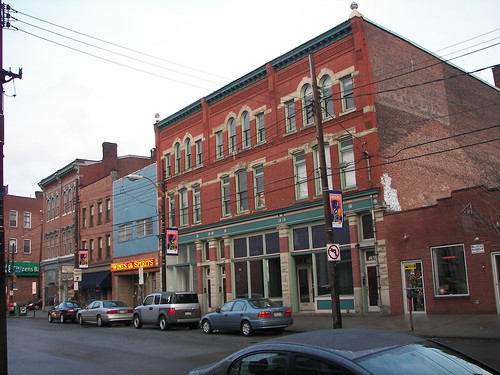
Main Street, Newark, Delaware.  Photo: Jennifer Corbett, WNJ.

Newark, Delaware: parking in the core is also a problem.  One of the negative comments on the NP article referenced a previous study in the city, on parking ("Newark parking garage debate heats up," Wilmington News-Journal), that as the person recounted "led to nothing happening."

Another comment mentioned that the University does have a parking garage close by that could be used to support parking in the Downtown.

Concept of Silver Spring, Maryland as a sustainable mobility district.  That made me think of my series of articles on Silver Spring, Maryland as a "sustainable mobility district" as being relevant to this discussion, about moving the discussion beyond "transit" or "parking" towards a broader consideration of "sustainable mobility."

-- PL #5: Creating a Silver Spring "Sustainable Mobility District"
---- "Part 1: Setting the stage"
---- "Part 2: Program items 1- 9"
---- "Part 3: Program items 10-18"
---- "Part 4: Conclusion"
---- "Map for the Silver Spring Sustainable Mobility District"
---- "(Big Hairy) Projects Action Plan(s) as an element of Comprehensive/Master Plans"
---- "Creating the Silver Spring/Montgomery County Arena and Recreation Center"

Syracuse Connective Corridor.  One of the examples shaping the Silver Spring concept is the "Connective Corridor" in Syracuse, New York.

The Syracuse Connective Corridor is a wide-ranging approach on improving the connections between the campus of Syracuse University and the city, while simultaneously emphasizing sub-districts within the city center ("Is Syracuse's Connective Corridor work transforming downtown?" and "Syracuse's Connective Corridor: 2 miles long, $47 million better," Syracuse Post-Standard; "The Connective Corridor – a message from our Publisher," Syracuse New Times).

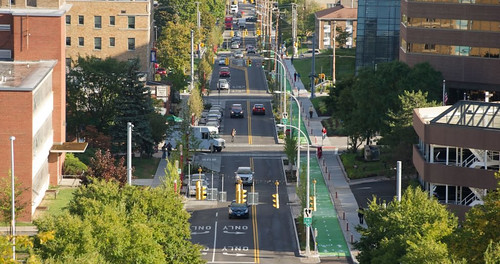
Syracuse Connective Corridor with cycle track
One of the facilities in the Connective Corridor program is a high profile separated cycle track for bicyclists.

Although there is some criticism that the project is shaped more to benefit the university, which is the primary funder.
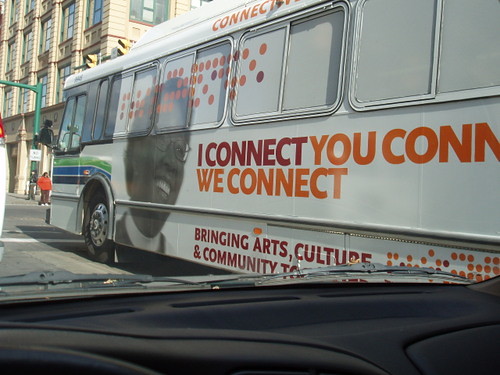
Connective Corridor decorated bus, Syracuse, NY

The description of the Connective Corridor in promotional materials sums up the elements that comprise a "Signature Street" or sustainable mobility district:
The Connective Corridor is a collaboration between Syracuse University, the City of Syracuse and Onondaga County to connect University Hill with downtown Syracuse.  The project includes new streetscapes to make the city more pedestrian and bike-friendly, a free public transportation system with smart bus technology, a network of green infrastructure, public art, wayfinding systems, façade improvements and innovative illumination projects that highlight Syracuse’s beautiful historic buildings and public spaces. The Corridor also connects the city’s vibrant arts and cultural district, as well as downtown dining and the great local food scene. Take the bus, walk or ride your bike...
Besides being a best practice example of a university taking initiative to create better connections and placemaking conditions within the city that is its home, it's an example of a university and a city joining together its resources--this latter point is important because many cities are like Newark, in running separate transit and parking systems from the university, when they would be better served by working together.

Integrating parking services.  Item #5 in the proposed program for Silver Spring is a re-articulation of parking services, including the provision of parking wayfinding systems and district-wide valet parking.  That seems like an area that needs to be explored in Newark too.

Downtown Milwaukee's street-based real-time parking wayfinding signage is a good model for the real-time signage side, because more than apps are needed to change people's perceptions and behaviors ("Downtown Milwaukee signs offer parking guidance," WUWM/NPR).

Another good example for university towns is the aforementioned Park on the Hill program in Chapel Hill.

Other elements of a sustainable mobility district.  Then add other elements from the Silver Spring framework, including improvements to the biking and pedestrian environment, including a city-wide secure bike parking system, and other placemaking improvements.

Compared to Silver Spring, some other elements would need to be added for the average college town, because they already exist in Silver Spring, such as bike sharing and car sharing, but they may not be present in smaller communities like college towns outside of major metropolitan areas.  Many universities have bike programs and special car sharing arrangements that can be leveraged to achieve broader sustainable mobility initiatives.

Sustainability planning.  Plus, universities tend to be leaders in sustainability planning and it's a good way to engage students and faculty, who are simultaneously local residents, in directing some of these energies towards community improvement..

-- "Sustainability Plans Popular on College Campuses," Environmental and Energy Study Institute

Indianapolis Cultural Trail
The Indianapolis Cultural Trail is another model of high profile pedestrian and bicycle facilities that can be drawn upon by college towns.

IBJ photo.

In a smaller, more self-contained place like a college town, e.g., Newark or Chapel Hill, etc., it would probably be easier to create a one-off car sharing organization, maybe even electric based, like Blue Indy ("BlueIndy car-sharing program striving to be in black by 2020," Indianapolis Business Journal), as a way to seed the necessary infrastructure for electric car usage beyond car share.

Portland's Electric Avenue (FAQ) would be another example that college towns could draw upon in broadening their focus from "transit" to "sustainable mobility."  (College towns are smaller and a better place to try to introduce e-based car services, whereas these types of programs are being implemented in larger cities where they are much harder to make successful.)

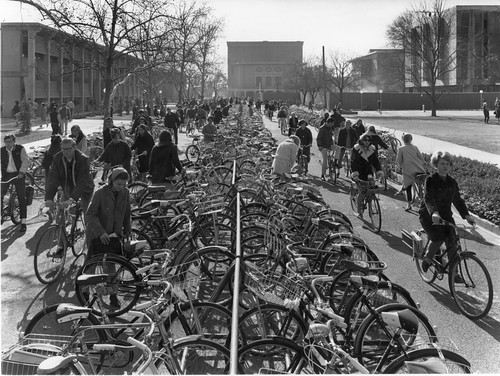
Davis, California as an important lesson for other college towns.  Davis was pathbreaking in that when the university campus was created, it didn't allow cars, and specifically promoted biking.  It led to the City of Davis becoming an equally committed proponent of bicycling("Davis, California - the American city which fell in love with the bicycle," Guardian)..
Bicycle racks at the University of California, Davis, 1963, by Ansel Adams


But this was in the period of widespread biking use, before automobility superseded other forms of mobility in the US.  Plus, because new student cohorts need to be educated and trained each year as other cohorts graduate, transportation demand management programming needs to be constant and rigorous rather than trickle down.

Over time, biking for transportation has significantly declined, both on the campus and in the city, and other cities, which developed more advanced practices, have leapfrogged Davis ("Fifty years of bicycle policy in Davis, CA," Ted Buehler).

The lesson is that promoting sustainable mobility practice needs to be constant.

Sustainable Mobility Platform elements for a college town
(recognizing that many of these elements are likely to be present, but are probably not well integrated)

1.   Integrating city and university transit into a single, unified system.
2.   Ideally riding the transit system would be free, through local and university funding sources (possibly through the creation of a transportation management district and use of parking revenues).
3.   Creating an integrated parking system between the city and university as appropriate, including wayfinding and valet services.
4.    Transportation Demand Management programming of a very serious nature, including trip travel programs for residents and large employers aimed to getting them using other modes (e.g., the Smart Trips program of Whatcom County, Washington) and the provision of TDM information at all types of locations--schools, libraries, retail businesses, large employers, bicycle shops, etc.

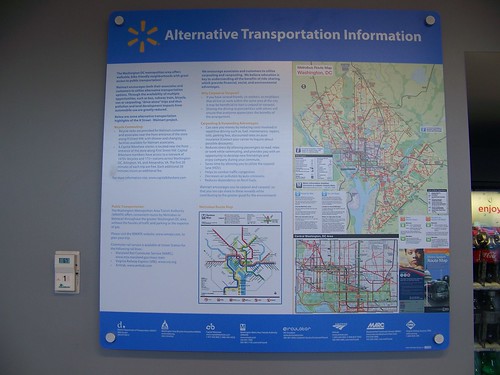
Alternative information sign, Walmart store, H Street NW, Washington, DC
TDM wayfinding signage at a Walmart supercenter in Washington, DC.

5.    Creating an infrastructure for electric car charging.
6.    Creating a car share system open to students under the age of 25, that supports both one-way and two-way usage.  Possibly the car share system could be comprised of electric cars.
7.    Set high mode split goals for biking, walking, and transit.
8.    Creating a city-university biking program, including a network of secure bike parking along the lines of the Melbourne Parkiteer system, some form of access to bikes (bike sharing), bike co-ops and an integrated network of high quality bicycle lanes, cycle tracks, and trails.*
9.    Use bike provision models such as those of Ripon College, North Central College, and UCLA to provide long-term access to bikes for students and for residents, bike commuting assistance programs such as of those in UK communities like the Hackney and Hounslow boroughs in London ("Eight "mutual assistance programs" that can build support for biking as transportation") which will loan people bicycles, locks, and helmets so they can try out biking
10.   The train station should be an anchor hub for bike parking and other bike services in the city, complemented by a campus-based "bike station."*
11.  Connect with metropolitan-regional transit systems for a low cost transit pass for use outside of the city/campus.
12.  Various pedestrian and placemaking improvements.
13.  Safe routes to school programming.
14.  Create zoning requirements for new construction that support high quality sustainable modes, especially biking in apartments, office buildings, schools, etc., plus electric car charging capacity, and spaces for car sharing, etc. College campuses tend to provide sub-standard bicycle parking, especially in dormitories.

The Urban Land Institute report, Active Transportation and Real Estate: The Next Frontier, describes 10 different apartment developments with extraordinary bicycle accommodations.  Other examples include Plant51 in San Jose ("Commuting has never been easier when you live at Plant 51 in San Jose," San Jose Mercury News) and Via6 in Seattle ("A look inside Via6's bicycle-friendly living and cycle club in downtown," Cascade Bicycle Club).

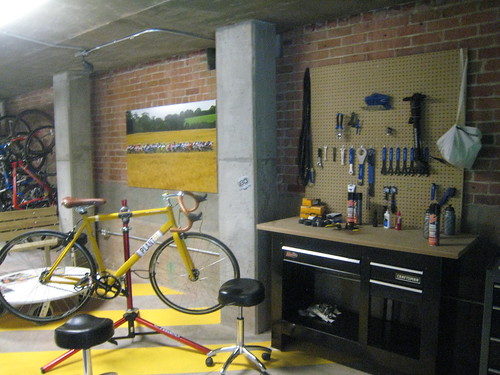
Plant 51 · Bicycle Kitchen
In-house bicycle repair station at the Plant51 condominium in San Jose.

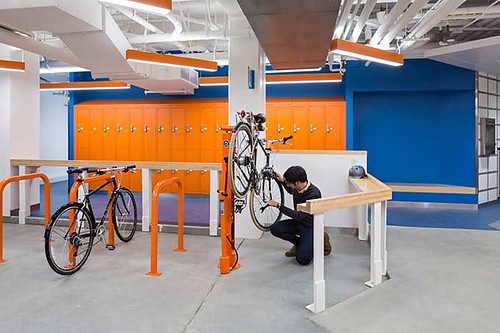
In San Francisco, the 100 California building owned by Pembroke Real Estate doesn't have car parking, but after a renovation the building now has a bike parking room with space for more than 100 bikes, a bike repair station, lockers, showers and towel service.
Bicycle room, 100 California Building, San Francisco
Bike Room, 100 California Building. Photo: Design Blitz SF.

Specific items for Newark
* Ideally the Wilmington MPO could work with SEPTA and the Philadelphia MPO to develop a "Cyclepoint" type program for bike parking at main train stations across the SEPTA network (in Newark, Wilmington, and Philadelphia especially), and a Parkiteer type secure bike parking program across the service areas of both planning organizations.

For Newark specifically, they should work to increase SEPTA train service between Wilmington and Newark, and to eliminate the "missing link" between the MARC and SEPTA systems.

Labels: , , , , , ,