Rebuilding Place in the Urban Space

"A community’s physical form, rather than its land uses, is its most intrinsic and enduring characteristic." [Katz, EPA] This blog focuses on place and placemaking and all that makes it work--historic preservation, urban design, transportation, asset-based community development, arts & cultural development, commercial district revitalization, tourism & destination development, and quality of life advocacy--along with doses of civic engagement and good governance watchdogging.

Tuesday, October 01, 2019

Revisiting Pittsburgh

For a couple years at the end of the 2000s I was in Pittsburgh a bunch of times, partly to work on a commercial district revitalization plan in the Lawrenceville District and I knew people running the Strip District organization (but the consultant I was working with ended up being a problem and the people running the commercial district revitalization group left, so we had no client, etc.).

Pittsburgh

As is my way, I spent a lot of time figuring out the city in terms of its revitalization trajectory.  Then, despite decades of incredible work, it still languished.

After I responded to something Richard Florida wrote about Pittsburgh, in "Urban economic development strategies: do you invest in people or places? ... yes," he re-tweeted it, saying it showed great understanding of the city's conditions.  (The items are appended at the end of this entry.)


And note later, I termed Pittsburgh an example of best practice revitalization, along with other cities  like Bilbao and Liverpool.  See "Economic restructuring success and failure: Detroit compared to Bilbao, Liverpool, and Pittsburgh," 2014.

Nigel, our e-correspondent from New Zealand, shares with us the new City Journal article on Pittsburgh, "A Renaissance Runs Through It: What Pittsburgh’s latest comeback tells us about urban revitalization," and just reading the first couple paragraphs makes me realize it's a perfect example of my argument about the long time needed to reach critical mass in population and business activity to the point where revitalization not only is evident but has a sustainable momentum.

Despite the fall of the steel industry (and failure/consolidation of other businesses like Westinghouse, Gulf Oil, eventually Heinz, etc.), it still had a core of leading businesses (Alcoa, Mellon Bank, etc.) including finance, universities, and medical care..

Decent neighborhoods. Attractive building stock. A strong history of innovation.  Foundations (Heinz and shockingly the Sarah Mellon Scaife Foundation which was controlled by the otherwise conservative Richard Scaife--"Richard Mellon Scaife dies: funded conservative groups ... and historic preservation in Pittsburgh," 2014") committed to investing in the city.

Some really awesome community organizations doing really great stuff.  For example, both the Pittsburgh History and Landmarks Foundation and the Pittsburgh Cultural Trust are not just national best practice, but world class in their work on historic preservation and the development and maintenance of cultural facilities specifically.

Some of the foundational ideas in Richard Florida's books are based on his experience in Pittsburgh, because when he was there, large numbers of people didn't stay after college, but some did, creating businesses, but the ecosystem wasn't there enough to keep the businesses or the people once the businesses moved into different phases where they needed different types of access to capital and talent.

But now, Pittsburgh is a center of research and practice for automated vehicles and robotics, and the start up business ecosystem is much more healthy than it was 15 years ago when Richard Florida taught at Carnegie-Mellon University.
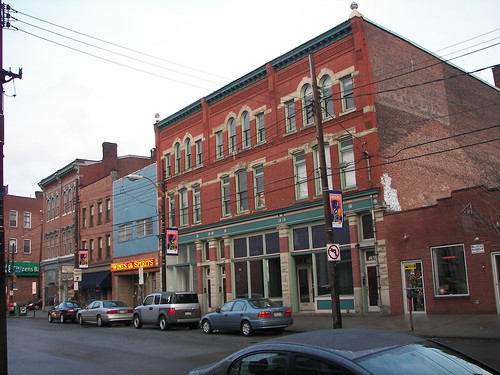
4000 block of Butler Avenue, Lawrenceville, PittsburghNice neighborhoods got better, neighborhoods that languished are now significantly improved ("One hidden element of the revitalization of Pittsburgh's East Liberty neighborhood) and housing prices in neighborhoods I looked at in the late 2000s have more than doubled in the ten years since.

I think it was more a function of time and the fact that time is necessary to rebuild both the ecosystem and the masses of people able to bend the curve towards city improvement. 

Because all the while, sprawl and the growth and development of the suburbs continues apace, which is why urban retail
and the Downtown still languishes on that score.

-- "Has DC reached revitalization critical mass, so that local government missteps don't matter?," 2011

Despite the cold weather, and the difficulties, Pittsburgh had the right conditions to rebuild after the loss of the steel industry.  It just took 30+ years.

And yes, the city was an early poster child for urban renewal dating to the 1950s, and for urban renewal, some of it, at least Downtown, was decent.  Efforts in the Hill District and East Liberty were flawed.  In Allegheny, a toss up.  Etc.

(This isn't an image from DC, but illustrates the point.)

DC as an example.  Similarly, using DC as an example, it took 20+ years after the introduction of Metrorail to DC before you started to see a critical mass improvement of the city -- because while not absolutely intention, Metrorail also served DC neighborhoods which were close to the core and comprised of attractive historic building stock and an urban form that favors walking, biking and transit

After 25 years or so, as the core stabilized, this revitalization pushed out beyond the core, to neighborhoods like Columbia Heights, H Street NE, and Petworth.

But with DC and economic studies of the value of transit, I know for the first 20+ years, studies didn't find much effect.  I think that's because the time frame you need to look at is much longer than people realize.

Aerial view of Dupont CircleAnd is hard to discern in any case, when you look at data at the metropolitan scale.

For DC proper, or Arlington County, you need to look at the core part of the system in those communities and measure the impact before and after, at the "submarket" scale even, not the entire city.

Note that studies by the Center for Transportation Studies at the University of Minnesota found that the greatest economic impact from transit are at the core of the system.

-- "Transit oriented development can take decades to realize, so two years is too short of a time to be expecting it (Austin Texas)," 2012
-- The Hiawatha Line: Impacts on Land Use and Residential Housing Value (Feb 2010, CTS 10-09)
-- Transportation as Catalyst for Community Economic Development(Dec 2007, CTS 07-07)

That makes sense.  It's where you have the most critical mass. Or what others call "the network effect."
======================
From the 2010 piece, "Urban economic development strategies: do you invest in people or places? ... yes":

... the point is that you need to have people-focused institutions that are place-committed. Capital can move anytime. But locally focused and locally committed institutions won't move. And if these institutions can develop a focus on improvement that is based on best practice, innovation, and quality then they become the levers and fulcrums of a new kind of industry.

If they don't, revitalization efforts are muddled and don't ever amount to very much.

The elements.
,

1. A number of quality universities that continue to attract talent, and at least two of the universities have strong engineering education programs which

2. These universities help develop new technologies and generate spin off businesses which build the region's economy and provide higher paying jobs.

3. It doesn't hurt that the University of Pittsburgh Hospital System is world class, especially in organ transplantation. This anchors medical care as a key "local" industry.

4. The city still has a handful of large national and global companies, a mix of manufacturing-research based companies like PPG and the U.S. headquarters for Bayer AG, software companies, and service industries (such as Mellon Bank). This means that there are still job and idea-producing industries there, even though these businesses are subject to the same concentration and downsizing trends affecting such companies.

5. Pittsburgh has a couple of incredibly strong foundations still present locally, focused on funding organizations and initiatives that improve the city both socially and economically.

6. Innovation, The region has a legacy and history of innovation that is embodied in organizations, including civic organizations and civil society so that groups are problem and self-help focused.

7. The arts organizations there have some heft. The Pittsburgh Cultural Trust has focused on re-establishing arts uses downtown and maintaining and extending the arts infrastructure there. The Carnegie Institutions set a standard of excellence as well. Etc.

Labels: , , , ,

Thursday, February 07, 2019

DC, Universities and "making versus taking" or universities that add to a community's capital and those that don't

Earlier in the week, the Washington Post ran an article, "How many colleges and universities operate in DC?," about the rise of universities from elsewhere in the US opening programs in DC and how this benefits the city.

Featured examples include the University of California Washington Center (pictured at left) and the proposal by Johns Hopkins University of Baltimore (which already has a center offering a variety of degree programs in Dupont Circle; plus their health system owns a hospital in the city) to buy the Newseum, a grand building on Pennsylvania Avenue close to the Capitol and the National Mall, for the relocation and unification of their programs into one facility.

I've written in the past about how DC has lots of universities but doesn't really get the maximum economic benefit from them, at least in terms of their sparking new business development and economic activity.

-- "Better leveraging higher education institutions in cities and counties: Greensboro; Spokane; Mesa; Phoenix; Montgomery County, Maryland; Washington, DC," 2016
-- "Naturally occurring innovation districts | Technology districts and the tech sector," 2014

And about universities, urban revitalization, and urban planning more generally:

-- "Should community culture master plans include elements on higher education arts programs?," 2016
-- "AJC series on Historically Black Colleges and Universities," 2018
-- "Speaking of planning for higher education: more on the University of the District of Columbia," 2012

including a couple pieces on College Park, Maryland, home of the University of Maryland College Park:

-- "College town follow up: alumni as residents and contributions to community capital," 2015
-- "More Prince George's County: College Park's militant refusal to become a college town makes it impossible for the city(and maybe the County) to become a great place," 2015
-- "Revisiting past blog entries: College Park as a college town and economic development | PG County and Amazon," 2018

That's because the schools and programs that tend to generate the most economic activity--business, engineering, computing--aren't necessarily that great.

And the health programs--Georgetown, George Washington, and Howard all have medical schools--aren't major research and health science technology development powerhouses compared to counterparts elsewhere.

For years, I wrote that not one DC based university was a member of the Coalition of Urban and Metropolitan Universities (Georgetown joined a few years ago and I guess that must have spurred the University of the District of Columbia to join too) and none really have great urban studies programs.  For awhile only UDC had an urban planning program.  Now it doesn't, but GWU, Georgetown and CUA have programs.

By contrast, other cities smaller, less well located, and "less prestigious" than DC have recognized the value in focusing on higher education as a revitalization and economic development tool and they're doing a better job of it.

JHU's major university center in DC is based at 1740 Massachusetts Avenue NW.

My argument about the "Washington semester" and degree programs, and centers (mostly about politics) being set up in DC by non-DC universities isn't about adding to the city as much as it is about benefiting or taking from it.

It's along the lines of my cultural planning writings which differentiate between arts organizations promoting "arts production" by which they add to, extend, and build the arts ecosystem and focus on producing art created by living artists versus promoting "arts consumption" or the presentation of arts and culture to audiences of works usually produced elsewhere, often by people no longer living.

Or as can be extrapolated from the piece "College town follow up: alumni as residents and contributions to community capital," universities based elsewhere but with programs in the city aren't likely to contribute much to community capital UNLESS they specifically create programs and initiatives to do so.

One example is how Kent State University's architecture school has an urban design studio in Cleveland, where the students are engaged in a variety of community-serving projects the the school's Cleveland Urban Design Collaborative.

(For a long time, HUD had a program to foster the development of such programs by universities, although no university in DC seems to have availed themselves of the program.  CUA's architecture school does a fair amount of urban design studio work by students on projects in the city.  To its credit, University of Maryland's planning and architecture school does a fair amount of projects in DC too.)

Labels: , , , , ,

Saturday, February 14, 2015

College town follow up: alumni as residents and contributions to community capital

A couple weeks ago I wrote about College Park in the context of university-town relations and leveraging the potential that a research-based state university can provide to community and economic development.  There was a lot I didn't discuss in that particular entry, such as the impact of urban universities at the neighborhood/sub-district level, which is fruit for another piece.

I realize that piece understated the importance of college towns being attractive and big enough to attract recent graduates as residents and the impact they have on community and social capital.

Just after writing that piece, I came across a brief on the topic by the Lincoln Institute of Land PolicyTown–Gown Collaboration in Land Use and Development, which is a good sum up of the issue.

I also came across an article in The Economist ("Trailing in its wake: How and why the fortunes of England’s two ancient university towns diverged") comparing Oxford and Cambridge and how Cambridge is doing much better economically than Oxford.

The article chalks this up to Oxford, albeit for different reasons, acting more like College Park in being resistant to taking the steps that would grow the local economy, in part by enabling the production of more housing at a variety of price points.

Oxford is more conservative politically, and wealthier residents are successful at limiting the development of new housing, which puts a brake on university-related enterprise development.
From the article:
“Cambridge is at least 20 years ahead of Oxford,” admits Bob Price, the leader of Oxford City Council. 
Both cities are wealthy and pretty. They are both about 60 miles from London, along fairly good train lines. Both are constrained by large “green belts” in which it is almost impossible to build houses. Both have Labour-led city councils. But there are big differences between Oxford and Cambridge, too—in topography, regional politics and priorities—and these help to explain the gap in performance. 
Whereas the land around Cambridge is flat and boring, much of Oxfordshire is rolling and gorgeous. It attracts wealthy, powerful residents who want to keep it that way. Oxford is surrounded by four different districts, run by Conservative politicians who do not all want to see an expansion of the city onto their land. Nor do they regard Oxford’s economic growth as their priority. Cambridge is surrounded by just one district, Tory-led South Cambridgeshire, whose councillors know on which side their bread is buttered.

Companies complain that the exorbitant cost of housing is making it hard to hold onto workers. In 2014 the average Oxford home cost 11.3 times average local earnings. ...

Cambridge, with 125,000 people, is quite different. Decades ago a few visionary academics proposed that the city should convert its boffinry (and especially its comparative strength in the sciences) into wider regional prosperity. In the 1970s Trinity College opened the Cambridge Science Park; the St John’s Innovation Centre followed in 1987. A whole ecosystem emerged, combining local government and business and then investors, all driven by the university. This success has also created housing and transport pressures, and property is expensive in Cambridge, too. But Cambridge built 1,020 homes in 2014—three times as many as in 2009. Oxford built just 60 last year.
A couple days ago, I attended a presentation as part of the Brookings Institution Global Cities Initiative, which featured Mayor Ken Faulconer of San Diego and Mayor Boris Johnson of London.

They talked about the things that leaders of global cities tend to talk about, the need to continually attract high powered and capable talent, the value of human capital, and research institutes and the development of innovation, helping to spark new business development, etc.

And later that night, I hung out with an old friend from Ann Arbor (a townie actually, but he went to UM and stayed and was a small businessman for many years and is heavily involved in civic affairs, currently serving as a trustee on the board of the local community college; his wife runs the county health department).

I caught up on mutual friends, people I don't really know anymore, their children, and all the various things they're doing within the community besides their important careers (another friend is on the board of the transit authority, etc.).

Juxtaposed with the discussion earlier in the day about talent, it occurred to me that the previous blog entry discussed the value of faculty and staff involvement at the critical mass scale in community involvement in traditional "college towns," but failed to make the same point about the value of the cumulative impact on a college town from those graduates who become residents and how these towns have access to a more high-powered set of talent and community capacity that they would't have access to without the symbiotic nature of the relationship between the university and town.

Instead the entry mentioned alumni residents more in economic terms, supporting the local retail community and their role in business development.

Ann Arbor's social capital has been shaped and formed in part by Vietnam era activism.

People my age came to the city a few years after the end of the Vietnam War, but the end of the war didn't stop activism, even if it became somewhat muted.

At least back when I was in Ann Arbor, there were a mix of organizations that included current students and community residents (most of whom had affiliations with the university).

Some organizations, like the Ann Arbor Tenants Union, received funding via student government, but served both residents and students.  Then, the "student" radio stations had plenty of alumni involved, which helped to provide some structure in the midst of the normal waxing and waning that student-only groups tend to experience.

Those involved alumni helped us ("young kids") learn and grow and be better than we would have been on our own and got us more interested in what was happening in the city.  At the same time, we provided new energy, more people, and a broader set of ideas that helped to shape the community outside of the campus.

And this student-alumni community integration continued through the 1980s (I don't know if and how it has been maintained since the 1990s), and is stoked by the continued involvement in civic life and the maturation and career path of the alumni-residents, ranging from people getting elected to City Council, their involvement in a variety of community organizations, working for local and state government, serving on boards and commissions, participating as parents of children in the local schools, etc.

That's another element that college towns like College Park, Maryland or Oxford, England lose out and fail to develop when they work diligently at diminishing the value of the college or university as an engine of community, social, and economic growth.

I don't think Ann Arbor is an exception in how community quality of life and the local economy is strengthened and continually improved because of how the town leverages the university's presence both in terms of talented faculty and staff and talented alumni who develop ties to the city and stay on as residents after they graduate, participating in civic and economic life, and making it bigger and better than it would be without their participation.

Obviously I know it's true in places like Berkeley, Cambridge, and Madison, and it's probably true in many other places where I don't have first hand experience with this phenomenon -- e.g., one of the attendees at the New Partners conference was Paul Soglin, Mayor of Madison, Wisconsin.

Soglin was featured in the documentary "War at Home," about student activism at the University of Wisconsin.  He served on City Council and as Mayor, starting when he was in graduate school.  He is Mayor once again, having been elected in 2011.

Places like College Park, Maryland and Prince George's County fail to have the same kind of benefit--even as University of Maryland graduates may choose to stay and live in metropolitan Washington--because the city and county fail to develop and strengthen the place value that makes staying on in a college town desirable.

Labels: , , , ,

Tuesday, January 27, 2015

More Prince George's County: College Park's militant refusal to become a college town makes it impossible for the city(and maybe the County) to become a great place

... like Ann Arbor, Madison, Chapel Hill, Cambridge, Berkeley, Boulder, etc.

Most cities lack the pedestrian density to support exclusively pedestrian malls.  College towns such as Boulder (pictured at right), Burlington, Vermont, and Charlottesville are exceptions, because of how town centers leverage the adjacent university campuses.

Last night I was talking with a colleague in preparation for the follow up piece on Prince George's County embarking on a zoning rewrite, and we were talking about what I call the "NIH effect," in Montgomery County, where people with high levels of education and relatively high incomes cluster around NIH because they work there, and how this impacts the schools and other civic institutions in the area.

It might not be as pronounced as it once was, but for me there was signature impact, because I remember being astounded back in 1979 as a sophomore in college mingling with so many kids from Montgomery County--typically they went to high schools like Whitman--how smart they were and how most had NIH lineage.

He brought up the University of Maryland and the fact that it doesn't have nearly the same kind of impact in Prince George's County that NIH does in Montgomery County, or the kind of impact that a typical large state university has on its environs.  (A lot of UMD students commute too, which dissipates some of the critical mass effect that a major state university can have on the local economy.)

Anti-college town policies in "College" Park.  We discussed how virtually every decision that the City of College Park and its Council makes is designed to make it impossible for a traditional college town to develop there, why the "commercial district" around the campus is pretty much pathetic, etc.

While there is a dense cluster of university buildings at Ann Arbor's core-central campus, it is surrounded on three sides by neighborhoods and two campus-related commercial districts, and the city's old "downtown" is just a few blocks west.

Highly educated and paid UMD staff and faculty have few reasons to live in the city.  Because there isn't much of a center outside the campus, faculty and staff have no compelling reason to live in College Park, especially because PG's schools lag those of certain other jurisdictions.  

No network effect.   By not having much "there there," the City of College Park and Prince George's County lose a wide variety of potentially beneficial impacts, especially for the schools.

The kind of "network effect" doesn't exist around the University of Maryland in the same way that such benefits are derived from NIH or the impact of children of faculty attending local public schools in cities like Ann Arbor, Michigan (etc.), the participation of faculty and staff in local civic affairs in a concentrated fashion, a concentrated grouping of high income consumers able to support local retail, etc.

Note that a big part of the economic impact in Ann Arbor is the University of Michigan Hospital, which is the largest employer in the city.  By contrast, the University of Maryland Medical School is in Baltimore.  Plus, Washtenaw County offers fewer options for high quality living, unlike how DC and Montgomery County are so close to College Park (my neighborhood is 4.25 miles from the campus by bike).  So Ann Arbor has less competition for residents than College Park.

The attractiveness of college town living to alumni.  Another factor in college town success is the desire of students to remain living in cities like Ann Arbor, Berkeley, Cambridge, and Madison after graduation, which helps to drive development of the commercial sector and small business development.

Both Baltimore and Philadelphia have well-developed programs designed to keep students in the city after graduation. Such a recruitment program would be tough for College Park to pull off, the way it is now.

College towns aren't perfect.  Sure the fact that it's a college town has shaped the retail in ways that favor students and may be less attractive to non-students, but the core of the commercial areas around the central campus are distinctly better than anything in College Park.

And there are some negatives that can arise from the economic value of neighborhoods serving as high rent "student ghettoes," and the lack of social and economic diversity that results.

Part of the problem comes from when the universities experienced their primary periods of growth.  Note that "the density" and spatial organization issue mentioned in the previous post is a related issue, and in part it has to do with when the university and the neighborhoods around it developed.

Ann Arbor's core neighborhoods developed during the era of the walking and transit city, so they are denser, set up in a traditional block and grid fashion, and are eminently walkable and served by some neighborhood commercial districts.

A big difference between most of the older universities mentioned above and UMD College Park is that Maryland is more a distinct campus that is cloistered, apart and separate from the city.  That's because it grew fastest in the 1950s, when the automobile dominated city planning.

Current conditions in "Downtown" College Park are anti-pedestrian. See the Washington Post piece, "Maryland to lower speed limit, expand speed cameras on troubled stretch of Route 1."

By contrast the University of Michigan's central campus is much more compact and is enveloped by the city around it.  But the fact that the North Campus developed during the 1950s and 1960s and is typical of universities developed in that period is instructive.

North Campus too is disconnected from the community and cloistered.  As a result, students don't spend much time there and don't like living there.

Note that as Johns Hopkins University in Baltimore leaks out from its campus into Charles Village, that has provided a new source of revitalization energy to that neighborhood.  The university has also significantly expanded its community connection and outreach effort.

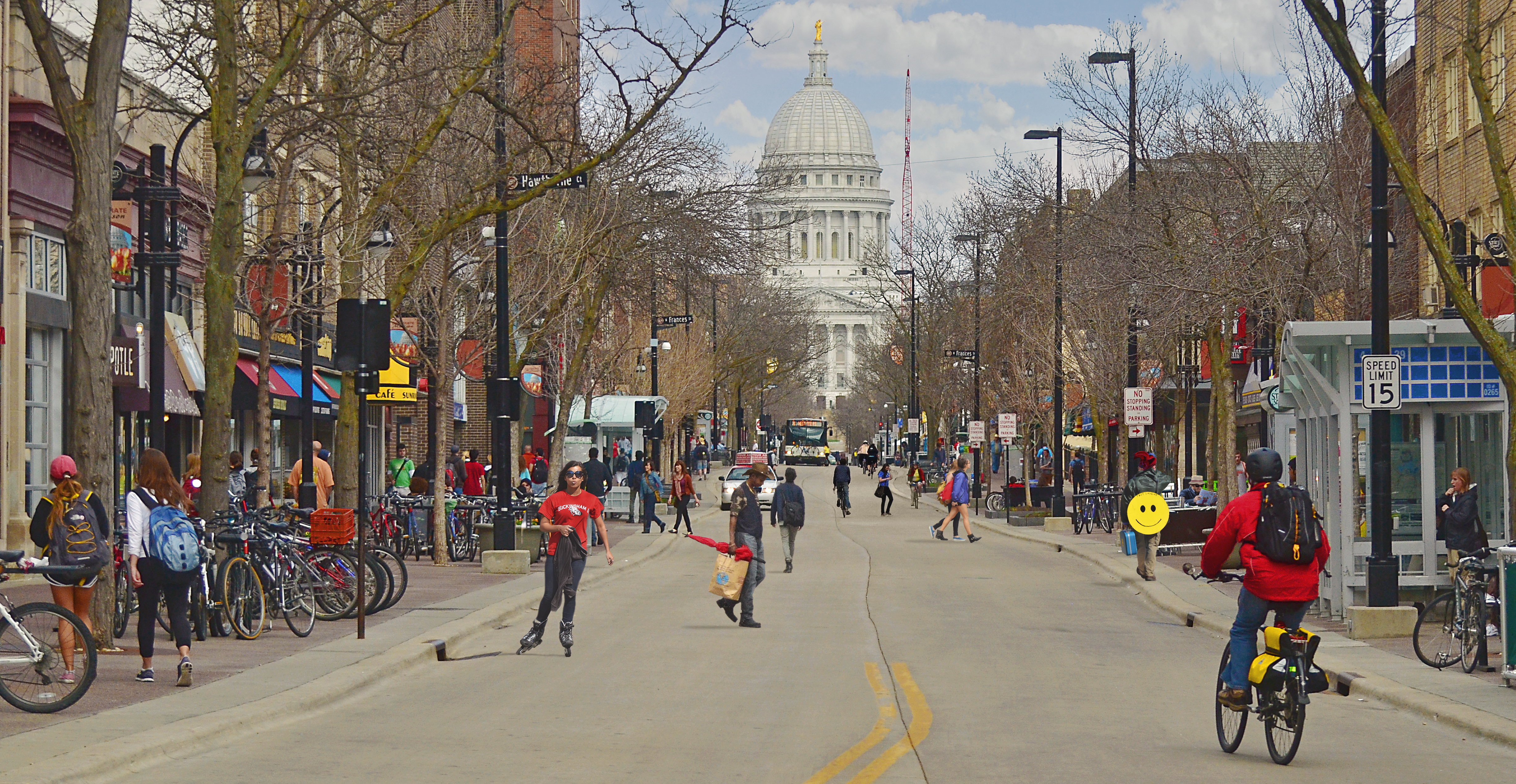
A spring day on State Street, Madison, WI, April 2013State Street in Madison, Wisconsin connects the campus and the State Capitol and is now closed to motor vehicle traffic.  Flickr photo by Richard Hurd.

The spatial organization of Madison and Berkeley are somewhat different in that the campuses are large and somewhat apart, but in both cases, the towns connect to the campus at particular edges in a manner that still knits the campus and town together in a manner that is mutually beneficial.

Conclusion.  It's probably too late, but making over College Park into a "true college town," using examples like Ann Arbor, Boulder, Chapel Hill and others would enable the city, county, and university to better reap a variety of positive development, community, social, and educational outcomes.

Labels: , , , ,