Rebuilding Place in the Urban Space

"A community’s physical form, rather than its land uses, is its most intrinsic and enduring characteristic." [Katz, EPA] This blog focuses on place and placemaking and all that makes it work--historic preservation, urban design, transportation, asset-based community development, arts & cultural development, commercial district revitalization, tourism & destination development, and quality of life advocacy--along with doses of civic engagement and good governance watchdogging.

Friday, August 29, 2025

Back to school reprint: Why isn't walking/biking to school programming an option in Suburban Omaha? | Inadequacies in school transportation planning

=======

Addendum, 9/5/2025

AP reports in, "Moms’ careers and personal time are hit hard by school drop-off demands, a poll finds," that driving kids to schools has a disproportionate effect on women/mothers, and even more so for low income families.  From the article:

Most parents drive their children to school, the survey found, and those responsibilities can have a major impact. About one-third of parents say taking their kids to school has caused them to miss work, according to the poll. Roughly 3 in 10 say they’ve been prevented from seeking or taking work opportunities. And 11% say school transportation has even caused them to lose a job.

One more reason to promote walk and bike to school programs.


==========

Back to School 2025

-- "Back to school reprint: Why isn't walking/biking to school programming an option in Suburban Omaha? | Inadequacies in school transportation planning"
-- "Back to school #2"
-- "Back to school #3" 
Schools should take the initiative to facilitate car pooling.  Especially in Greater Salt Lake City, where kids can go to schools outside of their home school district.

Original post from March 2022.

While my SmartNews newsfeed mostly seems to be about crime, there is a sub-thread on "good news." 

This ad from 1923 demonstrates that car companies 
have promoted driving kids to school for a long time. 

An article ("Exhausted Boy Ineligible To Take The Bus Walks 4 Miles To School Daily – One Day, A Stranger Makes An Offer," Goalcast), told the story of how a kid refused bus service to get to school had to walk two miles each way and this was especially hard in the winter as his family didn't have a car.  

The good news part of the story is that someone who saw the tv news story about it offered to drive the kid to school.  (The story is actually almost 7 years old.)

My first reaction was why didn't they get the kid a bicycle?  

While it would take him a minimum of 40 minutes to walk two miles, a bike ride would probably be 15 minutes.

According to the website for the Papillion La Vista Community Schools district, they don't provide bus service to students who live within four miles of a school.  At the time of the article, it was two miles.  This policy definitely presumes students will be driven by parents.

Walk to School Map, Bemis Elementary School, Rialto, California

Do school systems have responsibility to ensure "safe means" as well as "safe routes to school" in areas where bus service isn't provided?  In PLVCSD, the policy on "get to school yourself" seems to be applied regardless of the existence of walking and biking infrastructure or whether or not the family has a car.  

Although looking at Carriage Hill Elementary School on Google--this is where the student featured in the article went to school--the school has bike racks and there seems to be an acceptable sidewalk network serving the school (the sidewalks are pretty narrow and many immediately abut the street).

I have written in the past how few states require school districts to do what I call "balanced transportation planning," that is, to plan for walking, biking and other micromobility (skateboards, scooters, etc.), rather than to exclusively focus on bus-based transportation.  

-- "School bus travails and International Walk and Bike to School Day," 2021

Usually because of parent interest, and the fact that some schools are still embedded in walkable neighborhoods, in addition to busing, sometimes there are Safe Routes to School programs side by side.  

(For example, with Montgomery County Maryland, elementary school "no service" zones are one mile for elementary school, 1.5 miles for middle school, and two miles for high school.  But adverse walking conditions can provide exceptions to the policy.  Except for special education, DC doesn't provide school bus service at all.  But children and youth are eligible for a free transit pass for Metrobus and Metrorail.  The pass used to have a small charge, like $15 per month.  Now it's free.)

But with few exceptions, school districts aren't required to support SRTS programs.  When they are provided, they are more likely to be part of city planning or transportation departments, not the school system.

Washington State.  A few decades ago, Washington State changed their process, which had been focused on financial support for bus transportation.  Recognizing the issue was transportation, not "buses," they modified policy to include financial support for walking and biking.  

The planning guide they publish is particularly good.  Washington State provides resources to schools for "nonbus" transportation for areas within a two mile radius of the school.  They recommend school districts create district-wide traffic safety committees, and require the production of safe routes to school maps for all elementary schools (including private and parochial schools).  Increasingly, school districts in Washington are extending SRTS programming, including mapping, to junior and senior high schools.

-- School Walk and Bike Routes: A Guide for Planning and Improving Walk and Bike to School Options for Students
-- Safe Routes to School program, Washington State
-- City of Tacoma SRTS program, including SRTS Action Plan.  

Note that the Tacoma city transportation website for SRTS is significantly better than the resources provided on the school district website.  

It is typical for SRTS programs to be delivered by a city planning/transportation department rather than the school system, because they have the resources.  At the same time, my recommendation is that school districts be given this responsibility, and hire planners and outreach personnel, although there could be exceptions for smaller districts.

-- Seattle Walk to School maps

Boulder and Palo Alto do "multi-modal" student transportation planning.  Outside of Washington State, I only know of a couple school districts that do this along the lines of how I conceptualize it, Boulder Valley School District in Colorado and Palo Alto in California.  BVSD has multiple walk/bike planners on staff.

Other school systems do some planning for walk and/or bike to school, but it tends to be less systematic.  For example, Minneapolis has a Safe Routes to School policy plan, but not a master plan for each school.  Schools that do SRTS tend to do it in response to particularly motivated parents.

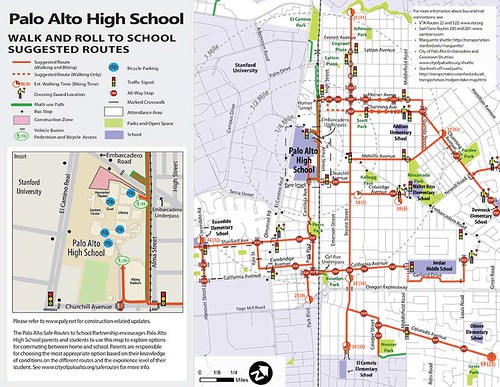
Besides printed brochures, Palo Alto posts large scale SRTS maps in each school building.

Palo Alto is exceptional because they do balanced transportation planning for all grades, while most places only focus on elementary aged students.

Nonbus service zones may equal nonplanning/disavowal of responsibility to ensure a kid can get to school safely and efficiently.  This story makes me realize that there is a subtle gap in school "planning" for transportation that I hadn't considered.

While a school district like Papillion La Vista Community Schools has policies for providing/not providing school bus transportation, they don't have a policy for ensuring kids have a safe and convenient means for getting to school.

By creating zones for no bus service, without a master policy these zones become "non planning zones" where the school system takes zero responsibility for ensuring that children can get to school safely.

Equity.  The Tacoma SRTS Action Plan has a strong equity lens (Equity is one of the "six" E's of their planning framework, which is a recent addition to the "E's" framework for bike and pedestrian planning), which is a great way to frame this discussion, because equity is the issue--are the students "who don't get bus service" provided with the support they need to get to school safely?

-- "Creating Inclusive & Equitable Safe Routes to School Programs," presentation, National Walking Summit

An equity lens means you provide extranormal assistance to the people who need it.

School systems with large non-bus service zones need to provide SRTS programming too.  In short, just because a school system sets up bus zones farther out shouldn't mean that at the same time they absolve themselves from responsibility for planning and implementing programs for how children may get to school--on foot, by bike, or by car--in the non-service zones.

While there should be a master SRTS program for all school districts, at the very least, all schools, including Carriage Hill Elementary School, should have a process for checking in with each student on their ability to get to and from school safely as part of the start of school/enrollment process, and for providing more direct assistance as needed. 

From Safe Routes to School to School Transportation Demand Management.  And just like how Ripon College started a bicycle program for new students as a way to reduce the need for students to bring a car and the increase in demand for parking spaces, which are expensive to build and maintain ("Ripon College gives freshmen free bikes for no-car pledges," Milwaukee Journal-Sentinel), school systems should step in and facilitate the provision of bikes to students as necessary, provide high quality bike parking, etc.

Plus, the school system needs to encourage the community to shovel sidewalks in winter so that students can safely walk or bike to school despite weather conditions.

And assist in the organization of car pools. 

In short, instead of focusing on "safe routes to school" and promoting walking and biking, we should be focusing on "transportation demand management" more generally.

SRTS prioritizes walking and biking, but foremost, what is required is a process where the school system leads in building the infrastructure, tangible like sidewalks, bike lanes, secure bike racks, showers for staff, bikes for kids who need bikes, etc. and intangible infrastructure like programming such as Walk and Bike to School Day, groups walking and riding to school, car pool organization assistance, etc.

Engagement.  Interestingly, the Tacoma SRTS program also adds "Engagement" to the traditional 5/6 E's framework for bike and pedestrian planning.  

I don't see how that's different from "Encouragement" but it reminds me to mention a few best practice programs I've come across.  And it makes more clear the need for ongoing and systematic programming.

There's tons out there on SRTS generally.  The entry "Revisiting assistance programs to get people biking: 18 programs," could be revised just for SRTS.

Nationally, the Safe Routes to School Partnership is the primary resource.

Starkville in Motion is an advocacy group in Mississippi that used "walking and biking to school" as a way to engage the community on improving pedestrian and bicycling infrastructure more generally, which is a point made by the Washington School Walk and Bike Guide, that infrastructure improvements for children walking and biking to school also benefit neighborhoods and builds support.

Pedestrian advocacy organizations like Feet First in Seattle have provided a great deal of support to Walk to School efforts.

Omaha has a group called Activate Omaha which has done some SRTS programming, but it is not a district wide program, nor does it provide support to suburban jurisdictions like the cities of Papillion (12 miles from Downtown Omaha) and La Vista (10 miles).

While International Walk and Bike to School Day is October 6th, schools should probably have such an event in September when school opens, as a way to check in with kids and parents on how they get to school.  

It turns out that in the US, the national walk and bike to school advocacy initiative has changed how they organize with separate Walk and Roll to School and Bike and Roll to School Days, the latter including scooters and skateboards.  The Walk Day is the same as International Walk and Bike to School Day, in October.

They have set Bike and Roll to School Day in May, which is National Bike Month, but to me that's the absolute wrong time to promote "rolling" to school, as by then the school year is almost over.

Youth bike programs.  Youth bike programs generally use biking as a way to teach life skills.  Some programs that come to mind are Gearin' Up Bicycles in DC, Phoenix Bikes in Arlington County, Virginia, Recycle-A-Bicycle in New York City (in the past, they've sponsored a national Youth Bike Summit), and Neighborhood Bike Works in Philadelphia ("Well Being: Ride of Dreams takes them far" Philadelphia Inquirer).  NBW is now an independent organization but originally it was a program of the Bicycle Coalition of Greater Philadelphia.

A program I find particularly impressive is the Ghisallo Bicycle Initiative in Austin, Texas.  It's definitely a model of national best practice.  One of their programs sets up "Bike Club" after-school programs at specific schools, but they have many more equally awesome programs, for all age levels.

Bike donations programs.  Ghisallo also provides free bikes to children as do others, including Sun Youth Organization in Montreal, Wish for Wheels in Colorado, Dallas Earn-a-bike, Project Bicycle Love in Ventura County, California, and the Community Bicycle Center in Biddeford, Maine.  While the Community Cycles Earn-a-Bike program in Boulder offers bikes to youths 16 and older, it is equally focused on adults.

Training.  Many states have bicycle and walking education programs for children, often involving either the traffic safety unit of the police department or local bicycling promotion organizations.

States should require all school districts do TDM /balanced transportation planning, not just focus on busing.  I wrote this based on my experience in Baltimore County, Maryland:

It happens that Baltimore County has a national best practice example of a walk to school program at Stoneleigh Elementary School, and I spent a few hours there on International Walk to School Day in 2009 (and had further interactions with the involved parents who created the program and the principal). 
I realized after that experience, and after learning that the State of Maryland Dept. of Transportation was doing a review of walk to school initiatives at the school district level, that the most fundamental issue was changing the requirements at the state level by requiring school districts to do balanced transportation planning, incorporating walking and biking into the planning regimen. 
Obviously, by doing that, where practical and appropriate, more children would be walking and biking to school. Yet that idea wasn't even in the scope of work of the Maryland study (and final report)!!!!!!!!! (I pointed that out in Oct. or November 2009, but the study scope was never changed.) 
Given that as much as 25% of local traffic in neighborhoods during school opening and closing hours is due to taking kinds to and from school by car, this is an important issue.

Nebraska.  Apparently the state has an SRTS program, and some resources like this Community Partnership Guide, but for the life of me, I can't find a dedicated SRTS webpage on the State DOT website.  State-level requirements for SRTS/school transportation demand management aren't in place. 


Labels: , , , , ,

Wednesday, October 04, 2023

Today is International Walk and Bike and Roll to School Day

 -- International Walk to School Day, First Wednesday in October

The US has its own Walk to School Day in May.  But in May the school year is almost over!

In the US, few states mandate that schools do what I call balanced transportation planning, that is planning for walking and biking as well as the school bus.  

Most just deal with school bus transportation, which is in part of function of school location planning, which gets more costly each year as prices rise for fuel and buses, and it gets harder to find bus drivers ("Why is there a shortage of school bus drivers," USA Today).

So schools should leverage International Walk to School Day as a way to promote sustainable modes for getting to school.

This post, "Why isn't walking/biking to school programming an option in Suburban Omaha? | Inadequacies in school transportation planning," is my most recent discussion of such issues.  

The newest realization in that entry is that school systems disavow responsibility for assisting kids in getting to and from school in non-bus zones.

My greater neighborhood in Salt Lake has a high rate of walk to school for multiple elementary and middle schools.  

Last spring, a child was killed by a truck which I argue the driver paid no attention, because she was in a crosswalk at an intersection with zero visibility issues and the vehicle was turning left ("Salt Lake City girl struck, killed in crosswalk near elementary school," Salt Lake Tribune).

The school created a road safety committee and instituted various transportation demand mangement measures for student drop off and pick up.

In response the school created a road safety committee and the city is building raised crosswalks to support that particular school.

Of course, I argue that such steps be taken proactively, not after a death.  

Even so, with a road safety committee and raised crosswalks, how do you get motor vehicle operators to pay attention?  

Labels: , , , , ,

Monday, October 10, 2022

Wednesday is National Walk and Roll to School Day

 Normally, International Walk to School Day is the first Wednesday in October.  Because Yom Kippur was on 10/5 this year, in the US it was pushed to the second Wednesday in 2022.

-- Walk & Roll to School Day

Although it's sadly pretty rare, this day should be leveraged by school districts, planning agencies, and transportation departments as a way to promote sustainable mobility options to get to and from school.  (The elementary school in our neighborhood is not quite 1/2 mile away and our next door neighbor walks to school many days with two girls who live on the next block.)

Recommendations.

1.  Probably the biggest is that states should require school districts to provide balanced transportation planning--meaning not just focus and funding on school buses, but to including walking, biking, and "rolling", with planners on staff to work with schools, having a sustainable mobility plan at the school district and individual school scales, resources, etc.

And this should be for schools at all levels: elementary; junior and senior highs.  Typically, school programs focus on elementary ages, but should include the upper grades as that is where selection of sustainable mobility modes can be routinized.

Palo Alto's walk to school brochures are also printed as large scale signs and placed in school lobbies.

2.  Besides having elements like walk and roll to school maps and signage, there should be a focus on creating secure parking systems for bikes, scooters, etc. 

Scooter parking at Bonneville Elementary School, Salt Lake City.

Kids here do get stuff stolen, although some but not all schools do have security cameras, which help.

-- "Why isn't walking/biking to school programming an option in Suburban Omaha? | Inadequacies in school transportation planning," 2022

Safety.  In some cities, walking to school can be problematic in terms of student safety.  Parent escorts, school personnel, etc., should be involved when necessary, and group walking--the "walking school bus"--should be promoted ("Walking School Bus," United Way of Greater Milwaukee and Waukesha County.  From the article:

“When we asked parents why they weren’t sending their kids to school, they told us that they didn’t feel the neighborhood was safe,” said Lincoln Avenue principal Yaribel Rodriguez. “If mom, dad, or a sibling was sick and they couldn’t walk their child to school, they were not comfortable sending them out to walk alone.”

Principal Rodriguez knew the school had to find a creative solution to ensure all kids could safely travel to school, so she turned to the Lincoln Avenue Community School Leadership Team (CSLT). Together the CSLT, made up of the principal, the school support teacher, the social worker, and the community school coordinator, explored the idea of starting a Walking School Bus.

“The concept of the Walking School Bus is simple,” said Regina Stieber, community school coordinator at Lincoln Avenue. “Teachers and parents walk a predetermined route, pick kids up along the way, and everyone travels safely together to school”

Lincoln Avenue’s Walking School Bus started with one day a week and was an instant hit. “Kids and parents started noticing us walking and asking to join,” said Regina. “The Walking School Bus is targeted at students with low attendance, but any student on the route is welcome to walk with us!”

It's also a great method for community building and the development of social capital.

-- Step by Step: How to Start a Walking School Bus at Your School, California Department of Public Health

Labels: , , , , ,

Friday, September 23, 2022

In Downtown Logan, Utah, some of the bus stops also provide information on walking

 The London Underground is noteworthy in how it's created a map with a list of walking distances between stations, in part to communicate that in some cases, rather than transfer between lines, it's faster to get out and walk.  They have maps for specific lines, as well as for all the stations in Central London.

Many transit wayfinding maps are typically organized around presenting a walkshed at 1/4, 1/2, and 3/4 mile distances.

Separately, there are walking oriented wayfinding systems like Legible London (which actually is based on the system first created in Bath, England).  Although London uses the same wayfinding system for transit, walking, and biking.


There are "guerilla wayfinding" systems encouraged as an element of tactical urbanism, to call attention to walk distances wrt locally-available amenities.

But I haven't seen bus stops and shelters conceptualized as an element of the walking network, or at least incorporating walking information as well as transit information in one place.  But the Cache Valley Transit District has done that at some--not all--bus stops in Downtown Logan.

It orients riders and tells them in which direction are the major destinations and how long it will take them to get there.


This would be an easy addition to bus stop signs and shelters. And it's a small transit system with a national best practice.

-- "Arlington County's bus shelters and a public realm framework of quality," 2013

Labels: , , , ,

Sunday, March 06, 2022

Why isn't walking/biking to school programming an option in Suburban Omaha? | Inadequacies in school transportation planning

While my SmartNews newsfeed mostly seems to be about crime, there is a sub-thread on "good news." 

This ad from 1923 demonstrates that car companies 
have promoted driving kids to school for a long time. 

An article ("Exhausted Boy Ineligible To Take The Bus Walks 4 Miles To School Daily – One Day, A Stranger Makes An Offer," Goalcast), told the story of how a kid refused bus service to get to school had to walk two miles each way and this was especially hard in the winter as his family didn't have a car.  

The good news part of the story is that someone who saw the tv news story about it offered to drive the kid to school.  (The story is actually almost 7 years old.)

My first reaction was why didn't they get the kid a bicycle?  

While it would take him a minimum of 40 minutes to walk two miles, a bike ride would probably be 15 minutes.

According to the website for the Papillion La Vista Community Schools district, they don't provide bus service to students who live within four miles of a school.  At the time of the article, it was two miles.  This policy definitely presumes students will be driven by parents.

Walk to School Map, Bemis Elementary School, Rialto, California

Do school systems have responsibility to ensure "safe means" as well as "safe routes to school" in areas where bus service isn't provided?  In PLVCSD, the policy on "get to school yourself" seems to be applied regardless of the existence of walking and biking infrastructure or whether or not the family has a car.  

Although looking at Carriage Hill Elementary School on Google--this is where the student featured in the article went to school--the school has bike racks and there seems to be an acceptable sidewalk network serving the school (the sidewalks are pretty narrow and many immediately abut the street).

I have written in the past how few states require school districts to do what I call "balanced transportation planning," that is, to plan for walking, biking and other micromobility (skateboards, scooters, etc.), rather than to exclusively focus on bus-based transportation.  

-- "School bus travails and International Walk and Bike to School Day," 2021

Usually because of parent interest, and the fact that some schools are still embedded in walkable neighborhoods, in addition to busing, sometimes there are Safe Routes to School programs side by side.  

(For example, with Montgomery County Maryland, elementary school "no service" zones are one mile for elementary school, 1.5 miles for middle school, and two miles for high school.  But adverse walking conditions can provide exceptions to the policy.  Except for special education, DC doesn't provide school bus service at all.  But children and youth are eligible for a free transit pass for Metrobus and Metrorail.  The pass used to have a small charge, like $15 per month.  Now it's free.)

But with few exceptions, school districts aren't required to support SRTS programs.  When they are provided, they are more likely to be part of city planning or transportation departments, not the school system.

Washington State.  A few decades ago, Washington State changed their process, which had been focused on financial support for bus transportation.  Recognizing the issue was transportation, not "buses," they modified policy to include financial support for walking and biking.  

The planning guide they publish is particularly good.  Washington State provides resources to schools for "nonbus" transportation for areas within a two mile radius of the school.  They recommend school districts create district-wide traffic safety committees, and require the production of safe routes to school maps for all elementary schools (including private and parochial schools).  Increasingly, school districts in Washington are extending SRTS programming, including mapping, to junior and senior high schools.

-- School Walk and Bike Routes: A Guide for Planning and Improving Walk and Bike to School Options for Students
-- Safe Routes to School program, Washington State
-- City of Tacoma SRTS program, including SRTS Action Plan.  

Note that the Tacoma city transportation website for SRTS is significantly better than the resources provided on the school district website.  

It is typical for SRTS programs to be delivered by a city planning/transportation department rather than the school system, because they have the resources.  At the same time, my recommendation is that school districts be given this responsibility, and hire planners and outreach personnel, although there could be exceptions for smaller districts.

-- Seattle Walk to School maps

Boulder and Palo Alto do "multi-modal" student transportation planning.  Outside of Washington State, I only know of a couple school districts that do this along the lines of how I conceptualize it, Boulder Valley School District in Colorado and Palo Alto in California.  BVSD has multiple walk/bike planners on staff.

Other school systems do some planning for walk and/or bike to school, but it tends to be less systematic.  For example, Minneapolis has a Safe Routes to School policy plan, but not a master plan for each school.  Schools that do SRTS tend to do it in response to particularly motivated parents.

Besides printed brochures, Palo Alto posts large scale SRTS maps in each school building.

Palo Alto is exceptional because they do balanced transportation planning for all grades, while most places only focus on elementary aged students.

Nonbus service zones may equal nonplanning/disavowal of responsibility to ensure a kid can get to school safely and efficiently.  This story makes me realize that there is a subtle gap in school "planning" for transportation that I hadn't considered.

While a school district like Papillion La Vista Community Schools has policies for providing/not providing school bus transportation, they don't have a policy for ensuring kids have a safe and convenient means for getting to school.

By creating zones for no bus service, without a master policy these zones become "non planning zones" where the school system takes zero responsibility for ensuring that children can get to school safely.

Equity.  The Tacoma SRTS Action Plan has a strong equity lens (Equity is one of the "six" E's of their planning framework, which is a recent addition to the "E's" framework for bike and pedestrian planning), which is a great way to frame this discussion, because equity is the issue--are the students "who don't get bus service" provided with the support they need to get to school safely?

-- "Creating Inclusive & Equitable Safe Routes to School Programs," presentation, National Walking Summit

An equity lens means you provide extranormal assistance to the people who need it.

School systems with large non-bus service zones need to provide SRTS programming too.  In short, just because a school system sets up bus zones farther out shouldn't mean that at the same time they absolve themselves from responsibility for planning and implementing programs for how children may get to school--on foot, by bike, or by car--in the non-service zones.

While there should be a master SRTS program for all school districts, at the very least, all schools, including Carriage Hill Elementary School, should have a process for checking in with each student on their ability to get to and from school safely as part of the start of school/enrollment process, and for providing more direct assistance as needed. 

From Safe Routes to School to School Transportation Demand Management.  And just like how Ripon College started a bicycle program for new students as a way to reduce the need for students to bring a car and the increase in demand for parking spaces, which are expensive to build and maintain ("Ripon College gives freshmen free bikes for no-car pledges," Milwaukee Journal-Sentinel), school systems should step in and facilitate the provision of bikes to students as necessary, provide high quality bike parking, etc.

Plus, the school system needs to encourage the community to shovel sidewalks in winter so that students can safely walk or bike to school despite weather conditions.

And assist in the organization of car pools. 

In short, instead of focusing on "safe routes to school" and promoting walking and biking, we should be focusing on "transportation demand management" more generally.

SRTS prioritizes walking and biking, but foremost, what is required is a process where the school system leads in building the infrastructure, tangible like sidewalks, bike lanes, secure bike racks, showers for staff, bikes for kids who need bikes, etc. and intangible infrastructure like programming such as Walk and Bike to School Day, groups walking and riding to school, car pool organization assistance, etc.

Engagement.  Interestingly, the Tacoma SRTS program also adds "Engagement" to the traditional 5/6 E's framework for bike and pedestrian planning.  

I don't see how that's different from "Encouragement" but it reminds me to mention a few best practice programs I've come across.  And it makes more clear the need for ongoing and systematic programming.

There's tons out there on SRTS generally.  The entry "Revisiting assistance programs to get people biking: 18 programs," could be revised just for SRTS.

Nationally, the Safe Routes to School Partnership is the primary resource.

Starkville in Motion is an advocacy group in Mississippi that used "walking and biking to school" as a way to engage the community on improving pedestrian and bicycling infrastructure more generally, which is a point made by the Washington School Walk and Bike Guide, that infrastructure improvements for children walking and biking to school also benefit neighborhoods and builds support.

Pedestrian advocacy organizations like Feet First in Seattle have provided a great deal of support to Walk to School efforts.

Omaha has a group called Activate Omaha which has done some SRTS programming, but it is not a district wide program, nor does it provide support to suburban jurisdictions like the cities of Papillion (12 miles from Downtown Omaha) and La Vista (10 miles).

While International Walk and Bike to School Day is October 6th, schools should probably have such an event in September when school opens, as a way to check in with kids and parents on how they get to school.  

It turns out that in the US, the national walk and bike to school advocacy initiative has changed how they organize with separate Walk and Roll to School and Bike and Roll to School Days, the latter including scooters and skateboards.  The Walk Day is the same as International Walk and Bike to School Day, in October.

They have set Bike and Roll to School Day in May, which is National Bike Month, but to me that's the absolute wrong time to promote "rolling" to school, as by then the school year is almost over.

Youth bike programs.  Youth bike programs generally use biking as a way to teach life skills.  Some programs that come to mind are Gearin' Up Bicycles in DC, Phoenix Bikes in Arlington County, Virginia, Recycle-A-Bicycle in New York City (in the past, they've sponsored a national Youth Bike Summit), and Neighborhood Bike Works in Philadelphia ("Well Being: Ride of Dreams takes them far" Philadelphia Inquirer).  NBW is now an independent organization but originally it was a program of the Bicycle Coalition of Greater Philadelphia.

A program I find particularly impressive is the Ghisallo Bicycle Initiative in Austin, Texas.  It's definitely a model of national best practice.  One of their programs sets up "Bike Club" after-school programs at specific schools, but they have many more equally awesome programs, for all age levels.

Bike donations programs.  Ghisallo also provides free bikes to children as do others, including Sun Youth Organization in Montreal, Wish for Wheels in Colorado, Dallas Earn-a-bike, Project Bicycle Love in Ventura County, California, and the Community Bicycle Center in Biddeford, Maine.  While the Community Cycles Earn-a-Bike program in Boulder offers bikes to youths 16 and older, it is equally focused on adults.

Training.  Many states have bicycle and walking education programs for children, often involving either the traffic safety unit of the police department or local bicycling promotion organizations.

States should require all school districts do TDM /balanced transportation planning, not just focus on busing.  I wrote this based on my experience in Baltimore County, Maryland:

It happens that Baltimore County has a national best practice example of a walk to school program at Stoneleigh Elementary School, and I spent a few hours there on International Walk to School Day in 2009 (and had further interactions with the involved parents who created the program and the principal). 
I realized after that experience, and after learning that the State of Maryland Dept. of Transportation was doing a review of walk to school initiatives at the school district level, that the most fundamental issue was changing the requirements at the state level by requiring school districts to do balanced transportation planning, incorporating walking and biking into the planning regimen. 
Obviously, by doing that, where practical and appropriate, more children would be walking and biking to school. Yet that idea wasn't even in the scope of work of the Maryland study (and final report)!!!!!!!!! (I pointed that out in Oct. or November 2009, but the study scope was never changed.) 
Given that as much as 25% of local traffic in neighborhoods during school opening and closing hours is due to taking kinds to and from school by car, this is an important issue.

Nebraska.  Apparently the state has an SRTS program, and some resources like this Community Partnership Guide, but for the life of me, I can't find a dedicated SRTS webpage on the State DOT website.  State-level requirements for SRTS/school transportation demand management aren't in place. 

Labels: , , , , ,

Monday, October 11, 2021

College towns and sustainable mobility promotion

School's back in session for many universities.

There is an article in the Detroit News, "Why Wayne State is offering free public transportation to students, staff," about how Wayne State University is shifting money it had spent on poorly used shuttle buses to instead pay for transit passes good on the area bus services (the city and the suburbs have separate systems), the city bike sharing system, and the QLine streetcar on Woodward Avenue.  

This program is open to students and staff.  (Article access requires subscription, but you can access it from a typical public library system's articles database.)

-- Wayne State press release describing the program

The SF Muni program is providing college students with free transit access too, this and next year, paid for by Covid stimulus monies.

It makes me think of the conversation I had with a planner at Towson University, who said "we should think about 'safe routes to campus' and all the ways--transit, biking, etc.--we can facilitate it."

A bunch of best practices.  Many universities have agreements with local transit services for student access.  For a time (until the 2008 recession), Central Washington University in Ellensburg made its transit system open to residents.  University of Maryland has an extensive shuttle bus system, and College Park residents could pay for a pass, and the University bus service also operated the special Route 1 bus service in that corridor.  Baltimore's Collegetown program has a shuttle bus operating between university campuses.

About 20 years ago, this was an area of interest for UCLA planning professor Donald Shoup  ("Unlimited Access: Prepaid Transit at Universities,").

Some transit systems, like LA Metro and the Baltimore-area MTA, offer reduced cost transit passes to college students independent of university financial support.

Photo: Ktransit.

Portland State University funded a stop for the campus on the streetcar line, and provided right of way through the campus. Oregon Health Sciences University operates the Portland Aerial Tram.  

But sadly, some universities like University of Southern California and Norfolk State University have been resistant to facilitating access to local transit systems.  Some don't plan for it at all.

Harvard University has paid for a number of bike sharing stations serving its campuses.  UC Davis when it first built its campus, made it walking and biking centric, banning cars from the central section of the campus.  Other campuses have bike rental/use programs, have bike repair shops on campus, and extensive intra-campus bike lane systems, etc.

UC Santa Barbara bike shop brochure

University of Utah has provided subsidies to faculty and staff for e-bike purchases. Some universities have bike master plans and the League of American Bicyclists "Bike Friendly" program includes universities, who vie for designation.  Baltimore's Collegetown program has a system of bike routes between campuses as well.  (I argued that Baltimore County should have tried to extend such routes to Towson University and UMBC.)

University of Utah has an arrangement with the transit authority so that tickets for sports events (football, baseball, gymnastics, basketball) also provide transit access for no additional charge ("Hate Stadium Parking and Game-Day Traffic? An Idea," CityLab). 

Sustainable mobility programming and college campuses.  I have three pieces that are particularly relevant:

-- "Innovative University Transportation Demand Management Programs," 2014
-- "College towns of a certain size as an opportunity for sustainable mobility nirvana," 2018
-- "This week is Bike Week at the University of Utah," 2018

The basic point is that college can be a good time to "imprint" students with best practice paradigms about sustainable mobility that they can adopt going forward, beyond college (fingers crossed, but I'm not totally convinced).

Certainly, living in Ann Arbor, mostly walking, but biking some and occasionally using either the University shuttle service between campuses (one year I lived on the route, but I still didn't use it much) or the city bus service, primed me for adopting sustainable mobility practices once I moved to Washington.  But plenty of college students are anti-transit and remain so after they graduate.

Intra-campus bike path at UCSB.

Promotion must be constant.  But that if you're going to promote sustainable mobility practice, it needs to be constantly emphasized and promoted, and multiple initiatives need to be adopted--especially because every year there are new students, AND YOU NEED TO START IN THE FALL TERM because that's when students come back to school.

For example, University of Maryland does its "bike week" in April, when school is almost over, while University of Utah does their "bike week" at the start of the fall term. (But Utah doesn't participate in the city bike sharing system.)

Ideal program elements.  A "sustainable mobility expo" needs to be held every fall at the bare minimum.

And more than just providing access to bike sharing--which many universities don't do at all, universities should have bike purchase programs for students and staff, bike maps (posted), repair facilities, etc.

States should require as part of campus planning requirements, that colleges be required to do sustainable mobility planning (biking, walking, transit).  For example, in Maryland there are no such requirements.  Some universities care and do it, others don't, even in the same county.

Similarly, cities should include transportation demand management planning requirements on colleges and universities, including for sustainable mobility (biking, walking, transit).

Secure bike parking should be a minimum requirement, as bike theft on campus is a perennial problem.

Labels: , , , , , , , ,

Friday, October 08, 2021

School bus travails and International Walk and Bike to School Day (first Wednesday in October)

Marissa James gets off the bus at Summit Elementary School in Summit, Miss., on Thursday, Aug. 5, 2021, on the first day of the 2021-22 school year for students in the McComb School District. (Matt Williamson /The Enterprise-Journal via AP.

I was remiss in not writing about International Walk and Bike to School Day, which is held the first Wednesday in October, in other words earlier this week.  

-- Toolkit for International Walk and Bike to School Day

It's a great event in that it's held in the fall, pretty early into the school year, and it has the opportunity to repattern people's choices on how they get to school. The 2019 post has a bunch of recommendations.

Of course, the biggest problem with "walk or bike to school" is how in the expansive land use and transportation development paradigm that the US has adopted--called sprawl--schools have been repositioned to serve larger populations and multiple neighborhoods, and are located at distances where walking to school is no longer emphasized, and school bus based transportation is required to get students to and from school.

GM has promoted driving to school as a way to promote car usage for almost 100 years.  Ad from the Saturday Evening Post Magazine, 1927.

This has been written about plenty over the past 20 years:

-- Why Johnny Can't Walk To School: Historic Neighborhoods in the Age of Sprawl
-- Helping Johnny Walk to School: Policy Recommendations for Removing Barriers to Community-Centered Schools, National Trust for Historic Preservation
-- "Why Johnny Can't Walk to School, op ed, Chicago Tribune

The vehicle-dependent travel paradigm for K-12 education has been a problem for a long time.  From the article:

School sprawl doesn't affect just kids, it also makes life worse for parents. A 1999 report by the Surface Transportation Policy Project, a Washington-based research and policy organization, reported that mothers with school-aged children make an average of more than five car trips a day, 20 percent more than other women. Today, the average American parent is trapped behind the wheel of a car--an average of 72 minutes a day, chauffeuring children to school, and then from there to soccer games, birthday parties, friends' houses and the like.

But now it's become even worse in the post-vaccine period of the pandemic because it has discombobulated the job market, especially for drivers of school buses ("As Schools Reopen, Districts Are Desperate for Bus Drivers," New York Times).

Many communities are now unable to operate all their bus routes, and parents and others are stepping up with car pools etc. to fill in the gap.  But there are plenty of students wasting hours each day because of missed bus runs ("Canceled bus routes caused 1,164 Fayette students to miss a half day or more this year," Lexington Herald-Leader, "‘This is a huge burden on families:’ Henrico students missing classes thanks to bus driver shortage," ABC8).

Business Insider argues it's a function of "underfunding schools" ("America's bus-driver 'shortage' isn't new: It's due to years of underfunding, and it's putting kids at risk.") completely missing the real issue, that it's a function of developing a vehicle-dependent paradigm for K-12 student transportation.

When I was a child in Detroit, a mile was about the maximum distance for elementary schools.  We all walked to school.  And older kids helped shepherd younger kids.

Here in Salt Lake City, it's comparable.  The school district makes a point of building walkable schools, and most schools have bike and scooter racks (even if the accommodations aren't up to the recommendations of national policy bodies).  This is true even though the region is firmly committed to sprawl (but also probably has to do with the Mormon Church's focus on siting churches at distances convenient to being able to walk to church--even though these days it appears that few people walk to church).

In DC, sometimes I would escort the girl next door on her bike ride to school.  

A lot of DC's schools would be walkable, except that probably most students don't attend local schools, but schools all across the city.

And if schools are farther away, kids need to be driven.

(Note, yes, with open enrollment schools, a greater number of students don't live near the school they attend.)

Conclusion.  Going forward, things will only get worse in terms of (1) finding bus drivers; (2) wages; (3) the cost of fuel; and (4) the cost of buses.  

The solution is for schools to reduce their dependence on bus transportation, and should be required to do balanced transportation planning, with a focus on shifting trips to walking and biking.  

-- School Walk and Bike Routes: A Guide for Planning and Improving Walk and Bike to School Options for Students, State of Washington DOT

But most states have requirements for school bus transportation planning, and few if any requirements for balanced transportation planning for all modes.  

One exception is the Boulder Valley School District serving Boulder, Colorado, which has walking and biking planners as part of their "student" (not "bus") transportation department. 

Many school systems create safe routes to school maps focused on walking and biking to school.

Palo Alto, California extends its Safe Routes to School planning to junior and senior high schools, whereas most school districts that do have good SRTS programs tend to limit them to elementary schools.

States should address that omission and require school systems do walk and bike to school planning as an element of comprehensive "student transportation" (not "school bus transportation"), rather than just leave it up to the vagaries of parent interest and propinquity.

In addition, as a way to help strengthen local transit systems ("Creativity helps Rochester bus system turn a profit,"  New York Times), school systems should aim to shift some students to public transit systems, because it can be more efficient to do so.  (Many school districts do this for junior and senior high, since these schools tend to be located not within walking distance.)

(Although ADA requirements mean that separate disability transportation is still a part of the mix regardless.)

Note that the MUNI system in San Francisco does this for K-12 students already ("SFMTA announces young people to ride Muni for free," Mass Transit Magazine). 

Labels: , , , , , , ,

Wednesday, July 01, 2020

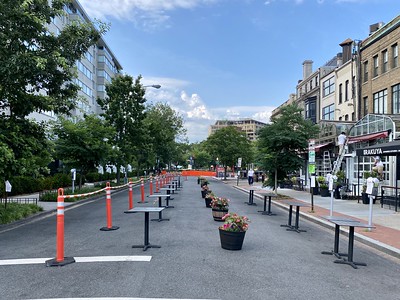
Revisiting pedestrianizing the 1500 block of 19th Street NW in Dupont Circle

Recently, the entry "" discusses how to make pedestrian and bicycling right of way expansions in the wake of the coronavirus a more permanent condition.

In 2019, the entry "Planning urban design improvements at the neighborhood scale: Dupont Circle, DC," discusses a systematic program for urban design improvements in and around Dupont Circle.  It was an outgrowth of my Purple Line series-thinking, although it took me a couple years to get around to writing about it.

One of the recommendations, Item #5, was pedestrianizing the 1500 block of 19th Street NW, which is the block with the Dupont Plaza Hotel on the east and the block of businesses on Connecticut--many have rear entrances, anchored by Kramerbooks and Afterwords Cafe, the combined bookstore-cafe that is open 24 hours on weekends (in normal times) and a very busy Starbucks.

5. Make 19th St. between the Circle and Q Street a permanent pedestrian street
(but with access for deliveries.)

Joe Flood, via Flickr, shares with us his photo of this block, set up for expanded restaurant patio service.
Untitled

I made a similar recommendation, starting with weekends, for 17th Street:

6. Make 17th Street between P and R Streets a pedestrian district on weekends.


17th Street NW, Dupont Circle

And from an update standpoint, instead DDOT and the Washington Area Bicyclists Association, is pushing the addition of a cycletrack to 17th Street, which would get in the way of pedestrianizing it.

Given the pedestrian volume in the area, and the need for this commercial street section to have a positioning that is more distinct vis a vis neighboring 14th Street and Dupont Circle as a way for its establishments to be more competitive, emphasizing and strengthening its pedestrian character should be prioritized over cycling--especially given nearby parallel routes, and let's face it, relatively low volumes of bicyclists.

In the past I've suggested that WABA reposition from a cyclist-exclusive orientation to a more expansive "sustainable mobility" agenda like Transportation Alternatives in NYC and Active Transportation Alliance in Chicago (formerly the Chicago Bicyclists Federation), they haven't done so.

So there isn't a good pedestrian advocacy group in the city--robust examples elsewhere include Feet First in Seattle, Starkville in Motion in Mississippi (although they do biking too), Walk Boston and Walk Denver--and therefore in DC the pedestrian agenda can too often be neglected.

Labels: , , , , , , ,

Tuesday, October 01, 2019

International Walk and Bike to School Day: Wednesday October 2nd, 2019

Wednesday October 2nd is International Walk and Bike to School Day.

It's a fall complement to how most local advocacy groups and the promotion calendar has walk and bike to school day in May, during National Bike Month.

-- Toolkit for International Walk and Bike to School Day

While it's always important to promote walking and biking, to me, May is exactly the wrong time to be doing it for schools, because it's at the end of the school year.

Instead, it should be done near the start of the school year, to promote biking (or walking) to school for the entire school year, not just towards the end of it.
Drive children to school ad, Chevrolet, Saturday Evening Post, March 3, 1923
Car companies have been promoting driving kids to school for almost 100 years.

Monday's "Ask Amy" column discusses how one boy prefers to cycle on the way to school by himself, rather than ride with another guy.

Bike advocacy calendars.  Need to be created the whole year, including bike to school in the fall and spring, even a Winter Bike to School Day.

Stoneleigh Elementary School, Baltimore County.  When I did the bike plan in Baltimore County, I was fortunate to be invited to observe International Walk and Bike to School Day at Stoneleigh Elementary School, where they had a robust walk to school program that had been initiated by parents, but was warmly supported by the school's principal who in turn was super as well.  To my way of thinking, the principal created a kind of site-based transportation demand management program.

Protect Our Children Slow Down street sign, Stoneleigh neighborhood, TowsonCompared to the traffic nightmares you witness around schools in DC, it was amazing.

Recommendations from then. After that day, learning about the efforts of two particularly motivated mothers with a lot of time to get the program off the ground, and after learning about Boulder Valley's district-level support program, I suggested that the best way for the State of Maryland to promote walking and biking to school would be to require the school districts to address all forms of transportation, including walking and biking, systematically, and at the district-level, rather than focusing solely on school bus transportation--rather than to hope for the best, that parents at various schools would develop Safe Routes to Schools programs on their own.

Secure bike parking programs should include schools.  I have written a lot about the need to create metropolitan networks for secure bike parking.

I hadn't thought about that including schools, but there is a need for it, as someone just wrote on my neighborhood e-list about how her son's bike was stolen while he was attending Takoma Park Middle School (Montgomery County, Maryland).

Because some drivers are a******* should you just give up?  There is an article at Greater Greater Washington, "Why I stopped taking my kid to school by bicycle," that's I find difficult relating to.

From the article:
It’s over because a man driving a dump truck the size of a house put my son’s life in danger.

The details of what happened unfortunately aren’t that remarkable. It was a perfect storm of road rage, reckless driving, terrible street design, and total lack of any kind of recourse, so basically a normal Tuesday on a bicycle in DC.

The dump truck driver drove aggressively and blasted his airhorn over many blocks on R Street NW. He was just feet from a half dozen other people on bikes who could do nothing but cringe and hope he didn’t mash us into pulp.

Oliver was terrified, asking me if we can ride on the sidewalk, asking me if we can stop, almost in tears.

After we turned up 18th Street and jumped the light at S Street to get away from this reckless man, Oliver turned and asked, “Can we take the Metro instead?” And that was it. I decided I can’t subject my son to this traffic violence anymore.
Marina bicyclingMarina.  I helped her get "a new" bike from this guy, Harper Cycles, who sells bikes at flea markets, such as the one in Dupont Circle at 15th and P Streets on Saturdays and the Takoma Farmers Market on Sundays.  He also does bike repairs.

If I let one terrible incident stop me from doing X or Y or Z, my life would be pretty constrained. In fact, I wouldn't have continued to live in the city after 1989 (a terrible crime incident which ultimately wrecked my then marriage), I would have moved to the suburbs, bought a gun, been fearful, etc.

Exit or Voice?  One of my complaints about GGW is that there is a fine line between whining and seeking solutions.  I find them to be bigger on whining and severely deficient when it comes to proffering robust frameworks for improving urbanism practice.

It would have been so easy to offer up some alternative ways of addressing the problem other than bailing (cf. Exit, Voice and Loyalty by Hirschman).

Relatedly, GGW has a new piece about tomorrow's Walk to School Day, "Walk to school day is right around the corner. Wouldn’t it be great if it were every day?," and it offers very little in actionable recommendations and nothing in the way of useful resources.  It does say there should be a systematic approach, and leaves it at that.

Report the errant driver?  And I know in that situation I would have called the police and reported it, and I would have gotten information about the truck and called the company, made other complaints, etc. I have done that multiple times.  (Following the driver to its destination, you could have identified the client for the trucking company, complained to them, etc.)

(In DC, I've argued for a long time that as part of the licensing requirements for truck drivers, they should be required to go through special driver training concerning urban mobility, specifically pedestrians and bicyclists. DC Government truck drivers and WMATA bus drivers ge such training.)

Why not seek solutions instead of reflexively stop?  I understand that the #1 priority of parents is keeping their kids safe. But I also understand, having started biking for transportation in 1990, that the mobility system still favors automobility and that to do the right thing wrt sustainable mobility, like biking, requires sacrifices.

Bike share bicycle with child in the carrierMore and more families are biking to school. Some with cargo bikes or other contraptions. 

Granted, it's much easier in some places than others, which is why every school should have to have a walk and bike to school plan, which is required in the State of Washington, what the Boulder Valley and Palo Alto school districts do, etc.

I can't fully generalize from my experience, but I have biked to school a bunch of times with the girl next door--she's 11 now--which is about a two mile distance.

There is a stretch where the sidewalks are somewhat inadequate. But even so, we've managed to create a pretty safe route and it will only become better as the sidewalk network approaching her school is built out.

One obvious solution: The Bike Train | group cycling to school. "The Walking School Bus" is touted in Safe Routes to Schools programs. It's pretty simple. It's people walking to school as a group.  There is less discussion about "group cycling" to school.   That should change.

--  Bicycling to School Together, A Bike Train Planning Guide
-- Tip Sheet #2: Organizing Bike Trains
-- "How to Build a Bike Train," YES! Magazine

But the Dutch have introduced a true "Bike Bus" ("Bicycle Buses Let Dutch Kids Pedal Together to School," TreeHugger).   Imagine a school or two deploying those.

Other resources.  While I advocate for systematic approaches at the school district administration scale, so that each school has a plan and program, something that seems to be rare, but Boulder and Palo Alto are exceptions and models for the rest of the country, Other good resources include:

--  School Walk and Bike Routes: A Guide for Planning and Improving Walk and Bike to School Options for Students, State of Washington DOT

Washington State doesn't require it, but they recommend that each city create a school traffic safety committee to bring together the school system, police, and other stakeholders to oversee the process of SRTS planning for each individual school, in particular the production and distribution of safe routes maps.

The Feet First advocacy group in Seattle has a wide variety of SRTS programs including the production of walk and bike to school maps for schools there (including private schools).  Granted they are walking-focused, but in any case the organization is a best practice model that ought to be modeled elsewhere.

And in terms of an annual calendar of activities to promote sustainable mobility for school aged children, they sponsor activities for the entire month, calling it Walktober.

Palo Alto produces SRTS maps for all the schools, not just elementary schools.  Besides printing them as brochures and putting them online, the maps are printed in large format posters and placed in each school.
Palo_Alto_High_Walk_&_Roll_Map_2014-08-11-2

Fairmeadow Elementary School Walk to School Map as a poster, Palo Alto

Starkville in Motion (Mississippi) is a good example of how to leverage people's interest in improving walk and bike to school environments as a way to drive sustainable mobility improvements more broadly across neighborhoods and the entire city.

Some cities, like Minneapolis, have city-wide Safe Routes to School framework plans.

Labels: , , , , , , ,