Rebuilding Place in the Urban Space

"A community’s physical form, rather than its land uses, is its most intrinsic and enduring characteristic." [Katz, EPA] This blog focuses on place and placemaking and all that makes it work--historic preservation, urban design, transportation, asset-based community development, arts & cultural development, commercial district revitalization, tourism & destination development, and quality of life advocacy--along with doses of civic engagement and good governance watchdogging.

Tuesday, November 28, 2023

I didn't know Cumberland Maryland "had" a pedestrian mall

 I've written a lot about pedestrian malls in the US (versus pedestrian districts in Europe).  It's hard to make them work because our mobility paradigm is dominated by the car, and because Downtowns are no longer leader centers and destinations within metropolitan areas, the way they were before the rise of suburban shopping malls.  But some cities, in particular college towns like Boulder and Burlington, Vermont, and to some extent Charlottesville, have them.

I've come to realize that the point isn't necessarily to have a long pedestrian mall, but to start small, where you can be successful, even with one block.  And to heavily program and manage it

-- "Planning for place/urban design/neighborhoods versus planning for transportation modes: new 17th Street NW bike lanes | Walkable community planning versus "pedestrian" planning," 2021
-- "Extending the "Signature Streets" concept to "Signature Streets and Spaces"," 2020
-- "From more space to socially distance to a systematic program for pedestrian districts (Park City (Utah) Main Street Car Free on Sundays)," 2020
-- "Why doesn't every big city in North America have its own Las Ramblas?," 2020
-- "Diversity Plaza, Queens, a pedestrian exclusive block," 2020

-- "Now I know why Boulder's Pearl Street Mall is the exception that proves the rule about the failures of pedestrian malls," 2005

That being said, many places, including DC, have removed pedestrian malls over the years.

The DMV region has two pedestrian malls that I knew about, in Charlottesville and Winchester Virginia.  Both tend to peter out at the ends.  (As does the pedestrian mall in Santa Monica, especially as it has over the years lost department stores as key anchors.)

I didn't know about Cumberland Maryland, which was mentioned recently on the Reddit Walkable Streets thread.  

However, they are tearing up all that beauty and investment, and adding a traffic lane, which makes it less than a stellar example ("Downtown mall work on schedule," "Downtown construction includes unexpected challenges,"  Cumberland Times-News).

-- Reimagine Cumberland

It's a shame because photos indicated that the mall was super well executed, managed and maintained.  That being said, I guess infrastructure improvements are necessary, and for the most part, they will be keeping the overall focus on walking, not driving.

Flickr photo by Jacqui Trump.

Photo: Steve Bittner/Times-News.com 
Construction continues on Baltimore Street on Thursday, July 13, 2023.

Rendering of the newly constructed pedestrian mall

Labels: , , , , , ,

Monday, September 12, 2022

Madison Wisconsin should be rethinking its pedestrian "district"

Unlike Western Europe, where many cities still have pedestrian districts that thrive at the center of their towns, despite the post-war adoption of the automobile as the primary form of mobility, the US pretty much dropped interest in pedestrian districts and city centers as it adopted the automobile.

In 1959, starting in Kalamazoo, Michigan ("Kalamazoo Mall, nation's first pedestrian mall, opened 60 years ago today," Kalamazoo Gazette), pedestrian malls were created in many cities as a last gasp measure to resuscitate city shopping districts in the face of competition from suburban malls, but for the most parts, these efforts failed and the malls were torn out and returned to automobile traffic.

One exception was pedestrian malls in college towns, where because a lot of the area population didn't have cars--college students--walking still was a dominant element of the mobility mix. (There are still pedestrian malls in non-college places like Santa Monica, California and Winchester, Virginia.)

College towns in Burlington, Vermont, Madison, Wisconsin, Boulder, Colorado and Charlottesville, Virginia are probably the most successful examples.

I wrote about Boulder's in 2005, "Now I know why Boulder's Pearl Street Mall is the exception that proves the rule about the failures of pedestrian malls."


So I often was critical about efforts to create similar districts in "today's circumstances" because the reality is that most cities and sub-districts don't have the volume of pedestrian traffic necessary to keep pedestrian exclusive places activated.  

Plants and planters aren't enough, you need people.

Although I have to say that I "came to my senses" in a way, not just because of the rise of the parklet movement and a wide variety of pro-pedestrian urban design initiatives, but because I came to realize that the issue was more about "rightsizing," that thinking about a multi-block mall was likely to be unsuccessful, but starting with one block in the places where a one block pedestrianized section can be successful is enough.  And it can be built from.

More recently, I've come to think about this in terms of "planning for walkable communities" versus "pedestrian planning."

-- "Land use planning is upside down by not focusing on maintaining and strengthening neighborhoods," 2022
-- "Extending the "Signature Streets" concept to "Signature Streets and Spaces"," 2020 
-- "Planning for place/urban design/neighborhoods versus planning for transportation modes: new 17th Street NW bike lanes | Walkable community planning versus "pedestrian" planning," 2021
-- "The layering effect: how the building blocks of an integrated public realm set the stage for community building," 2012

Madison Wisconsin: its pedestrian mall and nearby State Street.  But this comes up because the University of Wisconsin is doing a plan update for its section of the campus, Library Mall, abutting Madison's pedestrian mall, State Street Mall, and the local newspaper suggests that the City of Madison should join in and make it a joint planning process ("UW thinks big about pedestrian mall — the city of Madison should, too," Wisconsin State Journal).  From the article:

UW-Madison wants to reimagine and energize Library Mall in the heart of campus with stylish walkways, native plants, shade trees and splashing water.

The university’s $6 million plan looks good so far, with a fundraising campaign on the way.

Similarly, the city of Madison should be thinking big about nearby State Street, its premier shopping and entertainment district that runs between campus and the state Capitol. State Street needs more attention and investment as city buses prepare to leave the bottom half of State Street next year.

The most promising and exciting idea — one that civic leaders have talked about for decades — is turning State Street into a grand promenade. Instead of a river of concrete running its entire length, State Street should become an urban park catering to walkers, shoppers, sidewalk cafes, art, music, small business kiosks, trees, public events and more.

The lesson that I learned from the article about Boulder is that it isn't just about the design, and having lots of pedestrians, it's also about on-going management.  And, but I didn't take it as an overt lesson, planning, to ensure that the pedestrian district remains exciting and relevant in the face of changes in retail, entertainment, programming interests, etc.

What the paper is suggesting really is the creation of a pedestrian district, building on the success of Library Mall ("UW shares $6 million concept to dramatically reimagine Library Mall," WSJ), and strengthening Downtown Madison, especially in the face of how covid and the rise in work from home has reduced office district patronage and demand ("New proposal could make State Street a pedestrian mall on weekends this summer," WSJ).

Although it's unfortunate that this didn't seem to occur to either campus planners at UW or city planners.  Although I am not surprised because again, we don't tend to look at planning more organically and at the larger scale of the "walkable community."

Ann Arbor: Making State Street a curbless street.  There isn't a "pedestrian mall" at the University of Michigan, but central campus is pretty well integrated into the nearby commercial districts, so "the need" for a pedestrianized district isn't particularly pronounced. 

Plans for a redesign of the State Street commercial corridor in downtown Ann Arbor as presented to the city's Transportation Commission by the Downtown Development Authority and SmithGroup in January 2022.

Ann Arbor is redesigning and reconstructing State Street in the vicinity of the campus to be a "curbless street," which theoretically is a pro-pedestrian treatment ("Construction begins on downtown Ann Arbor’s first curbless street," Ann Arbor News).

But the design for State Street seems pretty automobile-centric.  Looking at the rendering it doesn't come across as a curbless street at all, at least if a curbless street is defined as being pro-pedestrian.  

But I suppose it is a start.

Exhibition Road in London is much better design-wise (Guardian review, 2012).  It doesn't come across so well in this photo which was taken early in the day before the museums had opened.

But problems with "the design" are evident in that pedestrian-car crashes were frequent.  

Proving to me that in car-centric places like the UK and the US, "shared spaces" can be extremely problematic.

Labels: , , , , , ,

Thursday, August 27, 2020

Why doesn't every big city in North America have its own Las Ramblas?


The other day I was watching an episode of the Rick Steves travel program on Spain and Barcelona and there was a very brief shot of Las Ramblas, the not quite one mile long pedestrian walk in the heart of the city.

[It's referred to both as Las Ramblas, plural, as it is made up of six technically separate walks, and La Rambla, singular.]

This video shows a walk along the length of Las Rambla.


It's fronted by a lot of retail, and kiosks and restaurant patios line the perimeters of the strolling area, and is complemented by public art, fountains, lots of tree cover, and other urban design and placemaking elements.

Las Rambla acts as a green ribbon in the midst of an urban environment dominated by concrete, brick and stone.

Major department stores, cultural attractions, La Boqueria public market, the waterfront, the Gothic District, and other destinations anchor Las Rambla, so that unlike many of the US "pedestrian malls" from the 1950s and 1960s, it's very central and active.  Activity extends into the night (supported by great Mediterranean weather).


I've written a bunch about how more US cities could develop pedestrian districts, starting out conservatively with one or two blocks, and only in the places where conditions are ripe for support.

-- "From more space to socially distance to a systematic program for pedestrian districts"


But in the vein of why does every city in the US have to be designed the same, to accommodate cars, it's a shame that at the same time as land use and transportation planning paradigms were adapted to the automobile ("Transportation and Urban Form: Stages in the Spatial Evolution of the American Metropolis," Peter Muller) we didn't think to put resources towards supporting pro-pedestrian spaces as well.

To repeat, Las Rambla is only about one mile long.

I have been thinking about this too in terms of the announcement today that after plans to downsize, the Lord & Taylor Department Store chain is throwing in the towel and dissolving completely.

Department stores are retail types that worked great in center cities, in Downtowns and large neighborhood retail districts, when walking and transit were the dominant modes for getting around.

Downtown Detroit during the Christmas Shopping Season, 1934.

People waiting to cross the street, Downtown DC, 1939.

Brixton, 2019

Department stores still thrive in places like Las Rambla but not in automobile dominated environments.

Labels: , , , , ,

Wednesday, July 01, 2020

Revisiting pedestrianizing the 1500 block of 19th Street NW in Dupont Circle

Recently, the entry "" discusses how to make pedestrian and bicycling right of way expansions in the wake of the coronavirus a more permanent condition.

In 2019, the entry "Planning urban design improvements at the neighborhood scale: Dupont Circle, DC," discusses a systematic program for urban design improvements in and around Dupont Circle.  It was an outgrowth of my Purple Line series-thinking, although it took me a couple years to get around to writing about it.

One of the recommendations, Item #5, was pedestrianizing the 1500 block of 19th Street NW, which is the block with the Dupont Plaza Hotel on the east and the block of businesses on Connecticut--many have rear entrances, anchored by Kramerbooks and Afterwords Cafe, the combined bookstore-cafe that is open 24 hours on weekends (in normal times) and a very busy Starbucks.

5. Make 19th St. between the Circle and Q Street a permanent pedestrian street
(but with access for deliveries.)

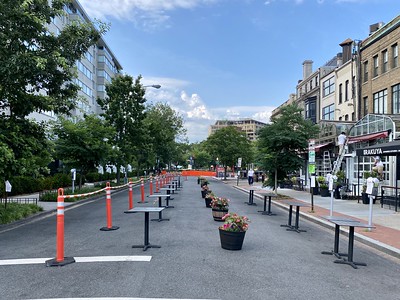
Joe Flood, via Flickr, shares with us his photo of this block, set up for expanded restaurant patio service.
Untitled

I made a similar recommendation, starting with weekends, for 17th Street:

6. Make 17th Street between P and R Streets a pedestrian district on weekends.


17th Street NW, Dupont Circle

And from an update standpoint, instead DDOT and the Washington Area Bicyclists Association, is pushing the addition of a cycletrack to 17th Street, which would get in the way of pedestrianizing it.

Given the pedestrian volume in the area, and the need for this commercial street section to have a positioning that is more distinct vis a vis neighboring 14th Street and Dupont Circle as a way for its establishments to be more competitive, emphasizing and strengthening its pedestrian character should be prioritized over cycling--especially given nearby parallel routes, and let's face it, relatively low volumes of bicyclists.

In the past I've suggested that WABA reposition from a cyclist-exclusive orientation to a more expansive "sustainable mobility" agenda like Transportation Alternatives in NYC and Active Transportation Alliance in Chicago (formerly the Chicago Bicyclists Federation), they haven't done so.

So there isn't a good pedestrian advocacy group in the city--robust examples elsewhere include Feet First in Seattle, Starkville in Motion in Mississippi (although they do biking too), Walk Boston and Walk Denver--and therefore in DC the pedestrian agenda can too often be neglected.

Labels: , , , , , , ,

Saturday, September 22, 2018

Guardian "Walking the City" series

In advance of today's World Carfree Day ("World Carfree Day: Saturday September 22nd), the Guardian has been running a series of articles called "Walking the City."

I wanted to have a feature on applying pedestrian streets principles in DC, not for long streets called pedestrian malls, but for a block or two, here and there around the city, where it can work.

In the past, I've been negative when pedestrianized districts have been proposed in DC (e.g., "How to f*** up 17th Street NW in Dupont Circle," 2007) but now I realize I was too much influenced by the first pedestrian mall I ever saw, in Kalamazoo in 1986, and its relative failure.
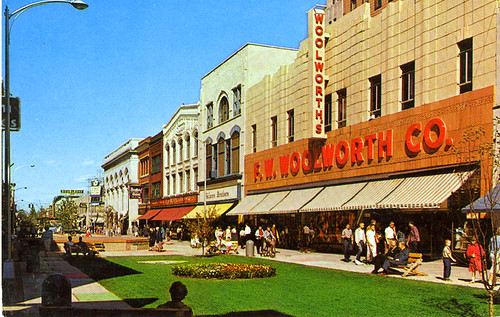
Burdick Street Pedestrian Mall Kalamazoo MI
It did not look this vibrant when I saw it.  This postcard is from the 1960s.

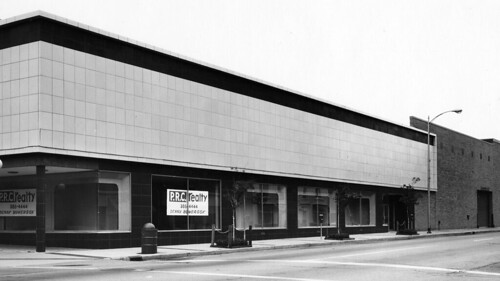
Kalamazoo Pedestrian Mall in the 1980s, after the JC Penney closed
Kalamazoo Pedestrian Mall in the 1980s, after the JC Penney closed.

I remember being very surprised at the Dutch ThinkBike workshop in 2010, when one of the facilitators pointed out DC doesn't have any pedestrianized areas and shouldn't that be something to be addressed?

-- "Reprint from 2010: The Dutch ThinkBike workshop in DC,"

In the US, pedestrian malls that are successful tend to be in college towns, but not exclusively such as Third Street in Santa Monica, places with a preponderance of people without cars.  In the region, Charlottesville and Winchester have pedestrian malls that remain successful, albeit with some property vacancies.

Charlottesville

For pedestrian malls to be successful, they need to be well designed, well managed, well programmed, and perhaps most importantly, highly visited because empty spaces don't attract visitors they repel them.

-- "Now I know why Boulder's Pearl Street Mall is the exception that proves the rule about the failures of pedestrian malls," 2005
-- "K Street: Last of the pedestrian Malls," Sacramento Business Journal, 2009

But the thing I had to get over is thinking about this in terms of long pedestrian malls or large pedestrian districts like in Essen, Hamburg, or Liverpool, and more in terms of one or two blocks, here and there, where it makes sense in the local context.

And building on and extending from there.  Like what I suggested a few weeks ago for Silver Spring, Maryland.

-- "Making "Downtown Silver Spring" a true open air shopping district by adding department stores

And no, I am not talking about "shared spaces" where pedestrians mix with cars.

More on this next week.

Labels: , , , , , , ,

Sunday, April 05, 2009

Today's trends with pedestrian malls

For a variety of reasons, I tend to not favor exclusively pedestrian malls. My reasons center around pedestrian traffic. Few places have enough people to keep an exclusively pedestrian place active throughout the day and into the evening. With activity vacuums, problems accumulate. As someone once wrote, "plants don't activate spaces, people do."

This article from the Sacramento Business Journal, "K Street: Last of the pedestrian malls," discusses K Street in Sacramento, the recent history and trends of pedestrian malls, and ponders the future of the pedestrian mall in Sacramento.
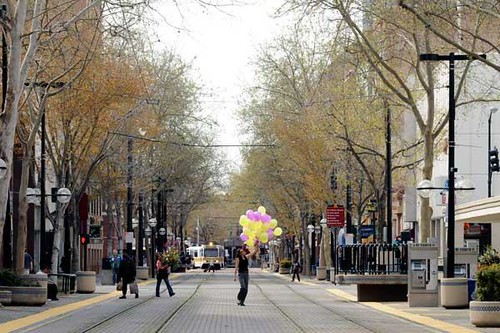
K Street pedestrian and transit mall, Sacramento
Dennis McCoy Sacramento Business Journal. Wednesday afternoon saw little traffic down K Street mall, dominated by light-rail tracks but few people.

Note that K Street in Sacramento isn't the last of the pedestrian malls. First, it's important to distinguish between pedestrian only malls and pedestrian + transit malls. There are number of the latter, such as 16th Street in Denver and Nicollet Mall in Minneapolis. And there are some extant pedestrian malls that are likely to remain. Interesting that many are in college towns, like Boulder and Charlottesville. But there are others too, such as in Burlington, Vermont.

The key is being adjacent to many many pedestrians (such as college students living on a residential campus, most not having cars).

Also see these past blog entries:

-- Pedestrian Malls (2007)
-- How to f*** up 17th Street NW in Dupont Circle (2007)
-- Now I know why Boulder's Pearl Street Mall is the exception that proves the rule about the failures of pedestrian malls (2005)

Labels: , ,

Tuesday, October 09, 2007

Not the last word on "pedestrian" malls


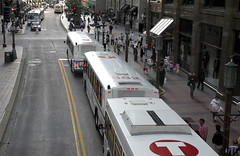
Bus Traffic on Nicollet Mall
Originally uploaded by Zach K

I have discussed this from time to time. Dave Feehan, president of the International Downtown Association, makes the distinction between pedestrian and transit malls. The "pedestrian" malls in both Denver and Minneapolis are really transit malls.

The Nicollet Mall in Minneapolis illustrates the necessity of focused development around the "pedestrian" mall. It appears as if land use and capital improvement planning is focused on extending the value of the Nicollet Mall by pushing retail there (including the new Target store), housing, and event venues--the Target Center is one block off the mall there. Plus hotels.

And wide sidewalks which allow for sidewalk cafes and comfortable places to walk.

In short, there is a layering of activity which focuses and concentrates people in that area, activating the spaces.

Someone wrote many years ago that plants don't activate spaces, people do. Without large numbers of people around--tens of thousands--pedestrian malls can't work.

In DC, about the only place where one could potentially work would be 7th Street NW, anchored as it is by the Convention Center, Verizon Center, the Smithsonian American Art Museum and National Portrait Gallery, the Landsburgh Theater, now the Harmon Theater too, even potentially the Historical Society (Carnegie Building) and the Central Library on 9th Street...

But even so, that doesn't mean that I believe in advocating for a pedestrian mall in DC. I'd rather spend more time making all places great, and supportive of walking, bicycling, and transit.

(Image by Zachary Korb, from Flickr. He also blogs in An Affair with Urban Policy)

Labels: , ,