Rebuilding Place in the Urban Space

"A community’s physical form, rather than its land uses, is its most intrinsic and enduring characteristic." [Katz, EPA] This blog focuses on place and placemaking and all that makes it work--historic preservation, urban design, transportation, asset-based community development, arts & cultural development, commercial district revitalization, tourism & destination development, and quality of life advocacy--along with doses of civic engagement and good governance watchdogging.

Tuesday, November 25, 2025

State of Utah Long Term Risks report

I was struck by the book The Fifth Risk, in its discussion about the Energy Department during the Obama Administration, and their emphasis on identifying and managing risk.  From the ReadyRoom blog entry "Risk Management Book Club #2: The Fifth Risk":

The book's title comes from MacWilliams's assessment of the risks faced by the country at the time of this transition: nuclear accidents; nuclear attacks from North Korea and Iran; an attack on the electrical grid; and project management, "the fifth risk." MacWilliams, a professional risk manager, believed the seamless transition of responsibility at DOE was key to its ability to protect the country.

In a post, I argue that a city's elected officials and stakeholders should see themselves as risk managers ("Town-city management: "We are all asset managers now"," "Learning the wrong lessons from risk management: GFC, Boeing (+ deregulation)"), and how like with large settlements because of police department misconduct, that's an indicator of a failure to manage risk ("Killing people is seen as a routine outcome, not as an indicator of the need for change: Orange County Sheriff's Department versus Fullerton Police Department," "Where is the risk management approach to police misconduct and regularized killings of citizens?").

So the fact that the State of Utah Legislature's Auditor General has produced a report on the long term risks faced by the state, High-Risk List" Identifying and Mitigating Critical Vulnerabilities in Utah – 2025, is quite interesting. (The report is modeled after one produced by the Government Accountability Office at the start of each new Congress.) The top ten risks are:

  1. Meeting Utah's water needs 
  2. Aging water infrastructure 
  3. Education pathways to in-demand professions
  4. Insufficient behavioral health capacity 
  5. Planning effective transportation 
  6. Public workforce shortages 
  7. Improving housing affordability 
  8. Utah's energy policy 
  9. Threats to cybersecurity and data privacy 
  10. Federal revenue diversification
In fall 2022, the Great Salt Lake hit its lowest water level since record keeping began. The lake’s elevation sank to nearly six meters below the long-term average. Photo: C. Yamane

I'm surprised the possible dissipation of the Great Salt Lake is not listed separately ("‘Last nail in the coffin’: Utah’s Great Salt Lake on verge of collapse," Guardian, "The Great Salt Lake Is Drying. Can Utah Save It?," New York Times, "The Great Salt Lake is shrinking. What can we do to stop it?," Science News).

Nor the impact of Climate Change and the Environment--a state that emphasizes outdoor tourism in particular skiing ought to be thinking about the long term effects of less snowfall, especially with the possibility of Utah being the permanent site of the Winter Olympics ("What will it take to save the Great Salt Lake by the 2034 Winter Olympics? It depends on whom you ask.," Salt Lake Tribune). 

And air quality, especially in the winter--I'm amazed that the EPA gives the Salt Lake Valley a pass on this ("Booming Utah’s Weak Link: Surging Air Pollution," "‘We Can’t Let the Kids Go Outdoors’: Our New Reality on the West Coast," NYT).  

I hope "agricultural priorities" is an element of water needs. Air quality ("Booming Utah’s Weak Link: Surging Air Pollution," "‘We Can’t Let the Kids Go Outdoors’: Our New Reality on the West Coast," NYT)  The face is 80% of water use is for agriculture, and half that goes to alfalfa production which is mostly shipped overseas for cattle feeding.  So China basically is getting Utah's water for cheap.  From the NYT:
While climate change has contributed to extensive water shortages in the Southwest, the Great Salt Lake’s decline is mostly human-caused. Agriculture uses 71 percent of the water that would otherwise flow to the lake, and cities use around 17 percent, according to research compiled by the Great Salt Lake Strike Team, a group of climate scientists, policy analysts and state regulators.

I don't see how Utah's energy policy is deserving of a call out and the more general issue of Climate Change and the Environment is not.

Chevron refinery at night.

Utah as a petro state.  I haven't fully read the report, but for a few years I've argued that Utah is a petro state, that the concept of nations as petro states ("The Petro States of America," Bloomberg) can be thought of sub-nationally.  

There are five refineries in Salt Lake and North Salt Lake, refining oil from Utah and Wyoming. Much of it is sold to markets outside the state.  And the state is getting approval for a railroad on federal lands to ship out crude oil for refining overseas.

Except for California, policy in petro states in the US and Canada favors fossil fuels, although Utah is gambling on nuclear energy ("Utah unveils plans to bring nuclear hub to Brigham City," Salt Lake Tribune).  

Another element of a petro state is its place within the automobile economy.  Utah doesn't have any auto manufacturing plants, but two of the ten largest car dealership groups are based in the state, adding their voice too fossil fuel supremacy.  

And road building, more than transit extension, is the top priority of the Utah Department of Transportation.  

The State Legislature even goes to the extent of trying to prevent "traffic calming" initiatives in Salt Lake City ("Bill giving UDOT veto power over some SLC street projects moves to governor’s desk," Salt Lake Tribune).

Technically, Utah is more of an extractive resources economy.  25% of the state budget comes from taxes on copper mining--but the state is second to Minnesota for copper production.  The oil thing is just a chaser.  Coal is an element that's up there too ("Mining is big business in Utah — to the tune of billions of dollars per year," Salt Lake Deseret News).

No takers.  An EV charging station in Moab, Utah.

Yet from the air quality and Olympics angle, were I state leaders, I'd push for the concept of EV only sales of automobiles by 2035 ("US Senate votes to block California 2035 electric vehicle rules," Reuters), the year after the Olympics, as a way to shift away from fossil fuels and to improve air quality and limit the impact of higher temperatures brought on by climate change.

(Rick Egan | The Salt Lake Tribune) New home construction in Saratoga Springs on Thursday, Dec. 3, 2020.

I'd say sprawl/urban development form--the Salt Lake Valley is the epitome of the sprawl, despite all you read about Utah being ahead of the pack in environmental planning ("The Utah Model: Lessons for Regional Planning," Brookings)--is also a risk in terms of water use, energy use, air quality, climate change and the environment, etc. ("More suburban sprawl won’t fix Utah’s housing affordability problem," "Utah launches all-out push to build thousands of new ‘starter homes’ that you might be able to afford," "Many Utahns ‘stuck’ with hourlong commutes amid housing crisis," Salt Lake Tribune).

I'd also add the risks of continual tax reduction and political homogeneity.  The state prides itself on growth--expecting to add 2 million more residents by 2065.  The legislators constantly cut taxes, saying "we need to share the benefits of growth" when the fact is, growing places need to spend more on creating new infrastructure and replacing aging infrastructure*, not less.  A city and county risk is frequent interference and law preemption by the State Legislature.

=====
Flickr photo by Steven Vance.  It's a nice park....

* One example is the park I'm on the board of--one building in dire need of replacement is 61 years old.

We have tens of millions of dollars in unfunded capital improvement projects.  One source of funds we'd normally rely on, won't happen until 2029, because it needs to go on next year's ballot, and after a ballot failure last year, the County Mayor is postponing it to the next cycle.

Budget cutbacks mean a bunch of projects we intended to start in 2027 won't be funded, as the County looks to increase property tax by 20%--the first property tax increase in 6 years--and of course, people are up in arms ("Salt Lake County mayor proposes nearly 20% property tax increase," KUTV).  And our park is but one site in an array of hundreds that have serious capital needs.

Labels: , , , ,

Friday, August 13, 2021

UTA (Utah Transit Agency) "Free Fare for Clean Air," August 12th and August 13th

 -- "Free Fare for Clean Air," UTA

I didn't know about this--the area's newspapers no longer publish every day and I definitely don't watch local tv news.  

Certain "city" agencies are "aggressive" about communicating via e-networks like Nextdoor, but if you don't subscribe to their twitter feeds, it's easy to miss.  From the website:

In partnership with the Utah Division of Air Quality (DAQ), the Utah Clean Air Partnership (UCAIR), and the Healthy Environment Alliance of Utah (HEAL Utah) Utah, the Utah Transit Authority has announced two Free Fare for Clean Air days. 

On Thursday and Friday, August 12-13, the fare will be free on all UTA bus and rail services, including paratransit, the Park City-SLC Connect, and UTA’s On Demand microtransit service in southwestern Salt Lake County. GREENBike is also offering a special promo code during the free fare days providing 24 hours of free service.

I'm not against this, of course, but I think without a lot of advance promotion, it doesn't really help to get new transit riders.  

Instead, it's a bonus for people already using transit.

Yesterday, I needed to use the Frontrunner commuter train to get to Layton, where I participate in a vaccine trial, and I only found out about the promotion, while noticing a message on the bus route display board saying "Ride Free Today."  

When I went to the ticket machine, it was covered up with a promotional flyer.

So on my way back, instead of biking, because it was "all free" (normally it would require an additional transfer costing $1.20) I rode all four modes in one day: train; light rail; streetcar; and bus; so my  trip back involved about 3 blocks total of bike riding once I got on the train.  

I didn't use the bike sharing system because I have a bike of my own.  

And while the bike share program's twitter feed is promoting the "Free Fare" days, it doesn't seem to be promoting "Free GreenBIKE" days.

I guess today I'll go check out Park City by bus!  (The bus stop for the special shuttle is less than a mile away.)

Labels: , ,

Thursday, April 18, 2019

A little bit of knowledge is a dangerous thing #2: Demand for coal as an energy source

I am a big fan of Little Free Libraries, and recently I came across a book published in 1953, The Big Coal Truck, by Frances R. Norwich.  It's about a boy watching the delivery of coal to an apartment building in an unnamed city, the coal being used for the on-site heating plant/furnace.
Page from the book, The Big Coal Truck, by Frances R. Horwich, published by Rand McNally in 1953

I love the illustrations in children's books generally, especially when they illustrate urban matters.

Because we are familiar with how things work now, we aren't so familiar with how things were "back then," in the same way that the youth of today don't know how to use rotary phones.

Into the 1950s, it was not uncommon for houses and apartment buildings to be heated by on-site furnaces powered by coal.

There were also coal yards across DC (and other cities) selling coal, often in areas alongside railroads, but not exclusively.

Recently, I was surprised to come across "shopping bags" from some DC-based coal companies at an antiques store in Maryland.
Gordon Brothers Coal, DC, bag

In fact, my house was constructed in 1929, and still has the coal chute.  At some point, the furnace was  converted to natural gas through a hookup to a bigger gas distribution system.  (Somewhere we still have a piece of ephemera that was on a wall, explaining about using coal.)

This kind of power generation had many deleterious effects on air quality.  And so laws were passed to force people to shift to natural gas and electricity based systems, powered through larger distribution systems rather than on-site energy sources.  And compared to site-based power generation by coal, large scale systems of electricity generation anchored by coal-fired generation plants was better for air quality generally--although not in the area where the power plants were built.

The switch was costly for many.  For example, a few months ago while reading a biography (Don't Call Me Boss: David L. Lawrence: Pittsburgh's Renaissance Mayor) of David Lawrence past mayor of Pittsburgh and Governor of Pennsylvania, I was surprised to see that one of his issues was helping to defray the cost to lower income households of a required changeover to electric or gas powered ovens.  That's stuff we don't even think about today.

Coal for a long time was the cheapest energy source for power generation.  But over time hydroelectricity, oil (usually for peak time generation), natural gas, and nuclear power were added to the mix, which today now includes wind and solar power, the latter moving back to a more site-based power generation paradigm, which in turn alters the economics of power distribution.

With fracking, natural gas has become even cheaper than coal, and power generation firms are shutting down coal generation plants in favor of natural gas generation.  Plus solar and wind sources are further reducing the demand for coal.

As is the more widespread use of LED lighting, which is cutting demand for electricity by up to 10%.

So the Trump Administration's desire to "bring back coal" faces the headwinds of various market forces that are driving the switch.

... not to mention global warming and climate change issues, which the current administration chooses to not believe.

I was blown away recently to read about this in terms of financial investment and risk analysis.  Basically now it's too risky to invest in coal or nuclear plants because it isn't clear given changes in the industry, that a plant will operate long enough to pay back loans.

I can't seem to find the article that I was reading about this, but these shed light on the concept:

-- "The Coal Cost Crossover: 74% Of US Coal Plants Now More Expensive Than New Renewables, 86% By 2025," Forbes Magazine
-- "Global 'collapse' in number of new coal-fired power plants," Guardian

One advantage coal has as a jobs generator is that it is very physical and tangible. Oil and natural gas are mostly distributed by pipeline, especially to power plants, while coal is moved by trains, has to be loaded and unloaded, and then at the plant, loaded into the plant. That takes lots of people, and it's a form of mass production. By contrast, natural gas delivery involves very few people.

One reason that freight railroads are experiencing a decline in business is because of the fall off in the use of coal for power generation ("Coal downturn hits railroads hard," High Country News).

Labels: , , , ,

Saturday, September 22, 2018

Guardian "Walking the City" series

In advance of today's World Carfree Day ("World Carfree Day: Saturday September 22nd), the Guardian has been running a series of articles called "Walking the City."

I wanted to have a feature on applying pedestrian streets principles in DC, not for long streets called pedestrian malls, but for a block or two, here and there around the city, where it can work.

In the past, I've been negative when pedestrianized districts have been proposed in DC (e.g., "How to f*** up 17th Street NW in Dupont Circle," 2007) but now I realize I was too much influenced by the first pedestrian mall I ever saw, in Kalamazoo in 1986, and its relative failure.
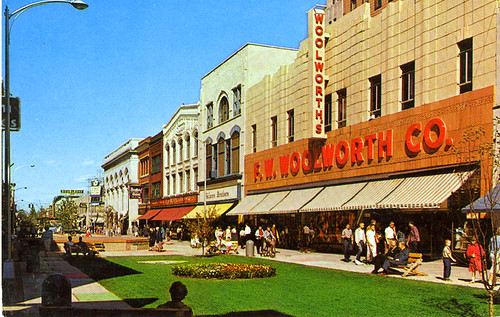
Burdick Street Pedestrian Mall Kalamazoo MI
It did not look this vibrant when I saw it.  This postcard is from the 1960s.

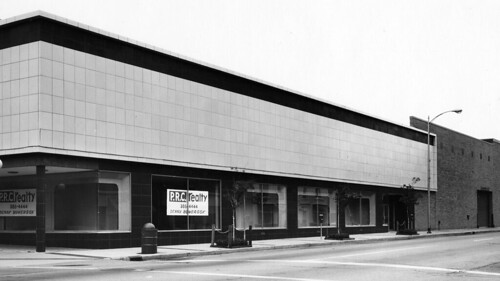
Kalamazoo Pedestrian Mall in the 1980s, after the JC Penney closed
Kalamazoo Pedestrian Mall in the 1980s, after the JC Penney closed.

I remember being very surprised at the Dutch ThinkBike workshop in 2010, when one of the facilitators pointed out DC doesn't have any pedestrianized areas and shouldn't that be something to be addressed?

-- "Reprint from 2010: The Dutch ThinkBike workshop in DC,"

In the US, pedestrian malls that are successful tend to be in college towns, but not exclusively such as Third Street in Santa Monica, places with a preponderance of people without cars.  In the region, Charlottesville and Winchester have pedestrian malls that remain successful, albeit with some property vacancies.

Charlottesville

For pedestrian malls to be successful, they need to be well designed, well managed, well programmed, and perhaps most importantly, highly visited because empty spaces don't attract visitors they repel them.

-- "Now I know why Boulder's Pearl Street Mall is the exception that proves the rule about the failures of pedestrian malls," 2005
-- "K Street: Last of the pedestrian Malls," Sacramento Business Journal, 2009

But the thing I had to get over is thinking about this in terms of long pedestrian malls or large pedestrian districts like in Essen, Hamburg, or Liverpool, and more in terms of one or two blocks, here and there, where it makes sense in the local context.

And building on and extending from there.  Like what I suggested a few weeks ago for Silver Spring, Maryland.

-- "Making "Downtown Silver Spring" a true open air shopping district by adding department stores

And no, I am not talking about "shared spaces" where pedestrians mix with cars.

More on this next week.

Labels: , , , , , , ,

Wednesday, September 19, 2018

World Carfree Day: Saturday September 22nd

The Guardian calls our attention to how more car free communities would improve air quality and reduce deaths and illnesses related to air pollution.

Car Free Day is a way to bring attention to this fact ("We can cut air pollution drastically right now. Here’s how").

The DC area has a "Car Free Metro DC" initiative but it isn't particularly visible.

-- World Carfree Network

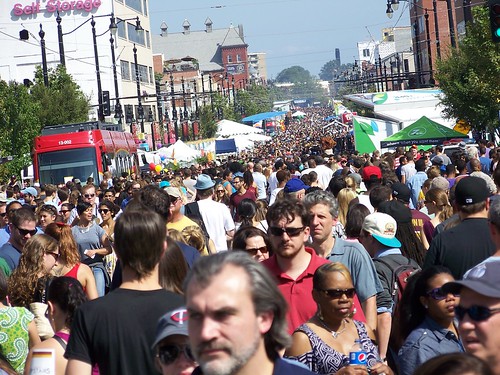
H Street Festival crowd shot, September 20th, 2014


I'm thinking just as various neighborhoods and cities have festivals from Adams-Morgan Day to the H Street Festival in DC, and how I keep advocating for Bike Expos and such on the part of transportation departments and college campuses, besides "back to school" events and such, Walk to School Day in October, Bike Month and Bike to Work Day in May, etc., that sustainable mobility agencies and programs should organize an annual transportation festival in association with Car Free Day.

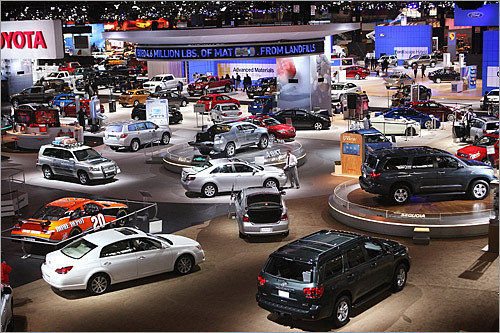
Think of it as "not the auto show."

Toyota exhibit at the Cleveland Auto Show

Although I'd call it "car light" and allow car sharing vendors to participate.

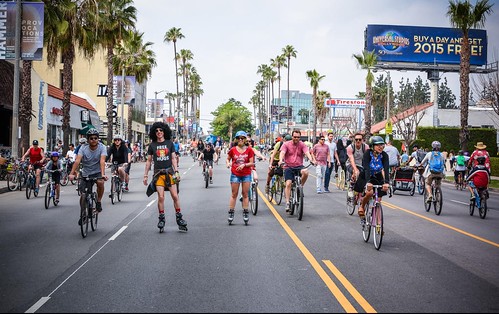
Model it after Ciclovia/CicLAvia--Los Angeles County tends to get between 100,000 and 250,000 participants in their "Open Streets" events, which they move around to different locations throughout the county.

CicLAvia, San Fernando Valley, March 22, 2015
Cyclists and rollerbladers enjoy the streets during a CicLAvia event in the San Fernando Valley. Photo: Rob Rovira, March 22, 2015.

But also in a very purposeful way, include focused exhibits on various elements of sustainable mobility--various transit modes, biking, walking, school and campus-focused programs, delivery programs, car sharing, bike sharing, scooter sharing, transportation demand management, trails and friends groups, etc. E-vehicles I'm not sure.  It still promotes automobility.  OTOH, you can get money from producers for sponsorships (same with car sharing).

Arlington County, Virginia has done the expo part, with the Arlington Car-Free Diet program but not linked with "a festival."  And social media campaigning.


The two elements need to be combined into one.

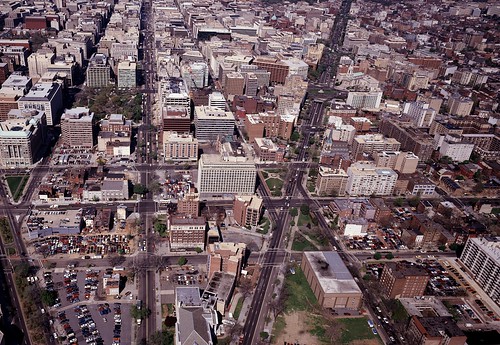
In DC, I've argued that Massachusetts Avenue, at the least from 9th St. to Dupont Circle would be a great place to do this as it would not impinge on any regular bus routes, is centrally located, is close to transit stations, and is highly visible.

Aerial_view_of_downtown_Washington,_D.C., Massachusetts Avenue is in the center right
Aerial view of Downtown Washington,D.C., Massachusetts Avenue is in the center right of the photograph.

====
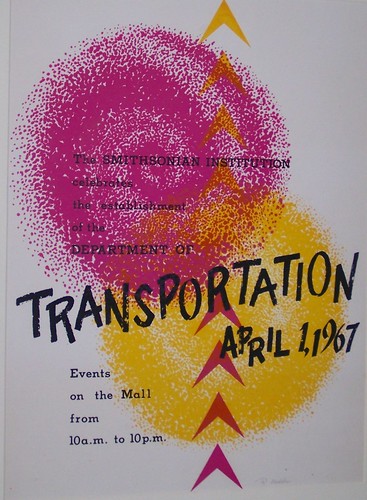
Before the Metrorail system opened in DC, there was a "festival" on the National Mall, introducing Metrorail cars to the public. DC did this with the Streetcar c. 2007-2008.

Poster highlighting the creation of the U.S. Department of Transportation, and celebratory events on the National Mall, 4/1/1967
Poster highlighting the creation of the U.S. Department of Transportation, and celebratory events on the National Mall, 4/1/1967.

There was a festival on the National Mall when the US Department of Transportation was created.

But I think from the standpoint of "what have you done for me lately" ("A consultant told Metro what many riders already know: It's the service," Washington Post), sustainable mobility programs and agencies need to be more outwardly focused and marketing "all the time."

Labels: , , , ,