Rebuilding Place in the Urban Space

"A community’s physical form, rather than its land uses, is its most intrinsic and enduring characteristic." [Katz, EPA] This blog focuses on place and placemaking and all that makes it work--historic preservation, urban design, transportation, asset-based community development, arts & cultural development, commercial district revitalization, tourism & destination development, and quality of life advocacy--along with doses of civic engagement and good governance watchdogging.

Thursday, August 06, 2026

Drought in Europe dries up rivers

 This was an issue a couple of years ago with the Rhine, which I didn't realize also went into France.

People walk around a dried section of the Danube River in Budapest on July 30. Photographer: Robert Nemeti/Anadolu/Getty Images.

It's an issue now with the Danube River in Hungary and Romania, which may force the closure of nuclear power plants, because the water level is likely to drop below the intake piping ("East Europe Braces for Power Curbs With Danube at Record Low," "As the Danube Hits Record Lows, Every Centimeter of River Counts," Bloomberg, " Europe’s rivers are running dry, and the knock-on effects are disastrousS," Guardian).

In the US this is a worry with Lake Powell (Utah) and Lake Mead (Nevada), affecting hydropower electricity generation at the respective dam generating plants at each lake.  

Labels: , ,

Monday, August 18, 2025

Data centers

Aldie, VA - January 20: On what was recently farmland, Amazon data centers have been built as close as 50 feet from Loudoun Meadows houses on January 20, 2023, in Aldie, VA. As the data center industry expands its footprint in Northern Virginia, often building massive commercial structures near residential neighborhoods, communities push back with their concerns.(Photo by Jahi Chikwendiu/The Washington Post) 

From sports facilities to data centers, not all projects add to local economic activity in the way that they are touted by proponents.  Data centers don't have a lot of jobs after construction, and the facility in and of itself doesn't generate business development of other types.

Not an issue for me but they pose big issues in terms of electricity needs ("Power costs soar in PJM region as data center demand spikes," Reuters), and water.  WRT electricity, in part rates increase on all users to produce energy for data centers which is unfair.  

Also, it requires upgrade to the transmission system, which is overburdened as well.  

Because of the demand posed by data centers, adding renewable sources isn't enough.  They need to use fossil fuel generated electricity too, The water demands too are incredible, although to some extent the water can be recycled.  Here are some resources.

-- "Amazon data centers are not an investment in us," Philadelphia Inquirer

The truth is, Big Tech’s AI-fueled data center frenzy is hurtling us further and faster into environmental catastrophe. A single data center can use as much energy as an entire city. Tech corporations are demanding so much extra energy and water as they compete for AI dominance that entire coal plants scheduled for closure are being kept open.

-- "The AI Data-Center Boom Is a Job-Creation Bust," Wall Street Journal

“Data centers have rightly earned a dismal reputation of creating the lowest number of jobs per square foot in their facilities” said John Johnson, chief executive of data-center operator Patmos Hosting.

... The reality is data centers can employ more than 1,000 people in the several months or years it takes to build them, but rarely need more than one or two hundred once they open, according to Synergy chief analyst John Dinsdale. Stargate would have to be much larger than currently planned to create hundreds of thousands of construction jobs, let alone permanent ones.

-- "Tax Breaks For Data Centers Bring Few Jobs," Forbes 

Data Centers As Infrastructure Projects. As governments look to stimulate economic development, it is crucial to see the industries they are supporting for what they are—rather than what they’d like them to be. Data centers, while essential to the modern economy, do not serve as permanent and ongoing job creation engines anymore than the construction of a highway or a bridge does.

Data center construction more closely resembles infrastructure projects that provide a backbone for economic activity, rather than being viewed as economic activity itself. It is for this reason that private industry seeks to offload the cost of data center construction onto taxpayers—it is increasingly becoming merely the cost of doing business rather than a profit center or competitive advantage.

As such, it is more appropriate for public subsidies to focus on construction and development of these facilities and the infrastructure required to make use of them—rather than their ongoing operation and ownership. Investing in the construction and laying out of telecommunications infrastructure can be justified in the broader context of development in underserved areas.

Subsidizing ownership of data centers, through property and sales tax breaks for example, is less defensible. The tech companies that dominate the market for these centers are among the most valuable companies in the world, with market caps that regularly dwarf the gross domestic product of the states they are asking to foot the bill. These corporations have ample resources to manage their own operational costs without public support.

For example, building data centers as a project adjacent to enhancing digital connectivity, which in turn can attract other businesses and support economic growth, makes good policy sense. Similarly, ensuring data centers make use of renewable energy sources by subsidizing their provisioning returns broader social benefits.

Subsidizing ownership of data centers, through property and sales tax breaks for example, is less defensible. The tech companies that dominate the market for these centers are among the most valuable companies in the world, with market caps that regularly dwarf the gross domestic product of the states they are asking to foot the bill. These corporations have ample resources to manage their own operational costs without public support.

State governments should therefore reconsider their approach to supporting data centers, focusing on subsidies for the construction phase and overall improvement of internet infrastructure. Simultaneously, states must ensure that these investments are tied to clear public benefits such as job creation in the construction industry, environmental sustainability, and enhanced connectivity for under-connected communities.

-- "How a Washington Tax Break for Data Centers Snowballed Into One of the State’s Biggest Corporate Giveaways," ProPublica

-- "Beating back data centers," American Prospect

Virginia state lawmakers aiming to establish a regulatory framework have run into obstacles. The industry has established the Data Center Coalition, their own PAC, comprised of heavy hitters like Amazon, CloudHQ, Visa, and others. The coalition has been at work in the Virginia General Assembly, spending $70,500 in campaign contributions so far this year.

Several bills that would have established a set of regulations failed last session, including one proposed by Del. Josh Thomas that would have required applicants to perform site assessments that detail noise, water, agriculture, parks, registered historic sites, and forest impacts. Virigina Gov. Glenn Youngkin (R), a vocal proponent of the centers, vetoed the bill, citing infringements on local control and red tape.

... OpenAI’s GPT-4 uses as much as three 16.9-ounce bottles of water to produce a 100-word email.

-- Good Jobs First has a number of reports and articles on the subject, including "Community Benefit Agreements with Data Centers Can Help Mitigate Harms," which takes the position I do on sports facilities--if you can't beat them, get the best possible deal for the community.

-- "Data centers need to bring their own power supply, watchdog says," Bloomberg via Crain's Chicago Business

Labels: , , , , , , ,

Wednesday, December 22, 2021

Revisiting the 2016 entry, "Ford Motor Company as a transportation company not a "car" company: bike share and small scale transit"

The Congress for the New Urbanism publication Public Square is somewhat Panglossian for my taste.  They just published an article, "Ford promotes street grids," about how Ford Motor is supporting the efforts of Bastrop, Texas to re-orient its urban form to a grid.

Myself and others pointed out that Ford Motor Company, and other auto companies, foremost focus on the promotion of automobility, regardless of this particular project.  You can hardly say coming up with the funding for a video indicates that the company has been transformed.

This ad was published by Ford in 1953, their 50th anniversary, as part of a series.The title: "The street will never be the same again" was prophetic in terms of the impact of the car and automobility on center cities. 

My joke is that the current state of Detroit is what the auto industry intended to happen to cities, because it wasn't in their interest to have center city urban form promote mobility alternatives to the car (walking, transit, biking).


While I think it's a great analysis from that point in time, a number of things have changed in the interim, and a major conclusion I drew is wrong.  Here were the major points:

-- Millennial demographic and psychographic changes are changing the US automobile industry.  That's still true.  Fewer people were buying cars overall, especially younger segments.  More people are buying trucks, to the point that GM and Ford have announced a reduction in the sales of cars while expanding the sales of trucks and SUVs ("Ford to stop making all passenger cars except the Mustang," NBC News).

But with the pandemic, more people took up automobility as opposed to using mass transit.  

-- Telecommunications enables car use without car ownership.  This is true, but few companies have figured out how to make money doing so.  Mercedes, BMW, GM, and others have dropped out of the business of car sharing.  

More recently, ride hailing (Uber, Lyft) has been repriced upward as drivers leave the business because of minimal profitability and an unwillingness of venture capital to continue to subsidize rides ("Farewell, Millennial Lifestyle Subsidy," New York Times).

-- New entrants competing to sell cars using different technologies or business models.  This is mostly about electric cars, and is unchanged.  EVs require a different fueling system than gasoline, which requires the buildout of a charging network ("The White House wants a robust electric vehicle charging network. Here's the plan," WGBH/NPR, "A perspective on equity in the transition to electric vehicles," MIT Science Policy Review).  And companies like Tesla prefer to sell cars directly rather than through independent dealers.  

-- Car companies versus transportation companies.  The entry focuses on something Ted Levitt wrote decades ago, about GM thinking of itself as a car company, not a transportation company.  I don't think he was right exactly, but he was on to something.  

GM saw itself as a "vehicle manufacturer" producing cars, trucks, heavy trucks, construction equipment, buses, and railroad locomotives.  That's transportation.  

What Levitt got wrong was that GM's problem was three-fold, that they didn't think of transportation as opposed to vehicles, they were stuck with a production and operations model that was increasingly unprofitable except for luxury vehicles and trucks, and they weren't sufficiently focused on the quality of the customer experience in terms of manufacturing quality, dealership to customer relations, and on technology like OnStar instead of the experience (versus Tesla).

When the price of gas changed significantly GM was stuck--their design sensibility didn't work with smaller cars, and their labor-health insurance and pension requirements made cars not particularly profitable.

Ford was similar, producing heavy trucks, tractors, airplanes for a time, with some dabbling in transit.  Like GM they got out of everything but cars and trucks, with an increasing focus on trucks, especially SUVs.   Both companies have been downsizing foreign operations, while still focused on China.

Ford created the Ford Mobility division (GM has a similar unit), its arm focused on serving customers "using cars" not necessarily owning them, along with other initiatives such as small group passenger services ("Ford’s Farley On Building Mobility Technology And Services Amid Auto Industry Disruption," Forbes). 

But these initiatives have shifted from dealing with "car customers" versus "car buyers and owners" and more towards technology initiatives like automated vehicles.  The Chariot group passenger unit was shut down in 2019.

Some of Ford Mobility's initiatives, like sponsoring for a time the SF bike sharing program, I argued were more about seeming appealing to potential and younger employees, especially in the Silicon Valley.  Ford ended  its participation in 2019.  

They still have a research unit there, but it's pretty small, about 300 employees ("A New Frontier: How Ford is Engaging Silicon Valley Startups to Transform Transportation").

More recently, Ford announced the acquisition of the long abandoned Michigan Central Station, and committed to its rehabilitation and that the Company's advanced technology initiatives would be based there as part of a new "Mobility Innovation District" ("Ford Reveals Plans for Inclusive, Vibrant, Walkable Mobility Innovation District Around Michigan Central Station").

It will have about 5,000 employees, demonstrating it tends to work better for companies to have employees and innovation units closer to the center.

New developments:
  • I was wrong about Tesla, it will become a mass manufacturer.  Part of my problem was recognizing that just because Elon Musk is a blowhard and the stock is driven up by fanboys disconnected from underlying value, the company is transformational, and is redefining the car industry.
  • The other thing that I didn't fully understand is that Tesla's entry as an exogenous shock (disruptive innovation), the lead promoter of electric vehicles, and the first mover especially in terms of branding has the strong possibility of boxing out the ability of GM and Ford to reposition and rebrand around electric vehicles.  Electric vehicles challenge the ways cars are designed, internal combustion engines and the billions of dollars of sunken investment, gasoline producers and sellers, existing business models, and traditional car dealerships.
  • Just as Sony's Walkman lost out to smartphones, VHS to DVDs, Kodak to digital photography, Nokia to Apple, newspapers and travel agencies versus the Internet, taxi companies versus Uber and Lyft, etc., GM and Ford may be analogous to Sony, Kodak and the printed newspaper.  That's the power of exogenous shock.
  • Tesla is years ahead both in terms of battery technology and IT systems and it may be too difficult for the other companies to catch up, especially as younger buyers see legacy companies as old news and not worth considering.
  • GM's Chevy Bolt has been a failure ("Chevy Bolt Battery Recall: How Could This Have Happened?," Car and Driver), when I thought it would redefine the industry.  Even without the battery fire problem, most potential customers preferred to buy a Tesla over a Bolt.
  • Tesla has opened a plant in China, and has one under construction in Germany.
  • However Ford and GM do have an advantage in the truck segment, which may keep them in the game as trucks shift from ICE to electric.  But not for cars?
  • Focusing on "car users" rather than "car owners" is likely to remain a niche market, and may require direct participation by public transportation agencies along with subsidy ("In DC and Seattle could Car2Go (ShareNow) be converted to a nonprofit and remain in business? (Or could it be sold to Zipcar?)," 2020) as part of transportation demand management planning.

  • In 2019, GM and Ford announced a shift away from car production to focus on trucks and SUVs.  Foreign manufacturers like Toyota and VW in a wide range of segments, and BMW and Mercedes in luxury segments, continue to offer a wide range of cars.
  • GM and Ford announced massive new programs for electric vehicle production.  
  • The big hang up is battery production, and the scarcity of the unique minerals necessary for batteries ("Is There Enough Lithium to Maintain the Growth of the Lithium-Ion Battery Market?," GreenTech).
  • Interestingly, rather than use existing plants, many of the vehicles will be produced in new facilities increasingly outside of Michigan and the core of the Midwest.  Is this because Michigan isn't competitive or is it a way to get cheaper labor and reduce the power of the UAW? ("Michigan Gov. Whitmer slammed after Ford opens electric vehicle plants in other states," Fox Business).
  • Car sales are up, but there are also supply problems because of a microchip shortage ("Microchip Shortage Update: Car Inventories Could Stay Low All Next Year," Kelly Blue Book).  This has led to a massive increase in the price of used cars too.
  • Gas prices are high as a result of supply difficulties, but mostly because of the contraction of the US shale oil industry because of a price reduction campaign by Saudi Arabia, designed to put many of the companies out of business ("With shale subdued, Saudi, Russia become more comfortable with oil rally," Reuters). 
  • It's not clear the US electricity grid is robust and resilient enough to power an automobile fleet shifting in toto from internal combustion engines to EVs ("Plug in cars are the future: the grid isn't ready," Washington Post).
  • And legacy dealers aren't necessarily committed to EVs, which demonstrates the importance of Tesla's decision to sell direct, starting from a fresh plate.
  • Many cities in Europe have "low emissions zones" in their center cities, which means that diesel and gasoline cars can't enter, or have to pay a significant daily fee upon entrance to the zone. 
  • In 2020, California banned the sales of gasoline powered vehicles effective in 2035 ("California will ban new gas cars starting in 2035. Gas station owners worry about their livelihoods," KCRW/NPR).  But too many states are dependent on fossil fuel production, car dealerships, car manufacturing, and the sprawl land use paradigm to be as bold.

Labels: , , , , , , ,

Friday, June 25, 2021

Coastal railroad system, wind turbines, and the Green New Deal...

Today's article in the Washington Post about the potential of the Chesapeake Bay region to become a primary player in wind turbine manufacturing and energy generation ("Dominion Energy is embracing offshore wind. It’ll be a break for the Chesapeake Bay region") by Dominion Energy's pivot to wind generation and away from fossil fuels, reminds me that I've forgotten to make the point that rail transit can be powered by such sources, making it even more sustainable.

In writing about how Massachusetts should develop a true state rail plan ("Massachusetts state rail plan," 2019) I thought I mentioned that they can make it incredibly sustainable by powering it through wind energy generated off the coast, in the Atlantic Ocean ("New report: New England has vast potential for offshore wind energy," Environment Massachusetts).

The report, Offshore Wind for America, examines U.S. offshore wind potential by both coastal region and by state, while documenting the status of existing projects and technological advances. New England could generate more than five times its projected 2050 electricity demand with offshore wind alone.

But I didn't.  

-- "Is high-speed rail the fast track to transport decarbonisation?," Railway Technology
-- "Electrification of U.S. Railways: Pie in the Sky, or Realistic Goal?," Environment and Energy Sustainability Institute

In the US, only Caltrain is really moving forward on systemic electrification.


The same goes for all of the states along the Atlantic, including Maryland, and I failed to mention the potential of offshore wind-generated electricity as the primary source of power for a statewide rail system in Maryland ("A "Transformational Projects Action Plan" for a statewide passenger railroad program in Maryland," 2019), and in the Maglev posts ("Transit "wokeness" in DC and Baltimore" and "DC, Transformational Projects Action Planning, and the Baltimore-Washington Maglev project") among others. 

Plus states along the Gulf of Mexico.  And the Pacific states of California, Oregon, and Washington.

That's at least 20 states.

Labels: , , , , , ,

Thursday, May 21, 2020

Displacing a problem doesn't solve it: an example of how restrained regulation can cost millions of dollars | Flooding in Mid-Michigan from a dam break

Scenario planning.  I have a review copy of Rob Goodspeed's Scenario Planning for Cities and Regions: Managing and Envisioning Uncertainties (Lincoln Institute of Land Policy, April 2020) to read.

It seems all the more timely given the pandemic failure ("Covid-19: did the UK government prepare for the wrong kind of pandemic?," Guardian).

Risk management.  But there are plenty of other examples of failure such as the Boeing 737Max, the breaching of the Fukushima Nuclear Power Plant in Japan, etc.

What it comes down to is risk management.

And government at all levels, but more accurately the top elected officials, don't appear to take a risk management perspective in their approach to governance.

There is the book The Fifth Risk by Michael which discusses risk management and the federal government ("'The Fifth Risk' Paints A Portrait Of A Government Led By The Uninterested," NPR).

It's a great read, but I don't think it is so much about risk management as much as it is about the federal government's role in science policy and programming, and how research leads to better practice that saves lives.

Although a point it repeats by a former official at the Department of Energy, about program and portfolio management as "the fifth risk" and the unwillingness to take enough chances for fear of failure or bad publicity.

Ironically this is the same reason by the Department of the Treasury appears to not be willing to lend money to corporations in the face of the pandemic ("Fear of Risk Could Diminish the Economic Rescue by the Treasury and Fed," New York Times).

The UK's National Risk Register.  Interestingly, the Guardian article mentions that the UK government publishes an annual risk assessment document, the National Risk Register.

Imagine if that document was used not just to set funding priorities, but to build a national consensus about what to worry about and how to address it.

Instead, as with the pandemic, we are having partisan debates about whether it is something to worry about versus a hoax designed to make certain politicians look bad.

From the Guardian:
Tony Blair’s government decided a completely new approach to civil emergencies was required, and established a revised and expanded civil contingencies secretariat in the Cabinet Office, backed by new legislation.

The ambition was “to create something which was better suited to the way in which the UK is run”, said Bruce Mann, the director of the unit from 2004 to 2010. Civil contingency planning would cascade downwards through tiers of government, he said, all the way from Whitehall to networks of local emergency response groups. ...

the team also had a second responsibility: predicting entirely new risks and anticipating how the government might respond. Within its first year the unit drew up the national risk register, a comprehensive catalogue of all the civil emergencies that could conceivably strike the UK, which continues to be updated annually. At the top of the list – then and now – was an influenza pandemic.
Then again, governments that increasingly denigrate and ignore science make this difficult ("Trump's Response to Virus Reflects a Long Disregard for Science," New York Times).  This has been a Republican priority for some time, out of recognition that various ideologically-driven policies were unsupportable, such as how Newt Gingrich shutdown the Congressional Office of Technology Assessment.

And for awhile now, I've been mulling over a piece by Ezra Klein ("Why we can’t build: America’s inability to act is killing people," Vox) and his book Why We're Polarized about why "we" in this case the federal government, is increasingly unable to act or to accomplish anything--dealing with the coronavirus is merely one more example in a string of failures to act.

Flooding in Midland County Michigan after a dam breach.  A few days ago, in the face of heavy rains -- a so-called 500 year weather event, although the last comparable 500 year weather event in the area was experienced 34 years ago -- the Edenville Dam in Midland County, Michigan was breached in the face of heavy rains ("Thousands evacuate area in Michigan after two dams fail and governor warns one city could see 9 feet of water," CNN).

This lead to the overtopping of another dam, the Scoville, along the Tittabawassee River, and in turn flooding throughout the county, including in Downtown Midland, which had been the long time headquarters of chemical manufacturers Dow Chemical and Dow Corning.

More than 3,500 households have been displaced, and water levels are over 35 feet high in parts of the City of Midland.

Aerial photo of flooding in downtown Midland, Mich., Wednesday, May 20, 2020. (Photo: Kelly Jordan and Junfu Han, Detroit Free Press).

In the US, dams that generate electricity are regulated by the Federal Energy Regulatory Commission.

For years, FERC had been issuing notices to the owners of the Edenville Dam about deficiencies ("Feds warned years ago Edenville Dam couldn’t handle a historic flood," MLive).

But the owner, Boyce Hydro LLC, based in Las Vegas, didn't act.

This led to FERC taking away the dam's license to generate electricity in 2018:
out of concern the spillway couldn’t pass enough water to avert a failure during a historic flood. ... 
Federal Energy Regulatory Commission (FERC) records indicate capacity issues at the Edenville Dam spillway were cited as problematic dating back to the late 1990s.

In a 2018 filing, regulators characterized dam owner Boyce Hydro as chronically non-compliant with regulatory requests to upgrade the dam. FERC wanted Boyce Hydro owner Lee Mueller of Las Vegas, Nev. to build additional spillways to reduce the risk of failure. The dam had six spillways at two sites. ...

Boyce Hydro “has repeatedly failed to comply” with regulators who wanted Mueller to “develop and implement plans and schedules to address the fact that the project spillways are not adequate to pass the probable maximum flood, thereby creating a grave danger to the public,” FERC deputy secretary Nathaniel Davis wrote.
But that didn't lead to the dam getting fixed.

With the removal of the license to generate electricity, the dam was no longer under the authority of FERC.

Oversight was transferred to a State of Michigan agency, the Department of the Environment, Great Lakes and Energy.

But that didn't lead to the dam getting fixed.

And DEGLE issued deficiency notices too and was getting around to dealing with the problem.  Granted unlike FERC which had been asking for action for close to 20 years, DEGLE had only been dealing with the issue for about two years.

Receivership as a model.  Not unlike how I argue with nuisance properties that instead of issuing notices, cities should initiate receivership actions ("Receivership as a strategy for notorious nuisance properties," 2017), clearly the same should go with dams, especially when the potential for catastrophic failure is significant and can cause hundreds of millions of dollars or more in damage.

Although receivership can be costly especially if the corporate entity isn't responsive and doesn't pay to correct the deficiencies.

The ideal solution.  What would have been best was for FERC to seize the revenues generated by the hydroelectricity and used those revenues to pay for repairs and other necessary improvements.


Similarly, regulatory failure in Michigan contributed to the problems with the water system in Flint.

First, Congress gave states authority to regulate intra-state water systems over the EPA.  Second, in most cases, state agencies with this authority regulate with a light hand, at least under Republican Governors.

Inadequate monitoring of the failure of a different state authority led to the failure--all they needed to do was spend $300/month on water treatment chemicals, which they did not do.

Labels: , , , , , ,

Tuesday, April 21, 2020

Earth Day, 50th anniversary

Wednesday April 22nd is Earth Day.

Before the stay at home orders, I had intended to do a series on Earth Day.  Today is the 50th anniversary of the first Earth Day ("The ‘Profoundly Radical’ Message of Earth Day’s First Organizer," New York Times).  Now I'm not up to it.


These items catch my fancy:

1.  To move better environmental practices forward, the US should create a program comparable to the EU Green Capital program, where cities across Europe "compete" for the designation, as a way to model best practices.

One city is designated each year.  This year it's Lisbon.

In the US, I'd set it up for a large and small city both, as well as a rural community.

2.  New enzymes may allow for significantly expanded plastics recycling--in a few years as the technology is refined ("Scientists create mutant enzyme that recycles plastic bottles in hours," Guardian).

3.  Trump Administration rollback of environmental health regulations is bad ("Why Is Trump Gutting Regulations That Save Lives?," "U.S. to Announce Rollback of Auto Pollution Rules, a Key Effort to Fight Climate Change," New York Times).

4.  Recycling programs were set up by industry to "deflate" popular will in favor of recycling, by confusing things and making it look like the industry cared ("Plastics Industry Insiders Reveal the Truth About Recycling," PBS Frontline/National Public Radio).

5. Norway, an oil producer, has shifted its automobile "fleet" to electric cars, because its prime source of electricity is hydroelectric production, significantly reducing the negative environmental effect of automobiles ("Norway and the A-ha moment that made electric cars the answer," Guardian).

Because the US relies on coal and natural gas for electricity production, even as alternative energy sources are increasing, shifting to electric cars is less environmentally beneficial.

Especially when the focus ought to be shifting from an automobile-centric land use and transportation planning and operations paradigm more generally.

6.  But like Norway and hydroelectricity, coastal states in the US have the opportunity to generate significant proportions of its electricity demand from wind turbines ("Offshore Wind Energy Enough to Power the Atlantic Coastal States," Environment America) and waves ("
Why Hasn't Tidal Power Taken Off?
," MIT Technology Review).

Although there can be opposition ("Offshore wind still looks to get a foothold in California," San Diego Union Tribune, "Offshore Wind Energy Looks More Promising for Oregon," Oregon Public Broadcasting).

7.  Which could power trains and an expanded passenger railroad system and electrification of existing diesel lines ("Electrification of US Railways: Pie in the Sky, or Realistic Goal?").

8. I haven't read much about the "Green New Deal" (NYT article) but I do think it should include materials productions requirements focused on more sustainable manufacturing practices, something that Europe has been doing for more than a decade.

There are many books published on the concept...

I will say the "green jobs" boom predicted as part of a refocusing on environmental outcomes in various government programs hasn't been forthcoming.

9.  Who knew that reduced ethanol production would lead to carbon dioxide shortages?  Including ethanol in gasoline is mostly a sop to corn producing states.  It doesn't have much beneficial impact for the environment and redirects agricultural land from food production, and can lead to higher food prices.

But apparently it's a major source of CO2 which is a key element in food production ("Coronavirus-driven CO2 shortage threatens US food and water supply, officials say," Guardian).

10.  Drought ("Drought: Worst western megadrought in 1,200 years is here," USA Today).

Labels: , ,

Sunday, April 12, 2020

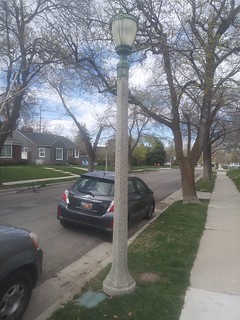
Concrete neighborhood streetlight pole

Concrete neighborhood streetlight pole, Yale Avenue, Yalecrest neighborhood, Salt Lake City

I've mentioned that Salt Lake City has what seems to be a unique program that allows residents on a street or in a larger neighborhood to band together and install a "private" network of sidewalk focused streetlights.  The city will provide grants to help this along.  But the project is organized and coordinated by residents.

It's also a lot cheaper because instead of linking the streetlights to the grid separately--usually through an underground network of cabling that requires digging up a portion of the entire street--the streetlights are connected to the grid via the electricity connection to individual houses--and that property pays for the cost of the electricity.

But I haven't seen many examples of concrete streetlight poles, which are super long lasting.  (San Francisco should use this material as it is impervious to urine for much longer period.  See "Lamp post destroyed by urine falls in street, just misses driver," San Francisco Chronicle.)

However, it's possible that these streetlights were installed by the original developer of the neighborhood, as the style is in keeping with other street furniture elements, like signage, placed elsewhere.

Labels: , , ,

Thursday, April 02, 2020

Electric outlet (plug) on a neighborhood streetlight

Electric outlet (plug) on a neighborhood streetlight

I've mentioned how Salt Lake City has a program where within a neighborhood, residents on a street can band together and agree to install neighborhood-scaled streetlights oriented to lighting sidewalks and supporting pedestrian activity.

The city will provide some financial support, but what makes the program unique is rather than having to dig up the entire street to lay utility infrastructure, each light is connected to the grid via the house on the lot where the light is installed, and going forward, the individual houseowner takes on the responsibility of paying for the electricity (and changing burned out light bulbs).

The light pole designs vary but many are similar to what in DC is called Washington Globe.

For holidays ranging from July 4th to Christmas, people often decorate the lightpoles and/or replace the white light bulbs with green or red bulbs.
Neighborhood streetlights in Salt Lake City's "Privately Owned Street Lighting Program" decorated for the holidays

Not all of the  lights include electric outlets (plugs) at the base, but many do.  This supports lights for decorating the pole.

The reason I mention this is beyond the community engagement element, it's something I brought up in DC about 17 years ago, when I was a committee chair for the H Street Main Street commercial district revitalization program.

Instead of having to create separate and temporary electricity infrastructure for street festivals and other special events, I said, "why not put electric outlets (plugs) in the streetlight network and treeboxes? "

This seemed especially prescient given that a redesign of the H Street NE streetscape was underway.

But it still hasn't been done as a matter of course.  And definitely not when the new H Street NW streescape was constructed in the early part of the 2010s.

Apparently, the local utility in DC isn't in favor, even though the city pays the bills.  And with lightpoles in a commercial district, to restrict inappropriate use, you could lock the access to the plug, so it would only be used for special events.

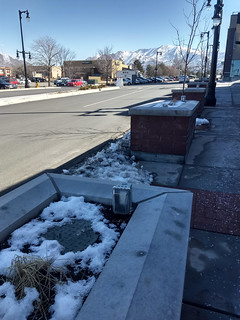
It's not uncommon in privatized public spaces, like the treeboxes in the CityCenterDC development, to see plugs in planters and treeboxes, although the below example is from the Sugarhouse district in Salt Lake City.
Planters in the Park Avenue development, Sugarhouse, have electric outlets

Labels: , , ,

Thursday, April 18, 2019

A little bit of knowledge is a dangerous thing #2: Demand for coal as an energy source

I am a big fan of Little Free Libraries, and recently I came across a book published in 1953, The Big Coal Truck, by Frances R. Norwich.  It's about a boy watching the delivery of coal to an apartment building in an unnamed city, the coal being used for the on-site heating plant/furnace.
Page from the book, The Big Coal Truck, by Frances R. Horwich, published by Rand McNally in 1953

I love the illustrations in children's books generally, especially when they illustrate urban matters.

Because we are familiar with how things work now, we aren't so familiar with how things were "back then," in the same way that the youth of today don't know how to use rotary phones.

Into the 1950s, it was not uncommon for houses and apartment buildings to be heated by on-site furnaces powered by coal.

There were also coal yards across DC (and other cities) selling coal, often in areas alongside railroads, but not exclusively.

Recently, I was surprised to come across "shopping bags" from some DC-based coal companies at an antiques store in Maryland.
Gordon Brothers Coal, DC, bag

In fact, my house was constructed in 1929, and still has the coal chute.  At some point, the furnace was  converted to natural gas through a hookup to a bigger gas distribution system.  (Somewhere we still have a piece of ephemera that was on a wall, explaining about using coal.)

This kind of power generation had many deleterious effects on air quality.  And so laws were passed to force people to shift to natural gas and electricity based systems, powered through larger distribution systems rather than on-site energy sources.  And compared to site-based power generation by coal, large scale systems of electricity generation anchored by coal-fired generation plants was better for air quality generally--although not in the area where the power plants were built.

The switch was costly for many.  For example, a few months ago while reading a biography (Don't Call Me Boss: David L. Lawrence: Pittsburgh's Renaissance Mayor) of David Lawrence past mayor of Pittsburgh and Governor of Pennsylvania, I was surprised to see that one of his issues was helping to defray the cost to lower income households of a required changeover to electric or gas powered ovens.  That's stuff we don't even think about today.

Coal for a long time was the cheapest energy source for power generation.  But over time hydroelectricity, oil (usually for peak time generation), natural gas, and nuclear power were added to the mix, which today now includes wind and solar power, the latter moving back to a more site-based power generation paradigm, which in turn alters the economics of power distribution.

With fracking, natural gas has become even cheaper than coal, and power generation firms are shutting down coal generation plants in favor of natural gas generation.  Plus solar and wind sources are further reducing the demand for coal.

As is the more widespread use of LED lighting, which is cutting demand for electricity by up to 10%.

So the Trump Administration's desire to "bring back coal" faces the headwinds of various market forces that are driving the switch.

... not to mention global warming and climate change issues, which the current administration chooses to not believe.

I was blown away recently to read about this in terms of financial investment and risk analysis.  Basically now it's too risky to invest in coal or nuclear plants because it isn't clear given changes in the industry, that a plant will operate long enough to pay back loans.

I can't seem to find the article that I was reading about this, but these shed light on the concept:

-- "The Coal Cost Crossover: 74% Of US Coal Plants Now More Expensive Than New Renewables, 86% By 2025," Forbes Magazine
-- "Global 'collapse' in number of new coal-fired power plants," Guardian

One advantage coal has as a jobs generator is that it is very physical and tangible. Oil and natural gas are mostly distributed by pipeline, especially to power plants, while coal is moved by trains, has to be loaded and unloaded, and then at the plant, loaded into the plant. That takes lots of people, and it's a form of mass production. By contrast, natural gas delivery involves very few people.

One reason that freight railroads are experiencing a decline in business is because of the fall off in the use of coal for power generation ("Coal downturn hits railroads hard," High Country News).

Labels: , , , ,

A little bit of knowledge is a dangerous thing #1: Nuclear power isn't the cleanest, greenest form of energy

There have been many op-eds published recently concerning nuclear power, which once a plant starts generating electricity, doesn't produce greenhouse gases.  The articles put forward the argument that because ongoing nuclear power production doesn't generate greenhouse gases, especially compared to power produced by coal, oil, and gas, that it should be prioritized.

My point about a little knowledge being dangerous comes across in this letter to the editor in the Washington Post, which lauds the Dilbert comic strip "for telling the truth about nuclear power."  Which the comic strips don't do.

Letter to the editor about nuclear power, Washington Post

People put forth the arguments that because there is zero GHG emission, it's the greenest form of energy, and should be subsidized if necessary, for its environmental effect as well as that it can provide base level power generation in the face of wind and solar sources, which are intermittent.

Definitely, I think it's worth continuing to extend production of nuclear power in those places that are already producing, to generate greater economic return which lowers utility rates, etc.

But it's a fallacy to argue that nuclear power is emissions free.

That's only the case if you don't take into account life cycle costing, which looks more broadly at the cost of mining and processing uranium, waste storage and processing, constructing and then decommissioning the plant, etc.

And even beyond life cycle costing, the fact is that building a plant is hyper high risk, driving many companies, such as Westinghouse and now Toshiba into bankruptcy ("How two cutting edge U.S. nuclear projects bankrupted Westinghouse," Reuters).

Let alone the high risk of mistakes, as is evidenced by Chernobyl in the Ukraine and now the Fukishima plant in Japan.  And because nuclear power production requires access to large amounts of water, plants have been located near major water sources like lakes and oceans, which are increasingly vulnerable locations in the face of extreme weather events and sea level rise.

The cost to reduce plant vulnerability to weather risk will be considerable.

According to reasonably definitive analysis ("Life cycle energy and greenhouse gas emissions of nuclear energy: A review," Energy Conversion and Management 49 (2008) 2178–2199), hydroelectric and wind power produce less GHG per unit of electricity generated than nuclear power, and nuclear power is roughly equivalent, a little worse, or a little better than solar power.

Granted compared to solar power, nuclear power takes up a lot less land which is a bonus, but this comes at great risk of environmental degradation and having to manage waste, alongside the economic risk that comes with building a nuclear power generation facility.

Labels: , , ,

Monday, October 08, 2018

Revisiting stories: Night-time safety: rethinking lighting in the context of a walking community and Detroit's reduction in pedestrian deaths from lighting upgrades

I wrote about this in 2014 ("Night-time safety: rethinking lighting in the context of a walking community" and "Lighting as an element of urban design and community identity: Cleveland chandelier + Chicago lighting design framework plan design competition").

The basic idea is that in the context of an 18- or 24-hour city, you need to plan specifically and in a structured fashion for the night-time daypart, and that means planning for lighting. The Eindhoven Netherlands lighting master plan takes this further, by defining six categories of light:

  • urban lighting (streets, public areas)
  • buildings and objects
  • art (indoor and outdoor)
  • events and festivals
  • information
  • advertising.
Since then, I also came across a lighting master plan from the City of Bath in the UK.  Bath is noteworthy for being the pilot system of modern integrated urban wayfinding systems.

-- Bath City Centre Lighting Strategy

LED conversion to save money.  Otherwise, the focus of most local governments is streetlight upgrading to LED to save money by using less electricity ("Webinar on street lighting: LEDs, networks: Thursday March 9th").

This has got many residents up in arms because of recommendations by a committee of the American Medical Association about the Kelvin frequency of LEDs and the fact that manufactured LED lighting tends to be at higher frequencies ("When the lights go on in DC, will they be too bright?," WTOP; "Takoma Park looks to new LED lights to save money, energy," Washington Post).

Smart City initiatives/Streetlights as networks.  Some but not all local governments are also looking at conversion projects as a way to reposition streetlights as networks, and incorporate other elements.  For example, DC would like to use new streetlight systems as a way to deliver wi-fi and incorporate Shot Spotter and other public safety technologies.

-- "Smart street lighting is driving smart city projects," SmartCities World

Streetlights as electric car charging devices.  London ("Want an electric car charge point on the street outside your house? There's a £2.5m pot, but the catch is you have to apply though your council," This is Money) and Los Angeles are two of the cities looking at this.

Streetlight conversion as an element of public safety.  Streetsblog USA calls our attention to Detroit ("Detroit Streetlight Effort Dramatically Reduces Ped Deaths") where likely the streetlight conversion was driven by saving money, but is positioned primarily as a public safety initiative. The city claims a 95% decrease in annual pedestrian deaths -- from 24 to 1 -- because of the change.

Communicating benefits: public safety versus saving money as the primary message for streetlight upgrades.  One of the most important books I read on marketing and message was called Strategic Marketing for Not-For-Profit Organizations.  Its primary point is that all organizations have three publics: input which give you resources; throughput which does the work of the organization (staff); and output to whom the organization's actions are directed.  And that you should differentiate your marketing depending on which public you're addressing.

Too often government agencies don't differentiate in messaging across the publics or test what type of messaging resonates best.  Saving money is a great benefit, but might not be the most important message.

... just as the presentations around the report Building Public Will make the point that the best message for clean rivers isn't environmental stewardship but more focused on public health and the fact that most drinking water comes from rivers.

The lesson is to figure out the best message that resonates with the public, not based on how you think the public should be acting and behaving ("take care of the environment" vs. clean drinking water or "historic preservation is a good thing to do" vs. it.makes your house worth more, etc.)

Labels: , , , , , ,

Wednesday, September 12, 2018

Better safe than sorry: Southern California Edison rate increase proposed for fire protection activities

Electricity distribution reliability. In the DC area, the PEPCO electricity utility is in the midst of a $1 billion infrastructure upgrade program in DC and Maryland aimed to reduce the number of outages.

DC proper has two different types of electricity distribution infrastructure. In the core of the city it's underground to not have "unsightly" wires.  In the outer city, it's above-ground.  The program is focused on addressing primary vulnerabilities in the system.

2.  Protecting watersheds from fire. Flagstaff, Arizona is one of a few jurisdictions to look at management of the potential for wildfires as an element of watershed and water quality management. In 2012, they passed a bond issue to pay for mitigation. It was particularly noteworthy because much of the watershed lies outside of the city borders.  Santa Fe does this too ("Got water? Thank (and save) a forest," Santa Fe New Mexican).

-- Flagstaff Watershed Protection Project: Home

But 8 years later Flagstaff has discovered that $10 million turns out to not be enough, even though other property owners are matching this with funds of their own ("Flagstaff watershed protection reason to celebrate," Arizona Daily Sun).

3.  California changes locality master planning requirements to include protection from wildfires.

-- Community Wildfire Protection Plan (CWPP) | Planning For Hazards
-- Wildland Urban Interface toolkit: planning, FEMA
-- Preparing a Community Wildfire Protection Plan

4.  Electric utility wildfire hazard mitigation requirements.  At least 10% of wildfires are caused by contact with electric lines.  Uninsulated lines are particularly susceptible.

Separately,  utility companies fearing lawsuits from wildfires caused by electricity line problems have been seeking liability protection from lawsuits from the California Legislature, which so far has not agreed ("The Dueling California Wildfire Bills That Could Decide PG&E’s Financial Fate," GreenTech Media).

So it makes sense to me that because it has been determined that electricity line problems have contributed to the development of wildfires in California, SCE should aim to address the problem ("Southern California Edison Proposes Grid Safety and Resiliency Program to Address the Growing Risk of Wildfires," press release).

All of the state's other utilities are now required to so based on new legislation passed last month ("There's a better way to pay for California's wildfire costs," Los Angeles Times).

Because these kinds of programs typically are funded by customers, through rate increases, that seems like a logical way to go.

Labels: , , ,

Thursday, April 12, 2018

One reason infrastructure can cost more than it should: dis-coordination

In Washington, DC, Pepco's Capital Grid program is a billion dollar investment in "hardening the electricity transmission grid," adding lines underground, and upgrading and building new electricity submissions ("Pepco rolls out $720 million infrastructure plan to keep up with D.C.'s growth," Washington Post).

My neighborhood is affected. 

They have been "rewiring" transmission connections to switch parts of the neighborhood from one substation to another, because the other station will go off line for reconstruction. 

Apparently heretofore, these kinds of connections have been "hardwired" to a particular substation and so change isn't possible merely by pushing a button and changing connections within the sub-grid from one station to another.

What it's meant is that they've had to dig up a part of a neighborhood street, Peabody, and create new connections.  Now that they've done that, when they are ready to shut down the other station, they'll be able to make changes more easily (but I don't think it will still be a matter of pushing a button; they will still have to string line, but it will be able to be done within the new trenching that they have created).

Here's the thing: DC Department of Transportation repaved that street just a few months ago, in the last fiscal year.

They knew that Pepco would be doing the underground work.

AND THAT AFTERWARDS, PEPCO WOULD HAVE TO REPAVE THE STREET ON EACH IMPACTED BLOCK.

But the timing and approval of Pepco's plans to tear up Peabody Street weren't congruent with DDOT's plan to repave it.  And DDOT's money for this type of street paving comes out of the annual budget and has to be spent the year that it is appropriated.

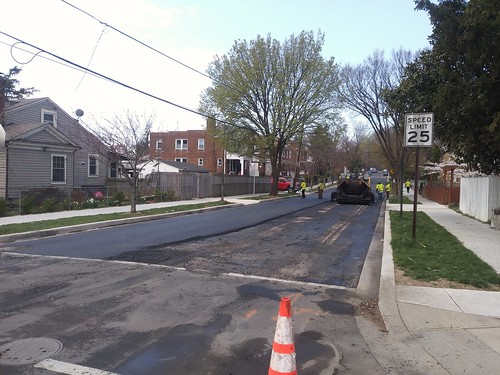
Repaving the 300 block of Peabody Street NWSo now the street that was repaved about six months ago is being repaved.

Why couldn't DDOT have suspended their plans for Peabody Street, and let Pepco pay for the whole thing. 

Couldn't DDOT have switched the use of the money allocated for the Peabody Street reconstruction to another equally worthy project.

Or could DDOT and Pepco have done this jointly and split the cost, saving money for both citizens and electricity customers who in this case are the same people?

Instead, both citizens and electricity customers will have to pay more money because of the dis-coordination.

====
One way to deal with this is to have contingency plans for the possibility of reprogramming within each fiscal year, if such utility projects are underway.

Labels: , , , ,

Sunday, March 11, 2018

Chattanooga as an e-car platform

Last week, I suggested Car2Go car sharing as a way to drive the development of an e-car charging system across a city ("Electric vehicles and city charging infrastructures: could car sharing be a way to drive changes more quickly?"). 

Note that I didn't use Brooklyn and Queens as an example, even though Car2Go is operative there today.  When asked about this by I colleague, I wrote:
My reservation is that it's not best to try to do something innovative but difficult in a place where it is already extraordinarily difficult to do anything. In other words, try to pick a place to start off with where you can be wildly successful and where opposition is likely to be muted.

E.g., DC tried to do streetcar in Anacostia but the area has pretty contentious if not noxious thinking about politics, "the neighborhood," transit, and public resources. So that area has zero streetcar and DC shifted to H Street NE. It delayed launch, but East of the River, by at 6 years. I was at a WMATA conference in Nov. 2006, where a DDOT person confidently said they'd be starting streetcar service in Anacostia the next year.

I should have said this about NYC:

After figuring this out in places where the constraints are fewer, like DC and Seattle, then take on a space with extraordinarily difficult infrastructure challenges like NYC, specifically Brooklyn and Queens where Car2Go operates.

OTOH, you could counter with Autolib, which was launched in Paris, which is just as tough a place to do it.

The difference though between NYC today and Paris then at the launch of Autolib is the support of the top elected officials, and the overall greater commitment in Europe towards dealing with the environment and climate change.

Autolib was an initiative of the then mayor. And today the Paris mayor is just as committed to the environment and clean air. Did you see that Paris will be giving incentive payments towards the purchase of bikes, cargo bikes, and e-bikes to people who agree to give up their cars, as part of clean air initiatives. That's an indicator of the difference between Paris and today's NYC.

These days, the current mayor of NYC doesn't seem to be particularly engaged when it comes to sustainable mobility generally, and he's not a rah rah kind of person on stuff that isn't social justice related.
Anyway, like the BlueIndy program in Indianapolis and the GreenSpot program in Jersey City, it seems as if Chattanooga is developing a similar program, according to GovTech ("Chattanooga pushes multimodal to solve its transportation problems").

But I don't think it's an example that is quantumly different at a system scale because it's pretty small when it comes down to it, but a bit more marginally interesting because the transit agency is adding a solar farm to power it--even though it seems somewhat duplicative as the region is known for cheap hydroelectric.  From the article:
The Chattanooga Area Regional Transportation Authority (CARTA) is constructing an 80-kilowatt solar farm, the installation of 64 electric-vehicle charging ports spread across 22 sites and a car-sharing program powered by battery-electric Nissan LEAFs. ...  
“With interest from an electric-vehicle car-share operator, CARTA entered into a funding agreement with TVA in February 2014 to provide for a minimum of 40 charging ports and a 20-vehicle car-share program ...

The car-share portion of the project is operated by Green Commuter, a membership-based car-sharing platform based in Los Angeles. Members rent the car for the time they need it, while the company pays for electricity to recharge the vehicles, as well as maintenance, parking and insurance costs. Rates are $7 an hour or $45 a day.
20 cars isn't that big a deal, almost not big enough to even acknowledge, although it is significant from the standpoint of smaller cities, as Chattanooga has about 180,000 residents.

The BlueIndy program has 230 vehicles. Granted, Indianapolis has five times the population of Chattanooga, but still, a program with 230 electrically powered vehicles is of a size that's significantly noticeable.

In DC, Car2Go has a 600 car fleet, albeit none are electric.

Multimodal vs. the concept of the sustainable mobility platform
.  The other thing that I don't think is as useful is to think about this in terms of "multimodalness." Yes, different modes are multiple.  But the issue is to integrate the sustainable modes into a system. 

Some refer to this as "transportation as a service" or "mobility as a service," although they aren't necessarily focused on all the services being "sustainable."

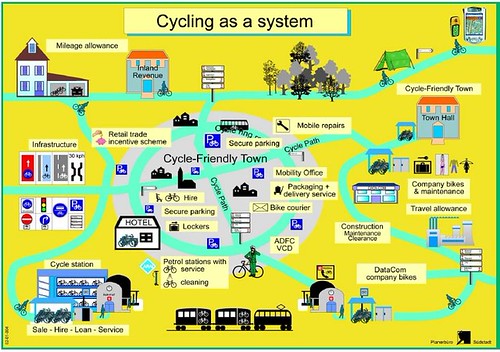
I prefer to call this the sustainable mobility platform ("Dolly micro-move app as an element of the Sustainable Mobility Platform" and "Free access to cargo bikes/e-cargo bikes as part of a mobility hub/sustainable mobility platform"), extending the concept from a diagram from an old national bicycle plan for Germany.

Bicycle Traffic as a system, diagram, German National Bicycle Plan, 2002-2012

Sustainable Mobility Platform Elements

I continue to work out where to place the various rungs on the ladder.  It's easier if you split it out according to trip distance.  These are the elements:

-- Walking
-- Scooters/Skateboards
-- Cycling
---- secure bike parking, air pumps, repair stands
---- access to trailers
---- tandems
---- cargo bikes
---- e-bikes
---- special populations ("Two men leading an effort to provide bikes to homeless," WLOX-TV)
-- Bicycle sharing
---- community system
---- building/campus (e.g., hotel, office building, university, office complex)
---- special populations ("New bike share program gives One80 Place's homeless a way around the city," WCIV-TV)
-- Segways/electric wheels
-- Delivery services (e.g., Dolly; UPS, FedEx, etc.) and package pickup points
-- Transit
---- various bus, streetcar, light rail, heavy rail, railroad services
---- network scale (regional, metropolitan, city; primary, secondary, tertiary)
---- intra-district(Baltimore Circulator, Circulators, San Diego FRED Shuttle); tertiary network (Tempe Orbit)
---- shuttle services (school, employer, residential)
---- microtransit either private (Bridg, Chariot, Israeli sheruts) or public (AC Transit FLEX pilot project, "The newest battleground between public transit and Uber, Lyft is an unlikely one," San Jose Mercury News)
---- van pools (longer distance) (vride)
---- shared taxi type services at edges of the transit system (taxi collectif in Montreal) or intra-district (Via, UberPool, Lyft Line) either publicly subsidized ("Mass transit gets boost from ridesharing," USA Today; "Uber and Lyft Want to Replace Public Buses," Bloomberg) or not
-- Taxis/Ride hailing
---- single trips (equivalent of "single occupant vehicle trips")
-- Car sharing
---- one-way (car2go)
---- two-way (Zipcar, Enterprise)
---- inclusion of a variety of vehicles in fleets to accommodate multiple uses (Zipcar)
---- electric car sharing systems
-- Scooters
---- scooter sharing (Scoot in SF)
-- Car pooling
-- Car rental

Somehow too the system support elements need to be woven into the framework, such as the charging stations, IT services, intelligent transportation systems, apps, etc.

Another way too to think about this is that the enabling infrastructure of a city's mobility system: streets and sidewalks; is the operating system for mobility but also placemaking and quality of life.

Labels: , , , , , , ,

Wednesday, March 07, 2018

Electric vehicles and city charging infrastructures: could car sharing be a way to drive changes more quickly?

Electric Avenue in Portland has five charging spaces.  There are fees to use the chargers, which include 4 DC fast chargers with CHAdeMO and Combo plugs, and two AC Level 2 terminals.


In 2014, I wrote a piece "Electric vehicles and critical mass," about the general issue of how to support the more widespread adoption of electric cars. The article discussed electric vehicle associations as promoters as well as Portland's "Electric Avenue," a street block remade over with e-charging infrastructure.

Since 2014 there have been many advancements concerning e-cars making the need for the development of a more widespread charging infrastructure within cities:
One of the policy drivers emphasizing electric cars is it reduces demand for oil sales and the impact on countries often at odds with the United States foreign policy establishment, like Russia, Iran, Saudi Arabia, and Venezuela ("The electric car industry could take a bite out of oil demand," CNBC). 

In Norway, a large oil producing company, the state oil firm and a major Canadian-based convenience store chain are experimenting with how to reposition "gas stations" ("Gas Stations Get Ready for the Electric Future," Bloomberg; "Couche-Tard looks to Norway for guidance to adapt to electric cars," CBC-TV) in the face of an automobile industry that shifts to electric cars.

And electric cars require little maintenance, putting pressure on auto repair firms and employment ("Will electric vehicles doom your neighborhood auto mechanic," Chicago Tribune).

I am aware of various electric vehicle car sharing schemes, such as in Paris, which I first wrote about in 2011 ("World class cities and the development of new transportation technologies: Paris and electric cars") and Blue Indy ("BlueIndy car-sharing program striving to be in black by 2020," Indianapolis Business Journal) in Indianapolis, which is run by the same firm, Bolloré Group, using the same cars as in Paris, and the Green Spot program in Jersey City ("Eco-friendly car-sharing service opens in Jersey City," Jersey Journal).

But I hadn't really thought about more wide spread car sharing programs as a way to drive the propagation of an e-vehicle charging network across a city, especially given the failure of Car2Go's electric vehicle program in San Diego ("Car2Go switching electric cars to gas in San Diego" and "Car2go ceases San Diego operations," San Diego Union-Tribune).  Note that I drove an E-Car2Go in San Diego and it was a dream to drive.

In my 2011 blog entry I wrote:
If you study the diffusion of innovation (see Diffusion of Innovations by Everett Rogers), in response to the Fox News story about Ecotality, I'd argue that it takes time to introduce new technologies, and it takes time to develop the critical mass of users and support services to make using the new, in this case mobility, technology, practical. (In fact, biking as transportation has some of the same issues.)

With the auto industry, it took about 30 years to truly scale up, and in that time a network of roads had to be created, a system of garages/repair facilities, gas stations, a dealer network, places to stay if you traveled (motels), road maps, etc. in order to be able to get around beyond your immediate neighborhood. Relatedly, the technology of the automobile had to be improved so that you didn't need to be a mechanic yourself in order to keep it running.
The problem doing e-car share in a place like Indianapolis is that it doesn't have a well developed platform for sustainable mobility. Transit is a hard sell there.  Car sharing, let alone using electric vehicles, is that much harder to promote. My sense is that Bolloré Group chose to go there because they were invited, not because they were thinking "what is the best place we can go to in the U.S. to launch our system in the best possible way there is to accelerate adoption of this program?"

Even San Diego probably lacks the right density and relatively short distances between residential areas and activity centers to make car sharing (or bike sharing) work, even though the city has a widespread rail and bus based transit network.

On the other hand, there are cities like DC which have deeper sustainable mobility platforms as well as experience with and success in car sharing.

I happen to be a fervent believer in the Car2Go one-way car sharing program because the small cars are particularly easy to park a definite plus in constrained parking situations.

But in the US, Mercedes stopped selling gasoline powered versions, although they are continuing to sell the electric motor version ("Mercedes to stop selling gas-powered Smart car in the U.S.," USA Today). 

Does that mean that in the future the small car2go vehicles will be discontinued, making the car2go car share "competitive advantage" of being able to park in space constrained places go away?

Electric Car2Go in Stuttgart.

Could e-car sharing be a way to push the development of e-charging, but in a city with better conditions supporting e-car adoption.  To keep small cars as part of the Car2Go car sharing fleet, the company could switch to the electric versions, if a city has the charging network necessary to support it.

The reality is that no city has a widespread charging network capable of supporting 600 (DC), 750 (Seattle),or 1,100 (Vancouver) cars, each requiring a charge at least a couple times/week, needing to access electricity charging in public spaces.

Why not use such a car sharing network of vehicles as a way to drive improvements to the e-charging infrastructure across a city?

Car2Go cities like Portland, Seattle, and Washington would be the best place to try this, although Car2Go has already removed SmartCars from the fleet there.  New York is probably too tough and Columbus and Denver, like San Diego or Indianapolis, don't have the right support conditions although Columbus is just starting to provide free bus passes to downtown workers ("45,000 Downtown Columbus Workers Eligible for Free Bus Passes," Associated Press).

Interestingly, this idea is comparable to how the electricity generation industry got started.  It was expensive to wire individual houses, so instead companies focused on getting large industrial customers.  One such customer was streetcar firms, which is why electricity companies often owned streetcar companies too, until the practice was outlawed.

Having large customers led to the installation of basic utility infrastructure, and once that was in place, it became much cheaper to provide electricity connections to the housing districts that lay in between power plants and large industrial customers.

This likely is the right model for the creation of widespread e-vehicle charging systems, with larger (relatively speaking) customers, car sharing firms maybe complemented by other business users, driving the development of e-charging networks ("From Firm to Networked Systems," Thomas P. Hughes, The Business History Review, Vol. 79, No. 3 (Autumn, 2005), pp. 587-593).

Environment America report on cities and electric car infrastructure.  Last month, Environment America released a report, Plugging In: Readying America’s Cities for the Arrival of Electric Vehicles, on what cities need to do to support the widespread adoption of electric cars. 

There is a good discussion about the different types of chargers, what cities are doing, and yes, that car sharing can be a way to drive e-car use forward, using Indianapolis as an example.

Streetlight modernization programs as a way to drive e-charging network development.  Many cities are looking to modernize streetlights to save energy and add other features such as wifi, public safety elements, traffic monitoring, etc.  The Environment America report mentions London and Los Angeles as examples of using streetlights for e-charging.

The report mentions a program in London that will install charging points on streetlights called the "On-street Residential Chargepoint Scheme" and a fund to pay for it ("Want an electric car charge point on the street outside your house? There's a £2.5m pot, but the catch is you have to apply though your council," This is Money).

The Urbicity equipment in use in London.

The London program has been developed by a German firm Ubitricity, which is working with various boroughs to install charging equipment in streetlights, paid for in part through simultaneous upgrades to the lights with LEDs, and the anticipated cost savings ("London street lamps are being turned into electric car charging points," Independent).

The advantage of using existing streetlight "networks" is that separate infrastructure doesn't have to be created which further clutters the sidewalk and curb zone. While the basic connections that can be installed cheaply are not particularly fast charging, it is a way to deploy much more quickly ("How We Could Put An EV Charging Station On Every Lamp Post: The key: use regular outlets instead of high-speed charging stations,"Fast Company).

Let's face it, the charging points on the street can be somewhat ungainly. From the article:
Owners of hybrid and electric cars can order a charging cable with an in-built electricity meter and will be able to charge their vehicles using lampposts in areas of Barnes, Hounslow, Twickenham, Kensington and Westminster.

The charging points offer a solution to the challenges of installing dedicated EV parking bays and removing parking spaces from the general supply, by giving residents who do not have access to off street parking the opportunity to charge their cars locally. However, the sockets offer lower power charging.
Los Angeles is testing such a pole too ("Los Angeles has a streetlight that can charge your car," Government Technology).  So far, LA's Bureau of Streetlighting has installed 82 car charging points.

Cutting costs by offering car sharing users the opportunity to be "ambassadors." Bike sharing systems in Paris and New York City have programs that reward users for rebalancing bikes to challenging locations. CitiBike calls its program Bike Angels ("New York's Citi Bike pays riders to make it run better," Slate; "Hacking the Citi Bike Points System, New Yorker Magazine).

The early car sharing service Flexcar which was merged into Zipcar had a similar program, rewarding users for putting gas in the car, etc.  When Zipcar took Flexcar over, they dropped the perks.

E-car sharing operations could train a set of members as ambassador-chargers empowered with the ability to take cars to locations where they can be charged, to aid system up-time, in return for similar kinds of rewards.  This makes it cheaper for a company to deploy the cars, which require more careful monitoring and refueling to stay charged. And paying people to do that costs a lot of money--and increases the cost to use the service.

Such a network in DC would also include Arlington.  The DC Car2Go system includes Arlington County, Virginia.  I don't know if the 600 car number refers to both DC and Arlington, or DC only.  The license in Arlington allows for a total of 100 vehicles, but cars in DC can be driven to and left in Arlington and vice versa.

Ideally an electric car based Car2Go network could be extended to the Bethesda and Silver Spring town centers in Montgomery County and Alexandria as well, creating a more extensive "platform" for sustainable mobility but in terms of the one way car sharing element and for a public e-charging network.

Labels: , , , , , ,