Rebuilding Place in the Urban Space

"A community’s physical form, rather than its land uses, is its most intrinsic and enduring characteristic." [Katz, EPA] This blog focuses on place and placemaking and all that makes it work--historic preservation, urban design, transportation, asset-based community development, arts & cultural development, commercial district revitalization, tourism & destination development, and quality of life advocacy--along with doses of civic engagement and good governance watchdogging.

Friday, August 28, 2026

Hourcar and the Minnesota State Fair

Hourcar is a nonprofit car share organization serving Minneapolis and St. Paul, Minnesota.  It's a rare non profit organization in the field that has survived--many of the initial firms sold themselves to for profit providers around the time that they needed to raise funds for the first wholesale replacement of the original fleet of cars as they aged.

The Minnesota State Fair works with vendors to provide a unique food and drink program.   Branding focuses on the Fair more than the individual firm, at least with cups for beer.

Judging by all the articles in the Minneapolis Star-Tribune (especially about food and drink, like this article about Pyres Brewing, "Pryes Brewing is going big at the 2026 Minnesota State Fair. Here’s why."), the Minnesota State Fair is a big deal.  This year, instead of providing a special drop off area for cars at the Fair, they're encouraging people to use special drop offs set up at the parking lots that are staging points for free transit shuttles to the fair.

That makes more sense than warehousing individual cars at the Fair.

Labels: , , , ,

Tuesday, December 17, 2024

A bit about car sharing

Zipcar bought Flexcar and then was bought by a major US car rental company.

For profit car sharing has been in the US for about 20 years.  The original services were two-way--Flexcar and Zipcar--in that you checked out a car from a specific spot and returned it to that spot, paying for full use of the car from start to end, even if there were dead times within your possession.  Other companies entered the market, but have mostly ceased operations.

There were older nonprofit operations in Chicago, Philadelphia, and San Francisco.  All were sold to for profit operators as it turns out they didn't account well enough for the cost of replacing the initial fleet of vehicles.  And other fleet maintenance costs ("As fleet grows, Communauto navigates challenges of changing thousands of winter tires," CTV News).

Later, Car2Go, a Daimler Benz company with super small cars, came on the scene with one way car share.  Once you picked up the car, you could drop it and leave anywhere else in the "car zone." 

A Car2Go on Pennsylvania Avenue SE in Washington, DC.

charlie has pointed out that it was more about helping the corporation meet EPA fleet mileage standards than being an operative service.  But it was well received and for a time was in many cities including San Diego and Seattle--and I used cars in both.  Also places like Brooklyn, Chicago and parts of LA.

The great thing about Car2Go was their small size made them super easy to park in cities with parking space constraints.

I'd written quite a bit about how cities treat car share.  Many look at it as a revenue source and charge for each car, and access to parking, making it more pricey to use--e.g., sales tax on a car share in DC was more than for an Uber/Lyft trip-- in ways that both privileged car owners over car users, and failed to take into account that car share is a form of transportation demand management--each car supports 6-8 households, and reduces demand for parking.  By contrast Canadian municipalities are more focused on the benefits ("Ditch the second car, Communauto is here," QCNA)

Mostly, one way car share is now out of business in the US.  I guess Free2Move still exists (by Peugeot) in DC.  AAA of California tried doing it in SF, Seattle, and a couple other places, but I think it's shutting down by the end of the year.  Car2Go met its demise some time ago.

In 2018, I wrote how DC was a naturally occurring leader in Mobility as a Service (MaaS), in "DC is a market leader in Mobility as a Service (MaaS)."  Most of the for profit actors are out of business now, and without one way or free floating car share, MaaS is a lot less useful for people who don't want to own cars.

The fact is only some places, and certain areas within certain places, have the urban design and density conditions to support one way car share.  In the US, I'd argue that the "transport association model" ("The answer is: Create a single multi-state/regional multi-modal transit planning, management, and operations authority associatio," 2017) would be conducive to offering one way car share and e-scooters, as it is likely that like most transportation services, some subsidy is necessary for the services to succeed.

Plus, it could operate in multiple jurisdictions as one integrated service, rather than on a city by city basis, with different rules for DC versus Arlington County versus Bethesda, etc.

News that the Montreal-based carsharing company Communauto was setting up operations in Calgary was seen by many as a step in the right direction. Taylor Lambert says that all depends on where we're trying to go. (Scott Dippel/CBC)

Communauto as North America's nonprofit car share survivor.  Interestingly, Canada has a pretty successful nonprofit car share operation called Communauto, and it offers both one way, called Flex, and two way services.  

 It's in 15 cities, and Paris, including Montreal where it started, and Toronto.  When bike share was first introduced in Montreal, you could access bike share, car share and transit all with one card  ("Communauto expanding in Montreal to meet growing demand," City News). 

From the article:

According to the news release, Communauto had already expanded its vehicle fleet in Montreal in 2023 by adding 900 vehicles. Bringing the total number of vehicles in the city to 3,700 — with the expansion this year, the new total should be 4,800. 

The new cars, will also include 85 electric cars and 70 minivans. Towards the end of the year, 400 vehicles are set to be replaced with newer models. 

They say that these additions allowed 14 per cent of Montreal households to use Communauto services, an increase of 22 per cent compared to the previous year.

In Chelsea and La Peche, boroughs in Quebec, the municipality actually paid subsidies to Communauto to bring the service to their community.

“It costs residents $12,000 per year to own a car,” said Delage, referring to maintenance costs, insurance, gas and other repairs. With Communauto, residents can sign up for a number of various membership packages from as low $0 per month and $12.75 per hour, or up to $30 per month, which will allow residents to use the cars for just $2.75 per hour. And users won’t have to pay for gas. The packages are built to cover the cost of gas through membership fees. Each car will have a Communauto credit card for users to fill up when they need to. But all the cars are hybrid – 12 Prius’ and two RAV4 SUVs.  

Equity as a burden.  One of the problems with calls for equity--making the services accessible everywhere in a community--is that in many places, it's not profitable to offer, and the places where it does work don't generate the level of extranormal profits necessary to subsidize the loss making parts of an operation.  Even in Montreal, Communauto is criticized for not offering its services in every part of the city ("Is car sharing stuck in neutral in Montreal?," Montreal Gazette, "The case against carsharing," CBC).

From the CBC article:

The need to get around the city, for different reasons and at different times of day, is universal. 

So is the right to feel and be safe as we do so. But ours is a heterogeneous community, with a wide range of physical abilities, degrees of financial security, access to technology, and other important factors that influence how each of us experiences the city. 

Therefore, if we were to try to define a transportation ideal to aim for, it ought to include access to safe, reliable, frequent transportation for all people. 

This is where the shortcomings of carsharing become sharply clear. I previously made use of car2go, and I could choose to make use of Communauto. I am able-bodied, an experienced driver with a valid licence, I live within the service zone, I have good credit and a smartphone, and though my modest income means I wouldn't make a habit of using the service, I can afford the occasional trip. That's a pretty long list of personal details, but every one is mandatory — if even one of those boxes was unchecked, I would be excluded from using carsharing. 

Another way to put it is that carsharing only serves those who can check all of those boxes. Excluded are those with financial insecurity or insufficient credit ratings; people who don't have a smartphone, including many seniors; people who live or work far outside of the service zone, which only covers about three per cent of the city; and people who are unable to drive, whether due to a disability or lack of licence. That's an awful lot of Calgarians left outside the circle.

These criticisms are comparable to those of creating bike infrastructure.  I'd argue that yes there isn't equal access, but that transportation demand management requires a number of strategies and tactics.  And it is possible to add some elements of equity to a program, like how bike share has either a low or no cost rate in some jurisdictions, for low income residents.

FWIW, this negative article assumes that car share users don't use public transit, which is the ideal service to use.  By contrast, in the MaaS entry I argue that car share is a key element of a broader sustainable mobility platform (Further updates to the Sustainable Mobility Framework," 2018) where the foundation is transit, and depending, on biking.

The way that Free2Move deals with that in DC is by having three zones, two, in less profitable areas, involve additional drop off fees of either $4.99 or $8.99.  Ouch.

Electric cars can be a burden.  Like with equity, car sharing firms are often called upon to offer only or a preponderance of electric vehicles.  But this makes the service a lot more complicated and costly.  Although I will say the electric Car2Gos in San Diego drove like a dream.  Most of the e-vehicle car sharing operations in the US have shut down.

However, Communauto is adding electric vehicles in a number of cities.

Should DC invite Communauto?  I always say when asked, that it was a privilege to live in DC, where you can live quite comfortably without a car, at least in the core of the city.  Yes it meant some constraints, depending on the reach of the transit system--before the Silver Line it was easier for me to take transit to Baltimore than to Tysons in Fairfax County.

DC should prepare for the possibility that Free2Move could go out of business.  In North America now it only operates in DC,  Scenario planning means covering the possibility.  Likely, it would require subsidy and without the transportation association approach, would be less successful..  For example, RATP, the transit provider in Paris, bought a quarter of Communauto Paris, supposedly as an investment, but it was probably more of a capital infusion.

Labels: , , , , , ,

Monday, May 31, 2021

Transportation demand management gaps, Salt Lake City International Airport and car sharing

Government tranportation organizations have a hard time working with for profit competitors.  In my writings on creating integrated transportation associations at the metropolitan and regional scale ("The answer is: Create a single multi-state/regional multi-modal transit planning, management, and operations authority association," 2017), linking the providers in an area in terms of planning, fares, schedules, and operations, like the German (or London and Paris) model, I have mentioned that most areas have problems integrating for profit providers, because they may compete with some of the government providers, such as with bike share ("Another example of the need to reconfigure transpo planning and operations at the metropolitan scale: Boston is seizing dockless bike share bikes, which compete with their dock-based system," 2018).

Regulation may be an additional barrier, focused on revenue or applying inappropriate business models, rather than providing the best service possible to citizen-customers.  The problem extends to regulation, such as treating car sharing more like traditional car rental ("Calif. Superior Court: Turo Is a Car Rental Company," Auto Rental News), or looking at it as a revenue source rather than as a fulcrum for transportation demand management ("Another example of DC's failures in transportation planning: carsharing," 2011).

Of course, there is also the lobbying by special interests ought to protect their businesses from the threat of change.

Airports are losing revenues because of ride hailing.  With airports, because revenues from concession fees from rental car companies, access fees from taxis, and parking are so high, they see ride hailing and car sharing services not as services that the customers of the airlines use, or that the flyers are the airport's customers, and should be accommodated, but as competitors for revenue ("Airport transportation demand management in flux," 2019, "Revisiting stories: ground transportation at airports (DCA/Logan)," 2017).  

Ride hailing also put national airport shuttle transportation firms out of business ("Say goodbye to those blue-and-yellow airport vans: SuperShuttle is going out of business," USA Today). So now airports have one less source of concession revenue.  And a warning about the impacts of change and innovation on legacy businesses.

Some transport agencies like BVG in Berlin, recognize what matters most is the whole of the system.  In the creation of an integrated mobile transport app, BVG, the Berlin transport association, includes all the providers, figuring it's better to be the go to/top of mind provider ("Sustainable mobility news," 2019).

Airports are accommodating ride hailing, even though they're losing revenue.  For the most part, airports have figured out how to accommodate ride hailing although it comes at a revenue cost.  Usually there is a per ride cost, but some rides may evade a per trip fee.

Airports and car rental firms don't like car sharing either.  Car rental firms, which pay a lot of money to airports for access, and airports, aren't pleased about the potential loss of revenue from cheaper car sharing options ("Airbnb for cars is here. And the rental car giants are not happy," Washington Post).

There are a number of lawsuits between airports and Turo, another company operating in this space ("Hillsborough aviation authority sues rental car company Turo over nauthorized use of Tampa International Airport," Tampa Bay Times).

A counter example is how the Montreal airport is a leader in this area, having provided space to the now shuttered Car2Go service ("Car2Go agreement with Montreal's Trudeau Airport could be a model for other jurisdictions").

Salt Lake International Airport and Avail.  The Salt Lake airport dropped the Avail "car sharing" service a few days ago ("City airport slams the brakes on car-sharing business," Salt Lake Tribune).  From the article:

Launched in Utah in 2019, the company quickly became a disruptor of the car rental industry nationwide. Travelers flying out of the airport can park their car with Avail for free while they’re gone, and passengers flying into Utah can borrow the car for less than a traditional rental. The person loaning out the car either makes a few bucks on the side, or at least comes home to a sparkling clean vehicle and no parking fee.

Avail partners with a commercial airport parking and shuttle company to make everything work. But the Salt Lake City airport put an end to Avail’s business May 23, when it required that partner to stop working with third parties, including peer-to-peer services.

The way services like Avail or Turo work ("Flying Out of DIA for the Holidays? Rent Your Car and Earn Some Cash!,"Our Community Now, Denver) is that someone flying drives to the airport for their flight leaving their car, and through peer-to-peer car sharing (which means that the companies don't own the cars, they are rented out by individuals through the app), the car is made available to others, presumably arriving passengers.  

By taking the car out of the parking structure, the airport makes less money, especially as one car can support multiple trips.

Like how New Jersey regulates car sharing firms as more traditional car rental outfits ("Car sharing as a method for managing the demand for on-street parking: Hoboken, New Jersey," 2013), making the cost much greater, which defeats the purpose of car sharing as simple to do, the Airport wants to treat the car sharing program as a car rental firm, significantly increasing the cost to users.

Car sharing accommodation at other airports.  What Car2Go did in Montreal was to have a $7.50 trip upcharge (not unlike how BART assesses an upcharge for trips to the SFO Airport). They also had airport access in Seattle, with a $5 upcharge ("Car2Go arrives at Sea-Tac airport," Seattle Times).

The "new" Gig one way car sharing program in Seattle has an agreement with a parking lot provider adjacent to Sea-Tac Airport to provide trip access from the Home Zone in Seattle to the airport, with a $10 upcharge.  Gig has an arrangement with the Oakland California airport too, with a $5 upcharge.

In Denver, Turo and presumably Avail, are paying $36,500 for one year access to 10 parking spaces, and have an agreement to share revenue.  In Wilmington, North Carolina, Turo agreed to pay $3 per trip, with a $5,000 minimum ("San Francisco unicorn Turo lands first U.S. commercial airport permit," San Francisco Business Times).

What about the airport passenger as a customer and customer service?  This is an example of legacy providers aiming to use regulations and inappropriate business models to fight off innovation and loss of revenue.

But ultimately it comes at the expense of the airport's customers, who lose out on a greater range of methods to serve their needs going to and from the airport.  The airport should be thinking of its customers as not just airlines or car rental firms, but airport passengers.  

-- "From Passengers To Airport Customers – How Should Airports Relate To Their Target Groups?," Romanian Economic Business Review, 2016
-- "Defining customer experience: How airports can own the passenger journey," ACI Insights, 2020
-- "Attracting and Retaining Airport and Airline Customers Through Stakeholder Collaboration, Aviation Pros, 2018
-- "Why should airports care about the passenger experience?," DKMA

Having car share services charge an upcharge and sharing it with an airport could be an inducement for the Salt Lake Airport.  More revenue than strict car share, albeit less than if the car just sat there totting up daily parking charges.

Utah as a proto transport association.  Interestingly, Greater Salt Lake functions somewhat like a German transport association, because UTA, the Utah Transit Authority, is the primary provider of transit throughout the Wasatch Front, providing bus, light rail, and commuter bus services, although some communities like Park City, have separate intra-city transit services.  (There are still multiple planning organizations and integration failures across the system.)

There are some car sharing programs in Salt Lake and bike sharing in Salt Lake and Park City, but they aren't integrated into an overarching German style VV.

-- "Verkehrsverbund: The evolution and spread of fully integrated regional public transport in Germany, Austria, and Switzerland," Ralph Buehler, John Pucher & Oliver Dümmler, International Journal of Sustainable Transportation (2018)

COMET bus riders receive free 45-minute passes for Blue Bike. Michael Dantzler/The COMET.

I do think that it would be relatively easy for UTA to integrate the local GREEN Bike program into a linked transit program, like the Comet bus system in Columbia, SC ("Transit as a mobility integrator," Mass Transit).

Airports should be part of regional transport associations too.  I hadn't thought of it til now, but airports should be participating members of regional transport associations too.

In many metropolitan areas, airports are inadequately integrated into the transportation planning system.  This piece, "DC area airport planning" (2021) has links to past entries on that topic.  

Comparable to most other metropolitan areas, as a planning entity, the Salt Lake International Airport is somewhat separate from the transportation planning side, included on some things like it being a hub in the regional transit network ("Manhattan Institute misses the point about the value of light rail transit connections to airports | Utility and the network effect: the transit network as a platform," 2020), but independent in other ways.

Their failure to be "fairer" when it comes to car sharing access or serving as a bike mobility hub ("Why not a bicycle hub at National Airport?, focused on capturing worker trips but open to all") are illustrations of why airports need to be part of the "transport association" mix, along the lines of an integrated sustainable mobility platform ("Further updates to the Sustainable Mobility Platform Framework") and transportation demand management planning.

=========================

From "Why should airports care about the passenger experience?,"

The secret benefits of focusing on the passenger 

For some time I’ve wondered why some airports go to extreme lengths to provide a spectacular ambience and a unique experience. A couple of years ago, I started asking airports at the top of the ASQ rankings why they continued to focus on the passenger when some might say they are wasting money. 

The responses I’ve received have shown very deep thought about the nature of how an airport works and how to create efficiency and pride in its culture. 

1. Passengers who have a great airport experience are more relaxed, spend more and want to come back 

2. Airports increasingly compete with each other and also with alternative transport modes for passengers, therefore developing customer loyalty is important right now – at the very least having a good reputation is vital before the competition arrives. 

3. A great passenger experience makes a good impression / enhances the reputation of your city/state/country. (The airport is the first and last thing a visitor sees). Therefore from a tourism, business and economic point of view it makes sense to invest in the airport. 

4. A great passenger experience makes it very difficult for governments/regulators to argue that the airport is doing a bad job – the airport is clearly serving the community. 

5. Focusing on the customer binds the organisation together. It gives all staff a clear goal and a clear understanding of the aims of the airport – what types of behaviour are acceptable and to be encouraged. 

6. Staff who are committed to providing a great passenger experience tend to help their colleagues more making the airport more efficient and effective. 

7. Staff, passengers and the local community who are proud of their airport look after it better, want to be associated with it and are less likely to litter or accept a shabby ambience. 

8. A great passenger experience keeps media onside and helps marketing/publicity for the airport. Passengers often prejudge an airport based on its media profile. Given that media tend to publish negative issues more than positive ones, this can be a problem.

Labels: , , , , , , ,

Monday, January 13, 2020

In DC and Seattle could Car2Go (ShareNow) be converted to a nonprofit and remain in business? (Or could it be sold to Zipcar?)

Even in bankruptcy some individual retail stores still succeed.  One of the things with retail bankruptcies, pretty much, is that even though a company is failing overall, there are various stores that are quite successful.  But there isn't a system to preserve those existing stores, and the momentum for closure is too great, so all the stores end up shutting down, regardless of their individual profitability.

Leading one way car sharing platform to exit North America.  Recently, Car2Go, the one-way carsharing service originally created by Daimler Benz, and later merged with BMW, and renamed ShareNow, announced that it would be shutting down all of its remaining operations in North America: Montreal; New York City; Seattle; Vancouver; and Washington, DC/Arlington County, Virginia ("Share Now, formerly Car2Go, is leaving North America," The Verge).

-- "Car2Go dying: further effects from the rise of ride hailing and damage to the sustainable mobility platform/mobility as a service paradigm"

I haven't used Car2Go in Canada or New York City. I have used it in Seattle (and San Diego, where it used electric cars, which were awesome).

Granted I don't have access to their financials, but I wonder if one or more of these cities could still be successful with one way car sharing, were the Mercedes-BMW venture willing to consider other business models, or weren't primarily interested in Europe, where they are better positioned to succeed as opposed to North America, which is a market very much cluttered with other operators going for the same market segment.
Car2Go vehicles bunched up on Hawaii Avenue NE
Plus as charlie mentioned, with a change in US CAFE requirements, and Dieter Zetsche no longer being the CEO of Mercedes, the company is no longer interested in the SmartCar ("Daimler's incoming CEO considering killing Smart, report says," CNET)

Planners need to have scenarios in place to deal with situations like this.  In some of my writings on parks and cultural planning, where there are multiple actors, I recommend that localities do some basic planning for all the parks or cultural assets in their community, especially if they are provided by state, federal, county, or for profit entities, in order to be able to respond when conditions change--e.g., in the aftermath of the 2008 recession many state park agencies closed park units, with devastating impacts on localities relying on these parks for tourism and other benefits.

The same now goes for transportation planning, because of the recent rise in the number of for profit actors in the space including micromobility--e-bikes, e-scooters, dockless bike share, micro-transit; ride hailing; and even train service in Florida and eventually Las Vegas (Brightline/Virgin Trains USA).

I recommend using the German Transport Association model as a way to coordinate and integrate mobility services across a region as well as providing a place at the table for for profit providers:

-- "The answer is: Create a single multi-state/regional multi-modal transit planning, management, and operations authority association" (2017)
-- "Another example of the need to reconfigure transpo planning and operations at the metropolitan scale: Boston is seizing dockless bike share bikes, which compete with their dock-based system" (2018)
-- "Branding's (NOT) all you need for transit" 2018

I argue that one-way car share is a key element in the sustainable mobility platform ("Further updates to the Sustainable Mobility Platform Framework") and within DC's platform for mobility as a service ("DC is a market leader in Mobility as a Service (MaaS)").

Could one-way car share, with microcars, still be viable in DC (and/or other cities) in a nonprofit or subsidy scenario?

-- Would it be worth continuing in terms of the SMP and MaaS?

-- Could it be worthwhile for Zipcar to buy it? (They weren't successful in coming up with one-way car share on their own).

-- Or would the Free2Move operation by Groupe PSA which operates in DC be willing to take on Car2Go's customer base?  (At least in DC, you can just join Free2Move.  But the other cities don't have that option.)

-- Just as DC jumped on Arlington County's negotiation of a bike share contract to relaunch bike share in DC in 2010, could DC and Arlington County somehow work together to continue to keep Car2Go alive, and even expand it in the DC area?

-- Is there a place for some kind of subsidy?  E.g., DC makes a lot of money per car, say $2,000, in annual licensing fees, in part to cover the opportunity cost of lost car revenue.  That's over $1 million per year.  Could a higher excise tax on ride hailing vehicle trips be used to support a subsidy program?  Etc.

-- Granted a big problem with nonprofit car share is having to reinvest in new vehicles as existing vehicles age out.

For this to be explored, cities would have to come together and ask ShareNow to keep the service going for a few more months, to explore alternatives.

-- ShareNow announced that the service would cease at the end of February 2020.

Perhaps NACTO, the National Association of City Transportation Officials, could get involved?  And the Shared Use Mobility Center of Chicago (funded through the sale of a nonprofit car sharing system to Enterprise Car Share).

I fear there is neither the time nor the creativity to be able to explore this kind of option.

Labels: , , , , , ,

Monday, September 30, 2019

Sustainable mobility platform in view of Car2Go's dialing back of one-way car sharing in the US

On Friday, Car2Go, the company that was originally owned by Mercedes Benz but now is a joint venture with BMW, announced that they are shutting down one-way car sharing operations in five cities: Austin (where they first launched in North America); Calgary; Chicago; Denver; and Portland ("Car2go pulls out of 5 North American cities casting more doubt on free-floating car-sharing’s viability," GeekWire).  From the article:
“This decision was not made lightly,” SHARE NOW said in a statement. “We have had to face the hard reality that despite our efforts, we underestimated the investment and resources that are truly necessary to make our service successful in these complex transportation markets amid a quickly-changing mobility landscape.”

SHARE NOW says it will double down on car-sharing markets “that present the clearest path to free-floating carshare success.” Those cities include New York, Washington D.C., Montreal, Vancouver, and Seattle.
Portland in particular is a shock because it's held up as the poster child of sustainable mobility. Calgary too has an extensive light rail system, but also is one of the headquarters of the oil economy in Alberta/Canada.

By happenstance, earlier in the week, in "Car free vs. car light/lite," I wrote about where the sustainable mobility paradigm is likely to be successful and by counter example, where it isn't likely to be successful:


Slightly edited

In a private e-discussion we were talking about car share and how car sharing firms are discontinuing service in many markets, and I made the point that you have to have the right antecedents for a Sustainable Mobility Platform to be able to be created and sustained.

The antecedents: (1) urban form; (2) density; and (3) a robust transit network preferably rail-based.

In these places you have the form and density to be car free, and the support of a transit system to be able to get places beyond walking distance.  Then, you can layer on everything else--bus and shuttles and jitney-type service to extend the transit system, bike share, car share, e-scooters, e-bikes, taxis and ride hailing (which are sustainable modes only when used in moderation, not when used instead of transit), delivery, etc.

This all gets back to Peter Muller's paper, "Transportation and Urban Form: Stages in the Spatial Evolution of the American Metropolis."

Cities designed during the Walking (before 1890) and Transit City eras (1890-1920) are built for sustainable mobility.  Cities built afterwards were built for automobility.  And it's very difficult to repattern such cities for sustainable mobility.


That includes car share.  In places where the vast majority of people "need" cars to get around for the simplest of tasks, people buy cars because it's cheaper than fractional use if you are using those cars for multiple trips every day.

Because you need the right urban form and reasonable population density and a decent transit system, I think it's difficult for most places to shift to a sustainable mobility paradigm.


The third point, a robust transit network, with a foundation in rail is important.  Portland is a good example of why.  Even though DC's Metrorail system has degraded, causing a massive decrease in rail and bus riders, there are still 600,000 daily rides on the Metrorail subway and probably between 600,000 and 700,000 rides on all the various bus systems in the metropolitan area.

By contrast, Portland's transit system has about one quarter of the daily ridership of the DC area.

(4) I didn't mention a fourth point which is essential, and that is a strong and well-used transit network is the foundation for people choosing to not own cars or to own fewer cars than the typical American household.  In DC, 40% of households don't own cars.  And that includes a high number of high income households.

Not owning a car creates demand for biking, transit, other micromodes, and car share, especially for atypical uses (moving stuff, going someplace with many people, going to a place that is less well connected by transit, etc.).

(Granted, one discouragement of car ownership is the difficulty of finding street parking.  Many houses in DC don't have rear parking and so people have to park on the street.  The difficulty of finding parking places encourages people to not own cars.)

While old reports are likely a little less true today, these articles indicate that many new households come to DC city in part because they don't want to own a car.  New households tend to be higher income compared to existing households, given current pro-city trends and attitudes concerning residential choice.

By contrast, while Chicago's rate of non-car ownership is high, 27%, it's still significantly lower than DC and is more likely to be comprised of low income households. And Portland's rate of non-car ownership is "low," about 13%, again likely to be concentrated in low income households.

-- " Over 37 Percent Of D.C. Households Don't Have A Car," DCist
-- " 88% of new DC households are car-free," Greater Greater Washington
-- "Vehicle Ownership in U.S. Cities Data and Map," Governing Magazine

I don't exactly know why Chicago is being dropped.  It is spread out, and they have had serious issues with vandalism ("100 car2go Mercedes hijacked in Chicago crime spree," TechCrunch).

Similarly, Enterprise Carshare, which bought the nonprofit car share IGo in 2013, shut it down in 2017 ("Enterprise CarShare halts service in Chicago, citing 'theft," Chicago Tribune).

Theoretically though, Chicago should be a city where a sustainable mobility platform can thrive.  But it's large, 220 square miles, and probably the conditions for sustainable mobility aren't equally favorable in many parts of the city.

LimePod car share, SeattleLimePod ceases operations in Seattle.  I did know that ReachNow, the BMW service, shut down, but I attributed that to a poor decision by the firms in not just merging into Car2Go, when they created the joint venture ("Car2Go cars to go away, fleet to rebrand after BMW merger," Vancouver Sun).

And GM's Maven ("GM's Maven exits show tough road for mobility," Automotive News). From the article:
GM, after expanding its Maven mobility brand to 17 metropolitan markets in the U.S. and Canada since January 2016, last week announced a "shift in strategy" that included exiting eight U.S. cities to concentrate on areas with "the strongest current demand and growth potential," the company said.

The pullback is the latest example of the balancing act automakers face between spending on unproven business models based on emerging technologies and reinvesting in their profitable primary business, manufacturing and selling vehicles.

"Alternative ownership, ride-hailing and car-sharing is still the Wild West," IHS Markit principal automotive analyst Stephanie Brinley said. "The opportunity for mobility services to generate revenue is there, and it's true, but getting from here to there is messy. And the scale, we don't fully know."
I didn't know that Lime shut down its car share service there too ("LimePod car-sharing program ending in Seattle," KIRO-TV).

Not that it couldn't have worked, but my sense is that Lime is doing all kinds of stuff ("growing bigly") to justify continued receipt of venture capital investments (not unlike Uber) and they didn't have a clear sense of a business model and why they were doing it.

FWIW, Seattle is Car2Go's most successful market in the US, and the service continues to thrive there.

Conclusions for firmsBuilding the right business model.  Much of the built form of the United States, especially in the past 75 years, has been designed to require automobility.  Sustainable mobility and what I call the sustainable mobility platform works best in conditions that predate automobility-centric built form.

Like how I argue that people learned the wrong lessons about e-scooters ("What the e-scooter industry hasn't figured out about Santa Monica: It's recreation not transportation," 2018), it's not clear that firms participating in the sustainable mobility space have figured out the business model for where it works and where it doesn't.

As capital becomes more scarce, and firms have to generate faster rates of return, they are going to be abandoning markets where they've introduced their service.

WRT cities like Seattle and Vancouver being strong bases for one-way car share, Car2Go has 132,000 members in Seattle and 200,000 in Vancouver.

The four required pre-conditions.  But most US cities aren't a good market.  They need (1) the right urban form; (2) density of population; (3) a high number of households choosing to not own cars by choice; and (4) a solid and successful transit system as the foundation for a robust sustainable mobility platform.

Are regulatory costs a factor?  Although one factor might be "regulatory burden" and that we don't know.  Cities, desperate for revenue, are torn between seeing car share as a transportation demand management mechanism ("Car share as a method for managing the demand for on-street parking: Hoboken, NJ," 2013) and a way to generate revenue by charging high rates to place the cars in the public space, and for "free parking" by users within the city.

Plus, many cities also have high sales tax rates on car share (ARE TAXES ON CARSHARING TOO HIGH?, Chaddick Institute, DePaul University), which tend to be much greater than taxes on taxi rides or the cost of residential parking permits.
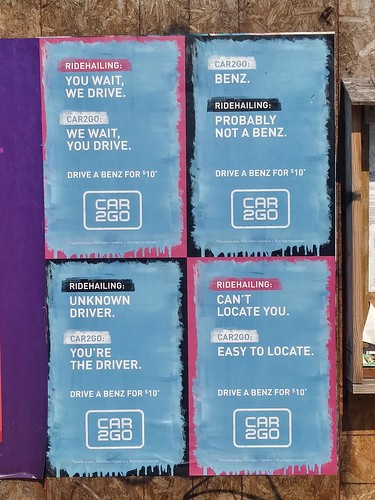
Car2Go paste up poster ads, New Hampshire Avenue NW
The need for ongoing marketing.   Observationally, I believe that the companies don't fully recognize the need for ongoing marketing, including in person "street team" marketing, such as at festivals, etc.  Zipcar still invests a lot in online and social media advertising, but not active outreach marketing.  To some extent, that's true of Car2Go too.

In a world where the land use and transportation paradigm is still built around mobility, constant marketing is a necessity for car share firms, as they lose members over time as they move, etc., they need to constantly grow the numbers of active users.

When Enterprise Car Share first launched, they had some great ads for television.  I was a bit shocked, because to me, while great, they needed to run the ads not nationally, but in the markets where they offered the service.

Similarly, Zipcar had tv ads too.

Conclusion for users.  I've used Car2Go and Zipcar in other markets, and that's part of its appeal (just as the universal deployment of the Lyft and Uber "taxi" apps simplify the use of "taxis" anywhere, rather than your having to learn the nature of the local taxi market when you travel).  And one of the markets where I used Car2Go in the past, San Diego, was dropped a long time ago.

While it won't make me stop using those services in DC, it does likely mean making other choices when traveling as car share firms reduce their footprint in North America.

Labels: , , , , ,

Sunday, February 10, 2019

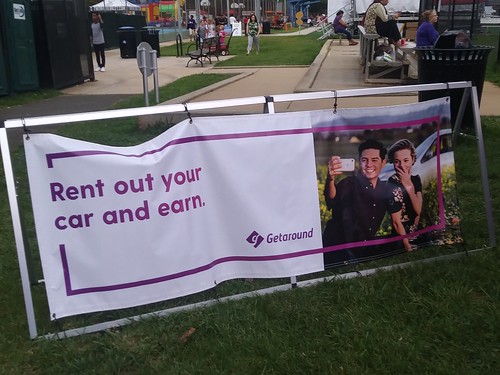
Los Angeles Metro partners with Getaround peer-to-peer car sharing service

A transit agency partnering with a car sharing service is not normally earth shattering.

For example, WMATA, the transit agency in the DC area, did it 15 years ago, originally with Flexcar I think, and then Zipcar when the firms merged ("Metro's SmarTrip Card and Zipcar Now One," Business Wire).

Now it's with Enterprise (link to Zipcar message about the change in 2015).

The firms bid high for exclusivity, but I've argued that instead transit agencies should make station sites "open access" ("Multiple missed opportunities in the creation of the Silver Spring Transit Center," 2015, item #6).

Companies wouldn't pay as much for spaces meaning revenue for the transit agency would be lower overall, but rider-customers would be able to use the services they are members of, which aren't necessarily the one that won the bid.  Overall, rider convenience would be greater.

For example, Enterprise likely outbid Zipcar for non-market reasons (to box them out), but because Flexcar-Zipcar was the first mover in this market, they have a much larger user base, and because most transit station catchment areas still have Zipcars close by, it's not much of an imposition and so users aren't likely to shift to Enterprise.

Similarly, the one-way service Car2Go has service in DC and Arlington County and it would be cool if outside of those home areas, transit stations across the metropolitan area were considered "home stations" part of the network.

This is one of the downsides of not having an integrated transport association in a metropolitan area ("The answer is: Create a single multi-state/regional multi-modal transit planning, management, and operations authority association," 2017, and the difficulties of mixing and matching nonprofit and for profit services ("Another example of the need to reconfigure transpo planning and operations at the metropolitan scale: Boston is seizing dockless bike share bikes, which compete with their dock-based system," 2018).

Anyway, the reason that the LA contract with Getaround is fascinating is that Getaround is a peer-to-peer service ("As Public Transport Ridership Dwindles, L.A. Metro Offering Car-Sharing Service for Rides to Stations, KTLA TV; LA Metro press release). From the article:
Angelenos can now make connections between metro station parking lots using a car-sharing app to rent and drive a car to the desired station, Los Angeles County Metropolitan Transportation Authority said in a news release.

Users can find a nearby car, book it and unlock it through the app, with prices beginning at $5 per hour depending on the vehicle type, Metro said.

The new transportation feature is a result of a partnership between the Los Angeles County Metropolitan Transportation Authority and Getaround, a San Francisco-based car-sharing app, which is licensed to occupy 110 parking spaces at 27 L.A. Metro station lots.
Getaround car sharing at Arlington County FairGetaround is the app provider and creator of the service platform or "product-service-chain," probably helps car owners with getting the right insurance, and takes a percentage of the rental fee.

But the cars, like ride hailing services, are owned by individuals, not a company, unlike the cars for Zipcar, Car2Go, Enterprise, or Free2Move.

That enables regular people to participate on a profitable basis within "government contracts" that normally don't provide this kind of opportunity for non-corporations.

Getaround is offering a $25 driving credit for new users as part of the promotion with LA Metro.

2. But the other thing a partnership with Getaround might offer is a way for transit agencies to "expand the sustainable mobility platform" in smaller metropolitan areas where the traditional corporate car sharing companies aren't likely to be active.

Also see:

-- "Further updates to the Sustainable Mobility Platform Framework," 2018

Labels: ,

Thursday, May 17, 2018

DC proposes ride hailing tax of 6%: It's not enough--car share users pay 10%

The Washington Post reports that DC ("D.C. Council would hike tax on Uber and Lyft more than Mayor Bowser"), like other cities are considering or have instituted ("Council Passes Ride-Share Tax to Fund Transit, CTA Announces $23M in Cuts, Reforms," Streetsblog Chicago; "Uber, Lyft taxi rides into Manhattan get slapped with a new surcharge," The Drive) a tax on ride hailing. 

DC charges a "gross receipts tax" of 1% on these services now.  This is not a per trip tax.  The Mayor proposed a raise to 4.75%, while the City Council is aiming for a 6% tax.

It's reasonable to regulate and tax to shape more desirable outcomes. Ride hailing imposes costs on transit by capturing riders, and also increases traffic congestion.

-- "When Calling an Uber Can Pay Off for Cities and States," New York Times
-- "The false promise of ride hailing as a pro-city transportation mode," 2018
-- "Public fees/taxes/charges on ride hailing trips," 2018

As new mobility services come into play, taxation and regulation may vary compared to legacy services, often in ways that are seemingly less fair to users of the new modes.

DC imposes higher taxes on car share users.  For example, as a car share user in DC, it seems unfair that each trip comes with a 10% local tax charge when we are already paying a good chunk of the minute or hourly use fees indirectly to the city for licensing and access to street parking.

By comparison, DC car owners pay a minimal annual registration fee (from $72 to $155, depending on the weight of the car) and if they live in an area of the city requiring residential parking permits, a $35/year fee.

-- "Car share users are getting abused by the cities that ostensibly support car sharing as a form of sustainable mobility," 2016

Considering the impact of ride hailing services on transit and congestion, of course the rides should be taxed.  And they shouldn't be taxed at a rate less than what car share users are forced to pay, when research shows that each car in a car sharing system ends up "removing" 7 to 11 cars, thereby reducing demand on parking inventory, rather than increasing demand for road space, like ride hailing.

Labels: , , , , ,

integrating payment systems in the Sustainable Mobility Platform

There is an article, "D.C. Metro's New App May Need a Pre-Launch Update," on CityLab, about WMATA's forthcoming phone-based payment system, and the author makes the point that by "merely transporting" the current card-based SmarTrip contactless fare payment and stored value system to an e-commerce app, it may be less innovative because it's not likely to include payment capabilities for modes not currently part of the payment system.

This is an interesting point that's been a concern for a long time, dating to c. 2001, triggered by the launch of (for profit) car sharing, followed by dock-based bike share a few years later. 

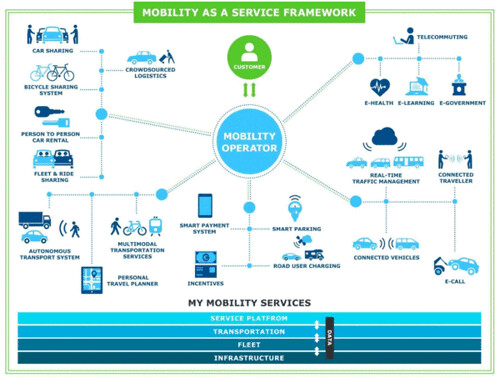
Sustainable mobility platform/TaaS and MaaS.  As the types of mobility (modes) available become broader and more diffuse, and the discussions of what I call the sustainable mobility platform but in the trade is referred to as transportation as a service/mobility as a service (TaaS/MaaS) it's deserving of more attention, as it raises some interesting issues.

-- The rise of mobility as a service, Deloitte

Unless the IT and access systems are designed from the outset to be compatible, it's difficult to have an integrated fare card that works on local transit as well as car sharing and/or bike sharing. 

But I am not sure that is as big an issue as I thought, because there are various standards systems that ensure access and interoperability.

More importantly, more mobility providers, including the car sharing firm Car2Go and all the new dockless bike and scooter providers, don't use card-based access systems, doing everything through phone-based applications.

Plus, firms operating programs on a multi-city footprint probably see it as a waste of time to integrate payment systems into local fare media programs when people are paying directly through their apps, linked to a credit/debit card or bank account.

Mobility as a service platform
Finland Ministry of Transport and Communications graphic.

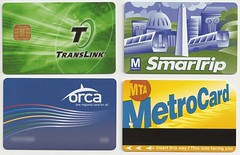
Regional transit fare payment systems.  With a few exceptions, like Greater New York City, by now most major metropolitan areas with multiple transit agencies have developed an integrated fare card system.

Transit CardsExamples include SmarTrip in DC, the Oyster Card in London (the first major example actually), the Orca Card in the Puget Sound region, etc. where it is set up as a master fare card that works across transit agencies in a defined region.

At the time, it was a great accomplishment for transit agencies to pull this off. 

Because most metros have a primary transit agency and a number of secondary systems, usually the primary transit agency takes the lead on creating a fare card payment system for its own use, and then opens up the platform to other agencies.  In some areas like San Francisco, the lead was taken by the area transportation planning agency.

Aren't necessarily usable on all forms of local transit.  But most of these fare collection systems don't cover every service.

In most places, railroad commuter trains aren't included. For example, in the DC and Baltimore region, while the SmarTrip card works in Baltimore and the CharmCard works in DC (actually the CharmCard is merely a branded SmarTrip card), it only works on bus and subway in the DC area, and bus, subway and light rail in Baltimore.  It doesn't work on railroad commuter services.

AND (which is a massive failure), SmarTrip cards can't be used on the bus between Dulles Airport and the Wiehle-Reston Metrorail station, even though the service is run by the Metropolitan Washington Airports Authority, a public agency.

By contrast in both the San Francisco and Puget Sound regions, the fare card systems work on railroad trips, as well as ferries.  In other places, railroad passes may provide free access to certain local transit services.  That is the case with MARC railroad monthly passes, and the Metrolink system in Greater Los Angeles.

Access to nonprofit mobility services that aren't traditional transit: bike sharing/car sharing.  With a couple exceptions, mostly in Montreal, access to car sharing and bike sharing hasn't been integrated in contactless fare media systems.  The bike sharing program in LA has been integrated into the TAP card system for access, but payment is separate from the stored value system used for transit.

The major exception is Montreal's STM transit system, where the Opus card can be used to access Bixi stations as well as card readers for cars in the Communauto car sharing program.  I think the difference is that both are local systems and the transit agency saw the value in integration.

What happens when for profit businesses enter the mix?  The problem with the thesis of the CityLab article is that for profit businesses engaged in transportation--car sharing, dockless bike and scooter sharing, taxis, etc.--may not be interested in participating in local transit fare media systems, especially when they operate on a national scale.

A dockless bike share bike from Lime Bike.

They're likely to see the cost of developing software integration applications for dozens of different transit fare collection systems as being greater than the benefit.  Similarly, they're not likely willing to pay collection and transfer fees, which are likely to be significant.  For them it's a lot easier for you to just use their phone-based app.

(Similarly, it's why firms develop specific e-commerce apps to better control their interaction with customers, rather than rely on web browser access.)

How to integrate for profit transportation service providers into the planning and operations mix? Regular readers know that in places like the DC area, with a balkanized set of transit agencies, I advocate the creation of collaborations equivalent to the "transport associations" of Germany. 

-- "The answer is: Create a single multi-state/regional multi-modal transit planning, management, and operations authority association," 2017
-- "Will buses ever be cool? Boston versus the Raleigh-Durham's GoTransit Model," 2017

These pan-metropolitan organizations integrate planning and operations into one body, provide integrated services and fare collection systems, regardless of what agency provides the service.  Note that Transport for London and the transit agencies in Greater Paris operate similarly.

But how do you integrate for profit entities into the mix?  Many transit agencies are working with ride hailing programs like Uber and Lyft on "microtransit" services.  Mostly, dockless systems have been more a matter of being foisted on local communities.

Theoretically, from a planning and operations standpoint, if the planning and transit operations paradigm was shifted to the German transport association model, it would be possible to bring the for profit sustainable mobility providers to the table.

I'd argue that the licensing regime for new mobility services should require participation in a metropolitan transport association coordinating and planning body.  But the problem is multi-fold. 

1. Most places don't have transport associations even though they have required transportation planning organizations--transport associations integrate planning and operations.

2.  The planning systems that exist aren't set up to deal very well with non-government entities. 

3.  The planning systems are often jurisdiction specific and don't function well at the metropolitan scale.  This is a problem even for government provided services like bike share that aren't transit.

4. For profit entities are competitive market-based organizations out to maximize their success and economic returns at the expense of others, without regard to the impact on parts of or the whole of the sustainable mobility platform.

Parking and tolling as another example.  Like traditional bike share, even though public parking and tolling systems are run by public agencies, their payment systems aren't integrated into one master fare, mobility access, and payment system. 

I did see an article a few years ago that a tolling organization in Texas proposed moving towards that kind of system.

EZ Pass is an interesting model because it operates on a multi-state scale covering dozens of metropolitan areas.

Would it make a lot of difference if transit media fare payment systems operated on a comparable basis, beyond that of even a metropolitan area?

Information versus payment.  Because most people are comfortable using debit card based payment systems, I no longer think that integrated payment systems with transit fare cards as the base are that important. 

The key with the sustainable mobility platform/TaaS/MaaS is integrating the modes at least in terms of information and awareness.  Yes, there is "consumer pain" at the outset of creating an account for a particular service, but after that initial touchpoint, access and payment isn't much of an issue.
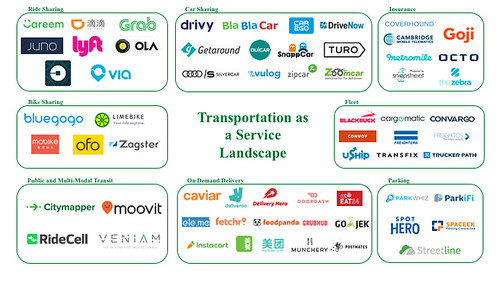
Transportation as a service landscape
Image from "The Road to Transportation-As-A-Service," Nokia Growth Partners.

Labels: , , , , , , , ,

Thursday, March 15, 2018

BMW Reach Now car sharing Pi Day promotion: a model for bike sharing promotion

This was sent along within a private email discussion that's been going on for a few months about car sharing.

Yesterday, "Pi Day," BMW Reach Now, the car sharing service, did a promotion on "Pi Day"--March 14th--charging only $3.14 per hour to use a car.

Except for the fact that Pi Day is in March, which isn't the most temperate of months, a special rate on Pi Day would be a great promotion for an all day bike share pass too, as a way to get people to try it out.

It should be positioned as a membership development promotion, and only open to people living in resident zip codes (the idea being, through taxes they pay they are paying towards the city/county expenditures on bike share anyway).


Labels: , , , ,

Sunday, March 11, 2018

Chattanooga as an e-car platform

Last week, I suggested Car2Go car sharing as a way to drive the development of an e-car charging system across a city ("Electric vehicles and city charging infrastructures: could car sharing be a way to drive changes more quickly?"). 

Note that I didn't use Brooklyn and Queens as an example, even though Car2Go is operative there today.  When asked about this by I colleague, I wrote:
My reservation is that it's not best to try to do something innovative but difficult in a place where it is already extraordinarily difficult to do anything. In other words, try to pick a place to start off with where you can be wildly successful and where opposition is likely to be muted.

E.g., DC tried to do streetcar in Anacostia but the area has pretty contentious if not noxious thinking about politics, "the neighborhood," transit, and public resources. So that area has zero streetcar and DC shifted to H Street NE. It delayed launch, but East of the River, by at 6 years. I was at a WMATA conference in Nov. 2006, where a DDOT person confidently said they'd be starting streetcar service in Anacostia the next year.

I should have said this about NYC:

After figuring this out in places where the constraints are fewer, like DC and Seattle, then take on a space with extraordinarily difficult infrastructure challenges like NYC, specifically Brooklyn and Queens where Car2Go operates.

OTOH, you could counter with Autolib, which was launched in Paris, which is just as tough a place to do it.

The difference though between NYC today and Paris then at the launch of Autolib is the support of the top elected officials, and the overall greater commitment in Europe towards dealing with the environment and climate change.

Autolib was an initiative of the then mayor. And today the Paris mayor is just as committed to the environment and clean air. Did you see that Paris will be giving incentive payments towards the purchase of bikes, cargo bikes, and e-bikes to people who agree to give up their cars, as part of clean air initiatives. That's an indicator of the difference between Paris and today's NYC.

These days, the current mayor of NYC doesn't seem to be particularly engaged when it comes to sustainable mobility generally, and he's not a rah rah kind of person on stuff that isn't social justice related.
Anyway, like the BlueIndy program in Indianapolis and the GreenSpot program in Jersey City, it seems as if Chattanooga is developing a similar program, according to GovTech ("Chattanooga pushes multimodal to solve its transportation problems").

But I don't think it's an example that is quantumly different at a system scale because it's pretty small when it comes down to it, but a bit more marginally interesting because the transit agency is adding a solar farm to power it--even though it seems somewhat duplicative as the region is known for cheap hydroelectric.  From the article:
The Chattanooga Area Regional Transportation Authority (CARTA) is constructing an 80-kilowatt solar farm, the installation of 64 electric-vehicle charging ports spread across 22 sites and a car-sharing program powered by battery-electric Nissan LEAFs. ...  
“With interest from an electric-vehicle car-share operator, CARTA entered into a funding agreement with TVA in February 2014 to provide for a minimum of 40 charging ports and a 20-vehicle car-share program ...

The car-share portion of the project is operated by Green Commuter, a membership-based car-sharing platform based in Los Angeles. Members rent the car for the time they need it, while the company pays for electricity to recharge the vehicles, as well as maintenance, parking and insurance costs. Rates are $7 an hour or $45 a day.
20 cars isn't that big a deal, almost not big enough to even acknowledge, although it is significant from the standpoint of smaller cities, as Chattanooga has about 180,000 residents.

The BlueIndy program has 230 vehicles. Granted, Indianapolis has five times the population of Chattanooga, but still, a program with 230 electrically powered vehicles is of a size that's significantly noticeable.

In DC, Car2Go has a 600 car fleet, albeit none are electric.

Multimodal vs. the concept of the sustainable mobility platform
.  The other thing that I don't think is as useful is to think about this in terms of "multimodalness." Yes, different modes are multiple.  But the issue is to integrate the sustainable modes into a system. 

Some refer to this as "transportation as a service" or "mobility as a service," although they aren't necessarily focused on all the services being "sustainable."

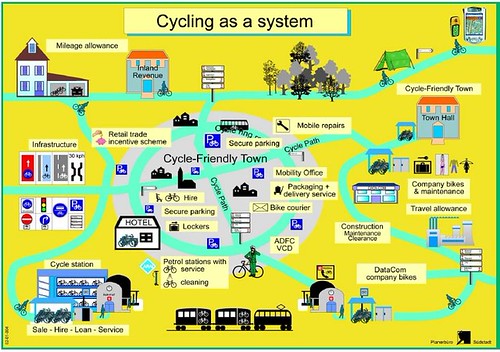
I prefer to call this the sustainable mobility platform ("Dolly micro-move app as an element of the Sustainable Mobility Platform" and "Free access to cargo bikes/e-cargo bikes as part of a mobility hub/sustainable mobility platform"), extending the concept from a diagram from an old national bicycle plan for Germany.

Bicycle Traffic as a system, diagram, German National Bicycle Plan, 2002-2012

Sustainable Mobility Platform Elements

I continue to work out where to place the various rungs on the ladder.  It's easier if you split it out according to trip distance.  These are the elements:

-- Walking
-- Scooters/Skateboards
-- Cycling
---- secure bike parking, air pumps, repair stands
---- access to trailers
---- tandems
---- cargo bikes
---- e-bikes
---- special populations ("Two men leading an effort to provide bikes to homeless," WLOX-TV)
-- Bicycle sharing
---- community system
---- building/campus (e.g., hotel, office building, university, office complex)
---- special populations ("New bike share program gives One80 Place's homeless a way around the city," WCIV-TV)
-- Segways/electric wheels
-- Delivery services (e.g., Dolly; UPS, FedEx, etc.) and package pickup points
-- Transit
---- various bus, streetcar, light rail, heavy rail, railroad services
---- network scale (regional, metropolitan, city; primary, secondary, tertiary)
---- intra-district(Baltimore Circulator, Circulators, San Diego FRED Shuttle); tertiary network (Tempe Orbit)
---- shuttle services (school, employer, residential)
---- microtransit either private (Bridg, Chariot, Israeli sheruts) or public (AC Transit FLEX pilot project, "The newest battleground between public transit and Uber, Lyft is an unlikely one," San Jose Mercury News)
---- van pools (longer distance) (vride)
---- shared taxi type services at edges of the transit system (taxi collectif in Montreal) or intra-district (Via, UberPool, Lyft Line) either publicly subsidized ("Mass transit gets boost from ridesharing," USA Today; "Uber and Lyft Want to Replace Public Buses," Bloomberg) or not
-- Taxis/Ride hailing
---- single trips (equivalent of "single occupant vehicle trips")
-- Car sharing
---- one-way (car2go)
---- two-way (Zipcar, Enterprise)
---- inclusion of a variety of vehicles in fleets to accommodate multiple uses (Zipcar)
---- electric car sharing systems
-- Scooters
---- scooter sharing (Scoot in SF)
-- Car pooling
-- Car rental

Somehow too the system support elements need to be woven into the framework, such as the charging stations, IT services, intelligent transportation systems, apps, etc.

Another way too to think about this is that the enabling infrastructure of a city's mobility system: streets and sidewalks; is the operating system for mobility but also placemaking and quality of life.

Labels: , , , , , , ,

Wednesday, March 07, 2018

Electric vehicles and city charging infrastructures: could car sharing be a way to drive changes more quickly?

Electric Avenue in Portland has five charging spaces.  There are fees to use the chargers, which include 4 DC fast chargers with CHAdeMO and Combo plugs, and two AC Level 2 terminals.


In 2014, I wrote a piece "Electric vehicles and critical mass," about the general issue of how to support the more widespread adoption of electric cars. The article discussed electric vehicle associations as promoters as well as Portland's "Electric Avenue," a street block remade over with e-charging infrastructure.

Since 2014 there have been many advancements concerning e-cars making the need for the development of a more widespread charging infrastructure within cities:

One of the policy drivers emphasizing electric cars is it reduces demand for oil sales and the impact on countries often at odds with the United States foreign policy establishment, like Russia, Iran, Saudi Arabia, and Venezuela ("The electric car industry could take a bite out of oil demand," CNBC). 

In Norway, a large oil producing company, the state oil firm and a major Canadian-based convenience store chain are experimenting with how to reposition "gas stations" ("Gas Stations Get Ready for the Electric Future," Bloomberg; "Couche-Tard looks to Norway for guidance to adapt to electric cars," CBC-TV) in the face of an automobile industry that shifts to electric cars.

And electric cars require little maintenance, putting pressure on auto repair firms and employment ("Will electric vehicles doom your neighborhood auto mechanic," Chicago Tribune).

I am aware of various electric vehicle car sharing schemes, such as in Paris, which I first wrote about in 2011 ("World class cities and the development of new transportation technologies: Paris and electric cars") and Blue Indy ("BlueIndy car-sharing program striving to be in black by 2020," Indianapolis Business Journal) in Indianapolis, which is run by the same firm, Bolloré Group, using the same cars as in Paris, and the Green Spot program in Jersey City ("Eco-friendly car-sharing service opens in Jersey City," Jersey Journal).

But I hadn't really thought about more wide spread car sharing programs as a way to drive the propagation of an e-vehicle charging network across a city, especially given the failure of Car2Go's electric vehicle program in San Diego ("Car2Go switching electric cars to gas in San Diego" and "Car2go ceases San Diego operations," San Diego Union-Tribune).  Note that I drove an E-Car2Go in San Diego and it was a dream to drive.

In my 2011 blog entry I wrote:
If you study the diffusion of innovation (see Diffusion of Innovations by Everett Rogers), in response to the Fox News story about Ecotality, I'd argue that it takes time to introduce new technologies, and it takes time to develop the critical mass of users and support services to make using the new, in this case mobility, technology, practical. (In fact, biking as transportation has some of the same issues.)

With the auto industry, it took about 30 years to truly scale up, and in that time a network of roads had to be created, a system of garages/repair facilities, gas stations, a dealer network, places to stay if you traveled (motels), road maps, etc. in order to be able to get around beyond your immediate neighborhood. Relatedly, the technology of the automobile had to be improved so that you didn't need to be a mechanic yourself in order to keep it running.
The problem doing e-car share in a place like Indianapolis is that it doesn't have a well developed platform for sustainable mobility. Transit is a hard sell there.  Car sharing, let alone using electric vehicles, is that much harder to promote. My sense is that Bolloré Group chose to go there because they were invited, not because they were thinking "what is the best place we can go to in the U.S. to launch our system in the best possible way there is to accelerate adoption of this program?"

Even San Diego probably lacks the right density and relatively short distances between residential areas and activity centers to make car sharing (or bike sharing) work, even though the city has a widespread rail and bus based transit network.

On the other hand, there are cities like DC which have deeper sustainable mobility platforms as well as experience with and success in car sharing.

I happen to be a fervent believer in the Car2Go one-way car sharing program because the small cars are particularly easy to park a definite plus in constrained parking situations.

But in the US, Mercedes stopped selling gasoline powered versions, although they are continuing to sell the electric motor version ("Mercedes to stop selling gas-powered Smart car in the U.S.," USA Today). 

Does that mean that in the future the small car2go vehicles will be discontinued, making the car2go car share "competitive advantage" of being able to park in space constrained places go away?

Electric Car2Go in Stuttgart.

Could e-car sharing be a way to push the development of e-charging, but in a city with better conditions supporting e-car adoption.  To keep small cars as part of the Car2Go car sharing fleet, the company could switch to the electric versions, if a city has the charging network necessary to support it.

The reality is that no city has a widespread charging network capable of supporting 600 (DC), 750 (Seattle),or 1,100 (Vancouver) cars, each requiring a charge at least a couple times/week, needing to access electricity charging in public spaces.

Why not use such a car sharing network of vehicles as a way to drive improvements to the e-charging infrastructure across a city?

Car2Go cities like Portland, Seattle, and Washington would be the best place to try this, although Car2Go has already removed SmartCars from the fleet there.  New York is probably too tough and Columbus and Denver, like San Diego or Indianapolis, don't have the right support conditions although Columbus is just starting to provide free bus passes to downtown workers ("45,000 Downtown Columbus Workers Eligible for Free Bus Passes," Associated Press).

Interestingly, this idea is comparable to how the electricity generation industry got started.  It was expensive to wire individual houses, so instead companies focused on getting large industrial customers.  One such customer was streetcar firms, which is why electricity companies often owned streetcar companies too, until the practice was outlawed.

Having large customers led to the installation of basic utility infrastructure, and once that was in place, it became much cheaper to provide electricity connections to the housing districts that lay in between power plants and large industrial customers.

This likely is the right model for the creation of widespread e-vehicle charging systems, with larger (relatively speaking) customers, car sharing firms maybe complemented by other business users, driving the development of e-charging networks ("From Firm to Networked Systems," Thomas P. Hughes, The Business History Review, Vol. 79, No. 3 (Autumn, 2005), pp. 587-593).

Environment America report on cities and electric car infrastructure.  Last month, Environment America released a report, Plugging In: Readying America’s Cities for the Arrival of Electric Vehicles, on what cities need to do to support the widespread adoption of electric cars. 

There is a good discussion about the different types of chargers, what cities are doing, and yes, that car sharing can be a way to drive e-car use forward, using Indianapolis as an example.

Streetlight modernization programs as a way to drive e-charging network development.  Many cities are looking to modernize streetlights to save energy and add other features such as wifi, public safety elements, traffic monitoring, etc.  The Environment America report mentions London and Los Angeles as examples of using streetlights for e-charging.

The report mentions a program in London that will install charging points on streetlights called the "On-street Residential Chargepoint Scheme" and a fund to pay for it ("Want an electric car charge point on the street outside your house? There's a £2.5m pot, but the catch is you have to apply though your council," This is Money).

The Urbicity equipment in use in London.

The London program has been developed by a German firm Ubitricity, which is working with various boroughs to install charging equipment in streetlights, paid for in part through simultaneous upgrades to the lights with LEDs, and the anticipated cost savings ("London street lamps are being turned into electric car charging points," Independent).

The advantage of using existing streetlight "networks" is that separate infrastructure doesn't have to be created which further clutters the sidewalk and curb zone. While the basic connections that can be installed cheaply are not particularly fast charging, it is a way to deploy much more quickly ("How We Could Put An EV Charging Station On Every Lamp Post: The key: use regular outlets instead of high-speed charging stations,"Fast Company).

Let's face it, the charging points on the street can be somewhat ungainly. From the article:
Owners of hybrid and electric cars can order a charging cable with an in-built electricity meter and will be able to charge their vehicles using lampposts in areas of Barnes, Hounslow, Twickenham, Kensington and Westminster.

The charging points offer a solution to the challenges of installing dedicated EV parking bays and removing parking spaces from the general supply, by giving residents who do not have access to off street parking the opportunity to charge their cars locally. However, the sockets offer lower power charging.
Los Angeles is testing such a pole too ("Los Angeles has a streetlight that can charge your car," Government Technology).  So far, LA's Bureau of Streetlighting has installed 82 car charging points.

Cutting costs by offering car sharing users the opportunity to be "ambassadors." Bike sharing systems in Paris and New York City have programs that reward users for rebalancing bikes to challenging locations. CitiBike calls its program Bike Angels ("New York's Citi Bike pays riders to make it run better," Slate; "Hacking the Citi Bike Points System, New Yorker Magazine).

The early car sharing service Flexcar which was merged into Zipcar had a similar program, rewarding users for putting gas in the car, etc.  When Zipcar took Flexcar over, they dropped the perks.

E-car sharing operations could train a set of members as ambassador-chargers empowered with the ability to take cars to locations where they can be charged, to aid system up-time, in return for similar kinds of rewards.  This makes it cheaper for a company to deploy the cars, which require more careful monitoring and refueling to stay charged. And paying people to do that costs a lot of money--and increases the cost to use the service.

Such a network in DC would also include Arlington.  The DC Car2Go system includes Arlington County, Virginia.  I don't know if the 600 car number refers to both DC and Arlington, or DC only.  The license in Arlington allows for a total of 100 vehicles, but cars in DC can be driven to and left in Arlington and vice versa.

Ideally an electric car based Car2Go network could be extended to the Bethesda and Silver Spring town centers in Montgomery County and Alexandria as well, creating a more extensive "platform" for sustainable mobility but in terms of the one way car sharing element and for a public e-charging network.

Labels: , , , , , ,