Rebuilding Place in the Urban Space

"A community’s physical form, rather than its land uses, is its most intrinsic and enduring characteristic." [Katz, EPA] This blog focuses on place and placemaking and all that makes it work--historic preservation, urban design, transportation, asset-based community development, arts & cultural development, commercial district revitalization, tourism & destination development, and quality of life advocacy--along with doses of civic engagement and good governance watchdogging.

Tuesday, February 06, 2024

Scooters, private equity, micromobility and transit

 (g.d.  Blogger keeps destroying the post, although I think it's the connection.)

Micromobility is the fancy term now in transit, looking at how bikes, bike share, electric bikes, scooters and even skateboards complement traditional transit, especially in terms of what is called "the first mile/last mile" problem of getting people from their point of origin to the transit station and from the transit station to their final destination.

Private equity doesn't do stuff "out of goodness" but to make a profit, and quickly--often much faster than it is possible for a developing business to do.  Lots of cool more public good type "businesses" have been destroyed by private equity seeking a quick return or to cash out.

We've already determined that in the US, because of population density, depopulation of cities, and sprawl, that transit isn't profitable.  That's why it's been taken over by the public sector, except in a few rare situations (Asian countries have high population density and transit agencies are more active in high value real estate development so their situation is different).

Isla Vista, California.

So I wasn't surprised to see some articles about the bankruptcy of Bird (Superpedestrian), the major player in the electric scooter space ("E-scooter companies are going bankrupt. That should alarm you even if you hate them," Fast Company, "Bird's bankruptcy is bad news for scooter commuters," Washington Post).  

The reason first is that transit isn't profitable, especially quickly.  

But the second is that they significantly misunderstood the market.  They thought it was transit, it was recreational.  Bird launched in Santa Monica, a tourist-beach town, and the scooter users were recreational.

-- "What the e-scooter industry hasn't figured out about Santa Monica: It's recreation not transportation," 2018

Note, ride hailing is a similar issue.  Trips cost more than transit, lead to more congestion as they replace transit trips with car trips, and were significantly subsidized by venture capital ("Farewell, Millennial Lifestyle Subsidy," New York Times).

Then there is the nuisance issue.  Many scooter users aren't respectful of the public space and abandon the vehicles at the end of their trip, on sidewalks, in intersections, etc.  From the FC article:

But those who care about the future of urban life should not indulge in scooter schadenfreude. For all the annoyance they inspire, shared e-scooters have been valuable additions to American neighborhoods, frequently replacing car trips that pose a much greater threat to street safety and clean air. Cities—whose leaders have contributed to e-scooters’ current predicament—would be worse without them.

Regardless, I think the premise is wrong.  At least in the US, scooter trips don't replace car trips, but transit trips, and they are a lot more expensive than a transit trip.  (This was true of initial research on bike share too, but there are advantages to reducing train congestion and getting closer to your final destination.)

It wasn't the kind of business that could scale up. Especially to make lots of profit.  See the flameout of Chinese bike share and the fact that with a couple exceptions, bike share in the US is not capable of making money.

That doesn't mean bike share isn't valuable, just that it needs to be conceived of in terms of first mile/last mile linked trips with transit.  

In some other countries, the transit agency provides free access to bike share to start or finish a trip, out of access and equity issues.  In the US, I think only Columbia Transit in South Carolina does this.

FWIW, I have no problem with scooters and bike share being integrated into transit systems, as a way to improve customer experience.

-- "The problem when you define every outcome as a success, you don't learn, and therefore failure is more likely: bike share in Seattle and Los Angeles as examples," 2016

But it's good at some things, not others. It's personal transit, not mass transit.  And it works best in areas with a lot of stations.  In terms of off loading parking, security, and maintenance, it's awesome.

Labels: , , , , , ,

Thursday, May 17, 2018

integrating payment systems in the Sustainable Mobility Platform

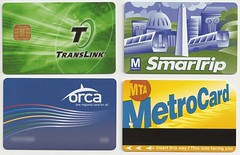
There is an article, "D.C. Metro's New App May Need a Pre-Launch Update," on CityLab, about WMATA's forthcoming phone-based payment system, and the author makes the point that by "merely transporting" the current card-based SmarTrip contactless fare payment and stored value system to an e-commerce app, it may be less innovative because it's not likely to include payment capabilities for modes not currently part of the payment system.

This is an interesting point that's been a concern for a long time, dating to c. 2001, triggered by the launch of (for profit) car sharing, followed by dock-based bike share a few years later. 

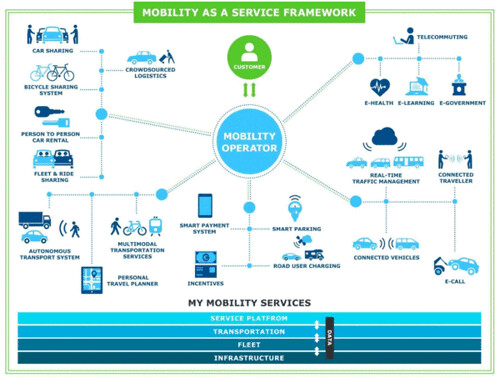
Sustainable mobility platform/TaaS and MaaS.  As the types of mobility (modes) available become broader and more diffuse, and the discussions of what I call the sustainable mobility platform but in the trade is referred to as transportation as a service/mobility as a service (TaaS/MaaS) it's deserving of more attention, as it raises some interesting issues.

-- The rise of mobility as a service, Deloitte

Unless the IT and access systems are designed from the outset to be compatible, it's difficult to have an integrated fare card that works on local transit as well as car sharing and/or bike sharing. 

But I am not sure that is as big an issue as I thought, because there are various standards systems that ensure access and interoperability.

More importantly, more mobility providers, including the car sharing firm Car2Go and all the new dockless bike and scooter providers, don't use card-based access systems, doing everything through phone-based applications.

Plus, firms operating programs on a multi-city footprint probably see it as a waste of time to integrate payment systems into local fare media programs when people are paying directly through their apps, linked to a credit/debit card or bank account.

Mobility as a service platform
Finland Ministry of Transport and Communications graphic.

Regional transit fare payment systems.  With a few exceptions, like Greater New York City, by now most major metropolitan areas with multiple transit agencies have developed an integrated fare card system.

Transit CardsExamples include SmarTrip in DC, the Oyster Card in London (the first major example actually), the Orca Card in the Puget Sound region, etc. where it is set up as a master fare card that works across transit agencies in a defined region.

At the time, it was a great accomplishment for transit agencies to pull this off. 

Because most metros have a primary transit agency and a number of secondary systems, usually the primary transit agency takes the lead on creating a fare card payment system for its own use, and then opens up the platform to other agencies.  In some areas like San Francisco, the lead was taken by the area transportation planning agency.

Aren't necessarily usable on all forms of local transit.  But most of these fare collection systems don't cover every service.

In most places, railroad commuter trains aren't included. For example, in the DC and Baltimore region, while the SmarTrip card works in Baltimore and the CharmCard works in DC (actually the CharmCard is merely a branded SmarTrip card), it only works on bus and subway in the DC area, and bus, subway and light rail in Baltimore.  It doesn't work on railroad commuter services.

AND (which is a massive failure), SmarTrip cards can't be used on the bus between Dulles Airport and the Wiehle-Reston Metrorail station, even though the service is run by the Metropolitan Washington Airports Authority, a public agency.

By contrast in both the San Francisco and Puget Sound regions, the fare card systems work on railroad trips, as well as ferries.  In other places, railroad passes may provide free access to certain local transit services.  That is the case with MARC railroad monthly passes, and the Metrolink system in Greater Los Angeles.

Access to nonprofit mobility services that aren't traditional transit: bike sharing/car sharing.  With a couple exceptions, mostly in Montreal, access to car sharing and bike sharing hasn't been integrated in contactless fare media systems.  The bike sharing program in LA has been integrated into the TAP card system for access, but payment is separate from the stored value system used for transit.

The major exception is Montreal's STM transit system, where the Opus card can be used to access Bixi stations as well as card readers for cars in the Communauto car sharing program.  I think the difference is that both are local systems and the transit agency saw the value in integration.

What happens when for profit businesses enter the mix?  The problem with the thesis of the CityLab article is that for profit businesses engaged in transportation--car sharing, dockless bike and scooter sharing, taxis, etc.--may not be interested in participating in local transit fare media systems, especially when they operate on a national scale.

A dockless bike share bike from Lime Bike.

They're likely to see the cost of developing software integration applications for dozens of different transit fare collection systems as being greater than the benefit.  Similarly, they're not likely willing to pay collection and transfer fees, which are likely to be significant.  For them it's a lot easier for you to just use their phone-based app.

(Similarly, it's why firms develop specific e-commerce apps to better control their interaction with customers, rather than rely on web browser access.)

How to integrate for profit transportation service providers into the planning and operations mix? Regular readers know that in places like the DC area, with a balkanized set of transit agencies, I advocate the creation of collaborations equivalent to the "transport associations" of Germany. 

-- "The answer is: Create a single multi-state/regional multi-modal transit planning, management, and operations authority association," 2017
-- "Will buses ever be cool? Boston versus the Raleigh-Durham's GoTransit Model," 2017

These pan-metropolitan organizations integrate planning and operations into one body, provide integrated services and fare collection systems, regardless of what agency provides the service.  Note that Transport for London and the transit agencies in Greater Paris operate similarly.

But how do you integrate for profit entities into the mix?  Many transit agencies are working with ride hailing programs like Uber and Lyft on "microtransit" services.  Mostly, dockless systems have been more a matter of being foisted on local communities.

Theoretically, from a planning and operations standpoint, if the planning and transit operations paradigm was shifted to the German transport association model, it would be possible to bring the for profit sustainable mobility providers to the table.

I'd argue that the licensing regime for new mobility services should require participation in a metropolitan transport association coordinating and planning body.  But the problem is multi-fold. 

1. Most places don't have transport associations even though they have required transportation planning organizations--transport associations integrate planning and operations.

2.  The planning systems that exist aren't set up to deal very well with non-government entities. 

3.  The planning systems are often jurisdiction specific and don't function well at the metropolitan scale.  This is a problem even for government provided services like bike share that aren't transit.

4. For profit entities are competitive market-based organizations out to maximize their success and economic returns at the expense of others, without regard to the impact on parts of or the whole of the sustainable mobility platform.

Parking and tolling as another example.  Like traditional bike share, even though public parking and tolling systems are run by public agencies, their payment systems aren't integrated into one master fare, mobility access, and payment system. 

I did see an article a few years ago that a tolling organization in Texas proposed moving towards that kind of system.

EZ Pass is an interesting model because it operates on a multi-state scale covering dozens of metropolitan areas.

Would it make a lot of difference if transit media fare payment systems operated on a comparable basis, beyond that of even a metropolitan area?

Information versus payment.  Because most people are comfortable using debit card based payment systems, I no longer think that integrated payment systems with transit fare cards as the base are that important. 

The key with the sustainable mobility platform/TaaS/MaaS is integrating the modes at least in terms of information and awareness.  Yes, there is "consumer pain" at the outset of creating an account for a particular service, but after that initial touchpoint, access and payment isn't much of an issue.
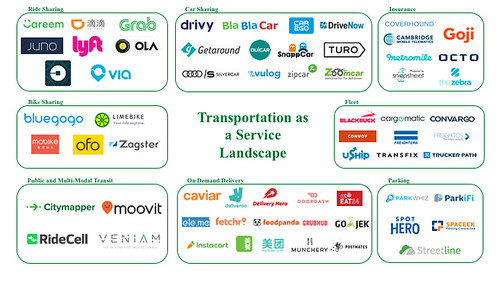
Transportation as a service landscape
Image from "The Road to Transportation-As-A-Service," Nokia Growth Partners.

Labels: , , , , , , , ,

Thursday, March 15, 2018

BMW Reach Now car sharing Pi Day promotion: a model for bike sharing promotion

This was sent along within a private email discussion that's been going on for a few months about car sharing.

Yesterday, "Pi Day," BMW Reach Now, the car sharing service, did a promotion on "Pi Day"--March 14th--charging only $3.14 per hour to use a car.

Except for the fact that Pi Day is in March, which isn't the most temperate of months, a special rate on Pi Day would be a great promotion for an all day bike share pass too, as a way to get people to try it out.

It should be positioned as a membership development promotion, and only open to people living in resident zip codes (the idea being, through taxes they pay they are paying towards the city/county expenditures on bike share anyway).


Labels: , , , ,

Wednesday, March 29, 2017

Making cycling irresistible in DC 2.0 | Revisiting a post from 2008

In 2008, Rails to Trails was putting together a case for a special federal appropriations program for trails and biking, and they asked each state to submit a policy outline.

The then chair of DC's Bicycle Advisory Committee asked me to write a paper with recommendations that they could review and consider as part of the process for preparing their response.

My one criticism of the general proposal by Rails to Trails was that it was very "bicycling as recreation" focused and not very "urban-centric" and I responded that since DC functions as a state for federal transportation planning purposes but is a city, we should tender a policy outline that is decidedly urban-centric.

Back then DC had some bike lanes and bike parking, police on bikes, and a small permanently constrained bike share test project, and not much bike accommodation beyond that.

This is the paper I came up with: "Ideas for Making Cycling Irresistible in Washington, DC," which suggests cycle tracks and other bike-specific accommodations, suggests switching some government jobs to bike-enabled (like parking control officers), having a payroll deduction program to buy bikes, making transit (Metrorail, VRE, MARC) more bike-accepting, expanding bike parkingprogramming , etc.

The title is a kind of riff on a paper by Ralph Buehler of Virginia Tech and John Pucher of Rutgers, "Making Cycling Irresistible: Lessons from Europe and North America."

When I worked in Baltimore County, the person from Maryland State Highway Administration on our advisory committee circulated it at SHA, and it helped to spark their interest in cycletracks.  I believe that including better cycle facilities in the part of the Purple Line not associated with the Capital Crescent Trail in part resulted from the circulation of that paper.

Anyway, a few weeks ago there was a piece in GGW ("A protected bikeway on Florida Avenue? Yes please!") about a cycletrack proposal on Florida Avenue NE (ironically I suggested that there be a road diet program for that street in 2005) and I thought some of the comments were overly negative and I responded thusly:
FWIW, these types of lanes were pioneered by the Dutch. I first saw them in use in Montreal. And at the ThinkBike Dutch bike planning meeting in 2010, they pushed bi-directional lanes. I was skeptical then. I am fine with them now.

They do create issues wrt signaling, etc., making it more expensive than a lane on each side of the street. But a high quality cycletrack as opposed to an average lane on each side of the street is probably preferred, is more visible, etc., and I think that matters.

Maybe I am worn down by reality, and I f*ing hate it when people say "don't let the perfect be the enemy of the good," but I think this is a fine step and helps to alleviate what would be opposition otherwise. ...
I really hated Lindblom's writngs on "incrementalism" when I was first exposed to them in the early 1980s. I couldn't understand why people didn't focus on achieving the best possible result.

After a few decades of living in the real world, I understand the concept a lot better. It's almost impossible to move people far along the idea-vision curve to perfection in one fell swoop. (Although the challenge is to constantly keep moving forward. Too often, stasis results at some point.)

I still push for ideal and vision, but the reality is, year by year, DC is experiencing significant gains in bike infrastructure, and that should be recognized and acknowledged and appreciated.

Where I see my role generally is pushing for the ideal in an issuespace where most people are pretty content with the average or sub-average.

Maybe I am fooling myself more generally, but I don't think so. Even though I am not calling for "the perfect" here, it's so much better than the current conditions it's unimaginable--take it as someone who used to ride on this street many times/week, and still ride it a couple times/week
After those comments, I had a private email exchange with an old H Street compatriot who is a planner for a road engineering firm where we talked about "incrementalism" and how it's time consuming and sometimes oh so slow, but when there is a general commitment to an overall plan and vision, it works -- even if too often it can be half-a****.

Since then I have been taking stock of where DC is facilities-wise in terms of biking as transportation, a kind of assessment of my "Making Cycling Irresistible in DC" piece.  And in terms of "incrementalism" it is quite a positive track record.

=======
Biking for transportation improvements in DC since 2008

The other day I was riding through the intersection at Florida and New Hampshire Avenues NW and looking at the extension of the 15th St. cycletrack from V Street, going up around Meridian Hill Park, I was so shocked.

It's gorgeous. Like Montreal ("Is Montreal the number one city for bicycling in North America," 2010).
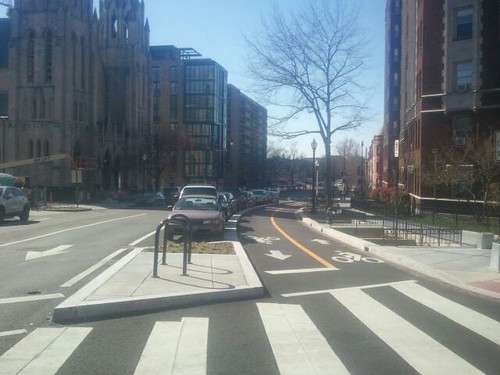
Cycletrack on 15th Street NW, looking west towards U Street (at W Street)
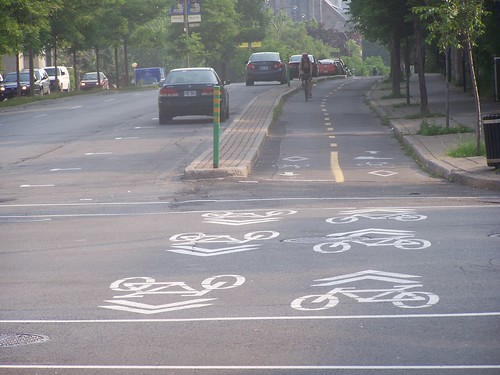
Cycle track (piste cyclable) in Montreal

And it pushed me forward to a more formal assessment of the bicycle facilities improvements across DC since 2008, when I wrote that piece.  One by one the improvements are incremental.  Collectively they add up to something significant.

(Rather than describe each treatment, see Urban Bikeway Design Guide, National Association of City Transportation Officials.)

★  more bike lanes
★ more bike parking and bike parking corrals on the street (Adams Morgan, Georgetown, 11th St. NW, etc.)
★  a bike share program (although I still have my doubts) that keeps expanding within the city and throughout the metropolitan area
★  regular printing and updating of the DC bike map (many communities have stopped printing maps)
★  cycletrack pilots leading to a growing network of cycle tracks (Pennsylvania Avenue, 15th, L, M, 6th St. NE, 1st St. NE, etc.)
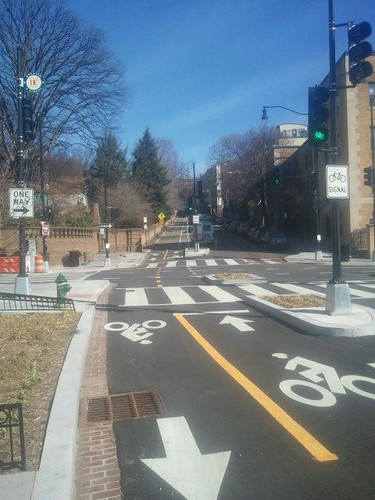
Cycletrack on 15th Street NW, looking east towards Meridian Hill Park (at W Street)
Cycletrack on 15th Street NW, looking east towards Meridian Hill Park (at W Street).

★  opening of a dedicated segment of the Metropolitan Branch Trail (although it will take more than 30 years since this trail was first proposed before it is finally realized)
★  bike favorable traffic treatments (bike boxes, bike traffic signals, painted markings across intersections, etc.)
★  contra-flow lanes for bicycle traffic introduced on one-way streets and the network of such lanes increasing
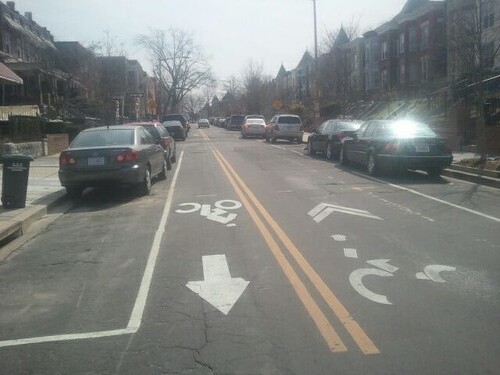
Contraflow bicycle lane, DC
A contraflow bicycle lane in DC.

 a signage program for "neighborhood bikeways"
★  improved treatments at "complicated intersections" creating various types of "pocket lanes" for through or turning bike traffic, e.g., on the northwest corner of 2nd St. NE going southbound at Massachusetts Avenue, by AU, at Hawaii Ave. and Taylor St. NE, etc.
★  completion of missing Anacostia River Trail segment on the east bank of the river (opened in 2016)
★  printing some not particularly scintillating trails brochures (WABA did it paid for by DDOT)
★  the BikeDC city-wide biking event (not that I do that kind of ride)
★  installation of some bike repair stands and air pumps (although the air pumps are substandard for high use locations and most break) by DGS and some BIDs
★  climbing lane on 14th St. NW
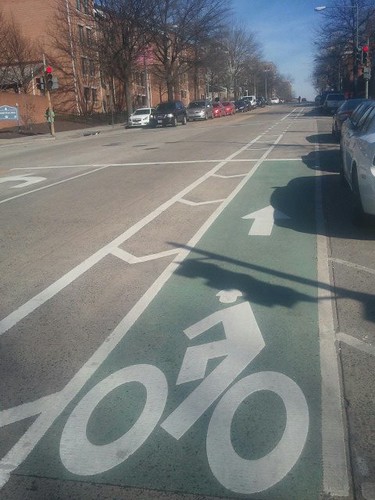
Climbing lane on the south side of 14th Street NW, north of Florida Avenue
Climbing lane on the south side of 14th Street NW, north of Florida Avenue.

★  more neighborhood bike shops
★  more new buildings adding higher quality secure bike parking, including air pumps, lockers, etc.
★  more bike centric building improvements planned (building on MBT at Florida Ave., Rhode Island Ave. -- I proposed something similar at Monroe St. Market in Brookland 6 years ago and they didn't get it at all, other than a bike shop; now buildings are being very forward)
★  bike-based paramedics deployed for special events
★  expansion of biking training in the local schools

One theoretically is an improvement, but I think it was way too expensive for what you get:

★  Bike Station at Union Station ($4.5 million for 125 bike parking spaces, a bike rental operation, and bike repair)

And one improvement for DC residents but not done by a DC Government entity:

★  allowing bicycles on MARC Penn Line trains on the weekends (which is in the process of being expanded to M-F)

In terms of street safety, compared to 9 years ago, I believe that I experience much less hassling by motor vehicle operators while riding, and that more motor vehicle operators defer to me as a cyclist/the more vulnerable user even when I don't have the right of way.  Sure there are still problems, but a couple times/year versus a couple times/week.

And don't forget to acknowledge the work of DDOT's Sustainable Transportation unit for making it happen and their continuous efforts to improve the system.

Next generation bicycle planning and programming for DC (and other places)

There's still a lot  more to be done though--many of the recommendations in the original paper still haven't been implemented fully or remain on the list of what could be, and that's where I need to focus my writing.

Especially programming. In a car-centric world, people need focused help to make the transition to biking as transportation.  Also see "What should a US national bike strategy plan look like?," "Are developers missing the point on eliminating parking minimums?: it's to promote sustainable transportation modes," and "More bikes: elements of a Bicycle Friendly Community."

In short, we've been effective at creating biking-appropriate infrastructure, but that goes only so far in shifting people to bicycling in a mobility paradigm where the car is still king.  At a certain point, you have to be more purposive as there is only so much usage can be realized via trickle down benefit from bike infrastructure.

Focusing on creating bicyclists as well as infrastructure would would make a big difference in terms of the still omnipresent opposition to the expansion of bicycle accommodations in various quarters, because if there were a lot more bicyclists, visible, a lot of the time, then motor vehicle operators wouldn't feel justified in criticizing bicycle infrastructure as being infrequently used (see "(Not exactly) Bike sharing as "Critical Mass," bikelash and changing mobility paradigms: some lessons from Salt Lake City," 2013).

While we see a fair number of bicyclists in certain areas of DC such as Capitol Hill, or at certain times of the day on trails, the ridership levels aren't so high that they register even in the eyes of the otherwise indifferent.

Remember, getting significant levels of use for bicycling as transportation, a system-structural approach is required.
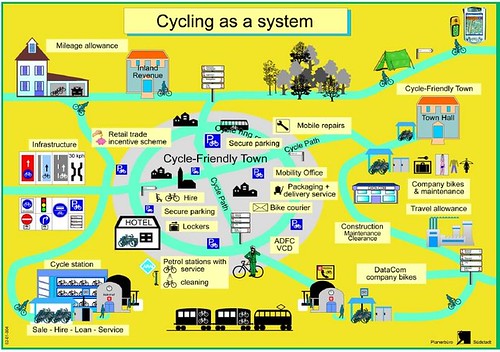
Bicycle Traffic as a system, diagram, German National Bicycle Plan, 2002-2012

While this isn't a complete list, these are many of the elements required for:

Making cycling irresistible in DC 2.0

Planning
★  Adopt the sustainable mobility platform concept to shape transportation planning
★  link programming to bike planning so that more people routinely adopt bicycling for transportation as their primary mobility choice (see the presentation "Best practice bicycle planning for suburban settings using the action planning method")
★  divide the city up into "transportation management districts" and creating systematic sustainable mobility plans within the planning, management, and operations process, which is the same way of saying
★  create bike infrastructure and facilities plans at the neighborhood and district scales (the current DDOT "Livability Plan" process is too idiosyncratic and unsystematic as it relates to this)
★  updating bike parking regulations so that parking amounts are based on likely use rather than the square footage of a building or use (see "Are developers missing the point on eliminating parking minimums?: it's to promote sustainable transportation modes" and "Best (or at least better) practices in bike parking and bicycle facilities implementation")
★  adoption of the guidelines for lane width from the FHWA Shared-Use Path Level of Service Calculator rather than outdated AASHTO guidance (this is especially true for the National Park Service)
★  getting the bi-ennial American Trails national conference to meet in DC as a way to push bicycle facilities improvements efforts across DC and the metropolitan area
★  the informal Capital Trails Coalition of area governments, bike groups, and the NPS should be formalized as a standing committee of the MWCOG Transportation Policy Board
★  define a metropolitan bikeways network, develop it, and promote it
★  include a maintenance element in the Bicycle Master Plan (Minneapolis is a model) that reflects seasonality (e.g., special maintenance for winter, although DC does clear snow from most shared use paths, better than surrounding jurisdictions)

Support Facilities and Infrastructure
★  more innovative parking treatments for dense neighborhoods such as Columbia Heights, at Metrorail stations, parks,special events venues, etc.
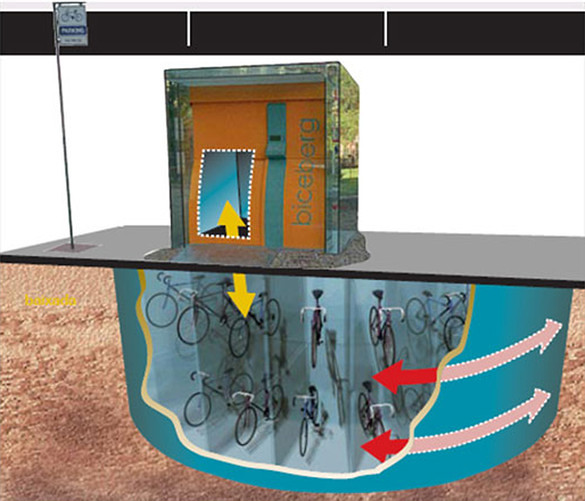
Biceberg underground bicycle parking
Biceberg underground bicycle parking has a capacity for up to 92 bicycles

★  creation of a network of secure bicycle parking, comparable to the Australian Parkiteer program in Melbourne/Victoria State--a system of more than 90 secure bike parking facilities open to members, regardless of location
★  installation of bike repair stands and high quality public air pumps at transit stations
★  installing only high quality air pumps instead of ones that break down frequently (change building regulations to specify certain types of air pumps for certain locations, based on likely use weighted to the location)
★  posting area and city-wide bike maps at Metrorail stations and transit centers (although bike share station maps provide some of this information at the sub-neighborhood and sub-district scale)
★  DC Government facilities should not be allowed to install sub-standard bike parking and current sub-standard bike parking should be replaced
★  better wayfinding signage generally, definitely improved signage for the 14th Street Bridge crossing between DC and Virginia
★  necessary additions to standard bike route wayfinding signage include bike shops, and the location of air pumps and repair stands
★ misters?
★  Rebuild the Suitland Trail, finish the MBT, install a cycle track across Rock Creek Park on Military Road NW, finish the sidewalk on the park side of Fort Totten Drive NE, creating a virtual cycle track, etc.
★  Create trailheads and "rules" signage systems for the trails, install high quality branded signage for trails
★  More and better amenities for trails
★  Improve bike and pedestrian access to parks in a systematic fashion ("A gap in planning across agencies: Prioritizing park access for pedestrians, bicyclists and transit users compared to motor vehicle access")
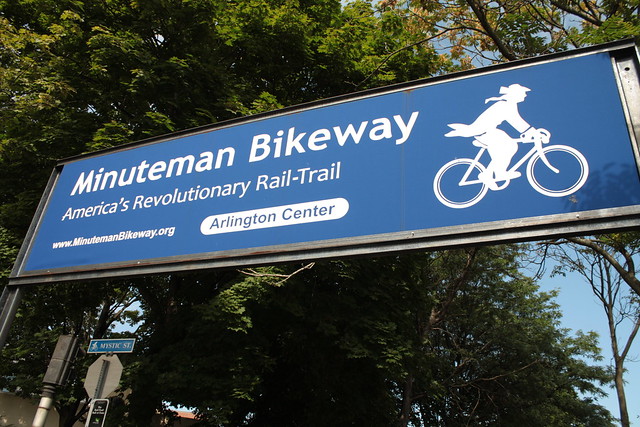
Minuteman Bikeway 010
Minuteman Bikeway signage, Greater Boston
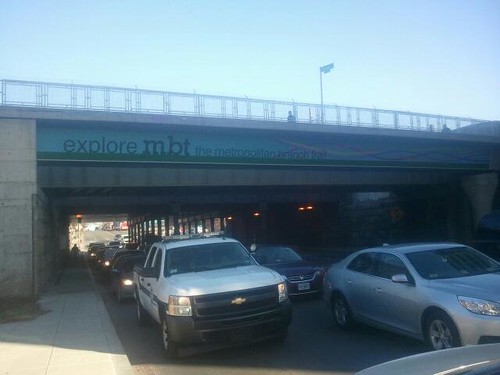

Metropolitan Branch Trail painted billboard on the bridge over Florida Avenue NE, looking eastbound
I just noticed that there is an MBT "billboard" painted on the bridge over Florida Avenue NE, although I would argue the signage is a bit too arty and should have graphics of bicyclists and pedestrians within the design to make it very clear.

★  When parking meters are removed either outfit the pole so it can be used for bike parking or add formal bike parking to the block
★  installation of bike counters
★  better bike gutters (most of them now are sub-standard)
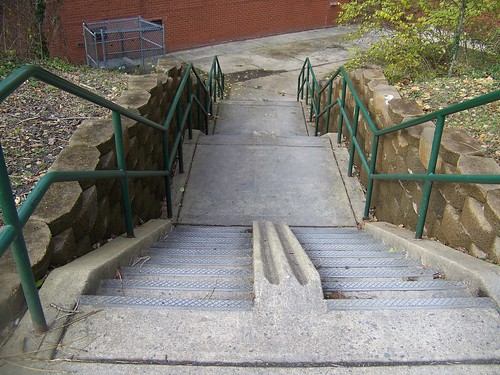
Bike gutter/trough, Capital Crescent Trail, Bethesda
The best bike gutters for this area are on the Capital Crescent Trail in Bethesda.
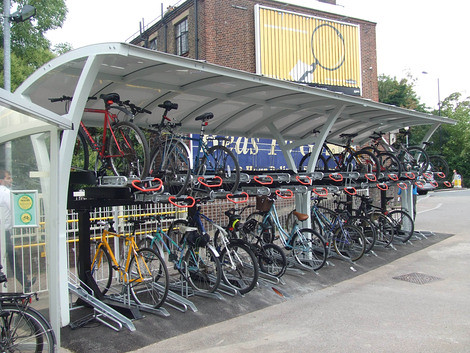
Double deck bicycle parking at Sutton Station, Southern Railway, UK
Double deck bicycle parking at Sutton Station, Southern Railway, UK.

Programming/Promotion
★  integrating programming, bike co-ops etc. into city recreation and community centers and schools
★  payroll deductions/loan programs to buy bikes for transportation (this is done in the UK, maybe a city like DC could help to pilot what should be a national program)
★  programs to get bikes to kids regardless of household income
★  programs facilitating bike take up by low income segment (e.g., "Creating a Commuter" program of the Community Cycling Center of Portland; Major Taylor Bike Clubs, etc. -- see "Eight "mutual assistance programs" that can build support for biking as transportation on the part of low income communities," 2015)
★  special programs to promote bike usage at public housing (and universities)
★  more programs to facilitate bike delivery, cargo bike usage, etc.
★  annual biking for transportation expo for DC (use the UTA Bike Bonanza program as one model) to promote bike use and
★  annual metropolitan sustainable mobility programming conference (use the Texas Trails Summit as an example)
★  Why doesn't DC have an amazing "Open Streets" program? (CicLAvia in Los Angeles is held in the spring and the fall and more than 100,000 people typically come out; blog entry)
★  Bike to Work Day is part of Bike Month, Bike Month needs a wider range of activities (blog entry)
★  create and distribute a metropolitan bikeways map

★  Better Leverage "National Trails Day" "National Public Lands Day," and the new "Bike Your Park Day" (the same day as NPLD) to promote biking, and trails use, maintenance, and expansion specifically

Enforcement/Safety/Maintenance
★  legalization of the Idaho Stop ("Failure to pass the Idaho Stop as an indicator of lack of commitment to DC's Sustainability Plan by DC's elected officials)")
★  requiring multiunit residential to improve bike parking security, triggered when a bike is reported stolen (most of the news coverage I've seen of this issue generally indicates very insecure and substandard bike parking, with big holes in security)
★  neighborhood bikeway streets should have a 20mph speed limit (Tucson does this)
★ develop a better program for maintenance of bike lanes, especially cycle tracks including clearance of debris

Other
★  should a Velodrome be created as part of the program for re-articulating the recreation and facilities program at the RFK Campus?
★  urban bike tourism promotion as part of the city's tourism promotion efforts

What about bike sharing?  The DC bike sharing system is considered one of the most successful in the US, although it hasn't experienced significant membership growth and the reason it operates profitably is because tourists rack up serious bank in additional use charges.

I am two minds about it. It promotes biking and is very visible.

At the same time, I have to believe that the same amount of money spent on bike share would have significantly more benefit if spent on the items identified above ("On your bike: the best and the worst of city cycle schemes," Guardian; and "How much does each bike share ride cost a system? Let’s do the math," Better Bike Share Partnership).

When evaluating the success of bike share, typically bike share is compared to transit in terms of costing on a per trip basis (e.g., "Do bike share systems actually work?," Outside).

While that is an important comparison, it's not the right comparison.

First, transit is a mass phenomenon while biking is a form of personal mobility.  Yes, formal bike share programs make biking an element of sustainable mobility product service systems, but it still moves people one at a time, even if that can be a lot simultaneously--1,000 bikes equals the capacity of about 20 buses, but the buses "rebalance" naturally while "operator intervention" is often needed for the bikes.

Second, money spent on bike share should be compared to the potential benefit of money spent in other ways to facilitate and encourage bicycling for transportation.  See "Bike share and sustainable bike share systems: sometimes other programs can have more effect for less cost" and "The problem when you define every outcome as a succoess, you don't learn, and therefore failure is more likely: bike share in Seattle and Los Angeles as examples."
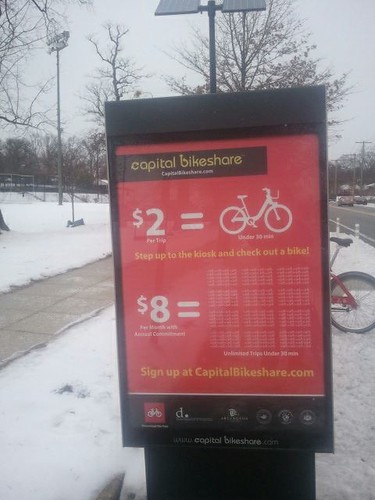
Bicycle sharing station on 3rd Street NW, adjacent to the Takoma Recreation Center, DC
Now the DC area bike sharing system will allow people to pay $2 for a single ride--which is about the same as the cost of a bus ride.

In most US cities, the bikes aren't getting used enough to justify the amount of public spending on the program ("Public bike sharing: analyzing the usage data in the US," Priceonomics). Although some programs are privately funded so there it isn't a matter of judicious use of public funding.

By contrast, European cities have bike share bike daily use rates 2x to 5x higher than those in DC ("Bike share boom: 7 cities doing it right," CNN). For example each bike in the Lyon (France) system makes more than 5 round trips per day, while in the DC system a bike share bike makes about one round trip per day.

One program that I think cities should be adopting is what the British call "Cycle to Loan Schemes," a program that is either free or very low cost where people can borrow a bike, helmet, and lock for a few weeks to try it out, instead of paying upwards of $600 on a bike, helmet, lock, and lights before even starting to try biking.

The London Cyclist Campaign is a lead organizer of such programs, Urban Cycle Loan, which were written about in CityLab, "How Cycling Is Becoming More Equitable in London."

Note with bike share, for years I've recommended active marketing programs.  Some of the systems in the US are starting to do this.  The system in London is probably the best.

Making bike lighting standard equipment when purchasing a bike.  Another change that is very important, but requires federal legislation, would make biking at night safer by (1) making bike lights for the front and rear of a bike required standard equipment on certain types of bikes most likely to be used for transportation (e.g., hybrid bikes yes, racing bikes no).  (2) creation of a bike turn signal as part of the rear light--although this should be visible during the day as well.

Enforcement.  Bicyclists argue that there needs to be more enforcement of errant driving by motorists.  Motorists resent speed cameras, red light cameras, parking tickets, and other what they consider "infringements"on their "right" to drive.

Fortunately, because of Pierre L'Enfant's grid of streets and blocks being human-scaled, for the most part, DC has fewer bicyclist deaths than most cities.  But there are still deaths and accidents (the right hook especially) and from time to time bicyclists kill pedestrians too, even recently ("Pedestrian struck by cyclist in Downtown DC dies," Washcycle).

Rather than see regular speeding and other infractions as deliberately breaking the law, motorists prefer to focus on what they perceive as "all those damn cyclists running red lights and stop signs." That's why moving legalization of the Idaho Stop beyond the State of Idaho and Paris is very difficult.

I would prefer passing a package of changes, including stricter requirements on motor vehicle operators to drive safely, e.g., in the Netherlands, drivers are presumed to be at fault in any accident involving pedestrians or cyclists, which ends up making them much more careful and responsible, the Idaho Stop, and other measures.

By contrast, the US system of laws and insurance relating to "accidents" mostly forgives negligence except in extreme examples that are judged to be willful.

Labels: , , , , , ,

Monday, January 16, 2017

Seattle to not continue forward with bike share

The city had already decided to junk its current system, called Pronto ("Seattle's launch of bike share and four interesting elements"), but they were planning to replace it with a system comparable to that just launched in Baltimore by Bewegen.  Instead they will be reprogramming the money to other bicycle and pedestrian projects ("Seattle’s Mayor Murray kills city-run bike-share program," Seattle Times).

This event is a good illustration of my point that "The problem when you define every outcome as a success, you don't learn, and therefore failure is more likely: bike share in Seattle and Los Angeles as examples" (also see ""Bike share and sustainable bike share systems: sometimes other programs can have more effect for less cost").

In reading some of the stories about the declining state of the NHS in the UK, they refer to the practice of "always being positive as "manifestation" ("Ministers can't silence NHS concerns because people can see it unravelling," Guardian).

From the article:
Believe hard enough, and you can get what you want. Or at any rate that’s the theory behind the fashionable cult of manifestation, as championed by Oprah; focus on your heart’s desire, tell yourself you’re going to get it, and it’s amazing what positive thinking can achieve. Only now this form of secular prayer seems to be catching on in Downing Street too.

This week Simon Stevens, head of NHS England, became the latest civil servant accused of failing to believe. He is said to be regarded by some within No 10 as “unenthusiastic”, insufficiently on board perhaps with thrilling efforts to solve the NHS crisis by claiming there isn’t one. Think positive, man! Best foot forward! Like Ivan Rogers, the departing ambassador to the EU said to be too gloomy about Brexit, apparently Stevens just needs to jolly well buck his ideas up.
Manifestation is not in my nature.

Labels: , , , , , ,

Monday, December 05, 2016

Bike share and sustainable bike share systems: sometimes other programs can have more effect for less cost

Georgia’s Own Credit Union has become the first presenting sponsor of the city of Atlanta’s bike share program, Relay. Photo: City of Atlanta.

There was an article ("Atlanta partners with Georgia's Own to expand bike share program," Atlanta Journal-Constitution) about the Atlanta bike share system expanding slightly in response to their lining up a sponsor, the Georgia's Own Credit Union, which was communicated on Twitter.

My counter was having the bikes used somewhat less than once/day is nothing to write home about.

(See the past blog entry "The problem when you define every outcome as a succoess, you don't learn, and therefore failure is more likely: bike share in Seattle and Los Angeles as examples," as well as this article from the Seattle Times, "‘It’s not lipstick on a pig’: City shows off new electric bikes," about how they are replacing their "failed" bike share system with a much more expensive but bigger e-bike based system.)

The response back was well, at least they're adding bikes, while systems in Columbus and Cleveland don't have any money to add bikes at all.

I think people are asking the wrong question.  The question isn't "how can we launch a bike share system?" or "where can we get more money to expand?"

The right question is "what is the best way to get more people regularly riding a bicycle for transportation?"  For a lot of communities, "traditional bike share" isn't the right answer -- although it's hard to fight the belief in bike share because people see bike share in another community and want to port it to their community.

I think there are (at least) four answers to the question "what is the best way to get more people regularly riding a bicycle for transportation?" and it costs a lot less money than traditional bike share:

1.  Have a program that is either free or very low cost where people can borrow a bike, helmet, and lock for a few weeks to try it out, like the various programs in the UK, called "Cycle to Loan schemes" such as in Hounslow borough in London.  The London Cyclist Campaign is a lead organizer of such programs, Urban Cycle Loan, which were written about in CityLab, "How Cycling Is Becoming More Equitable in London."

This way people don't have to spend hundreds of dollars to try out biking without being sure they will stick with it.

2.  Have a program that loans people money to buy bikes.  At first I thought only the Virginia Credit Union did this, which they launched in association with Richmond's hosting the UCI World Championship bicycle race in 2015, but it turns out that if you do a Google search, you find many other credit unions have similar programs.  (Note that in the UK, they have a payroll deduction program that funds bike purchases also.  And it doesn't seem that the Georgia's Own Credit Union has such a program.)

This reduces barriers to entry in terms of the potentially high cost to purchase a bike.  This type of program is best paired with a "Cycle to Loan" program so that people can move seamlessly from one to the other.

3.  Separately, institutions -- office buildings ("Property Funds See the Value in Being Green," New York Times), large employers, hotels ("The Colony hotels' bicycle rental service is part of growing trend," Dallas Morning News, and college campuses ("In Dayton, Giving Out Free Bikes To Keep Cars Off campus," Forbes") -- can make bikes available in simple programs that don't require a lot of technology and therefore are much cheaper to offer.

4.  Have a program that targets under-represented populations, like the Community Cycling Center of Portland's "Create a Commuter" program, which teaches people about biking, and provides them with the "kit"--bike and gear, lights for night and early morning riding, etc.--so that they can take up biking.

This helps broaden access to biking for people who could not otherwise afford to do so. In Portland they started this with funds from the Federal program, Job Access and Reverse Commute Program.

I think for the cities that don't possess the right characteristics for success in bike share--a functioning core with a lot of population, lower car ownership, and short distances between activity centers, residential areas, and employment centers, undergirded by a robust transit system--it's a lot better to focus on and invest in different kinds of access to bike programs that have greater return--measured by use--on much less investment.

SDOT’s Andrew Glass Hastings demonstrates electric bike that possibly could be part of a new Pronto rollout, Tuesday, Nov. 1, 2016, in Seattle.  ST photo.

Seattle moving to an e-bike based system.  With Seattle it's hard to say. The original system "failed" because they didn't have enough stations and bikes covering a large enough area.

The new system will be larger with a lot more bikes, but it will be e-bike based. It may be more successful because it will cover a bigger area, but e-bikes are even more expensive to buy and maintain within a bike share program than traditional bikes.  (Unsaid is the likelihood that the provider is motivated to fund the system as a way to demonstrate the technology, and it might not make sense to do otherwise.)

Similarly, Baltimore is using the same bike technology (Bewegen) and again, the increased cost to operate such a system decreases the likelihood of success rather than increases it.

In Seattle, the new bikes will be able to be checked out with transit fare cards (there, the Orca card) which is definitely a step forward (Divvy in Chicago and STM/Bixi in Montreal are working to integrate similar technologies into their transit-bike share systems too).

Labels: , , , , , ,

Friday, February 05, 2016

The problem when you define every outcome as a success, you don't learn, and therefore failure is more likely: bike share in Seattle and Los Angeles as examples

A few years ago at a private conference on bike sharing associated with the League of American Bicyclists annual meeting, I got frustrated by the presentation by the main presenters because they defined every example, even a two station bike sharing program in one of the Carolinas that had a handful of users per week, as a great success, making the point that the definition of success can be very dynamic.

I countered: when you define everything as a success, you don't ever learn, you don't figure out what works well and what doesn't.  (While they weren't happy with that statement, a person from LA MTA commented I had good insights...)

When planning for Seattle's bike share (user pictured at left) was going on, they used DC as an example of why they would be successful, but were not clear at all about the fact that 97% of revenue that makes DC's system break even on an operating basis is generated by tourists who either don't care or haven't figured out how to use the system without racking up additional fees.

Not to mention that compared to other major bike sharing systems, the membership for the Capital Bikeshare program grows at a much slower rate.

Besides the fact that Seattle has nowhere near the same level of tourism, Seattle has a mandatory bike helmet law, which makes itinerant bike use much less convenient (bike helmet use requirements in Melbourne are believed to be a major reason why that system isn't successful, "Spoke too soon: Melbourne Bike Share to drag chain another year" and "Bike Share Scheme Melbourne Usage Statistics | Helmet Law." Melbourne Age).

For these and other reasons the system is on the verge of financial failure ("Seattle's Pronto bike-share nonprofit teetering, seeks $1.4M rescue by city" and "Bike share's failure deflates Seattle's self-image," Seattle Times) and the city is going to take it over. From the second article:
The news that Seattle’s bike share program is insolvent only a year after opening is, symbolically anyway, a wound to Seattle’s green psyche.

It could be due to mismanagement. Or a lame rollout. These were some of the reasons offered for how a bicycling program could falter so badly in a place that fancies itself as Bike City, USA. ... there’s a more vexing problem: Nobody’s riding the bikes.

In its first year, people took 142,832 rides on Pronto bikes. That’s only 391 rides per day. It’s about seven rides taken at each station per day. Each station brought in only an average $30 a day in revenue.
A couple of other articles on bike share such as "How NYC's bike share saved itself," Fast Company, get into more detail about the extent to which programs must go in order to operate better.

Were advocates, planners under the gun from their political masters, and consultants from bike planning firms not so focused on defining everything as successful, likely there would be more real success.

FWIW, I don't think many cities in North America are capable of being successful with bike share, if success as defined as lots of users, high daily usage, greater take up of bicycling for transportation, low subsidies, etc.

Bike share in DC.  Wikipedia photo.

That being said, it might be worth supporting bike share applications in more limited circumstances, and not necessarily for transportation, such as for recreation and health reasons.

Many bike advocates counter that most forms of mobility "are subsidized" so why shouldn't bike share be subsidized, just like roads, driving, and transit?

But that begs the question that should be asked, but isn't:
what is the best way to promote greater adoption of bicycling for transportation, at what cost, and is bike share the best choice (by doing a cost-benefit analysis) and program on which to spend scarce resources?
Spain's Biceberg is an underground bike parking system that can store 23, 46, 69, or 92 bikes, accessed through an above-ground kiosk.  I think these should be installed in apartment-dominated neighborhoods in the core of DC, such as Columbia Heights or Dupont Circle, at transit stations, parks, and other public facilities to increase the availability of secure bicycle parking.

Giving people bikes, building bike parking including high capacity parking in neighborhoods dominated by multiunit housing without the capacity for on-site bike parking, requiring multiunit residential buildings and office buildings to provide high quality bike parking, creating wide ranging transportation demand management programs sponsoring biking, providing loan/payroll deduction systems for bike purchases (Bicycle Loan Program | VACU - Virginia Credit UnionTax free bikes for work through the Government's Green Transport Plan, UK) are probably ways that would reap more cost effective results.

Unlocked Capital Bikeshare bikes, 3rd and Pennsylvania Avenue SEUnlocked Capital Bikeshare bikes, 3rd and Pennsylvania Avenue SE.

But as along as elected officials cycle through Washington DC or NYC and see bike share in operation, they are going to demand that their city deploy a bike sharing system of their own, without recognizing or acknowledging that highly visible cool bikes don't in and of themselves make a successful program.

Los Angeles. It happens that after I started writing this piece, I did come across an op-ed ("L.A.'s bike-share program is being set up to fail") in the Los Angeles Times that makes some of these same points, although the piece has a serious error (attributing the better financial results of some programs solely to the sales of advertising or sponsorships).

The article makes three major points:

1.  While bike share is touted as helping to reduce car use, most users shift from public transit;

2.  The new bike share system sponsored by the transit agency will be incompatible with the other systems being deployed in cities like Long Beach and Santa Monica

3.  Since the system is most likely to be used by transit users, and most transit users in LA County are low income, the price to use bike share is too high to be used by low income users.

Creating a critical mass of infrastructure that supports sustainable mobility.  Note that the author argues that Downtown LA is the place where bike share is most likely to be successful, but states that this area is already served by a dense network of transit, making bike share unnecessary, that when most transit users are making longer trips, they aren't likely to end up using bike share.

I would argue that bike share shouldn't be touted as a way to reduce car usage as much as it can be one of the elements in creating a critical mass of sustainable transportation infrastructure that supports a car-light or car-free lifestyle more generally. 

Mobility shed diagramMobility shed diagram:  think of the rings as representing different mobility modes (shuttle, bus, subway, biking, walking, etc.), and varying in width based on the amount of distance that can be covered in five minute increments.  

The mobility shed.  In order for this scenario to work, there need to be tight links between transportation and land use planning, a great deal of density, and short distances between residential areas and primary destinations--activity centers such as major centers of employment like DC's Downtown, community business districts and supermarkets, entertainment destinations (stadiums, arenas, auditoriums, parks), etc.

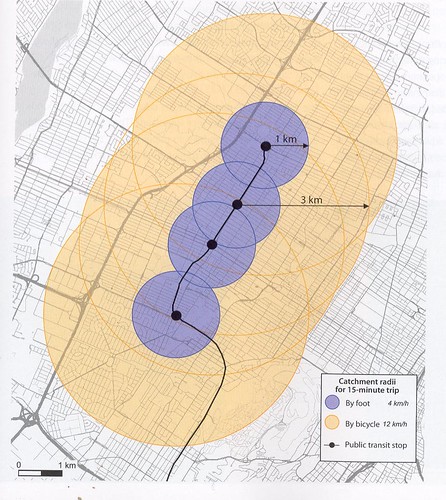
Catchment area of public transit stops for pedestrians and cyclistsBike and walk sheds from transit stations.  From Planning and Design for Pedestrians and Cyclists: A Technical Guide, produced and published by VeloQuebec.

Given that a bike ride of three miles takes about 15 minutes, this presupposes a fair amount of density within a three-mile radius.

Cities such as NYC, the core of Washington, the core of Chicago, San Francisco, etc. qualify, while most others do not.  Salt Lake City might be an exception for supporting a working system because the block size there is so big--an average city block in SLC is four to five times larger than blocks in other cities.

Cities like San Francisco with severe topography present a special case also.

Why bike sharing systems fail.  Not having this set of land use and transportation conditions is why bike sharing deployments in cities like Palo Alto failed, even though it was part of a regional bike sharing program, anchored by San Francisco, and why cities like Chattanooga ("2 years later, Chattanooga bike-share program is struggling," Chattanooga Times-Free Press), San Antonio ("San Antonio Bike-Share Threatens to Close Without Major Sponsor, Next City), and San Diego ("San Diego bike-share program hits snags over modest use," Los Angeles Times), and Toronto ("Clock is ticking for Toronto Bixi bike-share program," Toronto Star), among others haven't achieved much success with bike sharing.  (Note that in Toronto, the system is being taken over by the Toronto Parking Authority and the regional transportation agency, and some of the problems are being addressed.)

Moving towards the creation of SMDs or Sustainable Mobility Districts.  To determine where bike share can be particularly successful in Los Angeles, similar kinds of mapping exercises need to be performed, with a focus on identifying (and working to create) what we might think of as "sustainable mobility districts."

Maps at Seattle bike share stations show the respective distances that can be covered by a five minute walk or a five minute bike ride.  Image from Geekwire.

In the past, I've called this the mobility shed ("Updating the mobilityshed / mobility shed concept") and the maps for Seattle's bike sharing system are the first to illustrate the difference between "walk shed" and "bike shed" on posted maps.

In this scenario, bike share is complemented by walking, bicycling on owned-bikes, public transit (shuttle, bus, maybe streetcar, maybe light rail, heavy rail, railroad), one-way and two-way car share, taxi services, car rentals, even rollerblading and skateboarding, and electric bikes, mopeds, etc.

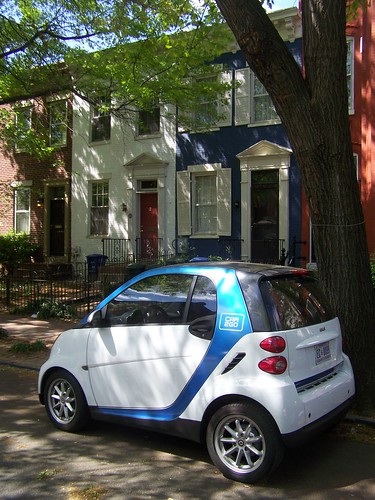
Car2Go on Capitol Hill
Car sharing is an element of a sustainable mobility infrastructure platform.  Right: a Car2Go one-way car sharing vehicle in Washington, DC.  

Members of car sharing systems like Car2Go and Zipcar can use sister programs in other cities across the US and Canada (for both systems) and Europe (for Zipcar).

The thing about bikes vs. bike share is that in most places the density of stations isn't likely to be great enough to be convenient for most trips, given that the normal advantage biking presents is the ability to perform your trip with complete efficiency, by being able to leave immediately from your origin point on bike and to arrive within a few feet of your final destination.  That's why an owned bike typically makes more sense for people who travel primarily by bike.

However, offloading storage and security issues--especially in cities like New York--can make bike share a worthwhile alternative for many.

Lack of one regional system.  It's hard to disagree with this kind of criticism.  I agree that one common system is the best way to go at the metropolitan scale, but because it can take such a long time to launch, some communities get frustrated and go off on their own.

From the standpoint of mobility as a platform, it is counter-productive because it requires users to join or pay to use multiple systems.  For similar reasons, it's why most metropolitan areas have combined transit fare media systems for local transit (although typically these systems do not include railroad services).

Launch of Citibikes in Jersey City.  Jersey Journal photo.

This comes up in Hudson County, New Jersey, on the west bank of the Hudson River across from Manhattan, where Jersey City has decided to join into the Citibikes system ("Fulop: Citi Bike Jersey City launch 'one of the most exciting things," Jersey Journalr), figuring that most of their residents and/or employers are tied into NYC in terms of their work and living choices, so therefore their transit shed is anchored by and within New York City.

But neighboring cities like Hoboken are going with their own system ("Hoboken launches bike share program" Jersey Journal ) which won't be tied into the same system in NYC, but is much cheaper to launch and operate.

Launch of Next Ride in Hoboken.  Jersey Journal photo.

That being said the Hudson Bike Share program has some interesting innovations in signage, outreach, communications, and in their creation of "no fee regional zones" where bikes can be retuned in locations outside of Hoboken.

I am not sure if some of these locations are in NYC, where the operator is based, with various bike rental locations in Manhattan. But this is interesting in how it allows cross-trips between certain locations outside of the normal "home zone" of the system.

The idea of the "no free regional zones" can be a way to deal with areas that don't participate (this is an issue with some boroughs in Montreal) or where there are a variety of different systems.

It's also an issue in Maryland, vis-v-vis suburban counties (Montgomery is part of the Capital Bikeshare system, while communities in and Prince George's County has considered developing a separate program) and Baltimore and Annapolis, which have some cross-trips with the DC metropolitan area.

It's also why the attempt by the US House of Representatives to create their own bike sharing system failed, when they should have just joined the DC bike sharing system.  Sadly the failure of that closed system is used by Republican Congressmembers as a reason to denigrate bike sharing more generally.

Another issue concerning how "metropolitan" scale bike share systems are operated.   One problem with bike sharing systems that isn't understood by users has to do with the fact that unless the system is run by a transit agency or only operates within a single jurisdiction, despite being branded as a single, metropolitan-scale system, it's actually organized on a jurisdiction specific basis. In reality it's a collection of separate programs unified under a single brand.

 For example, in the DC area, the Montgomery County participation is financed separately from DC, as are the programs in Alexandria and Arlington County in Virginia).  What this means is that revenues are collected by jurisdiction and not shared across jurisdictions, so there isn't the opportunity for cross-subsidies between high-use and low-use areas.  This was an issue in San Francisco and is in Boston, with the Hubway system.

But not understanding this element may blindside smaller jurisdictions elsewhere, believing that the revenues generated by the "success" of the system is DC are shared with the other members of the "compact."

Bike share and equity.  The LAT op-ed makes good points about bike share and equity in the LA context. However, the author misses the point that biking can be the killer app for people without access to cars, since the average cyclist can cover a great amount of distance, say up to 5 miles in less than 30 minutes, which is much less time by comparison to the time required to travel by either bus or rail when you take into account either time waiting or the time it takes to get to a station and from a transit station to your final destination.

See these past blog entries for a discussion on bike planning and equity and increasing bike take up amongst low income populations:

-- "Equity as the sixth "E" in bike and pedestrian planning"
-- "Revisiting bicycle (and pedestrian) planning and the 6th 'E': equity and the City of Minneapolis Bicycle Master Plan"
-- "Urg: bad studies don't push the discourse or policy forward"

Frankly, saving time was the primary reason I started biking for transportation in 1990--I figured it saved me a minimum of 30 minutes each day compared to walking and/or using transit.

The problem is that transit agencies haven't been conceptualized as "transportation solution providers" as much as they are providers of bus or rail transit service.  If they were, then agencies would integrate bike share into transit service operations very tightly.  (This kind of thinking is why the German rail system has offered bike share for more than a decade.)

And to be fair, many transit agencies see the value of bike share in terms of providing a faster means to get from a transit station or stop to the intended destination, which may still be some distance away.

Boston's success with making equity a priority in bike share.  But this issue is addressable.  Boston has gone the farthest in creating programs making bike share widely accessible to low income populations, offering annual membership, including a helmet, for only $5, to people who qualify.  (I have also suggested to public housing organizations that they integrate bike share and high quality secure bike parking on site but I haven't had much headway.)

Generally, this requires the involvement of agencies other than the local transit agency.  In the case of Boston, it includes the city's transportation department and the city's the public health agency, and private funders.  The local transit agency is not involved.

The Philadelphia Experiment.  Note that the Philadelphia Inquirer has run a number of articles ("Why low-income people bike share less," Indego popular for university commuters and joyriders, mixed results for low-income outreach," "Ridership with reach," and "Indego has inroads yet to make") about the relative dearth of low income users of the Indego bike sharing system there.

Unlike say articles by the Washington Post on the streetcar project, which in my observation are more focused on painting streetcar use as moronic, the Inquirer articles explore the issue in depth.  Mostly the system hasn't done very good marketing, and unlike Boston, they didn't create a discounted membership program for low-income uses.

But despite the existence of the Better Bike Share Partnership research initiative, of which the City of Philadelphia is a member, the Indego program doesn't appear to have launched with the implementation of best practices concerning take up by low-income populations, figuring that installing stations in low income neighborhoods was enough.  DC's system has the same problem ("Who uses Capital Bikeshare?," Washington Post).

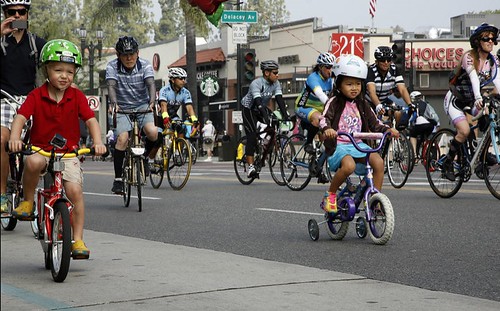
Bicyclists ride down Colorado Boulevard in Pasadena during CicLAviaThe CicLAvia "Open Streets" event in Los Angeles County is probably the most successful example of such a program in North America.  Each event brings out 100,000 to 200,000 participants.  The Los Angeles Metropolitan Transportation Authority is the primary sponsor of the event.  Photo from the LA Times.

By contrast the LAT op-ed suggests discounting transit service for trips that don't lend themselves to bike share.  I think that's misguided.

While I do believe that fares and passes should be discounted for low income riders, the money to cover that cost needs to be appropriated separately from funds allocated to transit systems for general operations and capital improvement.

Otherwise, discounting fares merely reduce the revenue for the transit system, and the fare structure for transit in LA County is among the cheapest in the US already--bus costs about the same as DC (which is the about the cheapest in the US for major transit agencies) but riding heavy or light rail is the same fare, $1.75, although transfers between modes are free only with a weekly or monthly fare pass.

Conclusion.  There are best practice analyses of bike sharing such as the Bike Sharing Planning Guide by the Institute for Transportation and Development, , and various studies by academics and other organizations (many are listed in this blog entry, "Bikeshare systems: Recent research on their growth, users’ demographics and their health and societal impacts," from Journalist Resource).

So it's not like there isn't good information out there about what works, what doesn't work, and what could work better.

Maybe the real issue is not that there isn't information, but that information is either not being accessed to begin with or it's not being used or it's rejected for non-evidence-based reasons.

Labels: , , , , , ,