Rebuilding Place in the Urban Space

"A community’s physical form, rather than its land uses, is its most intrinsic and enduring characteristic." [Katz, EPA] This blog focuses on place and placemaking and all that makes it work--historic preservation, urban design, transportation, asset-based community development, arts & cultural development, commercial district revitalization, tourism & destination development, and quality of life advocacy--along with doses of civic engagement and good governance watchdogging.

Tuesday, February 06, 2024

Scooters, private equity, micromobility and transit

 (g.d.  Blogger keeps destroying the post, although I think it's the connection.)

Micromobility is the fancy term now in transit, looking at how bikes, bike share, electric bikes, scooters and even skateboards complement traditional transit, especially in terms of what is called "the first mile/last mile" problem of getting people from their point of origin to the transit station and from the transit station to their final destination.

Private equity doesn't do stuff "out of goodness" but to make a profit, and quickly--often much faster than it is possible for a developing business to do.  Lots of cool more public good type "businesses" have been destroyed by private equity seeking a quick return or to cash out.

We've already determined that in the US, because of population density, depopulation of cities, and sprawl, that transit isn't profitable.  That's why it's been taken over by the public sector, except in a few rare situations (Asian countries have high population density and transit agencies are more active in high value real estate development so their situation is different).

Isla Vista, California.

So I wasn't surprised to see some articles about the bankruptcy of Bird (Superpedestrian), the major player in the electric scooter space ("E-scooter companies are going bankrupt. That should alarm you even if you hate them," Fast Company, "Bird's bankruptcy is bad news for scooter commuters," Washington Post).  

The reason first is that transit isn't profitable, especially quickly.  

But the second is that they significantly misunderstood the market.  They thought it was transit, it was recreational.  Bird launched in Santa Monica, a tourist-beach town, and the scooter users were recreational.

-- "What the e-scooter industry hasn't figured out about Santa Monica: It's recreation not transportation," 2018

Note, ride hailing is a similar issue.  Trips cost more than transit, lead to more congestion as they replace transit trips with car trips, and were significantly subsidized by venture capital ("Farewell, Millennial Lifestyle Subsidy," New York Times).

Then there is the nuisance issue.  Many scooter users aren't respectful of the public space and abandon the vehicles at the end of their trip, on sidewalks, in intersections, etc.  From the FC article:

But those who care about the future of urban life should not indulge in scooter schadenfreude. For all the annoyance they inspire, shared e-scooters have been valuable additions to American neighborhoods, frequently replacing car trips that pose a much greater threat to street safety and clean air. Cities—whose leaders have contributed to e-scooters’ current predicament—would be worse without them.

Regardless, I think the premise is wrong.  At least in the US, scooter trips don't replace car trips, but transit trips, and they are a lot more expensive than a transit trip.  (This was true of initial research on bike share too, but there are advantages to reducing train congestion and getting closer to your final destination.)

It wasn't the kind of business that could scale up. Especially to make lots of profit.  See the flameout of Chinese bike share and the fact that with a couple exceptions, bike share in the US is not capable of making money.

That doesn't mean bike share isn't valuable, just that it needs to be conceived of in terms of first mile/last mile linked trips with transit.  

In some other countries, the transit agency provides free access to bike share to start or finish a trip, out of access and equity issues.  In the US, I think only Columbia Transit in South Carolina does this.

FWIW, I have no problem with scooters and bike share being integrated into transit systems, as a way to improve customer experience.

-- "The problem when you define every outcome as a success, you don't learn, and therefore failure is more likely: bike share in Seattle and Los Angeles as examples," 2016

But it's good at some things, not others. It's personal transit, not mass transit.  And it works best in areas with a lot of stations.  In terms of off loading parking, security, and maintenance, it's awesome.

Labels: , , , , , ,

Wednesday, March 18, 2020

A bad bump for the sharing economy

wework, the coworking firm already on the ropes because of poor financial controls and overexpansion, may be seriously hurt by coronovirus since people won't want to be in places in close proximity to others ("Coronavirus may kill wework," Forbes Magazine).

The Wall Street Journal opinion piece "Coronavirus Will Permanently Change How We Work" suggests that the virus will increase significantly teleworking. I tend to disagree because the whole point of agglomeration economies is exchange and connectedness.

In a connected world public health surveillance and response systems need to be robust.  While the virus is bad, it is a 100-year (or more) event, and sadly, one that could have been contained if (1) the Chinese didn't have wet markets; (2) the Chinese were direct and honest about the emergence of the virus; and (3) the failure to have an ongoing and sound surveillance and proactive reaction system in place such as that employed in Taiwan ("Response to COVID-19 in Taiwan: Big Data Analytics, New Technology, and Proactive Testing," Journal of the American Medical Association), Hong Kong, Singapore, and South Korea.

South Korea, where the virus was more prevalent earlier, has fewer deaths from it than does the US, where the prevalence of the virus came later ("What the U.S. Needs to do Today to Follow South Korea's Model for Fighting Coronavirus," Time Magazine).


Jimmy Williamson rides an empty BART train from the East Bay to San Francisco on March 10, 2020. (Beth LaBerge/KQED)


Micromobility services shutting down in high risk areas.  Separately, e-scooter/bicycle sharing operations have announced a pullback ("Lime is yanking its electric scooters from California and Washington due to coronavirus," The Verge), which to me makes little sense because these devices allow people to make trips instead of on (theoretically) tightly packed transit vehicles--although transit systems are experiences catastrophic declines in service based on the statements that you need to be within 6 feet of someone with the coronavirus for 15 minutes to get infected--sounds like the minimum amount of time for a transit trip...

More biking.  With coronavirus, more people are biking in NYC ("A Surge in Biking to Avoid Crowded Trains in N.Y.C.," New York Times).

More driving?  But probably there will be more driving, except in the most congested places.  Although because people are self isolating/sheltering in place, fewer people are driving also.

Labels: , , , ,

Thursday, September 27, 2018

World Tourism Day, Thursday September 27th: Airbnb/Short term rentals, "overtourism" and impact on housing supply

-- World Tourism Day website

Given that this year's theme for WTD is "Tourism and the Digital Transformation," it makes sense to address the impact of digital/e-commerce enabling technologies on fractional rentals, to wit, home stay digital platforms like Home Away, Airbnb, and VRBO, which enable people to stay in non-traditional properties--homes and apartments--while traveling.

The thing is that in general I think "sharing services" like Airbnb are fine. Especially because they allow people to stay in real neighborhoods, and experience stays more like how a resident would, rather than a more homogeneous experience within a hotel.

But I wonder if I am not totally objective as a user of such services myself.  E.g., the place I stayed in in Hackney Wick, across from a London Overground station, was awesome.  Same with a basement apartment in the Capitol Hill neighborhood of Seattle.  Etc.

Who rents properties, individuals?  Airbnb, the market leader, was originally created by some apartment dwellers who wanted to rent out space in their apartment to help pay the rent.

Or firms?  But over time, it and similar services have become marketing platforms that in terms of properties with the most frequent use are dominated by professional firms rather than individuals, and are "whole unit" use rather than fractional.

-- The State of Airbnb Hosting: An in-depth analysis of Airbnb and the home sharing industry, LearnAirbnb.com

Hotel opposition over profits, employment.  Plus, hotel workers unions and hotel firms are vociferous opponents, figuring it cuts down on hotel stays and thereby profits and employment ("Airbnb fight is about hotel profits, not workers," Albany Times Union).

My sense is that this impact is minimal, because the type of people using this form of travel are not likely to be a major proportion of the people who normally rent hotel rooms.  The same goes for patrons of bed and breakfast establishments, etc.

Is non-traditional home stay a driver of Overtourism?  Answer: generally no.
 NotionsCapital shares an article with us from the Guardian, "Airbnb and the so-called sharing economy is hollowing out our cities."

Relatedly, there was a piece in the New York Times about "Overtourism" attributing this in part to airbnb.  Earlier they ran a story about how Palma on Spain's island of Majorca has banned airbnb ("To Contain Tourism, One Spanish City Strikes a Ban, on Airbnb)

 Still, I don't think these services are is what is making places like Venice or Barcelona "overtouristed." It's not like the thousands of people who go into those cities from cruise ships are then using Airbnb.

But sometimes the answer is yes because small reductions in housing supply make a big difference in strong markets.  But I think what we've learned from the housing market is that even small and "marginal" changes in supply and demand make a big difference in price and availability, particularly in high demand real estate markets.

These graphics showing the NYC neighborhoods with the highest number of Airbnb rentals and the percentage of the local housing supply dedicated to short term rentals were produced by a student at Pratt Institute.
Neighborhoods with highest number of Airbnb rental properties in NYC

Percentage of local housing supply dedicated to short term rentals

The Airbnb I stayed in, Hackney Wick, London
I can't remember the exact price of my stay in Hackney Wick/London, but it was less than £20 per night and literally, right across the street from the train station.

Combining the impact of housing sharing systems like Airbnb removing housing from the local rental market simultaneous with increases in demand to live in the city can result in significant price appreciation for rental properties.

Therefore, it's reasonable to regulate such short term housing travel arrangements, in high demand markets like  Barcelona ("How Barcelona Is Limiting Airbnb Rentals," CityLab), New York City or San Francisco ("Airbnb's Impact on San Francisco," five-part series, San Francisco Chronicle), etc.

Although according to this graphic produced as part of the study by the NYC Budget Office, the rent appreciation attributed to the impact of the short term rental market was relatively small in most neighborhoods.
nfographic: Airbnb Heats Up Housing Market in NYC neighborhoods | Statista
Source: Statista.

However, many studies do not find a significant impact in various communities such as Denver ("Does Airbnb hurt Denver's rental market? Not much numbers suggest," Colorado Public Radio) or in Australia ("What impact does Airbnb have on Sydney and Melbourne housing markets," SGS Economics and Planning).

Recommendations

1.  Accommodating Airbnb and similar services should be considered both within a comprehensive accommodations element within an overall community's tourism development program and planning initiative and as part of a community housing master plan.

2. In hyper strong residential real estate markets like NYC and SF, depending on the neighborhood, short term rentals may need strict limits and regulation, because shifting even 5% of properties away from residential use will make a big difference in terms of rents, etc.

While I tend to hate the imposition of what I think of as often arbitrary limits through zoning and building regulation process, I would put a ceiling on the number of "whole unit" rentals that can made through sharing services. In DC that would be in places like Capitol Hill, Georgetown, Dupont Circle etc.

I could see a maximum number of 5% of total housing units being able to be let via fractional home stay services.  I would probably start with a low number like 2%, and evaluate it yearly.

3.  Still, weak market neighborhoods in otherwise strong market cities should be treated differently.  E.g. in DC there has been a lot of discussion of airbnb as a force of gentrification in lower income communities like Anacostia, when the reality is that most of the activity is west of the river.  And, increasing visitation and business for local businesses can be seen as an economic plus ("Airbnb: Stays east of the Anacostia River grew 65 percent since mid-2017," CurbedDC).

In any case, all neighborhoods should be regularly monitored as part of housing planning and limits set as needed.

4. It should be illegal to convert apartment buildings to ersatz hotels as some property owners have attempted ("D.C. sues company for allegedly treating rent-control apartments like ‘hotel rooms’," Washington Post.

5. But years ago, I thought apartment management firms should use the idea of a "bed and breakfast" service of a unit or two as a way to let people try a building out.  Why not?

Separately, generally fractional rental of an apartment is a lease violation, but some companies are considering the ramifications of allowing it ("Using Airbnb to your advantage," MultiHousing News).

6. Regardless, all such uses should require licensing and payment of local hotel taxes for each stay.

7. However, I wouldn't put a limit on people doing fractional use rentals--making a room available in their house or apartment when they still occupy it. They should still have to collect the equivalent of hotel taxes.

Labels: , , , , ,

Wednesday, September 19, 2018

Dockless Bikes/Why We Can't Have Nice Things/Ignoring Past Experience

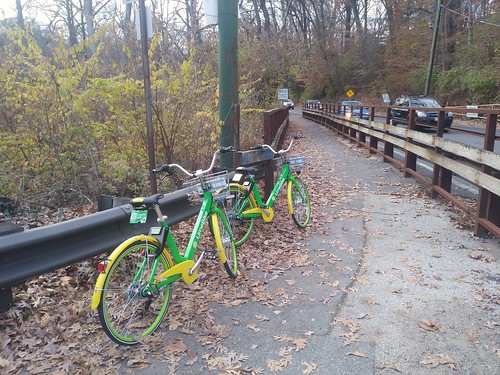
Dockless bicycle share bicycles (LimeBike) left on the Sligo Creek Trail, Montgomery County, MarylandI know I am beating a dead horse here, as it appears that most of the traditional (non-electric powered) dockless systems that were deployed in the US over the last year seem to be disappearing ("Theft and destruction of dockless bikes a growing problem," Washington Post).

-- "Bike sharing data from Seattle," June
-- "Maybe New York City just needs to invest in public secure bike parking (re: dockless bike sharing)," April
-- "I finally figured out why mobility services are buying other mobility services: they're acquiring customers already familiar with smart mobility," July

Over the weekend, my brother who lives in South Florida sent me this article, "The bike in the middle of Biscayne Bay: Why we can't have nice things in Miami," from the Miami Herald). It laments that vandalism etc. makes it impossible for dockless bike share to succeed there.

Yes, it does.  And everywhere.  Even with the very first attempt at bike share in the late 1960s in Amsterdam.  After a few weeks, the bikes were all gone, either stolen or wrecked ("How this Amsterdam inventor gave bike-sharing to the world," Guardian).

That's why the response in later iterations was both sound locking systems (second generation, Deutsche Bahn's Call-A-Bike) and later third generation systems with relatively impregnable dock-based systems in Europe with particularly hardy bikes.  (I say the "fourth generation" is dock-based systems that are solar powered.)

The dockless systems unleashed over the last year, but previously in China and elsewhere, ignored those lessons.  Cheap bikes.  Cheap locks pretty much (not for the Jump e-bikes).  No docks.  In a place like Singapore where crime is taken very seriously, people won't vandalize bikes.  That's not the case in major cities in the US or the UK ("Mobike no more: dockless bikes could soon be gone from UK streets," Guardian), or elsewhere.

I am reminded once again of a story told by Olmsted when he was creating Central Park.  He was at the garden party of a grandee, who complained to him that the landscaping and accountrements Olmsted was installing in Central Park was nicer than his own garden.  Olmsted replied that far more people would be using Central Park and it had to be built hardier in order to withstand all the use it was going to get.

Even systems with higher order checks on use, like Airbnb have had problems with vandalism by "guests" ("$5.3 million home in San Francisco wrecked after Airbnb rental," KGO-TV)  to the point where stays now come with $1 million of protection for the property owner (What is the Airbnb Host Guarantee? | Airbnb Help Center).

And it's not like car sharing systems leave the cars unlocked.  You go through a driver's license check first, each use must be authorized by the credit card before you have access to the car, there is a hardcore unlocking procedure.

I have zero "sympathy" for the failed dockless bike schemes, because they ignored past experience with "free range" bike sharing.  In places where people can vandalize, that small percentage of the population that has that propensity to violence will act it out, wrecking the system for others.

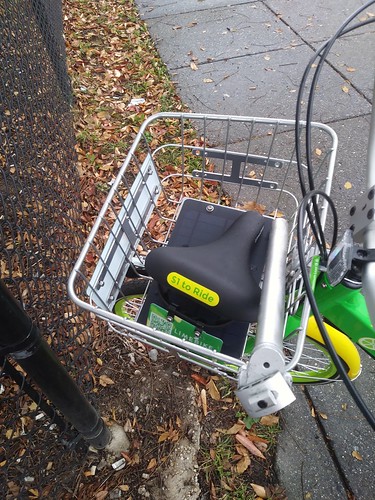
Broken seat, LimeBike dockless bicycle shareAlthough, not all of the problems with the bikes are due to vandalism.  The bikes are cheap and break easily, even when not being pushed to the edge.

=======
Separately, I've come to believe, at least in the US, that the issue about people not biking for transportation isn't access to bikes.  If access had been the issue, then you'd have seen lots of people using the dockless bikes for non-recreational purposes.  That wasn't the case.

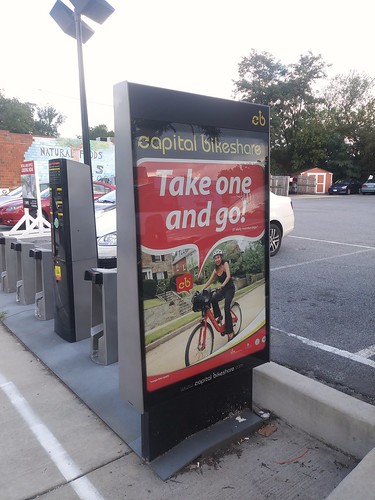
Capital Bikeshare dock station in Takoma Junction, Takoma Park, MarylandInterestingly too, the visibility of the dock stations for bike share might aid as a marketing device, but also as a branding and community building element--potentially, if that aspect is developed by the system.

I'd figure out a way to encourage "super users" to become brand ambassadors, volunteer trail ranger programs, to expand the user base.  In the case of DC, the system grows in membership from year to year but not hugely.  Other systems, like Divvy in Chicago, do a lot more marketing and community building.

Labels: , , , ,

Tuesday, March 20, 2018

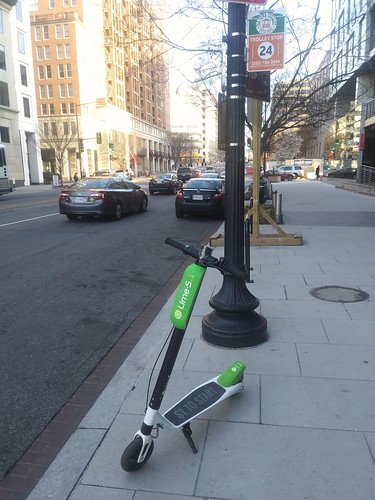
A Lime dockless electric scooter on 6th Street NW, Washington, DC

Rather than update the entry on e-scooters again, here is a photo of one ready for use in Downtown DC.  I don't think I made it very clear in the previous post that the investors in Bird ought to claw back their investments while they still can, because the firm will be outspanned by the dockless bike share companies adding e-scooters to their mix/platform.

A Lime dockless electric scooter on 6th Street NW, Washington, DC

Labels: , , , ,

Sunday, March 18, 2018

Brief update on dockless scooters (and bike sharing)

Earlier in the week I wrote about dockless scooters in Santa Monica, "Dockless scooters as an example of a lot of money sloshing around in venture capital."

Somehow I missed the roughly simultaneous news that LimeBike is adding e-scooters and electric bikes to its mix. 

It's likely doing this across their entire portfolio, although there are reports about this in Dallas ("LimeBike Plans To Add Electric Scooters And Bikes This Spring," KERA/Public Media) and DC ("First the dockless bikes, now scooters," Washington Post).

As far as e-scooters go, it means that an exclusively e-scooter operation like Bird is likely to be "lapped" by multi-mode sharing operations.

OTOH, Bird can, too, expand into bike sharing. But that requires a lot more capital than $100 million, especially as dockless bike sharing is in its "wild wild west" mode of expansion disconnected from business considerations.

I didn't write about it, but I was thinking about dockless bike share's business story as being comparable to the start of the railroad or interurban electric railway sectors, with various attempts at creating competing services, many of which either never really got off the ground, or ended up merging into other firms.

Apparently, in business schools this is called the "Consolidation Curve" (Harvard Business Review). From the article:
Everyone knows that most new industries are fragmented and consolidate as they mature. But how does that work exactly? Our long-term analysis of mergers around the globe has found that most industries progress predictably through a clear consolidation life cycle—and that companies can plot with some precision where they fall in the cycle.
Although the article's research is on larger companies and tends to occur over a much longer period of time than is likely for dockless bike sharing.

Similarly, with e-bikes, this development by LimeBike and Spin ("Bike-sharing startup Spin is getting into scooter-sharing," TechCrunch), which likely will be copied by other market participants, especially the better capitalized firms like Mobikes and Ofo, makes the e-bike exclusive dock sharing firm, Jump, similarly vulnerable to the firms with multi-pronged sharing platform.

The big question is how many users, who they are, and whether or not they switch from automobiles.  The Wall Street Journal ran a positive article about dockless bike sharing ("Bike share brings promise, and pitfalls"). 

I am still generally leery because the issue isn't access as much as it is willingness to use.  Lack of access to bikes or transit or shoes isn't why most people don't walk, bike, or use transit.  Although with the WSJ writer, he switched to the bikes instead of using ride hailing cars.

These systems tend to appeal to occasional users, rather than regular adherents to sustainable means.  Whether or not the widespread availability of dockless bikes shifts people from primarily using the automobile to sustainable modes is the key question.

And in terms of dockless systems adding functionality to the "sustainable mobility platform," it comes down to whether or not you want to use public funds to do so.  One can argue that the participation by for profit firms means public monies aren't required. 

But because there doesn't seem to be a good economic model for the business, especially with multiple firms participating in the market, it's hard to see a long term future for this element of the sector.

Switching from "all you can eat" pricing to paying by the ride raises the cost.  Note too that by switching from bike sharing membership systems to payment on a per ride basis, users of dockless systems pay 10x more, were they to ride at least twice daily, compared to membership in a traditional bike sharing system.

The Spin program has a monthly membership fee comparable to traditional bike share, but it's almost 4x the price of an annual membership in most places, and still more than double the highest priced system, Citibikes.

Paying more for electric propulsion. With e-scooters, the pricing is by the minute, plus a per use fee of $1.  By an e-scooter then, the cost for a 30 minute trip would be $7, while on a regular dockless bike the cost would be $1 and on a Jump e-bike, $2 for the same length of time.

Conclusion. It still makes more sense to own your own bike, as it's a lot cheaper and provides far more trip flexibility. However, in a place like NYC with high rates of bike theft and difficult storage conditions, alongside relatively short distances between activity centers, bike sharing can be a smart alternative.

=======
I haven't used a dockless bike.  I don't see a need, since I use an owned bike.  But I "found" a LimeBike discarded in a neighborhood alley and so I rolled it out to a location on a nearby street, by picking it up and rolling it on the front wheel.

It started chirping at me to rent the bike or it would notify the police...

Labels: , , , , ,

Tuesday, October 24, 2017

I hope Car2Go will not replace SmartCars with Mercedes vehicles in DC

====
Update: Tuesday 10/24

Car2Go did reach out to me about the post, writing:
We’d like to assure you that we are continuing to offer a mixed fleet of both smart and Mercedes-Benz car2gos in DC! Hope that puts your mind at ease.

Yea!
===========

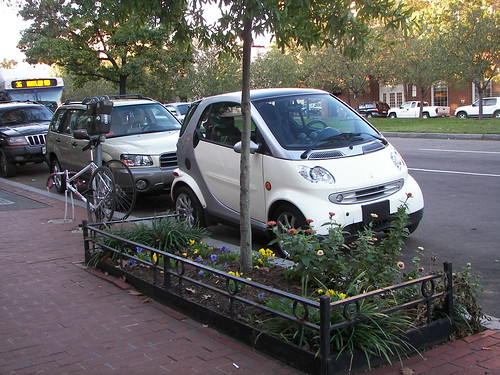
A Smart Car is smaller than a treebox.SmartCar parked on Pennsylvania Avenue SE.

As they are doing in Austin, Texas ("Car2Go booting Smart cars in favor of subtler, larger Mercedes fleet," Austin American-Statesman) and Portland, Oregon ("Car2go ditching Smart cars in Portland, switching to all Mercedes-Benz fleet," Portland Oregonian).  I put in query to car2go after the report from Austin, but they haven't replied and I haven't followed up.

In the Spring, Car2Go added Mercedes vehicles to their fleets across the country, in all likelihood to box out competition from BMW and other more upscale car sharing firms, but also to broaden the number of trips that can be accomplished by using the service by adding four-door vehicles.

The use of the Mercedes vehicles is somewhat more expensive than using the SmartCar, and significantly cheaper than using the BMW Reach Now service ("BMW plans for a future where no one buys cars," CNN), although at the present time the Reach Now service uses both Mini and more upscale vehicles.

I don't know about Austin and Portland, but I know in DC, Seattle and the borough of Brooklyn--the three largest communities of Car2Go users--because the street parking space inventory is so constrained, the small size and ease of parking the SmartCar ForTwo two-door vehicle is one of the two primary killer app/unique selling propositions" of the service, the second one being the one-way  nature of the service (versus the two-way nature of Zipcar, where you have to keep the car until you return it to the place where you picked it up).

The table below lists the length of cars in the Car2Go and BMW Reach Now car sharing fleets.  Car2 Go is active in 7 markets in the US (and 4 in Canada), Reach Now in 3.

Vehicle  Length in inches Length in feet
SmartCar ForTwo 106.18.83
Mercedes CLA 182 15.17
Mercedes GLA 174 14.5
BMW 328xi 178-181 14.83 - 15.08
BMW 330xi 182.5 15.2
BMW i3 157 13.1
Mini 2-door 151-158 12.6 - 13.16
Mini 4-door 168.3 14.025

From the PO:
They’ll be replaced with Mercedes-Benz CLA sedans and GLA compact SUVs, which were rolled out in Portland in February. Car2go, Smart and Mercedes-Benz all share a corporate parent in Daimler AG.

“What we’ve really seen is just a clear preference for these cars,” said Ken Hills, Car2go’s general manager for Portland. “They’re being chosen by our members more often, and they’re really being used for much longer trips.”
I think Car2Go may be missing a key point. It is true with SmartCars a particular type of trip tends to be accomplished, because of the car's small size (although a third person can fit in the cargo compartment in a pinch). It's true that the four-door cars capable of accommodating up to five people and more luggage are likely to be used for longer and different trips than can be accommodated by the smaller vehicle.

But Car2Go shouldn't be making an either-or decision, but an and-and decision, broadening the fleet by adding the Mercedes CLA and GLA vehicles to enable car sharing users to accomplish a greater variety of trips using the service, not unlike how Zipcar has a wide variety of vehicle types in its fleet (they are not limited to the makes of one company, unlike the Daimler Benz-owned Car2Go service) including pick up trucks and vans.

If Car2Go switched exclusively to Mercedes vehicles in the DC market, I imagine use will drop off because it will be much more difficult to park the vehicles--finding six more feet to park a vehicle can be very difficult and will add significant time to a trip just to find parking, making Car2Go more inconvenient, rather than convenient and efficient.

=======
Past entries:

-- "Car share news roundup," 2016
-- "Car share users are getting abused by the cities that ostensibly support car sharing as a form of sustainable mobility," 2016
-- "Car2Go agreement with Montreal's Trudeau Airport could be a model for other jurisdictions
," 2015
-- "Car2Go is coming to Brooklyn," 2014

My original pieces from 2005:

-- "Car sharing in DC, where I argued that it should be a priority to charge these services for their use of the public space
-- "High Cost of Free* Parking Revisited and Car Sharing in DC," where I reconsidered, better recognizing the value of these services as a method for managing parking inventory

Note that the Car2Go program has been introduced to some cities and later shut down, including in San Diego and Minneapolis. I would argue you need a fairly dense population at the core, a "Walking City" urban design ("Transportation and Urban Form," Peter Muller), and a rich network of sustainable mobility services in which services like one-way car sharing (and bike sharing) are embedded and part of a range of modes of which "car light" households partake.

Labels: , , , , ,

Wednesday, June 14, 2017

A new thought about Uber and Lyft as mobility/transportation services operating on a national footprint

One of the things that's problematic with "learning" how to ride transit is that transit is organized at the local, metropolitan, and regional scale, alongside a couple of nationally branded services (besides airlines, Amtrak, and the Greyhound and Trailways national bus lines), plus airlines.

Besides transit agencies all having different names for service, e.g., the T in Boston, the NYC Subway in NYC, the L in Chicago, Metrorail in DC (and many other places use the same name, or its variant, Metro; local and circulator and express bus services), with various names depending on how transit is organized in a particular area, most use different names, processes, transit media cards, machines, etc.
Tourists, Karlsplatz, Munich, Bavaria, Germany.
Karlsplatz, Munich, Bavaria, Germany

The Germans make it a little easier, having standard logos used across the country to denote the main types of services: Underground/Subway service; the U-Bahn; and local commuter rail, the S-Bahn; and a standard logo for bus services too.

But even Germany is a bit inconsistent in a common designation for light rail/streetcars, which in Europe are called trams either as light rail or streetcars.  Light rail services are called Stadtbahns, but there isn't a consistent logo like there is for the U- and S-Bahn services.  As shown above, in Munich they label these services as "tram."

You Besides knowing what it's called, you need to know what operates where, where bus stops and stations are located, have the right payment medium, etc.  Transit agencies may not have well integrated the ability to get information and transit cards at places like airports, etc.  (WRT airport transit information Chicago at O'Hare and Cleveland at its airport are particularly good at explaining what's up.)

WRT payment media, most metropolitan areas now have an integrated fare media card and system that works across most or even "all" of the services. For example, while most transit media systems don't include commuter railroads, the systems in the SF Bay and Puget Sound areas do include railroads (Caltrain, Sounder) and ferries too.

While it's true that if you know how to use one multi-faceted transit system well, you can usually figure out how to use it elsewhere, perhaps most people, especially "younger people" (often called "digital natives") aren't interested in spending the time and energy figuring it out.

Instead, they often use an app on their phones to "hail" or order a taxi, but not a "local" taxi -- local taxi services can be even more balkanized than transit services -- but a so-called "transportation network company" ride hailing service like Uber or Lyft.

And the advantage is that as long as these companies have their service available where you are at or are going to--other major cities--you can use the same app and process "universally," at the scale of the entire nation.

(In Ontario, with a couple exceptions, all transit agencies use the same fare card system, which was created by the Province.)

Perhaps that's some of the attractiveness of ride hailing services, despite the fact that they usually cost more than transit, especially if cost isn't the main concern, but convenience and ease of use is.

Note that Zipcar and Car2Go operate at the national scale too, although you have to switch the app to the right city (and it's pretty cumbersome to do in Zipcar).  When it works, it works great.  We've used Car2Go in Seattle, San Diego, and Brooklyn, and Zipcar in Seattle and San Francisco.

Labels: , , , ,

Saturday, June 10, 2017

Uber ads

Similarly there was an Uber commercial, promoting driving for the firm to make extra money.  In the past, I've received direct marketing promotions from Uber mostly but also Lyft, pushing driving for them.

But this is the first time I noticed a tv commercial, although according to the iSpot television commercial website, Uber has a number of different tv commercials.  This is the one I saw today, although its production dates to 2016.

I do think if drivers were making money, they'd have better retention, and wouldn't need to advertise so much for drivers.

Labels: , ,

Monday, January 16, 2017

Seattle to not continue forward with bike share

The city had already decided to junk its current system, called Pronto ("Seattle's launch of bike share and four interesting elements"), but they were planning to replace it with a system comparable to that just launched in Baltimore by Bewegen.  Instead they will be reprogramming the money to other bicycle and pedestrian projects ("Seattle’s Mayor Murray kills city-run bike-share program," Seattle Times).

This event is a good illustration of my point that "The problem when you define every outcome as a success, you don't learn, and therefore failure is more likely: bike share in Seattle and Los Angeles as examples" (also see ""Bike share and sustainable bike share systems: sometimes other programs can have more effect for less cost").

In reading some of the stories about the declining state of the NHS in the UK, they refer to the practice of "always being positive as "manifestation" ("Ministers can't silence NHS concerns because people can see it unravelling," Guardian).

From the article:
Believe hard enough, and you can get what you want. Or at any rate that’s the theory behind the fashionable cult of manifestation, as championed by Oprah; focus on your heart’s desire, tell yourself you’re going to get it, and it’s amazing what positive thinking can achieve. Only now this form of secular prayer seems to be catching on in Downing Street too.

This week Simon Stevens, head of NHS England, became the latest civil servant accused of failing to believe. He is said to be regarded by some within No 10 as “unenthusiastic”, insufficiently on board perhaps with thrilling efforts to solve the NHS crisis by claiming there isn’t one. Think positive, man! Best foot forward! Like Ivan Rogers, the departing ambassador to the EU said to be too gloomy about Brexit, apparently Stevens just needs to jolly well buck his ideas up.
Manifestation is not in my nature.

Labels: , , , , , ,

Monday, December 05, 2016

Bike share and sustainable bike share systems: sometimes other programs can have more effect for less cost

Georgia’s Own Credit Union has become the first presenting sponsor of the city of Atlanta’s bike share program, Relay. Photo: City of Atlanta.

There was an article ("Atlanta partners with Georgia's Own to expand bike share program," Atlanta Journal-Constitution) about the Atlanta bike share system expanding slightly in response to their lining up a sponsor, the Georgia's Own Credit Union, which was communicated on Twitter.

My counter was having the bikes used somewhat less than once/day is nothing to write home about.

(See the past blog entry "The problem when you define every outcome as a succoess, you don't learn, and therefore failure is more likely: bike share in Seattle and Los Angeles as examples," as well as this article from the Seattle Times, "‘It’s not lipstick on a pig’: City shows off new electric bikes," about how they are replacing their "failed" bike share system with a much more expensive but bigger e-bike based system.)

The response back was well, at least they're adding bikes, while systems in Columbus and Cleveland don't have any money to add bikes at all.

I think people are asking the wrong question.  The question isn't "how can we launch a bike share system?" or "where can we get more money to expand?"

The right question is "what is the best way to get more people regularly riding a bicycle for transportation?"  For a lot of communities, "traditional bike share" isn't the right answer -- although it's hard to fight the belief in bike share because people see bike share in another community and want to port it to their community.

I think there are (at least) four answers to the question "what is the best way to get more people regularly riding a bicycle for transportation?" and it costs a lot less money than traditional bike share:

1.  Have a program that is either free or very low cost where people can borrow a bike, helmet, and lock for a few weeks to try it out, like the various programs in the UK, called "Cycle to Loan schemes" such as in Hounslow borough in London.  The London Cyclist Campaign is a lead organizer of such programs, Urban Cycle Loan, which were written about in CityLab, "How Cycling Is Becoming More Equitable in London."

This way people don't have to spend hundreds of dollars to try out biking without being sure they will stick with it.

2.  Have a program that loans people money to buy bikes.  At first I thought only the Virginia Credit Union did this, which they launched in association with Richmond's hosting the UCI World Championship bicycle race in 2015, but it turns out that if you do a Google search, you find many other credit unions have similar programs.  (Note that in the UK, they have a payroll deduction program that funds bike purchases also.  And it doesn't seem that the Georgia's Own Credit Union has such a program.)

This reduces barriers to entry in terms of the potentially high cost to purchase a bike.  This type of program is best paired with a "Cycle to Loan" program so that people can move seamlessly from one to the other.

3.  Separately, institutions -- office buildings ("Property Funds See the Value in Being Green," New York Times), large employers, hotels ("The Colony hotels' bicycle rental service is part of growing trend," Dallas Morning News, and college campuses ("In Dayton, Giving Out Free Bikes To Keep Cars Off campus," Forbes") -- can make bikes available in simple programs that don't require a lot of technology and therefore are much cheaper to offer.

4.  Have a program that targets under-represented populations, like the Community Cycling Center of Portland's "Create a Commuter" program, which teaches people about biking, and provides them with the "kit"--bike and gear, lights for night and early morning riding, etc.--so that they can take up biking.

This helps broaden access to biking for people who could not otherwise afford to do so. In Portland they started this with funds from the Federal program, Job Access and Reverse Commute Program.

I think for the cities that don't possess the right characteristics for success in bike share--a functioning core with a lot of population, lower car ownership, and short distances between activity centers, residential areas, and employment centers, undergirded by a robust transit system--it's a lot better to focus on and invest in different kinds of access to bike programs that have greater return--measured by use--on much less investment.

SDOT’s Andrew Glass Hastings demonstrates electric bike that possibly could be part of a new Pronto rollout, Tuesday, Nov. 1, 2016, in Seattle.  ST photo.

Seattle moving to an e-bike based system.  With Seattle it's hard to say. The original system "failed" because they didn't have enough stations and bikes covering a large enough area.

The new system will be larger with a lot more bikes, but it will be e-bike based. It may be more successful because it will cover a bigger area, but e-bikes are even more expensive to buy and maintain within a bike share program than traditional bikes.  (Unsaid is the likelihood that the provider is motivated to fund the system as a way to demonstrate the technology, and it might not make sense to do otherwise.)

Similarly, Baltimore is using the same bike technology (Bewegen) and again, the increased cost to operate such a system decreases the likelihood of success rather than increases it.

In Seattle, the new bikes will be able to be checked out with transit fare cards (there, the Orca card) which is definitely a step forward (Divvy in Chicago and STM/Bixi in Montreal are working to integrate similar technologies into their transit-bike share systems too).

Labels: , , , , , ,

Sunday, May 08, 2016

Uber/Lyft lose referendum in Austin, Texas

Austin passed legislation imposing rules on e-taxi services like Uber and Lyft that are comparable to the regulations followed by regular taxi services.  Uber and similar companies funded a referendum to overturn the rules.  From the Austin American-Statesman article, "Prop 1 goes down as activist proclaims: ‘Austin made Uber an example'":
The results keep in place the ordinance that the City Council approved in December, which requires drivers with ride-hailing apps to undergo fingerprint-based background checks by Feb. 1, 2017. The city’s ordinance also prohibits drivers from stopping in traffic lanes for passenger dropoffs and pickups, requires “trade dress” to identify vehicles for hire, and imposes a variety of data reporting requirements on the ride-hailing companies.
The problem with "sharing" services like airbnb and Uber isn't that they are ways to monetize slack resources, it's that they try to do it market by market in ways that undercut for profit services engaged in the same industry.  They are seeking special privileges to undercut existing businesses, rather than seeking to compete "on a level playing field."  This has absolutely nothing to do with e-commerce and that the are e-based platform and not "brick and mortar" businesses provides no justification for getting to play by different rules.

Mykle Tomlinson, left, and Fred Lewis, right, put together yard signs Saturday to distribute at the anti-Prop 1 group headquarters, Our City, Our Safety, Our Choice. Austin American-Statesman photo.

I have no problem with vacation rental e-commerce platforms like Airbnb--although we don't use it, we do use VRBO. But it seems reasonable that properties participating, even if renting a spare room as opposed to a full unit or apartment (the type of property we prefer to rent ourselves) that users pay the same lodging taxes that visitors pay when staying in a hotel.

Similarly, with taxi services, for the most part, the demand for taxis is met by available service, with some exceptions, service to impoverished areas, but the reality is that services like Uber aren't much better at serving these areas either, although the way the service is structured, with a kind of prepayment helps to ward off some of the problems taxi drivers often experience taking or picking up fares in such areas.

But the only reason Uber can charge below taxi rates is because pricing is subsidized by capital investment and most of the real costs are borne by the drivers. And drivers, like taxi drivers, mostly take such jobs out of desperation not out of choice, so they will continue to drive even in the face of declining revenues.

In any case, why shouldn't e-taxi service providers be required to meet the same standards as traditional taxi services

Like Airbnb's successful opposition to a referendum-proposed change in San Francisco's regulations, which would have further limited the number of days someone could rent their property in a calendar year, and the company's aim to create political support organizations across the country ("Airbnb flexes new political muscle with plans for 100 home-sharing clubs," USA Today), Uber and Lyft wanted to defeat Austin's legislation to put on notice other communities, exactly how Walmart browbeated San Diego and other cities by threatening to overturn through referendum the city's legislation calling for mitigation of Walmart's negative effect on local business districts and businesses.  Rather than pay for the cost of a special election, the City Council capitulated ("City Council Votes To Repeal Big-Box Ordinance," San Diego Channel 10).

Instead, in Austin these companies lost, despite spending 50 times the amount of the community effort organized to keep the legislation in place.  From the Statesman article:
Uber and Lyft opened the money gusher in Austin as they attempt to beat back similar regulations in major cities across the country, including Chicago, Los Angeles and Atlanta. The giant sums left many observers convinced the companies were using the Austin referendum to send a message to those cities and others that might be eyeing tougher rules.

Ratcheting up the pressure further, Uber recently threatened to leave Houston, which requires drivers to be fingerprinted, drug-tested and undergo a physical before they can drive for the service — requirements far beyond those imposed by the Austin City Council in its December ordinance that Prop 1 would have overturned. Lyft does not operate in Houston.

“They’re operating at a much bigger scale than Prop 1 in Austin,” James Henson, the director of the Texas Politics Project at the University of Texas at Austin, recently told the American-Statesman. “This is not just about Austin, this is about how they assert themselves in regulatory markets in every market they’re in.
It is important that communities come up with a strong narrative that justifies an equal playing field for such firms, although it can mean that equal playing field may mean different things in different situations (e.g., "Supporting car sharing vs. privileging car owners and the use of the public space").

Especially because the companies are seeking to overturn local regulation through the passage of more favorable legislation at the state level.

"Level playing field" is as strong a sound bite and justification as "free market" or "competition."  It's not competition if you're asking for special privileges.

Labels: , , ,

Friday, February 05, 2016

The problem when you define every outcome as a success, you don't learn, and therefore failure is more likely: bike share in Seattle and Los Angeles as examples

A few years ago at a private conference on bike sharing associated with the League of American Bicyclists annual meeting, I got frustrated by the presentation by the main presenters because they defined every example, even a two station bike sharing program in one of the Carolinas that had a handful of users per week, as a great success, making the point that the definition of success can be very dynamic.

I countered: when you define everything as a success, you don't ever learn, you don't figure out what works well and what doesn't.  (While they weren't happy with that statement, a person from LA MTA commented I had good insights...)

When planning for Seattle's bike share (user pictured at left) was going on, they used DC as an example of why they would be successful, but were not clear at all about the fact that 97% of revenue that makes DC's system break even on an operating basis is generated by tourists who either don't care or haven't figured out how to use the system without racking up additional fees.

Not to mention that compared to other major bike sharing systems, the membership for the Capital Bikeshare program grows at a much slower rate.

Besides the fact that Seattle has nowhere near the same level of tourism, Seattle has a mandatory bike helmet law, which makes itinerant bike use much less convenient (bike helmet use requirements in Melbourne are believed to be a major reason why that system isn't successful, "Spoke too soon: Melbourne Bike Share to drag chain another year" and "Bike Share Scheme Melbourne Usage Statistics | Helmet Law." Melbourne Age).

For these and other reasons the system is on the verge of financial failure ("Seattle's Pronto bike-share nonprofit teetering, seeks $1.4M rescue by city" and "Bike share's failure deflates Seattle's self-image," Seattle Times) and the city is going to take it over. From the second article:
The news that Seattle’s bike share program is insolvent only a year after opening is, symbolically anyway, a wound to Seattle’s green psyche.

It could be due to mismanagement. Or a lame rollout. These were some of the reasons offered for how a bicycling program could falter so badly in a place that fancies itself as Bike City, USA. ... there’s a more vexing problem: Nobody’s riding the bikes.

In its first year, people took 142,832 rides on Pronto bikes. That’s only 391 rides per day. It’s about seven rides taken at each station per day. Each station brought in only an average $30 a day in revenue.
A couple of other articles on bike share such as "How NYC's bike share saved itself," Fast Company, get into more detail about the extent to which programs must go in order to operate better.

Were advocates, planners under the gun from their political masters, and consultants from bike planning firms not so focused on defining everything as successful, likely there would be more real success.

FWIW, I don't think many cities in North America are capable of being successful with bike share, if success as defined as lots of users, high daily usage, greater take up of bicycling for transportation, low subsidies, etc.

Bike share in DC.  Wikipedia photo.

That being said, it might be worth supporting bike share applications in more limited circumstances, and not necessarily for transportation, such as for recreation and health reasons.

Many bike advocates counter that most forms of mobility "are subsidized" so why shouldn't bike share be subsidized, just like roads, driving, and transit?

But that begs the question that should be asked, but isn't:
what is the best way to promote greater adoption of bicycling for transportation, at what cost, and is bike share the best choice (by doing a cost-benefit analysis) and program on which to spend scarce resources?
Spain's Biceberg is an underground bike parking system that can store 23, 46, 69, or 92 bikes, accessed through an above-ground kiosk.  I think these should be installed in apartment-dominated neighborhoods in the core of DC, such as Columbia Heights or Dupont Circle, at transit stations, parks, and other public facilities to increase the availability of secure bicycle parking.

Giving people bikes, building bike parking including high capacity parking in neighborhoods dominated by multiunit housing without the capacity for on-site bike parking, requiring multiunit residential buildings and office buildings to provide high quality bike parking, creating wide ranging transportation demand management programs sponsoring biking, providing loan/payroll deduction systems for bike purchases (Bicycle Loan Program | VACU - Virginia Credit UnionTax free bikes for work through the Government's Green Transport Plan, UK) are probably ways that would reap more cost effective results.
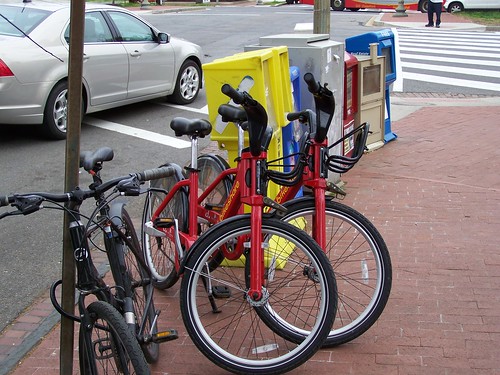
Unlocked Capital Bikeshare bikes, 3rd and Pennsylvania Avenue SEUnlocked Capital Bikeshare bikes, 3rd and Pennsylvania Avenue SE.

But as along as elected officials cycle through Washington DC or NYC and see bike share in operation, they are going to demand that their city deploy a bike sharing system of their own, without recognizing or acknowledging that highly visible cool bikes don't in and of themselves make a successful program.

Los Angeles. It happens that after I started writing this piece, I did come across an op-ed ("L.A.'s bike-share program is being set up to fail") in the Los Angeles Times that makes some of these same points, although the piece has a serious error (attributing the better financial results of some programs solely to the sales of advertising or sponsorships).

The article makes three major points:

1.  While bike share is touted as helping to reduce car use, most users shift from public transit;

2.  The new bike share system sponsored by the transit agency will be incompatible with the other systems being deployed in cities like Long Beach and Santa Monica

3.  Since the system is most likely to be used by transit users, and most transit users in LA County are low income, the price to use bike share is too high to be used by low income users.

Creating a critical mass of infrastructure that supports sustainable mobility.  Note that the author argues that Downtown LA is the place where bike share is most likely to be successful, but states that this area is already served by a dense network of transit, making bike share unnecessary, that when most transit users are making longer trips, they aren't likely to end up using bike share.

I would argue that bike share shouldn't be touted as a way to reduce car usage as much as it can be one of the elements in creating a critical mass of sustainable transportation infrastructure that supports a car-light or car-free lifestyle more generally. 

Mobility shed diagramMobility shed diagram:  think of the rings as representing different mobility modes (shuttle, bus, subway, biking, walking, etc.), and varying in width based on the amount of distance that can be covered in five minute increments.  

The mobility shed.  In order for this scenario to work, there need to be tight links between transportation and land use planning, a great deal of density, and short distances between residential areas and primary destinations--activity centers such as major centers of employment like DC's Downtown, community business districts and supermarkets, entertainment destinations (stadiums, arenas, auditoriums, parks), etc.
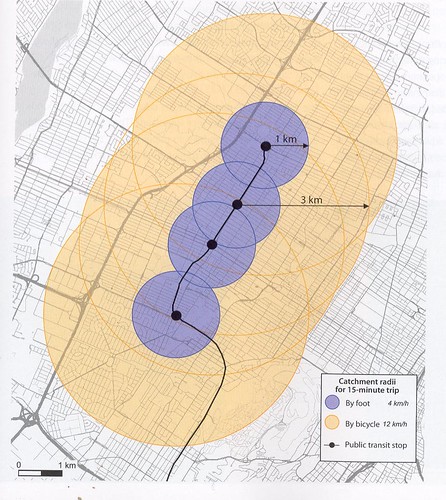
Catchment area of public transit stops for pedestrians and cyclistsBike and walk sheds from transit stations.  From Planning and Design for Pedestrians and Cyclists: A Technical Guide, produced and published by VeloQuebec.

Given that a bike ride of three miles takes about 15 minutes, this presupposes a fair amount of density within a three-mile radius.

Cities such as NYC, the core of Washington, the core of Chicago, San Francisco, etc. qualify, while most others do not.  Salt Lake City might be an exception for supporting a working system because the block size there is so big--an average city block in SLC is four to five times larger than blocks in other cities.

Cities like San Francisco with severe topography present a special case also.

Why bike sharing systems fail.  Not having this set of land use and transportation conditions is why bike sharing deployments in cities like Palo Alto failed, even though it was part of a regional bike sharing program, anchored by San Francisco, and why cities like Chattanooga ("2 years later, Chattanooga bike-share program is struggling," Chattanooga Times-Free Press), San Antonio ("San Antonio Bike-Share Threatens to Close Without Major Sponsor, Next City), and San Diego ("San Diego bike-share program hits snags over modest use," Los Angeles Times), and Toronto ("Clock is ticking for Toronto Bixi bike-share program," Toronto Star), among others haven't achieved much success with bike sharing.  (Note that in Toronto, the system is being taken over by the Toronto Parking Authority and the regional transportation agency, and some of the problems are being addressed.)

Moving towards the creation of SMDs or Sustainable Mobility Districts.  To determine where bike share can be particularly successful in Los Angeles, similar kinds of mapping exercises need to be performed, with a focus on identifying (and working to create) what we might think of as "sustainable mobility districts."

Maps at Seattle bike share stations show the respective distances that can be covered by a five minute walk or a five minute bike ride.  Image from Geekwire.

In the past, I've called this the mobility shed ("Updating the mobilityshed / mobility shed concept") and the maps for Seattle's bike sharing system are the first to illustrate the difference between "walk shed" and "bike shed" on posted maps.

In this scenario, bike share is complemented by walking, bicycling on owned-bikes, public transit (shuttle, bus, maybe streetcar, maybe light rail, heavy rail, railroad), one-way and two-way car share, taxi services, car rentals, even rollerblading and skateboarding, and electric bikes, mopeds, etc.
Car2Go on Capitol Hill
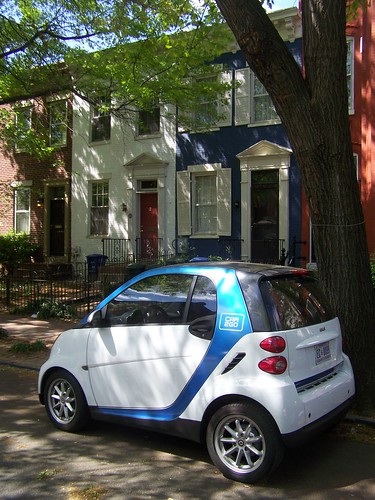
Car sharing is an element of a sustainable mobility infrastructure platform.  Right: a Car2Go one-way car sharing vehicle in Washington, DC.  

Members of car sharing systems like Car2Go and Zipcar can use sister programs in other cities across the US and Canada (for both systems) and Europe (for Zipcar).

The thing about bikes vs. bike share is that in most places the density of stations isn't likely to be great enough to be convenient for most trips, given that the normal advantage biking presents is the ability to perform your trip with complete efficiency, by being able to leave immediately from your origin point on bike and to arrive within a few feet of your final destination.  That's why an owned bike typically makes more sense for people who travel primarily by bike.

However, offloading storage and security issues--especially in cities like New York--can make bike share a worthwhile alternative for many.

Lack of one regional system.  It's hard to disagree with this kind of criticism.  I agree that one common system is the best way to go at the metropolitan scale, but because it can take such a long time to launch, some communities get frustrated and go off on their own.

From the standpoint of mobility as a platform, it is counter-productive because it requires users to join or pay to use multiple systems.  For similar reasons, it's why most metropolitan areas have combined transit fare media systems for local transit (although typically these systems do not include railroad services).

Launch of Citibikes in Jersey City.  Jersey Journal photo.

This comes up in Hudson County, New Jersey, on the west bank of the Hudson River across from Manhattan, where Jersey City has decided to join into the Citibikes system ("Fulop: Citi Bike Jersey City launch 'one of the most exciting things," Jersey Journalr), figuring that most of their residents and/or employers are tied into NYC in terms of their work and living choices, so therefore their transit shed is anchored by and within New York City.

But neighboring cities like Hoboken are going with their own system ("Hoboken launches bike share program" Jersey Journal ) which won't be tied into the same system in NYC, but is much cheaper to launch and operate.

Launch of Next Ride in Hoboken.  Jersey Journal photo.

That being said the Hudson Bike Share program has some interesting innovations in signage, outreach, communications, and in their creation of "no fee regional zones" where bikes can be retuned in locations outside of Hoboken.

I am not sure if some of these locations are in NYC, where the operator is based, with various bike rental locations in Manhattan. But this is interesting in how it allows cross-trips between certain locations outside of the normal "home zone" of the system.

The idea of the "no free regional zones" can be a way to deal with areas that don't participate (this is an issue with some boroughs in Montreal) or where there are a variety of different systems.

It's also an issue in Maryland, vis-v-vis suburban counties (Montgomery is part of the Capital Bikeshare system, while communities in and Prince George's County has considered developing a separate program) and Baltimore and Annapolis, which have some cross-trips with the DC metropolitan area.

It's also why the attempt by the US House of Representatives to create their own bike sharing system failed, when they should have just joined the DC bike sharing system.  Sadly the failure of that closed system is used by Republican Congressmembers as a reason to denigrate bike sharing more generally.

Another issue concerning how "metropolitan" scale bike share systems are operated.   One problem with bike sharing systems that isn't understood by users has to do with the fact that unless the system is run by a transit agency or only operates within a single jurisdiction, despite being branded as a single, metropolitan-scale system, it's actually organized on a jurisdiction specific basis. In reality it's a collection of separate programs unified under a single brand.

 For example, in the DC area, the Montgomery County participation is financed separately from DC, as are the programs in Alexandria and Arlington County in Virginia).  What this means is that revenues are collected by jurisdiction and not shared across jurisdictions, so there isn't the opportunity for cross-subsidies between high-use and low-use areas.  This was an issue in San Francisco and is in Boston, with the Hubway system.

But not understanding this element may blindside smaller jurisdictions elsewhere, believing that the revenues generated by the "success" of the system is DC are shared with the other members of the "compact."

Bike share and equity.  The LAT op-ed makes good points about bike share and equity in the LA context. However, the author misses the point that biking can be the killer app for people without access to cars, since the average cyclist can cover a great amount of distance, say up to 5 miles in less than 30 minutes, which is much less time by comparison to the time required to travel by either bus or rail when you take into account either time waiting or the time it takes to get to a station and from a transit station to your final destination.

See these past blog entries for a discussion on bike planning and equity and increasing bike take up amongst low income populations:

-- "Equity as the sixth "E" in bike and pedestrian planning"
-- "Revisiting bicycle (and pedestrian) planning and the 6th 'E': equity and the City of Minneapolis Bicycle Master Plan"
-- "Urg: bad studies don't push the discourse or policy forward"

Frankly, saving time was the primary reason I started biking for transportation in 1990--I figured it saved me a minimum of 30 minutes each day compared to walking and/or using transit.

The problem is that transit agencies haven't been conceptualized as "transportation solution providers" as much as they are providers of bus or rail transit service.  If they were, then agencies would integrate bike share into transit service operations very tightly.  (This kind of thinking is why the German rail system has offered bike share for more than a decade.)

And to be fair, many transit agencies see the value of bike share in terms of providing a faster means to get from a transit station or stop to the intended destination, which may still be some distance away.

Boston's success with making equity a priority in bike share.  But this issue is addressable.  Boston has gone the farthest in creating programs making bike share widely accessible to low income populations, offering annual membership, including a helmet, for only $5, to people who qualify.  (I have also suggested to public housing organizations that they integrate bike share and high quality secure bike parking on site but I haven't had much headway.)

Generally, this requires the involvement of agencies other than the local transit agency.  In the case of Boston, it includes the city's transportation department and the city's the public health agency, and private funders.  The local transit agency is not involved.

The Philadelphia Experiment.  Note that the Philadelphia Inquirer has run a number of articles ("Why low-income people bike share less," Indego popular for university commuters and joyriders, mixed results for low-income outreach," "Ridership with reach," and "Indego has inroads yet to make") about the relative dearth of low income users of the Indego bike sharing system there.

Unlike say articles by the Washington Post on the streetcar project, which in my observation are more focused on painting streetcar use as moronic, the Inquirer articles explore the issue in depth.  Mostly the system hasn't done very good marketing, and unlike Boston, they didn't create a discounted membership program for low-income uses.

But despite the existence of the Better Bike Share Partnership research initiative, of which the City of Philadelphia is a member, the Indego program doesn't appear to have launched with the implementation of best practices concerning take up by low-income populations, figuring that installing stations in low income neighborhoods was enough.  DC's system has the same problem ("Who uses Capital Bikeshare?," Washington Post).
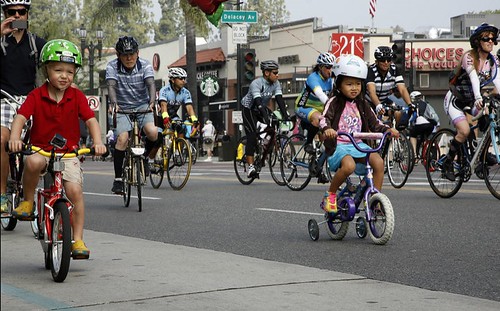
Bicyclists ride down Colorado Boulevard in Pasadena during CicLAviaThe CicLAvia "Open Streets" event in Los Angeles County is probably the most successful example of such a program in North America.  Each event brings out 100,000 to 200,000 participants.  The Los Angeles Metropolitan Transportation Authority is the primary sponsor of the event.  Photo from the LA Times.

By contrast the LAT op-ed suggests discounting transit service for trips that don't lend themselves to bike share.  I think that's misguided.

While I do believe that fares and passes should be discounted for low income riders, the money to cover that cost needs to be appropriated separately from funds allocated to transit systems for general operations and capital improvement.

Otherwise, discounting fares merely reduce the revenue for the transit system, and the fare structure for transit in LA County is among the cheapest in the US already--bus costs about the same as DC (which is the about the cheapest in the US for major transit agencies) but riding heavy or light rail is the same fare, $1.75, although transfers between modes are free only with a weekly or monthly fare pass.

Conclusion.  There are best practice analyses of bike sharing such as the Bike Sharing Planning Guide by the Institute for Transportation and Development, , and various studies by academics and other organizations (many are listed in this blog entry, "Bikeshare systems: Recent research on their growth, users’ demographics and their health and societal impacts," from Journalist Resource).

So it's not like there isn't good information out there about what works, what doesn't work, and what could work better.

Maybe the real issue is not that there isn't information, but that information is either not being accessed to begin with or it's not being used or it's rejected for non-evidence-based reasons.

Labels: , , , , , ,