Rebuilding Place in the Urban Space

"A community’s physical form, rather than its land uses, is its most intrinsic and enduring characteristic." [Katz, EPA] This blog focuses on place and placemaking and all that makes it work--historic preservation, urban design, transportation, asset-based community development, arts & cultural development, commercial district revitalization, tourism & destination development, and quality of life advocacy--along with doses of civic engagement and good governance watchdogging.

Tuesday, December 17, 2024

A bit about car sharing

Zipcar bought Flexcar and then was bought by a major US car rental company.

For profit car sharing has been in the US for about 20 years.  The original services were two-way--Flexcar and Zipcar--in that you checked out a car from a specific spot and returned it to that spot, paying for full use of the car from start to end, even if there were dead times within your possession.  Other companies entered the market, but have mostly ceased operations.

There were older nonprofit operations in Chicago, Philadelphia, and San Francisco.  All were sold to for profit operators as it turns out they didn't account well enough for the cost of replacing the initial fleet of vehicles.  And other fleet maintenance costs ("As fleet grows, Communauto navigates challenges of changing thousands of winter tires," CTV News).

Later, Car2Go, a Daimler Benz company with super small cars, came on the scene with one way car share.  Once you picked up the car, you could drop it and leave anywhere else in the "car zone." 

A Car2Go on Pennsylvania Avenue SE in Washington, DC.

charlie has pointed out that it was more about helping the corporation meet EPA fleet mileage standards than being an operative service.  But it was well received and for a time was in many cities including San Diego and Seattle--and I used cars in both.  Also places like Brooklyn, Chicago and parts of LA.

The great thing about Car2Go was their small size made them super easy to park in cities with parking space constraints.

I'd written quite a bit about how cities treat car share.  Many look at it as a revenue source and charge for each car, and access to parking, making it more pricey to use--e.g., sales tax on a car share in DC was more than for an Uber/Lyft trip-- in ways that both privileged car owners over car users, and failed to take into account that car share is a form of transportation demand management--each car supports 6-8 households, and reduces demand for parking.  By contrast Canadian municipalities are more focused on the benefits ("Ditch the second car, Communauto is here," QCNA)

Mostly, one way car share is now out of business in the US.  I guess Free2Move still exists (by Peugeot) in DC.  AAA of California tried doing it in SF, Seattle, and a couple other places, but I think it's shutting down by the end of the year.  Car2Go met its demise some time ago.

In 2018, I wrote how DC was a naturally occurring leader in Mobility as a Service (MaaS), in "DC is a market leader in Mobility as a Service (MaaS)."  Most of the for profit actors are out of business now, and without one way or free floating car share, MaaS is a lot less useful for people who don't want to own cars.

The fact is only some places, and certain areas within certain places, have the urban design and density conditions to support one way car share.  In the US, I'd argue that the "transport association model" ("The answer is: Create a single multi-state/regional multi-modal transit planning, management, and operations authority associatio," 2017) would be conducive to offering one way car share and e-scooters, as it is likely that like most transportation services, some subsidy is necessary for the services to succeed.

Plus, it could operate in multiple jurisdictions as one integrated service, rather than on a city by city basis, with different rules for DC versus Arlington County versus Bethesda, etc.

News that the Montreal-based carsharing company Communauto was setting up operations in Calgary was seen by many as a step in the right direction. Taylor Lambert says that all depends on where we're trying to go. (Scott Dippel/CBC)

Communauto as North America's nonprofit car share survivor.  Interestingly, Canada has a pretty successful nonprofit car share operation called Communauto, and it offers both one way, called Flex, and two way services.  

 It's in 15 cities, and Paris, including Montreal where it started, and Toronto.  When bike share was first introduced in Montreal, you could access bike share, car share and transit all with one card  ("Communauto expanding in Montreal to meet growing demand," City News). 

From the article:

According to the news release, Communauto had already expanded its vehicle fleet in Montreal in 2023 by adding 900 vehicles. Bringing the total number of vehicles in the city to 3,700 — with the expansion this year, the new total should be 4,800. 

The new cars, will also include 85 electric cars and 70 minivans. Towards the end of the year, 400 vehicles are set to be replaced with newer models. 

They say that these additions allowed 14 per cent of Montreal households to use Communauto services, an increase of 22 per cent compared to the previous year.

In Chelsea and La Peche, boroughs in Quebec, the municipality actually paid subsidies to Communauto to bring the service to their community.

“It costs residents $12,000 per year to own a car,” said Delage, referring to maintenance costs, insurance, gas and other repairs. With Communauto, residents can sign up for a number of various membership packages from as low $0 per month and $12.75 per hour, or up to $30 per month, which will allow residents to use the cars for just $2.75 per hour. And users won’t have to pay for gas. The packages are built to cover the cost of gas through membership fees. Each car will have a Communauto credit card for users to fill up when they need to. But all the cars are hybrid – 12 Prius’ and two RAV4 SUVs.  

Equity as a burden.  One of the problems with calls for equity--making the services accessible everywhere in a community--is that in many places, it's not profitable to offer, and the places where it does work don't generate the level of extranormal profits necessary to subsidize the loss making parts of an operation.  Even in Montreal, Communauto is criticized for not offering its services in every part of the city ("Is car sharing stuck in neutral in Montreal?," Montreal Gazette, "The case against carsharing," CBC).

From the CBC article:

The need to get around the city, for different reasons and at different times of day, is universal. 

So is the right to feel and be safe as we do so. But ours is a heterogeneous community, with a wide range of physical abilities, degrees of financial security, access to technology, and other important factors that influence how each of us experiences the city. 

Therefore, if we were to try to define a transportation ideal to aim for, it ought to include access to safe, reliable, frequent transportation for all people. 

This is where the shortcomings of carsharing become sharply clear. I previously made use of car2go, and I could choose to make use of Communauto. I am able-bodied, an experienced driver with a valid licence, I live within the service zone, I have good credit and a smartphone, and though my modest income means I wouldn't make a habit of using the service, I can afford the occasional trip. That's a pretty long list of personal details, but every one is mandatory — if even one of those boxes was unchecked, I would be excluded from using carsharing. 

Another way to put it is that carsharing only serves those who can check all of those boxes. Excluded are those with financial insecurity or insufficient credit ratings; people who don't have a smartphone, including many seniors; people who live or work far outside of the service zone, which only covers about three per cent of the city; and people who are unable to drive, whether due to a disability or lack of licence. That's an awful lot of Calgarians left outside the circle.

These criticisms are comparable to those of creating bike infrastructure.  I'd argue that yes there isn't equal access, but that transportation demand management requires a number of strategies and tactics.  And it is possible to add some elements of equity to a program, like how bike share has either a low or no cost rate in some jurisdictions, for low income residents.

FWIW, this negative article assumes that car share users don't use public transit, which is the ideal service to use.  By contrast, in the MaaS entry I argue that car share is a key element of a broader sustainable mobility platform (Further updates to the Sustainable Mobility Framework," 2018) where the foundation is transit, and depending, on biking.

The way that Free2Move deals with that in DC is by having three zones, two, in less profitable areas, involve additional drop off fees of either $4.99 or $8.99.  Ouch.

Electric cars can be a burden.  Like with equity, car sharing firms are often called upon to offer only or a preponderance of electric vehicles.  But this makes the service a lot more complicated and costly.  Although I will say the electric Car2Gos in San Diego drove like a dream.  Most of the e-vehicle car sharing operations in the US have shut down.

However, Communauto is adding electric vehicles in a number of cities.

Should DC invite Communauto?  I always say when asked, that it was a privilege to live in DC, where you can live quite comfortably without a car, at least in the core of the city.  Yes it meant some constraints, depending on the reach of the transit system--before the Silver Line it was easier for me to take transit to Baltimore than to Tysons in Fairfax County.

DC should prepare for the possibility that Free2Move could go out of business.  In North America now it only operates in DC,  Scenario planning means covering the possibility.  Likely, it would require subsidy and without the transportation association approach, would be less successful..  For example, RATP, the transit provider in Paris, bought a quarter of Communauto Paris, supposedly as an investment, but it was probably more of a capital infusion.

Labels: , , , , , ,

Wednesday, August 03, 2022

SmartCar as a city car

The Mercedes produced SmartCar has been discontinued, because the company is undertaking different initiatives to meet US fleet mileage requirements.

This car was used in the Car2Go one way car sharing program that Mercedes launched in the North America and Europe.  

It was a great program but in reality, would only work in a few places ("Car2Go dying: further effects from the rise of ride hailing and damage to the sustainable mobility platform/mobility as a service paradigm"), so it could never scale the way a large corporation like Mercedes would want, and they shut it down, although it still operates in some cities in Europe.

This photo of the car in a local supermarket parking lot in South Salt Lake City shows one of the key advantages of the SmartCar as a city car--it's small and easy to park.  It got great gas mileage and the electric versions were a dream.

The problem with the market for cars in the US is that it isn't particularly differentiated, with different vehicles for different purposes.

So sure a small car makes sense "for the city."  On the other hand, people tend to buy "one car" to meet a maximal number of their likely and intended uses.  So people aren't going to buy a small car for the city uses when they want a bigger vehicle to accomplish longer trips, carrying more people, etc.

Plus, car dealers aren't motivated to sell small cars because they don't make much money off them (not unlike how bicycle shops aren't motivated to sell low cost city bikes compared to expensive road bikes).

But then that's why the one way car sharing application was so great for cities like DC and Seattle.
 

Labels: , , , , ,

Thursday, June 09, 2022

Metra/Chicago creates a well priced German style all-mode transit pass

 Last week, I wrote a post, "Montreal first North American city with German/London style fare pass good on all transit, even local railroad services," after charlie called our attention to how the transit system in Greater Montreal is moving to a German style all-modes-in-one fare media system, which is really the first example of this in North America.

It appears that Metra, the commuter but 7 day/week railroad serving Chicagoland (mostly serving Illinois, with one line to Wisconsin, while Indiana is served separately from Metra), is sort of kind of backing into a similar system.  

In the past they've had a monthly pass, ranging from $116 to $275 depending on distance ("Metra to offer new $100 monthly pass, the latest change to draw back riders," CT), plus two add on pass options for local transit--a peak CTA rail and city and suburban bus pass ($55) or suburban only bus pass ($30).

But earlier this month, to stoke ridership in the face of pandemic decline, they've moved to a $100 monthly commuter pass.  And since they've announced a $30 add on city and suburban local transit pass, for a total of $130 ("CTA and Pace to offer new pass for Metra riders, as commuting habits change," Chicago Tribune).  

This is a significant reduction in price, as little as 1/3 the cost for some riders compared to previous rates.

Now it's not available in reverse, in that a CTA/Pace monthly pass for $75 can't add full rail access for $55.  But it's a start.

In a way, the Metra combo is better than the German options, because those increment higher based on zones, where due to the pandemic fall in ridership, Metra has shifted to a flat rate pass.

Conclusion: Desperation can lead to innovation.  In working in revitalization, I used to compare DC--a strong real estate market, and Baltimore--a weak real estate market, a lot, making the point that Baltimore had a "desperate willingness to experiment because they have no other choice."

Chicago's Nederlander Theatre and a busy Randolph Street on March 12, 2020, in downtown Chicago. (Terrence Antonio James / Chicago Tribune)

Metra and the Regional Transit Agency (RTA) are desperate because the pandemic has crashed visitorship and commuting to Chicago, destroying their ridership and revenues.  

At the same time, workers are liking telecommuting because it cuts the time and cost of telecommuting.  Bosses do like outsourcing the cost of office space to workers at home, but at the same time, want to see people in the office, out of the belief (which I believe) that people accomplish more when interacting.

With such significant reductions in transit cost, this is an economic development strategy for Downtown Chicago.  Fortunately, Chicagoland has a dense center city and commuter railroad transit network where they can pull this off.

====

I was talking to someone who knows someone who works for the Utah Transit Authority, who told him that the cost of collecting and process money is roughly equal to the revenue collected, so that the authority could move to a free transit system at no cost*.  But the Utah Legislature--70% Republican, 90% Mormon--is opposed to providing free transit.

* Note that in high transit use systems, the fear of moving to free transit is based on a rise in ridership, requiring more personnel and more equipment, so it would cost more and revenue would drop significantly as well.

Labels: , , , , , , ,

Wednesday, June 01, 2022

Montreal first North American city with German/London style fare pass good on all transit, even local railroad services

"One network, one schedule, one ticket." Hamburg in Germany pioneered the VV, or transport association, which links all transit service providers in an area into a single group, providing an integrated transit system with a fare payment system that integrates all modes.  That means bus and underground, commuter railroad, ferries, and if present, trams.  (The VV model has been adopted in Austria and Switzerland too.)   

-- "Verkehrsverbund: The evolution and spread of fully integrated regional public transport in Germany, Austria, and Switzerland," International Journal of Sustainable Transportation
-- "Branding's not all you need for transit," 2018

After the initial idea, which was focused on making transit easy to use, it took many years to get all the transit agencies on board, but over time, the Hamburg VV spread into neighboring states, and then was adopted as a national policy.

Germany's passenger railroad services are run by Deutsche Bahn, the national railroad, at multiple scales, including commuter railroad services around cities.  Over time, DB agreed to integrate these services, called S-bahn, into VV programs.

According to a brochure published by the MVV, the transport association serving Greater Munich in the German State of Bavaria, the association:

carries out key tasks which include creating a joint tariffs and fares structure, distributing revenues, planning, controlling tenders and contracts with regard to regional bus transportation, system marketing as well as market research, providing customer information across various transport companies, in particular web-based timetable information across the association, conceptual transport planning as well as traffic and transportation research. In addition, the transport association passes on its expertise to third parties on a consultant basis.

London has a similar fare system if you live there, where the weekly TravelCard covers bus, subway, tram, light rail and local railroad services called the London Overground, which used to be run independent of Transport for London, so they weren't included in local transit fare systems. Unlike the systems in Germany, ferry travel is separate. (Liverpool includes ferries in certain passes, but not excursion ferry travel.)  More recently, intra-London trips on National Rail are also covered in the TravelCard pass system.

US transit pass programs don't include railroad (or ferry) services.  US transit pass programs may integrate bus, subway and streetcar services, but "never" local railroad services.  

Although recently there are a couple of special exceptions, on equity grounds like in Boston, which includes in-city transit on the Fairmount rail line ("Boston’s Fairmount Line Could Be a National Model for Commuter Rail, But It’s Not There Yet," Streetsblog) and Chicago ("South Cook County Fair Transit Pilot for railroad as local transit").  I don't know of local ferry services, even when offered by the transit authority, being included in transit pass programs.

WMATA, the system in greater DC, is unusual is that it charges by mode, meaning you pay separate fares for subway and bus, even if you use both on one integrated trip.

Most US cities don't have an extensive set of intra-city railroad stations, although Boston, Chicago, New York City, and Philadelphia are the exceptions.  Montreal and Toronto have a fair number of in-city train stations, but not at the scale of a network.

There are initiatives  to include some railroad services in transit pass products in New York City ("Relief for New York City’s Transit Deserts? Commuter Trains Might Help," New York Times), and consideration of it in Philadelphia ("SEPTA releases options for future of Regional Rail," Mass Transit).  LIRR and Metro-North are testing $5 flat fares for in-city travel, but that's still almost double the single trip subway/bus fare ("Flat fare $5 CityTicket sales ‘soared’ on LIRR and Metro-North," AMNY).

I have recommended the consideration of such in DC and Baltimore ("One big idea: Getting MARC and Metrorail to integrate fares, stations, and marketing systems, using London Overground as an example," 2015), but hadn't thought about it so much wrt the Virginia Railway Express but should.  If MARC and VRE were to merge ("A new backbone for the regional transit system: merging the MARC Penn and VRE Fredericksburg Lines,") it would be a no brainer.  But to be beneficial, there would have to be an expansion of train service within the cities, complementing local transit.

Free local transit as an add-on benefit for railroad riders.  I know of four examples where railroad riders can ride local transit for free, while no additional charge railroad access isn't extended to local transit pass users in those systems.  

In Baltimore, pass holders for MARC, the railroad service, can ride local transit (bus, subway, light rail) for no additional charge. And they can ride Metrobus in the DC area, and local transit in Montgomery  and Frederick Counties for free as well.   VRE pass holders within Northern Virginia have free access to Metrobus, Fairfax Connector, and Omniride to and from train stations, but not throughout the day, unlike the benefit for MARC riders..

In Southern California, Metrolink train riders can ride local transit for no additional charge, including subway and light rail, by scanning the QR code on the ticket. 

In North Carolina, the State DOT provides Amtrak riders with free access to local transit (bus) ("North Carolina DOT negotiates free bus transfer access for Amtrak users," ). 

Montreal: the first North American transit system to include railroad services in all transit passes. Montreal has long been a leader in transit practice and policy, and sustainable mobility ("Is Montreal the number one city for bicycling in North America?" and "One more thing about Montreal as a `bike city`").  The city transit agency long ago integrated local car sharing and bike sharing into their transit pass.

charlie calls our attention to how Montreal's regional transit authority has created a set of regional passes all of which include access to railroad transportation ("How Much New Montreal Area Transit Fares Will Be Depending On Where You Live," MTL Blog).  From the article:

On July 1, the regional transit authority, the ARTM, is introducing new transit fares in Montreal, Laval and Longueuil, completing the rollout of a simplified pricing system in the whole metro area. 

The new scheme divides Greater Montreal into four zones: A, B, C and D. Fares will depend in part on the zones transit riders need to traverse to reach their destination. 

 Excitingly, commuters in every zone will have access to single fares that cover all modes of transit: bus, metro, exo train and the forthcoming Réseau express métropolitain light-rail network.

This is a BIG DEAL.  And the closest any North American city is to the VV model. (What's interesting in the VV model is that it frequently crosses jurisdictions, whereas in the US, cross-jurisdictional integration, especially across states, is exceedingly rare.)

Historically, the City of Montreal has had an integrated transit pass (STM is the transit agency, which like MUNI in SF operates only within the city, with the exception of a small portion that connects to one of the adjacent suburbs).

Like other big cities, it didn't include railroad access, because those services were run separately, by a regional railroad authority under the Provincial government.  A few years ago, the Province and the cities reorganized transit planning and service delivery, providing a path for integrating railroad services into the local transit program.

Thinking about transit fares as a design product.  "Branding's not all you need for transit" lays out three elements for transit success: (1) integrating services; (2) applying the design method to transit/treating transit as a "design product;" and (3) branding.  

The idea of "one network, one schedule, one fare" brings this all together.  But too often, transit fares aren't thought of as a design product, more as something to generate revenue.

So I've been thinking about laying out a way to think about this, although this is at best a draft.

Transit passes versus transit fare cards/contactless travel versus cash.  Note that most systems have introduced fare cards and now various phone-based apps, to pay for transit.  This is to reduce costs from handling cash.  As a result, fare card holders usually get discounted fares compared to the one off price of paying for a single ticket by cash or credit.

Sometimes people confuse the idea of transit passes, paying for transit a week or month at a time, as the same thing as the transit card.  They are a form of payment, and may or may not be integrated into fare card systems.  In many places, legacy railroad passenger services haven't been integrated into regional fare card systems. (For example, London, there are card readers.  For LIRR and Metro North and MARC and VRE they use conductors.  The "new" SMART rail in Sonoma and Marin Counties, was able to integrate fare card readers from the start.  Etc.)

Tickets not passes (but may be used with a transit card)

  • Single Fare ticket cash/credit
  • Single Fare using a transit card (usually even single tickets are cheaper using a fare card, compared to a cash/credit fare)
  • transfer free or an extra charge (some systems charge a flat fare per trip, often with a time limit, some charge more for transferring to another bus or mode)
  • All Day Pass (often excludes use during the morning rush)
  • Daily Fare Ceiling/Capping (London has a maximum per charge per day for rail services and bus services)
  • Special Event Transit (some places include free transit with sports and concert tickets, "Seattle Kraken expansion hockey team sets new standard for transit benefits in transportation demand management: free transit with ticket")
  • Evening and weekend passes (Melbourne was an early innovator,  may be discontinued in favor of fare capping)
  • Group Fares (cheaper price for multiple people compared to each paying individually)

Passes
The point of a pass is that it is discounted in price compared to the cost of paying a fare separately for each trip (traditionally, although they changed as ridership dropped, the WMATA system's passes weren't especially discounted).

Usually sold on a weekly or monthly basis.  Some places offer an annual pass, paid at one time, discounted from the cost of 12 separate monthly passes (German VV systems, Switzerland).  

  • Transit Pass (weekly or monthly)
  • Transit Pass for Youth (free or charged)
  • Transit Pass for Low income riders (free or charged, various eligibility criteria)
  • Transit Pass for Seniors (usually discounted, sometimes free)
  • Fare Capping (maximum amount that you will pay in a day; London charges separately for rail capping and bus capping; London and Melbourne were early adopters)
  • Pay as you go Transit Pass (for equity reasons, some systems are implementing pay as you go fares, which once you pay the equivalent of the cost of a transit pass, it stops charging for the rest of the pass period.  See the Transit Cooperative Research Program report, Fare Capping: Balancing Revenue and Equity Impacts.)
  • Tourist passes (special prices, usually for a multi-day period, usually local like the Hamburg Tourist Card or SF Visitor Pass, but may include national transit services, e.g., Eurail pass, may be for one person or multiple people)
Bundled services with passes 
examples, not a comprehensive list
  • subway/bus/light rail (Boston/Philadelphia)
  • subway/bus (New York City)
  • subway/light rail, bus, streetcar, cable car (SF)
  • railroad, subway, bus, ferry (Hamburg)
  • railroad, subway, bus, light rail/tram (Munich, Berlin, London)
  • railroad, subway, bus, light rail* (Montreal) * = forthcoming
  • subway (which is actually railroad), bus, ferry (Liverpool)
Bundled services with railroad service
  • free local service with railroad ticket or pass--Southern California Metrolink
  • free local service with railroad pass--Baltimore/MARC (it's important to note that this includes free transit service in Baltimore, but not subway service in Washington)
  • free local service to and from the train station for Virginia Railway Express
  • free local bus transfer for Amtrak riders getting off in North Carolina (NC By Train Transit Pass)

Free transit
examples, not a comprehensive list
See "No Fares," Tyee and "Revisiting free transit in the wake of the decision in Kansas City ... and Lawrence, Massachusetts," 2019)

  • free route: bus lines (Boston is testing this, the 500 route in Salt Lake provides service to the State Capitol)
  • free route: circulator services/core transit services (Baltimore Circulator, Savannah core)
  • free route: shuttles
  • free zone: fareless zones in the core, usually for rail, but sometimes including bus (Calgary, Salt Lake City, Pittsburgh, Melbourne)
  • free system: for residents not visitors (Talinn, Estonia, Kansas City, Banff instituted free transit for residents at the end of May 2022)
  • free system: for all users--college towns (Chapel Hill)
  • free system: for all users--resort towns (Park City, Aspen)
  • free system: for all users--an entire country (Luxembourg, for transportation demand management reasons)

Labels: , , , , , ,

Thursday, March 25, 2021

I guess the San Francisco Bay region needs a German style "transport association" too

The San Francisco Chronicle reports ("Chiu re-introducing bill to integrate Bay Area transit — and create universal Clipper Card") that State Assemblyman David Chiu wants to pass a bill that requires all the transit agencies in Greater SF to create an integrated map of all the transit services, and require that all transit agencies accept the Clipper card.  From the article: 

The Bay Area Seamless and Resilient Transit Act would establish deadlines for the Bay Area’s 27 different transit operators to create an integrated transit map for the region. 

It would also require the region’s Metropolitan Transportation Commission to create a pilot program for a unified fare pass that would allow commuters to travel across different transit operators while paying a fixed fare. Currently, some Bay Area transit agencies don’t rely on the widely used Clipper Card system, including ACE and Capitol Corridor trains.

The funny thing is that the SF Bay area is a leader in terms of transit service integration, and their transit fare media card, Clipper, is used on most services, even Caltrain, the regional commuter railroad, and they publish a bunch of good maps, and work towards service integration, such as their night transit network -- both are national best practices.


But apparently there are gaps.  And probably the gaps are bigger than Assemblyman Chiu realizes.  I'd recommend the creation of a German style transportation association, they are already a long way towards this, despite the gaps. 

I wrote about this a few years ago, in response to SF area advocates grousing about the Clipper card, and I said they weren't thinking big enough.

-- "Chicken and egg transit planning: Greater San Francisco and the Clipper Card upgrade" 

German transport association as a model of transit service integration.  In "The answer is: Create a single multi-state/regional multi-modal transit planning, management, and operations authority association," focused on DC, and "Branding's not all you need for transit," more generally, I discuss how the German transport association model should be adopted in those US metropolitan areas where multiple agencies are responsible for transit delivery, especially across jurisdictional borders.

--"Verkehrsverbund: The evolution and spread of fully integrated regional public transport in Germany, Austria, and Switzerland," Ralph Buehler, John Pucher & Oliver Dümmler, International Journal of Sustainable Transportation (2018)
-- Transport Alliances - – Promoting Cooperation and Integration to offer a more attractive and efficient Public Transport, VDV, the trade association for German transport associations.   

In the VV or Verkehersverbund model, the master transport association is in charge of planning for all modes, with a focus on creating a fully integrated set of services and fares.  (Transit in Greater London and Paris operates similarly.)  

All the operators are part of the association, and can be a mix of government-owned and for profit operators.  Who does what is hidden from the rider--all they see is that everything is connected and one fare media card is required.  

Note that this can be done collaboratively, without a formal mandate, the way that transit agencies in Raleigh-Durham, North Carolina have rebuilt their transit system over the past 10-15 years ("Will buses ever be cool? Boston versus the Raleigh-Durham's GoTransit Model").

And it can be difficult to integrate for profit mobility services that are more self focused, like car sharing firms, or bike share, especially if they compete with mass transit and/or government-provided services, like bike share.

Mobility as a service and transit farecards.  The piece on SF from a few years ago, "Chicken and egg transit planning: Greater San Francisco and the Clipper Card upgrade," focuses on how advocates wanted there to be seamless use of Clipper across mobility services including ride hailing and others.  I argue that while that is ideal, it may not really be necessary, and for profit entities aren't always good partners when it comes to this kind of integration.

It is happening more frequently, and in Berlin, the transit agency BVG actually took the initiative to create such a system, called Jelbi, contracting it out to application developer Trafi, which has developed similar apps for ride hailing firms like Lyft ("BVG Jelbi — world’s most extensive MaaS solution in Berlin").


BVG was successful in getting non-transit vendors to participate in the program.

To me,  it seems as if BVG decided to be the first mover in developing an overarching app figuring it was the best way to keep their place at the transit table, remain the top of mind leader in mobility innovation, and to keep their customers in the face of serious competition from private mobility providers less concerned about the viability of mass transit ("Berlin's new transit app Jelbi connects all modes in one place," Fast Company).

Over time, my sense is that transit media cards will be discontinued in favor of smartphone apps, and integration will either be easier or less of an issue.

Labels: , , , , ,

Sunday, November 01, 2020

NEW HARVARD/AARP REPORT FINDS MOST OLDER ADULTS DO NOT RESIDE IN LIVABLE COMMUNITIES

 From a press release from the Joint Center for Housing Studies at Harvard University about a newly released report, Which Older Adults Have Access to America’s Most Livable Neighborhoods? An Analysis of A ARP’s Livability Index commissioned by the AARP Public Policy Institute:

“While livability is ultimately subjective, the AARP Livability Index identifies key aspects of the built, economic, and social environments that contribute to community and individual well-being, and measures the degree to which those aspects are present in communities. Using data from the Index and the American Community Survey, the new report finds that renters and Asian older adults are more likely to live in high livability neighborhoods while homeowners, middle-income households, older adults with disabilities, and white older adults are more common in places of low livability. Shares of Black and Hispanic older adults hold steady across neighborhoods of all levels of livability.” ... 


 “This report illustrates the challenges that many communities face in supporting people as they age,” says Rodney Harrell, VP of Family Home and Community at AARP. “We need to ensure equitable access to the benefits that livable communities can offer, including for those living in higher-scoring neighborhoods. Every neighborhood has tradeoffs and every community can improve. Our findings support policy solutions to address barriers and improve livability for people of all ages and older adults more specifically.”

My reaction:

Probably it's true that most older adults don't reside in livable communities.  Fortunately, I do.  And I am in a situation of two households in one, including two people 83 years old, one with dementia.

In terms of communities using the index to make improvements, or for households using the index as a way to choose a place to live, I still see some problems with the way that the AARP Livability Index measurement is set up.

I can't claim I've drilled down deeply into every element of the Index, of which there are seven:

  • housing
  • neighborhood
  • transportation
  • environment
  • health
  • engagement
  • opportunity

but overall, the index is pretty impressive, with many factors captured within each category. It's pretty thorough. 

Although arbitrary at times. E.g., only counting a library if it's within a half mile. The metrics communities use for providing library "levels of service" aren't set up to provide that level of service. It'd need to be weighted to be more accurate and useful. Like a library within a half mile gets a stellar weight, but a library still within a mile still gets a positive, but lower rating. 

(Salt Lake City is 80 square miles and has a main library and seven branches.  Residents also have access to the County Library system, which doesn't have any libraries within the city limits.  DC is 60 square miles and has a main library and 25 branches.  In terms of personal experience, I'd say that both cities are reasonably served.  But DC might have too many libraries, although it'd rate more highly on the AARP Livability Index, arguably the more branch libraries, the less well stocked they are with materials.  For example, Salt Lake City's branch libraries have much better periodical collections than any of DC's branches, even in the wealthiest areas. )

Weighting for mobility and age and physical ability.  To be most useful, the index needs to be weighted mode, age and physical (cap)ability to make it truly applicable for individual households. E.g., I'd say it needs to be in tranches by age, mode, and assistance needs.   

Photo: Capitol Hill, DC.  The man used to bike by himself but eventually realized he was excluding his wife.  So they got a tandem bike.

AARP starts asking people to join at their 50th birthday. There's a big difference between a 50 year old with full faculties and physical capabilities, and an 83 year old with dementia or someone who needs an assistive device and or an "attendant" to get around.

Similarly, I understand the focus on walkability as a a primary metric, but at a certain age, it's not practical in terms of speed and carrying capacity for an 83 year old to walk a half mile to the grocery store and back.  Especially if you are impaired or need assistive devices to move around, etc.

But being able to move around your neighborhood, for exercise, is important. But even in the last year, having experienced a couple illnesses, our familial range in walking on daily exercise walks has been cut in half in terms of capability. 

We were talking with a friend about a park 1.2 miles away. She asked if we walked there. It would take at least an hour just to get there, with two 83 year olds, and then we'd have to get back. 

As much as I push sustainable mobility, it's not practical for many of the aged. Especially with transit. 

Even before the dementia became pronounced, I used to ruminate about the impossibility of wrangling two people then in their late 70s on the subway during rush hour. 

Although outside of the major city transit systems, transit isn't as rushed and crowded so it is probably less of a deal in Salt Lake as it would be in DC or NYC or Chicago or Boston. 

I write about the sustainable mobility platform as being comprised of a network of modes = walking + biking and micromobility + transit + car sharing (including access to one way and two way and a variety of vehicles to meet different needs) + delivery + taxi/ride hailing, 

In DC, with biking complemented by car share and transit and walking we didn't need to own a car. But if Suzanne's parents had joined us in DC, definitely we would have needed to get a car.

Flickr photo by Ed Yourdon, New York City.

Salt Lake's car sharing options are minimal and while the bus service is pretty extensive and we're in a good area for service, it's pretty time consuming to get somewhere.  

The light rail and commuter rail are polycentric systems, not really useful for getting around "within a place," more about traveling long distances.

I was doing an itinerant job this week, fortunately a few blocks away, while some other people working there took more than an hour to get there on transit, from a distance of 5-6 miles. For me it was a five minute bike ride.  (And it'd have been a 30 minute bike ride had I lived in the other place.)

The same goes for mobility and the aged. For our two households in one: me at 60, my partner, 53 and her two parents at 83, one with dementia, when we travel together we mostly drive, except for exercise-based local walking. 

Baltimore.

Even 7 months ago, we could manage a half mile walk with them to the grocery (we'd carry the groceries), but not now, as health conditions have changed. 

 But that doesn't prevent me from cycling on trips on my own, be it to the grocery or work or a library or whatever. (Suzanne doesn't bike.) 

Basing the index on type of mobility (mode).  Were I creating this kind of livability index, I'd make it work with a number of options, not unlike Google Maps, which gives you the option to choose four different modes to get somewhere: driving; walking; transit; and biking.  Exclusively on foot; on bicycle; with a car; need for assistance; etc. 

And the half mile thing just makes no sense in terms of how levels of service are provided. E.g., doctors or hospitals aren't built with a half mile radius. (Not that the index uses a half mile as the measure for access to health facilities). 

With Suzanne's parents, most of our life is captured in a three mile radius in terms of walking + car, albeit mostly car.

That includes access to amazing health and hospital care, a senior-rec center with a library provided by the county, another library provided by the city, an impressive array of retail, parks and walking opportunities. Even a major research university and additional recreation facilities (because of their age, they get free access to the county recreation facilities). 

The area and city is a grid but the road network is punctuated with dendrils and discontinuities in terms of the residential streets, which can break off for a block or two or more in various seemingly random ways--but the streets stay pretty straight and keep the same name.

Maybe even take into consideration topography and e-bike vs. regular bike.  E.g., as I age I may get to the point where I switch to an e-bike, especially because SLC has intense hills.  Even without age as a factor, many people here get e-bikes because of the hills.

Labels: , , , , ,

Monday, September 28, 2020

Is it necessary to block off streets to cars to create "low traffic neighborhoods"?

An e-list post shared the journal article "Low Traffic Neighbourhoods, Car Use, and Active Travel: Evidence from the People and Places Survey of Outer London Active Travel Interventions," which describes an initiative in London to create "low traffic neighborhoods" by blocking off streets to motor vehicles with bollards and other measures.

It's definitely useful as an experiment. And regardless, I think we need to create more pedestrianized areas of a block or more throughout our cities where it can be successful.


But we have plenty of information at our beck and call to shift significantly more trips to sustainable modes without blocking off streets, etc., which is harder to do in the US, because most cities lack the population density of a city like London, and for these to work, you need a lot of people to be able to keep the spaces active and safe.

Note too that some communities saw the creation of Low Traffic Neighborhoods as an imposition and inequitable ("The new road rage: bitter rows break out over UK’s low-traffic neighbourhoods," Guardian).

But in any case, LTNs seem like a great program:


1.  Developing places, including infill within existing places, at an intensity that can support transit and proximate amenities able to serve trips without "having to drive."  It means creating a set of origins and destinations that operate over comparatively short distances--a grocery store within two miles, rather than 5 miles away, etc.  Or having delivery options so you don't have to drive to a store to be able to bring back what you purchase, etc.

People tend to fight this tooth and nail, especially in terms of denser infill development, claiming it will have catastrophic impacts on neighborhood character and quality of life.  My experience in DC, where infill is pretty surgical, in commercial districts and on transit station sites, is that it has extranormally positive benefits in terms of adding density in a manner that supports transit and other sustainable modes and the provision of neighborhood retail and other amenities.

2.  Creating an integrated set of sustainable modes which work collectively to support not owning a car, not relying primarily on the automobile to get around.  I call this the sustainable mobility platform, but used to call it the mobility shed.   


Even in DC's outer city, where transit is less frequent and there is less station density for the subway, by combining the various services/modes, it's easy to get around without owning a car. 

On our block, we were the only household to do so, but it was not an imposition.  A bus line was 2.5 blocks away and a subway station and a substantively sized neighborhood commercial district was 0.75 miles away.  Larger commercial districts, accessible by bus, bike, walking, subway, and car share, were 2, 2.5, and 3 miles away.
 
But for this to work optimally, you need access to multiple modes. Losing one, such as one way car share when Car2Go exited the North American market, makes the system much less viable. 


3.  Transportation demand management programming and marketing.  But another element is programs to assist people in making the transition In the US, there are very few examples of this. This is called Transportation Demand Management and assistance programs are pretty weak and mostly nonexistent.  

I have written about that here, mostly wrt biking ("Revisiting assistance programs to get people biking: 18 programs").  Take up of biking as transportation still lags significantly the opportunity it presents. (Although a big problem with biking is trips with two or more people.) 

Arlington County Virginia's Commuter Stores were an early best practice example of promoting transit, but have a very limited focus on other modes and are in need of a reboot, given the relentless marketing of the automobile.

The best way to think about this is that car ownership is heavily marketed and supported.  If you want sustainable mobility to be able to compete it has to be equally well marketed and supported ("LimeBike and "scooter lifestyle stores" as an example of forward marketing for sustainable mobility").

The difficulty of finding parking encourages people to shift to other modes.  Otherwise, when people living in places where the cost--tangible and intangible--of owning a car is high, like the core of Washington, DC, New York City or Hoboken and Jersey City, New Jersey, where off street parking is rare or expensive and the supply of on-street parking is limited, they manage to "learn" how to do this on their own. 

High transit fares can be a disincentive.  The cost of transit can be an issue.  DC in particular has high cost transit compared to cities like NYC or SF, which have comparatively cheap monthly transit passes.

4.  Delivery of goods, ride hailing.  WRT the question of pick up and drop off of people and goods, I wasn't sure if that was meant positively or negatively. In fact, pick up and drop off of people and goods can be either.  And in appropriate amounts, both are part of the sustainable mobility platform.  Taxis of course go back hundreds of years as a mode.

With delivery, it can mean transporting goods and deciding not to buy a car, which is good. 

Or if you have e-commerce and a focus on delivery of each item purchased separately, without consolidating deliveries to particular addresses, it's another form of congestion ("How online shopping snarls traffic on city streets," Curbed"). 

The same goes with people. Uber and other ride hailing services usually induce trips and capture trips that would have otherwise been accomplished by more sustainable means ("Uber and Lyft Admit They're Making Traffic Worse," Bloomberg). 

Or you can have what I call intra-neighborhood or tertiary transit services which move people between transit stations, commercial districts, and home, and further encourage people not to drive an automobile.  

5. Trip chaining. As someone who bicycled primarily from 1990 to 2019, because of the time and energy cost of biking, I was seriously focused on trip chaining. 

For people who see driving as the natural and preferred way to get around, and have less demands on their time, they tend to be specifically focused on accomplishing trips/.goals separately, rather than in an integrated fashion.

This is another element of TDM that needs to be constantly marketed and reinforced.

"The street was never the same again," 1953-Ford-magazine-ad-, 50th anniversary, art by Norman Rockwell

Labels: , , , ,

Monday, January 13, 2020

In DC and Seattle could Car2Go (ShareNow) be converted to a nonprofit and remain in business? (Or could it be sold to Zipcar?)

Even in bankruptcy some individual retail stores still succeed.  One of the things with retail bankruptcies, pretty much, is that even though a company is failing overall, there are various stores that are quite successful.  But there isn't a system to preserve those existing stores, and the momentum for closure is too great, so all the stores end up shutting down, regardless of their individual profitability.

Leading one way car sharing platform to exit North America.  Recently, Car2Go, the one-way carsharing service originally created by Daimler Benz, and later merged with BMW, and renamed ShareNow, announced that it would be shutting down all of its remaining operations in North America: Montreal; New York City; Seattle; Vancouver; and Washington, DC/Arlington County, Virginia ("Share Now, formerly Car2Go, is leaving North America," The Verge).

-- "Car2Go dying: further effects from the rise of ride hailing and damage to the sustainable mobility platform/mobility as a service paradigm"

I haven't used Car2Go in Canada or New York City. I have used it in Seattle (and San Diego, where it used electric cars, which were awesome).

Granted I don't have access to their financials, but I wonder if one or more of these cities could still be successful with one way car sharing, were the Mercedes-BMW venture willing to consider other business models, or weren't primarily interested in Europe, where they are better positioned to succeed as opposed to North America, which is a market very much cluttered with other operators going for the same market segment.
Car2Go vehicles bunched up on Hawaii Avenue NE
Plus as charlie mentioned, with a change in US CAFE requirements, and Dieter Zetsche no longer being the CEO of Mercedes, the company is no longer interested in the SmartCar ("Daimler's incoming CEO considering killing Smart, report says," CNET)

Planners need to have scenarios in place to deal with situations like this.  In some of my writings on parks and cultural planning, where there are multiple actors, I recommend that localities do some basic planning for all the parks or cultural assets in their community, especially if they are provided by state, federal, county, or for profit entities, in order to be able to respond when conditions change--e.g., in the aftermath of the 2008 recession many state park agencies closed park units, with devastating impacts on localities relying on these parks for tourism and other benefits.

The same now goes for transportation planning, because of the recent rise in the number of for profit actors in the space including micromobility--e-bikes, e-scooters, dockless bike share, micro-transit; ride hailing; and even train service in Florida and eventually Las Vegas (Brightline/Virgin Trains USA).

I recommend using the German Transport Association model as a way to coordinate and integrate mobility services across a region as well as providing a place at the table for for profit providers:

-- "The answer is: Create a single multi-state/regional multi-modal transit planning, management, and operations authority association" (2017)
-- "Another example of the need to reconfigure transpo planning and operations at the metropolitan scale: Boston is seizing dockless bike share bikes, which compete with their dock-based system" (2018)
-- "Branding's (NOT) all you need for transit" 2018

I argue that one-way car share is a key element in the sustainable mobility platform ("Further updates to the Sustainable Mobility Platform Framework") and within DC's platform for mobility as a service ("DC is a market leader in Mobility as a Service (MaaS)").

Could one-way car share, with microcars, still be viable in DC (and/or other cities) in a nonprofit or subsidy scenario?

-- Would it be worth continuing in terms of the SMP and MaaS?

-- Could it be worthwhile for Zipcar to buy it? (They weren't successful in coming up with one-way car share on their own).

-- Or would the Free2Move operation by Groupe PSA which operates in DC be willing to take on Car2Go's customer base?  (At least in DC, you can just join Free2Move.  But the other cities don't have that option.)

-- Just as DC jumped on Arlington County's negotiation of a bike share contract to relaunch bike share in DC in 2010, could DC and Arlington County somehow work together to continue to keep Car2Go alive, and even expand it in the DC area?

-- Is there a place for some kind of subsidy?  E.g., DC makes a lot of money per car, say $2,000, in annual licensing fees, in part to cover the opportunity cost of lost car revenue.  That's over $1 million per year.  Could a higher excise tax on ride hailing vehicle trips be used to support a subsidy program?  Etc.

-- Granted a big problem with nonprofit car share is having to reinvest in new vehicles as existing vehicles age out.

For this to be explored, cities would have to come together and ask ShareNow to keep the service going for a few more months, to explore alternatives.

-- ShareNow announced that the service would cease at the end of February 2020.

Perhaps NACTO, the National Association of City Transportation Officials, could get involved?  And the Shared Use Mobility Center of Chicago (funded through the sale of a nonprofit car sharing system to Enterprise Car Share).

I fear there is neither the time nor the creativity to be able to explore this kind of option.

Labels: , , , , , ,

Wednesday, December 18, 2019

Car2Go dying: further effects from the rise of ride hailing and damage to the sustainable mobility platform/mobility as a service paradigm

I have written about what I call the sustainable mobility platform and its various components.

An element of the SMP is the concept of "mobility as a service" and I have suggested that DC is a world leader in the implementation of MaaS.

One way car share is a key element in the Sustainable Mobility Platform.

Business mergers often result in failure.  There are many many stories in business about failed mergers, because the dominant player in the merger lacked the finesse to deal with the acquired company, maybe it was really a different line of business, e.g., consumer focused instead of business focused, like Flip camera bought by Cisco ("Why Cisco killed the Flip mini camcorder," CNET).

Or it was in the same line of business and the purchaser thought they knew everything and they didn't.  Like how Safeway destroyed companies it bought in Chicago ("Dominick's owner Safeway exiting Chicago market," Crain's Chicago Business) and Philadelphia, and significantly "impaired" companies it bought in Texas.

GM's purchase of Saab.  Ford's purchase of Jaguar, Land Rover, Volvo...

Etc.

What motivated the merger of Daimler and BMW's smart mobility ventures?  I wonder if it was desperation not expertise that was going on when Daimler and BMW merged their "smart mobility" assets into one business? ("BMW Group and Daimler AG combine mobility services," Daimler press release) in 2018.

Maybe it wasn't about expertise, but about two companies not knowing what to do and figuring they should join and muddle through together, but without much of a strategy on how to move forward?

This comes up because of how the merger has handled the car sharing operations of the two companies, DriveNow and Car2Go, the latter now called ShareNow, have been or are being killed off, not unlike what happened with Safeway's supermarkets in Philadelphia and Chicago.

In July BMW's DriveNow operation was shut down, after it was put in a division different from Car2Go ("BMW ReachNow car-sharing service shuts down in Seattle," GeekWire).

In September, Car2Go shut down a number of operations in the US ("Sustainable mobility platform in view of Car2Go's dialing back of one-way car sharing in the US").

Now, they've announced they are shutting down all North American operations effective in February 2020 (plus a few in Europe), to focus on Europe ("Share Now, formerly Car2Go, is leaving North America," The Verge). From the article:
Share Now, the car-sharing service formerly known as Car2Go, is leaving North America. Daimler and BMW, the two global automakers that share ownership of Share Now, said it would cease service on February 29th, 2020. Share Now currently operates in New York City, Montreal, Seattle, Washington, DC, and Vancouver.

The decision was based on “two complicated realities,” Daimler and BMW said in a joint statement: the “volatile state of the global mobility industry” and rising infrastructure costs associated with operating a car-sharing service in North America.

While we had remained hopeful that we would be able to come to a solution — especially these last few months — we are ultimately not in a position to commit to the level of investment necessary to make the North American market successful both in the near and long term,” the companies said.
Awhile back, commenter charlie made the succinct point that probably it has been ride hailing that's had the most significant negative impact on car sharing.  I think that's true, because many people would rather be driven than drive themselves, even if driving yourself is cheaper.

That's true, sure.  Ultimately though, there are too many companies operating in this space, ride hailing will always drive "taxi service" in a race to the bottom, because even as income drops there will always be desperate people willing to drive.

And if they have to make a choice, a European company is less likely to remain committed to the US market.

Venture capital effects.  Of course, the other element of "ride hailing killing car share" is venture capital ("Is there too much venture capital?," Brookings).

Venture capital subsidization of ride hailing trips below cost not only impacts transit ("New research on how ride-hailing impact travel behavior," UC Davis) but car sharing too.

Being listed on stock exchanges, having to be more concerned about the cost of capital and the rate of return, for profit companies owning car share companies can't afford the same level of subsidy compared to ride hailing companies like Uber and Lyft ("Uber fares are cheap, thanks to venture capital. But is that free ride ending?," Los Angeles Times).

Free2Move/Peugeot.  Note that a couple years ago, Peugeot created a one way car sharing company, called Free2Move ("Peugeot owner chooses DC for Free2Move car sharing launch," WTOP-radio).  First it was an app integrating the various services into one interface.

Then it added an actual car sharing service, which at this time it only operates in DC.  Now it will be the only "major" operator of one way car share in the US. 

I wonder if they will seek to expand to some of the markets that Car2Go is abandoning?
A Smart Car in DC!, 500 block Pennsylvania Avenue, SE
The difference between Free2Move and Car2Go is the use of extremely small vehicles.  In places where parking supply is extremely tight, the smaller car is a "killer app."  Free2Move uses Chevrolet Equinox and Chevrolet Cruze vehicles, which are comparatively larger.


Labels: , , , , , ,

Wednesday, October 23, 2019

Sustainable mobility platform news

Mobility Hubs. Minneapolis ("Minneapolis pilots mobility hubs combining transit, scooters and bicycles," Minneapolis Star-Tribune) and Pittsburgh are getting attention for their "mobility hub" "innovations."

From the MST:
... new spots called mobility hubs where multiple modes of nonautomobile transportation intersect. Each one has a bus stop, a bench and parking for Nice
Ride bicycles and scooters that can be checked out by smartphone app.

The hubs opened this month at four busy north Minneapolis intersections and are designed to make it more appealing and convenient for people to leave their car at home, said Josh Johnson, the city’s advanced mobility manager.

“We want to get people out of their personal cars and onto low- or no-carbon transportation,” he said. “We are trying to get to those who have not considered using a bike, bus or scooter … to think about how you are moving around the city.”

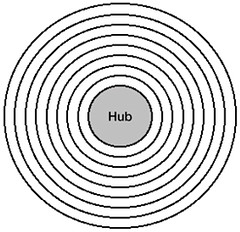
Mobility shed diagramSince I suggested setting up such hubs, centered around transit stations, dating to 2006-2008 ("Updating the mobilityshed / mobility shed concept"), it doesn't seem all that innovative to me.  (When I was writing about it, so too was the University of Michigan transportation center.)

More recently, the mode listings were updated in terms of a broader platform for sustainable mobility.

-- "Further updates to the Sustainable Mobility Platform Framework," 2018

And when I was involved in a bicycle facilities firm aiming to participate in the bike sharing space, we proposed similar kinds of layering, that you could integrate bike sharing systems with parking systems, and include electric charging infrastructure, have wayfinding systems and community information centers as part of the station kiosk system, and even create "transportation demand management stores" ("") on the front end of back end repair and operations depots.

Open Parking System diagram (Urbikes)

Integrating multiple modes by requiring different providers to work together.  What makes the Pittsburgh initiative ("A Micromobility Experiment in Pittsburgh Aims to Get People Out of Their Cars," CityLab) somewhat interesting is that instead of the city doing the integrating, they put out a tender calling on the for profit providers to work together and come back with integrated proposals.
But hearing from those residents was an affirmation for Ricks that the introduction of a few hundred so-called micromobility devices was not going to make the answer for everyone. “We know that Razors on steroids are not a safe way for a mom to take her kids to school,“ she said. “So while we still wanted them, we also wanted to be able to provide something else to improve that situation.” ...

That knowledge, and the stories at Mobiliti, helped seed Ricks’ idea for what is now the Pittsburgh Micromobility Collective, a self-organized, private consortium that aims to bring a range of “new mobility” services across the city. Led by the dockless bike and scooter startup Spin, the group also includes Zipcar, Ford Mobility, Waze, the scooter parking solution Swiftmile, and the Transit app. Earlier this year, the companies collaborated in response to a request for proposals from Ricks’ department, which called for a complement of car-free transportation options that customers can access and book through a single platform.

Their winning plan, which was one of five submissions, envisions “mobility hubs” clustered near transit stops throughout Pittsburgh. There, travelers would find some combination of bike-share stations, Zipcar vehicles, Waze carpool pickup spots, and parked and charged e-bikes and scooters from Spin to rent. The Transit app would handle route planning and ticketing services to customers, and Ford Mobility would feed data analytics back to the city.
Prototyping German style transport associations.  This is tricky.  While I think that all mobility providers should have to participate in a broad transport association which integrates planning, servicer, and operations, along the lines of a German Verkehrsverbund (VV), it's not clear that there are good examples, even in Germany of for profit and government agency actors all getting along.

-- "The answer is: Create a single multi-state/regional multi-modal transit planning, management, and operations authority association," 2017
-- "Verkehrsverbund: The evolution and spread of fully integrated regional public transport in Germany, Austria, and Switzerland," Ralph Buehler, John Pucher & Oliver Dümmler, International Journal of Sustainable Transportation (2018)
-- Transport Alliances - – Promoting Cooperation and. Integration to offer a more attractive and efficient Public Transport, VDV, trade association for German transport associations

So Pittsburgh is moving things forward.

By contrast, bike share programs operated by Boston and San Francisco actively opposed "competition," even to the extent of seizing bikes ("Another example of the need to reconfigure transpo planning and operations at the metropolitan scale: Boston is seizing dockless bike share bikes, which compete with their dock-based system").

Berlin's integrated transit app: integrated apps as an element of brand leadership.  Although in Berlin, they've created a mobility app that integrates both transit modes provided by the transport association and non-transit modes offered by private firms ("Berlin's new transit app Jelbi connects all modes in one place," Fast Company).
The app, Jelbi, which will launch this summer, connects services that currently each have apps of their own, making it difficult to plan a trip or buy tickets given the number of choices. “We have eight bikesharing companies in the market, alone,” says Christof Schminke, the managing director in Germany for Trafi, the tech company that built the platform for BVG, Berlin’s public transport company. “I think it’s a good sign that Berlin has all the mobility options, but for every service you need a separate app on your smartphone.”

BVG, which runs the city’s subways, trams, buses, and ferries, wanted to become a broader mobility provider for Berlin. “They also saw a competitive threat, because there are also other players, like automotive companies or the Ubers of the world, that are also starting to integrate other modes of mobility… they didn’t want to leave it to private players to [take on] this integrator role,” Schminke says. Other companies, like the startups offering bikes and scooters, saw the benefits of connecting with a public transit platform and getting more riders.
So maybe I am wrong in my past writings where I suggest that it isn't necessary to have an integrated app linking all modes, since most people are likely to use just a couple modes and are inclined to "self-integrate."

-- "integrating payment systems in the Sustainable Mobility Platform," 2018
-- "Chicken and egg transit planning: Greater San Francisco and the Clipper Card upgrade," 2018


From a branding perspective, even if it might not be absolutely necessary to provide one integrated app, it is key for the transit agency to maintain a prominent position in the mobility landscape and not unnecessarily concede its position, by yielding coordination of the sustainable mobility platform to for profit providers.

Here you can rent bicycles, car-sharing cars, electric scooters and soon also e-scooters with the new app: the new Mobility Hub at S-Bahn station Schönhauser Allee. Photo: Gerd Engelsmann, Berliner Zeitung.

According to the BZ, Jelbi is the Berliner word for yellow, and yellow is the primary color used by  the BVG transit system.  They are using the same word and design for both the transit app and micromobility hubs ("BVG turns on Jelbi This new app is intended to revolutionize Berlin's traffic" and "First hub for mobility In Kreuzberg, the change is now easier").

The aim is to include as many providers as possible, but rather than include everyone at the outside, providers are being integrated into the app in phases, and some firms, like Car2Go, have declined to participate.

As demonstrated by Berlin and Pittsburgh, government agencies do need to step up to be able to continue to assert the primary leadership role in the sustainable mobility platform, to be innovative when media coverage tends to accord innovative practice to the for profit firms, which fueled by venture capital and other big money normally move much more quickly.

Surcharges for ride hailing trips. Ride hailing -- Uber, Lyft, and others -- shifts trips from transit to private automobiles, hurting transit agency revenues and increasing congestion. So it's reasonable to put surcharges on the trips, to pay for the negative effects.  Chicago is proposing a $3 per trip surcharge ("Mayor Lightfoot's proposed ride-share fees would be the highest in the nation. But other cities are also considering hikes," Chicago Tribune).

As I state repeatedly, it pisses me off that in DC, the tax on a ride hail trip is 6% and sales tax on a car share trip is 10%.

Scooter rides now more expensive than a bus or subway trip.  Recently, led by Bird, scooter companies have significantly increased their pricing.  Originally, the cost was 15 cents/minute plus a $1 flat fee per trip.  New entrants conformed to the pricing, but some didn't assess the per trip fee.

But prices have gone up considerably.  The Washington Post ("That scooter ride is going to cost you a lot more") made a table showing the cost of a ten minute trip.  Now the cost is significantly higher than a typical bus or subway ride.

This isn't a surprise.  It's hard to show a for profit business model for scooters that shows the likelihood of significant profits justifying the big investments made in the sector thus far, made by firms seeking extranormal returns.  The scooters don't last that long and not that many people use them.  There's a reason bike share is subsidized...

I can see scooters being integrated into community bike sharing systems, but it would be at a subsidy.  In terms of for profit operations, I don't think the business is sustainable. 

Labels: , , , , , ,