Rebuilding Place in the Urban Space

"A community’s physical form, rather than its land uses, is its most intrinsic and enduring characteristic." [Katz, EPA] This blog focuses on place and placemaking and all that makes it work--historic preservation, urban design, transportation, asset-based community development, arts & cultural development, commercial district revitalization, tourism & destination development, and quality of life advocacy--along with doses of civic engagement and good governance watchdogging.

Thursday, August 10, 2023

Lies, damn lies, and misleading data: bus service (DC Circulator)

When I went to college there was a book "famous" in economics called Lies, Damn Lies, and Statistics, about the manipulation of data.

In reporting on transit ridership, I am bothered when they don't report ridership by bus line or day of the week, but "by the year."  

There was a reddit entry about this on the Alexandria bus system, touting 5 million riders last year, a system high, without discussion of daily data.  It turns out they have about 10,000 riders during a typical weekday, on 12 bus lines. Probably most of the ridership is on the King Street line, which connects the King Street Metrorail station to Old Town.

This comes up with the DC Circulator.  For years they haven't been reporting data by bus line--there are six.  Obviously it's because most of the lines have minimal ridership.   This is from a blog entry, "Semi-reprint: Methodology for determining transit expansion" from 2014:

DC Circulator ridership per day
High and low service months (2013 data)

RouteRidership PeakMonthRidership LowMonth
Georgetown-Union Station6,600June5,500February
Woodley Park-McPherson5,060February4,000November
Union Station-Navy Yard1,700July900November
Rosslyn-Dupont Circle2,750July2,550October
Potomac Ave.-Skyland1,650September1,150November


I had no idea that the ridership of these various bus lines was so pathetic. I knew they were bad mostly, but I had no idea how low the ridership is--other than the fact that I look at every Circulator bus that I pass and judge the amount of ridership on that particular bus, and most cases, except Downtown-Georgetown and sometimes on 14th Street, the number of riders appears to be minimal.

2. Circulator expansion is a form of what I call political bus service, provided to assuage business or neighborhood groups, but not really justifiable on a cost basis, because it gets minimal ridership.

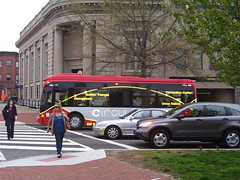
Circulator bus at a stop on 14th Street NW.  

The reason this matters is that besides "branding" the most significant element of Circulator service is frequency, ideally every 10 minutes.  

But to justify that level of service cost-wise, you need high ridership, [ideally] 9,000 to 12,000.

DC's highest used buslines provided by Metrobus provide service as frequent as every 6-8 minutes during peak times, and have from 15,000 to 20,000 daily riders.

Even though DDOT makes information about the services available, they are not subject to the same budgetary pressures as the transit services offered by Metro, because the Metro budget process is much more public because their fare and route system is subject to federal regulations about how changes can be implemented, while locally-provided services don't have the same requirements.

So they evade real scrutiny.

3. This is why for many years I have advocated for the creation of an objective set of service metrics and standards for locally-provided transit service, so that decisions about what to offer or to not offer can be made in an objective, non-political, cost effective manner.

===========

I threw up my hands about the Circulator years ago, calling it "political bus service"--created to assuage particular neighborhood groups, not because it's needed ("Throwing up my hands and the "Anacostia" "Circulator"," 2010).

The fact is that public services ought to be offered where they are used, although breadth--offering services where they wouldn't otherwise be available--is an important criterion too.  The thing is, most Circulator bus lines duplicate in some ways Metrobus service.

Anyway, Greater Greater Washington has an article on the Circulator ("The DC Circulator's electrification dilemma"), saying that the city shouldn't cut back services in order to pay for electric buses, that reducing bus service is a different way of contributing to greenhouse gas emissions.  It turns out, introducing electric buses and cutting three lines might actually be the way to get rid of the minimally used services.

The Circulator bus service has six lines.  With 5.7 million riders in a year pre covid, that's an average of 2,735 riders per line per day.  That's pathetic for a city that pre-covid, had multiple Metrobus lines with ridership between 12,000 and 28,000 each day during the week.

But now total ridership is almost 1/3 of that level, so it's fewer than 1,000 daily riders per line.

Note: all transit systems are screwed ridership-wise these days, given the impact of work from home on ridership.  Most systems have less than 50% of pre-covid ridership, although there are a couple of exceptions.

So I understand the dilemmas of transit planning in that environment.  On the other hand, it's all the more reason to discontinue services that are not only minimally used, but duplicated by other services.

====

Here in Salt Lake City, a local sustainable mobility group advocated for a dedicated bus lane on a street with only four lanes, for a bus line with fewer than 2,400 riders per day.  That's crazy.

I am reminded about a section in one of the books I read about the Vietnam War, that the US kept reporting battle victories duly written about in the New York Times, but a journalist mapped each battle, and noticed that each one was that much closer to Saigon, indicating that actually the US/ARVN were losing territory.  

Labels: , , , , , ,

Thursday, June 09, 2022

Metra/Chicago creates a well priced German style all-mode transit pass

 Last week, I wrote a post, "Montreal first North American city with German/London style fare pass good on all transit, even local railroad services," after charlie called our attention to how the transit system in Greater Montreal is moving to a German style all-modes-in-one fare media system, which is really the first example of this in North America.

It appears that Metra, the commuter but 7 day/week railroad serving Chicagoland (mostly serving Illinois, with one line to Wisconsin, while Indiana is served separately from Metra), is sort of kind of backing into a similar system.  

In the past they've had a monthly pass, ranging from $116 to $275 depending on distance ("Metra to offer new $100 monthly pass, the latest change to draw back riders," CT), plus two add on pass options for local transit--a peak CTA rail and city and suburban bus pass ($55) or suburban only bus pass ($30).

But earlier this month, to stoke ridership in the face of pandemic decline, they've moved to a $100 monthly commuter pass.  And since they've announced a $30 add on city and suburban local transit pass, for a total of $130 ("CTA and Pace to offer new pass for Metra riders, as commuting habits change," Chicago Tribune).  

This is a significant reduction in price, as little as 1/3 the cost for some riders compared to previous rates.

Now it's not available in reverse, in that a CTA/Pace monthly pass for $75 can't add full rail access for $55.  But it's a start.

In a way, the Metra combo is better than the German options, because those increment higher based on zones, where due to the pandemic fall in ridership, Metra has shifted to a flat rate pass.

Conclusion: Desperation can lead to innovation.  In working in revitalization, I used to compare DC--a strong real estate market, and Baltimore--a weak real estate market, a lot, making the point that Baltimore had a "desperate willingness to experiment because they have no other choice."

Chicago's Nederlander Theatre and a busy Randolph Street on March 12, 2020, in downtown Chicago. (Terrence Antonio James / Chicago Tribune)

Metra and the Regional Transit Agency (RTA) are desperate because the pandemic has crashed visitorship and commuting to Chicago, destroying their ridership and revenues.  

At the same time, workers are liking telecommuting because it cuts the time and cost of telecommuting.  Bosses do like outsourcing the cost of office space to workers at home, but at the same time, want to see people in the office, out of the belief (which I believe) that people accomplish more when interacting.

With such significant reductions in transit cost, this is an economic development strategy for Downtown Chicago.  Fortunately, Chicagoland has a dense center city and commuter railroad transit network where they can pull this off.

====

I was talking to someone who knows someone who works for the Utah Transit Authority, who told him that the cost of collecting and process money is roughly equal to the revenue collected, so that the authority could move to a free transit system at no cost*.  But the Utah Legislature--70% Republican, 90% Mormon--is opposed to providing free transit.

* Note that in high transit use systems, the fear of moving to free transit is based on a rise in ridership, requiring more personnel and more equipment, so it would cost more and revenue would drop significantly as well.

Labels: , , , , , , ,

Wednesday, June 01, 2022

Montreal first North American city with German/London style fare pass good on all transit, even local railroad services

"One network, one schedule, one ticket." Hamburg in Germany pioneered the VV, or transport association, which links all transit service providers in an area into a single group, providing an integrated transit system with a fare payment system that integrates all modes.  That means bus and underground, commuter railroad, ferries, and if present, trams.  (The VV model has been adopted in Austria and Switzerland too.)   

-- "Verkehrsverbund: The evolution and spread of fully integrated regional public transport in Germany, Austria, and Switzerland," International Journal of Sustainable Transportation
-- "Branding's not all you need for transit," 2018

After the initial idea, which was focused on making transit easy to use, it took many years to get all the transit agencies on board, but over time, the Hamburg VV spread into neighboring states, and then was adopted as a national policy.

Germany's passenger railroad services are run by Deutsche Bahn, the national railroad, at multiple scales, including commuter railroad services around cities.  Over time, DB agreed to integrate these services, called S-bahn, into VV programs.

According to a brochure published by the MVV, the transport association serving Greater Munich in the German State of Bavaria, the association:

carries out key tasks which include creating a joint tariffs and fares structure, distributing revenues, planning, controlling tenders and contracts with regard to regional bus transportation, system marketing as well as market research, providing customer information across various transport companies, in particular web-based timetable information across the association, conceptual transport planning as well as traffic and transportation research. In addition, the transport association passes on its expertise to third parties on a consultant basis.

London has a similar fare system if you live there, where the weekly TravelCard covers bus, subway, tram, light rail and local railroad services called the London Overground, which used to be run independent of Transport for London, so they weren't included in local transit fare systems. Unlike the systems in Germany, ferry travel is separate. (Liverpool includes ferries in certain passes, but not excursion ferry travel.)  More recently, intra-London trips on National Rail are also covered in the TravelCard pass system.

US transit pass programs don't include railroad (or ferry) services.  US transit pass programs may integrate bus, subway and streetcar services, but "never" local railroad services.  

Although recently there are a couple of special exceptions, on equity grounds like in Boston, which includes in-city transit on the Fairmount rail line ("Boston’s Fairmount Line Could Be a National Model for Commuter Rail, But It’s Not There Yet," Streetsblog) and Chicago ("South Cook County Fair Transit Pilot for railroad as local transit").  I don't know of local ferry services, even when offered by the transit authority, being included in transit pass programs.

WMATA, the system in greater DC, is unusual is that it charges by mode, meaning you pay separate fares for subway and bus, even if you use both on one integrated trip.

Most US cities don't have an extensive set of intra-city railroad stations, although Boston, Chicago, New York City, and Philadelphia are the exceptions.  Montreal and Toronto have a fair number of in-city train stations, but not at the scale of a network.

There are initiatives  to include some railroad services in transit pass products in New York City ("Relief for New York City’s Transit Deserts? Commuter Trains Might Help," New York Times), and consideration of it in Philadelphia ("SEPTA releases options for future of Regional Rail," Mass Transit).  LIRR and Metro-North are testing $5 flat fares for in-city travel, but that's still almost double the single trip subway/bus fare ("Flat fare $5 CityTicket sales ‘soared’ on LIRR and Metro-North," AMNY).

I have recommended the consideration of such in DC and Baltimore ("One big idea: Getting MARC and Metrorail to integrate fares, stations, and marketing systems, using London Overground as an example," 2015), but hadn't thought about it so much wrt the Virginia Railway Express but should.  If MARC and VRE were to merge ("A new backbone for the regional transit system: merging the MARC Penn and VRE Fredericksburg Lines,") it would be a no brainer.  But to be beneficial, there would have to be an expansion of train service within the cities, complementing local transit.

Free local transit as an add-on benefit for railroad riders.  I know of four examples where railroad riders can ride local transit for free, while no additional charge railroad access isn't extended to local transit pass users in those systems.  

In Baltimore, pass holders for MARC, the railroad service, can ride local transit (bus, subway, light rail) for no additional charge. And they can ride Metrobus in the DC area, and local transit in Montgomery  and Frederick Counties for free as well.   VRE pass holders within Northern Virginia have free access to Metrobus, Fairfax Connector, and Omniride to and from train stations, but not throughout the day, unlike the benefit for MARC riders..

In Southern California, Metrolink train riders can ride local transit for no additional charge, including subway and light rail, by scanning the QR code on the ticket. 

In North Carolina, the State DOT provides Amtrak riders with free access to local transit (bus) ("North Carolina DOT negotiates free bus transfer access for Amtrak users," ). 

Montreal: the first North American transit system to include railroad services in all transit passes. Montreal has long been a leader in transit practice and policy, and sustainable mobility ("Is Montreal the number one city for bicycling in North America?" and "One more thing about Montreal as a `bike city`").  The city transit agency long ago integrated local car sharing and bike sharing into their transit pass.

charlie calls our attention to how Montreal's regional transit authority has created a set of regional passes all of which include access to railroad transportation ("How Much New Montreal Area Transit Fares Will Be Depending On Where You Live," MTL Blog).  From the article:

On July 1, the regional transit authority, the ARTM, is introducing new transit fares in Montreal, Laval and Longueuil, completing the rollout of a simplified pricing system in the whole metro area. 

The new scheme divides Greater Montreal into four zones: A, B, C and D. Fares will depend in part on the zones transit riders need to traverse to reach their destination. 

 Excitingly, commuters in every zone will have access to single fares that cover all modes of transit: bus, metro, exo train and the forthcoming Réseau express métropolitain light-rail network.

This is a BIG DEAL.  And the closest any North American city is to the VV model. (What's interesting in the VV model is that it frequently crosses jurisdictions, whereas in the US, cross-jurisdictional integration, especially across states, is exceedingly rare.)

Historically, the City of Montreal has had an integrated transit pass (STM is the transit agency, which like MUNI in SF operates only within the city, with the exception of a small portion that connects to one of the adjacent suburbs).

Like other big cities, it didn't include railroad access, because those services were run separately, by a regional railroad authority under the Provincial government.  A few years ago, the Province and the cities reorganized transit planning and service delivery, providing a path for integrating railroad services into the local transit program.

Thinking about transit fares as a design product.  "Branding's not all you need for transit" lays out three elements for transit success: (1) integrating services; (2) applying the design method to transit/treating transit as a "design product;" and (3) branding.  

The idea of "one network, one schedule, one fare" brings this all together.  But too often, transit fares aren't thought of as a design product, more as something to generate revenue.

So I've been thinking about laying out a way to think about this, although this is at best a draft.

Transit passes versus transit fare cards/contactless travel versus cash.  Note that most systems have introduced fare cards and now various phone-based apps, to pay for transit.  This is to reduce costs from handling cash.  As a result, fare card holders usually get discounted fares compared to the one off price of paying for a single ticket by cash or credit.

Sometimes people confuse the idea of transit passes, paying for transit a week or month at a time, as the same thing as the transit card.  They are a form of payment, and may or may not be integrated into fare card systems.  In many places, legacy railroad passenger services haven't been integrated into regional fare card systems. (For example, London, there are card readers.  For LIRR and Metro North and MARC and VRE they use conductors.  The "new" SMART rail in Sonoma and Marin Counties, was able to integrate fare card readers from the start.  Etc.)

Tickets not passes (but may be used with a transit card)

  • Single Fare ticket cash/credit
  • Single Fare using a transit card (usually even single tickets are cheaper using a fare card, compared to a cash/credit fare)
  • transfer free or an extra charge (some systems charge a flat fare per trip, often with a time limit, some charge more for transferring to another bus or mode)
  • All Day Pass (often excludes use during the morning rush)
  • Daily Fare Ceiling/Capping (London has a maximum per charge per day for rail services and bus services)
  • Special Event Transit (some places include free transit with sports and concert tickets, "Seattle Kraken expansion hockey team sets new standard for transit benefits in transportation demand management: free transit with ticket")
  • Evening and weekend passes (Melbourne was an early innovator,  may be discontinued in favor of fare capping)
  • Group Fares (cheaper price for multiple people compared to each paying individually)

Passes
The point of a pass is that it is discounted in price compared to the cost of paying a fare separately for each trip (traditionally, although they changed as ridership dropped, the WMATA system's passes weren't especially discounted).

Usually sold on a weekly or monthly basis.  Some places offer an annual pass, paid at one time, discounted from the cost of 12 separate monthly passes (German VV systems, Switzerland).  

  • Transit Pass (weekly or monthly)
  • Transit Pass for Youth (free or charged)
  • Transit Pass for Low income riders (free or charged, various eligibility criteria)
  • Transit Pass for Seniors (usually discounted, sometimes free)
  • Fare Capping (maximum amount that you will pay in a day; London charges separately for rail capping and bus capping; London and Melbourne were early adopters)
  • Pay as you go Transit Pass (for equity reasons, some systems are implementing pay as you go fares, which once you pay the equivalent of the cost of a transit pass, it stops charging for the rest of the pass period.  See the Transit Cooperative Research Program report, Fare Capping: Balancing Revenue and Equity Impacts.)
  • Tourist passes (special prices, usually for a multi-day period, usually local like the Hamburg Tourist Card or SF Visitor Pass, but may include national transit services, e.g., Eurail pass, may be for one person or multiple people)
Bundled services with passes 
examples, not a comprehensive list
  • subway/bus/light rail (Boston/Philadelphia)
  • subway/bus (New York City)
  • subway/light rail, bus, streetcar, cable car (SF)
  • railroad, subway, bus, ferry (Hamburg)
  • railroad, subway, bus, light rail/tram (Munich, Berlin, London)
  • railroad, subway, bus, light rail* (Montreal) * = forthcoming
  • subway (which is actually railroad), bus, ferry (Liverpool)
Bundled services with railroad service
  • free local service with railroad ticket or pass--Southern California Metrolink
  • free local service with railroad pass--Baltimore/MARC (it's important to note that this includes free transit service in Baltimore, but not subway service in Washington)
  • free local service to and from the train station for Virginia Railway Express
  • free local bus transfer for Amtrak riders getting off in North Carolina (NC By Train Transit Pass)

Free transit
examples, not a comprehensive list
See "No Fares," Tyee and "Revisiting free transit in the wake of the decision in Kansas City ... and Lawrence, Massachusetts," 2019)

  • free route: bus lines (Boston is testing this, the 500 route in Salt Lake provides service to the State Capitol)
  • free route: circulator services/core transit services (Baltimore Circulator, Savannah core)
  • free route: shuttles
  • free zone: fareless zones in the core, usually for rail, but sometimes including bus (Calgary, Salt Lake City, Pittsburgh, Melbourne)
  • free system: for residents not visitors (Talinn, Estonia, Kansas City, Banff instituted free transit for residents at the end of May 2022)
  • free system: for all users--college towns (Chapel Hill)
  • free system: for all users--resort towns (Park City, Aspen)
  • free system: for all users--an entire country (Luxembourg, for transportation demand management reasons)

Labels: , , , , , ,

Thursday, March 25, 2021

I guess the San Francisco Bay region needs a German style "transport association" too

The San Francisco Chronicle reports ("Chiu re-introducing bill to integrate Bay Area transit — and create universal Clipper Card") that State Assemblyman David Chiu wants to pass a bill that requires all the transit agencies in Greater SF to create an integrated map of all the transit services, and require that all transit agencies accept the Clipper card.  From the article: 

The Bay Area Seamless and Resilient Transit Act would establish deadlines for the Bay Area’s 27 different transit operators to create an integrated transit map for the region. 

It would also require the region’s Metropolitan Transportation Commission to create a pilot program for a unified fare pass that would allow commuters to travel across different transit operators while paying a fixed fare. Currently, some Bay Area transit agencies don’t rely on the widely used Clipper Card system, including ACE and Capitol Corridor trains.

The funny thing is that the SF Bay area is a leader in terms of transit service integration, and their transit fare media card, Clipper, is used on most services, even Caltrain, the regional commuter railroad, and they publish a bunch of good maps, and work towards service integration, such as their night transit network -- both are national best practices.


But apparently there are gaps.  And probably the gaps are bigger than Assemblyman Chiu realizes.  I'd recommend the creation of a German style transportation association, they are already a long way towards this, despite the gaps. 

I wrote about this a few years ago, in response to SF area advocates grousing about the Clipper card, and I said they weren't thinking big enough.

-- "Chicken and egg transit planning: Greater San Francisco and the Clipper Card upgrade

German transport association as a model of transit service integration.  In "The answer is: Create a single multi-state/regional multi-modal transit planning, management, and operations authority association," focused on DC, and "Branding's not all you need for transit," more generally, I discuss how the German transport association model should be adopted in those US metropolitan areas where multiple agencies are responsible for transit delivery, especially across jurisdictional borders.

--"Verkehrsverbund: The evolution and spread of fully integrated regional public transport in Germany, Austria, and Switzerland," Ralph Buehler, John Pucher & Oliver Dümmler, International Journal of Sustainable Transportation (2018)
-- Transport Alliances - – Promoting Cooperation and Integration to offer a more attractive and efficient Public Transport, VDV, the trade association for German transport associations.   

In the VV or Verkehersverbund model, the master transport association is in charge of planning for all modes, with a focus on creating a fully integrated set of services and fares.  (Transit in Greater London and Paris operates similarly.)  

All the operators are part of the association, and can be a mix of government-owned and for profit operators.  Who does what is hidden from the rider--all they see is that everything is connected and one fare media card is required.  

Note that this can be done collaboratively, without a formal mandate, the way that transit agencies in Raleigh-Durham, North Carolina have rebuilt their transit system over the past 10-15 years ("Will buses ever be cool? Boston versus the Raleigh-Durham's GoTransit Model").

And it can be difficult to integrate for profit mobility services that are more self focused, like car sharing firms, or bike share, especially if they compete with mass transit and/or government-provided services, like bike share.

Mobility as a service and transit farecards.  The piece on SF from a few years ago, "Chicken and egg transit planning: Greater San Francisco and the Clipper Card upgrade," focuses on how advocates wanted there to be seamless use of Clipper across mobility services including ride hailing and others.  I argue that while that is ideal, it may not really be necessary, and for profit entities aren't always good partners when it comes to this kind of integration.

It is happening more frequently, and in Berlin, the transit agency BVG actually took the initiative to create such a system, called Jelbi, contracting it out to application developer Trafi, which has developed similar apps for ride hailing firms like Lyft ("BVG Jelbi — world’s most extensive MaaS solution in Berlin").


BVG was successful in getting non-transit vendors to participate in the program.

To me,  it seems as if BVG decided to be the first mover in developing an overarching app figuring it was the best way to keep their place at the transit table, remain the top of mind leader in mobility innovation, and to keep their customers in the face of serious competition from private mobility providers less concerned about the viability of mass transit ("Berlin's new transit app Jelbi connects all modes in one place," Fast Company).

Over time, my sense is that transit media cards will be discontinued in favor of smartphone apps, and integration will either be easier or less of an issue.

Labels: , , , , ,

Tuesday, July 02, 2019

Big pro-rider changes in transit pass products by WMATA (DC area Metrorail)

Years ago, "I was impressed by my analysis" of how WMATA charges by mode, not by trip, meaning a trip involving subway and bus required two fares (less a 50 cent discount), and that this boosting of fare revenue helped to reduce fare-subsidy related appropriations by local jurisdictions.

-- "Getting WMATA out of crisis: a continuation of a multi-year problem that keeps getting worse, not better," 2015

The problem is that WMATA's fares are getting to a ceiling point, with long trips having a peak fare of around $6 plus bus fare if applicable or parking fees.

Even short distance trips aren't that cheap.

And except how bus trips between systems involve no additional fare, the transit pass products had been pretty expensive, compared to cities like San Francisco and New York City.

Poster promoting new rider-friendlier transit pass product pricing, WMATA/Metrorail, DC area
Poster promoting new rider-friendlier transit pass product pricing, WMATA/Metrorail, DC.

This results from the fact that Metrorail is a hybrid, a longer distance commuter railroad married with a shorter distance subway system simultaneously serving the urban core, denser suburban areas, and more deconcentrated suburban areas.

But in last year's budget process, given the drop in ridership, WMATA proposed a number of pro-rider changes to pass products, including even a price reduction for four different pass products including the bus pass, and the addition of free bus service to subway pass products.

They went into effect yesterday ("WMATA adding more service, more affordable pass products," Metro Magazine).

That's a big win.

====
From an equity standpoint, the next step would be for local jurisdictions to create discounted fare cards based on income, such as what is done in San Francisco and Seattle, and more recently in New York City (where it is still being implemented).

E.g., in SF, a low income transit fare card is half price.

And in cities like London, where there is automatic incrementing of fares til you reach a cap, you could have a separate low income transit fare card that starts out "pay as you go" and once you reach the cost of the card the rest of the trips wouldn't involve payment til the next fare card period starts.

Edmonton is talking about implementing such a process.

Labels: ,

Tuesday, February 05, 2019

WMATA service and fare changes for FY2020

WMATA has done extensive communication about proposed fare and service changes for FY2020, printing a brochure with a survey in English and five other languages, and collecting these results at stations, and online survey and comment forms.

... one problem I do have with the new methods is that they are now anonymous, unless you choose to identify yourself.

Comments are due today by 5pm.
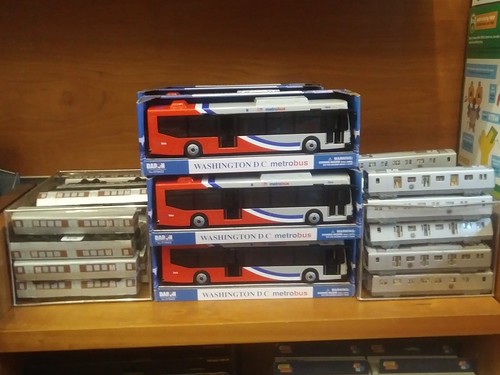
WMATA train car and Metrobus toys
Anyway, by and large, the proposed changes are excellent:
  • changing Yellow Line service to Fort Totten all the time
  • reducing the price of the 7-day bus pass
  • adding free bus service to the 7-day rail pass
  • a flat Metrorail fare of $2 for weekends (which is kind of like something I've suggested in the pass, based on special evening and/or weekend fare programs in Melbourne, Hamburg, and Montreal)
One I am indifferent to:
  • making all Red Line trains end at Glenmont
And one I have serious reservations about:
  • expand weekday peak service times, changing the hours of peak service to 5am to 10am -- 30 additional minutes -- in the a.m. and from 3pm to 8:30 pm in the evening -- 90 additional minutes.
1. It's not that I don't favor more frequent service.

2.  It's that in the past, WMATA has charged peak service fares during these time periods, while at the "shoulders" of each period providing less than frequent service.

3.  Charging more for less service is unreasonable.

4.  For WMATA to add peak service fares, by extending rush periods in the morning and evening, they should be required to guarantee they will provide additional service.

Labels: , , , , , , ,

Monday, December 10, 2018

Fare evasion and returning to the days of "Defining Deviance Down"

Last year, NYC decriminalized transit fare evasion, at the instigation of the District Attorney ("Manhattan DA To End Most Prosecution for Fare Evasion This Fall," New York Observer).   DC has just passed legislation to decriminalize transit fare evasion ("DC Council Approves Decriminalization of Metro Fare Evasion," NBC4).

The metropolitan transit agency, WMATA/Metrorail doesn't support the legislation, and claims that policing fare evasion contributes to crime reduction on the system.

The issues with decriminalization are fourfold:

(1) the loss of revenue to transit systems and how decriminalization impacts compliance;

(2) linkage between fare evasion and committing other crimes;

(3) transit access of the impoverished; and

(4) perceived differential enforcement against people of color.

It turns out there is some academic literature out there on the subject, including the book, Secure and Tranquil Travel: Preventing crime and disorder on public transport.

Increased tolerance for crime and disorder versus zero tolerance policy as a response.  Decades ago, Daniel Patrick Moynihan wrote a seminal article, "Defining deviancy down: How we've become accustomed to alarming levels of crime and destructive behavior," making the argument that out of sense of being overwhelmed by crime and not having the resources to respond, certain crimes were redefined as not being crimes.

The proposed response to "public tolerance of intolerable behavior" was to increase police enforcement using the "zero tolerance" approach.

Zero tolerance as repression, especially of people of color.  Many pushed back ("Defining Deviancy Down": How Senator Moynihan's Misleading Phrase About Criminal Justice Is Rapidly Being Incorporated Into Popular Culture," Journal of Criminal Justice and Popular Culture, 1994) arguing that was this meant in practice was further police repression meted out against the underclass.  Or that actions that shouldn't be considered crimes, were made into crimes, therefore "defining deviance up."

Fare evasion as an element of criminal activity.  Former transit police chief and later NYC Police Commissioner William Bratton believed that fare evasion was a crime that wasn't victimless, and associated with other criminal acts.

He argued that turnstile jumping was one element of people's perceptions that the subway system was unsafe.  And that people who were fare beaters tended to commit other crimes on and off the subway system, so that arresting fare beaters ended up reducing crime overall. 

From The Formula: How Algorithms Solve All Our Problems . . . and Create More:
... at a time when crime on the subway was at an all-time high, Bratton focused his attention on making sure that people paid for their tickets. His reasons .. were simple: fare evasion was a gateway drug to more serious crime.
Legitimate riders felt they were entering a place of lawlessness and disorder. They saw people going in for free and began to question the wisdom of abiding by the law. The system was veering toward anarchy. By stopping and searching law violators for even the most minor of infractions, troublemakers decided it was easier to pay their fares and leave their weapons (which were often uncovered during searches) at home. Crime fell exponentially.
Studies, such as by the New York City Transit system ("Measuring and Controlling Subway Fare Evasion: Improving Safety and Security at New York City Transit Authority"), Philadelphia ("SEPTA: Felonies down after crackdown on fare-evaders," Philadelphia Inquirer), and in the Netherlands ("The Effects of Increasing the Certainty of Punishment: A Field Experiment on Public Transportation," European Journal of Criminology) find a link between crime reduction and fare payment enforcement.

Also see "Sorry, but jumping a turnstile is not like getting a parking ticket," Washington Post).

Fare evasion as a function of poverty.  Arresting fare evaders has often been criticized as an initiative with disproportionate negative impacts on the impoverished ("Fare evasion is a crime of poverty," New York Daily News), especially people of color ("Subway Policing in New York City Still Has A Race Problem," Marshall Project). And this is in fact true.

The San Francisco Chronicle article, "How bad is BART fare evasion? We saw 90 people in 92 minutes slip through the gates," includes a time-elapsed video of fare evasion at the 16th Street/Mission Station.

 Photo by Gabrielle Lurie: A man jumps the turnstile at the BART station at Civic Center despite gates that were installed (seen at left and right) to deter fare evasion in San Francisco, California, on Thursday, Aug. 16, 2018.

Need to distinguish between the ability to pay and anti-social and criminal behavior.  In dealing with fare evasion, I think it's important to separate out criminal behavior from those people evading more out of being impoverished.

Fare Evasion
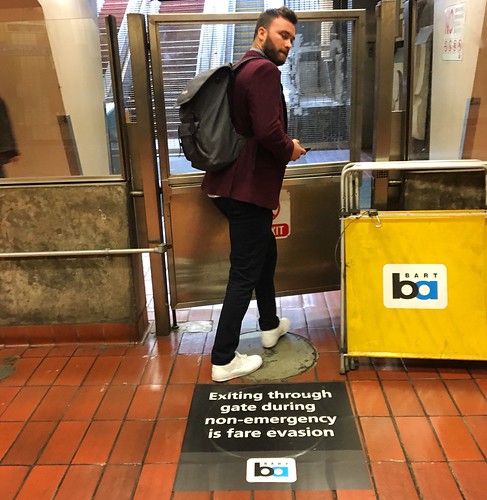
BART system.  WMATA has similar signs, less well designed, posted on the emergency gates in stations.  Photo: Dan Brekke, Flickr.

Rather than decriminalize fare jumping, because of how it contributes to people's sense of lawlessness and because of the association between fare jumping and criminal activity, I would rather see center cities provide reduced price transit service for the impoverished.

The solution to low income people needing transit assistance is to provide transit assistance, not to make it easier for people "to steal" from the public via the local transit agency,.

New York City's just done it ("New York Will Cut Transit Fares for Low-Income Riders," CityLab).  Cities like San Francisco already do.  Some bike sharing systems provide low cost or no cost access for people on income and/or housing assistance programs.  Other cities may not have a low income transit pass but provide discounted or free transit passes to youths--and youths, especially teens, commit fare evasion disproportionately.

DC does not have a low income transit pass.

Fare evasion seems to rise with decriminalization.  In keeping with the results of some of the studies cited above, NYC Transit has experienced a rise in fare evasion after decriminalization ("Fare Evasion Is Skyrocketing on New York City's Subway. Here's Why," NYT), although the article opines part of this might be a "protest" against bad service.

Photo: Photos By Jessica Christian / The Chronicle. A man is given a citation after failing to pay his fare at Civic Center BART Station during the morning commute in San Francisco, Calif. Thursday, May 31, 2018.

Note too that an illustration of the necessity of distinguishing between fare evasion as anti-social and/or criminal activity versus fare evasion is the San Francisco case.  The city offers some of the best priced reduced cost transit passes in the country for low income residents and youths.  But while these passes include BART access within San Francisco's core, the reduced price transit pass does not include BART stations outside of San Francisco.

So it's possible that fare evasion on the BART system, which mostly lies outside of San Francisco, has a slightly different etiology compared to the SF MUNI system.

Labels: , , , , ,

Friday, September 28, 2018

Chicken and egg transit planning: Greater San Francisco and the Clipper Card upgrade

Integrating transportation planning, delivery, and fares: the Germans do it best.  I am on record for promoting the German style transport association model for those regions that have a multiplicity of jurisdictions and transit operators.  Places like New York City, Philadelphia, DC, San Francisco, Los Angeles County definitely.  Places like Boston where the MBTA runs most of the services not so much.

-- "The power "of understandable graphics: a proposal for integrating NYC-area railroad passenger service
-- "One big idea: Getting MARC and Metrorail to integrate fares, stations, and marketing systems, using London Overground as an example

While there are still different agencies and service providers, the association takes on the responsibility for overarching planning, service, routes, and the creation of an integrated fare and fare media program that is not agency-dependent.

-- "The answer is: Create a single multi-state/regional multi-modal transit planning, management, and operations authority association," 2017
-- "Verkehrsverbund: The evolution and spread of fully integrated regional public transport in Germany, Austria, and Switzerland," International Journal of Sustainable Transportation (2018)

Raleigh-Durham's collaborative model suffices.  Although in the Raleigh-Durham region of North Carolina, they have a variant of this model that is more collaborative and a little less integrated compared to the German model (also used in Switzerland and Vienna, Austria).

-- "Will buses ever be cool? Boston versus the Raleigh-Durham's GoTransit Model," 2017

Metropolitan mass transit planning.  This fits in with my "metropolitan mass transit planning" concept, where network breadth, network depth, levels of service, and levels of quality are planned at the regional scale, and then transit operators are contracted to provide service meeting those standards.

-- Metropolitan Mass Transit Planning: Towards a Hierarchical and Conceptual Framework, 2006/2010

This means that instead of planning and operations being satisficed because of budget, budget is appropriated based on meeting the requirements of the network plan.

In the DC area, this isn't how it's done.  The state line boundaries impose big barriers, e.g., Maryland hates to pay for integrated services along corridors linking DC and Maryland.  In Virginia, the various entities do their own things.  With Bus Rapid Transit, there are three different initiatives (WMATA, Fairfax, Montgomery) plus WMATA's Rapid Bus program (MetroExtra).  Etc.

-- "Route 7 BRT proposal communicates the reality that the DC area doesn't adequately conduct transportation planning at the metropolitan-scale," 2016

Clipper fare system in San Francisco.  In San Francisco, CurbedSF has a series of pieces about the next generation of the Clipper fare card system and faults of the process.

-- "Modernization of Clipper card won’t include high-tech features already used in other cities
-- "Multimillion dollar contract to upgrade Clipper biased toward incumbent, say vendors"
-- "Officials fail to simplify convoluted transit fares before costly Clipper upgrade"

The articles key on the idea of "Mobility as a Service" or what I call the "Sustainable Mobility Platform"

-- "Further updates to the sustainable mobility platform," 2018
-- "Integrating payment systems in the Sustainable Mobility Platform," 2018
-- "DC is a market leader in Mobility as a Service (MaaS)," 2018

and integrating payment for various modes in one fare media system.

Integrating payment systems across for profit and nonprofit modes.  I've argued that this is a lot more complicated than "smart mobility" types make out.  Yes there is a need for there to be "one" fare media system in a state or multi-state region, rather than a different one for each provider.

But integrating so called "smart mobility services" is more difficult, especially when they are for profit firms and operating across multiple markets.

For individual providers of non-transit services that operate across multiple markets, like Zipcar, Car2Go, Uber, Lyft, Jump, Getaround, LimeBike, Skip, etc., the cost of maintaining integrated applications for each individual market is greater than the benefit.

Plus, I wonder how much having all the potential services be integrated matters at the end of the day?  How many people use multiple modes each day versus primary modes, so that one or two fare media payment systems--a transit fare card that works across all modes ideally (rail, subway, light rail, streetcar, bus, ferry, water taxi) + car sharing app or bike sharing app or e-scooter app, etc. even if un-integrated suffice just fine.

Cross-mode integrated fare media card: Montreal.  Note that Montreal has done some of this with the area's initial local nonprofit car sharing provider operating exclusively in its area, plus with the bike share program. 

But it's not like STM added the for profit Car2Go car sharing program to their fare card system.  Still, they might be the only transit agency around that has integrated car share and bike share into their fare media system.  (LA MTA sort of does it with bike share, but not really.)

Provincial-wide/state-wide fare media systems.  In Ontario, the Presto fare media system developed by the Province of Ontario for Greater Toronto via Metrolinx is now deployed in all but one of the province's transit agencies.  So instead of each agency paying to develop a system on its own, there is one overarching provider.

Two metropolitan areas, one fare card system: DC and Baltimore.  In the US, I only know of one place that does something similar across different regions.  Surprising, it is DC and Baltimore, which use the same system, likely because the operator of transit in Baltimore, the Maryland Mass Transit Administration, is also a funder of the the Washington Metropolitan Area Transit Authority (WMATA), so they ported the SmarTrip system to Baltimore.  A CharmCard in Baltimore is basically just a branded version of the DC SmarTrip card and either works on the other.

Note that PATH uses the NYC Transit fare card system, but this is not the same kind of cross-agency fare card program.

Shouldn't more states take this on?  E.g., in California, it would have been great for the State Department of Transportation to bring the large regional systems--Greater San Francisco, Los Angeles and Greater Los Angeles, San Diego, etc.--to develop one basic system comparable to what Metrolinx did in Ontario.

In the DC-Maryland-Virginia area, the Virginia State Department of Rail and Public Transportation should have "required" other transit agencies elsewhere in the state like Richmond or Hampton Roads to use the SmarTrip system, like in Baltimore with MTA.

This would leverage the investment in the system and make it more worthwhile for independent mode providers to link into the system.

Clipper failings are merely symptoms of bigger failures: the lack of a commitment to an integrated fare system, which in turn derives from not adopting the German transport association model.  The Curbed articles miss the point that the real fault isn't about the Clipper fare media system so much as it is that even though the regional transportation planner, the Metropolitan Transportation Commission, is one of the better MPOs in the United States, the various transit agencies don't inter-operate at the scale and depth of integration comparable to a German transport association.  (Even if Clipper works on more modes than any other transit card in the US--two different railroads, BART heavy rail, MUNI's bus, light rail, streetcar, and cable cars, and ferry services.)

Note that in Germany, the model presupposes a preference for optimizing mass mobility and making it less expensive to use (it still isn't cheap), which means providing state subsidies.  One of the reasons that transit agencies are less likely to want to do this in the US is because funding systems are in large part jurisdictionally based.

It wasn't easy to do--after Hamburg figured out and committed to creating a common fare zone and payment system it still took five years to implement the first version. 

Legacy systems are expensive to upgrade.  The articles also miss the point about the problem of legacy systems and the cost of upgrades, and getting all the various entities (including credit/debit card networks) to participate.

-- "The Contactless Wave: A Case Study in Transit Payments," Federal Reserve Bank of Boston

The problem with adopting Apple Pay and other smartphone-enabled payment applications isn't integrating it into a fare card system, it's integrating it into the current fare gate system, likely requiring an upgrade costing many hundreds of millions of dollars.

Although in London, it was done for less than $70 million, although the readers were developed by the fare media system operator, Cubic, the company with the contract in SF.

-- "Redesigning the public transportation experience: London's contactless card system," McKinsey
-- "The rollout of contactless ticketing in Europe," Metro Magazine

Adopting a focus on the quality of the user experience.  The Curbed series makes one particularly excellent point about how transit agencies are falling behind compared to private sector mobility providers like Uber, Lyft, and Chariot in terms of devoting resources to "User Experience."

The sections on:
  • The London Underground (Transport System) as a Design Artifact
  • Transit Systems and Legibility
  • Connectivity and access as questions of usability in mobility planning
  • Wayfinding
  • Overuse of the subway map concept as a way of representing information
from the entry "World Usability Day," discuss this point in greater depth.

There's more competition for the mobility dollar -- public transit--bus, rail, subway, ferry/water taxi; nonprofit bike share; for profit bus; for profit rail (Brightline); for profit car share; nonprofit bike share (SF, Montreal); for profit scooter share; taxis and ride hailing; collective taxi/microtransit; for profit ferry/water taxi; and delivery.

People will use the services that are easier and more comfortable to use.  That doesn't necessarily mean that the cheapest service is the preferred service. 

Public agencies will need devote more resources to "product design" and the user experience in order to remain competitive in the more complex and convoluted environment of "Mobility as a Service."

-- "Further updates to the sustainable mobility platform," 2018

Labels: , , , , ,

Tuesday, July 10, 2018

Greater Washington Partnership issue brief on mobility (transit) fare systems

WRT my pieces on the sustainable mobility platform ("Further updates to the Sustainable Mobility Platform Framework"), the need to create an integrated regional "transport association" to plan and operate transit in an integrated and coordinated manner ("The answer is: Create a single multi-state/regional multi-modal transit planning, management, and operations authorityassociation") and the need to integrate railroad transportation into the transit media fare card system ("One big idea: Getting MARC and Metrorail to integrate fares, stations, and marketing systems, using London Overground as an example")

I had no idea that the Baltimore transit agency and area local transit agencies are looking at separating from the WMATA SmarTrip system.

That would be terrible.

But I shouldn't be surprised, given how discoordinated the region is.

The Greater Washington Partnership has produced a paper, UNLOCKING THE PROMISE OF INTEGRATED MOBILITY IN THE CAPITAL REGION, calling for transit trip planning and fare integration and the inclusion of other modes beyond transit, including private services--something which public agencies have a hard time with ("Another example of the need to reconfigure transpo planning and operations at the metropolitan scale: Boston is seizing dockless bike share bikes, which compete with their dock-based system").

From the paper:
These principles were developed through extensive analysis, direct engagement with stakeholders and decision-makers, and with input from our nationally recognized Mobility Steering Committee.

The Greater Washington Partnership’s Integrated Mobility Principles
  1. Put the user experience at the center of ticketing and trip planning investments
  2. Build capacity for interoperability and new functionality in planning and ticketing systems for public and private mobility services
  3. Ensure that new ticketing systems equitably empower all consumers
  4. Leverage new ticketing systems to learn, experiment, and transform the travel experience
Near-Term Actions
  1. Establish strategic goals and plans for a single platform for all trip planning and ticketing in the Capital Region
  2. Incorporate fare capping into public transportation payment systems
  3. Pursue regional and national funding opportunities that move toward seamless ticketing across all mobility options in the Capital Region
  4. Avoid transportation agency procurements that preclude opportunities to innovate and integrate with other public or private mobility providers across the region
  5. Convene leaders of regional public transportation agencies regularly so they can share what they have learned
Outside of all the various transit services, I don't think that full integration of payment systems beyond transit is essential as I wrote a couple months ago, "Integrating payment systems in the Sustainable Mobility Platform."

Montreal integrated mobility using the STM Opus Card.

However, in Montreal, the stored value transit card can be used for certain bike share and car share applications.  In Ontario, all but one transit agency uses the system developed in Greater Toronto and paid for by the province.  So the same card can be used across the province.

It would be nice, but people manage to deal with having separate apps for different components (car sharing, ride hailing, bike share, scooter share).

More importantly, the amount of one off programming necessary to create such a platform and keep it updated and maintained is considerable and probably not supportable even at the multi-state scale.

What's really needed is for the GWP to advocate for the creation of a German style integrated transport association. Integrating fare media is but one element of such a program.

-- "Route 7 BRT proposal communicates the reality that the DC area doesn't adequately conduct transportation planning at the metropolitan-scale," 2016
-- "The answer is: Create a single multi-state/regional multi-modal transit planning, management, and operations authorityassociation," 2017
-- "Verkehrsverbund: The evolution and spread of fully integrated regional public transport in Germany, Austria, and Switzerland," Ralph Buehler, John Pucher & Oliver Dümmler, International Journal of Sustainable Transportation (2018)--
-- Transport Alliances - – Promoting Cooperation and. Integration to offer a more attractive and efficient Public Transport, VDV, the association of German transport companies

Note that VDV coordinates a common software and IT system for interoperability of fare payment systems called the Smart Ticketing Alliance, which operates across Germany.

Even the Raleigh-Durham GoTransit model of collaboration across transit agencies would be a step forward compared to the DC area, which doesn't even have a single integrated transit information call center.

WMATA bus study.  Separately, WMATA is wondering about the future of its bus operations ("With ridership falling, Metro will spend $2.2 million to study bus business model," Washington Post), which I will be writing about, and this is the flip side of the same question, which is how to get more people to use transit and how to make the system more successful.

-- "Making bus service sexy and more equitable," 2012
-- "Will buses ever be cool? Boston versus the Raleigh-Durham's GoTransit Model," 2017

Integrating fare systems is only one element.  And if WMATA isn't leading this effort well enough, it should be taken over by the MPO.  E.g., in Greater San Francisco, the MPO--Metropolitan Transportation Commission, not BART, the regional commuter heavy rail system, runs the transit media integration system.

When gas is cheap, transit is hard.  Even with integrated fare media systems and a German style transport association planning and coordinating and integrating transit operations, recognize that as long as the region is set up to prioritize automobility, and gas and parking is comparatively cheap, it's incredibly difficult for transit "to compete" with the car.

Only with hyper levels of concentration and limited road capacity, such as in New York City, does transit become the preferred choice.

In DC's core, with a street grid that prioritizes the movement of pedestrians, bikes, and transit over the car, limited parking, and a concentration of housing, employment, and activity centers, sustainable mobility works great too and is already working well, despite the failures in transit planning and coordination.

Although it could work even better, were the various elements of policy and practice integrated and coordinated.

Labels: , , , , ,

Wednesday, April 26, 2017

North Carolina DOT negotiates free bus transfer access for Amtrak users

Intra-state supported rail services delivered by Amtrak often have specially painted equipment denoting the state, such as this locomotive on the Piedmont run.

North Carolina is one of many states that funds intra-state railroad passenger service between many cities.  California, Maine, Oregon, Virginia, Washington, and others have comparable programs.

The NC DOT recently negotiated "last mile" agreements with local transit agencies so that train riders can transfer to local transit without paying an additional fee ("How transit partnerships will make your Raleigh-to-Charlotte train trip easier," Triangle Business Journal).

From the article:
The NC By Train transit pass will be available March 18 to passengers on the Piedmont and Carolinian trains in select cities for no additional charge.
Note that a form of this exists in the DC area with both MARC and VRE.  MARC pass holders--but not holders of an individual ticket--can ride MTA services in Baltimore (light rail, subway, bus), Metrobus in the DC area, and Montgomery County RideOn buses for no extra charge.

VRE riders can ride to and from stations via Metrobus, Fairfax Connector, and Prince William County's Omniride for no additional charge.

Southern California's Metrolink rail system has a similar program.

Likely others do as well.

In any case, more transit agencies need to think about the value of such agreements to facilitate convenience and ease of use, thereby encouraging more people to take transit.

Labels: , ,

Saturday, June 13, 2015

Comparison of railroad commuter train fares

Every year, New Jersey Association of Rail Passengers does a price comparison of various trip lengths and the cost of fares and monthly passes.

Image from Rarer Borealis blog.

It shows that the prices for NJ Transit generally are much higher than other high-use systems ("NJ Transit commuters pay the highest fares in the country, analysis finds," Newark Star-Ledger).

Washington-area railroad fares.  For longer distances, MARC--the Maryland Railroad Commuter line--is about the cheapest of the major rail lines.

For shorter distances, "intra-suburb," the Metro North service within Connecticut is significantly cheaper than any other service. The MARC shorter distances fares are cheaper than some routes-systems and more expensive than others.

The Virginia Railway Express service wasn't included in the comparisons, but it ranks in the middle--more than MARC, less than NJTransit, comparable to MBTA in Boston.

7-day service shapes higher pricing.  Note that most of the systems have 7-day/week service, which increases pricing compared to the DC-area services.  VRE doesn't run on weekends, and MARC's weekend service on the Penn Line has been running only since December 2013.

Labels: , , ,

Thursday, January 23, 2014

Semi-reprint: Methodology for determining transit expansion

The discussion in the comments section of this entry "The need for a double decker bus vs. streetcar comparison study" has ended up addressing ridership of the DC Circulator. I guess I had forgotten that there is a "dashboard" provided by the DC Department of Transportation for that system, which shows ridership, overall and by route.  Charlie helpfully provided the link.

-- DC Circulator dashboard
-- Baltimore Circulator ridership data (note that this is a free service, funded by a tax on parking lots and structures, and Baltimore has fewer people working and visiting downtown compared to DC)

DC Circulator ridership per day
High and low service months (2013 data)

Route Ridership Peak Month Ridership Low Month
Georgetown-Union Station 6,600 June 5,500 February
Woodley Park-McPherson 5,060 February 4,000 November
Union Station-Navy Yard 1,700 July 900 November
Rosslyn-Dupont Circle 2,750 July 2,550 October
Potomac Ave.-Skyland 1,650 September 1,150 November

I had no idea that the ridership of these various bus lines was so pathetic. I knew they were bad mostly, but I had no idea how low the ridership is--other than the fact that I look at every Circulator bus that I pass and judge the amount of ridership on that particular bus, and most cases, except Downtown-Georgetown and sometimes on 14th Street, the number of riders appears to be minimal.

2. Circulator expansion is a form of what I call political bus service, provided to assuage business or neighborhood groups, but not really justifiable on a cost basis, because it gets minimal ridership.

Circulator bus at a stop on 14th Street NW.  

The reason this matters is that besides "branding" the most significant element of Circulator service is frequency, ideally every 10 minutes.  But to justify that level of service cost-wise, you need high ridership, probably 9,000 to 12,000    DC's highest used buslines provided by Metrobus provide service as frequent as every 6-8 minutes during peak times, and have from 15,000 to 20,000 daily riders.

Even though DDOT makes information about the services available, they are not subject to the same budgetary pressures as the transit services offered by Metro, because the Metro budget process is much more public because their fare and route system is subject to federal regulations about how changes can be implemented, while locally-provided services don't have the same requirements.

So they evade real scrutiny.

3. This is why for many years I have advocated for the creation of an objective set of service metrics and standards for locally-provided transit service, so that decisions about what to offer or to not offer can be made in an objective, non-political, cost effective manner.

I frequently mention the service standards manual published by the King County Metro in Seattle, and I forgot about the methodology used in Orlando, which is discussed below.

==========================
Reprint from December 2010
==========================

I was at a holiday party and someone who claims he doesn't read my blog asked me why I didn't blog an entry against the expansion of the DC Circulator bus system into Anacostia/East of the River.

I told him it was a combination of (1) my giving up, because my arguments about the need for standards and metrics justifying this level of service have had no effect on expansion planning for Circulator bus service in DC, and (2) that it is possible, that like the service in Adams-Morgan/Columbia Heights, it's possible that the service is justified.

Now I have blogged a number of entries about the Circulator and neighborhood expansion. The Circulator bus service is designed to be high frequency. High frequency services are only justified when there is high ridership.

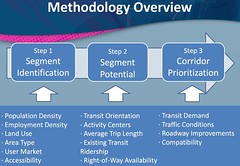
This concept is captured by a slide in the 2030 Transit (Lynx) Plan for the Orlando Metropolitan Area in Florida.

The slide lays out the three step process for determining areas where service should be provided, and where expansion is justified by travel demand. (Other slides discuss different types of transit services, the choice of which are based on capacity, speed, distance, and ridership projections.)

This is the kind of process we don't seem to have in DC, for DC-specific expenditures on transit service development and expansion. Instead, it's political, spreading around service to various wards (which is what happened with the Main Street program in its later years as well) to satisfy Councilmembers and their constituents, rather than being justified by demand and a consideration of the best use of scarce financial resources.

The Circulator bus lines serving Downtown and Georgetown have the type of higher ridership that justifies Circulator-type service.

For neighborhood services, the Columbia Heights-Adams Morgan route has closer to the kind of ridership necessary to justify high frequency, while the Capitol Hill-Navy Yard Circulator does not.
The Union Station-Navy Yard DC Circulator uses 30 foot buses
The Union Station-Navy Yard DC Circulator uses 30 foot buses, because ridership projections did not justify larger buses.

In my typology of metropolitan transit networks, there is a category for intra-neighborhood transit service (called the center city tertiary transit network), and this level of service justifies subway station and commercial district centric bus service. But that means that a Circulator in this area ought not to then go to McPherson Square, instead it should move people around the neighborhoods, the transit stations, and the commercial districts.

It could be that East of the River bus services need to be reconfigured to better serve activity centers and subway stations. That was suggested in a comment on a blog entry on this topic last January.

Labels: , , , , ,

Wednesday, November 13, 2013

Understanding Hong Kong's Transit system and the limited comparability to the US

Matt Yglesias has a piece, "Great Mass Transit Doesn't Have to Cost a Fortune," in Slate about his trip to Asia (I'm jealous) and his experience with transit there, comparing the mass transit system in the Washington Metro to Hong Kong.

While I think he is absolutely right that the way we do system development and contracting in the USA ends up making transit of all types very expensive (a point made very well by Steven Smith in a couple of Forbes pieces I think, or at least one, "NYC Officials Take Notice of Astronomical Subway Construction Costs") there are some key differences that make the systems structurally different in ways that make comparison not so easy. 

1.  The Hong Kong transit system (MTR) only runs the heavy rail system (supplemented with a small feeder bus network) not the surface transit system (trams and buses), and doesn't have to provide paratransit services, which are required by the US Federal Transit Administration, and are increasingly costly for most US transit agencies.

Image of an MTR platform during rush hour in Hong Kong, from Half an ABC blog.

2.  The system covers a dense city and enjoys high ridership, with "crush densities"--the willingness of riders to ride packed in/in close proximity almost double compared to the US, making it much more profitable to carry riders than it is in the US.  (This is a similar issue with comparisons of BRT system success in South America vs. North America--the average transit vehicle in such systems in South America carry double the number of riders than systems here, using the same types of vehicles.)

3.  The Hong Kong heavy rail system is an active developer of station sites, retaining the property that increases in value because of transit adjacency, developing this property, actively managing the property, and getting the lease revenue that results ("A glance at Hong Kong MTR’s retail results," West North).

My understanding is that half the revenue of the system comes from property lease revenue.

By contrast, in the US, most of the financial benefit of transit adjacency ends up being reaped by the private sector ("The Unique Genius of Hong Kong's Public Transportation System," The Atlantic).


The real lesson is that in a dense city where driving a motor vehicle is very difficult, an extensive heavy rail transit system can be run profitably.  In the US, most city regions are sprawled out and residential and commercial areas are widely dispersed, making the provision of profitable transit almost impossible.

That being said, the MTR system is managed much better than most systems in the US, although it is newer than the biggest systems in the US and therefore less costly to operate, aided by not having to pay US wages.

For more on MTR, see this blog entry, "Exporting success from Hong Kong's MTR," from City Block.

Note that it isn't that the situations aren't comparable, but the structural conditions are significantly different, which explains why transit can be profitable in Hong Kong and a loss leader in most North American cities.

Labels: , , ,