Rebuilding Place in the Urban Space

"A community’s physical form, rather than its land uses, is its most intrinsic and enduring characteristic." [Katz, EPA] This blog focuses on place and placemaking and all that makes it work--historic preservation, urban design, transportation, asset-based community development, arts & cultural development, commercial district revitalization, tourism & destination development, and quality of life advocacy--along with doses of civic engagement and good governance watchdogging.

Monday, July 21, 2025

Railroad mergers are driven by stagnation in demand | Why not focus on increasing demand?

The US has 6 "Class I" railroads after multiple mergers, two are in the West, two are in the East, two are (with some exceptions) north-south.  

Different railroads have different mixes of loads, but the decline of coal production as electricity plants shift to natural gas has really hurt.  

RRs have long since given up on short loads delivered fast enough.  That traffic has been diverted to trucks.  

Although CSX among others has invested a lot in truck-trailer/container portage ("Back on Tracks," Washington Monthly).  

Note that railroad demand is increasing, but in the context of including truck delivery, it's far less as a proportion of the total market, compare to the prime of railroading.

Over the weekend there have been reports that Union Pacific wants to buy Norfolk South, creating the first true transcontinental railroad ("UP-NS rail merger spotlights individual legacies in a legacy business," Freight Waves).

There are some proposals out there to divert trucks to rail, mostly to provide more capacity on constrained interstate freeways including I-81 in Virginia ("Why Putting Trucks on Trains to Bypass I-81 Won't Work," Heavy Duty Trucking,  Feasibility Plan for Maximum Truck to Rail Diversion in Virginia’s I-81 Corridor, VDOT) and I-70 in Colorado ("'Truck Train': Former Amtrak conductor shares plans to reduce semi-truck traffic on I-70," ABC Denver).  

From the I-81 article:

As the Roanoke Times reports, several members of the Roanoke Valley Transportation Planning Organization really liked the idea put forth by Rail Solution. The nonprofit says instead of pouring money into widening I-81, the state should double-track the Norfolk Southern rail line that runs alongside the highway to carry “through” trucks that don’t need to make a stop in the state. 

Envisioned is a service that could run the 600-mile corridor between Knoxville, Tennessee, and Harrisburg, Pennsylvania, and allow truck drivers to sleep on the train. At terminals on each end, truckers would drive their rigs onto a train with perhaps 30 truck positions, and the train would go once it reached a certain number of trucks, such as 30.

From the I-70 article:

The idea? Moving semi-trucks and other large commercial vehicles off the highway and putting them on rail lines instead. Swartzwelter and his family, like many Coloradans, enjoy going into the mountains, but are fed up with the traffic they have to deal with when traveling there. Swartzwelter said the roll-on, roll-off bridge would remove around 1,100 commercial trucks a day from I-70.

“I-70 is the biggest problem with that entire endeavor for everybody in the state,” he said. “Congestion and the danger of accidents, and then sometimes the highway itself is just closed.”

He said his idea is based on a successful European model. “Semi-truck drivers would drive their entire truck — the cab, the trailer, the whole rig — right onto a flatbed train," he explained. "That train would then traverse the mountains, and then the driver would be in a sleeping car up at the front of the train. At the end of the trip, the driver would get out fully rested, climb back into his truck or her truck, and continue on."

This would also address the shortage of truck drivers, even as the industry is shrinking too.

Freight Rail webpage, Federal Railroad Administration

Other freeway corridors like I-95 or I-15 probably have a similar profile that supports truck diversion.

The other is to ensure that when appropriate industrial businesses can still be served by the big railroads assisted by short line operations--even when car volumes are low transportation demand management requirements might make it efficacious.  This means industrial parks, logistics hubs, warehouse districts etc. ("This logistics hub plan is a huge win for the Illinois economy," Crain's Chicago Business).

Related to the connecting industrial businesses to railroads point is building to transit to serve new urban neighborhoods ("More than 100,000 people are expected to move into this new Toronto neighbourhood. So why is there still no transit line?," Toronto Star).

In any case, mergers approved going forward should have significant transportation demand management requirements, like the ones suggested here, the Chicago railroad decongestion initiative, etc.  

It should also include better support of passenger rail service.  The expansive powers given to railroads through federal franchises, at the time, was also based on railroads providing necessary travel services, which have since been offloaded to Amtrak and local rail passenger services.

Labels: , , ,

Friday, May 13, 2022

May should be National Train Month: Rethinking promoting more comprehensively travel by train in the US

 I started this post in 2019, and then I had to move west and I never finished it.  


1.  A Los Angeles Times article ("At 80, Union Station tries to reinvent itself for a rail future") about the upgrading of Union Station in Los Angeles reiterates  that train stations should be thought of as key "marketing touchpoints" for transit, based on how stations are key city and community hubs in cities like London, Hamburg, Paris, Tokyo, etc.

I wrote about this general idea in my comments in 2015 on the DC State Rail Plan with regard to DC's Union Station.  

The basic point in those comments was how to "Fully leverage Washington Union Station's potential as a portal and visitor center and as a focus point for marketing transit, specifically rail service."

A long time before, I made the point that bus shelters are "marketing touchpoints" for the transit system in multiple ways: (1) for the user; (2) for people walking or driving by and wanting information; and (3) more generally in terms of aesthetics and maintenance and how it communicates whether or not the community values transit, with poor condition shelters and stops with few if any amenities making clear that transit isn't valued.

This goes double for transit stations: subway; bus; railroads; and their combinations.


(Interestingly, only this year has the Federal Railroad Administration devolved to incorporate the kinds of ideas and not the best ones, that I suggested then.  But none on marketing. "Union Station overhaul removes parking spaces, adds underground facility," Washington Post.)

2.  Make May National Train Month.

The National Train Day that Amtrak did in the mid-2000s then dropped for budgetary reasons should be revived, involving the entire rail industry, but redeveloped into: 

(a.) Train Month.  One day out of 365 puts too much pressure, and people can only do one thing.  Train Month allows for more activities, spread out over an entire month, more attention, etc.; 


(c.) involving all types of train service, not just Amtrak, but all passenger train service, including regional commuter rail services

(d.) including freight railroad service; (e.) which could help with funding and visibility

(f.) also involving train and transit museums and tourist railroads.

Working with the American Public Transportation Association, the National Railway Historical Society and its local chapters, regional and state transportation museums, transit media such as Railway Age, Trains Magazine, Mass Transit, Classic Trains, Progressive Railroading, and Metro, and possibly with freight railroads and the Association of American Railroads, as well as excursion (tourist) railways, railroad passenger transportation agencies should revive the concept and create Train Month as a way to promote travel and transportation by rail, for commuting and leisure travel..

Ogden, Utah is home to the location of the Golden Spike National Monument, the place where the transcontinental railroad joined up.  The Ogden Standard-Examiner published a special book for the 150th anniversary.

-- "Golden Spike Centennial Edition," Ogden Standard-Examiner, 1969

But rather than one day, it should be done for the entire month of May designated  as National Train Month, spreading out activities over the course of the month by creating a calendar of events, coordinated at multiple scales (regional, state, national).

This would be timely especially given Amtrak's refocusing on expansion through their Amtrak Connects US program, calling for significant expansion of passenger rail service across the United States.


3. Other good models are various promotions especially tourism efforts by railroads in Japan, as featured on the NHK World television program, "Japan Railway Journal."  

In the late 1980s, Japan began privatizing the national rail system.  It broke it up into seven companies.  Some are capable of being independent, some are still government owned.  The regional JR services, usually with the foundation of high speed rail, are complemented by private railways operating on lines where the ridership is strong enough to maintain profitability, and by what are called third sector lines, which are a mix of privately run, privately owned, community owned or community subsidized.

Because the country is shrinking in population, especially in rural areas, railroads have focused on special tourism ventures to build ridership and revenues in the face of decline.  Some train stations have a small museum, there are efforts for engaging children (future riders!).  Using regional foods and special meals on trains.  Revitalization efforts.  Etc.

Although there are plenty of exemplary efforts outside of Japan.  Places that do special services for sports events or concerts.  Virginia Railway Express and its support of Clifton Days, a community heritage festival with a big dose of trains.  Souvenir tickets for children on the LIRR.  Various tourist railroads in the US.  Tourism promotion efforts by rail lines in England, and by AMT in Greater Montreal.  Etc.

4.  Train stations can be living "transportation and tourism museums."

Developing spaces and opportunities to present railroad history should be considered within the  program for the station's expansion.
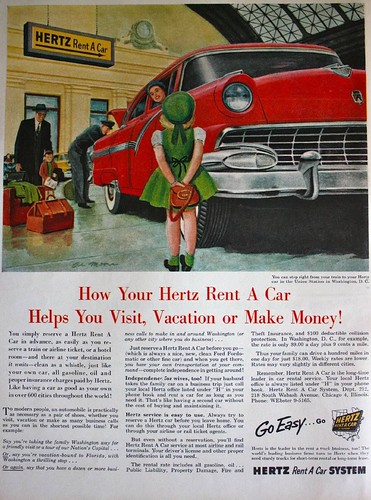
Hertz rental car ad, 1955, featuring Washington DC's Union StationThis 1955 Hertz rental car ad features Washington's Union Station.  Because Union Station is multi-modal (railroad, subway, local bus, inter-city bus, streetcar, tourist services, taxi, bicycle, walking) it's a good location for a transportation museum.

I see this as being done as a kind of joint venture with existing museums in a region, especially those museums already presenting aspects of railroad-related history with a local angle.

A "transportation" museum at a train station like Union Station  in DC wouldn't have to develop a large permanent collection.  

It could more be a place for existing museums to display items that would otherwise remain in vaults, complemented by changing exhibits curated both locally and developed by and with other transportation museums around the country.

Partners could include the National Museum of American History, the National Postal Museum, the National Railroad Historical Society Washington chapter, the B&O Museum in Baltimore, and the National Capital Trolley Museum.

Because of Washington's place as a leading tourist destination and the multimodality represented by Union Station, exhibits on other elements of transportation and visitation history would also be appropriate.

Private railcars on display at a railfan expo in Barstow, California.

Private railcar storage could be "displayed" to the public as part of the exhibit program also. [Note: when this was first written, Amtrak had an active program of renting space to privately owned passenger railcars, including at Union Station.  This has since been de-emphasized.]

The way active trains are staged within the St. Pancras Station in London shows this can be done.   There the Eurostar platform is placed above the ground floor retail.  The train engines were quiet, unlike comparable locomotive engines in the US.
Fire closes Channel Tunnel!  Eurostar trains stranded @ St Pancras London

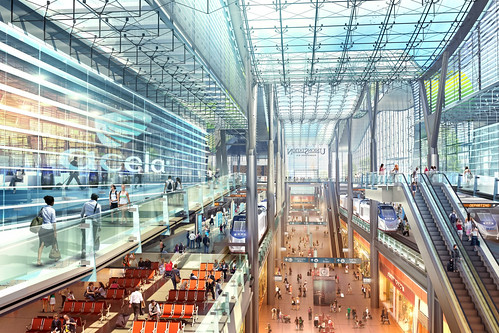
Renderings presented by Amtrak for a redo of DC's Union Station show something similar, the incorporation of the train shed into a kind of atrium, with active tracks.  I believe that this element has since been deemphasized in future planning for the station.
union-station-new-concourse

An example of the kinds of exhibits that could be presented is  the companion exhibit--shown here when staged at Chicago's Union Station--to the book Terminal Town, which covers all of the types of transportation terminals in Chicago.
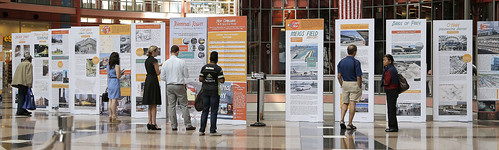
Terminal Town Display at the James R. Thompson Center
“Terminal Town: Celebrating 75 Years of Travel to the Windy City,” exhibit on display at Thompson Center by the DePaul University’s Chaddick Institute for Metropolitan Development. Photo by Jamie Moncrief/DePaul University.

The Market Street Railway--the F Line streetcar--is operated in part as a living transit museum.

5.  Add excursion rail programs to big city train stations.  Many states have scenic-excursion railroads that are tourist attractions.  There are a number of these systems in Virginia, Maryland, West Virginia, and Pennsylvania, and the B&O Museum and the National Capital Trolley Museum have short tracks used for train riding.  NRHS chapters also organize excursion trips.

Most state rail plans do discuss, albeit briefly, excursion railroads and their place in the rail and tourism systems.  But they don't suggest integrating this into the passenger rail network as it currently exists.

For example, in the DC area, as a way to build interest and awareness of railroad service in the region, it could be worthwhile for the local commuter railroad agencies, MARC and Virginia Railway Express,  with the National Railway Historical Society and the proposed transportation museum in Union Station and the B&O Museum, to develop a special event railroad excursion program.

-- "Two train/regional transit ideas: Part 2 | Running tourist trains from Union Station," 2021

6.  Treating railroad stations within states and regions as a network.  I have been thinking about this for a number of months, after reading articles about railroad station efforts in Detroit ("MDOT wants to transform Detroit's 'cramped' Amtrak station into $57M hub with retail, more," Detroit Free Press) and Ann Arbor ("Ann Arbor tells feds it's willing to scale back $171M vision," Ann Arbor News), although I did make this point in a review of the Silver Spring Transit Center ("Multiple missed opportunities in the creation of the Silver Spring Transit Center," 2015; "Updating my review of the Silver Spring Transit Center: a few things I missed," 2018) and in "A well designed train station is a well designed train station: it's not about "luxury"," 2017.
and the Takoma Langley Crossroads Transit Center in Suburban Washington.

Of course the ultimate expressions of this idea are the station networks created by Southern Pacific in Southern California and the Boston & Albany Railroad's stations by H.H. Richardson, with landscaping by Olmstead.  

Santa Ana Train Station
Stations from San Diego to Santa Barbara express the California "Mediterranean" architectural style.

The efforts by Richardson and Olmstead, termed "railroad beautiful" influenced the development of the ideals of the "City Beautiful" Movement decades later.  (See "A Railroad Beautiful" and "The Treatment of City Squares--III; The Square Before the Railroad Station," House and Garden (2) 1902 and "Railroad Gardening," Standard Cyclopedia of Horticulture.)  

7.  Train stations as vital urban hubs.  In "A well designed train station" I wrote:

I think more than "building a station to serve luxury markets," the issue is the design of the station as a way to maximize the quality of the trip and the experience, specifically: 

-- quality of accommodations for passenger throughput generally (entry and exit, connections to other transit services) 
-- quality of accommodations for passenger throughput specifically to/from and on platforms 
-- centrality of its location (for example the recently in the news Michigan Central Station was deliberately constructed in a location outside of the center "to avoid congestion" thinking it could attract patronage regardless) 
-- its place and position as the anchor of the area transit system and the mixed use district in which it is placed 
-- amenities, especially retail and food service 
-- architectural design and aesthetics.

We don't have to reinvent, the basic principles were set long ago.  For example, the book pictured at right was first published in 1916.  I can't find the cite but there's an equally great book on this, dating to the 1890s.

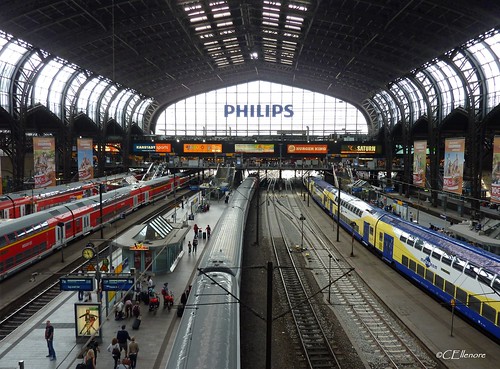
There is the new Penn Station in NYC, which I haven't yet had the chance to visit.  Grand Central and Penn Station in New York City, Union Station in DC, somewhat 30th Street Station in Philadelphia are much closer to the example of European train stations as major city hubs as well as transportation hubs--multiple stations in London, the main station in Hamburg, Gare de Lyon in Paris, etc. are all fabulous places, community and city centers, and mobility hubs.

Granted in the US, most major cities lack the kind of density needed to be able to create that kind of facility, as shown by the failure of new stations like the Anaheim Regional Transportation and Intermodal Center (poorly located, not served by a lot of transit, waiting for HSR).  

Still, it's the model to aim for.

8.  Finally, another element is interpreting transportation history not just as part of community cultural history interpretation programs, but as a part of transit systems.  Many years ago, Passaic County, New Jersey included this idea as a section of their county transportation plan, including railroads, transit, roads, canals, and rivers.  

DC's history trail interpretation program could be a model for the creation of community-wide railroad history "trails," with Union Station as the hub of the interpretation system.  

The sign below is in Chicago, and presents the history of a railroad bridge.  A handful of communities, the Ride Philadelphia program is one, information at the Queen Street Station in Lancaster, Pennsylvania is another, have transportation history interpretation programs that are good models.
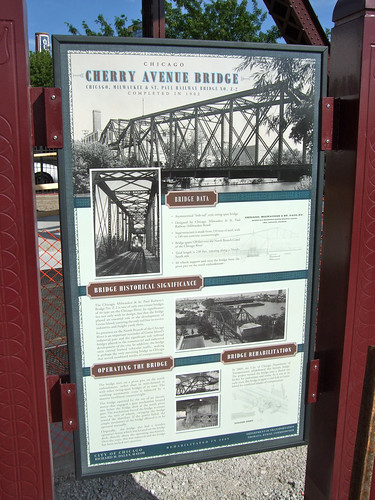
Cherry Avenue bridge interpretation and facts
Cherry Avenue bridge interpretation sign, Chicago.  Flickr photo by Steven Vance.

Labels: , , , , , , ,

Thursday, March 17, 2022

Trains and emergency evacuation: Ukraine and freight/emergency transportation planning | Homogeneous versus heterogeneous transportation systems

 A couple weeks ago, charlie called our attention to a great article ("On board the mobile command that's keeping Ukraine's trains running," Business Insider) on how the Ukraine Ministry of Infrastructure has responded to managing its train network in wartime conditions, with special focus on the use of trains to evacuate Ukrainians to safer areas out of the country, and how the staff no longer operates from a fixed position as that would be a highly vulnerable target for attack.  

With regard to transportation in wartime, disasters, and emergencies, there are (at least) three issues: (1) heterogeneous transportation system; (2) managing railroads and road systems; (3) capable of being ingmanagerially flexible.

Kamyshin starting a conference call with the top managers 
of Ukraine's six regional railroads. 
Alan Chin for Insider

People crowding a train platform in Kharkiv, Ukraine
Twitter photo: Nexta_TV

People waiting for trains to take them from Lviv to Poland. 
On Sunday only two trains were running and only women and children were allowed to board.
Photograph: Vincent Haiges/Avalon

Around that time was an NPR article about a volunteer effort in Poland to restore an abandoned train line to facilitate refugee trains from Ukraine ("Poland rebuilds abandoned rail tracks to Ukraine to help refugees fleeing the war").  (Also see "12 hours on board a packed train out of Ukraine," BI, "‘Everyone was fighting to get on a train’: the desperation of Ukrainians trying to reach safety," Guardian).

Ukrainian refugees lining up for services at the Berlin Train Station on March 8, 2022
Michael Sohn, AP

Since there have been other articles on train stations as gateways for Ukrainian refugees ("Berlin train station turns into refugee town for Ukrainians," AP, "Berlin's main train station becomes Ukrainian refugee welcome center," Reuters).  From the NYT:

Now Russia’s invasion of Ukraine is turning Europe’s trains and ornate imperial-era stations into a new refugee crisis network, putting them on a war footing yet again. At least a dozen state- and privately owned railway operators have opened up their services for free to refugees, and their cargo trains are being deployed to bring humanitarian aid to Ukraine.

When I first read the Insider article, I thought about how the US has built, for the most part, a homogeneous mobility paradigm, around cars and trucks and the "Interstate Highway and Defense System" network of high speed roads across the nation.

Trucks and roads work well for flexibility, but have capacity constraints both for loads and the number of vehicles, aren't particularly energy efficient, and require lots of personnel.  And they can create significant congestion.

Trains operate with small numbers of personnel and are energy efficient, but can be slower, certainly are less flexible, and are definitely vulnerable in wartime to tracks and trains being bombed. (Bombed tracks can be repaired.)

But when the highway system was created, no one ever considered there would be a time when oil would be super high in price and labor availability would be seriously constrained ("Taking Europe's Trains to Escape, or to Teach, A Conflict's Front Lines." NYT).

Freight transportation planning.  But in any case, the current supply chain logistics problems we have in the US indicate a lack of an adequate and integrated freight transportation planning policy that includes all the elements, including shipping, ports, trains, trucks and related labor issues ("Port of Los Angeles Stops Short of 24-Hour Operations, Unlike Long Beach," Wall Street Journal, "Rigged: Forced into debt, worked past exhaustion, left with nothing," USA Today).

Emergency evacuation.  And I thought back to various hurricane evacuation efforts in Louisiana (Katrina) and Texas (Rita), how the road system was overwhelmed, leading to traffic deaths, and how some people called for train evacuations not realizing that we have so little resources available for passenger train service that unlike in Ukraine today or Europe more generally, for the most part in the US, passenger train service isn't a realistic option for emergency transportation.

Evacuation from Houston in advance of Hurricane Rita, 2005.

If there are multiple tracks, all railroad tracks can be used for unidirectional traffic, which for safety reasons, is not possible with freeways.

Heterogeneity versus homogeneity in transportation planning.  In any case, the Ukraine example, as sad and as horrifying as it is, demonstrates the importance of hetereogenity in transportation planning and the provision of infrastructure, that you need both train service and car/truck service for both passenger and freight mobility in times of emergency. 

Labels: , , , , , ,

Wednesday, November 17, 2021

Free transit for Salt Lake Airport Users as a marketing promotion | Transit validation systems

1300 South at West Temple Street, near the Ballpark TRAX station

The Salt Lake Airport has been undergoing expansion and redevelopment.  A new terminal opened in the Spring, although the relocated transit station didn't open until earlier this month ("Will new TRAX station fix unprecedented problem for Salt Lake airport?," KSL-TV).

I've written about the airport twice.  One in response to a Manhattan Institute report that transit connections to airports aren't worth it.  I disagree because a transit system to be a system needs to connect to major destinations within a metropolitan area and the breadth of the network more generally is what encourages people to use transit.

-- "Manhattan Institute misses the point about the value of light rail transit connections to airports | Utility and the network effect: the transit network as a platform," 2020

The other piece was about a financial dispute between the Airport and a car sharing service.  The latter didn't want to pay the same rates as "car rental services" because the business model is different, and so they were forbidden access to the Airport.  

-- "Transportation demand management gaps, Salt Lake City International Airport and car sharing," 2021

Although the firm eventually capitulated.  The fact is that parking and car rental concessions are significant revenue streams, so Airports don't want to do anything that upsets that flow, especially as ride hailing has had a significantly negative impact on parking revenues.

Some of the reporting on the new airport has focused on how they haven't implemented an interior transit system/moving walkways because they are still expanding, and depending on the gate, people may have to walk at least one quarter mile to Concourse B ("Opinion: The terrible, horrible, no good, very bad walk from SLC’s Concourse B," Salt Lake Deseret News), which is especially inconvenient with children or if you're disabled..

And the Airport has already stated that often the parking structures and lots are full, and they have 30,000 spaces ("Why you might have problems parking for your flight at the SLC Airport," KJZZ-TV).

So "transportation demand management" aimed at ensuring adequate capacity at the parking structures is a good idea.

Transit validation: free transit with event tickets. Transit validation is the term for how your event ticket also includes free transit use.  I wrote about this recently concerning the new Climate Pledge Arena in Seattle, where attendees of sporting and concert events can use their ticket (via an e-app) to ride local transit for free ("Seattle Kraken expansion hockey team sets new standard for transit benefits in transportation demand management: free transit with ticket").

While the arenas for the Golden State Warriors in San Francisco and the Phoenix Coyotes do a version of this, the Seattle example is the most expansive, with access to light rail, bus, and Monorail.

While I have written quite a bit about airport transportation issues:

-- "Airport transportation demand management in flux"
-- "Transportation demand management, transit: Los Angeles Airport (LAX) and Logan Airport, Boston," 2019
-- "London's Stansted Airport provides digital information on transit options," 2019
-- "A brief comment on ground transportation at National Airport vis a vis VRE rail service," 2016
-- "Revisiting stories: ground transportation at airports (DCA/Logan)," 2017
-- "Airports and public transit access: O'Hare Airport and the proposed fast connection from Downtown Chicago," 2018
-- "Why not a bicycle hub at National Airport?: focused on capturing worker trips but open to all," 2017

I have never heard of free transit to and from the airport, which is what Salt Lake Airport and the Utah Transit Authority are doing through January 31st, 2022, when people show their boarding pass dated on the date of travel.

Photo: Miles in Transit.

Although, the Boston Silver Line bus is free from Logan Airport and has been since 2012 ("MBTA to give free rides from airport: No Silver Line fare in test to cut Logan’s congestion," Boston Globe).

But the Salt Lake Airport promotion is for all forms of transit: bus; streetcar; light rail; and commuter train.

While the UTA/Salt Lake Airport is the first example I know of of free transit to and from the airport, albeit for a brief period, obviously, adopting this type of practice more broadly would increase transit use in association with air travel, were it to be adopted more widely and permanently.

Labels: , , , , , ,

Monday, May 03, 2021

May should be National Train Month as a way to market and promote passenger rail

May 1st was the 50th anniversary of the first operating day for Amtrak, the National Rail Passenger Corporation.  

President Biden speaking in Philadelphia at an event honoring Amtrak's 50th anniversary
Photo: Voice of America

Amtrak was created to absorb from railroad companies increasingly focused on freight the obligations of providing passenger rail service.

The reality was that the long distance passenger services that the railroad companies pioneered became much less viable in the face of air travel and the automobile.

Amtrak was provided with privileged access to freight rail trackage and lower rates (neither was extended to commuter rail services independent of Amtrak), although freight rail service continued to be prioritized in a way that makes Amtrak service unreliable.

Joe Biden: a president who is pro rail.  With rail proponent and now President Joe Biden in office, Amtrak's prospects look a lot better after decades of being batted around by a Congress dominated by fossil fuel and automobile  interests, a overarching belief in the market over government action and little faith in the idea of public transit ("America's Amtrak moment could finally be here," CNN, "U.S. passenger railroad Amtrak asks Congress for $5.4 billion," Reuters).

National Train Day, a defunct promotion for rail passenger service.  For a few years (2008 - 2015), Amtrak sponsored National Train Day, but dropped it for budget reasons.

Originally, I didn't realize the significance of when it was celebrated, why they selected around May 10th, but it's because that is the anniversary day of the hammering of the Golden Spike in Promontory Summit, Utah, which marks the creation of a transcontinental railroad in the US, by creating a railroad line in the west, from Omaha and ending in Sacramento, which in turn connected to rail lines emanating from the Eastern US to Omaha.   

There is the Golden Spike National Historical Park in Promontory Summit, and the Utah State Railroad Museum at Union Station in Ogden.  There were big anniversary events in 1969, the 100th anniversary, and 2019, the 150th anniversary.

-- Spike150 anniversary website
-- 150th Anniversary Golden Spike special supplement, Ogden Standard-Examiner

In my in process set of articles on rearticulating passenger rail service in the United States, the third piece is about National Train Day as an element of marketing.  There are two main points.

1.  "Train Day" should be brought back, but as "Train Month" because one weekend is too difficult and too compressed to be able to promote passenger rail all across the US.

So National Train Day should be repositioned as National Train Month.

2.  Train Month should involve all sectors of the train industry, focused on passenger rail service but not exclusively.  But it should be much more expansive.  Not just national rail services by Amtrak, but regional commuter rail services, tourist railroads, train stations, railroad and transit museums, and related organizations and transit and trade media.  And freight railroads too.

This would provide lots of opportunities for events, and a lot of promotion.  It'd be a great time for advocacy groups to draw attention to their initiatives, etc.

And by involving multiple organizations, including the for profit freight rail industry -- which could use the opportunity to promote the energy savings value of freight railroad transportation as opposed to truck-based freight -- would ease the financial and organizational burden on Amtrak.

Many organizations are already doing events: leverage existing initiatives and add to them with a national calendar.  The recent post on tourist trains as an element of railroad transportation planning mentioned the B&O Railroad Museum, the Virginia Transportation Museum, Railway Heritage Days in Manassas, Virginia, and Clifton (Virginia) Day and various railroad transportation events.

There are plenty of similar activities across the country, such as Railroad Days at the Fullerton Train Museum in California, various events throughout the summer at the Illinois Railway Museum, tourism excursion trains, etc.

It may be like herding cats to get them to coordinate, but the wide array of organizations and assets makes a Train Month possible, and expands it far beyond Amtrak.

===========

Including transportation history as an element of transportation plans.  More than 10 years ago I saw a presentation by the planning director for Passaic County, New Jersey and what stuck out for me was how their transportation plan was transformational in that it included an element on transportation infrastructure, historical interpretation and tourism (Section 8: Scenic and Historic Byways), designed to integrate with the County's future heritage and tourism element of the Master Plan.  

Mostly "scenic and historic byways" are mostly thought of as roads ("Just in time for summer: 49 new National Scenic Byways and All-American Roads," Washington Post).  Passaic County expanded the definition to include transportation corridors more generally including rivers, canals, railroads, and historic trails and other transportation routes. 

Coming across that document definitely influenced my thinking about how the DC's State Rail should include a similar element (which didn't happen), focused on the place of Union Station and its potential as a real-life museum for the interpretation of DC, regional, and national transportation history.

And Ride Philadelphia, the transportation history display program in Center City Philadelphia, along with other displays I've seen in Walla Walla, Washington, Portland, San Francisco on their heritage streetcar line, and the display outside Queen Street Station in Lancaster, Pennsylvania.

Folks walking through the James R. Thompson Center in downtown Chicago Tuesday, Sept. 2, 2014, pause to view the “Terminal Town: Celebrating 75 Years of Travel to the Windy City,” exhibit on display. DePaul University’s Chaddick Institute for Metropolitan Development is launching a six-month community program to explore Chicago’s history and future as the epicenter of U.S. passenger transportation. “Terminal Town: Celebrating 75 Years of Travel to the Windy City,” opens a traveling exhibit Sept. 1-5 at the James R. Thompson Center, 100 W. Randolph St., and continues through the fall with tours, events and a new 300-page illustrated guide by transportation expert Joseph Schwieterman. (DePaul University/Jamie Moncrief)

I've also argued that transit stations and shelters should be used as touchpoints for delivering cultural history interpretation on local transportation history.  

In DC, it's been an issue about the preservation of an old trolley bridge in Northwest DC that was for the old 20 Streetcar line to Glen Echo Park ("Major setback in effort to save historic DC trolley bridge," WTOP).  


I argue that the bridge should be preserved, but it shouldn't be the responsibility of WMATA, since it isn't part of their active infrastructure portfolio.  Instead, the city should take it on.  But unlike Passaic County, DC's Department of Transportation doesn't think it's important.

Labels: , , , , , ,

Friday, April 10, 2020

Train/transit stations as "Living Stations" | New Network Rail/Arup report

I have a number of pieces on transit stations that look at the quality of stations on a number of dimensions in terms of multimobility (integrating other modes), as entrypoints and hubs of districts and neighborhoods, around the concept of transportation infrastructure as an element of civic architecture, and stations as nodes within larger networks at the metropolitan, regional and state scales.

-- "Transit, stations, and placemaking: stations as entrypoints into neighborhoods," 2013
-- "New State Rail Planning Initiative in DC," 2015
-- "Transit stations as an element of civic architecture/commerce as an engine of urbanism," 2016
-- "DC Union Station" 2016
-- "Takoma Langley Crossroads Transit Center: a critical evaluation," 2016
-- "Updating my review of the Silver Spring Transit Center: a few things I missed in 2015," 2018

Although the first report on the quality of Transit Wa.iting Environments that I read was focused on buses, and was produced for the Greater Cleveland Transit Authority. Also see From Here to There: A creative guide to making public transport the way to go from EMBARQ and SEPTA's Modern Trolley Station Design Guide.

In the DC-Maryland-Virginia region, I've recommended that the Metropolitan Planning Organizations come together and produce joint guidance on transit station planning.

A Network Rail report from 2011, Guide to Station Planning and Design Issue 1 Guide to Station Planning and Design looks at station design in terms of three zones:

-- access and interchange
-- facilities
-- platform

covering entry, services and amenities, and waiting and embarking areas.

Network Rail just released a report written by Arup called Tomorrow's Living Station, focuses on how stations can be active hubs beyond their strict transportational role:
Now more than ever, there is a huge opportunity for stations to become bustling, multi-modal hubs that are at the centre of movement for people, support inclusive, sustainable and economic growth, and improve the wellbeing of the communities they serve.

‘Tomorrow’s Living Station’, a report created by Network Rail and Arup, explores and identifies the future role stations will play in our towns and cities:

1. As the centre of movement for people
2. As drivers for inclusive and sustainable growth
3. At the heart of healthy communities
One key "station function" change they foresee is the shift to mobile ticketing, reducing the need for ticketing windows and related functions.

I haven't had a chance to read it yet, but there is a similar planning manual for Swedish Rail, Railway Stations: Planning Manual.  It dates to 2012, with an English version produced in 2018.  It discusses stations as hubs and anchors as well.

Labels: , , , , ,

Wednesday, December 18, 2019

Airport transportation demand management in flux

The rise of ride hailing has significantly impacted airports in two ways.

First, fewer people are driving to the airport and then parking their car and racking up fees for the duration of their trip.  This has significantly reduced parking fees as a source of airport revenue.  Heretofore it had been significant ("Protecting Your Bottom Line From the “Uber Effect”," Airport Improvement and "As Uber and Lyft grow, fewer are using taxis and airport parking," Atlanta Journal-Constitution).

Second, the use of ride hailing has caused significant congestion problems, and airports in San Francisco, Boston, and Los Angeles among others, have taken  steps to direct ride hailing vehicles away from the regular arrival and departure lanes (Addressing Airport Congestion as Traffic Takes Off in the Age of Uber and Lyft, student submission, Airport Cooperative Research Program design competition)..

A new third impact is on shuttle services like SuperShuttle.

Just as taxi firms are going out of business because of the impact of ride hailing services with people using their own cars ("The Human Cost of Uber and Lyft: Life in the Dying Taxi Industry," KQED/NPR) the same is happening with airport shuttle services ("Say goodbye to those blue-and-yellow airport vans: SuperShuttle is going out of business," USA Today).

The company had already stopped serving certain airports like BWI in Maryland and more announcements of service cessation have just been made including airports like LAX and National Airport in Northern Virginia.

From a transportation demand management perspective, it's worse to have passengers switch from a shared van to individual vehicles, although it is definitely more convenient for the rider, even if it costs more money.


I've written about transit and airports a few times, including airports "taking more responsibility" for organizing transit service to and from the airport as well as better connections to nearby stations.

-- "Transportation demand management, transit: Los Angeles Airport (LAX) and Logan Airport, Boston," 2019
-- "London's Stansted Airport provides digital information on transit options," 2019
-- "A brief comment on ground transportation at National Airport vis a vis VRE rail service," 2016
-- "Revisiting stories: ground transportation at airports (DCA/Logan)," 2017
-- "Airports and public transit access: O'Hare Airport and the proposed fast connection from Downtown Chicago," 2018

And biking:

-- "Why not a bicycle hub at National Airport?: focused on capturing worker trips but open to all," 2017

Metro Magazine has published a report by DePaul University's Chaddick Institute on higher end shuttle services to airports, although these trips can be hundreds of miles, to provide access to larger airports serving more locations ("Premium intercity bus lines launching new airport-oriented services").  Also see this Minneapolis Star-Tribune article about such a service in Out-state Minnesota, "Shuttle between MSP and Duluth and Mankato airports to launch with $9 fares."

I have a half written piece about how Chaddick's study of high volume origin-destination data to determine gaps and opportunities in high capacity transit service over long distances ought to be the basis for longer distance railroad passenger planning.

-- Ground Transportation Gaps

Labels: , , , , , ,

Friday, March 22, 2019

Transportation demand management, transit: Los Angeles Airport (LAX) and Logan Airport, Boston

Curbed LA has a piece, "It’s called the Crenshaw/LAX Line, but Metro’s newest train won’t actually go to the airport," about how with the opening of the Crenshaw/LAX line next year, riders can get about one mile away from the airport, but the Airport's forthcoming People Mover system won't be operational until 2023 ("Fly through the Metro station connecting LAX to light rail" and "Construction kicks off on tram that will ferry you around LAX").

While yes, it's somewhat nonsensical that LAX didn't get the People Mover project and the rail transit project on the same timeframe.

-- LAX People Mover webpage

The Airport does provide shuttle service from the existing transit station on the Green Line, Aviation/LAX, something the Curbed article doesn't really highlight, and it will shift this service to the forthcoming station, Aviation/Century, on the Crenshaw/LAX line next year.

But judging by the renderings, there's no question that the Aviation/Century Station will be a first class connection for services to the Airport.

It will have multi-modal services including an LA Metro Bike Hub.  (DK if it will also have spots for various car sharing options, it should.)

Interestingly, while the trip on the shuttle is free, you have to use a TAP card--the fare media card for LA Metro/LA County--because the trip is supposed to be linked to transit use.  This prevents people from driving to and parking on residential streets in the abutting neighborhood.


LAX Airport Metro Connector - 96th Street Transit Station from Grimshaw on Vimeo.
Visualization, LAX Airport Metro Connector - 96th Street Transit Station

Meanwhile, in Boston, Massport, the operators of Logan Airport, are going to double the pick up and drop off fee for ride hailing trips to $5--although it will be half that for Pooled trips with multiple passengers, and they are changing the pick up and drop off point in order to reduce the congestion that ride hailing trips to and from the airport have caused ("Your Uber and Lyft ride at Logan Airport may soon change," Boston Globe). From the article:
The Massachusetts Port Authority, which operates Logan Airport, on Thursday unveiled details of its plan to rein in the thousands of Uber and Lyft rides clogging its terminals and narrow roads, and a fee increase that would make its ride-hailing charge among the highest of any airport in the country.

“We have to do something,” said Edward Freni, the agency’s director of aviation, expressing exasperation about the daily traffic jams at the terminals and in East Boston. ...

Perhaps the biggest change would be to how riders get to the terminals. Today, travelers heading to Logan are dropped off right outside their terminals, while those leaving Logan are directed to dedicated pickup spots in adjacent parking lots to meet their drivers. Massport’s plan, which it has been considering for months, is to instead direct both pickups and drop-offs to the airport’s central parking garage, with an exception for riders with disabilities, who would still get curbside service.

The locations would require a walk of several minutes or so between the terminals and the garage through elevated passageways.

According to the article, ride hail trips make up 40% of trips during peak hours, and putting arrival and departure trips in the same place would make it easier for drivers to pick up new riders.

Note that a couple years ago, there was talk about putting in a moving sidewalk/better connections between the closest transit station and Logan Airport ("Automatic for the people: Logan to study if a train (or monorail) should replace shuttles at the airport," Boston Globe).

====
Past articles on better TDM practice for airports include:

-- "A brief comment on ground transportation at National Airport vis a vis VRE rail service," 2016
-- "Why not a bicycle hub at National Airport?: focused on capturing worker trips but open to all," 2017
-- "Revisiting stories: ground transportation at airports (DCA/Logan)," 2017
-- "Airports and public transit access: O'Hare Airport and the proposed fast connection from Downtown Chicago," 2018


Labels: , , , , , ,

Thursday, January 03, 2019

Metrolink Southern California ticket works for free local transit on most area transit systems

Metrolink rail ticket, Southern California, there is a chip/QR code embedded in the ticket, allowing it to be scanned for free local transit on most area systems

There is a chip/QR code embedded in the ticket, allowing it to be scanned for free local transit on most area systems in the participating counties in the Metrolink system, including LA's rail system.

In London, the London Overground railroad passenger system is integrated fare-wise with the London Underground subway system so that both systems count towards the daily £7 cap on fare costs. That makes for £210/month for unlimited rail transit. Bus costs extra. But the Travelcard is a bit more expensive, but includes bus and tram services too.

In the DC area, there is no integrated fare media system for local transit and regional railroad passenger service.

-- "One big idea: Getting MARC and Metrorail to integrate fares, stations, and marketing systems, using London Overground as an example," 2015
-- "The answer is: Create a single multi-state/regional multi-modal transit planning, management, and operations authority association," 2017

Labels: , , , ,

Sunday, November 11, 2018

Train station platform "safety"

A Newsday article, "Crowded Penn Station platforms have LIRR riders on edge - literally," discusses problems at Penn Station on Long Island Railroad platforms, because the platforms are too narrow for the number of passengers.

The article references Katherine Hunter-Zaworski, a professor at Oregon State University and a co-author of a forthcoming TCRP report on the subject, TCRP A-40 Manual to Improve Safety at the Platform-Train Interface (PTI). (Presentation by Professor Hunter-Zaworski on the outline for the report.)

I am not well traveled, but I have been in train stations in Germany and the UK. The main station in Hamburg is as busy or busier than the busiest train stations in the US.

The big difference is that the platforms are much wider. Hamburg train station.
Hamburg Hauptbahnhof

Liverpool Lime Street Station
Liverpool Lime Street's magnificent roof

Penn Station
Untitled

Granted LIRR/MTA/Amtrak/USDOT don't want to reconfigure the trackage system under Penn Station because it would be an engineering and cost nightmare, but width of the platforms is the biggest issue. Without changing platform width, everything else is just dealing with the constraints.

It occurs to me in passenger train service there should be a manual like the Shared-Use Path Level of Service Calculator, to determine ideal widths of multi-use trails, based on regular usage numbers.

Labels: , , , , ,

Friday, November 09, 2018

Could "fast freight rail" service be a way to make High Speed Rail more viable?

High Speed Rail is uniformly discussed in terms of passenger service, and is usually promoted for operation in high density corridors between major cities, pairs such as New York-Boston, or San Diego-Los Angeles-San Francisco, or Dallas-Houston.

It happens that the freeways connecting these cities typically are engorged with delivery truck traffic too.

Passenger rail service in the modern era isn't hugely profitable, at least in the US, while freight delivery remains reasonably profitable.

Plus, demand ("More surcharges, rejected freight sting US truck firms," Journal of Commerce) is making it hard to find drivers ("'What Does a Trucker Look Like?' It's Changing, Amid a Big Shortage," New York Times)) and simultaneously, demand for long distance truck delivery services is increasing, in part because of the rise of online commerce.

Why not consider trying to shift some freight service to a high speed rail network? Which would also help to reduce truck traffic on major interstates, reduce GHG emissions, etc.  It would also make HSR more economically viable.

Italy is about to launch such a service.  From Railway Gazette International ("Mercitalia launches high speed freight service"):
FS Group freight subsidiary Mercitalia is to launch its first high speed freight service on November 7. FS says the Mercitalia Fast service is designed to meet the needs of express courier companies, logistics operators, producers and distributors.

Operated by a converted ETR500 trainset, the Mercitalia Fast overnight service will convey express parcels and premium freight between the Maddaloni-Marcianise terminal near Caserta and Bologna Interporto, using the country’s north-south high speed line. According to Mercitalia Logistics General Manager Marco Gosso, Mercitalia Fast will be the first express freight service to use the Alta Velocità/Alta Capacità high speed network. With the train running at an average speed of 180 km/h, the end-to-end journey time will be just 3 h 30 min.

The trainset has been adapted to carry 1 m3 roll cages with a 220 kg payload, which will make loading and unloading ‘quick, efficient and safe’. With the 12-car train able to carry the equivalent of 18 articulated lorries or two Boeing 747 freighters, the daily train is expected to relieve the main north-south A1 motorway of around 9 000 lorries a year, reducing CO2 emissions by 80% compared to road haulage.
If it works, they intend to expand the service to other nodes in Italy's high speed rail network.

In Dresden, Volkswagen uses the local light rail system to move vehicles and parts between plants, with a special trainset called the "CarGoTram."  That example has spurred more local transit agencies to look at their light rail systems for other opportunities in freight logistics and delivery ("Light rail network used for freight transport," Rail Freight).


Granted, this is more of what I call intra-district transit rather than long distance freight transportation, but it's still an example of rethinking passenger transit systems as being solely focused on passenger service.

Back in the day, sttreetcar systems and interurban--a mode that mixed shorter distance streetcar transit over long distances today the South Shore Line in Indiana and Illinois with service to Chicago is the only remaining functioning interurban in the US--would be used for overnight freight service.

Labels: , , , ,