=====
Tuesday 9/29
Reprinted with a new time because of some changes/additions/corrections.
The primary changes from the Monday version are (1) re-titling and augmentation of the section "Integration of Metrorail and commuter rail fare media and marketing" to "Tighter integration of regional railroad services and metropolitan transit 'right now';" (2) retitling "Bi-directional service, service hours, and weekend passenger rail service" to "Improvements to current services" and adding a section on bike accommodations; (3) adding a section on excursion train tourism as an element of marketing regional passenger rail; (4) augmenting a bit the two sections on Union Station; and (5) mentioning electrification in the context of the proposed underground railroad line to North Arlington.
=======
DC has initiated a planning process to create a railroad element of the city's transportation plan. The first public meeting is Monday night: When the MoveDC transportation planning process was launched, I wrote a piece ("
Resources for becoming a learned participant in the DC master transportation planning process") discussing various elements of the plan, listing a lot of resources that people could access, in order to help them learn more about the issues. This piece is offered in a similar spirit. Warning: it's very long.
==================
5:30 pm - 8:00 pm
Monday, September 28th
Friendship Public Charter School- Chamberlain Campus
1345 Potomac Avenue SE
According to DDOT:
As part of the plan, DDOT will identify passenger and freight rail transportation needs and opportunities such as infrastructure upgrades, safety improvements, policy changes, and operations. In addition, DDOT will collaborate with the rail operators, community, businesses, passenger rail commuters (VRE, MARC, Amtrak), government agencies, and other stakeholders. The final SRP will provide an actionable and realistic roadmap for future rail investment in the District.
--
DC State Rail Plan webpage
 A rail plan must consider both freight and passenger rail issues
. While most people may think that a "state rail plan" for DC is solely concerned with Union Station and passenger rail service, a rail plan needs to consider both freight and passenger rail service.
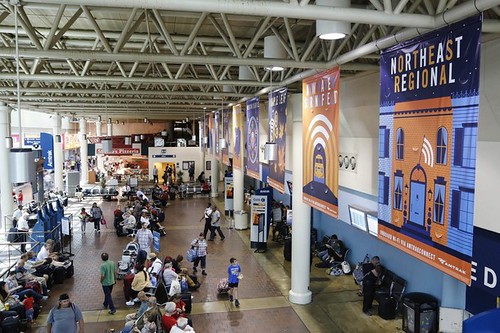
Union Station interior. Reuters photo by Jonathan Ernst.
Today, these services are run by separate entities, private companies for freight and public agencies for rail, although 40+ years ago both services were provided by privately owned railroads. But most passenger rail services are run on tracks still owned by private railroads.
In the last 60 years, passenger rail usage has significantly declined concomitant with the rise of automobile and air travel, and most passenger rail services are provided by public agencies. Amtrak, which was created to take on the passenger rail programs of most of the nation's railroads, provides services between states, while local and state authorities have been created to deliver commuter and intra-state rail services at the metropolitan and regional scale.
Over the past three decades, since the deregulation of freight railroad transportation, the industry has consolidated. The country is served by six major "Class I" railroads which tend to be regionally focused, such as Union Pacific in the Southwest and CSX in the Northeast and Southeast.
These systems focus on providing long distance service, complemented by smaller regional (Class II) and "short line" (Class III) railroads providing regional and localized services and connections to the Class Is, often on trackage that the larger companies find unprofitable to serve.
To maintain service, in some places, trackage serving either or both freight and passenger rail service may be publicly owned by either local, regional or state authorities (for example, in Alaska, the Alaska Railroad is owned by the State of Alaska). The federal government and many state governments have infrastructure investment and financing programs for freight transportation.
The law that created Amtrak guarantees that company access and at lower cost rates to freight transportation trackage, but other passenger rail services are not extended the same privileges.
Freight railroads prioritize freight service and don't invest in infrastructure which would exclusively support passenger rail service, saying that is a local responsibility. Creating new passenger rail services or improvements to existing services on right of way owned by the freight railroads is not a simple process.
National rail planning. The Passenger Rail Investment and Improvement Act of 2008 directed the Federal Railroad Administration to create a
National Rail Plan, covering both freight and passenger rail services. The planning process is ongoing. The law also created guidelines and expectations for State Rail Plans, which are meant to be congruent with national rail planning goals and objectives.
DC's rail agenda shouldn't be limited to consideration of intra-DC matters. Focusing a "State Rail Plan" exclusively on intra-DC matters and investment fails to leverage the opportunities presented by DC's place, position and role within the regional transportation system, may underplay how other entities shape the rail environment within DC, and how DC can contribute to improving the broader rail transportation system within and outside of DC's boundaries.
National initiatives for high speed passenger rail service. While the role of freight rail is significantly more advanced than in Europe, by comparison, European passenger rail programs are significantly more advanced than the US, particularly in high speed rail service between major cities within nations and across borders between countries. Japan and China also have extensive high speed rail systems.
In the first Obama Administration, there was an attempt to create a national initiative to move high speed railroad passenger service forward, but it ended up running aground over politics as it was painted by Republicans as a Democratic Party initiative. States controlled by Republican governors for the most part opted out of participation, wrecking the initiative.
Movement on this front has shifted to Amtrak in the Northeast Corridor and to various state and multi-state initiatives. Currently, efforts with the most traction are underway in California, Florida, and Texas, the latter two by private entities.
Current rail conditions "in DC."
Railroad tracks in DC are mostly owned by CSX. Separately, Amtrak owns a section of track that had been owned by the Pennsylvania Railroad, which is part of the dedicated Northeast Corridor passenger railroad line between DC and NYC, and is the most highly used passenger rail line in the US, used by both Amtrak and local services.
CSX provides limited direct freight rail service to some business locations within DC, but freight traffic through the city is high nevertheless, mostly emanating from the Port of Baltimore en-route to the Midwest, because the city's rail network interconnects the rail network between Baltimore and the Midwest.
CSX tracks are used for passenger rail service on the Camden and Brunswick MARC lines, for the "last miles" of VRE service from Virginia, between Long Bridge and Union Station, and for Amtrak service to West Virginia and Pennsylvania and points west from Pittsburgh.
While Norfolk Southern doesn't have trackage in DC,
their right of way is used for intra-state and inter-city and inter-state passenger railroad service in Virginia, and the company's priorities shape the ability to expand regional railroad passenger service between DC and Virginia. VRE service uses both CSX and NS right of way.
The State of Virginia has an agency separate from the Virginia Department of Transportation called the
Department of Rail and Public Transportation which is responsible for the state's rail-related transportation activities. The State rail plan and program provides a great deal of focus on expanding passenger rail services. A primary goal is upgrading speed of service between DC and Richmond so that in effect, Richmond becomes the equivalent of a southern terminus for the Northeast Corridor.
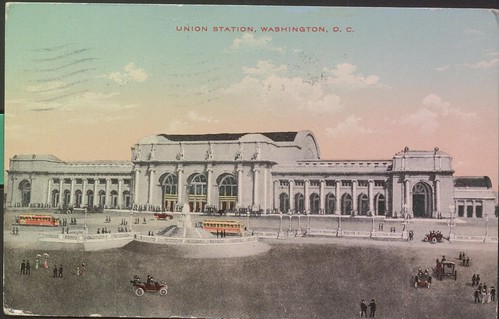
Passenger rail. Union Station is the terminus for inter-city and commuter railroad service provided by Amtrak, MARC (Maryland), and VRE (Northern Virginia).
Union Station is one of the most used transit stations in the US, with an average of 100,000 people moving through the station each day. It's the number two station for ridership in the Amtrak system, with more than 5 million passengers using the station each year. VRE also provides service to a station in L'Enfant Plaza.
Before Metrorail service began, railroad passenger services had been provided to many locations within DC other than Union Station, although by the 1970s, sub-city service was eliminated to all but Brookland and Takoma, although the Silver Spring Station in Montgomery County was also used by DC residents.
Amtrak has a master plan for major expansion of Union Station. To fully realize this plan, Metrorail capacity needs to be expanded to the station with the addition of another line.
--
Reimagining Union Station | The Washington Post
The
Southwest Ecodistrict Plan proposes expansion of rail services at the L'Enfant Plaza station (and the plan suggests using regenerative braking as a way to generate electricity from trains stopping at the station).
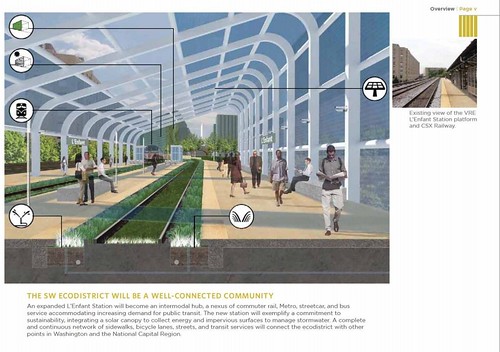 Page from the Southwest Ecodistrict Plan showing proposed improvements to the L'Enfant passenger railroad station.
In Northeast, Ward 5 Councilman Kenyan McDuffie suggested that there could be a new MARC station built in the vicinity of New York Avenue and Bladensburg Road NE, to provide more transit service in an otherwise underserved area, one that is scheduled to grow.
The State of Virginia, MARC and VRE have long term expansion plans which impact DC since DC is the prime destination for these services, although for the most part those plans are unfunded. Amtrak's plan for Union Station is part of a bigger initiative to upgrade the Northeast Corridor.
As part of the state rail plan, Virginia is investing significantly in rail passenger service expansion throughout the state through the Amtrak Virginia program and other initiatives.
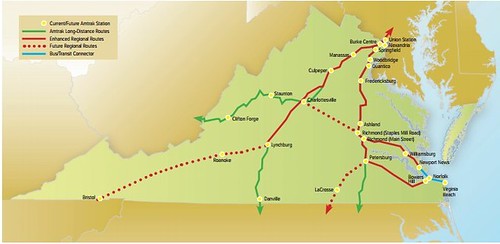
For a long time it has been suggested that MARC Penn Line service could be extended to Alexandria, thereby providing service directly to three more stations (L'Enfant in DC and Crystal City and Alexandria in Virginia) and reducing transfers to the Metrorail system at Union Station. This is also addressed in the VRE System Plan.
--
MARC Growth and Investment Plan
--
VRE System Plan 2040
--
Amtrak Northeast Corridor Rail Investment Plan
-- "
Aging Infrastructure Plagues Nation's Busiest Rail Corridor,"
New York Times
--
The Case for Virginia's Regional Trains: The Foundation for the Future
--
Endnote page for Case for Virginia's Regional Trains: Foundation for the Future
--
Dual powered diesel-electric locomotive introduced into service at NJ Transit and implications for long range regional railroad planning in DC, Maryland, and Virginia
--
Virginia State Rail Plan
--
West Virginia State Rail Plan
DC and Virginia and CSX have begun planning for the reconstruction and improvement of Long Bridge, owned by CSX, which is the major rail connector between DC and Virginia.
Freight rail.
Expansion of shipping capacity of the Panama Canal impacts competition between East Coast ports, in particular Baltimore (
Port coverage,
Baltimore Sun), Hampton Roads (
Ports and Rail archive,
Norfolk Virginian-Pilot), Charleston ("
Port of Charleston leadership calls for 'aggressive' growth,"
Charleston Post and Courier), and Savannah and Brunswick, Georgia ("
Georgia ports continue to set records,"
Savannah Morning News). To some extent, New York/New Jersey and Jacksonville are already out of contention.
CSX is a major provider of service between many of these ports and the Midwest and is implementing the
National Gateway program to upgrade infrastructure to enable unimpeded running of double-stack container traffic through the system.
In the multi-state area, more freight moved by train can reduce truck traffic in the I-95 and I-81 corridors, which is an element of managing and increasing throughput capacity and safety on those freeways.
Besides plans for Long Bridge, which impact both passenger and freight rail and Metrorail, as part of the
National Gateway program, CSX is rebuilding the
Virginia Avenue Tunnel, which is used exclusively for freight. Presumably, these improvements could reduce inter-city truck traffic some, but will have limited direct effects on DC specifically.
From a regional economic development perspective, VAT expansion supports the
Port of Baltimore as a preferred destination for global shipping vis-a-vis other East Coast port locations.
Some area residents are opposed to the VAT project, mostly because of short term negative impacts from construction (
DC Safe Rail | Don't Be Railroaded!), and sued to stop the project (in part using the proposed creation of a DC State Rail Plan as a reason to delay the project), but they were unsuccessful ("
Opponents of Virginia Avenue Tunnel project lose again,"
Washington Post).
Image of the retaining wall collapse in Baltimore. CBS photo.
Consequences of disinvestment in rail infrastructure. As an example of problems from underinvestment in rail infrastructure, Baltimore has experienced many problems.
Fires in tunnels have led to significant service disruptions in the past and in 2014, a railroad retaining wall in Charles Village collapsed, with major deleterious consequences ("
26th Street still under construction a year after collapse,"
Baltimore Sun).
Hazardous chemical shipments. While DC isn't at threat from crude oil derailments because the city isn't on routes to refineries, a concern expressed by residents is the transshipment of dangerous chemicals through the city and the possibility of train derailments and disastrous consequences.
DC City Council banned such shipments in 2004 but this was overturned by the Surface Transportation Board in 2005, which ruled that local action is preempted by federal law ("
Surface Transportation Board Rules That D.C. Ban On Rail Transportation of Hazardous Materials is Preempted by Federal Law As Battle Continues Over Security in the Rail Industry," K&LNGAlert).
High speed passenger rail services. Separate from maintaining, improving and extending existing passenger rail services, maintenance of the city's position in rail-based transportation requires that attention be paid to plans for high speed passenger rail service. Within DC proper, Amtrak is leading these efforts with proposals to improve the Northeast Corridor and expand Union Station.

The
Southeast High Speed Rail Corridor initiative aims to extend that planning southward, from DC to Atlanta and Jacksonville.
Virginia is working to extend high speed rail services southward from DC to Richmond, which would require electrification of the tracks.
Beyond Richmond, North Carolina is moving forward efforts to create more direct and higher speed rail connections between Raleigh and Richmond ("
Southeast Corridor rail milestone advances prospects for faster trains,"
Charlotte Observer).
These long range plans also shape planning for the Long Bridge because its capacity will need to be expanded, electrification infrastructure has to be added, and will impact the configuration of railroad service through an expanded L'Enfant Station.
Maglev. Magnetic levitation is a method for moving trains without wheels, through magnetic forces on a guideway track. In test situations, speeds over 300mph have been attained.
But maglev is still mostly a concept and there are only two maglev systems in operation now, serving airports and the center city in South Korea and Shanghai, and a test track about 25 miles in length in Japan. Japan aims to put maglev in revenue service by 2027 in its Bullet train system, in a new Chuo Shinkansen line ("
Japan Gives Top U.S. Politicians a Free Ride, Sales Pitch on New Maglev Trains," Daily Tech -- the article discusses the technological elements extensively). The line will be about 180 miles long, with nine stations, and will incorporate the test track.
From 2001 til about 2007,
Amtrak, with DC and Maryland, studied maglev but Amtrak has since moved in a different direction and the website is defunct except through archive.org. Within DC, the plan proposed that all of the maglev trackage would be placed underground.
More recently, a private maglev venture has surfaced.
Northeast Maglev aims to create a line between DC and NYC, starting with a pilot system between Baltimore and DC, in association with the Central Japan Railway Company ("
Campaign for ‘Floating Train’ to Connect New York and Washington Gathers Pace,"
Wall Street Journal).
The State of Maryland seems to be intrigued by and supportive of this effort, especially after Maryland Governor Hogan rode the maglev train on the test track in Japan while on a trade mission there ("
Hogan calls maglev ride 'incredible,' says state will seek $28 million grant to study,"
Baltimore Sun), and the company announced it is moving its headquarters to Baltimore ("
Maglev venture opening Baltimore office,"
Baltimore Sun). The
Annapolis Capital is skeptical ("
Our say: Hogan's interest in maglev not well-timed").
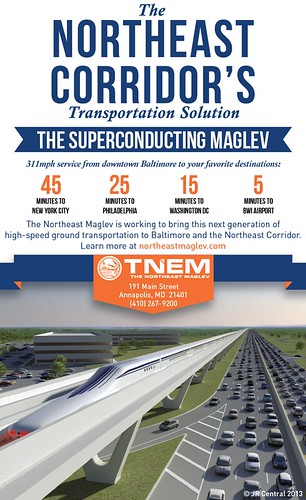 Northeast Maglev infographic.
Can the DC State Rail Plan be transformative?
Northeast Maglev infographic.
Can the DC State Rail Plan be transformative? In the words of Chicago architecture writer
Lynn Becker:
Planning consolidates and conserves; only ego, restless and voracious, creates.
One of the problems with producing plans is that their parameters are set by the vision of the client. If the scope is narrowly defined and the team producing the plan isn't willing to consider issues outside the scope or in nonstandard ways, the plan may not go very far.
This is potentially a big problem with the DC State Rail Plan because events and actors at the state and regional level in Virginia, at the state level in Maryland, two private rail companies, Amtrak, and other interests all impact how freight and passenger rail service is delivered in DC.
While I am sure that these entities will be represented on the advisory committee for the plan, again, their representation and ability to be innovative is constrained also by the priorities of their respective organizations (as Graham Allison wrote in
Essence of Decision, "where you stand depends on where you sit").
Innovative planners and recommendations can function like Alexander who "untied" the Gordian knot with a sword, and help a plan become more innovative.
That is essential with regard to the DC State Rail Plan in order to forge more effective regionally-serving passenger rail services.
Elements to consider in creating the DC State Rail Plan
Because DC is mostly a "pass through" as it concerns freight rail transportation, these points focus mostly on passenger rail, with a couple exceptions. And the comments on passenger rail for the most part concern regional rail service, and not Amtrak and its longer distance inter-city services. In any case, the primary goal for the Plan should be to maximize coordination between the various actors to achieve the greatest amount of benefit at the least cost.
--
Defining the transportation network as it relates to rail service at the outset of the planning process
The plan could better deal with some of the knotty issues around rail transportation in the region by defining (and planning) the rail transportation network at multiple scales.
In "
The Meta-Regional Transit Network," I defined the network at five levels:
-
international (connections between countries);
-
national (such as the Interstate Highway system or the proposed High Speed Rail Initiative, airports, the railroad network);
-
regional and multi-state (freeways sure but also railroads, such as passenger railroad service in NY, CT, NJ, and PA, and inter-city bus service)--I define regional as two or more metropolitan areas so that Baltimore-Washington is a region while each comprises a distinct metropolitan area;
-
metropolitan such as the subway and bus system for the Washington metropolitan region, which is anchored by the WMATA system and the VRE and MARC railroads; and is supplemented by
-
sub-metropolitan transit networks at the suburban and center city scales.
This network definition might need some tweaking as it relates to freight transportation, maybe not, but it's also important for the plan to discuss freight transportation in terms of the economy at national and regional/multi-state scales, and how federal law often pre-empts local action (like with the attempt to regulate hazardous materials transport). It's important to recognize rail transportation of freight as an element of the national economy to put resident interests in perspective.
--
Calculating the economic impact of rail transportation as an element of the city's economy and mobility system
A section of the rail plan should quantify the economic impact of rail transportation for the city's economy, including Amtrak's being headquartered here, and its employee base, including the Ivy City Maintenance Yard on the passenger rail side, and the economic value of the freight railroad system as well. According to
CSX's DC page, more than 400,000 freight car loads are handled each year, although it's not clear if those are trans-shipments or service to DC-based customers.
Some resources:
--
The Economic Impact of America's Freight Railroads, Association of American Railroads
--
Economic Impact of High Speed Rail on U.S. Cities, US Conference of Mayors
--
Economic Impact of Station Revitalization, Great American Station Foundation
--
The Value of Station Investment: Research on Regenerative Impacts, Steer Davies Gleave for Network Rail UK
--
Understanding SEPTA's Statewide Economic Value, Economy League of Greater Philadelphia
--
Railroad transportation infrastructure as an element of civic architecture
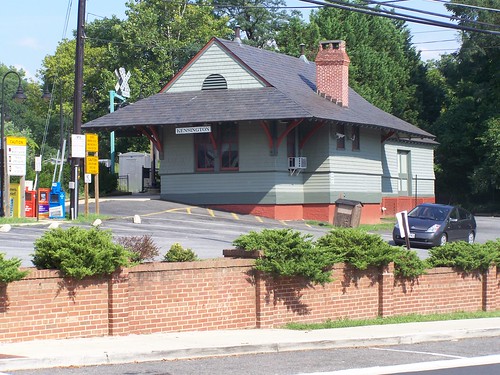
Most state rail plans don't address this issue, although station improvements are covered.
Mostly this issue has been thought of in terms of train stations, especially a city's main station(s)--these days most US cities only have one major train station, with some exceptions.
Metropolitan areas with commuter railroads also have a variety of station types including station buildings serving communities at a scale much smaller than a "portal" station in an urban core.
On the MARC Brunswick Line the Kensington Station (above right) is an extant example of how train stations were significant civic buildings in communities of all sizes.
Were the DC State Rail Plan being created at the metropolitan and regional scales, a plan element on railroad infrastructure and urban design would be much broader in its scope and coverage. It can be drawn more narrowly at the city scale.
The past blog entry "
Transit, stations, and placemaking: stations as entrypoints into neighborhoods" discusses how, especially in the urban context, transportation infrastructure's aesthetic elements have often been ignored and this can have deleterious impact on quality of life.
Since then I came across some early planning writings from the early 1900s on the aesthetic qualities and design elements of railroad systems, concerning both station grounds and the right of way and yard facilities. The Boston and Albany Railroad was a leader in adopting such an approach.
See "A Railroad Beautiful" and "The Treatment of City Squares--III; The Square Before the Railroad Station,"
House and Garden (2) 1902 and "Railroad Gardening,"
Standard Cyclopedia of Horticulture (these resources have been scanned for online access by the Hathi Trust).
Spatially, the impact of railroad tracks in terms of how they often split communities ("the wrong side of the tracks") may be avoided when railroad tracks are tunneled (for example how trains go under Capitol Hill between Union Station and Virginia Avenue).
In more recent years there have been some interesting projects, such as in Reno (Retrac) and the Port of Long Beach's Alameda Corridor, to put railroads in trenches, although mostly to reduce negative impact of street crossings on motor vehicle traffic.
Note that the SW Ecodistrict Plan suggests that the Virginia Avenue Railroad Viaduct could be tunnelized, and residents in Brookland suggested that the Metropolitan Branch could be tunnelized in a planning process in their neighborhood in 2007 ("
Rethinking the Metropolitan branch railroad and subway tracks in northeast DC").
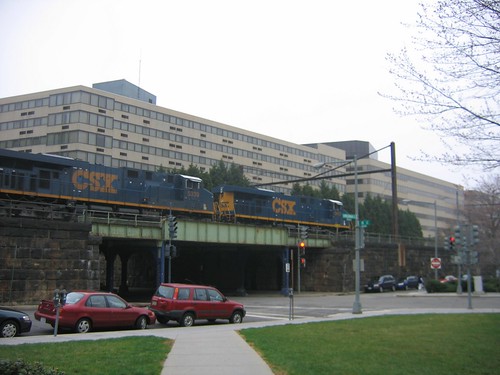 Virginia Avenue SW railroad viaduct. Flickr photo by Matt Johnson.
There are some examples of liner buildings being constructed along bridges, more recently in Columbus, Ohio but across a highway ("
Ohio highway cap at forefront of urban design trend,"
Chicago Tribune) and much longer ago in the Forest Hills district of Queens, New York, across the Lefferts Boulevard bridge across the LIRR tracks there.
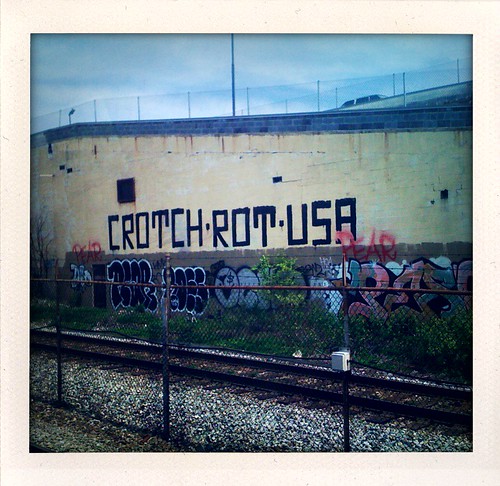 Graffiti along the Metropolitan Branch in DC. Flickr photo by Lukas Eklund.
Landscape architecture and visual elements
Graffiti along the Metropolitan Branch in DC. Flickr photo by Lukas Eklund.
Landscape architecture and visual elements. Mostly, the aesthetic elements of the views along railroad tracks are wanting. This shapes perceptions and attitudes toward the city, not just for railroad passengers, but also residents, who live with the views every day.
Baltimore's Green Tracks initiative ("
City to mark "Green Tracks" cleanup of Amtrak corridor and nearby neighborhoods,"
Baltimore Business Journal) to remove graffiti and improve the placemaking and environmental characteristics of their main rail corridor is a more recent example of "Railroad Beautiful."
Infrastructure. Stations, bridges, underpasses, etc. need to be designed not to strictly be utilitarian but also to improve and accentuate their surroundings. There is a tension between lowering costs and considering the long term effects of value engineering on subsequent economic and placemaking benefits. Also, transit agencies are not accustomed to managing their facilities in terms of aesthetics, other than for a handful of signature stations.
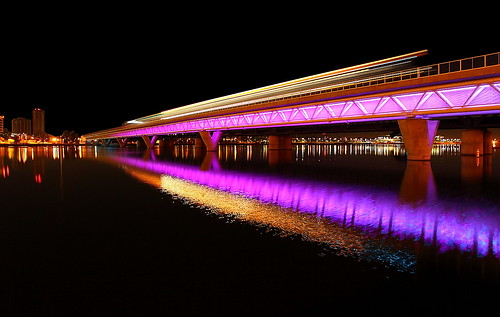 The light rail bridge across the lake in Tempe, Arizona incorporates architectural lighting and treats what could be ordinary and unattractive infrastructure as an element of civic architecture. Flickr photo by Grant Brummett Photography.
Obviously, Union Station is a pre-eminent example of the City Beautiful Movement and the power of planning (the McMillan Plan) to improve places through large building and construction projects. .
But the other elements of the railroad system in the city--the bridges, right of way, etc.--weren't necessarily constructed to be equally attractive. Recommendations should be made in the State Rail Plan to acknowledge the importance of "Railroad beautiful" design in all elements of railroad transportation infrastructure, not only train stations.
Underpasses associated with the Metropolitan Branch in particular tend to be dank and dark places.
The NoMA BID has an initiative to employ public art to improve some of their railroad underpasses as an element of their parks and cultural planning.
There are some good examples of public art and lighting treatments for underpasses. I am fond of the underpass at the Essen Hauptbahnhof in Germany, which also doubles as a bus station for the train station. This is a day photo. At night the outsides of the bridge structure are lit as well.
The "Living" and "Growing" bricolage public art pieces in highway underpasses along Lakeshore Drive in Chicago is another example of a superlative treatment. (DC has a similar but much smaller project in Takoma that is not nearly as powerful, and was 3x more expensive than the Chicago project.)
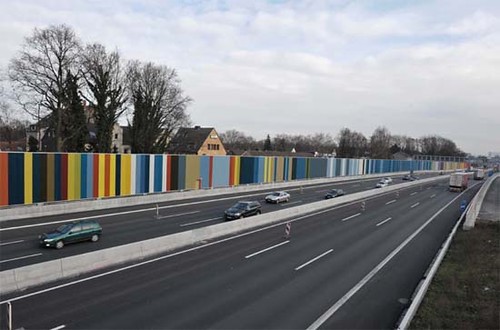
Barcode public art treatment of walls along the A40 Freeway in the Ruhr Valley, Germany could be a model for artistic treatments on train viaducts in DC.
--
Asserting a prominent role for DC in shaping regional rail passenger transportation policy and creating an integrated rail passenger transportation system for the multi-state region
Currently, regional commuter railroad services are delivered by MARC and VRE. The services are not integrated. MARC operates mostly within Maryland, with service focused on DC (and Baltimore), although the Brunswick Line serves three stations in West Virginia, duplicating the historical footprint of the line. VRE focuses on providing service between Virginia and DC, with primary close-in stops in Alexandria, Crystal City, L'Enfant Station, and Union Station.
DC is not a direct owner-participant in these services. In California,
Joint Powers Authorities are created to manage commuter railroad services, and usually involve multiple jurisdictions operating in concert.
DC and perhaps Union Station could be a kind of power broker and facilitator to encourage the creation of a united regional passenger rail service bringing together the existing MARC and VRE services, and expanding beyond the current footprint.
The DC State Rail Plan should acknowledge that the area's Metropolitan Planning Organization, the Transportation Policy Board, should take on a prominent position in rail transportation planning including the development of an integrated regional transportation plan that is not constrained by the planning dictates of individual transit authorities, especially WMATA. (For example, it's likely that Dulles Airport would have been better served by railroad, rather than an extension of the Metrorail system--it's about 20 miles from West Falls Church Metro to Dulles Airport.)
The DC State Rail Plan should recommend the creation of an integrated regional scale passenger rail system, merging VRE and MARC into one combined agency, under a JPA agreement involving multiple jurisdictions.
--
Formalizing DC's participation in VRE and MARC right now
The WMATA system operates as the equivalent of a JPA, with Virginia, Maryland, DC, and the Federal Government as members.
Note that VRE is a JPA already, owned by two different transportation commissions, it's just that DC isn't a member of the authority.
With an aim of creating an integrated regional passenger rail system, the DC State Rail Plan should propose that DC become a participating member in both MARC and VRE. This would require that MARC be reformulated as a JPA.
(West Virginia should also join a MARC JPA. The
West Virginia State Rail Plan does not suggest reformulating MARC as a JPA, but does hypothesize that the state could purchase train equpment for MARC, as a way to expand service on the Brunswick Line.)
--
Creating an integrated regional passenger rail system for DC, Maryland, and Virginia (with service to West Virginia, Pennsylvania, and Delaware)
I have written about this a lot:
--
A regional railroad passenger transportation vision for DC, MD, VA, WV and parts of PA
--
Regional transportation planning and fixed rail service
--
Why don't Maryland and West Virginia think about expanding MARC into a true regional system?
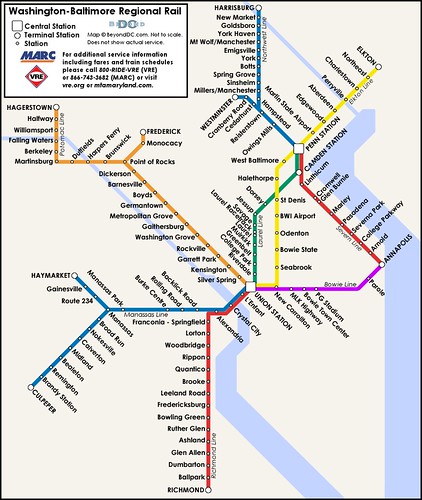
triggered originally by a map concept (shown below) created by Dan Malouff many years ago. I suggest calling the service RACER, an acronym for Railroad Authority of the Chesapeake Region.
 Through versus terminal-based service increases real capacity
. One advantage of creating an integrated system would be the creation of "through trains" on at least some of the lines, which would improve throughput and capacity for Union Station. Union Station is a "terminal" which means that trains begin and end at the station, which requires a lot of platform and yard capacity for trains that are "sitting around." By operating trains as through trains, demands on Union Station can be reduced (although overnight train storage capacity is still required).
However, there are many technical and engineering issues that make integration of VRE and MARC somewhat difficult. It will take quite awhile to pull off.
Need for an even bigger regional service footprint. Today, I argue this map isn't "bold" enough, even though it's still quite innovative, and should include additional segments serving (1) Southern Maryland (Prince George's and Charles County), (2) Maryland's Eastern Shore, (3) Baltimore to Frederick, (4) extension of Penn Line service to Newark, Delaware ("
MARC could be extended to Delaware,"
Baltimore Sun), (5) service south of Richmond, (6) service west of DC ("
Without the right planning "controls" you can't stop change: Loudoun County and rail service in Northern Virginia"), etc.
Inter-city vs. intra-city railroad passenger service. Before subways, railroads provided short and long distance transit. For the most part subway and streetcar service replaced railroad passenger service within cities. Some cities, like Washington have distinct railroad services focused on longer distance trips, delivering passengers to major cities (DC and Baltimore), with major terminal stations in the center cities. Other cities have limited subway service, like Philadelphia, and therefore retain a lot of intra-city railroad service. A number of cities have a mix of services, with main stations as destinations in the center city and major suburban towns, with a variety of sizes of station stops in between.
Usually, railroad service footprints follow legacy configurations of historical rail services. E.g., in Philadelphia, rail service today is based on what the Pennsylvania and Reading Railroads offered, and some neighborhoods still have two different lines serving them because historically the two companies competed.
Montreal also has a number of intra-city railroad stations separate from the subway system. Similarly, Chicago has six different Downtown Metra stations, each serving a different line (which represent the fact that many of the services were once run by different railroad companies). Baltimore had two B&O stations and one for PRR. Today, Camden Station reflects B&O service, and Penn Station the Pennsylvania Railroad.
Atlantic Terminal in Brooklyn.
New York's regional passenger system has a couple dozen railroad stops in Queens, Brooklyn, and the Bronx, most in outlying more "suburban areas, with most passengers moving through Penn or Grand Central Stations in Manhattan.
Atlantic Terminal functions as Brooklyn's main railroad station, but is secondary in physical prominence compared to stations in Manhattan.
Ridership has increased somewhat in the evenings with the opening of Barclays Center and the promotion of train access to sporting and entertainment events held there.
Many European cities, especially Paris, which built an extensive underground system to facilitate railroad service in the city in addition to the Metro, have systems with multiple in-city railroad stations, complementing subway service, although usually the rail service footprint predates the subway.
London's Crossrail project currently under construction is another example, although it's sort of a suburb-to-suburb service traveling through the city. Because DC's employment centers are so concentrated, for the most part, there isn't a strong need to add more stations within the city.
--
Tighter integration of regional railroad services and metropolitan transit "right now"
The DC State Rail Plan needs to take a position calling for the integration of transportation planning and operation at the regional scale. This would also mean that besides the long term goal of integrating MARC and VRE into one system, in the intermediate term the current regional rail services should be more tightly integrated into the metropolitan public transit systems in Greater Washington (and Greater Baltimore, although this is outside the scope of the DC State Rail Plan).
A few months ago, challenged by an entry on GGW that stated there were no big ideas for the area transit system, I wrote a piece "
One big idea: Getting MARC and Metrorail to integrate fares, stations, and marketing systems, using London Overground as an example" about the need for integrated marketing and fare media between Metrorail and regional rail passenger services. (The same goes for MTA in Baltimore and MARC, which is touched on here, "
What to do transit-wise in Baltimore since the Red Line light rail program has been cancelled.")
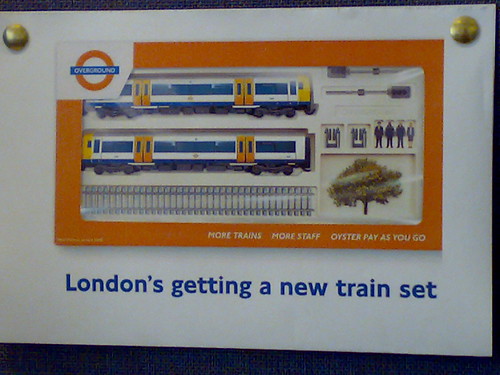 London Overground promotion. Flickr photo by Nick Hall.
One of the best examples of fare integration and sound marketing (complemented by equipment improvements and increased service frequency) is London's reorganization of underutilized surface rail lines into an integrated service called the London Overground, using a version of the Underground's logo to communicate that the systems are complementary.
The service is now wildly successful with large increases in ridership and increased property demand in the areas served by Overground stations.
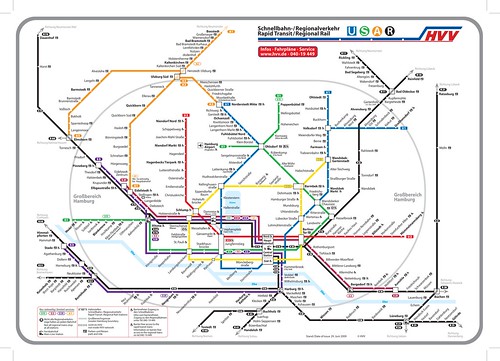
Similarly, Greater Hamburg has had an integrated transit fare media, marketing, and operations system for decades. This is perhaps best illustrated in the various system maps, which show all the services that are provided, regardless of which company provides the service. The HVV rail map shows all of the services as an integrated system.
By contrast, four different maps for the DC area--Metrorail, MARC, VRE, and Amtrak Virginia--are need to figure out where rail service is available. (MTA publishes an integrated transit map for Baltimore, but it's more focused on local transit and less on the regional service provided by MARC.)
Greater Boston's MBTA monthly passes include access to rail, heavy rail/light rail, bus, and ferry services. And MARC monthly passes allow free transit on MTA (and Metrobus and RideOn) but you can't use a CharmCard to pay for a ticket on MARC. But this is exceptional across transit systems in North America, where railroad fare systems, betraying their legacy routes, are not otherwise linked with local transit system fare media.
--
Improvements to the current services
Right now, of the five lines offered by VRE and MARC, only MARC's Penn Line has frequent service in both directions throughout the day. The MARC Penn Line is the only one of the five lines with weekend service, and that's only been the case since December 2013. The weekend service appears to be successful, with 4,000 to 7,000 people riding each weekend day on average.
Bi-directional service. Railroad passenger programs in Philadelphia, Greater New York, New Jersey, Boston, Chicago, New Jersey and other cities are usually two-way, even during rush hours, and have weekend service also.
Recommendations should be made to provide morning and evening bi-directional service on the Brunswick Line, which would aid reverse commuting in the Rockville Pike/I-270 corridor and would be a benefit for DC residents.
VRE has a limited number of reverse trains but not at times that support reverse commuting or single day round trips of significant duration. At the very least, testing the opportunity for reverse commuting service between DC and Alexandria could be considered.
Additional service. On the Penn Line, recommendations should be made to add one more train in each direction from Baltimore to DC (the last train leaves at 9:15pm and from DC to Baltimore after 11pm during the week. This would restore service to levels existing before budget-related cutbacks in 2009. Opportunities to extend VRE should be discussed in the plan as well.
Weekend service. While MARC Saturday service on the Penn Line goes pretty late, on Sundays the last train from Baltimore is at 5:30pm and the last train northbound from DC is at 7:00pm. A recommendation should be made to extend service later in the day on Sunday.
Weekend service expansion should be explored for the Brunswick Line, and should be discussed for the VRE lines as well, although it may be that demand for weekend service on VRE lines is limited.
Bicycles. MARC and VRE allow foldable bikes at all times. MARC does not allow regular bikes on trains during weekday service. Other train systems, especially those in California (Metrolink, Caltrain, Coaster) provide more and more prominent accommodations for bikes.
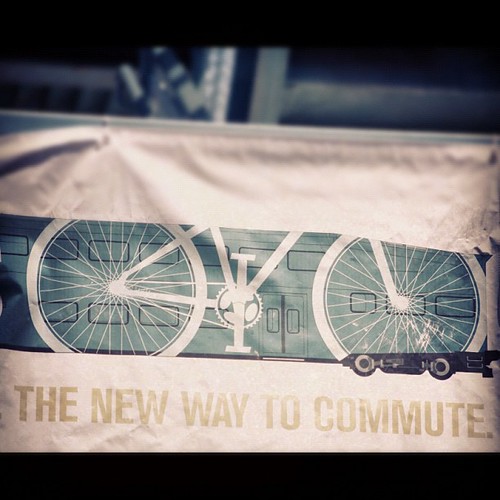 Image of a Metrolink bicycle promotion banner. Flickr photo by Erik Griswold.
VRE allows a limited number of regular bikes on certain trains
Image of a Metrolink bicycle promotion banner. Flickr photo by Erik Griswold.
VRE allows a limited number of regular bikes on certain trains. MARC has added bicycle cars for weekend service on the Penn Line ("
MTA adds more bike cars to weekend MARC Penn Line,"
Baltimore Sun).
Recommendations for adding bicycle accommodations to MARC trains in weekday service should be part of the DC State Rail Plan.
One easy way to do it
now between Baltimore and DC would be to allow bikes on the Camden Line trains, which have much lower ridership and excess capacity compared to the Penn Line. This could be a way to increase ridership on that line ("
MARC commuter railroad could implement daily bike service on the Camden Line").
Note that Amtrak is adding bicycle accommodation in its services from DC to Pittsburgh, to accommodate people cycling on the C&O Canal Trail and the Great Allegheny Passage ("
Bicycles now welcome on Amtrak's Capitol Limited,"
Pittsburgh Post-Gazette).
Marketing. There is a lot of room for improving the marketing of regional rail services, including street signage directing people to stations, which generally is pretty cryptic. (Discussion of this topic is deserving of a separate entry.) The DC State Rail Plan should make recommendations concerning the need for marketing improvements for passenger rail.
--
Opportunities for creating new DC passenger rail stations
DC has one major train station, Union Station, served by Amtrak, MARC, and VRE and a platform station at L'Enfant Plaza (7th and Maryland Avenues SW) served only by VRE. For the most part, it doesn't make sense to consider adding train stations within DC, because most of the trackage is in residential areas, while major employment districts generate the most demand for service.
Adding stations in residential areas isn't likely to generate a lot of ridership. For example, while not directly analogous, MARC's Riverdale Park station, a residential station with limited access to employment centers, has fewer than 50 daily riders.
However, with a vastly expanded rail passenger system for the region, it is possible that 3 stations could be added to DC, with a station just across the Potomac River in Rosslyn also serving Georgetown.
A new in-city station on the Penn Line to serve Northeast DC. Within MARC's current service footprint, it is possible to add a station in DC's New York Avenue corridor, in the vicinity of Bladensburg Road, as suggested by Councilman McDuffie (see "
Greater New York Avenue Gateway Revitalization"). Both the MARC Camden and Penn Lines travel through this area, which has extremely limited local transit service, and no railroad or subway service. If a MARC station were added, primarily served by the Penn Line, it would expand significantly the public transit options for a growing area of the city.
Ridership would be facilitated by an integrated fare media system treating trips from a New York Avenue railroad station to Union Station as a price equivalent to riding Metrorail. (Although maybe not, a MARC monthly pass might be slightly cheaper than two daily Metrorail fares.)
As population and retail density increases in the area, concomitant with various real estate development programs, it could be worthwhile to add a station serving that area sometime over the next 6 to 9 years. For that to happen, planning needs to start now.
Potential for an RER/Crossrail type railroad line to Arlington County and westward including a new Downtown rail station for DC. RER is a suburban commuter railroad system in Greater Paris. Inside the city, the lines are almost completely underground. Similarly, London's Crossrail will add new rail service to the city via underground tunnels and stations in Central London.
A few years ago, Dan Malouff, a transportation planner and writer/webmaster of the
BeyondDC website, suggested in an offhand written comment the need to create another major railroad station in the core of the region (within the Beltway) to ease capacity demands on Union Station.
Alexandria Union Station with Metrorail in the back to the left. Wikipedia photo by Choster.
Alexandria and Crystal City are the two train stations in Northern Virginia serving closer in destinations, focused on serving South Arlington and Alexandria (Alexandria is also an Amtrak stop).
The need for a station and service as hypothesized would be in North Arlington and points west (Tysons Corner), but there isn't existing railroad right of way on the surface which would facilitate the creation of such service. (Perhaps the Washington & Old Dominion Trail could be returned to rail service in the modern era, but the railroad shut down long before the rise of Northern Virginia as a business and residential powerhouse)
Using the RER and Crossrail as a model, a way to provide new railroad passenger service in a northwesterly direction would be to create an underground railroad line from DC Union Station northwest into Arlington County, which could be extended further into Fairfax County and beyond.
At the same time, at least two additional stations should be constructed between Union Station and Arlington Station, one in DC and one in Rosslyn.
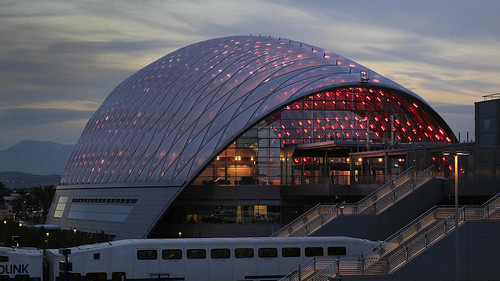 New Anaheim Regional Transportation Intermodal Center (ARTIC). A train station in the West End of DC and in Arlington could be built on the lower floors/in the sub-basement levels of an otherwise mixed use building, with office and other uses above. Photo by Allan Schaben, Los Angeles Times.
Creating Arlington Station on Wilson Boulevard
New Anaheim Regional Transportation Intermodal Center (ARTIC). A train station in the West End of DC and in Arlington could be built on the lower floors/in the sub-basement levels of an otherwise mixed use building, with office and other uses above. Photo by Allan Schaben, Los Angeles Times.
Creating Arlington Station on Wilson Boulevard. Comparable to the place of Atlantic Terminal in Brooklyn vis-a-vis Penn Station in Manhattan for the LIRR, a major train station could be constructed in Arlington, somewhere between the Ballston and Clarendon Metrorail Stations. It would be be served by Orange and Silver Line Metrorail service. I would expect that the station would be deep underground--necessary so as to not interfere with the Orange Line tunnel--with a mixed use building above.
A new rail station for the West End of the Central Business District. I would anticipate one in-city station being constructed in the vicinity of Connecticut Avenue and K Streets NW, with connections to the Farragut North and Farragut West Metrorail stations, on the Blue, Orange, Silver, and Red Lines.
A station for Rosslyn also serving Georgetown. Depending on the alignment from Union Station, the line could cross into Virginia in a manner that provides the opportunity for an underground station and connection at the Rosslyn Metrorail Station.
Likely because of tunneling issues, it makes more sense to have this station in Rosslyn and not Georgetown.
If the Georgetown BID's proposed aerial gondola system between Rosslyn Metrorail Station and M Street is constructed ("
D.C. has taken a step to link Georgetown and Rosslyn via gondola,"
Washington Post), that would make Rosslyn function like an in-city Metrorail station, so we can argue that a Rosslyn railroad station would serve both Northern Virginia and Georgetown.
Extension west from Arlington. Speculation on extension of this line beyond Ballston is beyond the scope of the DC State Rail Plan.
Design, engineering and construction. With expansion planning underway for I-66, a railroad construction program could be integrated in that program, although it's on no one's radar currently. One option would be to create a railroad line in a tunnel constructed under the westbound section of I-66.
Because the line would be underground it would be constructed with electrical catenary from the outset. Therefore, it could be inter-operated with MARC's Penn Line as a way to provide through service. (Also it could be designed with regenerative braking energy capture at the new stations.)
Like how MTA contracts with NJ Transit to serve a couple of its lines which originate in Newark, this line could show the way forward for integrating MARC and VRE into one service.
Service to Southern Maryland and a station for Southeast DC. If a line were created to serve Southern Prince George's and Charles Counties, it may be worth considering the development of a station stop in SE DC, possibly in the vicinity of the Bolling Air Force Base /Naval Research Laboratory. Over time, demand for service could increase if the St. Elizabeths West and East Campuses become major employment centers in accordance with DC economic development plans.
--
Safety issues
Street level crossing and safety. Nationally, railroad crossing safety is a big issue and is a major priority of state and regional rail planning. It is less an issue in DC because many at-grade railroad crossings were eliminated in the construction of Union Station and its new approaches.
However, there are some at-grade crossings on CSX tracks in Southeast DC. Deaths of pedestrians walking illegally on railroad tracks doesn't occur very often in DC, but there are portions of the right of way which are accessible if people cut through fencing. These situations should be covered in the plan.
Maintenance of areas around passenger rail stations. Snow clearance from the public plazas and walkways at Union Station has been poorly handled in the past ("
A "maintenance of way" agenda for the walking and transit city") but more generally the city should prioritize snow clearance, lighting and other public safety improvements around transit stations, including railroad stations. This need for a change in policy should be acknowledged in the State Rail Plan.
--
More fully leveraging Union Station's potential as a portal and visitor center
Alfred Eisenstaedt: Sunday afternoon crowd of passengers waiting for trains in Union Station, Washington, DC, 1943
When railroads were the nation's primary mass transit mode, especially for long distance trips, Washington's Union Station was the primary entry point into the city, with hundreds of trains serving as many as 200,000 people each day, arriving and departing from the city.
The expansion of Union Station as proposed by Amtrak and in the
Burnham Place at Union Station project planned through the decking over the Union Station railyard between the station and K Street NE is a game changer for the city and Central Washington.
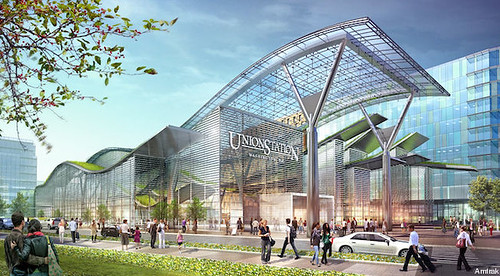 The plan reconceptualizes Union Station and extends it behind the station, incorporating what would be the train shed into a kind of atrium.
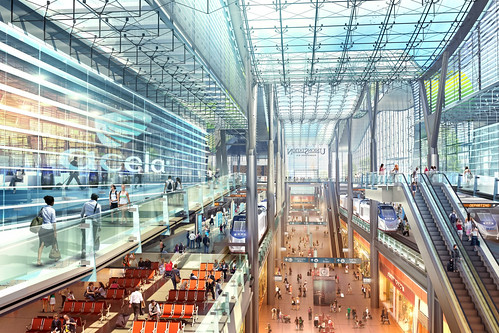
I haven't kept up with the most recent planning for the expansion ("
Beyer Blinder Belle and Grimshaw to Lead Master Development Plan for Washington Union Station"). There was
a recent presentation as part of the National Building Museum's
DC Builds program, although it's not yet online.
The DC State Rail Plan should address the experiential quality of the visitor experience in train stations located within DC in line with the discussion in "
Transit, stations, and placemaking: stations as entrypoints into neighborhoods." Right now, while the station is dynamic and exciting, the visitor service element is practically nonexistent, with a brochure rack in one gate area, and tour bus sales counters.
The plan should discuss Union Station's context as a major portal into the city for visitors, the opportunity for Union Station to serve as the city's main visitor center, and how this position could be further enhanced if a visitor-oriented transportation system connecting Union Station with the National Mall were to be created along the lines discussed in the past entry "
A National Mall-focused heritage (replica) streetcar service to serve visitors is a way bigger idea than a parking garage under the Mall."
Recommendations for how DC's economic development functions, Destination DC, and Union Station can better address visitor services should be part of the State Rail Plan (also see "
Need for a comprehensive visitor transportation plan in DC" and "
Parking under the National Mall should be part of an integrated approach to visitor services and management").
The plan should reiterate the need to add another Metrorail line to serve Union Station, in order to accommodate Amtrak's expansion plans and the anticipation of greater use of the station as a result of the above proposals to expand regional passenger rail services.
--
Including a cultural interpretation element in the plan on railroad history and a museum-exhibiting program centered at Union Station
Separately, the plan should discuss the interpretation and presentation of railroad history within the city. For example, the transportation plan for Passaic County, New Jersey has an element on transportation history and interpretation, in part as a component of tourism. Sadly, the MoveDC plan didn't include an element on cultural interpretation as it relates to transportation.
Union Station should be the focal point for the presentation of the city's transportation history.
The station is a signature element of the McMillan Plan of 1902 and a key example of the City Beautiful Movement and its Beaux Arts architecture style (as well as an example of Haussmann-like urban renewal programs).
Union Station has done a better job recently of presenting its transportation history but with the expansion of the station there is an opportunity to do much more.
Given that Union Station is frequently a site for Train Day festivities and Amtrak provides storage for privately owned passenger train cars, it would be possible to develop spaces and opportunities to present railroad history as a program element of the station's expansion.
One recommendation that should be made is the creation of a transportation and tourism "museum" within the station.
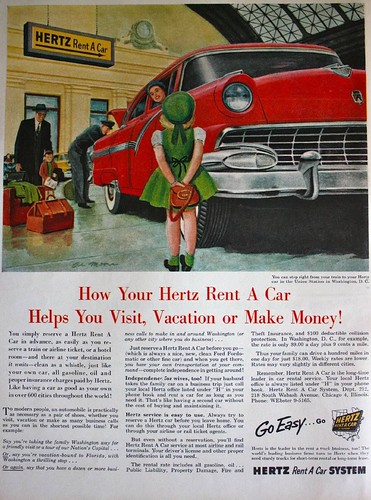 This 1955 Hertz rental car ad features Washington's Union Station. Because Union Station is inter-modal (railroad, subway, local bus, inter-city bus, streetcar, tourist services, taxi, bicycle, walking) it's a good location for a transportation museum.
I see this as being done as a kind of joint venture with existing museums in the region, especially those museums already presenting aspects of railroad-related history with a local angle.
A "transportation" museum at Union Station wouldn't have to develop a large permanent collection. It could more be a place for existing museums to display items that would otherwise remain in vaults, complemented by changing exhibits curated locally and developed by and with other transportation museums around the country.
Partners could include the National Museum of American History, the National Postal Museum, the National Railroad Historical Society Washington chapter, the B&O Museum in Baltimore, and the National Capital Trolley Museum.
Because of Washington's place as a leading tourist destination and the intermodality represented by Union Station, exhibits on other elements of transportation and visitation history would also be appropriate.
Private railcar storage could be "displayed"to the public as part of the exhibit program also.
One example of the kind of exhibit I am thinking is the companion exhibit--up currently in Chicago's Union Station--to the book
Terminal Town, which covers all of the types of transportation terminals in Chicago.
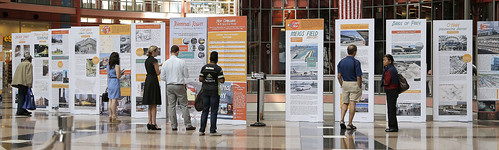 “Terminal Town: Celebrating 75 Years of Travel to the Windy City,” exhibit on display at Thompson Center by the DePaul University’s Chaddick Institute for Metropolitan Development. Photo by Jamie Moncrief/DePaul University.
DC's history trail interpretation program could be the model for the creation of a city-wide railroad history "trail." The sign below is in Chicago, and discusses the history of a railroad bridge there. Many communities, the Ride Philadelphia interpretation program is one, have transportation history interpretation programs that are good models.
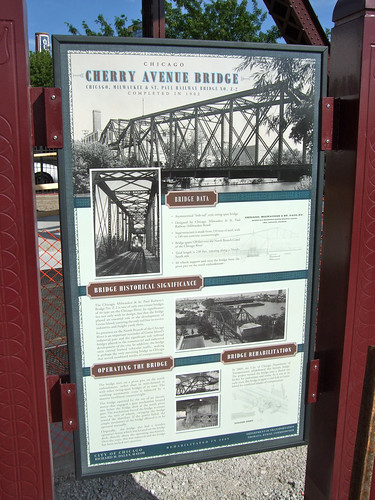 Cherry Avenue bridge interpretation sign, Chicago. Flickr photo by Steven Vance.
-- Train tourism
Many people are already riding trains as an element of their plans to visit DC and other cities in the region. It is a key element of the Amtrak Virginia program and generally Amtrak devotes a fair amount of marketing to tourism.
Poster circa 1930.
Many states have scenic-excursion railroads that are tourist attractions. There are a number of these systems in Virginia, Maryland, West Virginia, and Pennsylvania, and the
B&O Museum and the National Capital Trolley Museum have short tracks used for train riding. NRHS chapters also organize excursion trips.
Other state rail plans, including those for Virginia and West Virginia, do discuss, albeit briefly, excursion railroads and their place in the rail and tourism systems. DC as a city-state has much different conditions than a typical state, and there is no opportunity for that kind of dedicated tourist attraction in the city.
However, as a way to build interest and awareness of railroad service in the region, it could be worthwhile for MARC and VRE, with the National Railway Historical Society and the proposed transportation museum in Union Station and the B&O Museum, to develop a special event railroad excursion program.
One example is
the program between Norfolk Southern Railway and the Tennessee Valley Railroad Museum, which offers special excursion steam engine trains in the Spring, Summer, and Fall on various segments of the Norfolk Southern system (
2015 schedule).
Since Norfolk Southern is already doing this, they would be a logical partner to work with to test and launch such a program out of DC. At the same time, rather than just approach this haphazardly, a detailed marketing program to simultaneously promote regional passenger service should be developed in association with this program.
The DC State Rail Plan could make recommendations on excursion tourism as an element of the plan, both to serve tourist markets and as a way to market and promote passenger rail service.
--
Freight rail service expansion opportunities in the city as an element of transportation demand management
DC used to have an active freight railroad transportation presence, when railroads still served as the primary mode for long distance movement of goods.
That's why the built environment along the Metropolitan Branch is marked by large buildings used as warehouses, for distribution, and for printing among other uses (the XM Satellite building used to be for printing).
B&O also served DC with a dedicated freight terminal located at the northwest corner of the intersection of New York and Florida Avenues NE.
But as these uses moved to the suburbs and more shipping was captured by trucks, freight service within DC dropped precipitously, and freight delivery no longer occurs on the Metropolitan Branch (the segment of the rail network that goes north from Union Station to Montgomery County, Maryland).
In 2013, after attending a session of the MoveDC transportation planning process, in response to the underwhelming presentation about the freight element of DC's transportation plan, I sent them an email with three suggestions relevant to freight railroad transportation (and three other points on different elements of freight delivery management and the street network). From email (emphasis added, slight editing):
1.
Railroad-based raw materials delivery to the Aggregate Concrete plant and the Ft. Myer Asphalt Plant should be considered.
Basically the thought is to bring back limited freight railroad service to those two locations, which abut the Metropolitan Branch CSX line [the eastern leg of the Red Line subway in Wards 4 and 5], to reduce the number of truck deliveries of raw materials to those facilities. Traffic by such heavy vehicles has a disproportionately negative impact on the road network, especially in the vicinity of the concrete plant.
2. Related to this thought would be to
set up a railroad dump operation (not unlike how mines dump ore into railroad hoppers) in the general vicinity of the Ft. Myer operation for dumping of excavation/aggregate and demolished building materials in association with large construction projects.
Hundreds of heavy truck trips in the city every week are associated with each major construction project in the city. It would be possible to reduce the transportation impact of the site clearance portion of these trips--the number of dump truck [trip]s in and out of the city M-F throughout the day.
Creating a "dump" location operation, using railroad cars, would centralize operation of the gathering of the "waste" in a concentrated fashion, and would probably be cheaper. It would be a more efficient use of scarce road resources and would significantly reduce road damage resulting from heavy vehicle trips. (Granted, a fair amount of the benefit would be captured by Maryland.)
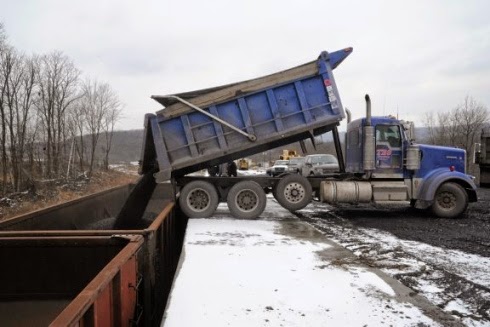 This article
 has an image of how I would see it working (at left).
Alternatively this could be done at the Fort Totten Waste Transfer Station, but that would be less efficient than the other alternative, because the location is farther and harder to reach.
b. A similar operation could be set up in the southern section of the city to interdict truck trips hauling construction debris from that area, without the trucks having to travel further north to the Union Station area.
3. Relatedly,
rail shipment out from the city for solid waste from the Ft. Totten waste transfer station might be an option. While it is the case that they are already moving this waste out at night with transfer trucks with minimal stress on the road network, it could be more efficient and cheaper to dump it into railroad cars.
I don't know if the waste-to-energy facility in Fairfax County that "landfills" DC's trash is railroad-accessible. However, moving this waste by railroad might afford DC a greater variety of lower cost disposal options than are otherwise available.
Labels: freight transportation planning, railroads, transportation planning


.webp)


.jpg)
.jpg)

.jpg)


.jpg)
.jpg)
.jpg)
.jpg)
.jpg)
.jpeg)
.jpg)