Rebuilding Place in the Urban Space

"A community’s physical form, rather than its land uses, is its most intrinsic and enduring characteristic." [Katz, EPA] This blog focuses on place and placemaking and all that makes it work--historic preservation, urban design, transportation, asset-based community development, arts & cultural development, commercial district revitalization, tourism & destination development, and quality of life advocacy--along with doses of civic engagement and good governance watchdogging.

Monday, September 22, 2025

Trump Cancels Trail, Bike-Lane Grants Deemed ‘Hostile’ to Cars

Bicyclists and pedestrians are on Martin Luther King Jr Dr, Sunday, Sept. 21, 2025 after the bridge over the Schuylkill River opened after more than two years in hiatus. Photo: Tom Gralish, Philadelphia Inquirer.  From "The MLK Drive bridge reopens to rave reviews from runners, bikers, and pedestrians."

The story from Bloomberg.  From the article:

The Trump administration canceled grants for street safety measures, pedestrian trails and bike lanes in communities around the country this month, each time offering a simple rationale for yanking back federal aid: the projects aren’t designed for cars.

A San Diego County road improvement project including bike lanes “appears to reduce lane capacity and a road diet that is hostile to motor vehicles,” a US Department of Transportation official wrote, rescinding a $1.2 million grant it awarded nearly a year ago.

In Fairfield, Alabama, converting street lanes to trail space on Vinesville Road was also deemed “hostile” to cars, and “counter to DOT’s priority of preserving or increasing roadway capacity for motor vehicles.”

Bicyclists, pedestrians, and power wheelchairs on the Martin Luther King Jr. Drive Bridge. 
Photo:Tom Gralish

... local officials and transit advocates said they were surprised by the language DOT used in rescinding previously awarded grants, and alarmed that the department seemed to be taking particular aim at programs that were designed to make streets safer for pedestrians and cyclists in a period of elevated traffic injuries and deaths.

... Despite rhetoric that associates non-car infrastructure development with liberal politics, “at the local level, there really isn’t that divide,” Mills said in an interview. Florida, he noted, is a red state with “extremely strong” plans to grow its network of mixed-use trails for bikes and pedestrians.
Transit planners increasingly have opted for alternative transit projects that can also alleviate automobile congestion, an approach Mills said is often more effective than car-focused projects. “These canceled projects may do that better,” he said.

=====

No surprise here.  Homogeneity in all things is a hallmark of the Trump Administration.  

The administration has shown its bias towards unfettering the motorist, starting with its opposition to the congestion toll zone in New York City.  And later eliminating transportation grants that called for equity in access for all users, not merely the primacy of motorists.

Labels: , , , , , ,

Friday, November 09, 2018

Could "fast freight rail" service be a way to make High Speed Rail more viable?

High Speed Rail is uniformly discussed in terms of passenger service, and is usually promoted for operation in high density corridors between major cities, pairs such as New York-Boston, or San Diego-Los Angeles-San Francisco, or Dallas-Houston.

It happens that the freeways connecting these cities typically are engorged with delivery truck traffic too.

Passenger rail service in the modern era isn't hugely profitable, at least in the US, while freight delivery remains reasonably profitable.

Plus, demand ("More surcharges, rejected freight sting US truck firms," Journal of Commerce) is making it hard to find drivers ("'What Does a Trucker Look Like?' It's Changing, Amid a Big Shortage," New York Times)) and simultaneously, demand for long distance truck delivery services is increasing, in part because of the rise of online commerce.

Why not consider trying to shift some freight service to a high speed rail network? Which would also help to reduce truck traffic on major interstates, reduce GHG emissions, etc.  It would also make HSR more economically viable.

Italy is about to launch such a service.  From Railway Gazette International ("Mercitalia launches high speed freight service"):
FS Group freight subsidiary Mercitalia is to launch its first high speed freight service on November 7. FS says the Mercitalia Fast service is designed to meet the needs of express courier companies, logistics operators, producers and distributors.

Operated by a converted ETR500 trainset, the Mercitalia Fast overnight service will convey express parcels and premium freight between the Maddaloni-Marcianise terminal near Caserta and Bologna Interporto, using the country’s north-south high speed line. According to Mercitalia Logistics General Manager Marco Gosso, Mercitalia Fast will be the first express freight service to use the Alta Velocità/Alta Capacità high speed network. With the train running at an average speed of 180 km/h, the end-to-end journey time will be just 3 h 30 min.

The trainset has been adapted to carry 1 m3 roll cages with a 220 kg payload, which will make loading and unloading ‘quick, efficient and safe’. With the 12-car train able to carry the equivalent of 18 articulated lorries or two Boeing 747 freighters, the daily train is expected to relieve the main north-south A1 motorway of around 9 000 lorries a year, reducing CO2 emissions by 80% compared to road haulage.
If it works, they intend to expand the service to other nodes in Italy's high speed rail network.

In Dresden, Volkswagen uses the local light rail system to move vehicles and parts between plants, with a special trainset called the "CarGoTram."  That example has spurred more local transit agencies to look at their light rail systems for other opportunities in freight logistics and delivery ("Light rail network used for freight transport," Rail Freight).


Granted, this is more of what I call intra-district transit rather than long distance freight transportation, but it's still an example of rethinking passenger transit systems as being solely focused on passenger service.

Back in the day, sttreetcar systems and interurban--a mode that mixed shorter distance streetcar transit over long distances today the South Shore Line in Indiana and Illinois with service to Chicago is the only remaining functioning interurban in the US--would be used for overnight freight service.

Labels: , , , ,

Sunday, August 10, 2014

Transit stuff #3: bus rapid transit vs. the creation of foundational suburban mass transit systems

Maybe we should be thinking of bus rapid transit as a way of building a trunkline/foundational transit system for suburbs rather than some magic bullet.   A Coalition for Smart Growth initiative, Communities for Transit, is out in force at the Montgomery County Agriculture Fair this week, to promote the proposed Montgomery County Bus Rapid Transit system.

Because I was with other people, including young children  more focused on animals and playing than going to information booths, I wasn't able to make it to the main gate, where apparently CFT has a duded-out bus and more information, but I did pick up info from people stationed at the other entrance.  (Ironically, the CFT booth is at the automobile entrance to the fair, not at the entrance used by people coming to the fair by bus.  Given the nature of the fair, and the fact that many people don't cover the whole thing, they needed a second booth at the other entrance.)
These CFT volunteers live in Friendshp Heights, Maryland.

I guess like how some people don't recognize that the point of certain kinds of transit services aren't for fast inter-city transit but are intended to enhance transit service within cities, and that's okay--see my piece "Making the case for intra-city (vs. inter-city) transit planning" vs. this Vox piece by Matthew Yglesias "Meet the worst transit project in America," and this from Reason about Detroit, "Is Detroit's New Light Rail Line America's Greatest Boondoggle?," I do have concerns that bus rapid transit is oversold.

There is no question that BRT is oversold compared to fixed rail transit, at least in those communities that have the density that makes economical the more costly choiceof fixed rail, because there is not one good example in the US of more people choosing to ride "bus rapid transit" compared to fixed rail
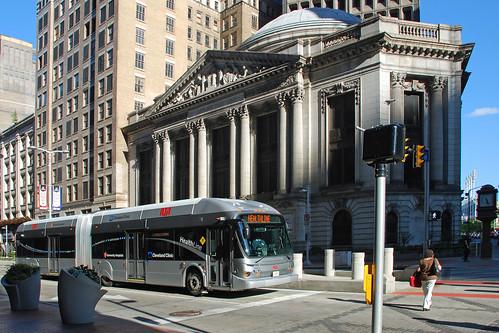
HealthLineCleveland HealthLine photo from Flickr by SoCal Metro.

Cleveland's HealthLine has ridership lower than most of DC's highest ridership bus lines, and much of the development said to have been sparked by the BRT line would have been construced anyway. Similarly, Boston's Silver Line BRT has abysmal ridership.

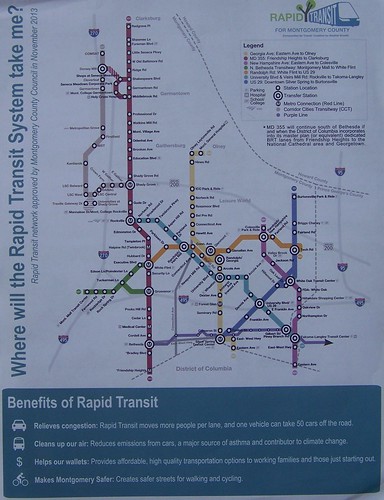
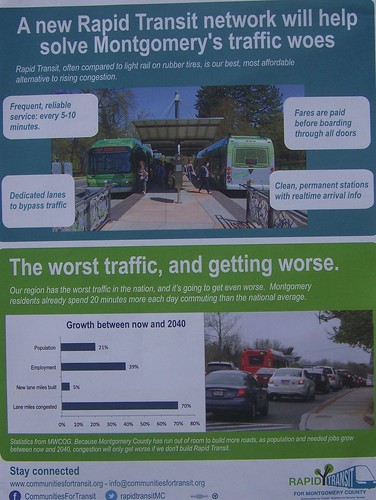
But looking at the flyer that CFT is handing out at the Ag Fair, it occurs to me, although I haven't yet come up with the succinct language needed to describe the concept, that what is being planned for Montgomery County isn't so much "Bus Rapid Transit" but an upgraded, complete, and foundational transit system, not unlike my concept of "Signature Streets", which suggests that communities should think of their mobility system holistically, as an element of an integrated public realm framework, and define and build out a "road system" that equally accommodates pedestrians, bicyclists, and transit users as well as motor vehicle operators, while simultaneously contributing positively to neighborhood and community quality of life, rather than diminishing it as so much of the road network does currently.

No community here... Rockville Pike, Montgomery County, Maryland.  Washington Post photo.
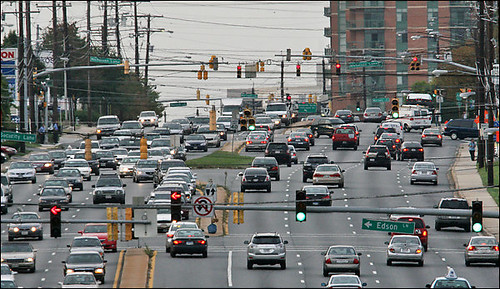
Rockville Pike, looking north, which Montgomery planners want to transform into a network of urban villages.

Route map, side two of the flyer
Flyer, side two, route map, bus rapid transit system, Montgomery County Maryland

Side one of the flyer
Flyer, side one, Communities for Transit, Montgomery County bus rapid transit system

The idea is that a county like Baltimore County should designate their primary road network, and build it and brand it as "foundational," and by doing so they can build the resident support necessary to pass votes for bond issues (comparable to Seattle's Bridging the Gap program, Oklahoma City's Metropolitan Area Projects program, or the Los Angeles or Denver sales tax initiatives to fund rail expansion).

It happens that Montgomery County already has Metrorail stations and two railroad passenger lines serving various points in the county, but the reality is those fixed rail transit services are oriented to DC.

A bus rapid transit system as conceptualized in Montgomery County's Countywide Transit Corridors Functional Master Plan is a different type of program which allows the suburban county to define its own transit agenda in a complementary manner to what already exists, but as an upgrade and rebranding.

Other examples.  Perhaps the Orange Line BRT in San Fernando Valley in Los Angeles
is maybe a better example of being able to serve as the trunk line for suburban transit rather than as a rail system, even though the end point station of North Hollywood links to fixed rail service.
Shown at left, the Orange Line runs in a dedicated transitway (formerly used by a passenger railroad line and then streetcars, not unlike how some of the Pittsburgh area busways are former railines too).

This ought to make the Orange Line a candidate for seeking approval for running buses longer than 60 feet in length, which would increase the capacity of the system, which has about 30,000 daily riders.

Warden Station, York Region's first rapid transit hub, in Markham. Viva system photo.

Perhaps the best example in North America of a suburban BRT system as an upgrade and creation of a foundational trunkline system within a bus transit system is the Viva system in the York Region of Greater Toronto.  There are five VIVA lines, one has ridership greater than 21,000 daily riders, and another is greater than 5,000 daily riders, while the other three have small ridership numbers.

Yes, they don't get ridership numbers like we do in DC proper for our bus lines.  But that's ok.  Also see "Maryland gubernatorial campaign transportation agenda."

Their ridership should be compared to other suburban jurisdictions that lack the density and concentrated activity and employment centers that are necessary to support successful fixed rail transit service.

Conclusion.  Still, it is unfortunate that many transit systems with cities as their foundation are yoked to and outnumbered by suburban jurisdictions and voting blocs, which can hamper the ability of the core system to grow and to stop the pressure to continually extend the system outwards in ways that make the system less efficient and more costly to operate.

Labels: , , , , ,

Wednesday, December 04, 2013

New PIRG-Frontier Group report on continued decline in motor vehicle travel in Top 100 urbanized areas

Today, US PIRG and the Frontier Group released the report, Transportation in Transition:A Look at Changing Travel Patterns in America’s Biggest Cities, which finds that vehicle miles traveled (VMT) in the nation's 100 largest urbanized areas (an urbanized area is a spatial subset of a metropolitan area, focused in large part on the center city and adjacent areas).

VMT began declining before the recession, and has remained in decline as the economy has improved.  They present data which supports their argument that this is not related to economic or income decline, but the result of structural changes in the economy, behavior, and attitudes.

This is the result of a variety of reasons, ranging from the cost of gas to increased working at home, increased use of transit and other modes, and a decline in car ownership, as well as attitude changes amongst certain segments of the population. 

This report follows others by the organizations (such as A New Direction: Our Changing Relationship with Driving and the Implications for America’s Future), which have been recommending consistently that local and national transportation policies ought to change in response to changing realities.

Report Recommendations
  • Revisit transportation plans. Most transportation plans are based on decades-old recommendations and tend to focus on roadway expansion.  Plans should be re-visioned and more accepting of a new mobility paradigm.
  • Reallocate resources to support other transportation modes.  The report starts out with a description of Madison, Wisconsin, and how after their decision to not allow freeways within the city, they invested in developing different forms of transportation infrastructure, including biking and transit, and the use of those modes has increased.
  • Remove barriers to non-driving options.  Planning and zoning requirements typically preference automobility.  Although changing these requirements in the face of an automobility dominant planning paradigm and resident beliefs is very difficult.  (Here, I think the report could have been stronger in discussing land use and how urban form shapes mobility choices.)
  • Enable innovative travel tools and services
  • Get better data and make it available.  1/4 of the jurisdictions covered in the report could not provide comparable data, because of antiquated collection methods and/or low priority for data collection.  Note that I think this is an excellent point.  Part of the acrimony in DC over proposed changes to parking provision in new construction has to do with failures of the city planning agencies to collect and present actionable data on parking inventory and how mobility use varies by housing type and proximity to transit.
My reactions

1.  Yes, Transportation Departments have to change.  How we do that in the context of road-dominated paradigms is a challenge.  I am working on what I call my unified theory on how to change transportation planning so that it focuses on achieving high quality mobility and placemaking and quality of life outcomes simultaneously.  But the challenge then is to get transportation agencies to take up the concept.

I thought there was opportunity in one of the states in the area, but now I am not so sure.  And it's not even clear that DC, a fully urbanized "state", even has a sustainability first transportation agenda.  Despite the claims of the DC Sustainability Plan, as Dr. Gridlock in the Washington Post recently pointed out, DDOT's biggest projects are motor vehicle related.

2.  Land use and transportation planning needs to be integrated,  Mostly it isn't.  Probably my most succinct writing about why an integrated planning paradigm is necessary was presented in this 2006 entry, "Comments on Proposed EYA Development at Takoma Metro Station."

3.  Metropolitan Planning Organizations, the agencies tasked by federal law to do transportation planning at the metropolitan scale, for the most part aren't visionary, and don't challenge automobile-centric planning.  There are exceptions, such as MPOs in Minneapolis, the Philadelphia region, Portland, Greater Seattle, and others. (The MPOs serving the DC and Baltimore areas are not exceptional supporters or promoters of sustainable mobility.)

4.  Can scenario planning help to change people's sense of responsibility for the deleterious impact of status quo transportation and land use policies?

Notions Capital shares with us a very interesting article from Public Roads, the publication of the Federal Highway Administration, on scenario planning by the MPO in Southwestern Pennsylvania ("Predicting the Future"). 

Right: scenarios used in planning by the Southwestern Pennsylvania Commission MPO.

Mostly people are happy with the status quo and work diligently to maintain it.  Scenarios presented in the FHWA publication Integrating Land Use Issues into Transportation Planning: Scenario Planning make it easier to see the consequences of "staying the course," about which most people seem to be either unconscious or uncaring.

The question is, if the results of the different scenarios presented, and the consequences assessed, will people take responsibility and support changes in policy and practice?

From the Public Roads article:
By using scenario planning software, SPC presented approximately 40 variables as performance indicators for each of the chosen scenarios and showed how those variables would differ depending on the scenario. Working with all 40 variables could become confusing, so the facilitators again gave the partners in the planning process the opportunity to choose which variables were most important to them. The participants selected the following six variables:
  • Density of development
  • Amount of land developed
  • Households close to highway interchanges
  • Households close to transit stops
  • Regional travel as depicted by regional daily vehicle miles traveled
  • Cost for basic infrastructure
 At least with such scenarios, the consequences of staying the course are measurable.  Although the problem with scenario planning is that it is only as good as the scope that the agency outlines--for example in my opinion, the scenarios used in the current DC transportation planning process MoveDC aren't very challenging at all, and don't provide much of an impetus for motor vehicle proponents to consider rethinking their perspectives.

5.  Transportation Demand Management needs to be integrated purposefully with sustainable mobility services.  Typically, such programs are not well integrated into transit service specifically.  As a result, it takes many years, if ever, to fully reap the benefits of the hundreds of millions to billions of dollars invested in such systems.  This needs to change.  (More on this later in the week.)

Labels: , , , , ,

Wednesday, November 20, 2013

One way to pilot a fee per mile vs. gasoline taxes: institute it now, for alternative fuel vehicles


Personally, I think a gas tax is easiest to collect, but a belief that somehow people will be more willing to pay a higher "use fee" on a mileage basis versus paying more in gas taxes is pushing the concept of a Vehicle Miles Traveled fee forward.

Tesla Model S.  Photographer unknown.

As part of a larger study, Oregon has been testing the concept for a number of years ("Oregon Nears Completion of Latest VMT Pilot," Governing Magazine) and recently introduced a larger test for 5,000 volunteers of alternative fuel vehicles ("Ten Questions (and Answers) About Oregon's New VMT Charge" Streetsblog DC).

There is no question that an unchanging gasoline tax will not raise enough money to pay for road and infrastructure repair and maintenance, let alone expansion and replacement, not to mention retrofitting of sustainable transportation infrastructure, take care of new placemaking elements, and throw some funding towards transit.

Charging a miles traveled fee is a way to raise the rates (not unlike how royalties were raised for performing artists simultaneously with the introduction of CD "records" so even though CDs were cheaper to produce than LPs, the price went up, not down) and collect more of the money necessary to maintain the road system.

Because alternative fuel vehicles powered by electricity, natural gas, and certain forms of biodiesel don't use fuels that are subject to the "gasoline" excise tax, they don't pay road taxes.

While Oregon continues to do testing, why not move from test to practice by instituting a VMT "fee" now, for alternative fuel vehicles--the vehicles that aren't paying taxes because they aren't using fuels that are taxed for road use.

There is a precedent for differentiated treatment of different elements of the same industry in "radio broadcasting."

In the 1990s, the music recording industry got Congress to pass as part of the Digital Millennium Copyright Act (DMCA) a royalty for recording companies on top of the royalties already due song writers and performers for songs "played" that was being extended to  Internet and satellite radio broadcasting.

It was a wrong-headed move.  First, traditional radio stations did not have to pay such a fee.  So this created an unlevel playing field between different segments of the same industry.  Second, Internet radio has less opportunity for revenue than traditional over-the-air broadcasters, not more, so this increased their costs and the likelihood of station failure.  Third, it stifles innovation.

But the impact of charging a VMT fee to all alternative fuel vehicles while slightly unfair and certainly unequal won't have the kind of stifling impact of the DMCA, even if hybrid vehicle owners were up in arms about the flat fee of $64 they are supposed to pay in Virginia as part of the change to gas taxes there earlier this year ("Repeal of Va. hybrid vehicle tax in the works," Richmond Times-Dispatch), "Hybrid drivers may save on gas but new tax gotcha," USA Today).

Banner at a Propel Clean Mobility Station (fuel station that still sells gasoline) in Fullerton, California.

From the USA Today article:
John Kraus has a new Toyota Prius V hybrid wagon that he's very fond of. He's also got a new Virginia tax on it that he's none too happy about.

Virginia Gov. Bob McDonnell, a Republican, signed a new law last month that lowers the gas tax for everyone, but slaps a $64-per-year fee on hybrid and electric car owners to help make up for what those drivers aren't paying at the pump.

"What's not to like about getting better than 40 miles per gallon of gas?" asks Kraus. "Oh, wait — less revenue for Virginia. Well, excuse us for helping to reduce the nation's oil dependency."
Or from the Los Angeles Times article "New alternative fuels station opens in Fullerton: The Propel Clean Mobility Center on Chapman Avenue offers gasoline as well as E85 ethanol and biodiesel":
Jamie Caissie, a 35-year-old flooring contractor, decided to try something new and filled up his GMC Sierra truck with E85 at the Fullerton station.  "My truck says it can take flex fuel, and it's 70 cents cheaper," said Caissie, who lives in Fullerton and often travels to San Diego and Northern California for work.
It's very important to differentiate between the "environmental benefits" and "trade benefits" of alternative fuel vehicles compared to traditional vehicles versus the "economic costs" involved in building, operating, and maintaining the road system, which are the same for all vehicles regardless of fuel source.

Regardless of the benefits to "society" from the use of alternative fuels, drivers of such vehicles still use the roads and shouldn't get a free ride while doing so.

Why not further the innovative impact of these vehicles by utilizing them to pilot a different and "better" way to pay for roads?

As a sweetener, authorizing VMT-based car insurance could be rolled into the program.  From "VMT fees, per-mile insurance make headway" by the State Smart Transportation Initiative:
While use of a mileage-based tax to replace or supplement the gas tax is still in the discussion stages, one company has begun to offer insurance on a pay-as-you-drive basis. Instead of a flat fee, or discounts for driving fewer miles than average or being a good driver, Metromile offers true per-mile insurance. In addition to a base monthly fee, drivers pay for each mile they drive. The company estimates that this offers savings in particular for urban drivers, who use transit, walk, or bike for many trips. Although the insurance is currently only available in Oregon, the Redwood City, CA-based company hopes to expand to other states soon.

Labels: , , , , , ,

Tuesday, November 19, 2013

Why is it so hard to just raise the federal (and state) gasoline excise tax?

Greater Greater Washington has an entry, "Topic of the week: No more federal gas tax?," about a legislative proposal to eliminate mostly the role of the Federal Government in managing and funding a national surface transportation system.  From the entry:
The Transportation Empowerment Act (TEA), by Senator Mike Lee (R-Utah) and Representative Tom Graves (R-Georgia), would virtually eliminate the federal gasoline tax over a 5-year period and devolve the responsibility of funding roads and transit to the states.
Given the difficulty of Congress doing anything (and sometimes that's a good thing, since the status quo is often better than ideologically-fueled "improvements") this isn't likely to go anywhere.

This kind of proposal scares me because at its root it is anti-federalist and anti-nation and pro-devolution, pro-state and pro-Balkanization that should be opposed by people who believe in an integrated nation.  Although that is a topic for another blog entry.

Why is funding roads a problem?

The federal gasoline excise tax hasn't been raised in over 20 years, so it has lost a significant amount of its purchasing power.  Meanwhile costs for maintaining the system go up, especially as sections of the federally supported road network (Interstate Highways and the US highway road system) get old and need to be rehabilitated.

Note that I didn't do a write up of a seminar I went to featuring transportation finance scholar Martin Wachs. When he was asked about what the fed. excise gas tax should be to cover the needs, he said that he considers credible estimates of 60 cents/gallon. No one asked and it would have to be done at the state level to figure out what state and local gas taxes should be.

He agreed with me that the excise tax or taxes on wholesalers is a lot easier to collect than a vehicle miles traveled tax (note that it would need to be around 3 cents/mile at an average fuel economy of 23 mpg for a typical automobile).  But he made a good point that a VMT-based system could include other "value added services" such as charging for insurance by the mile.

Some argue that devolving authority to the states would improve things, because the US DOT is a brake on innovation

While this seems true in some respects*, the fundamental problem is that the "highway" industry is dominated by suburban and rural interests at both the federal and state level, and even if the Federal Government were to cede its role to the states, the likelihood of most states--many are dominated legislatively by rural interests too, because of political district gerrymandering--all of a sudden taking up a pro-urban pro-city transportation agenda is remote.

So it won't change anything in terms of cities, except maybe make things a little worse, because cities won't be able to play off the Federal DOT against State DOTs, as a way to push forward change.

*  The Federal Highway Administration is actually an incredible resource on all things road, including biking, walking, and to some extent transit (that's handled by a different agency, the Federal Transit Administration).  They have amazing pro-bike and pro-walking resources, fund information and resource centers, etc.  But the decision-making structure is dominated by mobility agenda that favors motor vehicles.  And that agenda is set by Congress in large part, which is dominated by road building interests.

Most states find it just as difficult to raise taxes and gas taxes as Congress

Although earlier this year both Virginia and Maryland (and DC) did raise the state gas tax.  Virginia did it in a weird way that makes it less profitable vis-a-vis sales to through drivers on Federal Interstates.  Both Virginia and Maryland will be funding a number of projects as a result.

Last year Georgia failed for the most part to create locally funded transportation districts--a couple were approved, most failed (past blog entry, "Failure of the transit-roads sales tax measure in Metro Atlanta").

However, at the local level, many bond funding and sales tax initiatives, especially to fund transit, succeed.

Relatedly, there is a new effort ("California transportation leaders seek car tax hike for road repairs," Sacramento Bee) to put on the California ballot a referendum to increase the car registration tax to pay for road improvements.

California is very progressive politically, but I just can't see this being approved by the voters.

Note that since Washington State has allowed local jurisdictions to put a car registration tax increase on the ballot for funding local transportation infrastructure and operations, according to the Municipal and Research Services Center of Washington website, not one has been approved.

Apparently, Washington State had a car registration tax more comparable to other states but it was eliminated in the 1990s.  See "Car-Tab Tax, Rejected Twice by Voters, is Being Eyed Once Again by Lawmakers," from Washington State Wire.

Conclusion: Why not just do the right thing, and raise the gas tax?

It sucks when you pay at the pump, but considering what we get in return, a national road network that functions reasonably well, I'd say it's worth it in terms of being able to function as a nation with a mass market and relatively unhindered mobility.

P.S. at the local level, it's almost impossible to charge higher rates for residential parking permits...

But I've discussed that ad infinitum.

Labels: , , , , , ,