Rebuilding Place in the Urban Space

"A community’s physical form, rather than its land uses, is its most intrinsic and enduring characteristic." [Katz, EPA] This blog focuses on place and placemaking and all that makes it work--historic preservation, urban design, transportation, asset-based community development, arts & cultural development, commercial district revitalization, tourism & destination development, and quality of life advocacy--along with doses of civic engagement and good governance watchdogging.

Wednesday, January 13, 2016

With sustained reduction in gasoline prices, will suburban transit systems lose ridership and revenue?

Suburban bike, walking, and transit trips are longer than comparable trips in cities. I was in Southern California over the holidays, and thinking about our traveling and the difficulty for biking to accomplish the same kinds of trips, it made me realize that I had missed an important element when I wrote a pretty good Pedestrian and Bicycle Access Plan for Baltimore County, Maryland (also see the past blog entry "Best practice bicycle planning for suburban settings using the "action planning" method").

Whereas the National Household Travel Survey found that 51% of trips are three miles or less--with 29% one mile or less, and 13% three to five miles in distance--seemingly a good distance for capture by biking, the averaging of the data masks a likely fact, that trip distances for the average trip are likely to be significantly longer in the suburbs compared to center cities.

I haven't been able to track down definitive data on this, but there is a definite need to see this kind of data.

In short, while I live five miles from Downtown, but within the center city, I can get to many places within a 30 minute bike ride--besides Downtown and Capitol Hill and destinations in between, I can get to College Park, Silver Spring, and Bethesda in Suburban Maryland, and Friendship Heights, Tenleytown/American University (the library primarily), and Georgetown outside of the city's core.

Sustainable mobility is less efficient over long distances.  It's much harder to reach many places within a five mile trip/bike ride/transit trip in the suburbs, except within conurbations (e.g., within Bethesda but not between Bethesda and Rockville, within Silver Spring, or within Wheaton, but not so much in-between), not to mention that the riding conditions tend to be much more comfortable in the city as opposed to the suburbs, something that Montgomery County is addressing in their current bike planning efforts ("Making way for bicycles in a sprawling suburb where cars have always ruled," Washington Post ).

This is relevant to transit use obviously, because middle distance trips can take a long time on transit, and even longer trips may or may not be efficient depending on how the transit is delivered (commuter bus, railroad, regular bus, heavy rail, light rail).

Not to mention that most suburban transit systems deal with vast deconcentrated areas, and dispersed destinations and origins, making it hard to create an efficient transit system. Cities are advantaged by transit because of short distances between activity centers and origins, and concentration of both population and employment centers.

Image from PotomacLocal.

Prince William County transit system to raise fares and cut service.  I bring this up because the Potomac and Rappahannock Transportation Commission, operators of the OmniRide transit service in Prince William County, Virginia, which is about 30 miles from DC and to my way of thinking exurban, although it is decidedly a part of the Washington metropolitan area, is planning service cuts and fare increases.

PRTC provides intra-county transit services as well as commuter bus service to DC and other destinations, and is one of the owners of the Virginia Railway Express commuter railroad service,

Even though the transit system is benefitting from reduced cost of motor fuel, their ridership is dropping too, as people switch from transit to driving because of drops in gasoline prices, and the price/value equation of transit and driving in terms of not only dollar cost, but time.

-- PRTC SERVICE CUTS AND FARE INCREASE PROPOSED FOR JULY 2016

Four hearings are scheduled for February. Cuts involve longer distance commuter bus service as well as intra-county transit service. Documents accessible at the webpage discuss the budget proposal and conditions shaping the agency's funding in more detail.

Besides revenue losses, Prince William County's portion of the budget comes from state gas taxes, which isn't enough to cover the county's subsidy, and the county hasn't provided additional funds outside of the gas tax revenue stream.

Virginia reset its gasoline tax formula, so when prices go down, so do tax revenues.  The funding decline is accentuated by the fact that when Virginia moved to its present form of gasoline tax--a percentage of the total cost--it wasn't anticipated that the price would decline significantly, and a base or "floor" level amount wasn't prescribed by the legislation.

While the drop in fuel prices helps the agency a bit, it also cuts significantly into revenues from the fuel tax. (Note that this potential problem was identified before the legislation was passed.)

Conclusion. There are two different issues in Prince William.  The drop in ridership from substituting trips with a motor vehicle, because of falling gasoline prices.  And the drop in revenues from the gas tax revenue stream.

Other communities outside of Virginia won't have the latter issue to worry about, but should be impacted by the former--motor vehicle trips substituting for transit trips in lockstep with gasoline price decreases.

And loss in ridership generally makes a transit system less efficient, which makes it that much harder to garner support for transit in communities where the car is the predominate transportation choice.

Labels: , , , , ,

Sunday, August 10, 2014

Transit stuff #3: bus rapid transit vs. the creation of foundational suburban mass transit systems

Maybe we should be thinking of bus rapid transit as a way of building a trunkline/foundational transit system for suburbs rather than some magic bullet.   A Coalition for Smart Growth initiative, Communities for Transit, is out in force at the Montgomery County Agriculture Fair this week, to promote the proposed Montgomery County Bus Rapid Transit system.

Because I was with other people, including young children  more focused on animals and playing than going to information booths, I wasn't able to make it to the main gate, where apparently CFT has a duded-out bus and more information, but I did pick up info from people stationed at the other entrance.  (Ironically, the CFT booth is at the automobile entrance to the fair, not at the entrance used by people coming to the fair by bus.  Given the nature of the fair, and the fact that many people don't cover the whole thing, they needed a second booth at the other entrance.)
These CFT volunteers live in Friendshp Heights, Maryland.

I guess like how some people don't recognize that the point of certain kinds of transit services aren't for fast inter-city transit but are intended to enhance transit service within cities, and that's okay--see my piece "Making the case for intra-city (vs. inter-city) transit planning" vs. this Vox piece by Matthew Yglesias "Meet the worst transit project in America," and this from Reason about Detroit, "Is Detroit's New Light Rail Line America's Greatest Boondoggle?," I do have concerns that bus rapid transit is oversold.

There is no question that BRT is oversold compared to fixed rail transit, at least in those communities that have the density that makes economical the more costly choiceof fixed rail, because there is not one good example in the US of more people choosing to ride "bus rapid transit" compared to fixed rail

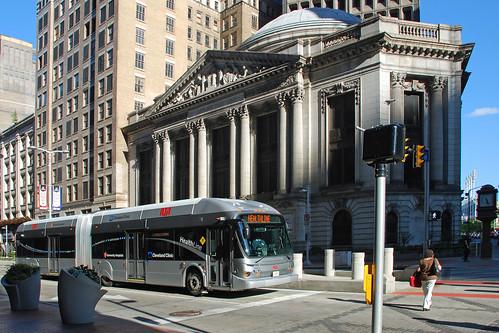
HealthLineCleveland HealthLine photo from Flickr by SoCal Metro.

Cleveland's HealthLine has ridership lower than most of DC's highest ridership bus lines, and much of the development said to have been sparked by the BRT line would have been construced anyway. Similarly, Boston's Silver Line BRT has abysmal ridership.

But looking at the flyer that CFT is handing out at the Ag Fair, it occurs to me, although I haven't yet come up with the succinct language needed to describe the concept, that what is being planned for Montgomery County isn't so much "Bus Rapid Transit" but an upgraded, complete, and foundational transit system, not unlike my concept of "Signature Streets", which suggests that communities should think of their mobility system holistically, as an element of an integrated public realm framework, and define and build out a "road system" that equally accommodates pedestrians, bicyclists, and transit users as well as motor vehicle operators, while simultaneously contributing positively to neighborhood and community quality of life, rather than diminishing it as so much of the road network does currently.

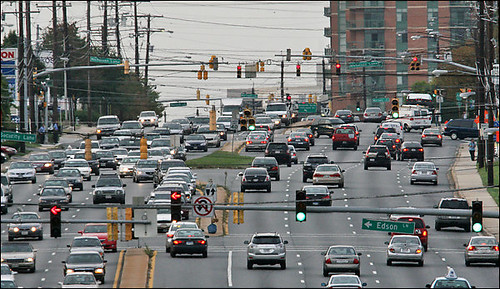
No community here... Rockville Pike, Montgomery County, Maryland.  Washington Post photo.
Rockville Pike, looking north, which Montgomery planners want to transform into a network of urban villages.

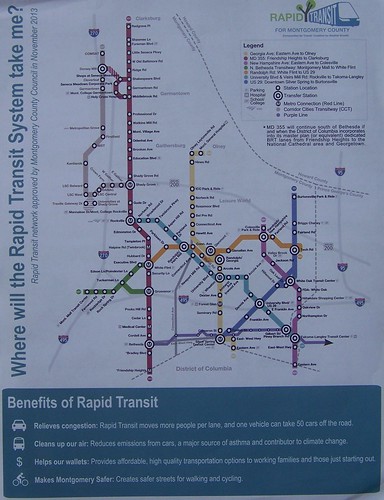
Route map, side two of the flyer
Flyer, side two, route map, bus rapid transit system, Montgomery County Maryland

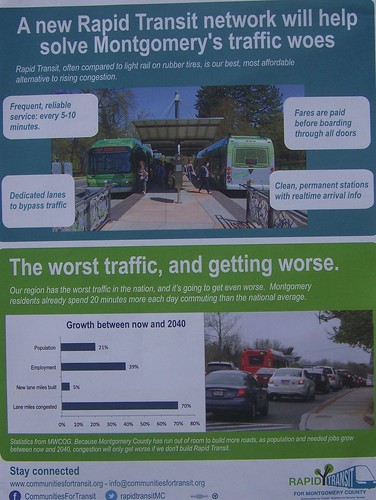
Side one of the flyer
Flyer, side one, Communities for Transit, Montgomery County bus rapid transit system

The idea is that a county like Baltimore County should designate their primary road network, and build it and brand it as "foundational," and by doing so they can build the resident support necessary to pass votes for bond issues (comparable to Seattle's Bridging the Gap program, Oklahoma City's Metropolitan Area Projects program, or the Los Angeles or Denver sales tax initiatives to fund rail expansion).

It happens that Montgomery County already has Metrorail stations and two railroad passenger lines serving various points in the county, but the reality is those fixed rail transit services are oriented to DC.

A bus rapid transit system as conceptualized in Montgomery County's Countywide Transit Corridors Functional Master Plan is a different type of program which allows the suburban county to define its own transit agenda in a complementary manner to what already exists, but as an upgrade and rebranding.

Other examples.  Perhaps the Orange Line BRT in San Fernando Valley in Los Angeles
is maybe a better example of being able to serve as the trunk line for suburban transit rather than as a rail system, even though the end point station of North Hollywood links to fixed rail service.
Shown at left, the Orange Line runs in a dedicated transitway (formerly used by a passenger railroad line and then streetcars, not unlike how some of the Pittsburgh area busways are former railines too).

This ought to make the Orange Line a candidate for seeking approval for running buses longer than 60 feet in length, which would increase the capacity of the system, which has about 30,000 daily riders.

Warden Station, York Region's first rapid transit hub, in Markham. Viva system photo.

Perhaps the best example in North America of a suburban BRT system as an upgrade and creation of a foundational trunkline system within a bus transit system is the Viva system in the York Region of Greater Toronto.  There are five VIVA lines, one has ridership greater than 21,000 daily riders, and another is greater than 5,000 daily riders, while the other three have small ridership numbers.

Yes, they don't get ridership numbers like we do in DC proper for our bus lines.  But that's ok.  Also see "Maryland gubernatorial campaign transportation agenda."

Their ridership should be compared to other suburban jurisdictions that lack the density and concentrated activity and employment centers that are necessary to support successful fixed rail transit service.

Conclusion.  Still, it is unfortunate that many transit systems with cities as their foundation are yoked to and outnumbered by suburban jurisdictions and voting blocs, which can hamper the ability of the core system to grow and to stop the pressure to continually extend the system outwards in ways that make the system less efficient and more costly to operate.

Labels: , , , , ,