Rebuilding Place in the Urban Space

"A community’s physical form, rather than its land uses, is its most intrinsic and enduring characteristic." [Katz, EPA] This blog focuses on place and placemaking and all that makes it work--historic preservation, urban design, transportation, asset-based community development, arts & cultural development, commercial district revitalization, tourism & destination development, and quality of life advocacy--along with doses of civic engagement and good governance watchdogging.

Sunday, August 02, 2026

National Farmers Market Week, August 2nd - 8th

Food is more than just picking up the item and buying it:  Farm and farming issues.  I've been keeping track of some of the broader issues concerning farms and farming, as something we should be thinking about all the time, but especially when it comes to National Farmers Market Week.

========

Farmers markets as events.  Most people think of farmers markets as events--I call them activation devices--to go out and do something.  

WRT activation, many years ago I wrote a piece outlining the different reasons to sponsor a market, and how that should shape policy wrt what can be sold, and the distance away by which a farm can be considered local.  

-- "The reason(s) why a farmers market is created shapes the type and mix of vendors allowed to sell" (2011)

One reason is to support farm income and the regional economy.

In DC, you get lots of vendors from West Virginia and Pennsylvania because they get better prices in the big city.

For example, there is research about the social value of markets as community hubs--that's great for the attendees, but what about the value to the farmers? ("Do Farmers Markets Build Community? New Research Says Yes," PPS)

Seattle Neighborhood Farmers Market, University District Farmers Market, Seattle, Washington. Credit: Redstone Photography

Farmers markets are supposed to be places to buy food first and foremost, food that is locally produced ("Local, organic, and bipartisan: How Vermont is challenging Big Food,," Christian Science Monitor).  

Secondarily we think about how farmers markets are supposed to be ways to cut out the middleman in a quest to get better and local (regionally sourced) food, ideally at a cost lower than from the supermarket.  

This is an old photo.  This year stone fruits are in short supply in Utah because of a late freeze in early June.

Well, maybe just maybe cheaper than Whole Foods--last week at the Downtown Farmers Market in Salt Lake City, which is a great one, in large part because there aren't dozens of markets in the area, but a handful, making it worthwhile for a large number of vendors to show up, vendors were selling corn for $8 per dozen.  

Granted it's not the 70s when you could get that many ears from a truck farmer for $1.  Still that's a shocker.

While a lot of the items sold at markets are value added products--e.g., hot sauce made from locally grown peppers, and the sauce costs more than selling raw peppers--the fact is food comes from farms.  And cost-wise, inputs, labor, taxes, it might not be enough ("Massachusetts loves its small farms. Will that be enough to save them?," Christian Science Monitor). 

BLT at Middle Child.

Farm to Table/Featuring local foods in special ways promotes the regional food system.  Farm to table is a longstanding movement where restaurants make items based on what they can source from local farms and farmers markets.  Some restaurants even have their own farms.

Middle Child in Philadelphia features for one month heirloom tomatoes grown at Philadelphia's Urban Roots Farm in BLTs--also with locally grown arugula and bread from the artisan Merzbacher’s Bakery ("Middle Child’s BLT season has arrived. This is how they prepare for the frenzy," Philadelphia Inquirer).  They also offer tomato agua fresca, tomato water ice, frozen tomato pops, and tomato martinis.  

An increasing number of bakeries are using regionally-grown harvested and milled grains, rather than standardized industrial seed varieties ("Regionalizing Michigan’s Small Grains: Highlights from the 2026 Food-grade Grains Field Day," Michigan State University).

VINE Foods, a new agricultural innovator to the market, starts its inaugural harvest of vine-ripened tomatoes on June 25, 2026 at 4451 Knight Arnold Road in Memphis.  Photo: Stu Boyd II-The Commercial Appeal

Relatedly, VINE Foods in Memphis is a small urban farm aiming to grow items that are best grown and consumed locally, like tomatoes ("VINE Foods plants roots in Memphis with innovative urban farm," Memphis Commercial Appeal).  

This is sort of what Urban Roots Farm is doing, and could be done in more places.  They also focus on the recovery and reuse of vacant lots, which is important in cities that have lost population ("Memphis-founded VINE Foods turns abandoned lots into organic produce farms," ActionNews5).

Years ago, I came across the Tomato Independence Project initiative in Treasure Valley/Boise, which now seems inactive ("Building a Better Tomato" Edible Idaho) and if you've tasted a great heirloom tomato off the vine, you know how important it is to spread the understanding of food that is not so industrialized that the flavor is gone, which is a problem with most tomatoes sold at the supermarket.  

More farming and promotion initiatives like this need to be developed throughout the country, to promote the consumption of what is otherwise highly perishable but super tasty locally grown foods.  The Dwarf Tomato Project is a national version, still at a small scale, of the TIP.

Wasatch Community Gardens in Salt Lake holds an annual "Tomato Sandwich Party." (Photo at right.)

Now, VINE Foods needs to find a restaurant partner like Middle Child.

Food needs sun and water (and other inputs) to grow | Climate change.  Crops need sun and water and other inputs to grow.  And labor to tend to the crops and then to pick them.  Bad weather can be catastrophic ("Spring’s bizarre weather caused up to $200 million in lost crops in Pa. N.J. farmers also suffered." Philadelphia Inquirer, "A late spring frost wiped out much of Utah’s tree fruit crop. Here’s what growers are selling instead," Salt Lake Tribune).  Weather is becoming much more extreme due to climate change, and the geographic areas where food can be grown are shifting in response to higher temperatures.

Weeks after December’s historic floods, water remains on Yeng Lee Cha’s farm in Snohomish. Cha says her farm experienced up to 9 feet of flooding, and the water didn’t recede for nearly two months in certain areas. The rushing water damaged farm... (Erika Schultz / The Seattle Times)

Flooding too ("WA’s Hmong farmers face floods at generational crossroads," Seattle Times).  Not just flooding, but land sinking as water is drained from underground aquifers ("Study finds California farmland is sinking shockingly fast," SFGATE).

1.  Food borne illness is a symptom of regulatory failure and the perils of large scale mass agriculture.  The media is full of reporting on cyclosporiasis associated with lettuce.  "Cyc­lospora isn’t new. Why it’s dif­fer­ent now," USA Today:

Every sum­mer, it seems, we get the same headline: a cluster of cyc­lospori­asis cases traced to fresh pro­duce, a recall, a brief wave of concern and then silence until next year. The news cov­er­age almost always frames this as a food safety story – con­tam­in­ated basil, bad lettuce, a sup­plier that slipped through the cracks.

I want to offer a dif­fer­ent dia­gnosis, because I’ve watched this exact pat­tern before, in a very dif­fer­ent dis­ease. This is a slow, envir­on­ment­ally depend­ent para­site with no capa­city to out­run a func­tion­ing sur­veil­lance sys­tem. It has no abil­ity to evolve its way past inspec­tion. It only needs one thing to spread fur­ther than it used to: for us to stop look­ing as care­fully as we once did. That’s the part of this story nobody is telling.

Import inspec­tion capa­city, pro­duce sampling at the bor­der, the state pub­lic health labor­at­or­ies run­ning whole-gen­ome sequen­cing to match an isol­ate from a sick patient to a spe­cific lot num­ber, the epi­demi­olo­gists con­vert­ing scattered case reports into a recog­nized cluster – this is the immune sys­tem pro­tect­ing our food sup­ply. And like any immune sys­tem, when you starve it of resources, you don’t get a health­ier host. You get a slower, blinder response to a threat that was always there.

Decades ago Jim Hightower wrote a book, Hard Tomatoes, Hard Times, criticizing Agricultural Colleges and their research programs designed to promote big agriculture by creating nee tools and crop seeds modified for easier picking and distribution over great distances rather than for nutrition and flavor.

Who knew that one of the outcomes of Big Agriculture/Big Farming could be Big Diarrhea.

Trading farm futures on your phone.

2.  Tariffs, foreign policy fights, etc.  Many farmers have lost access to markets because of tariffs or responses to US foreign policy ("Already under financial pressure, farmers squeezed further by tariffs and Iran war," PBS).  

Plus the Iran War has impacted the production of fertilizer inputs and the transport of fertilizer using the Strait of Hormuz ("The Iran War threatened a food crisis. The next Gulf conflict could do the same," Reuters).

... another reason why many farmers are active in buying and selling futures.  Or going bankrupt ("Minnesota bankruptcies rise as a ‘perfect storm’ of challenges roils farm country," MinnPost).

3.  Farming is hard work and its hard to convince younger people to take it up ( "Why The Kids Won't Farm," New York Times).

4.  Food science and technology.  Growing food involves scientific research ("Her Lab Worked to Future-Proof Fruits and Vegetables," New York Times), some of which the US under the Trump Administration doesn't want to fund anymore.  Some favor large scale production--industrial food--others don't ("Stop Worrying, and Learn to Love Industrial Food,," and "What Our Industrial Food System Can't Do," NYT).

5.  Food as intellectual property/Big corporations and massive supply chains.  As seeds beome patented, problems are created for farmers, including if they aren't licensed ("A California farmer is giving away tons of nectarines that he’s not allowed to sell" AP).  

Driscoll's has shifted from being a large farming operation to a massive "systems integrator" operating across the globe to make strawberries available every month of the year ("Why Are Berries Everywhere, in Every Season? Driscoll’s," NYT).

A fire burns piles of grapevines and stakes after they were ripped out at Sarmento Vineyard. Photo: Nic Coury for The New York Times

6.  Big farmers are less flexible with major changes in conditions.  For example, because people are buying fewer canned peaches, Del Monte is closing canneries and peach orchards need new markets (s ("California farmers must destroy 420,000 peach trees after Del Monte closes its canneries and cancels more than $550 million in long-term contracts," Fortune Magazine).  

As people drink less alcohol, including wine, more vineyards are shutting down ("Sales Are So Low, California Wineries Are Burning Their Vineyards," NYT).

7.  Right to repair.  Like with the concept of food as intellectual property, farm equipment has become much more technologically complex, full of electronics and sensors and connections to data systems and services that make recommendations on how to plow particularly plots, how much seed and fertilizer, etc.  

As equipment becomes more complex companies like John Deere had licensing agreements that prevented farmers from fixing the equipment themselves.  They had to wait for registered technicians, which can put equipment out of service for days. 

For years farmers have been fighting for the "right to repair."  They made some gains at the state level ("Colorado gave farmers the right to repair their own equipment, but Great Plains, Oklahoma farmers continue waiting," KOSU/Oklahoma Public Radio) but enacting federal legislation was impossible.  

Nevertheless, John Deere, the leading manufacturer, finally capitulated ("John Deere owners will get the right to repair their own equipment under a new FTC settlement," AP).

Farmers Andrew Cadwallader and his father David Cadwallader (front) at Waldac Farms in Salem, N.J., on Jan. 29. Tom Gralish / Staff Photographer

8.  Smaller farms need multiple revenue streams to survive.  In the past, there has been opposition to farms adding event spaces and agritourism accommodations, new types of facilities,  

There was a dairy selling ice cream issue years ago in Baltimore County, selling out to housing developers, now solar and wind farms, which some farms aim to add to increase and stabilize revenues.  

Boston Globe photo.

Salem, Pennsylvania wouldn't allow a dairy farm to add solar panel electricity generation to add revenue ("Will this Salem County town love its last dairy farm to death?," Philadelphia Inquirer).  So they got rid of their cows.  From the article: 

The future of a family farm in rural Salem County was at stake, and after multiple meetings and hours of presentations, questions, pleas, and complaints, a local planning board was set to vote.

Before the vote, one longtime resident of Mannington Township came to the podium with a warning. In preparation for this crowded, mid-March meeting, Alice Waddington, 98, said she’d made a list of dairy farms she remembered from her decades in the little town.

At one time, she said, there were close to a dozen. “There’s only one farm left milking cows,” Waddington told the board, “and that’s the Cadwalladers.”

In Vermont, farmers are fighting similar kinds of restrictions ("A rural rebellion in Vermont is on the verge of unlikely success," Boston Globe).

9.  Some farmers are making more money off social media than farming ("The Family Farmers Making More From Clicks Than Crops," Wall Street Journal).  This is led by younger generations of the family.

Labels: , , , , , ,

Saturday, November 08, 2025

No the first response should not be to tear down a vacant building: rehabilitate it.

My MIL has incredibly short sighted views about "blight."  Her response, "tear it down," fails to acknowledge that a vacant lot is blight too.  She's a product of 50+ years in Orange County, California, during the period of its major growth as a suburban county converting from farmland.

(Even she refused to acknowledge a blighted house in her subdivision--which dates to the 1960s and 1970s.)

She always looked down on Suzanne and I for our "urban lifestyle," living in the city, although when we were together in DC we lived in a mixed building neighborhood-ours is a bungalow--near Takoma Park, Maryland, but in DC.  S didn't want to live the rowhouse life, because she doesn't like noise.

Anyway, in my Nextdoor thread was an ad for the new Maye House apartment building on the outskirts of downtown at 508 E. South Temple.  Since we've been here in 2019 and before, the building had been an abandoned former medical building, close to the Salt Lake Regional Hospital, vacant for many years.

Before and after photos show investment, not demolition, is the best cure for vacant properties.


I'm a sucker for a swimming pool.


Labels: , , , , ,

Thursday, March 13, 2025

Salt Lake City TRAX light rail is kind of both "monocentric" and "polycentric"

In Cities in Full, Steve Belmont argues for center city centralization and in his discussion about transit, he contrasts the SF MUNI system, which is completely within the city, but complemented by the subway-commuter rail BART, which serves the Greater Bay Area, and the WMATA Metrorail system in Greater DC.

What I figured out that he didn't is that the Metrorail system functions as two different systems, a polycentric commuter rail system reaching out as far as 32 miles into the suburbs (Metro Center to Ashburn on the Silver Line), and a monocentric heavy rail subway system in the core of DC proper.  

WMATA/Metrorail core system in DC.

Full system graphic.

The smallest circle is the core of DC.  From Cities in Full.

Most every station catchment area in the DC core has revitalized, while many out-city station areas remain poorly developed ("Transit oriented development station typology revisited," "Welcome to the loneliest Metro stop," Washington Post).

I was arguing with New Urbanists about a "new urban development" in the Daybreak community of South Jordan ("Downtown Daybreak opens, a mixed-use city core," CNU), stating that an itty bit of urbanism, 200 acres, in the midst of hundreds of miles of sprawl is but a wee bit forward.

One of the counter points was that Daybreak "has light rail."  It will, but at 20 miles from the core of Salt Lake City, it's almost exurban ("Transit oriented development station typology revisited"), and research finds that the best ROI from transit is within the first 10 miles of the system.

TRAX came about because of the 2002 Winter Olympics and I think it functions pretty well within its transit shed ("Updating the mobilityshed / mobility shed concept" and "Manhattan Institute misses the point about the value of light rail transit connections to airports | Utility and the network effect: the transit network as a platform").  It's just that the State Legislature has been more focused on far suburban extensions of the system, rather than more intensive additions in the core of the system.

I wouldn't say TRAX in the core is exactly monocentric, but complemented by a decent enough bus system, if you live within one half mile to one mile of a station, it works pretty well.  The main core line, on 400 South in Salt Lake, hasn't seen the kind of more intense development and urban re-design that is necessary to adequately leverage the transit infrastructure, but for a city of its size--210,000 people--it does reasonably well.

I was skeptical of the proposal for the new Orange Line ("Utah Agency Picks Preferred Route for $400M Salt Lake City Light Rail Expansion," Engineering News-Record), because it is mostly duplicative of the existing transit shed, but it does add some stations in the Central Business-Residential District as well as a couple on or near the University of Utah campus, and proposes TOD at one of the stations on the campus also.

The favored route would include 2.8 miles of new track. Map courtesy Utah Transit Authority

Interestingly, this would move TRAX a couple stations towards Foothill Avenue, which is the main arterial in my neighborhood, leading to I-215.  

The new stadium station would provide a different route from the current station at 1300 East, which is at the bottom of the stadium/park and ride lot.
The blue line on the map is I-215.  On the northeast end, it runs into Foothill Drive, about two miles from the University of Utah campus.

To my way of thinking, the best intensification effort would be to have a line on I-215, either light rail or commuter rail to the University campus and research park (the Frontrunner train is also decent, a single line though, within its catchment area).  

And then separately with a light rail along Foothill and down to Sugar House to connect to the S-Line streetcar and back to the light rail, in an orbital route.


Of course, such line extensions could happen but beyond my life time.

Labels: , , , , , ,

Monday, August 30, 2021

Democrats prefer cities says research | The politics of Sprawl

Definition of the word cosmpolitan, from the Merriam-Webster dictionary:

1 : having wide international sophistication : worldly Greater cultural diversity has led to a more cosmopolitan attitude among the town's younger generations. 2 : composed of persons, constituents, or elements from all or many parts of the world a city with a cosmopolitan population.

Will sends us a link to this Vice News article, "Walking Places Is Part of the Culture Wars Now."  From the article:

According to a recent Pew Research Center poll that studied the issue of whether people prefer to live in places where "schools, stores, and restaurants are within walking distance" versus where they are "several miles away," the biggest divide in opinion is not young versus old, urban versus rural, or education level. It is political preference. 

Just 22 percent of Conservatives want to live in walkable neighborhoods, while 77 percent prefer driving everywhere. A slightly higher percentage of Republicans or people who lean Republican as a whole, 26 percent, want walkable neighborhoods. Meanwhile, 44 percent of moderate Democrats and 57 percent of liberals want walkable neighborhoods, resulting in a 50/50 split among Democrats as a whole. 

Frazz comic strip, 11/15/2012

...But one of the most striking findings is that the gap in walkable neighborhood preference according to extreme political views is even wider than the gap between urban and rural respondents, where 50 percent of urban residents polled want walkable neighborhoods and 25 percent of rural ones do. In other words, whether or not you actually live in an urban or rural area is less of a predictor of whether you want walkable neighborhoods than the political beliefs one holds regardless of where they live.

I am not surprised, although seemingly "small town values" would include a recognition of the importance of access, proximity, and walkability.

I remember when I worked as a Main Street program manager in the Brookland neighborhood in DC, while the leader of the program promoted the tagline "Brookland, small town, in town" making the point that the community was village-like, but still in the city, another member made the point that to her, "small town" meant parochial.


Labels: , , ,

Friday, August 13, 2021

Marketing the suburban lifestyle

Suzanne and I were talking this morning about Layton, Utah, a city along the I-15 and Highway 89, north of Salt Lake City, towards Ogden, and how between the state highway (6-8 lanes wide) and the freeway, any local sense of place has been mostly eradicated, aided by the development of a very specific retail estate and retail development paradigm that operates identically across the country.

For whatever reason she was looking up Mission Viejo, where she grew up, in Orange County in Southern California.  

The community developed in the 1960s and 1970s, and they had great marketing communications promoting adoption of suburban living through the acquisition of a house in the far suburbs--Mission Viejo is about 50 miles from Los Angeles.

Orange County had been rural and agricultural.

One of the great things about newspapers and magazines from this time is that they had these kinds of advertisements, which help to track changes in a community (e.g., the advertising by then local businesses like banks and appliance stores, ads on new shopping centers and residential developments, etc.).  

Similarly, at the time when there were so few but dominant national mass marketing media -- the three television networks, major metropolitan newspapers, and national magazines like Life, Saturday Evening Post, TIME, Ladies Home Journal, Better Homes & Gardens, American Home, and Fortune (plus trade magazines such as for home builders, gas station owners), etc. -- looking at newspapers and magazines especially is a great way to get documents of these changes.  (It is unfortunate that going forward, as newspapers and magazines go out of business, but also as these kinds of businesses either no longer exist or don't advertise in this way, we lose this kind of documentation.)

The University of California has a great digital archive called Calisphere, which has digitized many of these promotional materials as it relates to land use history in the state.

There are some great ads.  (Interesting too that the City website has a page on "Advertising Mission Viejo" linking to these ads.)

This one promotes the idea of locally provided amenities, that you don't need a car to get to, that you can cycle to, on a tandem bike no less.  Although no real quality bike infrastructure was provided.  

This postcard is brilliant.  It was provided as part of a welcome packet to new homeowners, who could send postcards promoting the "new town" when notifying friends and family of changes of address.

While billboards promoting new subdivisions are nothing new, it's great that they have been documented for Mission Viejo.


Interestingly, they were promoting the inclusion of community amenities as the "re-creation" of home, implying that this kind of home no longer existed in urban places.  And not really admitting that the necessary connector between home and amenities is the car, whereas before, community implied walkability.

Labels: , , , ,

Friday, November 06, 2020

2020 National Election: Poor results for Democrats in House and Senate probably reflects a change in how Republicans and Democrats vote

Another way to "balance out the red" in voting pattern maps is to weight the states not by physical size, but by the number of electoral votes it has.  The smaller the population, the fewer the electoral votes, as illustrated by these graphics from the Wall Street Journal.


Democrats as "Drop Off" voters.  The trend in the past had been that Democrats vote strongly in Presidential years, but were less motivated to do so in off elections ("How ‘Drop-Off’ Voters Differ From Consistent Voters and Nonvoters," Pew Research Center).

In 2018 (and 2019 in Virginia), this changed as Democrats enraged by Trump's 2016 victory and subsequent acts by the Trump Administration came out to vote in force, a complete reversal of past voting behavior.  

This didn't make much difference for the Senate--because of how it's structured to favor rural and small state interests--but it made a big difference in the House of Representatives, where many suburban and a handful of rural seats that had been Republican in the past--such as many seats in Orange County, California--were won by Democrats, and therefore, control of the House switched from the Republicans to the Democrats.

This was heralded as a sea change in politics--that formerly Republican leaning suburban voters especially were moving into the Democratic Party camp.

That's why it was expected that what happened would continue into the 2020 election cycle, and that there would be a landslide election in favor of the Democrats, who were projected to not only build their lead in the House--which is why so many Republicans chose not to run again, only we are seeing their seats remaining in the Republican camp, especially in Texas--but to take control of the Senate ("A Biden Landslide? Some Democrats Can’t Help Whispering," New York Times).

It didn't happen ("2020’s Biggest Election Losers" and "Susan Collins and Majorities," Wall Street Journal; "Dem leaders warn liberal rhetoric could blow Georgia races," Politico).

A new see sawing of House seats: are Republicans now the "inconsistent" voters?  I'm thinking this is the result of the mix of the electorate changing somewhat.  Now, the less politically engaged working class, rural, and similar segments have shifted to the Republican side.  They are motivated to vote by the Presidential election, less so in the off year cycle.

Democrats likely are now more politically engaged, and more likely to vote in both the Presidential and non-Presidential cycles of the national elections.

What this means is that in conservative leaning districts, more Republicans will vote in the Presidential election, shifting the seat to Republicans when the margins are tight,  But in the off-year cycle, it's likely that Democrats will continue to vote in higher numbers, and with more Republicans sitting out, the seat will turnover or flip to Democrats.  The switch could then occur in the next Presidential election afterwards.  Although at least with suburban seats, as demographic changes continue to favor Democrats, over time more of these seats are likely to become more permanently Democratic.

Although to do so, continuous organizing is required ("Arizona just showed the right way to harness the power of Latino voters," Washington Post).

The Senate is a different story, Republican control is likely to be maintained.  With a significant number of Republican held seats up for election in the Presidential election cycle, it will become increasingly difficult for Democrats to flip seats in red states.  

The small state bias in the structure of the Senate can probably only be overcome by adding a third seat to the larger states--but a bunch of the larger states are Republican too, so it could remain pretty tight in terms of control for many years to come.*

(Some have suggested statehood for DC and Puerto Rico, which would add 4 Senate seats.  But that could be a wash, because Puerto Ricans living on the island often vote for Republicans for statewide office.)

In this cycle, because Cunningham was stupidly indiscreet ("Cal Cunningham affair included July encounter in NC, new texts and interviews show," Associated Press), he likely cost the Democrats the Senate seat in North Carolina, but the Republicans will win Alaska for sure.  While the count isn't complete, Cunningham is 97,000 votes behind, but the likelihood is that with only about 168,000 votes to count, he can't make that up.

That gives the Republicans 50 seats.  If the Democrats can win both Georgian seats, the Democrats will gain control of the Senate because the VP chairs the Senate, and the VP will be Kamala Harris.

Conclusion.  The Georgia Senate runoff races on January 5th will test this theory ("Second Georgia Senate seat headed to January runoff that could decide Senate control," Roll Call), although their special nature makes it more of a one-off situation, in that both Republicans and Democrats will be motivated to vote.  If more Democrats vote, both seats will go to the Democrats, and control of the Senate will be split.

We'll see what happens in 2022.  Will seats like California District 48, New Mexico District 2, and Texas District 23 which have or seem likely to flip to the Republicans this year, flip back to Democrats in 2022, only to flip back to Republicans in 2024?

=========

* Adding a third Senate to the 20 most populated states

Adding a third Senate seat to the most populous states would shift the Senate to the Democrats but only slightly.

New seats added to California, New York, Illinois, New Jersey, Virginia, Washington, Massachusetts and Maryland, totaling 8, would be solidly Democratic.

New seats added to Ohio, North Carolina, Tennessee, Indiana, and Missouri, totaling 5, would be solidly Republican.

New seats in Texas, Florida, Pennsylvania, and Georgia, totaling 4, are a toss up, but I'd say would lean Republican, while seats in Michigan, Arizona, and Wisconsin would probably lean Democrat.  

It's remains pretty close, although it might be that Georgia is slowly realigning towards the Democrats especially if voter suppression can be staunched, while Florida, might be realigning towards the Republicans, because more conservative leaning Latinos will move there instead of more progressive states--the way that in the past, more conservative refugees from the Soviet Union would come to the US, while more progressive Russian refugees would move to Europe.

If we added 5 more seats--to the 25 most populated states--the Republicans would be favored (South Carolina, Alabama, Louisiana), not the Democrats (Colorado, Minnesota).

Labels: , , ,

We're not a Mean Nation because the Democrats aren't running on a hard left agenda

While it looks that Biden will win--not just the bare minimum of electoral votes, 270, as the addition of Nevada and Arizona to his win column looks quite certain, but because it appears that while extremely close, Georgia (16 electoral votes) and Pennsylvania (20 electoral votes) are likely to move to the Biden win column as well, giving him a comfortable total--there are plenty of negative indicators:

  1. the failure to flip Republican-held Senate seats
  2. the loss of Democratic-held House seats in conservative leaning districts
  3. the fact that in losing, Trump garnered more votes that Obama did in winning the 2008 election (although the US population is 27 million people greater today, 12 years later).

In the Guardian, Nathan Robinson, editor of Current Affairs, argues that the reason the election is so close is because the Democrats didn't run a truly progressive, hard left campaign  ("Trump should have lost in a landslide. The fact that he didn’t speaks volumes").

The headline is right, but the argument, while righteous and I'd love to believe it, is flawed.  

Sure, that the election is close speaks volumes, there are plenty of lessons for messaging and programming.

But if 69+ million people voted for Trump, it's not like a goodly number did so because they didn't think that the Democrats weren't progressive enough--that they thought that the Republicans can do a better job bringing about universal health care, a $15 minimum wage, and a strong public health response to the coronavirus ("The Counties With The Worst Coronavirus Surges Overwhelmingly Voted For Trump," AP).

Senate.  I am floored at how many Democratic Senate candidates that were touted as able to win got absolutely crushed:

  • Montana, Bullock got 45% of the vote
  • Iowa, Greenfield got 45% of the vote
  • Kansas, Bollier got 41% of the vote
  • Maine, Gideon got 43% of the vote
  • South Carolina, Harrison got 41% of the vote
  • Texas, Hegar got 44% of the vote
  • + reporting on Espy in Mississippi said he had a chance in Mississippi.  He got 42.5%.
The North Carolina race is close.  And maybe if Cunningham hadn't sent texts of a sexual nature to a woman not his wife (comparable to Comey's October surprise in 2016), he could have squeaked it out.  He's 97,000 votes short, with 300,000 votes to be counted.  It seems too big a deficit to make up.

The only saving grace is Georgia.  Because of a Libertarian candidate, it appears that Senator Perdue won't win 50% of the vote, leading to a runoff.  

Since the Georgia special election for the second seat is already going to runoff, having two Senate races on the ballot in January could actually get Democrats out to vote, when traditionally Democratic turnout for January runoff elections tends to be diminished.

House.  And many Democrats lost Congressional seats in Republican leaning seats (" Even if Trump loses the election, the next Congress will be even Trumpier," NBC)..

There's no way the disaffected but voting segment of the electorate voted Republican because they offer a better agenda for the working class, one that is more progressive.

For example, Republican Will Hurd barely won his Texas border district last election.  By fewer than 700 votes.  He didn't run again.  But the Republican easily won, by not quite 10,000 votes, which is much more than a handful.  Xochitl Torres lost in Arizona.  Some of the seats in Southern California that went Democrat in 2018 appear to reverting back to Republican this year (although maybe those seats will see saw from election to election?)

Can a progressive agenda succeed?  Do I think that a progressive agenda can resonate with good chunks of the Republican-leaning precariat electorate?  Yes I do.

These two graphics show the Presidential vote ("Let’s get ahead of it: A map of the early 2020 results by population, not acreage," Washington Post).  The first is by county or "acreage."  The second is weighted for population.


But there's no question it's not being articulated particularly well ("Why Joe Biden is better than Donald Trump for the US economy," Guardian).  And that includes people like AOC and Elizabeth Warren, not just Biden 

People live precarious lives because economic forces favor capital, not labor.  

The Republicans have been successful at wedge politics in creating a "coalition" made up of a chassis of angry mostly white and/or rural voters, topped with a body comprised of corporate ("How the Koch brothers built the most powerful rightwing group you've never heard of," Guardian), wealthy ("How Greenwich Republicans Learned to Love Trump," New Yorker), and other conservative interests ("The Unseen Agenda Behind Trump: Destroy the Public Realm to Free the Rich," CounterPunch; "Dark Money Funds Campaign Pushing Supreme Court to the Right," Between The Lines).

As long as the white precariat doesn't want people other than themselves to benefit from government programs ("Why More White Americans Are Opposing Government Welfare Programs," NPR), it is difficult to define a unifying progressive agenda.  

For Democrats and Progressives to be successful going forward, especially at the level of the House and Senate and state legislatures, Democrats and Progessives must redefine and re/build a positivist consensus about what the USA is about. 

Identity politics and singular versus plural identities. A big problem is that "identity politics" in the way that it tends to be defined in the US, is exclusionary in that people focus on their separate identity without also acknowledging an identity as part of a greater whole ("book review of Identity and Violence," New York Times; "Modeling Plural Identities and their Interactions").

After all, the US motto is e pluribus unum--from many, one.

Instead we're very much a divided nation.

-- "This Election Highlights How Divided the Nation Remains:  In many places, the results confirmed that red America is growing more red and blue America more blue," Wall Street Journal

Labels: , , , ,

Tuesday, October 20, 2020

No we're not in this together: it should be obvious that people and places with more resources fare better

 A couple articles in the Washington Post start with the argument that an exogenous event like a pandemic should be a great equalizer between the well off and the impoverished.

-- "A pandemic should be the great equalizer. This one had the opposite effect"
-- "Not even a pandemic can break rich cities’ grip on the U.S. economy"

You don't have to be a Marxist to understand that's not how the world works in capitalism.  

People with more resources do better than those with fewer resources.  (An easy way to figure this out is to read the weekend sections of the Wall Street Journal and the Financial Times, and the Friday Mansions section in the WSJ, the lifestyles portrayed are nothing like how "regular" people are able to live.) 

This is most pronounced with health care outcomes such as life expectancy ("The Association Between Income and Life Expectancy in the United States, 2001–2014," Journal of the American Medical Association, 2016).  Members of higher income households tend to live almost 15 years longer.

Concerning the pandemic, people who have more resources have health insurance so they don't stint on going to the doctor, can withstand gaps in income from hospitalization or quarantine, live in less crowded conditions, etc.

Similarly, cities and metropolitan areas with more resources do better than those places with fewer resources too.  Metropolitan areas do better than rural areas too (" Getting Health Care Was Already Tough In Rural Areas. The Pandemic Has Made It Worse," NPR).

Although some areas can be more vulnerable than others, depending on the nature of their advantages and if their economy is especially concentrated and homogeneous--for example cities like Houston and Tulsa are vulnerable to downturns in the oil industry ("I get tired of the articles that ascribe Houston's economic success to its lack of zoning" and "A follow up on an earlier point about Houston and extractive economies"), and how Michigan was once the center of the US-based automobile manufacturing industry.

Or, at least in terms of manufacturing, Greater Seattle and Boeing, and Boeing's decisions over the past two decades to move away from Seattle because the jobs are unionized.  The company moved its headquarters to Chicago in 2001 ("Inside Boeing’s Big Move," Harvard Business Review) and has been decentralizing plane manufacturing to Wichita and Charleston.  They've just announced that all 787 plane production will occur in Charleston. ("Jilted again, the problem isn’t Boeing, it’s us," Seattle Times).

Although many argue Boeing's moves destabilized the company's core competencies ("How Boeing Lost its Bearings," The Atlantic). 

And even when earthquakes or other natural disasters occur, people with more resources tend to do better, the less well off live in areas more prone to flooding etc. There are studies about how the rebuilding effort in response to hurricanes stokes the local economy, although those studies don't fully take into account the economic losses.

But it's pretty clear that low income households (and poorer areas) suffer disproportionately.

-- Greater Impact: How Disasters Affect People of Low Socioeconomic Status, US Department of Health and Human Services, Substance Abuse and Mental Health Services Administration

Although if "crowding" is something that has to be avoided for many years as a result of the pandemic, the "competitive advantage" of cities -- agglomeration -- is wrong-footed.  

While I believe that over time, with vaccines and other changes, cities will come back from the current situation, where office districts are ghost towns, with the resultant decline in businesses and cultural spaces of all sorts, it will come with great pain in terms of closed up businesses, empty buildings, and a massive revaluation of commercial property.

-- "The next economic crisis: Empty retail space," Politico
-- "Pressure on New York City Commercial Real Estate Worries Investors," Wall Street Journal

This is separate from the issue of too much space devoted to retail and the impact of e-commerce on physical retail, both of which has led to a shrinkage of many retail chains, and the continued bankruptcy and dissolution of companies--for example Neiman Marcus has shrunk and Lord & Taylor, the oldest department store group in the US, is shutting down.  Although the pandemic has accelerated this process.

Labels: , , ,

Tuesday, October 06, 2020

Urban book reviews in the South China Morning Post


Books to add to our reading list: 

Designing Disorder, Sitopia, Terra Incognita ("What will become of our cities, and how will they accommodate new realities?") and 

The 99% Invisible City ("Urban design explained: the signs, the symbols, the mysterious objects, and why LED panels have replaced the glow of neon").

Labels: , , ,

Friday, August 07, 2020

The suburbs aren't what we think: Politico interview with Thomas Sugrue

Politico has an interview ("Trump Doesn't Understand Today's Suburbs—And Neither Do You") with NYU Professor Thomas Sugrue about "the suburbs" in response to President Trump's overturning of a HUD funding rule that was supposed to encourage the production of more affordable and lower income housing in the suburbs.

I know about Professor Sugrue's work about Detroit, but haven't kept up with his writing and research otherwise.

The discussion is particularly good on how most people take for granted the various federal policy preferences and actions that subsidized the building of the suburbs and their racial demographics.

As an example, the massive developments by William Levitt, the Levittowns, were pretty much whites only.  See "A 'Forgotten History' Of How The U.S. Government Segregated America," NPR, and "Memories of Segregation in Levittown," New York Times.
Levittown in 1957, image from promotional brochure

I know that I was really surprised when I learned about this more directly, but not til about 20 years ago, in a book of papers published by the Brookings Institution.

(Recently, when the U of Michigan Alumni Magazine sent out their e-letter about recent writings about "anti-racism" I wrote an email back about segregation of dorms at the school, which I never learned about while enrolled, but uncovered a few years ago in an NYT obituary, "Jewel Plummer Cobb, 92, Dies; Led a California Campus."  They never responded.)

The basic points, besides the subsidy and creation of the suburbs as white enclaves:

  • that suburbs aren't monolithic
  • that the wealthy and most concerned about whiteness keep moving farther out more at the exurban edge of metropolitan areas
  • that inner suburbs in particular are more diverse as they decline relative to newer areas farther out
  • that immigrants increasingly are drawn to the suburbs for job opportunities, rather than first living in the city, etc.

Labels: , , , , ,

Friday, July 24, 2020

Three huge impacts on city life because of the coronavirus/pandemic

I haven't written a big takeout on what I think will happen going forward with cities given the coronavirus.  Yes, some people are leaving cities for suburban and rural areas.  But it's not clear that being/living in a city per se increases your risk.

Plenty of cities, even megacities, in the countries that have successfully managed their response, are doing fine relatively speaking, even if US cities are not.  The real problem is the abject failure of the federal government in particular the executive leadership to properly respond to the crisis, abetted by many state governments.

Cities are caught in the crossfire and become collateral damage.

Yes, metropolitan areas have higher numbers of deaths and death rate, and while this is a function of density, and crowded conditions in some places, it's also a function of a preponderance of congregate care centers being located in metropolitan areas.

It's unclear if using transit is a big risk factor.  But yes, recirculating air ventilation systems are a factor.

But clearly there are at least three big changes that make a difference, two impact residential choice and one impacts center cities as office districts and employment centers.

Florida spring break.  Photo: Saul Martinez for the New York Times.

Decline of indoor nightlife and "third places."  A major attraction to visit or live in cities is for nightlife and entertainment, coffee shops and other places.

And those kinds of places--restaurants, bars, clubs, concert halls, stadiums, arenas--are the worst places in terms of increasing the risk of infection

American Coffee ShopEven with a vaccine, people's--at least rational ones--willingness to patronize such establishments are likely to diminish for a long time.  I don't see how the sector can survive.

And if there isn't nightlife ("The city that never sleeps is losing its nightlife," Politico), then people become less willing to pay a premium to live in the city ("New York, L.A. Nightlife Lockdowns Sending Renters to Suburbs," Bloomberg).

A refocusing on outdoor space.  Cities are often built up places, with limited "free form" space as parks or otherwise flexible space.  At least in temperate months to support more active life in the face of pandemic, there will need to be more outdoor space.  Cities shifting street space to such activities is a step in this direction ("From more space to socially distance to a systematic program for pedestrian districts (Park City (Utah) Main Street Car Free on Sundays)").
View from the rear of the Sizzler Restaurant, Sugar House Park, Salt Lake City
Fabian Lake, with the Wasatch Mountains in the background.  Sugar House Park, Salt Lake City.

As an interested resident, recently I sent a bunch of unsolicited comments to Sugar House Park about how they could improve activation, in response to a proposal out there for adding a cafe.  I think adding such space there would be great.  But to my way of thinking, the particular proposal has a number of problems.
Will outdoor spaces need to stay open later as a result of this shift?

But during intemperate months, indoor activities will seriously decline.  People tend to spend more money during better weather, with the exception of holiday-induced spending like Christmas.  As long as coronavirus is around, without effective vaccines, economic activity is likely to become significantly more seasonal.

As it is, traditional retail generates most of its profits during the holidays.  Restaurants and entertainment is more balanced.  This is likely to change.

Retail/restaurants decline as a viable activation device for neighborhoods/commercial districts.  The other thing is retail and restaurants as an element of urban life, enlivening neighborhoods, strengthening placemaking qualities, etc.
Carmel Indiana Main Street
Carmel, Indiana.  (But this is a modern day construction of a city center, different from a traditional urban commercial district in a city, outside of a downtown.)

This is a major change.  A huge number of businesses have failed as a result of coronavirus shutdowns, and as this Washington Post article suggests, "If a business is still closed at this point in the crisis, it’s probably permanent," they won't be reopening.

Except for convenience retail (food, hardware, etc.), most of the businesses in local commercial districts are services and prepared food (restaurants, etc.).  With consumption down as a result of stay at home orders and unemployment, the reality is that a lot of consumption is discretionary.

If people aren't buying, businesses can't be selling.  And neighborhood commercial districts, lacking grocery stores and other necessary convenience retail, are going to have a hard time drawing patrons so long as people aren't going out to eat.

What about mixed use?  On the pro-urb list there is a spirited discussion that mixed use retail will be able to withstand the effect of the coronavirus, because it's a more robust property type.  I disagree.
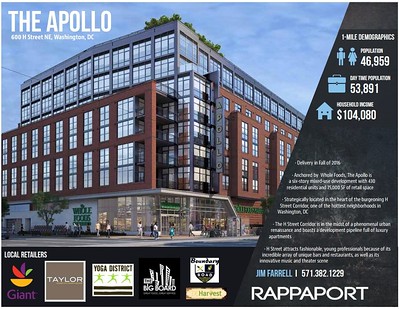
Apollo mixed use residential and retail project, 600 H Street NE, Washington, DC
I think the reality is that where mixed use retail is succeeding now, it's more a function of it being more likely to be located in high income areas.  (You need to be in a high value area to be able to justify the higher cost of creating this kind of development.) And the success is a measure of it being in a high income area, not the property type.

Mixed use is mostly food retail not non-food retail.  Mixed use mostly doesn't have retail, it has food-related business, which I sometimes call eater-tainment. It's gonna take years for that sector to recover. Even in the best circumstances it's a tough business, where most businesses have no more than a month of extra cash (retained earnings/working capital) on hand.

Most of the new mixed use in DC, in particular The Wharf, Navy Yard, those JBG buildings on U Street, have minimal retail. Lots of food-related business--but restaurants do better than selling groceries (which is why the Glen's Garden Market closed there).

The retail ends up not performing well--some exceptions with the JBG stuff because it ends up being regionally serving, and a store like Warby Parker with only a couple locations in the entire metropolitan area is a regional draw.

Navy Yard has a big Harris-Teeter and the baseball stadium and a waterfront. But the big previously announced high end cinema project was dropped even before the pandemic. There's only so much money, so much demand.

The retail underperforms because people go to those places for entertainment, not to buy stuff, but experiences.

And there isn't enough local population to support nonfood convenience retail like hardware stores etc. (e.g., the one that moved to The Wharf that had been in business for 40-50 years previously closed; the new hardware store opened in a mixed use building at 5th and K Street NW closed too). They don't want to carry purchases around with them. Granted it could be shipped, but they'd have to come into the store first.

From the perspective of an independent business owner, the rents are high for retail relative to sales/s.f. And chains are either going out of business or downsizing significantly both in terms of size of store and the number of locations.

And there can be so many restaurants that there isn't enough demand to keep them all in business. E.g., in DC on 14th St. when Le Diplomate opened, previrus with $15MM a year in annual revenue, that seriously diminished the revenue for other restaurants because there's only so much business, not just on 14th St., but on 17th St. and in Dupont Circle too.

My joke about the big real estate companies (I don't have much personal experience with Hines) is that they expect the retailer to pay for the privilege of activating their space.

Rents and property tax revenues will be effected.  Probably the rent/s.f. need to come down significantly going forward, which yes, will change the valuation of retail commercial property. Maybe in mixed use it won't be as big a deal because it can be a small proportion of an overall project. Over time, it will significantly impact local government revenues.

Cities as employment centers.  One thing that the pandemic has done is shift many jobs to telework.  I have always been somewhat down on telework because of the "urbanization" economies that are generated by proximity, exchange and interaction.

Engwicht in Reclaiming Our Cities and Towns: Better Living Through Less Traffic, succinctly delineates why this is important,
"cities exist -- to maximize opportunities for exchange by concentrating people, goods, and facilities within a limited area.
But the pandemic will lead to a sorting effect, comparable to how companies realized that certain types of jobs needed to be in clusters (knowledge-related) while back office jobs like accounting didn't.  You saw this how in the 1980s, finance companies in Manhattan shifted back office (low value) functions to Jersey City, Long Island City, and elsewhere.
Office space rental trends
A similar shift will likely happen again, and this will reduce the demand for center city office space.  Plus, companies might even be willing to accept a reduction in clustering benefits in return for offloading the cost of space to the now home-based employee.

It will be assuaged somewhat by office users having to reduce the trend of shrinking the amount of space/employee ("The implications of shrinking offices," City Observatory), to provide less crowded, more social distant spaces.

-- "When It's Time to Go Back to the Office, Will It Still Be There," Wall Street Journal
-- "Offices Try to Combat Coronavirus With More Fresh Air," WSJ
-- "Reopening the Coronavirus-Era Office: One-Person Elevators," WSJ

But long term, demand for commercial office space will be reduced.  Prices will drop.  Rents will drop.  And concomitantly, so will the demand for transit.  And property taxes as a source of local government revenues.

Labels: , , , , , ,

Saturday, August 03, 2019

Elijah Cummings, President Trump and Revisiting "The Urban Agenda"

Before the 2004 Presidential Election, I came up with this idea to try to get a presidential candidate to run on an urban agenda, so it could be articulated and communicated.

I created a blog called "The Urban Agenda" and the idea was that it would be a group blog.

I talked to people like Joe Riley, then the Mayor of Charleston about the idea of an urban agenda as a distinct element of a presidential campaign, and others.

I never could get much of a commitment from other people to contribute to the blog and it died as I directed my attention to this blog, which is why I am so impressed by the achievements of Greater Greater Washington in terms of being a blog produced by a group mostly of volunteers (now they paid coordination).

But the reality is that my idea wasn't realistic.  Not because we can't come up with an urban agenda.  But because people who run for president do so because -- even if they are delusional -- they think they can win.

Candidates aren't interested in running as a novelty, even though the point is to shape the national agenda in significant ways, because these new ideas will merely be co-opted and incorporated into the agendas of mainline parties, which is what third parties were known for in the late 1800s and early 1900s.

Their definition of success is winning, not shaping the long term agenda of the nation.

It's interesting to me that the mayors running in this round for the 2020 election, Bill DeBlasio of NYC and Pete Buttigieg of South Bend, Indiana, aren't running on what I would call an "urban agenda" -- although I haven't read Pete Buttigieg's book. (Mayor Gil Garcetti of Los Angeles considered running too.)

In any case, South Bend isn't that significant of an example of a revitalizing city when it comes to the kind of urban agenda I was thinking about.

When I first came up with the idea, the concept was a comprehensive approach to revitalization and poverty reduction, which would have included investments in housing, transportation, other infrastructure, commercial district revitalization, business development, workforce development, health and wellness care, etc.

Now the agenda would have to include policing, dealing with crime from a public health perspective, but also the "quick draw" culture that seems to result in a lot of unnecessary death.

Trump, Republicans as anti-city

Because Trump is a real estate developer, and many of his projects are in cities, many people thought he would be pro-city, and at the very least pro-investment in infrastructure and transit especially, which is particularly important to cities.

But while he likes "to build," being a bully and narcissist, he can't help but see cities as opponents, because center cities and metropolitan areas tend to vote Democratic, even in states where the electoral votes end up going Republican.

It kills him that most every metropolitan area in the US voted for Hillary Clinton.  To him that's unforgivable.  So he is continuing the anti-city tone of the Republican Party in his Administration, which features hardcore Tea Party representatives in key positions, especially Mick Mulvaney, who is director of the Office of Management and Budget and sets the budget priorities of the Administration.

The Tea Party movement has pushed the Republican Party to the point where it is one of the most conservative right parties in the world ("What Happened to America's Political Center of Gravity?," New York Times) mostly features representatives from rural and exurban locales.

Weighting of political parties on a left-right continuum
Weighting of political parties on a left-right continuum. New York Times graphic based on data from the Manifesto Project.


(In the new book American Carnage: On the Front Lines of the Republican Civil War and the Rise of President Trump, author Tim Alberta makes the important point that Trump's thrust of "Make America Great Again" is a reformulation but continuation of the "Tea Party" thrust in Republican politics.  "'American Carnage' Explores How Trump Won Over The Republican Party," WBUR/NPR).

Therefore the idea of a campaign run on an urban agenda is all the more relevant given the anti-urban agenda as expressed by the Administration of President Trump generally -- anti-immigrant, reduction in support for transit, reduction in support for cleaner energy, deregulation, reduction in the SALT deduction from federal taxes which disproportionately impacts cities, selection of a Secretary of HUD who is completely unqualified, voter suppression which disproportionately affects people of color and cities, etc.

Trump attacks Baltimore area Congressman Elijah Cummings. Last weekend, Trump tweeted negative comments about Rep. Cummings.
... Cumming (sic) district is a disgusting, rat- and rodent-infested mess. If he spent more time in Baltimore, maybe he could help clean up this very dangerous & filthy place.

"Why is so much money sent to the Elijah Cummings' district when it is considered the worst run and most dangerous anywhere in the United States? No human being would want to live there. Where is all this money going? How much is stolen? Investigate this corrupt mess immediately!"
The anti-city anti-people of color bent of the Trump Administration has been reiterated more recently by President Trump in his attacks on Representative Elijah Cummings, of Baltimore ("Better to have a few rats than to be one," Baltimore Sun).

Yes, Trump doesn't care about cities and his closest acquaintances say he is racist, but the motivation of his animus is the fact that Rep. Cummings chairs the House Committee on Oversight and Reform, which can't help but hold hearings on various acts of the Trump Administration.

Yes, Baltimore has big problems -- more about that in a follow up post.  Baltimore is also a great place, despite its problems.  As this episode of the PBS show, "Samantha Brown's Places to Love" indicates.


But ironically, most of Rep. Cummings' district is in Howard and Baltimore Counties (in fact, when I did the bike and pedestrian plan for Western Baltimore County, a goodly portion of this area was in the 7th Congressional District). It has a bit of Baltimore sure

What have you got to lose by voting for President Trump?

It brings me back to Trump's challenge to African-Americans in the 2016 Election campaign, imploring them to vote for him, "because what do you have to lose," making the point that in his opinion the Democratic Party hadn't done all that much for Blacks, despite their steadfast support.

Clearly there is plenty to lose ("Trump Asked Blacks, "What Do You Have to Lose? Apparently Our Civil Rights," Black Press USA).

The Hate U Give is a movie you should watch

The Hate U Give is a movie (based on the book by Angie Thomas) running on HBO right now. I was flipping channels the other night, and caught it at least one third of the way in. 

It's about a police officer killing a black youth during a traffic stop, and the impact on the girl who was in the car and witnessed the shooting.

That impact extends to her family, her relationships at the private school she attends on scholarship, and their community.

The dialogue and filming isn't always scintillating, but I think it's a pretty good movie that does a good job of communicating about this issue and turmoil present within inner city communities, which most supporters of President Trump likely have little direct experience with.

Labels: , , , , ,



