Rebuilding Place in the Urban Space

"A community’s physical form, rather than its land uses, is its most intrinsic and enduring characteristic." [Katz, EPA] This blog focuses on place and placemaking and all that makes it work--historic preservation, urban design, transportation, asset-based community development, arts & cultural development, commercial district revitalization, tourism & destination development, and quality of life advocacy--along with doses of civic engagement and good governance watchdogging.

Saturday, November 08, 2025

No the first response should not be to tear down a vacant building: rehabilitate it.

My MIL has incredibly short sighted views about "blight."  Her response, "tear it down," fails to acknowledge that a vacant lot is blight too.  She's a product of 50+ years in Orange County, California, during the period of its major growth as a suburban county converting from farmland.

(Even she refused to acknowledge a blighted house in her subdivision--which dates to the 1960s and 1970s.)

She always looked down on Suzanne and I for our "urban lifestyle," living in the city, although when we were together in DC we lived in a mixed building neighborhood-ours is a bungalow--near Takoma Park, Maryland, but in DC.  S didn't want to live the rowhouse life, because she doesn't like noise.

Anyway, in my Nextdoor thread was an ad for the new Maye House apartment building on the outskirts of downtown at 508 E. South Temple.  Since we've been here in 2019 and before, the building had been an abandoned former medical building, close to the Salt Lake Regional Hospital, vacant for many years.

Before and after photos show investment, not demolition, is the best cure for vacant properties.


I'm a sucker for a swimming pool.


Labels: , , , , ,

Thursday, April 07, 2022

Demolition isn't always the solution

As a revitalization planner, I am always hesitant to recommend demolition of a property, because it's not really a solution, especially in a weak real estate market.  When you demolish a building, it's merely replaced with a vacant lot that can be even harder to redevelop.  

It cures the nuisance, but doesn't cure "disinvestment."  The cure to disinvestment is investment.

Big old buildings, even derelict ones, are still opportunities, while big empty lots are just empty and require even more money to redevelop.

Detroit Free Press photo.

The old Packard car manufacturing plant in Detroit has been vacant since 1959, longer than my entire life.  The latest owner's plans for redevelopment stalled, and he is now marketing the property for sale.

Detroit newspapers report ("Judge: Demolish Packard Plant 'immediately'; backup plan set up if owner fails," Detroit News; "Judge orders Packard Plant owner to demolish plant immediately," Detroit Free Press) registration required) that the city, tired of the inaction, just won a lawsuit calling for demolition.

While the city has "won" the battle, likely they lost the war because the property will remain vacant for many more decades.

La Friche arts center utilizes the former Seita Tobacco Factory.

By contrast, there are a number of amazing revitalization initiatives in places like Dublin, Helsinki (Cabelfactory), Toronto (Evergreen Works), and Marseille (La Friche), and in the US, such as the Bethlehem Steel Works in Allentown, Pennsylvania, or MassMOCA in North Adams, Massachusetts ("RANSITION DECADE OF DECISION, 1989-1999 SPRAGUE ELECTRIC >> MASS MOCA"), where large factory complexes have ended up being redeveloped as multi-function arts and culture complexes.  

And plenty of examples of manufacturing buildings being reused in every state in the US for new business development ventures, incubators, business and light industrial research parks, etc. 

Most of these buildings and campuses were equally derelict at one time.

This idea of reuse rather than demolition is why I proposed instead of a "boring" housing and retail redevelopment at the Walter Reed Hospital campus in Northwest DC, that the city should instead of saved the Walter Reed Hospital building, which was 1.5 million square feet, and use it to support a biotechnology graduate education, research and business development initiative ("Ordinary versus Extraordinary Planning around the rebuilding of the United Medical Center in Southeast Washington DC | Part Two: Creating a graduate health and biotechnology research initiative on the St. Elizabeths campus," 2018).

But it's hard to be patient, especially with a building that has sat empty for more than 60 years.


Photos: Andy Morrison, Detroit News.

But I can guarantee a large site like this, newly cleared, in a city with dozens of square miles that are already empty, will remain empty for decades more.

Labels: , , , ,

Monday, May 11, 2015

Demolition vs. Preservation as a neighborhood revitalization strategy: Baltimore, Muncie, Indiana, etc.

A couple weeks ago, national Washington Post columnist Eugene Robinson suggested in "Tear down Baltimore's abandoned buildings to help rebuild," that Baltimore needs to get its demolition on.  He made this point out of the belief that "blighted" properties are pernicious visually and have a negative impact on neighborhood and personal perception.

The problem with this belief is that an empty lot produced in the place of the disinvested building is an equivalent form of blight and equally uncorrectable, as pointed out by the Springfield (IL) State Journal-Register in "City demolition efforts continue, but vacant lots slow to fill in."

Vacant properties in Central Baltimore.  The Sandtown-Winchester neighborhood is on the left side of this graphic.

Baltimore is a weak market, but with strong market opportunities.  While Baltimore is quite impoverished, it does have the opportunity to attract new residents, because of its location on the East Coast, being served by the Northeast Corridor Amtrak line, and close enough and with significantly cheaper but historic housing, to serve as a bedroom community for DC.

And areas marked by a high degree of vacancies are centrally located.

I was going to write a letter in response to the Robinson column, but Michael Allen of the Preservation Research Office in St. Louis, beat me to it.  In "Bulldozers aren't the only answer" he wrote:
As I read Eugene Robinson’s May 1 op-ed column, “Ghosts that haunt Charm City,” I found myself both nodding and shaking my head with equal vigor. I know all too well that abandoned buildings can drag down the look of a city written off for its many problems. 
Once upon a time, St. Louisans looked to demolishing abandoned buildings to resolve social problems and improve appearances. The results, however, diminished the city: fewer buildings, fewer people, less tax revenue, degraded land values. In 1998, Missouri created a state historic tax credit, and ever since St. Louis has been finding that rehabilitation creates wealth in communities that assumed they had hit bottom. 
St. Louis has a smaller population than Baltimore, none of the proximity to other major cities and far lower demand for real estate. Yet we harnessed the economic power of what seemed like a dead weight: vacant buildings. 
Mr. Robinson might want to rethink his thesis to at least admit that rehabilitation is as viable a solution as demolition — and one with greater economic returns. Not everything can be saved, but not everything should be bulldozed either. 
But this shouldn't be news.  For example, see "Eyesore to Community Asset: Historic preservation creates affordable housing and livable neighborhoods" from Shelterforce.

Costs associated with vacant properties don't go away when you tear down a building.  Demolishing a building just creates a vacant lot.  So demolition ends up being an incomplete "solution."  Just like vacant buildings, vacant lots contribute to increased costs to cities and counties.

According to a GAO study, vacant properties have a negative impact on immediate properties of close to 10%, while a study in Pittsburgh attributes an overall decrease in city property value ("Costs of blight," Pittsburgh Quarterly).

Vacant lots can be loci for trash and illegal dumping.  Image: (Maryland) Daily Record.

The Chicago Tribune reported ("Crime in Chicago's vacant property soars 48% since 2005") that crime increases in Chicago neighborhoods with a significant number of vacant lots and buildings.

Similarly, a Government Finance Review article reports in a significant increase in emergency services expenditures associated with vacant buildings and lots.

Certainly in those cities that have the opportunity to attract new residents, demolition is an ill-considered strategy that seemingly makes sense in the short term, but has long term negative consequences.

The language of revitalization.  As an aside, it's important to remember the importance of language and message.  A so-called blighted building is the result of disinvestment.  The solution to blight isn't "demolition," but reinvestment in the property.

Market economics makes rehabbing disinvested properties expensive and sometimes uneconomic in the short and intermediate run.  In weak real estate markets, the high cost of renovating a building that has been disinvested in for decades often means that the cost of the renovations isn't immediately recouped by increased property value--except, perhaps over a many decade period (e.g., for example it took 30+ years for many DC neighborhoods to get to the point where they were 5-10 years ago, let alone, the market of today).  So at the scale of an individual property owner, it seems to make economic sense to demolish rather than to repair or rehabilitate.

In weak real estate markets, the value of stable neighborhoods is less captured by individual property owners and is more a function of the whole, as a public good, as opposed to the way the property normally works, at the lot by lot scale.

To stabilize improve neighborhoods,local governments are justified in making extra-normal public investments in such places, including a variety of tactics including tax credits, providing properties for no cost, technical assistance, grants, and other financial inducements.

The Muncie illustration.  In preparation for a forthcoming blog entry, I was reading the book Resilient Downtowns, by Michael Burayidi and in touting historic preservation as a neighborhood revitalization and resident recruitment strategy, one of the examples it gave was from Muncie, Indiana.

The city had intended to demolish a number of "blighted properties," but push back from historic preservation and neighborhood activists led the city to change its direction, and instead, money earmarked for demolition was shifted towards funding renovation.

The book highlighted the renovation of a property at 911 E. Jackson Street, but didn't include photos.

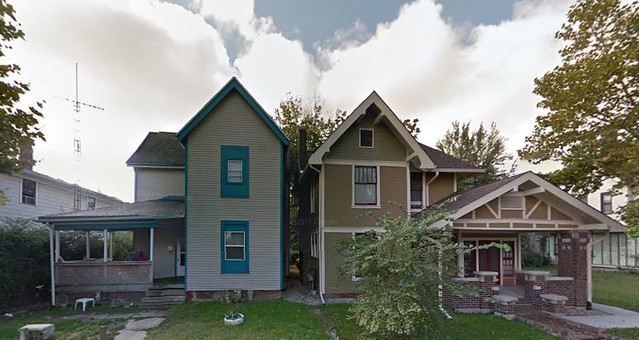
I looked up the building online, using Google Street View from the present and the past, and I was astounded at the transformation, and the visible proof that investment is the far better response to disinvestment, rather than demolition.

Of course, across the county, there are thousands and thousands of such examples which illustrate the benefits of making the choice to renovate rather than demolish.

The building on the right is 911 E. Jackson Street, Muncie, Indiana, before rehabilitation (2007)
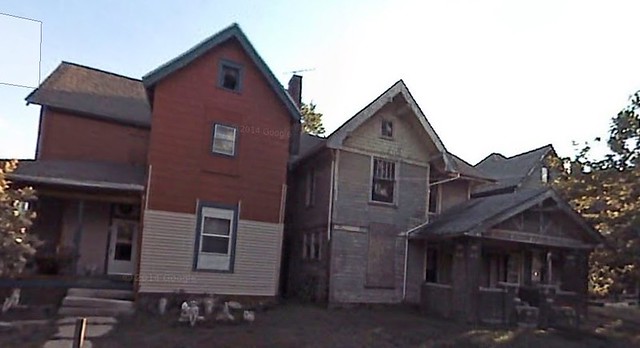
house before

911 E. Jackson Street, Muncie, Indiana, after rehabilitation (2014)
house after

The building had been vacant for more than 25 years, and a few years before the city ordered the building's demolition, it had been purchased by a graduate of the Ball State University architecture school in Muncie, with the intention of renovating the property.  But given the high cost of renovation and the difficulties raising funds, the owner had not yet begun the project.

According to "HUD Grant to Turn Threatened Indiana House into affordable housing," from Preservation Magazine, the final cost was about $300,000.  HUD community development funds paid about 80% of the total.

You can argue that demolition would have been cheaper, and it would have in terms of initial cost, but over time, the reinvestment in the neighborhood will pay off--especially compared to the opportunity costs of a vacant lot not likely to be redeveloped any time soon.

Clearly, the house next door (on the left in the image), was renovated as well, although I don't know the genesis of that project.  Generally, improvements in one property help to spark private investment by others--the argument made in Building Neighborhood Confidence by Goetze.

Note that Baltimore has many excellent neighborhood revitalization programs, including the Live Baltimore residential recruitment program, while the Healthy Neighborhoods program focuses on strengthening late emerging and transitioning neighborhoods (see "Systematic neighborhood engagement").

Parks and urban farms as an alternative vacant lot absorption strategy.  While touted in many quarters, I am not a fan of adaptive reuse of vacant properties for farms and parks, except in selective situations where a neighborhood lacks such spaces.

Image above from "Extreme Green Makeovers for Vacant Lots," Public News Service.

Generally, an occupied house, with residents paying income, sales, and property taxes, and committed to living in and maintaining a viable neighborhood, is the highest and best use for such properties.

But in weak markets, it can be a way to landbank properties and as a lower cost maintenance strategy.

-- Vacant Lot Handbook: A Guide to Reusing, Reinventing and Adding Value to Milwaukee’s
City-owned Vacant Lots
, City of Milwaukee
-- Greening Vacanant Lots: Planning and Implementation Strategies, Nature Conservancy
-- Green Pattern Book: Using Vacant Land to Create Greener NeighborhoodsCity of Baltimore Growing Green Initiative
-- Cutting Through The Red Tape: How Baltimore's Vacant Lot Programs Have Made it Easier For Communities To Revitalize The Underutilized And Blighted Spaces In Their Neighborhoods, MIT

The best alternative to demolition: rehabilitation of vacant properties as a community and jobs development program.

But I would argue that Baltimore needs to go beyond the programs they have, as various neighborhoods remain in persistent poverty.

I recommend a two pronged program for distressed and emerging neighborhoods.  Instead of focusing on property demolition and tearing holes in blocks and neighborhoods which further destabilizes rather than improves communities, instead (1) focus on rehabilitating and getting houses occupied, (2) through a skills and workforce development and training program.

Model programs include:
  • the HUD-funded Youthbuild program, which teaches construction skills to young adults through classroom and field settings such as affordable housing developments, schools, and community centers;
  • Savannah Landmark Rehabilitation Project -- this 1970s initiative aimed to preserve the ability of lower income households to remain in the Savannah Historic District despite rising housing prices.  It did so by purchasing and rehabilitating 260 units of housing units and keeping them as part of a portfolio of permanently affordable housing;
  • PUSH (People United for Sustainable Housing) Buffalo's energy efficiency and conservation rehabilitation program, which is a community development social enterprise that develops green jobs, while doing energy efficiency upgrades;
  • housing rehabilitation programs for low income and senior residents by affiliates of the nonprofit organization Rebuilding Together
  • the Artist Relocation Program in Paducah, Kentucky targets a different demographic, but is a good model for demonstrating how selling for low cost or providing properties for no cost in return for significant investment into rehabbing disinvested properties can be a good way to recruit new residents to otherwise vacant properties and neighborhoods.  They did this in the city's Lower Town neighborhood. See "Artists to the rescue" from the Evansville Courier and Press and this presentation.
  • The Roots to Re-entry program of the Pennsylvania Horticultural Society trains prison inmates "in gardening and landscape management. This intensive hands-on training focuses on horticultural practices, landscape maintenance, greenhouse operations, carpentry, and masonry skill sets. The training also includes course work in workforce literacy, job readiness, health education, and occupational therapy. Upon completion, program participants will receive post release support from PHS and its partners including job placement helping inmates make the transition to life outside the prison walls."

Labels: , , , , , ,

Thursday, May 29, 2014

There has to be a better way to spend $1.85 billion on "revitalization" just to demolish buildings: The US needs its own version of Germany's International Building Exhibition, let's start with Detroit

Detroit's proposed plan to address vacant properties that make up an increasing percentage of the abandoned city's building stock is to demolish them.  See "Why bankrupt Detroit wants to destroy nearly one-quarter of its houses" from the Christian Science Monitor.

The proposal is to spend $850 million to demolish 85,000 houses, at $10,000 per building, and to spend another $1 billion to demolish vacant industrial properties.

The problem is all that does is create a different problem--lots of empty land that gets stuff dumped on it, has to have the grass cut, etc., an ongoing and expensive maintenance headache.  And all you do is produce empty land which isn't productive.

Image from the General Motors Futurama exhibit at the 1939 World's Fair.

I don't know what to recommend exactly. Detroit's problem is residential and commercial abandonment, abetted by deindustrialization but also a concerted policy by the auto industry to move out of Detroit and out of Michigan in order to reduce the power of labor and the UAW within the state.

Detroit is collateral damage, although I also argue that the way Detroit is the end game of what the auto industry expected to have happen to cities, because cities weren't the right built environment for accommodating cars.

Ironically, today the Center for Community Progress announced that the sixth national Reclaiming Vacant Properties Conference will be held next year in Detroit, May 19-21, 2015.

I wrote up the summary piece on European regeneration practices based on the eight cities I wrote about for the Europe in Baltimore project but it hasn't been published yet.

There are a bunch of recommendations:  how to organize successful revitalization efforts; issues raised by the European Capital of Culture program; recommendations for Baltimore; recommendations for the US/Federal Government; (and a brief thought about US social housing policy).

One of the things I suggested is that it would be great for the US to create "an event program" comparable to Germany's IBA/International Building Exhibition (Internationale Bauausstellung).

-- Alice Shay's MIT thesis on the IBA program

IBA doesn't happen on a lock step schedule, but is about every 5 to 10 years. The intent of the Expo is to model new techniques for construction and design through the physical transformation of urban sites and districts, thereby repositioning the image and brand of a city.

IBA is focused on what we might call “learning through seeing” and “installations,” accomplished through actively creating and implementing “on-the-ground” projects.  They do a rigorous review of the process and have an extensive publishing program that helps to disseminate the learning.

A city-region is selected based on the level of its problems or questions that it raises and the commitment to address them in a multi-year program that culminates in a variety of physical transformation projects that significantly change the built and natural environment in ways that are truly remarkable--the Emscher Landscape Park project in the Ruhr region of Germany is in its third decade.

The charge for IBA Hamburg was/is to find solutions to three challenges faced by most cities, especially cities located on ports and rivers: the impact of climate change; modifying the urban landscape for new economic circumstances (in the face of limited resources); and social equity.

Imagine transforming US revitalization financing and planning programs to operate as demonstration projects on the massive scale of an BA program, rather than the small scale efforts that are more typical and take decades to achieve critical mass.

Detroit would be a good place to start.

That would be far better than a large scale demolition programs, as Detroit is planning to do ("Blight Cleanup Will Cost a Bankrupt Detroit $850 Million," New York Times) just to end up with empty land.

By contrast, about €2 billion of public and private investment will be spent on IBA Hamburgon physical improvements to the the communities within the project area over the period of 2006-2020, when the entire forecasted program will have been accomplished--even though the exhibition year of the program was limited to 2013, the time for which a majority of the projects were completed and able to be displayed.

I lived on this Detroit block for a couple years starting when I was 10 years old, when I was in foster care (with a family I was semi-related to). You can buy houses there now for as little as $3,000.

Labels: , , , ,

Friday, March 07, 2014

DC preservation protest this Saturday and Sunday

This event relates to an issue I've written about before ("Without remedies there's nothing you can do: historic preservation in Chicago and DC") which has to do with the lack of preservation protections in the city outside of areas designated as historic. While DC has many designated historic districts and tends of thousands of buildings are protected, as many as 100,000 buildings that are eligible for designation are not located within designated neighborhoods and therefore have no protection at all.

I wish there had been more notice about the protest.

The house discussed below is pictured on the right and is identical in form to its next door neighbor.  Photo by Mary Rowse.

From the Historic Washington e-list:

Dear fellow preservationists -

The time has come to protest the possible demolition of 3823 Morrison Street, NW in the heart of Chevy Chase DC this Saturday and Sunday from 11 - 3 pm. The property sits half a block from Connecticut Avenue, NW. You may have read that developer Robert Holman purchased the house in November 2013 for $825,000 and wants to tear it down. (See front page story: "Chevy Chase Neighbors Battle Raze Plan").

Various potential buyers have contacted him over and over again and he tries to dissuade each one from buying it. He appears to be unwilling to let buyers who want to save the property inside to evaluate it for themselves. From the outside the house appears to be structurally sound although there are some cracks in the pebble dash exterior.

Please come out Saturday and/or Sunday, March 8 and 9, to stand with members of the community who want to send a message to the developer that throwing a 100-year-old house away is not a sensible solution when it can be restored and put back into productive use.

We have tremendous power as a group of concerned citizens to change the outcome of this story if we protest together in front of the house and down the street at Connecticut Avenue and Morrison Street, NW.

Please meet on the sidewalk in front of the house this Saturday and Sunday, March 8 and 9 from 11 - 3 pm to send a message that we value the neighborhood's architectural resources and the house at 3823 Morrison is emblematic of the dignity and integrity old buildings bring to the Chevy Chase, DC neighborhood and every neighborhood in the city.

Weather will be in the 50's. Bring signs or we can provide them. They could say : "Save 3823 Morrison St", Don't Tear this house down", "Protect Chevy Chase, DC", "Don't Demolish, Restore", "Let buyers inside 3823 Morrison St.", "Demolishing is Environmentally Destructive", etc.

Property owner and developer Robert Holman continues to rebuff those interested in buying the house. It appears he has cut the sewer and electric lines but may have have left the gas and water lines connected. Nearly 100 people have signed a letter asking him not to tear down the house. Various win-win solutions have been suggested.

We must demonstrate to all that this community wants to protect its architectural heritage from developers who seek to maximize the size of buildings on lots. The house at 3823 Morrison Street, NW was built 100 years ago on a 6,300 square foot lot. Developer Robert Holman wants to bulldoze the nearly 3,000 square foot house and build a 5,500 square foot one in its place. He will increase the size and density of what's already there by undoubtedly bringing the new house closer to the front and side yard boundaries. He has written: "The only way to add square footage is in front and the side yard."

Please let us know if you'll be there Saturday and/or Sunday, March 8 and 9 between 11 and 3 pm.

This venerable home has been a fixture in the Chevy Chase, DC community for 100 years and is a defining element in the century-old neighborhood. Bulldozing the house and putting it in a landfill will be environmentally destructive and wasteful. This six-bedroom, three-story house contains highly prized and reusable materials such as 100-year-old bricks and heavy, dense "old-growth" wood.

While it clearly needs repair, 3823 Morrison, and its adjacent twin at 3825 Morrison, represent the kind of architectural gems Chevy Chase, DC is known for and that buyers eagerly seek to purchase. This substantial home deserves to be restored, not torn down and thrown away. Some people look at its neglected appearance and see a “teardown.” But teardowns can be very destructive to a neighborhood when older homes that were compatible with their surroundings are replaced with dramatically larger, out-of-scale structures that project closer to the street and to neighboring properties. Replacing such a prominent house in Chevy Chase, DC with something even larger, will be jarring and will forever alter the character and rhythm of this block.

We must take action immediately to protect what we value today or it will be lost tomorrow. Stable, established, pedestrian-oriented neighborhoods like Chevy Chase, DC are under pressure because they are highly desirable to developers. The infrastructure they need is already in place—sidewalks, tree-lined streets, alleys, transportation systems, stores, schools, libraries, parks and interesting and diverse architecture with porches and uniform setbacks. It is far more advantageous for developers to tie into an older community like this one than to start from scratch somewhere less developed. New construction in a community can be desirable. But not if it significantly alters the environment residents value.

Come out for Chevy Chase DC Saturday and Sunday, 11 - 3 pm at 3823 Morrison Street, NW. Together we will make a difference.

Mary Rowse
202-362-9279
202-329-0095

Labels: , , ,

Thursday, October 24, 2013

Ben's Chili Bowl demolishes 1001 H Street NE: Illegal demolition illustrates failures in DC's regulatory system

Historic buildings are the building blocks of successful urban commercial districts

As discussed in a previous entry ("Millennials, hipness, "rowhouse-y charm," and authenticity") it is the historic--eligible for designation or actually designated--building stock in neighborhood commercial districts that is the basic building block for "cool" "edgy" "interesting" "attractive" places to visit.

The link between urban revitalization and historic preservation is long standing. In fact, I am pretty much convinced that historic preservation strategies are one of the only sustainable methods for urban revitalization (transit helps, but isn't absolutely required) that there is. The Main Street program is based on this concept, and there are plenty of other studies and work that demonstrates the link.

Lately I am particularly enamored of the writings by John Montgomery, a professor and consultant involved in early culture and creative industries driven urban revitalization efforts in the late 1980s and early 1990s. His book The New Wealth of Cities: City Dynamics and the Fifth Way, is probably the best single discussion of virtually every aspect of culture district based revitalization (even better than Cities: Back from the Edge, which is equally great and I will say, easier to read, but is not quite the same as a primer), including the historic preservation element. I wish we would have known about JM's work when we started the H St. Main Street organization.

More recently, the World Bank published The Economics of Uniqueness: Investing in City Cores and Cultural Assets for Sustainable Development which focuses more on the historic preservation/heritage conservation element.

In DC, only historically designated areas "enjoy" extra-normal protections such as more careful design review and restrictions on demolition

The reason the link between historic buildings and urban revitalization is worth mentioning is that it provides justification for regulating what happens to buildings in commercial districts.

About 10 years ago, I submitted testimony with regard to DC's Department of Housing and Community Development and the Main Street program, suggesting that as part of the creation of a Main Street district, development review guidelines and building protections should be put into place, regardless of the historic designation status of the district.

A demolition on H Street NE demonstrates the gap in DC laws

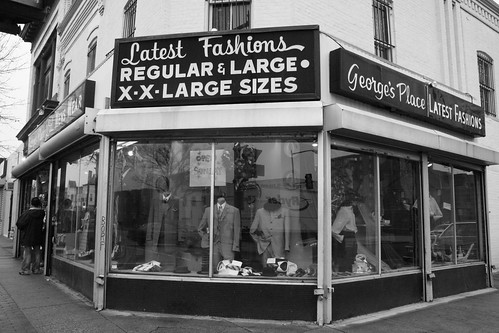
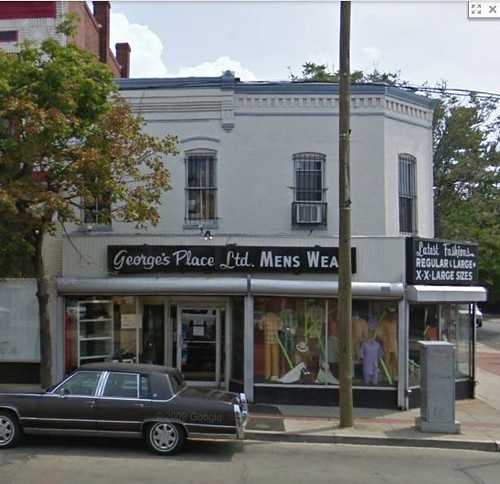
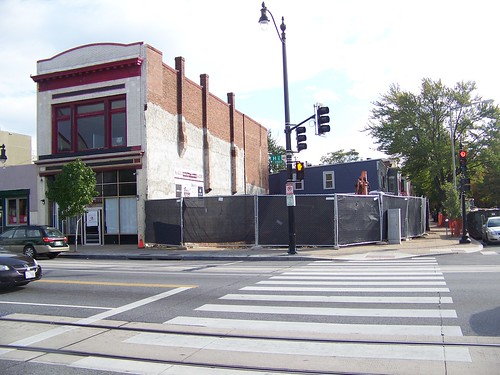
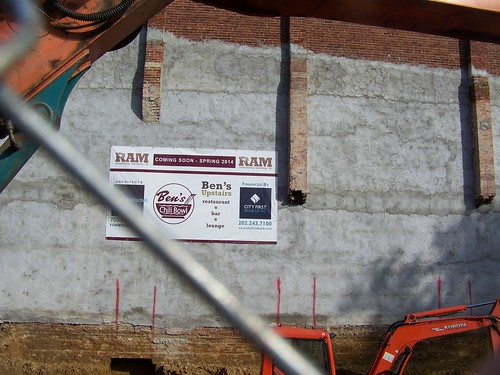
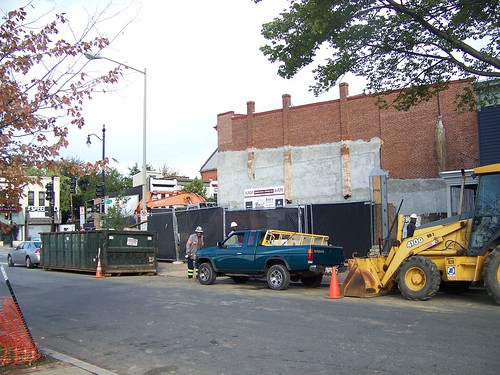
A few days ago, Ben's Chili Bowl, which bought 1001 H Street NE (two buildings) for a new location ("For Ben's Chili Bowl, expansion comes with responsibility," Washington Post) demolished the building, even though they submitted plans to the city's Building and Land Regulation Agency for renovation and never applied for a demolition permit. Despite the demolition, there isn't a stop work order posted on the property (at least as of yesterday afternoon, when I went by).

One of the provisions in the "Neighborhood Commercial District Overlay" discourages demolition by given a space utilization (or FAR, floor-to-area ratio) bonus.  What this means is that property owners can use more of the site if they keep an historically eligible building rather than tear it down.  Ben's was given that bonus, based on their submitted plans, but based on the demolition, they are not eligible for it.  But it's not the same as the Cleveland regulation.

Many years ago, rather than fix this projecting bay turret on the building at 1128 H Street NE, the then property owner had it parged (stuccoed).  Photo from Loopnet.

DC's regulation is based on the hope that there is goodwill and appreciation for historicity on the part of the property owner.

But I would think that the myriad examples of lousy work and boneheaded acts by property owners across the city would convince us that being hopeful isn't a good strategy.

DC needs building protections in commercial districts, whether or not these districts are historically designated

1.  One example would be how Cleveland has a zoning classification called a "Business Revitalization District," which requires design review and development coordination for all projects in designated revitalization districts (H Street would be considered such a district in the context of Cleveland's regulations).  This is to ensure that property owners don't take actions that diminish, rather than assist, revitalization.   From the Cleveland webpage:
Certain proposals for construction, exterior alterations, building demolitions or signs in the City of Cleveland must undergo a process known as "design review." The City established this process as a policy to ensure that any visual changes to buildings or open spaces will enhance the architectural character of Neighborhood Commercial Districts.
2.  Ultimately, even in a historic district, you can't prevent a company from breaking the law if that's what they want to do. So buildings do get demolished, despite the best efforts of government officials and building inspectors.

The way to prevent this from happening is to have serious penalties.

Some jurisdictions--not DC--have provisions in the law so that illegal demolitions are "cured" by a complete rebuilding of the property.

But in DC, other than a wee fine, nothing of substance will happen to the company, and DC loses buildings that are more than 100 years old.

And to require that buildings be saved, or at least very difficult to tear down. 

A more robust regulation like Cleveland's is definitely in order.

3.  Another penalty to consider assessing would be on the firms/employees that performed the illegal demolition, forbidding authorization to work on projects in DC for a period of 18 months or more.

Flickr image of 1001 H Street NE by Inked78
IMG_964.JPG

Google Street View Image
georges, 1001 H Street NE DC

Image from yesterday
demolition of 1001 H Street NE

Sign on the wall of the adjoining building, announcing the coming of Ben's to the H Street corridor
Ben's Chili Bowl, Sign on the wall of the adjoining building

Yesterday, despite the illegal demolition, no stop work notice had been posted, and workers were on site.
Side view on 10th Street NE, demolition of 1001 H Street NE


Labels: , , , , ,