Rebuilding Place in the Urban Space

"A community’s physical form, rather than its land uses, is its most intrinsic and enduring characteristic." [Katz, EPA] This blog focuses on place and placemaking and all that makes it work--historic preservation, urban design, transportation, asset-based community development, arts & cultural development, commercial district revitalization, tourism & destination development, and quality of life advocacy--along with doses of civic engagement and good governance watchdogging.

Friday, December 26, 2025

Meanwhile, many legacy cities continue to lag

Pittsburgh.  AP ran a story, asking the question, "How does Pittsburgh have 20,000 vacant homes -- and a housing shortage?."  The reason for the large number of vacant properties is because more suburban housing was built than there was demand, hence housing abandonment in Pittsburgh.  

This is abetted by the fact that the Pittsburgh metropolitan area isn't growing all that much. The population has been stagnant since 2000, and shrunk some from 1990 to 2000.

Cities like Cleveland, Detroit, Baltimore, St. Louis etc. have the same problem.  Hence many vacant lots and abandoned buildings ("Vacancy: America’s Other Housing Crisis," Bloomberg).

From a filtering perspective, if you want to live in the city, there are plenty of options--e.g. houses that today cost over $600,000 could be bought in 2003 for under $125,000.  But if not enough people want to live in the city, the overhang of vacant properties remains.

Another point is how much demand is there really?  One example is a small developer, believing that the relatively low income Hill District "needed" more upscale housing to appeal to new market segments, hasn't been able to sell the houses ("Six new townhomes. Zero buyers. And one developer on the brink," Pittsburgh Post-Gazette). 

I think the headline of the AP story is misleading, because it doesn't discuss at all a housing shortage in Pittsburgh.

DC.  The market turned in favor of urban living--the federal employment engine was strong and grew further as a result of the government response to 9/11 and the need for improvements in security technology ("Understanding the DC housing market: demand for urban living, not the construction of new housing, is the driving force," 2021) and vacant housing was rehabilitated and occupied.

Only with the Trump Administration's recent destruction of the federal government, especially for jobs and agencies based in DC and the suburbs, has DC's housing market turned downward ("DOGE Is Dampening the DC Real Estate Market," Washingtonian).

Public Land banks.  But when they do want to live in the city, the properties need to be rehabilitated and the cost can be extremely high relative to costs of existing housing.  The AP article argues that Land Banks, public authorities that acquire and sell vacant properties, are a potential solution.  

Philadelphia.  Photo: Matt Rourke, AP.

But most move particularly slowly with many bureaucratic hurdles and are usually underfunded ("City Council grills Land Bank on selling only 1,017 vacant properties in over a decade," Philadelphia Inquirer).

In Detroit, the Land Bank there has more recently acted as a developer to get buildings in shape for sale or rent.  Some neighborhoods have done better than others, and so the Land Bank is criticized for differential effects ("Detroit's land bank says it has led a city housing revival. The jury is still out," Detroit News)

Nonprofits. Various nonprofits, in Detroit, Cleveland and elsewhere, also do this kind of property rehabilitation, sometimes with the aid of receivership statutes, providing the ability to clear confused titles and cancel outstanding liens.

Lesson: focus.  Most of the successful nonprofit efforts focus on particular neighborhoods, aiming to build a critical mass of improved housing, rather than take on a scattered site approach.  This is tough though politically, because everyone wants their neighborhoods to be improved.

Labels: ,

Saturday, November 08, 2025

No the first response should not be to tear down a vacant building: rehabilitate it.

My MIL has incredibly short sighted views about "blight."  Her response, "tear it down," fails to acknowledge that a vacant lot is blight too.  She's a product of 50+ years in Orange County, California, during the period of its major growth as a suburban county converting from farmland.

(Even she refused to acknowledge a blighted house in her subdivision--which dates to the 1960s and 1970s.)

She always looked down on Suzanne and I for our "urban lifestyle," living in the city, although when we were together in DC we lived in a mixed building neighborhood-ours is a bungalow--near Takoma Park, Maryland, but in DC.  S didn't want to live the rowhouse life, because she doesn't like noise.

Anyway, in my Nextdoor thread was an ad for the new Maye House apartment building on the outskirts of downtown at 508 E. South Temple.  Since we've been here in 2019 and before, the building had been an abandoned former medical building, close to the Salt Lake Regional Hospital, vacant for many years.

Before and after photos show investment, not demolition, is the best cure for vacant properties.


I'm a sucker for a swimming pool.


Labels: , , , , ,

Friday, June 14, 2013

Housing receivership to cure nuisance properties: the option that DC refuses to consider

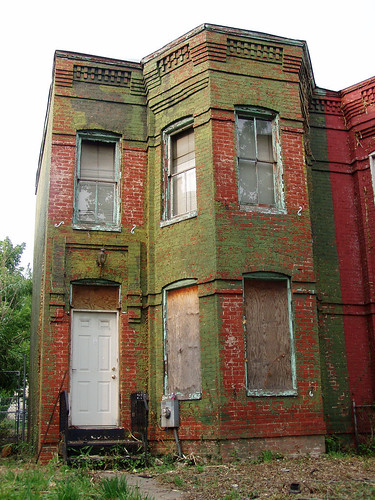
Vacant Rowhouse in Trinidad, Washington, DCVacant rowhouse in the Trinidad neighborhood of DC, photographed sometime before February 2006 by Frozen Tropics.

In 2002, I went to the National Trust for Historic Preservation conference, which was then in Cleveland, and I was exposed on a bunch of tours to the neighborhood stabilization efforts of the Cleveland Restoration Society and the Famikos Foundation.

Because Cleveland was and is a shrinking city, with minimal appreciation in housing prices, restoring historic properties doesn't came back in improved housing values the way it does in a strong market neighborhood in Brooklyn, or DC, or Alexandria, Virginia, or certain neighborhoods in Boston, etc.

In weak market cities the priority is neighborhood stabilization.  So often these organizations--at least back then, complemented by other city and county programs--would get control of properties and stabilize and improve them, often to the point beyond the amount a house could sell for in that market, in order to save the house and improve the neighborhood.

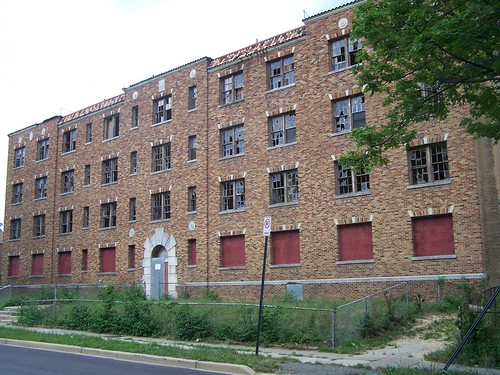
Disinvestment, 2nd and T Street NEBuilding at right at 2nd and T Street NE, around 2006.

I looked into this further and discovered that these efforts were aided by a strong State of Ohio statute providing for the ability to establish receivership for properties and a separate "Housing Court," to address housing-related matters.

Receivership can be awarded in order to cure habitual nuisances, and the Housing Court had the ability to award title for properties in receivership--provided that the nuisance was cured.  (DC nonprofits and the city have a bad habit of getting control of properties and then doing nothing with them for many years.  In such a situation, these entities ought not to be deemed "fit" to be able to be awarded properties through the receivership process.)

I was impressed and from 2002 to 2006, I used to testify about this before various DC City Council committees.  See "Receivership for housing" for part of the written testimony.  Eventually I stopped because there was no werewithal to take this concept up and apply it within DC.

The City Paper has a piece, "Lost and Foundering," about long term vacant properties in DC, and how the primary method that the city uses to get them back on the market--from the article:

D.C. has a system that’s supposed to prevent vacant and blighted properties from staying this way. If the Department of Consumer and Regulatory Affairs finds a property to be vacant, the agency slaps it with a 5-percent property tax; if it’s vacant and blighted, it becomes a 10 percent tax, a steep increase from the standard .85 percent rate for residential property. Generally, that charge is enough incentive for the property owner to fix up the building or sell it.

But what happens if the city can’t find the owner? When I visit 430 Manor Place, there’s a stapled packet of D.C. Superior Court documents taped to the front doorstep—Boese says these packets appear there periodically—detailing a lawsuit against the house’s owner, listed as “Estate of Irby L. Dickinson (a/k/a Irby Dickenson a/k/a Irby Dickson)” and “Unknown Heirs of Irby Dickinson,” both with an address in Birmingham, Ala. City property records show that “Irby Dickenson” bought the Manor Place property in 1945, though there’s also mention of an “Alma Dickinson” in 1968 and an “Irby Dickerson” in 1999, when the city put a lien on the house.

Vacant Rowhouse in Trinidad, Washington, DCLeft: another vacant property in the Trinidad neighborhood, photo by Frozen Tropics.

The primary method is to have a big tax on vacant property.  That does encourage sale to presumably better owners, but at the same time, it can encourage demolition, see "D.C. buildings linked to Armenian Genocide museum to be razed" from the Washington Business Journal, as an example.  Generally this is not in the public interest, but is done to reduce taxes.  (Something similar happened in the H Street neighborhood, with buildings next to the Atlas Theater.  The property owner got permission to demolish the buildings, which would have been contributing structures in a historic district, but H Street is not designated.  But the rise in value of the properties encouraged the owner to sell to a property owner disposed to take care of the property instead.)

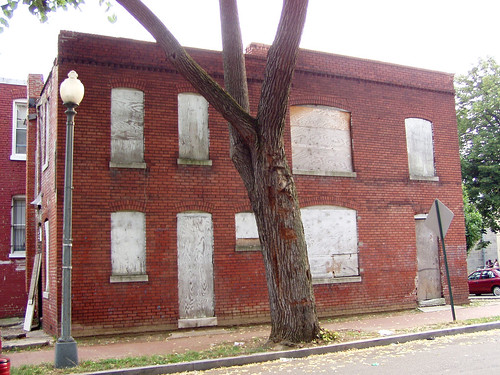
Vacant building allegedly for lease, H Street NERight: this building on H Street has been up for lease for at least ten years.  One way to get around the vacant property tax is to slap up a for lease sign, even if you are asking way to much money to lease the building and it requires thousands of dollars in renovation costs, which the property owner is not willing to pay.

The secondary method is to move on a property in Condemnation Court.  Again, this will motivate some property owners to sell, but others will just demolish the property, which may have been their intent all along.  See "Dwelling in the Past: Larry Quillian wants to raze his shotgun shack" from the City Paper.  I think of a building demolished on 10th Street NE around 2002, in response to a "condemnation notice".  The lot is still vacant today and if they had just fixed up the property, today it would be worth in excess of $600,000.  This is not in the public interest either.

The third method would be to have a method to establish receivership for properties that are determined to be nuisances, just like in the State of Ohio.  That DC doesn't do.

Hence, the problem of having properties stay vacant, often for decades, or buildings that should be preserved, getting demolished, and the creation of new nuisances--vacant lots--that are just as hard to "fix".

--------
Also see the past blog entries, "Investment vs. Disinvestment," which discusses in part what I call "the language of revitalization" and  "Preservation Laws do matter," which discusses the necessity of having the right laws and remedies in place, in order to address demolition by neglect and other neighborhood stabilization issues.

-- and the book Bringing Buildings Back by Alan Mallach, see "Bringing buildings back is really about bringing urban neighborhoods back "

-- while focused on weak markets, the Center for Community Progress focuses on vacant property issues, including receivership.

-- Their annual conference on Reclaiming Vacant Properties is September 9th-11th in Philadelphia.

-- Also see the Washington Post story, "Manassas's 9300 Prescott Ave. home sees likely resolution to weary story," about a house that has been vacant for decades, and the inability of the locality to address the situation for many years, and how neighbors came together to buy the house in order to "cure" the nuisance.

Labels: , , , , , ,

Wednesday, August 01, 2012

7th Annual Land Bank Conference, hosted by the Center for Community Progress

From the Center for Community Progress:

October 14-16
7th Annual Land Bank Conference will feature leading experts, stakeholders, practitioners
Kalamazoo, Michigan

The conference brings together revitalization professionals, practitioners for three days of networking, brainstorming, information-sharing on how to make land banking work for local communities.

As the nation’s towns and cities search for solutions to foreclosure, abandonment and vacancy, they are increasingly turning to land banking as an essential tool. The Center for Community Progress’ 7th Annual Land Bank Conference is a “must-attend” for all those who want to know more about the intricacies of land banking and how it’s being successfully used across the nation.

This year’s conference includes 20 sessions on issues from legislative options to preservation and redevelopment scenarios, from financing programs to preserving properties and adaptive reuse. Two in-depth training seminars on land banking and code enforcement dovetail with daily mobile tours that showcase Kalamazoo County Land Bank successes in brownfield redevelopment, mixed-use development and greening initiatives – plus dynamic keynote speeches from Hunter Morrison and Scott Bishop, two of the nation’s most respected revitalization experts.

Early bird registration discounts are available for those who register before September 14. See the full program, learn how to register here, or visit our website.

Labels: , , ,

Tuesday, July 24, 2012

Emptiest U.S. cities

According to "America's emptiest cities, 2012" from CNBC:

Each quarter, the Census Bureau publishes data on homeowner and rental vacancies in the 75 largest cities. Listed here are the [ten] cities with the most vacancies, using a weighted ranking of both rental and homeowner vacancies based on a 12-month average of both kinds of vacancy rates to smooth out sampling errors. Weights are assigned to rental and homeowner vacancies according to the national proportion of homes to rental properties in the U.S. Our list reveals the most significant outliers in both categories relative to other major U.S. cities.

1.  Orlando
2.  Dayton, Ohio
3.  Memphis
4.  Detroit
5.  Richmond, Virginia
6.  Las Vegas
7.  Atlanta
8.  Houston
9.  Tampa
10. Toledo
Image of vacant properties in the Church Hill neighborhood of Richmond, from Church Hill People's News blog.

Labels: , , ,

Tuesday, May 15, 2012

More on vacant properties and getting properties back to habitable use (abating nuisance properties)

Opportunities abound in Reservoir Hill
Reservoir Hill, Baltimore, 2006.

1.  Argh.  Re-reading the piece from other day, I was writing about DC and I said "the problem is working itself out."

I should have been more specific.  In neighborhoods in demand, the problem of nuisance properties is being addressed more by the market, as more properties, even properties off the market for decades, are being renovated because of rising property taxes, citizen complaints (e.g., "Shiloh Baptist Church Agrees to Sell Two of Its Vacant Properties" from DCist in 2009), and basic economics.

In weak market neighborhoods (and weak market cities and regions), like Anacostia, the problem remains.  Although I didn't discuss it in the piece from the weekend, I did discuss it in March, in this entry, "Deeper thinking/programming on weak residential housing markets is required: DC example, Anacostia.

2.  The blog RUSeriousingMe, known for the production and display of great infographics, did a piece, "Vacant properties and neighborhood reinvestment," around the time I was writing mine.

3.  And his piece reminds me that I completely forgot to discuss other strategies for dealing with nuisance, vacant, and abandoned properties in weak markets.

One of the best programs I am familiar with is in Baltimore, the Healthy Neighborhoods program, which targets incentives and support services to neighborhoods that are at best, emerging, e.g., Reservoir Hill yes, Federal Hill no.  The Preservation of Philadelphia has developed a similar program, based in part on the Baltimore program.

These blog entries discuss those programs:

- Addressing neighborhood-based revitalization and resident attraction

- Sexy and fashionable programs don't make blight go away

Labels: , , , , ,

Tuesday, March 27, 2012

Phoenix mobile phone app for making blight reports


Related to the point in the blog entry yesterday on comprehensive policies and programs focused on abandoned properties...

From the City of Phoenix webpage:

Phoenix is the first municipality in the nation to launch a free application that allows residents with smart phones to point, click and send photos of graffiti, over-height weeds, abandoned shopping carts and other blight violations to the city's Neighborhood Services Department (NSD).

These applications also allow users to choose an option to receive updates on the status of their request.

For iPhone Users

Download the myPhxAZ application from the iPhone App store by searching for the keyword " myPhoenix " and selecting myPhxAz.

For Droid-type Phone Users

Download the application from the Droid Market by searching for the keyword "myphoenix" then clicking on My Phoenix.


Also see "Phoenix blight-report app use steady" from the Arizona Republic and this instruction sheet.

Labels: , , , , ,

Sunday, March 25, 2012

Creative storefront use (mural)

1042 W. Queens West, Toronto
1042 W. Queen West, Toronto, mural
Photo by Kayla Rocca and Jacob Rutka.

The Grid is a weekly alternative newspaper in Toronto published by the Toronto Star. Lately they have been running a feature on vacant properties. This piece, "Know Vacancy: 1040-1042 Queen St. W.," discusses a couple properties in the West Queen West area. It turns out that the building with the mural has been vacant for a number of decades, but the owner allowed murals to be painted on the storefront, as a complementary activity supporting the photography gallery next door.

Interestingly, area photographer Kevin Steele has been taking photos of these properties over the years, and he has a slide show of some of those photos on Flickr.

Labels: , ,

Saturday, June 04, 2011

New book: Land Banks and Land Banking

From the Center for Community Progress:

As a follow-up to the 2005 seminal land bank text, the new Land Banks and Land Banking authored by Frank S. Alexander, offers public officials and community leaders a step-by-step guide for taking control of problem properties and then leveraging them to spur smart development and meet community needs. This new book provides detailed information gathered from the most robust and current land banks and land banking programs from across the country.

The book is available as a free download or in hardcover.
------
Land banking tends to be a necessary strategy for revitalization in weak real estate submarkets.

Labels: ,