Rebuilding Place in the Urban Space

"A community’s physical form, rather than its land uses, is its most intrinsic and enduring characteristic." [Katz, EPA] This blog focuses on place and placemaking and all that makes it work--historic preservation, urban design, transportation, asset-based community development, arts & cultural development, commercial district revitalization, tourism & destination development, and quality of life advocacy--along with doses of civic engagement and good governance watchdogging.

Sunday, July 19, 2020

"Heroes wear masks" graffiti stencil, Los Angeles

Lindsay Rojas walks past Brandenburg’s Spider-Man-themed drawing in Culver City.(Mel Melcon / Los Angeles Times)

Neal Brandenburg and his daughter Ruby are featured in this LA Times article, "'Heroes Wear Masks': Father-daughter duo shares a message in chalk," for their campaign making street stencils promoting mask wearage.

Labels: , , ,

Saturday, September 28, 2019

I hope they installed cameras: Illegal dumping cleanup in Oakland, California

According to the San Francisco Chronicle ("Dramatic before and after photos show Oakland street cleanup") a cleanup of a 2.5 mile stretch between Permain Street and Douglas Avenue in Oakland, California, a street that repetitively experiences illegal dumping involved 135 volunteers who removed 24 tons of refuse in a five hour effort.


It was organized by the Alameda County Illegal Dumping Pilot which is:
a six month-long endeavor to end illegal dumping regionally. Through education (teaching school children, landlords, and businesses about the dumping issue), eradication (sending out clean-up crews), and enforcement (cracking down on illegal dumpers), they hope to create a permanent shift in people's behavior.
While I think education and such is important, and it does reduce dumping by the small grouping of people who listen, as well as by making legal dumping easier, the best way to address illegal dumping is cameras, enforcement, big fines, and community service focused on making the people clean up the places they've soiled.

That's what they're doing with great effect in St. Louis ("Foc used ways to deal with illegal dumping: camera-based enforcement," 2018).

Labels: , , , , , ,

Wednesday, August 22, 2018

Focused ways to deal with illegal dumping: camera-based enforcement

Yesterday's Washington Post has an article, "'Like the Wild West': Prince George's continues to fight abandoned cars, litter," about illegal dumping in Prince George's County and complaints by citizens and business owners that the County has no enforcement program. From the article:
Standing in front of Kearney’s with his rescue dog on a recent morning, Cummins surveyed the state of Marblewood Avenue.

To his right, there was a pile of wood and a tattered maroon sofa that sagged in front of a “Gorgeous Prince George’s — No Dumping” sign. To his left, a black Dodge Charger with no license plates was parked in front of a “No parking any time” sign. It was one of more than a dozen abandoned cars on the street that had been tagged by county officials with green stickers threatening impoundment. But the cars are rarely towed and the stickers easily pulled off, Cummins said.

“It only gets worse in the afternoon,” he said, shaking his head as he walked his dog inside and explaining that more cars and trash are typically dumped later in the day. …

Complaints through the CountyClick311 program and emails to officials — Cummins estimates he has sent 200 in the past four years — have resulted in little improvement, both Santivasci and Cummins said.

The trash problem isn’t limited to Marblewood Avenue. Under Alsobrooks, the state’s attorney’s office has prosecuted 215 illegal-dumping cases since 2014, Erzen said. According to Maryland law, people convicted of illegal dumping could face up to five years in prison and a fine of $30,000. …

This fall, the county plans to create an interagency task force that will focus on enforcement, tracking and prevention, including studying why people litter and how targeted marketing can reduce the behavior. The county will also deploy solar-powered compacting trash cans and recycling bins in litter hot spots.
It happens that on Monday, the St. Louis Post-Dispatch ran an article, "Caught on camera: Look who the city nailed when it went after illegal dumpers," about the city's focused enforcement program, which puts cameras in areas in which illegal dumping frequently occurs.  There they've been fining offenders, there are repeat offenders, and yes, a majority of the offenders are from the suburbs.

Thanh Huynh of Fenton picks up trash in a Gravois Park alley between Nebraska and Oregon avenues on Wednesday, July 25, 2018, after she and her husband were sentenced to 40 hours of community service and fined $500 for illegal dumping while renovating a Dutchtown property. St. Louis Police patrolman Dave Krapf oversees the community service, making sure that offenders have water and plenty of trash bags. Photo by Robert Cohen.

When I first came across the St. Louis story online on Sunday, I was reminded of what it was like to live in DC in the period before 2005, when the city was marked by crime, abandoned properties, litter, graffiti, and illegal dumping--this was in my old H Street NE neighborhood within one mile of both the US Capitol and Downtown.

It's easy to forget those times, as most of those problems--well litter is still rampant and crime can still be a problem--have subsided.

Photos taken of these illegal dumping incidents led to successful charges against each of the perpetrators.  St. Louis City photo.

Illegal dumping.  At the very least, Prince George's County needs to look to St. Louis for guidance on how to better address illegal dumping.  And illegal dumping is a different problem from litter and needs to be addressed differently. According to the SLPD article the city has a special refuse tax designed to fund specific responses:
The cameras are perched on light poles throughout the city, trained on alleys that cut through stretches of town long forgotten and filled with piles of trash.

In the Baden neighborhood, on the city’s northern border, three of the 100 cameras are mounted in a one-block area just off North Broadway, a dumping ground so popular that a few days after city workers pick up truckloads of garbage, tires, drywall, mattresses and tree limbs, the area looks as if the crews were never there.

The eyes in the sky are part of a full-throttle effort by the city to clean up a mess that has been decades in the making. A trash fee increase approved by the Board of Aldermen last year paid for the cameras and also is funding new trash trucks and overtime for police officers to go after the culprits causing the messes. …

The cameras serve as 24-hour watchdogs, locked on problem areas and snapping images with every movement. The photos are downloaded weekly by police.

The cameras have led to 18 guilty pleas this year, including two by Ray Huffman, a contractor from Bonne Terre, Mo., a town about an hour south of St. Louis.

All but three of those who admitted to wrongdoing live outside the city of St. Louis.
Litter.  Litter is a different story from illegal dumping.  For years I've made recommendations.  Just having more trash cans isn't the issue.  Because the issue is people not caring enough to properly dispose of "trash" in general.  Although yes, not having cans in places where they are needed does increase litter compared to places where trash cans are placed.

The Post story also discusses the county's programs for waste diversion and recycling, which are a different issue entirely.

Community engagement.  In "Every Litter Bit Hurts" (2005), "Litter revisited" (2006), and "Community cleanups (and other activities) as community building and civic engagement activities" (2011) I've discussed various ways to begin to engage residents, students, and others in litter reduction programming.

In my personal experience, it's not enough for "one person" on a block to regularly pick up litter.  Sure, my block and the neighboring streets are cleaner than they would be because I pick up litter, especially recyclables.

But it doesn't result in people seeing my example and then being "inspired" to take independent actions of their own to pick up litter themselves. Maybe they do on their own property (not usually).  They definitely don't do it off their property.

Back when I did "broken windows" type experiments in the H Street neighborhood--focused litter reduction on the 600 block of I Street NE and regular cleaning of the bus shelter at 6th and H Streets NE, I found that the litter picking on I Street seemed to result in less trash being thrown, but cleaning the bus shelter made little difference.

Therefore, I think it's more important to do systematic efforts with community associations and schools, and more "adopt a block" and "adopt a bus stop" type programs.

And rather than focus on one "city-wide" cleanup day, I think it's better to have a full year of programming, drilling down to schools and neighborhoods and political subdivisions (wards/council districts, etc.).

WRT schools, I've always been intrigued by how in Japan, schools don't have custodians.  Instead, the students are responsible for cleaning the school.  Yes, it may not be as clean as floors buffed by a custodian running a floor polishing machine, but the kids learn responsibility and that if someone litters someone else has to pick it up.

It's why the "Every Litter Bit Hurts" piece recommends that all schools do community cleanups within a one or two block radius from the school every fall and spring.

Targeted cleanups in persistent problem areas. It happens this came up in my neighborhood recently, and I made a point that certain areas of the Greater Neighborhood/Ward have extranormal problems with litter.  Usually these are major intersections, industrial areas, areas along high use roads and railroad tracks, and besides commercial districts, often the residential blocks abutting these districts, for one half block to a full block beyond the commercial streets.

Those places should be identified, and a program to address the problems should be undertaken.

Metrics. One of the things I recommend is collecting and positing baseline data about litter. My favorite tool for this is the survey by Keep Australia Beautiful, which is more detailed than ones I've come across in the US.

-- Run a Neighborhood Litter Count, webpage, Keep Australia Beautiful
-- Simplified Litter Survey Form, Keep Australia Beautiful
-- Nattional Litter Index report, 2011-2012, KAB (data survey form on pp. 169-171)

Other litter reduction strategies. A few years ago, DC was one of the first jurisdictions to pass a 5 cent bag tax, levied on certain transactions and it has made a big difference in terms of discarded plastic bags as part of the litter stream.  While the Wall Street Journal originally covered the story with "the sky is falling" breathlessness, not quite one year later they followed with an article that concluded the program was working.

But it's just one gesture.  A container deposit law would be the best as research on states with container deposit laws have higher participation in recycling programs and less litter too ("What's the best way to get Americans to actually recycle?," Fast Company; "Do bottle bills boost recycling," Waste360).
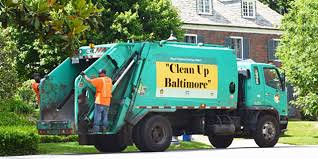
Baltimore city garbage sanitation truck with environmental messageTrash trucks as billboards.  One opportunity to message on litter and illegal dumping is on the sides of trash trucks.  Few municipalities seem to do this.  Baltimore is an exception.

Labels: , , , , , ,

Thursday, June 07, 2018

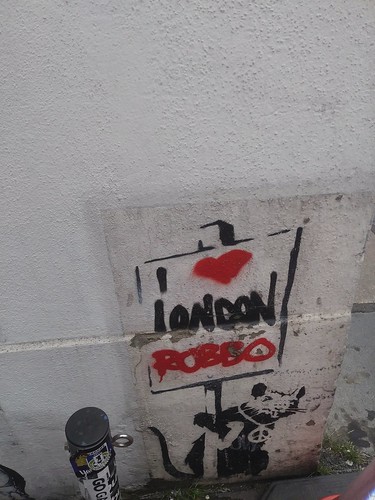
Robbo and London graffiti

King Robbo I Love London graffitum, probably in the City of London/Barbican Centre areaThe only reason I know about "King Robbo" is because there was a documentary, "Banksy vs Robbo & The Graffiti War" which ran at least once on the Ovation (arts) channel.

And I learned that Banksy's rat is somewhat derivative from a graffiti artist in Paris. I came across a Robbo graffitum somewhere (don't remember now) and shot a photo of it.

It's a good documentary.

Labels: ,

Friday, August 04, 2017

I don't see much to celebrate in the legacy of Cool Disco Dan

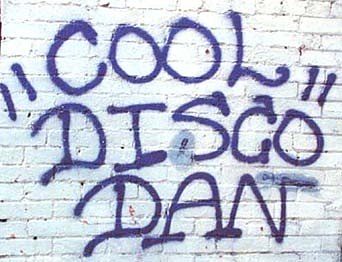
cool disco danCool Disco Dan, Danny Hogg, was a graffiti tagger in DC, very active in the 1980s, and he recently died ("'A folk hero': D.C. street art legend Cool 'Disco' Dan dies at 47," Washington Post).

There is a documentary on him, which ran recently on one of the HDTV channels of ABC7 in Washington.  In honor of his death, the Anacostia Community Museum is showing the documentary later today.
Friday 2pm- 4pm
Joe Pattisal’s 2014 documentary film, The Legend of Cool “Disco” Dan, narrated by DC native, Henry Rollins and featuring testimonials from Marion Barry, Chuck Brown, DC Scorpio, Reverend Walter Fauntroy and other influential voices from the 1980s.
As a person concerned with commercial district revitalization, I am torn about graffiti. Graffiti is seen as a detriment by many in terms of perceptions of community safety.

There is a difference between mere "tagging" and artistic expression/commentary/innovation. Graffiti tagging is different from murals and other similar kinds of public art, although I can let slide some graffiti, if put more on interstitial spaces, it is particularly creative or commentary.

If it isn't anything but a tag/name, how does it contribute to community, rather than an individualist expression that mars the built environment?

See this 2003 Post report, "2 Charged With Graffiti: Md. Men Spray-Painted in Much of D.C., Officials Say," on graffiti damage on H Street NE.

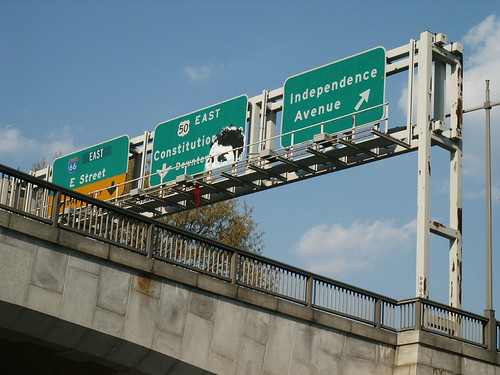
The same issue came up with "the work" of Borf, which was focused on tagging, not political expression, although there was one particular daring example of the tagging of a highway sign on Constitution Avenue ("The Mess That's Hard To Miss," 2007).

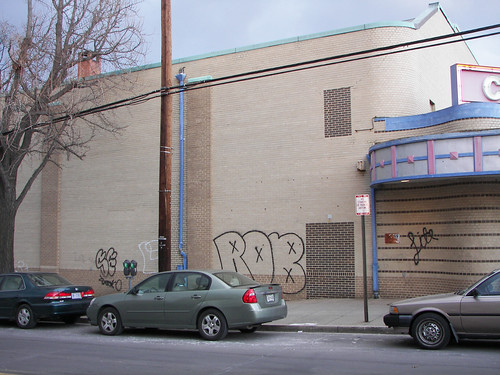
I dealt with a similar problem as a Main Street manager in Brookland in 2007, when multiple buildings were tagged similarly, including the former Newton Theater, now landmarked.

Banksy, now that's another story. cf. the documentary on the competition between "Banksy" and "Robbo," called Graffit Wars."
Emailing: banksy3gal
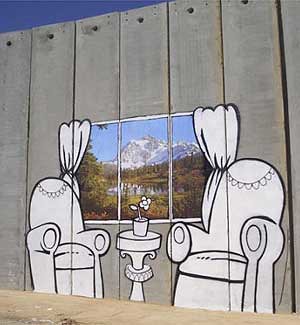
Banksy graffiti painted on the border wall demarcating the West Bank-Israel border.


In fact today there are new reports of Banksy painting again on this wall, showing President Trump's love of walls ("Trump graffiti on West Bank barrier mocks love of walls: Artwork resembles work of elusive artist Banksy; one image has US president wearing a skullcap, vowing to construct ‘a brother’ for the barrier," Times of Israel).

Or the "graffiti crews" that have migrated to large scale public art projects infused by graffiti, e.g., a neighborhood scale mural in Bogota, Colombia.

I don't see much value or anything heroic in the work of Cool Disco Dan from that perspective.

It does remind me of the narrative of "Chopper" in the A.D. 2000/Judge Dredd comic series from the early 1980s, of graffiti being a way to make a mark in an otherwise atomized society.

Labels: , , , , ,

Sunday, February 08, 2015

Surprising purposeful public art/graffiti in Georgetown

The reason this is surprising is because it is on the 3200 or 3300 block of P Street NW, in the heart of the Georgetown Historic District.  The GHD is unique in DC in that it was created by Congressional edict in 1950, 16 years before the National Historic Preservation Act was passed.  This district has a special federal standing and separate historic property review process compared to the typical DC historic district.

But the local preservation law doesn't cover "paint" choices on facades, so this might be "legal."

A similar case, but more bold and in your face, but not in a historic district or in a residential area where walking predominates, is how Chris Brown did over his garage-abutting retaining wall in Monster graffiti, which got his neighbors up in arms in Los Angeles.

But I wouldn't be disposed to paint my house in a similar manner.


No sidewalk...  Image source.

Labels: , , ,

Tuesday, September 03, 2013

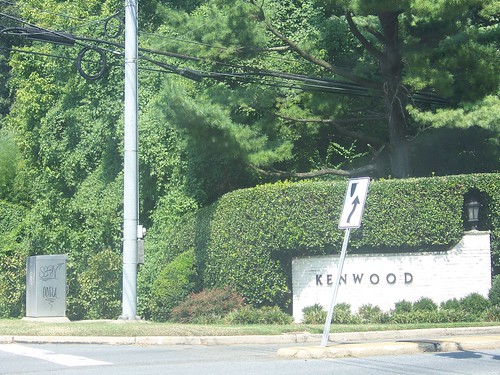
Graffiti at the entrance to the Kenwood neighborhood in Montgomery County Maryland (on River Rd.)

Graffiti at the entrance to the Kenwood neighborhood in Montgomery County Maryland (on River Rd.)

Mostly an urban phenomenon (except in declining areas), it's rare to come across graffiti in DC's northern neighbor, Montgomery County, Maryland.

Labels: , ,

Thursday, August 22, 2013

Photo query: NSA-related graffiti in DC

A government official's email on community lists is seeking reports of NSA-related political graffiti, to be able to send out crews to eradicate it. 

But I'd like to see some if people have come across it.... tell me where it is or send me images.

Thanks.

-----
P.S.  Yes, the "commercial district/urban revitalizer" in me has problems with graffiti, because it is seen as a sign of urban disorder, hurts perceptions of communities, and is especially worrysome to nonresidents, etc. 

But at the same time, I do appreciate creative graffiti and political expression.

Labels: , , , ,

Saturday, February 09, 2013

There is nothing to celebrate in the tags of Cool Disco Dan

Graffiti is a tough issue when it comes to urban revitalization. Many people see graffiti as an indicator of disorder, which makes it that much harder to rebuild and reinvest in neighborhoods, to attract visitors etc.

At the same time, there are a variety of types of graffiti.

A doughnut shop in Dupont Circle, for whatever stupid reason, wanted to pay "homage" to Cool Disco Dan in its name, but people objected, calling it a commodification of black culture.  See "Cool Disco Donut Changes Name to Zeke’s D.C. Donutz" from the Washington City Paper.

Cool "Disco" Dan tagged buildings throughout the city in the 1980s and 1990s, and I aver there was absolutely nothing artful in his "work".

I don't see how anyone can call it much different from a dog pissing on a tree, marking his territory.  The territory is marked, but nothing is added by the marking. The same goes for many other taggers, including "Koma" and "Nores", who tagged throughout DC in the early part of the last decade. See "2 Charged With Graffiti: Md. Men Spray-Painted in Much of D.C., Officials Say" from the Washington Post.)

I just don't see what there was to celebrate.  (However, Suzanne counters that with time, the work has gained meaning and achieved status among people who live in the city, even though it is incredibly simplistic, much different from the graffiti that has come afterwards stylistically, and that despite this simplicity, later taggers didn't cover it over with newer work.)

Image from Art Crimes article.

Other graffiti makes a statement, either politically or artistically.  (Suzanne calls this commentary.)

And because I appreciate discourse, protest, and art, I can see value in this.  See for example work depicted in the publication Beautiful Decay.

For example, Banksy's pieces on the West Bank wall separating Jordan and Israel are incredibly provocative.

Or even the gutsy move of Borf to tag a highway sign.  ("The Mark Of Borf" and "With Guilty Plea, Borf to Try the Art of Graffiti" from the Washington Post.)  But I am still glad he was caught and stopped.  His tags defaced so many DC buildings, at a great cost.

There is also the interesting point that many taggers are suburbanites who come into the city and deface it, because their work is visible in the city and invisible in the suburbs.

From an urban revitalization standpoint, most people don't make distinctions. Any marks are seen more like a dog pissing on a tree.
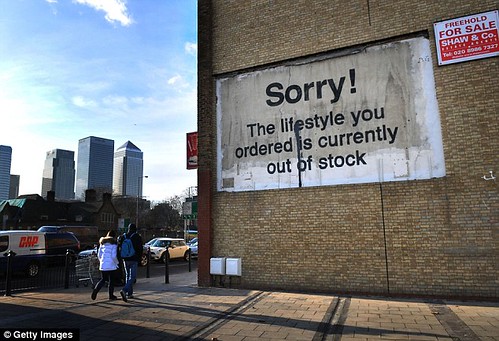
But I will concede that some graffiti artists do make us think or appreciate or consider the world in different ways.
Borf on the Bridge
This image, from Flickr by barkingmoose.  The next two images below depict work by Banksy.  First image, photographer unknown.  Second image by Getty Images.  See article from the Daily Mail.  The last image is from DC.

Emailing: banksy3gal

Sorry! The lifestyle you ordered is currently out of stock (Banksy billboard, near Canary Wharf)

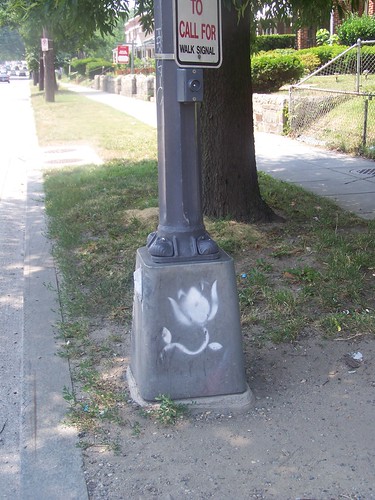
Graffiti flower on the base of a streetlight, North Capitol Street NE

Labels: , , , ,

Wednesday, July 25, 2012

Today: DPW Live, One-Hour Chat to discuss Graffiti in the District

From email by the DC Department of Public Works:

Wednesday, July 25, 2012, 12:00-1:00 pm
dpw.dc.gov/livechat

* Have you seen more instances of graffiti around the District of Columbia or in your neighborhood?

* Has your home or business ever been tagged with graffiti?


* Are you familiar with DPW's free graffiti abatement program and other initiatives to help property owners clean graffiti?


* Are you a business that gets repeatedly tagged with graffiti and looking for a way to end the cycle of vandalism?


Get answers to these questions and more by tuning into the Department of Public Works (DPW) Street and Alley Cleaning Division's live, online chat discussion on Wednesday, July 25, 2012 at 12:00 pm. During the chat session, residents also will have a chance to submit, to DPW's graffiti abatement team, the address of locations that have been spray painted with illegal graffiti. Frequently tagged businesses can also request to have their site considered for a free mural to help eliminate illegal graffiti.


To participate in the session once it has begun, place dpw.dc.gov/livechat
into the search browser or visit www.dpw.dc.gov and select the "Live Chat" icon up at the top of DPW's homepage. Transcripts of all chat sessions can be reviewed after the session by following these same instructions.

Graffiti in Brookland, January 2007 
Graffiti in Brookland, on the 1930s art deco former Newton Theater, 2007.

Labels: , ,

Tuesday, March 27, 2012

Phoenix mobile phone app for making blight reports


Related to the point in the blog entry yesterday on comprehensive policies and programs focused on abandoned properties...

From the City of Phoenix webpage:

Phoenix is the first municipality in the nation to launch a free application that allows residents with smart phones to point, click and send photos of graffiti, over-height weeds, abandoned shopping carts and other blight violations to the city's Neighborhood Services Department (NSD).

These applications also allow users to choose an option to receive updates on the status of their request.

For iPhone Users

Download the myPhxAZ application from the iPhone App store by searching for the keyword " myPhoenix " and selecting myPhxAz.
For Droid-type Phone Users

Download the application from the Droid Market by searching for the keyword "myphoenix" then clicking on My Phoenix.


Also see "Phoenix blight-report app use steady" from the Arizona Republic and this instruction sheet.

Labels: , , , , ,

Tuesday, December 13, 2011

And cool graffiti

From Dublin.

A woman walks past a wall covered in graffiti, which reads 'What This City Needs Is Hope' on a building in Dublin, Ireland.
(Peter Muhly, AFP/Getty Images / November 25, 2011.) A woman walks past a wall covered in graffiti, which reads 'What This City Needs Is Hope' on a building in Dublin, Ireland. Hammered by austerity measures a year after receiving a massive EU-IMF bailout, Ireland is hailed as a eurozone poster boy for the way it is coming to terms with the consequences of its boom to bust.

Labels:

Thursday, September 29, 2011

Marilyn Monroe statue defaced in Chicago

Image caption: A worker cleans paint off the 26-foot Marilyn Monroe statue that was vandalized early Tuesday at Pioneer Court in downtown Chicago. (José M. Osorio, Chicago Tribune)

(For the third time.) See "Vandals splash Monroe statue with red paint" from the Chicago Tribune.

Labels: , , ,

Tuesday, September 27, 2011

Local political graffiti in Toronto

Deadboy graffiti: Rob Ford, Mayor of Toronto, giving people the finger
Graffiti depiction of Mayor Rob Ford, Toronto, by Deadboy. Photo: Stephanie Findlay/Toronto Star.

Typical graffiti is mostly self-indulgent, as it is about an individual making his/her mark, but isn't a statement of much of anything outside of the individual. It can be relatively dull or quite interesting, artistically speaking. When you see political graffiti it tends to be about national or international issues, not local ones.

-- Colt 45 graffiti ad (the commodification of graffiti), Flickr photo by the depths
-- graffiti on railroad track retaining walls, Brookland Metro Station, DC

In Toronto, "Deadboy" has produced graffiti about Mayor Rob Ford and his brother Doug Ford, a Toronto City Councilman. See "Mayor Ford's antics breathes new life into Deadboy's graffiti art" from the Toronto Star.

Rob Ford, a kind of Tea Party-like Christopher Christie anti-government candidate ("there's billions of dollars of waste" in the city government), won the election and since has applied scorched earth policies and tactics along with his brother, such as the junking of the acclaimed Transit City expansion program in favor of a limited expansion of a likely to be underutilized subway extension, Doug Ford's attempt to build a shopping mall and such on the Toronto Waterfront, and proposed massive cuts to city programs.
Deadboy graffiti: Rob and Doug Ford, Toronto
Only the heads, replaced with Rob and Doug Ford, differ from the illustrations of Tweedledum and Tweedledee by British political cartoonist John Tenniel that appeared in a 1865 Lewis Carroll edition. STEPHANIE FINDLAY/TORONTO STAR.


In "Metro Hall gets graffiti-bombed," the Toronto Globe & Mail places Deadboy in the context of Toronto's new Graffiti Management Plan. From the article:

The showcase follows on the heels of Toronto’s new graffiti management plan, born from months of public consultation in the wake of a failed graffiti crackdown this winter. Passed by council in June, this radical shift in policy aims to distinguish graffiti vandalism from other forms of street art.

A staff panel and soon-to-be-established graffiti registry will help police differentiate between permitted, legally commissioned street art and vandalism. Designated “Graffiti Alleys,” located along Queen West, have been declared exempt from graffiti bylaw enforcement.

Mr. Lialias based the concept for SAS on various other city models, taking up the issue after learning that the mayor’s “War on Graffiti” in February forced business owners – many running small stores or galleries along the Queen West strip – to pay up to $10,000 for the removal of tags. Mr. Lialias teamed up with the city to consult both street artists and Business Improvement Areas, a process that culminated in the graffiti management plan.


-- Toronto's Street Art Showcase, digital projection of street art images onto a public building

Labels: , , ,

Wednesday, July 27, 2011

Quote of the day: buy a car and quit using transit

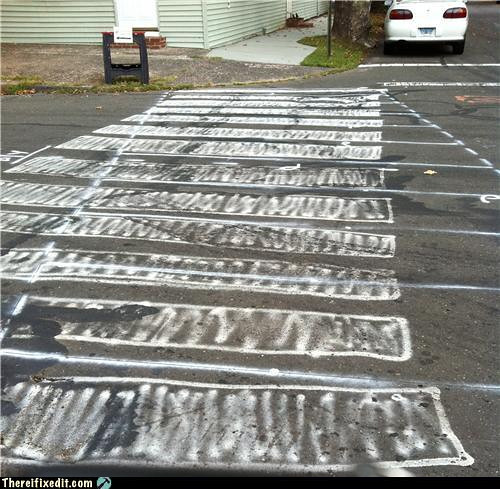
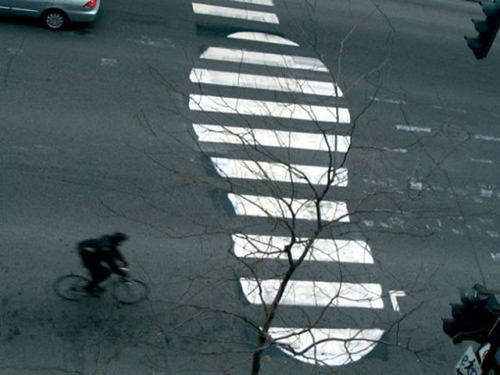
Self made crosswalk
User-generated crosswalk.

There is a thread in "progressive planning" about how the best way to deal with social inequity is to give people cars, so that they can better participate in the local economy, because increasingly lower income people live in places where jobs and other amenities are rarer. E.g., see "Auto-Mobility" from Washington Monthly.

In the CBS TV/Associated Press story about the Raquel Nelson case, "Mom gets probation in son's jaywalking death," the article ends with this paragraph:

"It's really cruel and a big waste of taxpayer money," said Sally Flocks, founder of PEDS, an Atlanta pedestrian advocacy group. "What is anybody going to learn from this? Raquel lost her precious son. The lesson she learned already is quit using transit and buy a car to get around. It's too dangerous to cross the streets here."

Her point is apt. Not unlike the idea expressed by GM car dealers in an ad in Vancouver, BC. I hope that transit and transportation agencies will look more closely at this issue--not by eliminating bus stops, but by creating more crosswalks and improved crossing environments as needed.
Creeps & weirdos GM ad against transit

roadsworth-street-art-painted-on-actual-streets30

Labels: , , ,

Saturday, May 21, 2011

A comment on the decline of newspapers?

Washington Post newspaper rack, Beautiful decay
Newspaper vending rack on Independence Avenue SW.

Labels: ,

Monday, November 08, 2010

Scenes from the Metropolitan Branch Trail

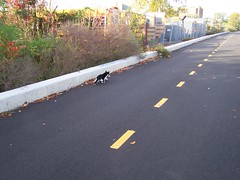
A cat walks "on the wrong side" of the trail, going north.
A cat on the Metropolitan Branch Trail, DC

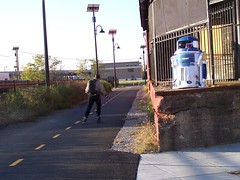
R2-D2 watches over the trail at Randolph Place.
R2D2 serves as a sentinel on the Metropolitan Branch Trail

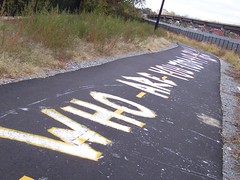
A serious amount of graffiti laid down in the vicinity of Rhode Island Avenue. (John mentioned this in a comment on Friday so I knew to look for it.) It reads "What are you today?" and there is a bunch of miscellaneous graffiti to the south of this piece, which is designed to show up from the subway tracks above.
Serious graffiti on the Metropolitan Branch Trail

Labels: , ,

Friday, July 16, 2010

How not to build support for municipal unions...

See "Hamden mayor painting the town clean (video)" and "Union files grievance on Hamden mayor's graffiti removal (video)" from the New Haven Register.

Hamden Mayor Scott Jackson paints over graffitti at on underside the Rt 15 overpass located at Wintergreen ave near Carbonella Dr. 07/12/10 VM Williams/Register

Labels: , , , ,

Wednesday, September 02, 2009

(Specific) graffiti: art or vandalism? You decide.

facade, 266-268 Carroll Ave., Takoma DC commercial district
Graffiti is visible on the west elevation of this building at 266-268 Carroll Ave., in the Takoma DC commercial district.

At least in Bristol, UK. From "Bristol Asks Public To Vote On Its Fondness For Graffiti" in the Telegraph:

Bristol City Council will put to the public vote whether murals which appear on buildings, walls and fences are street art or graffiti. As part of a formal street art policy, the council's street clean team will not take action if people decide the graffiti is nice and want to keep it.

The approach was prompted by a Banksy work which shows a naked man hanging out of a window while his lover's partner looks for him. When it first appeared on a council-owned building in the city's Frogmore Lane in 2005 it sparked debate over whether it should be removed.

The council set up an online poll and said that 93% of people wanted to keep it.

Now they are extending the public vote to any other street art that appears across the city.

Is garffiti art?
Sign at Bristol Museum for Banksy's exhibition 'Banksy Versus Bristol Museum' Photo: Publishers Association.

Labels: , , , , ,

Tuesday, February 24, 2009

Murals, public art, art expression, arts as economic stimulus

(Image of The Wall, Falls Road, Belfast by flickr photographer bk86a.)

Many murals done as public art projects aren't very good. And you're stuck with them for many years. Plus they have to be maintained.

A legitimate complaint of artists is that public art projects focused more on what I call "community building" and engaging un- or under-trained "artists" can produce average projects and cheapen the perception of artists as people who work, get paid to work, and have skills.

This image from Belfast shows us you can have provocative murals as public art.

The Boston Globe has had a bunch of coverage of Shepherd Fairey, because there is an exhibition of his work at the Boston Institute of Contemporary Art, as well as the fact that he was arrested before a scheduled event he was to participate in at the said museum.

There has been back and forth in the letters to the editor about Fairey's work as expression and art vs. vandalism. This is the conundrum I have at times with graffiti.

The reason that I do like Fairey's work is as a letter writer says "The greatest impact that this guy has is that he is indeed, like the best of street artists, making people think, talk, and argue. He's a catalyst for change." (Patsy Munden, Savannah, Georgia)

I guess typical neighborhood-oriented mural projects can be catalysts at the neighborhood level, even if the impact remains extremely localized.

See "Street Smart" and "A Long Tradition of Bending Images," from the Globe.

These questions are also relevant to national discussions on whether or not the nation "needs an arts czar" (see "Thanks, but we don't need an arts czar" from the Boston Globe and "Arts czar position has merit" from the Louisville Courier-Journal) or whether or not the National Endowment of the Arts and arts generally is a worthy conduit for stimulus money (see "Arts organizations may try for a share of the stimulus package" from the Winston-Salem Journal).

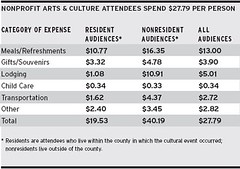
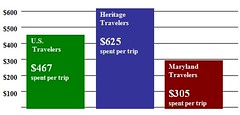
The funny thing about arts and tourism is that they do in fact have significant economic impact. The sad thing is that the average legislator, either at the national or local level, doesn't seem to be too clued into "what makes money" and "what costs money," as well as what are called the direct and indirect economic impact of expenditures.

Spending* by attendees of arts and cultural events

Audience spending by patrons of the arts and culture, table
Graphic on economic impact of arts event "consumers" from the Economic Imact studies conducted by the Americans for the Arts. * Additional spending beyond the initial cost of admission.

Economic impact of travelers, and cultural heritage travelers

Economic impact of tourism nationally and in Maryland
Tourism data from the Travel Industry Association and the Maryland Office of Tourism Development. (Sorry, this graphic was produced for a Maryland planning study I am working on, so it doesn't have comparative data for Virginia and DC.) Graphic produced by Christopher Taylor Edwards.

Labels: , , , , , , ,