Rebuilding Place in the Urban Space

"A community’s physical form, rather than its land uses, is its most intrinsic and enduring characteristic." [Katz, EPA] This blog focuses on place and placemaking and all that makes it work--historic preservation, urban design, transportation, asset-based community development, arts & cultural development, commercial district revitalization, tourism & destination development, and quality of life advocacy--along with doses of civic engagement and good governance watchdogging.

Tuesday, December 30, 2025

Local initiative in Huntsville, Alabama aims to improve security by banning problem customers across 18 bars

One of the first issues I got involved in in DC had to do with the overconcentration of liquor stores in my downtrodden neighborhood.  Such is linked to increased crime and community problems ("The Association between Density of Alcohol Establishments and Violent Crime within Urban Neighborhoods," Alcohol, Clinical and Experimental Research).  

I had learned about Seattle creating special zones to limit the sales of single bottles of beer, as an attempt to limit those problems ("Seattle may extend alcohol-sale limits to much larger area," "City tries to curb liquor sales," Seattle Times).  In 2003, the Washington Post published a story on those efforts ("Neighbors fight beer sales") and I got my picture in the paper (albeit on a slow news day)..

I wasn't against the sale of alcohol in managed situations (restaurants and taverns) unlike my neighbors, who couldn't see the difference in effect of on premise consumption of alcohol versus off premise consumption ("Restaurants and liquor licenses--How much is too much on H Street?," blog, 2005).

But the fact is, with establishments that are more alcohol-forward than food forward, with entertainment, music, dancing, etc., drinking can fuel violence.  I advocated for better security plans, and places did have them.

From "Bar Brawls," University of Toronto Magazine.

But one big problem is the focus not on sequestering and having the police deal with perpetrators, the plan is "to move them outside, off the premises, where it is no longer our problem."

All that does is displace the problem, it moves it from inside the club to outside, and the problem continues.  The media is full of articles about such problems all around the country, culminating in shootings and sometimes, deaths.

A consortium of clubs in Huntsville is dealing with this proactively, by maintaining a list of problem customers/people who have been banned, sharing the list across their 18-member group, and not permitting them to enter the premises to begin with ("North Huntsville bars band together to blacklist troublemakers across 18 venues," Fox 54/Rocket City News). 

The network allows participating venues to share information about patrons who have caused problems at any location within the group. When security staff scan a customer's identification at the entrance, the system immediately alerts them if that person has been banned from another business in the network, showing the duration of the ban, the reason for it, and which establishment issued it.

... Jabar Westbrook, owner of Goodtimez Billiards and other north Huntsville businesses, said the system addresses a common problem where troublemakers simply move from one venue to another after being ejected.

"Sometimes it's the same people going from place to place causing trouble, and so we're just trying to create consistency where no matter what, those people who are troublemakers can't just go somewhere else," Westbrook said.

This program makes a lot of sense, allowing bars to be proactive, instead of reactive.  It expands the range of options discussed in Assaults in and Around Bars, 2nd Edition (Center for Problem Oriented Policing, Arizona State University).

Labels: , , , ,

Thursday, February 01, 2024

Proof of Broken Windows theory in Philadelphia and New York City

Broken Windows theory ("Broken Windows: The Police and Neighborhood Safety," Atlantic Magazine, 1982) posits that communities where there are vacant buildings, litter, abandoned cars etc. communicate that it's okay to commit crime.  Unfortunately, there are few examples of its implementation, as police departments did mostly "zero tolerance policing" calling it community policing.  

New York City did data-based policing, but still not community investment, and it was very successful in reducing the crime rate.  But as crime dropped police needed stuff to do, and Giuliani was more of a hard ass, so they moved to Zero Tolerance Policing--stop and frisk.

And so there is a huge contingent of progressives and academics who argue that Broken Windows is b.s.

Broken windows successfully implemented on the NYC Subway in the early 1990s. One of the only places Broken Windows was implemented truly was the NYC Subway system under David Gunn, and transit police chief William Bratton.  

It's discussed in Bratton's second autobiography, The Profession: A Memoir of Community, Race, and the Arc of Policing in America ("Bill Bratton Explains His Ideas of Good Policing," New York Times).

During his interview for chief, Gunn took him around the system.  Gunn said we can fix the trains, eliminate graffiti on them (which is why miscreants now use acid to etch cars and windows), and run them on time, but if people have to experience chaos in the stations, they won't ride.

Broken windows theory in action.  An op-ed in the Philadelphia Inquirer, "Home repairs decrease gun violence in Philadelphia," references research done at University of Pennsylvania and Columbia University that found investing in fixing up abandoned properties led to significant neighborhood improvements including a marked reduction in gun violence.

From the article:

One study of Philadelphia’s Basic Systems Repair Program found that when even one home on a block received repairs, there was a 21.9% decrease in homicide rates. And the more home repairs a block received, the more homicide rates fell. The data reflect what we already know: When people’s basic need for a safe, stable home is met, it decreases violence in our neighborhoods. 

But that message isn’t getting through to our local government. As we talked to close to 200 Grays Ferry residents, the stories poured in. Many residents have applied for home repair programs — for plumbing, roofing, weatherization, insulation, and other renovations — but haven’t heard back, have been denied, or have had to wait many years. Philly residents need home repairs, and we know home repairs are a key part of reducing violence, so why isn’t our city making them more accessible? It is literally lifesaving work to keep longtime Black residents in their homes ... 

Our Council member, Kenyatta Johnson, is now also Council president, and he has enormous power to protect affordable housing in his district and beyond. We need him to work with community advocates to pass citywide policies that prioritize low-income housing and opt the 2nd District into the mixed-income neighborhood overlay, which would require housing developers to ensure 20% of their units are affordable. 

 -- "Fighting blight by fixing up homes could bring down Philly gun violence, new study shows," WHYY/NPR
-- "Abandoned house repairs reduced nearby gun violenceAbandoned house repairs reduced nearby gun violence," Penn Today (2023)
-- "Urban Blight Remediation as a Cost-Beneficial Solution to Firearm Violence: A Citywide Cluster Randomized Trial," Journal of the American Medical Association (2022)
-- "Urban Blight Remediation as a Cost-Beneficial Solution to Firearm Violence," American Journal of Public Health (2016)

==== 

Past blog entries include:

-- "George Kelling, co-creator of the "Broken WIndows" thesis, dies" (2019)
-- "The state of "broken windows" versus "problem oriented policing" strategies in 2016: Part 1, theory and practice," 2016 (references the speech by Ronald Clarke upon receiving the Stockholm Prize in Criminology)
-- "The state of "broken windows" versus "problem oriented policing" strategies in 2016: Part 2, what to do"
-- "Night-time safety: rethinking lighting in the context of a walking community," 2014
-- Crime prevention through environmental design and repeated burglaries at the Naylor Gardens apartment complex," 2013

Social urbanism is a related concept to Broken Windows, first introduced in Medillín, Columbia, which during the program experienced a 90% drop in the number of murders.

-- "Experiments in Social Urbanism"
-- "'Social urbanism' experiment breathes new life into Colombia's Medellin Toronto Globe & Mail
-- "Medellín's 'social urbanism' a model for city transformation," Mail & Guardian
-- "Medellín slum gets giant outdoor escalator," Telegraph
-- "Medellín, Colombia offers an unlikely model for urban renaissance," Toronto Star

I've written about ways to implement it in the US.

-- "Social urbanism and equity planning as a way to address crime, violence, and persistent poverty: (not in) DC" (2021)
-- "Creating 'community safety partnership neighborhood management programs as a management and mitigation strategy for public nuisances: Part 3 (like homeless shelters)" (2020)

Labels: , , , , , , , , ,

Tuesday, May 09, 2023

DC Public Safety Summit, Wednesday May 10th, 9am

I'm the first to say I don't know how to reduce violent crime other than ensuring police time is spent in the areas with the most crime, and that crimes involving gun possession be prosecuted diligently.

Recently, DC Police Chief Robert Contee said that the average person arrested for homicide in the city has been arrested 11 times before.  Similarly, homicide victims have a high rate of involvement with the criminal justice system.  It's pretty clear that a small number of people are responsible for a lot of crime.

Charlie has called our attention to the DC Crime Facts e-letter, and the site provides a lot of analysis about crime in the city.

DCCF has also alerted us to a "public safety summit" tomorrow, convened by Mayor Bowser, and bringing a lot of public officials to the table, with citizens invited.

Wednesday, May 10 at 9:00 a.m. 
District Emergency Operations Center 1015 Half Street SE, 10th Floor

Officials Attending:

Mayor Muriel Bowser 
Brooke Pinto, Ward 2 Councilmember, Chair, Committee on the Judiciary and Public Safety 
Lindsey Appiah, Acting Deputy Mayor for Public Safety and Justice 
Robert J. Contee, III, Chief of Police, Metropolitan Police Department  
Matthew Graves, United States Attorney for the District of Columbia 
Brian Schwalb, Attorney General for the District of Columbia 
Anita Josey-Herring, Chief Judge, DC Superior Court 
Linda Harllee Harper, Executive Director, DC Offices of Neighborhood Safety and Engagement and Gun Violence Prevention 
Kristy Love, Executive Director, Criminal Justice Coordinating Council  

It will be broadcast live on the city's cable television channel.

DCCF has a post, "Questions for Mayor Bowser's Public Safety Summit," providing lots of questions to be asked of the public officials.  It's pretty focused and trenchant and worth a read.  

He points out that arrests are down in the most dangerous parts of the city, and that areas of high crime have 300% to 400% more crime and incidents than "safe areas," but safe areas are overstaffed relative to crime.

What about a real Citizen Summit on Crime?  I doubt that much will come of the summit, as it was announced the day before, and there is no posted agenda.  But it also reminds me of something that Mayor Anthony Williams did two or three years running.  They were called Citizen Summits and were designed, theoretically, to get citizen insights into city policy and budget.

They got more publicity, including in the planning press, than they deserved.  I was critical that they were mostly window dressing, but I did attend one, and if they were organized to engage people in substantive ways, they could be very effective.

I would have an agenda, provide "education time" so people can be exposed to best practice insights,  featuring well known academics and other professionals, and go from there.

Academic insight.  Patrick Sharkey has written Uneasy Peace: The Great Crime Decline, the Renewal of City Life, and the Next War on Violence,  about the pre-covid crime drop and attributed a fair amount of it to citizen participation in community efforts to reduce crime.  

Alex Vitale takes a different tack, focused on overpolicing and criminalization of social issues in End of Policing.  It's provocative and worth reading, although maybe not relevant to the murder and gun problems.

-- "The opportunity to rearticulate public safety delivery keeps being presented: Rochester New York" (2021)

There is the broken windows approach.  

-- "Broken windows/collective efficacy: Baltimore; Newark; Grand Junction, Colorado; Pittsburgh; Albany" (2019)

A lot of academics criticize it, but I think they are missing the point.  BW never really got implemented, instead it was transmogrified into "zero tolerance policing" not community policing and improvement.

-- "George Kelling, co-creator of the "Broken WIndows" thesis, dies" (2019)
-- "The state of "broken windows" versus "problem oriented policing" strategies in 2016: Part 1, theory and practice," 2016
-- "The state of "broken windows" versus "problem oriented policing" strategies in 2016: Part 2, what to do"
-- "Night-time safety: rethinking lighting in the context of a walking community," 2014
-- Crime prevention through environmental design and repeated burglaries at the Naylor Gardens apartment complex," 2013

Herman Goldstein (deceased), wrote a lot about "problem-oriented policing."

And there is a lot of work on "violence interruption."  I go back and forth about it, but there is some potential there.

But basically there needs to be a place-based approach to the most dangerous areas in the city, something I wrote about in terms of equity planning and social urbanism.  

-- "Social urbanism and equity planning as a way to address crime, violence, and persistent poverty: (not in) DC" (2021)
-- "Creating 'community safety partnership neighborhood management programs as a management and mitigation strategy for public nuisances: Part 3 (like homeless shelters)" (2020)

I think that Mayor Bowser has bobbled the issue for years. And I don't see things changing.

Note that William Bratton's latest book is very good ("Bill Bratton Explains His Ideas of Good Policing," New York Times).

Labels: , , , , , , , , ,

Friday, March 31, 2023

I can't think of a worse idea: nonprofit suggests building homeless shelter in San Diego's Balboa Park

Art map.

San Diego's Balboa Park is a 1200 acre culture and parks complex, including 17 museums, the San Diego Zoo, and a variety of public gardens.  Built to host the 1915–16 Panama–California Exposition, later it hosted the 1935–36 California Pacific International Exposition.

With the rise in homelessness, spurred both by a rise in the cost of housing and the pandemic, public camping has increased significantly, and public parks and trails are often used as encampment sites, creating significant problems for many communities, which lack the financial and other resources to build the amount of housing and programs required to fully address the problem.

Posting on the Nextdoor community information system.

Here in Salt Lake City homeless camping in public parks has been a huge problem--at Liberty Park, a bit lesser problem at Fairmont Park. And is a problem at other city parks as well.

I was surprised to see that the Lucky Duck Foundation and separately a City Council member have suggested building tent shelters at Balboa Park, each capable of housing 500 people ("Balboa Park groups oppose proposed homeless shelter, saying it would be a violation of city, state rules," San Diego Union Tribune).

San Diego City Councilmember Stephen Whitburn has suggested the Inspiration Point parking lot in Balboa Park could serve as a possible site for a large, safe campground or other homeless services. His proposal has the support of Mayor Todd Gloria, but has not yet had a hearing before the full council.

The philanthropic Lucky Duck Foundation also has suggested the eight-acre lot at Interstate 5 and Park Boulevard as a site for large tented shelters that could accommodate about 500 people.

In planning I talk about its purpose being "designing conflict out" instead of designing a program that from the outset creates ongoing conflict.  

While I know that dealing with homelessness and shelters is more a management and program issue ("Creating 'community safety partnership neighborhood management programs as a management and mitigation strategy for public nuisances"), I can't think of something worse than putting a homeless shelter in a major park.  Unless there is a major set of programs and services for the patrons, which would limit their hanging out in the park.

Labels: , , , , , , , , ,

Thursday, August 27, 2020

Creating 'community safety partnership neighborhood management programs as a management and mitigation strategy for public nuisances: Part 3 (like homeless shelters)

A couple weeks ago, there were two separate articles ("SLC park has become 'nightmare' with dangerous crime, neighbors say" and "SLC businesses fed up with crime near homeless resource center," Fox13-TV) about the negative impacts on neighborhoods and commercial districts adjacent to new facilities serving Salt Lake County's homeless population.

There's a lot of break ins, assaults, and various other crimes.

It got me thinking.

Why not accompany "noxious uses" like homeless shelters with a "Community Safety Partnership" to provide extra safety and nuisance abatement services to the areas likely to be impacted by the placement?

This idea extends the discussion in the current series on creating more focused neighborhood stabilization initiatives.

-- "The need for a "national" neighborhood stabilization program comparable to the Main Street program for commercial districts: Part I (Overall)"
-- "To be successful, local neighborhood stabilization programs need a packaged set of robust remedies: Part 2"
-- "Creating 'community safety partnership neighborhood management programs as a management and mitigation strategy for public nuisance programs: Part 3 (like homeless shelters)"
-- "A case in Gloucester, Massachusetts as an illustration of the need for systematic neighborhood monitoring and stabilization initiatives: Part 4 (the Curcuru Family)"
-- "Local neighborhood stabilization programs: Part 5 | Adding energy conservation programs, with the PUSH Buffalo Green Development Zone as a model," 2021
 
Public safety versus policing.  In the post-George Floyd environment, there's been a lot of discussion about the difference between policing and public safety, calls to "defund the police," and renewed interest in alternative approaches, such as that discussed in the book by Alex Vitale, The End of Policing, where he makes the point that many social problems where we deploy police would be better addressed through alternatives to police officers.

And there has been attention brought to the CAHOOTS program in Eugene and Springfield, Oregon, which uses a team of social workers and other emergency personnel, but not police, as first responders originally to mental health-related issues ("'CAHOOTS': How Social Workers And Police Share Responsibilities In Eugene, Oregon," NPR) but which has been expanded to include:
"homelessness, intoxication, disorientation, substance abuse and ... dispute resolution. Non-emergency medical care, first aid, and transportation to services is also provided."
From "SLC park has become 'nightmare' with dangerous crime, neighbors say":
The community park was bustling... for all the wrong reasons, if you ask the people who live next to it.  "Lots of homelessness, lots of drug use, and lots of drug dealing," said Matt Engle, who can see the park from his home.

He and another neighbor explained they frequently see drug deals, and drug overdoses. They'll find needles next to human feces. The trash bins were overflowing on Wednesday, with more garbage littering the ground. ...

Part of the reason they think Jefferson Park has become a hot spot for criminal activity, is the location within the Ballpark area. It sits in between the two new homeless resource centers, which each opened within the last year.
The second SLC article is about similar and worse problems experienced by businesses located near one of the new homeless shelters, including assaults, drug use, prostitution, break ins, and outdoor defecation. 

WRT both situations, the city does have action teams that work with communities impacted by homeless shelters.  But the response or the way that the program is set up to work appears to be inadequate.

Salt Lake's homeless facilities used to be concentrated in the Rio Grande district Downtown, and they got out of hand in terms of drug dealing and violence.  In response, the city, county, State, and other stakeholders came together and created a program to relocate the facilities, to make them smaller and to not put them all in one place, not unlike how DC has distributed homeless family facilities around the city.

Like my criticisms of the DC response the program may have been built on some flawed decisions resulting from incorrect assessment of the issues.  They built three facilities, but reduced overall capacity, so that the problem of homeless people living on the street persists.  The facilities were full soon after they opened, before winter even set in, and Salt Lake City had to create an emergency shelter.

The plans reduced capacity on the assumption they could reduce homelessness with new service programs, but as I say the problem of homelessness is more like a river than a lake--the population isn't fixed and continually grows depending on social and economic conditions, just as a river isn't a still body of water, whereas lakes are more contained bodies of water.

In any case, creating substantive reduction in need on such a short time line was overly ambitious and likely to fail (which it did).

(Jeremy Harmon | The Salt Lake Tribune) Josh Valdez talks about his experience camping in Salt Lake City during the COVID-19 pandemic on Thursday, Aug. 13, 2020.

And while the deconcentration has removed most of the problems that had existed in the Rio Grande area, in some respects they've merely been displaced, both in other areas of downtown, which has a lot of homeless camping and congregating and to the areas around the new shelters.

In part this is abetted by how the pandemic has led to the closure of public facilities like libraries ("Have Salt Lake City homeless encampments gotten out of control again?" and "Business, public building closures leave Salt Lake City’s homeless with few places to use restrooms," Salt Lake Tribune).

Social service programs and resident opposition to their placement.  Over the decades there's been tons of media coverage of homeless shelters ("Homeless shelter opponents are using this environmental law in bid to block new housing," Los Angeles Times) and drug rehabilitation clinics ("Many residents oppose proposed Monument methadone clinic," Colorado Springs Gazette) as nuisances, among others.

Residents complain about the deleterious impacts on their neighborhoods, because of misbehavior and criminal activity by some of the clients of these facilities.

From "‘Not-in-my-backyard’ arguments ramp up against proposed Center for Health & Housing," Springfield State Journal-Register.  Photo: Ted Schurter.

The response to opposition is attempts at  shaming, that the residents are nimbys and unwilling to bear some of the burden associated with dealing with social problems ("Is Shame The Antidote To NIMBYism In The Washington Region?," WAMU/NPR).

The reality is that not all nimbyism is the same.

Even if most don't, some uses do generate extranormal negative effects. And typically, programs aren't set up to deal with these known and likely effects. Which generates even more nimbyism going forward.

Usually plans to address the known spillover nuisances from potentially noxious uses aren't required.  In the vein of "public safety" vs. policing, I think the problem is both simpler and more complicated.  The issue isn't an unwillingness of residents to bear the burden (although some will remain opposed in any instance), but simultaneously mitigating the potential for problems that arise with the placement of such uses.

It should be no different from taverns, nightclubs (Best Safety Practices for Nightlife Establishments, City of West Hollywood; "Nightclub and Bar Security: Bouncers, Doormen and Security Guards | You Are Security! " LPT Security Consultants), gas stations ("Creating a Safer Gas Station for Your Customers and Employees, Ovation Insurance) and convenience stores ("Are You Doing Enough to Secure Your Stores?," Convenience Store News) creating security plans, knowing that these types of uses (and others) are known to have a higher propensity for criminal activity.

-- Center for Problem-Oriented Policing, Arizona State University
-- "Tampa Bay Times investigation on the cost of emergency services associated with Walmart stores," 2016

My experience living around the corner from the Peirce Shelter in DC: itinerant service vs. structure and management.  The descriptions by SLC residents and business owners reminded me of my DC experience, when I lived on the same block as a big emergency shelter in the H Street neighborhood.  Emergency shelters provide a bed at night and breakfast, but then they kick people out during the day.  With nowhere to go, no place to store their belongings, etc., people tend to loiter, and often conduct and handle their life business out in the street, and there are crimes associated with  daytime activities.

The shelter was a scourge on the neighborhood, contributing to poor quality of life.  Just like in the Rio Grande area of Salt Lake City.

BUT THEN, it was converted from an emergency shelter to a facility as part of a three-phase system of addiction care and rehabilitation.  Instead of kicking people out every day, they stayed in, working on their program requirements.

Basically, the served population went from unmanaged to managed, and this had a massive positive impact on quality of life in the neighborhood at large.  Except for occasional ambulances at the shelter, and weekend car washes held there to raise funds for the clients, you wouldn't have known that they were there.

My lesson from this is that the problem with shelters is lack of management and throwing people out onto the streets during the day.

Plus not providing any programs and services aiming at interdicting and addressing the problems that come up during the day in the surrounding neighborhood as a result of putting people out early in the morning.

A "community safety partnership" approach to mitigating problems from homeless shelters and related uses.  As standard practice, why not accompany "noxious uses" like homeless shelters with a "Community Safety Partnership" to provide extra safety and nuisance abatement services to the areas likely to be impacted by the placement?  This idea extends the discussion in the two previous pieces on creating more focused neighborhood stabilization initiatives.


Community safety partnership =
police + neighborhood support workers + mental health personnel + social workers + other services


31.Before.WTPM.WDC.21September2019BID maintenance worker/ambassador, Downtown DC BID.

Besides how business improvement districts have cleaning programs and "ambassadors" to monitor public space and some even have social workers on staff to deal with homeless issues, other models to draw upon are the Los Angeles Community Safety Partnership ("After Years Of Violence, L.A.'s Watts Sees Crime Subside," NPR and "What Does It Take to Stop Crips and Bloods From Killing Each Other," New York Times), the "neighborhood warden" approach in England and Wales (Neighbourhood wardens: the activity pattern in one English city and Neighbourhood wardens: a review of international experience, LSE), and the CAHOOTS program, which is non-police-based crisis response for non-emergency calls.

From "Meet the neighbourhood wardens who are the 'eyes and ears' of Gedling's streets," Nottinghamshire Post. Photo by Joseph Raymor.

In The End of Policing's chapter on dealing with homelessness, Professor Vitale discusses the need for drop in centers alongside emergency shelter, with caseworkers, mental health services, counseling, practical amenities like mail drops, health care, food, and clothing.  

These types of services need to be part of a Community Safety Partnership program.  I know that some of these kinds of services are being provided as part of the new homeless service model in Salt Lake County, but I don't know about the depth or breadth of the program.

The programs mentioned are Bread & Jams in Cambridge, Massachusetts, which sadly is defunct  because of changes in homeless policy for services and redirection of funds ("Pantry’s Closure Will Leave Void in Harvard Square Daytime Homeless Services," Harvard Crimson), and Mission Neighborhood Resource Center in San Francisco.  B&J provided help with housing and job search, benefits advocacy, health care and policy advocacy.  MNRC provides showers, services, and outreach teams that work without police.


(In this piece, "One potential solution to the problem of "finding work" for homeless adults," I suggest creating supported job programs for homeless adults.)

Jared Arvanitas, manager for the Downtown Alliance's ambassador program, checks to see if Emil Miller and his dog, Tehya, need anything outside City Creek Center in Salt Lake City.  Photo: Streets Plus.
The goal of the Downtown Ambassador Program is to create an even more welcoming and safe city center for residents and visitors, as well as providing additional outreach efforts for people experiencing homelessness, said Steve Hillard, president of Streets Plus, a national company that specializes in providing ambassador services in several major cities. 

 "We hire licensed social service workers to serve as ambassadors, so on the street, we engage those in need, we do case management, refer them to appropriate services and talk to them every day," he said. 

"It's a very 'down to earth' networking (approach) to build relationships with (people in need) so that when the time comes and they're ready to make a move to get a meal, get clothing or get a job, in-patient services or housing, we're there to facilitate that process." 

Hillard said the program is geared toward "inclusivity" where people in the community feel a part of trying to make the downtown area welcoming to everyone. He noted that in Chicago, the program drew thousands of referrals and helped get 57 people off the streets and into a better living environments in its first year of operation. 

"We're talking jobs, in-patient services, treatment, housing and thousands of referrals for food, clothing and medical services," Hillard said. "We expect that we can do the same thing here in Salt Lake."
Neighborhood wardens are an initiative created by the Blair Government in the UK.  Basically, along the lines of the two previous posts on creating focused neighborhood improvement and stabilization initiatives in weak market neighborhoods, but in response to conditions created by conversion to private management of large housing estates in English cities.

Neighborhood wardens are what we might call quality of life managers, assigned to cover a particular area or "patch."  They address low level nuisances (litter, dumping, graffiti, etc.) and certain matters of "anti-social behavior").  "Their duties vary, but can include patrolling, cleaning and maintaining public areas, organising youth programmes, and liaising with police."
Top objectives of neighborhood warden schemes in the UK
In a paper on the program, the authors define four approaches, including "patrollers" and "neighborhood support workers."  Wardens don't have police powers, they usually wear uniforms, and in some situations, they are authorized to write tickets and fine notices for certain types of infractions.

32.ConnecticutAvenue.NW.WDC.10November2013
Bike-based ambassador/patroller in DC's Golden Triangle BID.

Los Angeles Community Safety Partnership. Spurred by the Advancement Project advocacy organization (The LAPD Community Safety Partnership: an experiment in policing, USC masters thesis), in 2011, the Housing Authority of the City of Los Angeles and the police department implemented a community-engaged policing strategy in four public housing communities in the Watts neighborhood: Nickerson Gardens; Imperial Courts; Jordan Downs; and Ramona Gardens.

The Watts neighborhood has the greatest concentration of public housing in the city and each development had been marked by deep-rooted gang problems, drug sales, and rampant crime.

The point of the CSP was to try something different from brute force policing--which had been the agency's primary method before--focusing on rebuilding the relationship of the police department with the community, because ultimately the safest communities police themselves.

Repositioning the relationship between the community and the police department and their role in public safety comes in part through youth participation on the football and track teams and how this reconstructs relationships between police officers, children, and their families.

While the CSP doesn't focus on arresting people, police officers will do so depending on the circumstances. In the three years previous to the launch of CSP, there were an average of 23 murders per year in the designated area. 

For two years after the program started, there were no murders. In the third year, there were two murders, but the perpetrators were quickly apprehended within days due in large part to information provided by the community.

Earlier this year the program was expanded2019 Program Assessment ("LAPD community policing program has prevented crime and made residents feel safer, study finds," Los Angeles Times).

Create Community Safety Partnerships/Neighborhood Stabilization Program for areas with homeless shelters, drug rehabilitation clinics, and other potentially noxious but legal and necessary uses.

Community safety partnership =
police + neighborhood support workers + mental health personnel + social workers + other services


Places where homeless shelters and similar kinds of uses are situated, like the Ballpark District and other areas in Salt Lake County, should be accompanied by the creation and operation of focused and ongoing neighborhood stabilization initiatives that are a combination carrot and stick, to foster order maintenance, to reduce problems typically associated with such facilities.

The inclusion of policing can be a necessary element, when serious crimes (assault, break ins, etc.) are part of the mix.  As Megan McArdle writes in a recent column ("Videos of Portland protesters show a complicated relationship with police and policing"):
“At some point,” says Peter Moskos of New York’s John Jay College of Criminal Justice, “society needs to accept that there is an element of repression — social control — in policing. At some point there are people who need to be policed.”
From "Judge rejects challenge to Venice homeless shelter," Los Angeles Times.  Photo: Mel Melcon.

(And yes, overconcentration of service facilities in particular areas can be a legitimate issue.)

Appointed and elected officials need to recognize that some concerns expressed by opponents to shelters and similar kinds of uses can be legitimate.

The point shouldn't be to shut down and shame people when they raise such issues.  It should be to address them.  Community Safety Partnerships are the way to respond proactively.

Salt Lake City as a great candidate for launching an Elm Street neighborhood stabilization initiative.  Note that based on other reporting ("Four homicides in one year have Ballpark neighbors calling for action" and "New study shows Glendale and Rose Park hit hardest by COVID-19," Salt Lake Tribune) Salt Lake City would probably be a good candidate for adoption of the "Elm Street" neighborhood stabilization model I outlined in the first two parts of this article series.  For deployment in multiple neighborhoods.

Conclusion: Create a Community Safety Partnership for Salt Lake City's Ballpark District. And the Ballpark neighborhood ought to be a top priority for the creation of a Community Safety Partnership type program.

Labels: , , , , , , , , ,

Monday, May 18, 2020

Different policy proscriptions are required depending on the economic strength of the local market: Community Revitalization/Historic Preservation

Pre-pandemic, DC was a strong real estate market, at least from about 2003, not before. But during the strong market period, actions it would take with regard to "nuisance properties" would likely get the property back online. One such tactic is the 4x tax surcharge on vacant properties.

But I remember a former Washington City Paper writer suggesting that such a surcharge would be great for Flint, Michigan.

 I said no, Flint has thousands of vacant properties, so a surcharge would merely lead to the demolition of such properties. And a vacant lot is no better, in fact, even worse to deal with in a weak real estate market, but because new construction won't appraise for a mortgage, given the state of pricing.

When DC was in a more weak state, a "condemnation order," which is an order to cure a nuisance property, would often result in the building being torn down. That's because either the property owner didn't have the money to fix it or because it didn't seem as if the increased costs would be paid off in terms of higher value.  Perversely too, by removing the building, the property tax would go down significantly.

Depending on the neighborhood, these days, the same property would be worth upwards of $1 million.

Frame Italianate rowhouse, 800 block of 10th Street NE, Washington, DC
800 block of 10th Street NE

For example, the vacant lot to the right of this building had been occupied by a frame rowhouse practically identical to the one still standing. But a condemnation order led to its being demolished. 

This was around 2002-
2003. But by 2005 definitely, the real estate market in this neighborhood had turned the corner.

The house still standing is valued at about $700,000 for tax purposes, and in 2018 the vacant lot sold for over $400,000.

But the property is still vacant today, and it is going on 20 years.

Had the property been improved and sold and lived in by a couple people paying property, income, and sales taxes, and hopefully patronizing local businesses and even contributing to community improvement, the city would have been far better off.

I have to believe that having a different process, focused on keeping the existing property intact, but fixing it up, would have been the better choice.

There is an article in the Richmond Times-Dispatch, "'I almost started crying when I saw it': A historic house tied to the Underground Railroad was demolished in Petersburg" about the demolition of a property on Pocahontas Island in Petersburg, Virginia. The city issued an order to condemn the building.

From the article:
Twitty recently received notice from the city’s code compliance department to repair or demolish the deteriorated structure.
Photo: Daniel Sangjib Min, RTD. 

“The owner took the demolition route,” Sangregorio said.

Twitty had rejected offers to sell the property, including from members of Stewart’s family and Preservation Virginia, whose CEO, Elizabeth Kostelny, called the loss of the house “tragic and completely unnecessary.”

“Many groups and individuals had shown great interest in helping to save and rehabilitate the structure,” she said.
Google Street View image of 215 Witten Street, Petersburg, Virginia.

Instead of fixing it up, the owner tore it down.

And given that May is National Historic Preservation Month, this is particularly noteworthy because the house "was old" and folklore connected it to the Underground Railroad story.

In any case, a vacant lot, in a weak market, is likely to remain vacant for decades.

But the city could have gotten a different result with different processes. The policy goal for such a house and such a neighborhood should be  conservation of existing buildings, not just for reasons of history and/or historic preservation, but because the likelihood of new construction happening is remote.

Instead of issuing a condemnation order or allowing for a house to be demolished, the process could have involved receivership ("Receivership as a strategy for notorious nuisance properties," 2017) where a third party is able to step in and fix it, and even eminent domain to force the sale of the property in a situation where the property owner is unwilling to maintain the property in a manner that maintains the health, safety, and value of the community.

In the Ohio receivership program, the entity that cures the nuisance can be awarded the property through a separate legal process.

Labels: , , , , , ,

Thursday, March 15, 2018

Revisiting stories: executive vs. legislative and the four vacant houses in Anacostia

Curbed DC reports ("Four vacant, government-owned Anacostia homes transfer to historic preservation group: The L’Enfant Trust has completed the transfer of four properties in the Southeast neighborhood") that DC has transferred four dilapidated but historic properties to the L'Enfant Trust for subsequent rehabilitation.

This was discussed in the past, because it was subject of a "battle" between the Legislative Branch and the Executive Branch.  The Executive Branch which controlled the houses wasn't doing much, and aggrieved citizens got the Legislative Branch to pass a law giving control of the properties to a local nonprofit that has been rehabilitating houses.

I wrote about it in this 2017 entry, "Three examples of L'etat c'est moi/Not invented here/Executive authority (in DC local government)."

What's more interesting than what I wrote is the comment thread. 

First, an anonymous commenter made the very good point that generally getting the Council involved in such matters can lead to serious corruption and had in the past (although that's true of the Executive Branch as well).

My point was that the Executive Branch needed to act.  That there was no reason to let the houses moulder and that if they couldn't act, then the Legislative Branch was right to step in and move things along.

That being said the process is an example of the failures in how the city does capital budgeting planning and management.

Second, was the other discussion in the thread about technocracy, execution, democracy, vision, etc. in local government. It's no less relevant one year later.

For example, David Brooks, columnist for the New York Times, has a piece about successful school reform, "Good Leaders Make Good Schools."

He blows it by mentioning DC as a positive example, in the face of local reporting on systematic failures in terms of test cheating, passing and graduating students who don't attend school, claiming 100% of graduating classes will be going to college when about 17% actually did, failure to respond to non-DC residents enrolling in DC public schools, etc.

The reality is that making successful change for hard to help populations is very hard.

Rather than acknowledge that from the outset and put the right resources in place to aim to accomplish it, instead the focus was on test scores and even graduation rates, which are easier to game.

It's another failure to execute that seemingly has little consequence.

Labels: , , , , , ,

Tuesday, April 25, 2017

Three examples of L'etat c'est moi/Not invented here/Executive authority (in DC local government)

1.  Legality of chickens.  Over the weekend there was a story, "Do you raise chickens in D. C.? Their days may be numbered," in the Washington Post about how successfully bested the city in a lawsuit concerning the legality of chickens, not via building regulations and zoning, but the definition of animals within the city's public health laws.

Even though the city talks a good game about urban agriculture, it hasn't moved forward legalizing poultry, although many other (more) innovative cities and counties have already done so, such as Seattle and Salt Lake City (""An update on Block Supported (Poultry) Agriculture").

The original proposal for allowing poultry in some of the discussions in the Zoning Rewrite were so strict that they likely eliminated eligibility from more than 98% of DC residential properties. (50 feet setback from each lot line--meaning a property would have to be about 110 feet wide and maybe the same distance in length.) That being said having some limitations is reasonable, but DC has never proposed reasonable limitations.

Rather than taking the opportunity to correct lack of vision, Mayor Bowser has put language in the FY2018 Budget legislation explicitly and directly changing the definitions in the public health law to ban the practice.

There is a petition organized by the successful plaintiffs, aiming to influence City Council to extract that language from the budget bill.

-- DC City Council: Lay off the hens; support backyard chickens in DC

1220 Maple View Place SE is one of the properties in question.  Photo: L'Enfant Trust.

2.  There has been coverage of the battle between the Executive Branch and the Legislative Branch over how to deal with four nuisance/disinvested properties in the Anacostia neighborhood ("Four Anacostia houses are at heart of an affordable housing struggle," Washington Business Journal; "DHCD Refuses to Comment on Derelict D.C.-Owned Anacostia Houses," Washington City Paper).  The properties have continued to decline and languish while under the control of the city's Department of Housing and Community.

Neighborhood residents convinced the City Council to transfer the properties to the housing rehabilitation program of the nonprofit L'Enfant Trust, which has restored a couple of houses in the neighborhood.

Instead of going along with the legislation, the Executive Branch has ignored the law passed transferring the properties, and separately is marketing the properties for sale.

3.  The nonprofit National Mall Coalition has been floating a concept for a number of years to build a parking structure/stormwater capture facility under the National Mall.  The revenue from parking would pay for the facility.  Granted the National Park Service, which controls the land, isn't too keen on the idea. But the NMC has offered to pay $100,000 for a feasibility study by the Army Corps of Engineers, which is willing to do the preliminary study.  But the request, even if paid for by a nonprofit or private sector initiative, has to come from a local government.

DC's Executive Branch is not willing to put forth such a request, so NMC is trying to get City Council to pass legislation authorizing the study.

I have some reservations, not about the initiative, but about there needing to be more "visitor management planning" wrapped around the proposal ("A National Mall-focused heritage (replica) streetcar service to serve visitors is a way bigger idea than a parking garage under the Mall").  To their credit, NMC added my recommendation of a visitors center to their original concept.

The National Archives McGowan Auditorium was flooded during a stormwater overflow event in 2006, costing millions of dollars in damage.

Still, what's "the harm" in a study, especially because it is in response to stormwater-related floods that caused millions of dollars of damage in 2006 ("With National Treasures At Risk, D.C. Fights Against Flooding," NPR) and maintaining the economic viability of the central business district ought to be a key element of the city's economic development and risk management policies.

====
What each of these examples share is that the initiative for action did not come from the Executive Branch, which seems to believe that only it knows what's best for the rest of us.

It's not a good way to behave or model behavior and it is definitely counter to language in Mayor Bowser's inauguration speech:
I will encourage creativity, risk-taking and innovation. It is my pledge to take sometimes the road less protected, to see jobs and opportunities when others see only the costs, and to praise my staff when they get it right and be the one to tell you if we get it wrong.

Now you know this, I’m not a “pie in the sky” politician. I believe in making both bold and pragmatic plans and executing them every day. At the end of every day, week or quarter—our team will have to show results. Not just during election season, but for the four full years.

Labels: , , , , , , ,

Friday, February 17, 2017

DC DPW Mural program, call for participation

I happened to be in the Anacostia neighborhood yesterday, and saw a Murals DC production on the side of a building near the Metrorail station.

The murals were renditions of old DC concert posters and I thought they came across very well.

From a DC Government email:
The DC Department of Public Works has a program called MuralsDC, a graffiti prevention project. DPW is now accepting applications from commercial property owners who are interested in receiving a free mural to replace or prevent a wall vandalized with graffiti. This program has been very effective for those owners dealing with repeat taggings. 
The information to apply for a mural is contained in the flier below. Please forward this to any business owners you may know of who would be interested. If there are any businesses within your ward that have been vandalized with graffiti, please encourage them to apply.

=====
Photo: Lloyd Wolf Photography.

This MuralsDC production is on the side of the Deanwood Post Office.

Labels: , ,

The answer is: Receivership

The question is posed by the headline of this Washington City Paper article, "What Can Elected Officials Do About D.C. Slumlords?" From the article:
“It’s frustrating because we have incredibly strong tenant protections, and yet negligent landlords still find a way to persist,” [Councilmember] Nadeau says. “That’s one of the biggest challenges that we face.”
I wrote about this earlier in the month (See "Receivership as a strategy for notorious nuisance properties"), in response to a City Paper cover story on a slumlord, making the same point:
Receivership.
In that article, Mari commented (which I seem to have missed), writing:
Why they aren't being seized... might be because of what happens the day after the property is seized.

DC government is a lousy landowner. When DC Gov takes a property it will sit vacant for years..... YEARS. DC Gov also doesn't appear interested in being a landlord. To hand if off to a non-profit seems interesting, but what non-profit out there that presently exists that is a real non-profit and not a "non-profit" that only exists to get contracts from municipalities? 
Taking a property would make an impact, but it would also use up a lot of resources.
This is my response:
I missed this comment. You are of course, absolutely right.

In my early writings, I joked that DC's primary property management strategy is "demolition by neglect." And that in an objective evaluation, using criteria of the Housing Courts in Ohio, DCG wouldn't be deemed a credible and eligible receiver, based on past practice.

That's why starting from the very beginning, I've argued that DCG shouldn't be the receiver, but capable nonprofits.

In Ohio, such activities are monitored by the Housing Court, so a receiver has to act, implement the plan to cure the nuisance, or they lose control of the property too. And receivers that fail don't get properties awarded to them in the future.  [added -- Failure is not rewarded, unlike the current process.]

I can't claim to know all the ins and outs of the various nonprofits in DC, but one that I observe to be very credible is Jubilee Housing. An organization like that could become a receiver.   (There are some good for profit property managers. They could act as receivers too.)

In Cleveland, it was the Cleveland Restoration Society (but because the job was so difficult, they got out of it for awhile). They were motivated to save historic properties from demolition.

And recently I wrote about a "nonprofit" business in Philadelphia set up to cure nuisances and make them habitable, usable properties that strengthen the neighborhood. (I can't claim to like their design choices but they do good work otherwise.) See "A great example of the market at work: making a business in restoring blighted properties/curing nuisances (Philadelphia)."

Labels: , , , , , ,

Sunday, February 05, 2017

Receivership as a strategy for notorious nuisance properties

The Washington City Paper has an important cover story this week, "Life Is Hell for Tenants of Giant D.C. Slumlord Sanford Capital," about the systematic abuse of tenants by a residential property owner that seems to specialize in poorly maintained properties catering to the extremely impoverished.  The company has been sued off and on over the years.

Washington City Paper photo by Darrow Montgomery.

For as long as I've written this blog, I've mentioned how some states and cities have very strong receivership statutes, which allow for the seizure of properties, in order to "cure" nuisances and correct behavior. Ohio has a particularly strong statute.

-- Ohio Revised Code; Title 37: Health-Safety-Morals; Chapter 3767, Nuisances; Section 3767.41

 Pennsylvania too ("Pennsylvania passes receivership law with regard to vacant/nuisance properties," 2010). Also see "When tax lien sales further, not staunch, disinvestment: Indianapolis," 2015.

Note that DC Government's management of properties is not such a great track record that they ought to be the manager of such properties. In my writings, I've suggested this authority be given to nonprofits, as is the case in Ohio. To win receivership, a management and action plan must be created and approved by the Housing Court. To clear title of liens and to be awarded the property, the nuisances have to be successfully cured.

Why Sanford Capital's properties aren't being seized is beyond me. (Other than the fact that the city doesn't want to have to have too contentious a relationship with commercial property owners.)

Having such a statute and process in DC would go a long way towards correcting the negative actions of companies like Sanford Capital.

Taking the property will have a lot bigger impact than paying a legal judgement, which is tax deductible.

Labels: , , , , , ,

Monday, January 09, 2017

A great example of the market at work: making a business in restoring blighted properties/curing nuisances (Philadelphia)

Many times I have written about how the State of Ohio has a strong receivership statute which allows nonprofits to take over properties that are "notorious" nuisances, "cure" the nuisance, and get awarded ownership of the property, which they subsequently sell.

The Cleveland Restoration Society has acted under that statute to fix properties and preserve their historic character, and then to sell them to property owners committed to maintaining the property ("Housing receivership to cure nuisance properties").

Pennsylvania has a similar law, called Act 135 ("Pennsylvania passes receivership law").  In Philadelphia, two people have created a business of curing nuisances and fixing properties on behalf of nonprofits ("These guys are Philadelphia's professional Blightbusters," Philadelphia Inquirer).

From the article
Operating under the more-corporate-sounding Scioli Turco Inc., they have mastered the ins and outs of an obscure state law called Act 135 that enables nonprofits to take control of blighted properties, fix them up, and sell them ("Philly nonprofit finds way to reverse blighted properties," Philadelphia City Paper). The owner gets the proceeds, minus the cost of repairs and Scioli Turco’s expenses.

It sounds almost too easy, yet Scioli Turco’s successes with Act 135 promise an alternative to the usual, slow-moving approach to attacking Philadelphia’s blight problem.

Scioli Turco is the brainchild of two Bella Vista activists, Joel Palmer, a retired pharmaceutical salesman, and Jeffrey Goldman, a database analyst. Frustrated by a long-vacant VFW post in their neighborhood, they asked the courts in 2011 to appoint them as the building’s conservators under the Act 135 rules.

Using their own money and loans, they put in $100,000 to stabilize the building. After selling it for almost three times that amount, Palmer said, they realized “the process was scalable” and decided to form a nonprofit to pursue other eyesores. ...

Since then, Scioli Turco has rescued 50 problem properties, not just in Bella Vista, but around the city.
Seems like a pretty creative and proactive method for revitalizing neighborhoods and addressing persistent problems.

-- Implementation and Best Practices Manual, Pennsylvania’s Abandoned and Blighted Property Conservatorship Act, Regional Housing Legal Services
-- Using Conservatorship to Reclaim Properties: Case Studies

Labels: , , , ,

Thursday, August 18, 2016

Reclaiming Vacant Properties Conference, 2016, September 28th - 30th, Baltimore, Maryland

The Center for Community Progress, which focuses on assisting communities in dealing with property abandonment in the face of weak real estate markets and broken economies, sponsors a national conference on the topic each year.

Next month, the 2016 conference will be held in Baltimore, Maryland.

Early bird registration rates are available through the end of August, which saves $200 over the cost of a regular registration.

-- Reclaiming Vacant Properties Conference (RVP) 2016
=======
When I first heard about the organization, based on actions in Genessee County and Flint Michigan ("The Man Who Owns Flint," Governing magazine and "Not just Flint: Philadelphia wrestles with vacant property, tax cheats, Flint Journal) I was somewhat horrified, because the national press seized on their work as an example of widespread demolition being "the only solution" for inner city neighborhoods when the reality is much more nuanced.

Once a building is demolished, it's gone.

The west side of the 800 block of 10th Street NE in the H Street neighborhood of Washington, DC had been frame houses.  Most were demolished in favor of a community development corporation ersatz brick rowhouse project constructed about 15 years ago.  

Next to the still standing Italianate frame rowhouse was a similar building, which the city condemned sometime around 2002, and the building was demolished.  Had it been renovated, today it would be worth close to $1 million.  Instead, there has been a vacant lot for almost 15 years.  Google Street View image.

Some neighborhoods are capable of recovery, even if over long periods of time. And demolition doesn't cure the real problem, which is disinvestment. Instead it creates a different problem, vacant land.

In 2002, I learned about how the State of Ohio has a strong receivership statute, which allows for nonprofits to take over vacant properties, and when properly "cured" (fixed up), they can be awarded the property and it can be resold. The Cleveland Restoration Society did this a lot to help to stabilize neighborhoods, fixing up historic properties and then selling them to people committed to living in the property going forward. This has helped to stabilize neighborhoods that otherwise would have declined in the face of the region's population shrinkage.

Alan Mallach's book Bringing Buildings Back is an excellent primer on neighborhood stabilization through focused attention on vacant properties.

-- "Bringing buildings back is really about bringing neighborhoods back" (2006)

In DC, for a number of years I testified in favor of creating a similar statute here -- because most properties in DC neighborhoods are capable of being restored as the real estate market even 15 years ago was comparatively strong -- but the City Council never seemed too interested. Instead, the City Government is the prime actor in dealing with vacant properties, and for various reasons it isn't particularly successful.

-- "Slumlording isn't always so simple" (2014)
-- "Pushing rehabilitation of vacant buildings/nuisance properties" (2012)
-- ""Why I hate DC" or the appropriate tactical strategy to apply to nuisance properties/ disinvestment is investment, not demolition" (2009)

Fortunately, the Center for Community Progress promotes nuanced responses to the vacant property problem, even if that isn't always communicated in media coverage.

Labels: , , ,

Friday, December 04, 2015

When tax lien sales further, not staunch, disinvestment: Indianapolis

DC has had issues with its program of selling tax liens.  Today's DC real estate market, very strong overall, is much different than it was more than 15 years ago, when the DC Government began an aggressive program for selling property tax liens.

The idea behind the program was to get languishing properties into productive use, by selling the lien, and the lien owner being motivated to get the tax debt paid with interest by the property owner, when if not paid, the lien owner gets the property and most likely then sells it, which eventually leads to it being reoccupied.

But many of the liens involved people who could no longer take care of themselves well, and people lost properties over tax debts as little as $150 ("Left with nothing" and "Jonetta Rose Barras: What lies beneath D.C.'s tax-lien abuses," Washington Post; "Meet the Man Behind D.C.'s Predatory Tax Lien Practices," Washington City Paper).  This problem is slowly being rectified in DC.

Although I will say that activists attempted to raise these issues at the time, but their remonstrations were ignored.

Land banks.  In weak real estate markets, acquisition of properties through tax liens and the creation of land banks has been a strategy to deal with disinvestment and abandonment (I don't like to use the word "blight" because blight is a condition that results from disinvestment).

Dan Kildee, at the time county treasurer in Genessee County, Michigan, which is centered around Flint--which has been devastated as a result of the decline of General Motors and the shutdown of multiple automobile manufacturing plants that had been based in and around the city, developed an aggressive tax lien and land banking initiative that became a national model ("Ten years of fighting blight: Genesee County Land Bank," Flint Journal).

Later, Kildee created the Center for Community Progress as an organization to foster the concept and to provide training and technical assistance to communities in similar situations.

My concern at the time when Flint and Dan Kildee got a lot of national media coverage, was that attention failed to make the distinction between "strong" and "weak" real estate markets, and there was an almost blanket support for demolition as the primary strategy ("Genesee County Land Bank says it has demolished 1,800 houses since 2013," Flint Journal.  In potentially strong markets, it's far better to save and rehabilitate properties.
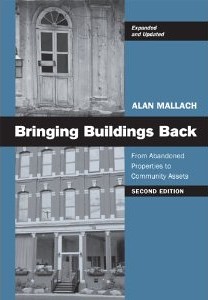
Bringing Buildings Back by Alan Mallach
It's not enough to acquire property, the trick is building demand so properties can be rehabilitated and occupied.
Wayne County Michigan, where Detroit is located, has been similarly aggressive in land banking. But the problem in weak markets is not necessarily acquiring or assembling properties, it's lack of demand to either buy, renovate, and reoccupy properties, or to build new buildings on now vacant land.

This is why I say "demolition" of properties isn't a solution.  A nuisance property may be demolished, but the problem isn't eliminated.  Instead, a new problem, a vacant lot, has been created. And often it is harder to develop a vacant property than it is to fix a disinvested property.

The book Bringing Buildings Back is a good resource for addressing the problem, as are focused neighborhood improvement programs like Baltimore's Healthy Neighborhoods Initiative, and Baltimore's resident recruitment initiative, Live Baltimore.

Historic Macon Foundation has been particularly adept at focusing historic preservation housing rehabilitation in neighborhoods in the city's core.  One of their initiatives worked with Mercer University, which wanted to help improve the neighborhoods abutting their campus.

HMF argues that their approach has moved from focusing on individual exemplary houses to preserving and improving entire neighborhoods. It's a shift in perspective that still (sadly) is noteworthy and exceptional.

-- Neighborhood Revitalization presentation, Historic Macon Foundation

Over time, some states have developed similar initiatives based on the Main Street commercial district revitalization approach, but applied to neighborhoods.  In Pennsylvania, they called it the Elm Street program.

But these programs tend to wane over time, partly because it takes many many years to develop demand and "fix" languishing communities, and because as political administrations change, so do their priorities, and programs such as these are often seen as being Administration-specific rather than "good programs" that need need to be supported over long periods of time.

This residence, at 1517 N Kealing Ave., is owned by Mt. Helix, the worst code violator in the city of Indianapolis. (Photo: Robert Scheer / The Star)

Indianapolis and tax liens.  Starting in mid-November, the Indianapolis Star published a number of articles about problems with the tax lien system there.

Unlike the system in DC, which from the standpoint of getting properties reoccupied, has worked, because DC is a strong real estate market with greater demand for housing than there is supply, in weak markets, the tax lien process can make the situation worse, not better.

The series kicked off with "Blight Inc.: How Our Government Helps Investors Profit From Neighborhood Decay." From the article:
Indianapolis is pockmarked with 6,800 abandoned homes that stunt property values, attract crime and destabilize neighborhoods. But one of the primary causes is mostly hidden. And it is, in large part, enabled by our own government.

An Indianapolis Star investigation has found that, increasingly, the empty house next door is not owned by a bank or an individual, but by one of many investors, often from out of state, who are enticed by the prospects of cheap homes that can be purchased — sight unseen and in bulk — at government tax sales. ...

The Star found that oftentimes these companies don’t make the needed improvements or even maintain their homes. Many of the houses languish neglected and empty for years. Some for as long as a decade. And the system makes it easy for investors to walk away without paying their taxes. In some instances, homes go to tax sale again, and again, and again.

... The Star’s examination of eight years of tax sale data showed investors walked away from more than 6,000 properties and stiffed Marion County for at least $28 million in uncollected taxes. Meanwhile, our government spends millions every year cleaning up trashed properties, issuing code violations, subsidizing redevelopment and responding to emergency calls to unsecured empty homes.
Because there is a "national system" for investing in tax liens ("Tax sales support get-rich-quick cottage industry"), which the Indianapolis Star describes as having been created during the Depression, national actors tend to be better equipped to acquire the liens.

As a result, area residents and organizations who would normally be motivated to take over properties to fix them and to get them reoccupied to help stabilize and improve neighborhoods, rather than profiting from it, are outbid by the national firms ("When neighbors wage war on blight: 'It;s extremely frustrating") and more often than not, because the properties are in weak market neighborhoods, tax lien properties continue to decline further ("Fires, drugs and murders haunt one company’s empty homes") because of mismanagement, failure to market the properties, or deliberate fraud.
Tax lien property in IndianapolisThis house, at 1909 Cornell Ave., has gone to tax sale four times. It is now owned by San Diego-based Mt. Helix, the company with the most abandoned homes in Indianapolis. (Photo: Robert Scheer / The Star)

As the Star points out ("Declining neighborhoods: Indy's auction block) it doesn't make sense that neighborhood decline is furthered by government action because of the way the tax lien system works, rather than being abetted by it.

This particular article is a definitive discussion of the tax lien system, and its problems.  

Receivership as an alternative. Not all land banks work out well ("Land bank, hit by scandal, holds back as blight spreads") and frankly, sometimes often alleged nonprofits can be mendacious too, as past history in DC has proven. The Indy Star series also uncovered malfeasance by nonprofits working with the tax lien companies, and failing to improve properties.

But many years ago I learned about receivership statutes in Ohio, which are another model for how to deal with nuisance properties (see "Eminent domain and receivership to "cure" habitual nuisances").

-- Preservation Services - Cleveland Restoration Society
-- Cleveland Restoration Society Saves Historic Van Sweringen Demonstration Home in Shaker Heights – now For Sale to a Preservation Buyer, press release

There, nonprofits can petition to take over a nuisance property, provided the Housing Court approves their plan for "curing" the nuisance. When they fix the property, they can then petition the Court for ownership of the property and waiver of liens. The organization then sells the property to residents committed to maintaining the property. The organization may lose money on the sale, but the neighborhood wins, because instead of a vacant property or lot, they now have a rehabilitated house with residents committed to the house and the neighborhood.

The key element of this process is that the nonprofit can't get ownership of the property until they cure the nuisance. Control is conditional on successful action. Having tight accountability mechanisms is a key difference between successful and unsuccessful programs.

But financing remains a problem. Nonprofits typically don't have a lot of money and staff, so they can do this for only a few properties at a time, and have to wait for the proceeds from the sales of properties before they can take on new projects.

Other innovative programs for neighborhood stabilization.  A few years ago I mentioned a Wall Street Journal article about a community-focused bank that had few problem residential mortgages, because they kept the loans they "originated," so they were motivated to be diligent (see "When locally/regionally owned companies make a difference over national firms").  This demonstrates the importance of community-headquartered banks, which focus on portfolio investing, making high quality to residents and businesses within their communities

Cleveland Restoration Society has developed another innovative program with the First Federal Bank in Lakewood (a suburb of Cleveland), where people can get loans from the bank to rehabilitate and occupy otherwise disinvested properties ("Cleveland Restoration Society, First Federal offer incentives to sell vacant, rundown homes," Cleveland Plain Dealer).

This program builds on another CRS loan program, called the Heritage Home Program, which has funded the improvement of over 1,000 historically designated residences.  That was funded in part by "Community Reinvestment Act" related financing tied with the City of Cleveland putting its accounts at banks agreeing to fund the program.
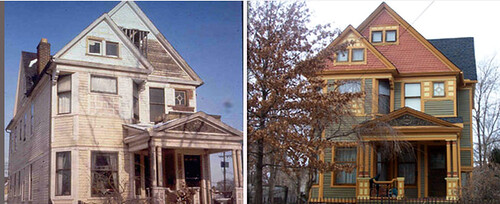
Home improvement via the Cleveland Restoration Society
>A before (left) and after of a home renovated with the help of the Cleveland Restoration Society's Home Heritage Program. CRS announced an expansion of the program Thursday. 

And unlike the firms active in Indianapolis, one company that has purchased a lot of foreclosure properties around the country, REO Homes LLC, has found it is good business to contribute to community improvement efforts in order to build the value of its own properties (see "Interesting wrinkle on neighborhood revitalization: investor fixing nearby properties to raise own property values").

Conclusion.  Property tax lien programs can be a negative, not a positive, for community stabilization and improvement, depending on the intent of the companies that are involved.  It can make more sense to create different kinds of programs that keep ownership and improvement of properties in local hands, rather than to expect non-local firms to be motivated in the same way to do a great job and focus on long term property and neighborhood stabilization.

(I can't claim to be aware of all the great programs and models that are out there.  I do know that many such programs exist and we need to raise the awareness of these programs and what works so that more communities can refocus their programs for better outcomes.)

A side note: too often the web doesn't substitute for high quality investigative reporting by local newspapers.  The Star says this is what it did to produce the series of articles:
The Star conducted more than 50 interviews with public officials, developers, residents, experts and corporate executives; and analyzed data from numerous sources, including: Eight years of Marion County property sales data; more than two years of data from Code Enforcement, police, fire and medical services; Marion County property records; and property value data maintained by the Polis Center at Indiana University-Purdue University Indianapolis.

The Star also visited Baltimore and San Diego, examined blight reduction programs in five other cities, and reviewed hundreds of pages of academic articles and case studies.
That's a lot harder than rewriting a press release and not asking any questions concerning whatever remains undisclosed.

This kind of time, depth and perseverance was once typical of newspapers focused on local reporting and improving communities, backed by the money generated by newspaper sales and advertising.  As both sources of revenue have declined precipitously, it is rare for newspapers to take on these kinds of investigations.

Newspaper chains are frequently criticized for dumbing down their papers, but perhaps more than most, the Gannett Newspaper chain has remained committed to funding investigations at many of their newspapers (e.g., earlier this year, the Sioux Falls Argus-Leader produced a nice series on the importance of focused teaching of reading skills).

The Star series definitely rises to the same level as two great Chicago Tribune series, "Squandered Heritage" on demolition of properties eligible for historic designation, and "Neighborhoods for Sale" on real estate development and aldermanic privilege .


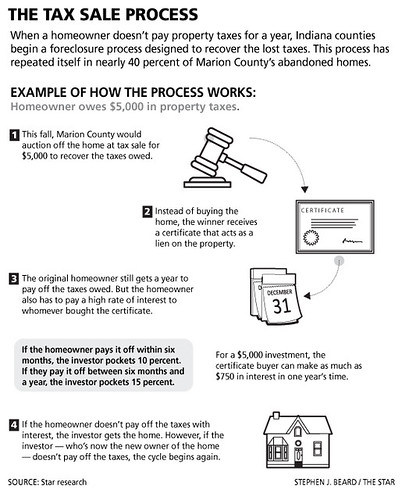
Graphic from the Indy Star series.
How tax lien process works

Labels: , , , , , , ,